The Election Commission of India on Sunday announced the schedule for Assembly elections in five regions, with West Bengal set to vote in two phases on April 23 and April 29, while Assam, Kerala and the Union Territory of Puducherry will go to the polls on April 9, and Tamil Nadu on April 23. Counting of votes for all four states and Puducherry will take place on May 4.
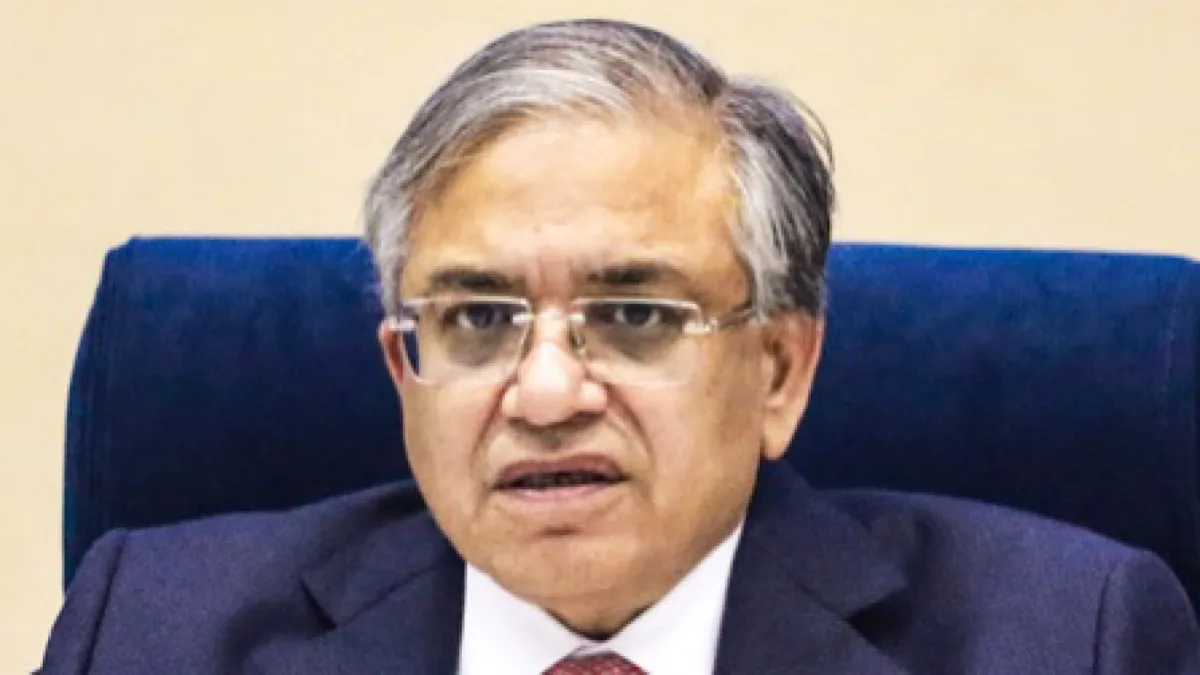
Announcing the schedule at a press conference in New Delhi, Chief Election Commissioner Gyanesh Kumar said the Commission had completed extensive consultations with state governments, administrative authorities and security agencies before finalising the poll calendar. “We are fully prepared to conduct free, fair and peaceful elections across these states and the Union Territory. All necessary arrangements have been made in consultation with state authorities and security agencies,” Kumar said.
Among the states going to the polls, West Bengal — with 294 Assembly seats — will vote in two phases. Polling for 152 constituencies will take place in the first phase on April 23, while the remaining 142 constituencies will vote in the second phase on April 29. The notification for the first phase will be issued on March 30, and the last date for filing nominations will be April 6. Scrutiny of nominations will be conducted on April 7, and candidates will be able to withdraw their candidature until April 9.
For the second phase in West Bengal, the notification will be issued on April 2, with April 9 as the last date for filing nominations. Scrutiny will take place on April 10, and the last date for withdrawal of candidature will be April 13.
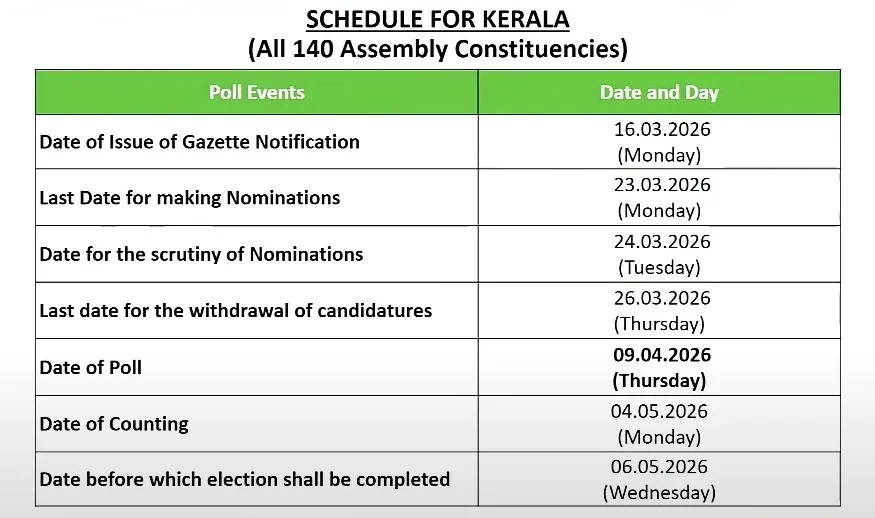
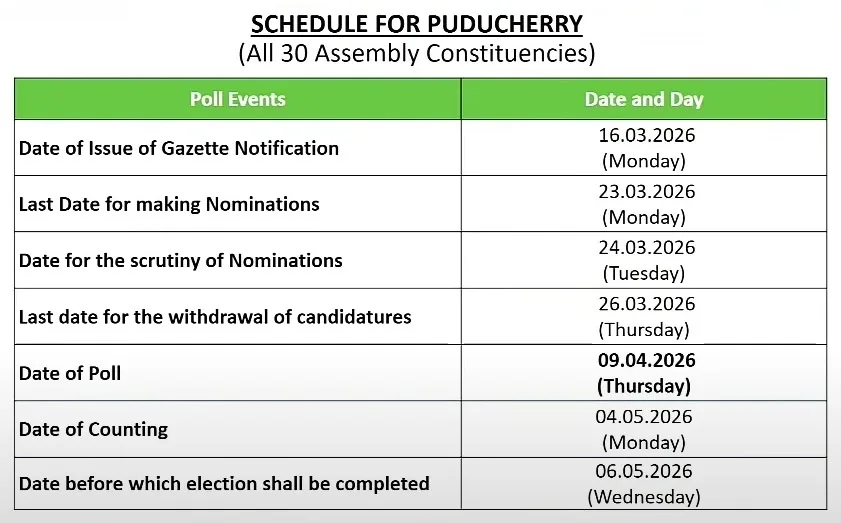
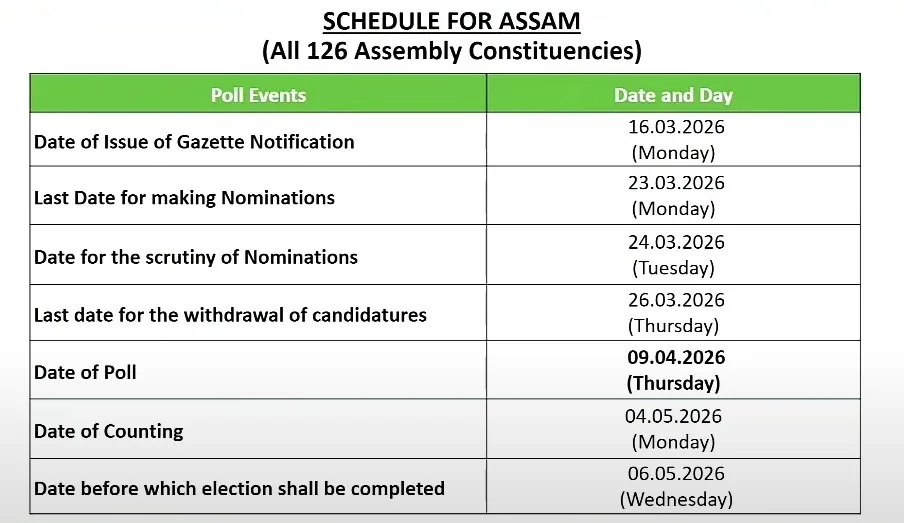
Polling in Assam, Kerala and Puducherry will be held in a single phase on April 9. In all three regions, the election process will begin with the issuance of notification on March 16. The last date for filing nominations will be March 23, scrutiny will be conducted on March 24, and the deadline for withdrawal of candidature will be March 26.
Tamil Nadu will vote on April 23. The notification for the election will be issued on March 30, while the last date for filing nominations will be April 6. Scrutiny will take place on April 7, and candidates will be able to withdraw their nominations until April 9.
Kumar said the Model Code of Conduct came into force immediately in all the poll-bound states and the Union Territory following the announcement of the election schedule. “The Model Code of Conduct is effective from this moment. We expect all political parties and candidates to adhere strictly to the guidelines to maintain the integrity of the democratic process,” he said.
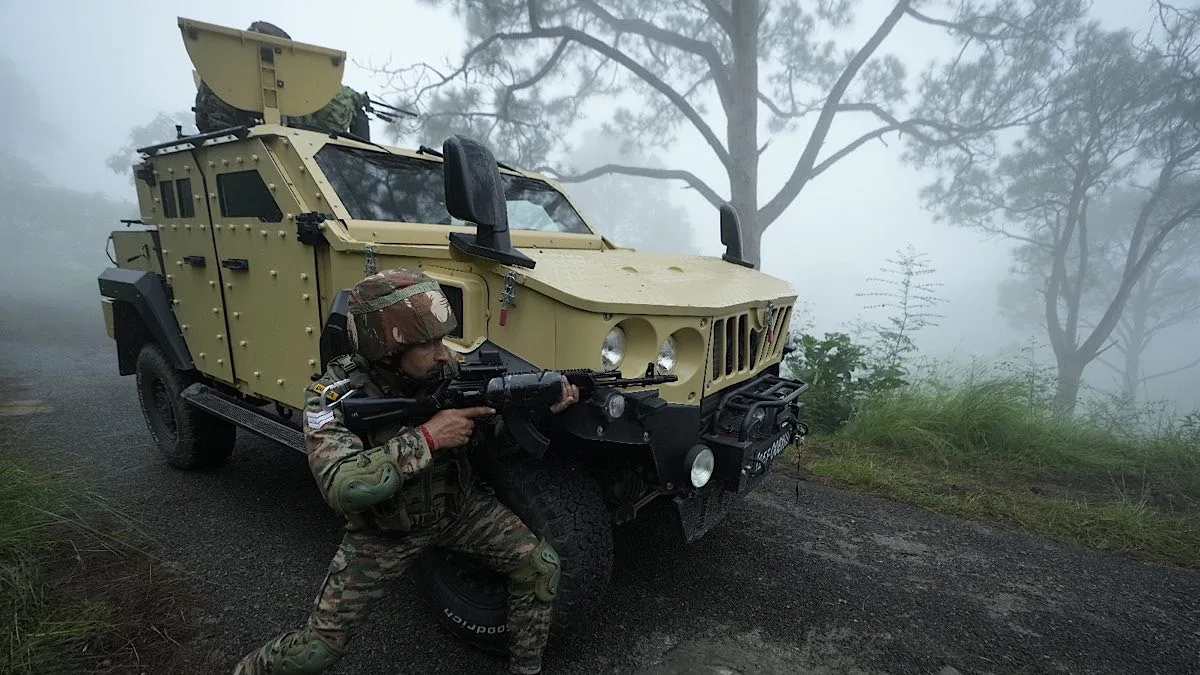
The Chief Election Commissioner said elaborate arrangements had been made to ensure peaceful polling, including the deployment of central armed police forces and enhanced monitoring of campaign expenditure. “Security arrangements have been carefully planned. Adequate deployment of central forces will be ensured wherever necessary to maintain law and order,” Kumar said.
He added that the Commission would focus on increasing voter participation, particularly among young voters and women. “Our focus is on ensuring maximum voter participation while maintaining the highest standards of electoral integrity,” he said, adding that technology-driven monitoring systems and voter facilitation measures would be widely used during the election process.
The Assembly elections are being closely watched as a significant political contest across several regions. In West Bengal, one of the key battlegrounds, Chief Minister Mamata Banerjee will be seeking another term for the All India Trinamool Congress government while facing a determined challenge from the Bharatiya Janata Party, which has expanded its organisational presence in the state in recent years.
Political observers expect a high-intensity campaign in the state, with both parties likely to deploy senior leaders and conduct extensive outreach across constituencies. The BJP has been working to consolidate its support after emerging as the principal opposition force in the previous Assembly election, while the Trinamool Congress is aiming to retain its dominance.
In Assam, the BJP will attempt to retain power in the northeastern state where it first formed a government in 2016. In Kerala, the ruling Communist Party of India (Marxist)-led Left Democratic Front is expected to face a challenge from the Congress-led United Democratic Front, continuing the state’s long-standing bipolar contest.
Tamil Nadu’s election is expected to revolve around regional parties and their alliances, which traditionally dominate the state’s political landscape. Puducherry will also witness a competitive contest among regional and national parties for control of the Union Territory’s legislative assembly.
With the schedule now announced, political parties are expected to intensify campaign activities across the five regions, setting the stage for weeks of vigorous political mobilisation ahead of the April polling dates.