Logo

South Africa targets over 1,00,000 tourists from India in 2017

PTI | Mumbai |

South Africa, southernmost tip of the African continent, is all geared up to welcome more than 1,04,000 tourists from India this year with specialised product offerings to suit people from the sub-continent.

“We have been witnessing consistent growth in tourists inflow from India. Looking at the growth trend we are expecting to host 1,04,000 Indian tourists in 2017,” South Africa Tourism in India Country Manager Hanneli Slabber told PTI here.
Indian visitor numbers to South Africa had surged by 21.7 per cent to 95,377 during 2016.

“We look forward to an exciting year. We are focused in increased our engagement with travel agents and customer outreach through outdoor media, television, digital and print. January's arrival figures are out and we welcomed about 6,300 Indian travellers and we look forward to very high numbers during the summer holiday season running from now until Mid-June,” she added.

In terms of geographic markets in India, South African tourism is planning to engage potential travellers in tier II markets through the agent-specific 'Learn South Africa' programme, which will train travel agents in 17 Indian cities during July 2017, she said.

“We are planning to train and customise specialised product offerings for travellers in these places with city-specific joint promotions with travel agents in all 17 cities. We have also published tourism related informations and product offerings in six Indian vernacular languages,” she added.

Demographically too, South African Tourism is also keen on targeting younger globe-trotters given that India has a sizable proportion of young population aged between 18-35, Slabber said.
Traditionally, young couples followed by families from the majority of the the tourists from India withing the 45 years, she said.

“Going forward, we are focused on the Meetings, Incentives, Conferences, and Events (MICE) segment and also on young solo travellers from India,” she pointed out.

With over 3,129 product offerings, and more being added, South Africa has something or other for everyone, Slabber said.

Further she said, Indians are great spenders and rank among the top five in the category.

“We find Indians love spending on experiences, food and shopping especially local handicrafts. In 2016, we saw the overall spends from India crossing 1.2 billion ZAR (South African currency) by the end of the third quarter,” she added.
India, Slabber said, is an important market for South Africa and is ranked in the eighth position among its international source markets.

“Our top source markets are the UK and US followed by Europe. India has great potential and if the growth remains consistent the country may jump the ranking in a few years time from the current eighth position,” she added. 

Housewife renders services of skilled worker: Court

PTI | New Delhi |

A housewife renders services of a skilled worker, a Delhi court has observed.

The observation was made by a Motor Accident Claims Tribunal (MACT) here while awarding the compensation of Rs 30.63 lakh to a 32-year-old homemaker who lost one of her legs in a road accident four years ago.

The woman, who was crossing a road with her six-month old son in 2013, got hit by a rashly-driven RTV and suffered 80 per cent disability while the child suffered head injury.

"A housewife renders services as a skilled workman…Since the disability suffered by the claimant (woman) is 80 per cent with regard to right lower limb, loss qua the entire body will be 40 per cent…" MACT Presiding Officer Arun Bhardwaj said.

The tribunal directed Tata AIG General Insurance Company Ltd, insurer of the offending RTV, to pay Rs 30.63 lakh to the woman and Rs 10,000 to her son for the injuries suffered by them.

"The impact of the accident was so severe that she lost her right lower limb… Compensation for pain and suffering is to be awarded keeping in mind the nature of injuries suffered by the claimant," it said.

According to the petition filed by the woman, on October 2, 2013 she was crossing the road from Ashram Road to Jaitpur Mor with her infant son when an RTV driven in a rash and negligent manner hit her.

As a result of this, she fell down with the child and both of them sustained injuries, it said.

They were taken to hospital where the woman, who suffered multiple fractures, lost her right leg leading to 80 per cent permanent disability.

During the proceedings, the driver and the owner of the vehicle did not appear in court to prove their innocence. 

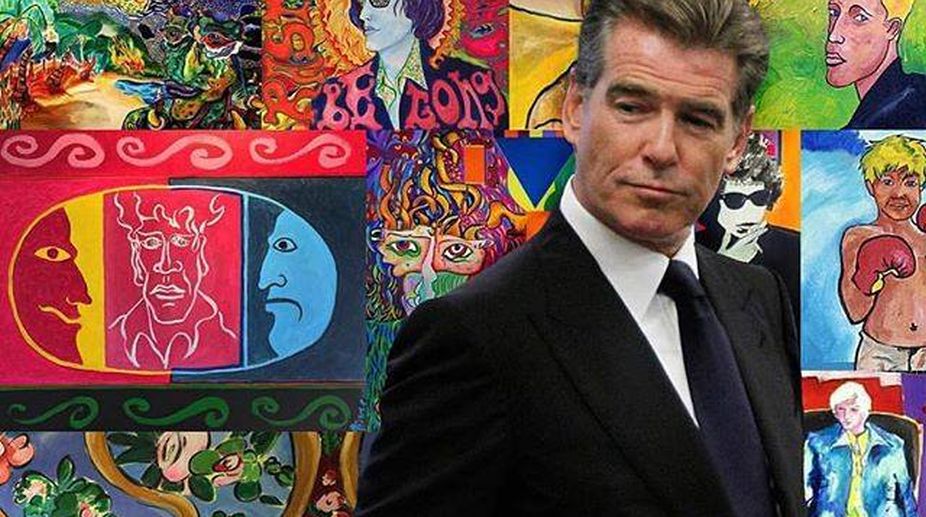
Pierce Brosnan was frustrated with his James Bond films

IANS | Los Angeles |

Hollywood star Pierce Brosnan says he was frustrated that his James Bond films wasn't "gritty and real".

The 63-year-old actor portrayed the spy in four films – Goldeneye, Tomorrow Never Dies, The World is Not Enough and Die Another Day. 

In an interview with Total Film magazine, he said that he wishes the plots weren't so outlandish, reports femalefirst.co.uk. 

He said: "There was a certain frustration within me as the films went on, as I could see the world happening around me and the movies … I wanted Bond to get a little more gritty and real and down and dirty, but however you try to nurse it along, the scripts would come along with the same outlandish scenarios."

The actor added: "So you go with the flow, and just enjoy the great experience of travelling the world and being this character. I had a great time on Die Another Day. There were things I read in the script that were so ridiculous, like the invisible car, but I just tried to act my way through it and believe in it.

"You can really give yourself a massive headache and a great amount of stress trying to wangle some sense of believability into it."

CBSE to hold Central Teacher Eligibility Test only once a year

PTI | New Delhi |

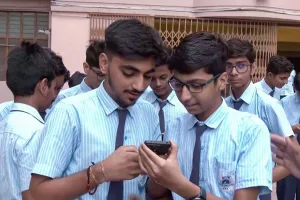
The appointment eligibility examination for class I-VIII teachers or CTET will be held just once a year instead of the current practice of conducting it twice.

The Central Board of Secondary Education (CBSE) has been conveying it to the HRD Ministry that it is overburdened with the responsibility of conducting multiple exams– including the JEE-Main and the NEET for under-graduate engineering and medical courses respectively.

The Board had recently proposed doing away with the practice of conducting the National Eligibility Test (NET), for recruitment of assistant professors, twice a year.

"When all major competitive exams are conducted once a year, why Central Teacher Eligibility Test (CTET) or NET should be conducted twice? They are massive-scale exercises which require massive resources and in a way reduce seriousness of candidates since the fear of wasting a year isn't there," a senior official told PTI.

Following consultations among officials from the CBSE, the HRD Ministry and the National Council for Teacher Education (NCTE), it has been decided that CTET should be conducted only once, the official added.

At present, the exam is conducted twice every year– February and September– and approximately nine lakh applicants appear for it annually.

It has, however, not been decided yet as to in which month the exam will be conducted now.

"The arrangement of the CBSE conducting NET and CTET is likely to continue till the proposed National Testing Service (NTS) is set up by the government for the conduct of all exams," the official said.

Proposed by the HRD Ministry, the NTS will be set up as an independent body dedicated to conducting entrance tests for higher education.

"The proposal of conducting NET once is in a very nascent stage. No decision has been reached on it yet," he added.

Leonardo DiCaprio, Nina Agdal spotted kissing

IANS | Los Angeles |

Actor Leonardo DiCaprio was spotted kissing model and his girlfriend Nina Agdal here.

They were spotted locking lips on the sides of the Hudson River in downtown Manhattan on Friday, reports people.com. 

"It was a really sweet moment," said one onlooker, adding that, "Nina put her arms around his neck and kissed him".

DiCaprio, dressed in his standard white tee and shorts, with a shirt wrapped around his waist and a newsboy cap "seemed very comfortable around her. And their affection was natural, not forced," added the onlooker. 

At one point, Agdal, dressed in short-shorts and an off-the-shoulder white crop top, brought a friend with her to join DiCaprio, who had been looking out over the water with his headphones on. 

"She was laughing loudly and very flirty with Leo," said the onlooker.

Later, a fan approached the Academy Award-winner, and the two shook hands cordially.
 

DGFT faces litmus test after digitisation, GST

PTI | New Delhi |

Foreign trade regulator DGFT is staring at the prospect of having to reinvent itself as a bulk of its current work profile is going online with digitisation and the impending rollout of the goods and services tax (GST).

The Directorate General of Foreign Trade (DGFT), under the commerce ministry, facilitates exports and administers programmes like the Merchandise Exports from India Scheme, Advance Authorisation and Export Promotion for Capital Goods.

“Our effort is to see how we shall optimise our human resources to continue supporting domestic exporters. We have to see how we use our human resources which will be freed after implementation of GST,” a senior commerce ministry official told PTI.

With the focus on digitisation, most of the activities are now being handled online like providing export-import code numbers and the like. Once the new indirect tax structure comes into effect, all the remaining work will be carried out digitally.

GST, which is set to roll out from July 1, will subsume excise, service tax and various other levies.
“A lot of work would come under the automatic system and the DGFT would not require the kind of manpower it needed in the past. We have to redeploy human resources,” the official added.

International consulting firm Frost and Sullivan has already submitted a report to the commerce ministry as part of efforts to revamp the DGFT.

Prior to 1991, the DGFT was known as the Chief Controller of Imports and Exports.

In 2016-17, India's total merchandise trade stood at about $655 billion.

With a view to raising India's share in global trade, the government continuously monitors the export performance and takes need-based measures, keeping in view financial and overall economic implications.

NITI Aayog Vice-Chairman Arvind Panagariya has recently said India needs to focus on domestic policies to step up its share of global trade to 4-5 per cent, from the current 1.7 per cent.

Donald Trump marks 100 days in office, slams media

IANS | Washington |

US President Donald Trump marked his 100th day in office in a rally in Pennsylvania, where he focused on his long-running antagonism with the news media and also touted his administration's "historic progress", a report said.

In his opening remarks at the rally in Harrisburg on Saturday evening, he mentioned the "big gathering" in Washington – the White House Correspondents' Association (WHCA) dinner, which he declined to attend and dismissed the event as "a large group of Hollywood actors and Washington media" who he said were "consoling each other in a hotel ballroom", The Washington Post reported.

"I could not possibly be more thrilled than to be more than 100 miles away from Washington's swamp, spending my evening with all of you, and with a much, much larger crowd and much better people, right?" Trump said at his event, not mentioning that he attended the dinner in 2011 while a reality television star and was repeatedly roasted by then-President Barack Obama.

In February, Trump had announced that he will not appear at the WHCA dinner this year, a break with past presidents, adding his absence from the event is for the best. 

Trump then went on to needle the media, touching on familiar themes and picking on his standard targets.

He dismissed news channels CNN and MSNBC as "fake news".

Trump decried what he again called "the totally failing New York Times", falsely claiming that the organisation was "forced to apologise" for its coverage of the 2016 election, a claim he has made before. 

He also took a shot at the daily's headquarters, which he called an "ugly office building in a crummy location".

Trump made clear that he was trying to draw a direct contrast with the news media, saying that they deserved "a very, very big fat failing grade" for their coverage, before shifting to a discussion of his administration's actions, reports The Washington Post.

Trump also vowed that he would make "a big decision" on the historic Paris climate agreement in the next two weeks. 

"I will be making a big decision on the Paris Agreement in the next two weeks. We will see what happens," Efe news quoted Trump as saying in the rally.

Meanwhile, Pennsylvania Democratic and liberal protest groups turned out for an opposition rally and march in Harrisburg on Saturday to protest Trump, who chose to host his event in the same city he referred to as "a war zone" during the campaign.

Chants included cries of "Hey hey, ho ho! Donald Trump has got to go!" and "No Trump! No KKK (Ku Klux Klan)! No fascist USA!", The Washington Post reported. 

Anti-Trump protests and events were planned in other cities across the country as well, including Utica and Syracuse, New York, Boston, San Francisco and Chicago. 

In Washington, crowds gathered for the Peoples Climate March in support of environmental protection efforts, some of which have been rolled back during Trump's first 100 days.

The worst of human nature

David Barnett | New Delhi |

Whenever official crime figures are released, there is often some side-discussion about how the “fear of crime” often paints a bleaker picture than the actual statistics themselves. And it’s true — we all do fear falling victim to crime, which is why we take care when walking down darkened streets or why we install burglar alarms on our homes.

But the flip side of that is that we’re also actually rather obsessed by crime. Not just Broadchurch, or the latest drama from the US, or the new Rebus novel by Ian Rankin, but proper murders, actual rapes, real robberies — what has come to be known, in all its multimedia forms, as true crime.

From the books that have their own section in most bookshops, to the Netflix documentary series, Making a Murderer, to the internet podcast Serial, true crime is finding ever new and inventive ways to thrive.

The public appetite for crime is as old as journalism itself. The first proper newspaper could be said to be The Daily Courant, a single-sheet news flyer that debuted in 1702. By 1714 there was a book available for sensation-hungry readers entitled A Complete History of the Lives and Robberies of the Most Notorious Highwaymen, Footpads, Shoplifts and Cheats of Both Sexes.

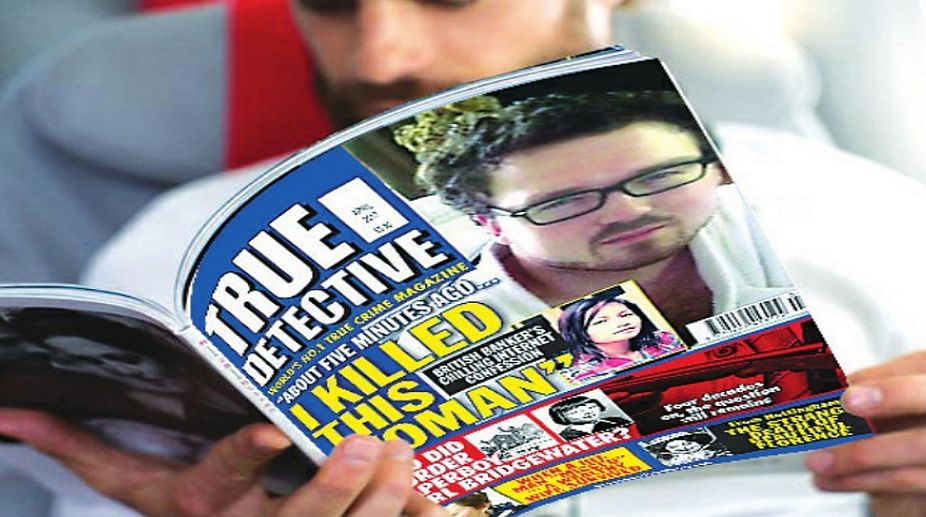
But really, we can pinpoint the birth of what we now accept to be true crime — detailed reportage of real criminal incidents — as 1924, when American publishing magnate Bernarr Macfadden unleashed upon the world a magazine called True Detective Mysteries. It began with fictionalised retellings of crimes, but Macfadden swiftly realised there was a hunger for straightforward and agonisingly detailed stories that were entirely factual, and within a few issues this is what he began publishing, soon dropping the pulp-like “Mysteries” bit of the title to create what would become a phenomenon, True Detective.

The magazine spawned dozens of imitators as readers lapped up the noholds-barred reports. Issues invariably featured a woman being menaced on the front cover, usually bound and/or gagged, her dress often torn to reveal enticing acres of flesh. The cover lines matched the illustrations in terms of salaciousness. Anyone who thinks clickbait is a modern phenomenon need only cast their eyes over a few True Detective covers, which became increasingly more lurid as the magazine thrived from the 1930s to the 1950s. “She was a prisoner of two ruthless men: ‘I begged them to kill me!” screams one. “Exposing: Sensational Secrets of a MailMarriage Siren,” says another.

“Riddled Brunette in Pink Pyjamas”. “Bloody Trail of the Lolita Lovers”. “The Woman-Hater Who Had To Kill”. So it goes.

By the 1970s, the illustrations had morphed into staged photographs of minidress-wearing teens that lent the magazine and its many imitators an even more pornographic style. By the mid-90s the magazine had fallen out of favour and folded, but only in the US. Since 1950, the magazine and its stablemate Master Detective had been licensed by a British publisher, and these continue to deal out deadly real-life dramas on a monthly basis.

Philip Morton, who’s on the editorial staff of True Crime Library, which publishes the magazines, says, “At first the UK editions consisted almost entirely of reprints from the American titles, but gradually more and more UK cases began to be covered as well, which necessitated building a stable of UK-based writers. The British titles have outlived their US parents and have been published every month since 1950, acquiring some sister titles along the way: True Crime launched in 1981 and Murder Most Foul launched in 1991.”

Consider the latest edition of True Detective. The helpless women have gone, to be replaced by composite images mainly featuring criminal mug shots. But the shout lines are as inventive as ever, “About five minutes ago… I KILLED THIS WOMAN”. “The strange death of beautiful Florence.” “Who did murder paperboy Carl Bridgewater?” But it seems that the magazine’s readers are not just interested in the gory details, but want some kind of justice as well. Morton says, “Murder is the most ‘popular’ crime in our magazines, particularly if it’s followed by justice and retribution in the form of execution. There seems to be a strong feeling among the readers who contact us that criminals should be made to pay, especially killers. That’s one form of satisfaction that I believe our readers derive.”

That’s understandable, but there must be more than a desire to see justice served behind the ongoing fascination with true crime. Isn’t it all about, well, a salacious need for the gory details?

Fozia Mir, a lecturer in criminology at Middlesex University, says, “Nonfiction crime books, documentaries and podcasts offer an escape for readers and listeners and are also entertaining. What could offer more escapism than reading about someone like Dennis Nilsen who dismembered his victims body parts and flushed them down the toilet, or Jeffrey Dhamer who made a shrine of his victims skulls? These crimes are so alien to us and reading about them satisfies our appetite for finding out what factors make someone commit such heinous acts.

“But there are moral and ethical issues where real life events are documented and that means a moral responsibility on those involved to report accurately, even though crime is packaged to be entertaining. Crime is not only packaged by the creators of documentaries and authors of books. Most of our understanding about the crime problem is informed by the news media, offering reports about ‘who is the offender?’ and the crime rate — both of which affects our understanding and fear of crime.”

Morton says, “I think people like to put themselves into life-and-death situations and imagine how they’d react — and our magazines, which are scrupulously truthful and as accurate as we can make them, certainly provide the material for such fantasies. What’s it like to be on Death Row, awaiting execution, or facing down a homicidal maniac, or indeed planning the perfect murder? Our writers specialise in putting our readers in just such situations, where they can experience a vicarious thrill.”

It’s impossible — in fact, remiss — to discuss the true crime genre without mention of Truman Capote’s 1966 book In Cold Blood. Utilising the techniques of the novel, Capote told the story of the brutal murders of the rich Clutter family by Dick Hickock and Perry Smith in Holcomb, Kansas, in 1959. Capote, initially accompanied by To Kill A Mockingbird author Harper Lee, conducted dozens of interviews and pored over official reports to create what was described as a “non-fiction novel”, which took him six years to complete. Rightly regarded as a classic, In Cold Blood, along with the 1974’s Helter Skelter (about the Manson Family murders written by the prosecutor in the case, Vincent Bugliosi) kick-started the modern True Crime book genre, which is now awash with fresh titles on a weekly basis.

While True Detective established the form, and In Cold Blood revolutionised it, there are still constant innovations in the genre. TV, of course, is no stranger to true crime documentary, but that, too, has evolved in recent times. Making A Murderer is a 10-part documentary series that debuted on Netflix in December 2015. Rather than rehash existing documents and reports, it took a different stance, in effect reinvestigating the case of Steven Avery, of Wisconsin, who had served 18 years for sexual assault and attempted murder before being freed after new DNA evidence came to light, and then arrested and prosecuted for a wholly separate murder. The series cast doubt on the whole case, especially the involvement and conviction of Avery’s nephew, Brendan Dassey, which resulted in an order for a retrial.

An even bigger cultural shift came with the 2014 podcast Serial, in which Sarah Koenig investigated, over multiple weekly episodes, the murder of Baltimore student Hae Min Lee and the conviction of her ex-boyfriend Adnan Masud Syed, on which doubt was cast. Podcasts have captured the attention, perhaps in a way that the same material presented in the written word might not have done for the Internet generation.

Though the method of storytelling has changed over the almost-century since True Detective magazine was launched, the basis of it is still the same — a fascination with the worst of human nature. It might be that the true crime genre allows us to study the depths that people can sink to, at a safe distance; or it might just be that we really, really like the juicy details of a particularly gory crime. Whatever it is, it’s not going away.

The Independent

Am I a Hindu, my Lord?

Pranab Chatterjee | New Delhi |

During the last election to the Lok Sabha when the prospect of the BJP coming to power appeared strong and its Hindutva agenda dominated public debate, a judicial observation was quietly made on the nature of the Hindu religion which had it that Hinduism was a way of life rather than a uniform system of belief. The Press did not report whether any elaboration was made by the court on the basic features of this way of life. The secularist political block too did not show much interest in the remark although the Sangh Parivar seemed to have endorsed it.

As a Hindu by birth who has lived many years with that identity the observation, however, prompted me to take another look at the way I have led life with a view to identifying the Hindu elements in it. I admit my knowledge of Hindu shastras is limited to the Bhagavad Gita and a few Upanishads. I further admit that I had never been a devout person although my faith in God and allegiance to our precepts have survived the ups and downs of life.

It would be apparent that any Hindu element in my life is not the result of conscious adoption made from the shastras but something naturally inherited from my family. I have lived in the way I was made to from childhood and which I copied from elders. It is, in other words, a continuation of the way in which my forefathers lived except for the changes brought about by circumstance or choice.

In our family which at one time had 22 members, I had never found an individual getting precedence over the collective. Happiness was sought and found jointly and bonds and obligations were accepted without grudge. We did not live life in isolation or in a selfish manner. Society was viewed as an elaborate network connecting one to another in love and loyalty not only within one’s own blood relations and caste groups but across the divisions that it was comprised of. The family was the smallest unit of that network which demanded compliance from its members to its wills and ways.

We were taught quite early about the continuity of life, about the permanence of the soul and of its rebirth in a new body after death in accordance with the karma accomplished in earlier incarnations. The fear of karmaphala compelled us to tread the right path and to be humble since we were never sure which karma would be considered bad by an ever-watchful God!

Although Vaishnavism was the dominant cult in the region where we lived, there was no dearth of Saivaites or Shaktas who practised their faiths without any difficulty. Pirs and dervishes too were common sights just as mosques and dargahs were. We understood God to be one who was worshipped in many forms and ways and who manifested Himself in all existing things in the universe. The concept of multiple paths to God and of His presence in everything had a liberating influence on our minds and prompted us to seek harmony with the world we were surrounded with – plants, animals and the environment. Disturbing or denying this harmony would lead to alienation of the self from the omnipresent Him.

Wealth, we were told, was required for the fulfillment of desires and for the progress of the soul to the higher level. However, both the acquisition and enjoyment of wealth must be made in a virtuous manner lest they caused degradation of the self. It was like a double-edged weapon which when acquired honestly and held with humility enabled one to preserve selfrespect and provide for others but would breed arrogance, fuel greed and lead one away from the path of God if gained immorally. Acquiring wealth for self preservation while remaining unmoved by the temptations offered by it was a life-long exercise prescribed to everyone. Western materialism fuelled desire but brought only transient happiness. Our religion, on the other hand, promised lasting peace and contentment to be achieved through renunciation and sacrifice.

Attraction to sensual pleasures spoilt the soul and sealed the path to liberation. Love between men and women, as witnessed in the West, was considered alien just as the accounts of courtship, abductions etc. narrated in the epics were viewed as having no relevance in real life. Marriage was meant not for the satisfaction of physical desires but for procreation and strengthening of the family unit. Wives were, thus, encouraged to give precedence to their motherly roles over that of the consort just as husbands were expected to be dutiful rather than doting.

The caste system influenced our lives and worked roughly in three ways: by putting a bar on marriage outside one’s caste, by restricting inter-caste social contacts and by prohibiting food cooked by one from the lowest caste. However, despite perpetuating injustice on the weakest section of the society, the caste system was not combined with hate nor did it prevent us from being kind and considerate to those at the lower end. We reasoned out their plight as the result of bad previous karma and always heard a warning within ourselves that such could well be our position if we committed any immoral act. The system, thus, redeemed itself a bit by keeping us on the right path and prompting us to be kind and generous.

Like other Bengali brahmins, we ate fish and meat for which justification was drawn from the Vedas where meat consumption by the people of the period had reportedly been mentioned. Meat eating was, however, restricted to animals having five toes which had preferably been offered as sacrifice to some gods. Goat meat fell in the approved category followed by that of deer while chicken and chicken eggs were forbidden. Since sacrificial meat was not always available, meat bought from the market was symbolically offered to a deity before being cooked.

I, finally, make passing reference to some of the contradictions which also marked our daily life: rigidity in religious practice coexisting with broadness in precept, veneration of women coexisting with vilification of their charm, belief in the spirit and the occult coexisting with belief in the sublimity of the soul!How do we lead life now nearly seventy years later? The supremacy of the collective ended long ago and the social bonds have snapped; money and material success have become the new salvation, removing the bar on pleasure and enjoyment; the self has, finally, acquired new godhood with the transcendent withdrawing Himself from His myriad manifestations! To put it simply, my wife and I now live by and for ourselves alone in an apartment, disconnected from our kith and kin. The residents of the building show little interest to be intimate with us. We have two children who stay away from us and live life in ways that do not always conform to tradition, save for their attachment to us. We have none for whom to make sacrifices nor see any other way of making charity than by giving donations to preferred institutions. Age and ennui have pushed us more into vegetarianism although chicken made an entry into the kitchen long ago.Regarding our spiritual pursuits, I recite the Bhagavad Gita every morning with a mind troubled by myriad mundane concerns while my wife weeps before her gods praying for resolution of the same mundane concerns! Renunciation has, nevertheless, set in; brought about more by circumstances than by consciously giving up desires.

Are we living life the same way as our forefathers did? If not, do we still remain Hindus? What is your verdict, my lords?

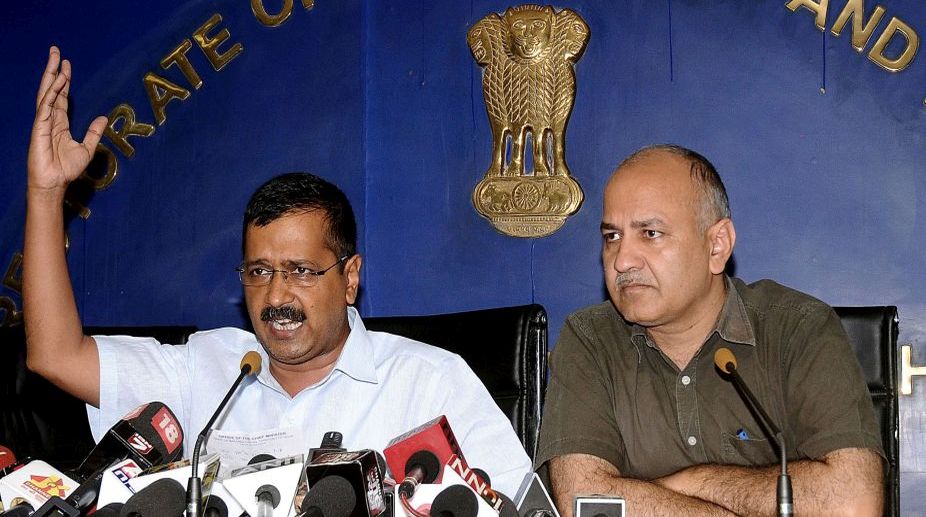
Will Kejriwal reinvent himself ?

Kalyani Shankar | New Delhi |

Delhi Chief Minister and Aam Admi party chief Arvind Kejriwal’s stars are not shining bright going by his party’s earlier poll debacle in Punjab and Goa and now the municipal corporation elections to Delhi. This indicates the continuous losing streak of AAP. So is the AAP finding itself at a crossroads? Is Kejriwal finished? Is AAP withering away?

No doubt winning and losing are part of the political game and no party or leader are finished with one defeat or a series of defeats until they lose the game altogether. That takes a while. Therefore if the AAP decides on course correction and work on the ground, all is not lost.

AAP has been seen as an upstart party since the time it emerged and formed the government in Delhi with the support of the Congress in 2013. It lost its sheen within months when Kejriwal resigned and Governor’s rule was imposed. However, the party won a spectacular victory in 2015 by winning 67 out of 70 seats in the Delhi Assembly polls and came back with a bang.

Unfortunately for him and his party, Kejriwal has frittered away the goodwill he had earned. The echo is seen in the corporation elections where the AAP came a distant second to the BJP.

What went wrong? First of all, AAP is struggling to change over from a movement to a party, which is not easy. Due to the dictatorial tendencies of the AAP chief, the party has already split once with senior leaders like Prashant Bhushan and Yogendra Yadav having left the party. Kejriwal has built up a personality cult around himself and does not tolerate any different points of view.

Secondly, instead of concentrating on governance, Kejriwal had been fighting with the Lt Governor of Delhi Najeeb Jung until the latter was replaced a few months ago. The ding- dong battle continued throughout. Kejriwal alleged that the Centre through Jung was not allowing him to function. He indulged in petty quarrels with the media, bureaucrats, other political parties and who ever came in the firing line.

Thirdly, Kejriwal also picked up quarrels with the Centre, the Home Minister and the Prime Minister. He considered himself equal to the Prime Minister because he took him on in Varanasi in the 2014 Lok Sabha polls although he lost. He attacked Central ministers like Arun Jaitley and got embroiled in defamation cases, which are haunting him still. He blamed the Centre for all his failures claiming that he was not allowed to function.

Fourthly, Kejriwal began to position himself as a leader who could challenge Modi in 2019 and did not miss a single opportunity to gang up with other non-BJP chief ministers to attack the Centre and the Prime Minister on many occasions. He became friendly with Bihar chief minister Nitish Kumar and West Bengal chief minister Mamata Banerjee in forming a pressure group against the Centre whenever possible.

Fifthly, he chose to spread the butter thin on his bread by expanding the party to other states with the result he is left without any stronghold anywhere. People of Delhi felt betrayed that Kejriwal chose to concentrate on Goa and Punjab instead of governing Delhi. His party came a cropper in the Assembly polls in both states. He had declared that his party would emerge as the third alternative in Gujarat, Rajasthan, Chattisgarh and other states where there is direct contest between the BJP and the Congress. The continuous losses have thrown cold water on his ambitious plans as of now.

Sixthly Kejriwal turned out to be a bad loser and blamed the Electronic Voting Machines for his poor performance. But there were no takers for his EVM bashing.

Seventhly, the results show that Kejriwal has lost the support of the middle classes and even the poor whom he pampered all along. Both sections had moved to Modi and the BJP disappointed with his non- performance. Seventhly, it has been proved worldwide that negative politics do not help. Kerjiwal believed in hitting out at his political rivals and making allegations wihtout substantiation and this has not helped.

So the time has come for AAP to make course corrections. The party must go back to where it began and introspect where it went wrong in just two years. AAP has lost its connection with the people. Otherwise the party would not have lost more than half of its vote share since 2015. Secondly, Kejriwal must realise that without strengthening himself in Delhi first and concentrating on solving problems of people, he cannot achieve his national ambitions.

After all when Kejriwal was given a second chance in 2015, it was with a hope that he would provide alternate leadership. Even his one time mentor Anna Hazare is critical of Kejriwal’s style of functioning. Thirdly, he must become more democratic and allow voices of dissent.

Kejriwal must move from a campaign mode to governance mode or else the party is likely to wither away. The AAP chief in his philosophical tweet on Saturday seems to have realised this when he said that he had spoken to many workers and the reality was that the party needs to introspect. “To not evolve would be silly…. need is action and not excuses…The only thing constant is change.” Will he make efforts resuscitate himself and his party?

Pointers on Erdogan’s visit

Shantanu Mukharji | New Delhi |

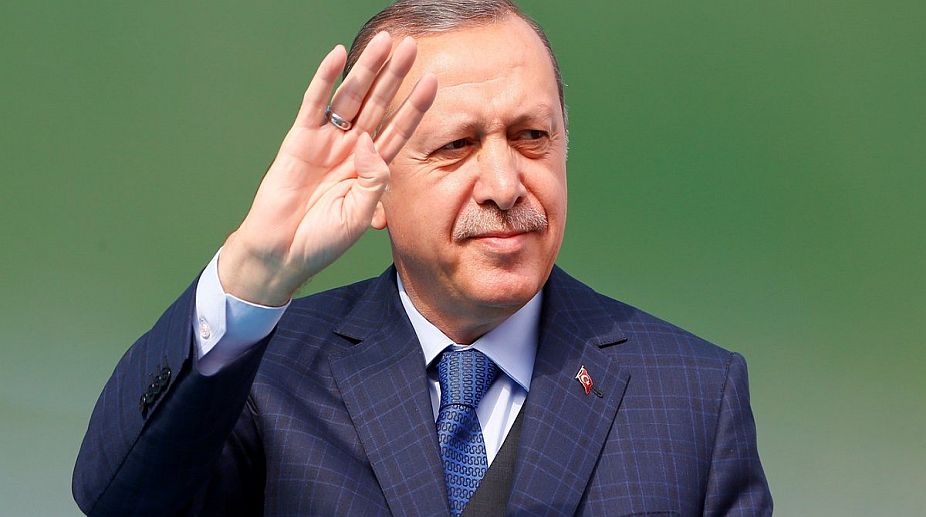
Turkish President Recep Tayyip Erdogan will be in New Delhi on a two day India visit commencing today(30April). This is Erdogan' s first visit as the President of Turkey though he had earlier came to India in 2008 as Prime Minister.

This visit assumes significance as barely two weeks ago he won a referendum, albeit by a slender margin securing nearly 51 per cent votes, to give himself enormous governance powers. Erdogan is not politically secure and his position remains imperilled by threats from within. The Turkish opposition has already cried foul alleging large scale manipulation in the referendum process. He had survived a military coup attempt last year raising fears of his political existence.

Against this backdrop, Erdogan is likely to present a bold face on his India trip to convey that he is in absolute control. He is expected to propose to the Indian side a strengthening of anti-terror cooperation and a deepening of ties with respect to investment and trade. On May 1, the Turkish President will hold talks with Prime Minister Modi where apart from these issues, the topic of the Nuclear Suppliers Group (NSG) may come up for discussion. On the face of it, Turkey does not seem opposed to India's NSG membership yet it is expected to proceed with caution.

Amongst other issues, Erdogan will in all probability further sensitise India on the threat he perceives from Fethullah Gulen Terrorist Organisation ( FETO). Last year's coup attempt to dislodge Erdogan and the outfit's activists allegedly being harboured in India, remains a cause of concern to him. Erdogan is also learnt to be considering flagging his apprehensions that FETO has been able to infiltrate into India through educational institutions and associations.

This concern notwithstanding, there are reports that Turkey on its part has been covertly supporting Muslim Brotherhood elements in India. This is confirmed by his detractors in Turkey who allege that Erdogan is promoting Neo-Ottomanism following his referendum "triumph" which is also distancing Turkey from the West and ties with Germany, Netherlands and other EU countries are badly fractured. Following his referendum victory, Erdogan has become an ardent supporter of Sunni Salafi groups to counter Syria. His support, therefore, to the Muslim Brotherhood does not look surprising.

India, while dealing with Turkey during the Erdogan visit, must take into account the extraordinarily excellent relations that Turkey enjoys with Pakistan. They are already in a strategic relationship. Pakistan and the Turkish Air Force are in a formal deal where Turkey would buy 52 Super Mushkak trainer jets and Pakistan would help train Turkish pilots to support recovery of the Turkish armed forces to meet the shortage of hardware and pilots in the aftermath of the aborted coup last year. Further, there are regular joint naval exercises between the two countries. On Erdogan's last visit to Pakistan (incidentally he has paid seven visits to Pakistan) in the recent past , he addressed the joint session of parliament which was also attended by the top Pakistani military brass.

Military warming up apart, Turkey and Pakistan have a bilateral trade worth 10 billion dollars. Pakistan supports Turkey's position in Cyprus, Azerbaijan and Armenia – not so palatable to the West. Importantly, Turkey supports Pakistan on the Kashmir issue. This merits factoring in while dealing with Turkey.

Diplomatically, it appears ceremonially appropriate that Jamia Millia Islamia (JMI) is conferring a honorary doctorate on Erdogan. JMI hosts should also remind Turkey that Indian Muslims have all along supported Turkey. In 1912-13, a medical mission from India , under Dr Ansari, was dispatched to Turkey on compassionate grounds. It's high time Erdogan recognises this historical fact in letter and spirit and comes equally close to India to strengthen bilateral ties. Even Mahatma Gandhi had supported the Khilafat movement despite criticism from many quarters.

Turkey, under Erdogan, seems to be playing an active role in its efforts to contain the ISIS menace in the region. The terror attacks in Ankara and Istanbul airport have been eye openers for Erdogan. He must share hard time intelligence with India on ISIS related activities in the war-torn region and on participation of Indians, if any. It can be assumed that Turkey being in such close proximity to ISIS-affected areas will have access to real time intelligence and robust cooperation between the two countries will provide new focus to bilateral ties.

The writer is a retired IPS officer, a security analyst and Senior Fellow, India Police Foundation. The views expressed are personal.

Discovery of Bharat~I

Ashok Kapur | New Delhi |

It is undoubtedly the Great Indian Civilisation. Today’s Indians are justifiably proud of the country’s rich heritage and glorious past. We never tire of showcasing our past to visitors and tourists who come to India and marvel at the ancient history of the “oldest civilisation in the world”. It is an incredible tale of riches of its mind and its wealth, indeed the ‘Wonder that was India’.

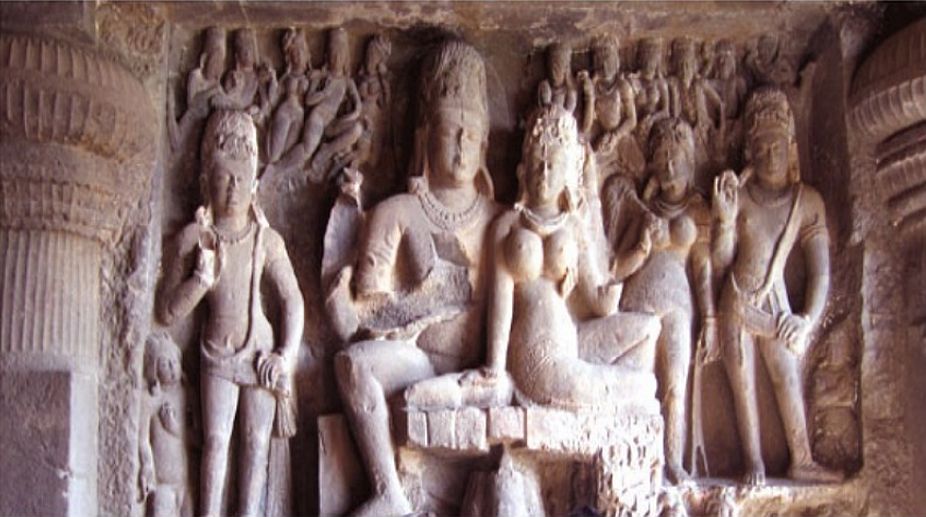
Our official travelogues proudly proclaim an Incredible India ~ like no other nation ~ ‘once upon a time’. The excavations at Mohenjodaro and Harappa, the Ashoka pillars, the breathtaking frescoes of Ajanta and Ellora caves, to name just three, and behold an ‘incredible land’. And it happened when the rest of the world was just emerging from the bush. These represent even today the acme of human skill, built or crafted at the dawn of world history, thousands of years ago. They represent too an inheritance of magnificence that would be the envy of any ‘developed’ nation.

Having said that, it needs to be acknowledged that these marvels were for ages lying buried beneath the ground, hidden in our forests or lost sight of because of indifference or neglect over the centuries. Bharat was as good as not there, as countless generations just walked past our ‘past’, absorbed in their mundane daily chores. The Ashoka pillars and rock edicts with detailed inscriptions stood testimony for more than 2,000 years to good governance in ancient Bharat.

These are spread all over the Indian subcontinent, from Taxila to Karnataka, forged in metal that has the sheen of polished granite. These dotted the open countryside for all to read and marvel at the first Welfare State in world history, save those who would not see. Most of us do not.

Mohenjodaro and Harappa, the first ‘smart cities’ in the world, to use contemporary jargon, lay buried just at the subsurface, hidden from the eye. But the racial memory of these cities that once housed a great civilization has survived to this day, in the form of robust folklore in the surrounding villages. These ancient cities thrived around 5,000 years ago. The very name of the present-day settlement ~ Mohenjodaro, ‘the mound of the dead’ ~ provided a clue, though none bothered to explore further for 5,000 years! What the mind does not query, the eye does not see.

The cave paintings of Ajanta and Ellora have similarly existed for more than 2000 years, away from public view in the forest of Aurangabad district in Maharashtra. Even today, they take the viewer’s breath away. A great Buddhist civilization once flourished here, with a highly aesthetic sensitivity and a finely evolved culture. It must have been rooted in the soil, settled and peaceful. Their arts and skills must have been very well honed, as the paintings depict a highly cultured and learned people. But again, the countless intervening generations did not venture into the forest. Therefore, nothing was gained.

Skipping several centuries, we enter the middle of the 19th century. A fortuitous development had taken place. “The Great Indian Civilisation” had been placed under the direct charge of an alien “master” ~ the British Government, to be administered directly from London. For the first time in our history, a proper ‘Government’ was in place, and Bharat was now divided into administrative units, each under the charge of a trained British officer. These officers were trained to survey and map the entire land, travel to all corners of the country, observe, explore and document everything. A nation was thus born, our very own India.

Administration as we know today, is a purely British invention. Bharat was undoubtedly ruled by countless emperors and kings since time immemorial. But it was first administered by the British. They were amazed to discover that this ancient land is dotted all over with priceless remains of several magnificent civilisations, dead and gone. Unhonoured and unsung, and, most tragically, undocumented. None of the ‘natives’ knew, or cared to notice and document when it all began, and where. Indian history again is a purely British invention, and transplanted into Bharat. The study of history was compulsory for the British administrators. After centuries of apathy, began the true discovery of the ancient land of Bharat.

Lord Curzon ruled India in the early 20th century, and he took the first concrete step to preserve and protect our ‘civilisational heritage’. He promulgated the Antiquities and Art Treasures Act, 1903 to protect and safeguard our past. Prior to the promulgation of the landmark legislation, no one in particular was in charge of the priceless, and countless art treasures of Bharat. It was common unclaimed property, and belonged to whoever could expropriate the same. The ‘native’ rulers, by and large had little or no use for history, the more enlightened ones being ‘schooled’, to use a pun, mostly in martial arts, religion and philosophy. The sword was always considered mightier than the pen.

It has rightly been said that as the past is mostly buried, archaeology is in a sense the beginning of history. The British then took the next logical step by setting up the Archaeological Survey of India in 1837 to survey, record and preserve our precious heritage.

The priceless treasures and antiquities were brought under the care and protection of the Administration, and mindless vandalism was to be penalized. Ages of neglect or, more appropriately, indifference were over at long last, figuratively and literally. Simultaneously, symbols of our cultural heritage were ‘packaged’ and documented to enlighten and educate the common Indian and to make him aware of the marvellous heritage. The first-ever Ancient Geography of India was published.

Mohenjodaro and Harappa were fortuitously discovered by chance, noticed meticulously by an alert mind. A new railway line was being constructed between the settlement and Abbotabad. It was personally supervised by a young British engineer on horseback. He noticed something that was amazingly strange ~ those who were digging the earth uncovered stones and pebbles that were regularly shaped, and there were hundreds of them. These were broken parts of perfectly shaped bricks, which originally must have been exactly rectangular. The corners were at perfect right angles.

Intrigued beyond belief, he found out that no ‘modern’ construction had ever taken place anywhere nearby. He summoned a meeting of village elders and was stunned at what they told him. The place was, once upon a time home to a great civilization, which had suddenly vanished in the mists of time. No one could say when and how, beyond elaborating that its residents inhabited great well-planned cities and were big builders. It was a very settled, orderly and peaceful civilization.On being further asked about the source of their information, the village elders explained that it was a persistent, timeless folklore in the entire area. They had been told as much by their great grandmothers, who in turn had been told by their great grandmothers.

The elders confirmed that the folklore had been transmitted by their forefathers for generations. The cities spread over acres and acres, but turned into a massive graveyard where thousands lay scattered and buried. Indeed, the present name of the settlement itself was indicative of its history, since time immemorial.

The writer is a retired IAS officer

(To be concluded)

French toast

Editorial | New Delhi |

The voter in France has restricted his choice as perhaps seldom before in the country’s political history. The Socialist and Les Républicains parties ~ the mainstream centre-left and centre-right groups ~ that have dominated French politics for decades, have for now been relegated to the footnotes. This succinctly is the message conveyed after last Sunday’s first round. Ergo, the presidential run-off next Sunday ~ 7 May ~ will be a clash between the far-right Marine Le Pen of the Front National and the centrist, Emmanuel Macron. Quite the most remarkable feature is that the two parties, that seem to be down and out in the race for the Elysee, have united to urge the country to back Macron and reject Le Pen’s populist, anti-EU and anti-immigration nationalism. Less than a fortnight before the critical round, Macron quite clearly has the overwhelming support of the people and the political class generally. However demoralised, the mainstream parties have been eloquent in their support to Le Pen’s opponent. The voters have rejected the far-right leader’s brand of nationalism in the fountainhead of libertarian democracy, however much she may rant at Macron as a “hysterical, radical Europeanist. He is for total open borders. He says there is no such thing as French culture. There is not one area where he shows one ounce of patriotism.” For all the creaking up of rhetoric, the voter thinks differently, however. The ascendancy of a hitherto fringe entity is the critical signal that has been emitted by the electorate. There is no ambiguity in the choice of the middle ground… in preference to the mildly Left, let alone the Right. Further comment must await the outcome of the run-off, but it would be reasonable to presume that this week’s broad trends will be manifest. If the mood of the electorate is an index to the renewed tryst with democracy, there is little or no scope for fanatical expressions of rabid nationalism.

Not wholly unrelated to the discouraging outcome of the first round is the “temporary” resignation of Le Pen from the presidency of Front National, pledging to be “above partisan considerations” and be riveted to the race for the Elysee. Her objective in stepping aside from helming her party’s presidency is to appeal to supporters of the defeated first-round candidates, particularly those who backed the conservative François Fillon, who finished third, and the innocuous right-winger Nicolas Dupont-Aignan. But given the groundswell of support for Macron, it is hugely unlikely that the 7 May run-off will be any different. Most particularly the support has been extended by the outgoing President, François Hollande, who says he will vote for Macron, his former economy minister, because Le Pen “represents both the danger of the isolation of France and of rupture with the EU”. A far-right President would “deeply divide France”, is Mr Hollande’s grim foreboding. “Faced with such a risk, it is not possible to take refuge in indifference.”

‘Restless’ mountain

Editorial | New Delhi |

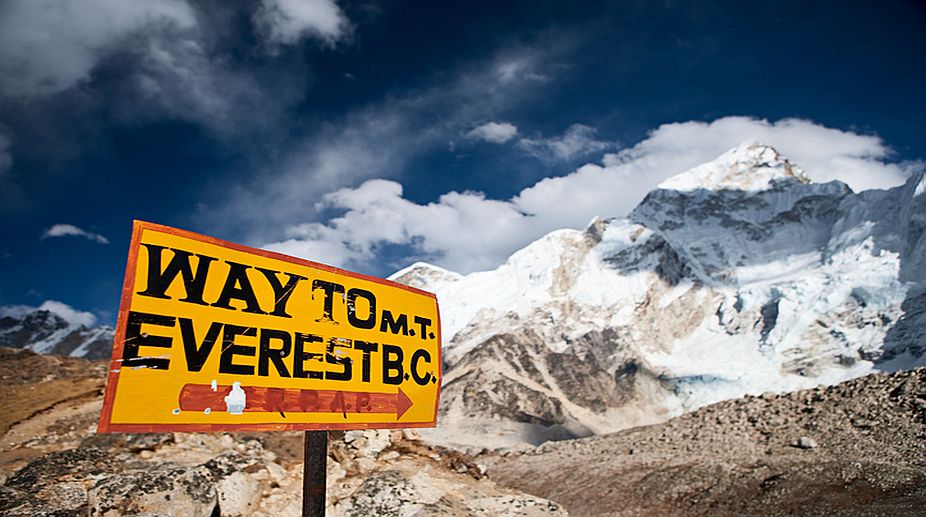
The “season” is yet to officially commence but already teams of mountaineers are out in the Mt. Everest region, training and acclimatising for a bid on what continues to be the “ultimate” in the demanding sport. It is estimated that at least 400 climbers are being permitted this season; and since that would mean at least twice as many sherpas ~ and even more porters at the lower levels ~ there will be no change in the worrisome “overcrowding” of the world’s most celebrated mountain. Hundreds have followed the 1953 footsteps of Tenzing Norgay and Edmund Hillary, but attaining the summit has lost none of its magical allure. Sadly, in recent years the death toll has also been rising, and while freak weather conditions were deemed responsible for major mishaps in 2014 and 2015, there is a growing awareness that some of the disasters are the outcome of overcrowding, and indeed “traffic jams” on the final stages of the climb/descent. That adds up to a real dilemma, the economy of Nepal is heavily dependent on mountaineering and thousands were left jobless when the “season” was truncated. There is also reason to believe that with so many teams trying for success a number of less-expensive but inexperienced guides are now being engaged by less-proficient climbers. Not only are “corners being cut” on the sanitation and environment-protection front (decades ago the famous British climber Chris Bonnington had spoken of a garbage-trail marking the route up the mountain), but climbers are also being exposed to avoidable hazards. Raising the permit fees might serve as a “population control” measure, but fewer numbers translates into economic disruption down the line. It is evident that Everest is fast-becoming a victim of its own romantic fascination: there are other “tall” peaks, equally challenging from a technical perspective, but they have not acquired the charm of Everest. Maybe a major publicity effort will create “counter-magnets”, so too a proposal to permit private agencies to “manage” some of them. Everest will always remain the pinnacle of the sport.

There is no dearth of attractive options in the “Indian Himalayas” and though the sport has turned increasingly well-patronised, somehow the full potential of foreign climbers has not been tapped. Could it be because of a five-star fixation of the travel trade, which is in sharp contrast to the humdrum treks that have proved so popular in Nepal? Or because large stretches of the northern frontier are popularly perceived as zones of “military-interest”, and a number of restrictions on human movement ~ foreigners specially ~ are in force? The sport in India continues to be dominated by the “uniforms”: a special effort is needed to ignite the larger spirit of adventure, and boost the economic prospects of our hill- folk.

Mission to Mars

Sam Rajappa | New Delhi |

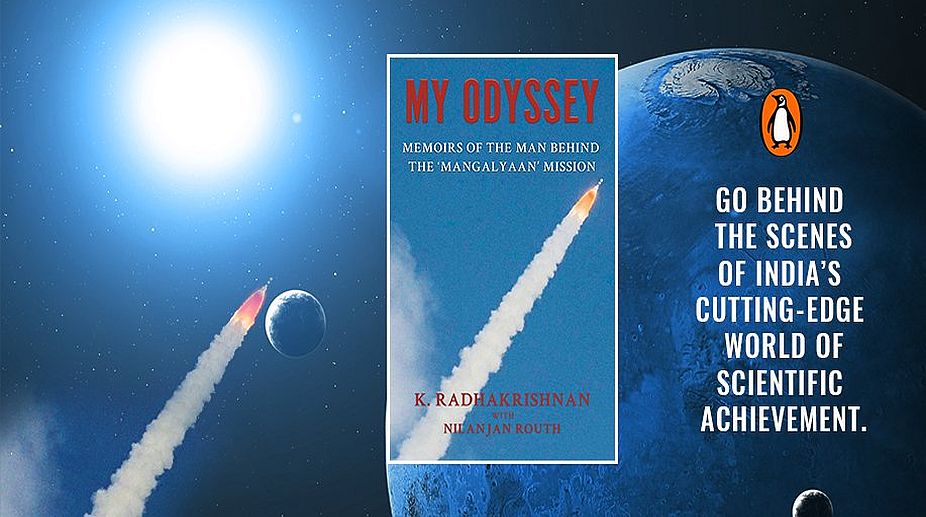
In the opening chapter of his memoirs, K Radhakrishnan, former chairman of the Indian Space Research Organisation, says, “I am leaving ISRO in great shape for my successor. I hope that posterity judges it that way.” What he hides in the book is leaving the organisation with a fine of $ 1 billion payable as compensation to the Bangalore-based multimedia Devas Corporation for breach of contract. The amount is almost equivalent to the annual budget of ISRO. A Permanent Court of Arbitration tribunal in The Hague has ruled in September 2015 that ISRO acted “unfairly and inequitably” in cancelling the contract between Antrix Corporation, commercial arm of ISRO, and Devas, primarily because of its inability to launch GSAT-6 and GSAT-6A satellites in time and lease transponders to Devas, among other things, within two months of his departure. He dismisses the entire episode as “unnecessary turmoil,” but he “held his ground,” whatever it may mean.

Vikram Sarabhai was the father of India’s space programme. His inspiring words had been the guiding principle of successive chairmen of ISRO. “There are some who question the relevance of space activity in a developing nation. To us there is no ambiguity of purpose. We do not have the fantasy of competing with economically advanced nations in the exploration of the moon and the planets or manned space flights. But we are convinced that if we are to play a meaningful role nationally, and in the comity of nations, we must be second to none in the application of advanced technologies to the real problems of man and society which we find in our country,” he wrote in the nascent stages of our space odyssey.

Radhakrishnan’s memoirs, as the title indicates, is the story of his climbing the ISRO ladder with a single-minded devotion to seeking personal glory. His crowning achievement is the Mangalyaan mission by using a Polar Satellite Launch Vehicle perfected by his predecessors. Had Sarabhai been alive, he would have disapproved of the mission and directed him to devote his energies to perfecting the Geo Synchronous Launch Vehicle, which was on the verge of completion when Radhakrishnan took over as the ISRO chief. By not developing the GSLV to perfection, ISRO has to continue its dependence on international launchers to orbit heavier satellites. That task gained momentum only after AS Kiran Kumar took over as chairman and ISRO is now geared up to launch GSLV Mark III capable of launching satellites weighing up to 4,000 kg.

If ISRO wants to undertake a genuine Mars mission, it is worth remembering that most of the technologically advanced countries could not do it alone. The best approach would be to partner with nations that already have the capacity and focus on the expertise that is particular to India. Mars exploration is going to be an international effort and India has much to contribute. The Mangalyaan mission did not add an iota of fresh information about the red planet, but it brought kudos to Radhakrishnan and got him listed as one of the top 10 space scientists of the world while his real forte is management, music and public relations in which he excelled.

Describing his taking over as chairman of ISRO, Rashakrishnan writes with disarming modesty, “The tradition of seamless transition at the helm of ISRO continued this time as well. I had been in the Space Commission for a prenatal period of one year. My predecessor continued with us as a Vikram Sarabhai distinguished professor, operating from a room opposite mine at Antariksh Bhavan. As a symbol of respect, I offered him the chairman’s car and I opted for a smaller one for myself.” Within weeks of this drama, his distinguished predecessor was booted out of Antariksh Bhavan, sans the chairman’s flashy car. “The baton is passed on from one leader to the next to pilot the organisation to new planes and explore new avenues to make a mark. Nevertheless, it does come with a caution of not perpetuating any weaknesses that might have crept in,” he says.

Radhakrishnan tells us that it is ISRO tradition to set near impossible targets. One such target was executing the first human space flight within seven years from the formal kick-off. “We knew the task at hand was arduous…I was asked to make a presentation on the project at the 110th meeting of the Space Commission. Incidentally, the meeting happened on 12 April 2008, the 47th anniversary of the first human space flight by the Soviet Union. As I made the presentation, there was a visible flow of sentiments with the latent euphoria of attempting similar in our own country. Finally, the Space Commission endorsed our project report to be placed before the Union Cabinet; this was the last hurdle.” Even after crossing the last hurdle nine years ago and the stipulated seven years from the kick-off have passed, there is no sight of the first Indian human space flight in the horizon. That is the price of setting near impossible targets.

A great devotee of Lord Ayyappa of Sabarimala shrine located in the Periyar Tiger Reserve in Kerala, he tells us till his 29th pilgrimage he took the shorter four-kilometre route from the banks of the Pampa. On his 30th pilgrimage, as a mark of obeisance, he took the more treacherous path of 65 km from Erumely through forests and hill tracks. Before taking his 36th pilgrimage, he had completed 41 days of austerities and was immersed in the Anandabhairavi raga while rendering the song Sabarimalayil thanka suryodayam. After completing his memoirs, he is pursuing Carnatic music and occasional performances on “renounced platforms”, he says with modesty. On 31 August last year, he gave a 75-minute performance at the Chembai Vaidyanatha Bhagavathar Music Festival held at Sree Krishna Gana Sabha, Chennai, sponsored by KJ Yesudas. The book abounds in such trivia.

Narrating his penultimate day as ISRO chairman, Radhakrishnan says, “I returned home from office at the usual time and changed into my comfortable house wear. With the sublime background of a light classical number, I started chit-chatting with my wife, Mini. At the dinner table, Mini suddenly asked me, How do you feel now?’ ‘Blissful!’ I responded promptly. Could I have asked for more than what we have done during the last five years? ISRO is now admired all over the country and abroad. We have completed 37 missions, six of them in the last six months…We reached the Mars.” More careful copy editing could have avoided bloomers like “the fiftieth Lok Sabha general election,” (Page 153) and the sprinkling of grammatical errors that had crept in. The jury is out. Verdict is awaited.

The reviewer is a veteran journalist and former director, statesman print journalism school.

The Fat Knight on a strict diet

Andy Martin | New Delhi |

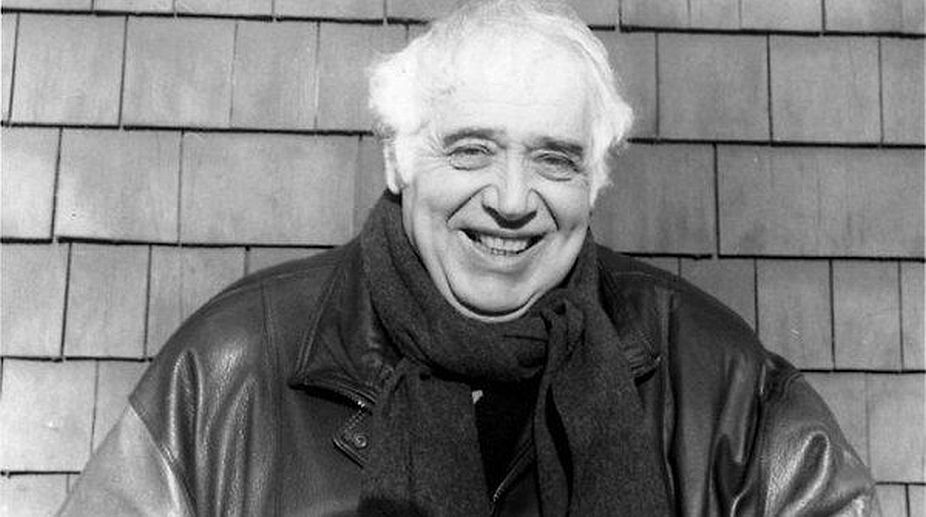
If I have understood Harold Bloom correctly, then I have misunderstood him. If I have got him right then I have got him wrong. Such is the law of misprision. I am bound to misinterpret everything he says. Again, if I have got the gist of his argument, I may have to kill him, or at least wrestle with him, overthrow, usurp, or subsume him. In an Oedipal way, of course!

At the age of 86, probably the greatest living literary critic on the planet, the Dr Johnson de nos jours, nothing worries him too much. Except maybe death and oblivion! But even then I think he has worked out a way around it —a modest, secular form of resurrection.

For a few decades, I had only read Harold Bloom. Such landmark works as The Anxiety of Influence (the agonistic struggle of poets with their major influences, like Wordsworth versus Milton, Plato versus Homer) and The Book of J (his hypothesis that certain chunks of Genesis and Exodus were written 3,000 years ago by a woman, perhaps a princess and daughter of Solomon, and woven into the Pentateuch). And then, on a vaster scale, The Shadow of a Great Rock, his literary appreciation of the entire Bible, and Shakespeare: the Invention of the Human. But then, a few months ago, I got the summons from the great man himself. Which sort of blew me away. Just a little bit like, in my own realm, hearing the voice of God finally, after just reading the Commandments.

He had read an article of mine and wrote to me that it was “a valiant attempt” and I should come and see him some time. So I bounded over to his house in New Haven, an hour and a half out of New York on the train, home to Yale University where he has taught for his entire life and is the Sterling Professor of Humanities. “You’re a young rascal,” he told me. A phrase you’re not going to hear too often. “You look about thirty-something.” Obviously his eyesight is not everything it used to be. “I feel we have known one another for years and you are already an old friend.” I pretty much fell in love with him. That’s how it is with the ephebe and the precursor. You have to fall in love even though you are doomed to, first, misconstrue, and then, finally, “turn away from” or rebel against him.

I was rebelling against him straight off the bat, to be honest. “Man, are you crazy?” I said. He had a doctor attending to him while I was there. Something to do with his legs. And yet, that very afternoon, he was teaching yet another class. He teaches over Skype now. His students used to come and see him and then the Yale bureaucracy outlawed that on account of some kind of anxiety of insurance. What if a student tripped and sprained an ankle? Obviously, from a Yale point of view, I was living dangerously just hanging out with him. I said, “I’m always telling my students, ‘Don’t be a hero!’” But Harold is a hero. A hero of the humanities. No way is this guy going to stop teaching. Ever. He wants to die with his boots on. “Come back soon,” he said on parting.

So naturally I had to go back, but only after I’d read his new book, Falstaff: Give Me Life. It’s the first in a series of “Shakespeare’s Personalities”, with Hamlet, Iago, and Cleopatra also in the pipeline. You read Bloom in part for the asides, like the time WH Auden stays over at his place and they lock antlers about Romantic poets, but find agreement over Falstaff, “I recall his saying that he preferred Verdi’s Falstaff to Shakespeare’s yet thought Sir John was closer to redemption than all but a few other people in the plays. I replied that Falstaff courted and accepted the obliteration of rejection.”

In one of his books, he wrote, “Bloom is only a parody of Falstaff.” He used to look a lot like I imagined Falstaff, only he’s lost a bit of weight recently. The Fat Knight, but on a strict diet! He has this theory that people tend ultimately to be either more Hamlet, “an abyss, a chaos of virtual nothingness”, a quintessence of dust, or Falstaff, overflowing with vitality and perpetual laughter, for whom “the self is everything”. I’m more Hamlet, he is definitely more Falstaff. Which is basically why he has written the book. It’s his homage to a character he feels he knows well. Or who, to put it in a Bloomian way, knows him. This is one of his great theories — that Shakespeare, with his vast vocabulary of 22,000 words, “an art so infinite it contains us”, knew pretty much everything there is to know about humankind. That he therefore “invented the human”.

Which of course sounds absurd, at first glance. Nobody invented the human, if not Yahweh. If we allow that humanoid creatures first starting prowling about some seen million years ago, then the only thing that invented the human is time. Aeons of time, combined with the series of mistakes in transmission that we call evolution. Another form of misprision, where the next generation is a screwed-up version of the old one, genetically speaking, but also, perhaps, a form of progress, in terms of adaptation to the environment. But no, says Bloom, Shakespeare invented the human.

He once wrote, “those Americans who believe they worship God actually worship three major literary figures, the Yahweh of J, the Jesus of the Gospel of Mark, and Allah of the Koran.” For Bloom, Shakespeare is scripture. He semi-seriously wonders if there could be a secular religion of Hamlet, for example. The whole point of “imaginative literature”, he argues, is the creation of vehement personalities, diverse characters, “distincts”. The phrase he uses about Shakespeare’s characters is that they are all “artists of themselves”, they appear self-created, fully autonomous. But here is the thing, and this is the only way to make sense of his inventing-the-human, they have (in part) created us, now. All those great Shakespearean figures have so hugely impacted on our consciousness of what it means to be human, that they have affected our concept of ourselves, and therefore shaped us, in another millennium, since we are what we think we are, up to a point. There is a lot of Shakespeare in Freud, for example. After Shakespeare, we are all Shakespearean, whether we like it or not, all doomed to strut and fret our hour upon the stage.

Part of what keeps him going and stops him from putting his feet up is his agon against the Shakespeare-haters. He feels that the Academy, at least in the humanities, has been going in the wrong direction for the last half-century. We have what he calls the “French” Shakespeare, in which great works are reduced to epiphenomena of language or politics or economics, a Marxist or Freudian or feminist Shakespeare, a deconstructed or Foucault-up Shakespeare, diminishing and impoverishing. Reduced Shakespeare is now, he believes, the norm, governed by the “fear of the Dead White European Male”.

Towards the end of The Shadow of a Great Rock, in analysing the Book of Revelation, he writes that “When I was a young literary scholar, I remember being fascinated by the genre of apocalypse. I turned 80 just two days ago and find I now have a certain distaste for apocalyptic literature.” A few years later, he is still capable of sounding a certain apocalyptic note. “After a lifetime spent in one of our major universities, I have very little confidence that literary education will survive its current malaise.” But the campus only reflects a wider society, “The universe increasingly has a common technology and in time may constitute one vast computer, but that will not quite be a culture.”

He is not above the magisterial putdown. He does not rate the original demotic Greek of the New Testament very highly. When I mentioned the work of a rival Shakespeare scholar, he shot back, “It is not a good book.” Of a friend of mine (let us call him “Fred”), he said, “I have read his work on Wallace Stevens and his work on Freud. I could find nothing in them of either Wallace Stevens or Freud. Only Fred.” Or how about this on Norman Mailer —“he has written no indisputable book… He is the author of ‘Norman Mailer’.” It’s all part of what he calls “antithetical criticism”.

Bloom has become a brand and a “study guide”. You can find Bloom’s Major Dramatists, Bloom’s Major Poets, Bloom’s Major Short Story Writers, and so on. It’s a bit of an industry, almost an empire, and there must be something of the agon in all this surely, a vaulting ambition or desire for dominion. But Bloom hates more than anything “the death of the author” school of thought. He wants to bring authors back to life.

I happened to mention Bertrand Russell’s doubt about the definite article, where authors were concerned. Russell reckoned that you couldn’t say that Sir Walter Scott was “the” author of Ivanhoe, because “you would have to survey the universe and demonstrate that everyone in it either did not write Ivanhoe or was Scott”. Bloom dismissed philosophical doubt with a wave of the hand. Scott is the author. So too is Bloom. Bloom is the Bloom, radically distinct, the artist of himself. Bloom is what he would describe as a “strong reader”, but he is also a “strong writer”, with a sense of purpose and conviction and passion, standing erect on the lectern of his own sublime subjectivity. “I too am what I am,” he wrote at the end of the The Shadow of a Great Rock, consciously echoing Yahweh in Genesis.

“Come back on Easter Monday,” Harold said to me, as I was leaving. “I feel an intense friendship towards you.” Of course, Harold, I’ll come back. He has this velvety bass voice, tinged with pain.

If Bloom himself were writing this, I am sure he would call to mind some reference to James Joyce and Leopold Bloom, hero of Ulysses. But the phrase that springs to my mind is a passing remark from an old barber of mine, no longer with us. “The bloom has gone,” he said one day, out of the blue, inspecting my hair closely for signs of decadence. A worrying thought. But I think I could now say in response, “You’re wrong, Albert. The Bloom has not gone. The Bloom lives. The Bloom blooms.”

The writer’s latest book is Reacher Said Nothing: Lee Child and the Making of Make Me. He teaches at the University of Cambridge

The independent

Of tides and tigers

Vijayluxmi Bose | New Delhi |

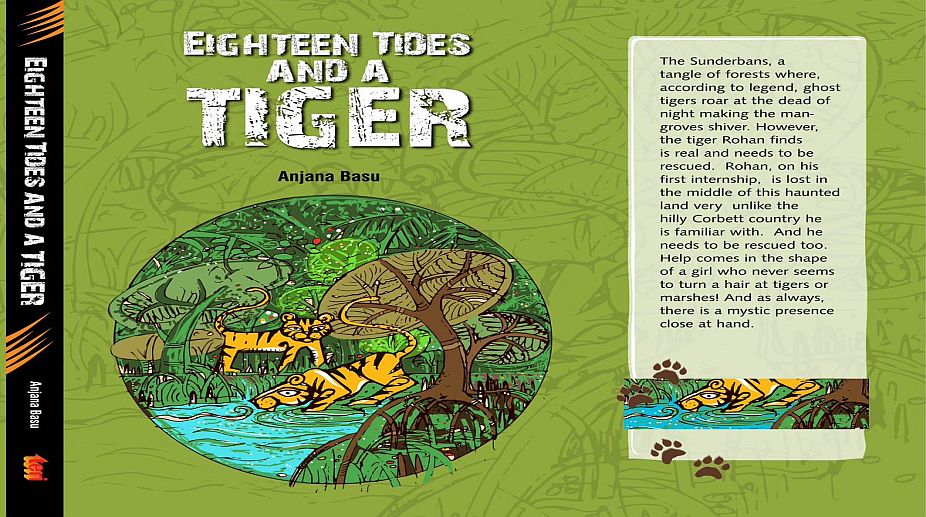
The tale begins with an observation of man-animal conflict perceived by an adolescent. Both Anjana’s forewords reflect her two passions — poetry and children! The latter she treats with amused affection and immense patience. Her nephew Rohan’s foreword says that three people were killed by tigers in the Kumaon because “the tiger was terrified on seeing them. This is an example of man-animal conflict”. The message —here’s a story about tigers and children — and not necessarily in that order.

The protagonist (Rohan) is “almost grown-up” but retains his wonder of all things natural and spooky. Manjul (like Rohan she was also there in the earlier stories) is an example of changing village conventions, although she still lives in a hut and herds her family’s cows, Manjul continues to go to school and aspires to be a forest official.

This time Anjana takes her protagonist to the Sunderbans — the land of 18 tides and many tigers and Rohan has to stop thinking “dry footed tigers”. There are tigers aplenty — the first appears in the night on the deck of a boat — respectfully called mama (uncle) by the boatmen. The second is a young tiger in distress. There are also tiger sightings, tigers stalking and scaring tourists — swimming with ease from one island to the next with scant respect for political borders!
Woven into the fabric of the story are the legends of Dakhin Rai and Bon Bibi — the fearsome tiger god and protector of the tigers — the former feared and appeased and the latter worshipped in the Sundarbans. Enter Bibi, a girl who poles a country boat at dead of night; she may be from a nearby village but then she has the skill to appear and disappear without a trace, keeping Rohan (and the readers) on tenterhooks. There is also a gunin (holy man) who blends in with the tree he inhabits, revered by villagers and on call with the Forest Department. Another high point is a fearsome wrestling match between two tigers which reminds one of Amar Chitra Katha stories. By now, Anjana aficionados are asking “But what of Carpet Sahib? Where is the shade of Jim Corbett?” Rohan thinks his mentor doesn’t like mangroves and swamps, but he’s proved wrong.

There are adults we’ve met before,The Khan Sahib and the Major, who give children a chance to have adventures. The tigers are terrifying, but the author explains how cornered they feel with increasing encroachments on their habitats. It’s interesting to see that as always, Bibi shares the stage with Rohan and the tigers. So there are really many tides, lots of creeks and streams, many tigers and multiple protagonists. There are also many stories within the tale. Tiger stories, monkey stories, account of the origin of the Gosaba; and the story that Bibi tells Rohan about young Dukhi. What’s enchanting about the book is that it is told from an adolescent’s perspective. As Ahmed Bhai says, “Who knows what happens in Bonbibi’s forests?”

Read the book to find out what does happen. It will tickle your imagination and may encourage you to take a boat and wander down the creeks that criss-cross the Sunderbans; peering into the undergrowth to see tigers that may or may not be lurking. And if you go, do say a prayer at Bonbibi’r than for protection — small shrines dedicated to Bonbibi in the Sunderbans.

The reviewer is a freelance contributor