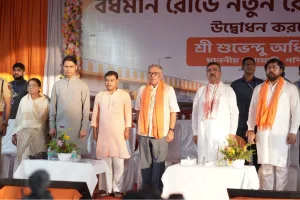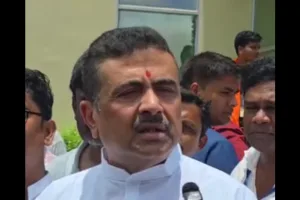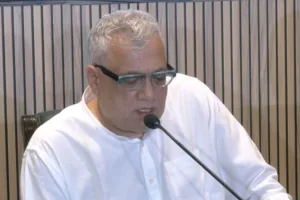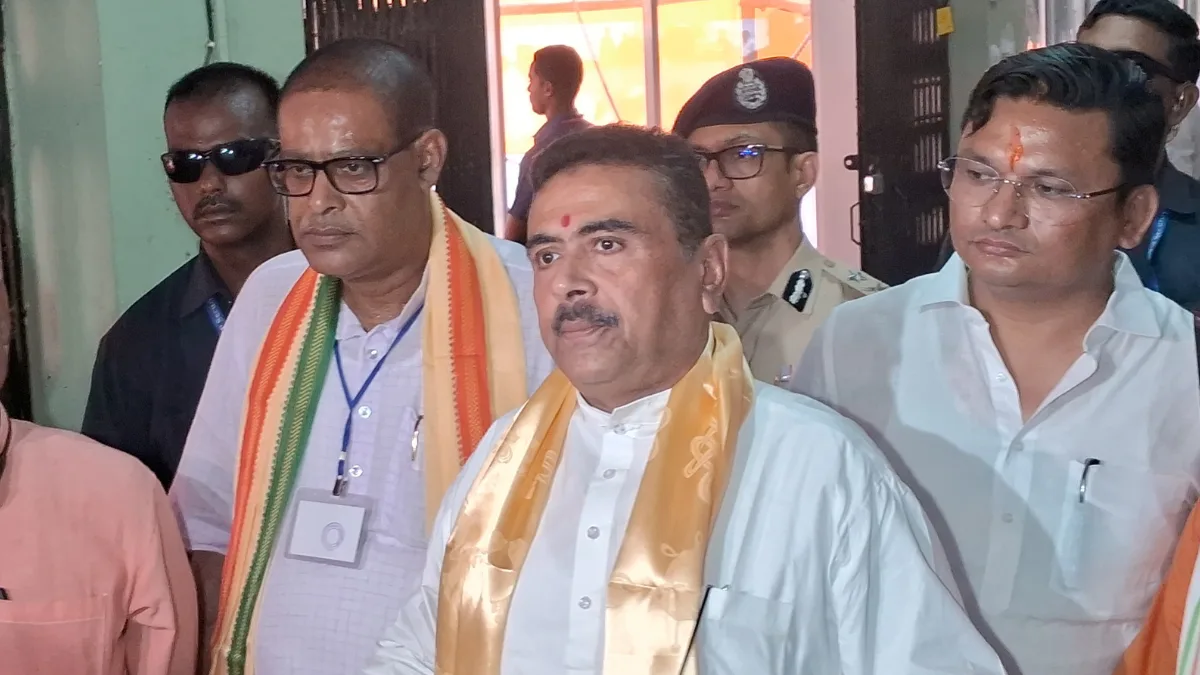
West Bengal Chief Minister Suvendu Adhikari on Monday called upon migrant workers to return home, assuring that his government would ensure employment opportunities within the state and that there was no longer any need for workers to migrate in search of jobs.
Addressing the media after distributing financial assistance to the families of 11 labourers from Jalpaiguri and Alipurduar who died in the recent tunnel tragedy in Sikkim, the Chief Minister said, “I appeal to all migrant workers to come back. There will be ample employment opportunities for them here.”
He said the state was passing through an “Amrit Kaal of development” and asserted that employment generation had improved significantly. Highlighting industrial and agricultural initiatives in North Bengal, he said projects centred on makhana cultivation in Malda, pineapple, maize and Tulaipanji rice were being developed in other districts of North Bengal.
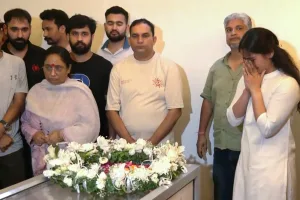
The Chief Minister had arrived in Jalpaiguri to hand over financial assistance to the families of the 11 workers from Nagrakata, Meteli and Falakata areas who lost their lives in the NHPC Teesta Stage-VI tunnel accident in Sikkim. The state government had earlier announced an ex gratia of Rs 5 lakh for each bereaved family.
After the programme, Adhikari said all 11 families had received the assistance. He added that seven family members had been offered jobs as Home Guards, while four others, who did not meet the eligibility criteria for the Home Guard posts, would be appointed as Civic Volunteers.
He said each bereaved family would receive a total compensation of Rs 21 lakh from different sources. According to him, the amount includes Rs 5 lakh from the West Bengal government, Rs 4 lakh from the Sikkim government, Rs 5 lakh from NHPC, Rs 5 lakh from the construction company where the workers were employed, and Rs 2 lakh from the Prime Minister’s National Relief Fund.
Responding to questions on the Sikkim tunnel tragedy, the Chief Minister said the inquiry was being conducted by the Sikkim government and that it was not a matter for the West Bengal government.
“The Chief Minister of Sikkim is fully competent and is supervising the inquiry,” he said. According to the information available so far, a hazardous gas had reportedly leaked inside the tunnel. “Had rescuers entered the tunnel immediately, they too might have lost their lives,” he added. The Chief Minister said officials from the Sikkim government had come to Jalpaiguri today and were handing over financial assistance to the families of the deceased workers.
Describing his visit as a humanitarian responsibility, the Chief Minister reiterated that labourers from the state need not seek employment elsewhere. Referring to the Centre’s employment initiatives, he urged workers to obtain job cards, saying the eligibility norms had been relaxed and that the government was committed to providing up to 125 days of employment.
He also highlighted various welfare measures, including enhanced old-age and widow pensions, expanded Ayushman Bharat health coverage for nearly 40 lakh senior citizens in West Bengal, and a separate state health scheme for those not covered under the central programme.
Referring to support for farmers, Adhikari said the assistance under the PM-Kisan scheme had been enhanced and the state government would also provide additional financial assistance Rs 4,000 to eligible cultivators for agricultural activities.
He further said that August 16, previously observed as “Khela Hobe Divas” under the former state government, would now be observed as “Ayushman Divas”. He also claimed that improvements in the quality of food grains supplied through the public distribution system and expanded welfare schemes would discourage distress migration.
The Chief Minister said issues relating to OBC reservations had largely been resolved, which, he claimed, would open up greater employment opportunities in the state.
On the issue of closed tea gardens, the Chief Minister said the Chairman of the Tea Board and the state’s Labour Minister, Arjun Singh, had recently held a special meeting to discuss the matter and that efforts were underway to resolve the issue. He said the proposed Prime Minister’s Tea Workers’ Assistance Scheme, with an outlay of Rs 330 crore, would provide relief to workers of closed tea estates once implemented. Expressing optimism, Adhikari said the government expected 12 to 13 closed tea gardens of the 25 to reopen within the next two to three months, bringing relief to thousands of workers and their families.
At the programme, Adhikari symbolically handed over cheques to the families of three deceased workers — Anand Toppo, Bolo Oraon and Bireshwar Oraon — before the remaining beneficiaries received the assistance. He met the family members individually, including parents and spouses of the deceased, and expressed his condolences.
Speaking informally with journalists, the Chief Minister said he would visit Jalpaesh Temple, as it was the holy month of Shravan, before proceeding to Uttarkanya for an administrative review meeting. He also indicated that alleged irregularities in various departments at Uttarkanya were under examination and that details would be shared with the media after the review.