Logo

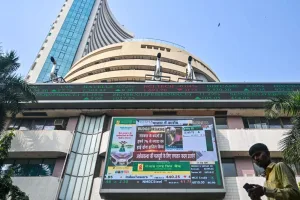
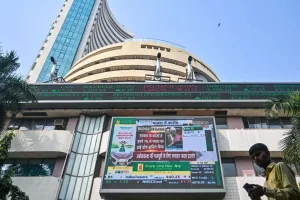
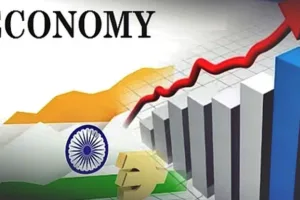
Sensex declines 50 pts in morning trade; Nifty slips below 8,800

SNS | New Delhi |

Tracking mixed Asian peers, domestic equity markets started Tuesday’s trading session on a lower note. At 9.40 am, the Sensex at the BSE was trading 50 points down at 28,302 and the Nifty at the NSE was trading 21 points lower at 8,784.

In the broader markets, BSE Midcap and Smallcap indices declined 0.5 per cent and 0.2 per cent respectively.

Among the BSE sectoral indices, Realty index was trading with the biggest gain, up 0.2 per cent, while Auto index became the top loser, down 1 per cent.

On Monday, the Sensex had closed 17 points higher at 28,352 and the Nifty had closed 12 points up at 8,805.

Top gainers in the Sensex-30 pack: Adani Ports (up 1.1 per cent), Reliance Industries (up 1 per cent), ONGC (up 0.9 per cent), ITC (up 0.5 per cent) and Cipla (up 0.4 per cent).

Top losers in the Sensex-30 pack: Hero Motocorp (down 2 per cent), Tata Motors (down 1.6 per cent), Bajaj Auto (down 1.6 per cent), Asian Paints (down 1.3 per cent), and Coal India (down 1.2 per cent)

Meanwhile, the Rupee was trading nine paise higher at 66.93 against the US Dollar.

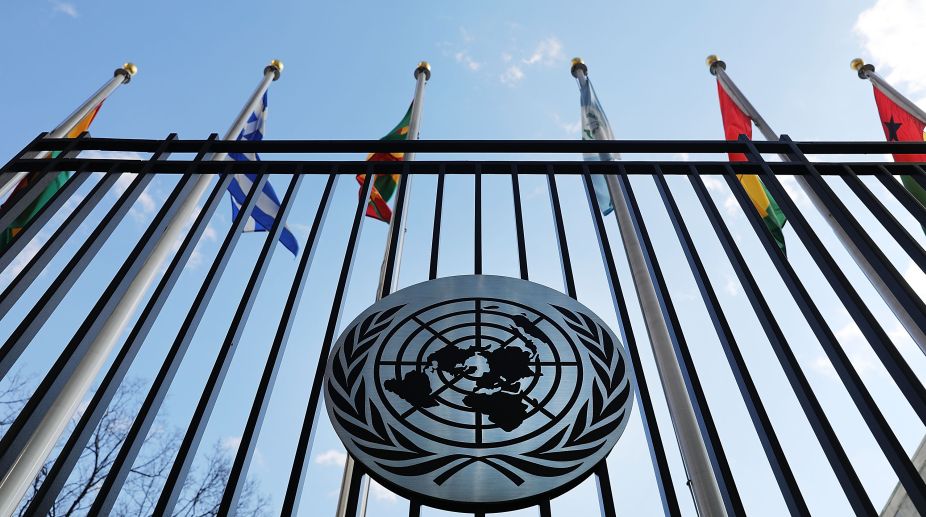
UNSC condemns N Korea missile launch, US demands actions

IANS | United Nations |

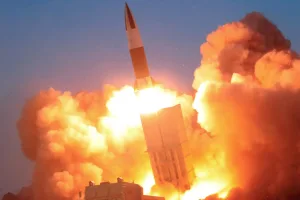
The UN Security Council unanimously condemned North Korea's latest missile test, while the US pushed for the response to include actions, and "not just words", the media reported.

Pyongyang's first military challenge since Donald Trump's arrival in the White House came on Sunday, when North Korean leader Kim Jong-un personally supervised the launch of a medium-range ballistic missile that landed in the Sea of Japan, Efe news reported.

On Monday, the Security Council held an urgent meeting to analyse the evidence and released a statement condemning the action.

In the statement, similar to earlier occasions, the highest decision-making body of the UN threatened to impose new "significant measures" against the North Korean regime, which would add to the harsh sanctions already in force.

In a communique by all 15 members, the Council declared that the North Korean missile launch was a "serious violation" of the country's international obligations and urged the regime to stop such actions.

However, no member state wanted to speak of possible concrete actions, while many insist on the importance of full implementation of existing punishments.

The new US administration, which is facing a North Korean missile launch for the first time, called on the Council "to use every available resource to make it clear to the North Korean regime – and its enablers – that these launches are unacceptable."

"It is time to hold North Korea accountable – not with our words, but with our actions," US ambassador to the UN Nikki Haley said in a statement.

Japan, which together with the US and South Korea requested an urgent meeting, was very satisfied with that clear message and suggested that it does not seek a new resolution against Pyongyang, but rather a way to strengthen the implementation of the current measures.

China, which in recent years has distanced itself from the North Korean regime as a result of its continuing weapons tests, also condemned Sunday's test.

At the same time, China also called upon all countries involved – in reference to the US, Japan and South Korea and their usual military manoeuvres in the region – to refrain from actions that might aggravate the situation.

The statement agreed by the Council stresses that Sunday's test contributes to the development of systems capable of transporting nuclear weapons.

The UN Secretary General, Antonio Guterres, also condemned the missile launch, which made it clear that this constitutes a new violation of existing UN Security Council resolutions.

Guterres has urged Pyongyang to change course and take the path of denuclearisation in order to comply fully with its international obligations.

EPL: Manchester City go second with Bournemouth win

Thanks to Raheem Sterling and a Tyrone Mings own goal, Chelsea's lead is cut to eight points!

SNS | New Delhi |

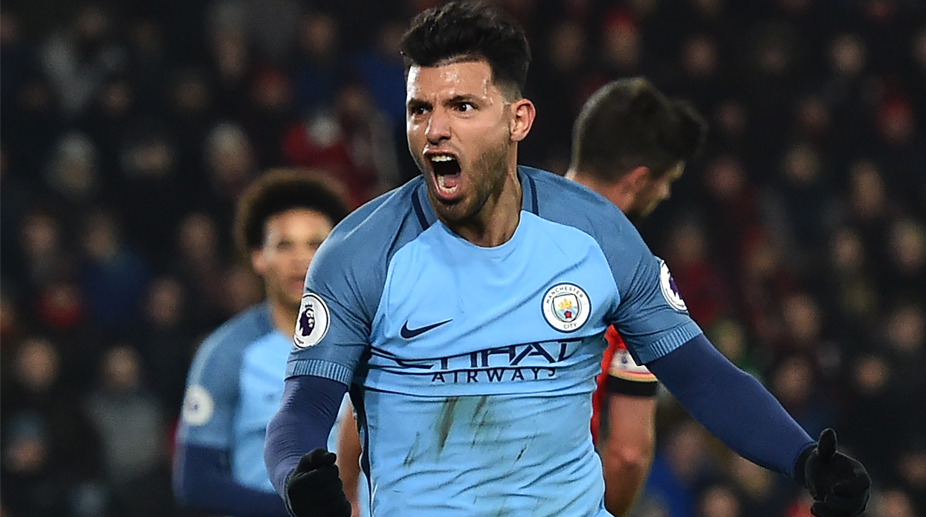
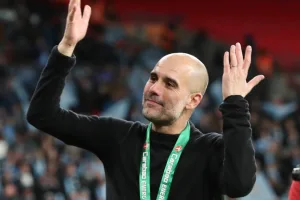
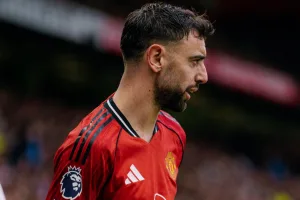
Manchester City on Monday night sidestepped a potential banana-skin, beating Bournemouth 2-0 away to rise to second in the Premier League table, cutting leaders Chelsea’s lead to eight points but it wasn't all hunky-dory at the Vitality Stadium.

For new signing and goalscoring sensation Gabriel Jesus had to be taken off as early as the 15th minute, with Sergio Aguero replacing him much to the worry of the travelling City support.

Despite the early setback, however, City utterly dominated the first half-hour, with Leroy Sane in particular running the show on the left wing and causing Eddie Howe’s men all sorts of problems.

He set up Raheem Sterling after good work on the flank but the winger’s shot was blocked by some last-ditch defending from the home side and even Kevin De Bruyne could not finish the rebound.

Yaya Toure then went close to finding the breakthrough but his curling, left-footed shot from the edge of the box was just wide.

It would be Sterling who would be the man who scored City’s 50th league goal of the season and the opener on the night. Sane had again beaten his man and while his cross got a slight deflection, Sterling was on hand to volley home from inside 5 yards in the 29th minute.

Bournemouth picked up the pace then and even had a goal disallowed as Joshua King was adjudged to have manhandled John Stones moments before finishing past Willy Caballero.

The Cherries were forced to make a substitution of their own as Jack Wilshere went down in the first half, with Benik Afobe replacing the Arsenal-loanee. 
After the break Bournemouth pressed for an equaliser, but Caballero proved to his manager Pep Guardiola that he is worthy of starting week in, week out for City with a fine save from Harry Arter.

Sterling then turned provider for the goal that sealed the deal, brilliantly beating his man on the left wing before sending in a dangerous ball which Sergio Aguero got a telling touch to in the 69th minute. Replays showed Aguero’s marker Tyrone Mings had the last touch, but City didn't care as they had the three points in the bag.

After Tottenham had been upset at Anfield on Saturday, City knew they had to win against Eddie Howe’s men, and while it wasn't a display of breathtaking attacking football, it was enough to clinch the result. They are in a good position as the Premier League enters a ‘mini-break’ of sorts, with domestic and continental cup competitions taking place for the next ten days.

And they will await the result of Jesus’s ankle scans anxiously, hoping the young Brazilian is back from injury without much delay as the business end of the season nears.

Love is in the air

Sushmita Kamrupa | New Delhi |

It is that time of the year again! The unmistakable hint of ‘love is in the air’ cannot be denied. It's the d-day for lovers as they rejoice on the day to immerse themselves into romance and sweet nothings with their partners.Love, however, is not just about roses and sweet nothings, it is also about friendship, a companionship that one shares with that special someone in the journey called life.

Harp is one such book that talks about love, life and its many mysteries that seem to boggle us everyday.

Harp by first time author Nidhi Dalmia is set in the late sixties and the story is woven through the journey taken by the protagonists.

The story evolves as they move across India, countries in Europe and the USA in search of their dreams, love and personal growth.

As the story moves, the protagonists find themselves in battle against their own heart, young minds, perturbed by the complexities that love presents.

A story about young ones finding their footing in the world as they chase their passions to make a career out of it and find themselves in the middle of cultural and social revolutions which not only changes things around them but also makes them question and ponder about the course of their lives and find answers for the quest within.

As the story takes a turn towards the end, the protagonists find themselves on crossroads with love and life, something that exists simultaneously but many times one has to choose a priority.

A story of love and heartbreaks, the book deals with real emotions written with ample use of imagery, painting vivid pictures of the faraway lands and engaging the reader with its pictorial depictions of settings and surroundings.

As Ashok, the protagonist, travels through the niche areas of Europe, the readers get a glimpse of local culture and the beautiful terrains of the inner, lesser known areas of the continent.

As the story cuts through various settings the descriptive narrative makes the journey as a reader quite interesting. At the end, the reader is left with memories of young love and its challenges, as true as life itself.

ACG-NBA Jump National Finals: Young hoopsters off to a dream-like journey

21 ballers were named for the initial batch to receive scholarships and training at NBA Academy India.

Akash Khanna |

When young talent is nourished to excellence, the journey is a fairy tale come true. Twenty such young hoopsters from India are off to live a dream-like journey with the primer academy to be established here at National Capital Region by the National Basketball Association (NBA) and the ACG Worldwide Group in April 2017.

Following a nationwide trial ‘ACG-NBA Jump National Finals’, 21 ballers were named for the initial batch to receive scholarships and training at NBA Academy India. However, three more hoopsters will join the initial batch through a wild card sort of equation.

“These are 21 best kids, which we have selected after sitting with four different coaches watching and analysing their performance and development in the past three months,” NBA India Managing Director Yannick Colaco told thestatesman.com in an exclusive​ interview.

ACG-NBA conducted tryouts in six regions, including Mumbai, Delhi, Ludhiana, Kochi, Chennai and Kolkata, following the finale at Jaypee Greens, Noida on Saturday, featuring top 45 prospects from across the country.

Colaco said he has seen “tremendous potential” in Indian kids for the game of basketball over the past two-three years and aims for the paramount with such initiatives for the growth of the game.

"We are focused on grassroot development program. Besides this, we have junior NBA program, which has now near 40 lakh kids in it. We continue doing these things to facilitate the growth of basketball in India, both for talent development as well as for creating a fan base,” he added.

Refining the very best talent out of the whole lot wasn’t an easy task for Colaco and his team as he called this three-month tryouts “a scouting process to find young talent” out of both – who played for national at various levels as well as those who always strived for one big chance.

“We wanted to see how developed they are as a basketball player and what is the potential for them to become better," Calaco said.

The 21 selected hoopsters reflected different shades of a single hue as the lot consisted players from all across the nation. Each kid will be staying here in the academy premises throughout the completion of the course.

The 14-year-old baller from Chhattisgarh, Rishabh Jaiswal, who was the last boy to make the cut in the final 21, counts it as the biggest ever opportunity for him and other selected boys.

“Coaching staff and facilities here are amazing and I am happy that I’ve got selected. We’ll stay here and learn a lot of new, good skills,” the humble hoopster said.

Rishabh has been playing basketball for the past three years and has featured in the Nationals, Open Nationals and School Nationals in the past. He has also captained Chhattisgarh state team that brought him under the spotlight in front of the NBA.

“It’s a great platform for youngsters like us as there isn’t much things happening for the growth of basketball, in compare to other sports. We hope to benefit best out of it and do great with the sport in future,” 14-year-old hoopster form Uttarakhand, Riyanshu Negi joined in.

“I am excited to be a part of this academy and it feels like stepping up closer to my dream,” Prashant Rawat, 16, six-feet-six-inches-tall shooter from the city of lakes Nainital, said.

The 24 players will get scholarships and training at the NBA Academy India, the first of its kind institute in the country and the NBA’s fifth elite training center globally.

Selected batch: Manoj Sisodiya, Md Ali, Riyanshu Negi, Amaan Sandhu, Sejin Mathew, Virat Dhakad, Achintya Krishna, Rajveer Bhati, M Shanmugam, Shaurya Kohli, Prashant Rawat, Vivek Chauhan, Jagshaanbir Singh, Brijesh Tiwari, Arvind Kumar, Robin Banerjee, Digvijay Shekhawat, Preshit Pawar, Suraj Phathak, Parth Sharma, Rishabh Jaiswal.


Trump, Trudeau create committee to deal working women issues

IANS | Washington |

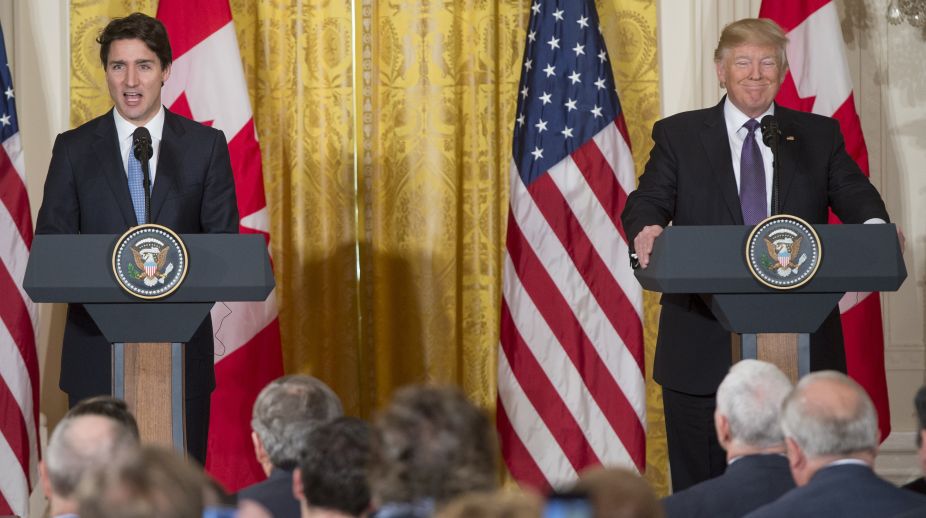
US President Donald Trump and Canadian Prime Minister Justin Trudeau on Monday announced the creation of a bilateral committee that will deal with the challenges posed to women in the workplace and how to increase their participation in the economy.

The two leaders participated at a White House round table with business executives and entrepreneurs within the framework of Trudeau's official visit to Washington, EFE news reported.

"In order to create economic growth and well-paying jobs we must assure the economy is a place where women can work and thrive," said Trump in brief remarks at the beginning of the round table.

Trump said that it is necessary for the US to adopt policies to keep women in the workforce, make it easier for them to both hold a job and deal with family issues and increase their access to capital.
Meanwhile, Trudeau emphasised the need to break down the "significant barriers" that continue to exist for women in the workplace and create more pathways to success.

Seated at the side of the Canadian premier was Ivanka Trump, the President's daughter who during the election campaign helped her father promote a tax plan to provide childcare and more affordable daycare centres.

Ivanka, who has a very close relationship with her father, still does not have an official title or duties within the new government.

The White House said that the bilateral Council for the Advancement of Women Business Leaders-Female Entrepreneurs is a sign of both Trump and Trudeau's commitment to eliminating barriers to the economic participation of women.

After becoming Canada's Prime Minister in November 2015, Trudeau fulfilled one of his campaign promises and named an equal number of women and men to his cabinet.

Trump, on the other hand, has selected very few women or minorities for his cabinet posts.

This was the first bilateral meeting between the two leaders since Trump became President on January 20.

Trump is expected to discuss with Trudeau his aim to renegotiate at the earliest opportunity the North American Free Trade Agreement signed by the US, Canada and Mexico more than 20 years ago.

In Canada, both conservatives and liberals feel that NAFTA, implemented in 1994, has been a key element in their country's economic well-being by enhancing trade between Ottawa and Washington to the point where they are now the world's two top trade partners.

Meanwhile, Trudeau wants to avoid conflictual issues, including immigration or the taking in of refugees in his meeting with Trump, so that the pair may establish a good relationship as quickly as possible.

After a private luncheon, Trump and Trudeau are scheduled to hold a joint press conference in the East Room of the White House.

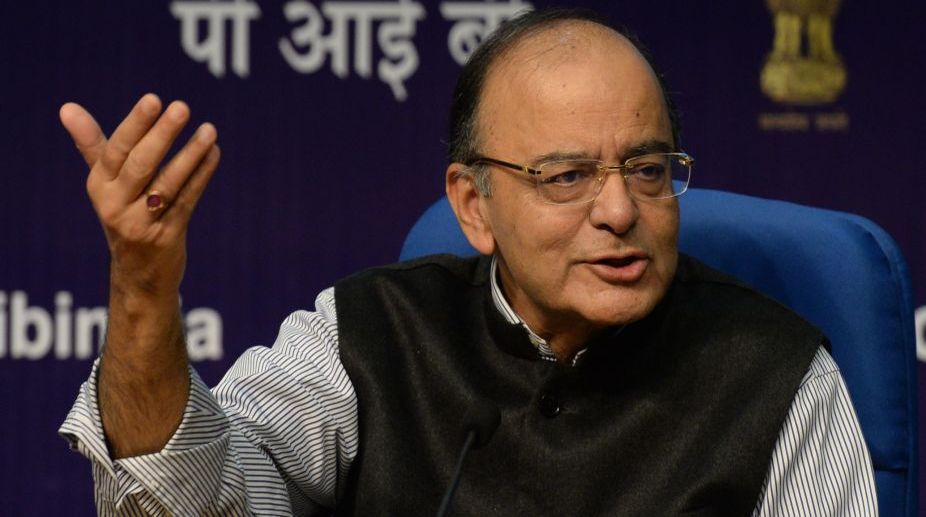
No impact of global slowdown on India: Jaitley

IANS | Bengaluru |

India remained unaffected by global slowdown and the rhetoric of protectionism in developed economies, said Union Finance Minister Arun Jaitely on Monday.

"Unpredictable global slowdown and the rhetoric of protectionism in developed economies have not affected India," he said at the 'Make in India – Karnataka' conference here.

Asserting that the government would continue to focus on investments and growth, Jaitley said the policy-makers were under pressure as the people wanted the country to grow at a faster rate.

"Unlike in the developed countries, we don't get to hear about protectionism in India, which indicates that we are willing to accept investments and fine tune our policies," he said.

Calling upon the state governments to work together with the central government for going ahead on the growth path jointly, the Finance Minister said the country had hunger to grow faster than the current (GDP) rate of 7-7.5 per cent.

"We are not satisfied with the tag of being the fastest economy in the world. We think we have a potential to do better," he pointed out.

Lauding Karnataka for proactively taking part in realising GST (Goods and Services Tax) by the middle of this year, Jaitley told the gathering that the state would accrue a lot of revenue when the new tax regime was implemented.

"Karnataka was the first state to become an educational hub in the country. As the state had limited resources, it allowed private organisations to enter the education sector by providing a conducive atmosphere and infrastructure," he added.

Organised by the state Department of Industrial Policy and Promotion (DIPP) and the Confederation of Indian Industry (CII), the two-day conference is showcasing the state as an investment destination across the sectors.
 

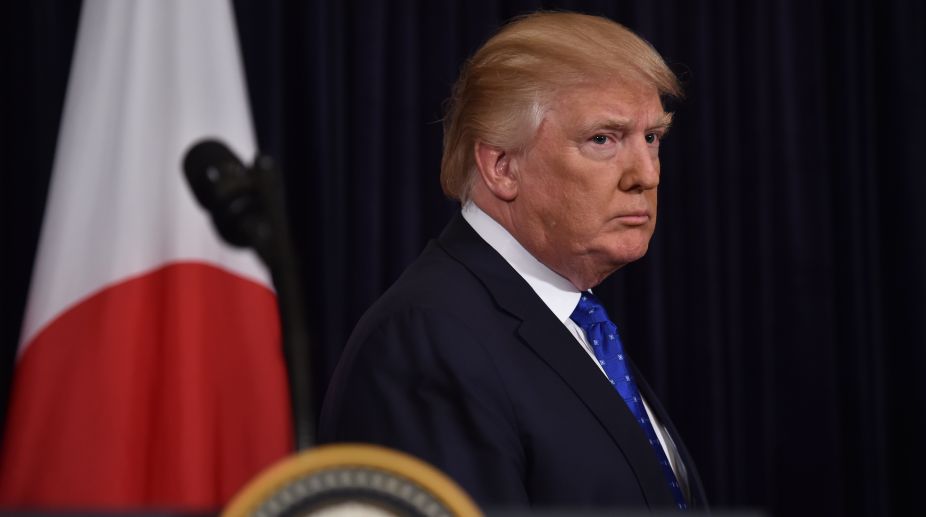
US will deal with North Korea ‘very strongly’, says Trump

AP | Washington |


President Donald Trump is vowing to deal with North Korea "very strongly" after the country's latest missile test.

The weekend test has been seen as an implicit challenge to Trump, who has vowed to take a tough line on North Korea.

Trump says at a joint press conference with Canadian Prime Minister Justin Trudeau that, "North Korea is a big, big problem and we will deal with that very strongly." 

Trump has yet to release a strategy for dealing with North Korea's nuclear ambitions. He delivered a brief statement Saturday night saying the US will stand by Japan "100 per cent."

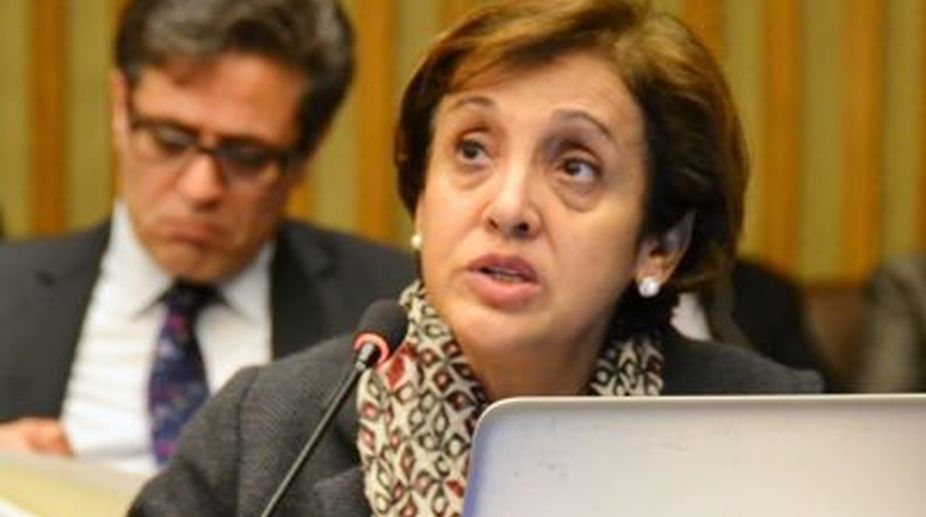
Tehmina Janjua becomes Pakistan’s first woman Foreign Secretary

IANS | Islamabad |

Tehmina Janjua was on Monday named Pakistan's new Foreign Secretary, becoming the first woman to become the country's top diplomat.

Janjua, who pipped several senior colleagues including High Commissioner to India Abdul Basit, will succeed Aizaz Chaudhary who was appointed as the new Ambassador to Washington.

Presently serving as Ambassador and Permanent Representative to the UN in Geneva, she will take over as the country's 29th Foreign Secretary in the first week of March 2017, a Foreign Office statement said. 

A seasoned diplomat with a career spanning over 32 years, Janjua holds a Master's degrees from Quaid-e-Azam University, Islamabad, and Columbia University, New York. 

She also served as spokesperson of the Ministry of Foreign Affairs during 2011. 

Janjua served as Ambassador of Pakistan to Italy from December 2011 to October 2015.

Her appointment belied media reports that Abdul Basit, envoy to India, was to be the top diplomat.

Had seniority been the only criterion, he would have been a certainty.

Sources said that he was Prime Minister Nawaz Sharif's first choice for the job in 2013 when he was asked to return to Islamabad from Berlin. But, Sharif changed his mind and picked Chaudhry instead for the post.

Basit was sent to India as High Commissioner. But, sources said this time Basit was out of favour with Sharif, who is believed to be displeased with his hosting of Kashmiri separatists in New Delhi.

With the change of the Foreign Secretary, major reshuffle would take place in Pakistan's envoys in important capitals, sources said, adding that changes will also take place within the Foreign Office as well. 

 

A definite transformation

Prakash Rengarajan |

A 2015 report by the United Nations Educational, Scientific and Cultural Organisation Institute of Statistics mentions that 74 countries face an acute shortage of teachers. Nigeria tops the list and India falls second. The country needs about 3,70,000 new teachers to meet the demand for primary education and 3 million by 2030. 
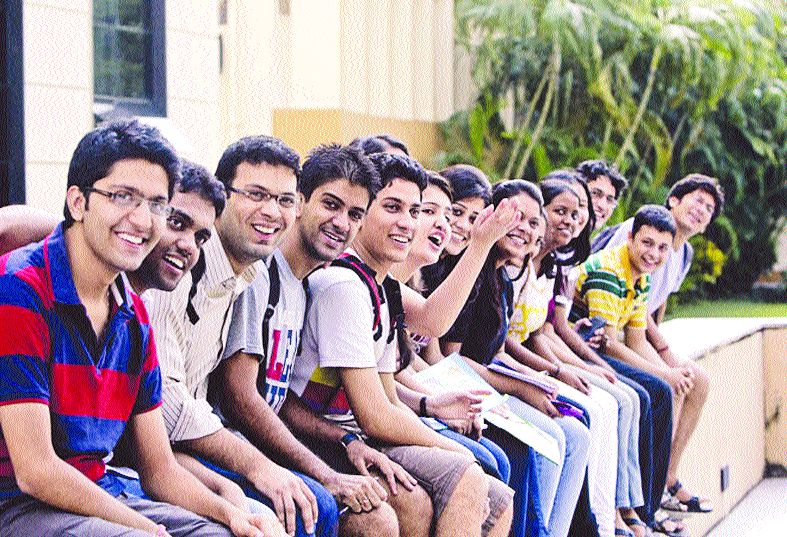
Given all these statistics, there is a need to look at different means of learning delivery in the country. The Indian education sector is undergoing changes towards a digital revolution and there is a change in the relationship between students and teachers. Owing to the increased Internet penetration and the use of mobile devices, technology is modernising how education is delivered and disseminated. 

It is not only making learning more enjoyable and engaging but also redefining the way teachers feel about their role in the system. The field of e-learning has given rise to digital classrooms which are beyond the limits of time, location, and demography. Many advanced digital learning tools have enabled students and teachers to learn and teach better. It has lead to the creation of adaptive learning and teaching. Many startups are changing the way education is delivered and making it accessible to one and all.

The formula for effective teaching comprises not only imparting knowledge but also gauging at depth level of understanding of each student and offering personalised learning mechanisms. The current system is undergoing dramatic changes in terms of technology use and the way education is being packaged, presented, and delivered. 24 X 7 learning environments have now sprung up which cater to wider strata of participants. E-learning programmes and innovative online coaching platforms are giving students and professionals’ greater choice in terms of new learning arenas as well as the pace at which it is imparted. 
Technology- enabled digital classrooms have brought in the concept which allows for greater interaction at an individual level as well as peer sharing and discussion. One such startup integrating technology with education is HelloClass. The app is beneficial to students and instructors alike.

 It not only offers an integrated tutoring service but also connects tutors to a larger audience, allowing them flexibility in terms of teaching hours and convenience. 

Education today is not restricted to the four walls of a classroom. With virtual classrooms, learning has become attainable and one can get access to materials from everywhere and at any time. Digital learning is now being used as a flipped classroom further adding value to how education is imparted. 

This has also become more adaptive and collaborative with more weightage being accorded to practice, experience, and sharing knowledge in a collaborative environment. Teachers and students alike can be located in any part of the world but through digital technology, they can interact with each other at the click of a button.

A last mile in digital learning will be impactful only when the larger vision of integrating technology into the education system becomes a reality. All this would require investment in digital infrastructure and e-content that is affordable as well. 

There is a lot of governmental focus on integrating technology with learning throughout India, as one of the components of the Digital India programme. Technology integration is aiming to not only take education to every doorstep but also meet the demand for quality providers in the country. The future of e-learning looks promising and has immense potential. 

The writer is co-founder and cheif executive officer, HelloClass

More reforms with less resources

Ashutosh Dash |

India, the youngest country in the globe with 50 per cent of its population below 25, certainly needs an extra emphasis on education as a key pillar for economic development. Apropos, the listing of education amongst the nine pillars of the last year’s budget, have soared the public expectations for this sector. Delicately the budget 2017 tried to please by delving into more reforms, along with the enduring ones, by deploying less than expected resources.

Reforms in higher education like restructuring of the University Grants Commission, autonomy for major institutes, thrust on outcome-based learning, increase in size of medical education, establishing national testing agency might be radical steps in enhancing quality of education without putting a sizeable burden on government exchequer.

While about six per cent of the GDP is allocated to education sector this year, the percentage does not look that encouraging. For giving impetus to quality education, ideally a seven to eight per cent should be considered. An elevated fund allocation would have provided a much important outlook of India as a nation keen in building its human capital.

The budgets of last couple of years have centred on creating new IITs, IIMs, AIIMs, etc and the current budget, continuing the trend, has proposed to set up two AIIMs. These new institutions of higher learning though are operational today, yet suffer largely from qualitative issues especially in terms of infrastructure and faculty. At this juncture a 10 per cent increase in the budget for overall with a bigger thrust on higher education is certainly an encouraging step forward.

Further somewhat more emphasis to IITs and AIIMs re-emphasises government’s concern for pure sciences over social sciences.

Most of the Indian institutes, be it IITs, IIMs or institutes of national importance stand nowhere in global rankings for lack of basic research and development infrastructure. To thrust on world-class infrastructure, some premier institutes both from public and private sectors would have been supported in continuance with the allocations made in previous year. This would have expanded employment opportunities to the large population of research scholars passing out of these premier institutes.

Building human capital though is essential for development of countries like India, but higher education does not seem to be quite affordable for the average youth of the country. The wide public expectation on a better and larger rebate on interest and principal repayment on education loan could remain unaddressed in the recent budget.

The demand to equate the tax treatment of house building and educational loans seems quite genuine in a knowledge based economy like ours and certainly needs to be addressed in future. Even some more tax benefits on higher education loans for Beti Padho would have added a feather to the ongoing awareness programmes for girl children.

Owing to limited access and heavy cost, many are deprived of higher education. The usage of DTH channels to link online courses available on the Swayam platform for free of cost would certainly enable student access to resources. This is a prominent drive in continuation to digital India programme and would support the initiative of women empowerment and education particularly by targeting the population beyond mainstream. But Swayam already had a soft launch and is not a new education scheme of the current year.

In spite of government allowing 100 per cent FDI in education sector, it has not experienced a great success. This probably needs a liberation model and the academia was eagerly waiting to see some budgetary provisions. It could have sent a positive vibrant signal to the global world class institutes for building strong tie-ups with existing institutes of higher education or bringing new infrastructure to the country.

Another alternative expected from the budget in this direction was to put more focus on exploring the possibility of Public Private Partnership model in education sector to provide more access to qualitative higher education to Indian youth.

Overall the budget tried to focus more on enriching the quality and access to education sector. Even though several good measures are introduced in this year’s budget, especially higher education, many things remain untouched.

However, it is expected that the future budget allocation would be more progressive and will make healthy moves towards strengthening the country’s growth.

The writer is associate professor finance, MD, Gurgaon.

Battling China in the region

Harsha Kakar |

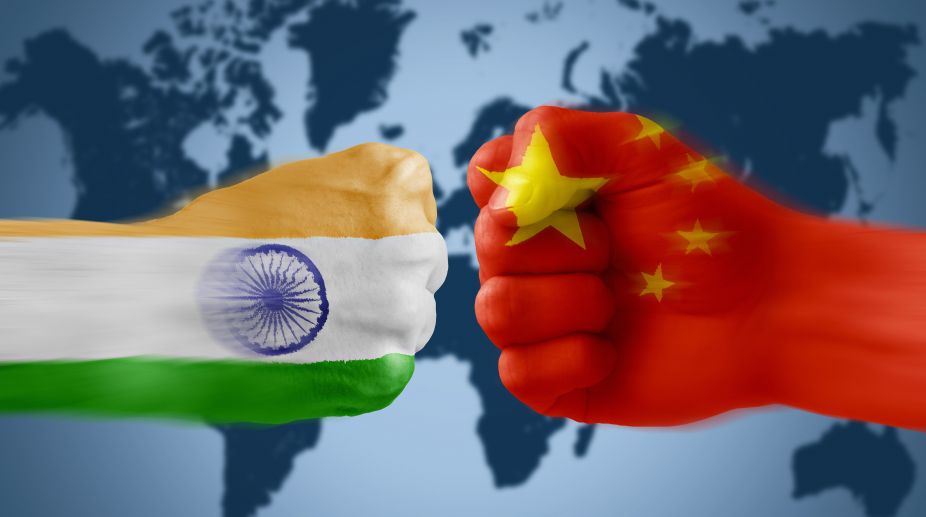
A news report over the weekend stated that China has warned India to stay off its ‘own colony’ Sri Lanka. For China, India is a major competitor in Asia. On the one hand, it has suggested that India join the China Pakistan Economic Corridor (CPEC) and One Belt One Road (OBOR) projects which it has initiated while conversely it has ensured that India is kept at a distance in every international forum. While borders remain peaceful, transgressions continue although a strong Indian response indicates that India is capable of responding. The Indo-China border dispute lingers on, with China raking up the Arunachal Pradesh and Dalai Lama issues at frequent intervals. Chinese actions and words have always been at variance.

To embarrass India, it has repeatedly blocked the UN from designating Azhar Masood as an international terrorist despite the West joining hands with India to push the case. It has also prevented India’s entry into the NSG. It would never accept India as an equal in the UNSC. Its support to Pakistan is well known, hence it would never permit anyone to criticise it in any international fora. It continues to arm Pakistan, ensuring that it remains a thorn in India’s military and economic development. Its involvement in the CPEC and Gwadar port only enhances security concerns for India.

China is now seeking to become a dominant power in the sub-continent, offsetting India. While it cannot influence the region directly by political means, it has begun employing its economic lever. It has enhanced its investment in Nepal aiming to reduce Indian influence and has bulldozed its way into Sri Lanka, taking over the Hambantota port on lease for 99 years. Its investments in Myanmar and base in Coco Islands are designed to counter Indian domination in the Indian Ocean. It has provided submarines to Bangladesh as also increased economic investments in the country. China is in secret talks with the Taliban, while seeking to gain leverage in Afghanistan. In the Maldives, with the present government being anti-India, Chinese investments have increased and it is also likely to develop an airport there. The only country  where it has yet to make deep forays in India’s vicinity is Bhutan.

Most countries in the sub-continent are economically weak. They desperately seek investments and infrastructure development. Presently, India’s influence in the neighbourhood is such that heads of state make New Delhi their first port of call. While India provides them with aid and seeks to incorporate them in its growth, however being a democracy it takes time before promised investments take root, since funds are dependent on nature of projects, as against China which moves much faster.
A clear case has been the Chabahar Port in Iran. India has yet to make any headway as it still awaits Iran’s response, prior to transferring funds for commencement of the project, while in China’s case, the intention to develop the CPEC was announced in Nov 2014 and it has already been operationalized. In addition, China’s economy is five times the size of India’s.

China’s investment in the region is pushing India to a secondary position. The investment also opens doors for Chinese goods, which are much cheaper and result in reduced Indian imports. Thus, nations end up with an adverse balance of payments which China can subsequently exploit. India’s attempts to challenge Chinese power in both Mongolia and Vietnam made almost no progress. Mongolia buckled under Chinese economic pressure and agreed to never invite the Dalai Lama again, while gently ignoring India’s offer of aid. Vietnam though still in touch with India for military purchases, is moving forward cautiously, mainly due to Chinese offers of investment and development. Even the Philippines, a close US ally, melted to Chinese economic offers and was even willing to break its American shackles.

China may be militarily superior to India, however is unsure of challenging it with an assured measure of success. Hence it follows the transgressions route. It is also aware of Indian influence in the region, which has existed for decades. Further, militarily it cannot influence the region and has therefore commenced employing its economic power to show that economic might can change balance of power in any region.
Simultaneous to investment, Chinese media representing Beijing warns India against interfering, blocking or hampering their investments. A clear case has been the unrest following grant of land in Sri Lanka for which China blamed India. In Nepal’s case, it has warned India against interfering in its investment and development activities once the anti-India government of Oli was replaced. By issuing such statements it conveys a message that it is willing to challenge India for a leadership role in the region.

China’s increasing investments are in the shape of loans; and China leverages these effectively. It has already succeeded in Sri Lanka and would soon do so in Nepal and Maldives. Recent reports indicate that Chinese submarines have begun docking in Chinese-run ports in Sri Lanka, enhancing security concerns for India. While Pakistan is a Chinese province in almost every sense of the term, considering its depth of investment, the others are likely to follow.

India has been observing these developments but has been unable to match Chinese investments or stem its actions. Its only option is to continue diplomatic engagement, as also remain a strong supporter for the region. It needs to monitor Chinese military cooperation with countries of the region. However, diplomatically India needs to tread with caution, as deterioration in ties could easily push fringe nations into the Chinese fold, enhancing security concerns. For countries in the region, playing the India versus China card would benefit them in the short term, as they have nothing to lose while the big brothers battle it out. The long term may be different, when China begins claiming its pound of flesh.

The writer is a retired Major-General of the Indian Army.

Time to tweak Act East policy

Rup Narayan Das |

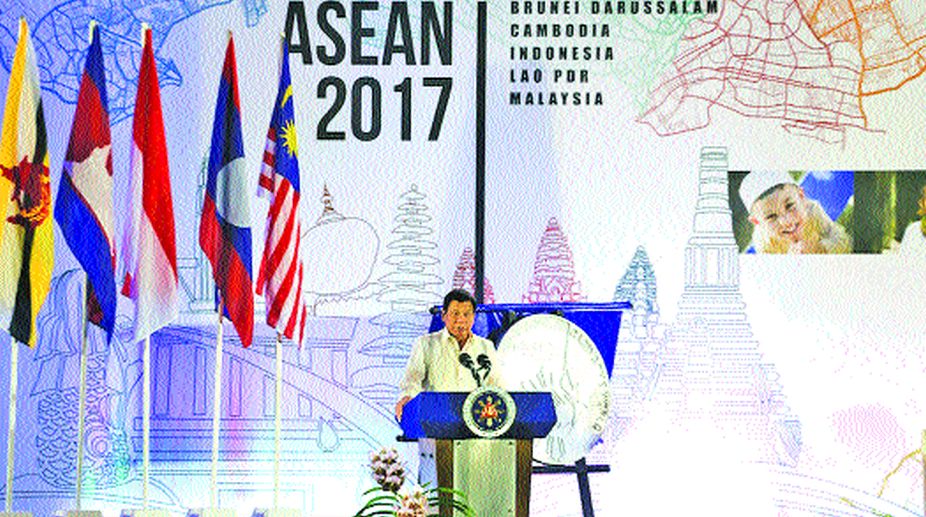
This year marks the 25th anniversary of the India-ASEAN Dialogue partnership. In a thoughtful manner Prime Minister Narendra Modi earlier last month reached out to the President of Philippines Rodrigo R. Duterte through a message iterating India’s steadfast support and commitment to the regional architecture. True, the message is occasion-specific. But more than what meets the eye at least two major reasons can be attributed to the Prime Minister’s message to President Duterte.

First, Duterte did an absolute turn around, when he reached out to China disowning the traditional strategic and security alliance with the USA. Not long ago Philippines itself had moved the International Court of Arbitration challenging Chinese claims on the South China Sea. Later the Hague-based international court gave its verdict in favour of Philippines, which was disregarded by Beijing.

India has supported the principle of freedom of navigation and had also welcomed the Hague ruling much to the chagrin of China. Thus the decision to reach out to President Duterte suggests a partial course correction limited to bilateral relations with Philippines under the new regime, although it does not suggest any fundamental dilution of India’s stance on South China Sea.

Second, Philippines will be chairing the ASEAN summit sometime later this year. The 10-member grouping is primarily an economic entity. In recent years it has been playing a very significant role in regional geopolitics. Although USA continues to be the reigning power in the region, there are signs of its slow withdrawal under President Trump, whose major foreign policy action was the decision to withdraw from the Trans-Pacific Partnership (TPP), the economic outfit of the political architecture of ASEAN.
Philippines, the main anchor of the security architecture of USA in the Asia-Pacific, has also distanced itself from Washington under Duterte. Thus, there are question marks over the ‘Pivot to Asia’ policy articulated and pursued by USA under President Obama, although President Trump has made no secret of his stance on South China Sea. Mr. Obama had tried to co-opt India in the ‘Pivot to Asia’ policy.
As of now there is no indication, unlike on the issue of fighting terrorism, as to the extent to which the US would like to engage India in its Asia-Pacific strategy. It is highly unlikely that the South China Sea dispute issue would be raised at the ASEAN summit meeting given the emerging bonhomie between President Duterte and China.

It is pertinent to mention in this context that Vietnam, the major party to the South China Sea issue has reached out to China to manage maritime differences. Only last month the General Secretary of the Communist Party of Vietnam, Nguyen Phu Trong visited China and had a ‘candid exchange of views’ on maritime issues. The two sides pledged to basic and long term solutions to the dispute.

China, a rising power and the second largest world economy, poised to replace USA in a few years, has challenged American supremacy in the region. In fact the spat over the South China Sea is in a way a jockeying for power in the region. While China has the economic clout to oblige member countries, they are wary of its strategic intent. A number of countries in the region have maritime disputes with China.
The US with its nuclear-equipped armada is the net security provider in the region. It is in this backdrop that the countries of ASEAN look forward to India for its benign role for peace and stability in the region.  Often strategic analysts, particularly those belonging to the West have painted the construct of a zero-sum game between the two Asian giants in the region. Historical baggage of the cold war, China’s past strategic behavior, its military might and the nature of its political regime have coloured this kind of a binary approach.

It is worth introspecting whether it is desirable for India to acquiesce in the US ‘Pivot to Asia’ policy. India can as well meaningfully engage with ASEAN countries economically, politically and culturally. There is, however, some perception in strategic circles that India’s foray into the South China Sea is a counter to China’s footprints in Pakistan Occupied Kashmir (PoK), besides its desire to explore hydrocarbons in the South China Sea, and advocating freedom of navigation and sea lanes of communication. Since India has iterated these positions time and again, it makes little sense to harp on these issues without any provocation. These gestures should send a positive signal to China.

Strategic partnership with the countries of the region, however, should be made more robust including defence and security relations. India should, however, avoid acquiescing in the US policy of balancing China.

The nature and structure of geo-politics have changed in recent years following the end of the cold war. Not only has there been a paradigm shift from the Atlantic to Asia-Pacific, but the grammar of geopolitics has changed. In these times of uncertainty and unpredictability, India’s strategy in the Asia-Pacific should remain sacrosanct, but its tactics can be tweaked taking into account the unpredictability of US policy towards Asia-Pacific and the churning taking place in the region, particularly after the leadership transition in Philippines.

India should add more economic content to the comprehensive strategic partnership with the countries of the region, particularly in IT and the IT-enabled services sector. Defence and security cooperation should also continue, but it should not give the impression that India is teaming up with USA to contain China. China is India’s neighbour. Engagement with China is not an option, but a strategic necessity.

The writer is a former senior fellow with Institute for Defence Studies and Analyses. The views expressed are personal.

NK goes ballistic

Editorial |

Sunday’s firing of a ballistic missile by North Korea was not wholly unexpected in the context of Pyongyang’s nuclear ambition. True it was not an ICBM test, but it has nonetheless served to ratchet up the pressure on Donald Trump who has vowed what he calls “100 per cent” support for Japan. It was more than a coincidence that he addressed the press conference in the company of the visiting Prime Minister, Shinzo Abe. The missile was launched towards the Sea of Japan (East Sea), whose waters could turn out to be as choppy as those of the South China Sea.

The trilateral equation becomes sharper still with North Korea having posited itself against the US and Japan. Though details about the missile are yet to be determined, it is said to have flown for about 500 kilometres before plunging into the sea. President Kim Jong-Un has without question conveyed a two-pronged message ~ the first to his ebullient counterpart in the White House, now grappling with a welter of sensitive issues and the consistently losing battle in the courts. In parallel, Kim is seemingly anxious to draw global attention to the North’s nuclear and missile capabilities. Arguably, he might have resorted to armed provocation to test the response from the new US administration. He has taken a risk that is dangerously real. While President Trump has not spelt out his pledge on “100 per cent” support to Japan, Prime Minister Abe has condemned the test as “absolutely intolerable” , one that has been a “clear provocation to Japan and its allies”. Assuming that it was “a celebratory launch” to mark the February 16 birthday of Kim Jong-Il, late ruler and father of the present, it begs the query as to whether such muscle-flexing was really necessary at this juncture? It shall not be easy to dispel the charge of provocation.
Aside from the diplomatic implications in the immediate perspective, the missile test flies in the face of UN resolutions that have barred North Korea from any use of ballistic missile technology. It is a measure of the consistent defiance that as many as six sets of UN sanctions, that have been imposed ever since Pyongyang’s first nuclear test in 2006, have failed to halt its nuclear strategy, masquerading as a test of defensive weapons ~ a euphemism if ever there was one.

Last year the country conducted several tests and launches in its quest to develop a nuclear weapons system capable of hitting the US mainland. Washington has reiterated it will never accept North Korea as a nuclear-armed nation; Sunday’s launch poses a test for Trump, who will need the help of China, the North’s closest ally, to deal with the reclusive state. This is the paradox of trans-Atlantic geopolitics.

Craven silence

Editorial |

Citing the importance of upholding human rights, the law minister appeared to have done well in calling for nationwide judicial and administrative action to ensure that undertrials were not held in custody longer than legally necessary. Alas, the commitment to human rights would appear hollow, and his “appeal” could seem just a cheap way of earning brownie points by his silence on the boast of his ministerial colleague, Miss Uma Bharati, on how she had dealt with alleged rapists during her rather short stint as chief minister of Madhya Pradesh. To be fair to the law minister he was not alone in keeping his lips cravenly buttoned on an embarrassing admission, for both the Prime Minister and the home minister would also be expected to spell out their position on sharing “space” in the union cabinet with a person who makes a virtue of downright barbaric methods that run counter to the ministers’ oath to honour the Constitution.

The National Human Rights Commission would also invite the charge of impotent inaction if it does not initiate a probe into the manner in which Ms Bharati has recommended making an alleged rapist scream in agony. There must be no time-bar on taking to task persons in authority who have scant respect for the law. And Mr Narendra Modi must understand that allowing Ms Bharati to get away with her boast only fuels the criticism of those who contend that the present government imagines it is a law unto itself. That Mr Modi has done little to rein in other vicious members of the parivaar is no excuse.

Nor is there any validity to the theory that Ms Bharati made her comments out of a sense of frustration at being reduced to a bit-player in the current political drama, or that she in her election speech was attacking the questionable law-and-order record of the Samajwadi Party’s government in UP. It is worth noting that the top police officer who served under Ms Bharati has denied her claims outright; also the figures provided by the national authority suggest that the instant punishment she said she had inflicted had no positive impact on the law and order situation when she called the shots in Bhopal. That non-BJP parties have not raised a stink over what Ms Bharati has said might underscore her decreasing political clout, but that is of trivial consequence.

Mr Modi’s contention that providing quality governance is high on his list of priorities is punctured by Ms Bharati’s recommending that rapists be hung upside down, their skins flayed and salt and chilli be rubbed into their wounds. It is doubtful if even the rape victims would find satisfaction in such methods. Yet in opting not to condemn them, Modi sarkar seems to reveal its mindset.


Craven silence

Editorial |

Citing the importance of upholding human rights, the law minister appeared to have done well in calling for nationwide judicial and administrative action to ensure that undertrials were not held in custody longer than legally necessary. Alas, the commitment to human rights would appear hollow, and his “appeal” could seem just a cheap way of earning brownie points by his silence on the boast of his ministerial colleague, Miss Uma Bharati, on how she had dealt with alleged rapists during her rather short stint as chief minister of Madhya Pradesh. To be fair to the law minister he was not alone in keeping his lips cravenly buttoned on an embarrassing admission, for both the Prime Minister and the home minister would also be expected to spell out their position on sharing “space” in the union cabinet with a person who makes a virtue of downright barbaric methods that run counter to the ministers’ oath to honour the Constitution.

The National Human Rights Commission would also invite the charge of impotent inaction if it does not initiate a probe into the manner in which Ms Bharati has recommended making an alleged rapist scream in agony. There must be no time-bar on taking to task persons in authority who have scant respect for the law. And Mr Narendra Modi must understand that allowing Ms Bharati to get away with her boast only fuels the criticism of those who contend that the present government imagines it is a law unto itself. That Mr Modi has done little to rein in other vicious members of the parivaar is no excuse.

Nor is there any validity to the theory that Ms Bharati made her comments out of a sense of frustration at being reduced to a bit-player in the current political drama, or that she in her election speech was attacking the questionable law-and-order record of the Samajwadi Party’s government in UP. It is worth noting that the top police officer who served under Ms Bharati has denied her claims outright; also the figures provided by the national authority suggest that the instant punishment she said she had inflicted had no positive impact on the law and order situation when she called the shots in Bhopal. That non-BJP parties have not raised a stink over what Ms Bharati has said might underscore her decreasing political clout, but that is of trivial consequence.

Mr Modi’s contention that providing quality governance is high on his list of priorities is punctured by Ms Bharati’s recommending that rapists be hung upside down, their skins flayed and salt and chilli be rubbed into their wounds. It is doubtful if even the rape victims would find satisfaction in such methods. Yet in opting not to condemn them, Modi sarkar seems to reveal its mindset.


Craven silence

Editorial |

Citing the importance of upholding human rights, the law minister appeared to have done well in calling for nationwide judicial and administrative action to ensure that undertrials were not held in custody longer than legally necessary. Alas, the commitment to human rights would appear hollow, and his “appeal” could seem just a cheap way of earning brownie points by his silence on the boast of his ministerial colleague, Miss Uma Bharati, on how she had dealt with alleged rapists during her rather short stint as chief minister of Madhya Pradesh. To be fair to the law minister he was not alone in keeping his lips cravenly buttoned on an embarrassing admission, for both the Prime Minister and the home minister would also be expected to spell out their position on sharing “space” in the union cabinet with a person who makes a virtue of downright barbaric methods that run counter to the ministers’ oath to honour the Constitution.

The National Human Rights Commission would also invite the charge of impotent inaction if it does not initiate a probe into the manner in which Ms Bharati has recommended making an alleged rapist scream in agony. There must be no time-bar on taking to task persons in authority who have scant respect for the law. And Mr Narendra Modi must understand that allowing Ms Bharati to get away with her boast only fuels the criticism of those who contend that the present government imagines it is a law unto itself. That Mr Modi has done little to rein in other vicious members of the parivaar is no excuse.

Nor is there any validity to the theory that Ms Bharati made her comments out of a sense of frustration at being reduced to a bit-player in the current political drama, or that she in her election speech was attacking the questionable law-and-order record of the Samajwadi Party’s government in UP. It is worth noting that the top police officer who served under Ms Bharati has denied her claims outright; also the figures provided by the national authority suggest that the instant punishment she said she had inflicted had no positive impact on the law and order situation when she called the shots in Bhopal. That non-BJP parties have not raised a stink over what Ms Bharati has said might underscore her decreasing political clout, but that is of trivial consequence.

Mr Modi’s contention that providing quality governance is high on his list of priorities is punctured by Ms Bharati’s recommending that rapists be hung upside down, their skins flayed and salt and chilli be rubbed into their wounds. It is doubtful if even the rape victims would find satisfaction in such methods. Yet in opting not to condemn them, Modi sarkar seems to reveal its mindset.