Logo

The charm of colonial glory

Swaati Chaudhury |

For those smitten by the travel bug and planning a trip to Darjeeling, there’s nothing quite as refreshing as a stay at the Windamere Hotel. Best-known as a colonial hotel nestling in the lap of the Himalayas, the luxury property offers the unparalleled ambience while making its valued guests feel at home.

Windamere is not any hospitality group and differs from other properties. This old-world place began way back as an English boarding hotel for the British tea planters in late 1880 and became Windamere Hotel only in 1939. 

Elizabeth J Clarke, managing director, Windamere Hotel explained, “Our hotel still remains the warm and friendly boarding house and recreates the magic of the bygone era when British tea planters halted here along with the royalty and dignitaries. It dates back to 1841 and came to be known as Ada Villa in the later part of the 1880s. Our hotel harks back to the good old days of personalised service in the dining hall. We flaunt an authentic old-world look and design, and treat travellers as our own privately invited guests during their stay.”

There are a number of plush hotels in and around the Darjeeling Hills but the unfading bygone charm of Windamere makes its stand out from the crowd. Clarke said, “We are one-of-a-kind in our style and intention. It is the only property that is truly colonial in nature and essence. Based on the lines of a private boarding house, our hotel makes visitors step back in time.”

Given the increasing willingness of Indian travellers to splurge with rise in disposable income, these days more domestic tourists are heading to Windamere Hotel. Clarke further said, “Once upon a time, we rarely had domestic tourists apart from the well-heeled class. With the change in economy, we welcome travellers from across the country. On the other hand, we have global seasonal travellers during spring and autumn. Once Indian tourists used to arrive during the rains but with changing times, they come all the year round. Both global and domestic tourists come during our Christmas and New Year revelries and that something that is much-awaited.” 

At Windamere, one can get to choose the style of accommodation based on personal preferences. Clarke said, “There has been a rise in booking of rooms from domestic visitors and we plan to expand our accommodation facilities in the upcoming period. The hospitality scene in Darjeeling is quite vibrant and a number of hotels have come up over the last few years. There are many options for travellers and there is something to suit everybody’s budget.”
Art for humanity’s sake

Rimni Chakravarty |

Spring is the time for new leaves to appear, shed off woollen clothes and listen to the murmurs of the gentle breeze that carry the fragrance of flowers. 

One of my colleagues invited me to attend the annual cultural programme organised by the Siliguri Subhaspally Welfare Organisation. The aim was to spread love in every heart at a time when the earth is tormented with hatred, jealousy, injustice and terrorism. There are people who in the midst of anguish brave the world to make it better through charity, music, art and dance — they bring spring in our lives, both literally and metaphorically. Paramita Dasgupta, principal of the Ubach Cultural troupe and Moloy Ghosh with his Rwitik theatre group from Siliguri, have made an attempt to reawaken human minds.

On a recent Sunday evening, the members of Siliguri Subhaspally Welfare Organisation stood outside the gate of Dinabandhu Mancha and heartily welcomed the people who arrived to attend their programme. The cultural extravaganza began at 6pm with a prize distribution ceremony for school students who had won prizes at an earlier sit-and-draw competition organised by SSWO in November last year.

President, Dr Prashanta Pal, who is a physician and social worker, thanked the audience for their presence in his welcome speech. Honourable members, Dr LC Basak, Dr AC Bhowal and Dr Chaturbhuj Kundu along with Dr Pal felicitated 15 school children who come from humble backgrounds with books and school bags.

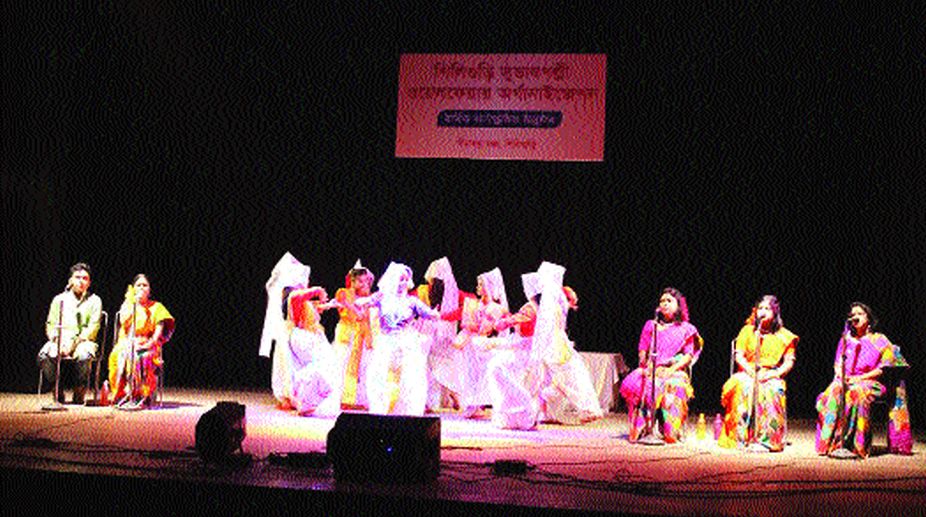
Dr Pal also honored Dasgupta — she is a well-known cultural figure of Siliguri who is seen in every function with her and her troupe’s grand, colourful performances. Hers is a fusion of Rabindrasangeet, contemporary songs, dance and poetry — all in a complete package. Ubacha’s theme for the evening was Ei Basante Phag renute which means, the pollens of March this spring.

Ubacha’s dance and poetry recitation gushed like spring waters in the auditorium of Dinabandhu Mancha, which was packed with people from different age groups. The cultural event was choreographed by Dasgupta who was assisted by her group’s members — Dr Prajnamita Dasgupta and Sarbani Mazumdar in recitation, Sarashi Dutta and Debalaya Ganguly in singing; Govinda Saha, principal of Chandamanjari in dance along with Bibek Ghosh, Anushka Pradhan, Raju Halder, Riyanka Saha, Nandita Ghosh, Sneha Pal, Mukta Das, Neha Banik and Nikita Pal. They were assisted by Prasenjit Guha on tabla and Abhimanyu Roy on keyboards. 

The programme continued with a drama called Sasti, performed by the members of the Rwitik theatre group .The drama was based on a Rabindranath Tagore story, which depicted the complexities of our social and family life. 

As a member of the audience, one was really touched by the efforts of the artists. 

Indian Government’s statement on hate crimes in US soon

Statesman News Service | New Delhi |

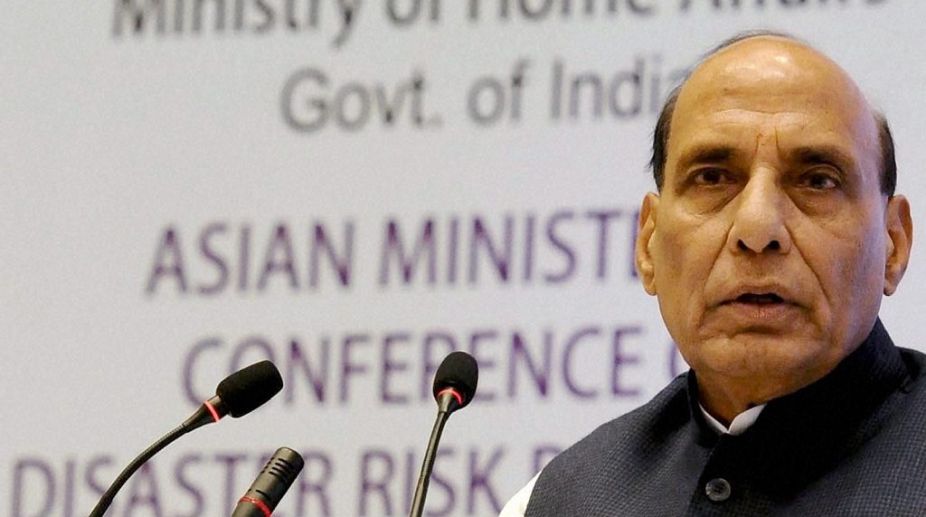
The alleged hate crimes against Indians in the US were being viewed seriously by India and the government will make a statement on the matter in Parliament next week, Union Home Minister Rajnath Singh said in the Lok Sabha on Thursday.

Responding to the issue of recent hate crime incidents in the US, leading to the death of two Indians, Singh said India has already taken serious note of it and assured the House that the government would take steps to ensure that Indians in the US feel safe and secure.

The issue was raised by Opposition members during zero hour in the Lok Sabha. Senior Congress leader Mallikarjun Kharge questioned the silence of Prime Minister Narendra Modi on the issue.
Kharge demanded that the Prime Minister should come forward and make a statement in the House and suggest measures to stop such ‘hate crimes’ on Indians in the US.

Erasing boundaries through storytelling

Deepak Rikhye |

William Shakespeare wrote, “The play’s the thing,” when Hamlet was to observe the King’s conscience. But drama can signify many other powerful thoughts. We have read about India being a diverse nation with many languages and dialects along with different beliefs. Akbar confronted the issue with help from personalities like the famous musician, Tansen to foster a level of tolerance between India’s different religious beliefs. Maharaja Ranjit Singh’s quote, has found its way into books of history, “my eye and God’s eye are one eye; one seeing, one knowing, one love”. 

They were people who read and imbibed ancient Indian literature. For example, in the Mahabharata, Bhriju tells Bharadvaja that caste divisions relate to differences in physical attributes of different human beings. Then logically all castes are mixed. That is followed by a profound question — we all seem to be affected by desire, anger, hunger, fear and sorrow, then how do we  have caste differences? The scriptures tell us that all human beings have the same father, so children of the same father cannot have different castes. 

But we now live in 2017, centuries after Akbar, Tansen or Ranjit Singh. Leaders of India still grapple with one vital question — how do we unite our people and what can we use as a conduit to connect ourselves with each other, notwithstanding our diverse beliefs? How do we unify this apparent fragmentation? India has its own share of playwrights, poets and musicians, whose profound works, in history, when articulated through storytelling and drama, actually gives us the faith that our greatest strength is our diversity because we no longer feel sequestered. Michel de Montaigne, born in 1533, studied law to become a counsellor and he devoted himself to reading and writing. In an essay, On Books, he wrote, ‘We must without distinction leaf our way through authors, ancient and modern, so as to learn about the matter which they treat in their divergent ways.”
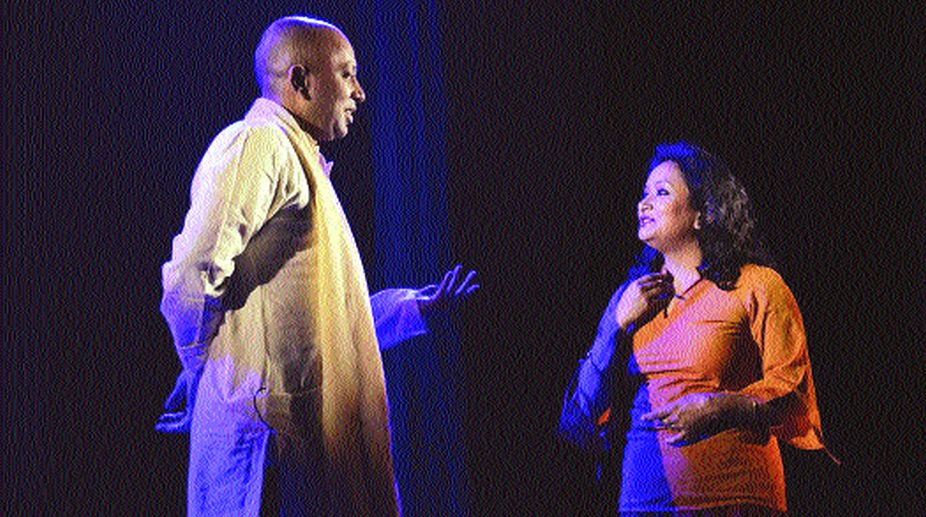
The conduit we seek can verily be the theatre as the power brought forth by this form of art is phenomenal. It is already happening and actors and musicians, of one organisation in Bengal, are helping to unify the country. This remarkable organisation is doing exactly what Montaigne had prescribed because their performances are inspired by India’s talented writers, all of whom evoke their own “matter.”  The organisation, run by Pranay and Sohini Gupta, is called Tagore Appreciation Society, which also looks after people in rehab for various addictions and underprivileged children.
TAS believes in a form of theatre that unites cultures, arts, languages, religions and people. Their organisation is a combination of people who pursue a vision; they are playwrights, theatre directors, and actors. Their intrinsic message says that in this volatile world only the integrative expression can be at the heart of human unity. This interpretation has transcended earlier efforts in history by Akbar and others. But that is what history is all about. It is a sequence of living and learning which transcends noble endeavours of the past.

Pranay and Sohini’s indefatigable pursuits have for the last few years formed a niche by virtue of being multi-lingual and cross-cultural. International luminaries like Zubin Mehta, Gulzar, Soumitra Chatterjee and others have acknowledged presentations by TAS. Pranay Gupta, a leading inspirational speaker on leadership, says, “Our work is a rebellion against stereotyping traditional performing arts, and we seek to fuse this art with dynamic and fresh ideas that inspire to entertain.” New blends of artistic forms through live storytelling as a medium, from Kabir to Kavi, are recent examples of some performances. Sohini Gupta emphasises that theatre is not dying but is thriving. 

The art of storytelling is therefore integral to the work of this organisation. Fresh ideas weave through the central thread of storytelling and Pranay also presents this to corporate companies by his “Power Talks”. One particular performance, From Kabir to Kavi, encompasses a tribute to Kabir and Rabindranath Tagore. It includes live music with musicians who have travelled the world and the production is tri-lingual with dialogues in English, Hindi and Bengali. Kabir’s verses are articulated in the live singing of Rabindrasangeet. The play reflects the hypocrisy of a world dominated by hatred and racism. It is an ode to love, peace, joy and harmony. 

Tagore’s Gitanjali has been produced as a unique medley of storytelling and shows a view of life through a doorway of beauty. Pranay Gupta is an accomplished theatrical raconteur and his role must carry the entire production, replete with diction, expression and a voice that will pause for effect at the right time. He had imbibed the values of speech and drama at his alma mater, St. Paul’s in Darjeeling, under the tutelage of an illustrious educationist, KK Mustafi, who was also a former student of the famous school. Pranay’s wife, Sohini, is an accomplished actress and this combination has indeed added impetus and dynamism to TAS. 

PM Modi hopeful of GST rollout this budget session

Statesman News Service | New Delhi |

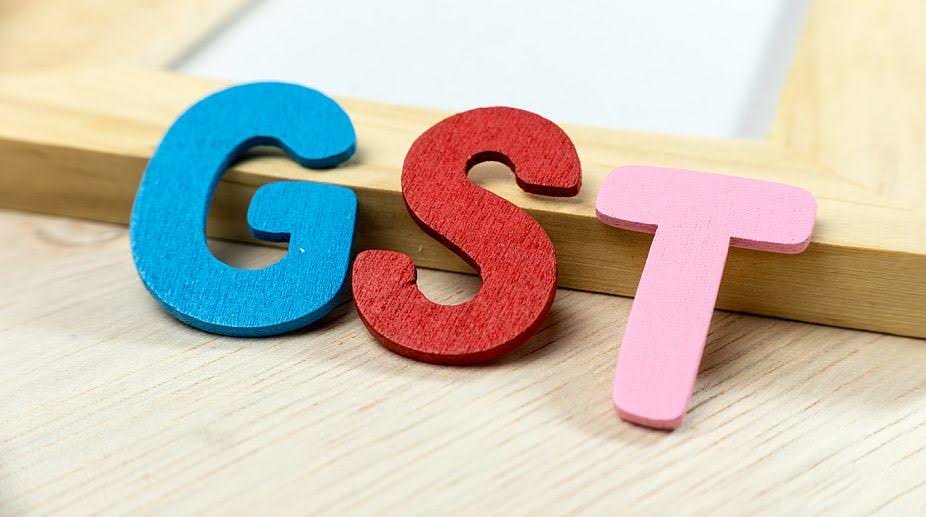
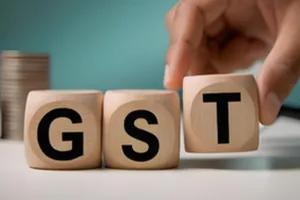
Prime Minister Narendra Modi was hopeful that through the Opposition’s "positive cooperation" and by virtue of unanimity being reached on many contentious issues, a "breakthrough" in the final rollout of the Goods and Services Tax (GST) will be possible during the Budget session of Parliament which resumed on Thursday after a month’s recess. 

 “…Let’s hope there will be a breakthrough in the implementation of GST,” the Prime Minister told media persons outside the Parliament complex. 

The constitutional amendment paving way for GST is set to lapse by mid-September. The government intends to introduce the supporting legislation related to the Central GST (CGST) Bill in Parliament and get it ratified before the states introduce the State GST (SGST) Bill in respective legislative assemblies. 

The Prime Minister exuded confidence over his government’s ability to ensure smooth implementation of a common Goods and Sales Tax regime across the country thanks to ‘positive cooperation’ of the states and the political parties. There is a buzz in government circles that the GST is likely to come into force by 1 July. 

Modi said there is a possibility of a "breakthrough" in GST before the end of the second leg of the month-long Budget session as "all the states have extended positive cooperation on the issue. All the political parties too have played a positive role", he said. 

Modi said his government had gone ahead following a democratic process of wider discussion and reached unanimity on some issues. "Efforts are now underway to complete the process of the GST rollout in this session with everybody’s cooperation," he said. 

Modi expressed the hope that a detailed discussion on the Budget will take place during the session. "I am hopeful the discussion and debate will be of the highest level and focus on the poor people of the country," the prime minister said.

Muslim vote divided in UP, finds poll

Asad Ashraf | New Delhi |

Both the Samajwadi Party and Bahujan Samaj Party were banking on Muslim votes along with their traditional Yadav and Dalit support in the Uttar Pradesh Assembly elections. It is on this account that both distributed a number of tickets to Muslim candidates to ensure the support of the community.

However, an exclusive exit poll conducted by CrowdNewsing to gauge the mood of Muslim voters in UP, pointed out that the community has voted diversely in this election. The poll, which was conducted with a sample size of 2500 voters in ten cities and towns of the state, reveals that 55% Muslims voted for the Samajwadi-Congress alliance, and 36% for the BSP. The other 9% voted for other parties.

The exit poll reveals that in communally disturbed cities of western Uttar Pradesh, people from the minority community have voted for the SP-Congress alliance whereas in many pockets of central and eastern Uttar Pradesh, the Muslims have stood with Mayawati’s Dalit-Muslim social engineering, bypassing the Congress-SP alliance as well as smaller parties like AIMIM (All India Majlis-e ittehadul Muslameen).

When probed about their disaffection for the BJP, most respondents blamed the party’s public positioning among the community. Altogether 86% respondents believe Prime Minister Narendra Modi’s Shamshan versus Kabristan comment was a direct attack on the minorities. Only 7 per cent believed the Prime Minister’s statement was a reference to equality among all communities.

On the question of whether Ram Mandir or Babri Masjid was an electoral issue or not, 59% believed that it’s a non-starter. Among the respondents on this question, 75 % were people under the age of 30.

On the reason behind their voting percentage, 45 % said it was for the party’s ability to win, followed by the candidate’s ability to defeat BJP which stood at 29 % and candidate's track record at 20%.

Among the issues that matter the most, development of infrastructure, roads, water and electricity tops the agenda at 44%, followed by the party’s ability to "prevent riots and communal violence" at 23%, "creation of jobs" at 19% and "candidate’s religion" at 12 per cent. Commenting on the need to have an exit poll exclusively among Muslims, Bilal Zaidi, the founder of CrowdNewsing, said, "There is a tendency in the mainstream media and political parties to engage with religious clerics whenever there is a conversation around the Muslim population, and elections are no different. The idea behind this survey was to look beyond these self-appointed interlocutors to understand the voting preferences as well as the aspirations of the community."

Tanweer Fazal, political analyst and sociologist, Associate Professor at Jawaharlal Nehru University, commenting on the diversity of Muslim voters, said, “ Muslims should be never be seen as a single community, there are various layers within the community, they vote accordingly. Besides this Mayawati had distributed tickets to Muslims in large numbers, the vote was destined to be divided.” 

Finally, with many analysts predicting a hung assembly, 92 per cent of the respondents want SP and BSP to bury their differences and form a mega alliance to prevent a BJP government in Uttar Pradesh.

‘Obesity behind chronic kidney disease’

Ajita Singh | New Delhi |

Obesity is known to trigger chronic kidney disease in Indians, medical experts said on World Kidney Day, which was dedicated to the theme of obesity and chronic kidney disease. 

Disproportionately enlarged waist lines in individuals are likely to take huge toll on their kidney function. Worse still, women are impacted in more numbers than men as per data from a large pan-India study led by the George Institute for Global Health. India is only confirming the worst, it added. 

Preliminary data emerging in the Indian Chronic Kidney Disease (ICKD) study ~ a longitudinal study that is recruiting patients with kidney disease early on with the aim of following them up over a long period to identify the risk factors so that appropriate timely prevention measures can be applied ~ has shown alarmingly high levels of body mass index and waist circumference, thus highlighting the association between measures of obesity and development and progression of CKD.

The study funded by the Department of Biotechnology, Government of India, has been enrolling patients in nine hospitals across the country. A preliminary analysis of data of 1,500 patients with kidney disease recruited as part of the study shows the overall prevalence of obesity at 49 per cent, but the figure in women was a whopping 57 per cent. 

The data on abdominal obesity is even more alarming, with about 63 per cent of women and 48 per cent of men exhibiting waist circumference beyond the cut-offs accepted for the Asian population. 

“The data confirms the fact that there is high prevalence of obesity in patients with chronic kidney disease. Of particular concern is the high prevalence of abdominal obesity among women,” says Dr Vivekanand Jha, Executive Director of the George Institute for Global Health, India.

“Obese people are twice as likely to develop kidney disease compared to those with normal weight. Obesity also increases the likelihood of progression of kidney disease and development of complications, such as cardiovascular disease,” said Dr Jha, adding that there is no data on this relationship from India. 

According to Dr Rajesh Aggarwal, Senior Nephrologist at Sri Balaji Action Medical Institute, "Being obese can harm the kidney directly or indirectly. The excess fat in human body can directly increase the risk of stone diseases, proteinuria, hyperfiltration injury which make it unable for the kidney to hold the protein and induces damage to the organ.  So avoid the foods that make a person obese or harm the kidney which might include junk food, oily and spicy food, artificial sweeteners, excess of salt, caffeine, etc." 

Dr Ravi Bansal, Senior Nephrologist at PSRI Hospital said, “Obesity and being overweight are major risk factors for chronic kidney disease and is related to the disease progress. Moreover, obesity is a major risk factor for diabetes and hypertension as well, which together account for about 70% of all cases of end-stage renal disease. In India more than 2 lakh people die of kidney failure annually.” 

The good news is that obesity is largely preventable. “Education and awareness of the risk of obesity and a healthy lifestyle, including proper nutrition and exercise, can dramatically help in preventing obesity and kidney disease," concluded Dr Jha.

New Deputy Secretary in PMO

Statesman News Service | New Delhi |

An Indian Foreign Service officer of the 2003 batch, Siddhartha Nath, has been appointed as a Deputy Secretary in the Prime Minister’s Office on Thursday. 

An order to the effect of Nath’s appointment in the PMO has been issued by the Ministry of Personnel. 

Nath joins a group of seven other Deputy Secretaries currently serving the Prime Minister’s Office here. 
 

TRAI favours PCO-type model for low-cost public Wi-Fi services

PTI | New Delhi |

Telecom regulator TRAI on Thursday recommended small entrepreneurs and shop owners be allowed to become Wi-Fi hotspot venues and team up with 'aggregators' to offer low-cost public Internet services in a PCO-type model.

"Since there is a significant section of the population still to be connected, measures taken to enable larger service providers to provide public Wi-Fi…will not suffice….Steps need to be taken to ensure that in addition to existing service providers, small providers can also enter the public Wi-Fi ecosystem and have the capability and incentives to provide public Wi-Fi on a small scale," TRAI said.

TRAI has suggested the concept of 'Public Data Offices' and 'aggregators' for providing public Wi-Fi services at cheaper rates.

According to TRAI, the Wi-Fi venues can be provided by local shop owners or grocery stores and `aggregator' can provide last mile Wi-Fi services and seamless experience for authentication and payments. The aggregator can buy bandwidth from Internet service providers and re-sell them.

The aggregators would not require any specific licence, but would have to adhere to registration and record keeping requirements prescribed by the telecom department, TRAI said.

"Further, the PDOs will ensure that users can buy the data amount based on their needs. The availability of data services for small token values will stimulate the demand for public Wi-Fi services," it said.

TRAI said that during public consultations, it came across certain existing models which have managed to stimulate demand for paid public Wi-Fi by offering "sachet" sized access plans of low denominations ranging Rs 2 to Rs 20.

"However, the success of such models is predicated upon appropriate changes being effected in the regulatory and licensing regime," it said.

The import duty applicable on Wi-Fi equipment should be revisited, it said, adding that this will reduce the cost of providing Internet services.

TRAI has favoured doing away with the existing requirement of authentication through one-time password for each instance of access, and said that "authentication through eKYC, eCAF (Customer Acquisition Form) and other electronic modes be allowed for the purpose of KYC (Know Your Customer) obligations".

It has also suggested that virtual network operators should be allowed to join hands with multiple network service operators for providing internet service.

The telecom regulator has favoured de-licensing spectrum in the 5.725 5.825 GHz spectrum band for outdoor usage, and asked the telecom department to expedite decision on allocating E-band and V-band to service providers. 

TRAI favours PCO-type model for low-cost public Wi-Fi services

PTI | New Delhi |

Telecom regulator TRAI on Thursday recommended small entrepreneurs and shop owners be allowed to become Wi-Fi hotspot venues and team up with 'aggregators' to offer low-cost public Internet services in a PCO-type model.

"Since there is a significant section of the population still to be connected, measures taken to enable larger service providers to provide public Wi-Fi…will not suffice….Steps need to be taken to ensure that in addition to existing service providers, small providers can also enter the public Wi-Fi ecosystem and have the capability and incentives to provide public Wi-Fi on a small scale," TRAI said.

TRAI has suggested the concept of 'Public Data Offices' and 'aggregators' for providing public Wi-Fi services at cheaper rates.

According to TRAI, the Wi-Fi venues can be provided by local shop owners or grocery stores and `aggregator' can provide last mile Wi-Fi services and seamless experience for authentication and payments. The aggregator can buy bandwidth from Internet service providers and re-sell them.

The aggregators would not require any specific licence, but would have to adhere to registration and record keeping requirements prescribed by the telecom department, TRAI said.

"Further, the PDOs will ensure that users can buy the data amount based on their needs. The availability of data services for small token values will stimulate the demand for public Wi-Fi services," it said.

TRAI said that during public consultations, it came across certain existing models which have managed to stimulate demand for paid public Wi-Fi by offering "sachet" sized access plans of low denominations ranging Rs 2 to Rs 20.

"However, the success of such models is predicated upon appropriate changes being effected in the regulatory and licensing regime," it said.

The import duty applicable on Wi-Fi equipment should be revisited, it said, adding that this will reduce the cost of providing Internet services.

TRAI has favoured doing away with the existing requirement of authentication through one-time password for each instance of access, and said that "authentication through eKYC, eCAF (Customer Acquisition Form) and other electronic modes be allowed for the purpose of KYC (Know Your Customer) obligations".

It has also suggested that virtual network operators should be allowed to join hands with multiple network service operators for providing internet service.

The telecom regulator has favoured de-licensing spectrum in the 5.725 5.825 GHz spectrum band for outdoor usage, and asked the telecom department to expedite decision on allocating E-band and V-band to service providers. 

UP leads in proj completion; Gujarat tops in eco development

PTI | New Delhi |

Uttar Pradesh emerged as the best state in terms of capital spending and completion of projects during the first three quarters of this current fiscal, while Gujarat bagged the numero uno position as regards the overall development, says a report.

In terms of total value of projects completed, Uttar Pradesh topped the list with Rs.185.5 billion, followed by Maharashtra at Rs.178 billion, Telangana Rs.111.3 billion and West Bengal Rs.61.3 billion, according to a Deutsche Bank research note.

When it comes to the number of projects completed, UP again grabbed the lead position 25 units during the April-December period of the current fiscal. Punjab saw completion of 21 units, while Maharashtra stood at third place with 19 units with regard to projects completed.

Overall, the project completion rate of all states is up 104 per cent in April-December 2016, from the year-ago period, with five states Maharashtra, UP, Telangana, West Bengal and Punjab constituting almost 83 per cent of total value of projects completed.

On the other hand, Gujarat, Bihar, Jharkhand, Odisha, Tamil Nadu, Karnataka and Kerala recorded a contraction in the project completion rate in April-December period of current fiscal over the year-ago period.

In terms of overall development that includes economic, social, fiscal and governance aspects, Gujarat was ranked as the best state, followed by Maharashtra, Tamil Nadu, Punjab and Karnataka. While Bihar, UP, Odisha, Rajasthan and West Bengal feature at the bottom in the list.

The report said that at state government level, capex spending has increased substantially since last financial year for most states, compared to their past trend, and encouragingly the positive momentum is continuing for many states through the current fiscal as well.

"It is encouraging to see that capex momentum in states such as UP, West Bengal and Bihar has picked up in the last two years, albeit from a low base, especially given that these states are generally regarded as economically backward relative to the other states. The challenge will be to sustain the momentum in the years ahead so as to bridge the gap with the other states," the report noted.

It further said states which have a higher urbanisation rate are also the same states that are relatively more prosperous and enjoys a higher score related to developmental metrics.

"The government's initiative to build smart cities across India is encouraging and should help expedite the pace of urbanisation, which has been abysmally slow in the last several decades.

The strategy of building or transforming small tertiary towns to cities and connecting them to hub cities like Mumbai, Delhi, Bangalore, Chennai and Kolkata, through high speed transport will increase productivity and reduce the problem of urban primacy," the report added.

UP leads in proj completion; Gujarat tops in eco development

PTI | New Delhi |

Uttar Pradesh emerged as the best state in terms of capital spending and completion of projects during the first three quarters of this current fiscal, while Gujarat bagged the numero uno position as regards the overall development, says a report.

In terms of total value of projects completed, Uttar Pradesh topped the list with Rs.185.5 billion, followed by Maharashtra at Rs.178 billion, Telangana Rs.111.3 billion and West Bengal Rs.61.3 billion, according to a Deutsche Bank research note.

When it comes to the number of projects completed, UP again grabbed the lead position 25 units during the April-December period of the current fiscal. Punjab saw completion of 21 units, while Maharashtra stood at third place with 19 units with regard to projects completed.

Overall, the project completion rate of all states is up 104 per cent in April-December 2016, from the year-ago period, with five states Maharashtra, UP, Telangana, West Bengal and Punjab constituting almost 83 per cent of total value of projects completed.

On the other hand, Gujarat, Bihar, Jharkhand, Odisha, Tamil Nadu, Karnataka and Kerala recorded a contraction in the project completion rate in April-December period of current fiscal over the year-ago period.

In terms of overall development that includes economic, social, fiscal and governance aspects, Gujarat was ranked as the best state, followed by Maharashtra, Tamil Nadu, Punjab and Karnataka. While Bihar, UP, Odisha, Rajasthan and West Bengal feature at the bottom in the list.

The report said that at state government level, capex spending has increased substantially since last financial year for most states, compared to their past trend, and encouragingly the positive momentum is continuing for many states through the current fiscal as well.

"It is encouraging to see that capex momentum in states such as UP, West Bengal and Bihar has picked up in the last two years, albeit from a low base, especially given that these states are generally regarded as economically backward relative to the other states. The challenge will be to sustain the momentum in the years ahead so as to bridge the gap with the other states," the report noted.

It further said states which have a higher urbanisation rate are also the same states that are relatively more prosperous and enjoys a higher score related to developmental metrics.

"The government's initiative to build smart cities across India is encouraging and should help expedite the pace of urbanisation, which has been abysmally slow in the last several decades.

The strategy of building or transforming small tertiary towns to cities and connecting them to hub cities like Mumbai, Delhi, Bangalore, Chennai and Kolkata, through high speed transport will increase productivity and reduce the problem of urban primacy," the report added.

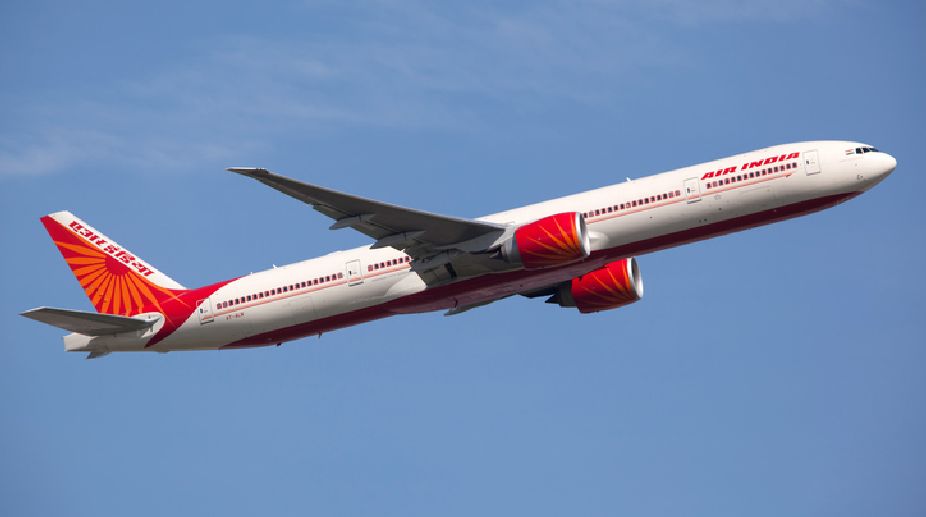
No plans to privatise Air India: Govt

PTI | New Delhi |

The Government on Thursday ruled out any proposal seeking to convert a part of Air India's long-term borrowings into equity or privatising the airline.

Government is not considering inducting banks as strategic investors in Air India or privatising the airline, Minister of State for Civil Aviation Jayant Sinha said in a written reply in Lok Sabha Sabha.

Earlier, a section of media had reported that Air India had asked banks to recast its long-term debt of Rs 9,000 crore through the Scheme for Sustainable Structuring of Stressed Assets (S4A).

As part of the airline's turnaround plan, the minister said till date Rs 24,723.74 crore have been released as equity support to Air India.

As part of the turnaround strategy for Air India, the company with the overall support of the government has initiated a number of steps in order to cut costs and losses, he said.

The airline has constantly been improving its operational and financial performance, he said, adding it posted an operating profit of Rs 105 crore in FY 2015-16, thereby advancing the turnaround plan target by two years.

No plans to privatise Air India: Govt

PTI | New Delhi |

The Government on Thursday ruled out any proposal seeking to convert a part of Air India's long-term borrowings into equity or privatising the airline.

Government is not considering inducting banks as strategic investors in Air India or privatising the airline, Minister of State for Civil Aviation Jayant Sinha said in a written reply in Lok Sabha Sabha.

Earlier, a section of media had reported that Air India had asked banks to recast its long-term debt of Rs 9,000 crore through the Scheme for Sustainable Structuring of Stressed Assets (S4A).

As part of the airline's turnaround plan, the minister said till date Rs 24,723.74 crore have been released as equity support to Air India.

As part of the turnaround strategy for Air India, the company with the overall support of the government has initiated a number of steps in order to cut costs and losses, he said.

The airline has constantly been improving its operational and financial performance, he said, adding it posted an operating profit of Rs 105 crore in FY 2015-16, thereby advancing the turnaround plan target by two years.

AIIMS bid to open VIP counter irks patients

Anjana |

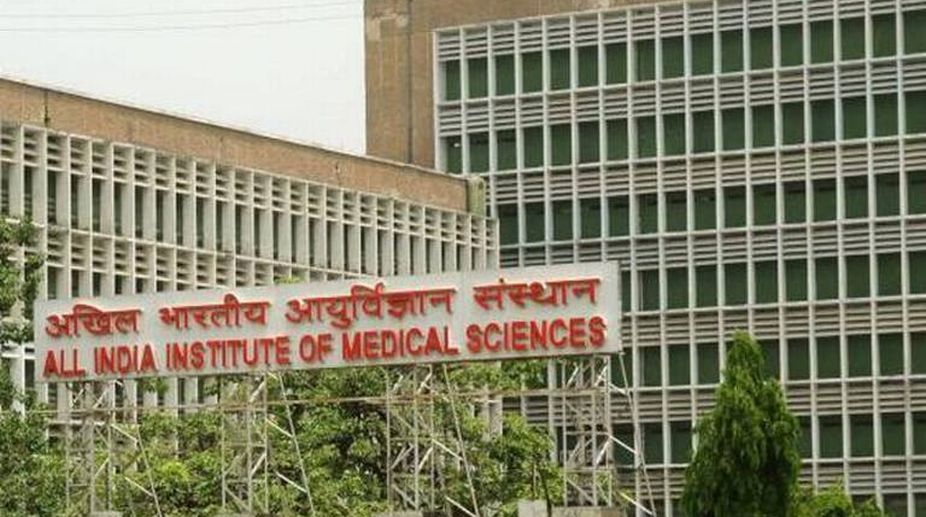
Patients at All India Institute of Medical Sciences (AIIMS) seemed to be irked over the premier institute's new move to open exclusive OPD counters for VIPs. These "special patients" can now escape OPD's long queues. 

However, the definition of VIPs will be decided by AIIMS director, deputy director administration (DDA), medical superintendent and senior financial advisor, besides the officer on special duty (OSD) to the Union health minister. 

Neha Rana, who was standing at the OPD queue, said, "My father is unable to stand due to severe stomach ache. I am here from 8 am for his check-up, but unable to consult a doctor due to long queqe and it's already 10 am. Why the hospital authorities are providing special counters to VIPs. I am totally disappointed from this step." 

The move has also drawn wide criticism among doctors and faculty members. A doctor on the condition of anonymity said, "The VIP culture shall be removed from AIIMS as it is a government hospital. This is simply not acceptable. Already patients have to wait for hours to consult a doctor." 

Earlier, the media and protocol division at AIIMS facilitated the registration process for VIP references, but there was no exclusive counter for them. Now, the AIIMS administration has officially started a mechanism to ensure smooth registration for VIP references from 1 March, opening a new counter at the Rajkumari Amrit Kaur OPD. 

Arjun Singh (39), a diabetic, said, "I came from Palwal. It took me around two hours to reach here. After this, I am facing a long queue to consult a doctor. How a patient can stand for such a long time. Then, this exclusive VIP references. These things annoy me." 

On an average, AIIMS gets 10,000 patients daily at its OPD counters. As OPD registration closes at 11 am, patients who have been referred from one department to another have to register online for consultation the next day. 

AIIMS bid to open VIP counter irks patients

Anjana |

Patients at All India Institute of Medical Sciences (AIIMS) seemed to be irked over the premier institute's new move to open exclusive OPD counters for VIPs. These "special patients" can now escape OPD's long queues. 

However, the definition of VIPs will be decided by AIIMS director, deputy director administration (DDA), medical superintendent and senior financial advisor, besides the officer on special duty (OSD) to the Union health minister. 

Neha Rana, who was standing at the OPD queue, said, "My father is unable to stand due to severe stomach ache. I am here from 8 am for his check-up, but unable to consult a doctor due to long queqe and it's already 10 am. Why the hospital authorities are providing special counters to VIPs. I am totally disappointed from this step." 

The move has also drawn wide criticism among doctors and faculty members. A doctor on the condition of anonymity said, "The VIP culture shall be removed from AIIMS as it is a government hospital. This is simply not acceptable. Already patients have to wait for hours to consult a doctor." 

Earlier, the media and protocol division at AIIMS facilitated the registration process for VIP references, but there was no exclusive counter for them. Now, the AIIMS administration has officially started a mechanism to ensure smooth registration for VIP references from 1 March, opening a new counter at the Rajkumari Amrit Kaur OPD. 

Arjun Singh (39), a diabetic, said, "I came from Palwal. It took me around two hours to reach here. After this, I am facing a long queue to consult a doctor. How a patient can stand for such a long time. Then, this exclusive VIP references. These things annoy me." 

On an average, AIIMS gets 10,000 patients daily at its OPD counters. As OPD registration closes at 11 am, patients who have been referred from one department to another have to register online for consultation the next day. 

Trump ban could hit World Cup bid: FIFA chief

With Trump seeking to ban nationals from several Muslim-majority countries, Infantino says the US may not even be in a position to submit a bid.

AFP | London |

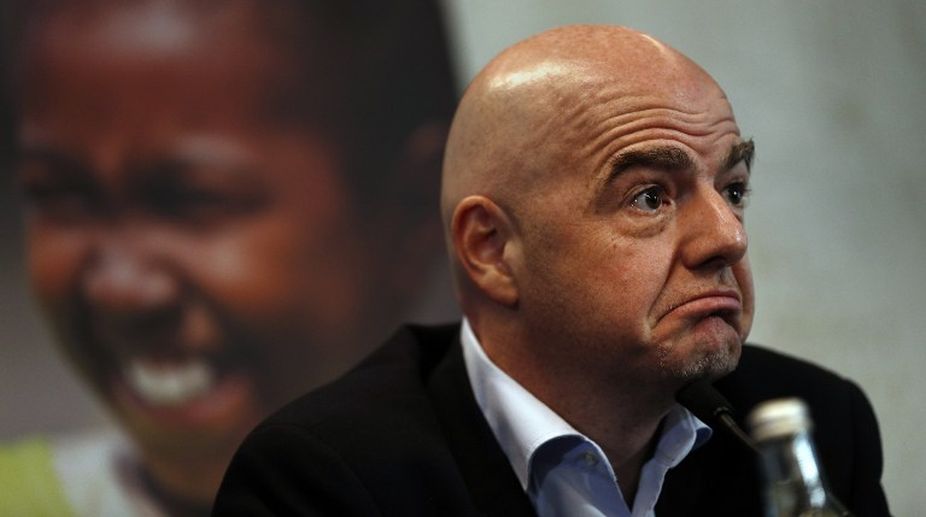
American President Donald Trump's controversial travel ban could make it impossible for his country to host the 2026 World Cup, FIFA president Gianni Infantino warned on Thursday.

The United States is the favourite to stage the expanded 48-team tournament in 2026, either on its own or as part of a joint-bid with neighbours Mexico and Canada.

But with Trump seeking to ban nationals from several Muslim-majority countries, Infantino says the US may not even be in a position to submit a bid.

"Mr Trump is the president of the United States of America and as such of course (I have) huge respect for what he does," Infantino told reporters at London's Heathrow airport.

"He's in charge, together with his government, to take decisions that are best for his country. That's why he has been elected.

"We are now in the process of defining the bid requirements. In the world there are many countries who have bans, travel bans, visa requirements and so on and so forth.

"It's obvious when it comes to FIFA competitions, any team, including the supporters and officials of that team, who qualify for a World Cup need to have access to the country, otherwise there is no World Cup.

"That is obvious. The requirements will be clear. And then each country can make up their decision, whether they want to bid or not based on the requirements."

Infantino's comments echoed recent remarks by UEFA president Aleksander Ceferin, who said the World Cup "cannot be played" in a country with extensive travel restrictions.

Infantino also expressed hope that a dispute with the Argentine Football Association (AFA) will soon be resolved.

FIFA has warned the AFA it could be suspended if it does not allow South American federation CONMEBOL to vet candidates in its forthcoming presidential election.

"Argentina unfortunately went through a very, very difficult period," said Infantino, who was speaking after a two-day FIFA executive football summit.

"We were obliged to appoint a normalisation committee in Argentina, which is quite uncommon for a big football country like Argentina.

"But now it seems the statutes have been more or less agreed. There is one still open question, which will be solved soon.

"I'm very confident about that and then the elections will take place.

"I'm confident there will be no need for drastic measures, provided everything goes well. Otherwise there will be need for drastic measures."