Logo

Diverse blend of delineations

Tapati Chowdhurie |

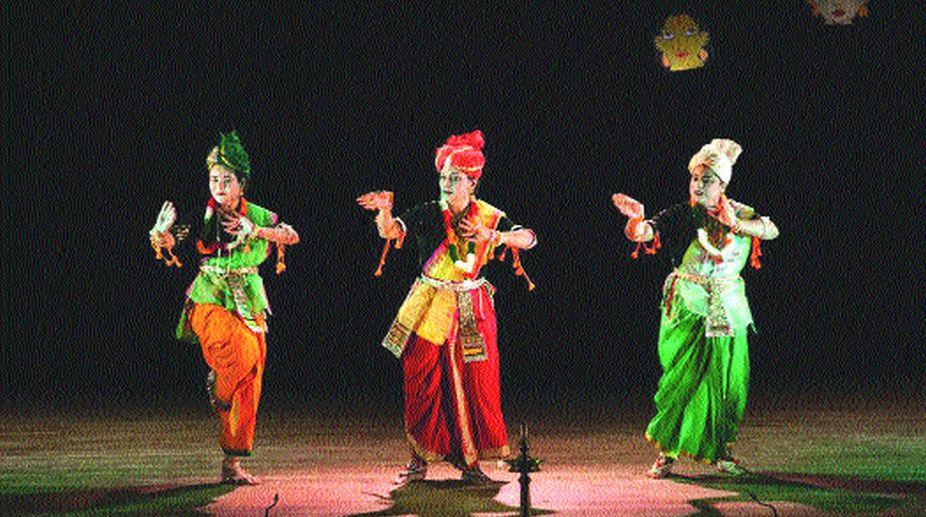
Katha Angika was a festival of dance and theatre, which celebrated five genres of Indian classical dance. The festival was rounded off with Kalaripayattu — an Indian martial art from the hoary past. In fact it finds mention in Sangam literature much of which has been lost. But let’s take a look at the four classical dance styles that were presented.
Kerala was culturally enriched by the great Chera monarch Kulasekhara Perumal, who was also one of the 12 Alwar saints of the south. The state has a rich tradition of dance drama on mythological themes, especially those depicting Vishnu taking the form of Mohini with enticing abhinaya. Thus was born Mohiniattam. The devadasis who settled down in Kerala naturally accepted the concept of Mohini. A few pieces of the style established Priyadarshini Ghosh and Mohana Iyer, of the Natyanova Dance Company, as innovative choreographers. The duo joined by their troupe members Ranu, Sreeradha, Sushmita, Saheli and Srijaini commenced with the genuflection to Ganapati, the remover of obstacles. His various attributes were described in a slow-paced way. The piece was in ragam Hamsadhwani and talam chempata while the music was by Leela Omcherry. Mukhachalam, a piece showcasing the pure nritta of Mohiniattam in in raga Malika and tala malika — a composition of Kavalam Narayana Panikkar — captured the circular and semi-circular movements the genre’s uniqueness. Mangala Shloka, in ragam Bageshri and talam marma, in praise of Lord Nataraja, was replete with the typical Kerala style of rhythm reaching a crescendo.

Moving on, Sreyashi Dey presented Shiva-Shakti in the Odissi style. The style is known for its grace, sculpture-like stances and intense lyricism in its movements. She showcased two opposites — one with form and the other formless, energy and consciousness in the cosmos as a whole as well as in every individual.

The first hymn from Shiva Panchaka, described Lord Shiva who is the most mercurial God of the Hindu Trinity. The power and energy of Shiva as portrayed by Dey in the rich style of her mentor Guru Gangadhar Pradhan was commendable. Her huge chaukas and pronounced bhangas were pleasing to behold. The piece vividly and reverentially described the physical attributes of Lord Shiva. Choreography was by Guru Gangadhar Pradhan. 

On the other hand, Mahakali Stuti was in praise Mahakali or the Dark Mother. She liberates, and along with her counterpart Lord Shiva, grants moksha and is famed as the destroyer of ego. Dey evocatively described her outer appearance and beautifully etched the Goddess’ multiple forms. Literature, stories of mythology and the great Indian epics are generally the traditional source grounds of classical dance and therefore its value will never to be lost as long as they are performed on stage. The choreography of Mahakali was by Guru Bichitrananda Swain.

Odissi dancer Arpita Venkatesh’s Navagraha paid respects to Navagraha (the nine planets) with the Navagraha Stotra of Rishi Vyasa in a neat choreographic work with her students. Venkatesh shone like a jewel with the impeccable form acquired from her guru Alok Kanungo, who has been recently awarded the Sangeet Natak Akademi Award. With the help of a well-reherased work, Venkatesh was cynosure of all eyes.

Next up, Poushali Chatterjee, carefully nurtured in the Guru Bipin Singh style of Manipuri dance, delivered Vasanta Raas with her group. Chatterjee got the audience involved by playing with colours in Khilata Radha Gopi Sangh. The playful Krishna tackled the whole lot of gopis alone with sprinklers filled with colours. It was a good idea to use shredded yellow marigold rather than actual gulal. It made cleaning the stage for the next performer a lot easier. The rendition of Tanuum, which is a pure dance piece, gave the audience a glimpse of Manipuri. However, to be at her best, Chatterjee should catch up on her practice.

Thereafter, one found their way to Kathak. Sanjay Bhattacharya started his repertoire with Rambhajan, which was rather unusual. Tulsi Das’ Sri Ramchandra Bhajman sung in Yaman Kalyan raga and teora tala was soothing and appealed to the listening pleasure of the audience. In the nrityang taal, Rudra was used to show the students’ taalim. Teen taal, which is the most sought after taal of all Kathakas and which spells either success or doom, was presented in a pleasing manner. Toras, tukras, tehais, amad, padahant and chakradhars were executed with as much ease and élan as young aspiring dancers are capable of. The last piece was by Bhattacharya himself. A good performer and teacher, he would do better as a performer with a well-tuned physique.

Sutradhar Arko Mukhopadhyay is a theatre person to whom launching an evening of dance was child’s play. He was a natural stage actor as was aptly clear when he spoke. He is presently a Kalaripayattu trainee in Kerala under the mentorship of Assan Ajith Kumar. A group of Kalaripayattu artists, Ajith Kumar, Maruthi Mama Chikilsa and Kalari Sangham came all the way from Kerala to present their art at Gyan Manch. Their wielding of the weapons and close contact technique were commendable. 

Sreyashi Dey with her admirable academic record of teaching at Michigan University is the founder-president of Akshara, which is a platform to create, perform and promote the arts from India both in their traditional forms and in more dynamic and contemporary expressions. She is also the president and artistic director of Shristi, which specialises in performance and preservation of Indian classical dance. Katha Angika was her presentation in Kolkata to fulfill her pledge to the arts.
The genius of computational horsepower

John Lui |

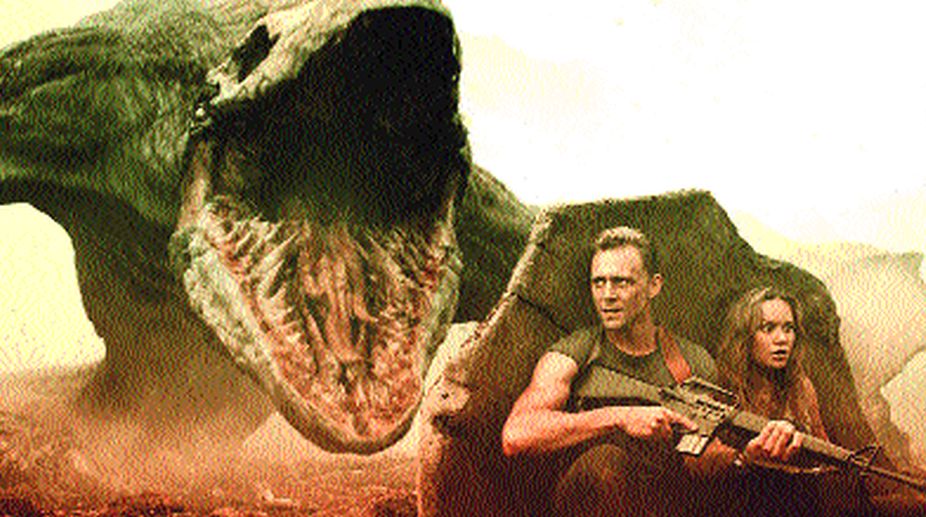
In a scene near the start of Kong: Skull Island, (top) a band of adventurers buzzing around in military helicopters comes face-to-face with the monster that gives the film its title. A spectacular vertigo-inducing battle ensues between Kong and the copters. Much of that scene was done at Industrial Light and Magic Singapore. Visual effects supervisor, 41-year-old Jeff Capogreco, says that the scene “introduces us to Kong and he isn’t very happy. People are invading his home”.

It is a complex sequence about three minutes long, composed of 150 “shots”, the unbroken scene between two cuts. Real actors inside dummy aircraft whirl around the digitally-created Kong, with the fight taking place against jungle scenery and sky, which might also be painted in by computer.
“Singapore did the helicopters being smashed and crushed. Kong is roaring and jumping,” says Capogreco, who has worked there since 2014. ILM’s other studios — in London, Vancouver and their head office in San Francisco — also worked on the film.

The giant ape is 30m-tall — two times taller than the one in 2005’s King Kong, directed by Peter Jackson. This new Kong is the largest in Hollywood history, says Capogreco. Director Jordan Vogt-Roberts said he needed Kong to be enormous to create a sense of awe.

Jackson’s film featured a smaller, acrobatic Kong able to leap from spot to spot. It also had to fit inside a New York theatre in the final act. Vogt-Roberts’ Kong, however, does not have to fit in a theatre nor tenderly cradle a woman in his hand — his less nimble Kong needed to be massive enough to crush a helicopter in one hand.

Capogreco says advancements in software now provide a much greater level of creature realism, compared with the 2005 ape. The quality difference can be seen in one detail — hair. The more hair a furry digital creature has, the more realistic it looks. “We can render five to 10 times more hair now than we did 10 years ago,” says Capogreco, who is Canadian. 
Rendering, the process of turning computer code into an image, requires computational horsepower. With each hair on Kong’s body having its own colour and length, and each patch acted on by sunlight and wind in different ways, the resources involved are huge, he says.

Like Jackson’s Kong, the Kong of the new movie is based on capturing the motion of an actor, then mapping the motion onto a digital version. Actor and movement coach Terry Notary, who has worked on films such as Warcraft (2016), Dawn of the Planet of the Apes (2014) and The Hobbit trilogy (2012-2014), provided the facial expressions and body movements for the new Kong. 41-year-old Ashwin Ram had no human actor to base his creatures on. The Indian national, a lead modeller at ILM Singapore, helped create the Skullcrushers — the fast-moving, car-sized two-legged animals attacking the humans in Kong. “They are based on fantasy, but they have to behave in a realistic way,” he says. This means they have to move in ways that make sense to viewers because people have preconceptions about how animals move, he adds. He based the Skullcrushers on a variety of reptiles — Komodo dragons, monitor lizards and snakes. “The challenge was to create a creature that could be both a snake and lizard,” he says.

Chelsea Khoo, 37, creature technical director at ILM Singapore, faced a similar issue of making the fantastical look realistic, except her job is on a different scale. The Singaporean artist specialises in making simulations of fur, cloth and flesh look real. Every creature has one of these coverings. Kong, of course, is all fur.

“Different areas have different fur. The hair under the arms and on the legs is longer, while the hair on the top of the head is short. The direction of the hair growth is different. When Kong moves, the wind acts on them differently,” she says. She studied videos of gorillas on television and YouTube to make sure she got it right, says Khoo, who had also worked on the recent fantasy epic The Great Wall (2016).

Kong’s fur presents one set of issues, but hairless creatures such as The Great Wall’s tao tie monsters are just as tricky because muscles moving under skin have to follow natural- looking patterns too, she says. That film’s other challenge was cloth — in particular, the flowing capes of warriors.

The actors wore real capes, but director Zhang Yimou asked ILM Singapore to digitally enhance the billowing of the soft, silken fabric worn by soldiers in battle. How does one learn the behaviour of cloth under different conditions? One conducts experiments. “We took videos of ourselves wearing capes. We jumped, we fought; we rolled on the floor to get a good idea of how the fabric would look.”

the straits times/ann

Saving lives instead of taking them

Statesman News Service |

The name Desmond T Doss may not be familiar — even among World War II buffs, his story is lesser known — but the subject of the film Hacksaw Ridge undoubtedly had a story worth telling.

The bare facts are these — on 1 April 1943, Doss, a skinny shipyard worker, vegetarian and devout Seventh-day Adventist, arrived at Camp Lee in his home state of Virginia and voluntarily enlisted in the United States Army. Doss’s religious conviction made him an unlikely recruit. He refused to hold a weapon, much less engage in active fighting, and he would not participate in training or manoeuvres on Saturdays — the day his church keeps as the Sabbath. Yet these same beliefs were also what compelled Doss to join the war effort as a combat medic. 

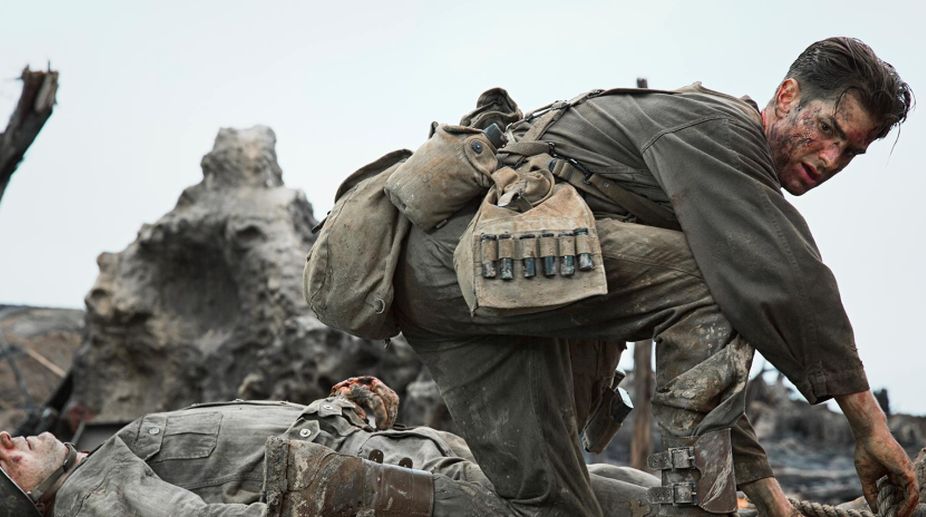
As the war in the Pacific reached its deadliest phase in the spring of 1945, Doss and the rest of his unit were on the Japanese island of Okinawa, about to take part in the capture of the heavily fortified Maeda Escarpment, nicknamed Hacksaw Ridge due to the shape of its 400ft cliff edge. Amid fierce fighting and heavy bombardment (all captured with visceral power in the film), Doss’s unit was ordered to retreat. However, Doss chose to stay behind, returning to the battlefield again and again to find wounded soldiers and bring them to safety.

In October 1945, when Doss was awarded the Medal of Honor by President Harry Truman, the citation credited him with saving the lives of 75 men. Thus, Doss became the first non-combatant in US military history to receive such a commendation and one of only three since.

Given such extraordinary circumstances, the story of Doss’s training, struggles with the military machine and eventual acceptance from his fellow soldiers, would have made for a compelling movie in itself. In the Mel Gibson directed Hacksaw Ridge, however, all this is only a first act.

With a story so vivid — and true — why has the life of Desmond Doss taken so long to reach the screen? Partly the delay is down to Doss himself. As Bill Mechanic, producer of Hacksaw Ridge, explains, “Desmond never wanted to sell his life rights, he didn’t want to popularise himself, feeling that would be a contradiction to who he was.” This humility certainly wasn’t based on a lack of interest from Hollywood, as Doss’s only child, Desmond Jr, told People magazine. “I grew up in a house where there was an endless stream of people coming through the door wanting to make a movie, write a book, etc,” he said. “The reason he declined is that none of them adhered to his one requirement — that it be accurate.”

According to the accounts of both World War II veterans and current military personnel, Hacksaw Ridge admirably meets this requirement for accuracy and in the end Doss did give permission. A few years before he passed away in 2006, he gave his blessing to documentary maker Terry Benedict, who set in motion the project which would eventually become a feature film. In it, he is brilliantly essayed by Andrew Garfield — a part for which he received an Oscar nomination for Best Actor.

Yet Doss’s years of relative obscurity have had a further, unexpected benefit. Though the Battle of Okinawa was fought more than 70 years ago, perhaps this story has never been as relevant as it is right now. With the devastating war in Syria in its sixth year, global powers are attempting a new kind of international intervention.

Can it ever be possible to oppose violence without perpetuating it? Desmond Doss’s model of “conscientious cooperation” — his phrase — provides one strikingly poignant answer.

the independent 

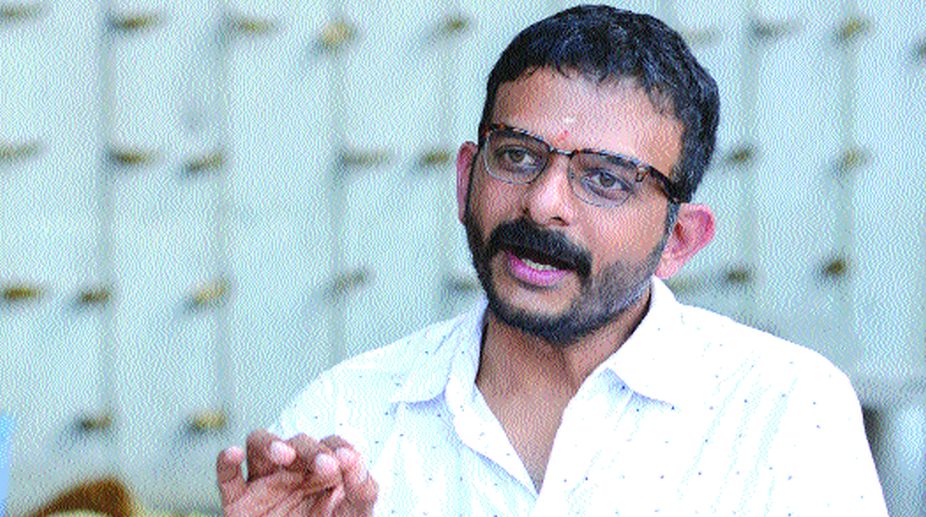
‘Indian artistes have been docile’

Sri Krishna |

Popularly known as “TMK”, Thodur Madabusi Krishna is a widely admired Carnatic vocalist known for his blunt views on issues ranging from politics to social subjects. The 41-year-old was conferred the prestigious Ramon Magsaysay award last year for his commitment as an artist and his advocacy of art’s power to heal India’s deep social divisions, breaking down barriers of caste and class.

A student of the Krishnamurti Foundation’s The School in Chennai, Krishna was influenced by Jiddu Krishnmurti’s philosophy of ‘pathlessness’ and  honed his mastery of Carnatic music under the tutelage of Seetharama Sarma, Chingleput Ranganathan and the legendary Semmangudi Srinivasa Iyer.

TMK has co-authored “Voices Within: Carnatic Music – Passing on an Inheritance,” a book dedicated to the greats of Carnatic music. His later book, “A Southern Music,” is a first-of-its-kind work on the Carnatic tradition and was awarded the Tata Literature award for the best debut non-fiction book in 2014. In an interview to SRI KRISHNA, he spoke on various contemporary issues. Excerpts:
 
Q: You are a strong critic of the existing political system and your articles too reflect it. You sound a bit cynical. Why this stand? 

 A: I definitely feel that there is a certain downward turn to the way we are looking at the social and political discourse in this country, especially over the last two or three years. I think why I am upset about it is because I think there is a clear direction of keeping people and ideas polarised and creating binaries out of ideas. I feel that there is a movement towards pushing people to violence ~ it need not be physical violence but violence towards ideation. That is where it all begins. I fear that we are pushing people and communities to ideational violence which leads to physical violence.
There are enough examples and I don’t need to elaborate on this. It is all over the country. Depending on what thought process you hold or opinion you have, you are called all kinds of names today. I don’t remember anything so sharp ten or fifteen years ago. For everything you are considered non-patriotic. This is hyper-nationalism which is also embedded in a certain religiosity and religious identity.

To me it is very bothersome and I do believe that this is not the direction that we should take as a society. It is not about political parties but about the discourse that this country needs to take. I feel that the present political set-up is not doing anything to nurture a more open environment where you are not sharpening knives. Today everyone is sharpening a knife and that is indeed worrisome.
 
Q: There is a view that there is growing intolerance in the country. What role do you feel the artistes’ community can play to restore tolerance?

A: The truth of the matter is in India artistes have been most docile. Let us take that as a fact. We (artistes) have never participated in the political system and I don’t mean political parties but the idea of politics. We have been very careful and even subservient to every political dispensation and the reasons are obvious, I don’t have to elaborate. I think that is a sad thing in the country that artistes don’t realise that their engagement in the political is very important to create diverse ideas, even creative spirit in the political process. We do not do it. I think the artistic community should participate in the political discourse, especially as we live in a time when certain thoughts are considered wrong and you have people of power, specially ministers, who come out and say that we will not allow that which is anti-national. Who is defining the identity of what is national and what is anti-national? All these are being bulldozed, I believe, on large parts of this country. And the sad thing is we are all feeding it and making it more aggressive. The best way to challenge anything is not necessarily to talk about it but to use an artistic form to express views. I believe there is a huge role for artistes.
 
Q: It seems that views described as Rightist are not only prevalent in India but also spreading all over the world in a political sense. Your take on this.

A: It is indeed a global phenomenon whether it is in India, the United States of America or many parts of Europe. I think we are seeing the rise of dominance-based politics and society. Different forms of oppression and pressure are being put on people who don’t subscribe to that. This is a global phenomenon and globally we have to watch for it because all these forces will join hands. Here again it is important for liberal society to engage with conservative ideas on a level playing field. It is not about bulldozing or violence but liberal society should engage conservatives in an intellectual and emotional conversation for only then we shall not fall into a trap of political maneuverings. That is also important. We cannot sit on a high horse and be liberal for that is also dangerous. We have to see that every opinion exists and we have to engage with it and also negotiate with it. We have to find various spaces of commonalities for only then can we challenge such oppressive thoughts.
 
Q: What kind of role do you see the media play?

A: The media too has a huge responsibility. I mean there is a certain section of the media which is doing what it should do. It is asking questions. But, there is a lot of media that is basically pandering to what is being sold as political ideas or social ideas or national ideas. I think that the media wants to create a certain hyperbole, almost like they want a blockbuster film of every news item, irrespective of human lives or human thoughts or ideas. The media is not playing its role and it needs to introspect.

It is not about editorial stance of a newspaper. That is not what I am discussing. I think the way you engage with controversies, with differences, with shall we say clashes or disagreements. You cannot engage with it with the prime objective of making it sensational. I think the Indian media is now very much in the flow of creating sensation. The media should realise that in the long run every sensation you create affects actual human lives, ways of living and not just that moment of TRP ratings for more shares on Facebook or more tweets. There has to be far more introspection.
 
Q: How do you view the events that took place on the Marina in Chennai at the time of the Jallikattu agitation? Do you feel that this is a start of a people’s movement in the state?

A: I am going to disagree with you on this. I must say that people thought that Jallikattu was a way of bringing them together. It is a good thing people came together but I am a bit sceptical as it brought people together for the wrong reasons. It was also a kind of jingoistic nationalism.

But did we come together when there was constitutional disorder in the state a few weeks ago? We did not. Let us be honest. We all tweeted and wrote on Facebook but beyond that did anybody come together? No. Did we create a situation where the Governor had to think differently what to do? No. The fact is that we are not coming together for democratic processes. We are coming together again for identity politics. How is it going to help in any kind of community building? I think we should have come together when this mess with Sasikala, Pannerseelvam, Palanisamy and Stalin was going on. The community should have come together and demanded a far better way of going about things. We did not, which is why it makes me wonder whether there was any meaning at all in the coming together on Jallikattu. What did we get after seven days of standing at the Marina other than getting Jallikattu. What nobody talks about is that it killed human beings. About ten people lost their lives. Nobody seems to be bothered that human beings lost their lives. Other than that, what have we achieved in terms of democratic process? I don’t think we have achieved much. I would be happy if I am proved wrong.

Just an ordinary journalist

Ravindra Kumar |

My revulsion to being considered a member of the media is growing. I am part of one medium – the newspaper. My responsibilities, my role and my accountability are restricted to this medium. I will answer for my sins and foibles but not for those of others.

Fellow editors in India and Asia – dear friends all – tell me of the inevitability of media convergence and chide me for being antediluvian. 

They say the modern newsroom requires people skilled not just in fact-gathering and writing; headlining and editing, but also in podcasting, broadcasting, tweeting and heavens know what else. That to me sounds like Indian restaurants of yesteryears – they offered Chinese, Continental, Thai and Mughlai cuisines from a single wok and made a hash of them all.

I am entitled to my view but you will ask why I am unburdening myself now. The reason is that something very sad happened a few days ago. This event, coming on the back of a string of others, forced me to organise my thoughts on why I ought to remain a plain and simple journalist, and not allow membership of the much-hyped club called the media to be thrust upon me. 

A 20-year-old girl, student of a prestigious college in Delhi and daughter of a man who lost his life in an India-Pakistan border conflict when she was two, said in a video posted on social media, “Pakistan did not kill my dad, war did.” 
That is a profound thought, one that every sensible person ought to reflect upon. It is a thought that deserves introspection and informed articulation, especially in these ultra-nationalistic times. It should open minds, not close them further. It does not deserve derision or hate or the threat of violence. But that is what it got.

For her poignant appeal to good sense, Gurmehar Kaur was trolled, hounded, threatened with rape, labelled a Maoist and a separatist, and suffered the mortification of being told by a junior minister that her father’s soul must be weeping “because she was being misguided by those who celebrate on the bodies of martyrs.”  

Rattled by the rabidity of responses, Gurmehar withdrew from the public space in tears. A brave and spirited girl I would be proud to call my daughter was forced to cower. All that I and many like me could do was watch helplessly as the deluge of hate swamped our world. The media was at work, and to think they call it social. 

Convergence would make me a part of this horror. 

Gurmehar Kaur’s case was special but by no means unique from the perspective of labelling. A few days earlier, at a “media” conclave, I was questioned by members of the audience. They asked me why the media was so irresponsible; why it sensationalised events; why it found little or no space for the other side of the story and why it conducted trials and played the role of judge, jury and executioner. I was shaken by the degree of antipathy. Partly to gain time and gather my thoughts, I asked my interrogators to provide examples. 

The examples came thick and fast. They supported each of the charges, sometimes conclusively. Culpa, maxima culpa! But it had nothing to do with me. Each charge was exemplified by an excess of a television anchor or a Twitter user, members of that grandly-titled media of which I was alleged to be a part. I pleaded not guilty and cited my watertight alibi. For my pains, one person accused me of chickening out on a technicality.

This is the reason the narrative must be rewritten and the lines redrawn so that members of the Press can extricate themselves from this oversized cloak called the media into which they are being squeezed. 

We are inheritors of a glorious legacy and bound by the rigours of a demanding craft. We are not hoodlums who threaten to rape or maim those we don’t like or shout out those we disagree with. The best of us err, sometimes grievously, but have learnt that making amends can be uplifting. 

Those on social and other media – be they presidents, prime ministers, ministers, television anchors or citizens of the world – who are prepared to subject themselves to the standards we aim for should join us. They too must strive for the truth, aim to keep the discourse even-tempered, find space for all sides of a story and have the ability to admit mistakes. But if they cannot do so, let them be members of the media and leave us journalists in peace, even if it is to be the peace of an ethereal grave that Twitter and Facebook dig for us. 

The writer is Editor, The Statesman. He cannot be found on social media. This is a series of columns on 
global affairs written by top editors and columnists from members of the Asia News Network and published in newspapers and web sites across the region. 

Finances of the Nation ~ II

Shantanu Basu |

The political reluctance in matters of taxation and enforcement is pronounced. Governments lose several thousand crore each year owing to collusion between revenue officers and assessees. There is very limited reconciliation of revenues between revenue collection agencies, their accounts officers and receiving banks. CAG’s customs audit report for 2015-16 reports that 89 indirect tax commissionerates shows gross amount of Rs.6.20 lakh crore as unreconciled. Even if a single per cent of revenue were not paid at all or was showed as having been paid (using forged bank stamps and pay-in forms), this would amount to a whopping Rs.6200 crore, enough for about 2.43 lakh jobs paying Rs 20000 per month and bringing 4-5 times that many people well above the poverty line. Owing to the cash basis of government accounting, the quantum of revenue lost by lack of enforcement owing to their own ranks never figures in the annual accounts. As if this were not enough, extortion at toll gates takes its own toll as legitimate revenues of the state are converted into private wealth and then applied to various purposes, mostly illicit. Tax demand notices likewise are often inspired and adjudication often ends up costing more than the settlement terms. All this while governments live off borrowed moneys.

While low global oil, commodity and shipping prices allowed the Government of India the luxury of raising central excise on imported oil, 2016-17 and onwards is seeing a rise to $60 dollar/barrel levels. This would invariably reduce the Government’s fund-raising capacity. Cesses are not ad hoc substitutes for revenue collection by manufacturing that shows few discernible signs of revival. Cesses collected over the years that ought to run into several lakh crore, notably on education, are nowhere manifest in our educational institutions while state spending steadily declines in this sector, as in many others. Governments in India no longer have the financial muscle to enhance spending much more nor incentivise consumer spending by tax rebates notwithstanding political grandstanding. What then of alternative financing from India’s financial institutions (FI)?

Defaulted dues are of broad types ~ non-performing assets (NPAs) and restructured debts (CDRs). When a loanee fails to pay back principal and interest when instalments are due, nor is there any prospect of their business being revived by FI intervention, it is declared an NPA. On the other hand, CDRs are attempted bailouts by loaning FIs by extension of time (e.g. owing to adverse business scenario, sudden change in state policies, etc.), conversion of debt into equity or by management participation of the loanee entity. Over the years, PSBs have suppressed their actual NPAs by the subterfuge of sanctioning many more loans than those defaulted. CDRs partly supplemented PSB efforts by staggering declaration of NPAs in misrepresentative but audited PSB balance sheets. GNPAs of PSBs in the last five fiscals rose three-fold. As of December 31, 2016, of every Rs 100 loaned by PSBs, Rs 11 is in default. These figures do not include NPAs en route in the form of CDRs that may multiply this figure alarmingly given the steadily worsening domestic and global economic scenario.

Recently, a former Deputy Governor of the RBI, Dr KC Chakrabarty, estimated that NPAs, as on date, were about Rs.20 lakh crore. Obviously, this figure could stretch into an unknown abyss and did not include historical loan waivers over the last 2-3 decades. Some PSBs like IOB and UCO Bank have GNPA in the range of 17-23 per cent. For IOB, gross bad loans are more than 2.5 times its net worth; both UCO Bank and United Bank of India have eroded their net worth by at least double while IDBI Bank is 1.3 times negative in its net worth. These worrisome figures do not include loans given to projects where the dates of commencement of commercial operations had passed, but the projects had failed to take off, presumably mostly in the infrastructure and telecom sectors. At the same time, international conventions demand a minimum percentage of liquidity that banks must maintain viz. Basel-III. Although PSBs currently comply with these norms, a rapid rise in NPAs in the coming months, matched by poor recovery record, could cause them to fall below these stipulations. The Indradhanush plan of the Department of Financial Services, Ministry of Finance of August 14, 2015, estimated the extra capital requirement up to 2019-20 at about Rs 1.80 lakh crore. This estimate was based on credit growth rate of 12 per cent for the current year and 12 to 15 per cent for the next three years depending on the size of the bank and their growth ability. It was also presumed that the emphasis on PSBs financing would reduce over the years by development of vibrant corporate debt market and by greater participation of private sector banks. Accordingly, budget provision of Rs 25000 crore each in 2015-16 and 2016-17 and Rs 10000 crore each in 2017-18 and 2018-19 was proposed in Budget 2016-17. Owing to revenue shortfalls and rising revenue expenditure, the full amount has not been paid in most fiscal years. This tendency would only be exacerbated in 2017-18 and onwards. Obviously, such ad hoc allocations for recapping PSBs take away development funds from the public exchequer and are not a sustainable solution. Further, ever-rising NPAs cast a shadow on the Department of Financial Services’ estimates of Rs 1.80 lakh crore required for recapping PSBs.

At the same time, Budget 2017-18 proposed the creation of a Distressed Assets Agency (DAA) to which distressed loans of PSBs would be transferred and that would look for buyers for them. Although the fine print on financial arrangements for DAA is not yet in the public domain, there are grave doubts about the Government of India’s ability to bankroll the share capital for such an entity. It bears recall that the collapse of Lehmann Brothers in 2008-09 in the US was rooted in its taking over distressed housing assets from Wall Street banks and then not being able to sell them, although pay-outs for such takeovers were met by Wall Street banks, acting individually or in consortium mode. A similar situation could happen if, for instance, builders were to attempt to sell apartments and commercial buildings in the ghost towns on the Greater Noida Expressway since the sale value would be appreciably lower (maybe 40-60 per cent) than what is owed to financing agencies, a very likely event. Even if they refinanced their defaulted loans with fresh lower-interest ones from PSBs (after recent interest rate cuts), no real accretion to infrastructure development would occur while the option of further default remains omnipresent. PSBs, now increasingly, under close watch of vigilance and investigative agencies, are also loath to loan further funds.

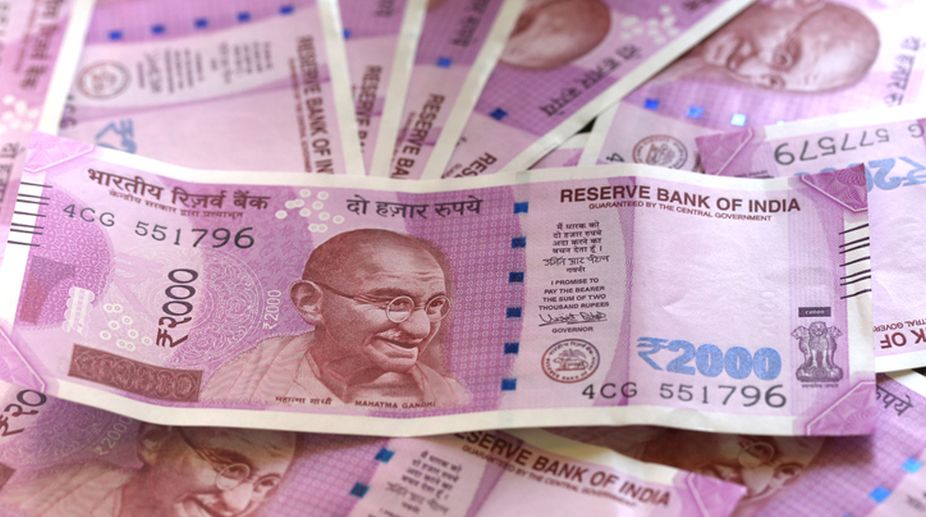
With such huge pressure building on it, the Government of India is left with very few options. Accordingly, over the last year or so, relatively healthy CPSUs are mandated to return a minimum 30 per cent of their net profits to the Government as dividend. With looming wage revisions, many CPSUs that are holding companies are now resorting to milking their subsidiaries for their cash balance to pay off dividend. For others whose profits are recession-hit or minimal, the choice is to dip into their reserves. Recently, the Ministry of Railways reportedly protested to the Finance Ministry against the latter’s demand for transfer of Rs 850 crore dividend earned by 14 Railway CPSUs after the merger of the Rail and General Budgets in 2017-18, stating that such transfer would only add to the shortfall in railway earnings. Compounding these is RBI’s recent decision to cut back its dividend to 12 per cent in order to absorb costs of printing new post-demonetisation currency. The Government, mainly via its FIs, also owns large chunks of shares of the private corporate sector. Companies/FIs like ITC (34.43 per cent), ACC (14.66 per cent), Axis Bank, L&T (45 per cent), Bharti Airtel, Gammon India (63.4 per cent), Monnet Ispat (50.14 per cent) and Tata Steel (19.66 per cent) have several lakh crore rupees of government investment in them. Faced with an unenviable situation, the government has now started divesting part of such holdings, some in the open market, and the rest being picked up by state FIs such as LIC. Many relatively healthy CPSUs have also been coaxed in the past year into buying back government shares that have reduced their liquidity further, at least till their next IPO. Given the less than average performance of the stock market, offloading shares of CPSUs is unlikely to garner huge resources, even when the government has recently listed its four general insurance companies.

With President Trump promising large public-private sector investments in America’s crumbling infrastructure, interest rates would invariably rise and cause FDI to flow back from India to the safer confines of the US that may depress Indian bourses even more, and, with it CPSU divestment offerings. The layman understands that unless consumer incomes rise (with employment), demand will remain depressed. In turn, this will depress manufacturing and along with it, supporting services. Momentary spikes in GDP from increased revenue collection owing to extraneous reasons are not much cause for optimism. A stasis has emerged in which all expecting fingers are pointed towards governments that do not have large-scale spending wherewithal any longer and must rely on increased borrowing. Stop-gap measures like the ones stated in the preceding two paragraphs eat into the nation’s cash reserves, particularly when ploughed into revenue expenditure and uncertain public projects. The Union Finance Minister’s job has never been as unenviable, not even in 1989-90.

(Concluded)

Denuded welfare

Editorial |

Just when the so-called “remonetisation”, eventually a measure of forward movement since November 8, was expected to put the rural economy back on the rails, the bedrock of development has been severely jolted on the bread-and-butter issue of wages. Not to put too fine a point on it, the increase in the Mahatma Gandhi NREGS has been almost absurdly incredible in eleven states, with eastern India being quite the worst affected. It thus comes about that Assam, Bihar, Jharkhand, Uttarakhand and Uttar Pradesh will have to make do with a rupee rise each day. Odisha scores marginally better with Rs.2 and West Bengal must only be mildly happy with a Rs.4 hike.

Small wonder that discordant notes are resonant across the country. While Haryana boasts the highest daily wage ~ Rs 277 ~ Bihar and Jharkhand will continue to languish at a daily rate of Rs.168. Neither figure takes into account the siphoning of funds by the village middlemen who have arrogated to themselves a pivotal role in the allocation of the stipulated minimum 100 days’ work a year. A watershed initiative in the social sector, that was trumpeted as a flagship achievement by the Congress-led UPA government, has come to be plagued by inequity, bereft of even a semblance of uniformity. The original praxis that was abandoned in 2008 was remarkably rational ~ the daily payment for workers was the same as the minimum wage of a particular state. From region to region, the difference has become sharper ever since the Centre decided to link the daily wage to the Consumer Price Index for Agricultural Labourers.

The ministry of rural development does have a point when it argues that adoption of the state’s minimum wage will benefit workers in those states that increase their minimum wages more frequently ~ and at a higher rate ~ than others. In the net, the targeted group or more accurately the BPL category is suffering the worst of both worlds. Imperative therefore is a uniform procedure for revising minimum wages under the scheme.

If the latest Economic Survey is an index to go by, the workers in several states would appear to be shortchanged because of what it calls the “exclusion error”, for which the poor in at least five states ~ Bihar, Madhya Pradesh, Rajasthan, Odisha, and UP ~ could access only a third of the resources spent on the scheme in 2015-16.

These states represent the country’s drought-prone poverty baskets, though Bihar, Odisha, and UP are vulnerable to floods as well. It is a commentary on the “benefits” or the lack of it that the states that are predominantly poor, incurred only 30 per cent of the total expenditure. The concept of welfare has been severely denuded a decade after the MGNREGS was flagged off. 

The rural economy is stuttering despite the touted GDP.

Rare harmony

Editorial |

With a most bitter election campaign approaching boiling point, it was inevitable that there was limited scope for discussing other matters ~ and, of course, there is some truth to the charge that only the negative makes “news”. So, therefore, lost in the political thunderstorm was a rare instance of the fierce differences between the Central and Delhi governments being set aside and their functioning in what might even be hailed as “harmony”. Adhering to the Centre’s request for reducing the Value-Added Tax on aviation turbine fuel, the budget just presented by the Aam Aadmi Party government announced a VAT reduction from 25 per cent to one per cent on fuel being used by air services operating under the Regional Connectivity Scheme. True that Delhi airport is not included in the RCS, but there is every possibility of flights to and from the North-east availing of the lower fuel price ~ which would certainly be appreciated by the large number of people from that part of the country who study or find employment in the national Capital. People who it must be confessed have not found life in Delhi very comfortable. Whether the AAP government’s gesture will impact the larger situation is a matter to be watched. Anyway, it is a welcome “first”.

The reality will be known when the lower tax finds expression in terms of rupees and paise via the revised fares the airlines will offer. It is estimated that around 40 per cent of operating costs aref uel-related, and one travel expert has calculated that the new tax structure would result in a ten per cent reduction in fares. The civil aviation ministry has welcomed the Delhi move, now it must ensure the necessary follow-up action. There is need for immediate clarification on how a non-RCS airport like Delhi will benefit from the revised tax, and whether fares are to be calculated taking into account the ultimate destination of the passenger or if the “normal” rates will apply from Delhi to the “hub” from which an onward RCS flight is taken. In these days of “dynamic” pricing the passengers’ interests are not necessarily paramount.
The ministry must also persuade other states to follow the Delhi move so that regional connectivity becomes a reality, not a scheme only on paper. The links between the Capital and smaller towns in the region might not be as complex a matter as facilitating air travel to and from the North-east. There may be no immediate political advantage to be gained from the reduction in VAT on ATF, but it would help project the AAP as having “national” ambitions ~ and not in the somewhat divisive sense in which the BJP uses nationalism.

Every cloud has a silver lining

Srijita Datta |

Having initially started out as a short film director, Sourav Sarkar’s journey as a film-maker has been extensive and diligent over the last 3-4 years. His recent feature film, “Dugdhonkor,” after its release in 2015 has garnered over 15 lakh viewership worldwide, but being screened at the 3rd India International Festival at Tampa Bay, Florida, marked the beginning of his journey, while his documentary “Nibhritochari” after its premiere at Nandan, got screened for the Indian Association of Retired Persons, Kolkata as well as got officially nominated at the 3rd International Film Festival at Prayag, Delhi, 2017. Excerpts from an exclusive interview

Congratulations on your work getting international acclaim. Can you tell us about the journey?
My journey, briefly, can be regarded as one of inner confidence. Most were apprehensive of me taking a career-shift. But I knew I’d be able to communicate with my viewers strongly through my films. The journey was challenging and even depressing at times, but nothing could stop me.

You had initially started out as a short film director. ‘Nibhritochari’ is a documentary film. But ‘Dugdhonkor’ is a feature length film. Was there any particular reason why you chose to shift from short films, and how was the experience? In comparison to documentaries/short films, how hard was it to make a full length film?
Every film has its own unique characteristics. I did not shift from one type to the other; I believed I’d be able to reach viewers through all these different types, at different points of time. Certain concepts need to be expressed in two hours length; some need only 5-10 minutes. It depends on what the film-maker is conceiving. But, from technical point of view, a full length feature film needs more research, workshop, time and money too.

Did you have any prior training in the field? Can you tell us something about your mentors (if any) and how they inspired you?
I did not do any formal training for films but being an engineer, I had prior ideas about the steps and management behind developing any product. A film is technically an emotion driven product. Since childhood, I possessed a strong inclination to understand emotions and emote myself. I used to play some musical instruments, wrote poems and short-stories, was technologically sound through my previous professional experience too. Rest of the skills grew while making films one after another. However, I am inspired by the well-known seniors over the country to learn and implement new things every day.

What prompted you, as an individual, to recognize that filmmaking was not just a hobby, but that it would be your life and your living?
It is not possible for the society to realize how much effort, perspiration and brain-work is required to make films maintaining standards. After starting my first film, I understood that it’s a full-time involvement. No other major responsibility can share the brain-space with it.

How has it been like, following your dream? Were there any particular periods of struggle/difficulties in pursuing the same?
Following my dreams is a matter of great satisfaction and meaningfulness to me. But the joy increases when I see others also following their own dreams. A dreamer understands a dreamer most. There is struggle, and inevitably would be. If one has new dreams, one needs to struggle for implementing that. I have talked to successful seniors very often. And they are always in struggle too – for delivery consistent quality.

Are there any particular films that have been the most inspiring or influential to you, and why?
I am very fond of Asian films. Films from Korea, China, and Thailand inspire me very much as I can relate as lot with them, as well as Indian classics. Some films from Europe, Iran and Latin America gave me a good scope for observation  and learning. 

Is it harder to get started or to keep going? What was the particular thing that you had to conquer to do either?
It is hard every moment. Independent film-making is a social movement. Here you speak freely on social and psychological aspects. Freedom of concepts and presentation can go to a large extent – nobody can question whether that is already proven popular. No compromise with freedom at the cost of apparent business demands. The challenge is to make viewers hungry for new concepts and styles. This is a culture which needs to start from our early education period. I personally interact a lot with viewers. It is just not ‘making’ films, it is way beyond. 

What was the most important lesson you had to learn that has had a positive effect on your films? How did that lesson happen?
“Every cloud has a silver lining”. I see life in an optimistic manner. Even if my film has a depressing tone according to the need of script, there is an underlying optimism.

What are some personal attributes that make for a good filmmaker in your opinion, and what do you do to foster them?
To me, a good film-maker should have a commendable grasp over all the departments in film-making. He should lead the team with confidence and clarity, and then only others will be encouraged to work with him.

What makes a film great for you? Are there any certain qualities that make a film better for you?
Being a film-maker, it’s very difficult to judge greatness of other films as I find many things to learn from every film. However, I personally appreciate classical narrations. Films with unique subject matter attract me more, and then come the craft of it.

Are there any common qualities in cinema today that you dislike? Is there something you try to subvert or avoid or rebel against in your work?
In India, untouched concepts, coming out of deep intellect, are not getting proper space in cinema. Experiments are less in number. There is only a few, and that also not properly acknowledged. This is pretty unfortunate. I try to avoid stereotyping as much as possible. 

What advice would you give to someone who wants to have a life in filmmaking?

Satisfy yourself first, then satisfy others. Don’t stop in face of any adversity if you are confident. Don’t try to be famous by making films. Rather, it’s healthy to think on how mankind gets long-term benefit through your film, and your ideas. Fame will automatically come to you.

Voices of Tagore’s women

Shoma A Chatterji |

Did Chitrangada’s father, the King of Manipur, take her permission before deciding to bring her up as a boy and man by suppressing her sex and gender physically, educationally and socially? Did she even know what being a woman was until she saw Arjuna in deep meditation in the forest where she had gone hunting? Were her prayers to Madana, the God of Love to turn her into a beautiful maiden her own choice? Or, was it triggered by Arjuna, who could not recognise the woman in her hunter’s form and went looking for the elusive beautiful princess he had heard so much about? Who is the real Chitrangada? Tagore, through Chitraganda (1892), answers this question in the end.  Anubha Fatehpuria’s powerful performance through these brief but historic questions on a woman’s identity was the best enactment among the seven performances in Saptaparnee, staged at the Academy of Fine Arts recently. Directed by Tulika Das, Chitrangada packs in more questions that today are more rhetorical than they were then.

Usha Ganguly, founder-director of Rangakarmee that celebrates 41 years of its existence within the Kolkata theatre scenario, conceived of a unique performance to celebrate some of the strongest, universal women hand-picked from Tagore’s works to present them on the proscenium stage. The short skits are focussed more on the questions they raise, shedding light on perceptions that might not have been as clear when Tagore created them as they are today. The original script is by Sadhana Ahmed of Bangladesh, the stage design by Sanchayan Ghosh, lights by Badal Das and the musical score by Bhadra Basu.

The pièce de résistance lay in septuagenarian Maya Ghosh’s incredibly strong Malati in the poem Sadharon Meye. She strides across the proscenium space, making imaginative use of the stage props. She throws her voice like a challenge to the writer (Sarat Chandra Chattopadhyay) she is talking to, her flowing white hair, her confident strides, her taking those graceful bows, belying her age.. She tells the author to write about an ordinary girl called Malati, the name of hundreds of ordinary girls like her. He should write about how this girl she wants to go to England and stand out, not like Shakuntala or any other Sarat Chandra heroine who always meets with tragedy, but as a Shining Star, graded first in mathematics with distinction. She wants to be bright enough so that her wicked lover can only be found in the corner when she lives the attention. Ghosh’s entire performance is a satire, an incisive attack on a patriarchal society that thrives on the tragedy of the woman it considers “ordinary” which she most certainly is not.

Chandara of Shasti (Punishment) enacted by Karuna Thakur and directed by Sima Mukhopadhyay  is in Hindi and the abstract is condensed so that the essence of the story and the tragedy of Chandara comes across lucidly. Whose punishment is it all about? Is it really Chandara’s punishment for a crime she did not commit? Or is it her punishment of her husband who she refuses to meet when he comes to see her, with that single world, “Moron”?  Carolyn Brown translates “Moron” as “What Husband?” Karuna has performed well but the stylisation appeared to be a bit more loaded than necessary. Jibito o Mrito (1892) provides Bengalis with one of their more widely used epigrams Kadombini moriya proman korilo she more nai (Kadombini died, and thus proved that she hadn’t). Kadambari, a young widow, finds herself on a cremation ground and thinks that she is dead. Performed by Mrinmoyee Biswas and directed by Suranjana Dasgupta, the short skit shows an angry Kadambini, raising questions against a society that forced her to die just because they had accepted her as ‘dead’, a convenient death for Bengali family of the time. Mrinmoyee is somewhat constrained by her black robe that restricts her body language and this impacts on the play. Kadambini was expendable and erasable from human memory.

Senjuti Mukherjee’s Damini from Chaturanga directed by Sohag Sen is enriched by her beautiful stage presence, her imaginative costume and of course, her performance that is a blend of femininity, grace, strength and courage. In Chaturanga (1914), Damini emerges as the most powerful character in this love story with unusual and bold twists. Senjuti articulates about how certain she is about what she wants and what she does not. She is not afraid to ask questions even Lilananda Swami is uncomfortable with. She questions her dead husband’s right to will away the house, her jewels and even herself to Leelananda Swami’s religious cult, without her permission. She questions Swami’s right to accept her custody without asking whether she agrees to be taken care of. She is not afraid to express her physical desire for Sachish. When she finds he is afraid to respond, she tries to woo him by appearing to shift her focus on Sribilash.

Kathakali’s performance as Nandini in Rakta Karabi ( published in book form in 1926) under the direction of Abanti Chakraborty somehow, misses out completely the spirit of Nandini in a world where hers is the sole strident voice raising questions against this autocracy. Nandini symbolises the universal woman born free and sustains her freedom with her ornaments crafted out of red oleanders (Raktakarabi).  Tagore reveals layers of the constant repression of the weak by the powerful, of the captive by the captor, of the exploited by the exploiter and of labour by the capitalist.

Nandini is also a metaphor for freedom of the individual but this does not come across. This forms the weakest link in this seven-act performance. Ela of Char Adhyay (1934) was performed by Sanchayita Bhattacharjee directed by Ishita Mukhopdhyay. With her powerful voice, clear diction and bold body language, Sanchayita brings across Ela who persuades her lover Atin to kill her before her political mentor’s goons do. She desperately urges Atin to kill her instead of allowing “their dirty hands to touch me.” Though Sanchayita looks and is much older than what Ela was, she infuses the energy and dynamism of youth by the sheer strength of her performance. 

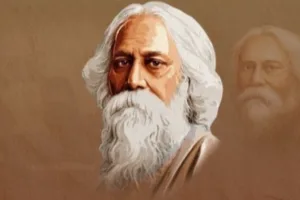
Rabindranath Tagore created, redefined, reinvented, deconstructed, and presented the woman of tomorrow. Tagore’s women come across as strong and independent even when trapped in conventional roles. Women everywhere will find a close friend in Tagore. Positive or negative, central or marginal, young or old, normal or psychotic, rural or urban, married, single or widowed, traditional or modern, his fictional women are imbued with personality traits rarely found in Bengali literature of the time.

Delhi Assembly passes Rs.46,600 crore budget for 2017-18

PTI | New Delhi |

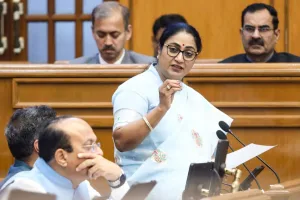
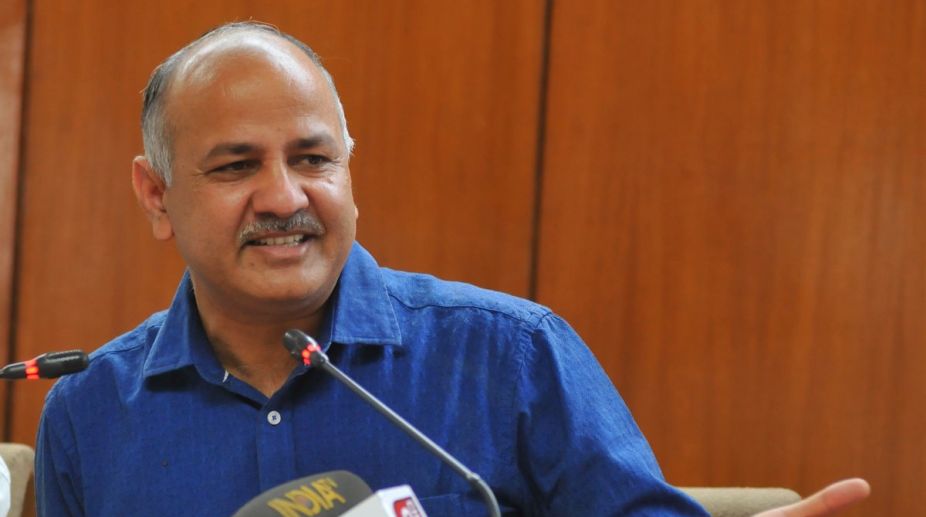
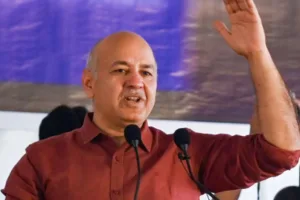
The Delhi Assembly on Friday passed the Rs.46,600 crore budget for 2017-18 with Deputy Chief Minister Manish Sisodia hailing it as "poor-friendly".

Prior to the passing of the Budget, there were an exchange of Urdu couplets between Sisodia and Leader of Opposition Vijender Gupta during the Budget discussion.  

Critcising the AAP government for "false promises" on the last day of Assembly's Budget Session, Gupta said, "Tu is tarah se mere sath bewafai kar ki tere baad mujhe koi bewafa na lage".

Responding to the BJP leader's criticism, Sisodia said, "Na Jaane kiski duaon ka faiz hai mujhpar, mai dubta hun aur dariya uchal deta hai".

The Opposition leader raised questions on the "outcome" budget of the AAP government, saying that he was not able to locate the quantifiable output and outcome indicators in the budget documents.

He said, "Government has failed in presenting a good budeget which doesn't have any base. Mohalla clinics have not been set up despite allocation of Rs.650 crore during the last two years." 

He also alleged that Wi-Fi has also found no space in the budget document, which was the key pre poll promise of AAP and similarly CCTV scheme has been neglected.

"Last year there was a Swaraj Budget and this year there is an Outcome Budget. I haven't seen any outcome so far," he said.

Replying to Gupta's allegations, Sisodia said that not everything is mentioned in the budget speech.

"I would request Guptaji to read the budget. We have allocated funds for Wi-Fi and CCTV. Everything can't be included in the budget speech. Finance minister of other states have praised the budget and this budget will make the common man fearless," Sisodia said in the assembly.

He said that Gupta is misleading the public by quoting the wrong figures and is calculating figures on his own.

Sisodia said the AAP government has completely changed the definition of "development".

"Earlier, development was just construction of roads, but according to us, the definition is to improve lives of people by introducing quality education in government schools, construction of hospitals," he said.

In reference with the recent "Shamshan Ghat" remark of Prime Minister Narendra Modi, Sisodia said "Shamshan Ghat" is not development for us.

He also said that by introducing "tax-free budget", we have made people "fearless".

"Earlier people used to fear that government can impose tax on them in budget. But our government is making people brave by reducing tax on various items. They now don't have fear that this government will increase tax," the Deputy Chief Minister said.

In the budget tabled in Delhi Assembly on March 8, no new tax was introduced or hike effected in existing tax rates by AAP government in its Rs.48,000-crore budget for 2017-18 which laid major focus on education, health care, transport and social sectors.

The government has slashed VAT on Air Turbine Fuel (ATF) from existing 25 per cent to one per cent for direct flights between Delhi and remote areas identified under the Centre's Regional Connectivity Scheme (RCS).

Finally, unemployed youth to get promised allowance in HP

Archana Phull | Shimla |

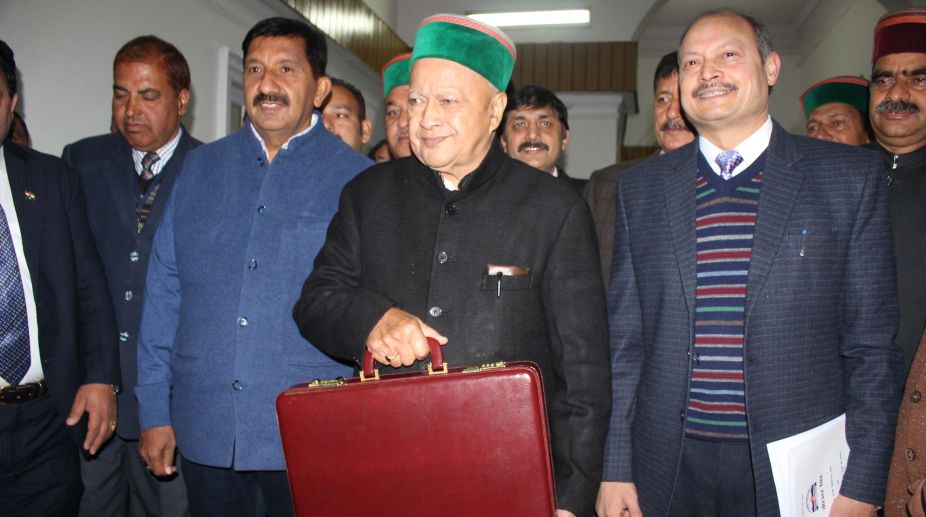
After much controversy and infighting within the cabinet and party, the cash strapped Congress government in Himachal Pradesh finally announced promised Unemployment Allowance to the unemployed youth in the state budget for 2017-18, presented in the HP assembly by Chief Minister, Virbhadra Singh on Friday.

The unemployed youth having 10+2 qualification will be given Rs.1,000 per month, while the disabled, unemployed youth will be given Unemployment Allowance of Rs.1,500 per month, said CM, who presented his 20th annual budget as Finance minister of the state in his six tenures as CM.  

He said that the detailed guidelines on eligibility would be issued by the state government shortly.

The government has kept an outlay of Rs 150 Crore for the Unemployment Allowance, which is likely to benefit around 1.5 lakh such unemployed youths in HP, who are registered in the employment exchanges in HP.

Earlier, the government was reluctant to give Unemployment Allowance and the CM had focussed more on the skill development allowance instead. But, with the opposition BJP is making it an issue and the Congress party too putting pressure on him recently, he considered it in the budget, eyeing elections, which are due by the year end.  

The budget proposals for 2017-18 in HP are estimated at Rs.35,783 Crore, with a fiscal deficit of Rs.4,946 Crore.
However, keeping with his populist approach and it being a election year, the CM has not levied any additional taxes even this time and has given a ‘please all’ budget, taking care of different categories, especially the marginalised section, farmers and employees.

Out of every 100 Rupees, the state will have Rs 77.45 as total receipts, including transfers from the central government, including loans. The government will meet the gap of Rs 22.55 by borrowings. Out of Rs 100, Rs 39.55 would be spent on development works.

 “The budget is a reflection of my sentiments towards people. I would have given more, if there were more funds,” said the CM.

Former BJP Chief Minister and leader of opposition, Prem Kumar Dhumal, however, dubbed the budget as “much ado about nothing.”

In his longest ever budget speech that extended to over four hours, the CM announced to enhance the Social Security Pension of 650 per month to Rs 700 per month.

He said the pension would be provided to all mentally retarded children/adults without any income limit, while the pension for the beneficiaries above 80 years of age is proposed to go up from Rs.1,200 to Rs.1,250 per month.
As per budget proposals, the reservation quota for the disabled will be increased from 3 to 4 per cent. The additional state honoraria of Anganwari workers will be enhanced from Rs.450 to Rs.1,000 per month and that of Anganwari helpers from Rs.300 to Rs 600 per month.

The budget proposals include due benefits to employees, who comprise a formidable number of over 2.5 lakh, and rolls out schemes for boosting organic farming, polyhouse cultivation of vegetables and the fruit production in the state.
The Himachal assembly will pass the budget proposals on March 30.

Delhi rejects third party mediation; releases 2 Pak juveniles

Statesman News Service | New Delhi |

New Delhi on Friday rejected any suggestion for third party mediation between India and Pakistan.

‘’Our position on addressing all issues between India and Pakistan bilaterally has not changed,’’ sources here said  when asked for reaction to reports that UN Secretary General Antonio Guterres was mulling the option of talking to senior officials from India and Pakistan on the situation in Kashmir and how things could be improved on the ground. 

Guterres ''will talk to different officials if it helps (to) move the process along. That's something that he is looking into. Beyond that, I have nothing to say about the issue,'' UN chief's Deputy Spokesman Farhan Haq was quoted as saying. 

Meanwhile, the MEA said two Pakistani juveniles, Faisal Hussain Awan and Ahsan Khurshid Chaudhry, were repatriated via Attari/Wagah on Friday following the completion of investigation and the confirmation of their nationality. It said New Delhi attaches highest importance to addressing all humanitarian matters, including early release and repatriation of all eligible Indian prisoners and fishermen.

Kashmir University students protest exams without covering syllabi

Statesman News Service | New Delhi / Srinagar |

Many students of Kashmir University in Srinagar have again stepped out of their classes to protest on the campus ~ but for a different reason this time round. These students, pursuing their Master's in various disciplines, have accused the varsity authorities of allegedly forcing them to sit for their semester examinations ~ scheduled for the end of this month ~ without ensuring completion of their syllabuses by their teachers.

"This year our university, keeping in view the loss of academic months during last year's unrest in Kashmir, had introduced winter session for us, which commenced on January 2017. But due to heavy snowfall our classes got suspended for about a month, so they could only resume in February. We were supposed to attend sixty lectures per class in sixty working days, but the departments are now hastening the process and compelling us to sit in exams even when we haven’t completed 30% of our syllabuses so far," said a female student on condition of anonymity.

Scores of students gathered in front of the Kahsmir Universty Vice Chancellor’s Secretariat on Thursday to register their protest against "curtailing" their semester duration from at least four months to merely a month. They urged the VC to defer their semester exams on the ground that thir syllabuses have not been covered by their teachers yet.

According to protesting students, there have been just 25 working days so far with respect to their semester classes which started in February rather than January. They have blamed the varsity authorities for "playing with their future" by holding examinations "prematurely". These students are from various post-graduation departments including Biochemistry, Environmental Science, Zoology, Biosciences and Social Studies.

"As there have been very less classes, we have no idea about the subjects in our books. Some of the topics were dictated to us without explaining properly with teachers giving PowerPoint presentations. For rest of the topics we were suggested to go through e-tutorials on the University's website," a Biochemistry student said.

The head of a faculty warned students of "dire consequences" if they attempt to stage any protest demonstration against the varsity's decision. "We were threatened with rustication and cancellation of our admission if we go to VC’s office with our complaint. We did not receive proper lectures and we are still being forced to take our exams. So, our degrees would be mere pieces of papers. The exams are scheduled for this month's end and we have no idea what we are supposed to write in our answer papers," said some Zoology students.

When contacted by The Statesman for the varsity administration's reaction on the issue, the Controller Examination Prof Abdul Salam Bhat said, "We are yet to take any decision on the matter," adding that "When we get the confirmation regarding the completion of syllabuses from heads of different departments, only then we go ahead with the date sheet (exams schedule), otherwise we don’t." 

It is another matter that the varsity authorities have already issued the exams scxhedule for Biochemistry, Biotechnology, Zoology, Math and MCA departments.

BMC reclaims encroached road after 47 years!

IANS | Mumbai |

After 47 long years, the BrihanMumbai Municipal Corporation (BMC) has managed to reclaim a 1.5 km stretch of prime public road in a congested area which was encroached upon by a private housing society, an official said here on Friday.

According to Deputy Municipal Commissioner Vasant Prabhu, the 1.5 km X 18 mt thoroughfare in question was a development plan road which the Scindia Society had captured by erecting an illegal wall, way back in 1969!

It was a vital link joining one of the most-congested roads, the Andheri-Kurla Road with Prof. N.S. Phadke Marg, parallel to the Western Express Highway.

Accordingly, owing to the dispute with the society for 47 years, the BMC could not open the road and ease traffic congestion in that area.

However, in the past four days, the BMC aggressively entered the vicinity with a team of 60 workers, a police team, JCBs, dumpers and other material to demolish the wall, an illegal security cabin, an illegal entry point, an unauthorized compound and several other unauthorized structures encroaching on the public property, said K-East Assistant Municipal Commissioner D.K. Jain.

The BMC took complete possession of the road. The civic body has undertaken repairs, renovation and resurfacing of the entire stretch on a war-footing.

The BMC has also shifted all the public utilities like Mahanagar Gas Ltd and Reliance Energy lines on that road and it will be thrown open for public use and road traffic from Saturday morning on, Jain assured.

The BMC has alleged that the society had resorted to grabbing the road with an eye on the additional Floor Space Index that could have benefited it, but locals wonder how it could take 47 years for the civic body to initiate action in the matter.

The BMC has also decided to throw the rule book – albeit, belatedly – at the society and has initiated appropriate action for illegally encroaching upon the public property for nearly five decades.

Jain said that reopening of the road will directly benefit thousands of people living in 40 other housing societies in the vicinity and ease the traffic congestion in the locality.

Andheri east is one of the most crowded suburb of Mumbai with approaches to the domestic and international airports, many five-star hotels, several deluxe hospitals, educational and residential complexes, the Western Railway and Harbour Line, the city's first metro connecting Ghatkopar-Andheri-Versova, industrial and commercial hubs, the SEEPZ and other important locations.

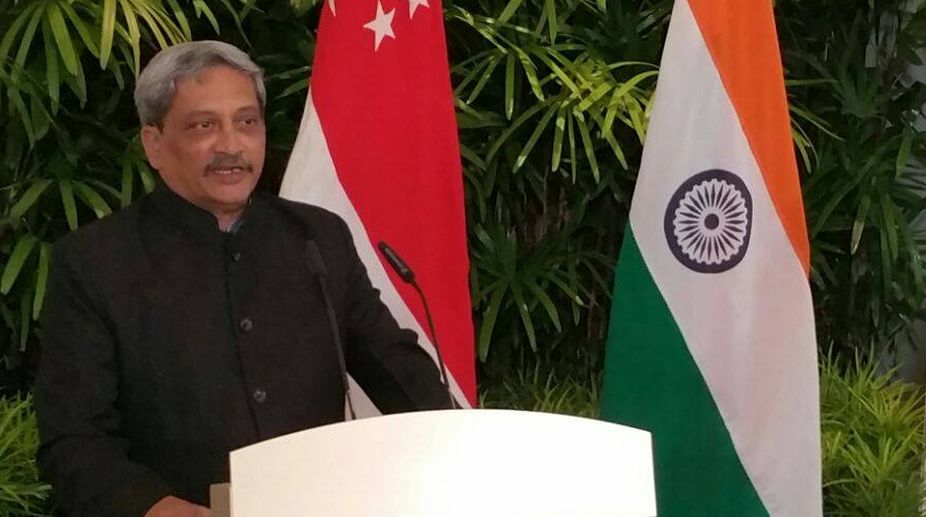
Police probing death of soldier: Manohar Parrikar

Statesman News Service | New Delhi |

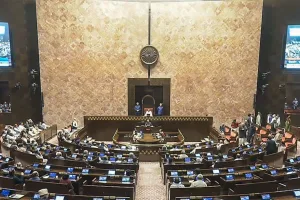
Police are probing the death of Lance Naik Roy Mathew who was found dead in an army barracks, the Lok Sabha was told on Friday.

Replying to queries in the House, Defence Minister Manohar Parrikar  said the soldier was found dead in an army barrack days after he featured in a sting video criticising the 'Sahayak' system in the Army.

Saying this was an “isolated incident,”  the minister said consultations are on over the Sahayak system. "It (Naik's case) was an isolated incident. Police is carrying out an independent probe," he said.

Parrikar, however, refused to make any further comments on the incident. "I don't want to make any comment on it as it would be prejudicial to say anything at this stage," he said.

Lance Naik Mathew was found dead in a barrack in Maharashtra's Devlali Cantonment on 3 March.

The minister said consultations are on over the Sahayak system, which came into focus recently after a few soldiers took to social media to air their grievances over the buddy system in the Army. 

"We are in consultation with all concerned and an appropriate mechanism would be worked out soon," Parrikar said.
 Earlier, responding to a question on this subject, Minister of State for Defence Subhash Bhamre, said there were a few incidents of complaints by jawans, but it did not reflect the collective mood of the soldiers.

"There are various mechanisms to address the grievances of jawans, that include regular holding of 'Sainik Sammelan' where the soldiers can raise their problems," Bhamre said. 

Earlier this week, another soldier, Sepoy Sindhav Jogidas Lakhubhai of the Army Medical Corps, took to social media to attack the 'batman' or Sahayak system in the Army. Earlier, Lance Naik Yagya Pratap had posted a video on the same issue. The Army has, however, said both the soldiers were never assigned any Sahayak roles.

Self-reliance: The government is pursuing several measures to realise progressively higher levels of indigenisation and self-reliance in the defence sector.  To this end, the Defence Procurement Procedure 2016 (DPP 2016) has provisions which accord higher priority to procurement from Indian vendors, Bhambre said.

He said notwithstanding this, import of defence equipment may be necessitated to meet operational requirements and when indigenous equipment is not available.

The modernisation of the Armed Forces is an ongoing process and is executed in consonance with the roadmap laid down in the Long Term Integrated Perspective Plan (LTIPP) which specifies the capabilities that the armed forces need to acquire over a 15 year period (2012-27), considering the current capabilities of the armed forces, the emerging threats in the region and the prevailing technological environment, Bhambre said.

DGs of Indo-Bangla Medical Services meet

Sri Krishna | New Delhi |

The Directors General of Medical Services of India and Bangladesh on Friday discussed various areas of cooperation. India has been at the forefront in training doctors and paramedical staff of Sri Lanka, Bhutan, Nepal, Afghanistan and Bangladesh.

Major General  S M Motahar Hossain, DGMS (Bangladesh Army), called upon Lt Gen Manoj Kumar Unni, DG AFMS, and Lt Gen Velu Nair, DGMS (Army), on Friday and expressed gratitude for the support and continuous cooperation of Indian Armed Forces, including treating the patients being referred to India.

He sought expert technical advice on medical matters through telemedicine and in other sophisticated fields of surgery and organ transplant to which the hosts expressed willingness.