Logo

Ousted S Korean president says sorry to people

IANS | Seoul |

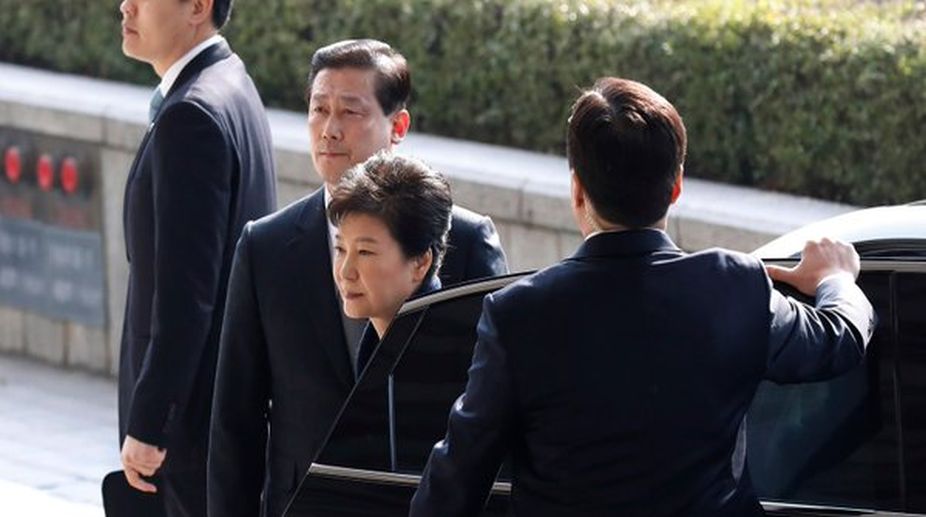
Ousted South Korean President Park Geun-hye appeared on Tuesday in the prosecutors' office to be questioned over an corruption scandal that led to her impeachment earlier this month.

Park said in front of cameras at the Seoul District Prosecutors' Office, that she was sorry to people, vowing to face an interrogation faithfully, TV footage showed, Xinhua reported.

Just leaving the brief message to the public, Park entered the prosecutors' office in southern Seoul.

Park, dressed in a dark blue coat, walked out of her private home in the southern district of Seoul at about 9:17 a.m. local time (0017 GMT), getting in a black sedan and saying nothing to hundreds of supporters outside her home.

The motorcade, carrying Park and security guards, arrived in the office just minutes later.

Park will be interrogated by state prosecutors for her alleged involvement in the scandal, which removed her from office after the impeachment was passed in the parliament on Dec. 9. The constitutional court upheld the motion on March 10.

Park became the fourth South Korean former president to be grilled by prosecutors.

Sushma helps Indian woman in distress in Pakistan

IANS | New Delhi/Hyderabad |

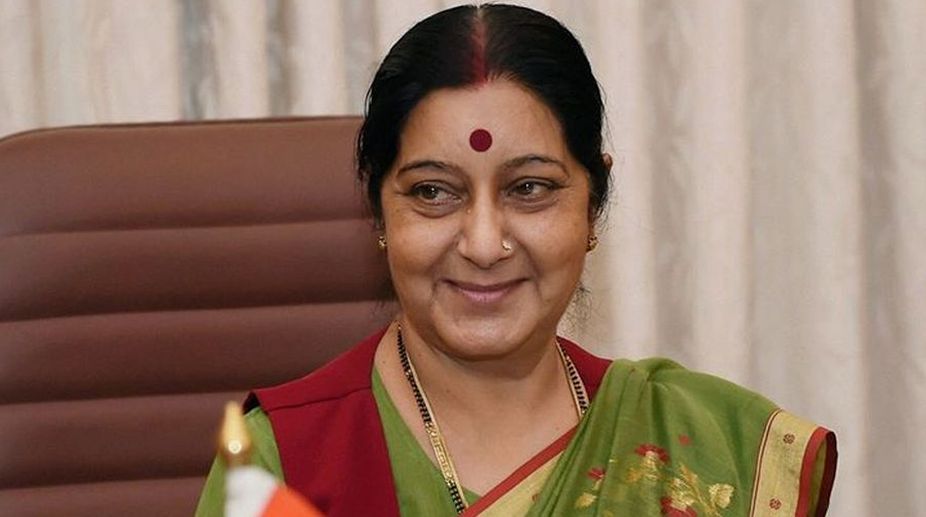
Following a father's YouTube SOS that his daughter was being mistreated by her in-laws in Pakistan, External Affairs Minister Sushma Swaraj on Monday said the Indian High Commission had met the victim and was ensuring her safety and return to India.

Sushma Swaraj tweeted that she received a YouTube message from Mohammad Akbar that his daughter Mohammadia Begum, an Indian national, was married to a person in Pakistan "and was being ill-treated by her in-laws".

"Our mission sent a Note Verbale requesting the safety, security and well-being of Mohammadia Begum," she said.

"Our High Commission officials met Mohammadia Begum and she expressed her desire to return to India."

As the Hyderabad woman's passport had expired last year, Sushma asked the Indian High Commission to renew her Indian passport and facilitate her return to India.

Meanwhile, Mohammedi Begum (the name on her passport) spoke to her mother Hajara Begum over phone and informed that her husband Muhammad Younis beat her up and locked her in a room after Indian High Commission officials met her.

The 44-year-old broke down while narrating the ill-treatment at the hands of her husband and in-laws. The mother advised her to have patience and wait for the help from the High Commission.

Hajara Begum said Younis had been abusing her daughter. "He even tells the children to keep themselves away from her as she is a Hindustani and all Hindustanis are Hindus."

Younis has even threatened that he will not allow her go back to India alive. He reportedly married another woman, a Pakistani.

Hajara Begum said her daughter had turned very weak due to physical and mental torture and needs immediate medical help.

Mohammedi Begum and Younis have five children — three sons and two daughters. The youngest son is nine-year-old and he was born in Pakistan while the other children were born in Muscat, Oman.

"If the children come with her that will be good but my appeal is that she should be brought home immediately," said Hajara Begum.

It was on March 16 that Sushma had sought a report from India High Commissioner Gautam Bambawale.

Mohammedi Begum's father Mohammed Akbar, a cycle mechanic, had earlier sent an e-mail to Sushma Swaraj in January seeking her help in bringing back his daughter.

He alleged that Muhammad Younis, who concealed his actual nationality and claimed to be from Oman, married her in 1996.

The 'nikah' was performed over telephone through some agent and Begum joined Younis, a mechanic, in Muscat. After 12 years of marriage, Begum got a shock when Younis, who had lost his job, disclosed that he was a Pakistani.

Mohammedi Begum had visited Hyderabad in 2012. Her father said this was her only visit to India in 21 years.

Been a strange journey on GoT: Kit Harington

IANS | Los Angeles |

Game of Thrones star Kit Harington says he is connected with Jon Snow, his character from the fantasy series, on an emotional level, and will always cherish his journey in the show.

"I sort of know where he is now. Next season will be next season, he might go through a big change, I don't know. He's dear to me. I've lived with him for so long. I think I've come into a place of feeling quite emotional about him, actually, knowing that I'm not going to get to go back to him after next year," Harington said in a statement. 

He added: "I'm really trying to just take stock of having lived this sort of dual life with this character, and being through so much with this character. It's been a strange journey, but I'll always be fond of it."

The seventh season of the popular fantasy drama series Game of Thrones will premiere on July 16. It will be back in India on Star World, Star World HD and Star World Premiere HD. The final season is likely to air in 2018. 

Harington added that he has "just finished season seven, and I am already counting down the days until I get the season eight scripts". 

"Everyone's been wondering how it's going to end, and what's going to happen right from the get-go, and theorising about it. It's really exciting to me not knowing, genuinely having no idea where it's going to end, what they've got in their heads, and being the first to find out," he said. 

Game Of Thrones, which is based on novels by George R.R. Martin, and is a dramatic telling of a story entwined with sneaky ploys, nudity and bloodshed in a quest to claim the 'Iron Throne'.

US Defence Secretary to meet Doval on March 24: Pentagon

PTI | Washington |

India and the US will discuss a wide range of bilateral security issues and defence ties during National Security Adviser Ajit Doval's visit to the country.

US Defence Secretary James Mattis will meet Doval on March 24, Pentagon Spokesman Capt Jeff Davis told reporters during an off-camera news conference here.

They are likely to discuss a wide range of bilateral security issues and those related to the defence relationship.

"Clearly India is a very strong security partner and a force in the region. We continue to have very good relationship with India in the region," Davis said in response to a question.

The Mattis-Doval meeting later this week would be one of the highest-level meetings between the two countries after the Trump Administration came to power on January 20.

Doval is also expected to meet his American counterpart Lt Gen HR McMaster at the White House, the first between the two national security advisors.

Davis said he is not aware of the reasons for Doval's visit to the US, but the Defence Secretary would be meeting with the Indian National Security Advisor on the sidelines of the international meeting of anti-ISIS Coalition being hosted by the US State Department later this week.

Early this month, Indian Foreign Secretary S Jaishankar met McMaster at the White House.

During his Washington trip, Jaishankar was also scheduled to meet the Defence Secretary. But the meeting could not happen as Mattis was travelling.

India home to 101 billionaires, Mukesh Ambani tops list: Forbes

PTI | New York |

India is home to world's fourth highest number of billionaires with Reliance Industries chief Mukesh Ambani leading the club of more than 100 super rich Indians, according to a new list released by Forbes magazine.

The Forbes list of the 'World's Billionaires' 2017 consists of 2,043 of the richest people in the world who have a combined net worth of $7.67 trillion, a record 18-per cent increase over the past year.

The list has been topped by Microsoft co-founder Bill Gates for the fourth year in a row. He has been the richest person in the world for 18 out of the past 23 years.

Gates has a fortune of $86 billion, up from $75 billion last year, followed by Berkshire Hathaway chief Warren Buffet with a new worth of $75.6 billion.

Amazon's Jeff Bezos added $27.6 billion to his fortune; now worth $72.8 billion, moving into the top three in the world for the first time, up from number five a year ago.

US President Donald Trump is ranked 544th on the list with his net worth of $3.5 billion.

India is home to 101 billionaires, the first time it has has more than 100 super rich individuals.

The US continues to have more billionaires than any other nation, with a record 565, up from 540 a year ago. China is catching up with 319, Germany has the third most with 114 and India has the fourth highest number of billionaires.

There are nearly 20 people of Indian-origin who have made fortunes in various nations across the world, led by UK-based Hinduja brothers ranked 64th with $15.4 billion net worth, Indian-born tycoon Pallonji Mistry, who controls the 152-year-old Mumbai-headquartered engineering giant Shapoorji Pallonji Group at the 77th spot with $14.3 billion net worth and petrochemicals major Indorama co-founder Sri Prakash Lohia at the 288th spot with $5.4 billion net worth.

Mistry's younger son Cyrus is embroiled in a legal battle with the Tata Group after he was suddenly ousted as chairman of Tata Sons, a position he had held since 2012.

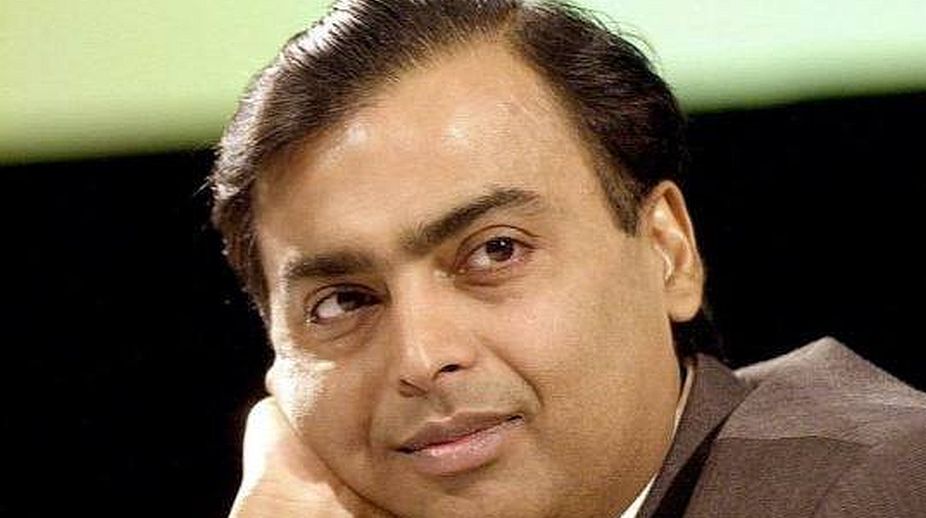
Ambani, 59, leads the pack of Indian billionaires, coming in at the 33rd position with a net worth of $23.2 billion.

Forbes said the "oil and gas tycoon" sparked a price war in India's hyper-competitive telecom market with the launch of 4G phone service Jio last September. His younger brother Anil is ranked 745th with a net worth of $2.7 billion.

The younger Ambani sibling "orchestrated the merger of his Reliance Communication's telecom business with that of rival Aircel, controlled by Malaysian billionaire Ananda Krishnan.

The combine, which awaits regulatory approvals, will be the country's fourth-largest mobile phone operator," Forbes said.

Next on the list of Indian billionaires is ArcelorMittal chairman and CEO Lakshmi Mittal on the 56th spot with a net worth of $16.4 billion.

Forbes said the Indian steel baron regains his status as the world's second richest Indian on an uptick in steel prices and demand. "The world's biggest steelmaker also got a reprieve from import tariffs on steel imposed by the US and Europe and a one-time $832 million saving from a new labour contract signed last year with its US workers," it added.

The list includes only four women billionaires from India, led by Savitri Jindal and her family at the 303rd position with a net worth of $5.2 billion. "After declining last year, the fortune of steel and power clan, whose matriarch Savitri Jindal chairs the OP Jindal Group, rose as steel prices recovered," Forbes said.

Smita Crishna-Godrej from the Godrej clan is ranked 814th followed by Biocon founder Kiran Mazumdar-Shaw (973) and Leena Tewari (1030), chair of USV India which specialises in diabetic and cardiovascular drugs.

Also making the list is Wipro chairman Azim Premji (72), Adani group founder Gautam Adani (250), Bajaj Group chair Rahul Bajaj (544), investor Rakesh Jhunjhunwala (939), Infosys co-founder NR Narayana Murthy (1161), chairman emeritus of Dabur Vivek Chand Burman (1290), Infosys co-founder Nandan Nilekani (1290), Wockhardt chair Habil Khorakiwala (1567), Mahindra group chief Anand Mahindra (1567), property tycoons Niranjan and Surendra Hiranandani (tied at 1678) and Yes Bank head Rana Kapoor (1795).

Founder of mobile wallet Paytm Vijay Shekhar Sharma is ranked 1567 with his net worth of $1.3 billion. Forbes said Paytm was "one of the biggest beneficiaries of the government's decision to demonetise 86 per cent of India's rupees and move to a cashless economy", notching up 200 million registered users and five million transactions daily.

Making his debut on the list at 814th spot is Acharya Balkrishna, friend of yoga guru Baba Ramdev, who holds 97 per cent stake in the fast-growing consumer goods firm Patanjali Ayurveda. His net worth is $2.5 billion.

Forbes said Facebook founder Mark Zuckerberg moved up to number five for the first time, after his fortune rose $11.4 billion in 12 months.

Meanwhile Carlos Slim Helu of Mexico, once the world's richest man, fell to number six, the first time he's been out of the top five in a dozen years. There were 195 newcomers.

China had the most new ten-figure fortunes with 76. The US was second with 25. The list has 56 billionaires under age 40, down from 66 last year, after some aged out and others dropped below the $1-billion mark.

Seventy-eight people fell off the list, including 33 from China, 7 Americans and 9 who are still super wealthy but share their wealth among extended family members and therefore are not eligible for these ranks.


Sensex recovers 57 points in early trade on strong Asian cues

PTI | Mumbai |

The benchmark BSE Sensex recovered by almost 57 points in early trade on Tuesday on the back of gains in FMCG, capital goods, PSU, power, auto and IT sector stocks amid positive Asian cues.
After falling 130.25 points in the previous session on profit-booking, the 30-share Sensex was trading in positive zone with a gain of 56.92 points, or 0.19 per cent, to 29,575.66.
Also, the broader NSE Nifty rose by 18.05 points, or 0.19 per cent, to quote at 9,144.90.

Brokers said resumption of buying by investors coupled with continued inflow of foreign funds and a firm trend in other Asian bourses, helped indices to trade in positive terrain.

Bucking the trend, shares of Divi's Lab plunged nearly 20 per cent to Rs 635 following reports of US Food and Drug Administration (USFDA) issuing an import alert for its Visakhapatnam Unit.

Among other Asian markets, Hong Kong's Hang Seng rose by 0.27 per cent while Shanghai Composite Index gained 0.22 per cent in early trade today. Seoul jumped more than one per cent while Singapore put on 0.1 per cent. Japan's Nikkei, however, was trading 0.31 per cent down.

The US Dow Jones Industrial Average ended 0.04 per cent lower in yesterday's trade.

UN urges N Korea to comply with international obligations

IANS | United Nations |

The United Nations on Monday urged North Korea to fully comply with its international obligations while commenting on the latter's test of a new type of high-thrust rocket engine over the weekend.

When answering the question about UN Secretary-General's response to the test at the daily news briefing, UN Deputy Spokesman for the Secretary-General Farhan Haq said that "you have seen our basic concern about the situation in the North Korea and our concern about the various tests."

"We want ultimately for Pyongyang to comply fully with relevant resolutions of the Security Council and it needs to refrain from further provocations and comply with its international obligations," Xinhua reported.

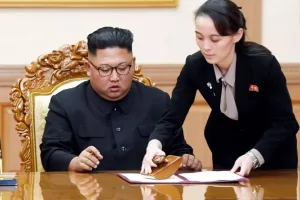
Pyongyang said it had conducted a ground test of a new type of high-thrust rocket engine that its leader Kim Jong-un was calling "a revolutionary breakthrough for the country's space program." 

Kim attended the test at the Sohae launch site, according to a report on Sunday by the Korean Central News Agency, which said the test was intended to confirm the "new type" engine's thrust power and gauge the reliability of its control system and structural safety.

‘Electronics banned from cabin in inbound US flights’

IANS | Washington |

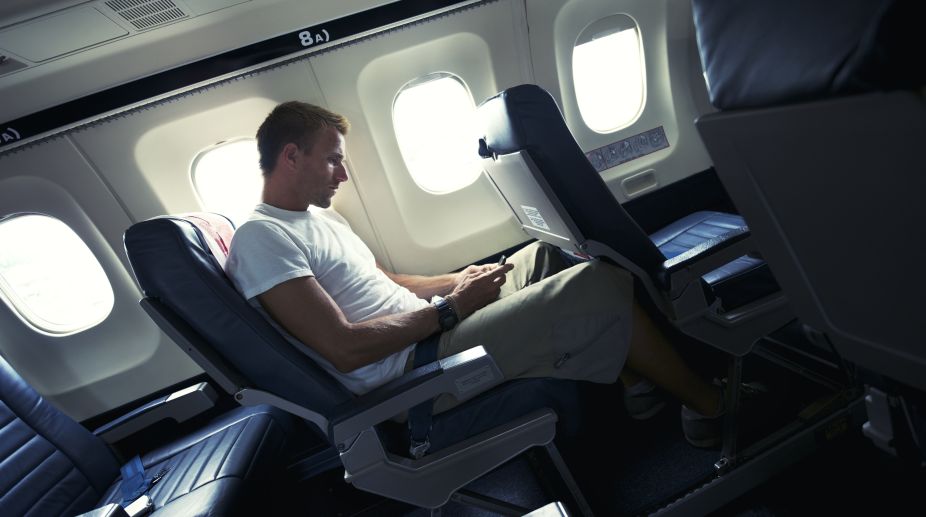
Airlines that fly from certain countries in the Middle East and Africa to the US must soon require passengers to check in almost all electronic devices rather than carry them into the cabin, a US official has said.

The official said this will impact some airlines flying into the US, while another administration official specified that this covers devices larger than a cellphone, CNN reported on Monday.

An aviation official told CNN that there is a security concern regarding passengers boarding non-stop flights to the US from specific countries. This relates to the "screening in (some) countries" for such non-stop flights to the US.

They added that they believe a threat to the US would be negated if a passenger transferred through a secondary city with additional and more trustworthy screening procedures. 

The directive is to ensure enhanced security measures at select airports for a limited duration.

In a written statement, the Department of Homeland Security said: "We have no comment on potential security precautions, but will provide any update as appropriate."

A State Department official said embassy officials have been notifying relevant countries and airlines, CNN reported.

Another official said the ban on some electronics is believed to be related to Al Qaeda in the Arabian Peninsula (AQAP). 

The intelligence community has been tracking this threat for some time, but the official said that some information from a recent US Special Forces raid in Yemen contributed to the ongoing concern.

AQAP has been actively trying to build bombs that contain little or no metal content to target commercial aircraft, the CNN report added. And the group's chief bomb maker, Ibrahim al-Asiri, has trained others to do so. 

To date, they are the only terror organisation that has shown a marked effort to try to attack airlines, the officials said.

A third US official said there has been concern about attacks via electronics for some months, but there was not enough information to warrant an airline action before.

An aviation official said US carriers are not affected because none flies directly from the countries in question to the US.

Neither source would specify what airlines were impacted beyond Royal Jordanian Airlines, which tweeted Monday that it will ban most electronics from the cabins on its flights to and from its North American destinations, CNN reported.

Royal Jordanian, however, later deleted its tweet without explanation.

Democrats begin campaign against Trump’s Supreme Court pick

IANS | Washington |

Democratic senatorsduring a congressional hearing launched their campaign against Judge Neil Gorsuch, President Donald Trump's nominee for the vacant Supreme Court seat.

Gorsuch, 49, appeared on Monday for the first time before the Senate Judiciary Committee to ask senators to vote for him and allow him to take a lifelong seat on the high court replacing conservative Justice Antonin Scalia, who died in February 2016, Efe news reported.

Gorsuch stressed "the importance of an independent judiciary" in his opening statement to the committee.

"Under our Constitution, it is for this body, the people's representatives, to make new laws. For the executive to ensure those laws are faithfully enforced. And for neutral and independent judges to apply the law in the people's disputes," he said.

During his 13-minute remarks, the Judge – who serves on the Denver-based 10th US Circuit Court of Appeals – made no reference to Trump's attacks on other judges but directed some of his remarks at the rest of the country's judiciary and thanked the nation's judges for their work.

Democratic senators have asked Gorsuch to publicly take a position on Trump's attacks on the judges who have blocked his executive order temporarily prohibiting US entry to refugees and nationals of six Muslim-majority nations.

Specifically, one of the Democrats' objectives in these hearings is to evaluate Gorsuch's willingness to oppose Trump, given that the Supreme Court potentially will have the last word on measures that the president is proclaiming by decree, including the immigrant and refugee travel ban.

In addition, during the hearing, Democratic lawmakers criticised Gorsuch for the rulings he has issued in favour of large companies.

Meanwhile, Democrats portrayed Gorsuch as a coldhearted magistrate who interprets the law literally, while Republicans praised his legal preparation and expressed support for some of his rulings, including the one he issued in 2013 against former President Barack Obama's healthcare reform.

To gain confirmation, once moving through the Judiciary Committee, Gorsuch will need 60 votes in the full Senate, a barrier that could be difficult for him to overcome since Republicans only hold 52 seats and would need the support of at least eight Democrats.

That support could be difficult to muster because Democrats are still angered over the Republicans' decision not to consider Obama's nomination of Judge Merrick Garland for the high court seat, a move that was ignored by the Republican lawmakers using the argument that it made no sense to approve such a nominee in an election year.

Given these difficulties, Trump has asked Republican Senate Majority Leader Mitch McConnell to resort to the so-called "nuclear option," a rule approved in the past by Democrats to enable them to approve bills or nominations by a simple majority of 51 votes instead of a super-majority of 60.

The committee will meet again at 9.30 am, on Tuesday and is scheduled to hold hearings until Thursday, after which the full Senate vote on Gorsuch's nomination could come in early April.

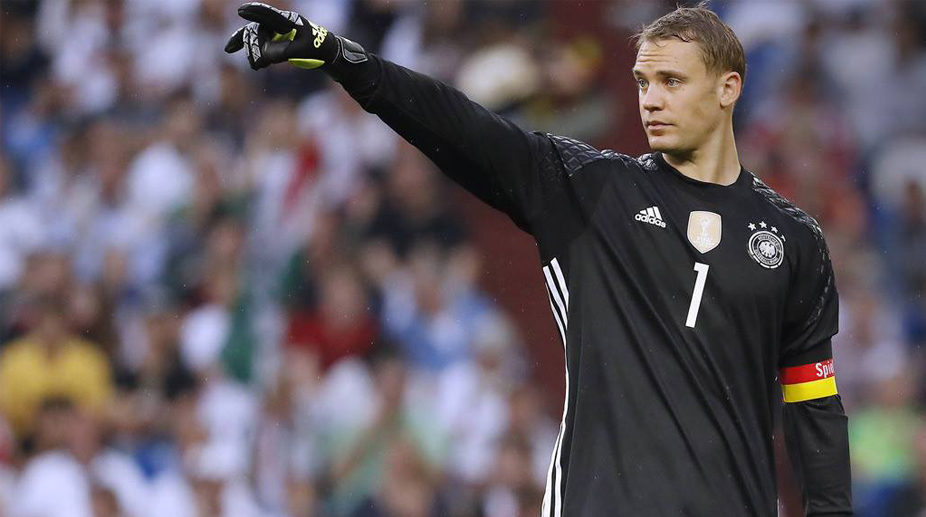
Germany captain Manuel Neuer ruled out of World Cup qualifier

The 30-year-old goalkeeper will be treated for calf problems at his club FC Bayern Munich.

IANS | Dortmund |

Germany goalkeeper Manuel Neuer was on Monday ruled out of the 2018 football World Cup qualifier against Azerbaijan in Baku on Sunday due to calf injury.

The 'World Goalkeeper of the Year' will also miss Wednesday's friendly match against England in Dortmund, the Germany football federation, DFB announced.

"The 30-year-old goalkeeper will be treated for calf problems at his club FC Bayern Münich," the official statement said.

Uncapped Paris Saint-Germain (PSG) goalkeeper Kevin Trapp was named as a replacement for Neuer.

"After consultation with goalkeeping coach Andreas Köpke, head coach Joachim Löw has decided to call up Kevin Trapp as Neuer's replacement. The PSG keeper has featured in the senior squad before, but is yet to win a Germany cap. Trapp, who played 11 times at Under-21 level, will join up with the squad on Monday in Kamen close to Dortmund," it added.

A Bridge between nations

Jaya Gosh | New Delhi |

The study of Scottish literature, with its multi-lingual history in Gaelic and English, and its place in the cultural and political history of modern Scotland, is an astonishingly rich resource for understanding cultural diversity, the underpinnings of political power, and the long trajectory of its historical tradition especially inflected by its relationship with India in the colonial and post-colonial era.
Scottish literary and political culture has always been suffering from an anxiety of subservience — they show distinctive contextual specificities embedded in the cultural and political formations and Scotland has remained peripheral in the context of English history. Here it would be relevant to look back on the Scottish tradition built up by the universities of Edinburgh and Glasgow in the mid-18th century, which asserted their cultural identity beyond provincial preoccupations. 
It has been lamented by critics that Scottish literature and culture, despite its enviable flowering in the 15th century, gradually disappeared till its reappearance in the 18th century. In the post-Chaucerian era, the country seemed to develop a distinctive cultural identity, as evident from the writings of James Stewart, David Lyndsay, Robert Henryson or William Dunbar. In the 18th century, Scottish tradition, however, came to be more significantly substantiated through writers such as David Hume, Adam Smith, Mark Akenside, Robert Blair and James Macpherson. While David Hume and Adam Smith concentrated on historical and philosophical writings, Macpherson and Akenside led to the development of the age of sensibility. In the 19th century, Sir Walter Scott not only brought about a new consciousness of historical romance, he also developed a distinctive sense of Scottish nationalism. 
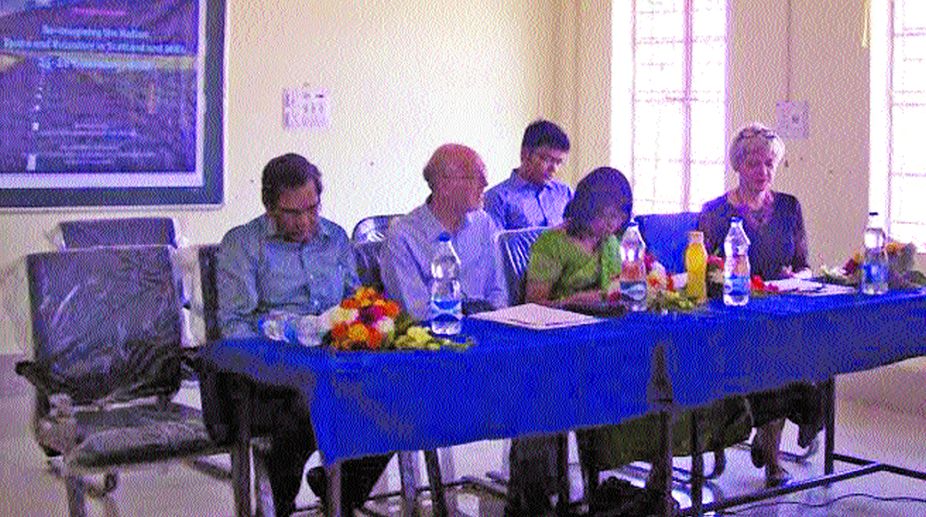
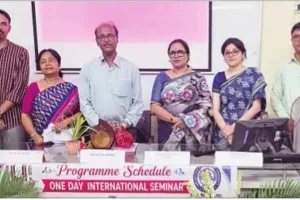
The Indian Association of Scottish Studies in collaboration with Bankura University organised a conference on “Re-imagining the Nation: Space and Boundary in Scotland and India” recently. It was attended by eminent scholars from Scotland and across Indian universities. Gautam Buddha Sural, head, department of English delivered the welcome address. Carla Sassi of The University of Verona, in her keynote address, distinctively welcomed this collaborative endeavour and gave a scholarly mapping of the relevance of Scottish Studies in India. She also spoke on “Conflicting Landscapes in Scottish Literature”. Thereafter Bashabi Fraser of Edinburgh Napier University, in her plenary speech, spoke on “Scottish Orientalists and the Bengal Renaissance” while Neil Fraser of the University of Edinburgh spoke on “Educator, Innovator, Environmentalist: Patick Geddes and Rabindranath Tagore”. The discussions developed an idea of Scottish Studies in the audience. 
On the other hand, Indian scholars largely examined the Scottish-Indian cultural connections in British India. The wide spectrum of inter-disciplinary subjects covered by the eminent Indian scholars ranged from memoirs and sketches of India by Scottish writers; the conservation work and engraved history at the Scottish Cemetery in Kolkata; the spread of education among the Lepchas to the Scottish poets of John Company, Scottish Orientalism, Scottish animal stories, Scottish missionaries in India, comparative legal studies of India and Scotland et al. 
In the inaugural session, Deb Narayan Bandyopadhyay, vice chancellor of Bankura University, recollected how the entire episode of development of Indian Association of Scottish Studies started over a cup of coffee and how it has spread within a span of about two years. He also pointed out that he had already recommended the inclusion of Scottish Studies as an optional course for the students of English and the department has already developed a curriculum on the same for fourth semester students. 
The vice chancellor has also initiated an exchange programme between Bankura University and Universities in Scotland. The Government of Scotland has donated around 8,000 books on Scottish literature, law, social sciences and such other allied subjects to Bankura University. A separate James Alison Section has been established in the library of the university and books and other articles of Alison have been kept there on exhibition. One hopes that Bankura University will become a hub of Scottish literary studies in the near future.

THE WRITER IS ASSISTANT PROFESSOR AND HEAD, DEPARTMENT OF ENGLISH, DR GOUR MOHAN ROY COLLEGE, UNIVERSITY OF BURDWAN

Tips and tricks to improve

Ramesh Batlish | New Delhi |

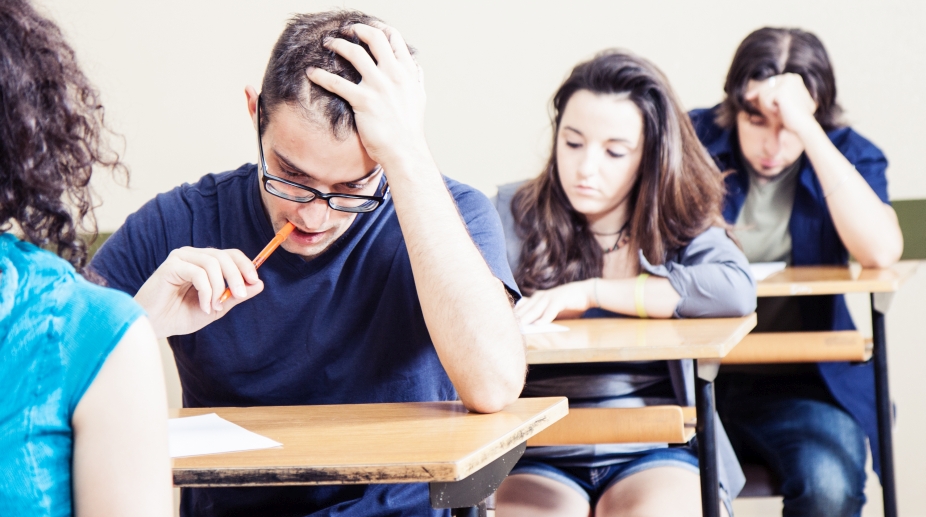
For about 12 lakh students aspiring to become engineers, the Central Board of Secondary Education is organising the largest exam of our country the JEE (Main) on 2 April in offline mode and on 8- 9 April in online mode. Through this the top 2.2 lakh students will get a chance to appear in the JEE (Advanced) scheduled on 21 May. 
The JEE Main however will have a separate merit list for admission to the NITS, IIITs, GFTIs and some deemed universities. There is no weightage to board marks unlike last year where 40 per cent was given to class+2 board marks and 60 per cent to JEE Main score. Also, this year only those students who had a valid Aadhar card could apply and the number of attempts remains three. 
A serious aspirant ideally must have completed the syllabus by now. Analysis of each paper is important to check the mistakes and to avoid repeating them in the actual exam. For students who are repeaters, may join a crash course for topic wise revision along with several mock tests, else they should have a systematic revision plan involving rigorous testing concept wise/chapter wise along with several mock tests from reliable sources as per current pattern.
Sometimes the right strategy and time management play a vital role in deciding the rank for an aspirant. So, one must be quick enough to adapt to the level of the paper and act promptly. 
One basic approach could be not to give full time in one go to a particular instead allocate some time so that one could review this subject again. For a three hour paper with three subjects, generally students tend to give one hour each. It is advisable that they give 40-45 minutes in attempting questions from any one subject they feel confident and move on to second subject and then to the third. In the remaining time the unsolved questioned may be reviewed. This would help in increasing the attempting rate. However, students may develop their own strategy based on their preferences.
Clearing JEE (Main) is not a difficult task. Systematic approach towards its preparation along with a proper revision plan will help students get admission into one of the top National Institutes of Technology. Looking at the previous year trends, there is generally one question from each of the chapters in physics, chemistry and mathematics. So, selective study is not advisable. Given the weightage, in mathematics you can expect more questions from calculus and algebra. In physics, one can expect more questions from mechanics and electromagnetism. In chemistry there could be more questions from physical and organic chemistry.
Always attempt theoretical/ fact based questions first and then questions which require calculation. It’s human nature that if you attempt a few confident questions in the beginning then you feel loaded with positive energy which increases your efficiency and speed for the rest of the paper. It is advisable to avoid lengthy numerical questions in the first 10 or 15 minutes of the exam.

THE WRITER IS AN EXPERT, FIITJEE

Presentation software ‘toxic to education’

Bent Meier Sorensen | New Delhi |

Any university teacher who does not harbour a painful recollection of a failed lecture is a liar. On one such occasion, I felt early on that I had lost the students entirely. Those who hadn’t sunk into comatose oblivion were listless and anxious. Ungracefully, I threw myself even deeper into my PowerPoint presentation to save me from total ruin. Years later, I can still hear myself reading aloud the bullet points from the overhead and see myself turning around to the students to sell these points to them.
Luckily, I have no recollection of what they thought of it, but my most painful memory is the experience of boring myself. When that happens, it is time to change one’s ways. That’s why I’ve led a move to ban PowerPoint from lectures.
There are a host of possible reasons for a lecture going wrong— a badly planned course, inadequate preparation, feeling uninspired on the day, disengaged students, a crowd that’s too big, and a poorly designed auditorium. To this bulleted list of catastrophes comes PowerPoint. 
The physical face-to-face lecture is potentially a complex and open event where the students, the readings, the lecturer and a case-based or theoretical problem interact. Yet, to be interesting and relevant in a lecture, teachers need to ask questions and experiment, not provide solutions and results. Unfortunately, PowerPoint is designed to provide just that. Originally for Macintosh, the company that designed it was bought by Microsoft. After its launch the software was increasingly targeted at business professionals, especially consultants and busy salespeople.
Its way into academia was then helped by the increased pressure on faculties to deliver more teaching and the increased demand from a more diverse student population to be more concretely guided through the jungle of knowledge. As it turns out, PowerPoint has not empowered academia. The basic problem is that a lecturer isn’t intended to be selling bullet point knowledge to students— rather they should be making them encounter problems. Such a learning process is slow and arduous, and cannot be summed up neatly. PowerPoint produces stupidity, which is why some, such as American statistician Edward Tufte have said it is “evil”. Of course, new presentation technologies like Prezi, SlideRocket or Impress add a lot of new features and 3D animation, yet I’d argue they only make things worse. A moot point doesn’t become relevant by moving in mysterious ways. The truth is that PowerPoint’s actually are hard to follow and if you miss one point you are often lost.
On top of this comes the ambivalence of what’s in those bullet points. In my presentations, the texts on slides are really just my private and often hastily written down thoughts. Unlike my other published and peer-reviewed work, no one has seen or criticised my PowerPoint’s. Yet the students perceive my bullet points as authoritative, and they would often quote them in their assignments instead of going through the toll of finding the meaningful points in the real texts from the course.
While successfully banning Facebook and other use of social media in Master’s programme in philosophy and business at Copenhagen Business School, we have also recently banned teachers using PowerPoint. Apart from that, the teachers write with chalk on the blackboard (or markers on the whiteboard). Contrary to what PowerPoint allows, the chalk and blackboard enable us to note down points from the students alongside and connected to the points that we ourselves develop. Most universities are actually defending Microsoft’s monopoly by stealth, by architecturally letting the projector and PowerPoint take precedence over other technologies such as the blackboard.
Yet, while at our master’s programme we as teachers have a clear plan in terms of what should happen every minute of the lecture, the exact content should remain variable and open-ended. In order to support interaction, the students sit with visible nameplates, also introduced in the first lecture of the course last year. This way less active students can be called upon to expand on the concepts and connections growing on the blackboard, either from their seat or by coming to write on it.
In all my years of using PowerPoint the traditional way, students unvaryingly complained about not getting the slides in advance of the lecture. Today, they don’t mention the lack of it at all — they only call for a better order on my blackboard. They are right, but contrary to the rigid order of a PowerPoint presentation, the blackboard order can actually be improved in real time.
Without the temptation of PowerPoint, lecturers have nothing but the students to fall back on. That seems like a much more promising turn of events.

THE INDEPENDENT

Presentation software ‘toxic to education’

Bent Meier Sorensen | New Delhi |

Any university teacher who does not harbour a painful recollection of a failed lecture is a liar. On one such occasion, I felt early on that I had lost the students entirely. Those who hadn’t sunk into comatose oblivion were listless and anxious. Ungracefully, I threw myself even deeper into my PowerPoint presentation to save me from total ruin. Years later, I can still hear myself reading aloud the bullet points from the overhead and see myself turning around to the students to sell these points to them.
Luckily, I have no recollection of what they thought of it, but my most painful memory is the experience of boring myself. When that happens, it is time to change one’s ways. That’s why I’ve led a move to ban PowerPoint from lectures.
There are a host of possible reasons for a lecture going wrong— a badly planned course, inadequate preparation, feeling uninspired on the day, disengaged students, a crowd that’s too big, and a poorly designed auditorium. To this bulleted list of catastrophes comes PowerPoint. 
The physical face-to-face lecture is potentially a complex and open event where the students, the readings, the lecturer and a case-based or theoretical problem interact. Yet, to be interesting and relevant in a lecture, teachers need to ask questions and experiment, not provide solutions and results. Unfortunately, PowerPoint is designed to provide just that. Originally for Macintosh, the company that designed it was bought by Microsoft. After its launch the software was increasingly targeted at business professionals, especially consultants and busy salespeople.
Its way into academia was then helped by the increased pressure on faculties to deliver more teaching and the increased demand from a more diverse student population to be more concretely guided through the jungle of knowledge. As it turns out, PowerPoint has not empowered academia. The basic problem is that a lecturer isn’t intended to be selling bullet point knowledge to students— rather they should be making them encounter problems. Such a learning process is slow and arduous, and cannot be summed up neatly. PowerPoint produces stupidity, which is why some, such as American statistician Edward Tufte have said it is “evil”. Of course, new presentation technologies like Prezi, SlideRocket or Impress add a lot of new features and 3D animation, yet I’d argue they only make things worse. A moot point doesn’t become relevant by moving in mysterious ways. The truth is that PowerPoint’s actually are hard to follow and if you miss one point you are often lost.
On top of this comes the ambivalence of what’s in those bullet points. In my presentations, the texts on slides are really just my private and often hastily written down thoughts. Unlike my other published and peer-reviewed work, no one has seen or criticised my PowerPoint’s. Yet the students perceive my bullet points as authoritative, and they would often quote them in their assignments instead of going through the toll of finding the meaningful points in the real texts from the course.
While successfully banning Facebook and other use of social media in Master’s programme in philosophy and business at Copenhagen Business School, we have also recently banned teachers using PowerPoint. Apart from that, the teachers write with chalk on the blackboard (or markers on the whiteboard). Contrary to what PowerPoint allows, the chalk and blackboard enable us to note down points from the students alongside and connected to the points that we ourselves develop. Most universities are actually defending Microsoft’s monopoly by stealth, by architecturally letting the projector and PowerPoint take precedence over other technologies such as the blackboard.
Yet, while at our master’s programme we as teachers have a clear plan in terms of what should happen every minute of the lecture, the exact content should remain variable and open-ended. In order to support interaction, the students sit with visible nameplates, also introduced in the first lecture of the course last year. This way less active students can be called upon to expand on the concepts and connections growing on the blackboard, either from their seat or by coming to write on it.
In all my years of using PowerPoint the traditional way, students unvaryingly complained about not getting the slides in advance of the lecture. Today, they don’t mention the lack of it at all — they only call for a better order on my blackboard. They are right, but contrary to the rigid order of a PowerPoint presentation, the blackboard order can actually be improved in real time.
Without the temptation of PowerPoint, lecturers have nothing but the students to fall back on. That seems like a much more promising turn of events.

THE INDEPENDENT

America’s toilet-fixated President

Matthew Norman | New Delhi |

Why does Donald Trump have problems with mature female politicians?
This may be both the most frequently posed question on earth and the one least likely ever to be properly answered. But after Angela Merkel’s jaunt to Washington DC, a mystified planet once again asks itself this: What the hell is Donald Trump’s problem with mature women?
If this presidential reality were more like televisual art, and less like deleted scenes from One Flew Over The Cuckoo’s Nest, at least one person might get the chance to find out.
Lately, I’ve been rewatching The West Wing in the quest for escapism. It doesn’t work. Rather than finding comfort in Aaron Sorkin’s utopian White House, the contrast heightens the horror.
But nothing can tarnish its brilliance, and I beg anyone who hasn’t seen it to correct that. If so, you’ll eventually come upon a story line in which, after five nights without a wink, an insomniac President Jed Barlet has a psychiatrist smuggled in. Once the shrink rules out caffeine, nicotine, spicy food etc, he chisels a weary grin from Bartlet by asking if his job involves much stress.
No meganarcissist would ask for professional help, since that would be a show of weakness. But were Trump forced into an evaluation – preferably lasting almost four years, and conducted by the planet’s 300 finest psychiatrists working four hour shifts around the clock in six teams of 50 working four hours – what would they make of Friday’s gallantry? How would they explain why, when invited to shake her hand by journalists and Chancellor Merkel herself, Trump sat rigidly still and played deaf?
Since the Goldwater Rule – the ban on US psychiatrists speculating about non-patients – does not apply here, let’s take a punt on a deep rooted phobia of mature women.
With younger females, as we know, he is fearless. So fearless that he confided his admiration for a pre-teen Paris Hilton to Howard Stern on live radio (though denying sexual intent; “Well, at 12, I wasn’t interested. I’ve never been into that … but she was beautiful.”) 
Grabbing young women by their hands, and elsewhere, is no insurmountable hurdle. The visceral distaste seems to kick in when a woman hits middle age. Megyn Kelly was in her mid-40s when he not so obliquely cited menstruation as the reason for her robust questioning at a debate. Rosie O’Donnell had just turned 50 when he gallantly described her as “disgusting inside and out”.
As for Hillary Clinton, she was pushing 70 when Trump asked a rally crowd if anyone knew why she had briefly left a Democratic debate. “I know where she went, it’s disgusting,” he answered himself, screwing up his face like the kid who wanted to do a poo at Paul’s, to a chorus of cheering and laughter. “I don't want to talk about it,” he went on, milking the hilarity. “No, it's too disgusting. Don't say it, it's disgusting.”
There is no official word that the 62-year-old Merkel availed herself of the Oval Office facility shortly before Friday’s surreal rudeness, but in the absence of another explanation it is natural to wonder.
It is also natural for females of all ages (and possibly males as well) to excrete, and wholly unnatural for anyone older than three to find it disgusting. In a more crowded field than the Grand National, nothing underscores the Trump the Giant Toddler meme more effectively.
While the pathology is a mystery (too little is known about his early relationship with his Scottish-born mother), the repulsion with mature women is clear from word and deed. Without the alleged video footage from Russia, we can’t know if younger ones (assuming a top-ranked Muscovite prostitute’s career is short) are excused their bodily functions.
Trump dismissed the pee-pee tapes rumour by claiming to be too germophobic to cope with such indelicacy. But would a true germophobe have maniacally clung to the hand of Japanese premier Shinzo Abe for a pulverising 17 seconds without having snapped on the protective latex glove first?
It is true that Trump gauchely held the hand of a bemused Theresa May, 60, during January’s visit to Washington. But US government sources later ascribed that to a more esoteric fear called bathmophobia – the morbid terror of slopes! – as they were on a gentle incline at the time. 
He also shook Hillary’s hand at their first debate (though he cunningly sidestepped the ordeal in the next by planting some of Bill’s alleged lovers in the audience).
With a heroic effort of will, it seems that Trump can master his repugnance. In fact, he did shake Merkel’s hand in a private moment away from the TV cameras. So the earlier refusal to show minimal respect to the western world’s most distinguished national leader was a matter of choice rather than compulsion which makes it a million times worse. 
In another context and with someone else (almost anyone else in human history), you could almost have felt a twinge of sympathy. If the hands he kept to himself are less tiny than the talk show hosts make out, their owner looked tinier than ever besides the colossus from Berlin. His extreme discomfort (he seemed to be blushing, which is quite a feat with his complexion) suggested that, on a level not so far beneath the conscious, he appreciates how desperately out of his depth in such company he is. 
Harold Wilson said of Tony Benn that he immatured with age. If that goes for Trump, who started his political career as a toilet-fixated three year old, the Benjamin Button of the Oval Office will be a foetus by Thanksgiving.

The Independent 

Will soldiers get pay commission benefits?

Harsha Kakar | New Delhi |

It has been almost a year since the pay commission was implemented for all central government employees. The initial report of the commission had itself hurt military pride. Apart from lowering its status, it had also reduced its allowances, ensuring those occupying plush offices in secure zones in Guwahati from the IAS and allied services would draw better allowances than soldiers deployed in the highest battlefield of the world, the Siachen Glacier. The pay commission had created a rift between various central services, especially the military and the bureaucracy. The military’s demand has always remained one, status quo with other services. The military feels  it was the bureaucracy that was responsible for lowering its status to that of the Central Armed Police Forces (CAPF), well below the IAS, IPS and other allied services. Such was the anguish across the military that service chiefs were compelled to jointly reject orders for issuing directions for the pay commission’s implementation. Such an action has been unprecedented in the history of Independent India.
The hue and cry rose to such levels in media and social media circles that the Prime Minister had to intervene and refer the pay commission of the military to a separate anomalies panel under the Department of Personnel and Training (DOPT). The DOPT functions under the PMO. The PM's directions were issued despite orders by the Defence Minister to service chiefs to accept the report as released, while the anomalies could be handled subsequently. 
Had the service chiefs accepted the directions of the defence minister, not a single anomaly would have been rectified. Anomalies of the fifth and sixth pay commission continue to remain unresolved; expecting the anomalies of the seventh to be cleared would be farfetched. Had the pay commission not been released till a viable and satisfactory solution was arrived at, involving all affected parties, the present scenario of one service still awaiting its release would never have arisen. 
It has been over six months since it was referred to the anomalies commission and there are still no inputs of when it is likely to be announced. If it takes a department under the PMO over six months to implement his directions, then there are serious doubts on what can be expected. While every other central service has enjoyed the benefits, the military quietly remains hopeful. The announcement of elections in five states and the kicking in of the code of conduct made any release of the final report unlikely till the announcement of results. However, everything should have been concluded, the findings discussed with service chiefs and the report ready for release. No inputs on the same seem to flow till date. Similar is the case with another anomalies commission, concerning allowances, under the secretary of finance. Why should there be a delay now? The elections concluded almost a fortnight ago, results were announced, new governments have assumed power, hence the code of conduct no longer exists. 
The Justice Reddy commission report on the OROP was submitted to the finance ministry in October last year. It was for the government to study and announce its final recommendations. To continue to keep the issue alive, the agitation by the veterans continues at Jantar Mantar. Again, there is absolute silence on the part of the government. This raises the question of whether it is serious on implementing it, or was it just a ploy to garner votes in elections.
Both anomalies commissions have no representative of the military, the main affected party. It has members of other central services who are tasked to provide justice to the military which in reality may never happen. Is the government hoping that by delaying its release, it could push the military leadership to accept a midway mark, by which it could continue to maintain the protocol gap created by the original release? If that is the intention, then it may be a wrong action, as it would lower the standing of the chiefs in the eyes of the rank and file of the military and enhance the divide between the military and the bureaucracy as also within the military. The government is aware that there is unlikely to be any official bickering as military rules and regulations prohibit it. 
Casualties in J and K continue to rise, while the summer has yet to commence. Army deployment would increase as anti-militant operations take centre stage. Morale in the army needs to be at an all-time high, especially as local support to anti-national elements is on the rise and encounters are only going to increase. One of the most important ingredients of high morale is pay and allowances and appropriate status and respect. 
The military suffers a shortage of over nine thousand officers. Degraded status and an ignoring attitude would never help in making the service attractive for the masses. A change at the top, with the defence minister having moved to Goa, would stall the process of Non-Functional Upgradation (NFU), as also pushing for an early release of the pay commission. A temporary defence minister or a new appointee would require requisite time to understand the problems and grievances of the service, before attempting to address them. 
The Prime Minister's words of praise in his speeches or spending time with troops on Diwali, are insufficient. It is time for him to act and openly prove the genuineness of his words, release the pay commission, clearing major anomalies. It is equally surprising that the opposition can question the Prime Minister’s silence on hate crimes in the US, but refuse to question the government on delay in releasing the military’s pay commission. 

(The writer is a retired Major General of the Indian Army.)

15 killed in Baghdad car bomb attack

IANS | Baghdad |

At least 15 people were killed and 33 others wounded on Monday in a car bomb explosion at a marketplace in the Iraqi capital of Baghdad, a police source told Xinhua.

The attack occurred in the evening when a booby-trapped car parking at a crowded marketplace detonated at the predominantly Shiite neighbourhood of Amil in southern Baghdad, the source said on condition of anonymity.

The massive explosion destroyed several nearby shops and many stalls, along with damaging several nearby civilian cars and buildings, the source said.

The toll could rise as ambulances, police and civilian vehicles were evacuating the victims to the city's hospitals and medical centres, the source added.

No group has so far claimed responsibility for the attacks, but the Islamic State, in most cases, was responsible for such attacks targeting crowded areas, including markets, cafes and mosques across Iraq.

Terrorist acts, violence and armed conflicts killed 385 Iraqis and wounded 609 others in February across Iraq, the United Nations Assistance Mission for Iraq said.

The attacks came as the Iraqi security forces backed by anti-IS international coalition are carrying out a major offensive to drive out the IS militants from its last major stronghold in Iraq's northern city of Mosul.