Logo

The new power play in South Asia

Mahfuz Anam | New Delhi |

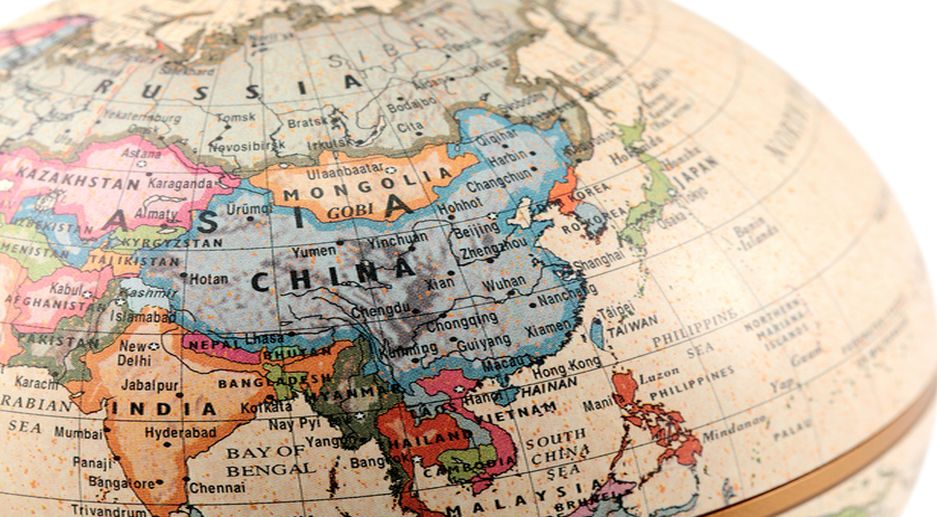
Sheikh Hasina’s upcoming visit to India between April 7 and 10 is turning out to be perhaps her most important bilateral visit to a country that surrounds Bangladesh from three sides, making it the only neighbour in all but a physical sense. 
It is now known that the Bangladeshi leader turned down the Indian request for a 25-year defence treaty. In its place there will likely be now a memorandum of understanding (MoU) on several related issues including purchase of equipment and weapons needed for UN peacekeeping, disaster response and management, land mine detection, spare parts for Russian Migs, etc. For all this India appears willing to extend US$ 500 million in credit.

Indian leaders, policymakers and even the media agree that Sheikh Hasina’s government has gone far beyond the extra mile possible to improve Bangladesh-India relations.

In The Times of India, Subir Bhaumik, a former BBC correspondent and a frequent commentator on India-Bangladesh relations, wrote, “Hasina has been steadfast in her support of Modi government’s ‘isolate Pakistan’ drive, her government has cracked down hard on northeastern rebels and Islamist militants, on fake currency rackets and Pakistani agents to address Indian security concerns. She has cleared transit for Indian goods to the Northeast through Bangladesh territory and addressed most of India’s connectivity concerns seen as crucial to success of India’s Look East policy. As Hasina prepares for her Delhi visit, Indian and Bangladeshi officials are trying to finalise a deal to allow Indian use of Chittagong and Mongla ports for accessing the northeast.”

What Bhaumik did not mention, and one fact that India truly needs to be grateful to Sheikh Hasina for, is her determined and successful effort to dismantle all the camps of the insurgents from the Northeast that Khaleda Zia’s government had allowed in a mistaken policy to keep ‘pressure’ on India. Over time these insurgents had become a genuine worry as their destructive power rose with sanctuary on Bangladesh’s side of the border. Thankfully, that is now history. Not to be forgotten or its importance underrated is how Sheikh Hasina’s government has changed the narrative from “India, the hegemonic oppressor” to “India, the development partner” ever since she came to power in 2009. I was a part of the entourage to the Indian capital in January 2010, when the Awami League chief risked her political future and took a leap of faith and signed a very comprehensive agreement with India in which, in one go, she responded to most of India’s important demands without getting any of Bangladesh’s demands met. Her faith has so far worked only partially in terms of duty free access of Bangladeshi goods in the Indian market, a major demand from our side. The story on energy cooperation is also good.However, the biggest frustration remains in the crucial area of water sharing, especially of the Teesta. Bangladesh stands greatly disappointed on this score as no tangible progress has been made since it was aborted at the very last minute on the eve of Prime Minister Manmohan Singh’s last visit in September, 2011.

India’s complex and controversial river-linking project hangs on Bangladesh’s head as a possible doomsday scenario with unknown implications for our ecology. India appears not to sufficiently appreciate the fact that all of Bangladesh is a delta and we survive only if our rivers do.  All Sheikh Hasina’s efforts appear to be now in jeopardy as India seems to be quite concerned about her China policy which resulted in the latter’s increasing presence not only in Bangladesh’s development projects but also in the sensitive area of military equipment purchase.

China has been by far the biggest source of defence purchase for Bangladesh for many years, ever since the coming of military in power in 1975 , reinforced in 2002 when former prime minister Khaleda Zia inked a comprehensive umbrella agreement during her visit to China.

India of course has been watching with considerable unease as bilateral cooperation between Bangladesh and China soared. Indian discomfort experienced a quantum leap when during Chinese President Xi Jinping’s visit when Bangladesh-China cooperation was elevated from “comprehensive partnership cooperation” to “strategic partnership cooperation” and China offered US$ 24 billion worth of economic and development aid with another US$ 13 billion in private sector investment.

What perhaps set the alarm bells ringing loud in New Delhi was the procurement of two refurbished Chinese submarines which brought the Indian defence minister for his maiden visit and the push for a 25-year defence pact proposing enhanced cooperation between the two militaries and insisting on purchase of defence equipment from India.

In Bangladesh the usual pattern of politics was to have improved relations with China when Khaleda Zia came to power and a distinct cooling of it when Sheikh Hasina formed the government accompanied by a pronounced tilt towards India.
Since coming to power in 2009 Sheikh Hasina has changed all that. For the first time the present prime minister, to her considerable credit, was able to forge uniquely close relations with India while simultaneously making China a major development and investment partner.

So how should India view Bangladesh’s rising closeness with China?  With suspicion or with maturity? Should India insist on countering the imagined Chinese ‘influence’-  imagined because China has in no way been able to influence our policy of friendship towards India – by forcing a ‘defence treaty’ or ‘greater defence cooperation’ on Bangladesh? Will such  enhanced cooperation’ give India any additional strategic benefit than it already enjoys?

Bangladesh needs India as a close ally and friend. But it also needs China as a significant development partner. It is unrealistic on India’s part to expect any government in Bangladesh not to try to reach out to China while pursuing a very close relationship with India. Over the many decades that Sheikh Hasina has been in politics and the several years she has been in power she has been consistent in her policy of good relations with India. What is new is her success to reach out to China. Instead of looking at it with suspicion India should repose trust on Bangladesh as a reliable ally and see her policy towards China as contributing to regional stability and bringing two Asian giants closer. If there is to be an Asian Century it will have to be built both by India and China and it has to benefit their smaller neighbours.  Stability is the key to Asia’s future and that stability can only be guaranteed by India and China coming closer, which they are doing through  bilateral trade aiming to reach a US$100 billion in the near future and billions of dollars' investment in each others’ countries. The idea of exclusive sphere of influence of each of these Asian Giants with “No Entry” sign for the other is an outdated concept and one that is doomed to failure in this digital age. A new element in our regional equation is the overt hostility of President Trump towards China and his declared policy of confronting the latter in the South China Sea. What effect is Trump’s policy likely to have on Narendra Modi’s resurgent Hindu nationalist government, especially on the hawks of the party? Will the US President’s anti-China policy encourage India to push for an anti-Chinese policy on her neighbours? Will India see Trump as an opportunity to upstage China in South Asia, especially because of China’s support for Pakistan remains strong while India’s relations with the latter has dipped to its lowest ebb?

The question for us is, how will Trump’s anti-China policy affect India, and how will it play out in South Asia, especially on India’s attitude towards Bangladesh?

Whatever it is, Bangladesh should never allow itself to be drawn into the India-China rivalry. We want India to be our ‘closest friend’ but ‘not our only friend’. Sheikh Hasina’s commitment to good relations with India is beyond question. So why should her reaching out to China be seen with suspicion? She has also reached out to Russia and our ties with this re-emerging superpower, and a significant partner in our Liberation War, is far better than it has ever been since 1971.
As Sheikh Hasina’s visit comes closer, India must seriously think how to forge a new, dynamic and win-win relationship with its emerging neighbour in the East.

The writer is Editor and Publisher, The Daily Star, Bangladesh. This is a series of columns on global affairs written by top editors and columnists from members of the Asia News Network and published in newspapers and websites across the region.
Civil-Military construct~II

Ashok kapur | New Delhi |

It is the clear verdict of history that the Cold War between the Allies and the former Soviet Union, that was to last half a century after the Second World War, was a direct result of British and American generals repeatedly ignoring civilian directions at the concluding stages of the war. The Allied military leadership, while marching into Germany opened a broad front for the liberation of Berlin, ignoring warnings that Stalin was making a straight dash for the Capital city. The civilian leadership could rightly anticipate that if the latter were to reach there first, Berlin would be a divided city.

In retrospect, the civilian strategy proved to be wiser. For half a century, the two nuclear blocs ~ NATO and the Soviets ~ were locked in an ‘eyeball to eyeball’ confrontation in Berlin, putting the whole world under the threat of a nuclear holocaust. And it was a similar story of warped military thinking that landed many of the East European nations into the iron grip of the former Soviet Union through their local Communist parties ~ agents of the Soviet Communist party. The most tragic case was that of Poland.

Overrun by the Nazis, Poland was fighting with its back to the wall. The Polish Resistance was fighting the occupying Germans in alliance with the local communist party, waiting for the promised help from the Soviet Army. The Red army did march all the way from Russia but halted abruptly at the gates of Warsaw. The Allied military leadership was supplying arms to the Polish Resistance to fight the Nazis, in close alliance with the local communists, who betrayed them to the Nazis when the moment arrived.

The British civilian leadership had cautioned their military not to encourage the Polish resistance to trust their communist allies, who were merely acting as proxies for Moscow. The tragic scenario unfolded precisely as the Allied civilian leadership had anticipated. The Polish communists betrayed the Polish Resistance ~ behind their back ~ to the occupying Nazis who butchered them mercilessly. It has been described as the most pernicious act of perfidy in the Second World War. Only after the butchery was complete, did the Red Army enter, with Polish communists ~ who did not fight ~ riding piggyback.

Soon after Second World War, the most serious conflict was the Korean War. The Allied forces were led by the US General, Douglas MacArthur, the hero of many a battle during the earlier war. Undoubtedly, he was a great military commander but a poor political strategist. The North Koreans had invaded South Korea, with the support of the Chinese communists. MacArthur wanted to cross the river boundary between Korea and China, and take the fight right into China.

By which time, China had come under Communist rule led by Mao Zedong. He was a ruthless dictator who was prepared to sacrifice a few lakh Chinese soldiers, for a “cause”. His army had just one gun for three soldiers, so that if the gun-carrying soldier was to be killed, his weapon would be passed on to the next soldier. For this reason, he had developed the ‘human wave’ tactics. MacArthur completely misread him, convinced that the Chinese would not intervene, their army being ill-prepared and under-armed. For his poor military judgment, he was dismissed from service.

The world was on the brink of a nuclear holocaust in 1962, over US-USSR confrontation over Cuba, a Soviet satellite. The former Soviet Union had clandestinely smuggled offensive nuclear missiles there, posing a nuclear threat to the USA. The Americans imposed a blockade of Cuba, preventing any ship from either entering or leaving. At the time, both the USA and the USSR were super powers, heavily armed with nuclear weapons. The USA had imposed very tough conditions on the USSR. A blockade, by itself was a somewhat humiliating ban on the then other major power.

President Kennedy was the US P resident, who, incidentally, was himself a former Naval officer with experience of war. The US military advised him to maintain the blockade which could possibly have led to a nuclear exchange, and the whole world could have been faced with a catastrophe. The civilian advice to him was wiser ~ a quarantine, which would permit the Soviet ships access to Cuba but after inspection by the US Navy so that no offensive cargo was being ferried.

The US move was complied with by the Soviets, and proved to be a face-saver for the other super power. Shockingly, the then US Air Chief in an unprecedented show of utter defiance of civlian authority made his intention open ~ his bombers would start bombing Cuba within the hour. It was an unprecedented act of open defiance of civilian authority that could have resulted in a nuclear war with the Soviets. The threat was issued after President Kennedy had publicly declared cessation of the dispute with the Soviets. The Air Chief had to be almost physically prevented from doing so.
Modern psychologists tell us that a man acts according to his experience and training. A soldier who has been taught the art of war and trained to fight all his life to win, and win decisively by annihilating the “enemy” cannot suddenly turn a peacenick. For him, there is only one glory ~ to be recognised for ‘victory’ in battle. To be denied this, for whatever reason is to question his very existence and being.

In sum, the question of a Defence Supremo is closely linked to the question of primacy of the civil or military viewpoint not only during peacetime but even during war. The issue assumes critical importance in the age of nuclear weapons when the nuclear powers, both declared and undeclared have a combined destructive capacity of a million Hiroshimas. History is replete with instances of disasters whenever the military viewpoint has prevailed even during war.

Galbraith, the top civilian adviser to President Kennedy during the Cuban crisis, was a witness to the US military functioning during the last time almost the entire humanity stood on the edge of a precipice ~ “In the US, as in other democracies, it is thought wise and even necessary that the military power be kept subordinate to civilian authority and restraint … in nearly all recent Pentagon confrontations when faced with the strongly conditioned attitude of the military, civilians have surrendered thereto.”

(Concluded)

The writer is a retired IAS officer.

Repeat of history

Editorial | New Delhi |

The election symbol is the most valued possession of any political party. The ruling AIADMK in Tamil Nadu is no exception. Its ‘two leaves’ symbol popularised by the party’s founder-leader MG Ramachandran has been prohibited in the 12 April by-election in the RK Nagar Assembly constituency by the Election Commission of India. Following the death of former AIADMK Chief Minister J Jayalalitha on 5 December, the party has split into two: one faction claiming the support of the people led by O Panneerselvam who succeeded Jayalalitha as CM on 6 December and the other by VK Sasikala who grabbed the general secretaryship of the AIADMK though she was not eligible to hold the post. She is not even eligible to be a voter for the next 10 years. The majority of the AIADMK MLAs chose to sail with Sasikala for considerations not worthy of their calling. She has chosen her nephew TTV Dinakaran, against whom several serious criminal cases are pending and his citizenship itself is suspect, for the RK Nagar seat and gave him Form B (authorisation for nomination of a candidate) to contest on behalf of the AIADMK. The Panneerselvam faction has nominated E Madhusudhanan, president of the AIADMK presidium, for the seat. The EC was put in a dilemma on the question of allotting the ‘two leaves’ symbol. According to Para 15 of the Election Symbols (Reservation and Allotment) Order, whenever there is a split in the party the symbol should go to the group with the majority. In the present case, the Sasikala faction holds the majority in the legislature as proved in a recent vote of confidence. But the MLAs were kept in harness and taken straight to the Assembly without giving them an opportunity to visit their constituencies. The EC had taken recourse to Para 15 of the Election Symbols Order in deciding the Samajwadi Party symbol dispute in favour of Akhilesh Yadav recently. But the AIADMK symbol dispute is not that simple. In this case, the EC relied on the precedent set by the order of the then Chief Election Commissioner R V S Peri Sastri freezing the ‘two leaves’ symbol. Following the death of MGR in 1988, the first split in the AIADMK occurred: one group was led by his widow Janaki Ramachandran and the other by Jayalalitha. Just as in the present case, the majority in the legislature claimed by the Janaki group could not be established beyond doubt. Peri Sastri’s compromise offer to have a free symbol each incorporating a miniature form of ‘two leaves’ was rejected by both. In the Assembly election held in January 1989 both factions of the AIADMK without the benefit of the ‘two leaves’ were routed. Only after the merger of the two groups and restoration of the ‘two leaves’ symbol was the AIADMK able to win an election and form the government in 1991. For the 12 April by-election to the RK Nagar Assembly seat, neither faction is permitted to use even the name AIADMK, let alone the ‘two leaves’ symbol. One does not have to be a psephologist or an astrologist to predict the outcome of the RK Nagar polls. History is repeating itself.
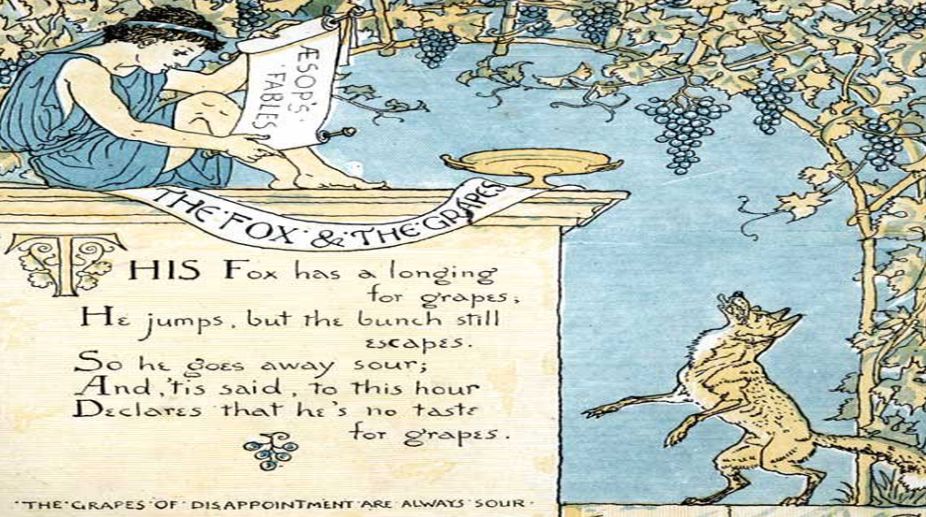
Not ‘sour grapes’

Editorial | New Delhi |

The Election Commission would be doing itself and the democratic process considerable disservice if it echoed the “sour grapes” line of the government and BJP members of the Rajya Sabha, and ignored the points made by the Opposition during the Elders’ discussion on electoral reforms. It is a tragic truth that with demonstrative disruption having usurped the place of dignified discussion in the apex legislature, there is tendency to treat lightly (even by the Presiding Officers) views expressed in “non-violent” debate, or for everything to be perceived through the prism of party politicking, yet there can be no masking the grim reality that the sanctity of the election mechanism is no longer “a given”. And the failure of Nirvachan Sadan to inspire the desired levels of trust and confidence is ominous. Allegations and suspicions that officials performing electoral duties function in accordance with the diktat of the ruling party, regardless of which party happens to be in power in the Centre or state at any given point in time, must be sincerely examined. The credibility of a process in which the nation took such tremendous pride must never be sacrificed at the altar of convenience. During the recent elections, in fiery UP in particular, the EC did “take note” of many transgressions, but seemed to back off from cracking the whip on anyone. With the result that questions are now being asked if the Commission has lost its “bite” after being shorn of the “Seshan bark”. Under sustained attack in the Elders was the use of Electronic Voting Machines that were not backed up by the “paper trail” system. Sure there is an element of “losers’ lament” to the criticism from the BSP and Samajwadi Party members, yet the fact that members of other parties which had little at stake in UP and Uttarakhand echoed their apprehensions added a ring of authenticity to the flak.

Significantly, the assault was not mounted on Nirvachan Sadan but on the central government for not making requisite funds available to it for upgrading apparatus. That some former CECs have faulted the Commission for not forcefully countering the criticism of “doctored” EVMs is something not to be discounted. Several other “reforms” were mentioned during the debate ~ by members from all sides of the House ~ which would require political consensus to implement. Hence it is critical that the debate be sustained, not shelved until the next round of elections. Yet in the short term the onus rests squarely with the EC, it cannot get away with claiming that EVMs are tamper-proof. After all, it was one of the BJP’s current spokesmen who was among the earliest of the “doubting Thomases”: doubts do not evaporate when “landslides” are recorded.

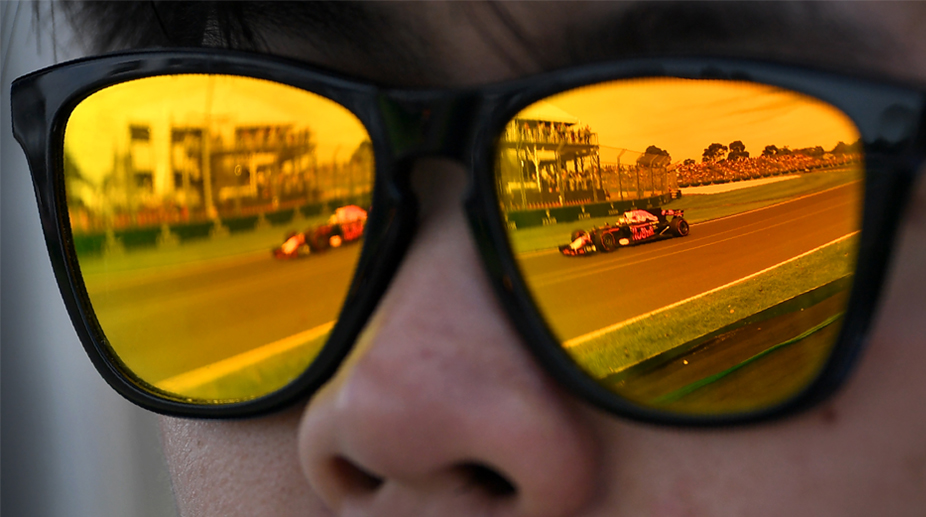
F1: Controversial moments in the world’s most elite motorsport

Some facts that even die-hard fans of the sport will find difficult to justify!

Prithviraj Dev | New Delhi |

Formula 1, or F1 for short, is undoubtedly the football of motorsports. Fans get attached to teams more than the drivers fairly early and are loyal till death.

There comes a time when a team (or driver) engages in some underhand tactics. However, it does raise questions about the integrity of people involved in F1.

The Statesman has compiled a list of the 10 most controversial moments in F1’s chequered history:

1994: Ayrton Senna and Roland Ratzenberger’s shocking deaths
Without meaning to sound too insensitive, a crash in a sport as frenetic as F1 is not a big deal and while a loss of human life can never be trivial, Williams driver Ayrton Senna’s crash and subsequent death at Imola is a dark event that has been shrouded in controversy for decades since.The racing fraternity was reeling with rookie Ratzenberger’s death during qualifying on Saturday but nothing could have prepared them for Senna’s death come race day. While the crash in itself could have been avoided, there was another bigger issue. Senna’s time of death was marked as 2:17 pm local time which meant the triple champion had died on impact. Instead of cancelling the race and thereby suffering a massive financial loss, the organisers delayed the announcement of his death and while subsequent trials in Italian courts have dragged on, their much-delayed judgement have left many who witnessed Senna’s death with a sour taste in the mouth.
 

1989-90: Senna-Prost, an epic rivalry that went too far 
Super-fast cars driven by ultra-competitive athletes is a concoction that is bound to bring controversy. And when two of the greatest drivers of their era went head-to-head, sparks flew and how. Suzuka, hosting the Japanese Grand Prix, was witness to some decidedly underhand tactics from both McLaren drivers as they desperately tried to win the championship. First, in 1989, Prost was leading the title ranking going into the penultimate race of the season with Senna needing a win to keep his championship hopes alive. Prost led the race from pole and didn't let Senna pass, which led to the Brazilian barging him off the track and going on to win the race. F1 stewards decided to disqualify the Brazilian and scupper his chances of the year’s tittle, a contentious decision even now. Then next year at the same venue, with Prost trailing Senna in the championship, Senna (now driving for Ferrari) once again hit the McLaren man in what could be called a deliberate accident. No action was taken against the Brazilian and he went on to lift the championship, much to the disbelief of Prost

1985: F1 finally boycotts South Africa over apartheid
Formula 1 has always been a sport reserved for the highest echelons of society but its apparent pro-Apartheid stand had brought the ire of many human-rights activists from around the world. FIFA had expelled the nation in 1960 and so had the IOC in 1970, but F1 continued to hold an annual race at the Kyalami circuit  and despite intense public pressure, didn't bar the African nation till 1985. A vast majority of fans felt that by not removing the South African GP from the calendar for such an extended period of time, spoke volumes about their allegiance. 

1994, 1997 & 2006: Michael Schumacher, the legend with a tarnished reputation
A majority of F1 fans born in the 80s and 90s will instantly associate the sport with one driver: Michael Schumacher. And while nobody can doubt the five-time champion’s talent or competitiveness, the German did have a few on-track moments which have tainted his legacy. At the 1994 Australian GP, he smashed his car into Damon Hill’s, claiming it was “purely unintentional”. Then three years later, a near-identical incident to the one at the Australian GP, Schumacher went into Williams driver Jacques Villeneuve but somehow the Canadian managed to finish the race despite the collision. Schumacher was disqualified that year from the driver’s ranking but his low-blow tactics came to the fore at the 2006 Monaco GP. Fernando Alonso had been impressive in practice and looked certain to clinch pole, but Schumacher literally stopped his car midway, causing a massive traffic jam of sorts which ensured his Spanish opponent could not beat his time. Stewards felt he had cheated for obvious reasons and despite public denials from Schumacher, gave the pole to the rightful recipient, Fernando Alonso.
2007: McLaren-Ferrari Spygate
F1 has a rich and storied history of which many instances can be made to champion the cause of the premier motorsport. The 2007 spying scandal involving McLaren and Ferrari, however, had many hanging their heads in shame in its aftermath. Corruption had permeated the uppermost echelons of McLaren, who were desperate to overhaul their arch-rivals Ferrari by any means unnecessary. A Ferrari chief mechanic handed over substantial data ( from cars to finances to strategies) to McLaren and by a stroke of misfortune for McLaren’s Chief Designer Michael Coughlan, the bubble was burst. A record $100 million fine followed for McLaren but their reputation never truly recovered ever since. 

2005: Indianapolis and the 3-team fiasco
While the current lot race purely on Pirelli tyres, not so long ago Bridgestone and Michellin were the preferred choice for most of F1. As a matter of fact, the vast majority of F1 teams raced on Michellin, with only three racing on Bridgestone (Ferrari, Minardi and Jordan). And after some spectacular tyre failures, Michelin stated they could not guarantee tyre’s safety for more than 10 laps. An incredible admission, which of course did not go down well with F1’s governing body, FIA, who decided against changing the rules to suit Michellin and decided the race would go ahead. A farcical full-race occurred as all teams on Pirelli tyres went back to the pits after the customary formation lap, amid loud boos from unsuspecting fans. Michael Schumacher in his Ferrari, won what was effectively a six-driver race at a canter in what a leading commentator described as “the strangest race I have ever seen.”

2002: Stagegate in Austria
Again Michael Schumacher at the centre of the storm, but this time the blame fell mostly towards his employers: Scuderia Ferrari. Schumacher was conceding for the driver’s title and for a change, his younger teammate, Rubens Barrichello had outperformed him on a race weekend. But with the Brazilian out of the reckoning for the drivers championship, Ferrari gave him clear orders to let his teammate pass him, going against the very instincts of motor racing in the process. 

2008-09: Racism rears its ugly head in Spain
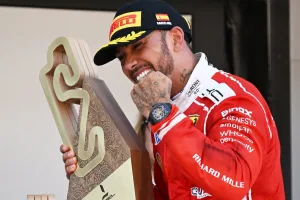
Two years in a row, then McLaren driver Lewis Hamilton was subject to torrent abuse from a section of fans in Spain. First at testing in February 2008 and then at the 2009 Spanish Gp F1’s first ‘black’ champion had to drive around the track with some fans clearly showing that a lack of education persists in the European continent even. With black paint on their faces, these fans disgraced themselves and the sport each time the Briton pitted. While the FIA condemned their actions, the fact that no action was taken rankled many fans.

1982: Williams’ Watergate
One man’s ingenuity is viewed by another as plain and simple cheating. In the capricious world of F1, tweaking a little too much can get you on the wrong side of the administration. That is exactly what Williams decided to do, by putting large water tanks in their cars, emptying them just before the race and then filling them back up immediately afterwards. What that meant was effectively they were running on a much lighter load than compared to their competitors, who were of course, unaware. So the illegal ballast methods were found out and the FIA promptly disqualified Williams and Brabham from the Brazilian GP in which Nelson Piquet Sr and Keke Rosbeg (Father of 2016 champion Nico) had come first and second respectively.

2009: Crashgate in Singapore

The most recent incident in the list, Nelson Piquet Jr’s ‘convenient’ crash at the 2009 Singapore GP seemed a little fishy at first, but when stewards delved deeper, Renault’s massive culpability came to light. Front-runner Fernando Alonso had a poor qualifying session, starting the race from 15th place and was effectively out of the race until his teammate crashed just after he went in for a pit stop. The safety car came out and enabled Alonso to catch up to the rest of the pack and Renault’s further pulled themselves in the quagmire that was fast spreading by sacking Piquet after the race. To which the aggrieved driver responded with a statement clearly stating that “The team told me to crash and that’s exactly what I did.” While Alonso won the race, by the time the revelation saw the light of day, it was too late and some members of Renault’s technical department got banned for their part in the controversy, a massive let off considering the grand scheme of things.

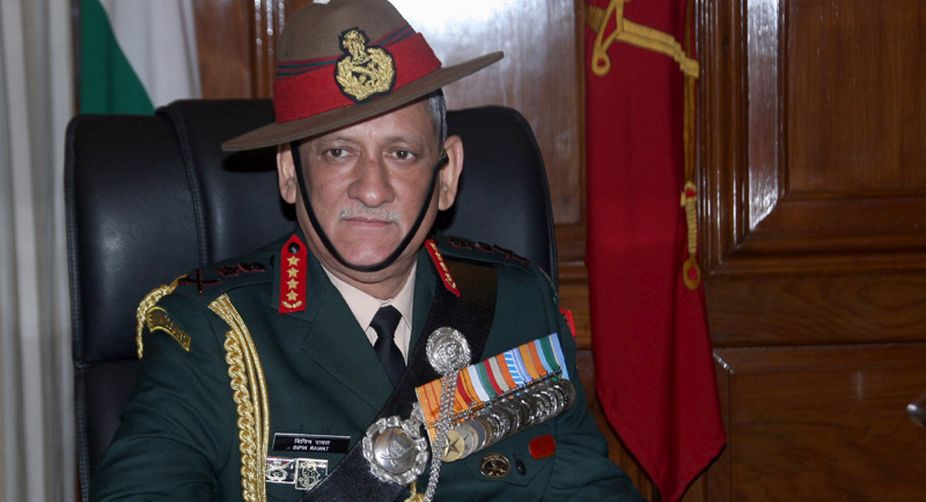
Army wants next war fought with Indian technologies: General Rawat

IANS | New Delhi |

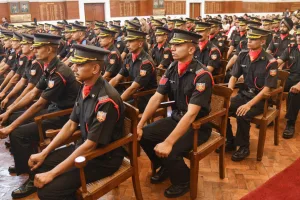
Indian Army chief General Bipin Rawat on Friday said it wants to fight the next war with Indian technologies.

"We want to fight the next war with technology on our side and not like the past," General Rawat said at the release of the 'Compendium of Problem Statements, Volume II' here.

The compendium has been prepared by the Army Design Bureau (ADB) after detailed interaction with all stakeholders, including soldiers deployed in the field. 

Pointing out the drawbacks in trial equipment, he asked the industry and academia to focus on the fact that the Army will fight wars in varied terrain and weather conditions, a Defence Ministry release said.

He asked the industry and academia to come up with robust, rugged, miniaturised yet technologically compatible solutions.

The 28 new problem statements, part of Volume II, will allow industry and academia to understand the needs of the Army and come up with indigenous solutions for military requirements.

The first volume, with 50 problem statements, was released on December 5 last year.

The ADB, inaugurated last August, has been formed in a bid to meet the Army's longstanding need to create and modernise weapons indigenously. 

It facilitate the weapons and technology building efforts between the Defence Research and Development Organisation, industry and the Army.

UEFA fines Arsenal, Bayern; suspends Tottenham’s Alli for 3 games

IANS | Nyon |

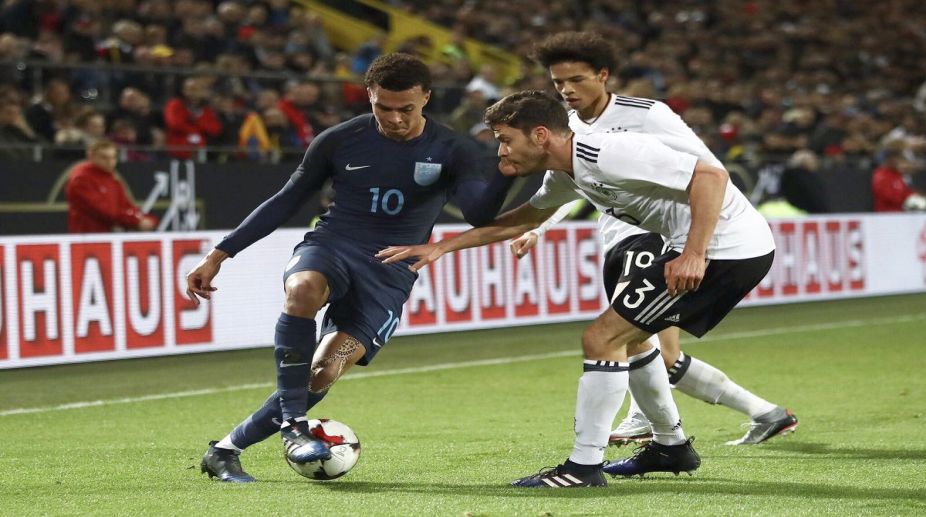
The Union of European Football Associations (UEFA) decided on Friday to fine Arsenal and Bayern Munich, as well as suspend Tottenham Hotspur's Delle Alli for three matches.

UEFA stated that a fine of 5,000 euros (about $5,400) has been imposed on Arsenal for the field invasion by their fans in the second leg of the Champions League's last 16, played in London on March 7 against Bayern Munich.

The German club was also fined 3,000 euros ($3240) because its fans threw objects onto the field during the same match, which ended 5-1 triumph for Bayern.

In addition, the control, ethics and discipline committee of UEFA also sanctioned Tottenham's midfielder Alli with a three-game suspension, after he was sent off with a red card in the second leg of Europa League's last 32 on February 23 against Belgian side Gent.

The 21-year-old collided roughly with Gent player Brecht Dejaegere 40 minutes into the match, which ended with a 2-2 draw and the elimination of Tottenham from the Europa League.

Grievance redressal portal for oil & gas complaints

Statesman News Service | New Delhi |

The Ministry of Petroleum and Natural Gas today announced a dedicated grievance redressal platform ~ E-SEVA ~ for addressing petroleum and gas related complaints.

The portal E-SEVA is an integrated grievances redressal platform across social media for addressing all oil & gas-related service issues. It will be a single point interface for all customers to reach out to the government for addressing their feedback or grievances, said the Minister of State for Petroleum and Natural Gas, Mr Dharmendra Pradhan.

To begin with, the portal would serve as a single point for queries on Twitter and Facebook, later other social media platforms would also join, said a senior officer of the Ministry. For quick intervention and resolution of complaints, consumers can send their feedback or queries with compulsory information (Full Name, Consumer ID, Location, Service Agency, Petrol Pump / Depot / Company Details), he said.

Mental health Bill introduced in LS

Statesman News Service | New Delhi |

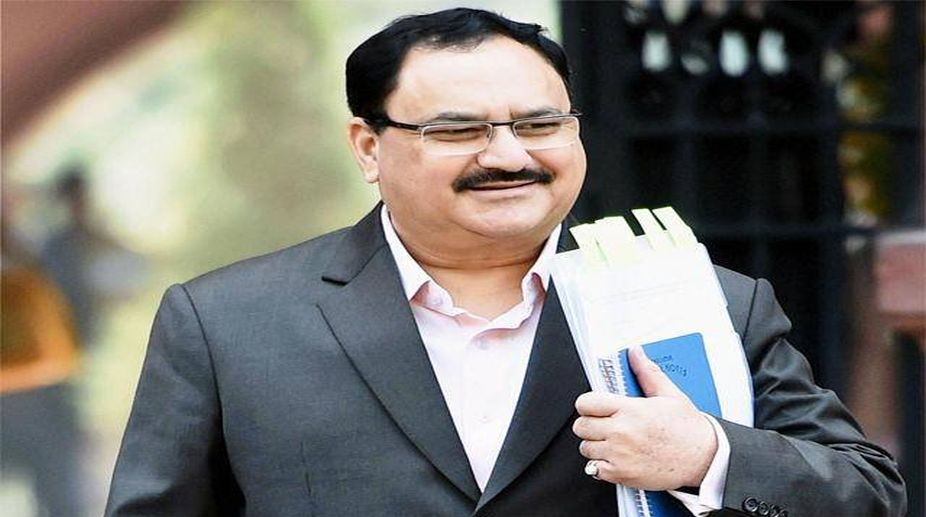
Union Health Minister J P Nadda today introduced the Mental Healthcare Bill, 2016, in the Lok Sabha that would make provision to protect, promote and fulfill the rights of persons suffering from mental illness.

The Bill, which was cleared last year by the Rajya Sabha, is crucial as it would not only decriminalise suicide, but also ensure right to better healthcare for people suffering from mental illness.

Introducing the Bill, Mr Nadda said it was progressive and patient-centric. “The purpose of the bill is to give treatment at community level….the society should give an environment in which we should see maximum mental healthcare is community based,” the minister said.

Later initiating the debate in support of the Bill, Congress leader Shashi Tharoor said mental patients are treated worse than animals and they are termed ‘lunatics’. He said it is time to replace the term ‘mentally ill’ with ‘person with mental illness’ and ensure self respect and dignity to such people. He said educational institutions should also hire professionals to improve the mental health of students. Half the medical students in India suffer from depression and anxiety, Tharoor added.

BJP member, Dr Heena Gavit, called the Bill a revolutionary one and said it would give dignity to people suffering from mental illness. She also lauded the decriminalisation of suicide. The discussion on the Bill would continue on Monday as it remained inconclusive.

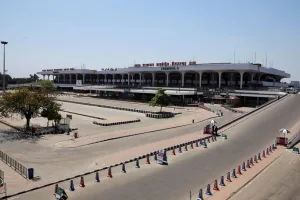
Suicide bomber killed near Dhaka airport

IANS | Dhaka |

A suicide bomber was killed in a blast in front of a police box near Dhaka airport on Friday, media reports said.

Assistant Commissioner of Police (Airport) Ruhul Amin Shagor said a suicide bomber attempted to attack the police box overlooking the airport intersection at 7 p.m., Dhaka Tribune reported.

He confirmed the attacker has been killed, and no other casualties were reported.

The attacker, an adult man dressed in jeans and a shirt tried to blow up the outpost with explosives in his pocket or tied around his waist. 

According to a witness, the bomber was not carrying anything in his hands, but looked like a drug addict.

Talking to media, Police Commissioner Asaduzzaman Mia said the attacker, in his early 30s, was also hauling a luggage which is being inspected by the Bomb Disposal Unit.

He also said it may not have been a suicide attack, but a lethal slip when the terrorist was spooked out and detonated the charges early.

The suicide attack comes exactly a week after another bomb attack on the Rapid Action Battalion (RAB) camp — an anti-crime, anti-terrorism unit of the Bangladesh Police — at the city's Ashkona area, barely half a kilometre away from the airport blast site.

Area-specific strategy needed for disadvantaged states: President

IANS | Patna |

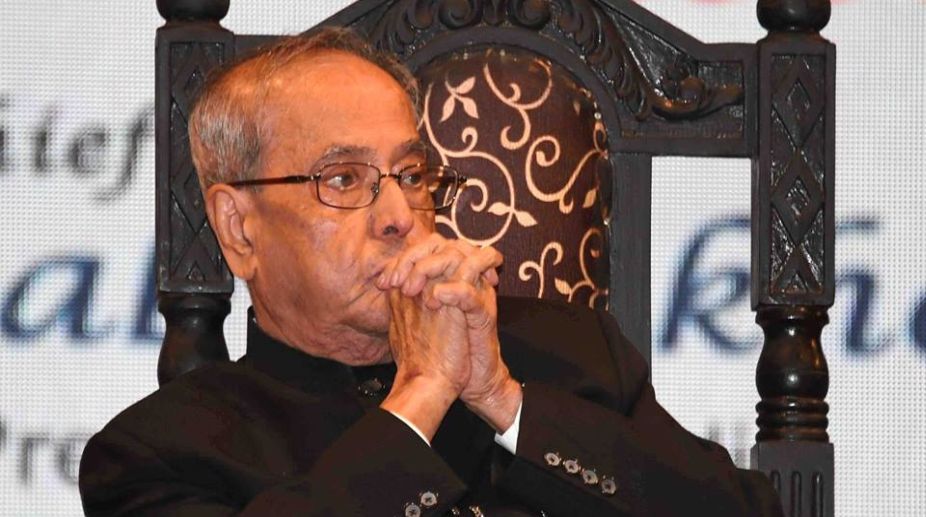
Disadvantaged regions like Bihar and Jharkhand require a strategy for development that can harness productive forces of the economy and not just blindly follow path of industrialisation, President Pranab Mukherjee said on Friday.

"We need to realise that for seriously disadvantaged regions like Bihar and Jharkhand, a strategy of development requires policy makers to unleash the productive forces of economy, and not just unquestionably follow a path of industrialisation, as was done by countries or regions which had developed earlier," Mukherjee said.

The President said that the enormous gap between the potential and reality of development in Bihar and Jharkhand, the former having plenty of fertile land and the latter endowed with abundant mineral resources, had attracted the attention of many scholars.

"Despite the region being a land of rich mineral resources and fertile soil, relative economic progress and development could not take place," Mukherjee observed while inaugurating a conference here organised by the Asian Development Research Institute (ADRI).

"It is here that one requires directed research which can identify appropriate policies that best suit the interests of the regions," he said. 

He said one should consider the immense potential of human development for promoting economic development in regions like Bihar and Jharkhand. 

The international experience shows that for specially disadvantaged regions, human development could be an alternative development strategy, he said. 

Mukherjee, however, observed that of late, both states had started doing well, particularly Bihar had shown the way in implementation of many social development schemes. 

"The growth performance of Bihar's economy has been steady over the past one decade, registering an annual growth rate at 10.5 per cent. This is a remarkable achievement," he said.

The President said that while Bihar still remained a largely agricultural state, Jharkhand was "slowly transforming itself into an economy with larger share of service sector".

Meghalaya Assembly passes Rs 13,048 cr Budget

IANS | Shillong |

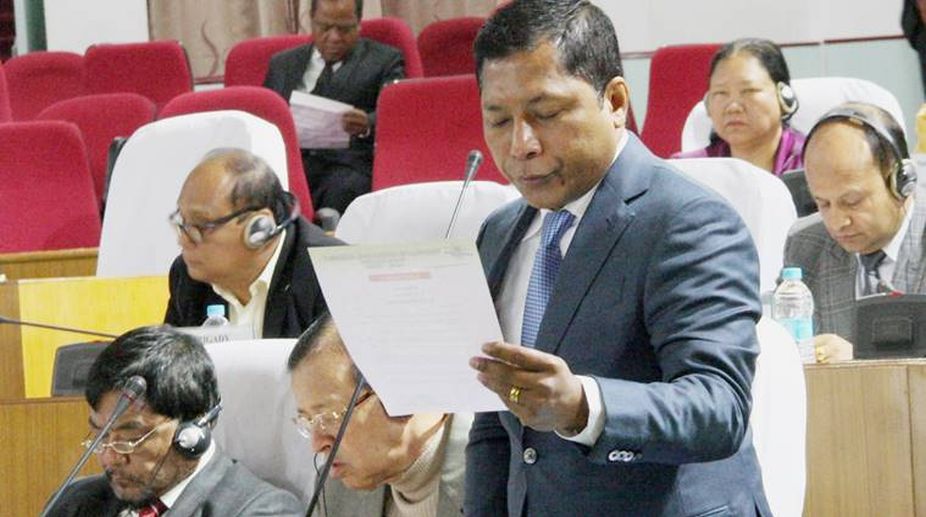
The Meghalaya Assembly on Friday passed the annual state Budget of over Rs 13,048 crore for the year 2017-2018 by a voice vote.

On March 15, Chief Minister Mukul Sangma had presented a Rs 1,236-crore deficit Budget for 2017-18, which is around 3.8 per cent of the Gross State Domestic Product.

Sangma had estimated the total expenditure at Rs 12,873 crore during 2017-18, of which revenue expenditure was estimated at Rs 10,648 crore and capital expenditure at Rs 2,225 crore. Excluding repayment of loans, the estimated total expenditure would be Rs 12,538 crore

The Budget also indicated that interest payment during 2017-18 was estimated at Rs 589 crore and pensions at Rs 730 crore.

For 2017-18, the total revenue has been projected at Rs 2,072 crore, of which the state's own tax revenue estimated at Rs 1,559 crore and state's own non-tax revenue estimated at Rs 513 crore.

Sangma, who presented the last Budget of the Congress-led Meghalaya United Alliance government as the state goes to polls next year, accorded the highest importance to community and rural development, allocating Rs 1,731.57 crore and earmarked a plan outlay of Rs 909.94 crore for the Education Department.

An amount of Rs 712.80 crore was allocated for infrastructure like roads and bridges, Rs 420.93 crore for Health and Family Welfare, and Rs 285.94 crore for Agriculture and Horticulture.

Pledging a development outlay of Rs 9.80 crore for Information and Public Relations, the Chief Minister proposed to constitute a Meghalaya Media Society to look into the welfare of journalists, besides proposing a new scheme to provide accommodation facility for the senior accredited journalists of the state. 

Punish those harassing woman journalist: IWPC

IANS | New Delhi |

The Indian Women's Press Corps (IWPC) has urged Tamil Nadu Chief Minister E. Palaniswami to punish those harassing Chennai-based journalist Sandhya Ravishankar for writing about sand mafia.

The grouping said Ravishankar was facing "threats and abuses" and the IWPC was "deeply disturbed by the harassment".

"We condemn the trolling and pressure put on her by interested parties so that she does not raise the issues of illegal mining and corruption," the IWPC said in a statement on Friday. 

It urged the Chief Minister to protect the journalist, have the matter probed and "ensure that the culprits behind her harassment are identified and punished. 

"The state should ensure her safety and well being as also her right to continue to work fearlessly and independently," said the letter to the Chief Minister from IWPC President Sushma Ramachandran.

SBI chief Bhattacharya among top 50 in Fortune’s greatest leaders

IANS | Mumbai |

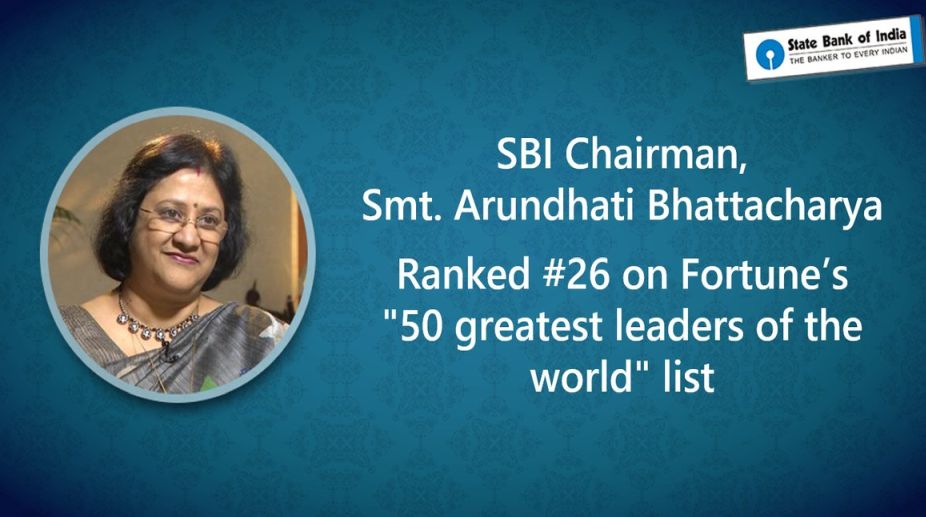
 State Bank of India (SBI) chief Arundhati Bhattacharya has been ranked 26th in the Fortune's top 50 greatest leaders. She is the only Indian corporate leader in the list.

"Arundhati Bhattacharya, Chairman, SBI, has been ranked 26th in the fourth edition of Fortune's World 50 Greatest Leaders list. By this, Arundhati Bhattacharya becomes the only Indian corporate leader to be featured in the list," the public lender said in a statement here on Friday.

Bhattacharya is the first-ever woman to chair the country's largest lender. 

The leaders in this Fortune list excel at leading effectively in today's challenging business environment.

Bhattacharya has steered the SBI through an ongoing battle with bad loans, surprise demonetisation move and will be overseeing the upcoming six-bank merger, the statement said. 

"She has led the 211-year-old institution into the digital era. She has been well recognised and granted a rare extension in her three-year term at the SBI," it said.

SBI chief Bhattacharya among top 50 in Fortune’s greatest leaders

IANS | Mumbai |

 State Bank of India (SBI) chief Arundhati Bhattacharya has been ranked 26th in the Fortune's top 50 greatest leaders. She is the only Indian corporate leader in the list.

"Arundhati Bhattacharya, Chairman, SBI, has been ranked 26th in the fourth edition of Fortune's World 50 Greatest Leaders list. By this, Arundhati Bhattacharya becomes the only Indian corporate leader to be featured in the list," the public lender said in a statement here on Friday.

Bhattacharya is the first-ever woman to chair the country's largest lender. 

The leaders in this Fortune list excel at leading effectively in today's challenging business environment.

Bhattacharya has steered the SBI through an ongoing battle with bad loans, surprise demonetisation move and will be overseeing the upcoming six-bank merger, the statement said. 

"She has led the 211-year-old institution into the digital era. She has been well recognised and granted a rare extension in her three-year term at the SBI," it said.

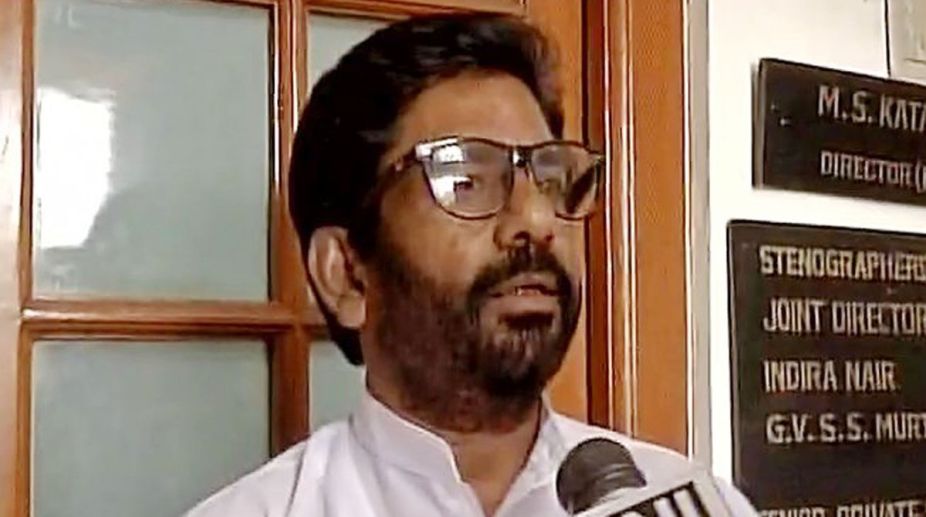
Shiv Sena sympathetic to MP who assaulted airline staffer

IANS | Mumbai |

The Shiv Sena on Friday appeared sympathetic to its MP Ravindra Gaikwad – charged with assaulting an Air India staffer – saying while it did not endorse his action it wanted to know why the situation was allowed to escalate to this level.

"The speed at which our party MP has been banned from flights, if Air India had similarly ordered an improvement in its services, it would have been better," Shiv Sena Rajya Sabha MP and spokesman Sanjay Raut said.

Raut said although his party had no agenda for violence, "if provoked the party would hit back appropriately.

"The question does not concern only one MP, but the common masses in the country also who have to suffer due to the service of Air India," Raut said, appearing to defend Gaikwad.

He alleged that when passengers were being "looted" in airports at Mumbai and New Delhi, why such promptness was lacking on improving Air India's service.

Raut said rather than the party taking any action, it would let the law would take its own course in the matter.

Meanwhile, Harshal Pradhan, the media advisor to Shiv Sena President Uddhav Thackeray, said Gaikwad had submitted his explanation to the party, but declined to reveal details.

He termed the issue as "minor" but blown out of proportions by the government to divert attention from major issues like farmers suicides in the country.

The party has been under fire from all quarters with Mumbai Congress President Sanjay Nirupam demanding that the Sena should sack its "goonda MP".

Osmanabad MP Gaikwad admitted to having assaulted an Air India staffer "25 times" with his slipper and even tried to push him out of the aircraft in Delhi on Thursday.

Earlier, Air India and all private airlines blacklisted Gaikwad and cancelled his tickets, leaving him with limited travel options to and from New Delhi and his constituency.

Teenager kills mother over money

IANS | Kolkata |

A teenage boy, along with a friend, was arrested for allegedly strangling his mother as she refused to heed his demand for extra pocket money in West Bengal's South 24 Parganas district, police said on Friday.

"Rahul Haldar (17), a resident of Diamond Harbour in South 24 Parganas district, first sedated his mother by giving her sleeping pills. When the woman became drowsy, Haldar strangled her with a nylon rope with the help of his friend, Suman Sanki (17)," a senior officer from Diamond Harbour police station said.

"Both the boys were apprehended and shifted to the Juvenile Justice Board in South 24 Parganas district's Garia," the officer said.

According to police, the boy was addicted to marijuana and often fell out with his mother over extra pocket money.

"The boy confessed he was addicted and bore a grudge against his mother as she did not give him extra pocket money. The boy and his friend have been slapped with charges of murder and conspiracy, under various sections of the IPC," the officer added.