Logo

Did Rasha Thadani use ‘Uyi Amma’ to start PR wars against other star kids? Mom Raveena Tandon reacts

Rasha Thadani’s song ‘Uyi Amma’ has sparked a storm online, with fans comparing her to other star kids. The buzz has reached her mother, Raveena Tandon, putting the family in the spotlight.

Statesman News Service | New Delhi |

Bollywood babies, fan wars, PR gossip and one hit dance track; welcome to the latest star kid storm! This time, the spotlight is firmly on Rasha Thadani, and guess what? Mom to the rescue. Yes, actor Raveena Tandon has finally broken her silence on those messy PR rumours floating around after the ‘Uyi Amma’ song dropped online.

And oh boy, the internet did what it does best. Compare, speculate, and then compare some more.

Also Read: PK was courage, today is caution: Rajkumar Hirani talks about the rise of defensive Bollywood

When one song sparked a full-blown star kid war

The moment Rasha’s dance number ‘Uyi Amma’ came out, social media exploded. Fans began praising her screen presence and dance moves, but along with the love came whispers.

Some online users claimed that Rasha’s team was secretly spreading negative chatter about other star kids just to make her look better.

According to rumours, a whole PR conspiracy was apparently at work. But now, Raveena has stepped in and said, absolutely not.

During a podcast appearance, Raveena shut down the gossip in the tone only a protective Bollywood mom can manage. She clearly denied that her daughter or their team planted any negative PR stories about other celebrity kids.

She explained that many of these young actors are children she has literally seen growing up. They are kids of her close friends, part of the same film family circle. So why would her daughter try to pull anyone down?

According to Raveena, the entire narrative spiralled because social media loves drama. Some fans praised Rasha, some supported other newcomers, and slowly, comparisons turned toxic. Soon enough, trolling started on both sides.

Then came the wildest accusation that Rasha herself was behind the negativity.

Raveena didn’t hold back. She said their family has never worked with PR in such a nasty way and never would. She insisted no one is “vile or wicked” enough to put another child down just to shine brighter.

Toxic fan wars: The real villain?

Raveena also pointed out a bigger problem: gossip culture around celebrity kids. According to her, rumours fly faster than facts in Bollywood. One comment online and suddenly people assume there’s a hidden PR machinery working overtime.

She even joked about people asking which PR machinery they were talking about, because according to her, there is none. In her view, the entire issue became bigger simply because social media turned normal comparisons into full-blown fan wars.

Rasha Thadani’s journey


View this post on Instagram


A post shared by Rasha Thadani (@rashathadani)

For those who missed the timeline, Rasha made her acting debut last year with ‘Azaad’, directed by Abhishek Kapoor. The film did not do great at the box office, but her performance — especially her dancing caught attention. And ‘Uyi Amma’ became the talking point.

Even critics who didn’t love the film admitted that the young actor showed confidence and strong screen energy in the song.

Despite the debut film’s box office struggle, Rasha is not slowing down. She already has another project lined up, ‘Laikey Laikaa’, where she stars opposite Abhay Verma. Interestingly, she is not just acting but also stepping into singing. She has lent her voice to the film’s song ‘Chaap Tilak’ along with IP Singh.

The track is composed by Faridkot (Rajarshi Sanyal and IP Singh) with lyrics by Sidharth–Garima and Singh.

New unemployment allowance scheme of Bengal govt eyewash: LoP Adhikari

Under this scheme, a monthly allowance of Rs 1,500 will be given to secondary examination-passed youths in the age bracket of 21 to 40.

IANS | Kolkata |

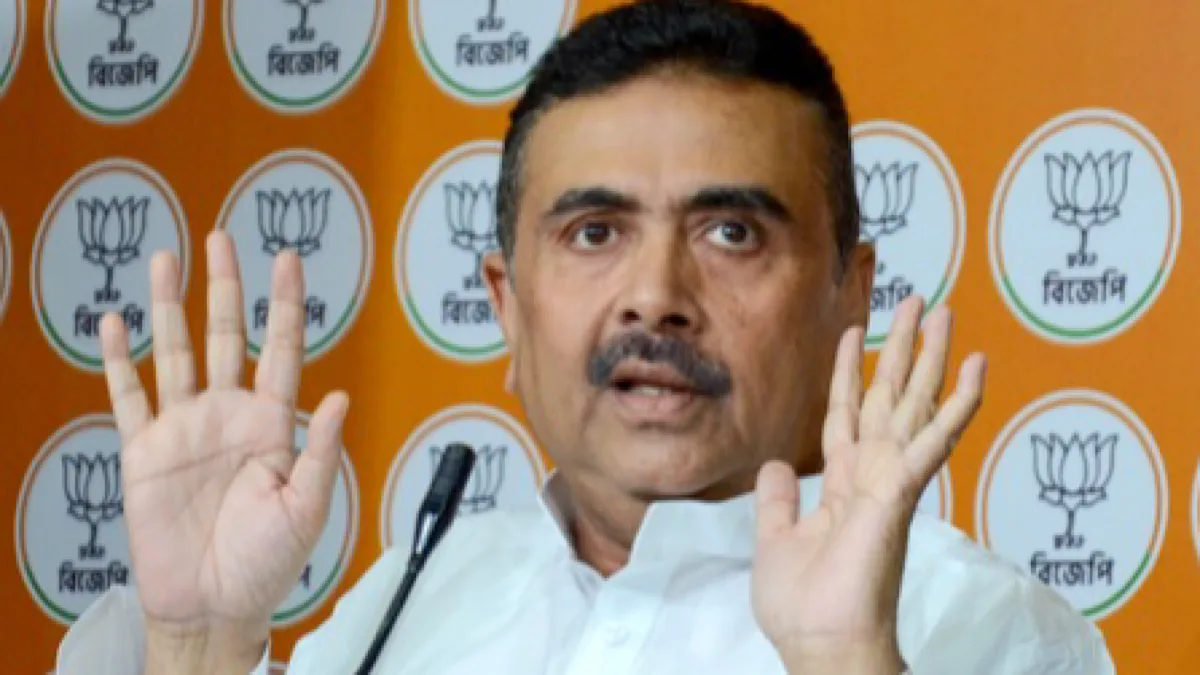
The Leader of the Opposition (LoP) in the West Bengal Assembly, Suvendu Adhikari alleged on Monday that the new unemployment allowance scheme ‘Banglar Yuva Sathi’ announced by the West Bengal Minister of State for Finance (Independent charge), Chandrima Bhattacharya while presenting the interim budget for 2026-27 on February 5, was nothing but an eyewash aimed at misleading unemployed youth in the state.

Under this scheme, a monthly allowance of Rs 1,500 will be given to secondary examination-passed youths in the age bracket of 21 to 40.

While presenting the interim budget on February 5, Bhattacharya said that the scheme will come into effect from August 15 this year if the Trinamool Congress returns to power.

However, Chief Minister Mamata Banerjee preponed the date of implementation of the scheme and announced that the payments under the scheme will be made with effect from April 1 instead of the August 15 date announced earlier.

Accordingly, the state government has started receiving applications for the scheme through special camps opened at all the 294 Assembly constituencies in the state from February 15.

On Monday morning, the LoP, in a post on his social media handle, described the scheme as eyewash before the forthcoming Assembly elections, and also expressed doubts over the actual number of genuine beneficiaries who would receive payments under the scheme.

According to him, the new scheme is nothing but a replication of the old scheme of ‘Yuvashree’ just by changing the name.

“It is the same old tactic of reintroducing the same scheme with a new name. In a bankrupt state that is economically starving because of the flight of capital and lack of investments, the true appreciation of talent is non-existent. Now it is yet another ploy of the state government to make unemployed youths stand in queues for submitting the applications at the designated camps,” Adhikari said.

He also questioned the necessity for organising camps for the submission of application forms when the same thing could be arranged online easily. He also questioned the police action at some of the designated camps on Sunday, which was the first day for submission of the application forms under the scheme.

“There was no need to deploy police at the camps. The West Bengal Police has developed the habit of beating job seekers and unemployed youths,” he claimed.

“Why did the police beat up unemployment allowance applicants again?” Adhikari questioned.

AI is not going to take jobs, learn 10-15 tools, it will increase your productivity: Info Edge founder Sanjeev Bikhchandani

Info Edge Founder and Executive Vice Chairman Sanjeev Bikhchandani on Monday highlighted that Artificial Intelligence is not eliminating jobs but significantly enhancing productivity, urging young professionals to adopt AI tools or risk being left behind.

Statesman News Service | New Delhi |

Info Edge Founder and Executive Vice Chairman Sanjeev Bikhchandani on Monday highlighted that Artificial Intelligence is not eliminating jobs but significantly enhancing productivity, urging young professionals to adopt AI tools or risk being left behind.

Speaking at the “Future of Employability and AI” session of the AI Impact Summit 2026, Bikhchandani said that AI is currently being deployed to improve efficiency and serve previously unviable market segments, rather than to replace human workers.

Using a business example, he said companies often find it financially unviable to assign employees to serve thousands of low-paying clients. However, AI-powered voice bots can now handle such outreach effectively, enabling firms to serve an underserved segment without increasing headcount.

“You can sit in office and you can make phone calls now the bottom 5100 clients who really don’t pay that much. It doesn’t make financial sense to have a person person holding them and calling on them, it doesn’t make financial sense for a person who and for India, so we put a chatbot, a voice bot automatically calls, you can’t make out it’s not a human being, that’s how it’s advanced, right, and suddenly we are calling them up. Now what is happening here is stuff that is not getting done, we have served an underserved segment, underserved market by using AI. Thus nobody is thrown out of a company because of AI, I don’t want that happening going forward, but right now it’s being used to increase productivity, it is being used to do stuff better, it is being used to do stuff better,” said Bikhchandani.
Addressing young professionals, Bikhchandani advised them not to worry about larger policy debates or the development of large language models (LLMs), but to focus on building practical AI skills relevant to their careers.

“How AI is like that. You don’t have to build LLMs, right, and I tell you what to all the young people here, you don’t worry about system problems, you don’t worry about policy issues, you just worry about your job here and your career, your individual career. What should you do, what should you do to make sure AI doesn’t make you lose your job, and AI enables you to get your turn, just learn 5 10 15 useful AI tools. Let me assure you the older people in any company would not know that because they are not quick learners, but if you learn them right, you will get your now,” he said.

Meanwhile, former CEO of HCL Technologies, Vineet Nayyar said that AI would impact 50 percent jobs, whereas it will also create more 50 per cent new employment opportunities.
The AI Impact Summit which kicked off on Monday in New Delhi will welcome world leaders from across 20 countries, including French President Emmanuel Macron, Brazilian President Lula da Silva, Sri Lankan President Anura Kumara Dissanayake and others. UN Secretary General Antonio Gutteres will also attend the event.

AI progress needs urgency, political will and strong state capacity: CEA V Anantha Nageswaran

Speaking at the India AI Impact Summit 2026 during a session titled ‘Employability in the AI Age: Preparing for the Jobs of Tomorrow’, Nageswaran underlined that India must act with clear intent to ensure AI strengthens, rather than disrupts, the country’s growth and social fabric.

Statesman News Service | New Delhi |

Chief Economic Advisor (CEA) V Anantha Nageswaran on Monday said that progress in artificial intelligence (AI) will not occur by “drift” and stressed the need for urgency, political will, and strong state capacity to harness its benefits.

Speaking at the India AI Impact Summit 2026 during a session titled ‘Employability in the AI Age: Preparing for the Jobs of Tomorrow’, Nageswaran underlined that India must act with clear intent to ensure AI strengthens, rather than disrupts, the country’s growth and social fabric.

“India can become the first large society where human abundance and machine intelligence reinforce, and not undermine, each other,” he said.

“This will not happen by drift; this will require urgency. It will require political will, it will require state capacity, and it will require a clear national commitment to aligning technological adoption with mass employability.”

He emphasized that the effort must be a coordinated “Team India” initiative involving the government, private sector, academia, and policymakers. “The window is still open, but it is not indefinite,” he cautioned.

The CEA called for aligning AI adoption with large-scale job creation and inclusive growth, warning that uncalibrated technological change could lead to social and economic instability.

“For India, this is not a debate about the future of work; it is a decision about the future of growth, social stability, and cohesion. We must act, and act now,” Nageswaran said.

He stressed that reforms must begin with strengthening foundational education and upgrading pedagogy and skill development systems. According to him, improving the teaching of core skills is the starting point for ensuring that AI contributes to employability and shared prosperity.

Nageswaran also highlighted the need to scale up high-quality skills training, expand labour-intensive service sectors, and remove regulatory bottlenecks that hinder job creation.

He concluded that India must move decisively to co-create prosperity with AI, ensuring that technological advancement supports economic growth while safeguarding social cohesion.

Geeta Patnaik, Odia singer known for ‘Phur Kina Udigala Bani,’ dies at 73 after brain stroke in Cuttack

Patnaik’s voice gave life to numerous popular Odia songs that stayed close to listeners’ hearts for decades. Her melodies blended emotion and simplicity, making her songs timeless favourites across generations.

Statesman News Service | New Delhi |

The golden voice in Odisha that once floated through homes, radios, and film songs has gone still. Veteran Odia singer Geeta Patnaik is no more, and fans are still trying to believe it.

Geeta Patnaik: Cause of death

Geeta Patnaik, aged 73, passed away on Sunday according to her family. The shock began earlier in the week. She reportedly fell ill during an event on Thursday in Cuttack.

What looked like a sudden health issue soon turned serious. She was first rushed to Capital Hospital in Cuttack.

Doctors ran tests and confirmed she had suffered a brain stroke.

Also Read: Sunil Thapa dies at 68 in Kathmandu: Ratey Kaila fame and ‘Mary Kom’ coach role defined his cross-border career

As her condition worsened, she was shifted to private hospital in the city for advanced treatment. Despite efforts, doctors later declared her brain dead on Sunday. The news spread quickly.

Her brother-in-law, Pradosh Patnaik, shared the heartbreaking update with news agency PTI. He confirmed that she had been under treatment since the stroke and that doctors finally pronounced her brain dead during treatment.

Political leaders react with grief

Condolences poured in from top political leaders of Odisha and beyond. Chief Minister Mohan Charan Majhi called her passing an “irreplaceable loss” to Odisha’s music and culture. He also prayed for peace for her soul and strength for her family.

Former Chief Minister Naveen Patnaik said her melodious voice had reached every household in Odisha. He noted that her popular songs would keep her memory alive forever.

Union Minister Dharmendra Pradhan also described her demise as an irreparable loss to Odisha’s art and cultural heritage.

Geeta Patnaik songs

Geeta Patnaik was not just a singer; she was a musical memory for generations. Her career spanned more than five decades. She worked closely with legendary Odia music icon Akshaya Mohanty creating songs that became timeless classics.

One of her most loved tracks was ‘Phur Kina Udigala Bani’ from the film Jajabar. Even today, the song is remembered for its emotion and melody.

Over the years, she recorded numerous popular Odia songs that found a permanent place in listeners’ hearts.

Her final rites will be held on Monday. Before that, her mortal remains will be taken to her residence in Cuttack so that family, friends, and admirers can pay their last respects.

India’s power play at mega AI Summit: PM Modi to host global tech titans, including Bill Gates, Sundar Pichai

Prime Minister Narendra Modi will inaugurate the India AI Impact Expo at Bharat Mandapam in New Delhi today, marking the formal opening of the five-day summit that runs from February 16 to 20.

Statesman News Service | New Delhi |

With India hosting the AI Impact Summit 2026, New Delhi is set to emerge as a hub for global dialogue on artificial intelligence, showcasing the country’s ability to develop practical AI solutions and amplifying the Global South’s voice.

Prime Minister Narendra Modi will inaugurate the India AI Impact Expo at Bharat Mandapam in New Delhi, marking the formal opening of the five-day summit that runs from February 16 to 20.

With the grand inauguration, the Summit will host world leaders, captains of industry, innovators, policymakers, researchers, and tech enthusiasts from across the globe. PM Modi is scheduled to meet 35 to 40 CEOs on the sidelines and will address the main plenary session on February 19.

One of the first major global artificial intelligence summits hosted in the Global South has drawn participation from more than 100 countries, strengthening its position among leading technology powers.

The India AI Impact Summit 2026 will bring together some of the world’s most influential tech figures.

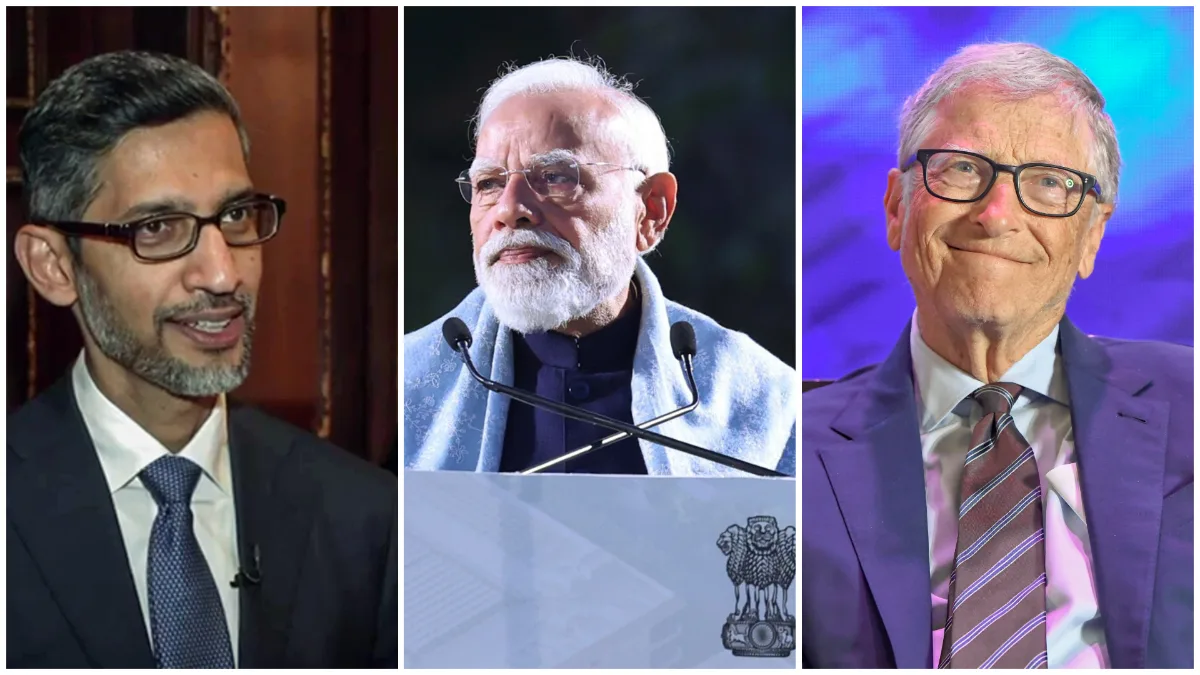
Top global tech leaders, including Google CEO Sundar Pichai, OpenAI CEO Sam Altman, Anthropic CEO Dario Amodei, and Google DeepMind co-founder and CEO Demis Hassabis, will be in attendance at the summit.

Microsoft co-founder Bill Gates is also slated to take part, alongside leading industry executives and policymakers.

Also, Presidents, Prime Ministers, Crown Princes, and the brightest minds from Silicon Valley and beyond will converse at the Bharat Mandapam to attend the AI Impact Summit 2026.

According to organisers, more than 40 CEO and 20 heads of state are expected at the summit, with investment commitments of up to $100 billion under discussion.

More than 3,000 speakers are scheduled to participate in over 500 sessions, alongside more than 300 exhibitions and live demonstrations by startups, research institutions, and major technology companies at the five-day summit that is being held across multiple venues in the national capital, including Bharat Mandapam and Sushma Swaraj Bhawan.

AI Impact Summit 2026: Delhi to host 3,000 speakers, representatives from 100+ nations, 600 startups

With bilateral meetings, CEO roundtables and large-scale startup showcases planned, the summit doubles as a diplomatic and economic platform aimed at shaping global artificial intelligence cooperation.

Statesman News Service | New Delhi |

The AI Impact Summit 2026 is set to be formally launched in the capital later on Monday, with Prime Minister Narendra Modi scheduled to inaugurate the India AI Impact Expo at Bharat Mandapam. Delegates from more than 100 countries, including global technology leaders and policymakers, are converging in New Delhi for the five-day event that will run until February 20.

The scale and profile of the summit underline India’s effort to assert a stronger voice in shaping how artificial intelligence is governed and deployed worldwide, particularly at a time when countries are divided over regulation, access, and technological competition.

Also Read: India AI Impact Expo 2026: 10 things to know about the five-day event to be inaugurated by PM Modi today

Global tech leaders and policymakers to gather in Delhi

Over the next five days, Delhi will see an unusual mix of cabinet ministers, chief executives, researchers and startup founders sharing the same stage. The summit’s schedule is packed (more than 500 sessions and over 3,000 speakers) with halls filled with live demos, product showcases and working prototypes from global tech companies and homegrown innovators alike.

The conversations are being framed around three broad ideas: People, Planet and Progress. In simple terms, that means looking at how artificial intelligence can improve daily life, support sustainable development and drive economic growth.

Among those expected to participate are Google CEO Sundar Pichai and OpenAI chief Sam Altman. United Nations Secretary-General Antonio Guterres is also slated to attend. Microsoft co-founder Bill Gates is expected to be present, though officials have not specified his programme. NVIDIA CEO Jensen Huang, who had earlier been expected, will not attend due to unforeseen circumstances.

Ahead of the launch, Prime Minister Modi described the international turnout as a sign of India’s rising technological capacity and the strength of its young talent pool. In a post on X, he said the participation reflects the potential and capabilities of the country’s youth and highlighted India’s progress in science and technology.

Emphasis on responsible and inclusive AI

Senior officials associated with the summit have indicated that India intends to promote a model of artificial intelligence development focused on equitable access and responsible innovation, rather than heavy-handed regulatory approaches.

The Expo, spread across 10 arenas covering more than 70,000 square metres, will host over 600 startups and 13 country pavilions, including those from France, Germany, Russia, the United Kingdom, Australia, Japan, Italy, the Netherlands, Estonia, Tajikistan, Switzerland, Serbia, and Africa.

Many of the participating startups are expected to demonstrate AI tools already deployed in climate resilience, agriculture, healthcare, governance and digital infrastructure. Organisers estimate that more than 2.5 lakh visitors could attend over the course of the summit.

Diplomatic engagements planned alongside summit

Prime Minister Modi is scheduled to hold bilateral meetings with French President Emmanuel Macron and Brazilian President Luiz Inacio Lula da Silva during the event. A leaders’ roundtable and a meeting with technology CEOs are also planned.

With ongoing investments in artificial intelligence, semiconductors and quantum computing under initiatives such as Digital India, the summit offers India an opportunity to project itself not only as a large digital market, but also as a participant in shaping global norms around emerging technologies.

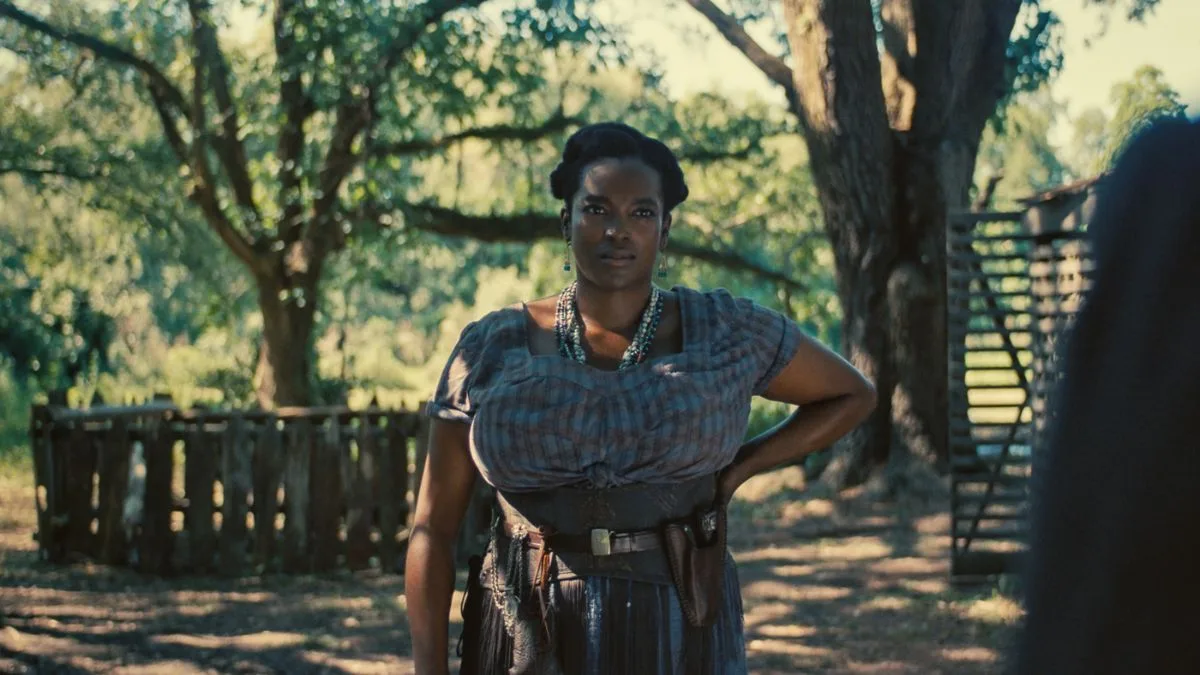
Wunmi Mosaku can’t celebrate her Oscar nomination for ‘Sinners’, says ICE killings have left her shaken

The ICE killings refer to the January 2026 fatal shootings of US citizens Renée Good and Alex Pretti in Minneapolis during federal immigration enforcement operations, incidents that sparked protests and political outrage.

Statesman News Service | New Delhi |

The champagne is ready, the Oscar buzz is loud, but one star says her heart just isn’t in party mode. Wunmi Mosaku, who earned an Oscar nomination for best supporting actress for ‘Sinners’, has revealed that real-world tragedy has overshadowed her big career moment.

In a candid chat with The Sunday Times, Mosaku said she simply cannot celebrate while grieving the reported deaths of two American citizens, Alex Pretti and Renee Good, who were shot and killed by agents of US Immigration and Customs Enforcement in Minnesota. She also mentioned the kidnapping of a five-year-old boy as part of the heavy news weighing on her mind.

Also Read: Sinners music honours Black voices through blues and jazz; what awards mean for artists rising from oppression

A nomination that feels “beautiful” but painfully heavy

Mosaku described her mixed emotions in very human terms. One moment is “beautiful”, the Oscar nomination. The other moment is “dark and heavy,” she said, calling the situation “truly dystopian.” She admitted she cannot imagine stepping out to celebrate when such tragic headlines are dominating the news.

She also shared a personal detail: her husband is less shocked than she is. According to Mosaku, he believes there is a “strange American psyche” where terrible events happen and people still go to work the next day.

She, however, feels floored for days and wonders how people can gather in crowded places right after such incidents. She said her instinct is to retreat into a cocoon adding that her reaction reminds her husband that such normalisation is not healthy.

Hollywood voices grow louder against the crackdown

Mosaku is not alone. Several Hollywood figures have spoken out strongly against the immigration crackdown linked to Donald Trump’s policies.

On Feb. 5, veteran actor Jamie Lee Curtis told Variety that “the ICE situation is out of control.” She called the actions of federal agents in Minnesota and elsewhere an “abhorrence,” saying she is shocked again and again by what she sees.

Curtis went further, arguing that the situation feels “inhuman” and even suggested it distracts the public from paying attention to the Epstein files.

Power-sharing row deepens as DMK-Cong alliance faces strain before TN Assembly polls

Congress leaders argue that despite playing a crucial role in alliance victories, the party has not held power in Tamil Nadu since 1967.

IANS | New Delhi |

With the Tamil Nadu Assembly elections not very far away, tensions between the DMK and the Congress over seat-sharing and participation in government have resurfaced, threatening to cast a shadow over the INDIA bloc in the state.

For nearly two months, friction has persisted over the Congress party’s demand for a formal share in governance if the alliance returns to power.

Though a Congress delegation met Chief Minister and DMK president M.K. Stalin on December 3 to discuss seat-sharing — seemingly cooling tempers — the issue flared up again after a senior Congress observer publicly advocated a “coalition government” model in Tamil Nadu.

The delay in constituting a formal DMK committee to initiate alliance talks further irked Congress leader Rahul Gandhi. During a January 25 meeting in Delhi, Rahul is learnt to have conveyed his displeasure to DMK Deputy General Secretary Kanimozhi, urging early commencement of seat-sharing negotiations to avoid a last-minute crisis similar to the Bihar Assembly elections, where Congress managed only six wins out of 61 seats contested.

The DMK later announced that talks with alliance partners would begin on February 22. However, Congress leaders in Tamil Nadu have intensified public pressure.

MPs Manickam Tagore and Jyothimani, former MP Viswanathan, and former TNCC president K.S. Alagiri have openly demanded a role in government, arguing that the party’s consistent support for the DMK must translate into power-sharing.

Strong counter-statements from DMK Ministers Raghupathi and Rajakannappan have deepened cadre-level resentment. Even after CM Stalin stated on February 11 that “sharing power is not part of Tamil Nadu’s political culture,” the debate has not subsided, with leaders from both sides engaging in sharp exchanges on social media.

Congress leaders argue that despite playing a crucial role in alliance victories, the party has not held power in Tamil Nadu since 1967. They cite historical precedents — 61 seats in 1984, 60 in 1991, and 34 in 2006 — where Congress remained outside the ruling structure. In 2021, while the DMK won 133 of 173 seats contested, Congress secured 18 wins from 25 seats, recording a higher strike rate.

Sources say Congress is now seeking up to 45 seats and greater opportunities for young leaders, warning that dissatisfaction could drive grassroots workers toward Vijay’s TVK.

The DMK, however, is believed to be strategically allocating seats to smaller allies first, possibly to corner Congress into accepting a late-stage compromise.

With the AIADMK likely to release its first candidate list on February 24 and campaign momentum building, both parties are engaged in a high-stakes negotiation — not merely over seats, but over status, leverage, and their future within the alliance.

Bengal SIR: ECI directs Bengal govt to suspend 7 AEROs

To recall, earlier in August last year, the ECI had directed the state government to suspend and register FIRs against two electoral registration officers (EROs) and two AEROs against whom charges of being involved in electoral rolls preparation malpractices were proven beyond a reasonable doubt.

IANS | ECI,SIR |

The Election Commission of India (ECI) had directed the office of the West Bengal Chief Secretary, Nandini Chakraborty, to immediately suspend seven more assistant electoral registration officers (AEROs) engaged in the ongoing Special Intensive Revision (SIR) in the state on charges of dereliction of duty.

To recall, earlier in August last year, the ECI had directed the state government to suspend and register FIRs against two electoral registration officers (EROs) and two AEROs against whom charges of being involved in electoral rolls preparation malpractices were proven beyond a reasonable doubt.

The office of the West Bengal Chief Secretary also attracted the ire of the ECI for partially implementing the order by suspending those two EROs and two AEROs, but not registering FIRs against them.

Now, the ECI has directed the Chief Secretary’s office to suspend seven more AEROs involved with the revision exercise. Besides suspending these seven AEROs, the state government has also to initiate departmental disciplinary proceedings against them.

The seven AEROs whose suspensions have been directed by the ECI include Sefaur Rahaman from Samserganj Assembly Constituency in Murshidabad district, Nitish Das from Farakka in Murshidabad, Dalia Ray Choudhury from Maynaguri in Jalpaiguri, Murshid Alam from Suti in Murshidabad, Satyajit Das and Joydeep Kundu from Canning (Purba) in South 24 Parganas, and Debashis Biswas from Debra in West Midnapore

Earlier, on February 14, the ECI had directed the office of the Chief Secretary to register pending FIRs by February 17 against the two EROs and two AEROs, which it had ordered in August last year.

A fresh communication in this regard was sent by the ECI to the state secretariat on Saturday evening, setting February 17 (Tuesday) as the deadline for registering FIRs against these errant electoral officers.

“The ECI noted that despite repeated reminders to register FIRs against these four errant electoral officers, the state government had been lackadaisical in initiating action. Therefore, the Commission decided to fix a deadline for registering FIRs against them,” the CEO office insider said.

Two of the four officers against whom FIRs have been directed to be registered are the Electoral Registration Officer (ERO) of Baruipur East Assembly constituency in South 24 Parganas district, Debottam Dutta Chowdhury, and the Assistant Electoral Registration Officer (AERO) of the same constituency, Tathagata Mandal.

The other two officers were the ERO of Moyna Assembly constituency in East Midnapore district, Biplob Sarkar, and the AERO of the same constituency, Sudipta Das.

The officers were accused of tampering with the electoral rolls. Based on these allegations, the ECI had directed that the officers be suspended and FIRs be lodged against them.

Chief Minister Mamata Banerjee had criticised the ECI’s directive at that point in time and accused the poll body of acting as a “bonded labour of the BJP”. She had also stated that her government would not take action against its employees.

Cynthia Erivo shuts down Ariana Grande rumours, ‘Why can’t two women just be close?’

Cynthia Erivo responds to rumours about her bond with Ariana Grande, calling it a deep but platonic friendship.

Statesman News Service | New Delhi |

Cynthia Erivo has spoken out about the ongoing rumours surrounding her bond with Ariana Grande, saying their connection is simply a close and platonic friendship.

The two starred together in Wicked, directed by John M. Chu, and their strong on-screen and off-screen chemistry quickly caught attention.

Also Read: Ariana Grande admits she’s ‘not used to taking breaks’ after 15 nonstop years

But according to Erivo, the reaction surprised her.

“Why can’t two women be close?”

In an interview with The Stylist, the 39-year-old actress said people seemed unsure and unaware how two women could share a deep bond without it being romantic.

She said, “At first, I think people didn’t understand how it was possible for two women to be friends—close—and not lovers. I’ve never really spoken about this, but there was this strange fascination with the two of us, where people either thought we were putting it on for the cameras or that we were lovers.”

She explained that some even questioned whether their friendship was real or just for publicity. Erivo said there isn’t enough open conversation about strong, platonic female friendships.

Also Read: Olivia Colman says she’s ‘always felt sort of non-binary’ and feels at home in queer stories

“And I think it’s because there’s such little conversation around platonic female friendship that is deep and real, even though it exists everywhere.”

Because of that, when people see it publicly, it can make them uncomfortable. She added that such relationships exist everywhere, but they aren’t often shown openly on camera.

“We’re not used to seeing it on camera, in front of people. A relationship where people are connected sometimes just makes people uncomfortable; we aren’t taught that those relationships are good for us.”

Also Read: Kristen Stewart buys shuttered LA movie theatre, says she’s drawn to its ‘mysteries’

Director praises their chemistry

Director John M. Chu also spoke about their connection during an appearance on the Variety Awards Circuit Podcast.

He shared that when Erivo auditioned, her performance was powerful from the start. And when Grande stepped into the role of Glinda, he felt certain about the casting.

Also Read: Rupert Grint breaks silence on rising fascism, Harry Potter actor calls it ‘obviously’ wrong but plays it safe

He said, “When Cynthia walks in and sings, you feel it in your bones. And when Ari sat there and became Glinda, there was no question. I knew what everyone is seeing now – I got to see it on day four.”

The film adapts the first act of the 2003 stage musical by Stephen Schwartz and Winnie Holzman, based on Gregory Maguire’s novel inspired by L. Frank Baum’s classic story.

Inside the World of Wicked

Set before the events of The Wonderful Wizard of Oz, the story follows Elphaba Thropp, played by Erivo, and Galinda, later known as Glinda played by Grande.

The film also features Jonathan Bailey, Ethan Slater, Bowen Yang, Peter Dinklage, Michelle Yeoh and Jeff Goldblum.

At its heart, Wicked explores how two very different women form a meaningful connection long before their lives take separate paths.

For Erivo, that bond is simple. It’s real. And it’s friendship.

Also Read: Michelle Yeoh says she is ‘not in a position’ to speak on US politics, triggers controversy over selective activism

FM Sitharaman to bolster economic ties with Norway, meet CEOs and investors

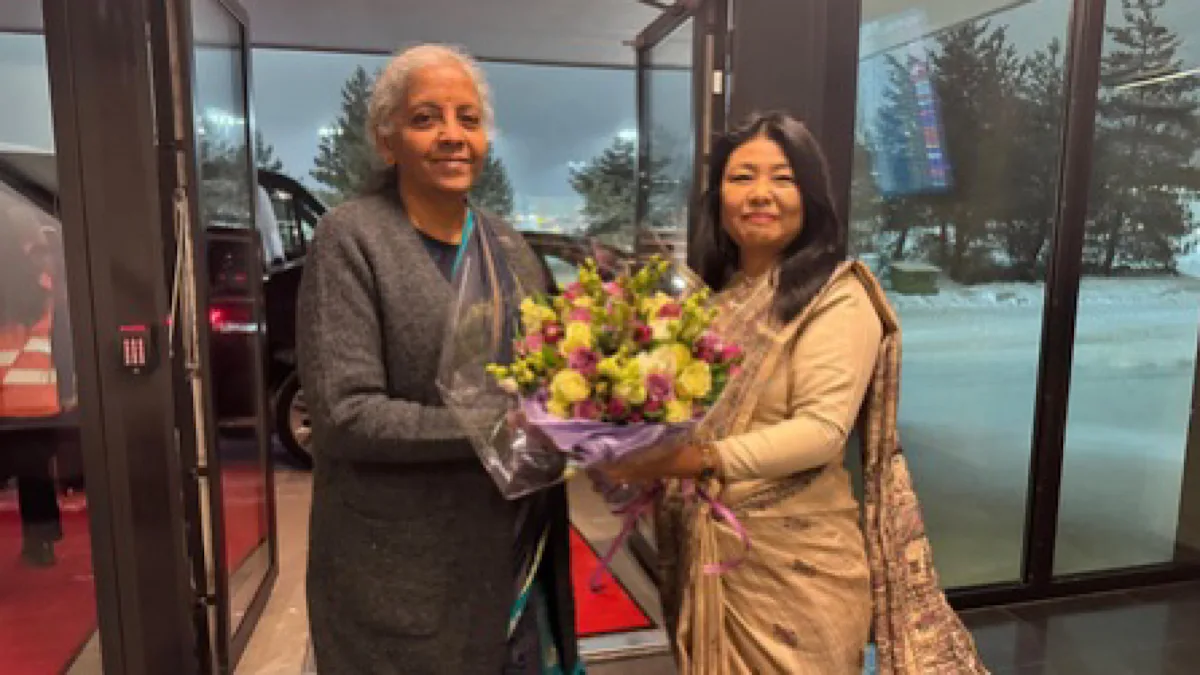
Finance Minister Nirmala Sitharaman was set to meet Jonas Ghar Store, Prime Minister of Norway, and hold bilateral meetings with Norwegian Finance Minister Jens Stoltenberg along with Minister for Trade and Industry, Cecilie Myrseth, it was announced on Monday.

IANS | New Delhi |

Finance Minister Nirmala Sitharaman was set to meet Jonas Ghar Store, Prime Minister of Norway, and hold bilateral meetings with Norwegian Finance Minister Jens Stoltenberg along with Minister for Trade and Industry, Cecilie Myrseth, it was announced on Monday.

She will also hold a roundtable discussion with Norwegian CEO and investors and engage with the diaspora at a community event, according to a Finance Ministry post on X.

“During her two-day visit in Oslo, the Union Finance Minister will call on Jonas Ghar Store, the Prime Minister of Norway; hold bilateral meetings with Norwegian Finance Minister Jens Stoltenberg and Minister for Trade and Industry Cecilie Myrseth, besides engagements at the Oslo Science Park where she will interact with start-ups,” the ministry informed.

Earlier, FM Sitharaman met top leaders and industrialists during her visit to Germany and discussed bilateral trade relations in the backdrop of the EU-India FTA deal.

She met Keith Svendsen, Chief Executive Officer of APM Terminals, in Munich. Svendsen spoke about the positive and long-standing relationship of Maersk with India and mentioned key investments and partnerships with India across its maritime ecosystem.

He also conveyed the intention to continue expanding this association across India, said the ministry.

Svendsen also appreciated India reform initiatives over the years, especially, deregulation and ease of doing business, and also mentioned about the key announcements made during the recent Budget including the one related to container manufacturing.

The two also discussed the advantages of the recently concluded India EU-FTA, with regard to opening up Indian and European markets and potential benefits for businesses on both sides in the future.

Finance Minister met Lars Klingbeil, Vice Chancellor and Federal Minister of Finance, Germany and discussed the meeting between Prime Minister Narendra Modi and Federal Chancellor Friedrich Merz in India in January this year that strengthened bilateral relations, particularly in defence, trade, and technology.

Klingbeil, in the meeting with Sitharaman, called the Free Trade Agreement (FTA) a big step for trade and investments in India, and especially focused on the bilateral development cooperation and also the Metro rail expansion in India, according to the X post by Finance Ministry.

She apprised Klingbeil about the success of India’s Digital Payment systems and willingness to share the best practices on India’s digital stack with Germany.

Sitharaman also met Brigitte Haas, Prime Minister of Liechtenstein, and Alois Philipp Maria, Hereditary Prince Alois of Liechtenstein, in Munich.

‘India playing key role in shaping future of AI,’ say top tech leaders ahead of AI-India Impact Summit

The India AI Impact Summit is to commence from today and the world’s top tech leaders will be in attendance.

ANI | New Delhi |

The India AI Impact Summit is to commence from today and the world’s top tech leaders will be in attendance. The summit will be the first global AI summit to be hosted in the Global South. It will bring together global leaders, policymakers, technology companies, innovators, and experts to showcase and deliberate on the transformative potential of AI across governance, innovation, and sustainable development.

Executive Vice President Nvidia Jay Puri, who is part of the Summit believes that the world is witnessing the start of a new industrial era shaped by AI.

“It’s incredibly exciting to be traveling to New Delhi for the AI summit at such a defining moment for our industry. The energy, ambition and pace of innovation we are seeing are extraordinary. We are at the beginning of a new industrial era, one that will be shaped by AI. The future of AI will be global, but it will also be deeply local. And it’s inspiring to see India playing such a key role in shaping that future. With one of the world’s largest developer ecosystems, a thriving startup landscape and extraordinary digital ambition, India has the scale and talent to lead in this era. We are here to collaborate with the government, industry, startups and academia to help build and scale AI that drives real economic growth and meaningful societal impact,” Jay Puri said in a video posted by the Indian Embassy in the US.

Jeetu Patel, President & Chief Product Officer at Cisco is looking forwar to see the role India plays in the development of this sector.
“I am delighted to be attending the AI Impact Summit in India and am looking forward to the role India plays in this movement of AI,” he said.

The AI Impact Summit is starting today and will run upto February 20 at Bharat Mandapam, New Delhi, marking the first global AI summit to be hosted in the Global South. Designed as a five-day programme covering policy, research, industry, and public engagement, the Summit is expected to bring together global leaders, policymakers, technology companies, innovators, and experts to deliberate on AI’s role in governance, innovation, and sustainable development.

Prime Minister Narendra Modi is set to inaugurate the Global AI Impact Expo later in the day. The India AI Impact Expo, spanning over 70,000 square metres, is expected to feature more than 300 exhibitors from 30 countries across 10 thematic pavilions, showcasing AI’s transition from research and pilots to large-scale deployment.
Ahead of the Summit, the PM welcomed the delegates coming to India and highlighted the country’s progress in the field of science and tech–making an indelible contribution to global development.

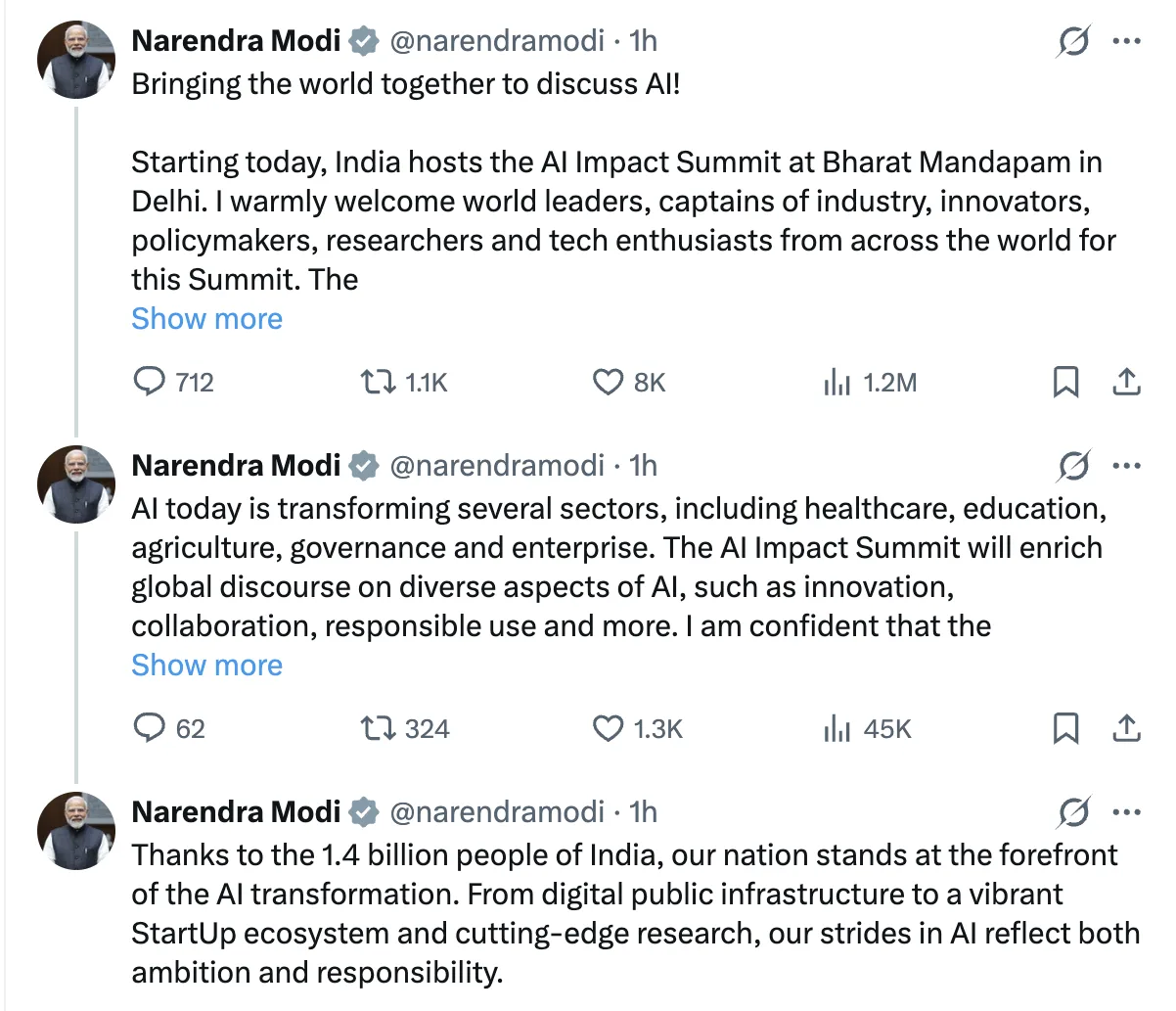
“Starting today, India hosts the AI Impact Summit at Bharat Mandapam in Delhi. I warmly welcome world leaders, captains of industry, innovators, policymakers, researchers and tech enthusiasts from across the world for this Summit. The theme of the Summit is Sarvajana Hitaya, Sarvajana Sukhaya or welfare for all, happiness for all, reflecting our shared commitment to harnessing Artificial Intelligence for human-centric progress.
“AI today is transforming several sectors, including healthcare, education, agriculture, governance and enterprise. The AI Impact Summit will enrich global discourse on diverse aspects of AI, such as innovation, collaboration, responsible use and more. I am confident that the outcomes of the Summit will help shape a future that is progressive, innovative and opportunity-driven, he further said.

The Summit builds on India’s development-focused approach to AI, aligns with the India AI Mission and Digital India Initiative, and emphasises translating global AI discussions into practical, people-centric outcomes.

‘Huge money laundering racket behind RSS’: Karnataka minister Priyank Kharge demands legal scrutiny

The Congress leader also criticised recent religious discourse and challenged calls to confer the Bharat Ratna on Veer Savarkar, sharpening the ideological clash with the RSS-BJP camp.

Statesman News Service | New Delhi |

Karnataka minister Priyank Kharge on Sunday accused the Rashtriya Swayamsevak Sangh (RSS) of financial irregularities, questioned the source of its funds and demanded that the organisation be brought under constitutional and legal scrutiny.

Speaking in Bengaluru during at a book release event, the Congress leader alleged that money collected by the RSS and its affiliated bodies from within India and abroad could point to a “huge money laundering racket.”

Kharge’s remarks come amid renewed political exchanges between the Congress and the RSS-BJP leadership over issues ranging from religious discourse to the demand for Bharat Ratna for Veer Savarkar.

Kharge questions RSS funding and ‘Guru Dakshina’ explanation

Addressing the gathering, Kharge claimed: “Around 2500 affiliated organisations are associated with the RSS. Money is being collected from many countries, including America and England. Considering this, it can be said that there is a huge money laundering racket behind the RSS.”

He also took aim at what he described as vague explanations about the organisation’s funding model. “If we ask about the source of RSS money, they tell us that we will get Guru Dakshina. However, when I did some research, according to them, Guru Dakshina means ‘flag’. So, tomorrow morning, if I also hoist the blue flag and collect money, I will ask the government and them (RSS) whether they will agree,” Kharge said.

Stating that he would continue to press the issue, he added, “From now on, I will not give up until this RSS organisation is registered under the Constitution and the law.”

Remarks on Ramayana discourse and Mohan Bhagwat

Kharge also criticised what he described as the political use of religious narratives. Referring to recent interpretations of the Ramayana, he said, “Ramayana, written by Valmiki, is different; what is happening now is different. Politicians and religious leaders are talking about religion as they wish. No religion incites violence.”

Taking a swipe at RSS chief Mohan Bhagwat, Kharge said, “RSS chief Mohan Bhagwat, who says that one should have three children, is not getting married. However, he talks about raising other people’s children.”

He further alleged that the BJP was making contradictory statements and claimed that such politics was affecting the poor.

Savarkar and the Bharat Ratna row

Separately, Kharge criticised calls to confer the Bharat Ratna on Veer Savarkar. In a post on X, he raised questions about Savarkar’s role during the freedom struggle and asked why someone who, according to him, “worked against Bharat” should receive the country’s highest civilian honour.

His comments were in response to remarks made by RSS chief Mohan Bhagwat on February 8 during a two-day lecture series titled ‘100 Years of Sangh Journey – New Horizons’.

Donald Trump signals support for Israeli action if diplomacy with Iran breaks down: Report

With Geneva negotiations just a day away, Washington is weighing both diplomatic engagement and contingency planning, as regional states signal reluctance to support any escalation.

Statesman News Service | New Delhi |

US President Donald Trump told Israeli Prime Minister Benjamin Netanyahu in December that he would back Israeli strikes on Iran’s ballistic missile programme if talks between Washington and Tehran fail, according to a US media report. The conversation reportedly took place at Trump’s Mar-a-Lago residence in Florida, even as diplomatic efforts with Iran were being revived.

The disclosure lands at a sensitive moment. A second round of US-Iran nuclear talks is scheduled in Geneva on Tuesday, following what both sides described as a cautious but inconclusive opening round in Oman earlier this month. Trump’s reported stance suggests that while diplomacy is underway, the military option remains on the table.

Military contingency reportedly discussed behind the scenes

A CBS News report, cited by IANS, said Trump conveyed to Netanyahu that he would back Israeli military action targeting Iran’s missile infrastructure if talks break down.

The report also said US military and intelligence officials have explored how Washington could assist Israel in such an operation. Among the possibilities discussed were aerial refuelling support for Israeli aircraft and diplomatic efforts to secure overflight clearances from regional countries, Xinhua reported, quoting the same account.

However, Saudi Arabia, Jordan and the United Arab Emirates have made it clear they would not allow their airspace to be used for attacks on Iran, or by Iran to strike elsewhere.

Neither the Pentagon nor the White House has issued public comment on the reported discussions.

Diplomacy and deterrence running in parallel

Even as the report surfaced, US Secretary of State Marco Rubio said during a visit to Slovakia on Sunday that he preferred resolving tensions with Iran through diplomatic channels.

The next round of negotiations is due on Tuesday in Geneva. Rubio confirmed that US envoy Steve Witkoff and Trump’s son-in-law Jared Kushner will represent Washington.

The talks follow an initial meeting in Muscat, Oman, on February 6. While both sides described that exchange as a “good start”, it produced no visible breakthrough.

Iran prepares delegation for Geneva

Iranian Foreign Minister Seyed Abbas Araghchi travelled to Geneva on Sunday to lead what Tehran described as a “diplomatic and specialised” delegation.

According to a Foreign Ministry statement, Araghchi is expected to meet Swiss Foreign Minister Ignazio Cassis, Omani Foreign Minister Sayyid Badr bin Hamad Al Busaidi and Director General of the International Atomic Energy Agency Rafael Grossi.

Officials on both sides have outlined differing expectations from any potential agreement, underscoring the fragile footing of the renewed talks.

For now, the diplomatic track continues. But the reported exchange between Trump and Netanyahu indicates that contingency planning is not far from the conversation.

North-East looks forward to stable, friendly Bangladesh under BNP rule

As the detailed preparations for the much-awaited general election in Bangladesh fructified without any untoward ado last Thursday, and the results the next day showed the Bangladesh Nationalist Party (BNP, led by Tarique Rahman) had established a landslide victory, the people of North-East India now expect a stable, progressive and friendly regime in Dhaka.

NAVA THAKURIA | Kolkata |

As the detailed preparations for the much-awaited general election in Bangladesh fructified without any untoward ado last Thursday, and the results the next day showed the Bangladesh Nationalist Party (BNP, led by Tarique Rahman) had established a landslide victory, the people of North-East India now expect a stable, progressive and friendly regime in Dhaka. One of the oldest political parties in the South Asian nation, the BNP won over 200 constituencies in the 300-member national parliament (Jatiya Sansad), whereas its nearest rival, the Jamaat-e-Islami Bangladesh and allies, secured 77 seats.

The country’s pioneer political party, the ousted Awami League, was out of the race after 15 years of continuous rule, as its activities were banned by the interim government following its chairperson and former premier Sheikh Hasina being forced to flee to India on 5 August, 2024. The Muslim majority country of 170 million people was ruled by Nobel laureate Dr Muhammad Yunus from 8 August. The 13th Jatiya Sansad polls, conducted amid tight security and improved technological monitoring, witnessed a voter turnout of around 60% (out of a 127.7-million electorate).

The polling was largely peaceful, with registered voters exercising their franchise in overall trouble-free conditions, contrary to previous polling, which were controversial owing to very low voter turnouts. Nearly 2,000 candidates belonging to 51 political parties as well as independent contestants were in the fray. For the first time in 35 years, no one was killed in election-related violence on polling day, though seven persons died around polling centres across the country because of natural causes. One polling officer collapsed while on duty in Brahmanbaria, a former BNP leader in Khulna and five voters died due to illness in Dhaka, Chittagong, Gaibandha, Kishoreganj and Manikganj.

One can remember that the BNP ruled Bangladesh along with then ally Jamaat (during 2001 to 2006 under the leadership of Begum Khaleda Zia), when separatist militants of North-East states enjoyed almost a free run there. During Sheikh Hasina’s long tenure (began in 2009 and continued till 2024), these armed groups faced a serious crisis, as she took personal interest in curbing their activities across Bangladesh. A good number of militant leaders were deported to India, where they later joined in peace talks with New Delhi. The neighbouring country became unsafe for the militants, mainly belonging to the United Liberation Front of Assam.

It is hoped that Tarique Rahman’s leadership may not encourage anti-India rhetoric in Bangladesh. But the increasing space for Jamaat representatives in the Jatiya Sansad may haunt the north-eastern region. The issue came alive before the elections, as some Bangladeshi youth leaders proposed to offer shelter to north-eastern militants and even separated the region from the rest of India. The outburst was strongly rejected and countered by Assam Chief Minister Himanta Biswa Sarma, who commented that India would not remain silent if those leaders continue threatening to destabilise and sever the region from the mainland.

Terming it a bad mindset, Sarma asserted that they should not even think of cutting the Siliguri Corridor (popularly known as the Chicken’s Neck) to indulge in their hyper anti-India sentiments. The hardliner saffron leader reminded Bangladesh about their own vulnerable chickens’ necks (80-kilometer line from Dakhin Dinajpur in West Bengal to Garo Hills in Meghalaya, and a 28-km stretch from south Tripura to the Bay of Bengal) before threatening India. However, the emergence of BNP as the winning party in the election was promptly lauded by Prime Minister Narendra Modi.

In fact, he became the first global leader to congratulate Tarique Rahman for decisive victories in the much-watched electoral exercise. Dialing the premier-elect of Bangladesh, which shares over 4,050 km of international border with India, PM Modi expressed willingness to work with him to strengthen multifaceted relations between the two neighbours. He reiterated that India will continue to support a democratic, progressive and inclusive Bangladesh, which was responded to quickly by the BNP leadership in Dhaka. New Delhi had earlier sent foreign minister S. Jaishankar to carry condolence messages to Tarique Rahman on his mother Begum Zia’s demise at the age of 80, on 30 December.

But hours before, ousted premier Hasina slammed the Bangladesh election as a well-planned farce, even demanding the resignation of Dr Yunus as the head of the caretaker government. From her temporary shelter somewhere near Delhi, Sheikh Hasina also alleged that abnormal increases in the number of voters raise serious questions about the authenticity of polls. The ‘iron lady’ even demanded the cancellation of Bangladesh’s “illegal and unconstitutional election”. Contrary to the latest initiative of New Delhi (to send a timely congratulatory message to the BNP chief), India avoided sending any election observer, even though Dhaka had sought it, sending an invitation to Delhi. However, over 400 global observers were present on voting day in Bangladesh.

When Bangladesh was born in 1971, the people of eastern India also supported the cause of offering shelter to thousands of Muktijodhas (freedom fighters), but many of them did not return to their homeland. Those East Pakistani nationals (numbering probably in hundred thousands) continue to live in the region, the majority in Assam, which has now turned into a headache, as more Bangladeshi migrants continue to arrive to change the demography. The unabated influx of these immigrants, a never-ending political issue in the region, poses a threat to the very existence of the indigenous people. The historic Assam agitation (1979 to 1985) had reflected the anxiety of Asomiya people.

A friendly government in Dhaka may now extend some negotiated ways to deal with those illegal settlers as a priority for safeguarding the interests of north-eastern indigenous communities. Moreover, they look forward to maintaining an improved relation with Bangladesh for exporting items like coal, limestone, stone chips, and bamboo products, with imports of commodities including cement, plastic goods, garments, processed food and beverages. An improved connectivity through road, rail and river routes crossing Bangladesh to the rest of India is also expected with a favourable government in Dhaka. Potential tourism revenues from Bangladeshi nationals and the use of Chittagong port as well as Sylhet airport are also expected to give dividends to the landlocked regions of the north-east.

(THE WRITER IS A GUWAHATI-BASED SPECIAL REPRESENTATIVE OF THE STATESMAN)

Dibrugarh Literary Festival a melting pot for North-East’s literary talent

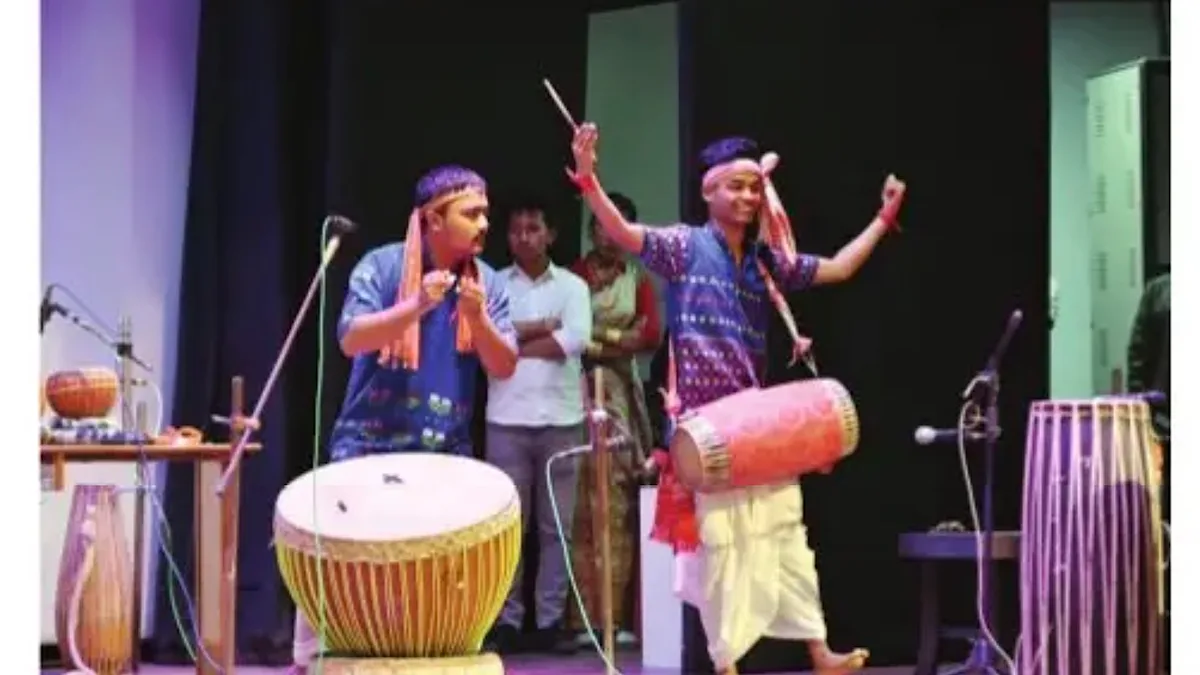
Dibrugarh, considered the second capital of Assam, will be buzzing with activity as the Dibrugarh University housed there will host the Dibrugarh University International Literature Festival (DUILF) from February 18-21.
ASHOK CHATTERJEE | Kolkata |

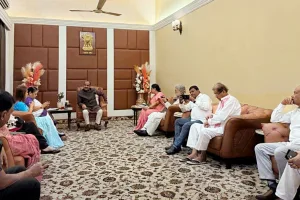
Dibrugarh, considered the second capital of Assam, will be buzzing with activity as the Dibrugarh University housed there will host the Dibrugarh University International Literature Festival (DUILF) from February 18-21. The four-day festival will focus on the Middle East and North Africa (MENA) nations this year while bringing global literary conversations to northeast India. The DUILF 2026 will feature over 150 writers from 25 countries, who will participate in 52 sessions.

It will explore literary themes besides discussions on an eclectic range of issues from the world of business, music, films, sports, politics and history through panel discussions, book readings and launches, poetry sessions and the chance for visitors to interact and engage with the authors. The literature festival’s chief coordinator Rahul Jain, who is also associated with the Brahmaputra literature festival and Guwahati international film festival as artistic director, believes that the festival in its third year has brought about a particular sensitisation in urban areas on DUILF. Rahul says he wanted to do the festival away from Guwahati, at a public university, as students from the rural areas are deprived of such an exposure. “We see that the same set of students are coming over again and again, which proves DUILF’s popularity.

We see long-term. The students, who attend, will become part of the civil society in the years to come and they will take this festival forward,” said Rahul. The trustees of the lit fest chose Dibrugarh University, a 60-year-old public university, because of its stellar record and location, which is surrounded by rural (gramyanchal) and mofussil areas. The festival aims to bring in students from these generally deprived rural areas, covering their transport, food, and stay to expose them to the best authors and writers. The festival actively involves students from outside the host institution, specifically from the 177 affiliated colleges under Dibrugarh University, and also from neighbouring states like Nagaland, Meghalaya, and Arunachal.

Rahul explained that they bring a selected number of students (200-500 daily) from these areas and provide them with accommodation. The festival features topics like sports literature, military history, and films, catering to the university’s 30 odd departments and 17 odd centres. Even the professors are involved, with the event included in the academic calendar, and the approach allows students from all departments, such as physics or political science, to find relevant panels. “This event provides a crucial opportunity for students, many of whom have not been exposed to these cultures, to network and build lifetime relationships by interacting with authors, poets, and high-profile guests like former Indian foreign secretaries or sportspersons,” said the chief coordinator of the festival.

The non-profit has found a sustainable model to fund the festival. It has decentralised funding and relies on contributions from the university, stakeholders, local companies, who have begun “owning” the festival because of its location in Dibrugarh to serve rural areas. The event gives free access to students and other interested parties. Even the students are invested in the festival. Aftara Sultana, a student of English literature, who now also is a research scholar and guest lecturer, said she has been involved with the festival since its inception in 2024. Initially, she served as a repertor and comparer, and attended sessions as a student. She highly values the festival because it “bridges the gap between the authors and the readers,” allowing students to directly connect with authors whose works they are studying.

She said: “The festival is interdisciplinary and democratic. My friends from the economics and anthropology departments are as involved as those from English literature. Last year, there was a session with editors of journals, where I met with one of the authors whose work I was using for my thesis. Sessions with journal editors provide clarity on the publication process, which is important for research scholars like me.” Aftara said the excitement for the festival is pervasive, with even first-semester students looking forward to it based on their seniors’ accounts. She said that students from outside Assam, including a research scholar from Arunachal, whom she met last year, inquired about the next festival, indicating a welcoming atmosphere.