Logo

Tiny island is a giant political symbol

Katchatheevu never needs an invitation in Tamil Nadu politics. It turns up on its own – like that extra vada that arrives with a masala dosa.

SANTHOSH MATTHEW | New Delhi |

Katchatheevu never needs an invitation in Tamil Nadu politics. It turns up on its own – like that extra vada that arrives with a masala dosa. Small, crisp, and suddenly the centre of attention. As the state heads toward another Assembly election, Katchatheevu is back on the political plate, spicing up speeches, sharpening slogans, and stirring emotions. History has a way of returning in sharp one-liners. In Parliament, Mahavir Tyagi once challenged Jawaharlal Nehru during the Aksai Chin debate.

When Nehru dismissed the land as barren, Tyagi replied with sarcasm that still bites: if a bald head has no hair, does it mean the head has no value? Today, that logic echoes loudly in Tamil Nadu. Katchathe ev u may be a dry, uninhabited island, but its value cannot be measured in acres. Floating in the narrow stretch of the Palk Strait, this tiny island has grown into a giant political symbol. Every election season, it reappears with renewed force. This time, the language is louder, more emotional, and deeply rooted in Tamil nationalism and populist appeal. New political players have turned up the volume. Vijay and his Tamilaga Vettri Kazhagam have stepped into the field with a mix of cinema-style messaging and political ambition.

For many of his supporters, Katchatheevu represents Tamil pride – something lost, something that must be reclaimed. The issue travels fast among the youth, from public meetings to mobile screens. Then comes Seeman of the Naam Tamilar Katchi, whose politics has always revolved around Tamil identity. His speeches do not treat Katchatheevu as just a diplomatic issue. He frames it as a question of honour, turning the island into a symbol of Tamil self-respect. The message is simple and powerful, designed to connect instantly. The Pattali Makkal Katchi led by Ramadoss adds another layer. By focusing on fishermen and their struggles, the party brings the issue down from high politics to everyday life. Here, Katchatheevu is not about maps or treaties – it is about survival.

National politics also enters the scene. Narendra Modi often speaks of a kind of “dharma diplomacy,” a balancing act rooted in civilisational values and practical strategy. In relations with Sri Lanka, this means keeping peace while addressing concerns at home. In Tamil Nadu’s election language, this idea is reshaped into a moral duty -protect Tamil fishermen, defend their rights, and do so without disturbing regional stability. Dharma becomes both a principle and a political tool. On the coast, the issue feels far more re al. Fishermen from Rameswaram, Nagapattinam, Cuddalore, and Karaikal have lived with this problem for years. For them, the sea has no visible borders. Crossing an invisible line can mean arrest, confiscation of boats, or months in a foreign jail. What was once routine fishing has become a risky gamble.

Amid all this, the island carries a quiet spiritual pull. The St. Antony’s Shrine, dedicated to Saint Anthony of Padua, draws devotees from both India and Sri Lanka. For a brief moment every year, faith softens borders. Boats arrive not with nets, but with prayers. It is a reminder that Katchatheevu is not only about politics – it is also about shared culture. The roots of the dispute go back to the 1974 agreement between Indira Gandhi and Sirimavo Bandaranaike, which placed the island under Sri Lankan control. That decision continues to fuel debates, accusations, and promises of reversal, even as international agreements make any change complicated. In election season, complexity rarely sells. Simplicity does. Katchatheevu becomes a story that fits easily into speeches – a lost island, struggling fishermen, a promise of justice. It is emotional, visual, and easy to understand. That is why it returns again and again.

As campaigning intensifies, the island will travel everywhere – from loudspeakers in village squares to trending clips online. It will shape conversations in tea shops and television studios alike. Voters will hear it, argue about it, and carry it with them to the polling booth. After the votes are counted, Katchatheevu will fade from daily headlines. It always does. It will wait quietly in the waters of the Palk Strait, ready to return when the next election calls. In Tamil Nadu’s politics, some issues come and go. Katchatheevu stays. Small in size, powerful in emotion, and always ready to appear unannounced – like that extra vada that no one asked for, but everyone ends up talking about.

(The writer is Professor, Centre For South Asian Studies, Pondicherry Central University.)
‘No radicals, no moderates’: Tehran fires back at Trump’s ‘infighting’ claim with one voice

Iran’s leadership has pushed back sharply against US President Donald Trump’s claim of internal infighting, with multiple senior figures issuing coordinated statements asserting unity behind the Supreme Leader.

Statesman News Service | New Delhi |

After Donald Trump claimed that Iran’s political and military establishment was divided, Tehran responded with a single, repeated message.

From the Supreme Leader to the President and Parliament Speaker, the language was nearly identical.

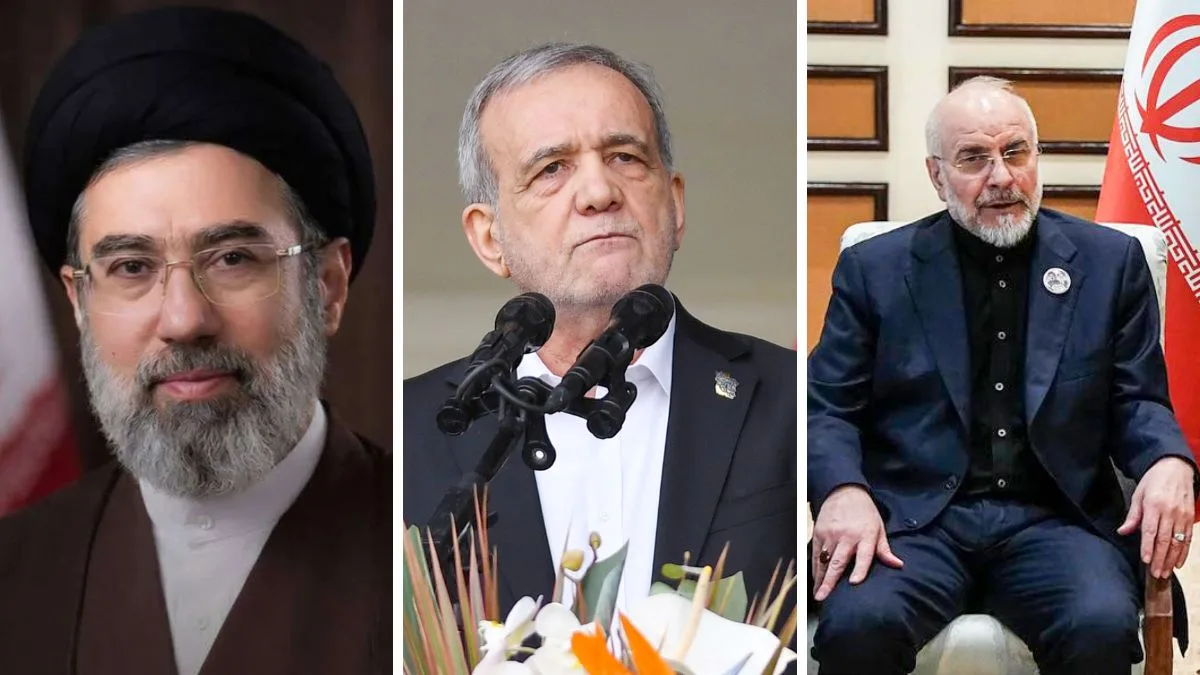
“In Iran, there are no radicals or moderates,” President Masoud Pezeshkian said, insisting the country stands united as “revolutionaries” under the Supreme Leader.

“In Iran, there are no radicals or moderates; we are all “Iranian” and “revolutionary,” and with the iron unity of the nation and government, with complete obedience to the Supreme Leader of the Revolution, we will make the aggressor criminal regret his actions,” read his post on X.

Unity as message, not just sentiment

Iran’s Parliament Speaker Mohammad Bagher Ghalibaf echoed the same line, stressing “iron unity” between the people and the government, while warning that any aggressor would “regret his actions.”

“At the top, Supreme Leader Ayatollah Seyyed Mojtaba Hosseini Khamenei framed unity as a strategic advantage.

“Due to the strange unity created among compatriots, a fracture has occurred in the enemy,” he said.

The repetition is not accidental. Analysts say the coordinated messaging reflects a deliberate attempt to project stability at a time of pressure.

The messaging was not limited to top leadership.

Iranian government officials said the posts were part of a coordinated response to what they described as “provocative and unfounded” claims from Washington.

In a statement shared on X, the government said leaders across branches, including First Vice President Mohammad Reza Aref, Government Information Council chief Elias Hazrati, and Agriculture Minister Gholamreza Nouri, amplified the same message to present a unified front.

They stressed that labels such as “hardliner” and “moderate” “do not reflect the reality on the ground.”

The government also shared an image of President Pezeshkian, Speaker Ghalibaf and Judiciary chief Gholam-Hossein Mohseni-Ejei, signalling alignment across Iran’s key power centres.

Trump’s claim vs Tehran’s counter

Trump had earlier suggested that Iran was struggling with internal divisions, describing “infighting” between factions and confusion over leadership.

But the response from Tehran has been swift and synchronised, rejecting that narrative entirely.

His remarks also fed into earlier claims that divisions within Iran had prompted calls to delay military action, including requests from international stakeholders for more time for Tehran to present a unified proposal.

Power structure under scrutiny

The pushback also comes as attention turns to how Iran’s system operates under stress.

Beyond elected leaders, institutions like the Islamic Revolutionary Guard Corps (IRGC) hold significant influence, with a role that extends beyond defence to safeguarding the political structure.

Experts note that Iran’s power system is layered with parallel military structures, multiple intelligence networks and overlapping command lines, often described as complex and opaque.

Some analysts suggest that officials engaged in negotiations with the US are closely aligned with the IRGC, reinforcing institutional cohesion during crises.

A war of perception as much as power

The exchange underlines a deeper layer of the conflict.

Beyond strikes, sanctions and blockades, both sides are shaping competing narratives. Washington portrays a weakened, divided Iran. Tehran projects resilience, unity and control.

In that sense, the messaging itself has become part of the battlefield.

Mapping change in India’s villages

On 24 April 2026 , India completes five years of the SVAMITVA (Survey of Villages and Mapping with Improvised Technology in Village Areas) Scheme – an initiative that has quietly but decisively transformed the foundations of rural governance.

TUHIN A. SINHA | New Delhi |

On 24 April 2026 , India completes five years of the SVAMITVA (Survey of Villages and Mapping with Improvised Technology in Village Areas) Scheme – an initiative that has quietly but decisively transformed the foundations of rural governance. What began in 2020 as a drone-based mapping exercise has evolved into one of the most far-reaching structural reforms in independent India, addressing a problem that persisted for decades: the absence of clear, legal ownership of residential property in rural areas.

For generations, millions of Indians lived in homes that were theirs in practice but not in law. These properties existed outside formal documentation, leaving rural households without legally recognized assets. This gap was not merely administrative – it constrained access to credit, fuelled disputes, and limited economic mobility. SVAMITVA has fundamentally altered this reality. By leveraging drone surveys and geospatial mapping, the scheme has brought clarity, legality, and dignity to rural property ownership. Over 3.28 lakh villages have been surveyed, and more than 3 crore property cards have been prepared across nearly two lakh villages as of early 2026.

In effect, India has mapped almost its entire rural habitation area with a level of precision that would have been inconceivable just a decade ago. This is the formal recognition of one of India’s largest unrecorded asset bases. The most immediate impact of SVAMITVA has been in financial inclusion. With legally recognized property cards, rural households can now use their homes as collateral to access institutional credit – an opportunity that was historically unavailable to many. Early assessments indicate a marked rise in rural credit flows following the rollout of SVAMITVA, signalling a structural shift in the rural economy. What was once “dead capital” has now been converted into bankable assets.

This transformation carries particular significance for women, who are often co-owners of these properties and are now better positioned to access formal financial systems and assert economic agency. SVAMITVA is not merely a land records programme – it is a template for technology-driven governance. Drone -based surveys provide high-resolution, accurate data, while GIS-enabled platforms ensure that records are transparent, accessible, and tamper-resistant. This shift from paper-based ambiguity to digital precision is already reducing property disputes, long a source of friction in rural India. At the same time, Gram Panchayats are gaining the ability to assess property taxes more effectively, strengthening local governance and financial autonomy.

The scheme is also enabling scientific village-level planning, with reliable geospatial data forming the backbone of decision-making. SVAMITVA is part of a broader push by the Modi government to integrate drone technology into governance and development. Initiatives such as the Drone Rules liberalisation, the Production-Linked Incentive (PLI) scheme for drones, and the “Drone Didi” programme aimed at empowering rural women are collectively building a new technological ecosystem. Drones are now being deployed for agricultural spraying, infrastructure monitoring, disaster management, and land surveys – marking a shift toward real-time, data-driven governance.

SVAMITVA, in this context, is the flagship that demonstrates how cutting-edge technology can directly improve everyday lives in rural India. The success of SVAMITVA is most visible in states that have embraced it with administrative clarity and political will. Uttar Pradesh stands out for its scale, having completed surveys in over 90,000 villages and generated more than one crore property records, while also moving towards providing legal sanctity to these documents. Madhya Pradesh and Chhattisgarh have achieved near-complete coverage, showcasing the power of efficient implementation. States such as Har yana , Uttarakhand, Goa, and Tripura have reached saturation, effectively completing the rollout of the scheme.

In Andhra Pradesh, the initiative has gone beyond mapping to resolving long-pending disputes and improving local taxation systems. These examples illustrate that while SVAMITVA provides a national framework, its success is amplified by proactive state-level execution. One of the defining strengths of SVAMITVA is its foundation in cooperative federalism. With the overwhelming majority of states and union territories participating, the scheme reflects a rare alignment between the Centre and the states on a governance reform of national importance. At the same time, the design allows flexibility. States can adapt implementation strategies based on their administrative contexts and existing land record systems.

This balance between a unified national vision and decentralized execution has been critical in ensuring both scale and effectiveness. The long-term significance of SVAMITVA lies in the ecosystem it is creating. By b uilding a comprehensive digital database of rural property ownership, the scheme is laying the foundation for a unified land information system that can integrate with banking, taxation, and planning frameworks. It is also catalysing India’s drone ecosystem, generating new skills, employment opportunities, and technological capabilities. With discussions already underway about extending similar models to urban areas, SVAMITVA could well become the template for a nationwide transformation of property governance. Five years on, SVAMITVA stands out as a reform that is both quiet and transformative.

It does not command daily headlines, yet its impact is deeply structural. It has given millions of rural Indians legal ownership of their homes, unlocked economic potential, reduced disputes, and strengthened grassroots governance. In the broader arc of India’s development journey, SVAMITVA may well be remembered as the reform that bridged the divide between informality and formalization in rural India. It is a reminder that the most enduring transformations are often those that operate beneath the surface – mapping change, quite literally, from the ground up.

(The writer is a national spokesperson of BJP and an acclaimed author.)
Fractured Union

For decades, India’s political system rested on a quiet understanding

Statesman News Service | New Delhi |

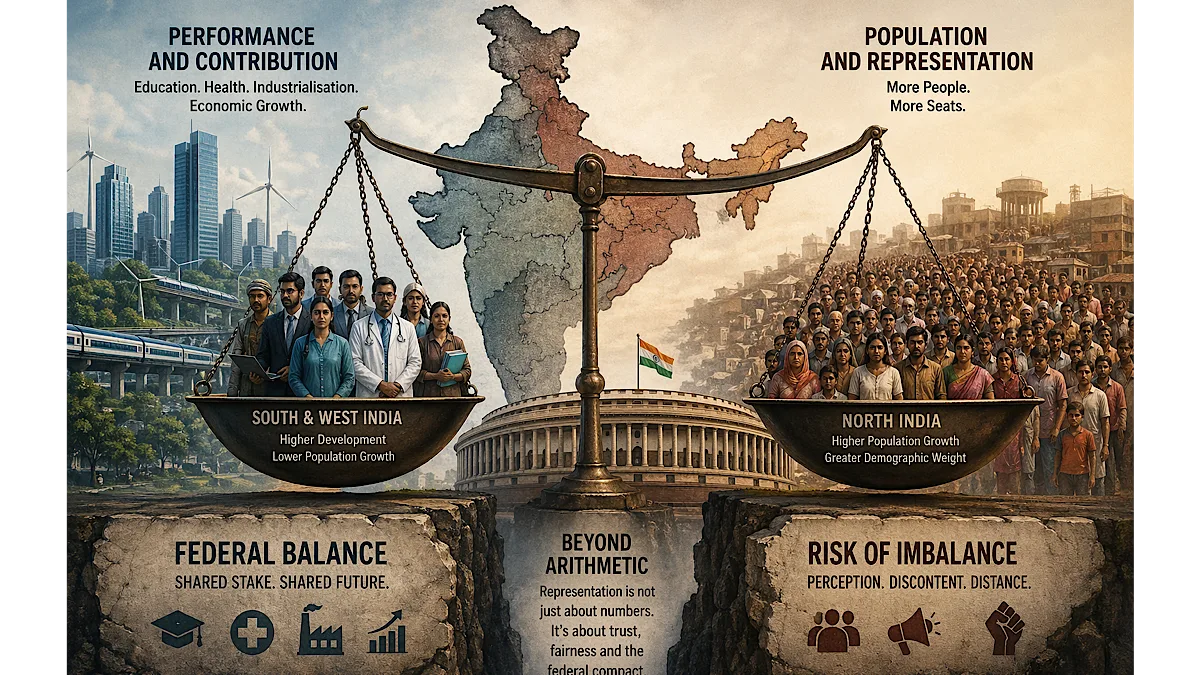
For decades, India’s political system rested on a quiet understanding. Representation would not be allowed to track population changes too closely, and states that invested in education, health, and family planning would not be penalised with diminished political voice. It was never formally articulated as a grand bargain, but it functioned as one, a stabilising compact within a diverse federal union. That equilibrium now appears to be under strain.

The renewed push to revisit delimitation, combined with the eventual expiry of the long-standing freeze on seat reallocation, signals a shift toward a more literal interpretation of representation: population as the primary determinant of political weight. On the surface, this aligns with democratic logic. In practice, it risks unsettling the balance that has held together regions with vastly different demographic and economic trajectories. India’s growth has not been uniform. Southern and western states have generally moved faster on industrialisation, human capital, and income growth, while population expansion has been more pronounced in parts of the north.

This has created a structural divergence: the engines of economic output are not always the regions with the fastest demographic expansion. When representation begins to reflect the population more directly, that divergence acquires political consequences. A shift in parliamentary weight toward more populous states may be democratically defensible, but it raises a harder question: how do you sustain a federal system when the regions driving economic growth feel their voice shrinking? In a country where fiscal transfers, national policy priorities, and regulatory frameworks are shaped centrally, perceptions of underrepresentation can translate into deeper political unease. This is not merely a contest over seats.

It is a question of incentives. Federal systems depend on a sense of shared stake. States that contribute disproportionately to national output must also feel that they have a meaningful role in shaping national decisions. If that perception weakens, cooperation can give way to negotiation, and negotiation can harden into resistance. The risk is not immediate rupture, but a gradual erosion of trust between regions. In this context, the design of representation becomes more than a technical exercise. It becomes a test of whether India can reconcile democratic principles with federal balance.

None of this suggests that delimitation should be avoided indefinitely. A system frozen in time cannot remain legitimate forever. But moving toward a new framework requires more than arithmetic adjustments. It demands a broader political consensus on how to balance population, performance, and participation within a single constitutional structure. India’s federal compact has endured because it accommodated differences without creating divisions. As that compact is revisited, the central question is simply who gains more seats, but whether the underlying sense of fairness that binds the union can be preserved. A federation is sustained not just by rules, but by the willingness of its constituent parts to accept them. When that willingness begins to fray, the consequences extend far beyond the allocation of seats in Parliament.

‘It’ll open when they make a deal’: Trump seals Hormuz, Iran seizes ships and global oil hangs in balance

US President Donald Trump has said Washington will keep the Strait of Hormuz effectively shut as leverage against Iran, signalling that the vital oil route will reopen only when a deal is reached.

Statesman News Service | Mumbai |

The Strait of Hormuz, the narrow passage through which a significant share of the world’s oil moves, has become the centrepiece of the US-Iran standoff. It is not just a flashpoint, but a pressure tool.

Speaking at the White House, Trump made it clear the closure is deliberate. He also added that reopening the route now would allow Iran to earn “$500 million a day”, something he is unwilling to permit.

“They would have opened it up 3 days ago. They came to us, and they said, ‘We will agree to open the Strait.’ All my people were happy except me. I said, ‘One minute, if we open the Strait, that means they are going to make $500 million a day.’ I don’t want them to make $500 million a day until they settle this thing. So I am the one that kept it closed. We have total control of it. It will open when they make a deal or something else happens that is very positive,” he said.

Trump also claimed that the blockade in place is “airtight”, suggesting that movement through the route is tightly controlled as part of a broader strategy to weaken Iran’s position.

Oil flows shift as pressure builds

With tensions rising in the Gulf, Trump said several ships are now heading towards the United States instead of passing through the Strait of Hormuz.

He added that the US is producing more oil than ever and is not facing a supply crunch, even as the situation continues to disrupt traditional energy routes.

” … We have this unbelievable economy… I called JD, Marco, Howard and Scott and told them that I hate to tell you, but we have to do a little bit of a detour. We have to go to Iran and make sure that they are out of nuclear weapons… A lot of ships are coming to the United States, and they are using the United States instead of the Hormuz Strait… We don’t have an oil shortage… We are right now producing more oil than Saudi Arabia and Russia combined… We are taking in millions of barrels of oil from Venezuela,” he said.

The Strait of Hormuz links oil producers in the Gulf to global markets, and any disruption has immediate ripple effects on prices and supply chains.

Iran counters with control, tolls and warnings

Even as Washington asserts control, Tehran is signalling that it too holds leverage over the waterway.

Iran’s central bank confirmed that revenue from newly introduced transit fees for vessels passing through the Strait has already been deposited, dismissing speculation that payments were being made in cryptocurrency.

Deputy Parliament Speaker Hamidreza Hajibabaee said all ships using the route must pay tolls in Iranian rials, calling it a rightful charge for passage through Iran’s territorial waters.

He also said two vessels had been seized for violations, warning that more could follow if needed.

The message from Tehran is equally clear. The Strait is not just a route, but a point of control.

Competing claims, one choke point

Both sides are now framing the Strait of Hormuz as a symbol of dominance.

Trump has insisted that no ship can move without US approval, while Iranian officials have stressed that all tanker lanes fall within Iran’s territorial reach.

But the competing claims reveal the deeper reality of the conflict. Control over energy, not just territory.

With around one-fifth of global oil and a significant portion of gas shipments passing through the route, the stakes go far beyond the immediate confrontation.

No quick resolution in sight

Trump has signalled that he is in no hurry to reopen the Strait or conclude a deal.

“I don’t want to rush it… we have plenty of time,” he said, suggesting that Iran faces increasing pressure as its oil flows remain restricted.

For now, the Strait of Hormuz remains less a shipping route and more a bargaining chip. One that could shape the next phase of the conflict.

Cultural Signal

In West Bengal’s election theatre, a fish is no longer just a fish. It has become a political instrument ~ held up, quite literally, as proof of belonging.

Statesman News Service | New Delhi |

In West Bengal’s election theatre, a fish is no longer just a fish. It has become a political instrument ~ held up, quite literally, as proof of belonging. Across constituencies, candidates are stepping into neighbourhoods with fish in hand, turning a staple of Bengali life into a campaign prop. At first glance, this may seem like a quirky local tactic.

But it reveals a deeper unease about identity, authenticity, and political intent. This symbolic contest also reflects a deeper shift in Indian politics, where every day cultural markers ~ from food to language ~ are increasingly mobilised as political currency, reshaping how electoral trust is constructed. The anxiety is not accidental. The rise of the Bharatiya Janata Party across India has often been accompanied ~ rightly or wrongly ~ by associations with a more prescriptive cultural framework, including attitudes toward food. In a state where fish is not merely diet but identity, that perception creates a political vulnerability. The performative embrace of fish, then, is not about cuisine; it is about reassurance. For the ruling Trinamool Congress, led by Ms Mamata Banerjee, this vulnerability is an opportunity.

By framing the contest as a defence of Bengal’s cultural fabric ~ its fish-and-rice civilisation ~ it shifts the electoral conversation away from governance deficits toward identity preservation. This is a terrain where emotional resonance outweighs administrative record. What emerges is a contest not of policies but of signals. One side seeks to portray itself as culturally embedded; the other warns of cultural intrusion. The fish becomes a shorthand in this exchange, instantly recognisable, emotionally loaded, and politically efficient. Yet, this symbolism also exposes a limitation in contemporary electoral politics. When campaigns rely on gestures of cultural alignment, they often sidestep harder questions. West Bengal faces structural challenges ~ industrial stagnation, employment constraints, and fiscal stress ~ that cannot be resolved through symbolic gestures. Even debates around fish production, raised by leaders like Prime Minister Narendra Modi, risk being subsumed within this symbolic contest rather than being examined as policy issues. There is also a subtle recalibration underway.

The very fact that national leaders and parties feel compelled to engage in such cultural signalling suggests an acknowledgment: electoral success in India’s regions cannot be built on uniform narratives. It requires adaptation to local identities, even if that adaptation takes theatrical forms. But theatre has its limits. Symbols can frame a contest, but they cannot sustain governance. Voters may respond to gestures of familiarity, yet their long-term choices are shaped by livelihoods, opportunities, and institutional performance. The fish, in this election, is doing heavy political lifting. It reassures, provokes, and mobilises. But it also distracts. In elevating a symbol to the centre of political discourse, the campaign risks narrowing the space for substantive debate. What this election will ultimately test is not who can hold the fish more convincingly, but whether voters are willing to look beyond it. That question may ultimately decide the verdict.

Three Doomed Bills

With voting scheduled in a week’s time in opposition-ruled West Bengal and Tamil Nadu, opposition parties questioned the timing of the special session.

DEVENDRA SAKSENA | New Delhi |

The Government introduced three Bills in a special session of the Lok Sabha convened on 16 April 2026:

(i) the Constitution (131st Amendment) Bill 2026,
(ii) the Delimitation Bill 2026, and

(iii) the Union Territories Laws (Amendment) Bill, 2026. The first two Bills aimed to increase the size of Lok Sabha to 850 (from the existing 543), sought to enable delimitation based on the 2011 census, and provided for reservation for women based on this delimitation. The Union Territories Laws Bill contained similar provisions for the Union Territories of Puducherry, Delhi, and Jammu & Kashmir.

With voting scheduled in a week’s time in opposition-ruled West Bengal and Tamil Nadu, opposition parties questioned the timing of the special session. The Government projected the Bills as having the main aim of empowerment of women, by granting them 33 per cent reservation in the Lok Sabha and State Legislative Assemblies, but reservation for women had already been enshrined by the Constitution (106th Amendment) Act 2023. The 131st Amendment Bill merely lifted the pre-condition of increase in women’s seats being dependent on the ongoing census, instead making it dependent on the 2011 Census.

It also emerged that despite the Government’s avowed intention of empowering women, the Nari Shakti Vandan Adhiniyam, or the Women’s Reservation Act of 2023, had not been notified till now; a notification was issued in the midst of the Parliamentary debate, on 16 April. The opposition rightly saw the 2026 Bill, as an attempt to amend a non-operational Act. The three Bills, taken together, carried forward the principle of Lok Sabha seats being allocated in proportion to population as determined by the 2011 census, removed the freeze on the number of MPs in the Lok Sabha, and also paved the way for constitution of a Delimitation Commission.

Determination of seats in the Lok Sabha, strictly on the basis of population was not acceptable to Opposition MPs from the South, because the population of southern States had grown much more slowly in comparison to northern States, and the South would have lost Lok Sabha seats, had population been made the sole criterion for determination of seats. The PM and Home Minister assured members that the Government proposed to increase representation of all States by a flat fifty per cent, thus preserving the inter-se proportion of seats for all States. However, this argument did not cut much ice with the Opposition, who preferred to rely on the printed word, rather than assurances.

After a long and contentious debate, the first Bill failed to garner the required two-third majority in either House, and the Parliamentary Affairs Minister, withdrew the other two. There is another school of thought which believes that the Bills were purposely brought in, with an intention to fail (Defeat by design? Why the govt pushed a bill it knew would fail, Vibha Sharma, The Statesman, 19 April 2026). According to Ms. Sharma: “The reality is that even a ‘doomed’ bill can serve purposes beyond becoming law ~ such as setting the agenda, shaping public discourse, drawing attention to key issues, and normalising policy ideas over time.”

This analysis appears correct; had the Government been honest in its intentions, then it would not have scheduled the special Parliamentary session in the midst of elections, when opposition parties could reasonably be expected take contrarian grandstanding views. Also, lacking numbers in both Houses, the ruling party could have sought consensus, by discussing provisions of the Bills with Opposition parties. The fact that PM Modi roundly castigated all opposition parties in his address to the nation on 18 April 2026 reinforces the conclusion that the three Bills were moved with a hidden agenda; should they make the cut and become law, the Government could portray itself as the champion of women and should the Bills fail, the Opposition could be painted as anti-women.

In both cases, women could be counted upon to vote, overwhelmingly, for the ruling party. Beyond what is already in the public discourse, two germane issues appear to have escaped general attention. Firstly, a fifty per cent increase in the number of MPs, followed by a fifty per cent increase in the number of MLAs, would put an unconscionable burden on the exchequer, what with the rising pay, perks, and lifelong pensions for parliamentarians. Sadly, not all our MPs are people of sterling character, according to a study by the Association for Democratic Reforms (ADR), 46 per cent of current Lok Sabha MPs have criminal cases registered against them, of whom 31 per cent face serious criminal charges like murder, kidnapping, or crimes against women.

Thus, proceeding on a negative note, more MPs could mean more such people in positions of power. Increase in the number of MPs could also mean that the daily chaos in Parliament would multiply manifold, and the Speaker would have an even tougher time to regulate proceedings. Surely, if the aim of the now defunct Bills was more debate and deliberation in Parliament, the Speaker, and more mature members, could counsel hon’ble MPs not to resort to walk outs and disruptions at the drop of a hat.

Also, Parliament could be in session for more days ~ not the 60 odd days in a year but 150 days, like its British counterpart. Significantly, none of the three Bills talked about increasing the number of MPs in the Rajya Sabha; the Bills, if passed, would have created a huge imbalance between the two Houses of Parliament; Lok Sabha with a strength of 850 would have totally dwarfed the 245-member Rajya Sabha. During joint sessions of Parliament, held in cases where a Bill is passed by one House but rejected by the other, the voice of the Rajya Sabha would have been reduced to a whisper ~ an undesirable outcome on all counts, because the Rajya Sabha is a representative of States and Union Territories, and has the Constitutional duty and power, to protect the rights of States against the Union Government.

The entire exercise could be seen as a fight for women’s votes: the Government has assiduously cultivated women for votes, be they slogans like Beti Bachao, Beti Padhao, or schemes like the Pradhan Mantri Ujjwala Yojana that provided subsidised cooking gas to households, and schemes like Pradhan Mantri Awas Yojana and Mudra Yojana, which have benefited women peripherally. However, the reality is that, so far, reservation in political posts has not benefited women; the Constitutional provision for one-third reservation for women in local bodies ~ enhanced to fifty per cent by some State Governments ~ has given birth to the disgusting institution of Pradhan Patis, husbands who officiate for their Pradhan wives. On the other hand, the number of women in the Lok Sabha has progressively increased from 5 per cent to the current 14 per cent ~ without any reservation.

There have been women leaders like Indira Gandhi, Vijayalakshmi Pandit, and Sushma Swaraj as also the current crop of firebrand MPs, like Smriti Irani, Supriya Sule, and Mohua Moitra ~ all having been elected without the benefit of reservation. Contrary to intentions, reservation of seats for women may result in wives and daughters acting as proxies for their male relatives, creating God forbid, an institution of MP-Pati. One can safely say that the three Bills brought by the Government were doomed from the beginning, because they bundled the issues of women’s reservation and delimitation ~ no political party had any issue with the former, which cannot be said about the latter.

A more honest approach would have been to separate the two issues; women’s reservation would have sailed through, and delimitation could have been postponed to a more opportune time. Finally, one should not trust politicians blindly. As Erik Pevernagie, the Belgian painter and writer, had said: “Many politicians promise green, green grass by blending niceties with delusion and by using alluring confidence tricks. They voice attractive tales and tell things people like to hear. But the post-factual grassland often appears to be parched and barren.”

(The writer is a retired Principal Chief Commissioner of Income-Tax)

US-Iran tensions: Macron calls for stability, rejects ‘blockade’ approach on Iran; IDF strikes Lebanon despite ceasefire

US President Donald Trump says the Strait of Hormuz will reopen only after Iran agrees to a deal, while Tehran rejects claims of internal rifts.

Statesman News Service | New Delhi |

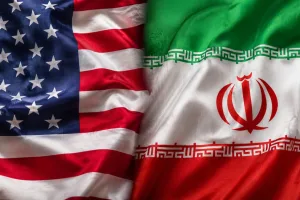
The Middle East crisis entered another tense day on Friday with the Strait of Hormuz again at the centre of the standoff between Washington and Tehran.

Trump said the US was in “total control” of the key oil route and would not rush into a deal, while Iranian leaders dismissed his claims of infighting and said the country remained united behind Supreme Leader Ayatollah Seyyed Mojtaba Hosseini Khamenei.

Middle East tensions: LIVE updates

‘Uninformed, inappropriate and in poor taste’: India on Trump’s ‘hellhole’ remarks

New Delhi said that Trump’s remarks “do not reflect the reality of the India-US relationship, which has long been based on mutual respect and shared interests.”

Statesman News Service | New Delhi |

India on Thursday slammed US President Donald Trump’s remarks over his “hellhole” remarks on Indians as “uninformed, inappropriate and in poor taste.”

In a statement shared on X, the Ministry of External Affairs (MEA) Official Spokesperson said that the Ministry has seen Trump’s remarks and the subsequent clarification issued by the US Embassy in response.

The MEA spokesperson further stated that the remarks don’t reflect the India-US relationship, which is based on mutual respect and shared interests.

“We have seen the comments, as also the subsequent statement issued by the US Embassy in response. The remarks are obviously uninformed, inappropriate and in poor taste. They certainly do not reflect the reality of the India-US relationship, which has long been based on mutual respect and shared interests,” the statement read.

What Trump said about India?

US President Trump had apparently endorsed American radio host Michael Savage’s racist rant and reposted his letter on Truth Social, which referred to India, China, and other nations as “hellholes”.

“A baby here becomes an instant citizen, and then they bring the entire family in from China or India or some other hellhole on the planet. You don’t have to go too far to see that. English is not spoken here anymore. There is almost no loyalty to this country amongst the immigrant class coming in today, which was not always the case,” read the letter shared by the US President.

As the remarks triggered outrage in India, Trump issued a clarification over his “hellhole” remark on India. In a statement issued by the US Embassy in New Delhi, Trump said that India is a “great country” and called Prime Minister Narendra Modi a “very good friend”.

“The President has said, ‘India is a great country with a very good friend of mine at the top’,” a US Embassy spokesperson said.

Women voters outnumber men in first phase of Bengal elections: ECI

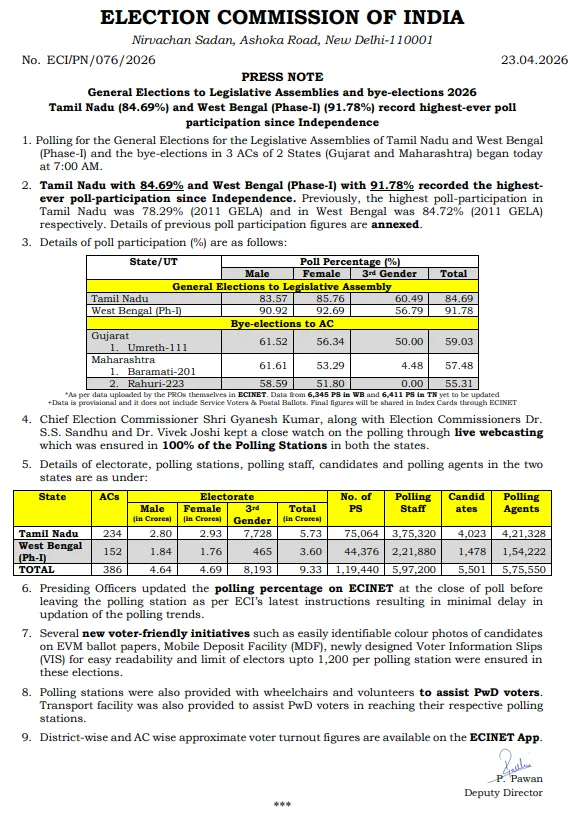
Women voters in West Bengal outnumbered their male counterparts in the first phase of the West Bengal elections, figures released by the Election Commission of India have revealed.

Snehal Sengupta | Kolkata |

Women voters in West Bengal outnumbered their male counterparts in the first phase of the West Bengal elections, figures released by the Election Commission of India have revealed.

According to data given out by the ECI, 92.69 per cent of women in the electorate cast their votes on Thursday, surpassing the 90.92 per cent turnout recorded among men. The margin of difference stood at 1.77 percentage.

Meanwhile, turnout among third gender voters was reported at 56.79 per cent, reflecting a comparatively lower but still significant level of engagement.

Women voters have turned out to be decisive factor in Bengal and have swung the results of previously held elections in the state.

The first phase of the elections covered 152 Assembly constituencies across 16 districts in the state.
The overall voter turnout on Thursday, reached a record 92.28 per cent, an ECI official said.

Polling is set to continue with the second phase scheduled for 29 April that will encompass 142 Assembly Constituencies. The counting date for the polls is scheduled on May 4.

Polls largely peaceful: WB CEC

The first phase covered 152 Assembly Constituencies spread across 16 districts of the state.

Snehal Sengupta | Kolkata |

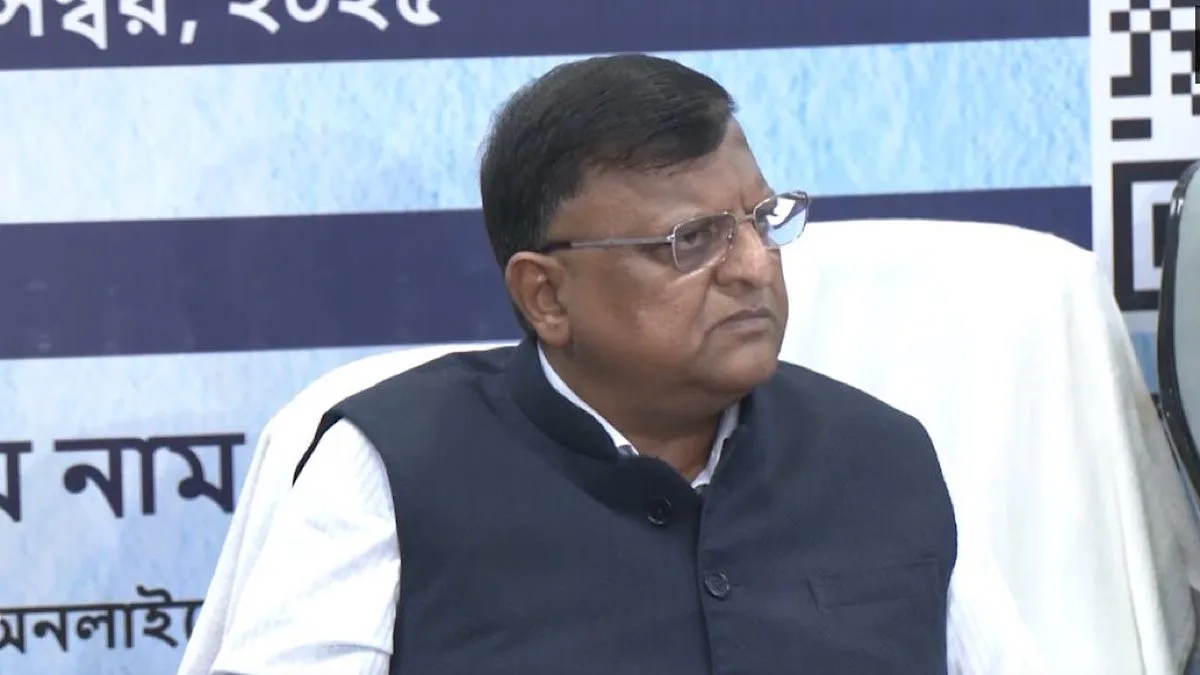
Barring stray incidents of poll violence the first phase of polling witnessed no instances of large-scale poll related incidents, the Chief Electoral Officer (CEC) of West Bengal, Manoj Kumar Agarwal said on Thursday.

The first phase covered 152 Assembly Constituencies spread across 16 districts of the state.

Addressing a press conference, Agarwal said that people cast their votes without fear and expressed satisfaction with the polling arrangements. He said that the feedback from polling stations suggested voters were largely pleased with how the process was conducted.

“The people of Bengal have voted fearlessly. I received reports that said they were quite happy with the polling arrangements. Incidents of poll-related violence were less this time,” Kumar said.

The second phase of polling, which will cover 142 constituencies, is scheduled for April 29 in West Bengal. The counting of votes is set to take place on May 4.

Kerala scorches; IMD issues heat wave warning for several districts

Amid rising heat and humid conditions in Kerala,the India Meteorological Department (IMD) has issued a heat wave warning for several districts in Kerala as of Thursday.

Statesman News Service | Thiruvananthapuram |

Amid rising heat and humid conditions in Kerala,the India Meteorological Department (IMD) has issued a heat wave warning for several districts in Kerala as of Thursday. Temperatures have crossed 41 degrees C in certain areas, marking the first official heat wave alert in the state since2024.

The IMD has informed that there is a possibility of a heat wave in isolated places in the Kollam, Thrissur, and Palakkad districts on Thursday and Friday. As part of the vigilance, an orange alert has been declared in these districts. The temperature in the Palakkad district may rise to 41 degrees Celsius on Thursday and Friday, the IMD said.

As a safety precaution measure, the Kerala State Disaster Management Authority (KSDMA) has issued a “self-lockdown” advisory for peak hours. The KSDMA has advised the people to stay indoors between 11 am and 3 pm when UV index levels are at their peak. It also asked people to drink plenty of water even if they do not feel thirsty.

Meanwhile, a young man died of sunstroke at Pallipoyil near Chakkarakkal in Kannur. The deceased has been identified as M V Sanal Kumar (37), a native of Pallipoyil. Sanal Kumar, a well construction worker, collapsed while working on Wednesday afternoon.His colleagues immediately took him to a private hospital. He died while undergoing treatment in the intensive care unit on Thursday afternoon.

An Anganwadi teacher in Valayam, Kozhikode suffered a sunburn on Thursday. The teacher, Anila, suffered burns on her right wrist while working. She sought treatment at the government hospital in Valayam. A four-year-old child also suffered burns at Vandoor in Malappuram. The child suffered sunburn while playing.

Air India may reduce overseas flights due to losses and high fuel costs

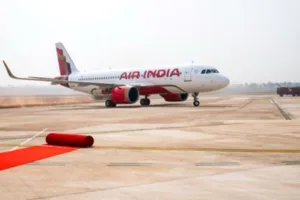
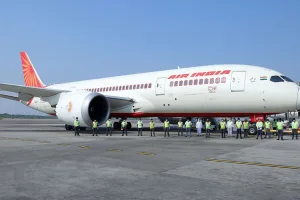
Tata Group-owned Air India is likely to reduce its international flight operations after posting a loss of nearly Rs 20,000 crore in FY26, amidst rising aviation fuel costs, according to senior officials.

Statesman News Service | Mumbai |

Tata Group-owned Air India is likely to reduce its international flight operations after posting a loss of nearly Rs 20,000 crore in FY26, amidst rising aviation fuel costs, according to senior officials.

According to a travel industry source, a final decision is expected to be taken at a board meeting scheduled for early May. It has been decided to keep travel companies informed about any development in this regard.

Air India is considering a 15% to 20% reduction in its flight schedule, though the overall cut across the Air India Group is expected to be relatively lower, in the range of 10-15%.

If the flight rationalisation proposal is implemented, more than 100 flights could be affected, from roughly 1,100 services operated daily by the Air India Group. Currently, Air India operates more than 700 domestic and international flights every day.

International services are likely to see the deepest cuts, since rising fuel costs, longer flying hours and higher crew expenses have squeezed route profitability and aircraft utilisation on overseas routes.

Air India has been reassessing capacity deployment across its entire network, particularly on long-haul international routes, where extended block hours have eroded productivity and weighed on overall operating economics.

Overseas flight operations to Europe and North America are most likely to form a substantial portion of the proposed reduction, even as the airline is also exploring temporary frequency reductions as well as timetable adjustments to improve cost efficiency without fully exiting key overseas markets.

The exercise is being presented as a network optimisation initiative rather than a rollback of expansion plans. While domestic operations may also see selective changes, the bulk of the impact is expected to fall on international routes, where cost pressures are higher, according to industry sources.

India welcomes operationalisation of visa-free transit for Indian nationals transiting through French airports

India on Thursday welcomed the announcement on the operationalisation of visa-free transit for Indian nationals transiting through French airports, saying that the decision is a reflection of the enduring partnership between the two nations.

NIKHIL VYAS | New Delhi |

India on Thursday welcomed the announcement on the operationalisation of visa-free transit for Indian nationals transiting through French airports, saying that the decision is a reflection of the enduring partnership between the two nations.

Addressing his weekly media briefing in New Delhi, MEA spokesperson Randhir Jaiswal stated that the removal of the transit requirement was agreed upon during the meeting between Prime Minister Narendra Modi and French President Emmanuel Macron in Mumbai in February, earlier this year.

Jaiswal mentioned that the decision underscores the deepening India-France partnership, recently elevated to a Special Global Strategic Partnership during Macron’s visit.

“We welcome the announcement on the operationalisation of visa-free transit for Indian nationals transiting through French airports. As you may recall, the removal of the requirement of transit visas for Indian passport holders was agreed upon between the Prime Minister and President Macron during their meeting in Mumbai in February this year,” he said.

“The Government of France has now operationalised this agreement, and Indian nationals transiting through mainland France exclusively by air will no longer need a transit visa with effect from 10 April 2026,” Jaiswal said.

“The decision reflects the enduring partnership between India and France, elevated to the level of a special global strategic partnership during the recent visit of President Macron, and further facilitation of smoother movement of people and enhanced people-to-people ties,” he stated.

Later in a statement, the MEA said the visa-free transit for Indian nationals transiting through French airports in the European territory has now been operationalised by the French Government.

“This follows an announcement made by Prime Minister Modi and President Macron during the latter’s visit to India in February 2026,” it said.

“Indian nationals transiting through the European territory of France exclusively by air will no longer require a transit visa, with effect from 10 April, 2026,” the statement said.

“The decision is a reflection of an enduring partnership between India and France and showcases deep commitment by the two leaders to strengthen bilateral relations, including strengthening of people-to-people bonds by facilitation of smoother movement of people between the two countries,” the statement added.

BJP urges NIA to investigate source of funds of Arabic-themed restaurants in Kerala

The BJP’s Thrissur district committee has urged the National Investigation Agency (NIA) to investigate the financial sources of Arabic-themed restaurants in Kerala.

Statesman News Service | Thiruvananthapuram |

The BJP’s Thrissur district committee has urged the National Investigation Agency (NIA) to investigate the financial sources of Arabic-themed restaurants in Kerala.

BJP Thrissur District Intellectual Cell Convener Prasidh Das on Wednesday filed a complaint with the NIA Director, seeking an investigation into the financial sources of restaurants and its alleged anti-national connections. The complaint also states that an investigation should be conducted into the hotels opened after demonetization.

The move follows a controversy over Vishu-themed advertisements that featured images of Lord Krishna alongside non-vegetarian dishes, which the BJP claims hurt religious sentiments of the Hindus.

The complaint states that the opening of such establishments across the state, which require a large amount of capital investment in a short period of time, is suspicious. Hence the role of foreign funds in this should be investigated. The complaint also states that it should be investigated whether these restaurants have any links with the banned Popular Front of India.

The complaint explicitly mentions eight specific restaurants or hotel chains. The petition was triggered by promotional posters from these restaurants that depicted young Lord Krishna sitting in front of a plate “Kuzhimanthi” (a meat dish), leading to police cases. Critics have condemned the move as an attempt to “communalise food” and cast unfounded suspicion on a specific business sector based on cuisine.

I-PAC–ED Vs Mamata Banerjee: ED defends Article 32 plea, cites breakdown of rule of law in West Bengal

The Enforcement Directorate (ED) on Wednesday defended the maintainability of its petition under Article 32 of the Constitution, telling the Supreme Court about alleged complete breakdown of law and order in West Bengal and claiming that its officers were unable to perform their duties due to interference and obstruction by Chief Minister Mamata Banerjee.

Parmod Kumar | New Delhi |

The Enforcement Directorate (ED) on Wednesday defended the maintainability of its petition under Article 32 of the Constitution, telling the Supreme Court about alleged complete breakdown of law and order in West Bengal and claiming that its officers were unable to perform their duties due to interference and obstruction by Chief Minister Mamata Banerjee.

The ED has sought a probe by the Central Bureau of Investigation (CBI) against the Chief Minister and other state police officers who had accompanied her at the time of the incident at the residence of Pratik Jain, the co-founder of political consultancy firm I-PAC, on January 8.

Appearing for the ED, Solicitor General Tushar Mehta told a Bench of Justice Prashant Kumar Mishra and Justice N.V. Anjaria that the agency and its officers were entitled to approach the top court as their fundamental rights had been affected. He argued that the “rule of law” forms part of the right to equality (Article 14 of the constitution) and when it is violated, the Court can intervene.

Referring to the coal smuggling case involving proceeds of crime worth about ₹2,700 crore, Mehta said the ED officers, while discharging statutory duties, were prevented from functioning freely. He submitted that this was not an isolated incident but part of a pattern of interference in investigations carried out by central agencies. “This is my legal submission. I will demonstrate how the rule of law is violated. The ED officers who went there to discharge their duties are seeking protection of their fundamental rights,” he added.

Mehta argued that the distinction between an officer’s official and individual capacity cannot be drawn in such situations, as the consequences of obstruction are faced personally by those discharging official duties. He added that even State governments, including West Bengal, have approached the Supreme Court under Article 32 in the past and cannot now question its maintainability in the case of ED.

The ED has accused Chief Minister Mamata Banerjee of interfering in search operations conducted on January 8, this year at premises of Pratik Jain – the co-founder of the political consultancy firm I-PAC in Kolkata, and has sought a CBI probe into the incident.

During the hearing, the Bench raised concerns about entertaining such petitions under Article 32, noting the wider implications.
“There is inherent danger if we keep on entertaining. This court will be flooded with Article 32 petitions. Not by individuals. By different state governments. As a court, shall we discourage or shall we encourage this?” the Bench asked.

Mehta responded by saying such petitions should generally be discouraged, but insisted that the present case stood on a different footing as it involved individuals whose rights were allegedly affected. He said that such matters should be decided on a fact-to-fact basis.

He maintained that the matter required examination on its own facts, pointing out that ED officers had been subjected to criminal proceedings and obstruction while carrying out their duties, and that approaching local police would not ensure a fair investigation.

Tiny seed, big power: Acharya Balkrishna’s post sparks buzz over chironji’s surprising health benefits

A simple Facebook post has brought chironji back into discussion, highlighting its long list of traditional wellness uses. The tiny seed is now being talked about for everything from skin care to energy and digestion support.

Statesman News Service | New Delhi | Updated :

When Acharya Balkrishna dropped a simple post on Facebook about a tiny seed called chironji, it didn’t look like breaking news at first glance. But soon enough, this small kitchen ingredient started getting big attention online. This “small but powerful” seed is being linked to a long list of traditional health benefits. That ranges from boosting energy to supporting skin glow and even calming the body.

In his post, the message was simple: chironji may be small in size, but it carries big value for health.

Tiny seed, big buzz on social media

Chironji, often used in sweets and traditional dishes, is being talked about as more than just a festive ingredient. According to the details shared, it may help increase physical strength and also provide energy to the brain.

In simple words, it is seen as a natural “energy booster” in traditional wellness thinking.

Also Read: Just 200 ml water, lemon & rock salt: Acharya Balkrishna’s viral remedy claims to soothe gas and digestive discomfort

It is also said to be helpful during cold and cough. Along with that, it is linked with benefits for skin-related issues too. From acne and pimples to uneven skin tone, chironji seeds, rich in natural oils, are believed to work like a gentle moisturizer for the skin.

In traditional descriptions, chironji is also associated with balancing the body’s internal energies, especially Pitta and Vata, which are often mentioned in Ayurveda while explaining common health issues like digestion problems and skin flare-ups.

From skin glow to stress relief

One of the most talked-about points is chironji’s possible role in skin care. The oil extracted from its seeds is often described as helpful in reducing dryness, itching, redness, and even dandruff caused by dry scalp. Some traditional references even suggest it may help with grey hair and nourish the scalp when used regularly.

The leaves of the chironji tree are also mentioned in traditional use. A paste made from dried leaves is believed to support healing of wounds, cuts, ulcers, and other skin irritations. It is described as having a cooling effect on the skin.

Beyond beauty care, chironji is also linked with deeper health claims. It is said to possibly help in anaemia by supporting blood production. Some studies on extracts of the seeds suggest they may increase red blood cells, white blood cells, haemoglobin levels, and overall blood volume in experimental settings.

There is also mention of its possible role in reducing stress and tiredness. Because chironji contains proteins, dietary fibre, and is low in calories, it is often described as something that may support stamina, reduce fatigue, and improve overall immunity in traditional usage narratives.