Photo
MORE Photo STORIES
Paraguayan Santa Cruz to retire from international football
Roque Santa Cruz (Photo: Facebook)
Militant killed in Kashmir
The militant was killed when an infiltration bid was foiled on LoC in north Kashmir's Baramulla district.
Representational image (Photo: Getty Images)
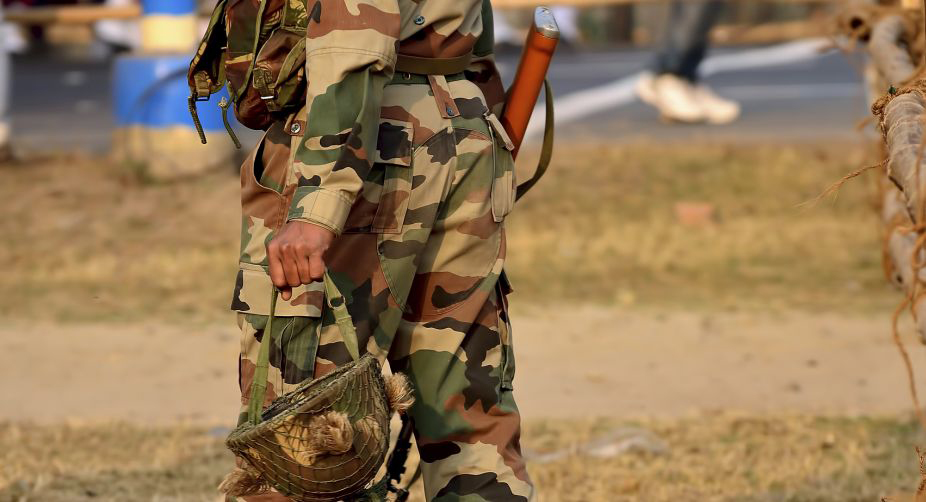
One militant was killed on Thursday when an infiltration bid was foiled on the Line of Control (LoC) in north Kashmir’s Baramulla district.Police said the troops challenged a group of militants in Uri sector’s Rampur area.”In the ensuing encounter, one militant was killed. The operation against the militants was still on,” the police added
Mystical McLeod Ganj
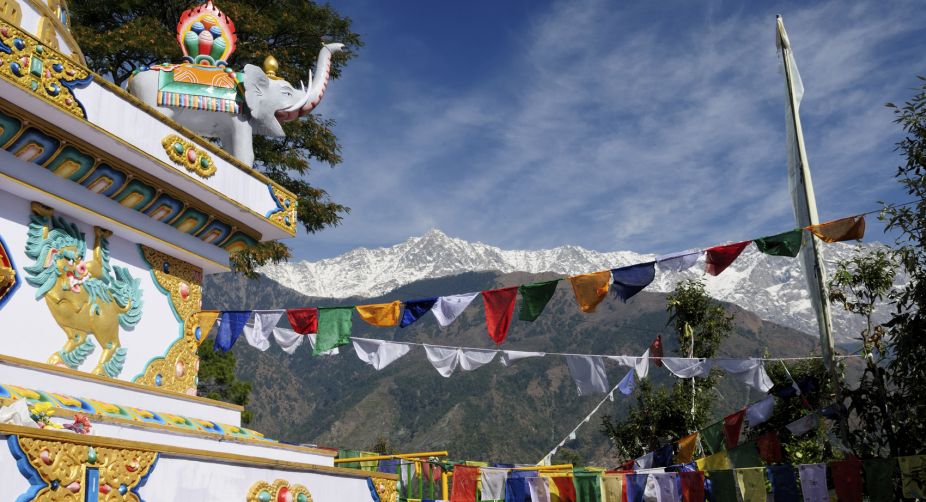
(Photo: Getty Images)
“Give the ones you love wings to fly, roots to come back and reasons to stay.”
Cool and quiet, life is simple and peaceful here… and there are reasons to come, and to come back to this small and beautiful hill town—McLeod Ganj. While the beauty of the place beckons, a chance to meet a living spiritual legend Dalai Lama grants a mystic charm to the place that even the harshest of cynics will be hard pressed to deny.
Nestled in the scenic Kangra district of Himachal Pradesh, this hill town or ‘Little Lhasa’ as it is fondly called has built up a fanatical fan following in recent times, especially among the (wink, wink) spiritually inclined tourists.
There is no escaping the Tibetan presence here, as there are dozens of antique shops selling all kinds of Buddhas, prayer wheels and the lot.
From pure silver jewellery to jade figurines, there is an eclectic list of items available and the best part is, you are welcome to bargain to your heart’s content!
A word of advice for those with deep pockets: Monday is the designated holiday for all Tibetans shops. So make sure your shopping sprees end before!
Speaking of contentment, McLeod Ganj is a fun place for those who are willing to experiment with their gastronomic choices. Authentic Tibetan fare like Thenthuk, Tingmo, Thukpa Bhatuk are available at almost every other restaurant. As long as you don’t worry too much about the hygiene, it is plain sailing for carnivorous and herbivorous homo sapiens both. The two standout eateries are ironically not in the main hub of the town, with Trek and Dine serving delicious wood-fired pizzas in neighbouring Dhraramkot ( A village that is ‘high’) while Illiterati Cafe (Formerly Boom Boom Cafe) on Jogibara Road has a great menu catering to European taste-buds.
McLeod Ganj proper is a little cramped with the influx of ‘gora people’ and of course the native Himachal and the Tibetans who are in exile. That is why staying in a property which is on the outskirts of town is highly recommended. One can walk in or hail a cab to town when they please.
Summer months, as can be expected with any hill station, are exceptionally crowded and best avoided by astute travelers. The months of February-March and October-November are ideal for extended weekend plans.
The famous Triund is only a few hours walk and for those who have the zeal, a must-visit while the others can always make do with a trip to the Dalai Lama’s residence and the main temple in town. Unsurprisingly and somewhat ironically the temple is most peaceful when the ‘Old Monk with Gucci shoes’ isn’t in town.
Asking any local on when His Holiness will be in town is like playing Russian Roulette, as depending on whom you ask, he could be anywhere between his residence to Paris to Peru!
As enchanting as it remains, the call of the wild and a spiritual sojourn to the place remains alluring. One can fly to Kangra airport and then cab it to McLeod Ganj but for the more adventurous types, driving down hill will be a far more appealing option. However, the 488km (Delhi to McLeod Ganj) road trip isn’t for beginners or solo drivers for most of the roads near the town are quite winding and one has to be alert at all times whilst driving in the hills.
Without a doubt, a great getaway for couples and larger groups, McLeodganj is a town that will wash away your worldly worries at least for the duration of your escapade!
If only childhood was carefree
The most fundamental attribute of child abuse is that it is severely detrimental to his/her well-being.
Children’s Day is acknowledged on various days in different
nations and honours children belonging to all corners of the globe. Although
the dates vary, the aim retains its equivalence in encouraging healthy
interaction, mutual exchange and understanding among children so as to avail
and ennoble the welfare of children in the world.
However, it is alarming that despite several attempts to
initiate children welfare and safety, they fall prey to reprehensible practices
such as child abuse, physical and mental abuse and neglect, child labour and
child prostitution. In recent decades some extreme forms of violence against children,
including sexual exploitation and trafficking, which count among the worst
forms of child labour and impact of armed conflict, have provoked international
outcry and achieved a consensus of condemnation. However, in addition to these
extreme forms of violence, many children are routinely exposed to physical,
sexual and psychological violence in their homes, schools, and places of work.
Child abuse can’t be merely identified as the root cause of
such malpractices as there are a multitude of despair befalling children such
as starvation, malnutrition, abandonment, warfare and economic exploitation.
There is also a major difference between unintentional and intentional harm.
The most fundamental attribute of child abuse is that it is severely detrimental
to his/her well-being.
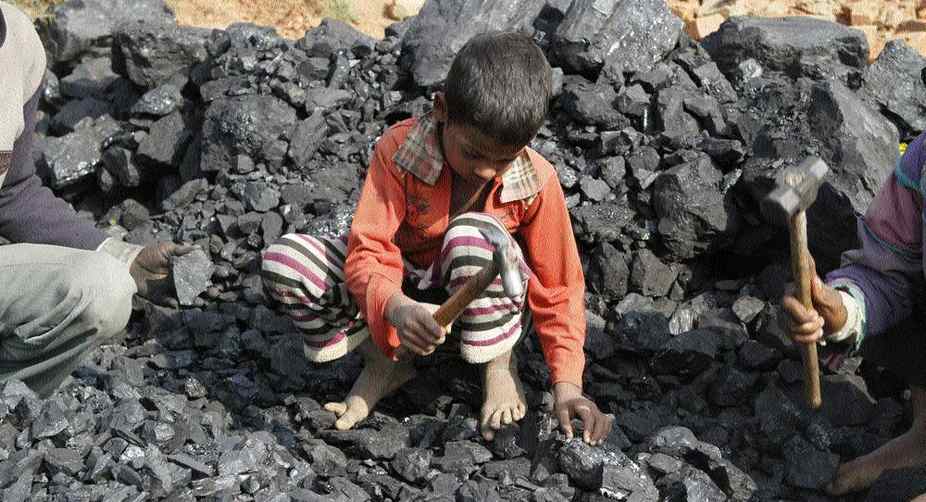
Child labour, one of the commonest forms of child
exploitation is characterized by full-time work at too early of an age, and too
many hours spent working. The work often exerts undue physical, social, or
psychological stress. They are often exposed to high temperatures and
unsuitable atmospheres which not only snatches away their right to live life at
the fullest in their childhood but also end up threatening their subsistence.
They are even vulnerable to toxins and chemical hazards. When children are
forced to work by their families, they are deprived of schooling and shining
academically.
An estimated 6 million work-related injuries occur among
children annually, which results in 2.5 million kinds of disabilities and
32,000 fatalities every year. It is ironical that the worsening situation is
more common in the developing and developed countries where although, people
claim to work towards the betterment of their nation fail to realize the bitter
truth. Moreover, the wages paid off at the end of the day are not enough to
feed three or four members in a family. As a result, increasing numbers of
deaths are estimated which are either from poverty, malnutrition or suicide.
Physical abuse and emotional ill-treatment are also
consequences which give rise to neglect, fear and frictions in the lives of
children who are often prey to severe punishments or threats.
Armed conflicts is a major detrimental cause affecting
children all over the world, especially in the third world countries where
small children are taught how to play with guns and bombs instead of toys in
their budding stage. The resources which could have been invested in
development are disarticulated in arms. The disruption of food supplies, the
destruction of crops and agricultural infrastructures, the disintegration of
families and communities, the displacement of populations and the destruction
of educational and health services and of water and sanitation systems, all
take a heavy toll on children.
In today’s world where terrorism has become a staid issue,
children are constantly being used by terrorists, since children are easier to
indoctrinate and less likely to protest. They take solemn advantage of their
ignorance about their own morality and groom them to a heightened extent with
the use of arms. For increasing numbers of children living in war-torn nations,
childhood has become a nightmare.
Therefore, it is necessary that children must be allowed to
enjoy an unprecedented childhood with an uninterrupted multitude of opportunities
lacking the stains of terror, harm and abusive practices in their lives, for in
the words of Ruskin Bond it is true that when all the wars are over, a
butterfly will still be beautiful. It is also our moral duty to groom the
kiddies well so that they realize their morality to “protect” and
“protest”.
Let us all strive together to make Children’s Day worth its
importance and glorify the lives of children and adolescents all over the world
as there goes the saying,
“Childhood should be carefree, playing in the sun; not living a
nightmare in the darkness of the soul.”
By Sahasika Zaman
Coordinator. Cl. IX, St. Mary’s High School, Coochbehar
All Time Favorite
Encountering a ghost, monster, or other supernatural creature that is terrorising the local populace, they decide to investigate.
Scooby doo, an American animated cartoon franchise,
comprising several animated television series produced from 1969 to the present
day is one of our most favorite cartoons of all time. Being kids the cartoons
were the major parts of our entertainment. Power Puff girls, Tom and Jerry,
Courage the cowardly dog, Dragon Tales, were a few which I remember from my
childhood.
Scooby Doo belongs to the production house of Hanna and
Barbara and its writers are Joe Ruby and Ken Spears who have done an excellent
job in grasping the interest of the audience. Each of these episodes featured
Scooby and the four teenage members of Mystery, Inc., Fred, Shaggy, Daphne and
Velma, arriving at a location in the ‘Mystery Machine, a van painted with
psychedelic colours and flower power imagery.
Encountering a ghost, monster, or other supernatural
creature that is terrorising the local populace, they decide to
investigate. The kids split up to look
for clues and suspects while being chased at turns by the monster. Eventually,
the kids realise that the ghost and other paranormal activity is actually an
elaborate hoax, and often with the help of a trap designed by Fred, they
captured the villain and unmask him. The hilarious encounters would leave the
audience laughing.
The friendship between shaggy and Scooby teaches us as kids
the value of friendship. The funniest part about the whole show is that Scooby
doo and the gang is never really looking for a mystery but they just seem to
bump into one. Shaggy and Scooby are always scared and hesitant when they see
something that terrifies them but in the end they are the ones who actually
solve the mystery.
In 1972, new one-hour episodes under the title ‘The New
Scooby-Doo Movies’ were created; each episode featuring a real or fictitious
guest star helping the gang solve mysteries, including characters from other
Hanna-Barbera series. Later, in 1979, Scooby’s tiny nephew Scrappy-Doo was
added to both the series. The thrill and the excitement which one used to have
while watching Scooby Doo is something memorable. The series was later renamed
as Scrappy Doo and Scooby Doo series. Thus, the amusing show had stolen
millions of hearts of the viewers and still remains one of the favorite cartoon
shows.
By Oindrila Gupta
Coordinator, Class XI, St Joseph and Mary’s School
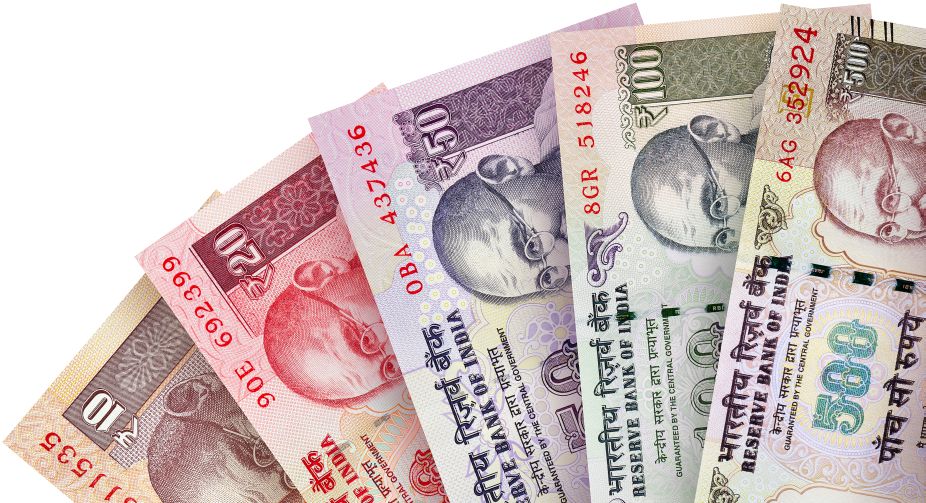
Rs.2,000 denomination a puzzle, feels Chidambaram
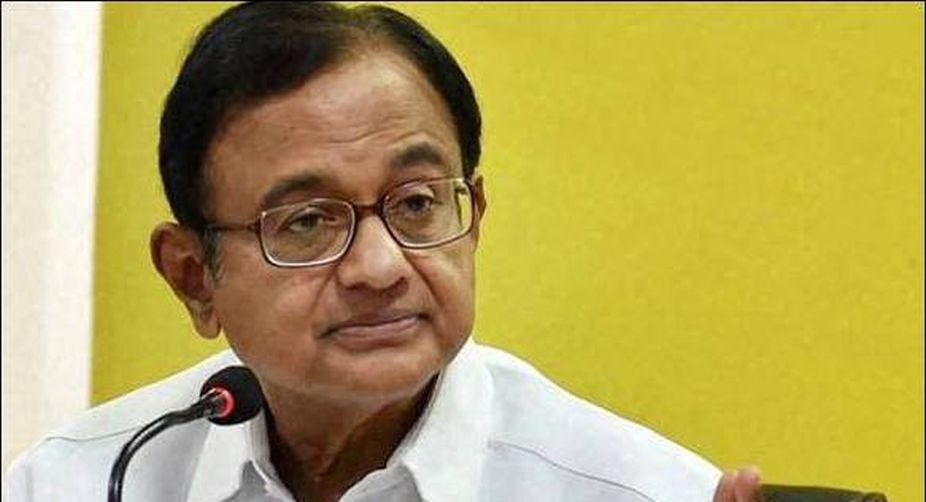
Chidambaram (Photo: Facebook)
Former Union Finance Minister and senior Congress leader P Chidambaram on Wednesday said the Centre's decision to demonetise Rs.500 and Rs.1,000 notes and introduce Rs.2,000 notes was a “puzzle”.
Though supporting the demonetisation move, Chidambaram said how the government implemented its decision will decide whether it is a wise one or not.
“They demonetized Rs.500 and Rs.1,000 notes and introduced Rs.2,000. It seems to me a puzzle. Let the puzzle be unravelled by the government,” Chidambaram told the media here.
“If the government was introducing Rs 2,000 note by itself, that would be a different matter. What I don't understand is why they demonetised Rs 500 and Rs 1,000 and introduced Rs 2,000 note. Maybe, it's my inadequacy,” he added.
Chidambaram said: “If they give us a good reason, maybe we'll be convinced.”
“I have thought about it and have spoken to a few people. Even they are unable to understand why the government did this,” the former minister said.
“How will this move help in preventing the generation of black money? If new income or wealth is unaccounted, will not that income or wealth be stashed away in Rs 2,000 notes?”
“How is demonetisation of high denomination notes going to serve the purpose if a new and higher denomination note is introduced? The government must explain this apparent puzzle,” asked Chidambaram.
He said he is worried about the timing as so many marriages are lined up.
“Somewhere, I read that some 40,000 marriages will take place in Delhi in the next few days. The period between November 15 and December 15 is expected to witness some five million marriages all over the country,” said Chidambaram.
“… how the government handles it, I do not know,” he added.
The former Finance Minister stressed that 99 per cent people are holders of legitimate/accounted money and the government must “quickly, efficiently” exchange their old currency of higher denomination without causing any harassment.
He said if housewives, students and small traders are made to fill up bank forms, it'll be pure harassment, and the Congress will condemn it.
Chidambaram said the decision must be seen in the background of “undisputed facts and data”.
“In 1978, the Janata government demonetised high denomination notes. That action failed to achieve its objectives. High denomination notes were re-introduced shortly afterwards and the volume of unaccounted wealth and income admittedly increased,” he said.
On whether demonetisation will prove a game changer, Chidambaram said: “… I think the consensus has been that the economic gains may be very small but disruption and public inconvenience may be very large.”
He said unaccounted wealth and money is largely invested in construction, real estate, bullion, jewellery and securities.
“I have no first-hand information about how much is stashed by way of hard cash. Only the government can answer that question. I am concerned about 98 or 99 per cent of people who are entitled to exchange their old notes,” the Congress leader said.
WB CM visits Singur project site
Banerjee visited the Tata project area in Singur on Wednesday evening to apprise herself of the latest progress in the land.
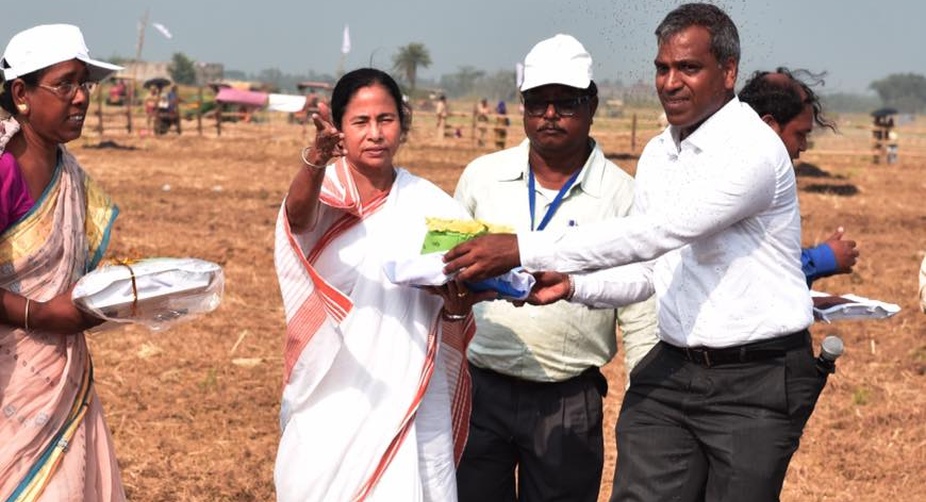
WB Chief Minister Mamata Banerjee visited the Tata project area in Singur on Wednesday evening to apprise herself of the latest progress in the land conversion work and expressed intense satisfaction about the near-completion of the ongoing work.
She said, “We are ready to send the detailed report of the completion of work as directed by the Supreme Court, two weeks ahead of the final date fixed by the court.”
Already the seeds of seasonal vegetables have been sown and saplings have come up.
The irrigation department is working to install 56 mini deep tube wells.
The chief minister praised every one, from the labourers to the higher officials and expressed her desire to reward every one appropriately.
She also announced an extra LTC for the police personnel deployed there and a reward of Rs.10,000 for the constables for putting in their tireless effort at Singur.
The chief minister assured the farmers who have received the physical possession of land of more agricultural kits (seeds and manure) and financial help.
Banerjee said the ownership of 71 acres of land cannot be traced out. no one have yet turned up to claim ownership of the land.
Surprisingly, such untraced owners of land had previously collected the compensation cheques.
The 71 acres of unclaimed land will be kept separately fenced, which later can be used for public welfare purposes, she said.
Singur will attract research workers, students, agriculturists and people from all over the world.
Singur will became the destination of the world, she said.
Monuments in remembrance of Tapashi Mallick, Raj Kumar Bhul will be set up, an outlet will be set up where the interested visitors can avail books on Singur Andolan and its success story, audio and visual VCD will also be made available, a board will be set up,depicting all the names who have put in their tireless effort towards the completion of the work,much ahead of the scheduled time.
The chief minister said: “Next time when I visit, I am sure this land will be full of greenery.
Demand for separate state gains momentum in Odisha
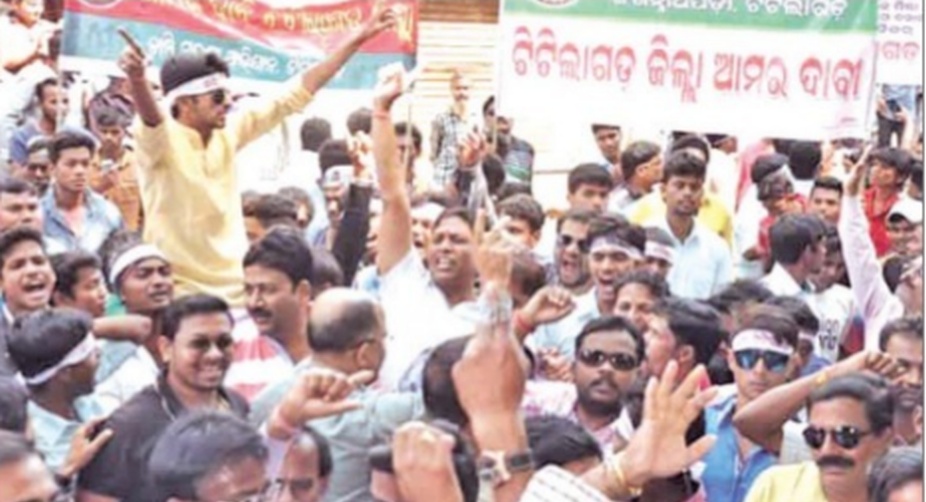
With the clamour for a separate Titlagarh district gaining momentum,the local people have started holding motorcycle rallies, post card campaigns.
With the clamour for a separate Titlagarh district gaining
momentum,the local people have started holding motorcycle rallies, post card
campaigns and postings on social media saying chief minister Naveen Patnaik
should make an announcement to this effect during his visit on Thursday.
Three years ago CM Naveen Patnaik had assured the people
that he would examine the demand and make an announcement. But he has remained
mum for three years and tomorrow when he comes he owes an answer to people of
Titlagarh, said the activists who were on a bike rally to mobilise support. The
Titlagarh zilla kriyanustan committee and the Adivasi Sangh have jointly
mobilised public opinion in favor of a separate Titlagarh district. Presently
it is part of Bolangir district. Though the demand for separate district is not
new , it was revived during the last local body election and the Naveen Patnaik
government had managed to assuage the feelings by hurriedly upgrading the
notified area council to a municipality to defuse the agitation .
“Just when the movement was gaining strength three years ago
the CM upgraded the NAC to a municipality and stalled it by also promising that
the demand for a separate district will be taken in to account” recounted the
residents of Titlagarh town. We will not be befooled again by chief minister Naveen
Patnaik and tomorrow when he visits the region, he has to address the issue,
they said. Some people, though in favor of a separate district as it could
bring changes in these tribal dominated underdeveloped area, are skeptical
about the timing of the Kriyanustan committee led agitation as it appears to be
a pre-panchayat election political stunt The local BJD MLA T Sahu supports the
demand , yet the CM turns deaf, they charged. The chief minister Naveen Patnaik
is scheduled to visit and address public meetings at Papsi and Muribahal , both
of which are under the proposed Titlagarh district area.
Kahaani 2 has a universal story: Vidya
Photo: Facebook
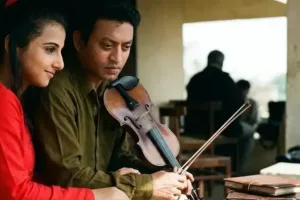
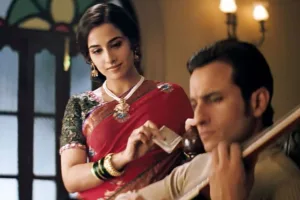
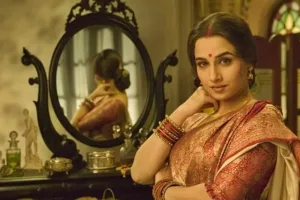
Actress Vidya Balan, who is busy promoting her film Kahaani 2 said the films story will connect with the masses and explained how she gets into the skin of a character in a film. “The film has a universal story. Honestly, when I am doing something I completely enter into it and I don't think how the film will turn out,” the National Award winning actress said. Vidya, who went to radio stations on a promotion spree on Wednesday, spoke about her enjoyable experience there. “I love radio trails a lot because RJs are very energetic and every station has something interesting happening. You don't get bored,” she said. The film Kahaani 2: Durga Rani Singh has been promoted in a different manner with wanted posters of the actress, who is playing the character Durga Rani Singh, posted in public. Asked if she is nervous about the film she said, “I am not nervous. I have done whatever I wanted to do. Now all we can do is give our best in promotions. We are promoting the film in a different manner, which keeps my interest and energy level going.” The Hamari Adhuri Kahani actress also gave her opinion on the recent US Presidential elections. “I supported Hillary Clinton because if a woman can become the President of America then it would be great. She is an exemplary woman and I admire her,” Vidya said. Vidya also highly supported government's decision to ban 500 and 1000 rupees notes. “It is a very good step which will keep a check on black money. Some people will face issues but I am sure the government has some plans for them too,” she said. Kahaani 2: Durga Rani Singh is an Indian suspense-thriller film directed by Sujoy Ghosh and produced by Ghosh and Jayantilal Gada. Featuring Vidya Balan and Arjun Rampal in lead roles, the film is a sequel to the 2012 film Kahaani.
A Day to Commemorate
Children are the insurance of human civilisation. Being fruits of tomorrow, they are the result of the efforts we put in today. It’s high time we give Children’s Day a better purpose
The day 14 November is celebrated as Children’s Day in
India. Other countries have different dates. Universal Children’s Day is
celebrated on 20 November. On the same date in 1959 the United Nations adopted
the Declaration of the Rights of the Child and in 1989 the Convention on the Rights
of the Child.
A summary of the rights under the Convention on the Rights
of the Child can be found on the UNICEF website. Children’s Day is not about
celebrating and dedicating one single day to children for who they are. It
should not be about attending local Children’s Day fairs to see magic shows and
get unhealthy free sweets for just being a kid.
Children directly and indirectly face crisis that the world
goes through. They are used as labourers in some countries and are immersed in
armed conflict, living on the streets, suffering by differences be it religion,
minority issues, or disabilities. Their voices are hardly audible amidst the
sound of guns, lofty orations of politicians, or the cries for food. World
leaders are doing what they can through conventions, summits, legislation and
sanctions but what can children do for children? The school is a powerful
institution for youngsters.
School children can come together to help the not-so
privileged kids. The electronic media
can be a mighty tool that can get the right message across to the right people
in a short time. Children’s day can be that one special occasion when millions
of kids can demand that grown-ups should
stop all atrocities against children and
provide food and education to each child the world over.
It is a day to bring awareness and begin action in a new
direction, find more avenues through which children can be helped. It should be
seen as the day we open our eyes and heart to children around the globe that
have succumbed to violence in forms of abuse, exploitation and discrimination.
Children are the insurance of human civilisation. Since
fruits of tomorrow, they are the result of the efforts we put in today. It’s
high time we give Children’s Day a better purpose.
By Saronyo Lal Mukherjee
Coordinator, Class XI, South Point High School
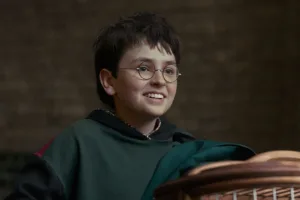
In Harry Potter land
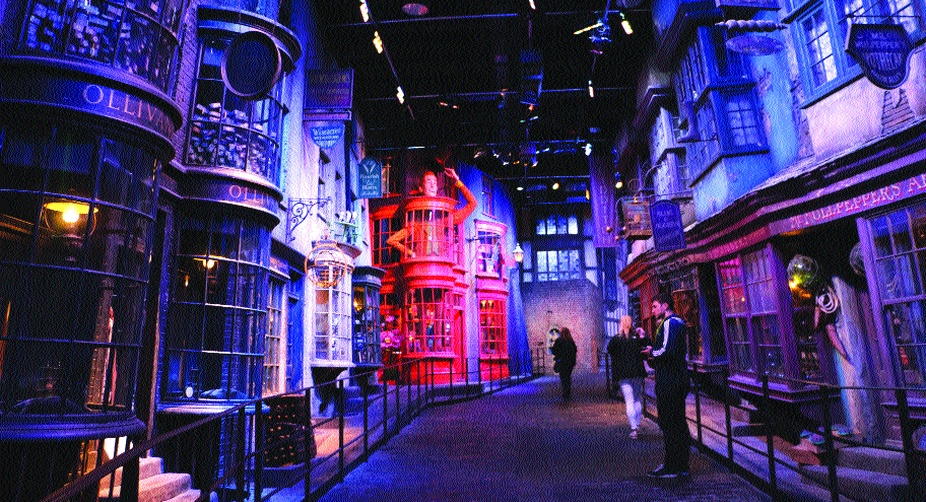
The
Warner Bros Studio Tour in London is an incredible experience even for the
spontaneous fans of the film sequence, who would like to learn more about how
movies are made. For grave Harry Potter fans.
Fortunately for me, I happened to fly from Delhi with Virgin
Atlantic at a time when it is celebrating 25 years of entertainment and for
those who do not know Virgin is the first airline to introduce inflight
entertainment, hence this year they are celebrating it with a season of
film-themed activity!
In the build-up to being the official airline of the new
Harry Potter film aka Fantastic Beasts and where to find them obviously there
were some Harry Potter films to watch and I certainly made the most of it in my
premium economy seat. I was equally charged up and excited to be attending a
red carpet premiere at the London Film Festival of “Queen of Katwe”,
a new Disney movie and attending the Festival’s Gala ball. I have been to
London several times before but never to the Harry Potter studio…this time my
mind was made…I simply had to check it
out!
The studio tour
Most general way to reach the studio is by a taxi, but I
would recommend taking the bus transport with Warner Bros, which needs to be
booked in advance. On reaching of course, you will find a queue, because it
wouldn’t be a Harry Potter attraction without a line up (this being one of the
world’s most famous film franchises after all). Time spent in the entry queue
passes very quickly as there is plenty to look at counting the flying car from
Chamber of Secrets, which is suspended from the ceiling and the “cupboard
under the stairs”, where Harry was at the Dursley’s in Philosopher’s
Stone.
Then came the fun
part. Once we had watched a quick film, we were led into a screening area for
another, longer film featuring the key cast members aka Harry, Ron and Hermione
as we all know them. This just builds your anticipation even further and I felt
like a little child all excited!! Soon thereafter, we were in the Great Hall.
Here I could see where they squeezed 400 cast members in to film the Great Hall
scenes; I loved looking at the original costumes and even found out some fun
trivia like the fact that they had to sew the children’s pockets to avert them
from niggling in sweets when filming scenes…cutely adorable isn’t it?
Next, I walked around
a diversity of dissimilar interactive displays and information in abundance. I
don’t want to give too much away because you’ll be more excited to discover it
for yourself, but let me just say there is almost nothing you won’t know about
Harry Potter when you walk away from the experience.
Of course, you will
see concoctions class, the Triwizard cup, the Philosopher’s Stone, and lots
more. The green screen rooms are great to experience, where one can get a fun
picture snapped on a broomstick or in the flying car. Of course, you need to
hand over some pounds to essentially walk away with the picture, else if you
could try casting a spell over the cashier attendant. Then, there’s a
well-deserved break in The Back Lot, where I stood at Privet Drive, saw the
Night Bus, and the Hogwarts Bridge. Here I also found a large cafe and an
opportunity to sit down with my Butter beer (one of only two places in the
world where it can be purchased).
The Hogwarts model
Refreshed, I continued my exploration of Round 2. The rest
of the tour features more of the sets and costumes. At the end of the tour, we
were treated to a 360 degree view of the star of the show ~ the model of
Hogwarts crafted by talented hands was built on 1:24 scale by a large team of
artists and squad members and was captured and heightened with digital special
effects to generate accurate images of the school for the movies. At this point
I got a bit emotional; trust me walking around the model can be an verwhelming
experience for diehard Harry Potter fans.
Shopping experience
I was at the Studio Shop located in the lobby as I exited.
Every conceivable Harry Potter souvenir was available in the shop, including
sweet treats like Chocolate Frogs and Bernie Bott’s Every Flavour Beans,
replica wands, robes, glasses, souvenir t-shirts and lots more. An interactive
green screen experience in the shop also allowed me the opportunity to appear
on pages of The Quibbler and the Daily Prophet or as a suspect on an Azkaban
Prison wanted poster. As for me I was all ready to buy all the Gryffindor
goodies my pounds could buy and live out of my fantasy of receiving a letter of
acceptance by the owl.
FAST FACTS
Best way to reach: Fly Virgin Atlantic premium economy,
which can give any Business class a run for its money with world class
amenities and service at affordable rates and terrific timings and yes, a great
baggage allowance.
Best place to stay: Sheltered by an eight storey vertical
garden, The Athenaeum is a family owned luxury hotel in an art deco building is
a few minutes’ walk from Buckingham Palace and bang opposite Green Park.
By Rupali Dean
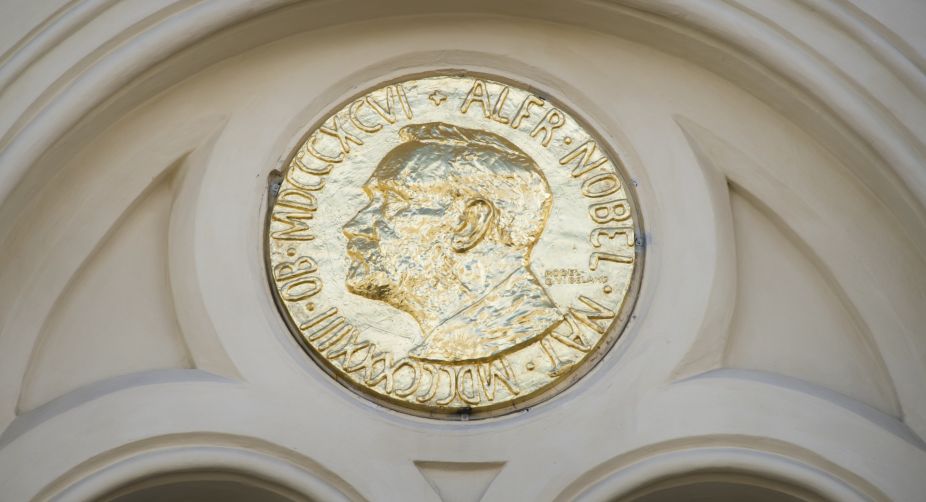
The story of two Nobel misses
(Gety Images)
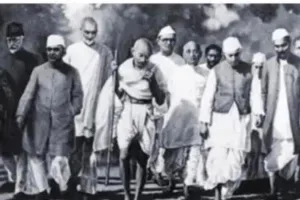
Generations to come will scarce believe that such a one as this ever in flesh and blood walked upon this earth,’ said Albert Einstein soon after Mahatma Gandhi’s assassination on 30 January 1948. Renowned historian Romain Rolland called Gandhi the ‘greatest Indian after Buddha and the greatest human being after Christ’. If Gandhi was the greatest Indian, Jawaharlal Nehru, according to Dr S Radhakrishnan, was the greatest Indian after the Mahatma. Dr Radhakrishnan said so in 1965 on the occasion of Nehru’s first death anniversary. It was iterated, half a century later, by veteran journalist Inder Malhotra, during the celebration of Nehru’s 125th birth anniversary in 2014.
It is surprising, therefore, that two of India’s greatest sons were not awarded the Nobel Peace Prize for their monumental contribution to humanity and world peace. According to the archives of the Norwegian Nobel Institute, 12 Indians, besides Gandhi and Nehru, were recommended by various organisations/eminent citizens (both Indian and foreign) for the Nobel Peace Prize. The names of these Indians were: Dr S Radhakrishnan, Sri Aurobindo, Vinoba Bhave, Mahesh Yogi, Aga Khan III, Raja Mahendra Pratap Singh, H M Banerjee, Nalini Kumar Mukherjee, Sanjib Kumar Chaudhuri, B N Rau, Rajah Manikam and Dr M C Davar (for his efforts to prevent Partition and promote Indo-Pak amity).
Mahatma Gandhi was first nominated for the award in 1937 by a member of the Norwegian Parliament who wrote: “Gandhi’s absolute peace ideal, non-violence, has permeated India’s poor and tortured masses. In spite of differences they were now of one mind and willing to endure mistreatment, imprisonment, hunger and death in an unarmed peaceful freedom struggle.” But the Nobel Committee (NC) rejected the nomination on the ground that Gandhi’s actions in politics were “tactical with sly calculations”. In the following two years, 1938 and 1939, Gandhiji was recommended by 27 members from “Friends of India”, Denmark. The recommendation was supported by renowned missionary C F Andrews and Nobel Laureate Romain Rolland. In 1947 three eminent Indians — C Rajagopalachari, B G Kher and G V Mavalankar — nominated Gandhi for the award. A consultant of the NC wrote, “There is no doubt that Gandhi is the spokesman for violence-free resistance, a pacifist in the most radical sense. …For the vast majority of his countrymen he is a prophet like no other since the Buddha.” However the NC felt that Gandhi had given up his consistent rejection of war.
After Gandhi was assassinated on 30 January 1948, Norwegian jurist Frede Castberg sent a proposal for a posthumous award for Gandhi He said that “Gandhi could only be compared with the founders of major religions.” This time the NC wanted to award a posthumous prize to Gandhi but a minor technical hitch became an obstacle to the award: Where will the prize money be sent? Gandhi had left no estate and no testament.
Jawaharlal Nehru was first nominated for the award in 1949 by the faculty of universities of Delhi and Bombay who wrote: “During the course of the two years after India attained her freedom, Pandit Jawaharlal Nehru had made it clear that his country would not align with any of the power blocs into which the world is unfortunately divided today. By thus adopting an independent line of foreign policy he has considerably strengthened the forces working for international peace.” However, Nehru missed the award by a whisker. The 1949 Nobel Peace Prize was awarded to a black American Ralph J Bunche. By awarding a black for the first time the NC wanted to send a strong message of racial indiscrimination. Nehru was nominated to the award another six times till 1961. In 1954 he was nominated, along with former British PM Clement Attlee, for “establishing a parliamentary government in India — for his neutralist foreign policy and for upholding the same principles as Gandhi.” The nominators included many international organisations, foreign universities and Nobel Laureates. The documents of the NC suggest that the Norwegian government was interested in awarding the Nobel Prize to Nehru. However, his firm handling of the Kashmir issue with Pakistan, accession of Goa and, later, deteriorating relations with China cost him the honour. A member of NC quoted from a statement of Nehru on use of military and weapons for the sake of India’s security. He was no more seen as ‘a man of peace.’ It was not only India’s misfortune, but also of the Nobel Committee that two most deserving persons in the world were denied the honour which would have brought greater glory to the award.
– By Praveen Davar
(The writer, an ex-Army officer, is Member, National Commission for Minorities. The views expressed by him are personal)
Bitter medicine
(Getty Images)
A silent pioneer
Rightly has it been said that the founding fathers of the Asiatic Society were responsible for the rediscovery of India and her past.
Rightly has it been said that the founding fathers of the
Asiatic Society were responsible for the rediscovery of India and her past. The
“Transactions” of the Asiatic Society, first published as Asiatick
Researches between 1788 and 1797, were so much in demand in the literary and
scholarly world that a pirated edition of the first volume came into
circulation in England in 1798, and some of its volumes translated into German
and French. Through them the Society came in contact with several
internationally distinguished scholarly Associations like the American
Philosophical Society of Philadelphia, the Linnean Society of London, the Royal
Society of Edinburgh, and the Society of Antiquities of England.
The Society proved to
be a pivotal centre of Oriental studies and research, extending a helping hand
to the other two major centres of activity that paved the way to the Indian
Renaissance, the College at Fort William, and the Serampore Mission of William
Carey, that proposed English translations of classical Sanskrit texts in 1805.
The first book chosen was the Sanskrit epic Ramayana, undertaken by the Society
at a cost of Rs 5,500.
Some of the famous contributions of the Asiatic Society
during the first 30 years are remarkable, namely, S Davis’ Astronomical
Calculations of the Hindus in 1795; H T Colebrooke’s Duties of a Faithful Hindu
Widow in 1795; J Duncan’s Discovery of Two Urns in the Vicinity of Benares in
1797; H T Colebrooke’s The Vedas in 1805; J Malcolm’s Sketch of the Sikhs in
1810; F Wilford’s Ancient Geography of India in 1815 and E Strachey’s Early
History of Algebra in 1816.
Two decades before
Ram Mohan Roy’s first tract on Sati, H T Colebrooke had proved from study of
early texts that the practice of Sati was a gross deviation from authentic
tradition.
Sir Charles Wilkins translated the Bhagavadgita into English
in 1785, deciphered a number of Sanskrit inscriptions published a translation
of Hitopadesa in1787 and a Grammar of the Sanskrit Language. Sir William Jones
translated Kalidasa’s Abhijnana in 1789, Jayadeva’s Gitagovinda in 1789 and
Manusamhita in 1794; and edited the Ritusamhara in 1792; and translated the
Laila Majnu from Persian. The works initiated by Wilkins and Jones were
continued by Colebrooke and Wilson. Colebrooke, as president of the Society
from 1806 to 1815 contributed 19 papers to the Transactions of the Society. He
published an English translation of Jagannath Tarkapanchanan’s celebrated work
on Hindu law, the Vivadabhangarnava under the title Digest of Hindu Law on
Contracts and Successions in1798. His critical edition of the Sanskrit lexicon
Amarakosha came in 1808. Wilson, Secretary from 1811-32, published Kalidasa’s
Meghaduta in 1813 and translated 18 principal Puranas into English. He also
published an edition of Kalhana’s Rajatarangini in 1825. Sir John Shore,
1751-1834 who succeeded William Jones as president of the Society in 1794,
published from a Persian version an abridged English translation of the Yoga
Vasistha and contributed six papers to the Asiatic Researches. Alexander Csoma
de Koros’s Grammar of Tibetan Language was published in 1834.
Most of the works of the Society are research-based and
research-oriented, and so have not been loudly spectacular. But its
publication, the “Books”, consisting of a series of several hundred
Oriental texts in Sanskrit, Arabic, Persian, Bengali, Tibetan and other Asian
languages, both in original and translation, has earned the Society a
formidable reputation among scholars over the world. Archaeological and
Geological surveys, census reports, treatises on law and
revenue systems, all prepared solid bases for all future researches on Asia and
the Orient.
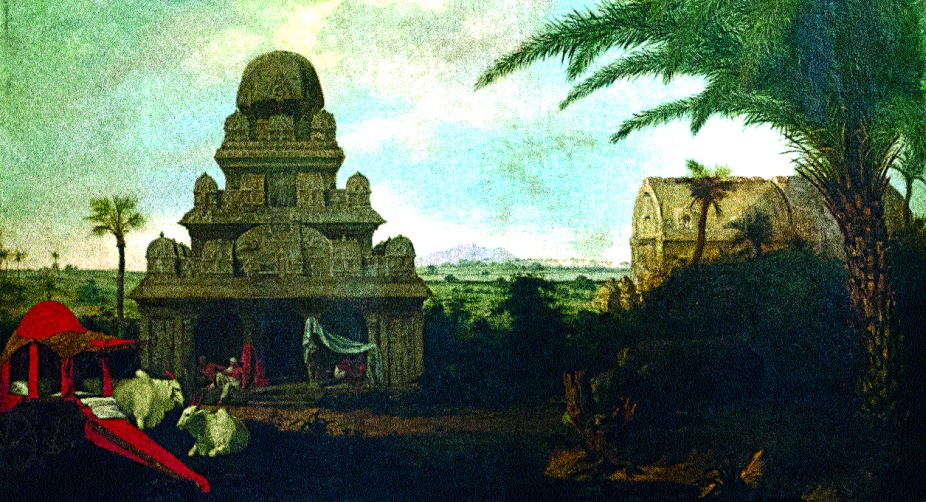
The exhibition at the
India International Centre is suitably rich in text and visual exposition, well
chosen eye opener for the city’s post Independence generation towards an
illustrious but silent pioneer of India’s academic world.
By Aruna Bhowmick
EU calls special meet after US results
The talks will be held in Brussels, where the foreign ministers of the 28 EU member states will hold a regular meeting.
Representational Image (Photo: Getty Images)
EU foreign ministers will hold a special meeting Sunday following Donald Trump's win in the US presidential election, a German diplomat said on Wednesday.
German Foreign Minister Frank-Walter Steinmeier “welcomes that an EU foreign ministers' meeting will take place Sunday,” said a ministry source.
The talks will be held in Brussels, where the foreign ministers of the 28 EU member states will hold a regular meeting , reported German national news agency DPA.
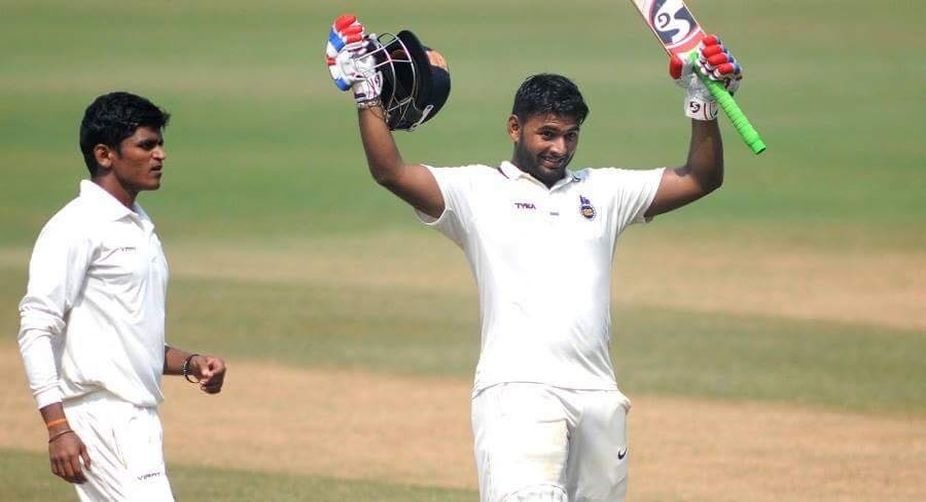
My hard work is paying off: Rishabh Pant
Rishabh Pant (Photo: Facebook)
He batted himself into the record books as he scored the fastest hundred in first-class cricket. Not only that, Rishabh Pant has had a staggering season so far having scored 799 runs from seven innings at an astounding average of 133.16 and a strike-rate of 113.17.
The young lad from Delhi has shown his prowess in domestic cricket and is gearing up to play at the highest level.
“I have been working hard a lot, I worked on many aspects and prepared well for the season. I think my hard work is paying off,” Pant said speaking exclusively to thestatesman.com.
“I didn’t do well in the last season but Tarak Sinha sir, who is my coach, has helped me a lot. All the credit for my success goes to him,” he added.
The 19-year-old has already scored four hundreds in the season, including two in a single match against Jharkhand.
In the five games of the Ranji Trophy this season he has hit 44 sixes.
Pant’s sequences of scores this season are 146, 308, 24, 9, 60, 117, and 135.
En route his record breaking ton, Pant eclipsed a 28-year-old record set by former Tamil Nadu opener VB Chandrasekhar, who reached the three-figure mark in 56 balls against Rest of India during the Irani Cup match of the 1988-89 series.
“I am happy with my performance but do not want to get complacent. Whatever I play, I just concentrate on performing well and try not to think about anything else,” the 19-year-old said.
Pant also played a few promising knocks in the last Indian Premier League (IPL) season for Delhi Daredevils. In one of the matches, he was given the man of the match trophy for his match-winning effort.
Earlier this season, he was not picked for India A's tour of Australia and admitted that it acted as a trigger to score tons of runs now.
“I was hurt for not getting selected for India A, but I took it positively and promised myself to score more and more runs so that no one can ignore me,” Pant said.
When asked about his ultimate aim and if he has set any target for himself, he said, “In our club (Sonnet club in Delhi), only if a player has played Test cricket, he is considered as an international player. So, my ultimate aim is to play Tests for India,” adding, “But, yes limited over cricket is equally important.”
Every player has a role model in his life and Pant is no different.
“I used to watch Adam Glichrist earlier; I follow Dhoni bhai (MS Dhoni) now. Not to forget Virat bhaiya (Virat Kohli) who is now everyone’s idol,” the Delhi player said.
Currently, with a win and three drawn matches, the Delhi team is third in Group B in the Ranji Trophy.
“I don’t think about future and remain in present only and don’t know about Delhi’s chances to win the trophy. We are currently third and positive about winning,” Pant signed off.
By Abhishek Mahajan


Russian paratroopers jump as a rainbow appears in the sky
during the joint Russian, Belarusian and Serbian military exercise ‘The Slavic
Brotherhood’ at the military ground Kovin, near Belgrade (Photo: Stringer/AFP)" alt="img" />

Russian paratroopers are seen as a rainbow appears in the
sky during the joint Russian, Belarusian and Serbian military exercise (Photo:
Stringer/AFP)" alt="img" />


A Cargo ship sails the Atlantic Ocean during sunset in
Cartagena, Colombia (Photo: Luis Acosta/AFP)" alt="img" />