Logo

Justice Khehar sworn in as Chief Justice of India

IANS | New Delhi |

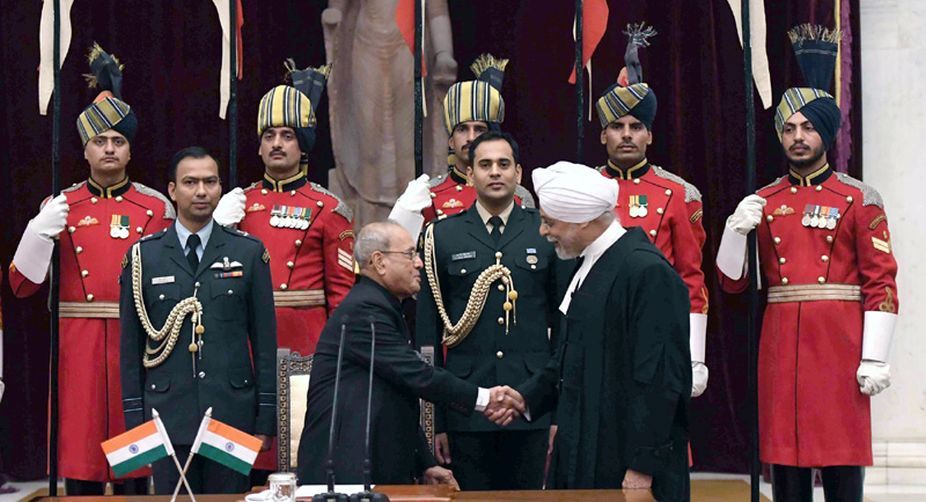
Justice Jagdish Singh Khehar was on Wednesday sworn in as the Chief Justice of India (CJI).

Khehar was administered the oath of office by President Pranab Mukherjee at Rashtrapati Bhavan here.

He succeeded Justice Tirath Singh Thakur. Khehar is the 44th CJI and also the first Sikh to hold the apex office.

He would have a tenure of little over seven months.

Khehar was the author of the judgment by a five-judge constitution bench that held "unconstitutional" the Constitution's 99th amendment paving way for the National Judicial Appointment Commission and the National Judicial Appointment Commission Act, 2014.

Mexico registers first baby with maternal last names

AP | Mexico City |

Public registry officials in northern Mexico say they have registered the country's first baby named with the maternal surnames of both parents.

The tradition in Latin America is to give babies two last names the father's surname, followed by the mother's paternal surname.

So the baby Barbara born to Jose Gonzalez de Diego and Alicia Vera Zboralska would normally have been named Barbara Gonzalez Vera, losing the parents' maternal surnames.

But to honor the maternal line, the couple won a court injunction allowing them to name their child Barbara de Diego Zboralska.

The director of public registries in the northern state of Nuevo Leon says it was a first. Raul Guajardo said on Tuesday that "this kind of registry doesn't occur anywhere else in the world."

Mortal remains of 2 Indians reaches India from Turkey

PTI | Mumbai |

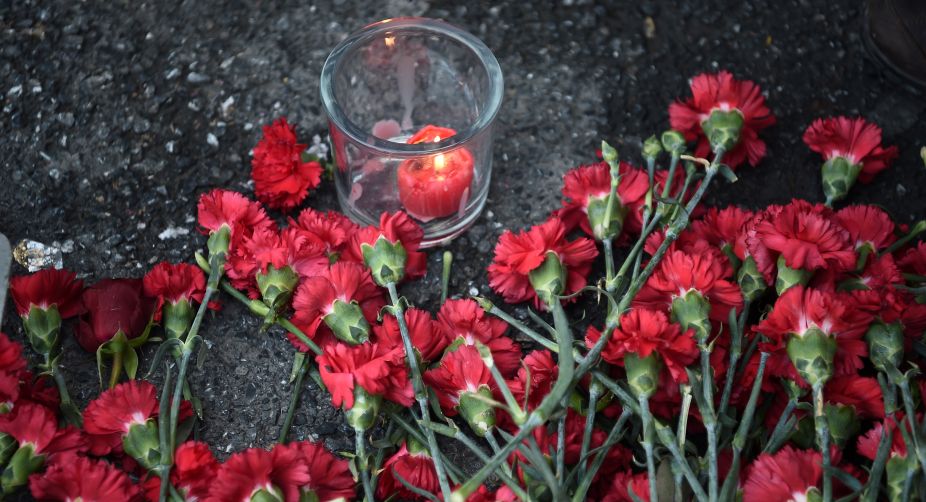
Bodies of film producer-realtor Abis Rizvi and fashion designer Khushi Shah, who were among 39 people killed in the Istanbul terror attack, arrived here early on Wednesday.

"The Turkish Airlines plane carrying the bodies landed at Mumbai airport shortly after 5 am," BJP MP Kirit Somaiya, who received the bodies at the airport, said.

While Rizvi's body has been taken to his home in suburban Bandra, Khushi's body was flown to Vadodara for cremation later today, he said.

Rizvi's burial will also take place on Wednesday.

The flight carrying the bodies left Istanbul last night.

Khushi and Rizvi were among the 15 foreigners who were killed when a gunman went on a rampage at the waterside Reina nightclub in Istanbul where revellers were celebrating the New Year.

Premier League: Giroud rescues Arsenal yet again

Four second-half goals were scored in a thriller at the Vitality Stadium on Tuesday night.

SNS | New Delhi |

Arsenal came back from three goals down to battle to a 3-3 draw against ten-man Bournemouth on Tuesday night in the English Premier League, with the result seeing them slip to fourth in the league table.

The Cherries had raced to a three-goal lead after some lackadaisical defending from the visiting side, with full-back Charlie Daniels opening the scoring as early on in the first half.

Granit Xhaka then compounded the Gunners’ misery by pushing Ryan Fraser on the edge of the box, giving referee Michael Oliver with no choice but to point to the spot. A silly challenge, considering the winger was going away from goal and Callum Wilson went down the middle with his spot-kick, doubling the home side’s advantage in the 21st minute.

And when Fraser scored his side’s third two minutes before the hour-mark, it seemed to be game-over.
Credit to Arsenal, however, as Alexis Sanchez and Olivier Giroud sparked a stunning comeback as they avoided what could have been an embarrassing defeat.

Sanchez headed in from close range in the 70th minute to reduce the deficit before substitute Lucas Perez scored a stunning volley five minutes later to renew Arsenal’s hopes.

After Simon Francis was given his marching orders in the 83rd minute, another Arsenal goal seemed inevitable and it came via their French striker, Giroud, whose glancing header beat Artur Boruc in the 92nd minute to earn a vital point at the Vitality stadium (pun unintended).

Considering the circumstances of the point, Arsenal will have to be content with avoiding defeat, but with league leaders Chelsea eight points clear with a game in hand, perhaps it will be another season of frustration for Gunners fans.

Mark Hamill pens tribute to Carrie Fisher

IANS | Los Angeles |

Actor Mark Hamill has written an emotional goodbye letter to his Star Wars late co-star and friend Carrie Fisher, who passed away last week age 60.

The letter has been published by hollywoodreporter.com.

"When you were in her good graces, you couldn't have more fun with any person on the planet… And then you could go 180 degrees opposite, where you were furious with one another and wouldn't speak for weeks and weeks," wrote Hamill, who played Fisher's onscreen brother in the Star Wars movies.

"But that's all part of what makes a relationship complete. It's not all one sided. Like I say, she was a handful. She was high maintenance. But my life would have been so much drabber and less interesting if she hadn't been the friend that she was.

"She was able to make you feel like you were the most important thing in her life,' Hamill explained. 'I think that's a really rare quality," he added.

The actor recalled the first time he met Fisher when she was 19 and he was 24. He recounted how they went for dinner the night before they began filming Star Wars.

"I mean she was just so instantly ingratiating and funny and outspoken. She had a way of just being so brutally candid. She was telling me stuff about her stepfather, about her mom, about her father Eddie Fisher – it was just harrowing in its detail.

"I kept thinking, 'Should I know this?' I mean, I wouldn't have shared that with somebody that I had trusted for years and years and years. But she was the opposite. She just sucked you into her world. I was just in awe of her. She was so committed to joy and fun and embracing life," he wrote.

Mark Hamill pens tribute to Carrie Fisher

IANS | Los Angeles |

Actor Mark Hamill has written an emotional goodbye letter to his Star Wars late co-star and friend Carrie Fisher, who passed away last week age 60.

The letter has been published by hollywoodreporter.com.

"When you were in her good graces, you couldn't have more fun with any person on the planet… And then you could go 180 degrees opposite, where you were furious with one another and wouldn't speak for weeks and weeks," wrote Hamill, who played Fisher's onscreen brother in the Star Wars movies.

"But that's all part of what makes a relationship complete. It's not all one sided. Like I say, she was a handful. She was high maintenance. But my life would have been so much drabber and less interesting if she hadn't been the friend that she was.

"She was able to make you feel like you were the most important thing in her life,' Hamill explained. 'I think that's a really rare quality," he added.

The actor recalled the first time he met Fisher when she was 19 and he was 24. He recounted how they went for dinner the night before they began filming Star Wars.

"I mean she was just so instantly ingratiating and funny and outspoken. She had a way of just being so brutally candid. She was telling me stuff about her stepfather, about her mom, about her father Eddie Fisher – it was just harrowing in its detail.

"I kept thinking, 'Should I know this?' I mean, I wouldn't have shared that with somebody that I had trusted for years and years and years. But she was the opposite. She just sucked you into her world. I was just in awe of her. She was so committed to joy and fun and embracing life," he wrote.

UN should be ‘cornerstone’ of multilateralism: Antonio Guterres

IANS | United Nations |

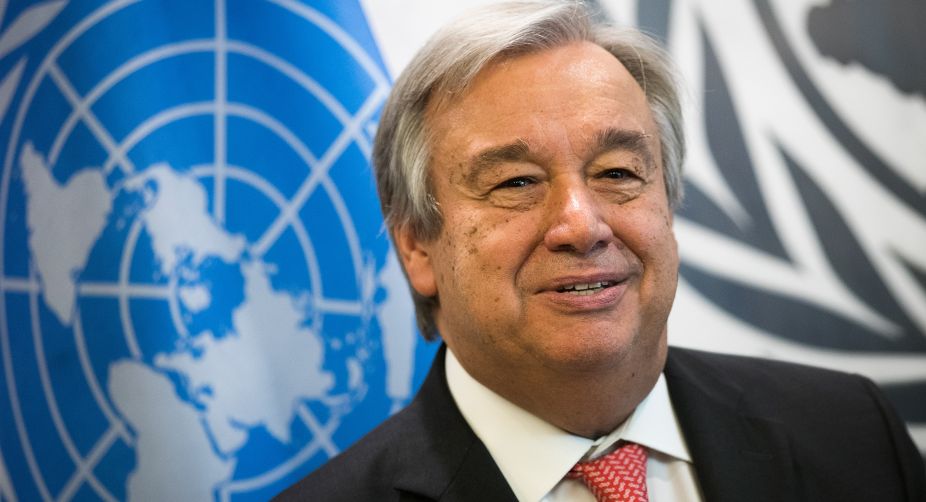
The new Secretary-General of the United Nations, Antonio Guterres, defended on Tuesday the role of the United Nations as the "cornerstone" of the multilateral approach to solving the worst problems affecting the international community.

Guterres, on his first day as head of the UN, delivered a brief message to United Nations employees in the main lobby of the organisation's headquarters, in which he repeated some of the principles he stood up for in his message last Sunday, EFE news reported.

The Secretary-General said he feels proud to take the place of South Korean Ban Ki-moon for an initial term of five years, and also promised to do everything possible to rid the United Nations of its "straightjacket of bureaucracy".

The Portuguese Guterres added that countries acting separately cannot possibly resolve the challenges currently facing the international community, which makes multilateral action positively essential.

"We need to recognise that only global solutions can address global problems and the UN is the cornerstone of that multilateral approach," he said.

The UN Secretary-General promised to promote a dialogue with the organisation's personnel and insisted that only working as a team can the United Nations' goals be accomplished.
 

UN should be ‘cornerstone’ of multilateralism: Antonio Guterres

IANS | United Nations |

The new Secretary-General of the United Nations, Antonio Guterres, defended on Tuesday the role of the United Nations as the "cornerstone" of the multilateral approach to solving the worst problems affecting the international community.

Guterres, on his first day as head of the UN, delivered a brief message to United Nations employees in the main lobby of the organisation's headquarters, in which he repeated some of the principles he stood up for in his message last Sunday, EFE news reported.

The Secretary-General said he feels proud to take the place of South Korean Ban Ki-moon for an initial term of five years, and also promised to do everything possible to rid the United Nations of its "straightjacket of bureaucracy".

The Portuguese Guterres added that countries acting separately cannot possibly resolve the challenges currently facing the international community, which makes multilateral action positively essential.

"We need to recognise that only global solutions can address global problems and the UN is the cornerstone of that multilateral approach," he said.

The UN Secretary-General promised to promote a dialogue with the organisation's personnel and insisted that only working as a team can the United Nations' goals be accomplished.
 

I don’t qualify for BCCI president’s post: Ganguly

The CAB has called a meeting on Wednesday to discuss the way forward.

PTI | Kolkata |

Former India captain and Cricket Association of Bengal president Sourav Ganguly on Tuesday denied he's a frontrunner to become the Board president after the latest turn of events at the BCCI.

Dismissing the suggestion that he was running for the post of BCCI president, Ganguly said at CAB office: "My name is coming up unnecessarily. I don't qualify. I have just completed one year (as the CAB president) and have got two more years left. I am not in the running (for the BCCI president's post)."

Asked whether the CAB would implement the Lodha Committee's reforms, Ganguly said the association had no option but to obey the SC order.

"We are having an office-bearers' meeting tomorrow (Wednesday) where we will decide on the future," he said.

The CAB has called a meeting on Wednesday to discuss the way forward.

The CAB chief said even though several of the present officials would be ineligible to contest in the association's polls, there would be others to fill the void.

Ganguly said CAB would hold its Special General Meeting only after the conduct of the third ODI between India and England at the Eden Gardens on January 22.

I don’t qualify for BCCI president’s post: Ganguly

The CAB has called a meeting on Wednesday to discuss the way forward.

PTI | Kolkata |

Former India captain and Cricket Association of Bengal president Sourav Ganguly on Tuesday denied he's a frontrunner to become the Board president after the latest turn of events at the BCCI.

Dismissing the suggestion that he was running for the post of BCCI president, Ganguly said at CAB office: "My name is coming up unnecessarily. I don't qualify. I have just completed one year (as the CAB president) and have got two more years left. I am not in the running (for the BCCI president's post)."

Asked whether the CAB would implement the Lodha Committee's reforms, Ganguly said the association had no option but to obey the SC order.

"We are having an office-bearers' meeting tomorrow (Wednesday) where we will decide on the future," he said.

The CAB has called a meeting on Wednesday to discuss the way forward.

The CAB chief said even though several of the present officials would be ineligible to contest in the association's polls, there would be others to fill the void.

Ganguly said CAB would hold its Special General Meeting only after the conduct of the third ODI between India and England at the Eden Gardens on January 22.

Magnitude 7.2 quake hits near Fiji; tsunami alert issued

AP | Nadi (Fiji) |

Authorities say a magnitude 7.2 earthquake hit near the Fiji Islands, causing a tsunami warning for parts of the pacific near the nation in the south Pacific Ocean.

The US Geological Survey says the earthquake hit a part of the ocean about 227 kilometers southwest of Nadi. The agency says the quake is 10 kilometers deep.

The agency says a tsunami warning has been issued for parts of the Pacific located within 300 kilometers of the quake. But no such warning has been issued for the Hawaiian Islands.

A 2004 quake and tsunami killed a total of 230,000 people in a dozen countries, most of them in Aceh, Indonesia.

Magnitude 7.2 quake hits near Fiji; tsunami alert issued

AP | Nadi (Fiji) |

Authorities say a magnitude 7.2 earthquake hit near the Fiji Islands, causing a tsunami warning for parts of the pacific near the nation in the south Pacific Ocean.

The US Geological Survey says the earthquake hit a part of the ocean about 227 kilometers southwest of Nadi. The agency says the quake is 10 kilometers deep.

The agency says a tsunami warning has been issued for parts of the Pacific located within 300 kilometers of the quake. But no such warning has been issued for the Hawaiian Islands.

A 2004 quake and tsunami killed a total of 230,000 people in a dozen countries, most of them in Aceh, Indonesia.

A Doval hand in Delhi’s affairs

Arati R Jerath |

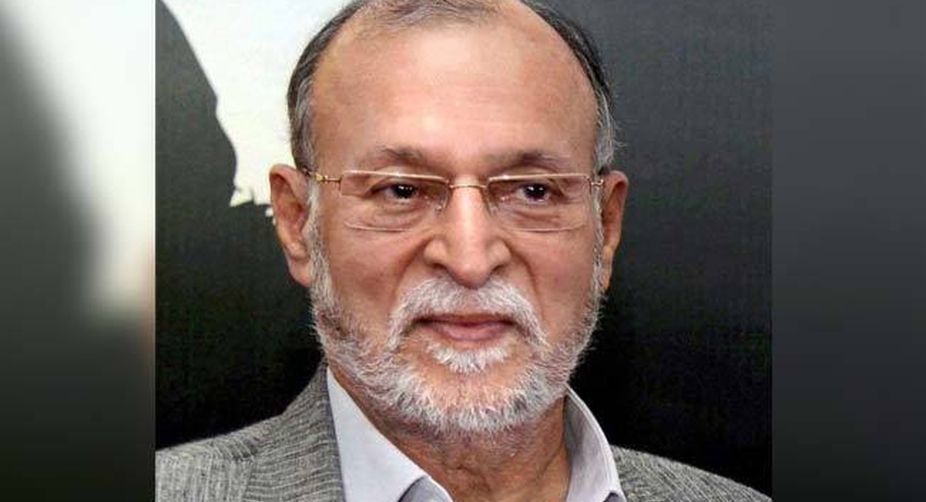
The appointment of Anil Baijal as Delhi’s new Lt Governor is expected to bring National Security Advisor Ajit Doval into play in the affairs of the Capital. The PM’s principal secretary Nripen Mishra was the go-to person for former LG Najeeb Jung. Political watchers believe that Doval will now take over the Delhi portfolio on behalf of the Centre and work closely with Baijal.

The Baijal-Doval aixs is an old one. Both were part of L K Advani’s core team when the BJP patriarch was union home minister in the Vajpayee government. Doval was a key person in the Intelligence Bureau while Baijal was Advani’s trusted home secretary.

Baijal’s shift to Vivekananda Foundation started by Doval was a natural progression. In fact, when Narendra Modi took over as prime minister, Baijal’s name figured prominently as one of the choices for principal secretary. Doval was one of his big backers. Although he lost out to Nripen Mishra, it was widely believed that Baijal would be given an important assignment sooner rather than later.

His name came up again to succeed N N Vohra as J & K governor. But the situation in the Valley has been so volatile that the Centre decided against a change of guard at the top till normalcy returns.

The first indication that Baijal was tipped for an assignment related to Delhi came when M M Kutty was appointed chief secretary. Kutty is known to be close to Baijal. Modi wanted Kutty’s name to be run past Baijal before the appointment. Significantly, Jung was deliberately kept out of the loop on this.

Doval has rarely attended a Delhi function. But he did make it a point to be present when Baijal was sworn in as LG. Pure friendship may have motivated him to come but for Delhi watchers, his presence was an indication of things to come as the Baijal era begins in the Capital.

Youth troika?

While there is much talk of a possible electoral pact between the Akhilesh faction of the Samajwadi Party, the Congress and RLD, not many know that scions of the families that run these three political parties have been in touch for a long time and are good friends now.

Akhilesh, Rahul Gandhi and Jayant Chaudhary, who is heir-in-waiting to take over RLD, apparently talk to each other directly and regularly over phone and through SMS. This is independent of their parents who often have no clue what their kids are up to. And much to everyone’s frustration, they have not kept party elders in the loop either.

The push for a grand SP-Congress-RLD alliance is coming from the three political scions. Now that Akhilesh Yadav has revolted, it remains to be seen whether the friendship will mature into a political alliance. Will the troika form a youth front to take on Modi and Mayawati?

CBI director

Suspense continues over the appointment of the next CBI chief as the Modi government’s plans of confirming Gujarat cadre officer Rakesh Asthana in the post seem to be running into rough weather.

Several hurdles have come up. One is that Asthana has not yet been empanelled as a special director. He remains an additional director and is therefore too junior to be appointed director of CBI.

Another problem is a Supreme Court judgement that the choice of a CBI director should be from among serving officers of the four senior-most IPS batches. Asthana belongs to the 1984 batch. There are serving officers from the 1979, 1980, 1981 and 1982 batches who ought to be considered as per the SC order. This virtually rules Asthana out.

A third issue that has cropped up is the mishandling of the arrest of former Air chief S P Tyagi in the Agusta Westland bribery case. Tyagi had to be released on bail after the Supreme Court rapped the CBI for not doing its homework and presenting substantive evidence of a money trail. This is being seen as a black mark against Asthana in his first big case as acting CBI director.

The Modi government is now in a fix which is why it continues to postpone holding the meeting of the three-member appointment committee. The members of this committee are the Prime Minister, Leader of Opposition and Chief Justice of India. Congress leader in the Lok Sabha who is nominated to fill the position of LoP, Mallikarjuna Kharge, has written a protest letter to the PM asking why the meeting is not being held. This is the first time in 10 years that the CBI is led by an acting director.

Backing out

There was a minor ripple when President Pranab Mukherjee suddenly called off a visit to the Maulana Azad Urdu University in Hyderabad recently. He was to give a convocation address to graduating students of the university.

He had accepted the invitation but cancelled at the last minute. Embarrassed university authorities put out a story that the President had taken ill and could not be present.

Interestingly, the President’s team released photographs of Mukherjee on his morning walk that day. It was done almost as if to contradict the version of the university. The move suggested that the President was unhappy about certain reports he had received about the university and that’s why he dropped out at the last moment.

The university’s chancellor is Zafar Sareshwala from Gujarat. Sareshwala is an unabashed Modi bhakt and had got into trouble with his community for praising the Prime Minister.

Respecting the rights of homeless people

Bharat Dogra |

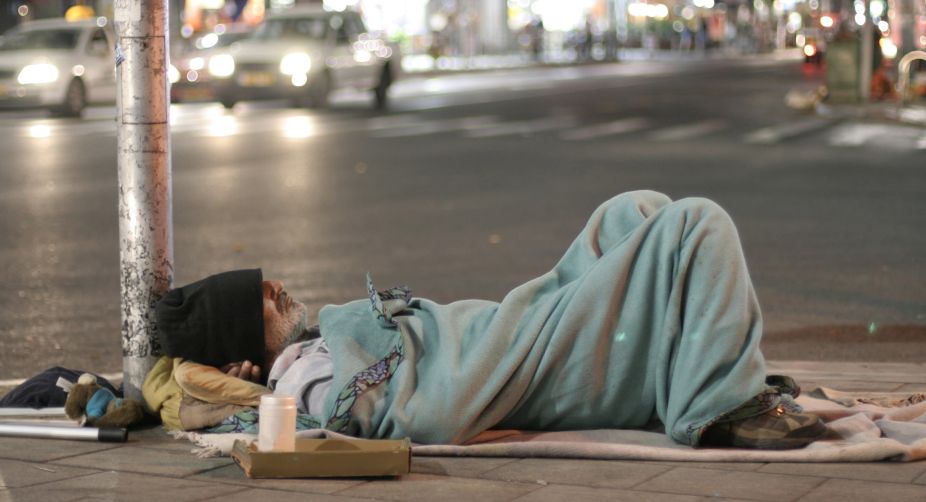
When working hard at our workplace or travelling in difficult conditions, we comfort ourselves with the thought of resting after reaching home, but what if there is no home to go to? This is the cruel reality for millions of homeless people in our country. The precise number is difficult to provide as homeless people are most likely to be left out in census counts. Indications are that their number is well in excess of 3 million. This number is likely to go up significantly if those on the verge of homelessness or very precariously housed people are also included.

Homeless people are most exposed to all weather extremes, cold waves as well as torrential rains, and this is just one of the reasons which exposes them more to illness and disease. Most homeless people also suffer from varying levels of hunger and malnutrition as assured or adequate income to meet basic minimum needs is not available to the overwhelming majority of them. While suffering the most from hunger they are the ones who are least likely to get subsidised food from ration shops due to lack of residence proof. Another reason is the denial of essential sanitation facilities and sometimes even clean drinking water. Vulnerability to mental health problems is also very high. The homeless are also most exposed to road accident injuries as well as workplace accidents. They are also the ones who are least likely to be able to access proper medical treatment—many of them do not have the basic identity papers for obtaining care in government hospitals.

The homeless face high levels of insecurity. This insecurity comes on the one hand from goons and criminals who exploit and terrorise them in various ways. On the other hand, some insecurity also comes ironically from policemen who often beat them indiscriminately or pick them up to send them forcibly to beggars’ homes.

These problems are particularly acute for homeless women and children. Given the increasing insecurity generally of women in many cities, one shudders to think of what homeless women have to endure. They as well as homeless children are very vulnerable to sexual exploitation. Children are vulnerable also to substance abuse. The problems of homeless people have been generally discussed in the context of big cities such as Delhi and Mumbai, while the problems of homeless people living in smaller urban agglomerations have been almost completely neglected. However, as I found during a recent visit to Sumerpur town of Pali district (Rajasthan), migrant tribal workers from remote villages were spending their night in a most inhabitable part of the town, plunged in darkness, denied any facilities, exposed not just to mosquitos but even scorpions and snakes. With the accentuation of the livelihood crisis as well as increasing social disintegration, the number of homeless people in India is increasing. In some places the slum dwellers pushed to the outskirts of cities and far away from previous livelihoods as a part of slum demolition drives have been forced to start living as homeless people near their employment places. To give an example, a community engaged in the highly creative work of collecting used clothes in exchange for new utensils and then selling clothes after mending and cleaning them was based in Raghubir Nagar area of West Delhi where they had their huts as well as work sheds. Their huts were demolished creating a livelihoods crisis as they were sent far away. Finally, to save their work several of them had to stay back at night in the open as homeless people.

Government efforts to help homeless people are confined mainly to providing them shelters at night, and even these efforts pick up mainly during the winter months. But when other government policies, sharp inequalities and social disintegration are causing an increase in the number of homeless people these efforts can have only a limited impact. Despite this limitation, however, a shelter-based approach can also give some good results if these shelters become a hub for integrating several needs of homeless people, combining safety, nutrition, health and information with shelter. Good results can be realised if volunteers from within the homeless people can be given important responsibilities and their close involvement is assured. They will need some training and motivational support, and with such modest help they can play a very important role in taking forward the programmes for helping the homeless.

Giving such responsibility to carefully selected representatives of the homeless along with adequate budgetary support is possible once there is recognition of and respect for their rights. Most homeless work in very adverse conditions to not only support themselves but also to send badly needed economic support to elderly people, children and women in remote villages. These include villages affected by various disasters. Initiatives that help homeless people in cities also help their dependents in villages. Hence the needs of homeless people should get high priority in urban planning and governance.

The writer is a free-lance journalist who has been involved with several social movements and campaigns.

Reformed farmland

Jaydev Jana |

The farmer is the only man in our economy who buys everything in retail, sells everything at wholesale, and pays the freight both ways. — John F Kennedy

The development paradigm has traditionally treated agriculture as the prime mover, the engine to sustain people, a promoter of property and power, the launching pad for development as well as the foundation on which the economic edifice can and does rest. The agricultural commodity market remains at the heart of agricultural development and is an important element in achieving the farmer’s well being. The availability of the market is as important as irrigation. It relates to the quantity that has to be grown, the method of cultivation, and the method of profitable sale.

The importance of this crucial aspect has largely been ignored by the agricultural policy makers and mainstream economists. Since independence, the major problem that confronts small and marginal farmers is the lack of proper marketing. In spite of several attempts to reform, agricultural markets largely suffer from poor competitiveness, fragmentation, inefficiency, presence of middlemen, and frequent price manipulations. Indeed, agriculture in India has now become a relatively unrewarding and hopeless profession due to the unfavourable price regime.

Farmers are on a treadmill in which the downward pressure on the price that they receive — and/or the upward pressure on inputs needed for production — force them to adopt new technologies to enhance the scale of production in an attempt to continue in the farming profession. But farming is one of the few enterprises that pays retail prices for inputs and sells its produce at wholesale prices. As the financial returns of farmers decline per unit of output, in order to reap the same returns as before the farmers are generally advised that they must expand operations. The treadmill that it creates is indicated by the adage, “We grow more corn to feed more cows, to make more milk, to buy more land, to grow more corn.” Those who survive under the process of ‘scale enlargement’ usually have large enterprises, a good education, and enormous working capital. They are highly organised and enjoy a premium for the commodities they sell because of their large quantity. They pay less for inputs as also interest on borrowed money, and are in a position to earn a profit through the use of hired labour.

But as regards small and marginal farmers, a mere increase in production with improved farming techniques is not the panacea for the problems that they face. Indian agriculture is dominated by small holders, with 85 per cent of all operated holdings being marginal or small and 63 per cent being just marginal. Adoption of technology enables them to produce more, but their produce is sold for less. The scenario can aptly be described with the words of Joannes Stobaeus, ‘Farming is a most senseless pursuit, mere labouring in a circle. You sow that you may reap, and then you reap that you may sow. Nothing ever comes of it.’ A similar trend has been noticed in livestock farming as well.

The share of farmers in the total retail price has declined and the marketing/trader share has increased. The average farmers are so poor and indebted that they are not in a position to wait for better prices. A recent survey conducted by the National Sample Survey Organisation (NSSO) revealed that nearly 50 per cent of India’s 90 million farmers were indebted to either banks or money lenders. They are compelled to dispose of their products immediately after harvest to clear their dues, so that they can borrow again. The prices remain low at the time of harvest. Thus the semi-feudal tenure-based relationship and the interlocked contracts lead to ‘forced commerce’ or ‘distress sales’ in Indian agriculture. Immediately after the harvest, the supply consists of the completely unrewarding sales of indebted farmers. Worse still, contracts for agricultural commodities are interlocked with credit in order to depress commodity prices below those which would result from unconstrained transactions, and raise interest rates above those of the ‘market’.

The policies on procurement and Minimum Support Price (MSP) for some agricultural commodities, intended to plug ‘distress sale’, have been of little help to farmers. The MSP fixed by the government has not been regulated effectively and it remains on paper due to lack of a proper marketing system, regulations, policies, awareness, punishment etc. As a result, while the traders and rich farmers profit from MSP, poor and marginal farmers are victimised by exploitative prices.

There are many ways by which farmers can dispose of their surplus produce. Commodities are sold to village money-lenders, the rural markets, and cooperative marketing societies. According to one estimate, around 85 per cent of the wheat, 75 per cent of oilseeds and 35 per cent of cotton in Punjab are sold by farmers in the villages. Often the money lenders act as commission agents of the wholesale traders. The chain of middlemen in agricultural marketing is so large that the share of farmers is reduced substantially. For instance, a study has revealed that farmers get only about 53 per cent of the price of rice, 31 per cent being the share of middlemen and the remaining 16 per cent being the marketing cost. In case of vegetables and fruit the share is even less — 39 per cent in the first and 34 per cent in the latter. The share of middlemen in the case of vegetables was 29.5 per cent and in case of fruit 46.5 per cent. Some of the intermediaries in the agricultural marketing system are village traders, brokers, wholesalers and retailers, money-lenders, and so on. The number of unregulated markets in the country is substantially large. Brokers, taking advantage of the ignorance and illiteracy of farmers, use unfair means to cheat the peasantry both in terms of weight and quality.

The Government of India introduced major reforms by implementing the Agricultural Produce Marketing (Regulation) Act (APMRA) during the 1960s and Seventies. This has been a major driving force behind the achievements of the Green Revolution. But the gains brought about by APMRA have been diluted over time. Markets are not adequately regulated. Under the APMRA, the prices are determined and driven by Agricultural Produce Market Committee (APMC). The monopoly rights enjoyed by APMCs on the first sale of commodities have been disappointing. However, political will is required to dismantle this centralised monopoly and make it compete with other players such as big retailers. Integrating fragmented agricultural markets can ensure a better deal for farmers and also help consumers who suffer frequent price increases on account of local shortages.

Small holders have to contend with the risk of high market-price fluctuation risk. Many are unaware of the daily prices and often depend on middlemen, who exploit them. There is a marginal presence of modern channels like retail (supermarket) buyers, food processors, and wholesale cash ‘n’ carry players. The supermarkets procure only ‘A’ grade produce, offer APMC market-based prices and do not buy regularly with pre-committed orders. The contracting agencies still do not attend fully to the market risk, let alone the production risks of the growers. Indian agriculture is largely an unorganised sector and the root cause of the crisis is the income-deficit. This calls for marketing extension, not just production extension. This would mean better product planning at the farmer’s level, provision of market information, securing/accessing markets for farmers, provision of alternative markets and market orientation in terms of improved practices. To safeguard farmers from exploitation by middlemen the plan called ulavar santhal (farmers’ market), where the farmers can directly sell their products at reasonable prices to consumers, can be introduced.

The writer is a retired IAS officer.

Defy and perish

Editorial |

Since defiance of the apex court has ominous ramifications for national governance, there can be no divided opinion on the removal of top office-bearers of the BCCI by a three-member bench headed by the Chief Justice. However, that does not translate into blanket endorsement of the July 18 order by which the court mandated implementation of the recommendations of the Lodha committee.
That the time to debate those recommendations has judicially expired does not mean that questions will no longer be raised about their validity: hopefully, subsequently a less emotionally-charged bench will review the situation.

It was always somewhat controversial that a panel headed by a former Chief Justice should submit a document that would be adjudicated upon by a court over which he had once presided: and surely the “majesty of the law” would have been enhanced if the Lodha panel had declined to oversee implementation of its own recommendations.

Legal experts may see nothing improper in that, to many a layman it “just doesn’t smell good”. What began as a probe into a match-fixing scandal — how many of the “fixers” have been criminally “fixed” — snowballed into populist action to “re-form” (as opposed to reform) the administration of the game. Anurag Thakur, Ajay Shirke and their predecessors may not have been the most upright of administrators, but they are not the villains their Lordships seem to damn them.

Few openly use the term “judicial overreach”, but some of the language used by the court in recent times clearly invites the description of “intemperate”. It does the image of the judiciary no credit when some members of the bench are seen as “bullies”.

For while over the years the BCCI may have blundered and cut corners, it has done more for players and ex-players than any other sports body in the country; a pity that their Lordships did not recognise that, and lapped up the views expressed by disgruntled elements.

All that, however, is history. What is now awaited is the arrangement their Lordships will put in place to retain the special “space” that cricket commands. For the alleged “commercialisation” of the game has generated the funds for new world-class stadiums, etc., as well as promotional and training facilities that produced international superstars.

Those “developments” were neither accidental nor incidental, and the apex court will be required to ensure that the all-round success of the game is sustained — and not just in the series of matches already scheduled.

“Success” may have gone to the heads of the BCCI leaders, it also triggered considerable jealousy because the game, largely, financed itself. If the judicial action does not preserve financial and administrative autonomy, what is being played is “not cricket”.

Obama strikes back

Editorial |

As he goes through the wrap-up motions of his eight-year Presidency, Barack Obama has effected a robust reprisal against Russia… barely a fortnight after he pledged to respond to cyber-attacks by Moscow during the elections and “at a time and place of our choosing”. He has chosen the time, he has chosen the place — during vacation in Hawaii — when jollity is the flavour of the season around the world.

Rarely in American history has the election to the Oval Office influenced foreign policy so profoundly, throwing up a stark difference in geostrategy between the outgoing President and the likes of Donald Trump.

Last week’s cache of sweeping new sanctions entails the expulsion of 35 Russian diplomats in retaliation against the cyber-attacks on the Democratic National Committee (DNC), Hillary Clinton’s campaign and other political organizations, in an attempt to influence the election in favour of the Republican candidate. Much as Trump nudges towards the Kremlin — in a dramatic reversal of Cold War animosity — President Obama has pledged further action, even alerting Americans that they “should be alarmed by Russia’s actions”.

Significant too is the timing of the counter-blast; he has utilised his vacation to convey a pregnant statement across the Atlantic — “I have issued an executive order that provides additional authority for responding to certain cyber activity that seeks to interfere with or undermine our election processes and institutions, or those of our allies or partners.”

On closer reflection, he has spelt out his agenda against Russia three weeks before the inaugural grandstanding and the anticipated paradigm shift in bilateral ties. As much is plain from his caveat — “I have sanctioned nine entities and individuals: the GRU and the FSB, two Russian intelligence services; four individual officers of the GRU; and three companies that provided material support to the GRU’s cyber operations.” He has also announced the closure of two Russian complexes in Maryland and New York.

In the net, Trump at the threshold is likely to be on a sticky wicket vis-a-vis US ties with Russia. Radically different is the approach to foreign policy — most importantly in relation to Russia, China, and Taiwan. It is the quadrilateral equation that will be on test as he steps into the White House in three weeks’ time.

And this is no less critical than the change in the party in power and governance in the larger scheme of things. The measure of success that Putin has scored with the Russo-Turkish agreement on Syria has been neutralised fair and square.

More crippling sanctions are on the anvil and Mr Obama has hinted that these remain “unstated”. It is imperative for him to counter the “very disturbing Russian threats to US national security”. This is the fineprint of the parting shot to the Kremlin whose diplomacy has stumbled from Ukraine to the US elections 2016.