Logo

Delhi Police scans threats issued to Gurmehar Kaur

Abhay Singh | New Delhi |

Delhi Police is investigating three types of comments in the case of Gurmehar Kaur, a 20-year-old Delhi University student and army martyr's daughter, who was allegedly abused by netizens. Police are scanning comments, trolls and abuse comments.

"Police are also preparing a list of the people who have issued threats," police sources said.

In social media, basic comments and trolls are natural that's why police are  not giving much attention like abuse, but they are also not taking them out of context.

"Cases cannot be filed against the basic comments," police sources added.

Police sources further claimed that they have identified several handlers who have abused the DU girl, some of the accounts have been de-activated by the users but it will no affect the investigation.

After Gurmehar moved the Delhi Commission for Women (DCW) with her complaint against those allegedly threatening her with rape and violence, Delhi Police registered an FIR against unknown persons under Sections 354A (sexual harassment and punishment for sexual harassment), 506 (punishment for criminal intimidation) of IPC and Section 67 of the IT Act.

Sources claimed that police are identifying the areas from where the accounts were active during the time when abuses were hurled at the girl.

Meanwhile, Delhi Police has been in touch with her through telephone calls and emails.

However, Gurmehar still has not given the investigators the URL of her abusers that will help identify the user accounts responsible for the incident. The police said they are in touch through the email, but are yet to receive the links.

“From the first day itself, the cyber cell has been investigating the case on the basis of the screen shots, and we can’t book some users just on the basis of screen shots. How can the police filter the real users from non-pertinent threats?", said a source.

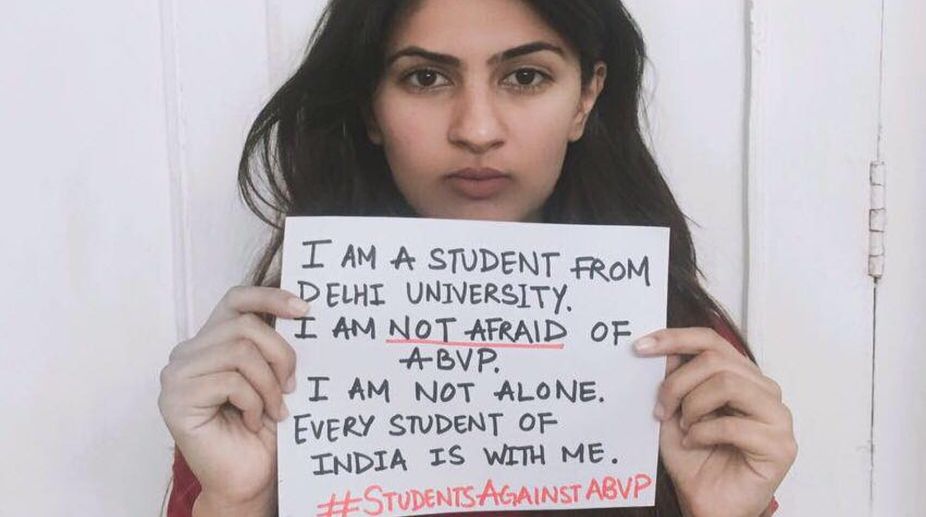
Gurmehar, daughter of martyred Captain Mandeep Singh, started the social media campaign, "I am not afraid of ABVP" following recent violence in and around Ramjas College on DU's North Campus. It went viral and received massive support from students across universities.

Police also said they have written to various social networking sites and it will take about 15-20 days for them to answer their queries.

Delhi Police scans threats issued to Gurmehar Kaur

Abhay Singh | New Delhi |

Delhi Police is investigating three types of comments in the case of Gurmehar Kaur, a 20-year-old Delhi University student and army martyr's daughter, who was allegedly abused by netizens. Police are scanning comments, trolls and abuse comments.

"Police are also preparing a list of the people who have issued threats," police sources said.

In social media, basic comments and trolls are natural that's why police are  not giving much attention like abuse, but they are also not taking them out of context.

"Cases cannot be filed against the basic comments," police sources added.

Police sources further claimed that they have identified several handlers who have abused the DU girl, some of the accounts have been de-activated by the users but it will no affect the investigation.

After Gurmehar moved the Delhi Commission for Women (DCW) with her complaint against those allegedly threatening her with rape and violence, Delhi Police registered an FIR against unknown persons under Sections 354A (sexual harassment and punishment for sexual harassment), 506 (punishment for criminal intimidation) of IPC and Section 67 of the IT Act.

Sources claimed that police are identifying the areas from where the accounts were active during the time when abuses were hurled at the girl.

Meanwhile, Delhi Police has been in touch with her through telephone calls and emails.

However, Gurmehar still has not given the investigators the URL of her abusers that will help identify the user accounts responsible for the incident. The police said they are in touch through the email, but are yet to receive the links.

“From the first day itself, the cyber cell has been investigating the case on the basis of the screen shots, and we can’t book some users just on the basis of screen shots. How can the police filter the real users from non-pertinent threats?", said a source.

Gurmehar, daughter of martyred Captain Mandeep Singh, started the social media campaign, "I am not afraid of ABVP" following recent violence in and around Ramjas College on DU's North Campus. It went viral and received massive support from students across universities.

Police also said they have written to various social networking sites and it will take about 15-20 days for them to answer their queries.

BJP wants paramilitary troops at UP counting centres

Statesman News Service | New Delhi |

Ahead of the 11 March counting of ballots for the seven-phased elections in Uttar Pradesh, the BJP has demanded deployment of central paramilitary forces at all the counting centres in the state.

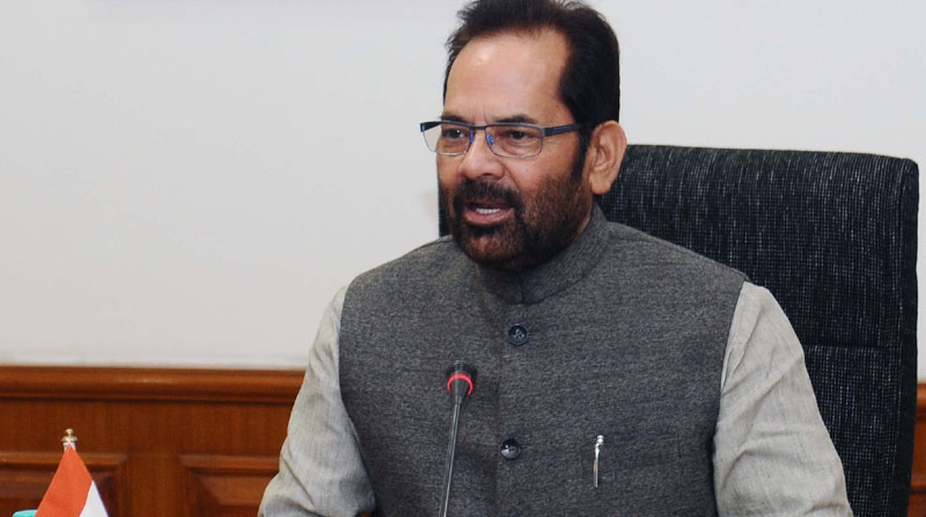
The demand was made by the BJP senior leader and central minister Mukhtar Abbas Naqvi came even as the political parties gear up for the last phase of polls in Uttar Pradesh and Manipur scheduled for 8 March.

Naqvi in a tweet sought deployment of central paramilitary forces inside all the counting centres in UP. This comes close on the heels of a recent BJP memorandum to the Chief Election Commissioner and Election Commissioners in which the party alleged deletion of names of valid voters from the voters list in the state and demanded those left out be allowed to cast their ballots.

The party on Monday also drew the Election Commission’s attention to the alleged incidents of ‘booth capturing’ in Manipur during the first phase of polling in the state. Naqvi demanded re-polling in all the booths which reported incidents of booth capturing.

“BJP complained to EC regarding booth capturing at several booths in 1st phase of Manipur Assembly polls & demanded re-poll on these booths,” Naqvi tweeted.

In preparation for the smooth counting of votes in the five states of Goa, Punjab, Uttarakhand, Uttar Pradesh and Manipur the Election Commission has issued directions to the respective CEOs for making adequate security arrangements at all the 157 counting stations on March 11.

The Commission has also directed Chief Electoral Officers to make all counting arrangements by the night of 7 March. Videos will capture the movements of EVMs and their secure upkeep.

There will be 75 counting centres in Uttar Pradesh, 53 in Punjab, 15 in Uttarakhand, 12 in Manipur and 2 in Goa.  

BJP wants paramilitary troops at UP counting centres

Statesman News Service | New Delhi |

Ahead of the 11 March counting of ballots for the seven-phased elections in Uttar Pradesh, the BJP has demanded deployment of central paramilitary forces at all the counting centres in the state.

The demand was made by the BJP senior leader and central minister Mukhtar Abbas Naqvi came even as the political parties gear up for the last phase of polls in Uttar Pradesh and Manipur scheduled for 8 March.

Naqvi in a tweet sought deployment of central paramilitary forces inside all the counting centres in UP. This comes close on the heels of a recent BJP memorandum to the Chief Election Commissioner and Election Commissioners in which the party alleged deletion of names of valid voters from the voters list in the state and demanded those left out be allowed to cast their ballots.

The party on Monday also drew the Election Commission’s attention to the alleged incidents of ‘booth capturing’ in Manipur during the first phase of polling in the state. Naqvi demanded re-polling in all the booths which reported incidents of booth capturing.

“BJP complained to EC regarding booth capturing at several booths in 1st phase of Manipur Assembly polls & demanded re-poll on these booths,” Naqvi tweeted.

In preparation for the smooth counting of votes in the five states of Goa, Punjab, Uttarakhand, Uttar Pradesh and Manipur the Election Commission has issued directions to the respective CEOs for making adequate security arrangements at all the 157 counting stations on March 11.

The Commission has also directed Chief Electoral Officers to make all counting arrangements by the night of 7 March. Videos will capture the movements of EVMs and their secure upkeep.

There will be 75 counting centres in Uttar Pradesh, 53 in Punjab, 15 in Uttarakhand, 12 in Manipur and 2 in Goa.  

SC notice to Centre, RBI on plea over depositing old notes

PTI | New Delhi |

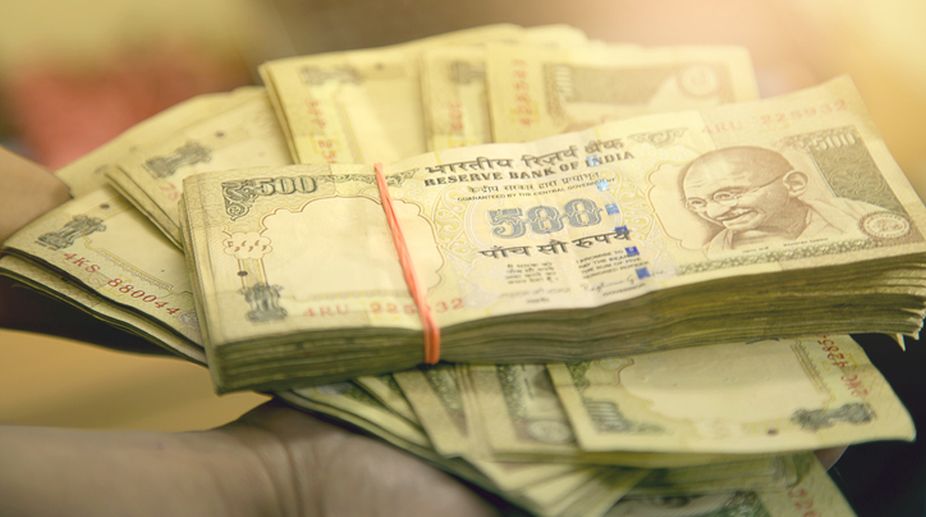
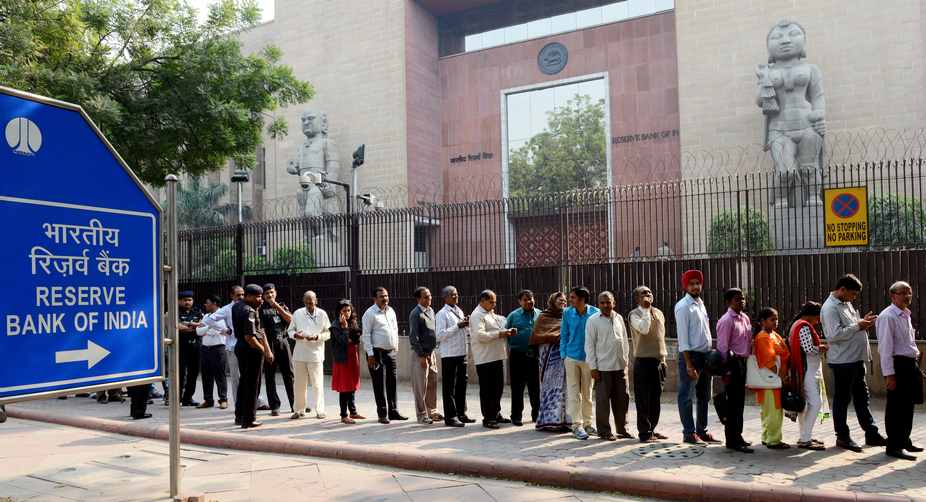
The Supreme Court on Monday asked the Centre and the RBI to reply as to why people were not being allowed to deposit demonetised currency notes till 31 March as promised.

"Issue notice returnable by 10 March," a bench of Chief Justice J S Khehar and Justices D Y Chandrachud and S K Kaul said and asked petitioner Sharad Mishra to serve the copy of its notice to the Centre and the Reserve Bank of India during the course of the day.

Several petitions were also filed by companies and individuals over the government going back on its decision to extend the date of depositing demonetised notes till 31 March.

The plea referred to the speech of Prime Minister Narendra Modi on 8 November 2016, when he said that citizens would be allowed to deposit the demonetised notes of Rs 500 and Rs 1,000 beyond the cut-off date of 31 December 2016 till 31 March 2017.

“There may be some who for some reason, are not able to deposit their old 500 or 1,000 rupee notes by 30 December 2016. They can go to specified offices of the Reserve Bank of India up to 31 March, 2017 and deposit the notes after submitting a declaration form," Prime Minister Narendra Modi said in his address to the nation on 8 November.

Subsequently, a notification was issued by RBI spelling out that people may deposit demonetised currency notes even after 31 December 2016, at specific RBI branches up to 31 March 2017, after complying with certain procedural requirements.

The central bank on 31 December designated its five offices in Mumbai, New Delhi, Chennai, Kolkata, and Nagpur to exchange defunct currency notes post the 50-day demonetisation period that ended on 30 December.

The bench also considered the argument that the RBI's last ordinance, which permits only those persons who were outside India during the stipulated period to deposit the demonetised currency notes till 31 March, is a breach of assurances given by the Prime Minister and the RBI.

SC notice to Centre, RBI on plea over depositing old notes

PTI | New Delhi |

The Supreme Court on Monday asked the Centre and the RBI to reply as to why people were not being allowed to deposit demonetised currency notes till 31 March as promised.

"Issue notice returnable by 10 March," a bench of Chief Justice J S Khehar and Justices D Y Chandrachud and S K Kaul said and asked petitioner Sharad Mishra to serve the copy of its notice to the Centre and the Reserve Bank of India during the course of the day.

Several petitions were also filed by companies and individuals over the government going back on its decision to extend the date of depositing demonetised notes till 31 March.

The plea referred to the speech of Prime Minister Narendra Modi on 8 November 2016, when he said that citizens would be allowed to deposit the demonetised notes of Rs 500 and Rs 1,000 beyond the cut-off date of 31 December 2016 till 31 March 2017.

“There may be some who for some reason, are not able to deposit their old 500 or 1,000 rupee notes by 30 December 2016. They can go to specified offices of the Reserve Bank of India up to 31 March, 2017 and deposit the notes after submitting a declaration form," Prime Minister Narendra Modi said in his address to the nation on 8 November.

Subsequently, a notification was issued by RBI spelling out that people may deposit demonetised currency notes even after 31 December 2016, at specific RBI branches up to 31 March 2017, after complying with certain procedural requirements.

The central bank on 31 December designated its five offices in Mumbai, New Delhi, Chennai, Kolkata, and Nagpur to exchange defunct currency notes post the 50-day demonetisation period that ended on 30 December.

The bench also considered the argument that the RBI's last ordinance, which permits only those persons who were outside India during the stipulated period to deposit the demonetised currency notes till 31 March, is a breach of assurances given by the Prime Minister and the RBI.

Complete remonetisation in 2-3 months?

Statesman News Service | New Delhi |

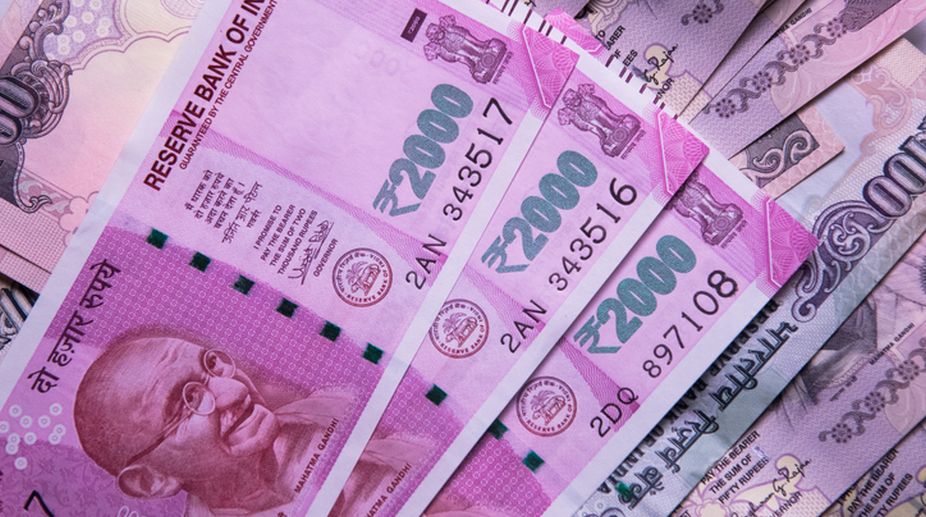
Reserve Bank of India (RBI) Deputy Governor Viral Acharya on Monday said the remonetisation process will be completed in the next two to three months as the process is going on at a fast pace.

Acharya added that the level of currency in circulation will be slightly lower than that during the pre-demonetisation period. “It will be slightly lower, but it is in that ballpark,” he said.

On 8 November last year, the government withdrew the legal tender status of Rs.500 and Rs.1,000 notes in its effort to curb black money in the economy. The high denomination currency was to the tune of Rs.15.5 lakh crore in circulation.

Acharya said the cash shortage in the economy is temporary, but there might be some spillover in the next quarter in some segments, especially for two-wheeler manufacturers. He said, “I'm not saying that the temporary impact is not hard on some parts of the economy, you would expect the effect to be temporary. There may be a couple of sectors like two-wheeler sales, where there is slightly slower rebound. My sense is things are probably coming back to normal."

Speaking on the GDP numbers released by the Central Statistics Organisation (CSO) last week, Acharya said, “our (RBI) GDP estimates were reasonably close to the CSO numbers, though the drivers could have been different. How much of the informal sector has been reflected other than because of its links with the formal sector is interesting and worth thinking about. We have to wait for a few quarters to say exactly where things are.”

 The GDP slowed marginally to 7 per cent during the October-December quarter, defying expectations of a sharper hit to economic activity due to currency replacement.

In his first public speech on 28 February after assuming office, Acharya had suggested fresh structures through which the non-performing assets faced by Indian banks could be resolved and called for a need of greater reforms in the sector.

Gross non-performing assets across 42 listed banks in India have increased to Rs 7 lakh crore of the end of December 2016, nearly double the amount reported at the end of the September 2015 quarter.

Acharya acknowledged that there has been little resolution of stressed assets. This is despite the fact that the RBI has put in place a number of mechanisms through which bad loans can be resolved.

Complete remonetisation in 2-3 months?

Statesman News Service | New Delhi |

Reserve Bank of India (RBI) Deputy Governor Viral Acharya on Monday said the remonetisation process will be completed in the next two to three months as the process is going on at a fast pace.

Acharya added that the level of currency in circulation will be slightly lower than that during the pre-demonetisation period. “It will be slightly lower, but it is in that ballpark,” he said.

On 8 November last year, the government withdrew the legal tender status of Rs.500 and Rs.1,000 notes in its effort to curb black money in the economy. The high denomination currency was to the tune of Rs.15.5 lakh crore in circulation.

Acharya said the cash shortage in the economy is temporary, but there might be some spillover in the next quarter in some segments, especially for two-wheeler manufacturers. He said, “I'm not saying that the temporary impact is not hard on some parts of the economy, you would expect the effect to be temporary. There may be a couple of sectors like two-wheeler sales, where there is slightly slower rebound. My sense is things are probably coming back to normal."

Speaking on the GDP numbers released by the Central Statistics Organisation (CSO) last week, Acharya said, “our (RBI) GDP estimates were reasonably close to the CSO numbers, though the drivers could have been different. How much of the informal sector has been reflected other than because of its links with the formal sector is interesting and worth thinking about. We have to wait for a few quarters to say exactly where things are.”

 The GDP slowed marginally to 7 per cent during the October-December quarter, defying expectations of a sharper hit to economic activity due to currency replacement.

In his first public speech on 28 February after assuming office, Acharya had suggested fresh structures through which the non-performing assets faced by Indian banks could be resolved and called for a need of greater reforms in the sector.

Gross non-performing assets across 42 listed banks in India have increased to Rs 7 lakh crore of the end of December 2016, nearly double the amount reported at the end of the September 2015 quarter.

Acharya acknowledged that there has been little resolution of stressed assets. This is despite the fact that the RBI has put in place a number of mechanisms through which bad loans can be resolved.

Advisory for Amarnath Yatra pilgrims: Go for a walk everyday

Statesman News Service |

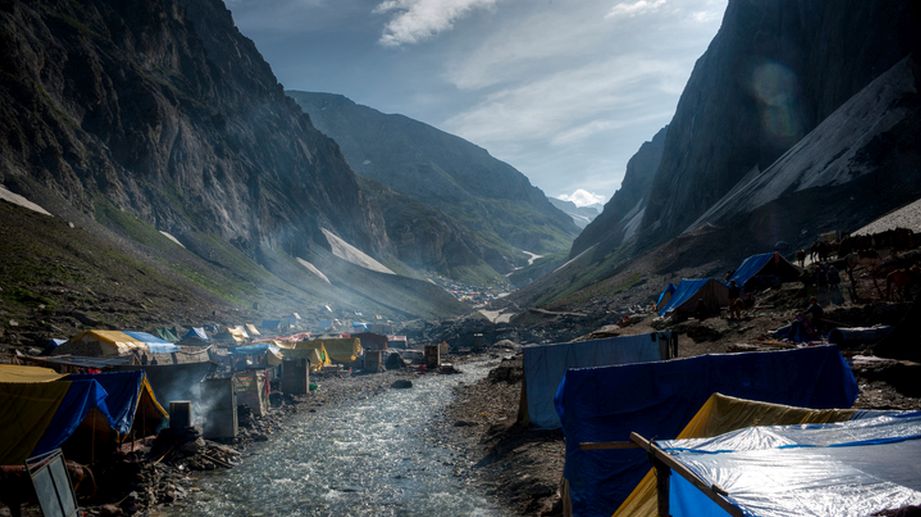
The Amarnath Shrine Board has issued a health advisory for pilgrims undertaking the Amarnath Yatra this year to prepare for the arduous journey by having a four to five kilometre walk every day, morning or evening, at least a month before the Yatra.

The Amarnathji Yatra starts this year on 29 June and continues till 7 August. The pilgrimage to the Holy Cave of Shri Amarnathji involves trekking at altitudes as high as 14000 feet. The Yatris may develop high altitude sickness with symptoms like loss of appetite, nausea, vomiting, fatigue, weakness and dizziness,

The advisory said the pilgrims should start deep breathing exercise and Yoga, particularly pranayam for improving oxygen efficiency of the body. The pilgrims should check with their physicians prior to travelling to higher elevations, if they had any old medical conditions.

The pilgrims should walk slowly, while ascending and take time to acclamatise, and relax for a short while on steep inclines. They should not ignore the symptoms of high altitude illness. “Don’t drink alcohol, caffeinated drink, or smoke,” the advisory said.

Advisory for Amarnath Yatra pilgrims: Go for a walk everyday

Statesman News Service |

The Amarnath Shrine Board has issued a health advisory for pilgrims undertaking the Amarnath Yatra this year to prepare for the arduous journey by having a four to five kilometre walk every day, morning or evening, at least a month before the Yatra.

The Amarnathji Yatra starts this year on 29 June and continues till 7 August. The pilgrimage to the Holy Cave of Shri Amarnathji involves trekking at altitudes as high as 14000 feet. The Yatris may develop high altitude sickness with symptoms like loss of appetite, nausea, vomiting, fatigue, weakness and dizziness,

The advisory said the pilgrims should start deep breathing exercise and Yoga, particularly pranayam for improving oxygen efficiency of the body. The pilgrims should check with their physicians prior to travelling to higher elevations, if they had any old medical conditions.

The pilgrims should walk slowly, while ascending and take time to acclamatise, and relax for a short while on steep inclines. They should not ignore the symptoms of high altitude illness. “Don’t drink alcohol, caffeinated drink, or smoke,” the advisory said.

‘Manmohan didn’t assert himself during UPA-II for strange reasons’

PTI | Chandigarh |

Manmohan Singh was not a "weak" prime minister, but for some "strange reasons" he decided not to assert himself during the second term of the UPA government, Congress leader Manish Tewari said on Monday.

Responding to questions after a book launch event here, Tewari said, "My personal take is that Manmohan Singh was not a weak Prime Minister.

"Had he been a weak PM, he wouldn't have gone ahead with the civil nuclear deal. But for some strange reasons, he decided, during the second term of the UPA, not to assert himself." 

Attacking Narendra Modi for his 'shamshan-kabristan' remark, he said it doesn't behove the prime minister's post and termed as "worrying" the BJP's bid to tailor the national discourse to its views.

"I will try and be non-partisan, but unfortunately when you are seeing the Prime Minister of the country bringing down the discourse to 'shamshan' and 'kabristan', it does not really augur well for the institution of the PM.

"It is one thing when you are campaigning to become the PM and it's another thing when you are the PM," he said.

"Therefore, when you speak as the PM, in every action, every articulation of yours, that statesmanship should come out," the former Union information and broadcasting minister said.

During a poll rally in Uttar Pradesh, Modi had stressed that there should be no discrimination on the basis of caste and religion. "If there is electricity in graveyard and during Ramzan, it must also be available in a crematorium and during Diwali," Modi had said.

Tewari said that he feels that there has been a "concerted attempt" to try and tailor the national discourse to BJP's views after the party came to power.

"What happened in FTII-Pune, what's happening in the censor board, what is being played out in the universities…

It's a premeditated, concerted attempt to adjust the national discourse and that's the most worrying tendency," he said.

‘Manmohan didn’t assert himself during UPA-II for strange reasons’

PTI | Chandigarh |

Manmohan Singh was not a "weak" prime minister, but for some "strange reasons" he decided not to assert himself during the second term of the UPA government, Congress leader Manish Tewari said on Monday.

Responding to questions after a book launch event here, Tewari said, "My personal take is that Manmohan Singh was not a weak Prime Minister.

"Had he been a weak PM, he wouldn't have gone ahead with the civil nuclear deal. But for some strange reasons, he decided, during the second term of the UPA, not to assert himself." 

Attacking Narendra Modi for his 'shamshan-kabristan' remark, he said it doesn't behove the prime minister's post and termed as "worrying" the BJP's bid to tailor the national discourse to its views.

"I will try and be non-partisan, but unfortunately when you are seeing the Prime Minister of the country bringing down the discourse to 'shamshan' and 'kabristan', it does not really augur well for the institution of the PM.

"It is one thing when you are campaigning to become the PM and it's another thing when you are the PM," he said.

"Therefore, when you speak as the PM, in every action, every articulation of yours, that statesmanship should come out," the former Union information and broadcasting minister said.

During a poll rally in Uttar Pradesh, Modi had stressed that there should be no discrimination on the basis of caste and religion. "If there is electricity in graveyard and during Ramzan, it must also be available in a crematorium and during Diwali," Modi had said.

Tewari said that he feels that there has been a "concerted attempt" to try and tailor the national discourse to BJP's views after the party came to power.

"What happened in FTII-Pune, what's happening in the censor board, what is being played out in the universities…

It's a premeditated, concerted attempt to adjust the national discourse and that's the most worrying tendency," he said.

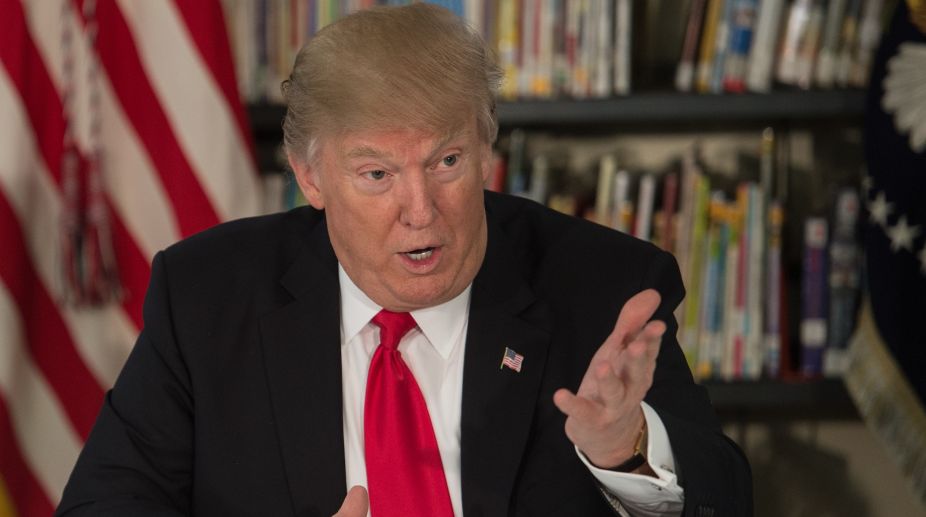
Trump signs new travel ban targeting six Muslim nations

PTI | Washington |

US President Donald Trump on Monday signed a revised executive order, temporarily halting entry to the US for people from six Muslim-majority nations who are seeking new visas while dropping Iraq from the list, after worldwide outrage over the controversial immigration policy.

White House Press Secretary Sean Spicer confirmed President Trump signed the order behind closed doors "this morning".

The latest executive order specifies that a 90-day ban on people from Sudan, Syria, Iran, Libya, Somalia, and Yemen does not apply to those who already have valid visas.

Any individual who had a valid visa either on January 27, 2017 (prior to 5:00 PM) or holds a valid visa on the effective date of the Executive Order is not barred from entry into the US, according to the order.

"The 90-day period will allow for proper review and establishment of standards to prevent terrorist or criminal infiltration by foreign nationals," it says.

The new order drops Iraq's name from the list of targeted countries, saying Baghdad has agreed to increase cooperation with the US on the vetting of its citizens applying for a visa to travel to America.

"Iraqi citizens are not affected by the Executive Order," says the order which will come into force on March 16.

The Refugee Admissions Program will also be temporarily suspended for the next 120 days while Department of Homeland Security (DHS) and interagency partners review screening procedures to ensure refugees admitted in the future do not pose a security risk to the US, the new order says.

FBI is currently investigating 300 individuals admitted to the US as refugees for potential terrorism related activities.

Officials hope that this time it will be a very orderly process and there would be no chaos at port of entry. Those people who are travelling on valid visas and arrive at a US port of entry will still be permitted to seek entry into the United States.

President Trump has also directed the State Department and the DHS to make recommendation of any country that could be included in the future suspension of entry into the US.

Homeland Security Secretary John F Kelly Kelly said the executive order signed today will make America safer, and address long-overdue concerns about the security of our immigration system.

"We must undertake a rigorous review of our visa and refugee vetting programs to increase our confidence in the entry decisions we make for visitors and immigrants to the US.

We cannot risk the prospect of malevolent actors using our immigration system to take American lives," he said.

In the first 20 days, the DHS will perform a global, country-by-country review of the identity and security information that each country provides to the US to support US visa and other immigration benefit determinations.

Countries will then have 50 days to comply with requests from the US Government to update or improve the quality of the information they provide.

Stating that the US immigration system has been repeatedly exploited by terrorists and other malicious actors, the executive order says it will ensure that the US can conduct a thorough and comprehensive analysis of the national security risks posed from its immigration system.

Trump had signed an executive order on January 27 imposing an indefinite travel ban on Syrian refugees and a temporary curb on people from Iran, Iraq, Libya, Sudan, Yemen and Somalia – from entering the US for at least 90 days.

The move triggered worldwide outrage and widespread protests at home and abroad. Protests broke out in several US cities and thousands of people demonstrated at many airports.

There were chaos in the first days of its implementation, as people arriving at US airports from targeted countries were detained and sometimes sent back to where they came from.

More than 100 academics from Texas colleges and universities signed a petition against the travel ban.

A federal judge in Seattle suspended the order, and a federal appeals court in San Francisco refused to reinstate it, leading Trump administration to come up with this revised version.

Trump had criticised the court order suspending the ban as "a very bad decision, very bad for the safety and security of our country. The rollout was perfect." 

The new order is meant to address complaints raised by the federal judges that parts of the first version of the executive order were unconstitutional.

Iraq has agreed to timely return and repatriation of its nationals who are subject to removal.

Kelly said the executive order signed today is prospective in nature applying only to foreign nationals outside of the United States who do not have a valid visa.

"It is important to note that nothing in this executive order affects current lawful permanent residents or persons with current authorisation to enter our country. If you have a current valid visa to travel, we welcome you. But unregulated, unvetted travel is not a universal privilege, especially when national security is at stake," he added.


Champions League preview: Real Madrid face tricky trip to Napoli

Is a two-goal deficit too much or will Napoli spring a surprise on Tuesday night? 

SNS | New Delhi |

Holders Real Madrid have a 3-1 advantage but will have to be wary of a comeback from Napoli when the sides clash in the second leg of their UEFA Champions League round-of-16 tie at the Stadio San Paolo on Tuesday night.

The tie is very much open after Napoli scored a priceless away goal at the Santiago Bernabeu. And the Gil Azzurri are a team that are notoriously difficult to beat owing to the fact that their fans create a hostile environment like no other.

Still, Zinedine Zidane’s men have the upper hand and will fancy their chances of progressing to the quarters for the seventh consecutive season come Tuesday.

Real Madrid

At one point all-conquering, the Los Blancos have had a dramatic loss of form after their 40-game unbeaten streak came to an end in January. Losses to Sevilla, Celta Vigo and Valencia have shown their are chinks in their armour as arch-rivals Barcelona have overtaken them in the league standings.

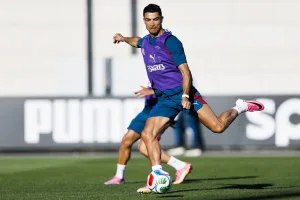
Rumours over star forward Cristiano Ronaldo’s rift with teammates have been circulating in what has been a lean season by his impossibly-high standards. The Portuguese was rested for the weekend win over Eibar and alongside Welsh winger Gareth Bale (Currently suspended for domestic competitions but not the Champions League) will form the two focal points for every Madrid attack.

With a vulnerable defence, which rarely keeps a clean sheet, the onus will be on midfielders Luka Modric and Toni Kroos to nip Napoli’s dangerous counterattacks in the bud. And with Raphael Varane injured, Pepe will step in to partner Sergio Ramos in centre defence which makes the visitors a little more susceptible and Napoli will look to exploit that weak link on Tuesday.
Apart from Varane, full back Fabio Coentrao is the only casualty as Madrid have travel to Napoli with an almost-full squad.

Napoli

In red-hot from prior to their first-leg clash with Madrid, things have gone downhill for Maurizio Sarri’s men since then. An embarrassing home defeat to Atlanta was followed by a loss to Juventus in the Italian Cup semifinal but a thrilling away win over Roma at the weekend suggests the Gil Azzurri aren't throwing in the towel yet.

They have an extremely potent attacking trio in Lorenzo Insigne, Jose Callejon and Dries Mertens and their speed on the counter will prove crucial against a leaky Madrid defence. While Insigne gave Napoli the lead in the first leg, the Italian side were unable to build on their great start and and failed to put away the few chances they got afterwards. A repeat of that cannot happen on Tuesday for their opponents will make them pay for every reprieve that is gifted to them.

Aiding Napoli in the tie will be their vociferously passionate fans who will give their utmost to prove just why the San Paolo is such a difficult place to get a result and even if Madrid progress to the quarters, it won’t be all smooth sailing.

Centre back Lorenzo Tonelli is the only injury concern for the home side.

Super Stat: The last time Madrid travelled to Napoli was in 1987, when the UEFA Champions League was called the European Cup and the tie ended in a 1-1 draw!

Note ban impact on GDP may be seen this quarter: RBI

PTI | New Delhi |

Demonetisation impact on GDP may be seen in the current quarter in some segments, while the remonetisation excersise should be completed in 2-3 months, RBI Deputy Governor Viral V Acharya said on Monday.

Asked if spillover of notes ban could extend to January-March quarter, Acharya said the impact could be felt in some segments.

"Ultimately, the cash shortage is like the liquidity shock and unless it had led to a substantial wealth destruction one would expect its effects to be quite temporary. I'm not saying that the temporary impact is not hard on some parts of the economy, you would expect the effect to be temporary," he said.

"There may be a couple of sectors, like 2-wheeler sales, where there is slightly slower rebound," he said.

When asked about the GDP estimate, he said, "you can see our MPC resolution which is that our estimate was actually reasonably close to that (of CSO estimate)." 

"Of course, the drivers may have been slightly different, but I think there are a couple of things that people have raised which would be interesting and worth thinking about, which is how much of the informal sector gets fully captured other than through its links to the formal sector," he said.

He further said that the impact of the notes ban would only be temporary and would help in bringing informal sector into the mainstream economy.

"I think everyone should keep in mind that the remonetisation is taking place at a very fast pace. We have some way to go, but I think we expect that within two to three months we will reach full currency in circulation. It will be slightly lower, but it is in that ballpark (number)," he said.

The demonetisation of high value currency notes of Rs 500 and Rs 1,000 announced on November 8 led to scrapping of Rs 15.4 lakh crore from the system.

The newly appointed Deputy Governor also said that asset quality review (AQR) is on the track.

The RBI had set a deadline of March 2017 for completion of AQR exercise for the public sector banks.

It had embarked on the AQR exercise from December 2015 and asked banks to recognise some top defaulting accounts as NPAs.

It has had a debilitating impact on banks' numbers and their stocks.

The move resulted in a spike in bad assets with lenders recognising over Rs 1 lakh crore of bad assets in the December quarter alone.

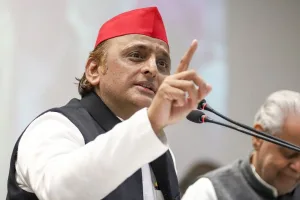
EC’s showcase notice to Akhilesh for bribery remark

PTI | New Delhi |

After Arvind Kejriwal and Manohar Parrikar, it is now the turn of Uttar Pradesh Chief Minister Akhilesh Yadav to face the fire of the Election Commission over bribery remarks.

The Samajwadi Party supremo was on Monday served with a showcase notice for reportedly asking voters in Bhadhoi on March 4 to accept money but vote for the cycle, his party's election symbol.

Prime facie finding him guilty of violating the model code, the Commission asked him to respond by March 7 as to why action should not be taken against him.

According to the Commission's notice, Yadav had asked voters to accept money from other parties, but vote for the 'bicycle' symbol of the ruling Samajwadi Party.

"I (have) heard that voters are being given money. My advice to you is to keep the money with yourself and vote for the bicycle," Akhilesh had said.

The poll watchdog reminded him that bribery and abetment of bribery of voters is a penal offence.

BJP minister seeks redefining of ‘minority’

Manoj Chaurasia | Patna |

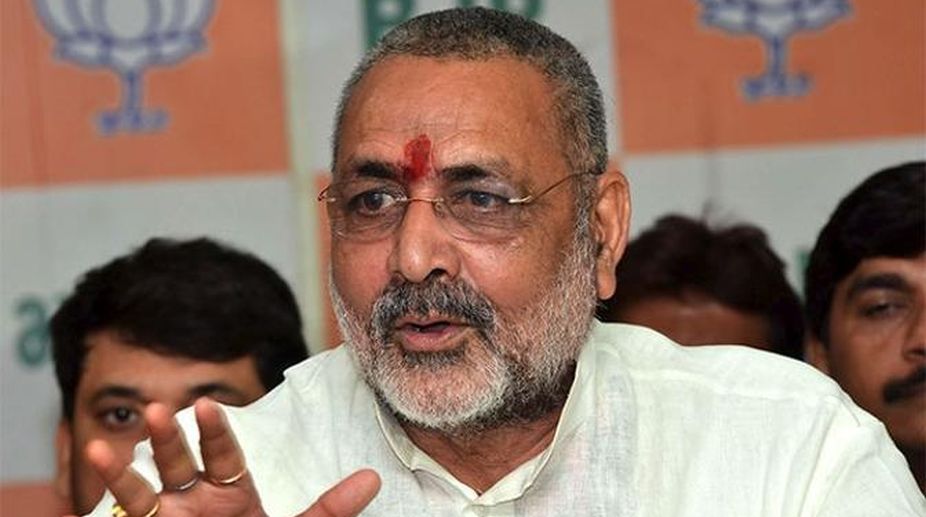
Union Minister of State for Micro, small and medium enterprises Giriraj Singh on Monday set off a new controversy by seeking a debate over redefinition of the minority in the country, sparking strong protests from the ruling coalition headed by chief minister Nitish Kumar. Especially the RJD led by Lalu Prasad mounted heavy attacks on the minister for his remark.

“There should be a fresh debate as to who is a minority in the country,” asked Singh, speaking to newsmen in Gaya. Asking the Muslims to shed the minority tag, Singh wondered how Muslims in many districts of Bihar are in a majority while they love to be identified as the minority.

Seeking a fresh debate over who should be accorded the minority status, the minister cited a recent report of the Pew Research Centre predicting that India will have the biggest Muslim population by 2050.

“By 2050, the study projects India to be the country with the largest number of Muslims—more than 310 million—even though Hindus will continue to make up a solid majority of India’s population (77 percent) while Muslims remain a minority (18 percent),” claims a latest study from the Pew Research Centre, a nonpartisan American “fact tank” providing basic information on social issues, public opinions, and demographic trends shaping the United States and the world.

Even as his views got instant support from the party, the ruling party leaders launched blistering attacks on the minister for his “divisive” move.

“He always talks non-sense and doesn’t deserve to be a minister,” remarked RJD chief Prasad. His son and deputy chief minister in the Nitish Kumar government, Tejashwi Yadav alleged the Union minister was making such remarks under his desperate bids to “communalise” the ongoing assembly elections in neighbouring Uttar Pradesh and get the support of the majority Hindu voters.

Another senior RJD minister and minority affairs minister Abdul Ghafoor accused Mr Singh of making such remarks out of desperation. “The BJP is losing UP polls and hence its leaders are making such comments”, he alleged.