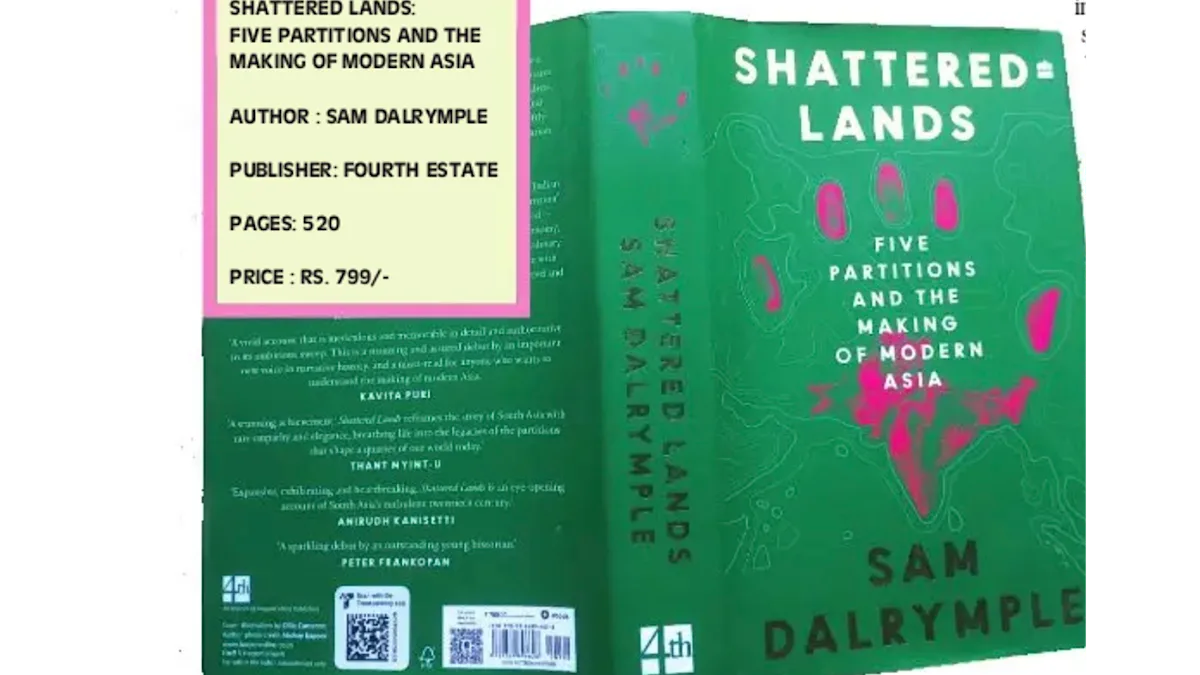
Amazing as it may sound, a huge swath of Asia, including mo dern India, Pakistan, Bangladesh, Nepal, Bhutan, Yemen, Oman, the UAE, Qatar, Bahrain, and Kuwait, was once woven together under a single imperial flag, an entity officially known as the “Indian Empire,” or more simply as the Raj. This chunk of land, the British Empire’s crown jewel, stretched from the Red Sea to the jungles of Southeast Asia , accommodating one-fourth of the world’s population.
The British Indian Empire issued passports stamped “Indian Empire,” used the Indian rupee, and was secured by the British Indian Army stationed in forts stretching from the Bab el-Mandeb strait to the Himalayas. But Time playe d its devastating game, and this vast empire shattered into smaller countries within a span of just fifty years. New nations emerged and maps were redrawn, inviting a lasting legacy of war, exile, and division. Sam Dalrymple’s book, Shattered Lands, describes in vivid detail how the mighty British Empire came to an end in the Indian Subcontinent.
Advertisement
Twelve new nations were born through the revolutionary activities of freedom fighters and tense dialogues by politicians in executive boardrooms. The book also traces the roots and backgrounds of current insurgencies in Kashmir, Baluchistan, Northeast India, Burma, and other corners of the subcontinent. It is a precious record of vaulting ambition and treacherous betrayal, of forgotten wars and unexpected alliances, and of borders forged through ink and fire. Dalrymple’s account draws on intensive archival research, private memoirs, and interviews conducted in English, Hindi, Urdu, Bengali, Punjabi, Arabic, and Burmese.
Rather than focusing exclusively on noted politicians and key government functionaries, Shattered Lands sincerely profiles common people whose lives were severely upended by the Partitions. The author regularly contrasts the present geopolitical situation of these truncated regions with the pre-Partition era when they were all part of a single political entity. The writer reminds us that today, the India-Pakistan border is not the only heavily fortified and highly tense boundary in this part of Asia; rather, entire South Asia has become one of the most heavily armed, fenced, and landmined zones on the planet. For instance, the India-Bangladesh border is one of the longest in the world, protectd to day with thermal-imaging sensors and guarded by drones via a satellite-signal command system.
All these geopolitical trappings were entirely missing just a century ago, when a vast expanse of Asia remained under British control and shared common government customs, rules, and protocols. The India of that era was vastly different from the land we see today. From Kashmir to Hyderabad, six hundred thousand square miles of the Indian Empire were controlled by local monarchs who surrendered their foreign policy and defense to the British Viceroy but were otherwise internally independent. Kashmir was larger than France; Travancore’s population was greater than Austria’s; and Hyderabad’s economy rivaled the size of Belgium’s.
However, the splitting of this mighty empire turned everything upside down. Partitions occurred in diverse pockets of the empire, fatally affecting tens of millions of people. The book covers the chief regional separations as catastrophic events, including the partitioning of Arabia, Pakistan, and Burma from India. It spans landmark historical turning points: the visit of the Simon Commission, the Direct Action Day of 1946, the Fall of Hyderabad, the 1971 Liberation War in Bangladesh, uprisings in Northeast India, and bitter disputes over mother tongues during the twilight days of the Raj. Dalrymple reminds the reader that the lands within the Raj were connected by trade, marriage, and faith long before the British ever arrived. We are also apprised of the princely states and protectorates as they existed before being absorbed into centralized nations.
The Maharajas, Sheikhs, and Nizams who ruled these kingdoms were fabulously wealthy. Following the death of J. D. Rockefeller in 1937, Time magazine named the Nizam of Hyderabad the richest man in the world and the fifth richest in human history. Beyond material wealth, rulers like the Maharaja of Mysore were celebrated philosophers whose states modernized faster than many territories under direct British rule. The First World War changed everything. Demands for independence became widespread, yet few initially suspected that the distinct nations of India, Pakistan, Yemen, and Burma would all emerge from the wreckage of British India. Many of these countries possessed ancient identities, cultures, and histories of independence. Remarkably, as late as 1928, not a single one of the borders that currently slice through South Asia was foreseen.
Shattered Lands tells the extraordinary story of how five distinct partitions transformed Britain’s Indian Empire into twelve modern nation-states. One of these events, the partition of the Arabian Peninsula from India, remains relatively unknown to the public, having commenced in 1937. Had this separation not happened, most of the Arabian Peninsula (except for Saudi Arabia) might have structurally become part of independent India or Pakistan. The author also deals extensively with the creation of Pakistan, an event that emerged through massive communal violence and precipitated the largest forced migration in human history. This is what visionary Pakistani historian Ayesha Jalal calls “the central historical event in twentieth-century South Asia.” In addition, the writer narrates the Partition of Princely India and, decades later in 1971, the bloody fracturing of Pakistan itself. Dalrymple’s account brings back into focus a historical “undivided India” that practically included parts of both Arabia and Burma. The standard version of “Undivided India” pushed by mainstream nationalist historians is often a colonial construct that lasted for only a few months in 1947, completely overlooking Burma and Arabia’s deeper ties.
Successive partitions and decades of historical amnesia have made modern populations forget that they once shared a single political identity. Today, many Indians forget that Burma was fundamentally tied to their country’s administration. As Burmese author Thant Myint-U wrote in 2011: “Almost no one I knew in Delhi had ever been to Burma and … I was told there are no Burmese-speaking experts in India. Instead, there were hints of a slightly forlorn connection: a relative who had been born in Burma, a recipe that had been kept in the family after a time spent long ago in Rangoon, a sense of old religious or cultural affinity, an interest, but otherwise little knowledge.” Dalrymple’s book strongly counters the retrospective teleology of nationalist historians who claim that the Raj’s successor states were fated to exist as they do today. Shattered Lands is terse yet packed with fascinating anecdotes and real-life events that rarely find a place in mainstream textbooks.
While the arrival of the Simon Commission created considerable stir, the book delves deep into the day-to-day friction of their journey across the empire in the face of tremendous grassroots hostility. It uncovers forgotten rebellions, such as the Saya San rebellion in Burma, which is one of the most fascinating yet overlooked insurgencies of the Raj, and one that traditionally began at the Pagoda of the Emerald Green Mountain. It is equally amazing to note that as late as 1940, Tamil separatism in South India was a far bigger political flashpoint than Pakistan separatism. Even Jinnah himself, in a private interview, initially rejected the idea of Pakistan as “some sort of Walt Disney dreamland, if not a Wellsian nightmare.”
Yet, a few weeks later at a rally in Calcutta, the very same Jinnah announced that India was an artificial construct forged by the British that should be divided into “independent states.” Demands for independent sovereignty soon echoed from many quarters: the Nagas fought for an independent Nagaland; Sikh leaders called for “Sikhistan” or “Khalistan”; Pashtuns demanded “Pashtunistan”; and there was even a demand for India’s lower castes to be granted an autonomous “Achhutistan.” A fear of imminent Balkanization pervaded political meetings so intensely that one contemporary Indian observer commented: “Giving in to the Pakistan demand would only lead to endless partitions and all minorities would ask for the right to self-determination.
How would we stop them? Even women would one day demand a separate ‘Zenanistan’ or ‘Land of Women’.” Dalrymple deals exhaustively with the visceral terror of Direct Action Day on August 16, 1946, the political undercurrent of which was to establish “either a divided India or a destroyed India.” The Muslim League premier of Bengal, Huseyn Shaheed Suhrawardy, chillingly wrote in The Statesman that “bloodshed and disorder are not necessarily evil in themselves, if resorted to for a noble cause.” Furthermore, the chapter on the birth of Bangladesh presents harrowing accounts of the systemic persecution of students, women, and the minority Hindu population, pulling back the curtain on what transpired in the inner corridors of power.
By analyzing proxy wars, the fall of Hyderabad, and the final days of the Raj, the author demonstrates how the political turbulence that shook the foundations of the British Indian Empire still creates ripples across modern South Asia. Fissiparous (splintering) tendencies remain highly visible today, resulting in heavily fortified borders and a resurgence of fierce nationalism. Dalrymple’s book does more than just bring the seismic balkanization of a forgotten empire back into focus; it serves as an indispensable guide for future political decision-making and a stark reminder of the chaos that breaks loose when a massive empire is blown to smithereens. You can listen directly to the author discuss these historical dynamics, oral histories, and the geographic boundaries of the unmade empire in this Sam Dalrymple Interview on Shattered Lands. This panel from the Jaipur Literature Festival features the author discussing the foundational ideas behind his research.
(THE REVIEWER IS A PHD IN ENGLISH FROM CALCUTTA UNIVERSITY AND A FREELANCE WRITER)