Logo

India’s growth to accelerate to 7.4 per cent in 2017-18: ADB

PTI | New Delhi |

The Asian Development Bank (ADB) on Thursday said that India's growth rate will improve to 7.4 per cent during 2017-18 and go up further to 7.6 per cent in the next fiscal, remaining ahead of China.

“The impact of the demonetisation of high-value banknotes is dissipating as the replacement banknotes enter circulation. Stronger consumption and fiscal reforms are also expected to improve business confidence and investment prospects in the country,” said the Asian Development Outlook, ADB's flagship economic publication.

India recorded a growth rate of 7.1 per cent during 2016-17, notwithstanding the fears that demonetisation of high-value currency notes of Rs.500/1,000 in November last year would adversely impact the economic growth.

“In India, the sub-region's largest economy, growth is expected to pick up to 7.4 per cent in fiscal year (2017-18) and 7.6 per cent in 2018-19, following the 7.1 per cent registered last FY,” it said.

With regard to China, the report said, the overall output is expected to slow to 6.5 per cent in 2017 and 6.2 per cent in 2018, down from 2016's 6.7 per cent.

Efforts of the Chinese government to maintain financial and fiscal stability would continue to be a modest drag on growth going forward, it said, adding the continued structural reform would help in maintain growth in the government's target range.

Over the last few years, India has taken a host of economic reforms initiative, including the Goods and Services Tax (GST) and liberalisation of the FDI regime, with a view to improve business climate and promote growth. The GST is expected to roll out from July.

The report further said that South Asia would remain the fastest growing of all subregions, with growth reaching 7 per cent in 2017 and 7.2 per cent in 2018.

Commenting on the future prospects, it said that in two-thirds of economies in developing Asia, the growth is being supported by higher external demand, rebounding global commodity prices, and domestic reforms, making the region the largest single contributor to global growth at 60 per cent.

Number of foreign jihadists in Iraq and Syria unknown: US

AFP | Washington |

The US intelligence agencies don't know the true number of foreign jihadists still fighting in Iraq and Syria, or the extent of the threat they pose to their home countries, a senior US military officer has said.
Some 40,000 foreign jihadists have joined the Islamic State group in Iraq and Syria from at least 120 countries in Europe, Africa and southeast Asia, General Michael Nagata said yesterday at Washington's Center for Strategic and International Studies think-tank.
“We know we have killed several thousands of foreign fighters in Iraq and Syria,” said Nagata, director of the National Counterterrorism Center's Directorate for Strategic Operational Planning.
“But we are unable to give you a precise number. It's a substantial number.”
“We really don't know” how many remain despite the massive resources trying to determine the number, he added.
Estimating the security threat they pose their home countries on their return is also problematic, he said.
“ISIS and the foreign terrorist fighter problem is not a monolith,” he said, using an alternate acronym for the IS group. “It's an incredibly diverse set of actors with an incredibly diverse set of motivations.”
However, the security threat — particularly from the children of jihadists who have followed their parents to Iraq and Syria and could potentially perpetrate attacks in their home countries — should not be overestimated, Nagata said.
The IS group has released videos apparently showing children executing prisoners in order to “create a propaganda-driven impression that all the children of ISIS fighters will take up the black flag, that they are ready now to commit acts of violence even if they are only 11 or 12,” Nagata said.
Although “there may be some truth” in that perception, he said, “it is probably not as strong or widespread as what the Islamic State group wants us to believe.”
The IS group has lost much of the territory it once held during a more than two-and-a-half-year military campaign by a US-led international coalition.
Coalition-backed Iraqi forces are currently battling to recapture the northern city of Mosul from the jihadists.
US-backed fighters of the Syrian Democratic Forces are also mounting an offensive to retake the Syrian city of Raqa, the IS group's last major stronghold in that country.

Trump, Merkel discuss Afghanistan, Ukraine issues on phone

IANS | Washington |

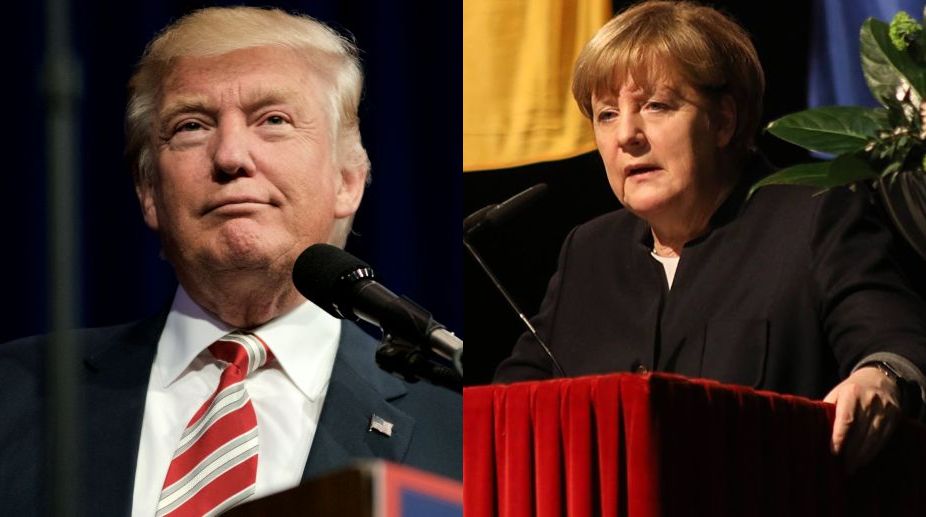
US President Donald Trump and German Chancellor Angela Merkel have discussed the conflict in eastern Ukraine and the situation in Afghanistan over a phone call, the White House said.

Trump and Merkel spoke on Wednesday and "pledged close cooperation and coordination on these and other issues," the statement said, Efe news reported.

Merkel had also addressed the issue of Ukraine on Monday during a phone call with Russian President Vladimir Putin and French President Francois Hollande, urging Putin to use his influence on the separatists.

The Chancellor met Trump in March, after which the US President accused Germany of owing a vast sum of money to the US and NATO.

‘Why does Messi carry the entire burden of Argentina?’

While he is a hero at the Camp Nou, Messi has not always had the same adulation in his homeland.

AFP | Barcelona |

Sevilla boss Jorge Sampaoli says that compatriot Lionel Messi should be the pride of Argentina rather than criticised for his failure to deliver a major trophy.

Messi was in top form on his return from suspension and scored twice as Barcelona extended Sevilla's slump in a 3-0 win on Wednesday.

But while he is a hero at the Camp Nou, Messi has not always had the same adulation in his homeland.

"There is a necessity for some people to win something solely thanks to Leo," said Sampaoli, who has been linked with taking over as Argentina boss for the rest of their faltering World Cup qualifying campaign.

"That seems like too much of a burden to me for a player who has given everything and who makes all of Argentina proud that he is the best in the world."

Messi was handed a four-match international ban for insulting an assistant referee in a 1-0 win over Chile on March 24.

Without the five-time World Player of the Year, Argentina then lost 2-0 to Bolivia to fall to fifth in South American World Cup qualifying with only the top four guaranteed their places in Russia next year.

Widespread reports in Argentina over the weekend claimed that Sampaoli would be the leading candidate for the job if coach Edgardo Bauza is sacked before the two-time world champions' next qualifier, away to Uruguay on August 31.

Messi has been a beaten finalist three times with Argentina, at the 2014 World Cup and the 2015 and 2016 Copa America.

After missing a penalty in a shootout defeat to Chile in 2016 he briefly announced his retirement from international football before reversing that decision two months later.

La Liga: Lionel Messi returns to inspire Barcelona against Sevilla

You just can't keep the Argentine wizard down for long!

SNS | New Delhi |

Lionel Messi returned from suspension to inspire Barcelona to a comfortable 3-0 win over Sevilla on Wednesday, the Argentine magician grabbing a first-half brace and an assist as La Blaugrana kept the pressure on Real Madrid in the La Liga title race.

Wednesday’s meeting between second-placed Barcelona and fourth-ranked Sevilla had been built up to be an epic clash, but in an anti-climax of sorts, ended up being an extremely one-sided game.

For the hosts raced into a 3-0 lead after little over a half-hour had been played on the night, with their number 10 returning to action with a wondrous display.

Racing down the right wing with a couple of Sevilla defenders for company, Messi shrugged off a challenge to send in a low cross with his weaker foot for Luis Suarez. The Uruguayan forward didn't get to the ball in time, but a defender’s touch flicked the ball in the air and Suarez promptly sent in an audacious back-volley to open the scoring in the 25th minute.

Three minutes later, it was Messi’s turn to score as Barcelona launched a sizzling counter-attack after Sevilla Angel Correa had cheaply given the ball away in his own half. Ivan Rakitic released Neymar on the left wing and the Brazilian sent in a low cross for Suarez. The Uruguayan didn't have much of an angle, so cut it back for Messi, who finished between Sergio Rico’s legs to double the Catalans’ lead.

And within five minutes of going two-nil up, Barca had their third and this time Messi went for power, rather than finesse but found the same devastating result. A headed clearance from a corner had fallen his way in the Sevilla box and he let loose a venomous volley which left Rico with no chance.

Barcelona continued to dominate possession but put their foot off the pedal and despite the home side backing off, Sevilla seemed incapable of really testing Marc-Andre ter Stegen on the night. They had two glorious chances to open the scoring as Steven N'Zonzi fired too close to  ter Stegen when clean through before Vitolo headed despite being completely free inside the area.

To make matters worse, winger Vitolo was sent off for a second bookable offence late in the game when he hacked down Neymar and while Sevilla are probably safe in terms of Champions League qualification, third-placed Atletico Madrid are now three points ahead of them.

For Barcelona, the result means that Real Madrid will go into the Madrid derby on Saturday knowing that should they slip up, the Catalans will leapfrog them should they beat Malaga later on the day.

UN awaits full report on chemical attack in Syria

IANS | United Nations |

UN is awaiting a detailed report on a chemical weapons attack earlier this week in Syria that killed at least 70 people and injured more than 200 others, media reports said.

"We are still receiving information. Full details are still not known," Under Secretary-General and High Representative for Disarmament Affairs Kim Won-soo said at the opening of a Security Council emergency meeting to discuss the incident.

A team from the Organization for the Prohibition of Chemical Weapons (OPCW) "is actively gathering and analyzing the information", and it will be deployed to the area where the incident occurred as soon as possible, Efe news quoted Kim as saying.

Kim spoke at the opening of a session that is expected to lead to a Security Council resolution, although a vote is still pending.

The international community has strongly condemned the chemical weapons attack in Khan Sheikhoun, a town in the northern province of Idlib.

Kim said the UN was gathering information from "all sources available" and he had been in contact with OPCW members and Syrian representatives at the United Nations.

The chemical weapons attack in Khan Sheikhoun is the most serious in Syria since an August 21, 2013 attack in Guta, on the outskirts of Damascus.

EU agrees to give $619 m to Syria in 2018

IANS | Brussels |

During the international conference on Syria, the European Union agreed to give the country $619 million (580 million euros) in 2018, an official said.

EU's high representative for foreign affairs Federica Mogherini said during the two-day conference titled 'Supporting the Future of Syria and the Region' here, that the money would also be used to help Lebanon and Jordan, who have taken in thousands of refugees, Efe news reported.

"What is vital is that humanitarian funding, this humanitarian funding, turns into humanitarian action," she said.

In order for the funding to be translated into real help for Syrians, Mogherini said two things were necessary: aid workers and full humanitarian access to all of Syria.

According to her, the EU intended to maintain the same level of aid in 2019, adding that the bloc was the primary humanitarian aid donor to Syria and the refugee hosting countries.

Mogherini highlighted that, as well as respecting its financial compromises, the EU was promoting economic and job growth in Lebanon and Jordan, as well as for Syrians, in order to avoid a conflict between refugees and their host communities.

"I think we have to be very clear about the fact that we are supporting the Syrians and we are supporting them as they hope to build the future of their country," she said.

The Italian politician said all aid that had been pledged in 2016 had been delivered, and it was now important to analyze where progress had been made.

"We will look forward to 2018 and 2019 to ensure we can provide some continuity and predictability to the humanitarian support we give to Syrians," said Mogherini.

EPL: Eden Hazard carries Chelsea past Manchester City

The Blues bounce back thanks to their Belgian maestro!

SNS | New Delhi |

Chelsea got back to winning ways in the English Premier League, edging Manchester City 2-1 in their encounter at Stamford Bridge on Wednesday night, with Belgian winger Eden Hazard the standout player on the night.

The Blues have long been ahead of the chasing pack, but a home loss against Crystal Palace on the weekend had seen their lead cut short to seven points and another loss could have potentially seen it cut to four.

Antonio Conte knew that a statement was required and brought in Kurt Zouma at the back, moving Cezar Azpilcueta up, which in turn made Pedro a winger rather than a wing back. The 3-4-3 formation remained as the Blues sought to avoid a second successive home defeat.

Pep Guardiola placed Jesus Navas at right back, surprising considering Pablo Zabaleta was available, with club captain Vincent Kompany returning to the starting XI and Fabian Delph was brought in to shore up the midfield.

Chelsea began the first half in the ascendancy and didn't take long to go ahead in the tie.
Azpilcueta’s smart cutback from the right wing was hit first-time by Hazard, but despite the Belgian winger not getting the cleanest of contacts, the ball deceived Willy Caballero in the City goal. Replays suggested Kompany had the slightest of touches which perhaps changed the trajectory of the ball and as a result, Chelsea were 1-0 up after just ten minutes had been played.

City grew into the game, starting to see more possession but they needed a blunder from Chelsea keeper Thibaut Courtois to get back into the tie. Sergio Aguero attempted to close down Blues back pass to the Belgian custodian, but Courtois had time to pick his pass yet his attempted clearance found David Silva. The Spaniard approached the Chelsea goal quickly and let loose from a narrow angle. While Courtois made the initial save, the rebound fell to Aguero, who tapped home into an empty net in the 26th minute to get level on the night.

The home side didn't take long to restore their lead and it was their turn to get lucky this time.
Fernadinho was drawn in to make a silly challenge on Pedro in the box and as the Spanish winger promptly went down, match referee Mike Dean pointed to the spot without any hesitation. Hazard stepped up to take the penalty and as has been the case on many occasions this season, sought to send the keeper the wrong way. Caballero, however, guessed right and while he made the initial save, Hazard couldn't miss the rebound and Chelsea were back ahead 10 minutes from half-time.

The second half was a period of few chances, with the sides clearly struggling after having played on the weekend. Surprisingly, Hazard was the man who squandered a golden chance to get his hattrick and seal the deal, blazing over after Pedro’s cutback had set him up perfectly.

City had an even better chance in the closing stages but centre back John Stones somehow got under the ball and sent his shot over the goal after Silva’s corner had found him unmarked near the centre of the goal.

With the result, City remain rooted in 4th place and now a 14-point gap has been opened up between them and Chelsea, a statistic which says Guardiola and co’s title challenge is over with just eight games to go in the season.

For Chelsea, it was a perfect riposte after many had been accusing them of taking the foot off the pedal in their loss to Crystal Palace, and while Tottenham beat Swansea 3-1, the fact that Chelsea remain seven points clear puts them in pole position to lift the title.

Shunglu Committee report questions Kejriwal over several appointments

IANS | New Delhi |

In a major set back to Aam Aadmi Party government here, the Shunglu Committee formed by former Lt Governor Najeeb Jung to look into decisions taken by the government, has questioned several appointments made, including the appointment of Health Minister Satyendar Jain's daughter Soumya Jain in Mohalla Clinic project.

The committee reviewed 404 files of the Delhi government and found several irregularities with various appointments.

The report which is accessed by IANS, questioned Soumya Jain's appointment to the post of mission director in Delhi government's Mohalla Clinic project.

"Soumya, who is an architect, was made an adviser to Mission Director, Delhi State Health Mission. However she asserted her expertise with regard to Mohalla Clinics even though her CV does not support her claim. Second, the memorandum of Association of State Health Society (Delhi) and rules and bylaws do not support such appointment," the committee said in its report.

"The file contained no evidence of who approved her appointment," it said.

"These events can only be explained by the fact that Soumya Jain is the daughter of Delhi Health Minister Satyendar Jain," the report added.

The three-member Shunglu Committee, headed by former Comptroller and Auditor General (CAG) V.K. Shunglu, was set up by then Lt Governor Najeeb Jung after Delhi High Court gave primacy to the LG in Delhi administrative affairs in August last year. 

The LG office has called over 400 files on decisions taken by the AAP government in Delhi, for review.

The Committee also raised questions on the appointment of Nikunj Agarwal as Officer on Special Duty (OSD) to Delhi Health Minister.

"The appointment of Nikunj Agarwal as OSD to Health Minister on co-terminus basis is a case of violation of recruitment procedure and lack of authority. Co-terminus appointment can be only made with the approval of the Lt Governor but the matter is not placed before the Lt Governor. The case does not seem fit for ex-post facto approval," the report said.

The Committee in its report also questioned the allotment of 206, Rouse Avenue — a bungalow which belonged to a minister now used as party office — to AAP.

Reported use of chemical weapons in Syria alarming: WHO

IANS | Geneva |

The World Health Organisation (WHO) condemned the alleged use of chemical weapons in the Syria attack, saying that it was "alarmed" at the use of toxic chemicals as a weapon in the war-torn Middle Eastern country.

"The images and reports coming from Idlib today leave me shocked, saddened and outraged," Xinhua news agency quoted Executive Director of the WHO Health Emergencies Programme Peter Salama as saying in a statement.

"These types of weapons are banned by international law because they represent an intolerable barbarism," he added.

Located in southern rural Idlib, rebel-held Khan Shikhoun was reportedly struck by toxic chemicals in an attack on Tuesday which killed least 70 people and wounded hundreds more.

WHO warned that the capacity of hospitals in the area to cater to the needs of the wounded was limited amid shortages of medicines and damaged infrastructure.

The Geneva-based organisation said it had sent critical drugs to health care services in the area and that Turkey-based experts were providing advice on how best to diagnose and treat affected patients. 

Governance through judiciary

Noman Ahmed | New Delhi |

Last week, Pakistan’s Supreme Court ordered that only Qingqi rickshaws produced by government-approved manufacturers shall operate on roads. Not long ago, the SC passed an important verdict on water, sanitation and environmental conditions in cities in Sindh. It directed respective government authorities to abide by the various directives included in the verdict.

The top court has emerged as a monitor and judicial observer on matters traditionally dealt with by the executive but which have a direct bearing on the welfare of common people. The SC’s actions relate to issues such as breaches in public safety, inflation, violation of zoning and building by-laws, traffic congestion, prices of medicine, issues related to missing persons, organ transplantation, etc.

It is commonly observed that the executive at the provincial and federal levels has shown a steady decline in delivering services to the people. As per routine, the responsibility of the executive is to plan, deliver and manage the provision of mandatory goods and services to the public at large. Needless to say, while the judiciary can take stock of the situation and direct the relevant organs of the executive, it cannot acquire the role of the executive itself.

In desperation, the downtrodden and oppressed consider the SC and subordinate courts as the last providers of relief in almost every domain of public life. Much of the rot in the service delivery apparatus is by design, not by default. The government in Sindh has let loose such forces that they have contributed to the total retardation of respective administrative and regulatory bodies. The SC recently took Sindh land authorities to task for their illegal allotment of land in Karachi’s Gulshan-e-Iqbal area on which a builder had constructed a residential complex, whose occupants are now at risk of losing their homes.

Regulation, monitoring and control of construction practices are an important area of public management. Social justice and the rights of all stakeholders are safeguarded if the buildings and structures are in alignment with prescribed plans, rules and zoning guidelines.

In reality, however, avaricious interest groups — with active support of the various agencies and tiers of government — facilitate the illegal development of buildings and structures. Acting on petitions and even exercising suo moto jurisdiction, the superior courts have taken action on several occasions, apparently to set technically and legally correct precedents for the relevant building control authorities to follow. Sadly, the reverse has continued to happen. The Makro Habib case in Karachi is an example. In its landmark judgement a few years ago on this important case, the SC ordered the demolition of the superstore that was illegally constructed on a playground in Karachi’s Lines area. That decision is yet to be acted upon. Moreover, many other such violations have sprung up in the same and other neighbourhoods of the city.

It is neither the responsibility nor the mandate of the courts to micro-manage affairs related to buildings and structures in cities and towns. However, in a situation where the government either shirks its responsibility or prefers to facilitate vested interests, the pressure to act increases on the courts.

The political will to correct what ails the executive machinery is simply non-existent. In many cases, the political leadership’s interests coincide with that of corrupt officers/functionaries. The few honest officers who do not comply with inappropriate orders often have to face the music. Recently, the inspector general of Sindh police was sent on ‘forced leave’ by the province’s political bosses; and it was only a stay order by the Sindh High Court that allowed him to resume his job. This Friday, the Sindh government again surrendered his services to the centre. A contempt of court notice has been filed and is to be heard. The message from unscrupulous political quarters is clear: toe the line without questioning legality and merit. The result is a breakdown of service structure, demoralisation amongst honest cadres and an overall collapse in institutional capacities.

The officer cadres used to be the executive’s backbone. An extraordinarily rigorous procedure was in place to fill these slots with men and women driven by a desire to serve. It was their superior abilities that enabled the bureaucrats of yore to carry out very challenging assignments. There was in those days a clear distinction between the political leadership and the bureaucracy. The judiciary used to work closely with the bureaucracy to fix matters typically afflicting society. The political process used to allow for such coexistence to a reasonable extent. The objective was to ensure an uninterrupted facilitation of people’s rights. The effectiveness of the staff/officers was due the attention they gave their respective tasks, rather than to pleasing their superiors. But a deep (and probably irreversible) rot has set in as a result of political interference, and it has eroded the capacity and moral fibre of working bureaucracies. The public sector has to be revived through a carefully designed approach. Bolstering and revitalisation of constitutional fora, such as parliamentary standing committees, for monitoring the performance of public institutions is a crucial step. These bodies must be given adequate teeth to help implement corrective actions and reforms. Considerable improvement can be achieved by securing the mandate of the civil and municipal services and by empowering their cadres. If insulated from undue political interference, many officers are still driven by a sense of service.

Dawn/ANN.

Making enemies retrospectively

Yogesh Pratap Singh and Sanjeeb Panigrahi | New Delhi |

Vivekananda was asked by a young lady in London, “What have you Indians done? You have never even conquered a single nation.” That may be true from the point of view of the Englishman, the brave, the heroic, because for them conquest is the greatest glory that one can have over another. “If I ask myself what has been the cause of India’s greatness, I answer, because we have never conquered. That is our glory.” Vivekananda replied.

While conquerors habitually decimate their enemies, India seemed exceedingly driven to offer an olive branch to its enemies. This has been an integral part of our tradition which was endorsed by the Father of the Nation when he wrote, “Repression has never worked. I challenge anybody to point me to a single episode in either ancient or modern history, which proves that repression has even once achieved the end to which it has been directed. The English failed in America,….it failed in South Africa after the Boer War, It failed in Ireland yesterday…..it will fail in India tomorrow. If repression succeeds in anything, it is in advertising the cause of the enemy.”

The recent Enemy Property (Amendment and Validation) Ordinance if it succeeds will certainly create a hostile environment in the country.

The Genealogy of Enemy Property Law Government estimates there are about 16,000 properties (movable and immovable) of migrants who left for Pakistan. There are some 149 immovable properties of Chinese nationals spread across Karnataka, West Bengal, Assam, Rajasthan, Meghalaya, Tamil Nadu, and Delhi etc. There is no authentic valuation of such properties but a conservative estimate could place the figure at about Rs 1.7 lakh crore.

The outbreak of World War II in 1939 resulted in the Defence of India Act, 1939  and the Defence of India Rules, 1939 made thereunder. The office of the custodian of enemy property for India, Mumbai, was constituted to prevent paying money to the enemy and to administer enemy properties in India till peace was restored. Properties left by enemy subjects were vested in the custodian and continued to remain vested in it even after the war ended.

During the wars of 1962 – with China – and of 1965 and 1971 – with Pakistan – the government designated certain properties belonging to citizens of these two countries as “enemy properties.” After the 1965 war, India and Pakistan signed the Tashkent Declaration on 10 January 1966. The Declaration included a clause, which stated that the two countries would discuss the return of property and assets taken over by either side in connection with the conflict.
As a result the Government notified an Enemy Property Registration Order that was later replaced by the Enemy Property Act 1968. “Enemy property” under this law included properties of persons who were believed to be citizens of a country classified as an enemy country by the Government of India. These properties are vested in the “Custodian of Enemy Property”, an office constituted under the Act.

Besides managing the property, the custodian can declare any property to be enemy property and seize it, and order the sale of the property. The Custodian can also oppose court cases filed by an aggrieved individual whose property is divested. The 1968 Act prohibited transfer of enemy property by an enemy if it was against public interest or to evade vesting of property in the Custodian.

The Raison D’être

The principle behind the enemy property law, both the 1968 Act and the present Act, is that citizens of any country with which India has gone to war cannot be allowed to hold property in India. The 1968 Act provided that the Central government may order for an enemy property to be divested from the Custodian and returned to the owner or other 
person.

The said Act also permitted the sale of enemy property by the Custodian only if it was in the interest of preserving the property, or to secure maintenance of the enemy or his family in India. Defying the Tashkent Agreement the Government of Pakistan disposed of all such properties in its country in 1971. Pakistan’s unilateral action perhaps became the rationale of the present Act.

The New Regime

The amendment aimed at capping the ambiguities in the 1968 Act is to ensure that enemy properties that have been vested in the Custodian remain so and do not revert to the enemy subject. Notwithstanding any court judgement now the magnified power of the Custodian under the new regime extends to sale or disposal of enemy property within a time period specified by the Central government.

The Act seeks to include the vesting of enemy properties in cases like the enemy’s death and if the legal heir is an Indian and the enemy changes his nationality to that of another country. It expands the definition of “enemy” to include legal heirs of enemies even if they are citizens of India or of another country which is not an enemy and nationals of an enemy country who subsequently changed their nationality to that of another country. It further provides that vesting of enemy property with the Custodian shall mean that all rights, titles and interests in the property will vest with the Custodian. No laws governing succession will be applicable to these enemy properties.

However, the amended Act prohibits all transfers by enemies and renders the transfers that had taken place before or after the commencement of the 1968 Act, as void. The Amended Act ousted the jurisdiction of civil courts and other authorities from entertaining cases against enemy properties, or against actions of the Central government or the Custodian under the Act.

The amended Act eliminates the duty to maintain the enemy and his family and allows the Custodian to carry out some measures (including selling, mortgaging or leasing enemy property). This incorporates few permissible actions such as fixing and collecting rent, license fee, etc. from enemy property, and evicting unauthorised occupants and removing unauthorised construction from such properties. Although the Public Premises Act, 1971 regulates elimination of unlawful occupants and construction from public premises but the amended Act is to include enemy properties within the definition of public premises.

Judicial Treatment

Mohammad Ali Jinnah, the founder of Pakistan kept fighting till his death to get back his bungalow “Jinnah House” in Mumbai. His daughter Deena Vaidya, too, failed to secure the ownership. However, Mohammad Amir Mohammad Khan alias Sulaiman Khan, the son of the late Raja of Mehmoodabad, a close comrade of Jinnah and the Muslim League won the claims of his father’s property in the Supreme Court after a 32-year long legal battle. However, the fruits of this victory are now eclipsed by the new Ordinance promulgated by the President of India.

The apex Court in Union of India & Another vs. Raja Mohammed Amir Mohammad Khan, on 21 October 21 2005, while rendering the verdict in favour of Raja Mehmood Khan, opened space for further claims as genuine or ostensible relatives of persons who had migrated to Pakistan and produced deeds of gift claiming rightful owners of enemy properties. In a bid to obviate the Supreme Court ruling the Government of India brought series of ordinances and finally the present amendment Act.  
 
New Law Sans Conscience

The new law if it stays alive would adversely affect the rights of a major chunk of citizens and especially the Muslims by making them enemies with retrospective effect. It would also undermine the decisions of Indian courts that have established the Custodian as the guardian of the property and not the owner. Attempt to make retrospective accomplishment would turn upside down the rights and obligations already vested in citizens.

Notwithstanding the constant and unequivocal admonition administered by the Supreme Court including in the latest Krishan Kumar v. State of Bihar (2017) that once again re-affirmed that re-promulgation is a colorable exercise of power and amounts to a fraud on the Constitution, the executive wing of the State continues to be in denial. Hence, another basic feature of the Constitution – democracy – stands dishonored. What is at stake here is not government, or governance, but the very essence of constitutional trinity of our national philosophy — liberty, equality and tolerance to meet India’s international commitments to the United Nations. 
 
The writers are, respectively, Associate Professor of Law at NLU Odisha and an Advocate, Supreme Court of India. 
The views expressed are personal.

The dilemma facing surgeons

Sujoy Gupta | New Delhi |

The Constitution’s preamble guarantees the “dignity” of every citizen. In March, the government of West Bengal fulfilled its constitutional duty with welcome alacrity.

Moved by the untimely demise of citizen Sanjay Roy on 24 February the administration moved the state Assembly to enact the West Bengal Clinical Establishment (Registration, Regulation and Transparency) Bill on 3 March, the governor gave his assent on 16 March and the bill became law.

On the very next day, an 11-member West Bengal Clinical Establishment Regulatory Commission was set up as per this new law. Undaunted by the absence of brevity in legislative nomenclature, the Commission held its first meeting on 22 March demonstrating rare speed of state governance. Forthwith, at one stroke, one expects the end of negligence, excess billing and lack of transparency in all private sector hospitals, nursing homes, diagnostic clinics and medical establishments in West Bengal.

So far, things look good. A collective sigh of relief seems to have been heaved by sick denizens and their families. There is a general sense of relief that efficient and fair-priced medicare seems assured. After all, there is a statutory (not administrative) Commission to keep vigil over the two latter factors. 

One must be aware, though, that there is usually a flip side to most good things. Within every silver lining, paraphrasing the proverb, hangs a dark cloud. Prima facie, in the current instance, an unusual and unfortunate hidden lacuna lurks behind the swathe of good deeds and intentions cited above.

The paradox lies in that not all medical practitioners are “free birds”, metaphorically, to provide succour to ill folks lined up at their doors. Why? Because unlike clinicians and physicians, surgeons need full back up services of adequately equipped and staffed operation theatres (OTs) to deliver services required of them. In a knee jerk reaction to perceived uncertainties in the newfound era of thorough vigilance over current practices in private sector medicare establishments, doctors and paramedic support staff across the board are reportedly fearful of penalties that might lie in wait under the law.

For surgeons, the emerging scenario is a genuine matter of concern. On one hand, they are obliged to clearly explain to patients and their families details of why certain procedures are being considered and the approximate cost and risk involved. On the other hand, the reliability of failsafe OT facilities is wobbly right now. As a result, generally speaking, honest surgeons are caught between the devil and the deep sea. The sooner this anachronism is resolved, the better for all concerned. To revert to the original point, surely surgeons too need to have their “dignity” guaranteed. 

The writer pens non-fiction biographies and fictional short stories.

A ban on devices or a protectionist move?

Karanjit Kaur | New Delhi |

Two weeks ago, the Donald Trump administration declared that travellers to the United States must check in their laptops, tablets and other large electronic devices on flights to the country.

Not all are affected though; just those flying in from 10 airports in eight Muslim-majority countries – Egypt, Jordan, Kuwait, Morocco, Qatar, Turkey, Saudi Arabia and the United Arab Emirates (UAE).

The UAE is home to Dubai's Emirates and Abu Dhabi-based Etihad Airways – two of the world's fastest-growing airlines. The ban also affects Qatar Airways.

Britain announced similar rules shortly after, but targets different countries from the US'  list: flights from Turkey, Lebanon, Egypt, Saudi Arabia, Jordan and Tunisia.

To add to the confusion, Australia said last week that security checks for flights from some Middle East airports would be intensified. It has not banned passengers taking laptops and other devices on board. It said additional screening is now done for passengers travelling via airports in Dubai, Abu Dhabi and Doha in Qatar. Explosive detection screening is conducted for randomly selected passengers and their baggage. Checks may also include targeted screening of electronic devices, the Australian government has said.

If the ban persists, other countries, including Singapore, may follow suit.

Question: If the threat, one must assume, is the same, why the difference in the list of blacklisted airports? So far, there are no good answers.

But what exactly is the threat?

The US government has remained silent but reports quoting unnamed US officials say the restrictions came after a US raid on terrorist targets in Yemen in January found that terrorists have successfully developed compact battery bombs that fit inside laptops or other devices. Believed to be strong enough to bring an aircraft down, the bombs need to be manually triggered.

Earlier this week, US news network CNN reported that US intelligence and law enforcement agencies believe that terrorist groups have the capability to plant explosives in electronic devices such as laptops that cannot be detected by screening equipment commonly used at airports.

If this is true, why limit the restrictions to just the 10 airports in eight countries and in the case of the British ban, airports in six countries? It is easy enough for someone with evil intentions to fly to the US, Britain or Australia via any other airport where there are no such restrictions.

The stepped-up checks by Australia also make little sense if US intelligence says that terrorists may have found a way to circumvent existing checks.

The perplexity of the whole situation does not end here. Since passengers will have to check in their larger devices, there are also concerns about fire risk from lithium batteries. Indeed, the International Civil Aviation Organisation (ICAO) – the commercial aviation arm of the United Nations – warns that incidents involving devices containing lithium batteries may be more easily mitigated in the cabin than in checked baggage.

The US and Britain have not said anything to mitigate the concerns.

Refusing to let the restrictions impact service levels especially in premium class, Emirates, Qatar and Etihad have told customers that they can use their laptops and other devices right before boarding their flights to the US. This means that travellers from Singapore to New York via Dubai for example, can use their laptops during the flight from here to Dubai and while in transit. The worry in this case is whether the laptops and other devices can be collected in time for them to be put through the usual screening before being loaded into the aircraft belly-hold.

Going one step further, Qatar and Etihad have also started lending premium passengers laptops and tablets to use on flights to the US. How this makes sense, given the current ban, is impossible to comprehend.

What this means is that it is a security risk if travellers use their own laptops on flights to the US but no risk if the laptops are given out by the airlines.

Rallying behind airlines affected by the ban, the International Air Transport Association (IATA) which represents global carriers, has called for an urgent rethink.

Its director-general and chief executive Alexandre de Juniac said: "The current measures are not an acceptable long-term solution to whatever threat they are trying to mitigate. 

Even in the short term it is difficult to understand their effectiveness. And the commercial distortions they create are severe."

There is an urgent need for the US and Britain to engage ICAO and the aviation industry, to deal with whatever the threat is and come up with a sustainable long-term solution.

Whether it is restricting the amount of liquids and gels in planes or making regular flight tracking mandatory for all airlines, history has shown that security initiatives make sense and work best when introduced across the board, and mandated by ICAO.

The same global coordinated approach must be taken for the current ban on laptops and other electronic devices.
A failure to do so would serve only to perpetuate a growing belief that the true intention behind the ban is protectionism – to clip the wings of Middle Eastern carriers whose growth has been at the expense of other airlines including US carriers.

The Straits Times/ANN.

Demonetised Living

Govind Bhattacharjee | New Delhi |

India has just been through a rough patch brought about by the demonetisation of high value currency notes amounting to about 86 per cent of the total value of notes in circulation, and worth about Rs 15 lakh crore. The measure, claimed by the Government as a ‘surgical strike on black money’, was greeted with widespread condemnation by the so-called liberal literati. It was opposed by leftist academics, self-proclaimed experts, opposition politicians as well as economists, including the Harvard-trained variety. They called the step a “historic blunder” and its driver  a heartless, Tughlaqesque despot insensitive to the unspeakable suffering it had caused to common people.

However, demonetisation did not alienate the people; on the contrary, it seemed to have gained their approval. While everybody cried that the entire cash-driven informal sector would collapse because of this thoughtless step and predicted the imminent collapse of the Indian economy, no such thing has happened. Even a state like UP, where the economy was largely dependent on the informal sector, has voted to power the party that demonetised the Rs 500 and Rs 1000 currency notes on 8 November.

Peter Diamandis, a Harvard-MIT trained engineer and founder of the Singularity University, talked of “rapid demonetisation of the cost of living itself” within the next 20 years. This, he has predicted, will open up cheaper means to satisfy our basic needs. In the face of robots increasingly taking away our jobs, this sounds too good to be true. But Diamandis has shown that powered by innovations in “exponentially accelerating technologies” like network sensors, artificial intelligence, robotics, synthetic biology and 3D printing, the costs of humanity’s basic requirements ~ housing, transport, food, healthcare, entertainment, clothing and education on which an average Indian spends 90 per cent of his income ~ will continue to fall exponentially, eventually becoming nil. It will radically alter the way people have lived and worked on this planet since the dawn of civilisation.

Progress in exponentially growing technologies will enable us to make the next two decades more productive in terms of benefits to humanity than in the last two centuries. The divide between the privileged and the commoner which has all along thwarted humanity’s progress would then be a thing of the past, and abundance will be within everybody’s reach. It is all about technology and innovation, which if managed well, can turn scarcity into abundance.
Technology has indeed solved many of our problems and drastically reduced the attendant costs. If today we are able to feed our billion-plus population and then export the surplus foodgrains, it is only thanks to green, blue, white and yellow revolutions brought about by technology.

As Diamandis has pointed out, thanks to the use of exponential technology, many of our basic needs have already become practically demonetised, for example, photography, music and entertainment, access to information and research, telephone or video calls etc., and many more are in the offing. Once Uber launches its fully autonomous services, transportation and insurance costs will plummet, and the automotive market worth a trillion dollars will become effectively demonetised. The price of food globally has been on a downward spiral since the last century, having already dropped by more than 50 per cent since 1960. With the use of vertical farming that eliminates the need for fertilisers and pesticides, advances in genetic engineering of food products and with better management of transportation, storage and handling that today accounts for 70 per cent of the total food costs, hunger could be effectively eliminated from the world. The increasing world population and growth in income will continue to exert pressure for increased and more sustainable agricultural production to feed the planet. A report titled  Food Security in a World of Natural Resource Scarcity: The Role of Agricultural Technologies, released in 2014 by the International Food Policy Research Institute (IFPRI), Washington DC had estimated that improved agricultural technologies could increase the yield of crops globally by as much as 67 per cent and cut food prices nearly by 50 per cent by 2050.

Housing today is costly primarily because of location, but once we are able to operate from any place, and access all essential services that we need, there would be no need to seek a preferred location in a city. We can then live anywhere, work from our homes or drive to the nearest workplace in autonomous cars, the time can be productively utilised thanks to improved connectivity.  Fortunately, the poorest countries are the sunniest and the cost of solar power is plummeting radically. With advances in technology, energy will continue to demonetize faster still.

Healthcare remains a challenging sphere, but advances in robotics are already opening up the possibility that in the near future, robots will take over surgery, exercising a precision far beyond the capability of the most experienced of human surgeons. With increasing deployment of robot-surgeons, the cost will reduce drastically. As regards prognosis of diseases, the price of genomic sequencing is dropping fast, and the more accurate our sequencing becomes, the easier it would be to arrive at the correct diagnosis. The cost of medicines will also come down as we learn to use 3-D printing for manufacturing medicines, with our home-based 3-D printing machines.

Access to good education has always drawn the dividing line between the elite and downtrodden, the rich and the poor. But even education has already been substantially demonetised. Information and knowledge are freely available in the internet, and with free Massive Open Online Courses like Coursera, Khan Academy, and online availability of high-quality instructions from Harvard, MIT, Stanford, IITs etc. available to anyone with an internet connection, much of the problem of access has already been solved. It will of course still take several decades in a country like India, but it would be far easier to impart internet-based quality instruction than reform our decrepit public school system. Education will be liberated from the tyranny of universities and schools; the child of a billionaire and the child of a commoner will have access to the same education in the foreseeable future. That would be the perfect democratisation, liberalisation and globalisation of education.

Diamandis and Kotler co-authored another book, Bold: How to Go Big, Create Wealth and Impact the World in which they identified the six phases of exponential technologies ~ Digitalisation or introduction of digital technology; Deception, during which technologies advance quickly, often below the radar; Disruption, which disrupts established industries; Demonetisation, eliminating the need to buy something, like digital photography and abolishing the need to buy films; Dematerialisation, when physical tools are replaced by digital apps; and Democratisation, when access becomes universal as costs decrease. In a lecture delivered at the World Economic Forum at Davos in 2015, Diamandis gave an example of the power of exponential technologies. In 2010, the average speed of a $1000 computer was 100 billion calculations per second. In 2023, it would become 10,000 times as much, which is the speed at which our brain computes. 25 years hence, a $1000 computer is likely to have the computational power of the entire human race, leading to unprecedented democratisation of knowledge.

But the revolution may also cause disruption, if we cannot manage it well. An example is Kodak, which in 1996 was a $28 billion company with 140,000 employees. It had invented the digital camera in 1976, but failed to anticipate its potential. In 2012 it went bankrupt, disrupted by its own invention in the same year that another digital imaging company, Instagram, with only 13 employees, was acquired by Facebook for more than $1 billion. 

A similar story is that of HMT in India, which was a market leader in watches but failed to see the potential of quartz watches, an opportunity that others grabbed and shoved HMT out of the market altogether. These disruptions will cause turmoil in the short term, but eventually everything will settle into a demonetised equilibrium in which humanity, if it so chooses, can live peacefully and harmoniously, without scarcity and without conflict.

The writer is a commentator and the opinions expressed are personal.

Spreading wings

Editorial | New Delhi |

“If pigs could fly…” Using that unflattering comparison would certainly lend itself to being unfairly harsh and cynical, yet it is not entirely inappropriate when putting a realistic “frame” on the rosy picture presented by the civil aviation ministry on the ambitious bid to enhance regional connectivity via the ‘Udan’ flight plan. The awarding of 128 routes to some 50 un-served and under-served airports does hold much potential, but there is scope for considerable buffeting between the plans drawn up at Rajiv Gandhi Bhawan and what translates into action on the ground and in the air. Alas, apart from its unquestioned skill in poll manipulation, the performance of the NDA government does not inspire confidence in the management sphere, and Ashok Gajapati Raju and Jayant Sinha are not in the same league as Amit Shah and Narendra Modi when it comes to “producing results”. A range of mind-boggling figures were presented at the launch of Udan, as if the domestic civil aviation sector had been re-born. Yet even those figures trigger scope for skepticism, so it would be advisable to wait for the schemes to get airborne before making value-assessments. Sure there is much that merits appreciation, particularly the geographical spread of the towns being air-linked. But the scheme, at least at first glance, creates the impression of a hub-and-spoke exercise ~ linking small towns to a larger one in the region. Is that true regional connectivity if it means first touching base at a “metro”, then taking a connecting flight? Of course the direct links between the six or seven major towns to urban centres in the region are not to be scoffed at.
Much will depend on the schedules the airlines will formulate and implement, the frequency of flights, the type of aircraft to be deployed ~ and of course how effective will the authorities be in ensuring the “fare cap” on a specified number of seats per flight. The track-record on that front is not re-assuring and the minister has firmly ruled out fixing an upper limit on fares on “general flights”: so will the showing on Udan be markedly different? Airlines operate in accordance with market conditions ~ quite a few have “crashed” ~ so what guarantee they will persist with the scheme after the subsidies period runs out? A pessimistic view is that the Vayudoot fiasco could repeat itself, for private operators are not in the charity business that the “feeder airline” supposedly was. What about MPs using their “free” tickets on the Udan services? That would certainly impact financial viability, as well as leave Alliance Air, SpiceJet, Air Deccan, Turbo Megha Airways and Air Odisha Aviation vulnerable to much pressure. For MPs, as a recent happening underscored, do have “clout”.

Farmers’ misfortune

Editorial | New Delhi |

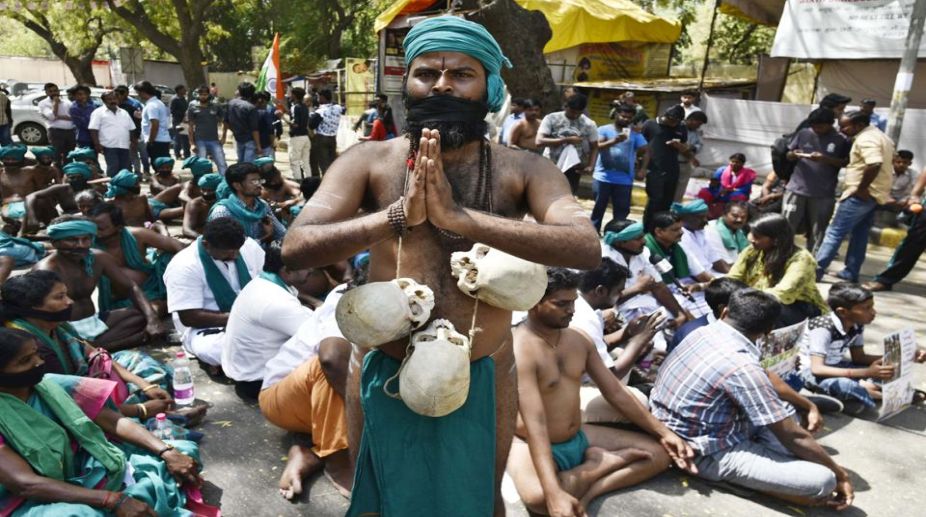
The absence of a responsive government in Fort St George and the seeming neglect of the Centre have added to the woes of farmers in Tamil Nadu. More than 150 farmers have died, either by suicide or due to governmental shortcomings as the state faces its worst-ever drought in 140 years. Added to it is the death of much lamented J Jayalalitha on 5 December last year, plunging the state in political chaos. Men wielding power in Fort St George are more interested in worsting the fortunes of the rival faction of the ruling AIADMK than in solving people’s problems. O Panneerselvam, who succeeded Jayalalitha as Chief Minister, announced on 10 January that Tamil Nadu would be declared a drought-hit state and that farmers who have incurred 33 per cent loss in paddy and other irrigation crops would be paid Rs 5,465 per acre and for long term crops Rs 7,287 per acre. Before implementing it, he was ousted by VK Sasikala who took control of the AIADMK by stealth and installed K Palanaswami as Chief Minister. The entire state machinery, including ministers, is now engaged in getting TTV Dhinakaran, Sasikala’s nephew, elected to the Tamil Nadu Assembly from Radhakrishnan Nagar constituency, represented by Jayalalitha. With no responsive government in Chennai, the farmers have taken their agitation to New Delhi. Carrying human skulls and other symbols of protest, they have occupied Jantar Mantar for the last three weeks. The BJP government of Narendra Modi has so far not given any definite assurance to them.

The only promise the BJP has given is to provide a Dravidian party-free government in Tamil Nadu in the near future. The Congress, on the other hand, did express solidarity with the hapless farmers campaigning in New Delhi who have adopted unique strategies like displaying skulls or disrobing to the barest in public. Congress vice president Rahul Gandhi, who called on them in Jantar Mantar, assured his party would fight for them and raise their grievances in Parliament and the Assembly in Chennai. Claiming the Modi government has written off debts worth Rs 1.4 lakh crore of 50 industrialists, he wondered why it could not waive the agricultural loans of Tamil Nadu farmers who are in distress. When Congress leader Jyotiraditya Scindia raised the issue in the Lok Sabha, Radhamohan Singh, Agriculture and Farmers’ Welfare Minister, blamed the Tamil Nadu government for not utilising funds provided by the Centre for the purpose. Money made available under the State Disaster Relief Fund could also be used to mitigate sufferings of farmers due to drought, he said. Tamil Nadu under SDRF was allotted Rs 3,000 crore, but the relief the state sought, including Rs 264.11 crore for the destruction caused by cyclone Vardha in December last year, was Rs 39,565 crore. Against this, the Centre has released Rs 2,014 crore only based on the recommendation of a high-level committee meeting chaired by Union Home Minister Rajnath Singh on 23 March.