Logo

Over 200 children protest against Donald Trump’s immigration policies

IANS | Washington |

Over 200 children along with other demonstrators staged a protest outside the White House against US President Donald Trump's immigration policies, the media reported.

According to the organisers, the group included children from Miami, New York, Colorado and the Washington D.C. area who began their journey to the capital last week to "send a message" to the President, The Hill magazine reported.

They stopped in Atlanta and the Raleigh-Durham area in North Carolina before ending their trip here.

Under the slogan "We belong together", the protesters on Thursday gathered at Lafayette Park, in front of the presidential mansion, to "raise the community's awareness that we should be united".

"The reason why I'm here is that the President wants to separate families. He shouldn't do it, because it's bad to do that. We need for him not to do it," seven-year-old Nayahuari Mesa, who was here with her three-year-old brother and parents from New York, told Efe news.

Her mother, Felicia Martinez said that Nayahuari was aware of the situation and, although fortunately her husband was able to acquire permanent US residence just a month ago, after 12 years as an undocumented migrant, she wants to be part of the fight to prevent other families from suffering possible separation.

Legal immigrants and undocumented migrants, as well as families who were able to take advantage of the immigration relief plans pushed by former President Barack Obama, joined forces to make clear to the Trump administration that they were not going to give up.

Rosana Araujo, from Uruguay, came in the caravan that drove up from Miami, as part of the Women Working Together organisation, said that she is one of those immigrants without papers who could be separated from her US-born son.

"We came with our children, we're a group of fathers, mothers and kids who – in (Easter Week) – want to send a message: that family unity exists," Araujo, who has been in the US without papers for 14 years, told Efe news.

"Let the raids stop, let there be more protection for immigrants, for each community to become a sanctuary community, for our mayors, commissioners and representatives to support the community and not cooperate with the police," she said.

She was referring to the threats from the Trump administration against the so-called "sanctuary cities", which by municipal decision do not persecute immigrants based on their immigration status.

Both Latinos and African Americans, to shouts of "Up with education, down with deportation", also joined the protes.

More than 11 million people are estimated to live illegally in the US, and about six million US-born children are at risk of being separated from their parents if the latter are deported. 

Pakistani exports to India grow despite border tensions

IANS | Islamabad |

Despite mounting tension along the border, the trade between Pakistan and India has remained intact since the beginning of the current fiscal year, a media report said on Friday.

A report by the State Bank of Pakistan (SBP) revealed that Pakistan grew its exports to India during the first eight months of 2016-17 while curtailing imports by 23 per cent, Dawn online reported.

The trade balance, however, remained in favour of India.

The two countries have long been locked in a bitter rivalry. But worsening political relations seem to have little impact on bilateral trade relations, according to trade analysts.

After growing by 14 per cent, exports from Pakistan to India amounted to $286 million in the July-February period. Imports from India fell 23 per cent to $958.3 million from $1,244 million recorded a year ago, the SBP report said.

One reason for Pakistan's improved exports to India is high cement demand in the neighbouring country. 

This has offset the negative impact of a decline in Pakistan's cement exports to Afghanistan and South Africa, reports Dawn online.

The SBP said cement exports continued their downward trend, with the largest share in the year-on-year decline in the first half of 2016-17 originating from two markets – South Africa and Afghanistan.

"A slight consolation was continued strong demand for Pakistani cement from India. This partially offset the declines witnessed in the two other major markets," the SBP report said.

Meanwhile in the first eight months of the current fiscal year, Pakistan recorded a trade deficit of $672 million with India. 

The deficit was $993 million in the same period of the last fiscal year.

Imports from India in 2015-16 were worth over four times the exports from Pakistan, a five-year high. 

Pakistan imported goods worth $1.8 billion in 2015-16 compared to the exports of just $400 million, the SBP report added.

Democrats pressurise Donald Trump to keep national monuments

AP | Washington |

Western Democrats are pressuring President Donald Trump not to rescind land protections put in place by President Barack Obama, including Utah's Bears Ears National Monument.

Obama infuriated Utah Republicans when he created the monument in late December on 1.3 million acres of land that is sacred to Native Americans and home to tens of thousands of archaeological sites, including ancient cliff dwellings.

Republicans have asked Trump to take the unusual step of reversing the designation, saying it will add another layer of unnecessary federal control and close the area to new energy development.

In a letter this week, nine Western Democratic senators wrote Trump to say that weakening protections for Bears Ears or any other national monument would be a direct affront to local communities and stakeholders.

“This is especially true in the case of Bears Ears National Monument, for the Native American tribes who call this living cultural landscape their ancestral home,” the senators wrote.

The White House has said it is reviewing the decisions by the Obama administration to determine economic impacts, whether the law was followed and whether there was appropriate consultation with local officials.

In an ongoing back-and-forth with Republicans over the monument, Democrats on the House Natural Resources Committee released documents yesterday to try to bolster their argument that there was adequate consultation. The documents from Arizona Rep. Raul Grijalva, the senior Democrat on the panel, detail repeated phone calls and visits between the Obama administration and Utah's congressional delegation and governor.

The emails show that Utah officials hoped to work with the federal government on the issue before Obama designated the monument in the final days of his administration on Dec 28. In an email on Dec 21, as state officials grew increasingly concerned that the designation was coming, a member of Utah Gov Gary Herbert's staff wrote an Interior Department official and thanked her for her time.

“I'm not kidding when I say you're an amazing example of a public servant,” wrote Herbert's director of federal affairs, whose name was blacked out in the emails.

Democrats said the back-and-forth showed collaboration.

“If anyone wants to paint Bears Ears National Monument as a surprise or the product of rushed or incomplete planning, they'll have to explain hundreds of emails and dozens of pages of shared work product,” Grijalva said.

A spokeswoman for House Natural Resources Committee Chairman Rob Bishop, R-Utah, fired back. The spokeswoman, Molly Block, said that releasing the documents was a “desperate attempt to create a faade of local support.”

When the designation was announced, Republicans in the state said it was an egregious abuse of executive power. It was opposed by the governor and the entire congressional delegation, in addition to many local residents.

Herbert said then that the designation “violated assurances made by (Obama's) interior secretary to take into account local concerns before making a monument designation.”


Canada bans removing passengers from overbooked airplanes

IANS | Ottawa |

The Canadian government has banned all airlines in the country from forcibly removing passengers from overbooked flights, officials said.

In a letter issued on Thursday to the heads of all airlines that fly in and out of the country, Transport Minister Marc Garneau warned that an incident like the one injuring a passenger aboard a United Airlines flight earlier this week is not allowed to occur in Canada, Xinhua news agency reported.

"I am sure that you were as disturbed as I was, and as all Canadians were, over the appalling incident that took place onboard a United flight earlier this week, when a passenger was forcibly removed from his seat," he wrote.

"I am writing to you today to convey that such an incident would be unacceptable in Canada."

The warning is not only for Canadian airlines such as Air Canada and WestJet, but also to all international airlines that fly in and out of the country.

The minister's letter comes after a passenger named David Dao, 69, was dragged off an overbooked United flight in Chicago on Sunday after refusing to leave his seat to accommodate airline crew members.

Dao was seriously injured by security officers who forced him off the plane against his will, banging his head on armrests in the process.

The minister's warning comes ahead of expected legislation to introduce a passengers' bill of rights in Canada.

The legislation will outline what passengers can expect from airlines in situations such as bumping from overbooked planes or for lost or damaged luggage. 

Harry Styles unveils album track listing, artwork

IANS | London |

Former One Direction band member Harry Styles has unveiled his album's track listing and artwork on Twitter.

The 23-year-old singer revealed that the self-titled record will release on May 12, reports mirror.co.uk.

Styles also tweeted two photographs of what appear to be the album artwork. One image shows his wet hair and naked back, while the second shows the singer floating in a pool of water.

These were posted along with the track list for the album, which features his debut solo single Sign of the times.

The ten-track album will include – Meet me in the hallway, Sign of the times, Carolina, Two ghosts, Sweet creature, Only angel, Kiwi, Ever since New York and Woman and from the dining table.
 

UEFA Europa League: Manchester United held at Anderlecht

Everything still to play for in the second leg at Old Trafford next week!

SNS | New Delhi |

Manchester Untied’s propensity towards drawing a football game under Jose Mourinho came to the fore once again, the Red Devils allowing Belgian side Anderlecht to hold them to a 1-1 draw in the first leg of their UEFA Europa League quarterfinal tie on Thursday.

Mourinho fielded his best possible XI, with Antonio Valencia returning to start at right back but first-choice goalkeeper David de Gea was deemed fit only for the bench.

The hosts had the first chance of the game despite United monopolising possession, with winger Frank Acheampong flashing a cross-shot which eluded his teammates before flashing wide of Sergio Romero’ post.

After that, however, it was one-way traffic as United exerted control and they should have gone ahead with Marcus Rashford sent in an inviting cross for Zlatan Ibrahimovic. The Swede beat his marker to poke the ball at goal but Anderlecht keeper Ruben Martinez made an important stop and Jesse Lingard was unable to finish on the rebound, hitting the post.

Rashford was looking bright and went close to scoring when he sent in a long distance shot which almost curled away into the far corner but United weren't to be denied for long.

Valencia sent in a cross straight at Rashford, whose initial shot was saved by Martinez but Henrikh Mkhitaryan was on hand to tap in the rebound nine minutes from half-time.

The sides went into the interval with United holding a slender advantage and as the second half began, the away side looked to find that second goal which would effectively seal the tie in their favour.

It never came, however, with Mkhitarayn first and Paul Pogba later missing chances to double United’s lead. While the Armenian’s chance was a little difficult considering it was from an acute angle, Pogba had been set up for a one-on-one by a delightful through ball from Ibrahimovic, but chose to shoot straight at Martinez rather than finishing in a corner.

And their profligacy came back to haunt them as as Leander Dendocnker headed home Ivan Obradovic’s cross in the 86th-minute to give Anderlecht a fighting chance of progressing to the last-four.

The return leg is next week, on the 20th of April at Old Trafford but now United must shift their focus to the English Premier League as Mourinho’s former club and current league leaders, Chelsea, come visiting on Sunday.

Burden of farmer loan waiver will not be passed on to people: Yogi

IANS | Lucknow |

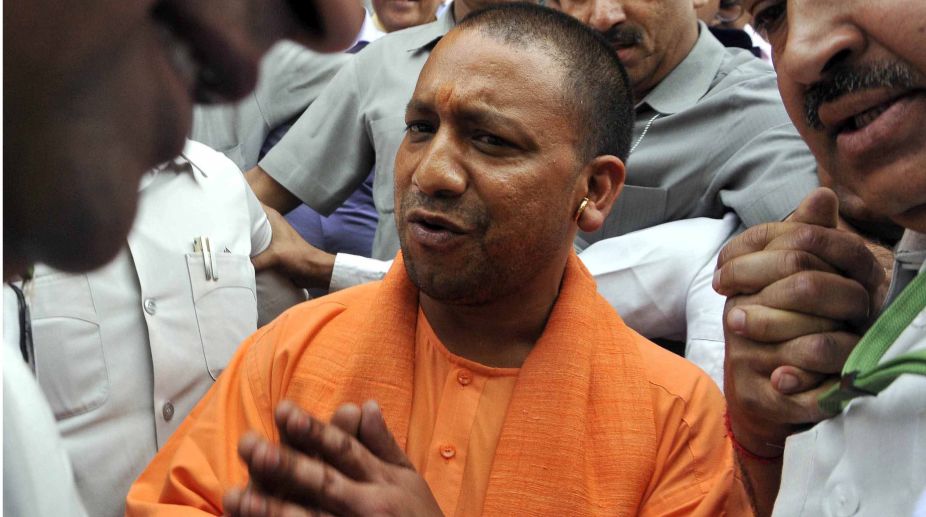
Uttar Pradesh Chief Minister Yogi Adityanath on Thursday said the burden of the Rs 35,000 crore plus loan waiver for farmers announced by the government will not be passed on to the people.

"We have made arrangements for the same and we will also cut short the unnecessary expenses" the Chief Minister said.

The state government had set an aim of providing the best and efficient health care services to the people and to ensure that under all circumstances, these services reach far flung areas to people in need.

Yogi also accused his predecessor Akhilesh Yadav of rejecting the hitch emergency ambulances for the last two years, thus depriving the people of a major life saving facility.

All ambulances will be monitored through GPS and will be run by GVK-EMRI, which will be responsible for proper running of the equipments and in case they are found non-functional, a fine of Rs 10,000 will be levied.

Health Minister Siddharthnath Singh informed that of the 150 ambulances flagged off, 75 were provided by the Central government in 2014-15 and 75 in 2015-16 under National Health Mission but the past government did not use them.

BJP out to murder AAP: Yogendra Yadav

IANS | New Delhi |

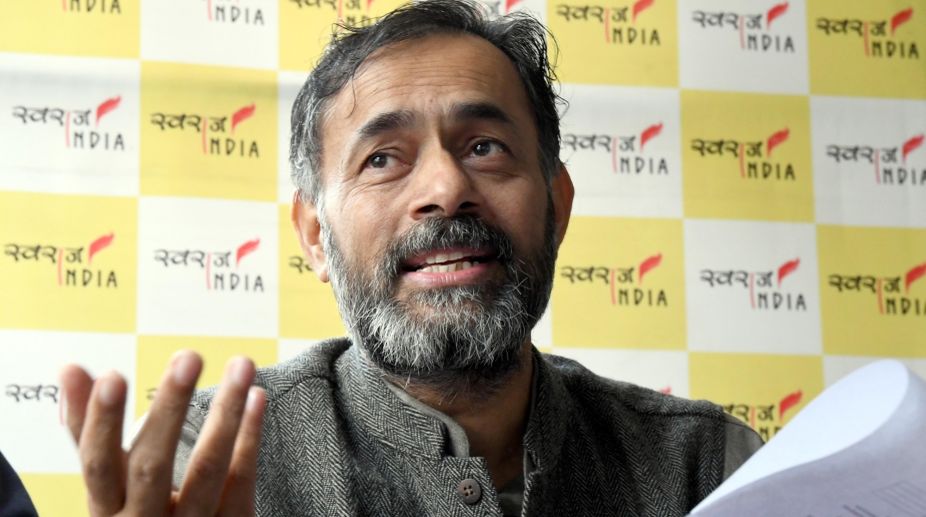
Swaraj India National President Yogendra Yadav on Thursday said BJP is out to murder the Aam Aadmi Party but the Arvind Kejriwal led party will suicide before it gets murdered.

Yadav who was speaking in a public rally, roadshows, jansabha and padyatras in different parts of east Delhi' areas said: "There is no denying the fact that the BJP is out to murder the Aam Aadmi Party. But the AAP, due to its misgovernence, misdeeds, corruption and compromises is all set to commit suicide."

He also accused former Lt. Governor Najeeb Jung for an "arm of the ruling party (BJP) at the Centre.

"Jung obstructed many routine initiatives of the Delhi Government. The Delhi Police got after every real and imagined crime of AAP legislators like no other state police has done to any ruling party".

He alleged that if the same standards were applied uniformly, dozens of BJP's own MPs and hundreds of MLAs all over the country should have been in jail.

While the BJP has worked overtime to highlight the misdeeds of the AAP, the harsh truth is that there were just too many misdeeds waiting to be exposed.

Stock exchanges in IFSCs may permit trading in equity derivatives: SEBI

IANS | Mumbai |

The Securities and Exchange Board of India (Sebi) on Thursday said stock exchanges operating in international financial services centres (IFSCs) may allow dealing in equity derivatives.

"Based on the recommendations of the Risk Management Review Committee of SEBI, it has been decided to specify derivatives on equity shares of a company incorporated in India as permissible security," the market regulator's circular said.

"…the recognised stock exchanges operating in IFSCs may permit dealing in derivatives on equity shares, subject to prior approval of Sebi," it added.

According to the circular, the Market Wide Position Limit (MWPL) for "derivatives on equity shares" will be equal to 10 per cent of the number of shares held by non-promoters in the relevant underlying security (free-float holding).

Further, the MWPL for "derivatives on equity shares" in recognised stock exchanges in IFSCs would be reckoned separately from that in recognised stock exchanges in domestic market, the circular said.

"Sebi's circular to allow trading in equity derivatives of a company incorporated in India by stock exchanges operating in IFSCs is a welcome move and will allow the IFSCs to move ahead at an even faster pace," said Ajay Pandey, MD and Group CEO, GIFT City.

Syria chemical attack allegation ‘credible’: OPCW

IANS | The Hague |

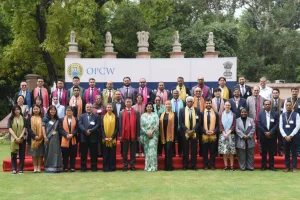
A preliminary assessment showed that the alleged use of chemical weapons in Syria "was a credible allegation", said the Hague-based Organisation for the Prohibition of Chemical Weapons (OPCW) on Thursday.

Chairperson of the OPCW executive council, Ambassador Odette Melono of Cameroon, in consultation with the Director-General of the OPCW Ambassador Ahmet Uzumcu, convened a meeting of the council to discuss these allegations, Xinhua news agency reported.

"The Director-General shared with the council the immediate steps taken by technical secretariat experts to analyse the available information and their preliminary assessment that this was a credible allegation," said the UN watchdog on chemical weapons.

The OPCW fact-finding mission has collected samples, which have been sent to OPCW designated laboratories for analysis. OPCW experts are currently analysing all information gathered from various sources.

The Director-General called on state parties that are in a position to do so to share with the Secretariat any relevant information without delay and allow the experts to complete its work within the next two to three weeks.

On April 4, a reported toxic gas attack hit the rebel-held town of Khan Sheikhoun in Syria's Idlib, killing over 80 people and wounding scores of others.

Two days later, the United States launched 59 cruise missiles against the Shairat military base in central Syria, from where, as the US believes, Syrian airplanes carrying chemical weapons took off.

The Syrian government denied the accusation. It said that its air strikes hit an arms depot containing toxic gas and blamed the rebels for storing such chemical materials.

Tea, rivers, and hiking

Swaati Chaudhury | New Delhi |

For adventure buffs ready to head for a trip in and around the Darjeeling Hills, there’s Glenburn Tea Estate offering them a reason to feel happy with a torrent of adventurous activities. It’s not always that one gets to experience such mesmerising adventure in the stunning landscapes of the eastern Himalayas with breathtaking views of snowcapped Kanchenjunga.

Husna Tara Prakash, proprietress, GlenburnTea Estate and Boutique Hotel, said, “The area around Glenburn Tea Estate has a diverse landscape replete with avian species, butterflies, beetles and crabs in the nearby springs that form a perfect retreat for those seeking a break from their fast-paced life. It is an ideal destination where adventure lovers can take up hiking and retire to a high level of comfort at night. Those seeking solitude can always spend some time in the verandah of Glenburn bungalow sipping their favourite Darjeeling cuppa. Our Glenburn Tea Tour involves exploring the estate and tea factory, taking our visitors into a wonderful journey of beverage making.”

There are a number of hiking trails including both gentle and arduous treks that last for a day along the River Rung Dung. Prakash informed, “Tourists can spend the night at the Glenburn Lodge with utmost comfort on the banks of the River Rangeet and can camp, trek across the river to Sikkim, play a game of beach cricket, take a dip in the river or go for fishing in Rangeet from October to May. The fishes include Golden Mahseer, brown trout, rainbow trout, snow trout and carp. Tourists can also go on sightseeing tours of Darjeeling or Kalimpong.”

Other interesting adventure options are hiking along the river Rangeet to Manjit hamlet in Sikkim, hiking to Ramitay Daara, afternoon hike to Shikari Dura hamlet, river Rung Dung hike or exploring the Lamhatta orange orchard and Cluny Sister’s church.

The Glenburn Tea Tour offers a guided tour of the factory with opportunities for tea tasting sessions where one can get a taste of an exciting range of tea including black, green, oolong and white. At the Glenburn Campsite excursion, tourists are offered the choice from a range of activities like paddling in rock pools, fishing, bird-watching, beach activities on Rangeet, relaxing on sandy beaches and going on short treks on the river banks. Barbecued dinner and bonfire are popular options for tourists on the beach. There are amazing avian species along the Rangeet to watch out for like cormorants, wild geese and hornbills.

Tourists are required to take up precautions while venturing out for the campsite like using insect repellants since there are sand flies along the river. Care should be taken while swimming or paddling along the river since there is a strong current and the rocks are quite slippery. Moreover, the river has quick sand that has to be avoided.

Rangeet passes through dense jungles and tourists can get to explore the rich biodiversity, identify the avian species and the floral life.

For the day’s most important meal

Start your day on a happy note with easy to prepare healthy, wholesome breakfast.

Deepa Gupta | New Delhi |

Breakfast is the most necessary of the three basic meals of the day. Impacting every dimension of our being, a good breakfast helps maintain weight, helps weight loss, provides radiant skin, better immune system, reduces obesity, high blood pressure; prevents heart disease and diabetes. To reap all the benefits of breakfast, here is the list of a few healthy foods, which can be easily and quickly prepared to start your day right.

  • Vegetable and oats: Cut the vegetables (onions, carrot or bean) in small cubes. Heat one teaspoon of olive oil in a pan. Sauté the onions. Add all the vegetables and a little salt, turmeric powder and chilli powder. Let the vegetables get cooked by keeping the pan covered. Add one and a half cups of water. Bring it to the boil and then add half a cup of oats. Stir till the water is dried. Have it with coriander chutney.
  • Grilled vegetable and paneer sandwich: Take two pieces of whole grain bread. Spread coriander chutney on one bread slice and tomato ketchup on another. Place thin slices of cucumber, tomato and paneer on the chutney piece. Cover it with the ketchup bread piece. Grill it in a sandwich maker for few seconds without adding butter.
  • Poha: Wash one cup of poha. Drain the water and keep aside for 15- 20 minutes. Meanwhile, chop the onion and carrot. Add half a teaspoon of mustard seeds of a pan with some heated olive oil. When they pop up, add onion and sauté for five minutes. Add carrot and peas and cook them till tender. Then, add the soaked poha. Put in a little salt, turmeric powder, red chilli powder, a little bit of sugar and lemon juice. Cook for 10 minutes and it’s ready to eat.
  • Milk and porridge: Pressure cook porridge adding four times of water in respect of the quantity of raw porridge. Add little sugar after it is cooked. Add hot milk. Stir and eat hot.
  • Besan or sooji cheela: Chop onion, green chillies and fresh coriander leaves. Grate carrot and cauliflower. Add these vegetables, salt, red chilli powder and water to besan or sooji to make a thick batter. Heat up a non-stick pan and add a little olive oil. Spread the batter and cook from both sides. Have it with coriander chutney.
  • Boiled masala eggs: Boil eggs and then cut in two halves. Sprinkle finely chopped onions, coriander leaves, green chillies, salt and chat masala on it.
  • Mung beans sprouts: Soak them in water overnight. In the morning, drain the water. Put the swelled beans in a bowl with a lid and keep aside for two days. Wash them after seven to eight hours so that it does not stink. After two days you will see beautiful sprouts from mung beans.

Put them in a pressure cooker. Add half a cup of water, a little salt and turmeric powder. Give a pressure and take the beans out of the cooker. You may eat them plain, adding a little lemon juice or you may add finely chopped onion, tomato and cucumber in it to enhance the taste and health benefits.

These breakfast options are complete meals in themselves with whole grains, protein and fibre.

Taking a leap of faith

Nivedita R | New Delhi |

When one thinks about Rishikesh, the images that immediately come to mind are of tranquillity in the foothills of the Himalayas, its holiness and religious significance. Situated approximately 230 km from Delhi, this pilgrimage town is regarded as one of the holiest places for Hindus and is also popular as the “Yoga Capital” of the world.

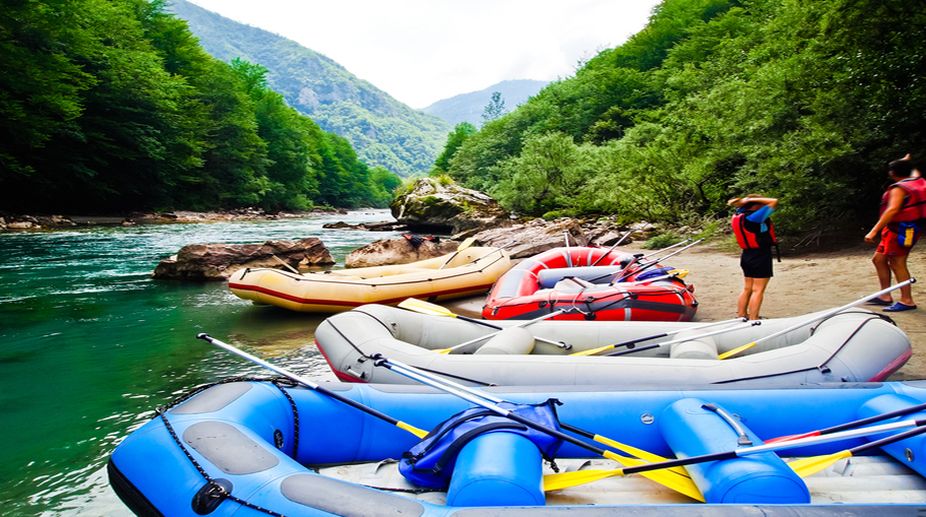
However, in recent times, there has been a change in the way we look at this place. What was once solely a pilgrimage town has now transformed into an adventure hub. Attracting tourists from across the world, Rishikesh offers exciting activities such as white water rafting, cliff jumping, bungee jumping and flying fox to name just a few. White water rafting has always been a popular activity in Rishikesh, but now adventure enthusiasts have a choice of more fun-filled and adrenalin coursing options.

Speaking about its transition from a purely religious town to an adventure hub, Rahul Nigam, founder and managing director of adventure sports outfit Jumpin Heights, said, “It (Rishikesh) continues to remain a religious town and will always be one. It has developed into an adventure hub and even the Uttarakhand government is taking up a lot of initiatives. We are both (religious and sports) simultaneously growing well.”

Colonel Manoj Kumar, co-founder of Jumpin Heights, explained, “There was nothing here when we came in 2006. Over that period, a lot of camps have come up and the area is now very well-developed.” White water rafting in Rishikesh began at a small level in 1980s and subsequently grew by the 2000s. The turnover from the camping and rafting business in Rishikesh is around Rs 60 crore annually.

“Youngsters should come and try these adventure sports. I have had people come to me and tell me that these sports not only help in overcoming fear but also one gets a feeling that they can take on the world,” added the former Army officer.

The must try things in Rishikesh are bungee jumping, white water rafting and staying in camps as it is an experience in itself. Some of the camps also offer trekking programmes and biking tours. Apart from that, one should not also miss the Ganga Aarti in Parmarth Niketan at dusk.

Any adventure sport has a risk factor attached to it. Keeping this in mind, organisers have put in place several safety features, which is constantly updated. Yet there are accidents and unfortunate incidents, several organisers said. For instance, rafting in Rishikesh, although extremely popular, comes with a certain degree of risk.

There have been many incidents of casualties due to the overturning of the raft. This was primarily because of illegal rafters outnumbering legal ones and flouting rules. However, it’s better to be safe than sorry. Therefore, it is advised to consider the danger aspect seriously and go for the well-known rafting companies, who ensure emergency measures and thoroughly brief participants to minimise risk.

In bungee jumping, explained Nigam, there are only minor incidents like shoulder dislocation and the cord rubbing against one’s cheek during the jump. He said, “Once a gentleman had a shoulder dislocation but in that case, it was his fault as he didn’t inform us prior to the jump about his medical condition. However, we were able to correct it immediately.

“If people inform us in advance about their medical condition, if any, then we strap them accordingly. We have a doctor on call 24×7.” People with heart ailments, epilepsy, neck and back injuries are strictly prohibited in this sport. Camping on the banks of the Ganga is truly an incredible experience. One gets as close to nature as one can. Housed completely in tents, with no electricity or running water, the facilities are absolutely basic. Even the washrooms are in tents! Trekking and white-water rafting are the main activities offered by these camps.

However, with their rising popularity, there was rampant proliferation of these rafting camps, which have put forth myriad environmental concerns. A petition in April 2015 by an NGO had sought the closure of these camps on the grounds that they contributed to the pollution of the Ganga. Apart from the lack of sewage or sanitation facilities, camp owners often left garbage, including plastic, food as well as alcohol bottles and cans. This also impacted the wildlife habitat, the petitioner alleged.

The petition was also against the Uttarakhand government’s decision to issue licenses to a number of camping sites without considering the carrying capacity of the Ganga.

In July 2015, the National Green Tribunal refused permission to rafting camps on the river bank from Shivpuri to Rishikesh. Now NGT has allowed beach camping in 25 out of 30 sites along the Ganga in Rishikesh. As per its order, camping will be permissible outside a 100-metre radius from the middle of the river.

Environmentalists and local inhabitants are of the view that adventure activities and tourism should take into consideration environmental concerns. Activist and founder of Social Action for Forest and Environment, Vikrant Tongad said, “In 2015 we had filed a petition in NGT against the ‘unregulated’ operation of rafting camps in Rishikesh. The petition expressed concerns over ‘flattening of land’ and ‘pollution caused by the temporary campsites’ because of improper sewage disposal, lack of sanitation and general pollution caused by drinking alcohol, firecrackers and bonfire.”

He added, “Adventure sports are very important in terms of both being close to nature and revenue generation. However, one should also ensure that the environment is not harmed and keep in mind all the dos and don’ts.”

Out of the 25 beach camp sites that are allowed by the NGT, only three are suitable for putting up camps and the rest are still partially within a 100-metre radius from the river, Tongad said.

Building greater capacity

Abhiraj Ganguli | New Delhi |

With more boisterous issues hogging the headlines in the last couple of months, Prime Minister Narendra Modi’s Skill India campaign has been somehow overshadowed in the popular discourse. But its importance in addressing the country’s massive skill gap cannot be overstated.

The Harvard University South Asia Institute along with Tata Trusts undertook an 18-month research project called “Livelihood Creation in India through Social Entrepreneurship and Skill Development” from August 2015 to December 2016. As part of the project, 16 organisations were given social innovation grants totalling Rs 50 lakh and their proposals were implemented during the later stages of 2016. Six publications documenting various aspects of their research have also been published.

Shashank Shah, project director and fellow, Harvard University South Asia Institute and visiting scholar, Harvard Business School, spoke about how it all came about, the insights gained during the course of the project and the future of skills development in India. Excerpts:

Q. How did the idea for the project come about?

According to a survey of skills gap by the National Skills Development Corporation, over the next decade, Indian industry needs 240 million people just to maintain the current growth rate. The entire Indian education system produces only about 12 million graduates, and another 4.3 million people who emerge from the education system as skilled people every year. Of these, many people are not employable due to poor quality of skill sets or lack of relevant vocational training.

According to a Labour Ministry Report, in 2012-13, one out of every three persons in the age group of 15 to 29 years, who have completed at least their graduation, was found to be unemployed. Of the unemployed in this age group, 36.6 per cent were in the rural areas and 26.5 per cent in urban areas.

It is in this context that this project on “Livelihood Creation in India through Social Entrepreneurship and Skill Development” was envisaged as a collaborative endeavour between the Tata Trusts and the Harvard University South Asia Institute. The project aimed at providing the much needed platform to bring in international expertise and knowledge from the diverse faculties of Harvard University.

The collaboration between Harvard and local subject experts aimed at catalysing the process of creating livelihoods thereby contributing to social and economic empowerment of the vulnerable sections of India. The large canvas and support provided by the Government of India machinery and the Skill India campaign envisaged by the Prime Minister emerged as a very timely opportunity to contribute towards poverty alleviation and human development through the route of social entrepreneurship and skill development.

Q. Why did you specifically focus on the handicrafts and handloom sectors?

The production of handicrafts is (after agriculture) the largest source of income among rural populations — an estimated 11.65 million Indians were engaged in craft production in 2013. This is expected to grow to 17.79 million by 2022. Data from unofficial sources indicate that up to 200 million craftspeople or artisans directly and indirectly depend on this sector for a livelihood, suggesting the need for a more rigorous mapping and understanding of the sector. Hence, this project aimed at providing that support and addressed the challenges currently faced by enterprises that seek to improve rural livelihoods in the handicrafts and handloom sectors. The specific locus of Harvard South Asia Institute’s intervention was the rich and varied Indian handicraft tradition, practiced by skilled rural artisans, who produce objects of great beauty with strong market potential. The goal of this project was to provide tangible and intangible inputs to augment the capacity for impact of a select set of organisations working in the field to improve the lives and livelihoods of India’s handicraft and handloom artisans.

Q. What are some of the key insights you’ve gained through the project?

During our field research and from responses received from over 400 applicants, we realised the capacity gaps that existed in the leaders of these organisations. Through the workshops, we focused on delivering these through inputs from subject experts from India, and Harvard cases taught by Harvard faculty who led these workshops.

The top three capacity gaps in Indian crafts entrepreneurs were found to be market access and marketing; scaling up and strategy, and finance. On the other hand, the top three capacity gaps in science and tech-based social entrepreneurs were partnerships and networking; mentoring and expertise, and programme/product management.

Q. Have you shared your research with the government? What is their response?

We have shared our publications with select government agencies. We also invited select government representatives to share their insights with our grantees during the workshops and the summative events. For example, Manish Kumar, managing director, National Skills Development Corporation, and Vijaya Raghavan, secretary, department of biotechnology, delivered the keynote and valedictory addresses at the Summit event held on 23 January.

Q. What is the “All India Arts Alliance” and how will it work?

One of the major gaps noticed by the participants of the crafts track was the lack of a platform to share their ideas, concerns and innovations as a collective entity. Consequently, the 52 organisations that participated at the crafts workshop in January 2016, ideated and volunteered to form an alliance that would serve this purpose. After year-long deliberations, the alliance was launched at the Harvard SAI summit event.

Ihitiashri Shandilya, chief executive officer, MithilAsmita, took on the mantle as the coordinator of this alliance. Harvard SAI has no direct role to play in this alliance. We were happy to provide an ecosystem where the crafts entrepreneurs could interact and ideate to initiate and implement such an alliance.

Q. What more can be done for skill development and livelihood creation in India?

In my understanding, there exists a tremendous opportunity to build capacity in the leaders of social enterprises such that it catalyses their institution’s growth, and also impacts and empowers the rural artisans. For example, by providing capacity building to the 52 crafts enterprises’ leaders through our workshop, we indirectly impacted 180,000 rural artisans they were working with.

I believe that academic institutions, civil society organisations and corporations can work together to contribute to livelihood creation in India through skills training. The CSR legislation also provides an opportunity to corporations to fund capacity building for NGOs.

The academic institutions can bring to play their research-based insights and frame multi-perspective curricula to contribute to the widening of horizons and inculcate virtues of effectiveness and efficiency, innovation and impact-orientation in these organisations.

Skills development and livelihood creation in India received a major fillip thanks to Harvard University South Asia Institute for conducting the research.

To know more about the project, grantees and publications,check out http://southasiainstitute.harvard.edu/ about-livelihood-creation-project


The spirit of Innovation

Rajesh Aggarwal | New Delhi |

‘The enterprise that does not innovate inevitably ages and declines,” said Peter Drucker an acclaimed management consultant and author. It may sound too radical, but the visionary wisdom behind those words cannot be overlooked. Today, we live in an age of fastpaced changes where organisations must strive for evolution and innovation. Revenue, profits, sales are necessary for a company’s growth, but what is crucial for it to stay relevant. It includes organisational resilience to anticipate and respond to incremental change and sudden disruptions to survive and thrive. It also implies that we recognise people’s innate capacity to adapt and create.

Geniuses like Steve Jobs took the world by storm using his innovative skills. He experimented with different pursuits before starting Apple computer with Steve Wozniak in 1976. Apple’s revolutionary products which have been dictating the evolution of modern technology were nothing but the manifestations of an innovative mind.

Innovative companies attract creative employees who set in motion an environment of innovation. The fallout of this creative thinking — the satisfaction and the excitement of solving interesting problems, the sense of achievement, the thrill of collaboration, and the augmentation of skills are all key ingredients to the kind of purpose-driven culture that fosters disruptive innovation.

Traditional carrots — pay hikes, bonuses, perks, and sticks — poor appraisal, denial of increment and lack of promotion, do work, but only to an extent in motivating employees. Real motivation comes from within and is best generated in an atmosphere of growth and creativity. It keeps employees energised and committed, especially the world-changers and the risk takers, who thrive on disruption. The promise of innovation gives purpose and meaning to their work. Such people are an asset for companies that want to stay ahead of competition.

An organisation is all about its people.

Long-term innovation models require dedicated inputs, support, and engagement from the employees and all stakeholders involved. Progressive organisations are the ones having skills to manage complexities of human minds. To be successful in today’s fast-changing business environments with collective and energised value-creation, companies need to adopt holistically innovative mindset. Creativity and innovation at workplace progress with soul searching. If organisations are able to find out their raison d’être, capabilities grow like never before. On the other hand, if they only focus on revenue generation, there are chances of disenchantment of the employees. Inculcating a culture of innovation is imperative even for better human resource management, attracting inspired talent and managing brand reputation. Even a decade back, innovation was viewed as a primary challenge of building leadership capabilities. Today the lens of innovation has become the indispensable high-performance mantra to incubate experiment and come up with breakthroughs. Innovative leaders are today agents of change and an asset for any organisation. They lead by example to generate new ideas and turn challenges into opportunities, to stay one step ahead of the curve every time.

Here, it must also be pointed out that an organisation’s innovation need not always be in the domain of products or services. All of that ultimately adds to the value chain of building efficient workplaces. Here, it is important to underline that while innovative ideas can be arbitrary or unstructured, the roadmap for execution needs to be clear.

It is becoming increasingly clear that innovation backed by adequate in-house R&D is the way forward to succeed and for employees to excel. There are companies that have launched internal start-up programmers, where teams work on entrepreneurial ideas, to stimulate creativity. Others have started competitions where employees pitch ideas to improve the business, and the best ones get funding and support. When it comes to companies operating in the agrochemical space, embracing cutting-edge innovative technologies helps immensely in dealing with issues on-ground, and developing sustainable products for customised needs.

But it’s not as if innovation is new to Indian business. The rural community driven economy of our country has been turning to Jugaad (which itself is ground-level innovation at its best) for as long as one can remember.

The digital age we live in allows a more open and collaborative environment where everyone works to brainstorm on ideas. The new environment allows for collaboration and ideas to come from any quarter, not hemmed in by hierarchies. Inculcating a culture of innovation is one of the most important things a leader can do to improve the performance of employees and the balance sheet of the company. But it is tough. Entrenched corporate cultures thwart innovation efforts. Business leaders need to reinvent their culture and deliver better innovation.

But going forward, only disruptive process-driven innovation will act as a critical differentiator in outperforming the existing standards of organisational excellence. When led by outstanding torchbearers or smart entrepreneurs, effective innovation management policies can energise teams to deliver their best. Instead of chasing profits for shareholders, one must focus on innovation which creates value for all stake holders.

The Writer Is Managing Director, Insecticides India Ltd.

Targeting militants but not all

Owen Bennett Jones | New Delhi |

There were many who believed the Pakistan army would never confront the militants in North Waziristan. Too many strategic assets were located there, they said. And the cost of appeasing the West by dismantling the militants’ infrastructure would be too high. But the predictions were wrong. Eventually — after years of hesitation — the army did move in. It’s easy to forget now that back in 2007 it was not uncommon to hear Peshawarites say they were moving their children out of the city for fear that the state could not provide sufficient security. And even if many of those parents still worry today about the risk of their offspring being kidnapped, there can be little doubt that the situation is vastly improved.

Many of those who doubted the army’s resolve also thought it would never make a genuine effort to control the Pak-Afghan border. After all, for years the army had said it could not control the movement of militants from Pakistan into Afghanistan because the border was so porous. But now that the flow is reversed it turns out that the border can be controlled. There are new posts, forts and radar systems to stop militants getting into Pakistan from Afghanistan.

It all prompts the question: are these developments in northwest Pakistan a one-off? Or are they a model for what might happen in the rest of Pakistan?

The army would doubtless argue that its fight against militant violence is by no means restricted to the northwest. The Fata campaign has been matched by a commitment to tackle militancy in Karachi. And even if many might see the Baloch insurgency in a different light to violent jihadism, from the military’s point of view, in Balochistan too, the state has confronted those who violently oppose the state.

And yet elsewhere in the country some militant outfits remain untouched. There are three types of groups to consider: those active in Afghanistan, the sectarian groups and the India-facing outfits.

Despite all the impassioned official denials, the world has little doubt that the Afghan Taliban leadership has sanctuary in Quetta. Given that foreign affairs adviser Sartaj Aziz said as much it’s difficult to believe anything else. And there is a reason for this policy. In the minds of some of Pakistan’s military strategists the protection offered to senior Afghan Taliban leaders and their families serves Pakistan’s national interest. The international community, the argument goes, will be unable to get a peace deal Afghanistan without going through Pakistan.

Similarly, the links with India-facing groups are plain for all to see. The idea that Pakistan can rely can on the indigenous movement in Kashmir may be gaining ground in some official circles but as long as Modi is in power the Pakistani militants are going, at the very least, to be held in reserve.

Which leaves the sectarian groups. Even for the most hard-bitten supporter of the state’s use of jihadi proxies, support or toleration of the sectarian groups is very hard to understand. The sectarian groups cause huge suffering. They deepen a potentially disastrous rift in Pakistan society. They are already the subject of outside interference and financing and thereby undermine Pakistan sovereignty. In addition, they offer a potential route for the militant Islamic State group to get into Pakistan society. While many analysts believe IS lacks the infrastructure or popular support base to become a major force in Pakistan, there is still a risk that the organisation could become established by forming an alliance with anti-Shia groups such as Lashkar-i-Jhangvi.

Despite all these serious considerations the sectarian groups continue to operate. The most likely explanation — beyond sectarian prejudices reportedly held by some senior officers — is that these groups are now so numerous that confronting them head-on would risk something approaching civil war in the key province of Punjab.

There are other reasons to believe that various types of militant groups active outside the northwest will not be touched. The civilian government has still failed to adopt a clear position on militancy. Maulana Abdul Aziz Ghazi, one of the leaders of the Lal Masjid rebellion, remains in charge of an institution that became a byword for antistate violence and which was cleansed of violent elements at a high cost to human life. Nor has the government instituted sufficiently thorough reforms to undermine the militants by providing people with schools, hospital and courts.

But the failings are not by civilians alone. The lack of resolve is also creeping into military parlance. Increasingly, the military is moving away from saying militancy reflects internal divisions in Pakistan. Instead, it is taking the much easier and convenient line of blaming it all on foreigners. Even if such claims are sometimes justified, they run the risk of become a catch-all explanation that will undermine the clear thinking needed to take on such a difficult adversary.

The writer is a British journalist and author of Pakistan: Eye of the Storm.

A way ahead for the Congress

Bharat Dogra | New Delhi |

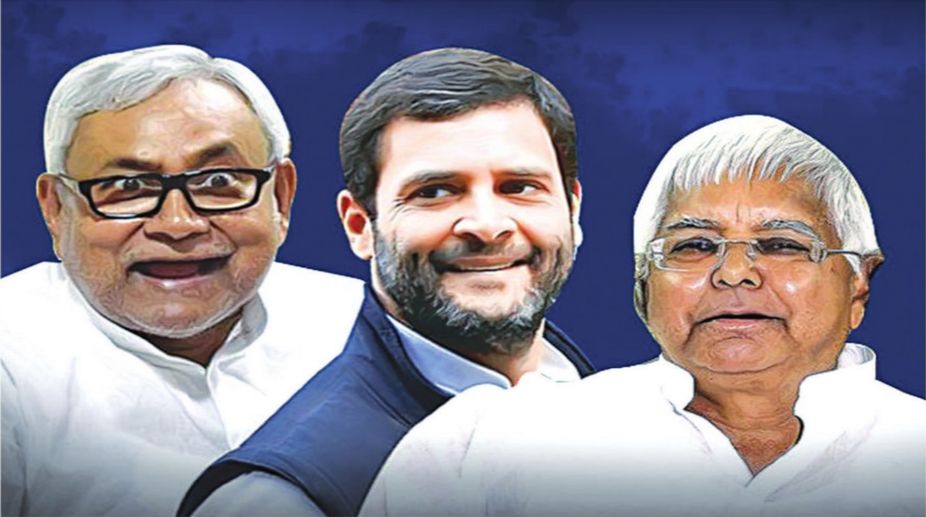
The Congress teamed up with Nitish Kumar and Lalu Prasad in the Bihar assembly elections to defeat the BJP. In Uttar Pradesh, however, the alliance of the Congress with Akhilesh Yadav could not prevent a massive win by the BJP.

While the two results were very different, in both cases the Congress had to bear the adverse consequence of its base among people getting badly eroded due to the fact that an overwhelming majority of the seats were simply not contested by its candidates. When a majority of the seats are not even contested, the mobilisation capacity and organisational structure of a once dominant party of these states is further rusted and eroded.

This lowers the morale of even old timers and loyalists. Several committed cadres find themselves ill at ease when they are asked to extend support to and seek votes for candidates of parties with whom they do not agree. These and related factors need to be taken into account while planning the election strategy of the Indian National Congress for 2019.

This is a critical time for the most prominent political party of India in historical terms which now has to adjust to its new role in opposition. Despite all its recent adversities, it remains by far the leading opposition party in terms of its nationwide presence. Even in the middle of a difficult and adverse phase, the Congress won the most number of seats in three out of five states in which elections were held recently. It is another matter that it could form government in only one out of these three states.

So clearly while the Congress has more than its share of problems all is not lost and a resurgence is still possible. For this efforts have to be made at several levels. One important aspect is to formulate a careful strategy regarding electoral alliances after consultations that involve not just leaders but also grassroots supporters.
One mistake which cost the Congress a lot in Uttar Pradesh was to enter into an alliance with the Samajwadi Party merely on the basis of talks at the top level without proper consultation at the grassroots level. The idea behind the alliance was not bad at all, as the prevailing circumstances of Uttar Pradesh demanded some sort of alliance to defeat the well-oiled, efficiently managed election machine of the BJP which was aiming aggressively at sweeping the election through any means.

The mistake Congress made was in reaching the agreement so late that the supporter base could not be taken into confidence and could not also convey the ground realities to the leadership.

The ground realities indicated that a late agreement would not result in conducive conditions that were needed for the supporters of the two parties to establish a genuine understanding with each other. The ground reality also indicated that some of the most powerful and resourceful leaders of the Samajwadi Party would not only hesitate to support the alliance but may even disrupt it.

The Congress cannot afford to go on repeating its mistakes particularly in such important states as Uttar Pradesh. Some leaders are now talking of organising a Bihar-like mahagathbandhan to defeat the BJP in Uttar Pradesh in the next Lok Sabha elections scheduled for 2019.

Even if such a broad alliance of the SP, the BSP and the Congress becomes possible in UP (this itself is very doubtful) this will leave only about 10 to 15 per cent seats for the Congress. After the debacle of the Congress in the 2017 assembly elections, any decision to contest a small number of seats will be nothing short of catastrophic. Contesting a few seats amounts to leaving the battle before the bugle has been sounded. So before talking of a mahagathbandhan in UP leaders should think of implications properly. Any attempt to defeat the BJP by liquidating itself can only be called foolhardy from a longer term perspective. The proper strategy for the Congress would be to announce that it will contest not less than 80 per cent of seats in all the states in the next Lok Sabha elections. This will help to mobilise party workers and supporters at least to some extent in important states like Uttar Pradesh and Bihar where there is so much uncertainty that there is hardly any incentive for party leaders to prepare for Lok Sabha elections.

However any such determined decision to contest a majority of the seats in the next Lok Sabha election also implies that the Congress will be able to get only smaller parties as electoral allies. There is nothing unfortunate about this. This is the way it should be for a truly national political party. It should have only smaller allies who will be content with a few seats. This is the right time for such a firm decision to send a clear signal to party members and supporters.

However the party should maintain cordial relations with all opposition parties which will also be helpful for post election efforts to form a government.

The writer is a freelance journalist who has been involved with several social movements and initiatives.