Logo

Govt to help global def firms set up manufacturing units in India

Agencies | Washington |

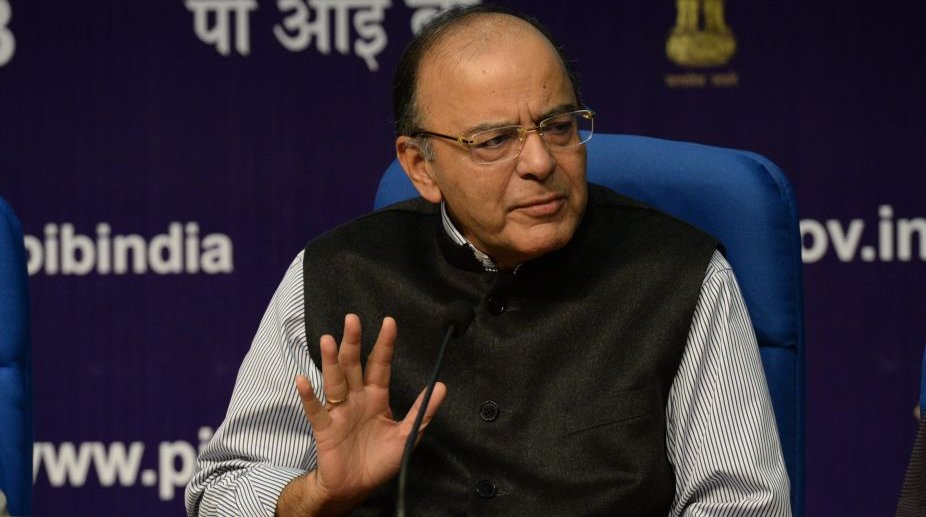
India is formulating policy to help major global defence companies set up manufacturing units in the country in collaboration with Indian firms, Finance Minister Arun Jaitley said today.

“Under our changed policy, we are in the future going to concentrate not merely in buying from the rest of the world, but encouraging global defence majors in collaboration with Indian companies to set up manufacturing units in India, Jaitley said at a reception hosted by India's Ambassador to the US Navtej Sarna. Jaitley, who holds the additional charge of the Defence Ministry, said the Union Government has made the initial policy changes while some more are being planned. “Hopefully in the years to come, the impact of this change as far as defence manufacturing policy is concerned would be visible in India. It is receiving a good response from major manufacturers, Jaitley said without giving any details.

Jaitley was given the additional charge of the Defence Ministry apart from the Ministry of Corporate Affairs after his predecessor Manohar Parrikar was made the Chief Minister of Goa.

Using cricket lingo, he described himself as the “night watchman” for these two ministries. “One of my principal responsibilities is to look after the finances of the government. There are some additional responsibilities that keep coming, he said.

“In the US you do not have much of cricket. In India it is our favourite game. In the game of cricket, we call it night watchman, he said, referring to his dual role.

“The Prime Minister has asked me to fill in that role in some other departments. But my principal requirement is in finance, Jaitley said. Jaitley, leading an Indian delegation, arrived here on April 20, to attend the annual Spring meetings of the International Monetary Fund and the World Bank.

In addition to his meetings and presentations at the annual Spring meetings of the IMF and the World Bank, Jaitley is also scheduled to attend meetings of other multilateral forums including that of the G-20 finance ministers.

Finance Minister Arun Jaitley today said that for the first time there is popular support for economic reforms in India and the recent election outcomes are indicative of it. “The significant part of our economy today is, that there is perhaps for the first time, a huge amount of popular support as far as economic reforms are concerned,” Jaitley said here at a reception hosted in his honour by Indian Ambassador to the US.

A tale of two soulmates

Partha P. Majumder | New Delhi |

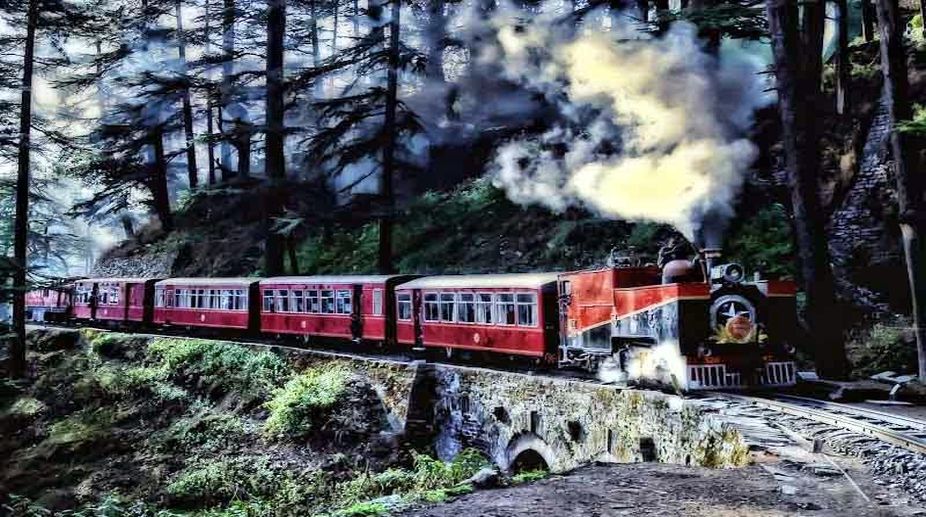
I was viewer number 516,341. At 9 pm on 11 February 2017. Five days after The Statesman carried a report on this beautiful BBC documentary. It is on YouTube; “The Kalka-Shimla Railways.” Even without watching this documentary, I knew of the Himalayan Queen, the toy train that runs from Kalka to Shimla.

My wife and I had planned the start of our New Year traveling through Himachal Pradesh, starting with a ride on the Himalayan Queen from Kalka to Barog.

Lady Luck was not with us. The New Delhi-Kalka Shatabdi decided to depart New Delhi about five hours after its scheduled time; at 12:30 pm on 2 January. We learned of this when we reached the New Delhi railway station around 7 in the morning. We gave up. There was no way that we could catch the toy train from Kalka.

So we travelled by bus to Barog – where we had decided to spend a night – from New Delhi. We decided that we would take the toy train on our return. Even that was not to be! The train was similarly delayed on the day of our return, and we couldn’t afford to wait. Therefore, I had to be contented with being the 516341th viewer.

We enjoyed our travels through Himachal Pradesh. We returned to Shimla on the last leg and had deliberately chosen a hotel high up on a hill. One had to climb about 250 meters up a steep slope to reach the hotel; no car would reach. I was, of course, not aware of this when I had booked the hotel. We checked into the hotel in the afternoon of 6 January and went for a walk in the evening. It started to drizzle. We hurried back. It was cold and was getting colder.

Soon, through the window of our hotel room, we saw white flakes coming down. The pines and firs were soon covered by the white powder. The snowfall became heavier. There was a snow cover of many inches. The landscape looked beautiful. Around midnight it got scary. The town went pitch dark because of power outage. We were to leave Shimla the next morning. The prospects seemed bleak. It was still snowing heavily.

Reality struck us at dawn. The entire town had come to a grinding halt. The hotel door could not be opened because of accumulation of snow. No cars were plying. We were told by staff that they had not seen such snowfall in a decade. We were, of course, going to miss our flight from Chandigarh to Kolkata. We stayed put in our room. However, after noon the front desk of the hotel started to call us to vacate. We had booked for one night. We couldn’t overstay because our room had to be given to another guest who was expected to arrive. How would the guests reach the hotel and even Shimla if they were arriving from elsewhere?

The front desk called again around 3 PM to inform that some buses had started to ply from the local bus station and we could go to Kalka. How were we going to get to the bus station; a walk of about one-and-a-half kilometres through two feet of snow? The hotel agreed to provide us with a porter who would carry our suitcase.

My wife and I are both over 60 years old. She has a weak knee; climbing down is a chore. Walking on snow and patches of ice can be dangerous. We had lived in Pittsburgh – that gets heavy snow each winter – for a few years, and we knew. If one of us fell and got a fracture, how could we go to the hospital? On the other hand, we really needed to return as quickly as possible.

We decided to hit the road. We were not alone. Some local people and a few tourists were also on the road, trying to reach their destinations. With a porter guiding our way, we inched forward. Slowly, but steadily. Until I slipped and fell. No damage done. I fell a couple more times. My wife also had a few falls. No bones broken; lucky us. Slowly, but surely, after a three-hour walk we covered the 1.5 km to the bus stand. We saw many buses parked. But no bus operators. Hundreds of tourists wanted to leave Shimla. The sun was setting. There was no electricity. We had to find a hotel. Grand Hotel was the nearest. We climbed up to the reception desk, but sadly they were sold out. We requested the Manager to allow us to spend the night in the reception lobby, even if for a fee, but he refused. Just then, the person behind the desk informed the Manager that there was a cancellation of a double room. We jumped with joy. The hotel charged us a fortune, but it was worth it.

We woke up to a bright and sunny morning. We went out and saw a huge traffic jam was building up. We were desperate. We needed to leave Shimla. We checked out of the hotel and asked for a porter to take our suitcase to the bus station. A handsome, well-built guy came and introduced himself as Kamal. He carried our suitcase. Things at the bus station hadn’t changed. Kamal went searching for a taxi to take us to the Inter-State Bus Terminal (ISBT) about 3.5 km away. All taxis near the bus stand were stuck in snow.

Kamal said he would leave. I paid him a handsome amount. Before leaving, he shared his cellphone number and said that we could call him if we wanted his service again.

We waited for about an hour but there was no transport. We overcame our hesitation and decided to walk. We needed Kamal to help us carry our suitcase. I called him. He said that he was about 15 minutes away, but would come. He took our suitcase and started to walk. We had hardly walked fifty steps when he stopped to talk to someone. Then he told us that he had found a taxi that would take us to ISBT for Rs. 500. Kamal was our hero. He loaded our suitcase into the trunk and looked at me. I reached into my pocket, but found Kamal shaking his fingers at me. Kamal came forward to me and said “Sahab, paisa sab kuchh nahi Hoya hai;” Sir, money is not everything. He left and our taxi started to roll. Eventually we reached Kolkata the next day.

Kamal occupied my thoughts for the next few days because I had encountered a similar soul many years ago. In September 1980, I had gone to Houston (USA) to do a postdoctoral. During the Christmas break that year, I decided to visit some of my friends around America. I didn’t have money to fly. I also wanted to see the U.S. So I decided to take the Greyhound bus from Houston. I was to travel to Minneapolis, with stops in many cities to meet friends.

It was snowing heavily when I reached Minneapolis. My friend was to pick me up from the Greyhound station. When I disembarked, I couldn’t see him. I waited and then called him from a payphone. He said that he was unable to take his car out because of snow. He had even failed to book a cab for me. He was lost. I too was lost. The snowfall was relentless. Spending the night in the bus station didn’t seem like a safe option.

An African-American guy came up to me and asked, “How you doing man?” He came back in a few minutes and asked, “Man where you going? I drive a taxi. I can give you a ride. No fear, man.” I didn’t feel safe in spite of his assurance. Since I didn’t see any other option, I told him. He went away and came back in a few minutes driving a taxi. I boarded and sat beside him. He turned the fare meter on.

“I am Benji. And you?” I told him my name. It was a difficult drive. The taxi skidded every few meters. He asked me where I came from. “India! I love to go to India someday.”

“Man why are you traveling by Greyhound? It takes so much time.” He was very happy when I told him that I wanted to see his country. We talked about his family, my family, about India, about Calcutta, about post-doctoral – “Oh, so you are a doc? You never told me this, man.” I protested, but he was not to listen. “Doc, you save so many lives. I like docs.” I protested again, but to no avail. He suddenly stopped and said that’s your friend’s house. “Relieved, I reached into my back pocket. He started to shake his finger. “No man. We are friends. Money ain’t everything. Go have fun with your friend. I go home now. Not far.”

I met Kamal 37 years after I met Benji. Kamal and Benji live 10000 km apart, in disparate cultures. Both have large hearts. I consider myself fortunate to have met them.


Search for the top post

Kalyani Shankar | New Delhi |

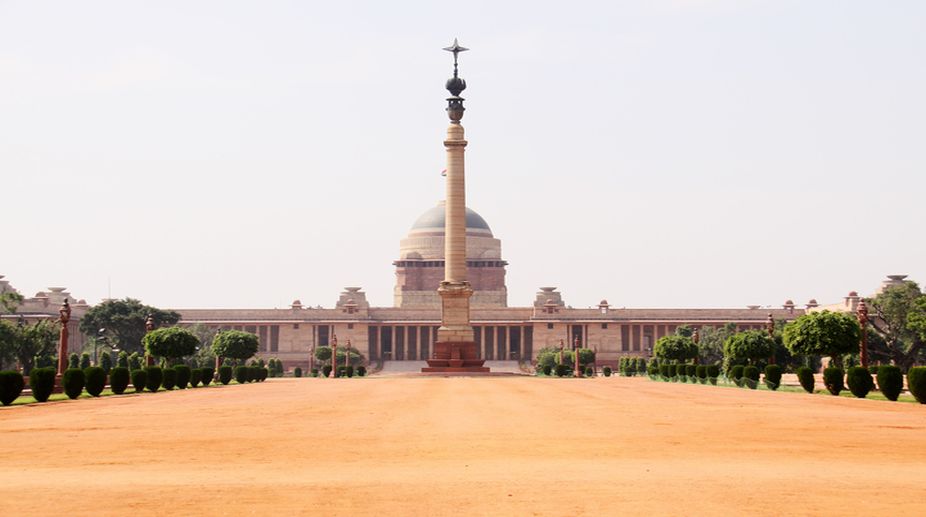
Who will be the next occupant of Rashtrapati Bhavan? The incumbent Pranab Mukherjee will retire on July 25 after a successful fiveyear inning. While there was a possibility for a second term for Mukherjee before the UP polls, after the unprecedented results of the recent five state Assembly polls the BJP is moving towards installing its candidates as president and vice president. They both could be from the RSS stable. Having a president of its choice in Rashtrapati Bhavan will be helpful to the party in complicated political situations – like imposing Central rule in a state. A strong vice president would help in the Rajya Sabha where the BJP is in a minority.

What does the electoral arithmetic say? The president is elected by members of an electoral college that comprises elected members of Lok Sabha and Rajya Sabha and elected members of all legislative assemblies. The total value of votes of the MPs is 5,49,408 while the total value of votes of all 4,120 MLAs across India is 5,49,474. Going by the present count, the BJP alone has 4,33,182 votes and along with its NDA allies the number goes up to 5,24,088. This is still 25,354 votes short of the half way mark of the total 10,98,882 votes. Even if the arithmetic is short of the 50.1 per cent mark, the formidable political stature of Prime Minister Narendra Modi that the recent election has reinforced will afford him all the leeway he needs to get the support of smaller parties for candidates of his choice. The BJP hopes to bridge this gap by mobilising support from non UPA, non-BJP parties like the AIADMK, BJD, TRS, INLD and even JD (U). But the support can only come if the choice of candidate is acceptable to these parties.

Though the BJP leaders claim that no discussions have taken place so far about the probables, there has been speculation in political and party circles. There are candidates for every possible scenario be it a scheduled caste, scheduled tribe, a Brahmin, the Other Backward Classes or a woman but certainly not a Muslim as the BJP may not choose one. It could be some one from the Northeast or from the south, as the party wants to expand in both regions. While the names of octogenarian BJP leaders L.K.Advani and Dr Murli Manohar Joshi were doing the rounds earlier, their chances have dimmed after the revival of the Babri Masjid demolition case by the Supreme Court last week. While Prime Minister Modi has reasons not to support Advani as the latter had opposed him from becoming the prime ministerial candidate in 2013, Dr Joshi continues to have good relations with the RSS. He has also tried to bridge the gap with Modi in the past three year. While some in the BJP claim that no governors are under consideration, the octogenarian Uttar Pradesh Governor Ram Naik’s name is doing the rounds. He had been the Petroleum minister in the Vajpayee government and is also close to Modi and the RSS. His age is his minus point but rules are always waived when required. The name of the Jharkhand Governor Draupathi Murmu (58) is also being floated as she is a tribal woman and so far no tribal has occupied Rashtrapati Bhavan. The other tribal leader whose name has surfaced is the former Deputy Speaker Karia Munda from Jharkhand.

There has been speculation about elevating Lok Sabha speaker Sumitra Mahajan (73) as Vice president or President. Mahajan has served as Speaker for the past three years and had a long stint as an M.P from Madhya Pradesh and had been a minister of state in the Vajpayee government.

Among the ministers, the name of Sushma Swaraj (65) is under speculation for both posts. She is a Brahmin and has acquitted herself well as a minister in the NDA governments. She was the Leader of Opposition in Lok Sabha earlier. After her recent kidney transplant, it is felt that she might be given a less strenuous role, as her present position needs constant overseas travel. Yet another whose name is in circulation is urban development minister M. Venkaiah Naidu (67). He had been the party chief earlier, served the party well and had been a minister in the Vajpayee government. Since the BJP needs a strong chairman for the Rajya Sabha, his name is doing the rounds for both posts.

Union Minister for social development and entrepreneurship Thavar Chand Gehlot (68) is a Dalit face and is liked by Modi. The other Dalit face being talked about is former Minister Jatiya, from Madhya Pradesh who was the labour minister in Vajpayee government.

The wounded opposition is getting ready to field its own candidates for both posts, as it does not want to let the presidency go unopposed. Congress President Sonia Gandhi is leading the opposition in finding a common candidate and has been talking to the Left, JD (U) and other parties. But it will only be a futile exercise as the BJP has the magic numbers in its pocket. The ideal position would be to find a consensus candidate for both posts. Modi should reach out to the opposition to find a good candidate. Going by the way Modi operates; it could be a dark horse and a person loyal to him. After all he had produced such people from the RSS stable earlier.

Time to shake up the bureaucracy

Debaki Nandan Mandal | New Delhi |

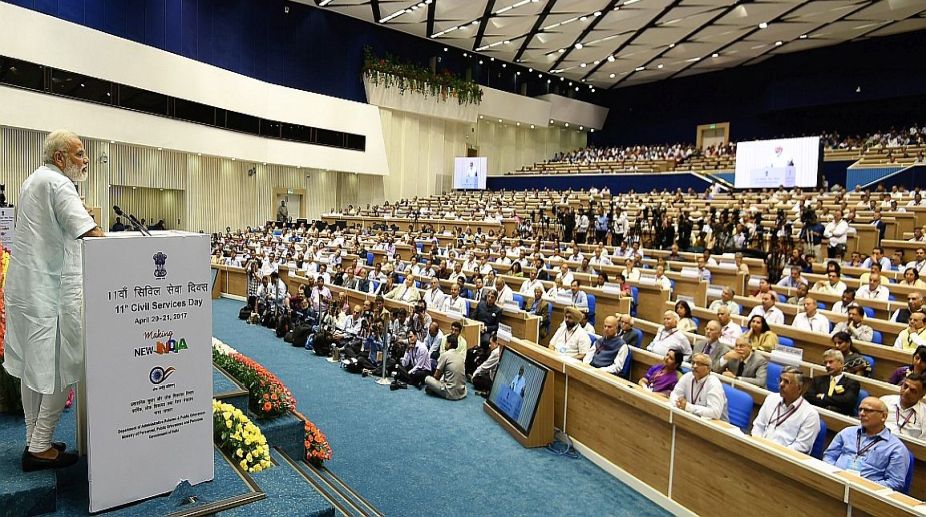
Civil Services Day provides an occasion for serious soul-searching as to what ails this age-old institution of governance and what should be done to restore it to its pristine glory. But at the outset a recap of history beginning with the first prime minister of the country is necessary to garner a holistic view of the indispensable administrative machinery.

Jawaharlal Nehru devoted one full chapter in his Autobiography to describe the abominable role played by civil servants. However, he could not bring about any major reforms in the bureaucracy during his 17 year-long prime ministerial tenure. His obsession with the socialistic pattern of society, drawing inspiration from the Soviet model created a regulatory regime which conferred unfettered powers on the bureaucracy with the inevitable fall-out of a patron state. And when asked in 1964 what he considered his greatest failure as India’s prime minister, Nehru replied, “I could not change the administration, it is still a colonial administration.”

Indira Gandhi’s committed bureaucracy ushered in, in the words of BBC’s Mark Tully, an era of Neta babu Raj which kept ‘India in slow motion.’ The politician-bureaucrat nexus destroyed the neutrality of the civil service when it was sought to be controlled through a carrot and stick policy. No wonder, it bred corruption and fathered all sorts of scams in the political economy, not to speak of creating a distance between the ruler and the ruled.

Rajiv Gandhi was not unaware of the goings-on in the administration when he rued “we have government servants who do not serve but oppress the poor and the helpless, who do not uphold the law but connive with those who cheat the state and whole legions whose only concern is their private welfare at the cost of the society.” His theory of PM to DM was an attempt towards decentralisation. But the agenda remained unaddressed since he died young.

The focus shifted from a tight regulatory regime to untangling bureaucratic control during the five-year-stint of P V Narasimha Rao. The Economic Reforms launched in July 1991 were not only a path-breaking move to open the economy before the world but also to cut the bureaucracy down to size.

Manmohan Singh, himself an astute administrator with a wealth of experience in several areas was aware of the poor performance at all levels of the government and the urgent need to reform the civil services. “We must introspect and recognise that there is great public dissatisfaction with the functioning of the government at all levels. The civil service must endeavour to address this challenge as a collective entity.” Administrative reforms ‘at every level’ he declared to be his priority. Though UPA-I introduced some path-breaking legislation in the social sector like RTI, RTE etc, UPA-II was a disaster with various scams involving ministers and bureaucrats.The colonial legacy with automatic pay increases and promotion to the highest levels based on rank secured at entry level has not been done away with. Cadreism in government, as pernicious as casteism in society, is still the order of the day. Recommendations of the earlier Pay Commission – which include pruning the 5-6 layers in administration to not more than two, a 30 per cent reduction in government, just three national holidays and any 10 or 12 the staff may choose from during the year – still remain unimplemented.

When Narendra Modi assumed power in May 2014, his real challenge was to re-energise the bureaucracy which was resistant to all change. His 19-point code of conduct for bureaucrats was interpreted as the end of achche din of doing no work. A lingering suspicion surfaced that the country has now a prime minister who is determined to end the status-quo mentality of the Nehruvian establishment he had inherited. Advocating the need for transformation in the NITI ‘Transforming India’ Lecture series on 26 August last year he said “transformation of governance cannot happen without a transformation in mindset and a transformation in mindset cannot happen without transformative ideas.”

In bureaucracy, the nagging perception is that the honest one is largely inefficient, the efficient not the most honest but the honest and efficient bureaucrat is at a high premium. Initially, the prime minister decided to give all a chance assuming that the bureaucracy would work with the government of the day. But the assumption appears to have proved costly to Modi.

Excepting a few infrastructure sectors such as power, roads and highways, the push for skill development or manufacturing through ‘Make in India ‘is suffering. Now the prime minister is reluctant to give a long rope to the officers. Instead, he wants to make them accountable. He asked the Union agriculture secretary to redo the presentation before the committee of secretaries and fired two senior IPS officers and one IAS officer on grounds of poor performance. Besides, he wants government schemes implemented on schedule.

True, the prime minister has given the bureaucracy many a pep-talk. But it is still mired in the inertia and sluggishness of the past 70 years and is finding it difficult to cope with him. The massive problems encountered in the roll-out of the demonetisation scheme is a pointer to the fact that the prime minister and the administrative machinery are not running at the same pace.

Experience of the last few months unequivocally suggests strategies to upgrade the management skills of the government. Given India’s complexities and the pace at which the prime minister wants to bring about a change, a judicious mix of the best minds in government and the private sector may be necessary to professionally manage specific schemes. We have to think about India beyond those who have a ‘batch’, a ‘service’ and a ‘year’ to refer to. The chosen one should not be treated as an intruder or an outsider. The American bureaucracy welcomes the new entrant and goes about its business in the most normal way. It is high time that the prime minister should end the obduracy of the Indian bureaucracy which has the reputation of resisting ‘outsiders’ and killing their creativity.

The prime minister must unfold the plan of a new administrative machinery which will be a proper blend of bureaucrats and management specialists from outside government who are not weighed down by bureaucratic baggage. This will shake up the system and trigger a paradigm change in the way the government works. Yes, this will be the next big surgical strike in national interest.

The writer is a former Joint Secretary to the Government of West Bengal.

End of History?~I

Arunabha Bagchi | New Delhi |

As the Warsaw Pact was collapsing in 1989, the Japanese-American political philosopher Francis Fukuyama published an essay “The End of History” in the journal “The National Interest”, which he later elaborated into a highly acclaimed and controversial book, The End of History and the Last Man in 1992. The author claimed: “What we are witnessing is the end of history as such: that is, the end point of mankind’s ideological evolution and the universalisation of Western liberal democracy as the final form of human government.” This was, according to Fukuyama, the fulfilment of Hegel’s prophecy. This came to my mind in the wake of the spectacular gain of the BJP in the latest UP elections, which along with the party’s dominance in Uttarakhand and Haryana confirmed its hold in the Hindi belt of our country. Barring some coastal states, the party is now well entrenched all over the country, and is spreading its wings even in the North-East.

The latest state election results led many analysts to discuss the future political developments of our country. Most focused their analysis on the election results since Independence and dwelt on dominant leaders, notably Jawaharlal Nehru, Indira Gandhi and Narendra Modi. Some could even see a silver lining in the miserable performance of the Congress and the possibility of regional parties to gang up together to defeat the BJP some time in the future. The comeback of the Congress after Sonia Gandhi assumed charge of the party and the defeat of Indira Gandhi by the united Opposition in 1977 were used to support those wistful thinkings. Then, of course, were the traditional arguments of our history of religious tolerance, the impossibility of Hindutva ideology to be accepted for long with so much divisions and conflicts within the adherents of the Hindu faith itself, and the Hindu “majoritarian” impulse finally inhibiting our development by sapping us of whatever scientific temperament we might possess.

Although a scary thought, I started thinking that, to paraphrase Fukuyama, we in India may be approaching the end point of our ideological evolution, with the hegemony of the Hindutva ideology becoming the final form of our political structure. Most analysts date Hindutva back to the tract Essentials of Hindutva” by Vinayak Damodar Savarkar during the early twenties of the last century. This notion of Hindutva formed the basis of Hindu nationalism, which included all religions originating from India, but excluded those with foreign roots. This led KB Hedgewar, after deliberation with Savarkar about organising the Hindu nation in Bharat, to form the RSS (Rashtriya Swayamsevak Sangha). This organisation formed the cadre for the already established Akhil Bharatya Hindu Mahasabha, and the Sangh Parivar was born.

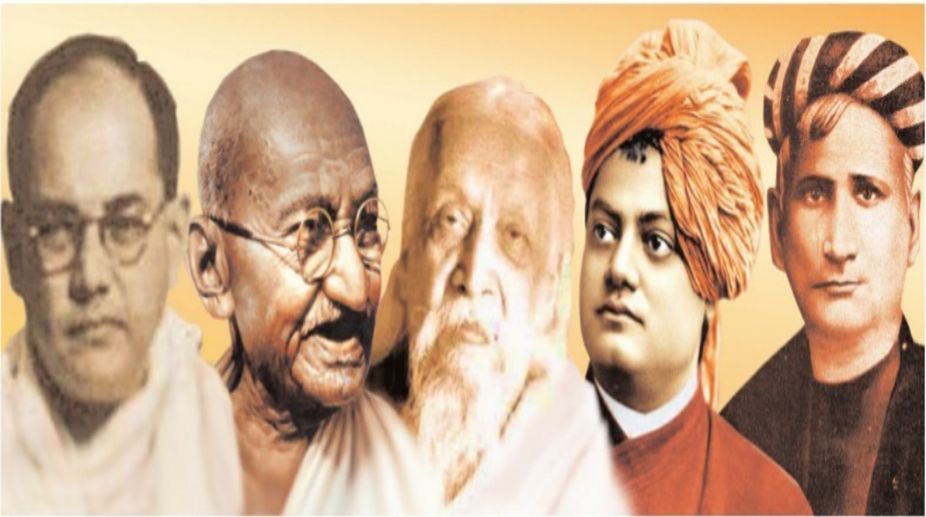
But the idea of the Hindu nation goes back half a century earlier and was first explicitly propounded by the great writer, Bankimchandra Chatterjee. He countered the assertion of British historians that India was merely a geographical entity and not a nation in the western sense. He argued that the Aryans took over a vast swathe of Indian territory in prehistoric times and created a nation. Gradually it got split by internal and external forces and led to the disintegration of the nation.

Only when Hindus get united would a modern version of the Hindu nation be established in India. He, along with many historians, thought of Indian history as composed of our glorious Hindu past, followed by the Muslim conquest and rule by foreign invaders for a millennium, and finally British rule during his time. Although Muslims were tolerated, Bharat was essentially a Hindu nation.

Bankimchandra focused on religious symbols shared by Hindus in all regions and among all communities of Hindus, instead of on abstruse philosophical subtleties of our past. He brought The Gita to the forefront, championing it as our sacred text in line with the Bible or the Quran. He weeded out all later additions on Krishna in the Mahabharata and portrayed him as the uttam purush (greatest human being) that ever existed in history! Finally he glorified the Hindu selfless community of monks in the novel, Anandamath, and immortalised “Bande Mataram” by inserting that hymn to the Mother Durga there. I have never met any Hindu who had the slightest reservation with any of these efforts of Bankimchandra. Whatever discomfort people had about his ignoring the large Muslim population living in this land of Bharat evaporated with the creation of Pakistan.

Bankimchandra was followed as great defender of Hinduism by Swami Vivekananda, the universally acclaimed spiritual father of modern India. He was the first Indian to defend vigorously the Hindu religion against the common prejudices of the Abrahamic religions at the World Congress of Religions at the Art Institute in Chicago in 1893. He continued in town hall meetings during his long stay in the United States thereafter to champion the universality and superiority of Advaita Vedanta over all other philosophies of religion. In those parochial times, his efforts met with little success abroad, but his courage and conviction electrified Hindus in India leading them to imagine that they psychologically belonged to one nation. Swami Vivekananda was always careful to give the Muslim inhabitants of India due respect and wanted their cooperation in building this new nation. His concept of India as a nation was still a religious one, and not a political entity in the way understood in the West.

During Swami Vivekananda’s lifetime, the nascent movement for our self-rule began with the founding of the Indian National Congress. Leaders of the movement were the “true children of Macaulay,” whose main aim was to rule over the hapless millions in India directly, instead of acting as stooges of their British masters. This elitist movement was leading nowhere, when the revolutionary Swadeshi movement burst into the scene in Bengal at the start of the 20th century. They drew inspiration from both Bankimchandra and Swami Vivekananda, and one of their young leaders inspired them with the great Hindu heritage. He is, of course, one of our most revered religious philosophers ~ Sri Aurobindo. Before the end of the second decade of the last century this revolutionary movement was crushed by the British and the country was going through soulsearching that led to two different movements. Both used Hindu symbolisms to develop a nationwide upsurge of support for fighting against British rule.

The first and most important, of course, was the arrival of Mahatma Gandhi on the national political scene and his taking over the leadership of the Indian National Congress. His startling contribution was to create a mass movement for this struggle against the British by engaging the normally apathetic Indian villagers in this common cause, a feat that was never achieved in Indian history before. Netaji explained this miraculous phenomenon thus ~”His simple life, his vegetarian diet, his goat’s milk, his day of silence every week, his habit of squatting on the floor instead of sitting on a chair, his loin cloth ~ in fact everything connected with him ~ has marked him out as one of the eccentric Mahatmas of the old and brought him nearer to his people.”

These were quintessentially Hindu symbolisms, including his harping on the Ram Rajya as the ideal to strive for in the Independent Bharat. Mahatma Gandhi, of course, has been highly sympathetic and concerned about the Muslim inhabitants of India. To bring them into his movement, he sided with their leaders in demanding the return of the Caliphate in Turkey that was torn asunder at the end of the First World War. This regressive demand lost relevance when Kamal Ataturk took over power in Turkey and set out to make his country a modern liberal nation following the models in Europe.

The writer is former Dean and Emeritus Professor of Applied Mathematics, University of Twente, The Netherlands.

Electoral outrage?

Editorial | New Delhi |

It may not have been as devastating as previous outrages in Paris; it was nonetheless an ugly prologue to the swelling act of the presidential theme. Two days before the process began, the ISIS has claimed responsibility for Friday’s attack on the police at the iconic Champs Élysées though it might be premature to speculate quite yet whether the militants were intent on influencing the presidential election.

Suffice it to register that an Islamist effort to influence the political process in the West cannot be readily ruled out. Fears that the incident could have an impact on the elections ~ as promptly predicted by Donald Trump ~ are not wholly unfounded. Not least because the outrage on the eve of the elections may yet sway the voters to the right, going by the reaction of Marine Le Pen and the conservative candidate, Francois Fillon. Both have immediately declared a “war against Islamists”.

In a quirky irony of French politics, both have conveyed the impression that they seek to gain from yet another terrorist attack in the French capital, one that has left a police officer dead in the heart of the city. Small wonder that the French Prime Minister, Bernard Cazeneuve, has appealed to candidates, most particularly of the far Right, not to exploit the outrage as an electoral opportunity.

He has even accused Le Pen of seeking to divide France. In an apparent attempt to gain political mileage from the mayhem, she has made an eleventh-hour robust presentation, blaming the “so-called leaders” for failing to protect citizens ~ “Islamisation is a monstrous totalitarian ideology that has declared war on our nation, on reason, on civilization.” Palpably, the incident in the vicinity of Champs Élysées has caused a flutter in the political roost.

Any terrorist attack linked to Islamic militants will almost certainly rally voters behind Le Pen and her extreme rightwing Front National. A Le Pen victory will very probably convey an uncompromising message to France’s large Muslim minority about their place in the country, raising tensions, increasing the possibility of further attacks, and thus accelerating a cycle of violence. Whether or not a right-wing dispensation will be in a position to contain Islamist outrages is a different proposition altogether.

The Caliphate, under siege in Mosul (Iraq) and Aleppo in Syria has in the recent past emitted a signal to widen existing the social, racial and religious divisions in France and Europe in the larger perspective. ISIS tends to target countries where different cultures and faiths co-exist; the concept of pluralism is anathema to its sinister philosophy. Champs Élysées has been a symbolic target, not dissimilar to the recent attack on Parliament in London.

Purely symbolic

Editorial | New Delhi |

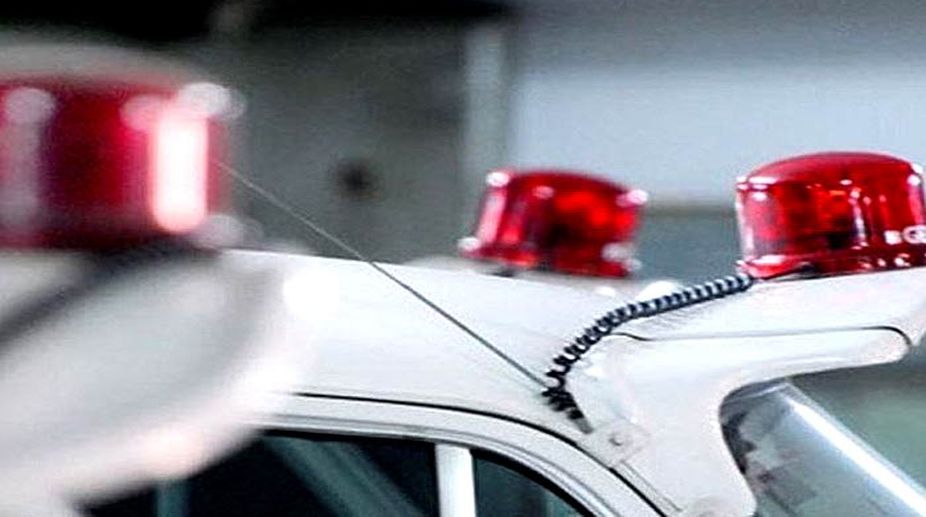
The theory that “well-begun is half-done”, unfortunately, is unlikely to come into play in respect of the government’s excessively-hyped ban on red beacons on VIP-carrying vehicles. The claim is that a bid is underway to dismantle a sickening, discriminatory culture, when in reality only a symbol is being addressed. Ushering in a “cultural” revolution will require more than the gimmickry in which successive governments have indulged, and the Prime Minister’s ‘tweet’ that “every Indian is special, every Indian is a VIP” points to a supercilious over-simplification of a malaise that will not be remedied by tokenism.

Cars carrying the President, Vice-President, Prime Minister and Chief Justice may not flash red beacons from next month, but the security-detail accompanying VIPs will ensure that no other traffic is simultaneously permitted to ply the same roads. Doing away with the lal batti culture does not ensure equality, ask those who seek to meet the chief minister of Delhi who was among the first to discard the beacon.

Under the guise of “security” an impregnable wall has been built around political figures, senior officials, etc., ~ will the armed forces follow suit and do away with flags/stars on staff cars? The minister for transport, who would like to portray himself as a prime mover in the new drive, has also spoken of junking the bungalows of Lutyens’ luxury enclave in the Capital: the truth is that many of those structures are on the verge of collapse ~ and some of the new apartment complexes raised to accommodate MPs are nothing short of luxurious.

There would be countless other manifestations of the VIP culture, and even Mr Narendra Modi would find it hard to attain what his publicitymachine has just churned out ~ remember Arun Shourie’s observation about this government being capable of merely “managing headlines”. Still, it would be cynically unfair not to give the government “a chance”: if only there was a non-electoral way to make it pay for failure to live up to its promises.

Only a few weeks back the government had a heaven-sent opportunity to cut inflated VIP egos down to size, but it declined to punish a misbehaving MP and, instead, it “sold up the river” the unostentatious civil aviation minister who ruled that in matters of flight safety no allowances should be made for “passenger-status”. That the minister found little support, either in government or Parliament tells its own tragic tale.

The scrapping of the red beacons is, at best, a welcome first step but what follows is more important ~ will MPs no longer claim privileges, will officials stand in queues to buy cinema tickets? When again will the son of a Prime Minister join the crush of students seeking college admissions?

Gujarat Traders Federation asks Modi to ease GST rules

IANS | New Delhi |

The Gujarat Traders Federation on Saturday asked Prime Minister Narendra Modi to intervene for easing the rules and structure of the upcoming Goods and Services Tax (GST).

The federation reached out to Prime Minister Modi through a letter which pointed out various hindrances towards ease of doing business that will occur once the GST is implemented.

In the letter, they said what they learnt from the structure of the GST rules adopted by GST Council which are being published now and in public domain, "it seems that it defeats and violates the very concept of Ease of Doing Business".

"We on behalf of honest small traders, small medium enterprises (SME) of India request you to kindly intervene into the matter and use your kind office to make the provisions and rules vide GST more simple and implementable."

According to the traders body, GST should enable "ease of doing business", "smooth movement of material across India" and "one India, one market, one tax".

"Instead of promised removal of check posts at state borders, government is starting mobile check post at every corner in the city, state and country.

"This is directly giving powers to inspectors and harassment and increasing tax terrorism," they wrote.

The federation mentioned the common practice of loaning goods for a short period of time which are replaced shortly will no longer be hassle-free under the GST.

"Although it is not sale, it is supply. Creating e-way bills for such transactions will result in cross verification issues," the letter added.

"Many shops have their warehouses situated away from their selling premises. Movement of goods from warehouse to shop will also require e-waybill. It will be absurd to do so."

BJP files complaint against Kejriwal over his dengue comment

IANS | New Delhi |

The Delhi BJP unit on Saturday filed a police complaint against Chief Minister Arvind Kejriwal over his Facebook post, which urged the voters not to vote for them (BJP) if they want to get rid of dengue and chikungunya-like diseases.

In the complaint, the Bharatiya Janata Party (BJP) also alleged that Kejriwal had violated Model Code of Conduct by posting "offending election material" on Facebook and also "campaigned beyond the prescribed time through his social media handles".

A team of lawyers led by some BJP leaders filed the complaint at the North Avenue Police Station on the direction of Delhi BJP President Manoj Tiwari.

The BJP also requested the Delhi Police to block Kejriwal's Facebook account.

The Delhi Chief Minister was also accused of impinging on the right of voters by threatening them via the video in which he said if the people of Delhi voted for the BJP, their children would fall prey to diseases like dengue and chikungunya.

Member of the BJP's legal team Neeraj, who submitted the complaint on behalf of the party, said he was "feeling apprehended" after watching the video.

"Kejriwal is the Chief Minister of Delhi and if he threatens the voters with dire consequences (dengue and chikungunya) for voting for the BJP, it clearly creates an apprehension in the mind of the voter," Neeraj said.

On Thursday, Kejriwal had said the people of Delhi would risk their children's lives if they voted for the BJP in the civic polls, during a Facebook Live event.

"If you vote for the BJP and if your child falls prey to chikungunya or dengue, you are responsible for it. I can offer free treatment to your child in (the Delhi government) hospitals, but why should children suffer at all?"

BJP MP’s comments on Modi’s marriage go viral

IANS | Bhopal |

A BJP MP's purported comments that Prime Minister Narendra Modi got "married but didn't set up his household" was released on Saturday and has gone viral over social media.

The comments by Jyoti Dhurve, the Bharatiya Janata Party (BJP) lawmaker from Madhya Pradesh's Betul (ST) constituency, is said to have come while discussing construction of a building for a proposed Kendriya Vidyalaya in Betul district. She could not be contacted to confirm or deny it.

As per the audio clip, a local journalist who identified himself as Yogesh Soni called up Dhurve to discuss the matter and plead that the school commence this session.

The MP, expressing annoyance, said: "The Prime Minister says to connect with the people, public money will be spent, not from the Prime Minister's fund. He (Modi) got married but didn't set up his household."

The comment has created a stir. While Dhurve could not be reached for reactions, BJP chief spokesman Deepak Vijayvargiya told IANS that all she said on this clip that she had never spoken anything like this and only talked about development.

La Liga preview: Real Madrid host Barcelona in decisive El Clasico

It's a season-defining clash between the arch-rivals but which team will be triumphant at the Bernabeu?

Prithviraj Dev | New Delhi |

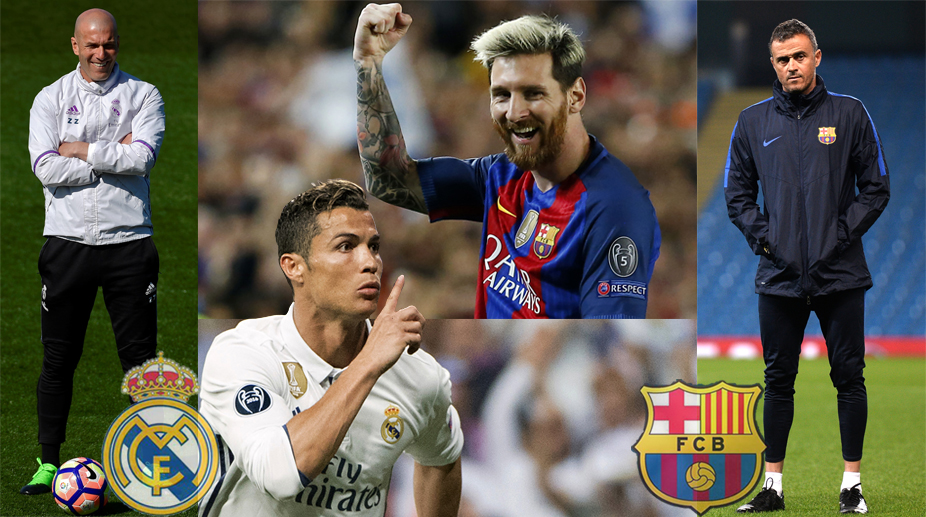
The winner of the 2016-17 La Liga title wil be effectively decided when Real Madrid host arch-rivals Barcelona in the latest instalment of El Clasico on Sunday at the Santiago Bernabueu.

Los Blancos have a game in hand and a three-point advantage over La Blaugrana, which means the visitors would be desperate for a win and seek to establish their dominance early on.

An ideal scenario for leaders, who prefer to play on the counter and against a misfiring Barcelona side that were unceremoniously dumped out of the Champions League in midweek, they will be fancying their chances on their home turf.

Real Madrid

It was a lucky win over Bayern Munich in the Champions League for Zinedine Zidane’s men, as they were second-best for a majority of both legs yet somehow managed to scrape through.

That’s been the theme all year long, but one feels that as the business end of the season approaches, they are going to churn out their best and what’s a bigger game than a home Clasico?

Gareth Bale has returned to training but after his sub-par displays all season-long, Zidane may be tempted to leave the Welshman on the bench. Isco started in his stead against Bayern, but wasn't too effective and perhaps the faster, more direct, Marco Asensio could see a rare start.

Their defensive woes continue, with centre-backs Pepe and Raphael Varane continuing their time on the treatment table, it will be Nacho and captain Sergio Ramos starting in the heart of the defence on Sunday. 

What they are saying: “It (El Clasico) really is a thrilling game. The world grinds to a halt to watch this game. It is massive, every player wants to play and the people on the street are already talking about it up to a month beforehand,” Real Madrid full-back Marcelo (as per www.realmadrid.com).

Injury absentees: Raphael Varane (Achilles), Pepe (Ribs), Gareth Bale (Calf)

Suspension Alert: None

Barcelona

La Blaugrana are without Neymar for this massive clash and while the appeal for his suspension has gone to CAS (Court of Arbitration for Sport), it is unlikely that the Brazilian will feature on Sunday. This prompts an offensive reshuffle for Luis Enrique, with Paco Alcacer and Arda Turan the front-runners to replace the Brazilian. While neither can say they can match Neymar’s quality, they would put in a real shift. However, it is uncertain if Turan would be able to overcome an adductor injury and if that is the case, Alcacer will definitely start.

Javier Mascherano is available, but Enrique is set to continue with Samuel Umtiti and Gerard Pique in centre defence and Jordi Alba is likely to continue at left-back.

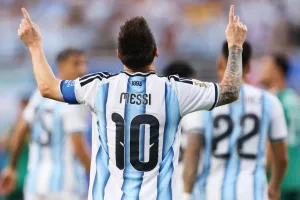
Without Neymar, the spotlight will be even more intensely focused on Lionel Messi and Luis Suarez. The diminutive Argentine had a rare off-day against Juventus in midweek and his poor record in recent Clasico’s will spur him on to give the world a timely reminder of his talents.

What they are saying: “I have great memories of the 4–0 win (Last season at the Santiago Bernabeu), not just because we won, but also how we did it, because we were very much superior.We want to win this game. We need to and we are going into it with a lot of confidence,” Barcelona midfielder Ivan Rakitic (as per www.fcbarcelona.com).

Injury absentees: Aleix Vidal (Ankle), Rafinha (Knee), Arda Turan (Adductor)

Suspension Alert: Neymar 

Super Stat: Cristiano Ronaldo has scored 16 goals in the Clasico in all competitions. Only Alfredo Di Stefano (18) and Messi (21) have scored more.

NITI Aayog stock-taking meet today

Deepak Razdan | New Delhi |

NITI Aayog’s Governing Council meets on Sunday to take stock of its development documents and a three-year Action Plan, while keeping in suspense how it disposed of the Mid-Term Appraisal (MTA) of the 12th Five Year Plan, and other unfinished agenda it inherited from the erstwhile Planning Commission.

The NITI Aayog Governing Council, headed by Prime Minister Narendra Modi, and comprising 35 Chief Ministers, key Union Ministers and Aayog’s members, is meeting for the second time since the new Think
Tank was constituted on 1 January 2015, to replace the Planning Commission.

The Government Resolution on the National Institution for Transforming India (NITI Aayog) kept the new body free of funds allocation work, assigning it the particular job of giving Central and State
governments relevant and strategic advice on policies.

However, NITI Aayog was simultaneously declared the successor-in-interest of the Planning Commission and told to finish its ongoing work, particularly the 12th Five Year Plan work, as this Plan (2012-17) was just half-way through with its currency when the NITI Aayog was constituted. This unfinished agenda of the erstwhile Planning Commission was the conclusion of the Mid-Term Appraisal, along with details of the 12th Plan achievements in physical and financial terms against the targets, including the GDP growth rate.

While the 12th Plan ended on 31 March, there was no word on the MTA, nor on the GDP growth rate achieved against the target of eight per cent. The NITI Aayog constitution was not meant to a disruptive event, and the12th Plan was meant to complete its full run up to 31 March 2017. Even the Budget 2017-18 made a Special Assistance provision of Rs 11,000 crore under a Finance Ministry demand for transfers to States for the schemes that were so far overseen from Planning Commission/NITI Aayog.

Under pressure to explain what happened to the Indian vision of development, NITI Aayog has been working on three documents ~ a 15-year (2015-30) Vision Document, a seven-year (2017-24) Strategy to
convert the Vision into implementable policy; and a three year (2017-2020) Action Plan for immediate programmes.

The NITI Aayog has been consulting States on the preparation of these documents. Among its other work, the Aayog is also to conduct outcome-based monitoring of expenditure in select sectors.

FA Cup: Chelsea thumps Tottenham Hotspur to march into final

Seven successive FA Cup semifinal defeats for the Lilywhites now!

Prithviraj Dev | New Delhi |

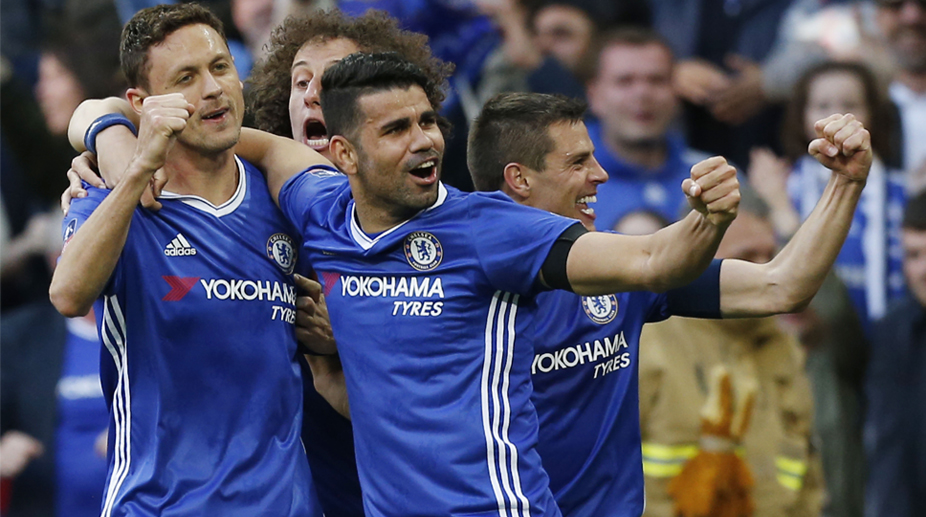
Tottenham Hotspur’s FA Cup semifinal hoodoo continued on Saturday, as Chelsea thumped the Lilywhites 4-2 in a pulsating cup tie at Wembley Stadium, the Blues continuing their quest for a double in Antonio Conte’s debut season in England. 

The Italian manager boldly rested his top-scorer Diego Costa and star winger Eden Hazard for the crunch clash, with Gary Cahill being replaced by young Nathan Ake as turned out in an unfamiliar XI. While Marcos Alonso and Thibaut Courtois returned to the starting XI after missing the last weekend’s Premier League clash against Manchester United, it was Michy Batshuaiyi’s presence at the tip of the attack that had Blues fans worried that Conte’s decision to rest his guns would backfire.

In the end, however, Conte’s decision to bring Costa and Hazard into the game on the hour-mark was vindicated as the latter played a key role in the win, scoring a well-taken goal to give Chelsea the lead and then assisting Nemanja Matic’s thundering shot which effectively sealed the deal.

Chelsea made a brighter start to the game despite missing several key players and deservedly took the lead through Wilian’s direct free-kick from the edge of the box in the 5th minute. Toby Alderweireld had brought down Pedro near the penalty area, got a yellow card for his mistimed challenge and was immediately rueing his indiscretion as the Brazilian winger put the ball into the net beating Hugo Lloris on his side of the goal.

Spurs, playing a 3-4-3 with Son Heung-min at right back, took their sweet time to grow into the game and once they found the equaliser via Harry Kane in the 18th minute, wrested control of proceedings. Christian Eriksen sent in a cross from the right and Kane had to stoop low to guide his header past Courtois from an acute angle.

With the momentum shifting in favour of Mauricio Pochettino’s side, Spurs came close to adding a second but Eric Dier’s header in the 36th minute flashed just wide of Courtois’ goal.

And as suddenly as they had scored against the run of play, Spurs then conceded a silly goal. Son, playing at right-back for the first time this season, needlessly slid in on Victor Moses inside the box to give referee Martin Atkinson no choice but to point to the spot. Willian stepped up and sent Lloris the wrong way to give Chelsea a vital lead two minutes from half-time.

The second-half began as the first ended, with Spurs dominating and they didn't take long to get back into the game. Eriksen was the provider again, sending in a cross from deep that Dele All finished on the half-volley past Courtois in the 52nd minute. 

Conte sensed that Spurs were growing stronger and sent on Costa and Hazard on the hour-mark, replacing Batshuayi and Willian respectively. 

And while Chelsea’s Spanish striker was kept under wraps fairly comfortably by Spurs, they switched off on a corner and once an unmarked Hazard got the ball inside the box, only one result was likely. The Belgian sent in a low finish into the far corner and with 16 minutes remaining it looked like Chelsea had put the fight out of Spurs.

And Hazard laid the ball off for Matic in the 80th minute, with the Serbian surprising all present with a thunderous first-time drive that cannoned in off the post to put the result beyond any doubt.

It is Chelsea’s first final since 2012 and the seven-time winners will face the winner of the Arsenal-Manchester City semifinal that takes place on Sunday.

Intense pressure had been on Conte and his men, who responded brilliantly and while the result has no direct bearing on the title-race (Chelsea lead Spurs by three points), the psychological effect cannot be understated for the momentum is well and truly in their favour now.

IPL 2017: Mitchell McClenaghan encourages Mumbai continue winning momentum

Mumbai beat Delhi by 14 runs to register their sixth consecutive win in the IPL 2017.

SNS | New Delhi |

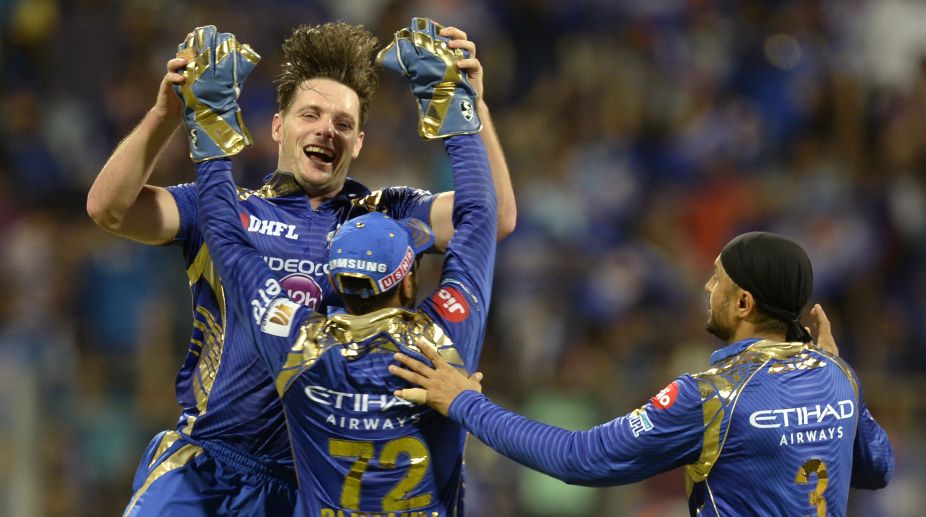
New Zealand pacer Mitchell McClenaghan claimed three wickets to help Mumbai Indians continue their winning momentum as the table-toppers beat Delhi Daredevils by 14 runs to register their sixth consecutive win in the IPL 2017.

Despite chasing a small target of 143 runs, Delhi failed miserably and Mumbai bowlers shone to the maximum to turn the table at the Wankhede Stadium in Mumbai on Saturday.

Supporting McClenaghan in the bowling attack, Jasprit Bumrah took two wickets, while Hardik Pandya joined the carnival after dismissing Karun Nair (5). 

The batting line-up of Delhi appeared collapsing right from the beginning as they lost first six of their batsmen for a single-digit score, out of which, Aditya Tare, Corey Anderson, and Rishabh Pant were dismissed for the duck.

At the lower middle-order, Kagiso Rabada (44) and Chris Morris (52*) ignited some hopes for Delhi fans. They established a 91-run partnership stand for the seven-wicket to drive Delhi a bit closer to the target.

In Mumbai's innings, Zaheer Khan led Delhi bowling unit had impressed as they dominated table-toppers Mumbai on their home ground and restricted them to 142/8 in their innings.

After winning the toss, Delhi decided to bowl first and kept Mumbai under control throughout 20 over of cricket.

Experienced leg-spinner Amit Mishra and young pacer Pat Cummins gained maximum in the bowling assault as both the bowlers claimed two wickets each.

Mishra took the scalp of MI skipper Rohit Sharma (5) and pinch-hitter Krunal Pandya (17), while Nitish Rana (8) and Kieron Pollard (26) were the victims of Cummins.

South African pacer Rabada, who played his fist game for Delhi, claimed the wicket of opener Parthiv Patel (8) and impressed with the run out of Harbhajan Singh (2), where he defeated the Indian in a sprint.

For Mumbai, Jos Buttler scored highest 28 runs as the table-toppers lost four of their batsmen for a single-digit score.

MCD elections crucial for Kejriwal-led AAP and Congress as BJP seems to be leading the race

Sharbani Banerjee | New Delhi |

Battle lines have been drawn for fierce, high-stakes municipal polls in Delhi on Sunday, which will be a triangular fight between the BJP ~ which has ruled the Muncipal Corporations of Delhi (MCDs) for the last

two consecutive terms since 2007 ~ the Aam Aadmi Party (AAP) ~ which is at the helms of the Delhi government since 2015 ~ and the Congress party which has virtually been relegated to the margins of the national capital politics.             

It will be a culmination on Sunday of weeks of unrelenting, high-voltage and even no-holds-barred campaign involving the top leaders of the BJP, AAP and Congress in order to stake their respective claims on the three MCDs.   

The Delhi Chief Minister Arvind Kejriwal remained the AAP's face in its MCD polls campaign while the BJP, led by its state unit president Manoj Tiwari, projected the Prime Minister Narendra Modi and his government's performance during its electioneering.

Along with Kejriwal, the AAP's MCD polls campaign was spearheaded by the Delhi Deputy CM Manish Sisodia. A slew of top central and state BJP leaders, including Union Ministers, took part in the saffron party's high-octane campaign.

The Congress's electioneering was spearheaded by its state unit chief Ajay Maken although the party also deployed a number of its senior leaders in its bid to reach out to the denizens of Delhi.    

This is the first time the AAP is participating in the MCD polls, whose outcome would be significant for the fledgling Kejriwal-led party which has been smarting from its dismal assembly elections performance in Punjab and Goa. Its candidate had lost his security deposit in the recent assembly bye-election to the Rajouri Garden constituency in Delhi too.

The civic polls will also be crucial for the Congress which had been completely wiped out in the Delhi assembly elections in 2015. The beleagured party is eyeing a major oportunity in the MCD polls to try and make a "comeback" in the Delhi politics. It had emerged as a runner up in the Rajouri Garden bypoll which was won by the BJP by a huge margin. 

Despite being the incumbent party in MCDs, the BJP seems to be riding high on the "wave" generated by Modi and the party president Amit Shah, even as the party, in a bid to neutralise its decade-old anti-incumbency factor, dropped all its sitting councillors in order to field new candidates.

While the AAP and the Congress went after "graft and misrule" plaguing the BJP-ruled MCDs, the BJP attacked the Kejriwal government's "failures and irregularities", with the three parties pledging to create a "clean, smart Delhi" in the event of clinching the MCDs. 

In the wake of the AAP's setback in the Punjab assembly polls, Kejriwal had consistently targeted electronic voting machines (EVMs), alleging that they had been tampered. He even demanded that MCD elections be conducted through the old system of ballot papers, calling for these polls to be even deferred to enable it.

The Delhi Lt Governor Anil Baijal and the State Election Commission, however, rejected CM's demand for being "untenable". The poll authorities have maintained that EVMs have always been "tamper-proof".

The MCD was trifurcated in 2012 into three corporations, with the North Delhi Municipal Corporation and the South Delhi Municipal Corporation accounting for 104 wards each while the East Delhi Municipal Corporation having 64 wards.

Over 13 million people of Delhi are eligible to exercise their franchise in over 13,000 booths for altogether 272 wards of the three MCDs. The counting of votes will take place on 26 April.

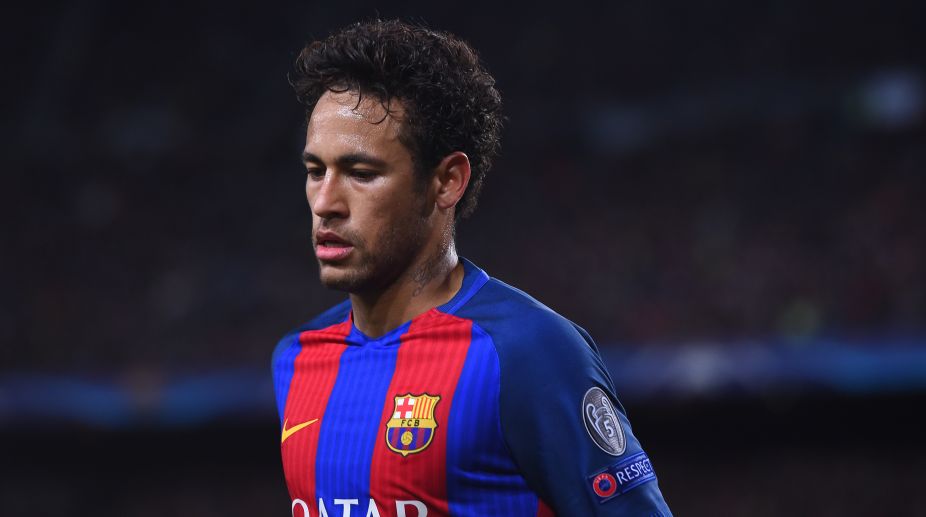
Barcelona striker Neymar to miss El Clasico against Real Madrid

The Brazilian superstar also missed the Catalans' match against Real Sociedad on April 15.

IANS | Madrid |

FC Barcelona striker Neymar Jr. will be unavailable for Sunday's 'El Clasico' against bitter rivals Real Madrid after Spain's Administrative Court of Sport (TAD) said on Saturday that it was unable to hear the Catalan club's bid to allow him to play.

TAD said the team's appeal arrived after the court's weekly meeting had already concluded Friday afternoon and that an extraordinary session could not be arranged for Saturday morning because the requirements for such a gathering had not been met.

Barcelona's appeal, according to the TAD, did not request any precautionary measures that are required for a potential stay of a suspension but merely asked the court to declare the player's full availability for Sunday's match against Real Madrid.

The Spanish football federation's competition committee decided to suspend Neymar for three games – one match for being sent off and two more for taunting a referee after receiving the red card during an April 8 match against Malaga that Barça lost 2-0.

The Brazilian superstar also missed the Catalans' match against Real Sociedad on April 15.

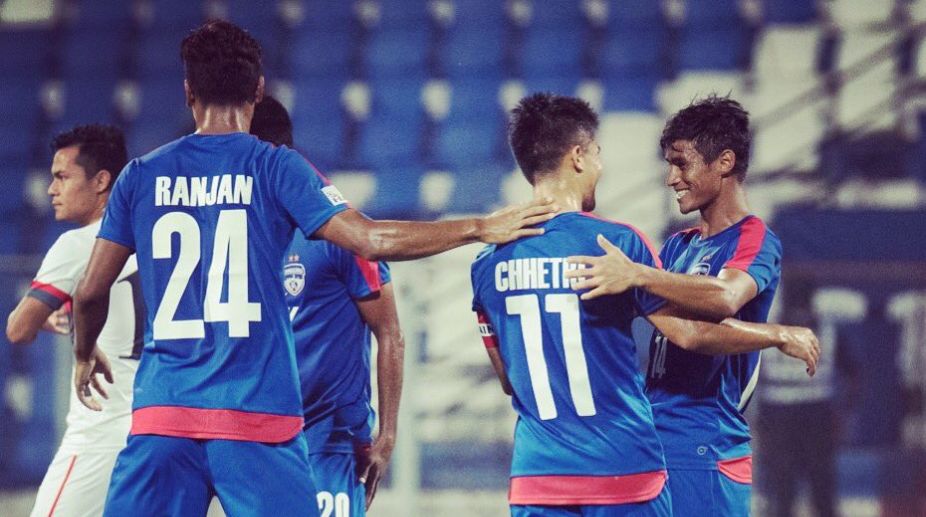
Sunil Chhetri strikes a double as Bengaluru FC thrash DSK Shivajians

Bengaluru FC dished out a dominating show to thrash DSK Shivajians 7-0.

PTI | Bengaluru |

Skipper Sunil Chhetri struck twice as defending champions Bengaluru FC (BFC) dished out a dominating show to thrash DSK Shivajians 7-0 in a high-scoring lop-sided contest of the 10th edition of I-League here on Saturday.

Playing their penultimate game, Bengaluru opened their account in the 20th minute when Chhetri staged an attack from the middle and passed the ball to young Seiminlen Doungel, who set it up for his captain.

In the end, the 22-yard long range shot from Chhetri was out of the keepers' reach.

The goal opened the floodgate for the Blues as Alwyn George joined the party two minutes later. Midfield maestro Eugeneson Lyngdoh then scored a left-footed scorcher after three minutes.

Before the breather, striker Seiminlen completed the quota of first half goals in the 31st minute. It was a stellar show by Chhetri as other than his one goal, he ended up assisting three goals in the first half.

After changing ends, DSK was successful in checking hosts from scoring till the first 20th minute. Meanwhile, CV Vineeth replaced Len in the 58th minute.

Bengaluru then continued their good show, producing their 5th goal which came from skipper Chhetri again. Vineeth then sounded the board twelve minutes later, while India international Sandesh Jhinghan, playing as central defender, hit the final nail in the coffin in the 90th minute.

With the win, the Blues extend their winning spree to the fifth game this season, across all the competitions they're competing in.

Earlier, DSK gaffer decided to bring in Soram Poirei under the bar instead of first choice Subrata Paul, who had an excellent outing against East Bengal last week. For Bengaluru, coach Albert Roca handed start to medio Alwyn George.