Logo

Britain goes 24 hours without using any coal-generated power

PTI | London |

National Grid confirmed that Britain had gone a full 24-hour cycle without using coal to produce any of the country's electricity, media reports said.

All electricity produced until late night on April 21 was generated from a mix of sources, but mainly gas-fired and nuclear powered generating stations. Wind, biomass and imported energy were also used on April 21, Xinhua news agency reported.

National Grid's Cordi O'Hara said: "To have the first working day without coal since the start of the industrial revolution is a watershed moment in how our energy system is changing.

"Britain benefits from highly diverse and flexible sources of electricity. Our energy mix continues to change and National Grid adapts system operation to embrace these changes."

The 24-hour cycle started on April 20 when a coal-fired power plant at West Burton went offline.

"The 24-hour cycle was confirmed at 22.50 hours on Friday, after which we started to use coal-fired generation again. We can't (tell) when this new record will be broken," O'Hara said.

Earlier this week, a new record was set on April 20, when Britain went for 19 hours without using any coal-fired generation of electricity.

Britain's first public coal fire power plant opened in London in 1882 and since then coal has played a daily part in generating the country's electricity.

The British government aims to phase out Britain's last coal-fired power stations by 2025 in its program to cut carbon emissions.

In 2015, almost a quarter of Britain's electricity was supplied from coal-fired plants, but in 2016 this had dropped to just under 10 percent as more of the older coal-fired stations closed. 

Harry Styles almost burnt ‘Saturday Night Live’ set

IANS | Los Angeles |

One Direction star Harry Styles almost burnt down the Saturday Night Live studios after his shirt caught fire.

According to a source, Styles was left fearing for his and everyone else's life on April 15 when he accidentally set his shirt on fire back stage in Rockefeller Plaza here following the live performance of his single "Ever since New York", reports mirror.co.uk.

"Harry nearly burned the place down. His manager asked if he could smell burning — he'd thrown his shirt onto a candle and the whole sleeve had set alight. He tried to stamp it out but then his sock caught on fire," the source told The Sun newspaper.

Styles, 23, reportedly threw his shirt on a candle. He tried to stamp out the fire with his foot, but instead, caught his sock alight.

"Luckily, the whole team got involved and managed to stamp the flames out, but it was one step away from needing a fire extinguisher," the source said.

Khloe Kardashian flashes lingerie

IANS | Los Angeles |

Reality TV personality Khloe Kardashian sported a racy look while stepping out, intentionally showing her lingerie in a red dress.

The Revenge Body with Khloe Kardashian host took to Instagram to share a photograph of her during the outing. 

She flashed her lace undergarments under the dress which featured very plunging neckline and a thigh-high slit, showing off her toned abs and legs, reports aceshowbiz.com. 

Khloe completed her look with a red lipstick, sunglasses and nude-coloured high heels, while carrying a red bag. She only captioned the image with three heart emojis, clearly proud of her appearance that day. 

Railways to launch mega app to answer all rail-related queries

PTI | New Delhi |

Come June, when all your train travel-related queries will be answered through one mega application, likely to be named HindRail, which incorporates in it most of the existing railways' apps.

The Indian Railways is developing the new app to work as a full-fledged inquiry system providing information on arrivals, departures, delays, cancellations, platform number, running status and berth availability.

Besides, it will also offer booking of taxis, porter services, retiring rooms, hotels, tour packages, e-catering and other travel-related needs.

The Railways will offer all these services on a revenue- sharing model with the service providers.

Thus, the app will serve as a revenue-earning platform for the public transporter and is slated to have a business potential Rs 100 crore every year.

The Railways often finds itself flooded with complaints from passengers about not getting reliable information on train running status, especially when they run late.

Mohd Jamshed, Railway Board member (traffic), acknowledges that there are problems in disseminating accurate information on delays. But, he says, the new app will address all these issues.

“The new app will be launched in June and it will not only give you information, you can also track trains through it,” he said.

Currently, there are several apps operated by the Indian Railways which provide various kinds of services. These include the CMS App for complaint management system.

The National Train Enquiry System (NTES) app provides inquiry facility. There are apps for booking reserved and unreserved tickets. There is another app managed by the IRCTC for the e-catering services.

All these will be integrated in the proposed app.

Asked about the possible name for app, Jamshed said, “We have to give a suitable name for it but it has not been decided as yet.”

However, it is reliably learnt the name 'HindRail' is being considered for the new app among other suggested names such as MeriRail, ERail, MyRail and Rail Anubhuti.

Chris Brown’s documentary to come out in June

IANS | Mumbai |

Singer Chris Brown's documentary Welcome To My Life will release in cinemas in June.

The 27-year-old will share his side of the story in Welcome To My Life, reports femalefirst.co.uk.

"This compelling documentary moves beyond the spotlight and past the attention-grabbing headlines to give pop superstar Chris Brown a chance to tell his own story," read a statement on the official website of the documentary.

"New interviews with the international phenomenon reveal long-awaited answers about his passion for making music, his tumultuous and much publicised relationships, and the pitfalls of coming of age in the public eye," the statement further read.

The documentary will also feature celebrities like Usher, Jennifer Lopez, DJ Khaled, Mary J. Blige, Mike Tyson, Rita Ora and Jamie Foxx.
 

Air India to hire 80 co-pilots for wide-body Boeing planes

PTI | Mumbai |

State-owned Air India is hiring over 80 junior pilots for its wide-body Boeing B777 and B787 aircraft to meet the shortage of cockpit crew.

The process to induct these first officers or co-pilots is in the final stage and they are expected to join Air India by next month, an airline source said here.

Air India currently has about 170 co-pilots to steer its 15 B777 and 23 B787 planes as against a requirement of over 370, the source said.

It is scheduled to take delivery of four more Boeing 787 as well as three B777 between July this year and March next year.
The airline operates these planes majorly on its long and ultra long haul routes.

“As many as 95 candidates were selected for the simulator test after they cleared the written examination. Of these, 85 could clear the simulator test and they are now in the process of joining Air India,” the source said.

These candidates are already type rated on narrow body Boeing 737 and conversion as pilots for the wide-body B737 can be done easily, he said.

“Conversion from a narrow body Boeing pilot to a wide-body Boeing aircraft pilot is easier than from Airbus to Boeing or vice versa as the training period then gets reduced from eight sessions to about four sessions,” the source said.

This, in turn, reduces the type rating cost as well, he said.

Of the 85 co-pilots who are expected to join the airline in May, 45 are likely to be deployed on B777s and the remaining 40 on B787s, he said.

Type rating is a regulating agencies' certification given to a pilot to fly a certain aircraft type that requires additional training, which involves huge cost, beyond the scope of the initial license and aircraft class training.

According to the source, a B777 requires a set (each set has two pilots) of 13 pilots (26 pilots) and a set of eight pilots (16 pilots) is needed for operating a Boeing 787.

There are nearly 90 co-pilots currently on the B777 fleet and 80 first officers on B787s.

“Going by the standard requirement, the airline needs at least 195 co-pilots for 15 B777s and 184 for 23 B787s. Moreover, seven more such planes are going to be added to the fleet in the next one year. So even after inducting 85 more pilots, the shortage will remain,” the source added.

Sam Faiers felt ‘pressure’ to have boy

IANS | Los Angeles |

TV personality Sam Faiers says she was desperate to have a baby boy because she knew how much her boyfriend Paul Knightley wanted a son.

Faiers was nervous throughout her pregnancy in 2015 as Knightley wanted a son and she felt it was her duty to provide him with that, reports dailymail.co.uk.

"Paul really really wanted a boy, and he was like 'as long as I've got my son you can have five girls' and I was like 'oh god pressure'," Faiers said.

"Some men really want boys and the mum feels under pressure as if it's their fault. But when that baby is born whether it's a girl or a boy the dad is unconditionally going to love that baby anyway," she added.

Voting begins for Delhi MCD polls

PTI | New Delhi |

Voting began this morning for the Delhi municipal polls to 272 wards in which the ruling BJP is locked in a triangular battle with the Congress and the AAP.

More than 1.3 crore people are eligible to vote in the civic elections, spread over 13,000 polling stations across the national capital.

Both the BJP and the Congress have exuded confidence about winning the electoral battle while the AAP is seeking to replicate its 2015 Assembly elections performance, despite suffering a debacle in the Rajouri Garden bypoll.

Polling began at 8 am amid tight security arrangements across the city.

Out of the 13,022 polling stations, the police have declared 3,284 as sensitive and 1,464 as hyper-sensitive.

Over 1.1 lakh voters are eligible to exercise their franchise for the first time. Also, for the first time in MCD elections, None Of The Above (NOTA) option has been made available.

There are a total of 1,32,10,206 voters entitled to exercise their franchise in electing councillors for the wards falling under the three corporations – NDMC (104), SDMC (104) and EDMC (64).

Voting will be held till 5 pm. Counting of votes will be held on April 26.

The Delhi State Election Commission has deployed ample staff to man its polling stations, some of which fall in outer Delhi areas.

The wards going to polls include Narela, Okhla, Rajouri Garden, Ballimaran, Nawada, Vikas Nagar, Matiala, Munirka, Bhati, Tehkhand, Khichripur, Jhilmil, Wazirpur, Burari, Tilak Nagar, Kasturba Nagar and Andrews Ganj.

The verdict of the poll will have political ramifications beyond the capital's borders and reshape the political equations here.

The BJP is seeking to retain the turf which it has held for the last 10 years and fielded all fresh faces from 267 wards. The party has projected for itself a tally of over 200 out of the 272 seats.

The AAP and the Congress too have claimed that they will cross the 200-mark.

The AAP has fielded candidates on all 272 wards while the Congress has 271 candidates in the fray.

Incidentally, in May last year, bypolls to 13 wards were held, in which the AAP had finished on top with five seats, followed by the Congress with 4, BJP at 3. One seat had gone to an independent candidate.

The AAP which had bagged 67 out of 70 seats in 2015 Delhi polls suffered a humiliating defeat in the recent Rajouri Garden bypoll.

Chief Minister Arvind Kejriwal, however, has refused to acknowledge the result as a "trailer for MCD polls".

His party has been highlighting "corruption" in the BJP-led civic bodies, an issue it seeks to leverage in this contest.

The erstwhile unified Municipal Corporation of Delhi (MCD) was trifurcated in 2012 into North, South and East Municipal Corporations.

There are 1,004 candidates vying in the NDMC area, 985 in SDMC and 548 in EDMC.

The BSP and the JD(U) have fielded 211 and 95 candidates respectively while the SP has entered the fray with 28.

The Generation-1 electronic voting machines (EVMs) are being used for the polls, which the Commission has described as "foolproof".

This would be the first civic poll after the latest delimitation which has redrawn the civic wards.

As per the new delimitation exercise, based on the 2011 Census, each ward now has an average of 60,000 people with an estimated 40,000 voters.

Delhi has 70 Assembly seats and before the delimitation, every constituency had four wards, but, now it ranges from 3-7.

Actress Erin Moran of TV’s ‘Happy Days’ dead

IANS | New York |

Actress Erin Moran, best known for her kid sister role in the '70s sitcom Happy Days, has died. She was 56.

Authorities in Indiana found her body on Saturday afternoon after getting a 911 call for "an unresponsive female", CNN quoted the Harrison county Sheriff's Department as saying.
 

Just deserts

Ardhendu Chatterjee | New Delhi |

Riding a brand new scooty, the stranger pulled up in one corner, comparatively quiet, about a hundred yards away from the main entrance. It remained wide open after the bell had gone for the lunch break. A bunch of curious onlookers watched the outsider scan the south front and the playing field, now boisterous, chaotic, confusing and disorienting like when a team wins a match.

At first glance, the gender of the stranger, wrapped in sky-blue windcheater, a pair of Ruffle Hem trousers and a helmet with a plastic safety visor, was not conspicuous but as the person started taking a few steady steps, the female form was unmistakable.

She intercepted a boy lagging behind his mates and enquired something of him. “There you go,” he almost shouted, his finger pointing at the physics teacher Abhik Sarkar and rushed after his pals breathlessly.

Abhik babu was talking to someone on his mobile on the outer part of the building and basking in the warm winter sunshine, his right leg on the trunk of a palm tree. As she walked on in that direction without removing the helmet or without fixing her gaze on anything or anybody, she stamped on the legs of a sleeping dog sparking moans and groans. Unfazed by the cur barking awfully at her, she moved forward with confident steps, as if she’d got what she wanted.

Abhik babu’s glance fell on the stranger wending her way across the ground towards him and when she was face to face with him, he abruptly terminated the conversation saying, “More in the evening, OK?”; He disconnected the line and turned an inquiring eye on her. A slight frown creased his brow as she stopped before him.

She saw before him a tall, bespectacled man in his early 50s, with a beaky nose and thick lips, which gave him a very harsh look. She chanced upon his photograph only recently but learnt that it was taken 22 years ago. 22 years! Long enough to wrinkle his face and whiten his hair. The person whose photograph she was carrying now looked quite different. “It’s natural,” she muttered, “Who can escape the ravages of age?” She unstrapped her helmet, took it off her head and fixed him with a straight no-nonsense look.

Abhik babu glanced sidelong at the girl, about five feet five inches tall, her facial expressions as innocent and angelic as those of a baby and her eyes as dreamy as stars.

Although her complexion was not very bright, it was healthy and glowing.

“You’re Abhik Sarkar?” she asked, “You live in Kirnahar?”

“Yes… But who are you? I don’t know you. Nor have I ever seen you,” he muttered under his breath.

“I’m a woman,” she snapped, looking inscrutable.

“I can see that, what of it?” he raked his fingers through his hair.

“So some women don’t matter to you?” she felt a blind rage of indignation flaring up within.

“It’s not your business to judge that,” he retorted. The young woman’s brusque and abrasive manner made his hackles rise.

“It is. The person who gave birth to you is a woman. The person you first married was a woman. The person you married for the second time is a woman. You didn’t abandon your ma, you’re living happily with your second wife but you ditched your first wife, didn’t you?” Her chest rose and fell with rapid breaths.

“I don’t understand how my personal life should concern or affect you,” he snapped.

“There are many things you don’t understand or never will,” she stared at him with a feline glare, “you will never understand that your second wife is infertile because of the tears shed by the mother of a new-born baby girl. You will never understand that your cousins have remained childless because they provoked you to abandon your first wife and onemonth old daughter. It’s called divine retribution. You will never understand how a young woman, divorced by her husband, could sacrifice all the pleasures of life in the face of temptations of marriage proposals from a good number of guys.” She paused a little to take a breath, to collect herself and then asked, “Do you know why she didn’t want to remarry?”

“How would I know?”

“Yes, yes, it’s impossible for a person like you to know it. Well, she feared she’d not be able to give her daughter the time or attention she needed.”

“Really?” he mocked in sheer disbelief.

“Oh, yes. But she’s only one regret,” she appeared enigmatic.

“What’s that Ms Omniscient?” he tried to make fun of her.

“She forgot to slap you in full public view for your insensitivity and medieval mindset before returning to her parental home permanently. But I’ll do what she couldn’t do.” And before he could duck or spring to his defence in any other way, she landed him a hard slap on the face.

“You deserved it long back,” she panted.

“How dare you slap me publicly? I’m of your father’s age,” he uttered a yelp while rubbing his hand across his cheeks.

“Father! Don’t you dare to utter that sacred word,” she fumed.

“Who the hell are you?” he asked, “Are you . . . please tell me, are you . . .?”

“Bye!”

She put on her headgear again and began to walk back to the spot — as defiantly as before — where she had parked her vehicle. She turned on the ignition key. The vehicle bounced along the main road and soon went out of sight.

“Is she . . .?” he racked his brain, recalled a face from a plethora of images and faces but couldn’t find any resemblance. How could he? The face had almost faded from his mind long ago.

Groups of students were still outside the school premises. After tasting delicacies like dahibara, phuchka, chanachur or mixtures of different ingredients, they were trooping in, painfully aware that the much-relished lunch hour was almost over. Fortunately, they didn’t witness his discomfiture.

The few who witnessed the scene rushed towards him in a body. She left the place like a storm, leaving everyone stunned. Had the person been a man, they would have run after him and overpowered him.

“Sir, what’s the matter?”

“Oh, it’s nothing. Don’t worry,” Abhik babu tried to downplay the attack on him.

“Why did the woman slap you then?”

“A case of mistaken identity.”

“Mistaken identity?”

“Yes, the cheeky girl is daft as a brush. Still, she mistook me for the husband of a relative of hers who has been humiliated by him,” he took a moment to spin the story.

“Why didn’t you return the slap and teach her a lesson?”

“She seemed to be distraught. Moreover, she lost no time to ask forgiveness when she realised her mistake,” he cooked up a plausible explanation.

‘Still, you should have judged whether she was lying or not,” they found it very hard to buy his argument, and thought it was just an attempt at face-saving.

“Well, what can I do? Suppose a daughter of yours made the same mistake; wouldn’t we forget and forgive?”

Just then the school bell rang to Abhik babu’s rescue. He waved the crowd off and went in. He entered a classroom in the last period to teach his scheduled class but instead of being attentive to the lessons delivered, a section of learners whispered to each other and smirked with devious smile. He felt he’d been stripped of all his dignity.

Being slapped by his own daughter was an experience that would haunt him for the rest of his life. For the first time he felt he had got his just deserts.

                                                                              ***

At the beginning, the gathering for the felicitation ceremony was small but soon it turned sizable. The podium of a spacious classroom was beautifully decorated. What was a departmental affair became a matter of celebration for other departments as well. Words spread that a girl student from the department of applied psychology had qualified as an IPS officer while studying in her final year. Soon students from other departments came in their droves to attend the ceremony, which was chaired by no less a dignitary than the vice-chancellor himself.

Once the felicitations were over, Shalini was told to say something on her goal in life. She seemed to be the epitome of feminine elegance with a svelte figure and a confident yet pleasing personality.

“In our country, girl children grow up in a cocoon. They are brainwashed into believing they belong to the weaker sex. Often men who don’t get the women they fancy throw acid on their faces or stab them to death. How many victims get justice? Justice in such cases is often delayed and denied. Most attackers get away with a light punishment. Imagine a situation when the survivor throws acid on her attacker or stabs him to give him a taste of his own weapon. ‘No, no, no, don’t do that. You’re a woman, for heaven’s sake, you can’t do what men do,’ most of our parents would be the first to dissuade us. They are scared that even prisons aren’t safe for women, gang rape being a strong possibility. I think both this mentality and scenario should change. Girls need to be as tough as guys to cope with difficult times. The only way to counter male chauvinism, sexual innuendoes and macho posturing is to take on the offenders head-on. . .

“There’s been much debate about women empowerment. Most women like to be engaged in jobs that do not involve risks. They want to be receptionists, clerks, air hostesses, teachers, engineers et al. Job reservation is a definite step forward towards that goal. Why not reserve 50 per cent jobs in IPS, state police and judicial services to contain incidents of domestic violence? When a couple with a new-born baby is divorced or separated, the wife often brings up the baby. The husband merrily marries another woman thinking that he’s done a great service to the woman by being a sperm donor and helping her to become a mother,” she paused as tears shimmered in her eyes although she had been able to fulfill her mother’s unfulfilled desire.

“My father left my mother for giving birth to a girl child. She didn’t even think of avenging this huge insult to her womanhood and returned to her parental home anticipating harm to her baby. When I was three months old, she had to rejoin her job with a private concern. She would see me twice a week; for the rest of the week I was left in the care of my grandparents, who, despite their age and frail health, took utmost care to give me everything a baby needs. They taught me to bring out the best in me. As a student, I had only one New Year resolution — I’d become an IPS officer and see to it that victims like my mother get justice,” she concluded her speech to a thunderous applause and standing ovation.

The department had arranged a car to drop her home — the vehicle was almost bursting with the boxes of gifts, souvenirs and bouquets she had received. As the driver cranked the engine outside the university gate, Abhik Sarkar appeared from nowhere like a genie.

“CU is my alma mater. I come here often. Today I was walking through the corridor to see a student of mine who teaches mathematics here but stopped in front of the classroom where you were being felicitated. I even listened to your speech. All the best!”

As he waved goodbye to her and melted into the crowd, the car roared to life.

Shalini leaned her head against the cushioned backrest. She felt the real loser was Abhik Sarkar and not her mother.


Mount Everest of modern literature

Javed Amir | New Delhi |

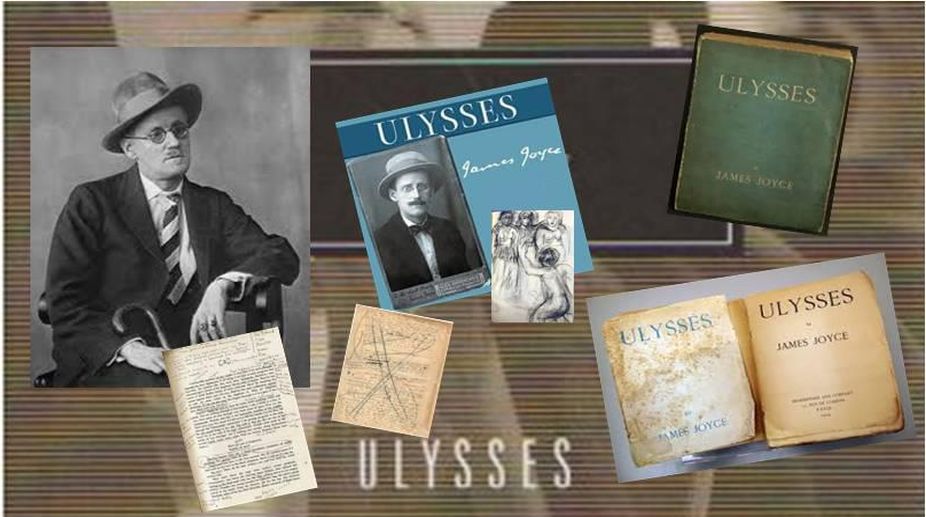
Did James Joyce write the most scandalous and pornographic novel ever written? Or is Ulysses the Mount Everest of modern literature, perhaps the finest work of fiction written in the 20th century?

Published in 1922 by Sylvia Beach of Shakespeare and Company, a famous bookshop in Paris, the novel was quickly banned in England and America. The US postal service burned copies that arrived from Europe as it had done earlier in 1918 with the serialised version that had been published in the New York magazine, The Little Review. Interestingly, today a copy of that first printing will cost one a quarter of a million dollars!

Ezra Pound called Ulysses a “super novel” while French novelist Valery Larbaud, who gave the first-ever talk on Ulysses in 1922 in Paris, called Joyce a literary equal of Sigmund Freud and Albert Einstein.

The fact is that if one compares Ulysses with today’s “obscene” fiction, it would look quite tame. But in the 1920s, the authorities were disturbed — not by the vulgarity of Molly Bloom’s interior monologue at the end of the novel, or even by the Nighttown sequence which was graphic and emetic — but the subtle scene on Sandymount beach where the middle-aged Leopold Bloom touches himself while staring at teenager Gerty MacDowell.

In these pages of Dawn (10 June 2007) I explained how I came to grips with this literary masterpiece with the help of Dartmouth College professor James Heffernan, a lifelong teacher of Joyce’s work. I now stand mesmerised and obsessed with this mega-genius called Joyce who produced this inexhaustible work of art. The icing on the cake is when one listens to the 22 CDs, produced by recording label Naxos, where Jim Norton and Marcella Riordan narrate the novel, capturing the accents, cadences and intonations of the streets of Dublin, enabling one to admire the spellbinding verbal loveliness.

As one gradually comprehends this multidimensional work, it no longer remains completely obscure. The novel is a tale of a single day — 16 June 1904. It spans about 18 hours penned over 800 pages. The hero, Leopold, is married to sexpot Molly and they have one daughter. Just as the mythical Ulysses in Homer’s Odyssey wandered the Aegean Sea, Leopold (Ulysses) and young Stephen Dedalus (Telemachus) separately roam the labyrinthine streets of Dublin till they finally meet around midnight.

Both characters cross paths with teachers, journalists, priests, acquaintances, friends, a woman in labour, barmaids, drunks, a pugnacious Irish jingoist euphemistically called a “citizen,” anti-Semites, the adulterer Boylan, the mourners in the cemetery and hustlers like Bella Cohen of the phantasmagoric Nighttown. Leopold is avoiding going home since Boylan has been invited by Molly, ostensibly to discuss the musical tour she is embarking on, but actually to seduce him. At the same time, Leopold follows Stephen because he wants to be his surrogate father. After rescuing him from a brawl at the bordello, Leopold invites Stephen to his home where Molly, having had her afternoon fling, is falling asleep and delivers one of literature’s greatest interior monologues.

This climactic ending has no parallel in world literature, both in its use of breath-taking language and the context in which it is delivered, and its stylistic brilliance. Chapter 18 is structured like a loom. There is weaving and unweaving going on similar to Penelope’s mythical loom in Homer’s work. The chapter consists of 36 pages and only eight sentences – like an eight-legged spider because it has almost no punctuation. Molly weaves her tale to unweave, to say lewd things and to unsay them. To move forward she has to go backward. To become a virgin, first she has to be an adulteress. Her deceptive, obscene outpouring of all the clandestine relationships she has ever had, we discover, is merely “to make him (Leopold) want me.” She really wants her estranged husband back.

The last words of the novel are her recollection of Leopold’s proposal of marriage in Gibraltar and with it one of the most beautiful prose arias in English literature comes to an end, “And how he kissed me under the Moorish wall and I thought well as well him as another and then I asked him with my eyes again yes (…).”

This most carefully written novel, though modelled on Homer’s Odyssey, is not its replica. It is more of a reincarnation, loosely updating Greek mythology for modern times. That is why some have called it “Ulysses on the Liffey.” (Liffey is the river that runs through Dublin.) The novel speaks to its reader in myriad voices — from poetry to banality, from profundity to cliché — where the narrative style has been replaced by the mythic. The language sings throughout, whether the 200-page chapter is written like a play rivalling Shakespeare (“I gave it to Molly/ Because she was jolly/ The leg of the duck/ The leg of the duck”) or as mind-boggling erudition (Chapter 3: “My soul walks with me, form of forms”), or in the unfeeling language of journalism and pompous comic headlines (Chapter 7: “Dear Mr Editor, what is a good care for flatulence”), or the gloriously written musical English of Chapter 4 which Vladimir Nabokov once described as one of the most beautifully crafted sentences in literature. Other chapters are written as sports journalism or mock catechism where questions abound, and some chapters end as pure gibberish.

“His writing is not about something,” wrote Samuel Beckett, “it is that something itself.” Joyce tried to make language become what it describes. When the sense is trotting, the words trot; when the sense is water, the words deliquesce, as critic Adam Thirlwell put it. In Ulysses, Joyce attempted to write a total taxonomy of the world’s phenomena. Hence, it has a full range of the world’s objects as well as the full range of its styles.

Much of Ulysses takes place in Leopold’s mind. He is the most completely imagined character in world literature. And yet we don’t know what happens to him and Molly at the end. What happens to Leopold and Stephen is also not clear. Joyce leaves all kinds of possibilities dangling at the end. In the last paragraph of her monologue Molly recalls a love affair she had 16 years earlier. This imaginative recreation recalls Marcel Proust’s À La Recherche Du Temps Perdu (In Search of Lost Time). Like Adam and Eve, it is paradise lost, for as Proust says, the only true paradise is the one we have lost.

The writer is a retired diplomat and a former editor and bureau chief at the national press club in Washington, DC.

Birth of a Nation

Krishnan Srinivasan | New Delhi |

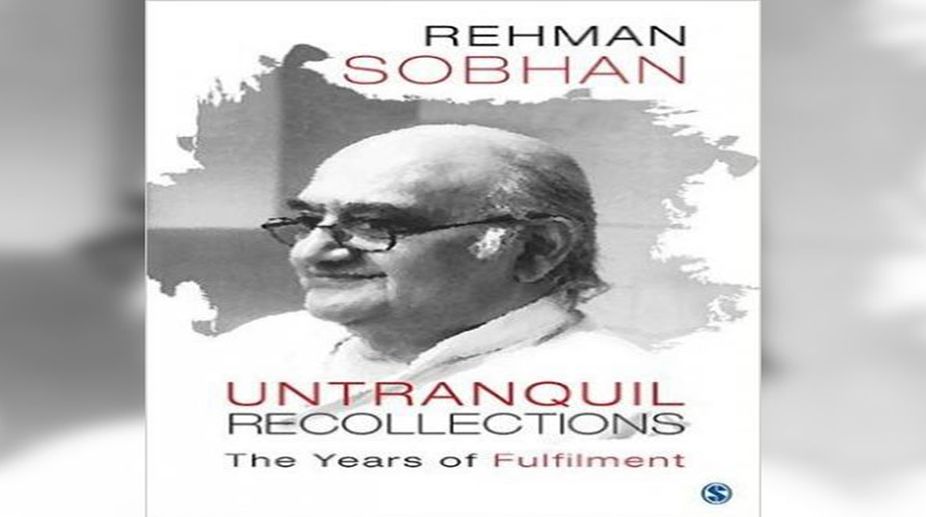
This autobiography by Rehman Sobhan covers the years from pre- 1935, when he was born, to 1971, when Bangladesh emerged as an independent sovereign country. Accordingly, it has to be considered the first of more parts of the Sobhan story.

Autobiographies are written by those well-known enough to presume that their lives are of interest to others or by those who have lived through momentous times, to which their first-hand accounts add value to what is already known. In other words, those that are born famous, and those who have fame thrust upon them. Sobhan is in the second category; he will be recognised by prospective readers as a leading public intellectual, a firm believer in South Asian identity and unity, an economist with expertise in development economics and political economy, and an author of more than 20 books.

Less well known will be his role in the intellectual content of the movement towards Bangladesh’s independence, first through his contributions to the documents that formed the basis for the eventually fruitless negotiations by the Awami League under Mujibur Rahman with the Pakistanis, and later to the proclamations that heralded the actual dawn of independence. Because he was dispatched to Europe and USA by Tajuddin, acting as Prime Minister-in-exile in the absence of Mujib, then in detention, Sobhan’s profile in India as a lobbyist for Bangladesh was inevitably overshadowed by his peers in Mujibnagar/Calcutta during the axial year of 1971.

This is not the first memoir that deals with the human tragedy that led to Bangladesh’s independence, and no viewpoint is identical to others. This work may be the last eye-witness account of that period 46 years ago but it will not be the final word since future records may yet reveal additional information. But Sobhan’s book will remain valuable, being by someone who was present in the struggle from the creation, so to speak. And throughout those years, his passion, energy and sincerity are characteristic of his ebullient personality.

The book can be considered in three parts; chapters one to six cover Sobhan’s education, with Cambridge comprising the longest one in the book; seven to 11 deal with his excursion into the leather business and university lectureship; and 12 to 17, his connection with the AL and the break from Pakistan. Each segment will appeal most to a different readership but the entire text is easily accessible for the generalist.

Sobhan was born with many silver spoons in his mouth, being related by blood or marriage to the Who’s Who of the sub-continental Muslim community, ranging from the Nawab of Dhaka to the crown prince of Jordan. That he spent one summer holiday in the house of the Governor-General of Pakistan and another with the Prime Minister speaks for itself. The book’s first segment will appeal to the declining numbers who recall the golden days of Calcutta society, public schools and elite British universities with delighted nostalgia, while others might find tedious the lengthy lists of names, places and procedures. It comes as a surprise that he departed for London from Pakistan in a second class four-berth cabin below deck.

Sobhan’s entry to Cambridge after the start of term was not quite as fortuitous as BK Nehru’s, whose memoir records his admission being facilitated by the lodge porter at Balliol. At university, Sobhan’s“political perspectives were given shape … my move to the left had already begun”, though he remembers his college “without much nostalgia” and is “not sure what Cambridge itself did for my intellectual development.” He claims as “improbable” his deliberate choice to base his home and career after 1956 in East Pakistan, an area he had only visited once before for one month, and did not speak Bengali. But this was hardly unique in the 20th century; many in India and Pakistan heard the same siren song to return from abroad and assumed leadership positions.

In the second segment, as leading shareholder of Dhaka Tanneries, Sobhan endeavoured to learn the craft, but the kow-towing of business circles to mediocre Pakistani bureaucrats planted his commitment to a self-governed East Pakistan. Of 22 families that dominated the private sector, there was only one Bangali; at liberation, only three per cent of industrial assets were owned by Bangalis. The relationship between West and East Pakistan was patently unequal and unjust, and the disparity of the two economies became a focus of Sobhan’s attention. He joined Dhaka University and it was there that “I forged a political identity that continues … even today.”

Again, the reader is given much detail of the personnel and development of the Economics Department, even to the layout of rooms.But Bangladeshi faculty and students, then as now, were a potent factor in shaping political events, and were given exposure that exceeded their years and experience. Sobhan’s political mentors were HS Suhrawardy, Mujib and Tajuddin. Under pressure from Pakistan’s local administration, Sobhan found refuge at the London School of Economics from 1966 to 1969. Leftinclined economists of that time seemingly constituted a formidable mutualhelp cohort and Bangladeshis of that tribe who needed a break, whether voluntary or imposed, found ready congenial employment in the West or international organisations.

The two economies theme motivated Sobhan in drafting AL’s negotiating positions urging maximum autonomy, including raising taxes and control over export earnings. He also assisted in preparing the election manifesto of 1970, the first direct franchise poll held in Pakistan, the independence proclamation and the eventual Constitution. Sobhan’s narrative is an insider’s account of the predictable Greek tragedy of failed negotiations between AL and West Pakistan, when “global sympathy was gained at a heavy cost in Bangali lives.” His escape from the Pakistan army to Tripura is gripping, and contacts with the Delhi government revealed a remarkable lack of information by the latter, which says much to the detriment of Indian intelligence, which apparently failed even to peruse the Dhaka press.

Mandated from April 1971 as envoy extraordinary (probably by coincidence the exact use of this technical term), Sobhan was dispatched to Europe and USA to lobby against aid to Pakistan by the principal donors, an assignment in which he displayed boundless energy, combined with zest for music, academics, sports, cinema, and culture both demotic and refined, as well as with networking skills aided by accurate powers of recollection — “my multidimensional role as media star, journalist, diplomat, academic and political rabble-rouser came quite easily to me.” He never lacked in self-confidence; even on leaving school, he notes his own “intelligence and academic achievements”. He mentions his position in the “UN delegation” but does not clarify what credentials this delegation possessed. Since Bangladesh was not then a UN member, presumably he was attached to the Indian delegation. The book is marred by repetitions, lamentable copy-editing and the poor binding commonplace with Indian publishers, and a wholly unsatisfactory index, a grave defect in this genre of history. For example Kaiser Morshed, Haroun er-Rashid and Khondkar Mushtaq Ahmed are altogether missing, and Mujibur Rahman himself is bestowed one page as reference. The disposition to use shorthand is irritating; Mujibur Rahman is Bangabandhu; then we have Boss, Sir, MAC, which require backtracking through the pages.

With these reservations, Sobhan’s book is a delightful read, leavened with gentle humour, often of a self-deprecating nature; Amartya Sen’s initial anonymity at Cambridge was due to shyness, which “may (now) appear rather unimaginable.” He justly praises the unfailingly support of then wife Salma. He has the ability to retain names, places, dates, times, and people, even the lowly individual who received him at Waterloo in 1953. He retained his London account of expenditure and notes from Cambridge lectures, but implausibly cannot recall if he used the “coloured” or “whites-only” toilet in Southern USA. The narrative concludes when he returned to Dhaka at the still-young age of 36. He hints broadly at dissatisfaction with the contemporary political scene, but for details, we have to await, expectantly, the remaining part or parts of Sobhan’s memoir.

The reviewer is India’s former foreign secretary.

Gertrude Stein and modernist painting

Somdatta Mandal | New Delhi |

Gertrude Stein (1874-1946) was an American novelist, poet, playwright and art collector. As an expatriate American and modernist woman writer who experimented with nearly all varieties of literary forms, she is widely acknowledged as a major author who is scarcely read. However, she continues to draw attention as a highly influential literary-cultural figure of the 20th century. Born in Pennsylvania and raised in Oakland, California, Stein moved to Paris in 1903 and made France her home for the remainder of her life. She hosted a Parisian salon, where the leading figures of modernism in literature and art, such as Pablo Picasso, Ernest Hemingway, F Scott Fitzgerald, Sinclair Lewis, Ezra Pound, Sherwood Anderson, Virgil Thomson, Henri Matisse, and many more would meet.

In fact, Stein is a familiar name to anyone who has gone through the history of European modernism or American literature of the 1920s or the Parisian cultural milieu of the early 20th century.Widely acknowledged as a major writer in her own right, Stein was a contemporary as well as a mentor to several of the more widely read writers of the time. She is said to be instrumental in labelling the young lot of American writers in post-war Europe as belonging to une generation perdue, in other words, belonging to the members of the “lost generation”. Her influence on avant-garde artists and art and her own innovations in different literary genres form the basis of her continued recognition in the academic world.

Stein’s writing, which effectively undermines hierarchical, patriarchal modes of signification, also problematises marginalisations of several kinds. Her style marked such departures from conventional (and even other modernist) writing that the academic world hardly had any adequate terminology or critical tool to analyse it, whether to determine continuities or to assess divergences. However, analogies with comparable experiments in the visual arts, particularly in painting, can make Stein’s writing more accessible, though not necessarily comprehensible. The recognition of the largely obscure and abstract nature of her writing is strikingly evident in the titles of some of the early books written about her. In 1933, Stein published a quasi-memoir of her Paris years, The Autobiography of Alice B.Toklas, written in the voice of her life partner, Alice B Toklas, an Americanborn member of the Parisian avantgarde. The book became a literary bestseller and vaulted Stein from the relative obscurity of the cult-literature scene into the limelight of mainstream attention. Two quotes from her works have become widely known, “Rose is a rose is a rose is a rose” and “There is no there there”.

Her other books include Q.E.D. (Quod Erat Demonstratum) about a lesbian romantic affair involving several of Stein’s female friends, and Fernhurst, a fictional story about a romantic affair. In Tender Buttons, which is considered by many as her literary cubist still life, Stein commented on lesbian sexuality. Just as lines and colours do not represent reality but suggest and evoke images, ideas or sensations in Picasso’s cubist still-life painting, the word combinations in Tender Buttons, without syntactic structure and coherence, convey meaning as an abstract still life does. Leaving the method of conveying meaning through the linear syntactic ordering of words, which characterise writing she adopts the “spatial” method of communicating meaning through associations and interrelations as in painting, using words in place of lines and colours. Following the early narrative experiments in Three Lives(1906) under the influence of Cezanne, she goes on experimenting with varied narrative devices, taking off from this in ways that parallel the methods of painters. Extremes of such experimentation can be seen particularly in the methods of verbal signification in Tender Buttons, presenting of characters in The Making of Americans, fragmentation and abstraction of narrative components in A Novel of Thank You (1926).

In these works Stein gave indirect expression to her personal concerns. With her training in philosophy and psychology and her acquaintance with revolutionary painters like Picasso, Braque, Matisse and Juan Gris, her writing soon took a new orientation. Like her painter friends, Stein also became preoccupied with the limits and possibilities of the artistic medium. In each of her fictional worlds, as in her experiments in the different genres, she sought new possibilities both within the genre and within her medium.

In the process of experimentation, Stein made radical deviations from convention. Her literary output thus has crucial interfaces with painting, modernism, post-modernism, and feminism. Stein’s interest in formal innovation, which began with her close understanding of painting, resulted in deviations from all traditional modes of writing, and in that process she wrote the “different language” of a feminist. Her activities during World War II have been the subject of analysis and commentary. Ultimately, the significance of her writings also lies not in their intrinsic value as literature or their being fully readable and comprehensible. This book is an attempt to understand the concerns that preoccupied Stein and to use this understanding to assess the creative patterns in her seemingly unreadable writings.

Coming to the nature of Stein’s experimental writings one must stress the importance of cubism as a genre. Cubism has the unique historic importance in that it opened up new artistic possibilities to a world that was changing at an unprecedented pace at the beginning of the 20th century. Studying the manner in which Picasso’s cubist style evolved can be relevant in efforts to understand Stein’s work. Just as cubist painting evolved through a series of experiments in the analysis of vision and of its depiction in art, Stein’s work can be seen to pass through a series of experiments in human perception and its representation in writing. This book suggests a framework for a study of the one through the other. The cubist style focused on the flat, two-dimensional surface of the picture plane and rejected the conventions and techniques of linear perspective, chiaroscuro and the traditional idea of imitating nature. Instead of creating natural-looking objects, which appear three dimensional, cubist painters offered a new composition of images made up of two-dimensional fragments. Among the numerous factors, which favoured this change must have been the newly gained acceptance of photography as an art form, largely through the work of Alfred Stieglitz. Photography held the potential to be a more effective alternative to painting in the illusionistic representation of reality, and it was imperative for painting to seek more challenging artistic goals. Stein’s writing experiments had their primary focus on the writer’s perception of reality and ways of rendering it in writing.
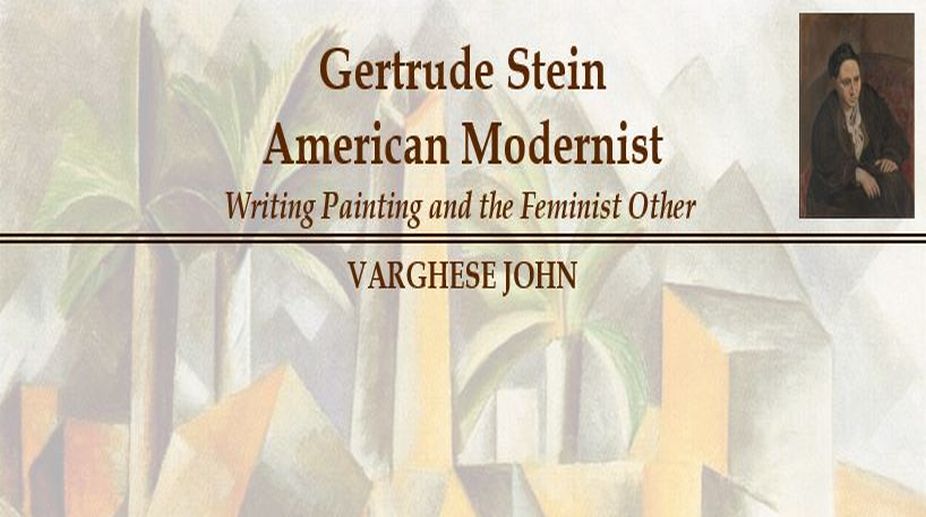
To conclude we can state that going through historical and biographical details, Gertrude Stein American Modernist: Writing Painting and the Feminist Other draws parallels between the concerns and methods of modernist painting, and those that preoccupied Stein. Using principles of the semiotics of writing and painting, the book develops a general framework for reading some of the major works of Stein and examines her importance as a writer. It would not be overemphasising to state that the book with its lucidity of language helps us also to understand the Modernist movement and the interrelationship between the arts much better. The author should be congratulated for being the first Indian to complete doctoral research on Stein, for making the readers familiar with this avant-garde writer whose writings still remain more read about than actually read, more known about than actually known, and for enlightening the readers with complicated literary landmarks that dotted the first three decades of the 20th century.


The reviewer is professor of English at Visva-Bharati university.

The illegal wildlife trade

Ian Johnston | New Delhi |

Nearly half of all the natural World Heritage sites on the planet are being ravaged by poachers who are driving some endangered animals towards extinction, according to a new report. The illegal wildlife trade was estimated to be worth some £15billion, making it the fourth largest international criminal trade after drugs, guns and human trafficking, according to the “Not For Sale” report.

Illicit logging and fishing are also occurring on an epic scale. The illegal felling of trees — a trade valued at between $30 billion and $100 billion (about £24bn- £80bn) a year — was estimated to account for up to 90 per cent of deforestation in major tropical countries.

Fish piracy, blamed by some in countries like Somalia for pushing people into actual piracy, was found to occur in 18 out of 39 marine heritage sites with protected species of sharks and rays among those being caught.

The report, commissioned by conservation group WWF, warned that species listed on the landmark Convention on International Trade in Endangered Species, adopted in 1975, were being killed in supposedly protected World Heritage sites. “Between 1970 and 2012, global wildlife populations declined by almost 60 per cent on average, and illegal harvesting of species was one of the main drivers for this decline,” the authors wrote.

“World Heritage sites now function as the last bastion for many critically endangered species, and unless protected within World Heritage sites, these species will go extinct. The current international approach to preventing illegal harvesting of Cites-listed species in World Heritage sites is not working, and stakeholders must redouble their efforts and address all parts of the wildlife trafficking value chain.”

According to a leaked copy of a speech by a senior Foreign Office official, some of the Government’s work on the illegal wildlife trade will be “scaled down” as trade and economic growth are given priority after the UK leaves the European Union.

But the WWF report said that unless governments, the United Nations and others took “additional, immediate measures” to address widespread poaching “some species might face local extinction and some World Heritage sites could lose their outstanding universal value” — the definition of why they are considered special.

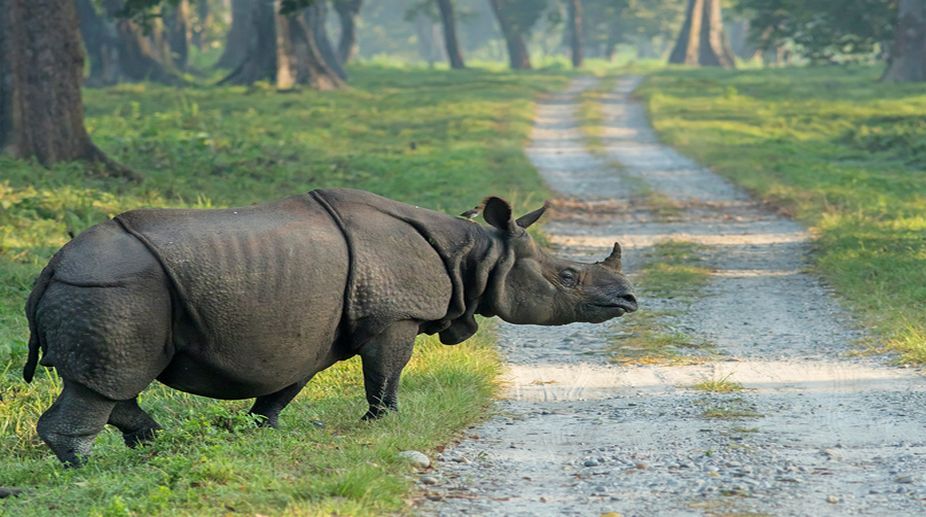
It said threatened species, such as elephants, rhinos and tigers, were being “illegally harvested” in 45 per cent of World Heritage sites, “the pinnacle of the world’s protected areas”.

“Elephant poaching occurs in over 60 per cent of the World Heritage sites containing African and Asian elephants,” the report said. “Selous Game Reserve in Tanzania has lost almost 90 per cent of its elephants since its inscription in 1982 and now has only 15,217 elephants left.”

The Okavango Delta, a World Heritage site in Botswana, where poachers have been active, was described as a “crucial habitat” for the elephants in northern Botswana, which make up nearly a third of all the remaining African elephants. About a third of all the world’s remaining 3,890 wild tigers now live in World Heritage sites.

Trying to stop poachers is difficult and dangerous with many prepared to use lethal force. “Wildlife trafficking has also often endangered peoples’ lives, and between 2009 and 2016 at least 595 rangers were killed in the line of duty, many of whom were protecting World Heritage sites,” the report said.

Chris Gee, the head of campaigns at WWF-UK, said poaching was “jeopardising the future heritage of these precious places and the people whose livelihoods depend on them”.

“Next year London will host the Fourth Illegal Wildlife Trade Conference, the UK Government must bolster efforts to support the end of this devastating trade,” he said. “Now is not the time to drop the ball on this issue. These findings show that for the future of many of our most endangered species it’s a matter of life and death.”

And John Scanlon, the secretary general of Cites, said it was “essential” that the convention was “fully implemented and that these irreplaceable sites are fully protected”.“In doing so, we will benefit our heritage and our wildlife, provide security to people and places, and support national economies and the rural communities that depend on these sites for their livelihoods,” he said.

Among some positive signs that the world is trying to deal with the problem, the report highlighted China’s decision to ban all trade in ivory by the end of this year as a “breakthrough” that could “provide forceful momentum for other countries to follow”. But it said more funding was needed with Cites’ core budget running at about $6m a year —in stark contrast to the billions being made by the poachers.

Inger Andersen, the director general of the International Union for Conservation of Nature, said, “This report is a sobering reminder of just how far this type of organised crime can reach, extending even into the supposed safety of World Heritage sites. This is a global challenge that can only be tackled through collective, international action.”

The Independent

Turning cow dung to black gold

Joshua Parfitt | New Delhi |

I apologise for the dirt,” says Pak Suparjono’s wife nervously as I pull up my trouser legs and tread between the cow pens and duck houses. Embarrassed about her back garden where the waste of seven cows lies in heaps among the coconut palms and bananas, she tries to lure us away with sweet tea. However, it is precisely this waste material – the fermented by-product of bio-gas — that Suparjono refers to as his “black gold”.

“Smell this,” urges Suparjono clutching a handful of dark brown loam, which has the woody aroma of rich earth. “I used to break my back making compost from manure for my crops, the smell was disgusting and required a lot of work —now I get a ton of the stuff every two weeks,” he laughs.

The biogas by-product, otherwise known as bio-slurry, is the main focus of a recent programme carried out by the Yayasan Rumah Energi foundation along with international help and support. The programme, known as Gading, complements the YRE’s Biru project —which has, since 2009, been facilitating and monitoring the construction of more than 16,000 biogas reactors across Indonesia.

The Gading programme is funded by the US development agency, the Millennium Challenge Corporation, which encourages sustainable development as a means to alleviate global poverty.With research and technical support from the Dutch not-for-profit specialist organisation HiVos, Gading fosters the growth of already existing micro-businesses in the agricultural sector. In the province of Yogyakarta, alongside the YRE, this takes the form of biogas and bio-slurry enterprises.

Mas Tyo, the Gading project’s organic fertiliser officer, explains that “Pak Subarjono is a perfect posterboy for our project — every part of his farm benefits from bio-slurry.” “The fresh bio-slurry provides a breeding ground for worms,” Mas Tyo elucidates, “which his 300-odd ducks forage for to produce quality eggs on a daily basis. Every few weeks the dry bio-slurry is collected and used as a rich compost and fertiliser for vegetable crops. The crops are sold on a monthly basis and some are fed to his cows. Before they are annually sold for slaughter, the cows fully supply the household with cooking fuel — thanks to the biogas reactor — and replenish the back garden with fresh bioslurry again.”

“My purchases of chemical fertilisers have also been slashed,” Subarjono eagerly shared. “One bag of fertiliser can cost up to Rp 250,000 (US$19, roughly a quarter of Yogyakarta’s monthly minimum wage) and you need to mix a few different kinds to get all the nutrients you need. Bio-slurry comes already complete in minerals, I’ve probably cut my use of chemical fertiliser in half already.”That this benefit can be drawn from a waste product — cow dung — gives the Gading project the environmental credibility it is looking for. According to a UN report, Livestock’s Long Shadow, livestock manure is harmful to the environment in large quantities, causing eutrophication in rivers and oceans, as well as polluting groundwater and irrigation canals. In the small province of Yogyakarta where there are almost 300,000 head of cattle, Suparjono is one of very few whose waste will not end up in the waterways.

The relationship between Biru, Gading and the estimated 12 million head of cattle in Indonesia is promising. Thanks to further research from HiVos, the program is now promoting duckweed — an aquatic plant with six times the amount of protein in soybeans per volume, which can be grown using bio-slurry as a fertiliser.

A 12 square metre pond is now under construction at Suparjono’s house. “With duckweed I can cut my purchases of soybean feed for my ducks considerably,” he says. “Just one more proof of the benefits of bio-slurry.” Fishing for facts, I ask him how much he will make from his duck egg sales — he replies, “Lumayan.” In English the rough direct translation would be “reasonable”, yet in the humble manner of the Javanese, coupled with a noticeable grin, the word tends to mean “a lot”.

Perhaps all others see is a darkcoloured waste product, yet for those who venture into Suparjono’s back garden in Bantul, Yogyakarta, it is clear he has already struck gold.

The reporter is with The Yayasan Rumah Energi the Jakarta Post/ANN

Pages from the past

Shoma A Chatterji | New Delhi |

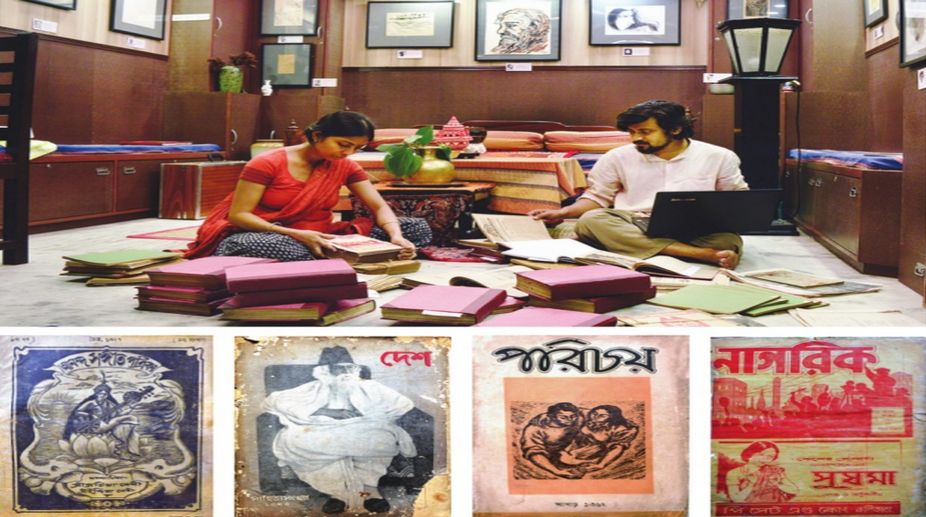
Can you even imagine seeing 600 Bengali journals and periodicals ranging between 1920 and 1984 in one place? If not, then you better hurry to Jeebonsmriti Digital Archive in Uttarpara, a few kilometres from Kolkata, where Arindam Saha Sardar is in the process of building a massive digital archive of old and original Bengali magazines for some time now.

World Book Day is observed every year today and it would be ideal to shed light on this one-man archive. It offers a window to a new world to those who love to dig into our cultural and literary past that would have been lost without men like Sardar. Jeebonsmriti Digital Archive evolved from his original foundation Bengal Photo Studio based on his love for old films, cinema technicians of a bygone era, music records, song books of films, film scripts and screenplays, movie cameras and such like. He has made three good documentary films on classic cinematographers like Subrata Mitra and Soumendu Roy, and one of the best art directors of Indian cinema, Bansi Chandragupta.

In June 2011, he organised an exhibition on music, an offshoot of his research on 78 rpm records produced between 1902 and 1971. “These are considered to be the original records in the Indian recording industry. LPs and EPs and 45 rpm records are said to be copies. Recording companies stopped recording on 78 rpm from 1970 but a few offshoots came out in 1971. I wanted to make a documentary on this subject. In 2008, I began to interview people directly involved with the 78 rpm recording industry. These included collectors of 78 rpm records, music directors, singers, lyricists, music arrangers, recordists and even the head of Megaphone Company on camera. Private songs and film songs and all modern Bengali songs were within the subject of my research. I collected 78 rpm records, photographs, record players, restored the photographs on Photoshop and organised my first exhibition on ‘Female voices on gramophone records’. It was my second exhibition on music. We also brought out a CD for fans of old Bengali songs as a source of much needed revenue” Sardar says.

In 2014, under the auspices of the Baudhha Dharmankur Sabha, Sardar exhibited Chitre Tathagata with digitally restored prints of paintings collected from rare magazines, books and photo albums from the 19th and 20th centuries on the life of Tathagata (Buddha). On display were 112 digitally restored prints of the title pages of invaluable publications in Bengali on Lord Buddha. A similar exhibition was held in May to celebrate Buddha Purnima at Shantiniketan’s Rabindra Bhavan. This collection deserves place among the calligraphic, graphic and printing history of Bengal. Among the painters were Abanindranath Tagore, Gaganendranath Tagore, Asit Kumar Haldar and Srimati Gouribala Bhanja Choudhurani.

In 2015, Arindam gathered around 57 sketches and paintings in blackand-white and colour reproductions, published during the 19th and 20th centuries in Bengali magazines such as Bharat Barsha and Basumati, and the Bengali almanac printed and published by Gupta Press, which prides itself on a massive collection of sketches of different kinds of Durga. The Bengali almanac or Ponjika, as it is known in Bengali, is a historical archive unto itself. For the uninitiated, the Gupta Press Ponjika was first published in 1869 from Kolkata to fulfill the growing demand of having a codified book of ceremonies. It is like a detailed and precise frame of reference of lists, dates, times and events marked in the current calendar year for fixing the dates of marriages, thread ceremonies, rice ceremonies, funerals and everything else with which rituals are associated. Filled with illustrations in black-andwhite and executed often adapting the Kalighat pata school of painting, the Ponjika offers a peek at cultural and aesthetic history through its evolution as the most successful commercial venture where art has played a distinctive role.

Jeebonsmrit, in collaboration with Focus, another cultural organisation of Uttarpara, has ventured into further research in cultural media in the form of collecting old Bengali periodicals of different kinds and digitalising them for posterity. Together, Jeebonsmriti and Focus, since 2015, have been holding exhibitions, discussions, seminars and conferences exploring the cultural history of Bengal along different periods in the past.

An exhibition for the public was inaugurated on 16 April this year to coincide with the Bengali New Year by artists and historians Somendra Bandopadhyay and Anup Motilal where the bound volumes of the magazines are on display. “We are also arranging for researchers to get their material by email,” says Sardar who has christened this exhibition after a famous line from a Tagore song that goes, Nobo Anonde Jaago (Rise in Happiness Reborn).

The time span of these magazines ranges roughly between 1903 and 1964 while there are relatively recent publications of special editions for the birth and death anniversaries of eminent literary giants of Bengal. A digitalised list of these magazines with their names, cover images, list of contents, names of editors, and dates of issue is also being prepared.

This is also a journey through the history of magazines noting the time when advertisements began to feature at the bottom of covers. The names of eminent editors who were great literary figures in their own right are printed on some of the covers. The price tag takes one by surprise. The cover of Porichoy shows that the monsoon issue (Ashaad of 1362) of June-July 1955 was 10 annas before the naya paisa era had begun. Generous donations have come not only from individual collectors or families with their personal collections, but also from organisations and institutions that once kept these memorabilia in their collection as part of their interests and functioning. As a journalist, this writer found the collection of old, tattered, torn and faded print magazines in Bengali the most attractive and priceless among them all. “This archive is not based on my personal passion. It is aimed at creating a real, virtual library of academicians, historians, museum curators, and research students who can use these in digitalised form for their research. We are collecting them and putting them together over the last six months, trying to restore and rescue them from complete destruction and disintegration through proper and scientific techniques though we hardly have funds to finance this huge project,” Arindam says.

In the footsteps of the Father

Tushar Kanti Das | New Delhi |

Mahatma Gandhi went to Kausani in 1929 for attending a political campaign. It is said that the mountain ranges mesmerised him so much that he absolved himself from his daily activities and took to meditation. He originally went for two or three days but ended up staying there at the government Dak Bungalow for 12 days! Gandhi ji put off his hectic schedule and started writing on Anasakti Yoga, which is mentioned in the Bhagavad Gita. He said Kausani is “the Switzerland of India”. After that, the government Dak Bungalow was converted into Anasakti Ashram, popularly known as the Gandhi Ashram of Kausani in Uttarakhand.

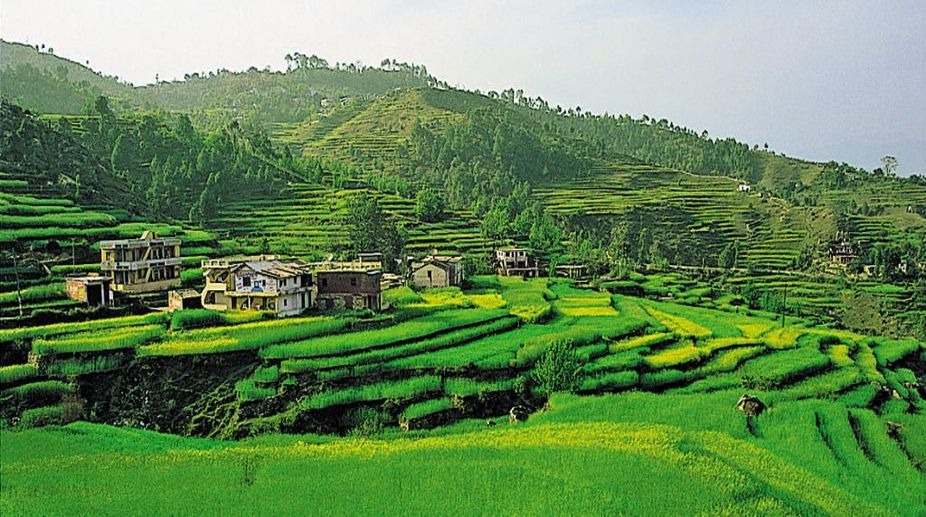
In the morning, when I set out for Kausani from Almora, white clouds wafted over the deep valley and the warm sunshine brightened the serpentine road ahead, which went past coniferous forests. Each bend gave way to pleasing sights and the snowcapped mountain ranges played hide and seek with us. After a two-and-half-hour ride, I halted before the old Someshwar Temple, which was a treat to the eyes after a tiresome journey. Leaving behind a small market to the left, the car winded up another 1,000 ft to reach the Anasakti Ashram.

I rushed, with excitement, to the view point in front of the CCCCCCCPrayer Hall. It seemed as if the vast blue sky was well within our reach! On the other side valleys, cut into steps for cultivation descended deep down. One was left spellbound by the serenity of the place surrounded by tall pine trees. I felt enthralled to live in the century-old heritage building where once Gandhi and other stalwarts had set foot and the walls of the Prayer Hall exhibit rare photographs on the life of Mahatma Gandhi.

After a delicious lunch and a stroll in the nearby market, I started for Baijnath, which is 19 km away from Kausani. The road was hemmed in by thick oak, fir and pine trees. Paddy fields were down below and the driver informed that the Basmati rice grown here is exported to foreign countries. The road to the temple goes over the Gomti River. Once there, one was witness to the magnificent twelve stone temples complex of Ek rekha deula or single-shrine structures, dedicated to Lord Baijanath or Shiva, Parvati, Ganesha, Brahma and Chandika, by the Gomti. They were built by the Katyuri rulers around the 13th century but subsequent invasions by Tamerlane, followed by Nadir Shah, left its architectural glory devastated. It was saddening to see such heritage temples left neglected without proper maintenance.

On the way back, I made a beeline for the workshops where the famous Kausani shawls are manufactured. It is said that Kausani was discovered in the early 20th century by the Troupe brothers who tried their hands at tea cultivation on the slopes of Kausani and also erected a bungalow there, which is now a coveted rest stop for mountaineers and expedition teams heading towards Manas Sarovar.

Next morning, a huge crowd had gathered to see the sun bathe the Himalayas in all its resplendent glory. One was elated to spot the different snow-clad peaks like Nanda Devi, Kamet, Trisul, Chaukhamba, Hati-Ghori, Nilkantha and Panchachuli among others, standing like walls as high as 22,000ft and stretching over 300km. The beaming sunshine behind the ranges made it look like a divine halo and the peaks seemed to vie with each other to be the first one to bathe in the sun rays. Within a matter of seconds, I witnessed a magical sight as the white peaks turned fiery red.

The last destination on the tour was Ranikhet where one was greeted with the white ranges almost touching the sky. As I said goodbye, memories of staying in the same place as the Father of the Nation with the Himalayas in the background filled the mind.