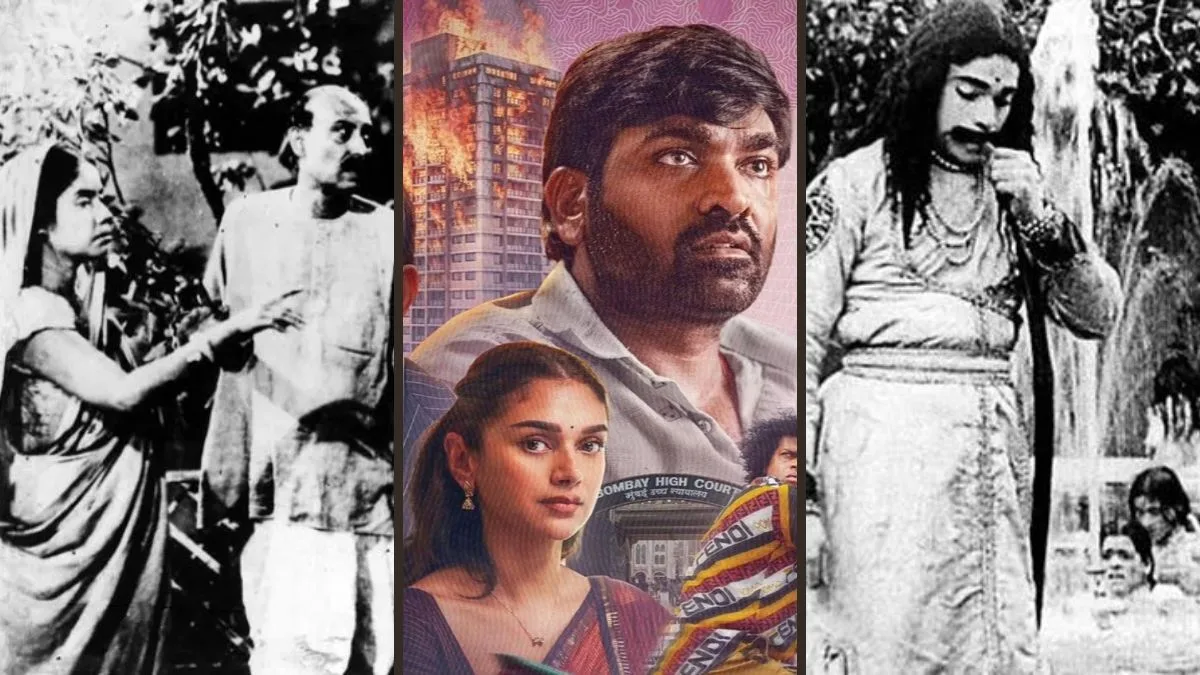
The new film Gandhi Talks has arrived on ZEE5 on March 6, and it is already creating curiosity among movie lovers. The reason is simple. It is a silent drama in an age where films rely heavily on dialogues.
The film stars Vijay Sethupathi, who carries the story almost entirely through expressions, gestures and body language. The story revolves around unemployed graduate whose life unexpectedly collides with wealthy businessman who is dealing with his own personal struggles. The film also features Aditi Rao Hydari and Arvind Swamy.
If ‘Gandhi Talks’ sparks your interest in this rare storytelling style, here are five silent films worth exploring.
Andhare Alo
One of the earliest examples of silent storytelling from Bengal is ‘Andhare Alo’ released in 1922. The film was produced by Taj Mahal Films in Calcutta and marked their debut production.
The film’s title translates to “Beam of Light”, and it was also known as “The Influence of Love.” It was directed by Sisir Bhaduri and Naresh Mitra, while Noni Gopal Sanyal handled cinematography.
The cast included Sisir Kumar Bhaduri, Naresh Mitra, Jogesh Choudhury and Durga Rani.
The film was based on a short story of the same name written by Saratchandra Chatterjee, a celebrated Bengali author known for his emotionally layered stories.
The plot revolves around a complicated love triangle. A man named Satyendra marries because of family pressure. However, after the wedding he leaves behind his young bride Radharani, who is only eleven years old, and becomes involved with a modern and mature courtesan.
Raja Harishchandra
If there is one film that sits at the very beginning of Indian cinema history, it is ‘Raja Harishchandra’.
Released in 1913, this silent film was directed and produced by Dadasaheb Phalke. It is regarded as first full-length Indian feature film.
The film starred Dattatraya Damodar Dabke, Anna Salunke, Bhalchandra Phalke and Gajanan Vasudev Sane.
The story was inspired by the legendary king Harishchandra known in mythology for his honesty. Dabke played the title role in the film.
Because the movie had no spoken dialogue, it used intertitles in English, Marathi and Hindi to explain key moments in the story.
Netaji Palkar
Another important silent film in Indian cinema history is Netaji Palkar, released in 1927.
The historical biopic was directed by V Shantaram. It was his first film as director. The movie was produced under banner of Maharashtra Film Company in Kolhapur.
Kaishavrao Dhaiber, who had worked as an apprentice with filmmaker Damle, co-directed the film. Later, he went on to become the chief cinematographer for Shantaram’s films.
The film’s director of photography was S Fattelal.
The cast included Ansuya, Balasaheb Yadav, Ganpat Bakre and Zunzarrao Pawar.
The story focuses on Netaji Palkar, who served as the Senapati (Commander-in-Chief) of Maratha king Shivaji. The narrative follows his efforts and struggles while trying to protect his kingdom.
The film made a significant impact on Marathi cinema.
Daughters of Today
Moving from western India to the north, another fascinating silent film emerged from Lahore in 1928.
The film was titled ‘Daughters of Today’ and was produced by GK Mehta and directed by Shankradev Arya.
It holds special place in cinema history because it was the first feature film made in Lahore.
At that time, Lahore was part of British India and would later become a major filmmaking hub in Pakistan. The film helped establish the city as a centre for filmmaking. It eventually evolved into what is popularly known as Lollywood.
The production journey was long and difficult. Work on the film began in 1924, but it took three years to finish.
The biggest reason for the delay was financial problems, which slowed down the production process.
Despite these challenges, the film introduced people who would later become major figures in South Asian cinema.
One of them was AR Kardar, who later became one of the most famous directors in Bombay during the 1930s, 1940s and 1950s.
Holy Wound
Silent cinema did not disappear after the early twentieth century. Occasionally, filmmakers return to the style to experiment with storytelling.
One modern example is the Malayalam silent film ‘Holy Wound’, released in 2022.
The film was directed by Asok R Nath and written by Paul Wiclif. It was produced by Sandeep R for Sahasrara Cinemas.
The music for the film was composed by Ronnie Raphael, who had previously worked on the film Marakkar.
The movie starred Janaki Sudheer, Amrita Vinod and Sabu Praudeen.
The film’s plot revolves around two young women who share a homosexual relationship. One of the women is married to a man, but she has no interest in a sexual relationship with him. The husband, however, forces himself on her and treats her brutally for his own gratification.
As she struggles with the trauma and abuse, she begins to remember her old friend, a woman she once loved who has now become a nun.