Logo

DDLJ in 2026: Kajol says Simran’s world wouldn’t last a minute in Gen Z reality

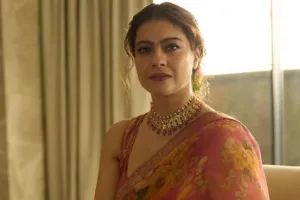
Kajol reflects on how much parenting and relationships have changed since the 90s, saying today’s youth behave very differently from the DDLJ era. She believes Gen Z would not follow the same permission-based life.

Statesman News Service | New Delhi |

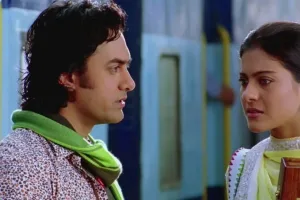
If Simran from ‘Dilwale Dulhania Le Jayenge’ walked into a Gen Z household today, would she still wait at the door with folded hands asking for permission or would she already be halfway to the airport with her phone in one hand and boarding pass in the other? That’s exactly the kind of thought Kajol recently sparked while talking about how much life has changed since the 1990s.

The actor, who famously played Simran in the iconic romance, opened up in a chat on ‘Shame Less with Lilly Singh’, where she reflected on love, parenting, and how young people behave today compared to the era when DDLJ ruled cinema screens.

Also Read: ‘If people didn’t like it, I’m sorry’: Akshay Kumar defends controversial fake moustache in ‘Samrat Prithviraj’

Simran vs Gen Z

Kajol didn’t hold back while describing how today’s teenagers function very differently. She pointed out that the idea of an 18- or 19-year-old asking parents for permission in the old-fashioned way barely exists anymore.

With a laugh, she explained the modern version of the conversation: “I don’t think anybody at the age of 18 or 19 is going up and telling their dad, ‘Can I please go on this trip?’ It’s more like, ‘Dad, I really have to go on this school trip, and you really have to pay for it.’”

Parenting then and now

Kajol also spoke about how relationships between parents and children have evolved over time. In the DDLJ era, emotional distance and strict expectations often shaped decisions. Today, she says, the dynamic feels more like open discussion than silent acceptance.

Parents are no longer just authority figures but also participants in conversations. Decisions are often debated, justified, and negotiated rather than simply accepted or rejected.

According to Kajol, this change reflects how society itself has moved where young people feel more confident expressing what they want without hesitation.

What Gen Z should really take from DDLJ

When asked what she hopes today’s generation learns from the film, Kajol shifted from humour to a softer note. She said the emotional core of DDLJ still matters even if everything else has changed.

“I think what I would love for them to take away is that relationships and family matter at the end of the day,” she shared. She added that no matter how independent life becomes, family love remains constant and grounding. “Your family is your family, and they love you… that’s what it’s all about.”

But Kajol didn’t miss a chance to joke about her own iconic look from the film either. When asked what Gen Z should ‘not’ copy, she laughed and said, “My dressing sense, at least, for sure.”

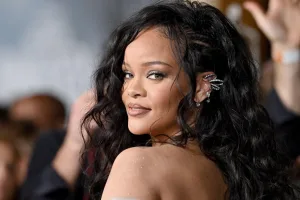
What is Rihanna doing in India? Surprise Mumbai arrival ignites wild speculation and fan chaos

Fans were left stunned as Rihanna quietly landed in Mumbai, turning an ordinary airport night into a full-blown celebrity spectacle. Her surprise appearance has now sparked intense curiosity.

Statesman News Service | New Delhi |

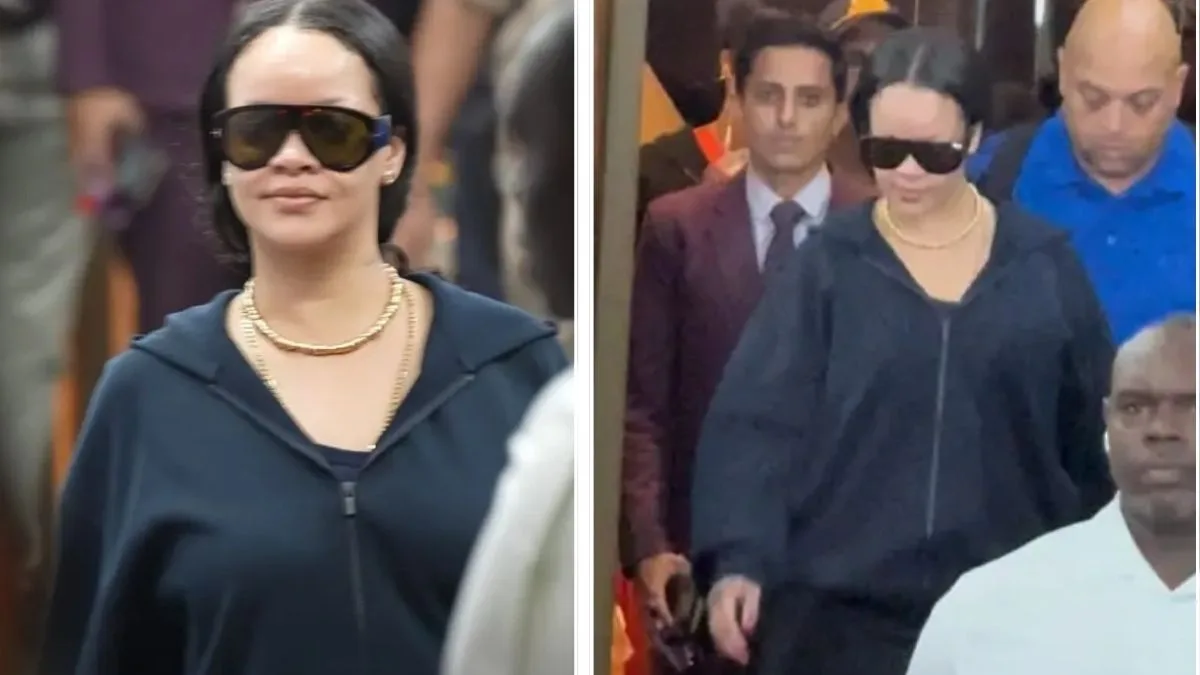
Rihanna in India: Mumbai turned into a flashing camera storm the moment global pop sensation Rihanna quietly slipped back into India. No announcements, no build-up. Just a sudden landing at Kalina Airport, and within minutes, the city’s paparazzi and fans were already on overdrive.

Reports say she arrived on a private jet, and what followed looked less like an airport exit and more like a celebrity festival breaking out in real time.

Dressed in an all-black outfit that mixed comfort with quiet luxury, Rihanna kept things relaxed but unmistakably star-powered. Her look was completed with a neat ponytail, oversized dark sunglasses, chunky gold jewellery. She caught every camera flash in sight.

And despite the chaos waiting outside, she appeared calm and cheerful as she stepped out walking towards her car with security escorting her closely.

Paparazzi chants and smiles

As soon as she appeared, the crowd outside Kalina Airport erupted. Photographers began chanting “RiRi… RiRi,” turning the arrival into a loud, joyful frenzy.

Instead of rushing in, Rihanna paused just enough to acknowledge the moment. She smiled widely, waved at the crowd, and even blew kisses toward the paparazzi who were calling out her name.

Cameras followed every step as she moved toward her vehicle, still smiling while trying to take in the attention.

In a surprising twist, she was also seen briefly filming the enthusiastic crowd herself from inside or near her car.

Mumbai visit linked to beauty brand event, possible public appearance

While the visit appeared sudden to fans, reports suggest Rihanna’s trip is tied to an event connected with her beauty brand in Mumbai.

Though details remain under wraps, industry chatter hints at a promotional appearance or a pop-up activation.

Also Read: Vishal Dadlani gets emotional remembering Zubeen Garg on Indian Idol: ‘Never seen stardom like him’

Satyajit Ray: Remembered, Revisited

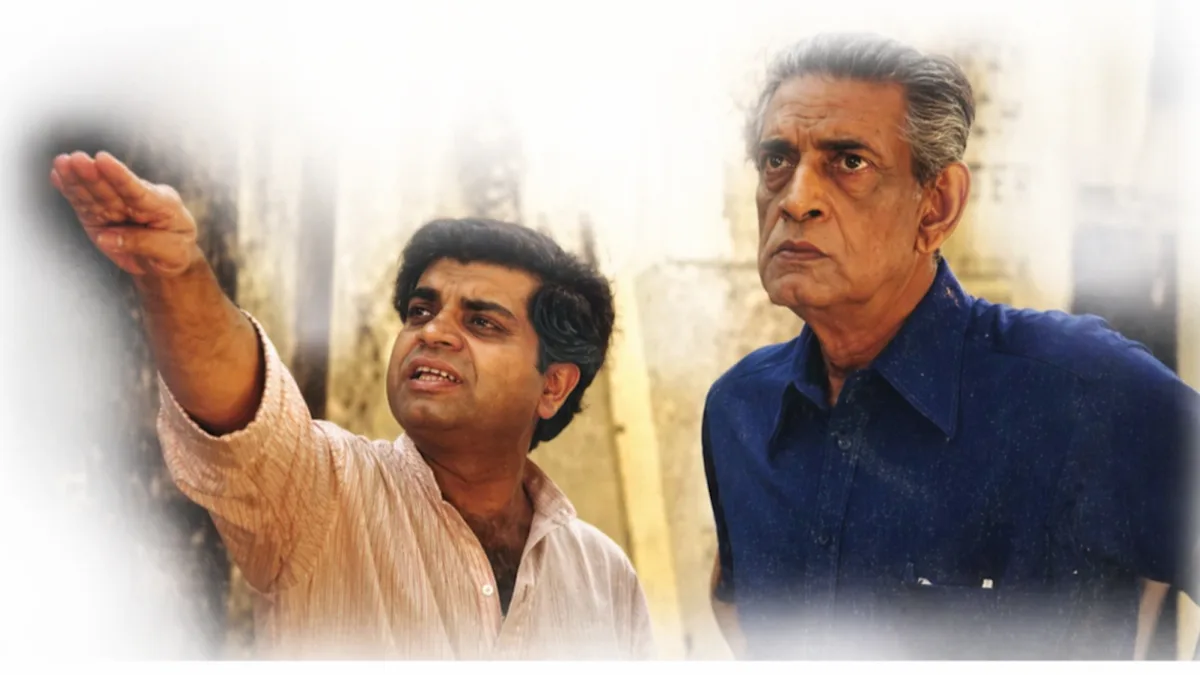
On the mighty Satyajit RayÊs death anniversary which was on 23 April his son Sandip Ray remembered his father

SUBHASH K JHA | New Delhi |

How do you recall the great Satyajit Ray ?

I remember him as an affectionate and caring father, though the onus of bringing me up, taking care of all my day-to-day requirements fell entirely on my mother. She looked after my school, my homework everything while my father was busy making movies. Though he did care a lot about what went on in my life. Oh yes, he was definitely a family man. He always wanted us to be near him. So what he did was to plan all his outdoor shootings around my school holidays.

Wow, seriously?

Yes! He shot his films according to my vacations, so my mother and I could be with him. More than the chance to be with my father these vacations became an opportunity for me to imbibe his filmmaking acumen.

So you were his first disciple?

I guess I began observing the Master at work at a time when other children are only bothered with games and homework. My three mandatory school holidays during my growing years—the summer, winter and Pooja holidays—were devoted to watching my father shoot his great works. I was there at the shooting of his first film Pather Panchali though too young to understand what was happening.

No clue that Pather Panchali would become his career-defining work?

No one knew it would become such a timeless classic. We all looked at the shooting as a picnic. We knew he was working on something different. But we were all more enamoured of the wonderful rural Bengali outdoors. I can still remember the hut where the film was shot and that railway track with the steam engine chugging on it. They don’t make steam engines or movies like Pather Panchali (1955) any more.

Which other Ray classic do you recall being shot?

I also remember being present for the shooting of Paras Pather (1958). There was this marvellous party scene featuring Tulsi Chakraborty in an immaculate suit and several other stalwarts of the Bengali film industry, and there was this huge crane with Baba’s regular cinematographer Subrata Mitra and Baba perched on it. That memory remains vivid.

When did you decide you would like to make films?

I don’t know…I was always keenly interested in the post-production aspect of filmmaking, particularly editing. I still consider editing to be my first love. According to me, that’s where the film takes shape. Seeing the rushes on the Moviola and watching Baba cut the film fascinated me. Those aspects fascinated me.

Do you see being Satyajit Ray’s son as an advantage or a disadvantage?

I think in my growing years there were more advantages than disadvantages to being Satyajit Ray’s son. I was treated very normally in school. Only later I find I am being constantly compared with him. But it’s all right. People do expect a lot from me as a filmmaker because of who my father was. But I don’t let those expectations bog me down. If I thought about it I’d have done nothing in life. I think most critics are satisfied with me.

Did you ask him a lot of questions during his shootings?

I think I was a very good student of Satyajit Ray. But I couldn’t ask him too many questions, as that would’ve disturbed him. So I’d address all my queries to members of his crew. They helped me understand his craft. I was completely fascinated by his working method.

How much of your father’s vision have you imbibed?

I’d say I have inherited his method of shooting. Like him I do extensive homework before shooting. In any case one has to be well-prepared before shooting since filmmaking has become very expensive.

Were you emotionally close to your father?

After I grew up Baba and I became friends. We shared a common passion—cinema and spent a lot of time discussing it. I’d show him the first cut of my film, though not the entire film. But he’s never come for my shootings nor for the editing. You know how the film industry is? Before I knew it they’d have said my father made all my films.

Did you show him all your films?

I did show him my films after they were complete. He was very satisfied with what I had done in Goopy Bagha Phire Elo (the third part of the Goopy Gyen Bagha Byne trilogy). I was very relieved. Baba was my censor board. Once he said it was okay, I was fine. I remember when he saw my first film he didn’t say whether it was good or bad. He only advised me to run through it myself and see where I had gone through.

His one advice which has stayed with you?

As a filmmaker his one advice to me was to view both good and bad films. While the good taught you what to do the bad taught you what not to do. Another very interesting advice from him was to be unsentimental about what I shoot. ‘You may love a particular shot. But if it doesn’t move the story forward throw it out because it’s a useless shot.’ If you see his films they absolutely fat-free. There are no superfluous moments in his cinema.

You learn the virtue of econonomic expression from your father?

In some of his best works like Aranyer Din Ratri he shot extensively and the film got lengthy. He ruthlessly cut away the footage. That’s where my fascination for editing came in. I could see how he was tailoring his films to make them precise and succinct….I think the successive generations of directors who are Baba’s fans are doing great work. In fact Dibakar Bannerjee shot one of my father’s short stories in Bombay Talkies. Dibakar is deeply influenced by my father. He is a very straight forward and nononsense man. He suddenly came to ask for the story. I was very happy to talk to him. He promised to be true to the story and I believe he has. He did tell me he was relocating the story from Bengal to Mumbai. I am happy to know not much has been lost in the translation.

Who are the other disciples of Satyajit Ray that you can pinpoint?

Another one is Ashutosh Gowariker. Sujoy Ghosh is also a fanatic fan of my father. He also plans to shoot one of my father’s stories. He came down to ask for the story. Sujoy is a fun guy. When these f i l m makers ask for rights to my father’s material I only give them the Hindi rights. I try to do justice to his Bengali stories. I’ve filmed Baba’s Feluda stories. My last film was an anthology of three ghost stories, two of them were my father’s stories. But I’d never dare to remake any of his films. It would be a futile exercise.

Your favourite works of you father?

Oh, there are many. Keeping The Apu Trilogy aside, I’d say Kanchenjungha is absolutely awe-inspiring. It was far ahead of its time. Then Aranyer Din Ratri was such a sublime film, then of course Charulata, Jana Aranya (for its black humour) and Goopy Gyen Baghan Byen. And of course the Feluda films. As for Baba’s Hindi films I liked Shatranj Ke Khilari but I loved Sadgati (featuring Om Puri and Smita Patil) even more. One of the most hard hitting films ever made, still very relevant. The Information & Broadcasting ministry had organized a wonderful tribute and created a museum of artefacts in my father’s memory on the occasion of 100 years of cinema. We were thrilled to hear about this. We’ve plans to do more in memory of my father in Kolkata and also in Mumbai I don’t have film prints of all of Baba’s films. Because they belong to different producers. Even the DVDs of his films that I have come from abroad. Luckily the Criterion Films company in New York came out with a restored version of Jalsaghar which is stunning. Sadly in India most of the Masters’ works are missing. It took a Martin Scorsese to restore Uday Shankar’s Kalpana. Most of the Bengali masterpieces are lost. I am happy Baba’s films are safe …in the West and the Ray Society. But films by Ritwik Ghatak and Mrinal Sen are gone.

(THE INTERVIEWER IS A VETERAN JOURNALIST AND FILM CRITIC.)

Tamil actor Akshaya Hariharan says her vote was already cast by someone else before she even reached the Chennai booth

She says she reached the Adyar polling station only to be told her vote had already been recorded in her name before she arrived. The actor has alleged identity mismatch, wrong photograph on record, and questioned how verification was cleared.

Statesman News Service | New Delhi |

It was supposed to be a simple morning of voting, just a quick stop at the polling booth and a proud “I voted” moment. But for Tamil actor and digital creator Akshaya Hariharan, the day turned into something she never expected: a claim that her vote had already been cast before she even arrived.

And she didn’t just say it quietly. She shared it with shock, frustration, and lot of unanswered questions.

A normal voting day that turned into confusion in Adyar

Akshaya Hariharan travelled from Velachery to her polling station in Adyar, Chennai, expecting to cast her vote in the Tamil Nadu Assembly Elections 2026. But things didn’t go as planned.

She said she had not received her voter slip, so she checked online to confirm her booth details before heading there. After reaching the polling station, she waited for nearly an hour, thinking the process was just slow due to the rush.

But what she was told next changed everything.

According to Akshaya, election officials informed her that her vote had already been recorded.

In a video posted on X (formerly Twitter), she described her disbelief: her name and details were correctly listed, but the photograph attached to the voter record was not hers.

“Hi, I am just here to say that someone else has already cast my vote. It is really shocking,” she said in the video.

She added that even though her second name “Hariharan” matched official records, the image shown was of another person entirely. For her, the mismatch raised a serious concern: how did verification fail at the booth?

“Someone else voted in my name,” says shocked actor

Akshaya’s biggest concern wasn’t just that her vote was already marked. It was how it happened.

She alleged that even a fingerprint had been recorded against her entry, suggesting that biometric or verification checks had been completed without catching the mismatch.

“Everything is correct on the paper, but only the photos are different. So they should have checked before,” she said.

A ‘tender vote’ that didn’t feel like real voting

After the confusion at the booth, Akshaya said she was eventually allowed to cast what she was told was a “tender vote.” But she admitted she wasn’t even fully clear on how the procedure worked.

Unlike the usual process involving an electronic voting machine (EVM), she said this vote felt different and less transparent.

“I do not find it appropriate because it was just a paper, and they did not even seal it in front of me. No one had answers to my questions. It is really disappointing,” she shared.

Also Read: Tamil Nadu election 2026: Rajinikanth votes at Stella Maris College booth in Chennai, greets voters with inked finger

For Akshaya, the experience left her unsettled. In a follow-up post on Instagram, she said it didn’t feel like she had actually voted at all because it wasn’t done through the standard EVM process.

Despite her frustration, she tried to end her message on a civic note, urging others not to skip voting. “This is the best I could do though. Please do not waste your vote. You still have time,” she wrote.

Complaint planned

Akshaya also said she intends to file a formal complaint with the Returning Officer regarding the incident. Her questions about verification, identity mismatch, procedural clarity remain unanswered for now.

Meanwhile, voting continued across all 234 Assembly constituencies in Tamil Nadu on April 23. Several well-known personalities from the Tamil film industry were also seen exercising their franchise. These included Rajinikanth, Kamal Haasan, Dhanush, Vikram, Vijay Sethupathi, Sivakarthikeyan and Khushbu Sundar.

Akshaya Hariharan has worked in films like ‘Saba Nayagan (2023)’, ‘Satya (2024)’, ‘Bloody Beggar (2024)’. She is also known as a content creator with a strong social media presence.

‘Don’t rush me’: Trump says Iran’s military ‘totally defeated’, vows no nuclear strike, sets no deadline

Trump claims Iran’s military has been hit hard but signals no urgency to end the conflict, keeping pressure on Tehran while leaving room for further military action.

Statesman News Service | New Delhi |

US President Donald Trump on Thursday (local time) said he would not set any deadline for ending the conflict with Iran, asserting that Tehran is in a weakened position both militarily and economically.

“Don’t rush me,” Trump told reporters at the White House when asked how long he was willing to wait for a response from Iran.

He claimed that Iran’s military infrastructure had been significantly degraded.

“Their military is totally defeated… Their Navy and Air Force are gone. Their anti-aircraft is gone,” he said, adding that Iran’s leadership had also been hit.

Trump said the United States had already struck a majority of its intended targets.

“We have hit 78% of the targets that we wanted to hit… It is amazing what we have done,” he said.

Despite these claims, Trump indicated that military action remained an option if a deal was not reached.

“If they don’t want to make a deal, then I will finish it up militarily with the other 25% targets,” he said.

‘Don’t rush me’: No deadline as pressure on Iran continues

At the same time, he stressed that he was under no pressure to conclude negotiations quickly.

“I am not under any pressure whatsoever,” he said, adding that Iran was the side facing urgency.

“You know who is under time pressure? They are,” Trump said, pointing to constraints on Iran’s oil infrastructure and storage capacity.

“If they don’t get their oil moving, their whole oil infrastructure is going to explode because they have no place to store it. Because they have no place to store it, if they have to stop it, something happens underground that essentially renders it in very poor shape, and you never recover fully… They have a matter of days before that event takes place,” Trump said.

He also reiterated that the United States would not allow Iran to acquire nuclear weapons, while criticising the previous nuclear deal.

“They cannot have the nuclear bomb, and they are not going to have it,” he said.

Trump added that the US blockade on Iran remains in place and effective.

“We have a blockade that is 100% effective… They are not doing well economically and financially…,” he said, while also suggesting that talks with Tehran were ongoing.

“We have been speaking to them,” he said, though he claimed Iran’s leadership was struggling internally.

“They don’t even know who is leading the country… They have been obliterated,” Trump added.

Earlier, Trump had also said he would not use nuclear weapons in the conflict, stating that such weapons should never be used.

“No, I wouldn’t use it. A nuclear weapon should never be allowed to be used by anybody,” he said.

For now, Trump’s remarks suggest a strategy that combines pressure with patience, with no clear timeline for resolution, even as Washington claims significant progress on the battlefield.

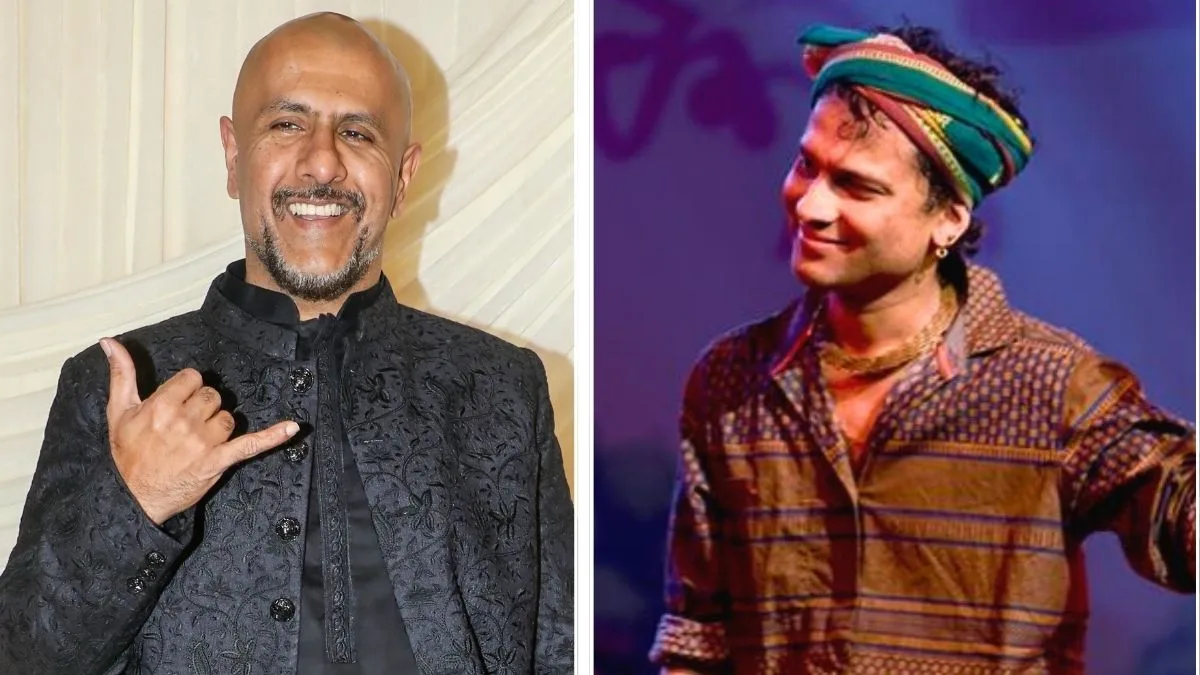
Vishal Dadlani gets emotional remembering Zubeen Garg on Indian Idol: ‘Never seen stardom like him’

A heartfelt moment unfolded on Indian Idol as Vishal Dadlani opened up about his deep admiration for late singer Zubeen Garg. The stage turned emotional as fellow judges and contestants joined in remembering the music icon.

Statesman News Service | New Delhi |

The atmosphere on the set of ‘Indian Idol’ turned emotional and heavy when music composer and singer Vishal Dadlani spoke about the late Assamese music legend Zubeen Garg.

Vishal didn’t hold back his feelings as he recalled how much Zubeen meant to him and the music world. The memory of the late singer clearly still feels fresh and painful for him, even as he celebrates his legacy on a public platform.

Vishal’s memories and Baadshah’s tribute on set

While speaking on the show, Vishal Dadlani said, “Zubeen ki baat ki jaaye toh sahi mein he was something else and I feel unke jaise stardom maine nahi dekha hain.”

He went on to share that he knew Zubeen Garg right from the beginning of his own career and always looked up to him as an idol.

“I knew him jab maine mera career start kiya tha and for us he was our idol and it just feels at times bad to know he is not around,” he added.

Adding to Vishal’s tribute, fellow judge Baadshah also spoke warmly about the late singer. He said, “I feel Zubeen can be considered as a true Indian Idol.”

Contestant’s performance and Zubeen Garg’s tragic passing

Contestant Manraj performed a powerful medley combining “Ab Tere Bin Jee Lenge Hum” from ‘Aashiqui’ and “Ya Ali” from ‘Gangster’. The performance left a strong impact on the judges.

Vishal Dadlani even noted that the contestant had a striking resemblance in style and emotion to Zubeen Garg.

Remembering Zubeen Garg’s untimely demise, there are reports that the legendary singer passed away on 19 September after a scuba diving accident in Singapore. He was rescued from the sea by the Singapore police and rushed to a nearby hospital, where he was admitted to the ICU.

Despite all medical efforts and intensive care, doctors were unable to save him.

Zubeen had travelled to Singapore only a few days before his accident. He was there to attend the fourth North East India Festival at Suntec, scheduled for 20 and 21 September.

Also Read: ‘Zubeen Garg was intoxicated, refused life jacket’: Singapore court told ‘no foul play’ in singer’s death

Tiny island is a giant political symbol

Katchatheevu never needs an invitation in Tamil Nadu politics. It turns up on its own – like that extra vada that arrives with a masala dosa.

SANTHOSH MATTHEW | New Delhi |

Katchatheevu never needs an invitation in Tamil Nadu politics. It turns up on its own – like that extra vada that arrives with a masala dosa. Small, crisp, and suddenly the centre of attention. As the state heads toward another Assembly election, Katchatheevu is back on the political plate, spicing up speeches, sharpening slogans, and stirring emotions. History has a way of returning in sharp one-liners. In Parliament, Mahavir Tyagi once challenged Jawaharlal Nehru during the Aksai Chin debate.

When Nehru dismissed the land as barren, Tyagi replied with sarcasm that still bites: if a bald head has no hair, does it mean the head has no value? Today, that logic echoes loudly in Tamil Nadu. Katchathe ev u may be a dry, uninhabited island, but its value cannot be measured in acres. Floating in the narrow stretch of the Palk Strait, this tiny island has grown into a giant political symbol. Every election season, it reappears with renewed force. This time, the language is louder, more emotional, and deeply rooted in Tamil nationalism and populist appeal. New political players have turned up the volume. Vijay and his Tamilaga Vettri Kazhagam have stepped into the field with a mix of cinema-style messaging and political ambition.

For many of his supporters, Katchatheevu represents Tamil pride – something lost, something that must be reclaimed. The issue travels fast among the youth, from public meetings to mobile screens. Then comes Seeman of the Naam Tamilar Katchi, whose politics has always revolved around Tamil identity. His speeches do not treat Katchatheevu as just a diplomatic issue. He frames it as a question of honour, turning the island into a symbol of Tamil self-respect. The message is simple and powerful, designed to connect instantly. The Pattali Makkal Katchi led by Ramadoss adds another layer. By focusing on fishermen and their struggles, the party brings the issue down from high politics to everyday life. Here, Katchatheevu is not about maps or treaties – it is about survival.

National politics also enters the scene. Narendra Modi often speaks of a kind of “dharma diplomacy,” a balancing act rooted in civilisational values and practical strategy. In relations with Sri Lanka, this means keeping peace while addressing concerns at home. In Tamil Nadu’s election language, this idea is reshaped into a moral duty -protect Tamil fishermen, defend their rights, and do so without disturbing regional stability. Dharma becomes both a principle and a political tool. On the coast, the issue feels far more re al. Fishermen from Rameswaram, Nagapattinam, Cuddalore, and Karaikal have lived with this problem for years. For them, the sea has no visible borders. Crossing an invisible line can mean arrest, confiscation of boats, or months in a foreign jail. What was once routine fishing has become a risky gamble.

Amid all this, the island carries a quiet spiritual pull. The St. Antony’s Shrine, dedicated to Saint Anthony of Padua, draws devotees from both India and Sri Lanka. For a brief moment every year, faith softens borders. Boats arrive not with nets, but with prayers. It is a reminder that Katchatheevu is not only about politics – it is also about shared culture. The roots of the dispute go back to the 1974 agreement between Indira Gandhi and Sirimavo Bandaranaike, which placed the island under Sri Lankan control. That decision continues to fuel debates, accusations, and promises of reversal, even as international agreements make any change complicated. In election season, complexity rarely sells. Simplicity does. Katchatheevu becomes a story that fits easily into speeches – a lost island, struggling fishermen, a promise of justice. It is emotional, visual, and easy to understand. That is why it returns again and again.

As campaigning intensifies, the island will travel everywhere – from loudspeakers in village squares to trending clips online. It will shape conversations in tea shops and television studios alike. Voters will hear it, argue about it, and carry it with them to the polling booth. After the votes are counted, Katchatheevu will fade from daily headlines. It always does. It will wait quietly in the waters of the Palk Strait, ready to return when the next election calls. In Tamil Nadu’s politics, some issues come and go. Katchatheevu stays. Small in size, powerful in emotion, and always ready to appear unannounced – like that extra vada that no one asked for, but everyone ends up talking about.

(The writer is Professor, Centre For South Asian Studies, Pondicherry Central University.)

‘No radicals, no moderates’: Tehran fires back at Trump’s ‘infighting’ claim with one voice

Iran’s leadership has pushed back sharply against US President Donald Trump’s claim of internal infighting, with multiple senior figures issuing coordinated statements asserting unity behind the Supreme Leader.

Statesman News Service | New Delhi |

After Donald Trump claimed that Iran’s political and military establishment was divided, Tehran responded with a single, repeated message.

From the Supreme Leader to the President and Parliament Speaker, the language was nearly identical.

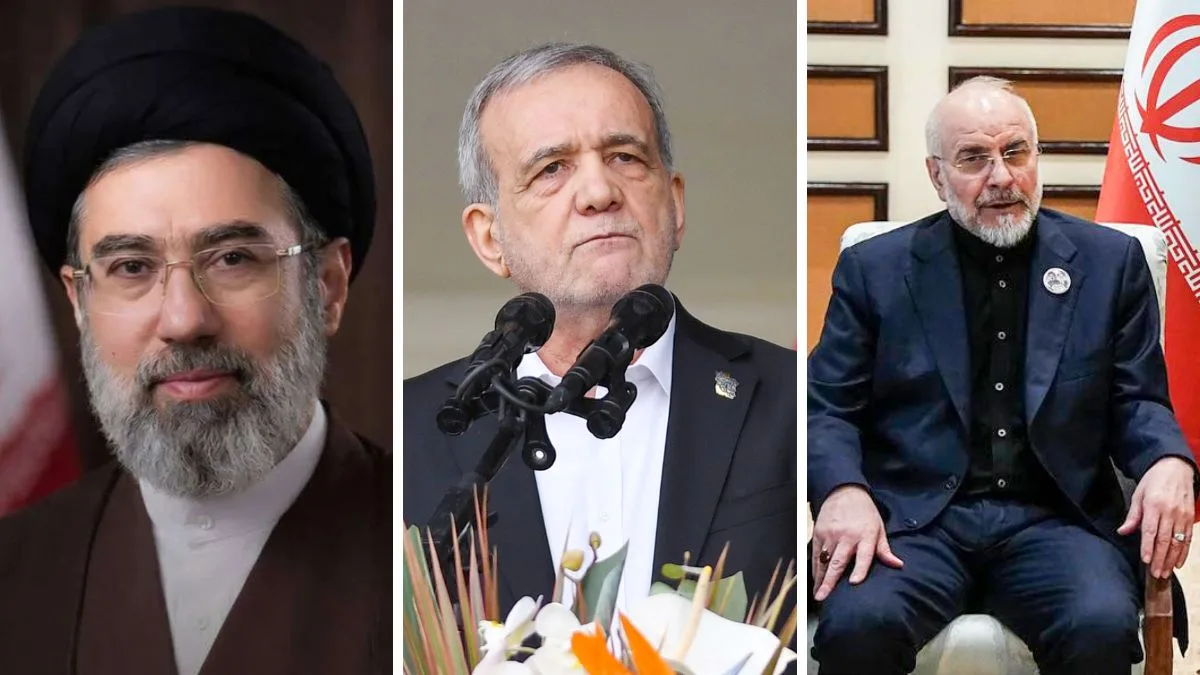
“In Iran, there are no radicals or moderates,” President Masoud Pezeshkian said, insisting the country stands united as “revolutionaries” under the Supreme Leader.

“In Iran, there are no radicals or moderates; we are all “Iranian” and “revolutionary,” and with the iron unity of the nation and government, with complete obedience to the Supreme Leader of the Revolution, we will make the aggressor criminal regret his actions,” read his post on X.

Unity as message, not just sentiment

Iran’s Parliament Speaker Mohammad Bagher Ghalibaf echoed the same line, stressing “iron unity” between the people and the government, while warning that any aggressor would “regret his actions.”

“At the top, Supreme Leader Ayatollah Seyyed Mojtaba Hosseini Khamenei framed unity as a strategic advantage.

“Due to the strange unity created among compatriots, a fracture has occurred in the enemy,” he said.

The repetition is not accidental. Analysts say the coordinated messaging reflects a deliberate attempt to project stability at a time of pressure.

The messaging was not limited to top leadership.

Iranian government officials said the posts were part of a coordinated response to what they described as “provocative and unfounded” claims from Washington.

In a statement shared on X, the government said leaders across branches, including First Vice President Mohammad Reza Aref, Government Information Council chief Elias Hazrati, and Agriculture Minister Gholamreza Nouri, amplified the same message to present a unified front.

They stressed that labels such as “hardliner” and “moderate” “do not reflect the reality on the ground.”

The government also shared an image of President Pezeshkian, Speaker Ghalibaf and Judiciary chief Gholam-Hossein Mohseni-Ejei, signalling alignment across Iran’s key power centres.

Trump’s claim vs Tehran’s counter

Trump had earlier suggested that Iran was struggling with internal divisions, describing “infighting” between factions and confusion over leadership.

But the response from Tehran has been swift and synchronised, rejecting that narrative entirely.

His remarks also fed into earlier claims that divisions within Iran had prompted calls to delay military action, including requests from international stakeholders for more time for Tehran to present a unified proposal.

Power structure under scrutiny

The pushback also comes as attention turns to how Iran’s system operates under stress.

Beyond elected leaders, institutions like the Islamic Revolutionary Guard Corps (IRGC) hold significant influence, with a role that extends beyond defence to safeguarding the political structure.

Experts note that Iran’s power system is layered with parallel military structures, multiple intelligence networks and overlapping command lines, often described as complex and opaque.

Some analysts suggest that officials engaged in negotiations with the US are closely aligned with the IRGC, reinforcing institutional cohesion during crises.

A war of perception as much as power

The exchange underlines a deeper layer of the conflict.

Beyond strikes, sanctions and blockades, both sides are shaping competing narratives. Washington portrays a weakened, divided Iran. Tehran projects resilience, unity and control.

In that sense, the messaging itself has become part of the battlefield.

Mapping change in India’s villages

On 24 April 2026 , India completes five years of the SVAMITVA (Survey of Villages and Mapping with Improvised Technology in Village Areas) Scheme – an initiative that has quietly but decisively transformed the foundations of rural governance.

TUHIN A. SINHA | New Delhi |

On 24 April 2026 , India completes five years of the SVAMITVA (Survey of Villages and Mapping with Improvised Technology in Village Areas) Scheme – an initiative that has quietly but decisively transformed the foundations of rural governance. What began in 2020 as a drone-based mapping exercise has evolved into one of the most far-reaching structural reforms in independent India, addressing a problem that persisted for decades: the absence of clear, legal ownership of residential property in rural areas.

For generations, millions of Indians lived in homes that were theirs in practice but not in law. These properties existed outside formal documentation, leaving rural households without legally recognized assets. This gap was not merely administrative – it constrained access to credit, fuelled disputes, and limited economic mobility. SVAMITVA has fundamentally altered this reality. By leveraging drone surveys and geospatial mapping, the scheme has brought clarity, legality, and dignity to rural property ownership. Over 3.28 lakh villages have been surveyed, and more than 3 crore property cards have been prepared across nearly two lakh villages as of early 2026.

In effect, India has mapped almost its entire rural habitation area with a level of precision that would have been inconceivable just a decade ago. This is the formal recognition of one of India’s largest unrecorded asset bases. The most immediate impact of SVAMITVA has been in financial inclusion. With legally recognized property cards, rural households can now use their homes as collateral to access institutional credit – an opportunity that was historically unavailable to many. Early assessments indicate a marked rise in rural credit flows following the rollout of SVAMITVA, signalling a structural shift in the rural economy. What was once “dead capital” has now been converted into bankable assets.

This transformation carries particular significance for women, who are often co-owners of these properties and are now better positioned to access formal financial systems and assert economic agency. SVAMITVA is not merely a land records programme – it is a template for technology-driven governance. Drone -based surveys provide high-resolution, accurate data, while GIS-enabled platforms ensure that records are transparent, accessible, and tamper-resistant. This shift from paper-based ambiguity to digital precision is already reducing property disputes, long a source of friction in rural India. At the same time, Gram Panchayats are gaining the ability to assess property taxes more effectively, strengthening local governance and financial autonomy.

The scheme is also enabling scientific village-level planning, with reliable geospatial data forming the backbone of decision-making. SVAMITVA is part of a broader push by the Modi government to integrate drone technology into governance and development. Initiatives such as the Drone Rules liberalisation, the Production-Linked Incentive (PLI) scheme for drones, and the “Drone Didi” programme aimed at empowering rural women are collectively building a new technological ecosystem. Drones are now being deployed for agricultural spraying, infrastructure monitoring, disaster management, and land surveys – marking a shift toward real-time, data-driven governance.

SVAMITVA, in this context, is the flagship that demonstrates how cutting-edge technology can directly improve everyday lives in rural India. The success of SVAMITVA is most visible in states that have embraced it with administrative clarity and political will. Uttar Pradesh stands out for its scale, having completed surveys in over 90,000 villages and generated more than one crore property records, while also moving towards providing legal sanctity to these documents. Madhya Pradesh and Chhattisgarh have achieved near-complete coverage, showcasing the power of efficient implementation. States such as Har yana , Uttarakhand, Goa, and Tripura have reached saturation, effectively completing the rollout of the scheme.

In Andhra Pradesh, the initiative has gone beyond mapping to resolving long-pending disputes and improving local taxation systems. These examples illustrate that while SVAMITVA provides a national framework, its success is amplified by proactive state-level execution. One of the defining strengths of SVAMITVA is its foundation in cooperative federalism. With the overwhelming majority of states and union territories participating, the scheme reflects a rare alignment between the Centre and the states on a governance reform of national importance. At the same time, the design allows flexibility. States can adapt implementation strategies based on their administrative contexts and existing land record systems.

This balance between a unified national vision and decentralized execution has been critical in ensuring both scale and effectiveness. The long-term significance of SVAMITVA lies in the ecosystem it is creating. By b uilding a comprehensive digital database of rural property ownership, the scheme is laying the foundation for a unified land information system that can integrate with banking, taxation, and planning frameworks. It is also catalysing India’s drone ecosystem, generating new skills, employment opportunities, and technological capabilities. With discussions already underway about extending similar models to urban areas, SVAMITVA could well become the template for a nationwide transformation of property governance. Five years on, SVAMITVA stands out as a reform that is both quiet and transformative.

It does not command daily headlines, yet its impact is deeply structural. It has given millions of rural Indians legal ownership of their homes, unlocked economic potential, reduced disputes, and strengthened grassroots governance. In the broader arc of India’s development journey, SVAMITVA may well be remembered as the reform that bridged the divide between informality and formalization in rural India. It is a reminder that the most enduring transformations are often those that operate beneath the surface – mapping change, quite literally, from the ground up.

(The writer is a national spokesperson of BJP and an acclaimed author.)

Fractured Union

For decades, India’s political system rested on a quiet understanding

Statesman News Service | New Delhi |

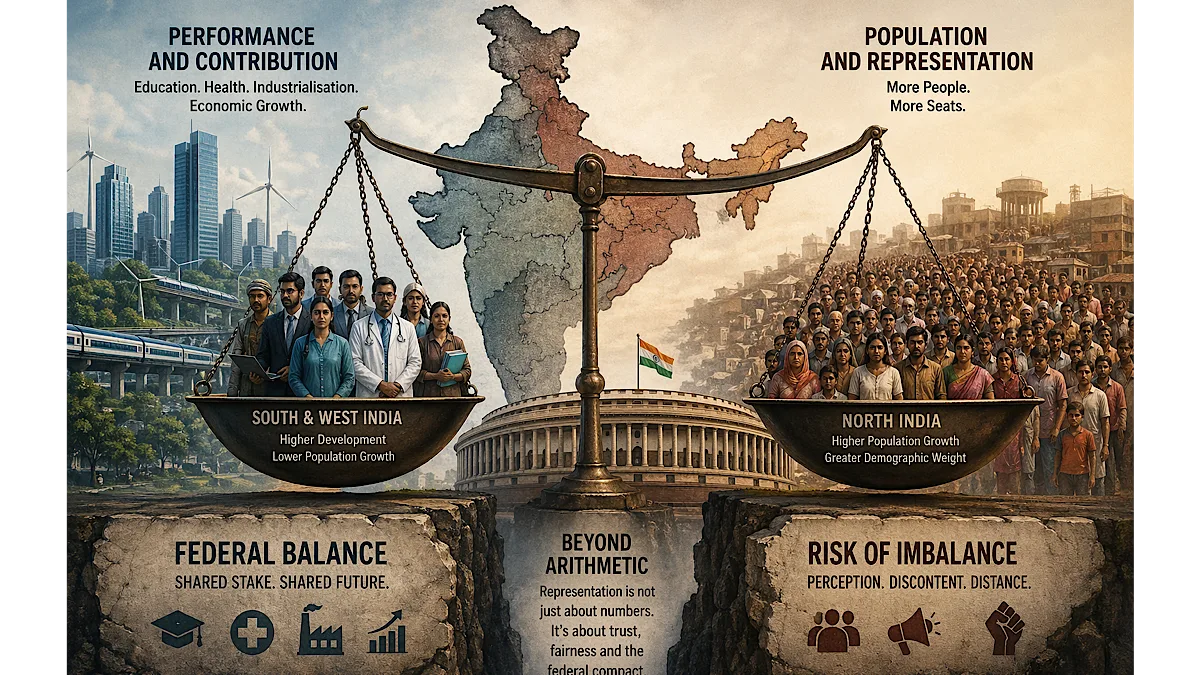
For decades, India’s political system rested on a quiet understanding. Representation would not be allowed to track population changes too closely, and states that invested in education, health, and family planning would not be penalised with diminished political voice. It was never formally articulated as a grand bargain, but it functioned as one, a stabilising compact within a diverse federal union. That equilibrium now appears to be under strain.

The renewed push to revisit delimitation, combined with the eventual expiry of the long-standing freeze on seat reallocation, signals a shift toward a more literal interpretation of representation: population as the primary determinant of political weight. On the surface, this aligns with democratic logic. In practice, it risks unsettling the balance that has held together regions with vastly different demographic and economic trajectories. India’s growth has not been uniform. Southern and western states have generally moved faster on industrialisation, human capital, and income growth, while population expansion has been more pronounced in parts of the north.

This has created a structural divergence: the engines of economic output are not always the regions with the fastest demographic expansion. When representation begins to reflect the population more directly, that divergence acquires political consequences. A shift in parliamentary weight toward more populous states may be democratically defensible, but it raises a harder question: how do you sustain a federal system when the regions driving economic growth feel their voice shrinking? In a country where fiscal transfers, national policy priorities, and regulatory frameworks are shaped centrally, perceptions of underrepresentation can translate into deeper political unease. This is not merely a contest over seats.

It is a question of incentives. Federal systems depend on a sense of shared stake. States that contribute disproportionately to national output must also feel that they have a meaningful role in shaping national decisions. If that perception weakens, cooperation can give way to negotiation, and negotiation can harden into resistance. The risk is not immediate rupture, but a gradual erosion of trust between regions. In this context, the design of representation becomes more than a technical exercise. It becomes a test of whether India can reconcile democratic principles with federal balance.

None of this suggests that delimitation should be avoided indefinitely. A system frozen in time cannot remain legitimate forever. But moving toward a new framework requires more than arithmetic adjustments. It demands a broader political consensus on how to balance population, performance, and participation within a single constitutional structure. India’s federal compact has endured because it accommodated differences without creating divisions. As that compact is revisited, the central question is simply who gains more seats, but whether the underlying sense of fairness that binds the union can be preserved. A federation is sustained not just by rules, but by the willingness of its constituent parts to accept them. When that willingness begins to fray, the consequences extend far beyond the allocation of seats in Parliament.

‘It’ll open when they make a deal’: Trump seals Hormuz, Iran seizes ships and global oil hangs in balance

US President Donald Trump has said Washington will keep the Strait of Hormuz effectively shut as leverage against Iran, signalling that the vital oil route will reopen only when a deal is reached.

Statesman News Service | Mumbai |

The Strait of Hormuz, the narrow passage through which a significant share of the world’s oil moves, has become the centrepiece of the US-Iran standoff. It is not just a flashpoint, but a pressure tool.

Speaking at the White House, Trump made it clear the closure is deliberate. He also added that reopening the route now would allow Iran to earn “$500 million a day”, something he is unwilling to permit.

“They would have opened it up 3 days ago. They came to us, and they said, ‘We will agree to open the Strait.’ All my people were happy except me. I said, ‘One minute, if we open the Strait, that means they are going to make $500 million a day.’ I don’t want them to make $500 million a day until they settle this thing. So I am the one that kept it closed. We have total control of it. It will open when they make a deal or something else happens that is very positive,” he said.

Trump also claimed that the blockade in place is “airtight”, suggesting that movement through the route is tightly controlled as part of a broader strategy to weaken Iran’s position.

Oil flows shift as pressure builds

With tensions rising in the Gulf, Trump said several ships are now heading towards the United States instead of passing through the Strait of Hormuz.

He added that the US is producing more oil than ever and is not facing a supply crunch, even as the situation continues to disrupt traditional energy routes.

” … We have this unbelievable economy… I called JD, Marco, Howard and Scott and told them that I hate to tell you, but we have to do a little bit of a detour. We have to go to Iran and make sure that they are out of nuclear weapons… A lot of ships are coming to the United States, and they are using the United States instead of the Hormuz Strait… We don’t have an oil shortage… We are right now producing more oil than Saudi Arabia and Russia combined… We are taking in millions of barrels of oil from Venezuela,” he said.

The Strait of Hormuz links oil producers in the Gulf to global markets, and any disruption has immediate ripple effects on prices and supply chains.

Iran counters with control, tolls and warnings

Even as Washington asserts control, Tehran is signalling that it too holds leverage over the waterway.

Iran’s central bank confirmed that revenue from newly introduced transit fees for vessels passing through the Strait has already been deposited, dismissing speculation that payments were being made in cryptocurrency.

Deputy Parliament Speaker Hamidreza Hajibabaee said all ships using the route must pay tolls in Iranian rials, calling it a rightful charge for passage through Iran’s territorial waters.

He also said two vessels had been seized for violations, warning that more could follow if needed.

The message from Tehran is equally clear. The Strait is not just a route, but a point of control.

Competing claims, one choke point

Both sides are now framing the Strait of Hormuz as a symbol of dominance.

Trump has insisted that no ship can move without US approval, while Iranian officials have stressed that all tanker lanes fall within Iran’s territorial reach.

But the competing claims reveal the deeper reality of the conflict. Control over energy, not just territory.

With around one-fifth of global oil and a significant portion of gas shipments passing through the route, the stakes go far beyond the immediate confrontation.

No quick resolution in sight

Trump has signalled that he is in no hurry to reopen the Strait or conclude a deal.

“I don’t want to rush it… we have plenty of time,” he said, suggesting that Iran faces increasing pressure as its oil flows remain restricted.

For now, the Strait of Hormuz remains less a shipping route and more a bargaining chip. One that could shape the next phase of the conflict.

Cultural Signal

In West Bengal’s election theatre, a fish is no longer just a fish. It has become a political instrument ~ held up, quite literally, as proof of belonging.

Statesman News Service | New Delhi |

In West Bengal’s election theatre, a fish is no longer just a fish. It has become a political instrument ~ held up, quite literally, as proof of belonging. Across constituencies, candidates are stepping into neighbourhoods with fish in hand, turning a staple of Bengali life into a campaign prop. At first glance, this may seem like a quirky local tactic.

But it reveals a deeper unease about identity, authenticity, and political intent. This symbolic contest also reflects a deeper shift in Indian politics, where every day cultural markers ~ from food to language ~ are increasingly mobilised as political currency, reshaping how electoral trust is constructed. The anxiety is not accidental. The rise of the Bharatiya Janata Party across India has often been accompanied ~ rightly or wrongly ~ by associations with a more prescriptive cultural framework, including attitudes toward food. In a state where fish is not merely diet but identity, that perception creates a political vulnerability. The performative embrace of fish, then, is not about cuisine; it is about reassurance. For the ruling Trinamool Congress, led by Ms Mamata Banerjee, this vulnerability is an opportunity.

By framing the contest as a defence of Bengal’s cultural fabric ~ its fish-and-rice civilisation ~ it shifts the electoral conversation away from governance deficits toward identity preservation. This is a terrain where emotional resonance outweighs administrative record. What emerges is a contest not of policies but of signals. One side seeks to portray itself as culturally embedded; the other warns of cultural intrusion. The fish becomes a shorthand in this exchange, instantly recognisable, emotionally loaded, and politically efficient. Yet, this symbolism also exposes a limitation in contemporary electoral politics. When campaigns rely on gestures of cultural alignment, they often sidestep harder questions. West Bengal faces structural challenges ~ industrial stagnation, employment constraints, and fiscal stress ~ that cannot be resolved through symbolic gestures. Even debates around fish production, raised by leaders like Prime Minister Narendra Modi, risk being subsumed within this symbolic contest rather than being examined as policy issues. There is also a subtle recalibration underway.

The very fact that national leaders and parties feel compelled to engage in such cultural signalling suggests an acknowledgment: electoral success in India’s regions cannot be built on uniform narratives. It requires adaptation to local identities, even if that adaptation takes theatrical forms. But theatre has its limits. Symbols can frame a contest, but they cannot sustain governance. Voters may respond to gestures of familiarity, yet their long-term choices are shaped by livelihoods, opportunities, and institutional performance. The fish, in this election, is doing heavy political lifting. It reassures, provokes, and mobilises. But it also distracts. In elevating a symbol to the centre of political discourse, the campaign risks narrowing the space for substantive debate. What this election will ultimately test is not who can hold the fish more convincingly, but whether voters are willing to look beyond it. That question may ultimately decide the verdict.

Three Doomed Bills

With voting scheduled in a week’s time in opposition-ruled West Bengal and Tamil Nadu, opposition parties questioned the timing of the special session.

DEVENDRA SAKSENA | New Delhi |

The Government introduced three Bills in a special session of the Lok Sabha convened on 16 April 2026:

(i) the Constitution (131st Amendment) Bill 2026,

(ii) the Delimitation Bill 2026, and

(iii) the Union Territories Laws (Amendment) Bill, 2026. The first two Bills aimed to increase the size of Lok Sabha to 850 (from the existing 543), sought to enable delimitation based on the 2011 census, and provided for reservation for women based on this delimitation. The Union Territories Laws Bill contained similar provisions for the Union Territories of Puducherry, Delhi, and Jammu & Kashmir.

With voting scheduled in a week’s time in opposition-ruled West Bengal and Tamil Nadu, opposition parties questioned the timing of the special session. The Government projected the Bills as having the main aim of empowerment of women, by granting them 33 per cent reservation in the Lok Sabha and State Legislative Assemblies, but reservation for women had already been enshrined by the Constitution (106th Amendment) Act 2023. The 131st Amendment Bill merely lifted the pre-condition of increase in women’s seats being dependent on the ongoing census, instead making it dependent on the 2011 Census.

It also emerged that despite the Government’s avowed intention of empowering women, the Nari Shakti Vandan Adhiniyam, or the Women’s Reservation Act of 2023, had not been notified till now; a notification was issued in the midst of the Parliamentary debate, on 16 April. The opposition rightly saw the 2026 Bill, as an attempt to amend a non-operational Act. The three Bills, taken together, carried forward the principle of Lok Sabha seats being allocated in proportion to population as determined by the 2011 census, removed the freeze on the number of MPs in the Lok Sabha, and also paved the way for constitution of a Delimitation Commission.

Determination of seats in the Lok Sabha, strictly on the basis of population was not acceptable to Opposition MPs from the South, because the population of southern States had grown much more slowly in comparison to northern States, and the South would have lost Lok Sabha seats, had population been made the sole criterion for determination of seats. The PM and Home Minister assured members that the Government proposed to increase representation of all States by a flat fifty per cent, thus preserving the inter-se proportion of seats for all States. However, this argument did not cut much ice with the Opposition, who preferred to rely on the printed word, rather than assurances.

After a long and contentious debate, the first Bill failed to garner the required two-third majority in either House, and the Parliamentary Affairs Minister, withdrew the other two. There is another school of thought which believes that the Bills were purposely brought in, with an intention to fail (Defeat by design? Why the govt pushed a bill it knew would fail, Vibha Sharma, The Statesman, 19 April 2026). According to Ms. Sharma: “The reality is that even a ‘doomed’ bill can serve purposes beyond becoming law ~ such as setting the agenda, shaping public discourse, drawing attention to key issues, and normalising policy ideas over time.”

This analysis appears correct; had the Government been honest in its intentions, then it would not have scheduled the special Parliamentary session in the midst of elections, when opposition parties could reasonably be expected take contrarian grandstanding views. Also, lacking numbers in both Houses, the ruling party could have sought consensus, by discussing provisions of the Bills with Opposition parties. The fact that PM Modi roundly castigated all opposition parties in his address to the nation on 18 April 2026 reinforces the conclusion that the three Bills were moved with a hidden agenda; should they make the cut and become law, the Government could portray itself as the champion of women and should the Bills fail, the Opposition could be painted as anti-women.

In both cases, women could be counted upon to vote, overwhelmingly, for the ruling party. Beyond what is already in the public discourse, two germane issues appear to have escaped general attention. Firstly, a fifty per cent increase in the number of MPs, followed by a fifty per cent increase in the number of MLAs, would put an unconscionable burden on the exchequer, what with the rising pay, perks, and lifelong pensions for parliamentarians. Sadly, not all our MPs are people of sterling character, according to a study by the Association for Democratic Reforms (ADR), 46 per cent of current Lok Sabha MPs have criminal cases registered against them, of whom 31 per cent face serious criminal charges like murder, kidnapping, or crimes against women.

Thus, proceeding on a negative note, more MPs could mean more such people in positions of power. Increase in the number of MPs could also mean that the daily chaos in Parliament would multiply manifold, and the Speaker would have an even tougher time to regulate proceedings. Surely, if the aim of the now defunct Bills was more debate and deliberation in Parliament, the Speaker, and more mature members, could counsel hon’ble MPs not to resort to walk outs and disruptions at the drop of a hat.

Also, Parliament could be in session for more days ~ not the 60 odd days in a year but 150 days, like its British counterpart. Significantly, none of the three Bills talked about increasing the number of MPs in the Rajya Sabha; the Bills, if passed, would have created a huge imbalance between the two Houses of Parliament; Lok Sabha with a strength of 850 would have totally dwarfed the 245-member Rajya Sabha. During joint sessions of Parliament, held in cases where a Bill is passed by one House but rejected by the other, the voice of the Rajya Sabha would have been reduced to a whisper ~ an undesirable outcome on all counts, because the Rajya Sabha is a representative of States and Union Territories, and has the Constitutional duty and power, to protect the rights of States against the Union Government.

The entire exercise could be seen as a fight for women’s votes: the Government has assiduously cultivated women for votes, be they slogans like Beti Bachao, Beti Padhao, or schemes like the Pradhan Mantri Ujjwala Yojana that provided subsidised cooking gas to households, and schemes like Pradhan Mantri Awas Yojana and Mudra Yojana, which have benefited women peripherally. However, the reality is that, so far, reservation in political posts has not benefited women; the Constitutional provision for one-third reservation for women in local bodies ~ enhanced to fifty per cent by some State Governments ~ has given birth to the disgusting institution of Pradhan Patis, husbands who officiate for their Pradhan wives. On the other hand, the number of women in the Lok Sabha has progressively increased from 5 per cent to the current 14 per cent ~ without any reservation.

There have been women leaders like Indira Gandhi, Vijayalakshmi Pandit, and Sushma Swaraj as also the current crop of firebrand MPs, like Smriti Irani, Supriya Sule, and Mohua Moitra ~ all having been elected without the benefit of reservation. Contrary to intentions, reservation of seats for women may result in wives and daughters acting as proxies for their male relatives, creating God forbid, an institution of MP-Pati. One can safely say that the three Bills brought by the Government were doomed from the beginning, because they bundled the issues of women’s reservation and delimitation ~ no political party had any issue with the former, which cannot be said about the latter.

A more honest approach would have been to separate the two issues; women’s reservation would have sailed through, and delimitation could have been postponed to a more opportune time. Finally, one should not trust politicians blindly. As Erik Pevernagie, the Belgian painter and writer, had said: “Many politicians promise green, green grass by blending niceties with delusion and by using alluring confidence tricks. They voice attractive tales and tell things people like to hear. But the post-factual grassland often appears to be parched and barren.”

(The writer is a retired Principal Chief Commissioner of Income-Tax)

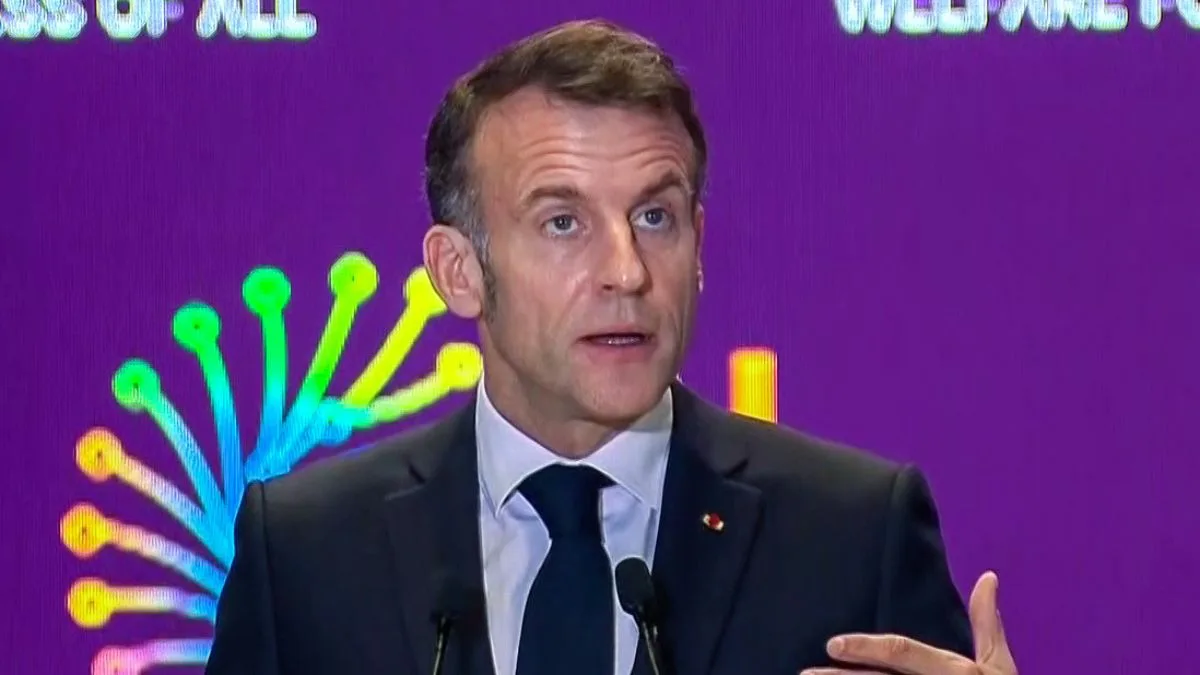
US-Iran tensions: Macron calls for stability, rejects ‘blockade’ approach on Iran; IDF strikes Lebanon despite ceasefire

US President Donald Trump says the Strait of Hormuz will reopen only after Iran agrees to a deal, while Tehran rejects claims of internal rifts.

Statesman News Service | New Delhi |

The Middle East crisis entered another tense day on Friday with the Strait of Hormuz again at the centre of the standoff between Washington and Tehran.

Trump said the US was in “total control” of the key oil route and would not rush into a deal, while Iranian leaders dismissed his claims of infighting and said the country remained united behind Supreme Leader Ayatollah Seyyed Mojtaba Hosseini Khamenei.

Middle East tensions: LIVE updates

‘Uninformed, inappropriate and in poor taste’: India on Trump’s ‘hellhole’ remarks

New Delhi said that Trump’s remarks “do not reflect the reality of the India-US relationship, which has long been based on mutual respect and shared interests.”

Statesman News Service | New Delhi |

India on Thursday slammed US President Donald Trump’s remarks over his “hellhole” remarks on Indians as “uninformed, inappropriate and in poor taste.”

In a statement shared on X, the Ministry of External Affairs (MEA) Official Spokesperson said that the Ministry has seen Trump’s remarks and the subsequent clarification issued by the US Embassy in response.
The MEA spokesperson further stated that the remarks don’t reflect the India-US relationship, which is based on mutual respect and shared interests.

“We have seen the comments, as also the subsequent statement issued by the US Embassy in response. The remarks are obviously uninformed, inappropriate and in poor taste. They certainly do not reflect the reality of the India-US relationship, which has long been based on mutual respect and shared interests,” the statement read.

What Trump said about India?

US President Trump had apparently endorsed American radio host Michael Savage’s racist rant and reposted his letter on Truth Social, which referred to India, China, and other nations as “hellholes”.

“A baby here becomes an instant citizen, and then they bring the entire family in from China or India or some other hellhole on the planet. You don’t have to go too far to see that. English is not spoken here anymore. There is almost no loyalty to this country amongst the immigrant class coming in today, which was not always the case,” read the letter shared by the US President.

As the remarks triggered outrage in India, Trump issued a clarification over his “hellhole” remark on India. In a statement issued by the US Embassy in New Delhi, Trump said that India is a “great country” and called Prime Minister Narendra Modi a “very good friend”.

“The President has said, ‘India is a great country with a very good friend of mine at the top’,” a US Embassy spokesperson said.

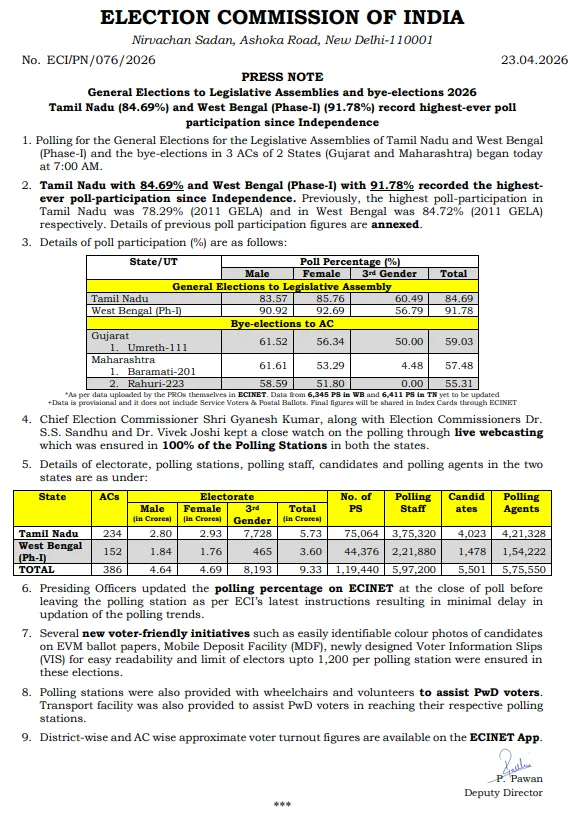
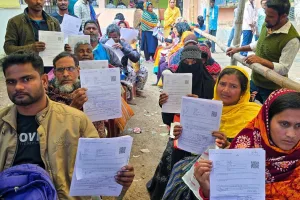
Women voters outnumber men in first phase of Bengal elections: ECI

Women voters in West Bengal outnumbered their male counterparts in the first phase of the West Bengal elections, figures released by the Election Commission of India have revealed.

Snehal Sengupta | Kolkata |

Women voters in West Bengal outnumbered their male counterparts in the first phase of the West Bengal elections, figures released by the Election Commission of India have revealed.

According to data given out by the ECI, 92.69 per cent of women in the electorate cast their votes on Thursday, surpassing the 90.92 per cent turnout recorded among men. The margin of difference stood at 1.77 percentage.

Meanwhile, turnout among third gender voters was reported at 56.79 per cent, reflecting a comparatively lower but still significant level of engagement.

Women voters have turned out to be decisive factor in Bengal and have swung the results of previously held elections in the state.

The first phase of the elections covered 152 Assembly constituencies across 16 districts in the state.
The overall voter turnout on Thursday, reached a record 92.28 per cent, an ECI official said.

Polling is set to continue with the second phase scheduled for 29 April that will encompass 142 Assembly Constituencies. The counting date for the polls is scheduled on May 4.

Polls largely peaceful: WB CEC

The first phase covered 152 Assembly Constituencies spread across 16 districts of the state.

Snehal Sengupta | Kolkata |

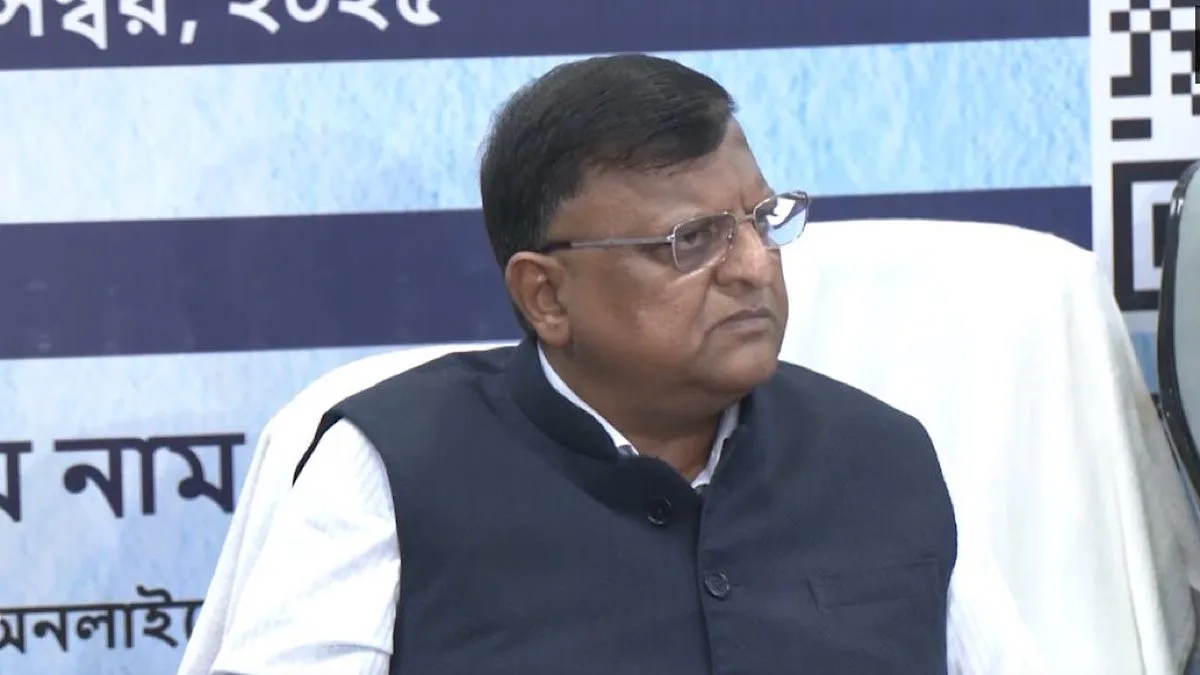
Barring stray incidents of poll violence the first phase of polling witnessed no instances of large-scale poll related incidents, the Chief Electoral Officer (CEC) of West Bengal, Manoj Kumar Agarwal said on Thursday.

The first phase covered 152 Assembly Constituencies spread across 16 districts of the state.

Addressing a press conference, Agarwal said that people cast their votes without fear and expressed satisfaction with the polling arrangements. He said that the feedback from polling stations suggested voters were largely pleased with how the process was conducted.

“The people of Bengal have voted fearlessly. I received reports that said they were quite happy with the polling arrangements. Incidents of poll-related violence were less this time,” Kumar said.

The second phase of polling, which will cover 142 constituencies, is scheduled for April 29 in West Bengal. The counting of votes is set to take place on May 4.