Logo

Mexicans form ‘human wall’ along US border to protest Trump

AFP |

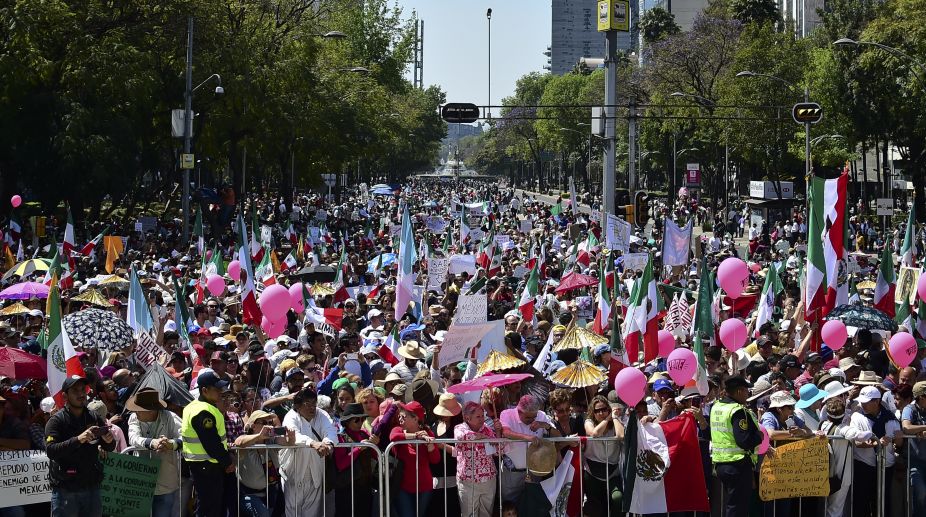
Thousands of Mexicans linked arms to form a "human wall" on their country's border with the United States, protesting President Donald Trump's plan to build a massive barrier between the countries.

The protest yesterday, organised by local authorities and Mexican advocacy groups, brought together people armed with flowers, including politicians, social leaders and crowds of students to the border town Ciudad Juarez — which already is separated by extensive fencing from its American neighbor city El Paso.

Protestors hurled slogans at Trump, whose plans to build the wall to keep undocumented immigrants out of the US — and make Mexico foot the bill — has enraged many people here.

"The wall is one of the worst ideas," said Carolina Solis, a 31-year-old student. "It won't stop anything — not drugs or migrants." 

"It's just a symbol of Donald Trump's hatred, the president's racism." 

Under the watchful eye of US Border Patrol officers, protestors — among them El Paso Mayor Oscar Leeser — formed a human barrier of nearly 1.5 kilometers (0.9 miles).

Many people on both sides of the border cross it daily, calling one country home while going to work in the other.

"Ciudad Juarez and El Paso are one city — we will never be apart," said Leeser, who was born on the Mexican side of the border.

His Ciudad Juarez counterpart Mayor Armando Cabada vowed to help resettle migrants deported from the US.

"Trump only generates fear in our US compatriots. We must show solidarity with them and tell them that they have our support," he said.

"If they are deported, we will welcome them with open arms." 

Last week, Immigration and Customs Enforcement (ICE) agents arrested some 680 people across the United States as part of a crackdown by the new administration on the estimated 11 million undocumented immigrants living in the United States.

Officials insist the raids targeted known criminals but rights advocates say people with no serious criminal records were also detained.

A similar protest was planned on Mexico's Pacific coast, at the border between the city of Tijuana and its US neighbor San Diego. 

Mexicans form ‘human wall’ along US border to protest Trump

AFP |

Thousands of Mexicans linked arms to form a "human wall" on their country's border with the United States, protesting President Donald Trump's plan to build a massive barrier between the countries.

The protest yesterday, organised by local authorities and Mexican advocacy groups, brought together people armed with flowers, including politicians, social leaders and crowds of students to the border town Ciudad Juarez — which already is separated by extensive fencing from its American neighbor city El Paso.

Protestors hurled slogans at Trump, whose plans to build the wall to keep undocumented immigrants out of the US — and make Mexico foot the bill — has enraged many people here.

"The wall is one of the worst ideas," said Carolina Solis, a 31-year-old student. "It won't stop anything — not drugs or migrants." 

"It's just a symbol of Donald Trump's hatred, the president's racism." 

Under the watchful eye of US Border Patrol officers, protestors — among them El Paso Mayor Oscar Leeser — formed a human barrier of nearly 1.5 kilometers (0.9 miles).

Many people on both sides of the border cross it daily, calling one country home while going to work in the other.

"Ciudad Juarez and El Paso are one city — we will never be apart," said Leeser, who was born on the Mexican side of the border.

His Ciudad Juarez counterpart Mayor Armando Cabada vowed to help resettle migrants deported from the US.

"Trump only generates fear in our US compatriots. We must show solidarity with them and tell them that they have our support," he said.

"If they are deported, we will welcome them with open arms." 

Last week, Immigration and Customs Enforcement (ICE) agents arrested some 680 people across the United States as part of a crackdown by the new administration on the estimated 11 million undocumented immigrants living in the United States.

Officials insist the raids targeted known criminals but rights advocates say people with no serious criminal records were also detained.

A similar protest was planned on Mexico's Pacific coast, at the border between the city of Tijuana and its US neighbor San Diego. 

Weekend Movie Matinee: 10 Movies that deserved an Oscar award

Prithviraj Dev | New Delhi |

There is something special, almost sacred about watching a cinematic masterpiece and woe betide the poor soul who dares interrupt the visual treat. 

Arguably the most effective medium today despite having first been introduced eons ago, films are meant to evoke emotions, sometimes just the one or at times a plethora of them.

And a testament to a great film is that long after its release, the plot, the motives of the protagonist and the antagonists are discussed into the wee hours of the night.

With so many good flicks propping up every year, it seems inevitable that one will lose and the other will triumph at the annual Academy Awards glitzy ceremony. This article is a feature on the best films The Statesman feels were unlucky to have missed out on an Oscar gong due to varying reasons.

Citizen Kane (1941)
Orson Welles was the Leonardo da Vinci of Hollywood at that time for he produced, wrote, directed and starred in one of the most influential films of all time. A dramatic two-hour affair loosely based on media baron William Heart’s life, this monochrome masterpiece was way ahead of his time. Perhaps for that reason, and despite being nominated for nine Academy Awards, it won just one golden lady for Best Writing (Original Screenplay).

The Good, the Bad and the Ugly (1966)
The gruffly handsome Clint Eastwood in the starring role with Italian maestro Sergio Leone at the helm, makes The Good, The Bad and the Ugly a sure shot winner at the Oscars, right? Wrong, for it didn't even get nominated, not the first and certainly not the last, glaring oversight by the Academy. Shot superbly with the legendary Ennio Morricone providing the score, the final instalment  of the Dollars Trilogy would influence the likes of Quentin Tarantino in the years to come.

Taxi Driver (1976)
Martin Scorcese and Robert De Niro are no strangers to blockbusters, having made many critical and commercial successes over the years. In fact, De Niro’s portrayal of the disturbed ex-US Army Marine Travis Bickle who after the Vietnam War plies his trade is still talked about today. His iconic dialogue  “You talkin’ to me?” on its own is enough to warrant a digital download.

The Vietnam War was a highly unpopular one in the States those days (still is, till date) and Scorcese’s film bravely broached the topic of depression in young healthy men at a time when it was considered taboo. With four Academy nominations that year, how it managed to win zilch remains a mystery unanswered till date. 

Apocalypse Now (1979)
A victim of his own groundbreaking success arguably was Francis Ford Coppola. His war-film had some of the biggest stars of that era, including the likes of Marlon Brando, Robert Duvall and Martin Sheen. The Vietnam War was a hot-topic in those days and hot-topics generally warrant scores of films. The fact that Apocalypse Now is considered among the finest, if not the finest film ever made, speaks volumes. Nominated for eight Academy Awards, it won ‘only’ two, for Best Sound and Best Cinematography.

Goodfellas (1990)
Another time the Scorcese-De Niro duo failed to win big on Hollywood’s biggest night of the year. The biographical gangster film was also notable for the fact that Ray Liotta and Joe Pesci (He won the Oscar for Best Supporting Actor) are forever etched in public memory for their meaty roles in this masterpiece that was based on Nicholas Peggi’s book, the Wise Guy. A classic example of how humour can be used to even out what is essentially a dead-serious film, Goodfellas deserved to convert more of its six nominations into wins than the sole one the it got for Pesci.

Pulp Fiction (1994)
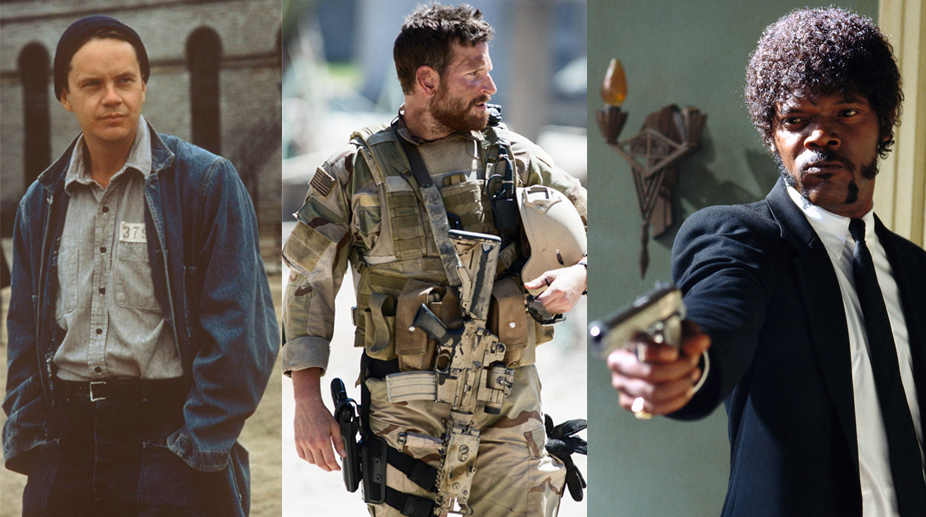
Chances are you have seem Samuel L Jackson in an Afro pointing the gun and saying the words “ I dare you, no I double dare you, say xxx one more time motherf***r” on a meme somewhere on the internet. Well, that dialogue came from Pulp Fiction, a film which may not be for family viewing, but almost every cinephile family must have watched a dozen times at least
Hollywood doesn't do more iconic than Quentin Tarantino and he doesn't do more iconic than Pulp Fiction (Okay, maybe he does, but what the heck). Shooting up had never looked more dope (pun intended) than when John Travolta did it in his top-down Chevy Malibu. Uma Thurman, Bruce Willis, Samuel L Jackson completed this eclectic cast for this neo-noir film that not only set the benchmark for future films, but redefined the genre. Nine nominations, none were converted into the Golden Statues and perhaps the jury thought this was a film that had too much of a negative impact on the youth?

Shawshank Redemption (1994)
Tim Robbins’ finest performance till date, with the evergreen Morgan Freeman supporting in a breathtaking tale of man’s redemption, this is rightly regarded as one of the best films of all time. Not just because it is the number 1 film on many all-time lists, this adaptation of a Stephen King novel evokes a plethora of emotions whether you are watching it for the first time or the 100th.
Running close to two hours and a half, it was nominated for nine Academy Awards, yet director Frank Darabont and his team came home empty-handed.

City of God (2002)
This Portuguese-language film, focusing on the sorry tale of Rio de Janeiro’s infamous favelas and their downtrodden inhabitants, revelled in its unabashed narrative which forms an integral part of the film. The protagonists plight can be felt and one weeps as tragedy strikes, something people living in plush homes may not empathise with, but many who aren't as fortunate will agree. Based on Paulo Lins’ novel of the same name, this film directed by Fernando Meirelles and Katia Lund has cult status in Latin America and rightly so. Nominated for four Oscars, including Best Director City of God somehow managed to win none and in a criminal oversight, failed to be nominated for best Foreign Film that year.

The Fantastic Mr. Fox (2009)
A stop-motion animated film based on the delightful novel of the same name by the hugely popular writer Roald Dahl, The Fantastic Mr Fox has to go down as one of Wes Anderson’s finest efforts. The quirky director and writer, spun a fun tale into a something much more, ably supported by a fine voice cast that included the likes of George Clooney and Meryl Streep. The reason that it didn't win best Animated Feature is pretty simple and for once there are no conspiracy theories. Fantastic Mr. Fox went up against a once-in-a-generation film like Up and just had to lose for no fault of its own.

American Sniper (2015)
Clint Eastwood was and is an excellent actor but his prowess behind the camera outstrips his prowess in front of it, hands down. And that’s saying something, but then the Oscar-winning director is known for hard-hitting films that send a message which is loud and clear. Inspired from a true story based on the life of Chris Kyle, a US Navy Seal sniper who was credited with over 225-confirmed kills, American Sniper doesn't just glorify war, rather explores the repercussions. There is no such thing as a perfect victory, for even if your body is unscathed, a part of your mind is scarred forever. Winning just one Oscar for Best Sound Editing despite being nominated for six, seems a travesty.

Weekend Movie Matinee: 10 Movies that deserved an Oscar award

Prithviraj Dev | New Delhi |

There is something special, almost sacred about watching a cinematic masterpiece and woe betide the poor soul who dares interrupt the visual treat. 

Arguably the most effective medium today despite having first been introduced eons ago, films are meant to evoke emotions, sometimes just the one or at times a plethora of them.

And a testament to a great film is that long after its release, the plot, the motives of the protagonist and the antagonists are discussed into the wee hours of the night.

With so many good flicks propping up every year, it seems inevitable that one will lose and the other will triumph at the annual Academy Awards glitzy ceremony. This article is a feature on the best films The Statesman feels were unlucky to have missed out on an Oscar gong due to varying reasons.

Citizen Kane (1941)
Orson Welles was the Leonardo da Vinci of Hollywood at that time for he produced, wrote, directed and starred in one of the most influential films of all time. A dramatic two-hour affair loosely based on media baron William Heart’s life, this monochrome masterpiece was way ahead of his time. Perhaps for that reason, and despite being nominated for nine Academy Awards, it won just one golden lady for Best Writing (Original Screenplay).

The Good, the Bad and the Ugly (1966)
The gruffly handsome Clint Eastwood in the starring role with Italian maestro Sergio Leone at the helm, makes The Good, The Bad and the Ugly a sure shot winner at the Oscars, right? Wrong, for it didn't even get nominated, not the first and certainly not the last, glaring oversight by the Academy. Shot superbly with the legendary Ennio Morricone providing the score, the final instalment  of the Dollars Trilogy would influence the likes of Quentin Tarantino in the years to come.

Taxi Driver (1976)
Martin Scorcese and Robert De Niro are no strangers to blockbusters, having made many critical and commercial successes over the years. In fact, De Niro’s portrayal of the disturbed ex-US Army Marine Travis Bickle who after the Vietnam War plies his trade is still talked about today. His iconic dialogue  “You talkin’ to me?” on its own is enough to warrant a digital download.

The Vietnam War was a highly unpopular one in the States those days (still is, till date) and Scorcese’s film bravely broached the topic of depression in young healthy men at a time when it was considered taboo. With four Academy nominations that year, how it managed to win zilch remains a mystery unanswered till date. 

Apocalypse Now (1979)
A victim of his own groundbreaking success arguably was Francis Ford Coppola. His war-film had some of the biggest stars of that era, including the likes of Marlon Brando, Robert Duvall and Martin Sheen. The Vietnam War was a hot-topic in those days and hot-topics generally warrant scores of films. The fact that Apocalypse Now is considered among the finest, if not the finest film ever made, speaks volumes. Nominated for eight Academy Awards, it won ‘only’ two, for Best Sound and Best Cinematography.

Goodfellas (1990)
Another time the Scorcese-De Niro duo failed to win big on Hollywood’s biggest night of the year. The biographical gangster film was also notable for the fact that Ray Liotta and Joe Pesci (He won the Oscar for Best Supporting Actor) are forever etched in public memory for their meaty roles in this masterpiece that was based on Nicholas Peggi’s book, the Wise Guy. A classic example of how humour can be used to even out what is essentially a dead-serious film, Goodfellas deserved to convert more of its six nominations into wins than the sole one the it got for Pesci.

Pulp Fiction (1994)
Chances are you have seem Samuel L Jackson in an Afro pointing the gun and saying the words “ I dare you, no I double dare you, say xxx one more time motherf***r” on a meme somewhere on the internet. Well, that dialogue came from Pulp Fiction, a film which may not be for family viewing, but almost every cinephile family must have watched a dozen times at least
Hollywood doesn't do more iconic than Quentin Tarantino and he doesn't do more iconic than Pulp Fiction (Okay, maybe he does, but what the heck). Shooting up had never looked more dope (pun intended) than when John Travolta did it in his top-down Chevy Malibu. Uma Thurman, Bruce Willis, Samuel L Jackson completed this eclectic cast for this neo-noir film that not only set the benchmark for future films, but redefined the genre. Nine nominations, none were converted into the Golden Statues and perhaps the jury thought this was a film that had too much of a negative impact on the youth?

Shawshank Redemption (1994)
Tim Robbins’ finest performance till date, with the evergreen Morgan Freeman supporting in a breathtaking tale of man’s redemption, this is rightly regarded as one of the best films of all time. Not just because it is the number 1 film on many all-time lists, this adaptation of a Stephen King novel evokes a plethora of emotions whether you are watching it for the first time or the 100th.
Running close to two hours and a half, it was nominated for nine Academy Awards, yet director Frank Darabont and his team came home empty-handed.

City of God (2002)
This Portuguese-language film, focusing on the sorry tale of Rio de Janeiro’s infamous favelas and their downtrodden inhabitants, revelled in its unabashed narrative which forms an integral part of the film. The protagonists plight can be felt and one weeps as tragedy strikes, something people living in plush homes may not empathise with, but many who aren't as fortunate will agree. Based on Paulo Lins’ novel of the same name, this film directed by Fernando Meirelles and Katia Lund has cult status in Latin America and rightly so. Nominated for four Oscars, including Best Director City of God somehow managed to win none and in a criminal oversight, failed to be nominated for best Foreign Film that year.

The Fantastic Mr. Fox (2009)
A stop-motion animated film based on the delightful novel of the same name by the hugely popular writer Roald Dahl, The Fantastic Mr Fox has to go down as one of Wes Anderson’s finest efforts. The quirky director and writer, spun a fun tale into a something much more, ably supported by a fine voice cast that included the likes of George Clooney and Meryl Streep. The reason that it didn't win best Animated Feature is pretty simple and for once there are no conspiracy theories. Fantastic Mr. Fox went up against a once-in-a-generation film like Up and just had to lose for no fault of its own.

American Sniper (2015)
Clint Eastwood was and is an excellent actor but his prowess behind the camera outstrips his prowess in front of it, hands down. And that’s saying something, but then the Oscar-winning director is known for hard-hitting films that send a message which is loud and clear. Inspired from a true story based on the life of Chris Kyle, a US Navy Seal sniper who was credited with over 225-confirmed kills, American Sniper doesn't just glorify war, rather explores the repercussions. There is no such thing as a perfect victory, for even if your body is unscathed, a part of your mind is scarred forever. Winning just one Oscar for Best Sound Editing despite being nominated for six, seems a travesty.

World’s first transgender doll to be unveiled

AP | New York |

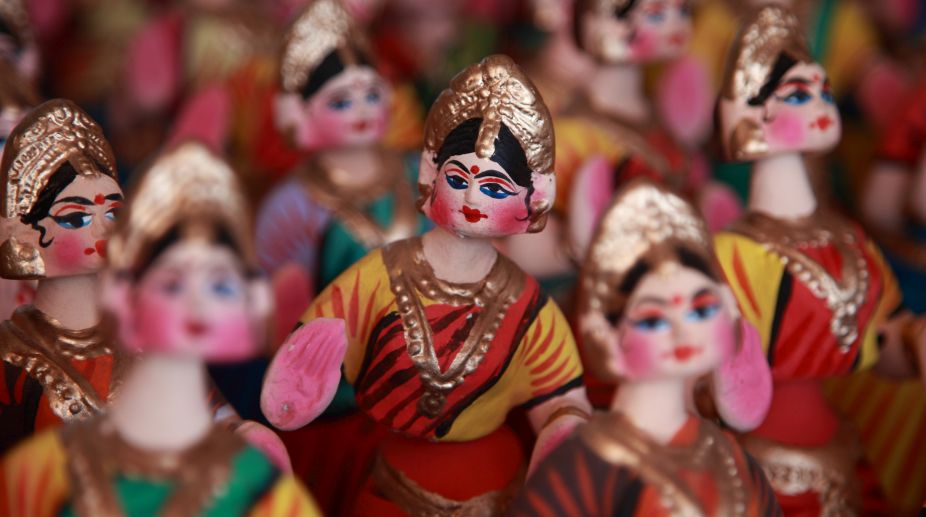
The worlds first transgender doll is being unveiled at the New York toy fair this weekend, modelled on the US teenager and LGBTQ campaigner Jazz Jennings.

Sixteen-year-old Jennings was propelled to fame as one of the youngest people ever officially documented as transgender, The Guardian reported on Friday. 

She has signalled her personal approval of the doll, which she thinks sends out a positive message about being transgender.

"Ever since I was little, I always loved playing with dolls," she said in an interview with the New York Times ahead of the toy fair. 

"It was a great way to show my parents that I was a girl, because I could just express myself as I am. So this really resonates with me, because it was something so pivotal in my own journey."

The doll is being made by the Tonner Doll Company, based in Kingston, New York, which specialises in making collectible fashion and specialist dolls for adults and children – including TV, comic book and movie characters such as Wonder Woman, Spider Man and Harry Potter. 

It boasts a plus-size doll in its range and claims to have a history of groundbreaking dolls based on "socially transformational heroes".

"I'm a doll!" Jennings posted on her Facebook page. 

"Thanks Tonner for being so progressive!" In a company statement, Tonner's chief executive, Robert Tonner, who personally sculpted the doll, said: "Jazz stands for everything I respect from a human nature point of view – she's incredibly brave, intelligent, warm-hearted and creative."

World’s first transgender doll to be unveiled

AP | New York |

The worlds first transgender doll is being unveiled at the New York toy fair this weekend, modelled on the US teenager and LGBTQ campaigner Jazz Jennings.

Sixteen-year-old Jennings was propelled to fame as one of the youngest people ever officially documented as transgender, The Guardian reported on Friday. 

She has signalled her personal approval of the doll, which she thinks sends out a positive message about being transgender.

"Ever since I was little, I always loved playing with dolls," she said in an interview with the New York Times ahead of the toy fair. 

"It was a great way to show my parents that I was a girl, because I could just express myself as I am. So this really resonates with me, because it was something so pivotal in my own journey."

The doll is being made by the Tonner Doll Company, based in Kingston, New York, which specialises in making collectible fashion and specialist dolls for adults and children – including TV, comic book and movie characters such as Wonder Woman, Spider Man and Harry Potter. 

It boasts a plus-size doll in its range and claims to have a history of groundbreaking dolls based on "socially transformational heroes".

"I'm a doll!" Jennings posted on her Facebook page. 

"Thanks Tonner for being so progressive!" In a company statement, Tonner's chief executive, Robert Tonner, who personally sculpted the doll, said: "Jazz stands for everything I respect from a human nature point of view – she's incredibly brave, intelligent, warm-hearted and creative."

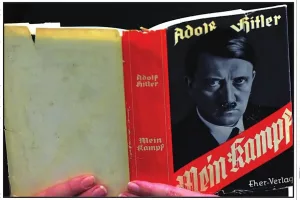
Hitler’s phone is up for auction; bids to start at $100k

AP | Chesapeake City |

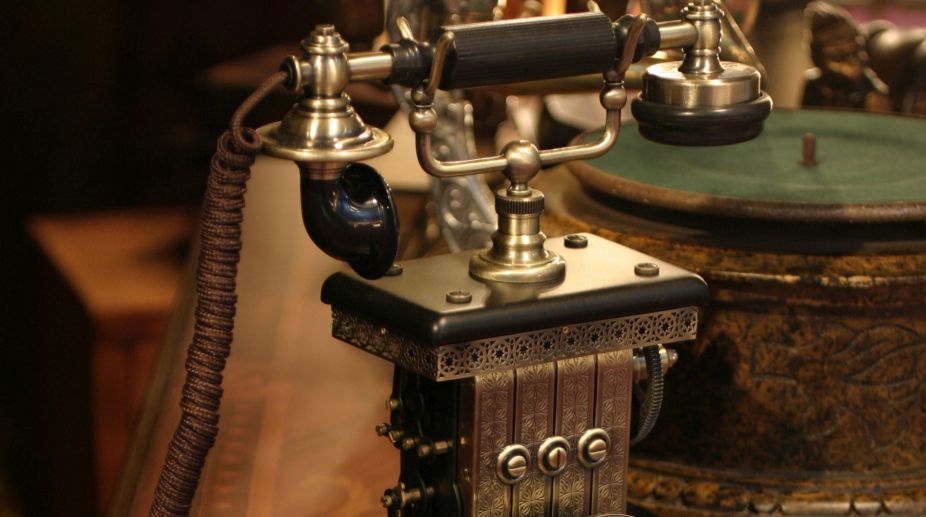
 Maryland auction house is selling Adolf Hitler's personal travelling telephone.

Bill Panagopulos of Alexander Historical Auctions in Chesapeake City says occupying Russian officers gave the phone to Brig. Sir Ralph Rayner during a visit to Hitler's Berlin bunker. Rayner's son is now selling the red phone with a Nazi party symbol and Hitler's name engraved on the back.

The phone is estimated at USD 200,000 to USD 300,000 and Panagopulos says bidding will start at USD 100,000 this weekend.

Panagopulos considers the phone a "weapon of mass destruction," noting that the orders Hitler gave over the phone took many lives.

He says the seller and auction house hope it ends up in a museum, where people who see it "really understand what extreme fascist thinking can bring about." 

Hitler’s phone is up for auction; bids to start at $100k

AP | Chesapeake City |

 Maryland auction house is selling Adolf Hitler's personal travelling telephone.

Bill Panagopulos of Alexander Historical Auctions in Chesapeake City says occupying Russian officers gave the phone to Brig. Sir Ralph Rayner during a visit to Hitler's Berlin bunker. Rayner's son is now selling the red phone with a Nazi party symbol and Hitler's name engraved on the back.

The phone is estimated at USD 200,000 to USD 300,000 and Panagopulos says bidding will start at USD 100,000 this weekend.

Panagopulos considers the phone a "weapon of mass destruction," noting that the orders Hitler gave over the phone took many lives.

He says the seller and auction house hope it ends up in a museum, where people who see it "really understand what extreme fascist thinking can bring about." 

1 dead, others stranded as storm lashes California

AP | Los Angeles |

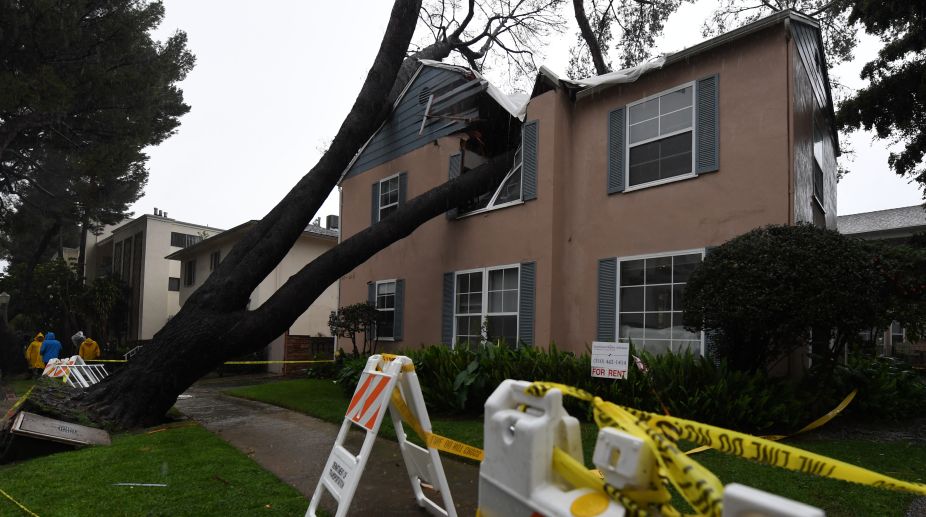
A powerful Pacific storm blew into Southern and Central California with wind-driven heavy rains that downed power lines and electrocuted a man, stranded others in flooded areas and disrupted hundreds of flights at airports.

With the storm feeding on an atmospheric river of moisture stretching far out into the Pacific, precautionary evacuations of homes in some neighbourhoods were requested on Friday due to the potential for mudslides and debris flows.

More than 300 arriving and departing flights were delayed or cancelled at Los Angeles International Airport.

In the Sherman Oaks area of Los Angeles, a falling tree downed power lines and hit a car. A 55-year-old man was electrocuted and pronounced dead at a hospital, police and fire officials said.

Winds gusting to 60 mph or more lashed the area. Heavy rains turned creeks and rivers into brown torrents and released slews of mud from hillsides burned barren by wildfires. Several stretches of freeways and highways were closed by flooding.

"It's crazy," said Robin Johnson, an academic adviser at the University of California, Santa Barbara. "It's just pouring down rain. The wind is just going nuts." 

"At one point the wind was so strong I'm surprised it didn't blow my windows out," retiree Phoenix Hocking said in a Facebook message from Carpinteria. "I now have a pond in my patio. And my dog is starting to grow flippers so he can go out and do his business." 

In San Bernardino County, a 20-mile stretch of State Route 138 in the West Cajon Valley was closed at the scene of a summer wildfire.

Mud sloshed over concrete rail barriers and about two dozen vehicles, including big-rigs and a school bus, were either mired in mud or became unable to turn around on the closed road and some were abandoned, county fire spokesman Eric Sherwin said.

In LA's Sun Valley, 10 cars were trapped in swift-moving water on a roadway and eight people had to be rescued, the Fire Department reported.

Two people in a car were rescued and four students on the bus were removed and taken to a school office, he said.

Another road in the area was covered with 2 feet of mud.

Using ropes and inflatable boats, firefighters rescued seven people and two dogs from the Sepulveda basin, a recreation and flood-control area along the Los Angeles River. One person was taken to a hospital with a non-life threatening injury.

The storm took aim at Southern California but also spread precipitation north into the San Joaquin Valley and up to San Francisco. It was not expected to bring significant rain in the far north where damage to spillways of the Lake Oroville dam forced evacuation of 188,000 people last weekend.

The National Weather Service said it could end up being the strongest storm to hit Southern California since January 1995. 

1 dead, others stranded as storm lashes California

AP | Los Angeles |

A powerful Pacific storm blew into Southern and Central California with wind-driven heavy rains that downed power lines and electrocuted a man, stranded others in flooded areas and disrupted hundreds of flights at airports.

With the storm feeding on an atmospheric river of moisture stretching far out into the Pacific, precautionary evacuations of homes in some neighbourhoods were requested on Friday due to the potential for mudslides and debris flows.

More than 300 arriving and departing flights were delayed or cancelled at Los Angeles International Airport.

In the Sherman Oaks area of Los Angeles, a falling tree downed power lines and hit a car. A 55-year-old man was electrocuted and pronounced dead at a hospital, police and fire officials said.

Winds gusting to 60 mph or more lashed the area. Heavy rains turned creeks and rivers into brown torrents and released slews of mud from hillsides burned barren by wildfires. Several stretches of freeways and highways were closed by flooding.

"It's crazy," said Robin Johnson, an academic adviser at the University of California, Santa Barbara. "It's just pouring down rain. The wind is just going nuts." 

"At one point the wind was so strong I'm surprised it didn't blow my windows out," retiree Phoenix Hocking said in a Facebook message from Carpinteria. "I now have a pond in my patio. And my dog is starting to grow flippers so he can go out and do his business." 

In San Bernardino County, a 20-mile stretch of State Route 138 in the West Cajon Valley was closed at the scene of a summer wildfire.

Mud sloshed over concrete rail barriers and about two dozen vehicles, including big-rigs and a school bus, were either mired in mud or became unable to turn around on the closed road and some were abandoned, county fire spokesman Eric Sherwin said.

In LA's Sun Valley, 10 cars were trapped in swift-moving water on a roadway and eight people had to be rescued, the Fire Department reported.

Two people in a car were rescued and four students on the bus were removed and taken to a school office, he said.

Another road in the area was covered with 2 feet of mud.

Using ropes and inflatable boats, firefighters rescued seven people and two dogs from the Sepulveda basin, a recreation and flood-control area along the Los Angeles River. One person was taken to a hospital with a non-life threatening injury.

The storm took aim at Southern California but also spread precipitation north into the San Joaquin Valley and up to San Francisco. It was not expected to bring significant rain in the far north where damage to spillways of the Lake Oroville dam forced evacuation of 188,000 people last weekend.

The National Weather Service said it could end up being the strongest storm to hit Southern California since January 1995. 

Dark comedy scripted by Trump

Robert Fisk |

It was almost as funny to listen to the “experts” on US channels trying to summarise Donald Trump’s ravings on the Middle East as it was to listen to his original gobbledygook at his press conference with Bibi Netanyahu. Unable to understand what the President’s inanities actually meant, the lads and lasses of the satellite channels were telling us that he was not as committed as his predecessor to the “twostate” solution but might favour a “one-state” solution – yet wasn’t ruling out a “two-state” solution. Oh yes, and he’d like Bibi to “hold back” on settlements.

Most of the “experts” chose to leave out the pathetic Trump addendum – “for a little bit” – because they had no more idea than Trump what this actually meant. The most lamentable quotation looks even worse on paper than it did when first uttered opposite a clearly nonplussed Israeli Prime Minister:

“So I’m looking at two states and one state. And I like the one that both parties like. I’m very happy with the one that both parties like. I can live with either one. I thought for a while that two states looked like it may be the easier of the two. To be honest, if Bibi and the Palestinians, if Israel and the Palestinians are happy – I’m happy with the one they like the best.” After the second sentence, most transcripts – and you could hear it clearly at the Washington press conference – inserted the word “LAUGHTER”.

Indeed there was laughter. Not because this was an intended joke by Donald Trump, but because his words were so flippant, so careless, so ignorant, so utterly deplorable, that laughter was the only psychological human release available to sane men and women after such tragic frivolity. An entire Arab people, a future Palestine – I notice the word itself was actually avoided – lies under the longest military occupation in modern history and the best the President of the United States could do was say that, heck, he’d go along with one state or two states – or maybe three, for all we knew.

The idea that one state might either be a secular Israel/West Bank state for Jews and Arabs with an Arab majority – goodbye Israel – or one state for Jews only but including a non-voting Arab majority – apartheid Israel – was simply neither here nor there. No wonder Bibi – how charming the old reprobate seems now beside Trump, almost “moderate” you might say – kept his mouth shut for longer than usual in the press conference. Trump has some nasty antiSemites among his supporters, and Netanyahu preferred to keep his throwaway hygienic gloves on during this particular performance.

Trump waffled on about Palestinian “hate”, and the hatefilled Palestinians (poor Hanan Ashrawi, Saeb Erekat and the rest) later preferred to take Trump more seriously, which – given that their homes might soon be stolen from them in their entirety by love-filled Israelis – was only to be expected. But it was instructive to recall beyond all this nonsense just how the very foundations of any modern discussion of an Israeli-Palestinian “solution” have for decades been built on a pile of journalistic and political semantic trash – which has now become so normal a part of the Palestine story that we have come to accept it as genuine. We all invented “alternative facts” in the Middle East when Trump was still at school.

Let’s start with settlements, the one word which both the sane Bibi Netanyahu and the insane Donald Trump felt happy to use. And there’s a problem here. Because there are no such objects as “settlements” on the Arab-Palestinian West Bank. They are colonies for Jews and Jews only on Arab land, stolen – immorally, as well as illegally under international law – from their rightful owners.

The Jews who live on them are colonialists. This word is forbidden by all parties – especially journalists – for obvious reasons. Which is why Bibi, more anxious about the encroachments of the anti-Israel boycott campaign than he cares to admit, was waffling on about how “Jews are called Jews because they come from Judea” (the Israeli name for the occupied West Bank) and thus “Jews are not foreign colonialists in Judea”.

Alas Palestinians are called Palestinians because they come from Palestine – and that part of Palestine which the Israelis call Judea is not within the border of the territory of the internationally recognised Israeli state (of which Bibi is Prime Minister). But this is far, far too much to grasp for Donald Trump.

Better keep to those friendly “settlements” and the hate-filled Palestinian communities who – in some reports – “surround” the settlements. We’ve long ago settled on a vocabulary of lies to support these alternative facts. Media reports often speak not of settlements, but of “Jewish neighbourhoods” – as if these examples of land theft are modern versions of Milton Keynes, harmless little state-sponsored suburbs whose Jewish people just want to live in peace with their “neighbours” (the hatefilled Palestinians) whose territory they have stolen. Similarly, the “wall” – mercifully unmentioned by Trump and Netanyahu – is still often referred to as a “security fence”, or even just a “fence”.

The late Ariel Sharon’s alleged purpose in building this monstrosity was to prevent Palestinian suicide bombers from entering Israel – or “Israel Proper”, as we have taken to calling it, to distinguish it, I suppose, from “Israel Improper”, which is the bit to the east of Israel inhabited by “settlers” but also by the hatefilled Palestinians. I might be more persuaded to accept Sharon’s explanation if it was not for the fact that the so-called fence – higher and longer than the Berlin Wall – encroaches on Palestinian territory which does not belong to Israel; and thus is part of the Israeli land-grab from the Arabs.

The story, needless to say, goes on and on. Talk of “occupied territories” – in other words, the West Bank (we shall speak not here of Golan) – is an absolute no-no these days in all respectable Western/American/Israeli conversation because the “occupied territories”, filled with hatefilled Palestinians, cannot be “occupied” if they are the lands of the Jews who are not (ergo Bibi) colonialists. And thus we have devised another phrase: they are “disputed” territories. This expression has two advantages. Firstly, it avoids – as it did for Trump and Netanyahu – all talk of occupation. Secondly, “dispute” suggests a little local disagreement about land deeds, something which might be resolved over a cup of coffee or a chat between two lawyers.

Anyone who tries to resolve such a “dispute” by throwing stones or protesting must therefore obviously be generically violent – which accounts for all those hate-filled Palestinians. And thereby we have to conclude. Pack them all into one state, Israel and the West Bank – both Israel Proper and Israel Improper – and you’ve got an Arab state. The Peacock, Gaddafi of Libya, almost as cracked as Trump, once proposed to call this “Israel-tine”. I’m not sure what it would be called if all its people had equal human rights. But it wouldn’t be Israel. Then there’s the Jewish state called – I suppose – Israel, with no rights for the Arab majority and therefore an apartheid state, though one not much different from other Middle East nations in which minorities rule over majorities.

“So I’m looking at two states and one state,” Trump told the world. “And I like the one that both parties like … I can live with either one.” The trouble is that the Israelis and the Palestinians cannot live with either one. But “I’m happy with the one they like the best,” quoth Trump. Cue: LAUGHTER!

Dark comedy scripted by Trump

Robert Fisk |

It was almost as funny to listen to the “experts” on US channels trying to summarise Donald Trump’s ravings on the Middle East as it was to listen to his original gobbledygook at his press conference with Bibi Netanyahu. Unable to understand what the President’s inanities actually meant, the lads and lasses of the satellite channels were telling us that he was not as committed as his predecessor to the “twostate” solution but might favour a “one-state” solution – yet wasn’t ruling out a “two-state” solution. Oh yes, and he’d like Bibi to “hold back” on settlements.

Most of the “experts” chose to leave out the pathetic Trump addendum – “for a little bit” – because they had no more idea than Trump what this actually meant. The most lamentable quotation looks even worse on paper than it did when first uttered opposite a clearly nonplussed Israeli Prime Minister:

“So I’m looking at two states and one state. And I like the one that both parties like. I’m very happy with the one that both parties like. I can live with either one. I thought for a while that two states looked like it may be the easier of the two. To be honest, if Bibi and the Palestinians, if Israel and the Palestinians are happy – I’m happy with the one they like the best.” After the second sentence, most transcripts – and you could hear it clearly at the Washington press conference – inserted the word “LAUGHTER”.

Indeed there was laughter. Not because this was an intended joke by Donald Trump, but because his words were so flippant, so careless, so ignorant, so utterly deplorable, that laughter was the only psychological human release available to sane men and women after such tragic frivolity. An entire Arab people, a future Palestine – I notice the word itself was actually avoided – lies under the longest military occupation in modern history and the best the President of the United States could do was say that, heck, he’d go along with one state or two states – or maybe three, for all we knew.

The idea that one state might either be a secular Israel/West Bank state for Jews and Arabs with an Arab majority – goodbye Israel – or one state for Jews only but including a non-voting Arab majority – apartheid Israel – was simply neither here nor there. No wonder Bibi – how charming the old reprobate seems now beside Trump, almost “moderate” you might say – kept his mouth shut for longer than usual in the press conference. Trump has some nasty antiSemites among his supporters, and Netanyahu preferred to keep his throwaway hygienic gloves on during this particular performance.

Trump waffled on about Palestinian “hate”, and the hatefilled Palestinians (poor Hanan Ashrawi, Saeb Erekat and the rest) later preferred to take Trump more seriously, which – given that their homes might soon be stolen from them in their entirety by love-filled Israelis – was only to be expected. But it was instructive to recall beyond all this nonsense just how the very foundations of any modern discussion of an Israeli-Palestinian “solution” have for decades been built on a pile of journalistic and political semantic trash – which has now become so normal a part of the Palestine story that we have come to accept it as genuine. We all invented “alternative facts” in the Middle East when Trump was still at school.

Let’s start with settlements, the one word which both the sane Bibi Netanyahu and the insane Donald Trump felt happy to use. And there’s a problem here. Because there are no such objects as “settlements” on the Arab-Palestinian West Bank. They are colonies for Jews and Jews only on Arab land, stolen – immorally, as well as illegally under international law – from their rightful owners.

The Jews who live on them are colonialists. This word is forbidden by all parties – especially journalists – for obvious reasons. Which is why Bibi, more anxious about the encroachments of the anti-Israel boycott campaign than he cares to admit, was waffling on about how “Jews are called Jews because they come from Judea” (the Israeli name for the occupied West Bank) and thus “Jews are not foreign colonialists in Judea”.

Alas Palestinians are called Palestinians because they come from Palestine – and that part of Palestine which the Israelis call Judea is not within the border of the territory of the internationally recognised Israeli state (of which Bibi is Prime Minister). But this is far, far too much to grasp for Donald Trump.

Better keep to those friendly “settlements” and the hate-filled Palestinian communities who – in some reports – “surround” the settlements. We’ve long ago settled on a vocabulary of lies to support these alternative facts. Media reports often speak not of settlements, but of “Jewish neighbourhoods” – as if these examples of land theft are modern versions of Milton Keynes, harmless little state-sponsored suburbs whose Jewish people just want to live in peace with their “neighbours” (the hatefilled Palestinians) whose territory they have stolen. Similarly, the “wall” – mercifully unmentioned by Trump and Netanyahu – is still often referred to as a “security fence”, or even just a “fence”.

The late Ariel Sharon’s alleged purpose in building this monstrosity was to prevent Palestinian suicide bombers from entering Israel – or “Israel Proper”, as we have taken to calling it, to distinguish it, I suppose, from “Israel Improper”, which is the bit to the east of Israel inhabited by “settlers” but also by the hatefilled Palestinians. I might be more persuaded to accept Sharon’s explanation if it was not for the fact that the so-called fence – higher and longer than the Berlin Wall – encroaches on Palestinian territory which does not belong to Israel; and thus is part of the Israeli land-grab from the Arabs.

The story, needless to say, goes on and on. Talk of “occupied territories” – in other words, the West Bank (we shall speak not here of Golan) – is an absolute no-no these days in all respectable Western/American/Israeli conversation because the “occupied territories”, filled with hatefilled Palestinians, cannot be “occupied” if they are the lands of the Jews who are not (ergo Bibi) colonialists. And thus we have devised another phrase: they are “disputed” territories. This expression has two advantages. Firstly, it avoids – as it did for Trump and Netanyahu – all talk of occupation. Secondly, “dispute” suggests a little local disagreement about land deeds, something which might be resolved over a cup of coffee or a chat between two lawyers.

Anyone who tries to resolve such a “dispute” by throwing stones or protesting must therefore obviously be generically violent – which accounts for all those hate-filled Palestinians. And thereby we have to conclude. Pack them all into one state, Israel and the West Bank – both Israel Proper and Israel Improper – and you’ve got an Arab state. The Peacock, Gaddafi of Libya, almost as cracked as Trump, once proposed to call this “Israel-tine”. I’m not sure what it would be called if all its people had equal human rights. But it wouldn’t be Israel. Then there’s the Jewish state called – I suppose – Israel, with no rights for the Arab majority and therefore an apartheid state, though one not much different from other Middle East nations in which minorities rule over majorities.

“So I’m looking at two states and one state,” Trump told the world. “And I like the one that both parties like … I can live with either one.” The trouble is that the Israelis and the Palestinians cannot live with either one. But “I’m happy with the one they like the best,” quoth Trump. Cue: LAUGHTER!

‘I wouldn’t suggest demonetisation’

Prashant Mukherjee |

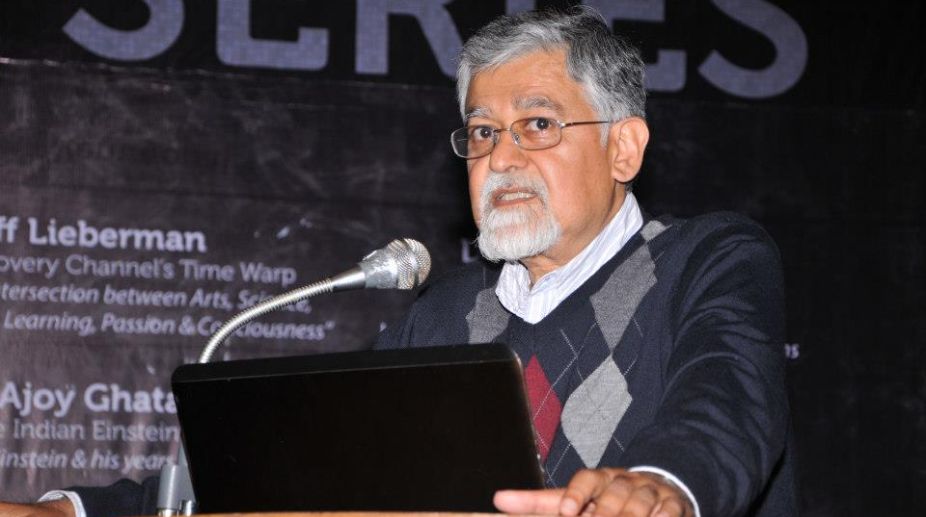
Eminent economist Arvind Virmani served the government for almost 25 years and was an adviser to the Union Government at the highest levels. He proposed many policy measures for the improvement of the economy. He was appointed India's representative to the International Monetary Fund in 2009, was Chief Economic Advisor to the government of India and authored the Economic Survey in 2008-09. He attended Doon School and graduated from St Stephen's College, Delhi, and from California Institute of Technology. He holds a doctorate in economics from Harvard University.

In an interview to PRASHANT MUKHERJEE, he shared his views on demonetisation, the Budget and monetary policy. Excerpts:

Q. Let me start with your views on demonetisation?

A: The decision of demonetisation taken in November 2016 itself suggested that there will be a ‘collapse of retail trade’. It’s simple logic ~ if you withdraw 86 per cent of the currency from circulation, sales will collapse. When I say retail trade it includes not only sale of goods and services but also wage labour. Having said that,we should find out if there was any positive impact of demonetisation. In order to sustain the fight against black money now that the step has been taken, voluntary compliance, meaning declaration of income for payment of tax, may go up, but to support this, the government needs to introduce some incometax reforms. There would be a positive effect on the housing sector. There is a black: white ratio of 50- 50 on a real estate deal. Hence, it’s conceivable that there will be reduction in the ‘black’ portion that will automatically bring down prices by 30 to 50 percent. Further to support this, state governments need to reduce the ‘circle rate’ and ‘stamp duties’ drastically. However, the effect on these items will not last beyond 3-5 years, unless complementary measures are taken to reduce new generation of black money. The government needs to make credit easier to sustain this. But apart from tax evasion, there is a huge politician-bureaucratpolice-criminal (PBPC) nexus which first needs to be reformed and addressed.

Q. What is your assessment of the impact of demonetisation on GDP?

A: My initial assessment was that the economy will take a hit for the year to the extent of 0.25-0.50 per cent on the GDP. But when the actual data came for December, then I expanded my scope as the impact on growth could be to the tune of 0.25 per cent to 1 per cent.

Q. If you were the current Economic Advisor to the government would you have advised demonetisation?

A: I was in government for 25 years. Almost every year, I used to give the government a list of reforms that it needs to consider for the economy. Never in my 25- year career have I recommended demonetisation and would have never done so.

Q. On the recent RBI monetary policy, do you think there is a further scope for reduction of key benchmark rates?

A: All my analysis over the last 12 months was that the monetary policy should have been loosened. But given what I know about the Monetary Policy Committee (MPC), this is very unlikely to happen. Moreover, by changing the stance from ‘accommodative’ to ‘neutral’ and not reducing key benchmark rates, it's hardening of monetary policy. In my view it is completely wrong. I am focusing very much on the current domestic scenario but the MPC is too focused on global aspects like what the Fed will do, what is the global GDP forecast, among others.

Q. How do you view the proposal of the government on fiscal deficit?

A: Fiscal deficit is an indicator where global rating agencies rate the economies. If one has to improve its ratings, the fiscal deficit should be reduced. In the medium term, if the country needs to be stronger it has to reduce its fiscal deficit to zero. I am very happy as the FRBM committee, for the first time, recommended reducing the fiscal deficit target below 3 per cent. This is a step in the right direction.

Q. How big a concern is declining private investments in the economy?

A: Private investments have been declining since the last 3 years and it is a serious concern. Part of this is the global economic conditions. The global demand was very low and hence private investments were down. But the good thing is that government expenditure has increased and the infrastructure sector is moving. However, I don’t buy the logic of recapitalising banks for huge bad debts, instead the government should reduce its stake in PSU holdings. It should only hold 25 per cent of the equity and the rest should be allowed for private investments.

Q. The Economic Survey has suggested the concept of Universal Basic Income to the government. What are your views on the idea of UBI and should it be implemented at all since it could cost anywhere between 4- 5 per cent of India's GDP?

A: Universal Basic Income (UBI) has been suggested in US and other developed countries as a solution to their problem of worsening income distribution over the past several decades. It is of little relevance to our problems and conditions. Since the 1960s the key issue in India has been poverty alleviation. In the 1990-2000s some of us analysed the record of poverty alleviation and came to the conclusion that poverty could be eliminated by devising a system that reduced leakages and administrative overheads. One such system was a negative income tax (proposed by me for India in a 1999 reform paper) for eliminating poverty. Surjit Bhalla and I have recently calculated that such a system of Net Income Transfers (NIT)/direct cash transfers could be fully funded by the current budget for food subsidy and MGNREGA.

Q. What your views on electoral bonds?

A: The electoral bond is an innovative but limited idea, which could be useful for relatively honest tax payers, businesses and companies. It would make it possible to use tax paid income to make political donations, instead of evading taxes solely for the purpose of meeting extortionary demands for donations from political leaders and parties. The bond doesn't, however, provide for tracing the payment from a specific donor to a specific party. However, even though it is a small step, it is welcome, because most reforms are built on a series of incremental steps, where each step encourages others to demand more reforms.

Health of the Republic

Jayita Mukhopadhyay |

India celebrated its 68th Republic Day, with characteristic fanfare. It is perhaps an apt moment to reflect on the health of the republic. Are we making the right moves, the desired progress towards the lofty ideals of Justice, Liberty, Equality and Fraternity? Has the hallowed objective of making India a ‘Sovereign, Socialist, Socialist Democratic Republic’ been accomplished? If not, what ails India? Since 8 November, demonetization of high-value currency has exerted tremendous pressure on the populace across the social spectrum. No other democratic country has demonetised its currency on such an extensive scale.

Enough has been written by those who vehemently support the move as a bold action to stem the tide of black money and fake currency as well as those who question the efficacy of this initiative, and view it as a political gimmick. While the jury is still out on its long-term impact, the short-term fallout has been quite devastating as those in the informal sector, the poorest and the most vulnerable section have borne the severest brunt of it all. And yet there havebeen no riots no violent upsurge. Again, analysts have offered various explanations of the mass psychology, like peoples’ fascination for strong, charismatic leadership, their inherent patriotic zeal and willingness to sacrifice for the good of the nation despite hardship, as well as a sense of schadenfreude, pleasure derived from seeing the better-off in distress. But perhaps, closer to the truth would be that popular support for demonetization is an expression of widespread discontent, frustration and anger of India’s teeming millions against deeply entrenched socio-economic injustice.

Inequality in India is as much social and cultural as economic, as it coincides with the faultlines of casteist, communal and gender divide. A poor man is treated with disdain vis-à-vis his better-off counterparts, when he goes to a local thana to report a heinous crime or is brushed off when he queues up before the local magistrate’s office for his dues. Daily humiliation aggravates abject poverty and lack of access to basic facilities like health, sanitation and drinking water which is accentuated by the ruthless machination of a neo-liberal economy.

The richest one per cent of the population control 53 per cent of the wealth; all other indices such as the nutrition and literacy levels and job progression present a dismal picture, totally nullifying our effort to create a Just, Equal society. If the hope of a better future, raised by the demonetization drive, is not fulfilled, it will be a cruel blow to our dispossessed fellow countrymen and will further debilitate the Republic.

The impunity with which the ‘sedition’ charges have been slammed against citizens voicing different opinions in recent times, despite the caveat once issued by TT Krishnamachari during debates in the Constituent Assembly that the only instance where it may be used is when the entire State is sought to be overthrown or undermined by force or otherwise, leading to public disorder, is indicative of increasing intolerance of contrary opinions, jeopardizing the atmosphere of true Liberty. Such incidents as at Dadri, where a man was lynched for allegedly eating beef, or Una, where a group of Dalits were flogged publicly are as disturbing as those of Dhulagargh where a communal carnage has been covered up, probably to assuage an important minority group so as to keep intact a potential vote-bank.

Whipping up communal and casteist sentiments for narrow electoral gains by politicians, the dithering of governments to uphold the rule of law, by punishing the culprits, irrespective of their caste or community background, do not augur well for the Republic which is committed to being a Secular republic honouring liberty, equality and justice.

The decline of our institutions, pre-eminently Parliament, is also a grave cause of concern. Our founding members, in their wisdom, chose a parliamentary form of government so that myriad groups with their diverse interests could make their voices heard, so that emergence of a consensus from plurality of thoughts could be the bedrock of an inclusive, pluralist democracy. In our prevalent first-past-the-post electoral system, majority of seats is often not indicative of majority of popular consent, making it morally imperative for the executive to address Parliament and solicit its views on important matters.

Unfortunately, this shrine of democracy has actually been desecrated by all and sundry as shouting and slanging matches have jeopardized the prospect of meaningful debate. Tax-payers money, in the form of hefty allowances to MPs have been totally wasted. Avoiding Parliament and directly addressing the gullible public, the attempt to sway public opinion through skilled demagogy, instead of reasoned explanations of vital decisions, is a dangerous trend which undermines the very ethos of a parliamentary democracy. The crisis of Fraternity also weakens the republic.

Fraternity, introduced in the Preamble by Dr B R Ambedkar, had the avowed objective of promoting fellow feeling among all Indians so that they could think and act as one people; but sectarianism and communalism, casteist, and even misogynist sentiments have nullified efforts to promote Fraternity. While the State has made provisions for women to receive education and make progress, they still have to tackle perverse patriarchal biases. Such incidents as mass molestation in Bangalore shake the confidence of our women who are fighting tremendous odds to make their mark in various spheres of life.

The chapter on Fundamental Duties, a latterday addition to the Cnstitution, gives a clarion call to citizens ‘to develop the scientific temper, humanism and the spirit of inquiry and reform’, which assumes special significance in the context of the Jallikattu controversy and the outbreak of violence in Bhangar. In the absence of proper opportunities for education and jobs, and in an atmosphere of perceived or actual discriminatory treatment from the government, frustration, fear and anxiety are bound to pivot around assertions of sub regional, parochial sentiments and obscurantist, primordial, irrational ideas.

People with vested political interests fanning such sentiments are doing serious damage to the fabric of the nation whereas sustained, sympathetic, careful attempt to inculcate modern, scientific ideas and a genuine willingness to address the grievances of the people is the need of the day. And yet, one must take pride in the glorious achievement of the Indian people as unlike many other developing nations which gained Independence around the same time, they have jealously guarded their democratic set-up against usurpation, they have braved the heat or rain to vote, have shown the sagacity to vote out a government which curtailed freedom or made false promises, through successive general elections.

The distinction of having the second largest reservoir of scientific and technical manpower in the world, the third largest army, and becoming the sixth member of the nuclear club, the sixth member in the race for space, and the tenth largest industrial power are no mean achievements, the credit for which goes to the grit, determination and hard work of India’s men and women.

The Padma awards this year have rightly bestowed recognition to some unsung heroes. One among them is Karimul Haque, a tea garden worker in Jalpaiguri district who uses his motorbike to take poor villagers to hospitals and clinics free of cost, and for whom the love and affection of people he serves, their endearing address ~ ‘ambulance dada’ ~ is motivation enough for the good work he is doing. So long as India keeps creating more such good Samaritans, the Republic is in safe hands. Jai Hind.

The writer is Associate Professor, Department of Political Science, Women’s Christian College, Kolkata


Fence-sitting on Mideast

Editorial |

As with a welter of other issues, Donald Trump has now effected a policy shift towards the Middle East and in the company of Israel’s Prime Minister, Benjamin Netanyahu. In the net, he appears to have jettisoned US dealings with the region, spanning several decades. He has been explicit on the point that the US is not committed to a two-state solution, generally perceived to be the bedrock of regional stability. He has at the threshold come through as a President with less than a firm grasp over Middle East geopolitics, to use the language of understatement. In a single sentence, and with little or no elaboration, he has rather casually discarded decades of US diplomacy ~ pursued by both Democratic and Republican administrations ~ on the Middle East peace process. While he has corrected his deviation from the traditional China/Taiwan construct, West Asia is a wholly different kettle of fish. He has accorded short shrift to the two-state solution, indeed one of Washington’s “guarantees” in international relations. He has made it plain that he is not concerned over whether negotiations should be geared towards that end, leaving it to the Israelis and Palestinians to sort out what he calls the “ultimate deal”. “I’m looking at two-state and one-state and I like the one that both parties like,” Trump said. Clearly, the US President’s presentation was rather dodgy. He has stopped short of spelling out a firm preference, let alone a policy according to his lights. “I can live with either one. I thought for a while it looked like the two-state might be the easier of the two; but honestly if Bibi, if Israel and the Palestinians are happy, I’m happy with the one they like the best,” was Trump’s assurance, engaging in the cordial informality of addressing Netanyahu by his nickname.

Yet unmistakable was the caveat addressed to the Palestinians, almost an echo of the Israeli government’s stand. For all the hedging over the twostate solution, he did mention the threat of Iran, incitement in Palestinian schools, and the Palestinian need to recognise Israel as a Jewish state. The Israeli Prime Minister has echoed the US President’s view that there will be ‘no daylight’ on issues such as settlements and the Iran deal. Ergo, the contentious issues that have festered for decades will remain intractable for some time yet. Trump’s remarks reinforced the inherent asymmetry between Israel and Palestine. Israel has a powerful military and is a technological power. Most importantly, it is the occupier of Palestinian territories, an occupation that has now entered its 50th year and has been marked by the almost relentless construction of Jewish settlements. The conflict simmers between an occupying body and an occupied body. Has Donald Trump opted for a classic case of fence-sitting?

Unhappy, insecure

Editorial |

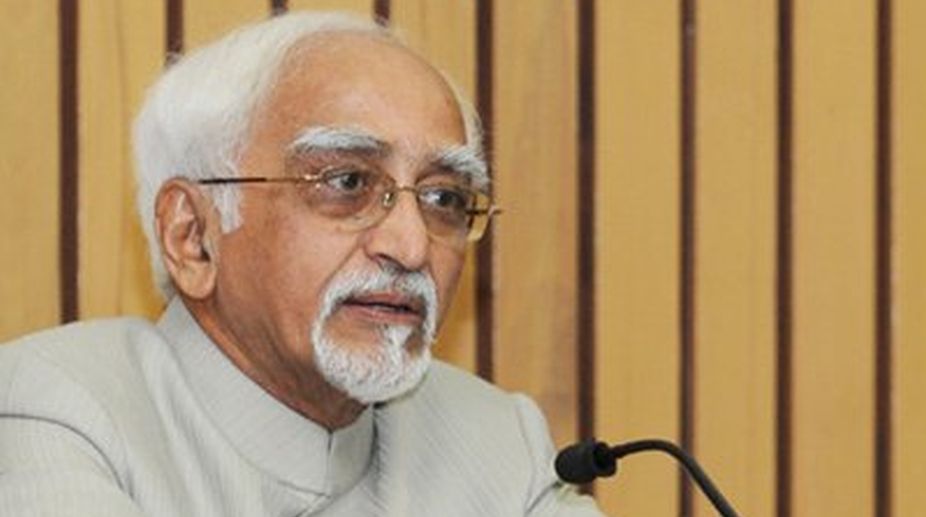
It was indeed refreshing that the Vice-President unshackled himself from the customary police/military perception of security, and emphasised the oft-overlooked reality that the roots of any security system lay in the happiness or satisfaction of the people. It was all the more significant that Mr Mohammed Hamid Ansari took that “social” angle when honouring the memory of the doyen of Indian strategic analysts, K Subrahmanyam. Sure, everybody will assert that there is no “military” solution to unrest ~ be it in the Kashmir Valley or the “red zone” in central India ~ but Mr Ansari went even deeper: trouble arose when the rule of law did not prevail, discontent and frustration festered. In recent times the President has slammed increasing intolerance, Mr Ansari preferred to highlight “religious majoritarianism” and “cultural nationalism” as key challenges confronting the nation. And so the approach to internal security needed “an adjustment”.

Issues of individual liberty and society’s security often appeared at odds with each other, but the fact was that the framework of traditional security was as important as human security at individual and community levels. Stressing the principles enshrined in the Preamble to the Constitution, the Vice-President said “these go beyond the framework of traditional security” to create conditions in which “citizens can endeavour to bring forth the desired fruits of their labour”.

It was clear that the prevailing security situation raised concerns, seven decades after Independence there was widespread unrest, discontent and conflicts. “There are threats emanating from regional and social imbalances which have given rise to, and fuel, insurgencies, terrorism, subnationalism and communalism”. While propriety prevented the Vice-President from any apportioning of blame, it was obvious that he was talking in terms of the collective failure of the political system, and the short-sighted approach of the current leaders who thrived on the vote-bank politics that made the divide-and-rule tactics of the colonial era appear rather benign. Mr Ansari also highlighted economic disparities, urban unrest, rural upsurge and the disenchantment of youth.

“The quality of life in rural and urban areas, except for the affluent, has deteriorated and the gaps between have and have-nots have widened” he said in what was actually a scathing attack on sustained misgovernance. And none dare dispute his demand that “the negative trends in internal security require to be addressed through well directed actions in the political, socio-economic and security fields”. The trouble is “who will bell the cat”? The Vice-President’s caution will attract as little attention as the apex court’s condemnation of political corruption as articulated in its recent order that stymied ambitious moves in the “deep south”. Who will win in UP is of greater importance to those who make pretence to leadership.

Softness in a solid core strength

Swapan Mullick |

An actress who is still on the circuit and reconciled to the crazy work schedules of an ongoing production wouldn’t probably want to declare that she is 75 and inclined to survive on inconsequential cameos. There are quite a few who probably need to soldier on with assignments that come their way. 

Madhabi Mukherjee is not among them. After more than six decades of appearing before the camera, she holds a wealth of experience that few can claim in Bengal. Whether it justifies the supporting roles that continue to bring her to the small screen is another matter. The point is that she has covered a range of characters from stereotypes to unforgettable symbols of strength that few of her contemporaries can equal.

It was not just a coincidence that Madhabi Mukherjee suited the creative ideas of practically all the major directors. When she was felicitated by the Federation of Film Societies and Shilpi Samsad, her screen colleagues and others may have liked to recall the three films she did with Satyajit Ray in succession —Mahanagar, Charulata and Kapurush. But films that are recalled with as much emotion, though talked about less, are Baishey Sravan that heralded her entry into socially relevant cinema with its echoes of the Great Bengal Famine, Subarnarekha that marked the high point of Ritwik Ghatak’s painful response to the social and emotional displacements after the Partition of Bengal and lovable studies of women like Subarnalata who could slip effortlessly into a middle class environment.
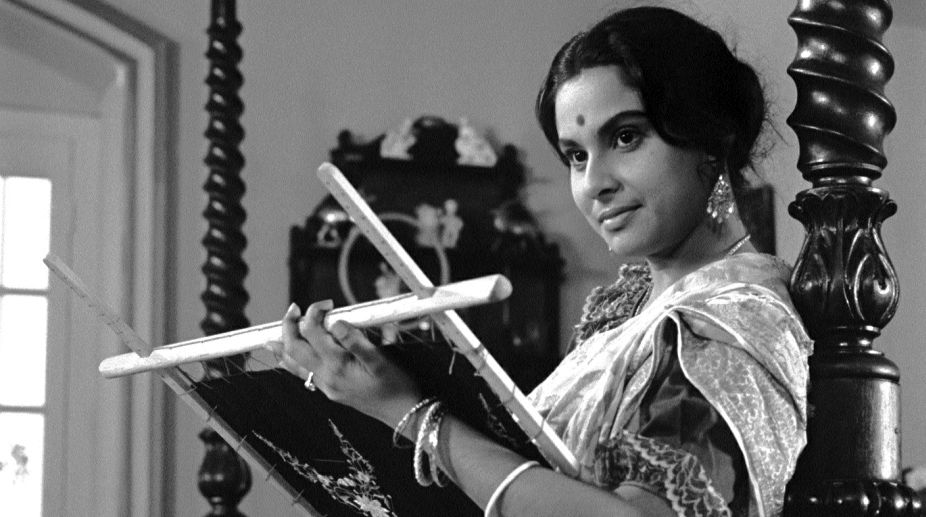
The best that can be said about Madhabi is that she is an extraordinary example of a self-taught actor who could jump from serious investigation to hackneyed melodrama, from fragile innocence to firm convictions. The capacity to reinvent herself in each role must have made her a director’s delight. 

Take three films in which she was cast opposite Uttam Kumar in vastly different situations. In Sankhabela, she was the incurable alcoholic’s wife who walks out after sharing some of her most unforgettable moments of togetherness with him. In Agniswar, she is the constant source of inspiration for the fierce champion of social and moral values. In Chhadmabeshi, she was the wife engaged in a mindless comedy of errors. All three demanded subtle adjustments in temperament and represented mainstream films made by Agragami, Arabinda Mukherjee and Agradoot that touched the hearts of audiences yearning for an escape from reality. What mattered was the ability to adapt herself to situations with the naturalness of the woman next door.

Madhabi could never be typed. Others may have been quick to acquire romantic images early in their careers but she was an exception. She did romantic roles but what distinguished her even on the popular circuit were films where she carried the quintessential features of the women of all age-groups who had a permanent place in the hearts of audiences — Saheb, Bindur Chheley, Biraj Bou, Thana Thekey Aaschhi and Ekti Jiban. During all this, Purnendu Pattrea may have taken the bold step of casting her as the rebel in the male-dominated world of Tagore’s Streer Patra. But then all through her acting career, she presented a softness that had a solid core of strength. It was a quality that endeared her to directors — from veterans like Tapan Sinha (Banchharamer Bagan and her first film, Tonsil) and Tarun Majumdar (Ganadevata) to younger contemporaries like Utpalendu Chakraborty and Rituparno Ghosh.

Inevitably, the major concerns revolved around the Ray films. One could only marvel at the maturity that she brought to her portrayal of Arati in Mahanagar when she was 21and Charu the very next year. She could hardly have imagined that, at that age, she would be the central character with delicate  shades of vulnerability, grace and wisdom rooted in feminine power. It was more complex and challenging than what her more glamorous contemporaries had done. It must have given Ghatak the confidence to make her the towering symbol of tragedy in Subarnarekha and convinced Ray that she was the only choice he had for the role of Charu. 

The Tagore creation in Nastanir was the quintessential embodiment of feminine contradictions — grappling with an emotional dilemma while sustaining the dignity of her gender and, at the same time, floating into the magical creative devices that made the film a timeless delight. Kapurush may have been less challenging but the subtle gestures and movements in the triangular affair demanded a sensibility and sense of timing that Madhabi had inevitably picked up from the Ray connection.

These are experiences that are inspiring as she continues to perform at the age of 75. What could be somewhat disturbing is that she had been bypassed by the national juries even after Mahanagar and Charulata. One reason could be that the social and human complexities in the two films never touched  even discerning viewers in the way Pather Panchali and Jalsaghar did. That was a pity. But those who were convinced about the sensibilities that she carried to the screen, it was perhaps a bigger loss that there wasn’t much of a creative life after the sensational sixties — that she was mostly stuck with uninspiring drama in her later years.