Logo

Priyanka Chopra stuns in Ralph and Russo gown at Oscars

PTI | Los Angeles |

Actress Priyanka Chopra slayed the Oscars 2017 red carpet in a eye-catching geometric Ralph and Russo white-and-silver panel dress.

The 34-year-old star, who made heads turn during her first red carpet appearance at the Academy Awards last year in a white Zuhair Murad strapless gown, completed her look with straight open hair and minimal make-up.

The Lorraine Schwartz diamond earrings and bracelets added a gorgeous touch to the whole ensemble. Matching silver sandals rounded out the look.

The actress also had a Baywatch reunion with her co-star Dwayne "The Rock" Johnson.

Indian origin actor Dev Patel also opted for white tuxedo for the gala night. Patel was nominated in the best supporting actor category for his role of elder Saroo Brierley in Lion.

Priyanka took to Instagram on Friday night to share the news with her fans while posting a photograph with legendary British singer Mick Jagger.

"Change of plans! Oscars here we come. Mick Jagger LA LA Land," Priyanka wrote alongside the image.

Priyanka made her debut in West with television show Quantico. The show is now in it's second season. The Indian star is also set to make her Hollywood debut with the Baywatch movie which features her in the role of main antagonist Victoria Leeds.

UP Assembly elections: Phase-V polling begins amid tight security

PTI | Lucknow |

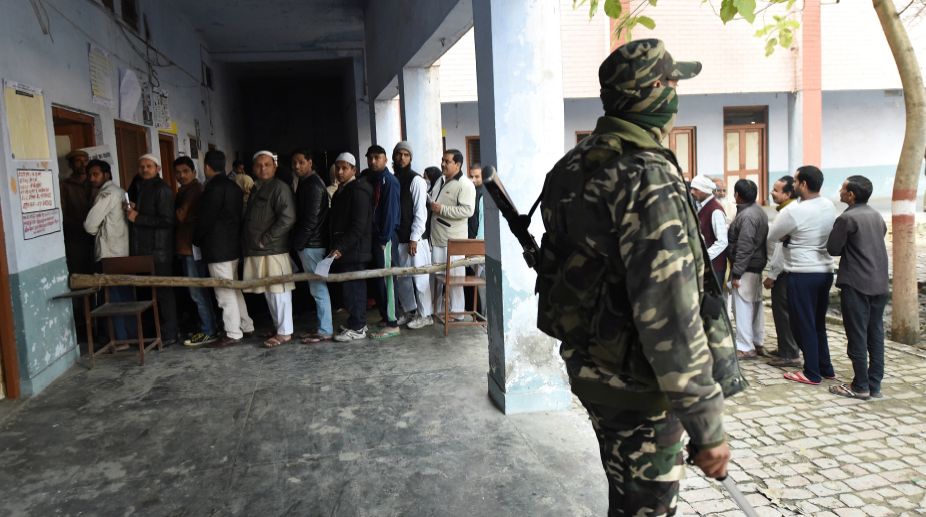
Amid tight security, polling began this morning in 51 Assembly constituencies of Uttar Pradesh spread across 11 districts that figure in the fifth phase, with all eyes on the Nehru-Gandhi pocket borough Amethi.

Prominent contestants in this phase include controversial minister Gayatri Prasad Prajapati (SP), who will be facing Amita Singh (Congress) and Garima Singh (BJP) in Amethi, the Lok Sabha constituency of Rahul Gandhi.

Amita is the wife of Congress leader Sanjay Singh, while Garima is his estranged spouse, making the contest a "rani versus rani" affair.

The districts going to polls in this phase are Balrampur, Gonda, Faizabad, Ambedkar Nagar, Bahraich, Shravasti, Basti, Siddharth Nagar, Sant Kabir Nagar, Amethi and Sultanpur.

Due to death of Samajwadi Party candidate Chandrashekhar Kanaujia in Alapur (Ambedkar Nagar), the EC has announced fresh date of voting in this constituency on March 9.

The ruling Samajwadi Party had won 37 seats out of 52 (total seats in this phase including Alapur) in 2012. While BJP and Congress won five seats each, BSP had won three and Peace Party two.

In all, 607 candidates are in the fray in this phase with maximum of 24 candidates in Amethi and minimum of six each in Kapilvastu and Etwa seats in Siddharth Nagar district.

Over 1.81 crore voters, including over about 84 lakh women, will decide the fate of ministers Vinod Kumar Singh alias Pandit Singh from Tarabganj (Gonda), Tej Narain Pandey alias Pawan Pandey from Ayodhya and BSP state president Ram Achal Rajbhar from Akbarpur, among others, in this phase Maximum number of 4,38,106 voters are in Mehdawal (Sant Kabir Nagar), while minimum 3,04934 voters are in Tanta (Ambedkarnagar).

There are 12,555 polling centres and 18,822 polling booths in this phase. The turnout in these constituencies in 2012 was 57.09 per cent.

For free and fair polls, 1,442 sector magistrates, 180 zonal magistrates and 170 static magistrates have been deployed besides police and general observers.

Gonda is close to Nepal and so are Bahraich, Shravasti, Balrampur and Sidhharth Nagar districts, adjacent to the Terai region in the foothills of the Himalayas.

Central forces are on high alert in these areas to ensure that no mischief monger sneaks into the Indian territory or escapes after committing any crime.

In his speech in Gonda, Prime Minister Narendra Modi had referred to the Kanpur train tragedy in which 150 people were killed and said the accident was due to a "conspiracy" and the perpetrators carried it out "sitting across the border".

Free trade with India on agenda of UK Commonwealth summit

PTI | London |

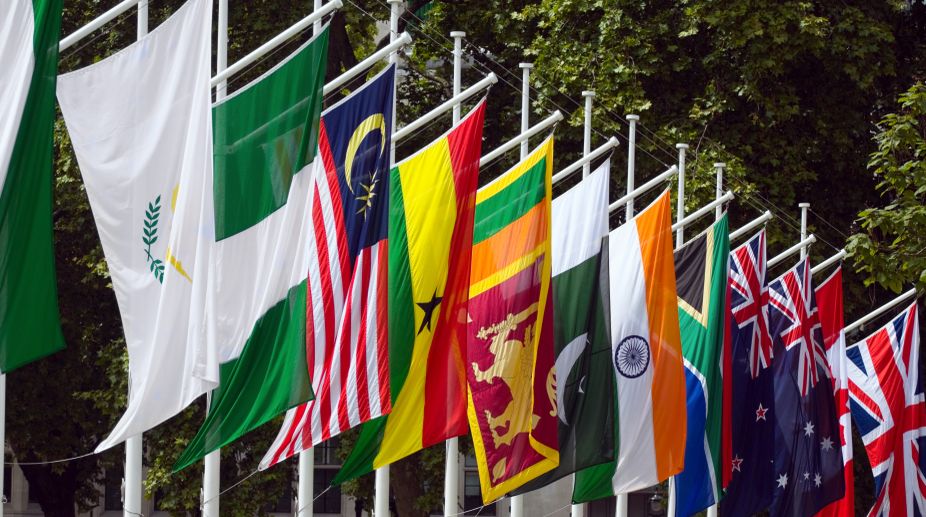
The UK Commonwealth summit, planned to set free trade deals on course as Britain exits the European Union, will put other leading commonwealth countries including India on course for greater trade liberalisation, a media report said on Sunday.

Lord Marland, chairman of the UK-based Commonwealth Enterprise and Investment Council, has planned the summit to set free trade deals on course as Britain exits the European Union (EU).

"The summit, to be attended by Liam Fox, the [UK] international trade secretary, will also seek to put other leading Commonwealth countries such as South Africa, Nigeria and India on course for greater trade liberalisation," The Sunday Times reported.

More than 30 ministers and around 60 business chiefs will attend the summit in London on March 9 and 10.

They are expected to sign an accord that will pave the way for a free-trade deal between Britain and countries such as Australia, New Zealand and Canada after Brexit, the report said.

"We will have more than 30 Commonwealth trade ministers under the same roof for the first time ever. I'm hoping we can initiate a Commonwealth trade accord which will endorse the benefits of free trade," Lord Marland told the paper.

"There are huge opportunities for Britain. Everyone in the Commonwealth speaks English and it is underpinned by the UK rule of law. We enjoy a lot of cultural links like sport as well," he said.

Ministers and business leaders will chair events on key issues such as finance, technology, good business practice and attracting inward investment at the event next month.

Psychic tug of war

Swati Deb | New Delhi |

The sense of betrayal is always the worst thing to happen. It is perhaps more relevant for a transparent society like the Nagas — a proud race given to strong faith in traditional customs and often known for peculiarities of past like head hunting. The peculiarity or whatever one would call it, strong male chauvanism is one such trait of the Nagas.
Thus those associated with the Naga way of life, in one way or another, were hardly stumped when Naga tribal groups took to the streets opposing women’s  reservation quota for elections to the urban local bodies.
Therefore, the aggression and mayhem in Nagaland over opposition on  the issue, as analysed by several North-east observers, actually, only “talks of a social paradox”.
For those who love Nagaland and its people, the episode will transform how one understands Naga prejudices and of course, the present psychic tug of war.  
The episode has finally led to a change of guard. Veteran regionalist Shurhozielie Liezietsu has now replaced the embattled chief minister TR Zeliang, who was forced out of office by persistent demand from tribal bodies for allegedly mishandling the protest over women’s reservation.
The Communist Party of India has reacted angrily. Its general  secretary,  Sudhakar Reddy  said in a statement that  “ it is a blatant and shameful betrayal of the Constitution and gender justice. This amounts to going back to the 19th century.  Mobocracy and male chauvinistic politics have overtaken positive reforms of gender justice. The government should take strong action against such type of attitudes of a particular state.” 
There is no gainsaying in pointing out that notwithstanding Christianity and English education, the socio-political fabric always favoured men over women in Nagaland. And Nagas would be hardly apologetic about it. This is not to suggest the women were ever discriminated against. The society has never heard of evil customs like Sati practices and so on.
Manliness is considered a virtue and that probably engulfs other issues associated with the belief. There are some contradictions but there is no society without the same.
 But some Naga contradictions have been always quite striking and notable to ignore. For example, Nagas have  always been anti-India or anti-Delhi for their support to “Naga freedom” but when it came to politics they embraced the Congress easily and even adored Indira Gandhi and Rajiv Gandhi. For that matter even Indira’a cousin BK Nehru has gone down in Naga memory lane as one of the best governors while the state’s only Christian governor MM Thomas was at  the receiving end of flak.
This is not the first time Nagas have opposed the women’s quota. In 1996, when “gender sensitised” politics, albeit supported by Left parties, made waves in national politics, the influential Naga Students’ Federation wrote to a parliamentary panel chairperson, Geeta Mukherjee, opposing the enforcement of a central or federal law that would allow 33 per cent reservation for women in Indian Parliament or state assemblies. The Nagas believe women — though highly educated and that too in English — should not be allowed a free hand in administrative jobs. 
The refrain being that such a law would hit at the roots of Naga tradition. Chief ministers in office have toed the line. In 1997, the Nagaland assembly, which so far has not seen an elected woman legislator, adopted a resolution unanimously after it was moved by  then parliamentary affairs minister Z Lohe. This happened under a Congress regime when veteran SC Jamir was the chief minister,  and mind you, not a single legislator worth his salt opposed it.
Though socially advanced with a high literacy rate, Nagaland and Mizoram, also with a majority of Christians, have an unenviable record of women’s representation in their legislatures.
A fullfledged state since 1963, Nagaland is yet to elect a woman legislator. Mizoram has so far got only two women to its legislature and in 1970s, riding the anti-Indira Gandhi wave due to national emergency, Rano Shaiza of Nagaland’s United Democratic Front, was elected to the Lok Sabha.
“We Nagas have come a long way with English education. Yet, we have some more miles to go,” said a retired state information department official, and a woman, on the condition of anonymity.
So much is the male ego or the spirit of benevolence, as one sees it, that some tribal bodies like the Angami Public Organisation said they can nominate even 40-50 per cent of women to urban local bodies. The Naga women — also known for their single- minded approach to various issues — however, have rejected the offer.
Nevertheless, the protests against women reservation in civic bodies turned more political and in the ultimate led to the ouster of Zeliang. 
There are some other angles to the drama, which are often not understood from the intellectual and ivory tower prism of Delhi and the Naga way of looking, which is nothing can be wrong from our side.
Zeliang has been allegedly hobnobbing with  BJP and RSS leaders, sometimes even going out of his way. This did not go down well. Some Naga politicians accused him of forgetting “Naga rights” and no Naga worth his salt can give up the special rights guaranteed under Article 371 (A). “This was not a gift from the government of India,” said a Naga legislator who pushed the first move to replace  Zeliang — the moment the demand for his resignation was mounted by the tribal bodies.
Nagaland Tribes Action Council convener, KT Vilie said that Naga people are not against women contesting elections but they oppose reserving seats for women, especially invoking a provision of the Indian Constitution. “Once this is done, it will infringe upon the traditional and customary rights of the Naga people. The Constitution today allows a special provision and the Nagas can follow their customary laws, social practices and beliefs of the tribe unless the state legislature changes it by resolution,” he explained.
Finally, Neiphiu Rio, the  state’s  three-time chief minister  (he quit to contest the 2014 parliamentary election) failed to make a comeback to state politics even as mid-way reports suggested that 49 legislators in the 60-member assembly had backed him. 
The final endorsement from the central BJP leadership allowing Shurhozielie to take over has many facets — wheels within wheels, as they put it.
One simple interpretation is that the BJP wants to hit many birds with its “Nagaland move” endorsing Shurhozielie. The decision is also linked to the BJP’s ambitious electoral game-plans in Manipur.
The Naga People’s Front has fielded 15 candidates in the Naga-dominated hilly regions of Manipur that goes to the polls on 4 and 8 March. In the 2012 assembly elections in Manipur, the NPF had emerged as a force to reckon with and had won four seats out of the 12 it contested.
The ongoing socio-political turmoil in Nagaland may harm the NPF’s campaign in Manipur. The BJP is not ready to part away with the possible victory of NPF in six to eight seats in Manipur hills. Backing Rio to make a comeback would have split the NPF. A split in NPF at this juncture would have spoiled its electoral prospects in Manipur immensely.
The BJP, for that matter, has a tough election battle to fight in Manipur. Trying to keep its ally, the NPF in good humour, would probably help BJP keep the right balance in Manipur where the local state unit is focused on “pro-Meitei politics” in the valleys.
 
(The writer is  a New Delhi-based freelance contributor and can be contacted at swati.mili@gmail.com)

Racism in India

Prasenjit Biswas and Suraj Gogoi | New Delhi |

Occupying a mere eight per cent of  the total land area in India, the seven Northeastern states and its ethnically-diverse people is a “micro-community” within the country.  The anonymity of belonging to a geographical region is itself challenging, as there is no common Northeastern Indian identity. Culturally and ethnically distinctive larger identities such as Nagas, Meiteis, Axomiyas alongside Kuki, Mizo, Khasi, Garo and many other ethnic and non-ethnic communities, including Bengalee Hindus and Muslims comprise a significant diversity that is “largely mismanaged”. The issue is how to manage this diversity at the national level?
Continuous harassment, humiliation and repression in the form of racism, under-representation, misrepresentation, as many scholars have suggested, goes on unabated. Chilling videos of landlords beating up Northeast girls in January in Bengaluru, the rape of another in Delhi’s Green Park area, rescue of young adult girls from traffickers’ network are some of the common malaise faced by an ordinary Northeasterner, as they travel to other parts of the country.
In the late 1960s, Nari Rustomji termed  Northeast India as a “Mongoloid fringe” of the country. Colonial rulers drew lines, Inner and Outer, and reinforced them with unenviable pusillanimity and controlled movement outside the hills. Post-colonial regimes in India continued with either a “leave them alone” or  “mainstreaming”, leaving a lot of loopholes in ensuring genuine recognition of cultural and ethnic specificity across the country.
The politics of misrepresentation went to the extent that in the popular biopic blockbuster Mary Kom, Priyanka Chopra replaced a Meitei actress Bala Hizam or another tribal actress Masochon V Zimik, who did not have the needed prosthetic eyelid that Chopra had to put on to make her look like Mary Kom. It is a complex substitution of a wide eyed Punjabi to turn her into chinki-eyed Mary Kom. This incident highlights how Northeasterners cannot represent themselves without a sanction from dominant identities.
In various media discourses too, Northeasterners are presented in terms of conflict, violence, insurgency, meat-eating and other such stereotypes. Within regional media, hill districts and remote localities are never talked about except in a negative way of presenting violence, insurgency or any other disruptive issues. Hill tribes of Manipur face exclusion, discrimination and arbitrary difference that makes them realise their experience of being treated unfairly.
A recent work of a non-fiction by Nandita Haksar, entitled The Exodus is Not Over: Migrations from the Ruptured Homelands of North-east India brought out how Tangkhul women face everything — death to rape and sexist exploitation in Goa and Delhi. A large number of malls in Delhi, Haryana and Punjab, which employ people from the Northeast portray a similar story of a culturally different migrant workforce that have to often bear the brunt of being different-looking with very different food habits. The upmarket restaurants, malls and markets make use of their language skills and other positive features, while they keep facing a discriminatory looking-down by owners, customers and buffs, although there are instances of fellow-feeling and kindness.
What is at issue is the very idea of an Indian face as distinguished from a Mongoloid face along with all its attendant cultural stereotypes, which create a sense of alienation and otherness. For the Northeasterners inventing new forms of socialisation is a constant need to link themselves with “strangers” as employers and neighbours in Indian cities, which is a major challenge. They remain as intruders in other social space of being Indian, as “pastoral keepers” of cultural norms in cities may not give them the connective tissue.
 Lin Laishram, who acted alongwith Priyanka Chopra in  Mary Kom stated that in every audition she had to face discrimination. Atim, the chief protagonist in Nandita Haksar’s work sees “some of her Tangkhul workers go out with managers” to get some favour, while she experienced statements like “no job for chinkies” here. Do the ideas of India fail to accommodate the racially-different? As professor Bimol Akoijam, a clinical analyst stated, it is like  “when this ‘racial other’ is positioned as ‘backward’ or ‘tribal’ (anthropological subjects), it produces a judgment that converts the ‘difference’ to being ‘inferior’. This informs the racist attitude towards the people from India’s North-east”.
 Akoijam went onto pointing out the need for sensitivity about racism as Article 15 of  the Constitution debars discrimination on the basis of sex, community, religion and race. He also pointed out, albeit for the first time, that race emerges as the major category of discrimination in the context of Northeasterners coming to live in mainland India.
 Indeed, he had the shock of his life when he found a reference in JD(U) Rajya Sabha member Pavan Varma’s book Becoming Indian as “my African friend”. Akoijam sought a correction as he hailed from Manipur, but the author never thought it fit to correct it. Thanks to the racist analogies of misrepresentation, Northeasterners could be anything but Indian, they could be Chinese, Nepalis, Africans and the like.  
In matters of food too, for instance, a broccoli is never a part of Assamese cuisine nor is fermented bamboo to Jats. To bring it even closer, akhuni (soya bean)  is not central to most cuisines found in Assam but certainly to the Meiteis and Nagas. Our mental map of landscapes is also imagined through food. Any attempt at exclusion and intolerance towards practice of those elementary cultural practices is a gross violation of human rights and secular understanding of Indian society. A major problematique in this is eating of beef, pork, insect, or dog meat by North-easterners and hill people, which is culturally prohibited.
One remembers Naga supremo Angami Zapu  Phizo shouting at the Governor of Assam on  the occasion of the signing of the 1975 peace accord in Shillong. Phizo remarked, “How can there be peace when one side does not share the food of the other side?”
It is seen at large that the food culture of Indian people are divided on multitude of connotations—value systems, religious beliefs and caste associations. Different kinds of food cultures and habits exist parallely, however, it necessarily doesn’t mean an existence without any conflict. As such ecological and social niches that food from North-east carries is taken with a sense of being exotic. But certainly, it does not constitute as an essential part of Indian food culture of samosa or jeelabi or sabjee. 
Students from the Northeast living in Delhi, Bengaluru,  Chennai, and also in other metros, often share a very conflicting relationship with their landlords and neighbours. They often face complains of their food being smelly and stinky. One sees very evidently that food has become an instrument of creating a distinctive other and can often cross that already ambiguous relationship to become violent. 
Although public memory is short, one would recall the exodus of Northeasterners from major cities in India. This was in 2012 when violence broke out in Bodoland forcing thousands to leave their  homes and hearths. It almost turned communal where people were killing each other or burning houses—about 77 people lost their lives and 400,000 had to take shelter in relief camps. Even after five years, at least half of them continue to stay put. To this violence, some hate-rumours were spread through social media that people from the mainland were targeted in the Northeast. This led to attacks by some unknown people in various metros in India, triggering panic among students and others who belong to the  North-east. The attacks were in retaliation to the displacement in Bodoland. An estimated 200,000 from various cities returned home. This resulted in restaurants running out of staff, malls with no security guards, airlines and airports with fewer crew members and so on. 
This targeting of the people in the cities was the result of bad understanding of geography and it carried strong racial undertones. It was a situation where anyone who looks like a Northeasterner was thought to be a Bodo. If that is not racism and bad geography, what is it? This is the result of absence of the Northeast subject from school textbooks in the mainland. Although, some efforts have been made recently, the Northeast largely remains neglected in school textbooks. Is this not internal orientalism?  
The imagination of the Northeast in the minds of most Indians is one of an unknown territory, whose inhabitants are not much known. They are known only if they accept mainstream culture such as Hinduism (in case of Meitei or some Arunachalee tribes) and along with the package, a mainstream language like Hindi. Certainly one does not see an easy way out of the situation.
The mp Bezbaruah Committee that recommended several cultural, legal and administrative measures to end discrimination of Northeast people in Delhi and other cities, could not address and recognise the question of race, which seemingly arises over and over again in this saga of difference.

(Prasenjit Biswas is an Associate Professor at the Department of Philosophy, NEHU, Shillong and Suraj Gogoi is a researcher in Sociology, National University of Singapore)

A bullet through the window

Manish Nandy | New Delhi |

On a warm summer night I had put my baby daughter to sleep in the bedroom upstairs when a muffled sound like a firecracker made me look out of the window. I saw tracer bullets crisscrossing the night sky. A civil war had begun.
It was August 1987, and some military officers were staging a coup d’état in the Philippines to topple the new government of President Corazon Aquino, who had deposed dictator Ferdinand Marcos.
The dissident officers’ strategy was to attack downtown Manila, the capital, and cripple the financial district. Expatriates like me were particularly vulnerable, for our countries were believed to be supportive of Aquino’s rise to power.
Our official walkie-talkie crackled with news of violence and advice to stay indoors. Several civilians had died in the initial fire-fight, and nobody expected the inexperienced new government to be able to end the insurgency anytime soon.
There was no television news; the station was reportedly under siege. No use calling the embassy for help, for it had lready announced that it could do little to assist anyone till morning. I called neighbors, who said insurgents had commandeered some people’s homes to better target key street corners. It was hazardous to stay put, but with the sound of gunfire from three sides, it was just as hazardous to leave.
My wife and I moved the baby to a central room and shuttered all the windows. We also packed two suitcases with essentials, in case there was an opportunity to get out. Then we did the most difficult thing of all: we waited.
Three hours later, as the guns rattled, the official word came that at dawn local civilians were to form a convoy of cars near the school and drive to a hotel in a safe area near the port, so that if the situation turned worse, we could be evacuated to a navy vessel.
As the sun rose, we rushed to our car with our suitcases and drove to the hotel. For a week we lived in a curious bubble: while violence raged elsewhere, we passed leisurely days in five-star comfort, at government expense, eating gourmet food in plush restaurants, our children entertained on the manicured hotel grounds by clowns and musicians.
No work, all play. We drank coffee and scotch, pored over newspapers for tidbits of news about the unfolding and then unraveling coup, chatted with colleagues, read books and just relaxed.
Our daughter took it all as an extended picnic and revelled in the endless company of familiar kids.
After seven days, the coup ended as a futile adventure, and we returned home. The house was the same as we had left it, with one exception. A bullet had penetrated a window on the first floor, traversed the length of the living room, and lodged itself neatly in a desk, on which stood a framed photograph of our baby, smiling without a concern in the world.

(The writer is a Washington-based international development advisor and had worked with the World Bank. He can be reached at mnandy@gmail.com)

Maharashtra largest consumer of low price biscuits

PTI | Jaipur |

Maharashtra, Tamil Nadu, Uttar Pradesh, Uttarakhand and West Bengal consume most of the low price high nutrition (LPHN) biscuits in the country each year, an industry body has said.

Of the total 36 lakh tonne biscuit consumed in the country annually, Maharashtra has emerged as the lasgest consumer of low price high nutrition biscuits, according to the Biscuits Manufacturers Welfare Association (BMWA).

Maharashtra leads with annual consumption of 1.90 lakh ton glucose, marie and milk of LPHN biscuits every year, it said.

Maharashtra is followed by Uttar Pradesh and Uttarakhand (1.75 lakh tonne), Tamil Nadu (1.11 lakh ton) and West Bengal (1.02 lakh tonne) in the tally. These states approximately consume one-sixth of the total LPHN biscuits sold in the country.

Other states that consume high volume of LPHN biscuits are Karnataka (93,000 tonne), Madhya Pradesh & Chhattisgarh (80,000 ton), Gujarat (72,000 ton), Rajasthan, Bihar and Jharkhand (62,500 tonne each), the industry body said.

Besides, Andhra Pradesh consumes 52,500 tonnes, Odisha 45,000 tonne and Punjab and Haryana 39,000 tonne each.

"Low price high nutrition biscuits such as glucose, milk and marie are hygienically produced affordable snack which is retailed in packs with MRP of Rs 2 to Rs 5 in all states.

Approximately, 6 crore packets are consumed per day and are popular in low income group and BPL families," BMWA President Haresh Doshi told PTI here.

According to the data association by the industry body, the domestic biscuit industry market size is Rs 37,500 crore including 26,500 crore in organised and Rs 11,000 crore in unorganized sector, respectively.

The sector provides employment to 72 lakh people direcly and indirectly. While LPHN biscuit market is growing, premium category segment of biscuits too is growing in the country.

The association estimates that 18.25 lakh tonne of LPHN biscuits will be consumed in 2017, whereas nearly about 16.75 lakh tonne premium category including cream, chocolate and cheese biscuits will be sold.

The biscuit manufacturers have also sought exemption of low price biscuits in good and services tax (GST).

The manufacturers say low price biscuits are item of mass consumption and higher taxes will have an adverse impact on production as well as demand.

Upgrading Mumbai and revolution of gratitude

Raja Murthy | New Delhi |

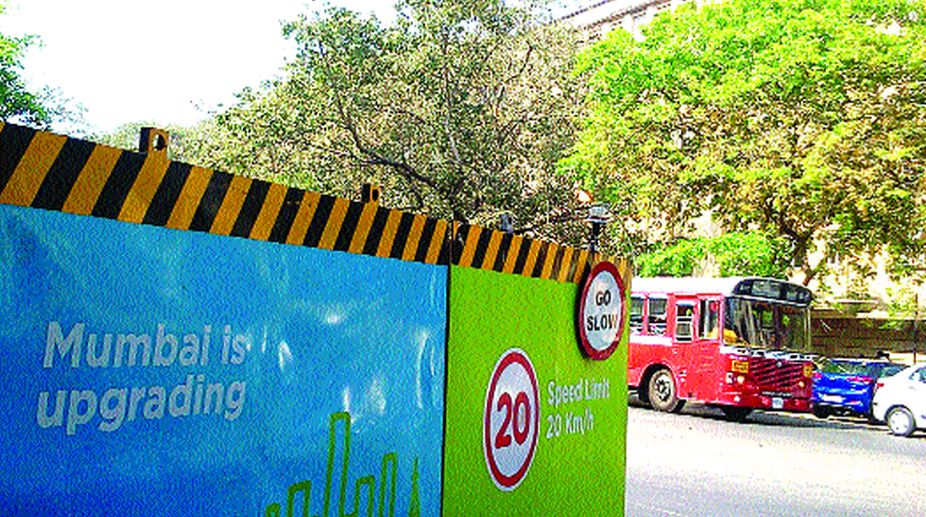
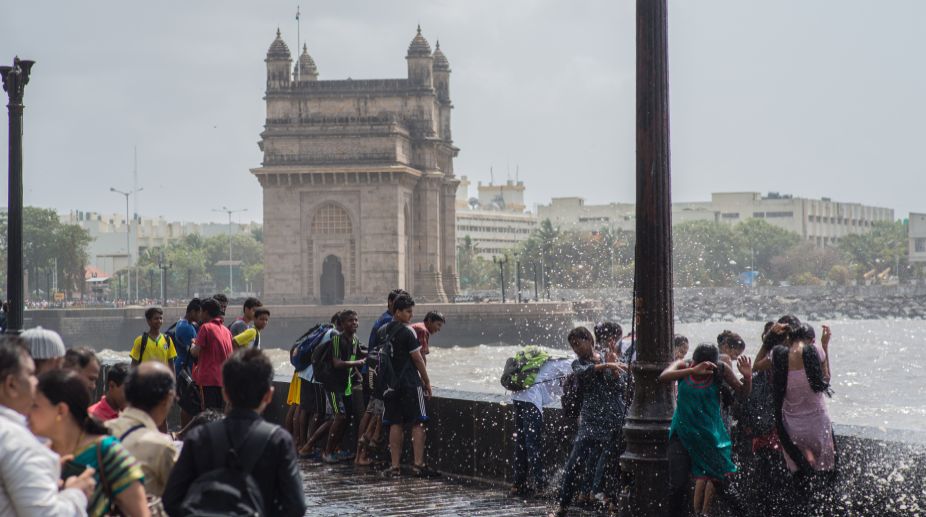
Mumbai is upgrading’ declare blue, green road boards around Churchgate, with work starting on the Colaba-Bandra-SEEPZ Mumbai Metro rail corridor – for commuting to be less daily torture for millions.
When wisely used, ‘upgrading’ becomes a word bubbling with progress, quality, evolution, a better life. Without wiser civilization upgrades,  we might still be in caves using Stone Age accessories.
Mumbai upgrading in any way sounds gratifying, for I owe a great debt to this special city that is my home since 1991. Here in 1993, when I was writing on street children, a social worker mentioned to me this word ‘Vipassana’. My fledgling journalism career was taking off, and I was not particularly looking for any path or process to upgrade my life. Yet I promptly went to the Dhamma Thali Vipassana Center in Jaipur – a young Raja in Rajasthan, amid Dhamma Thali’s dancing peacocks, the king of birds, and monkeys in trees– fitting reminders of this monkey-mind jumping from past to future, rarely still in reality of the present moment, this mind full of tricks.
Most fortunately, in some protection of destiny, I did not think of writing an article on Vipassana before or during my first 10-day course. It enabled experiencing the depths, instead of superficial analysis with the surface-level intellectual part of the mind. Judging Vipassana through mere words is like measuring the Indian Ocean with a teacup.
Instead, those days in Dhamma Thali became an inner revolution, an explosion of deep-rooted realizations beyond vocabularies, a subliminal connection to my real work in life. Later I did write about my experience for The Statesman, and then sub-editor Indrani Bagchi said the article got a phenomenal response. Not surprising, because this is time for the Vipassana inner revolution to upgrade lives across India and the world. “Time-clock of Vipassana has struck”, often said Sayagyi U Ba Khin (1899 – 1971), independent Burma’s first Account General who greatly wished that Vipassana return to India, the country of its origin.
Vipassana (www.dhamma.org) or ‘insight’ in ancient Pali language means to ‘see reality as it is’. This faculty of gaining insight impacts life like a person gaining sight after being blind from birth.
Reality changes from moment to moment.  I experience the cup of life brimming with quiet happiness, but I know this too shall pass…. and maybe when the dark clouds return, dangerous storms burst again through disturbed days, I know, yes, that too will change.
For change is the only constant, through the great Law of Cause and Effect. We reap the fruits of life from seeds of volition we sow each moment. Understanding the continuity of cause and effect is heart of the mind revolution called Vipassana. We understand, through direct experience, subtler realities of this mind-matter phenomenon called ‘I ’, the upgrading in life – and to share all benefits thereby gained, in an undying circle of infinite gratitude.
This feeling of gratitude empowers life’s upgrades, to share all benefits gained. Generous Mumbai has the world’s largest number of Vipassana practitioners, fellow explorers of experiential wisdom – no blind faith and imprisoning dogma. Mumbai was also home to the late Principal Vipassana Teacher Sayagyi U Goenka (1924 – 2013) – infinite gratitude to this Most Compassionate Being, for his ultimate sacrifice enabled gaining this self-dependent Vipassana journey of practical wisdom, this necessary inner revolution for the benefit of many.
For me, Vipassana is humanity’s most beneficial revolution, India’s greatest gift to the world – this universal self-dependent way to train, master the mind, free it from delusions, self-deceptions and lethal addictions to self-destructive thought patterns. Not that one takes a Vipassana course, or 100 Vipassana courses, and that’s it. The key to inner change needs correct daily Vipassana practice, working very hard to train the mind to be master of this moment in life.
Carelessness can cost, just as any revolution faces setbacks to be overcome, mistakes to be corrected.
Mumbai understands better this revolution. India’s financial capital – one of the wealthiest, busiest, most compassionate cities in the world – has the largest number of Vipassana practitioners. From Mumbai are 60 per cent of participants in Dhamma Giri – the world’s largest Vipassana centre that serves about 1,200 students monthly in Igatpuri, in fortnightly residential 10-day courses taught entirely free of cost. During the happy years I voluntarily served in Dhamma Giri from 1994, heaven was heading both ways on Panchavati Express: Mumbai to Dhamma Giri to Mumbai. With four Vipassana centres in Mumbai and 26 centres in Maharashtra state (out of 170 worldwide), Maharashtra justifies its name: ‘The Great State’ that leads a global renaissance of practical wisdom. In South Mumbai, 1969, Sayagyi U Goenka came from Myanmar, via Kolkata, and conducted the first Vipassana course in India after millennia India changed.
In the past 24 years, I have seen Vipassana benefit people of all backgrounds, religions, from children to corporate chieftains, scientists to Tihar Jail inmates. A common feedback: “I wish I had done this sooner”. Yet the Vipassana upgrade needs basic humility to accept unpleasant truths.  The ego ‘I’ needs objectively acknowledging room for improvement, a little upgrade. The ‘why-what’s-wrong-with-me’ attitude generally makes us vulnerable to tricks the mind plays – such as blaming others for our problems in life. Surely, maybe slowly, we free ourselves from recurring storms of delusions, aversion, anger, lust, self-destructive outputs of the ego.
With equanimity and without blind reactions, the inner enemies lose strength and fade away. Vipassana gradually liberates from conditioned habit patterns of the mind, poisonous thought process.  Daily life gains efficiency, like a computer cleaned of lethal virus.
The crucial realization that is easy to forget: the cause of happiness or suffering is within, not outside. Vipassana enables experiencing the actual reality beyond the apparent reality – of how I blindly react, not to external happenings, but to resultant biochemical flow of sensations within, pleasant or unpleasant. With equanimity to these sensations, instead of blind reaction with craving or aversion, life becomes a more balanced ship sailing through storms.
Not easy, because out of carelessness the ship sometimes crashes into rocks, gets battered in self-destructive storms of the mind. But the Vipassana training of equanimity, the compass of destiny, helps the ship to calmer waters, sail back on course. This battle goes on, fought across eons, fraught with failures, sometimes stumbling – but recovering balance again to continue the journey, oftentimes alone, determined to continue across endless time, and serve for liberation of all beings.

(The writer is a senior, Mumbai-based journalist.)

Upgrading Mumbai and revolution of gratitude

Raja Murthy | New Delhi |

Mumbai is upgrading’ declare blue, green road boards around Churchgate, with work starting on the Colaba-Bandra-SEEPZ Mumbai Metro rail corridor – for commuting to be less daily torture for millions.
When wisely used, ‘upgrading’ becomes a word bubbling with progress, quality, evolution, a better life. Without wiser civilization upgrades,  we might still be in caves using Stone Age accessories.
Mumbai upgrading in any way sounds gratifying, for I owe a great debt to this special city that is my home since 1991. Here in 1993, when I was writing on street children, a social worker mentioned to me this word ‘Vipassana’. My fledgling journalism career was taking off, and I was not particularly looking for any path or process to upgrade my life. Yet I promptly went to the Dhamma Thali Vipassana Center in Jaipur – a young Raja in Rajasthan, amid Dhamma Thali’s dancing peacocks, the king of birds, and monkeys in trees– fitting reminders of this monkey-mind jumping from past to future, rarely still in reality of the present moment, this mind full of tricks.
Most fortunately, in some protection of destiny, I did not think of writing an article on Vipassana before or during my first 10-day course. It enabled experiencing the depths, instead of superficial analysis with the surface-level intellectual part of the mind. Judging Vipassana through mere words is like measuring the Indian Ocean with a teacup.
Instead, those days in Dhamma Thali became an inner revolution, an explosion of deep-rooted realizations beyond vocabularies, a subliminal connection to my real work in life. Later I did write about my experience for The Statesman, and then sub-editor Indrani Bagchi said the article got a phenomenal response. Not surprising, because this is time for the Vipassana inner revolution to upgrade lives across India and the world. “Time-clock of Vipassana has struck”, often said Sayagyi U Ba Khin (1899 – 1971), independent Burma’s first Account General who greatly wished that Vipassana return to India, the country of its origin.
Vipassana (www.dhamma.org) or ‘insight’ in ancient Pali language means to ‘see reality as it is’. This faculty of gaining insight impacts life like a person gaining sight after being blind from birth.
Reality changes from moment to moment.  I experience the cup of life brimming with quiet happiness, but I know this too shall pass…. and maybe when the dark clouds return, dangerous storms burst again through disturbed days, I know, yes, that too will change.
For change is the only constant, through the great Law of Cause and Effect. We reap the fruits of life from seeds of volition we sow each moment. Understanding the continuity of cause and effect is heart of the mind revolution called Vipassana. We understand, through direct experience, subtler realities of this mind-matter phenomenon called ‘I ’, the upgrading in life – and to share all benefits thereby gained, in an undying circle of infinite gratitude.
This feeling of gratitude empowers life’s upgrades, to share all benefits gained. Generous Mumbai has the world’s largest number of Vipassana practitioners, fellow explorers of experiential wisdom – no blind faith and imprisoning dogma. Mumbai was also home to the late Principal Vipassana Teacher Sayagyi U Goenka (1924 – 2013) – infinite gratitude to this Most Compassionate Being, for his ultimate sacrifice enabled gaining this self-dependent Vipassana journey of practical wisdom, this necessary inner revolution for the benefit of many.
For me, Vipassana is humanity’s most beneficial revolution, India’s greatest gift to the world – this universal self-dependent way to train, master the mind, free it from delusions, self-deceptions and lethal addictions to self-destructive thought patterns. Not that one takes a Vipassana course, or 100 Vipassana courses, and that’s it. The key to inner change needs correct daily Vipassana practice, working very hard to train the mind to be master of this moment in life.
Carelessness can cost, just as any revolution faces setbacks to be overcome, mistakes to be corrected.
Mumbai understands better this revolution. India’s financial capital – one of the wealthiest, busiest, most compassionate cities in the world – has the largest number of Vipassana practitioners. From Mumbai are 60 per cent of participants in Dhamma Giri – the world’s largest Vipassana centre that serves about 1,200 students monthly in Igatpuri, in fortnightly residential 10-day courses taught entirely free of cost. During the happy years I voluntarily served in Dhamma Giri from 1994, heaven was heading both ways on Panchavati Express: Mumbai to Dhamma Giri to Mumbai. With four Vipassana centres in Mumbai and 26 centres in Maharashtra state (out of 170 worldwide), Maharashtra justifies its name: ‘The Great State’ that leads a global renaissance of practical wisdom. In South Mumbai, 1969, Sayagyi U Goenka came from Myanmar, via Kolkata, and conducted the first Vipassana course in India after millennia India changed.
In the past 24 years, I have seen Vipassana benefit people of all backgrounds, religions, from children to corporate chieftains, scientists to Tihar Jail inmates. A common feedback: “I wish I had done this sooner”. Yet the Vipassana upgrade needs basic humility to accept unpleasant truths.  The ego ‘I’ needs objectively acknowledging room for improvement, a little upgrade. The ‘why-what’s-wrong-with-me’ attitude generally makes us vulnerable to tricks the mind plays – such as blaming others for our problems in life. Surely, maybe slowly, we free ourselves from recurring storms of delusions, aversion, anger, lust, self-destructive outputs of the ego.
With equanimity and without blind reactions, the inner enemies lose strength and fade away. Vipassana gradually liberates from conditioned habit patterns of the mind, poisonous thought process.  Daily life gains efficiency, like a computer cleaned of lethal virus.
The crucial realization that is easy to forget: the cause of happiness or suffering is within, not outside. Vipassana enables experiencing the actual reality beyond the apparent reality – of how I blindly react, not to external happenings, but to resultant biochemical flow of sensations within, pleasant or unpleasant. With equanimity to these sensations, instead of blind reaction with craving or aversion, life becomes a more balanced ship sailing through storms.
Not easy, because out of carelessness the ship sometimes crashes into rocks, gets battered in self-destructive storms of the mind. But the Vipassana training of equanimity, the compass of destiny, helps the ship to calmer waters, sail back on course. This battle goes on, fought across eons, fraught with failures, sometimes stumbling – but recovering balance again to continue the journey, oftentimes alone, determined to continue across endless time, and serve for liberation of all beings.

(The writer is a senior, Mumbai-based journalist.)

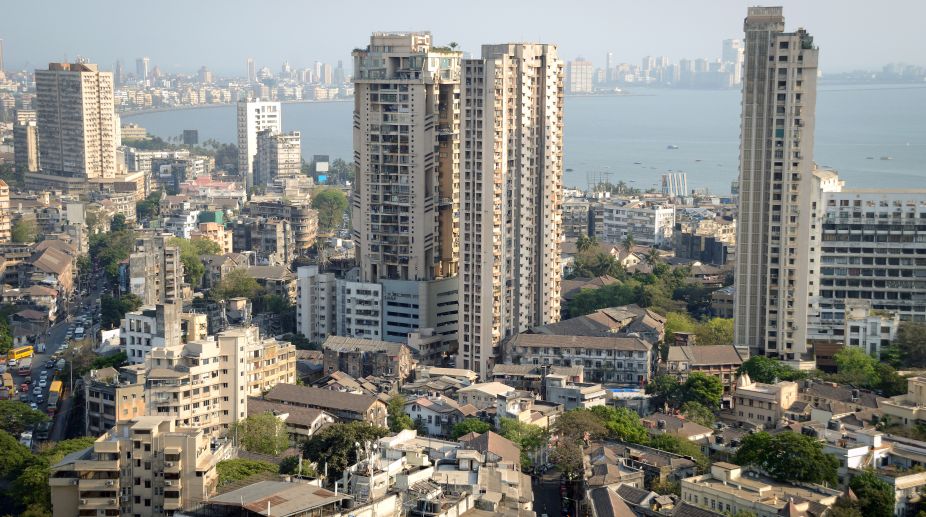
Mumbai richest Indian city, is home to 46,000 millionaires

IANS | Mumbai |

Mumbai is the richest Indian city with a total wealth of $820 billion, a report has stated.

According to the latest New World Wealth report, India's financial capital here is home to 46,000 millionaires and 28 billionaires, and is followed in terms of wealth by Delhi in second place and Bengaluru in third place.

Delhi is home to 23,000 millionaires and 18 billionaires with a total wealth of $450 billion, while Bengaluru has 7,700 millionaires and 8 billionaires and an aggregate wealth of $320 billion.

Home to 9,000 millionaires and 6 billionaires, Hyderabad comes next with a total wealth of $310 billion.

Kolkata houses 9,600 millionaires and 4 billionaires, and has a total wealth of $290 billion.

Pune, with a total wealth of $180 billion, has 4,500 millionaires and 5 billionaires. 

"Over the next decade, India is expected to benefit from strong growth in the local financial services, IT, real estate, healthcare and media sectors. In particular, the local hospital services and health insurance sectors are expected to grow strongly. Hyderabad, Pune and Bangalore are expected to lead the pack in terms of wealth growth," the report said.

The total wealth held in India as of December 2016 amounts to $6.2 trillion, while the country is home to 264,000 millionaires and 95 billionaires, it added.

An unequal world

Jaydev Jana | New Delhi |

There exists a highly unequal distribution of incomes and assets within countries and between countries. While billions of people enjoy longevity and good health, more than one billion people live in abject poverty, struggling for mere survival every day. The poorest of the poor face the daily life-and-death challenges of insufficient nutrition, lack of healthcare, unsafe shelter, lack of safe drinking water and sanitation. A grotesquely unequal distribution of income means millions of children run the risk of dying from easily treatable diseases. Economic inequality has always been a subject of discourse.
As far back as 1971, Jan Pen, a Dutch economist, came up with a graphical representation of income inequality within the British economy. To draw his famous graph, the heights of all adults was imagined as proportionate to their income and they were made to take part in an hour-long parade in the ascending order of their income. Pen then described what observers of average height would see.  It would be a parade of dwarfs and at the very end some giants would appear. The first marchers, the owners of loss-making businesses, the jobless, the working poor will not be visible at all. Their heads are below the ground. By even halfway through the parade, the marchers are still quite short. It takes about 45 minutes before the marchers are as tall as the observer. In the final stage, the giants will dominate. With six minutes to go they are 12 feet tall; when the highest earners walk by, right at the end, each is more than two miles tall.
A Pen’s Parade graph is true in every economy. It can be useful in showing how incomes, and income distribution, change over time. Growth in output hardly guarantees growth in equality. Global inequality is worse than at any time since the 19th century. The latest annual report of Oxfam, entitled ‘An Economy for the 99 per cent’ states that the bottom 50 per cent of the world’s population has just 0.2 per cent of the world’s wealth, and since 2015 the leading billionaires, six of whom are from the US, together have more wealth (net wealth of $426 billion) than what the bottom 50 per cent of the world’s population owns. There are 18 billionaires in sub-Saharan Africa living alongside the 358 million people living in extreme poverty. In India today 57 bilionaires control 70 per cent of its wealth. More precisely, the top one per cent has gained more income than the bottom 50 per cent put together. The 2016 list of Indian billionaires published by the US business magazine Forbes  reveals that India has a total of 84 billionaires.
Contrary to popular belief, many of the super-rich are not ‘self-made’. Over half the world’s 62 richest billionaires were as wealthy as half of the world’s population. However, the number has dropped to eight this year (2017) because of the revelation that poverty in China and India is worse than previously imagined, making the bottom 50 per cent even worse off and widening the gap between rich and poor. Indeed, global inequality has reached levels not witnessed for over a century.
To summarize a country’s current status of economic developmet and to classify countries in their respective levels of such development, the World Bank and other international organisations heavily rely on a single measurement called the gross domestic product (GDP) per capita. This indicator is not a comprehensive measure of economic development, because there are many other important indicators of well-being. In view of sustainable development’s commitment to social inclusion and broad-based prosperity, it is imperative to take into account not just a country’s average levels of income, but the variation of incomes across households and individuals within a country.
On the face of it, the average income can be fine. But it is ‘just fine’ because a few people are rich and the rest of the country is poor, then the state of affairs is not so fine after all. The popular measure of inequality of income within the country is the Gini coefficient (also known as Gini index), which ranges from zero to one. A score of zero means perfect equality: everyone earns the same. A score of one means that one person gets everything. Real societies are of course somewhere in between. Individual income inequality measured by the Gini coefficient has consistently risen. The Indian growth-inequality paradox is easy to pin down ~ the wealth that India creates is not evenly distributed.  According to the International Monetary Fund, India’s Gini coeffieient rose to 0.51 by 2013 from 0.45 in 1990, mainly on account of rising inequality between urban and rural areas as well as within urban areas. As of November 2016, India is the second most unequal economy in the world. Far from trickling down, income and wealth are being sucked upwards at an alarming rate. The IMF has recently warned that India faces the social risk of growing inequality.
The data, that has emerged from a decade of empirical research on growth, reveal that at the global level income and wealth are increasingly concentrated among the small number of countries in the world, leaving the rest to deteriorate in deprivation. Concentrations of wealth and poverty have an ethnic and geographic dimension. Inequality must be reckoned in terms of the global North and the global South, and the reality of imperialism, multinational corporations, class, race, caste and patriarchy. The low-income countries are heavily concentrated in two regions: tropical Africa and South Asia, with a few other low-income countries scattered in other parts of the world. ‘The 99 per cent’ is predominantly represented by hundreds of millions of the dispossessed suffering under varying conditions all over the world, but mainly concentrated in the global South.
To quote Kofi Annan, former UN Secretary-General and Nobel Laureate: ‘The widening gap between rich and poor is at a tipping point. It can either take deeper root, jeopardizing our efforts to reduce poverty, or we can make concrete changes now to reverse it’. The rapid rise of extreme inequality in incomes and assets has been the greatest threat to world peace, and to the survival fo the human species. In their book, The Spirit Level: We More Equal Societies Almost Always Do Better, Kate Pickett and Richard Wilkinson demonstrate that countries with higher levels of income inequality experience higher rates of health and social problems compared to more equal countries.
Inequality has damaged our ability to live within the planet’s resources and succeed in the fight against climate change. It makes the struggle for equality between the sexes far harder. While money is power, the holders of huge capital influence the government’s policies more than the voters can ever do. Inequality gives birth to a dominant political form that resembles a plutocracy rather than a democracy. The growing threat of left extremists and terrorism has its roots in economic deprivation and inequality in access to resources. Rising inequality is also a factor that promotes a divisive agenda of sectarianism, xenophobia and nationalism.

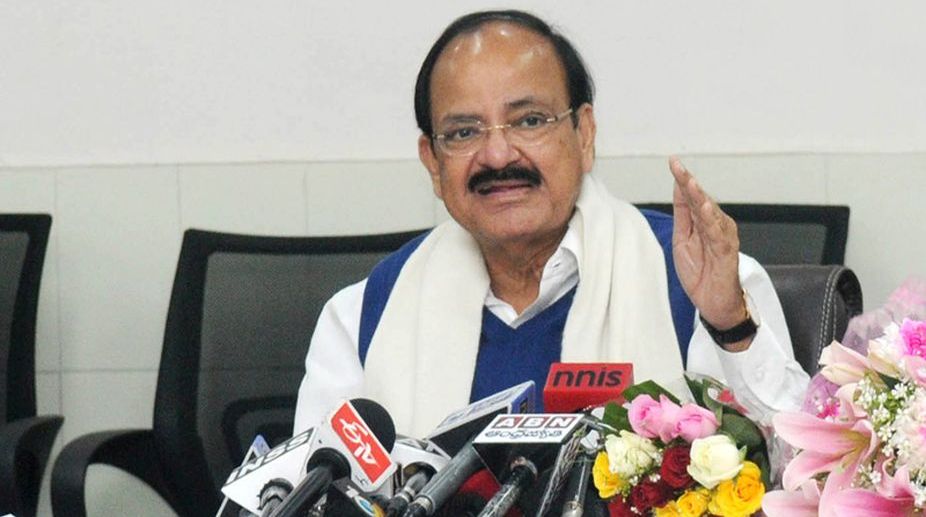
India seeks ‘strongest’ action to stop attacks on Indians in US

IANS | New Delhi |

Union Information and Broadcasting Minister M Venkaiah Naidu on Sunday asked the United States to condemn the killing of Indian techie Srinivas Kuchibhotla and take "strongest" action to prevent such attacks.

Meeting reporters after consoling family members of Kuchibhotla here, he said India had taken up the issue with the US at the highest level and stressed the need to take steps to provide security and assurance to Indians living there.

Voicing concern over series of incidents of alleged racial discrimination, Naidu said it was the responsibility of the US Government and the civil society to put an end to this.

Terming the Kansas shooting in which Kuchibhotla was killed and his colleague Alok Madasani was injured, shameful, he said this was a blot on US which claims to be the oldest democracy.

"American President and people should come out openly and condemn such actions and then take strongest action and send a message that this is not acceptable," Naidu said.

Stating that seven incidents of this nature occured, the Minister said that they are sending wrong message which was not good for US, its people and the world.

Naidu said that when small incidents occur in India, it was blown out of proportion and the country which claims to be the oldest democracy tell the world that this is what happening in India.

The Minister said the US should answer the questions raised by Srinivas' wife so eloquently even in this hour of grief.

He said the incident had caused anguish to Indians and brought sorrow to Telugus.

He said External Affairs Minister Sushma Swaraj acted swiftly and directed the Indian embassy to make arrangements for bringing home the slain techie's body.

Naidu, who was accompanied by Union Labour Minister Bandaru Dattatreya, said while the series of incidents caused concern among the Indian community in the US, there was no need for panic.

He said it was not proper to take decisions like dropping plans to travel to the US or returning to India.

"There is elected government and democratic system there. Elected public representatives there are voicing concern on such incidents," he added.

Kuchibhotla, 32, was killed and Alok Madasani was injured when Adam W. Purinton, a white man who earlier served in the US Navy, shot them at the Austins Bar & Grill in Olathe, Kansas state, on Wednesday night.

Purinton reportedly got into an argument with the victims and hurled racial slurs. He yelled "get out of my country", "terrorist" before shooting them.

Kuchibhotla of Hyderabad and his colleague Madasani from Warangal district in Telangana were working as aviation programme managers at Garmin, an MNC.

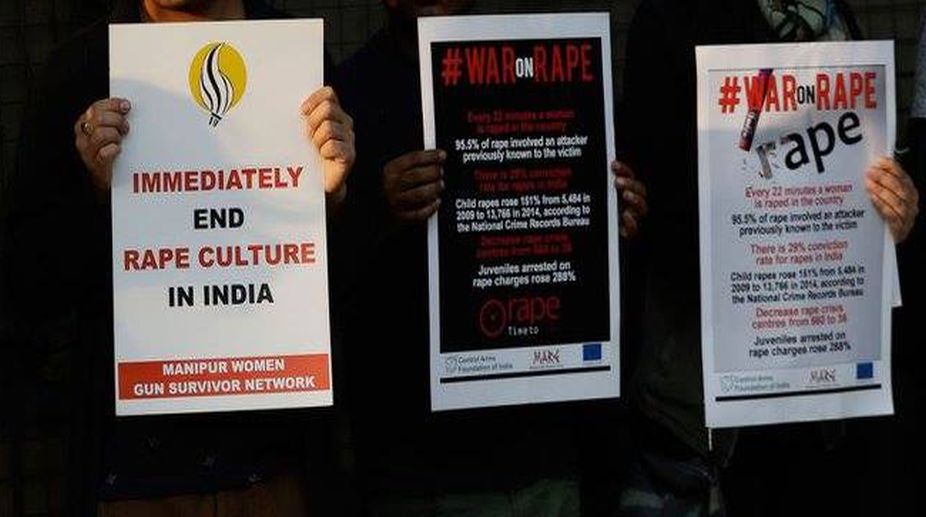
Kargil martyr’s daughter gets ‘rape threats’ for opposing ABVP

PTI | New Delhi |

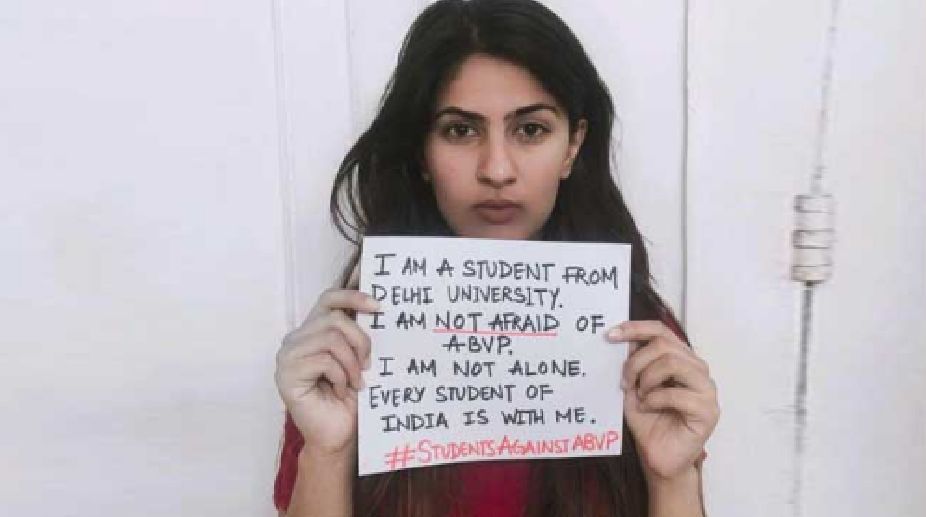
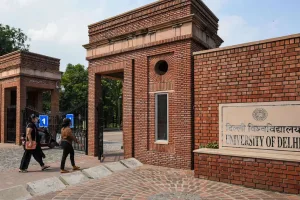
The Delhi University student, whose social media campaign against ABVP recently went viral, on Sunday alleged to have received "rape threats".

Lady Sri Ram Ram College student Gurmehar Kaur, daughter of Kargil martyr Captain Mandeep Singh, said she has attracted a barrage of hate messages over her stand on the issue.

"I have been getting a lot of threats on social media. I think it is very scary when people threaten you with violence or with rape," she told NDTV.

Giving rape threats "in the name of nationalism" is not right, she added.

Her comments received widespread support including from Delhi Chief Minister Arvind Kejriwal.

"Just listen to this. THIS is BJP. They will destroy our country. Everyone must rise against their goondaism," he tweeted while sharing her statement.

After the North Campus clash, Kaur had changed her Facebook profile picture holding a placard which read "I am a student from Delhi University. I am not afraid of ABVP. I am not alone. Every student of India is with me.

#StudentsAgainstABVP".

Delhi University's Ramjas College had on Wednesday witnessed large-scale violence between members of AISA and ABVP workers. The genesis of the clash was an invite to JNU students Umar Khalid and Shehla Rashid to address a seminar on 'Culture of Protests' which was withdrawn by the college authorities following opposition by the ABVP.


Kargil martyr’s daughter gets ‘rape threats’ for opposing ABVP

PTI | New Delhi |

The Delhi University student, whose social media campaign against ABVP recently went viral, on Sunday alleged to have received "rape threats".

Lady Sri Ram Ram College student Gurmehar Kaur, daughter of Kargil martyr Captain Mandeep Singh, said she has attracted a barrage of hate messages over her stand on the issue.

"I have been getting a lot of threats on social media. I think it is very scary when people threaten you with violence or with rape," she told NDTV.

Giving rape threats "in the name of nationalism" is not right, she added.

Her comments received widespread support including from Delhi Chief Minister Arvind Kejriwal.

"Just listen to this. THIS is BJP. They will destroy our country. Everyone must rise against their goondaism," he tweeted while sharing her statement.

After the North Campus clash, Kaur had changed her Facebook profile picture holding a placard which read "I am a student from Delhi University. I am not afraid of ABVP. I am not alone. Every student of India is with me.

#StudentsAgainstABVP".

Delhi University's Ramjas College had on Wednesday witnessed large-scale violence between members of AISA and ABVP workers. The genesis of the clash was an invite to JNU students Umar Khalid and Shehla Rashid to address a seminar on 'Culture of Protests' which was withdrawn by the college authorities following opposition by the ABVP.


Army exam paper leak: Students were answering papers in a Goa bar

IANS | Panaji |

Three of the 18 persons arrested from across Goa and Maharashtra in connection with the Army exam paper leak were picked up from a bar in North Goa's Anjuna village, police said on Sunday.

Some students were answering the illegally obtained question paper in the early hours on Sunday, police sources said. The trio was arrested by officials of the Crime Branch of Thane police, alongwith personnel attached to the Anjuna police station.

"The papers were being answered by the students in Sandhya Bar in Anjuna police jurisdiction. The raids were conducted in the early morning," a police source said.

Speaking to reporters late on Sunday, Director General of Police Muktesh Chander said the local police only provided logistical support to the Thane Crime Branch, which conducted the raids.

"Three persons were arrested. The students were allowed to go after we collected their details," Chander said.

The Thane Crime Branch has so far arrested 18 people across the two states in connection with the Army Recruitment Board exam paper leak for junior positions in the Indian Army. 

Over 200 students have also been detained by the Maharashtra Police.

The raids followed a tip-off to the Thane police that the paper, for which exam was due to be held on Sunday morning, had been leaked. The raids were conducted in Nashik, Nagpur, Pune and Goa.

Army exam paper leak: Students were answering papers in a Goa bar

IANS | Panaji |

Three of the 18 persons arrested from across Goa and Maharashtra in connection with the Army exam paper leak were picked up from a bar in North Goa's Anjuna village, police said on Sunday.

Some students were answering the illegally obtained question paper in the early hours on Sunday, police sources said. The trio was arrested by officials of the Crime Branch of Thane police, alongwith personnel attached to the Anjuna police station.

"The papers were being answered by the students in Sandhya Bar in Anjuna police jurisdiction. The raids were conducted in the early morning," a police source said.

Speaking to reporters late on Sunday, Director General of Police Muktesh Chander said the local police only provided logistical support to the Thane Crime Branch, which conducted the raids.

"Three persons were arrested. The students were allowed to go after we collected their details," Chander said.

The Thane Crime Branch has so far arrested 18 people across the two states in connection with the Army Recruitment Board exam paper leak for junior positions in the Indian Army. 

Over 200 students have also been detained by the Maharashtra Police.

The raids followed a tip-off to the Thane police that the paper, for which exam was due to be held on Sunday morning, had been leaked. The raids were conducted in Nashik, Nagpur, Pune and Goa.

Famine amidst food!

Editorial | New Delhi |

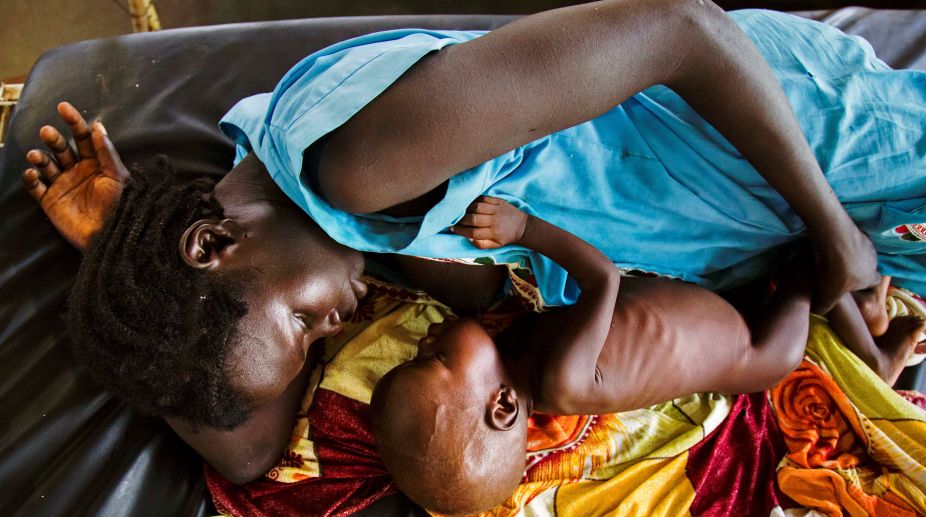
The caption’s contradiction in terms is unavoidable for it underlines the grim tragedy of South Sudan. It is an “impossibility theorem” of sorts, to summon the famous expression of Nobel Laureate Kenneth Arrow, who passed away on Tuesday at the ripe age of 95. The official declaration of famine, which was announced by the UN and the government on Monday, is eerily reminiscent of the denial policy of the British that led to the Bengal famine of 1942… as exposed to the world by this newspaper at that point of time. Once again, it is not an agricultural failure but the result of prolonged civil war and a crippling economic crisis that has devastated the war-torn East African nation. Above all, 75 years after the Bengal famine, a swathe of the world has to countenance the denial of food. And unmistakable must be the repetition of social history. The famine is almost an engineered humanitarian crisis, a hideous instance of man’s inhumanity to man ~ not celluloid fiction but a point of fact. With one million lives at risk, President Salva Kiir Mayardit’s government has been ruthless in its reprisal as he counters the adversaries in the midst of the civil war by blocking food supplies. The United Nations has informed the world at the peak of the crisis; logically therefore it ought to intervene without dithering, as it did in the wake of political upheavals in Libya and Syria. Quite totally outrageous has been the government’s blocking of food aid to some areas. Indeed, the contrived scarcity of food has emerged as a tool to rein in the rebellious.
The World Food Programme’s assessment that “there is only so much that humanitarian assistance can achieve in the absence of meaningful peace and security” alone explains the disconnect between the declaration of famine and the blockade against food supplies. The extent of human suffering is underscored by the official classification of “famine” and it is time for the comity of nations to react to the heart-rending conditions.
The tormented country showcases fields that are fertile, and yet the country is plagued by famine. And between the two extremes, there is no food. The risk of death out of hunger is substantial, going by the report crafted jointly by the Food and Agriculture Organisation, the World Food Programme, and Unicef. The data collection has been remarkably incisive. On a parity of reasoning, the response of the world must match the enormity of the tragedy. The famine is man-made, and the quality of life has descended to what the WFP calls “emergency level of hunger”. That succinctly sums up the tragedy of the world’s tiniest nation ~ seemingly improbable but direly true.