Logo

Hearing loss could soon be reversed

S Ananthanarayanan |

Inherited genetic deficiency is the reason for about half the 250 million cases of hearing loss worldwide. In most of these, the function itself of the organs of the ear is affected and medical intervention is generally not effective. Even devices like hearing aids or implants in the middle and inner ear, which partially restore auditory functions, are not always possible.

Answers for many medical conditions like haemophilia, leukaemia or Parkinson’s disease have been found in gene therapy, where genetic material is introduced into living cells to modify their function. In dealing with hearing loss, however, there have been limitations in the use of gene therapy, because of the different organs involved, particularly the inner and outer hair cells, which act in concert to ensure the remarkable sensitivity of the ears of mammals.

Two groups of researchers, working in institutes in Massachusetts, Chicago, New Orleans, North Carolina, Washington and Vienna, report in the journal, Nature Biotechnology, their success in creating a virus in the laboratory that is able to invade the cells of the inner ear and introduce a scrap of genetic material that sets right the working of both kinds of deficient hair cells. The work has been done with a particular inner ear condition that affects mice, but this is the first time that hearing function has been recovered and it holds promise of being useful to deal with human hearing loss, the authors of the papers say.

While the architecture of the ear provides the framework for capturing and channelling sound waves, it is the fine hair-like structures in the inner ear that translate sound vibrations into nerve signals, to be recognised as sounds. And here, there are different kinds of hair cells, some to sense high and low frequencies and others to help focus different frequencies at specific places.

The complexity is incredible — the tiny, liquid-filled resonating chamber of the ear, the cochlea, has tens of thousands of hair cells and different frequencies of sound are focused at points just hundredths of millimetres apart.

The functioning of physiological systems is orchestrated by the action of proteins, which play different roles of signalling and enabling organs to act in specific ways. Thousands of proteins are synthesised within the cells by joining together chemical units, called amino acids, according to specific patterns. The patterns are spelt out by the units in sequence along the length of the DNA, the giant molecules that code the entire genetic information of the cell. If there is an error or an omission in the code for a protein, which is important for the cell’s function, then it is not able to generate that protein and is not able to work correctly.

It is this kind of deficiency that is found to bring about deafness in some 50 per cent of the hearing-impaired people across the world. And more than 300 locations along the length of the DNA have been found to be relevant and over a hundred genes, or bits of DNA that code for the production of particular proteins, have been isolated in people affected by loss of hearing.

Gene therapy seeks to remedy this condition by replacing the deficient gene with a functional, therapeutic version, so that that a genetically deficient cell creates the required proteins and functions normally. Therapeutic genes, once introduced into the cell, are guided by additional bits of DNA-like sequences to seek out the correct place and replace the deficient portion. A difficult part of the operation, however, is the actual insertion of the genes and bits of DNA-like material into the diseased cell.

One successful method of doing this is with the help of viruses. Viruses are “almost” living entities that resemble cells, in so far as they contain DNA, but not any further. Viruses are almost only DNA, contained inside a protein coat, sometimes with a fatty covering. They have no other apparatus to create proteins or even to reproduce. But the special feature is that they are small, most cannot be seen with an optical microscope, and they are able to get through the outer membrane and into the body of specific kinds of cells. It is within such a “host” cell that viruses use the available resources to reproduce, and this is the process, which could lead to failure or death of the cell — this causes diseases arising from viral infections.

This disease-causing capability can also be used for the therapeutic purpose of inserting genes into gene-deficient cells. The viruses used are a category of adeno-associated viruses, which have been found to be present with others of the ilk but cause no disease. AAVs are small, just 20 nanometres, and are able to enter many kinds of cells. And then, they attach to the DNA at a specific place known as AAVS1. This quality makes AAVs safe and convenient to use for gene delivery.

One group of the researchers, including Lukas D Landegger, Konstantina M Stankovic and Luk H Vandenberghe among others, tried out a number of AAVs and found that the synthetic virus, Anc80L65, was able to efficiently transfer a fluorescent green protein into both the inner as well as outer hair cells. Being effective with outer hair cells was an improvement over existing vectors. Laboratory tests were carried out with human cells and the vector was found to be equally effective.

The second group, Gwenaëlle S Géléoc and colleagues, sought out a genetic condition where the genes involved were found in both types of cochlear hair cells. The Usher’s syndrome, which causes severe deafness and also affects balance and leads to blindness, results from the lack of a gene, UCH1C, which encodes the protein, harmonin. A sub-group of gene deficient mice, the c.216AA, were found to show both the hearing and visual defects of human Usher’s syndrome. Study of c.216AA mice showed that both types of cochlear hair lost their function after the first week of birth.

As lack of harmonin was the apparent cause, the group investigated whether introducing harmonin in c.216AA hair cells would preserve their function. The known synthetic viral vector called Anc80L65was hence designed to carry the code for harmonin-A1 or harmonin-B1, and introduced into the inner ear by injection.

The results were dramatic — a thousand-fold improvement of hearing, to near normal levels, of otherwise deaf and dizzy c.216AA mice. More than a hundred genes may be implicated in disorders of the human ear. Finding ways to use Anc80L65 with large animals could speed up the discovery of gene therapy methods for disorders of the human ear, authors of the paper say.
L&T arm to provide EPC services to Shell projects

IANS | Mumbai |

Engineering major L&T on Tuesday said that its hydrocarbon subsidiary will provide Engineering, Procurement and Construction Management (EPCM) services to Anglo-Dutch oil and gas firm Shell in West Asia, South East Asia and India over the next five years.

"L&T Hydrocarbon Engineering has signed an enterprise framework agreement (EFA) with Shell Global Solutions International B.V. for providing AEPCM services for Shell projects in the Middle East, South East Asia and India," said L&T in a regulatory filing to the BSE.

The subsidiary will leverage on its core strengths of engineering and project management to deliver projects for any agreement resulting from the EFA.

The company's office will be its high value engineering centre.

"The agreement is a breakthrough for our new engineering services business vertical. We will combine our engineering expertise with project and risk management skills to provide solutions to customers across the globe," said L&T Hydrocarbon Engineering Chief Executive Subramanian Sarma in a statement later.

Founded by two Danish engineers in India, the $16-billion L&T operates in 30 countries, providing technology, engineering, construction, manufacturing and financial services.

Indian killing in Kansas was ‘racially motivated’: White House

PTI | Washington |

The White House has condemned the fatal attack on an Indian engineer in Kansas City last week by a US Navy veteran as "racially-motivated hatred".

"As more facts come to light," Deputy White House Press Sarah Sanders told reporters that it looks like the Kansas shooting last week was a "racially motivated hatred".

Sanders reiterated that US President Donald Trump "condemns these" and any other racially motivated attacks in strongest terms. "They have no place in the country," Sanders said at the top of her off camera briefing.

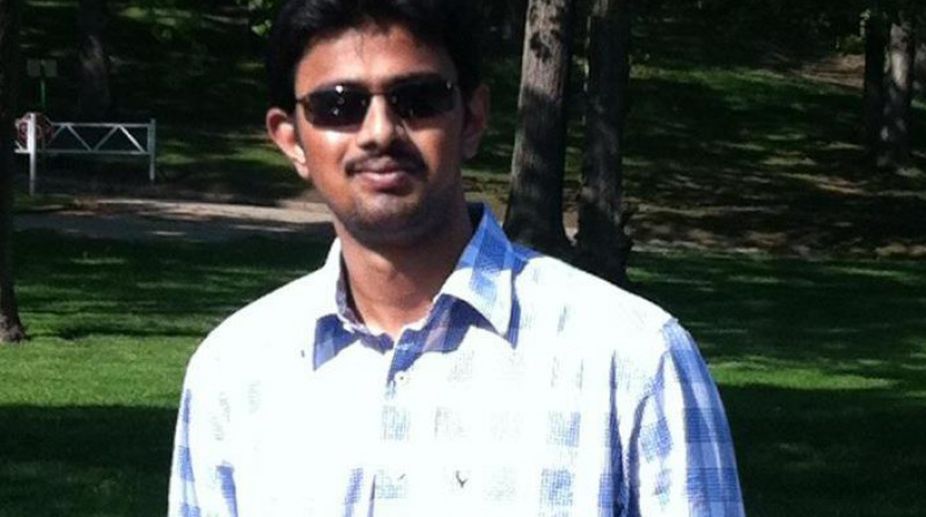
Srinivas Kuchibhotla, 32, was killed and Alok Madasani, another Indian of the same age, was injured in the shooting by the navy veteran Adam Purinton, who yelled "terrorist" and "get out of my country" before opening fire on them.

A 24-year-old American named Ian Grillot who tried to defend the Indians received injuries in the firing.

Purinton, 51, apparently mistook the Indians for immigrants from the Middle East.

Yesterday, White House Press Secretary Sean Spicer had said the incident was "disturbing", but did not say whether the Trump administration believed it was a hate crime.

The tragedy has led to fears among immigrants, who feel being targeted by President Donald Trump's plans to ban travellers from certain countries and build a wall along the Mexico border to realise his campaign pledge of putting "America first".

Meanwhile, the Federal Bureau of Investigation (FBI) said it is investigating the triple shooting and homicide at a bar in Olathe in Kansas last week as a "hate crime." 

Will Varanasi be like Delhi?

Arati R Jerath |

It is surprising that even as the BJP seems to be doing well in the battle for UP 2017, it has run into rough weather in Narendra Modi’s Varanasi constituency. A recent trip to the city revealed that a Delhi-like situation is building up there because of the party’s decision to deny a ticket to seven-time MLA Shyamdeo Roy Chaudhury, popularly known as Dada.

The similarities are astonishing. BJP workers in Varanasi are comparing Dada to Delhi’s Harsh Vardhan who was dumped by the party on election eve and denied a ticket to contest. Instead, his traditional seat of Krishna Nagar was given to Kiran Bedi who then became the party’s chief ministerial candidate. Similarly, Dada’s seat of Varanasi south has been given to a political greenhorn like Bedi named Neelkanth Tiwari.

The sidelining of Harsh Vardhan created huge resentment among Delhi BJP workers who silently sabotaged to defeat the party in Krishna Nagar and in the rest of Delhi. AAP swept 67 of Delhi’s 70 assembly seats.

In Varanasi too, BJP workers are hopping mad about Dada’s marginalisation. Although Dada himself, like Harsh Vardhan, is campaigning for the party like a loyal foot soldier, his supporters have vowed to avenge his humiliation. This has given the Congress nominee, Rajesh Mishra, an edge.

The anger with the BJP is not limited to Varanasi south. The sympathy for Dada has spread through the rest of the city where BJP old timers and those who worked to make Modi win in the 2014 Lok Sabha election are nursing a grudge. They feel the BJP used them and has discarded them now in favour of a new coterie nurtured by Amit Shah. Will Varanasi prove to be a mini Delhi?

Slipping popularity

The BJP’s top leadership is clearly worried about the party’s slipping popularity in Varanasi. Anything less than a sweep in the PM’s constituency would be humiliating.

Several damage control measures have been initialized. Amit Shah is camping in the city and will stay till polling day on March 8. Every day, a union minister is sent to Varanasi to pep up BJP’s sullen cadre. Even Modi’s elder brother Somabhai Damodardas Modi landed up for door-to-door campaigning on behalf of the PM. He was there for five days last week and is said to be planning another visit. The BJP hopes that the presence of a family member will add a personal touch to the campaign and remind voters that Varanasi is close to Modi’s heart.

Somabhai was out from 8 in the morning till late evening every day. Interestingly, on his last evening in Varanasi, he held court with the local and visiting media but was carefully circumspect.

But the BJP is pinning its hopes on a Modi blitzkrieg through Varanasi. He is expected to spend at least two days in his constituency, addressing rallies and meeting people. The party had planned a roadshow which has been cancelled because of security considerations.

It is indeed odd that the Prime Minister should have to put in so much effort in his own constituency for an assembly election.

The other bahu

Political circles in UP are puzzled by the decision of Mulayam Sngh’s second daughter-in-law Aparna Yadav to contest from the Lucknow Cantt seat. Samajwadi Party has never won that seat. It has either been won by the BJP or the Congress every time.

It seems Aparna Yadav had set her heart on contesting from Lucknow Cantt despite being warned that it is a difficult constituency for SP. She has been active in the area for the past two years, meeting people and addressing their problems. SP circles joked that like Akhilesh, she too campaigned on the slogan “kaam bolta hai’’. In other words, she felt that her work over two years would help her to win.

SP circles were unhappy about the manner in which she ran her campaign. She started off by driving around in her husband’s expensive Lamborghini. At Rs 5 crore, it has been the subject of much controversy. Halfway through the campaign, Aparna realised perhaps that the showy car was not going down well with voters. So she switched to a Land Cruiser. Although this too is a luxury 4-wheel drive which costs in the range of Rs 2 crore, it is certainly not as flashy as a Lamborghini. SP circles are not confident that Aparna can pull off a victory, given the history of the constituency. In fact, the buzz in Lucknow is that Rita Bahuguna Joshi may win the seat again, this time on a BJP ticket. Her last minute switch from Congress to the BJP may prove fortuitous.
Alternative home

It is ironic that Akhilesh Yadav has already moved into a bungalow that he earmarked for himself as ex-chief minister. In UP, ex-CMs are allotted government bungalows for their life time.

Akhilesh has chosen one on Vikramaditya Marg. He renovated it at a whopping cost of Rs 53 crores. He moved in when the family feud was at its height in December. No-one can understand why Akhilesh allotted the bungalow so many months before the election and moved into it as well. It is being seen almost as an admission that he is unsure of returning to power.

Interestingly, Akhilesh also had a new office constructed for the chief minister on Vidhan Sabha Marg near the UP assembly building. The cost of the new office is an astonishing Rs 603 crores.

The amazing thing is that Akhilesh has hardly used the office. He prefers to work out of his official chief minister’s residence on Kalidas Marg.

Forgotten facts about the INA

Praveen Davar |

It is amazing that an RTI application regarding the status of soldiers of Indian National Army (INA) has been referred to the Ministry of Home Affairs (MHA) by the Central Information Commission (CIC). According to a recent PTI report the CIC has opined that the MHA is under an obligation to explain the logic or reason in “neglecting the members of INA led by Netaji and rejecting them the status of freedom fighters.” He further asked whether the MHA was ready to provide pension benefits to INA soldiers. If only the applicant or officers in the government dealing with query had taken pains to go through the records and various documents available in the archives such ridiculous doubts wouldn’t have arisen.

No doubt Netaji Subhas Chandra Bose was a charismatic leader of the INA. But unfortunately it is not widely known that he was not its founder. The founder president of INA was General Mohan Singh, who founded the organisation almost two years before Netaji landed in Singapore in July 1943. Mohan Singh was a young major of the British Indian Army who, like other INA soldiers, was a prisoner of war captured by the Japanese army.

In a foreword to his memoirs Lt. General Iwaichi Fujiwara, who was a close associate of Netaji in the strategic planning and tactical operations of INA, has written: “The young dashing Mohan Singh was the founder and creator of the INA. Without his burning patriotism, his immovable conviction and lightening action … no hope could possibly be entertained for the birth and growth of the INA. Without his spirited involvement at the initial stage no attempt to organize it later would have proved successful. Even the appearance of the great Netaji, a warrior son of India in Singapore in July 1943 would have proved too late for the purpose.”

General Fujiwara also felt that Netaji took the risk of a submarine voyage to S.E. Asia from Germany at the height of World War II as he had learnt the news of birth of INA, whose chief General Mohan Singh and other senior commanders were entreating him to take over the organisation for the achievement of his objectives.

According to Col. (Dr.) D.S. Raju, who served as medical adviser to both Netaji and General Mohan Singh the latter had insisted that Bose should be brought to Singapore as a pre-condition for his further cooperation with the Japanese authorities. Mohan Singh therefore had set the stage for the advent of Netaji to East Asia. However, Col. Raju felt that “from the military standpoint of view he came on the scene too late.”

By the beginning of 1944 when the INA forces and Japanese army entered the battle zone around Imphal it was too late. The Allied defences were very strong and the fortunes of Axis powers were on the decline. INA troops and the Japanese suffered heavy losses and were gradually pushed back and compelled to evacuate Burma. It was a tragic end of a glorious patriotic struggle but no historian could underestimate the value of INA and the role it played in expediting the end of the mighty empire.

Writes General Mohan Singh in his memoirs entitled Soldiers Contribution to Freedom Struggle: “The Nation is deeply indebted to Jawaharlal Nehru. We must record that before his demise in 1964, Pt. Nehru realized the injustice done to the INA and after the decade and half of heart burning and immense suffering granted to the INA personnel the status of a political sufferer. He, having appreciated the tenacious efforts put up by the INA personnel for their rightful dues, set in motion the administrative machinery to grant them the arrears of pay and allowances which were confiscated when they were released from prisons in India.”

It was Generals of the British Indian army (before 1949) and Indian Army (after General Cariappa took over in January 1949) who opposed tooth and nail any concessions for INA personnel. Both Viceroy Field Marshal Wavell and C-in-C Field Marshal Auchinleck were unwavering in their commitment to take strongest possible disciplinary action against the Azad Hind soldiers. It was a natural reaction of the generals as the soldiers of regular army and INA were on opposite sides. However, the political leaders of the day, especially Pt. Jawaharlal Nehru, and later Indira Gandhi having the capacity to see the ‘bigger picture’ and appreciate national sentiments took the right decisions in favour of the brave officers and men of the INA. Gen. Mohan Singh acknowledges this in his magnum opus.

“Destiny had so willed that what the father had begun the daughter accomplished when she became the Prime Minister of India. It was during the Premiership of Indira Gandhi that the arrears of payments were made and the INA men were honoured as freedom fighters.”

The writer, an ex Armoured Corps officer, is Member, National Commission for Minorities. The views expressed by him are personal.

Imperial plunder — II

B Mondal |

How many million Indians were victims of famine during the 190 years of British rule? Thirty? Or, may be forty. And overall, India was never deficient in food grain. This has been testified by Robert Orme, the Travancore-born East India Company historian, in his 1778 book A History of Military Transactions of the British Nation in Indostan from the Year MDCCXLV.

The “denial policy” to starve people to death was carried out ever since the Viceroy, Lord Lytton (1876-80) ordered Sir Richard Temple to stop relief operations in famine-stricken areas when he found that the latter had imported half a million ton of rice from Burma to mitigate the woes of the starving masses. He had to abandon his mission in the face of the threat of severe punishment! This policy continued up to the 1943 “Great” Bengal Famine with Churchill taking preventive steps to deny rice to the province. When Mountbatten, Supreme Allied Commander, South East Asia, decided to reserve 10 per cent of the total shipping allocated for arms import to food, the Prime Minister intervened to direct that if Mountbatten could afford to spare 10 per cent shipping space his allocation could be reduced by that quantum. Dr Eamon de Valera, the Irish Prime Minister, got the Dail to appropriate 100,000 pounds for famine relief in Bengal which was under the care of the Gorakhpur-born LS Amery, Wavell and above all, Churchill. For the consumption of the world, it was given out that due to the Japanese occupation of Burma, rice could not be imported. The fact is that Burma had fallen to the Japanese in the earlier part of 1942 and the famine was caused in the latter part of 1943.

India was not deficient in food even in that year. The burning down of 90,000 country-boats to prevent them from falling into Japanese hands was a calculated step to stop the movement of foodgrain in the riverine interiors of Eastern Bengal and in Midnapore. With large-scale hoarding and army purchase with ready paper-money prices sky-rocketted; rose by four times, beyond the capacity of common man. Streets of Calcutta and surrounding areas littered with emaciated corpses.

The US magazine Life of 27 February 1944 contains a rather macabre paragraph on the supply of skeletons which American students were getting from India in the wake of the famine. Perhaps no other account could match the poignancy and official cruelty, than what Jawaharlal Nehru has recorded in The Discovery of India. The official Woodhead Commission had underplayed the death toll at one and a half million whereas Calcutta University’s Department of Anthropology, after extensive survey, puts it at 3.4 million. Even the casualty figures of World War II were not anywhere near it. This was the “bliss of superior British rule” in Imperial India.

Nehru has debunked the myth of lack of transport as also the astronomical extra-profit made in the traffic of starvation and death — Rs 1500 million, if the figure is taken at 1.5 million deaths in the Woodhead Commission report, or Rs 1000 extra for each death. “Transport was lacking for food, but racehorses came in special boxes by rail from other parts of the country.”

When those angels from England left India in 1947, they left their legacy that prompted the Americans to provide wheat to India under Public Law 480 in the early 1950s — for two years, two ship-loads of wheat were discharged each day at the ports of India. Mr Kapur’s praise for the British-built Railways virtually echoes the eloquence of Sir Woomesh Chandra Bonnerjee’s inaugural address as the first President of Indian National Congress on December 28, 1885 and also that of Dr BR Ambedkar at the All-India Depressed Classes’ Conference at Nagpur in August 1930.

The objective of introducing the Railways in India had nothing to do with people’s welfare or the country’s development. It was primarily designed to export Indian products and raw material, cotton for instance, cheaply and quickly to Manchester. Because of the American Civil War (1861-65) its supply from the US had become uncertain. Its military use was underscored by the blood-thirsty Col. James George Smith Neill of 1st Madras Fusiliers, who was on a mission to suppress the Benares uprising (June 1857). While moving with his troops from Calcutta to Benares he encountered an unexpected obstacle. When the guard and driver of the train insisted on starting on time, he warned them that until all his troops had boarded, the train should not leave. He had threatened to shoot the train crew and station staff once he had returned from his mission. Fortunately, the tyrant died before he could come back to take revenge. He suppressed the Benares Uprising.

The introduction of the Railway system was part of an evolutionary process and did not depend on one’s mercy.

If “revenue was collected through whips and pincers” during the pre-British era, it was “improved” by the British when the defaulters’ movable and immovable properties used to be auctioned away at throwaway prices or were dispossessed. The Japanese had invaded Naga and Kuki villages and were hiding amidst the local tribals. The reason behind their absolute loyalty to their British masters may probably be rooted in religion than in good administration and welfare measures, which were, in any case, as scarce as before. Even today, the area’s infrastructure and allied facilities are far from satisfactory. There is little interaction with the mainstream.

The second part of Mr Kapur’s article examines press freedom. Actually, however, there are far too many instances of journals, journalists and publishers being persecuted.. Benjamin Horniman of the Bombay Chronicle was deported. The Forward of Calcutta was fined Rs 100,000 in 1929 and it ceased to exist. The Panchajanya’s printing press, the Chittagong Printing and Publishing House was vandalised by “non-official Europeans”. The jail and fine imposed on the Rev. James Long for publishing Dina Bandhu Mitra’s Nil Darpan in English (The Blue Mirror) that highlighted the plight of peasants forcibly engaged in the cultivation by the English planters makes a mockery of press freedom in India during the purported golden era of British rule. Did the Police-Daroga rule undergo any change for better than that existed in another form prior to the introduction of Criminal Procedure Code of 1860. (By the way, Macaulay (b. 25.10.1800) had died three days before the ushering in of the year 1860; on 28.12.1859.)

Mr Kapur claims that “there is no other example in the history of nations where a foreign civilisation has contributed so much to the development of its ‘colony’ thousands of miles away.” Did the British develop or exploit India for her own well-being? Hundreds of dedicated civil servants came to India and Upper Burma to further their prospects. Denuding India of her gold reserves was another example of Britain’s good governance.

Is the Indian Constitution, as it emerged on 26 January 1950, a genuinely home-grown document or was it a ‘Made-in-England’ exercise, the Asoka emblem replacing the Crown? And wasn’t our sovereignty on 15 August 15 1947 onwards a myth, with Lord Louis Mountbatten as first Governor-General of “free” India. Section 2(1) of the Indian Independence Act of 18 July 1947 provided that “the territories of India shall be territories of His Majesty…”, to be repealed 29 years later by the Statute Law (Repeals) Act of 1976.

As for Tagore, I am not sure what would have happened had he survived for a little over two years to see the “bliss” of British rule during the 1943 famine. In his ‘Last Testament’ he has spelt out his verdict — “The wheels of fate will some day compel the English to give up their Indian empire. But what kind of India will they leave behind, what stark misery? When the stream of their centuries’ administration runs dry at last, what a waste of mud and filth they will leave behind! I had one time believed that the springs of civilisation would issue out of the heart of Europe. But today when I am about to quit the world that faith has gone bankrupt altogether.”

(Concluded)

Saffronite gains

Editorial |

Though not as triumphant as it has been in the Maharashtra civic elections, the Bharatiya Janata Party has emerged eventually as a factor to reckon with in Odisha, if the result of the panchayat election is any indication.

True the election has little or no relevance in the national perspective; but as an indicator of the pulse of the people, the election to the quangos — the pivot of rural governance — is a test of the moodswing that cannot but be unnerving for the ruling Biju Janata Dal.

It is more than obvious that at least two critical issues — demonetisation and the Mahanadi dispute with neighbouring Chhattisgarh — have failed to yield dividend for the ruling party. And given the proverbially short public memory, it can be safely presumed that demonetization is unlikely to be an issue in the 2019 Lok Sabha election.

As it turns out, the BJD’s strategy to exploit the two issues as its campaign plank palpably didn’t work. The ruling party has an edge in the overall construct, but its margin of victory has been truncated considerably.

Markedly, its image has been dented in what they call the “Mahanadi belt” in western Odisha, straddling no fewer than 15 districts. In parallel, the BJD’s strategy to exploit the river dispute to corner its rival in BJP-ruled Chhattisgarh was reduced to a fizzle.

From 30-odd seats in the previous 2012 election, the BJP’s psephological graph has risen to approximately 280 seats in a span of five years. The other side of the panchayat coin is the margin of the BJD — from 600-odd in 2012 to a little over 400 this time. Which explains Chief Minister Naveen Patnaik’s candid admission that the “Mahanadi didn’t work”.

The Congress has been relegated to the also-ran category. As the BJP dominates in the western belt, the ruling party’s stand on Mahanadi has not neutralised the saffronites in a predominantly rural state.

It has been a critical moral victory for the BJP, and the regional party that has been helming Odisha for as long as it has is scarcely in a position to savour the overall margin of triumph, Viewed through the national prism, the electorate in rural Odisha has been unmoved by demonetisation though as many as 4500 panchayats are as yet unbanked.

And yet money was said to be flowing, the average spending by a panchayat sarpanch varying between Rs 8 and Rs 10 lakh… and despite the crippling currency crunch. Furthermore, the party’s dissidents had aligned with either the BJP or the Congress, and this has been another factor that hurt the ruling party in a vast swathe of panchayats. Though it is not on the saddle overall, the result has afforded the BJP more power in Biju Janata Dal’s Odisha.

Magical gunsmiths?

Editorial |

Some 60 years ago the acerbic VK Krishna Menon had members of the US delegation at the United Nations Security Council squirming in their seats when he asked if American technology was so advanced that it produced guns which fired in one direction only — his way of flaying Washington DC’s line that the weaponry it supplied Pakistan could not be used against India.

Reason to recall that caustic brilliance has just been provided by the eve-of-retirement contention of the Director General of the Central Reserve Police Force, that a modified version of the much-slammed pellet guns will soon be issued to his paramilitary personnel deployed on mob-control duties in the Kashmir Valley.

The guns could no longer shoot “upwards”, thereby reducing the likelihood of people being hit in the face and blinded by the supposedly non-lethal weapon that has been roundly condemned for its maiming “qualities”. That soon-to-be senior ex-official has reposed much trust in “deflector” cones to be attached to the muzzle of the guns, they will direct the pellets downward.

The modifications will not be carried out at a unit of the Indian Ordnance Factory Board which produces the weapons: the outgoing CRPF chief has entrusted technical personnel of the Border Security Force with “doing the trick”.

While CRPF officials argue that there will be a “less than two per cent” chance of someone getting a blast from a pellet gun in the face, they simultaneously lay emphasis on the prescribed procedure that specifies shooting “below the belt only”.

What they carefully avoid is responding to the frequent charge that the policemen — albeit under severe pressure in difficult situations — often ignore instructions and shoot “directly” at stone-pelters. Can a deflector “deliver” in such situations? Is it not time to abandon the hypocritical “non-lethal” argument — or authenticate it by using pellet guns outside the Kashmir Valley?

The sustained argument over specific weaponry, and issuing “threats” to people allegedly impeding counter-insurgency operations by throwing stones at the security forces, only underscores the bankruptcy of the prevailing policy that lays stress on a “military solution”.

A policy now reinforced by the sustained bid by several ministers in the central government, and their countless trumpet-blowers, to condemn as “anti-national” anybody who advocates a political settlement to the problem that has remained thorny for some seventy years.

Four wars have been fought over Kashmir without a permanent solution having been forged on the battlefield. So what cause is there for confidence that yet another exercise of arms will yield lasting results? Atal Bihari Vajpayee did try to re-write the script, alas his “descendants” have opted to march in an opposite direction. And think that pellet guns will “speak” the last words.

Slain techie’s mother not to allow younger son to return to US

IANS | Hyderabad |

After losing one son in a racist attack in the US last week, Parvatha Vardhini is not ready to take risk by sending back another son to that country.

Sai Kishore, who is employed in a firm in the US, arrived here with the body of his elder brother Srinivas Kuchibhotla, who was shot dead in Kansas by an American.

Grieving over the lost of her second of the three sons, the mother is not willing to allow the youngest to return.

The eldest of the three brothers live with the parents here.

Kuchibhotla's body was brought home on Monday night and the last rites were performed on Tuesday.

The mother blamed the policies of US President Donald Trump for the killing of her son.

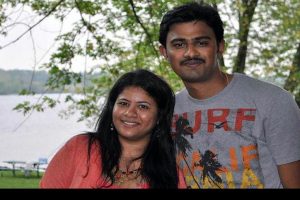
The techie's wife Sunayna Dumala, brother Sai Kishore and other relatives had come with his mortal remains.

Sai Kishore was also settled in Kansas.

It was not clear if Sunayana, who also works at a firm in Kansas, will be returning to the US.

Kuchibhotla, 32, was killed and Alok Madasani was injured when Adam W. Purinton, a white man who earlier served in the US Navy, shot them at the Austins Bar & Grill in Olathe, Kansas state, on Wednesday night.

Purinton reportedly got into an argument with the victims and hurled racial slurs. He yelled "get out of my country", "terrorist" before shooting them.

Kuchibhotla of Hyderabad and his colleague Madasani from Warangal district in Telangana were working as aviation programme managers at Garmin, an MNC.

Madasani's father Janardhan Reddy already said that he would ask his son to return home as the situation had turned bad in the US after Trump became the President. He had also appealed to parents not to send their children to the US.

"My son, like many other Indians in US are well qualified and can get better jobs in India," he had said.

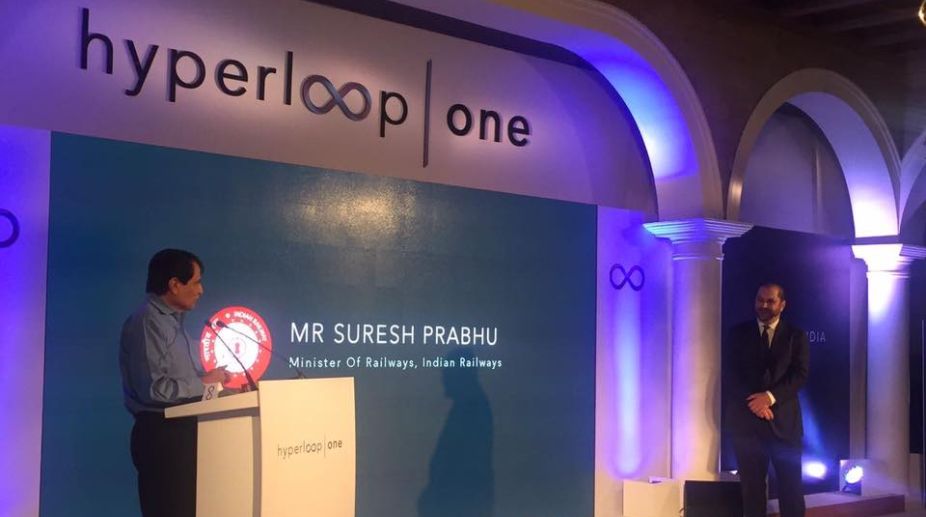
Moving at airline speed – Hyperloop One unveils ‘Vision for India’

IANS | New Delhi |

A futuristic technology in the transport system could see one whiz from Delhi to Mumbai in a pod-like car in just under one hour.

The system, unveiled by Hyperloop One here on Tuesday as part of its "vision for India", promises to revolutionize the advanced surface system by moving people and things at airline speeds.

Hyperloop One is developing the world's first operational Hyperloop.

If implemented, it would be possible to travel from Delhi to Mumbai in 55 minutes, Mumbai to Chennai in 50 minutes and Bengaluru to Chennai in 20 minutes, whizzing at a speed of around 1,100 km an hour and above.

Expressing interest in the technology, Railway Minister Suresh Prabhu said India would be keenly watching the project, which the company said was on track to run the world's first full-system test later this year in Nevada, USA.

"We all are living in exciting times. India is thinking of ways to revamp its railway network by various means like increasing the average speeds as well as developing specific high-speed corridors," Prabhu said.

He added the high-speed rail project was also at an advanced stage while India was also partnering with private entities to co-develop new railway innovations which, for the first time, would achieve speeds higher than "what we currently call high-speed rail".

Prabhu, however, added that India chooses her partners carefully and Hyperloop One would have to undergo a rigorous, but transparent, process to partner with India.

Hyperloop is a transportation system which proposes to propels a pod-like vehicle through a near-vacuum tube at more than airline speed.

NITI Ayog CEO Amitabh Kant said the key to India's growth now depends on how we transform the process of urbanization and the way people move.

"Future of the Hyperloop technology doesn't belong in the United States of America or in Europe. It belongs in a place that needs solutions," Kant said referring to India.

Rob Lloyd, the CEO of Hyperloop One, said the technology would help India build infrastructure that is both financially and environmentally sustainable.

"A transportation system like the Hyperloop will undoubtedly ease the pressure on existing infrastructure while enhancing the quality of life of the people. 

"We are already working with the governments around the world on passenger and freight projects, and we look forward to also partnering with India to support this endeavour," he said.

Shervin Pishevar, Executive Chairman of the company said the ambitious project was in line with Prime Minister Narendra Modi's vision for transforming India.

"India is an extremely important geography for developing Hyperloop networks and re-imagining how cities and regions work. The Prime Minister's vision of connecting the country is directly aligned with our objective of connecting the world," he said.

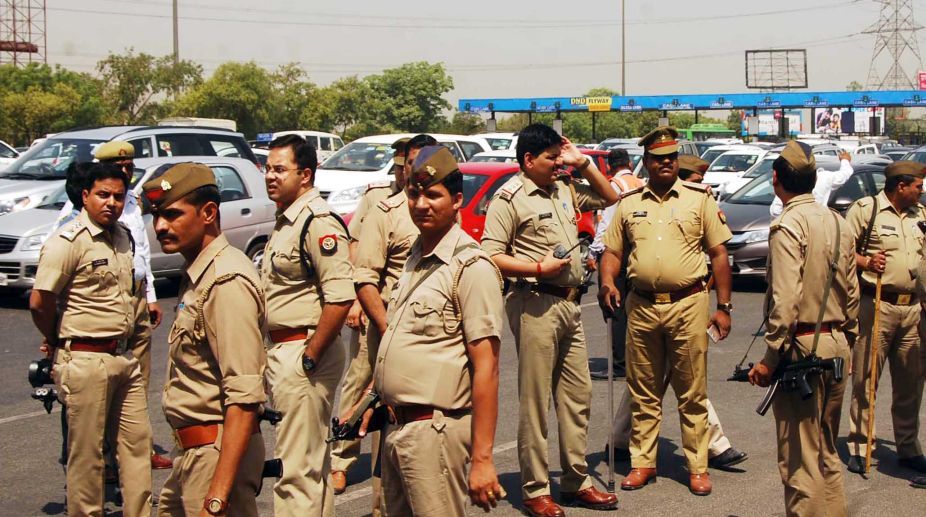
Bomb threat call in Delhi, police on alert

PTI | New Delhi |

Delhi Police was on Tuesday informed by their counterparts at Jabalpur in Madhya Pradesh about a phone call alleging that bombs were being planted at various locations in the national capital.

The phone call was received by Jabalpur SP.

It is suspected to be a hoax call. However, police is investigating the matter.

Jabalpur SP received the call on his mobile through Voice over Internet Protocol (VOIP) about bombs being planted at several locations in Delhi, said a senior police officer.

The SP informed the Delhi Police control room around 6.30pm, following which police has begun the task of identifying the caller, he added.

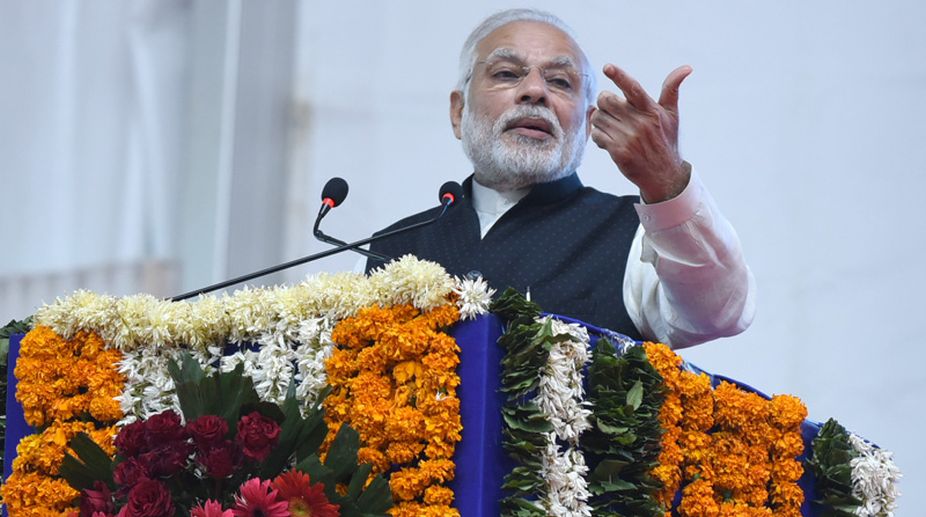
Efforts being made to improve connectivity in J-K: Modi

PTI | New Delhi |

Efforts are being made by the central government to improve connectivity and infrastructure in Jammu and Kashmir, Prime Minister Narendra Modi said on Tuesday.

He talked about the efforts while interacting with a group of over 100 youth and children from state who are currently touring different parts of India as part of the initiative Watan Ko Jaano.

The youth and children asked a number of questions to the Prime Minister on themes such as infrastructure development in Jammu and Kashmir, sports facilities in the state, education and employment opportunities, and the Prime Minister s work routine, a PMO statement said.

Modi told them that working hard is never a cause for exhaustion and completion of a task brings satisfaction, that is greater than any sense of exhaustion, the statement said.

He emphasized the importance of sports, and sportsman spirit among people.

Minister of State in the PMO Jitendra Singh was also present on the occasion.

"Had a great interaction with youth from Jammu and Kashmir who are touring different parts of India as a part of 'Watan Ko Jaano' initiative," the Prime Minister tweeted later.

"We had a discussion on various issues like infrastructure development, sports facilities, education and employment opportunities in J&K," he added.

Efforts being made to improve connectivity in J-K: Modi

PTI | New Delhi |

Efforts are being made by the central government to improve connectivity and infrastructure in Jammu and Kashmir, Prime Minister Narendra Modi said on Tuesday.

He talked about the efforts while interacting with a group of over 100 youth and children from state who are currently touring different parts of India as part of the initiative Watan Ko Jaano.

The youth and children asked a number of questions to the Prime Minister on themes such as infrastructure development in Jammu and Kashmir, sports facilities in the state, education and employment opportunities, and the Prime Minister s work routine, a PMO statement said.

Modi told them that working hard is never a cause for exhaustion and completion of a task brings satisfaction, that is greater than any sense of exhaustion, the statement said.

He emphasized the importance of sports, and sportsman spirit among people.

Minister of State in the PMO Jitendra Singh was also present on the occasion.

"Had a great interaction with youth from Jammu and Kashmir who are touring different parts of India as a part of 'Watan Ko Jaano' initiative," the Prime Minister tweeted later.

"We had a discussion on various issues like infrastructure development, sports facilities, education and employment opportunities in J&K," he added.

People have to be more tolerant in present times: Mamata

PTI | Kolkata |

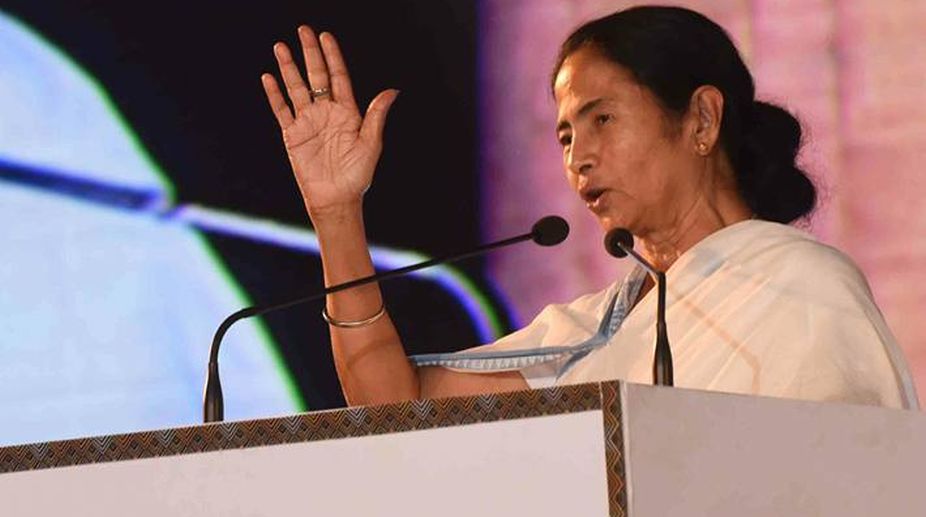
Stating that people nowadays should be more tolerant and there is no place of intolerance, West Bengal Chief Minister Mamata Banerjee on Tuesday said it is the fundamental right of a person to choose his religion.

"It is absolutely their freedom of choice what religion they will follow, what they will eat and what they will wear. Nobody has the power to interfere into the fundamental rights and the religious rights of any person. The country's Constitution has not given them the freedom to do so. Our Constitution is our armour," Banerjee said while speaking at the centenary celebrations of Bharat Sevashram Sangha at the Netaji Indoor Stadium.

"In the present times we have to be more tolerant.

There is no place for intolerance. There is no place for vandalism. If you are loving a religion, you have to respect it," she said.

Banerjee said bad people practice vandalism and initiate politics even with idols of Gods and Goddesses.

"Nobody from any specific religion initiates vandalism… I do not believe this… Only a few bad people initiate vandalism. You must worship idols of Goddesses keeping them at home or in temples and must not initiate vandalism throwing them on the streets," she said.

She went on to stress that law was equal for everybody and there cannot be any discrimination.

"Laws cannot be discriminated… Laws are laws. All are equal," Banerjee said.

People have to be more tolerant in present times: Mamata

PTI | Kolkata |

Stating that people nowadays should be more tolerant and there is no place of intolerance, West Bengal Chief Minister Mamata Banerjee on Tuesday said it is the fundamental right of a person to choose his religion.

"It is absolutely their freedom of choice what religion they will follow, what they will eat and what they will wear. Nobody has the power to interfere into the fundamental rights and the religious rights of any person. The country's Constitution has not given them the freedom to do so. Our Constitution is our armour," Banerjee said while speaking at the centenary celebrations of Bharat Sevashram Sangha at the Netaji Indoor Stadium.

"In the present times we have to be more tolerant.

There is no place for intolerance. There is no place for vandalism. If you are loving a religion, you have to respect it," she said.

Banerjee said bad people practice vandalism and initiate politics even with idols of Gods and Goddesses.

"Nobody from any specific religion initiates vandalism… I do not believe this… Only a few bad people initiate vandalism. You must worship idols of Goddesses keeping them at home or in temples and must not initiate vandalism throwing them on the streets," she said.

She went on to stress that law was equal for everybody and there cannot be any discrimination.

"Laws cannot be discriminated… Laws are laws. All are equal," Banerjee said.

It was not notebandi, but nasbandi: Lalu

PTI | Varanasi |

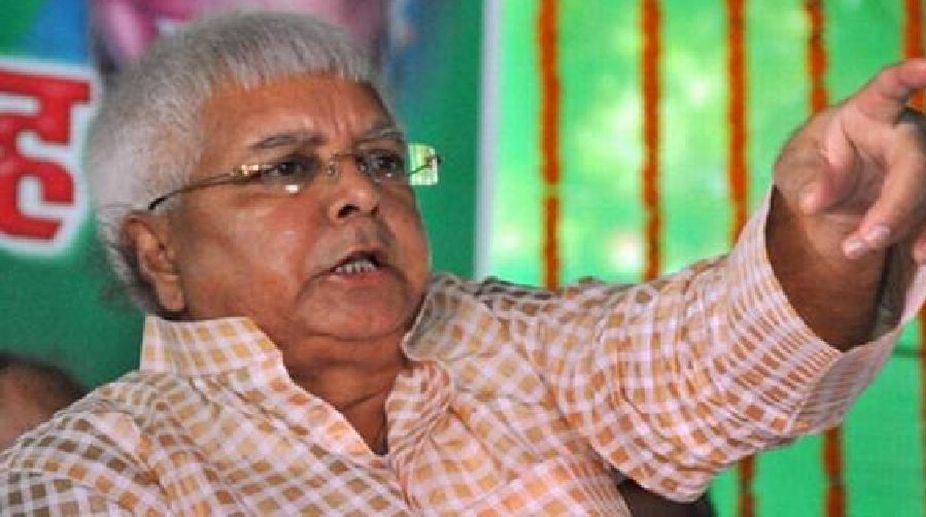
Rashtriya Janata Dal supremo Lalu Prasad Yadav on Tuesday sought to liken BJP-led NDA government's last November demonetisation decision with infamous mid-1970s Emergency-era phenomena of forced 'nasbandi' (sterilisation).

"It was not notebandi but nasbandi, carried out by the Modi government on crores of people, who were forced to stand in queue for withdrawing their own money from the banks," said Lalu, launching a scathing attack on Prime Minister Narendra Modi.

Lalu attacked Modi while addressing an election campaign rally here in support the SP-Congress alliance candidate and dubbed the Prime Minister as twin brother of US President Donald Trump, saying "no one knows what will the two do next."

Lalu dubbed Modi Trump's "twin brother," while seeking to describe Congress president Sonia Gandhi as 'bahu' (the daughter-in-law) of the country.

"Sonia Gandhi is the bahu (daughter-in-law) of India, she is no more a foreigner for us," he said attacking the PM and inadvertently raking up Gandhi's foreign origin issue. It was not clear what made Lalu suddenly assert Gandhi's identity as an Indian.

The RJD supremo also attacked BJP president Amit Shah saying he along with Modi sidelined their senior leaders like LK Advani and others.

Lalu was addressing a poll campaign rally at Pindra near here to seek support for Congress-SP joint candidate Ajai Rai, who is the sitting MLA from the seat.

Earlier he also addressed a rally in Marihan in Mirzapur in favour of Congress-SP candidate Laliteshpati Tripathi. 

It was not notebandi, but nasbandi: Lalu

PTI | Varanasi |

Rashtriya Janata Dal supremo Lalu Prasad Yadav on Tuesday sought to liken BJP-led NDA government's last November demonetisation decision with infamous mid-1970s Emergency-era phenomena of forced 'nasbandi' (sterilisation).

"It was not notebandi but nasbandi, carried out by the Modi government on crores of people, who were forced to stand in queue for withdrawing their own money from the banks," said Lalu, launching a scathing attack on Prime Minister Narendra Modi.

Lalu attacked Modi while addressing an election campaign rally here in support the SP-Congress alliance candidate and dubbed the Prime Minister as twin brother of US President Donald Trump, saying "no one knows what will the two do next."

Lalu dubbed Modi Trump's "twin brother," while seeking to describe Congress president Sonia Gandhi as 'bahu' (the daughter-in-law) of the country.

"Sonia Gandhi is the bahu (daughter-in-law) of India, she is no more a foreigner for us," he said attacking the PM and inadvertently raking up Gandhi's foreign origin issue. It was not clear what made Lalu suddenly assert Gandhi's identity as an Indian.

The RJD supremo also attacked BJP president Amit Shah saying he along with Modi sidelined their senior leaders like LK Advani and others.

Lalu was addressing a poll campaign rally at Pindra near here to seek support for Congress-SP joint candidate Ajai Rai, who is the sitting MLA from the seat.

Earlier he also addressed a rally in Marihan in Mirzapur in favour of Congress-SP candidate Laliteshpati Tripathi.