Logo

Opportunity for mutual

Rangan Dutta | New Delhi |

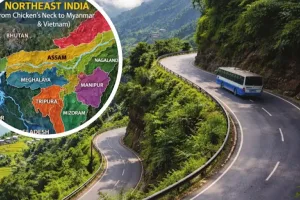
The strategic significance of the extended definition of the North-east, which made Sikkim a part of the North Eastern Council, is that the region is now the only one in India that shares land borders with five countries. And yet, interest in developments in Nepal has always been limited with little media coverage.
Even in the 1990s when the Maoists launched the Peoples’ War in that country and installed a parallel power centre vis- a- vis the state in several parts, media and people in the North-east did not feel concerned about the possible impact of Maoism in the region.
This was in sharp contrast with the perception that prevailed in the wake of the Naxalite movement in the 1970s. It might be due to the anti-foreigners movement in the 1980s when migration from Nepal was seen as a part of the problem. However, indifference to Nepal now makes little geo-political sense because in the post- April 2015 earthquake scenario, new opportunities are emerging for India in which the North-east may have a mutually beneficial role to play. Such possibilities have been obscured in the fog of political uncertainty associated with Nepal’s unfinished task of forming a constitution capable of meeting the legitimate aspirations of its diverse population, which is divided into four broad ethno-cultural groups. These are upper caste-based in the hills and the valley, Janjatis meaning tribes in the hills and plains divided into 54 groups, Dalits and Madhesis comprising roughly 31 per cent, 30 per cent, nine per cent and 31 percent, respectively of Nepal’s population of 29 million people according to the 2016 estimates. However, there are some gaps in these estimates due to overlapping of identities. 
The mind-boggling ethnic diversity of Nepal is seen from the fact that in only 15 out of 75 districts is there a single group that makes up more than 50 per cent of the population. This makes the task of delineation of legislative constituencies, reservation of seats and any system of decentralised governance extremely complex. Consequently the declaration the Maoists made when they joined the interim government in 2006 of wanting Nepal, even in the interim period, to become a democratic federal republic remained unfulfilled largely due to a lack of consensus in balancing the interests of ethnic groups in the distribution of political power in a democracy with federal features as worked out in the 2015 constitution. 
Since Nepal was not under direct British rule, its institutions of governance were not influenced, as in India, by the British “common law”, systems and procedures. From the formation of the state in 1768 under the legendary King Prithvi Narayan Shah till the 1990 constitution, Nepal was an absolute monarchy without any basic feature of democracy such as the rule of law, bill of rights, duly elected legislature, independent judiciary and an apolitical civil service. And, power and privileges were cornered by the “hill upper caste elite” who held roughly two thirds of all positions in government while the land and other rights of subjects were unclear and discriminatory. 
The Maoist insurgency was a violent protest against this “extractive” state. However, its promise of building an “inclusive” state has hit several road blocks of such magnitude that they prompted keen observers of Nepal like KV Rajan, who was the Indian envoy there, to feel that notwithstanding the 2015 Constitution and the decision of the government to go through the motions of elections to local bodies — scheduled in May this year — and provincial and national legislatures thereafter to be completed by January 2018, the election process is unlikely to succeed in the near future. The withdrawal of support of an alliance of Madhes-based political parties to Prime Minister Prachanda-led government on 15 March and the present Madhes agitation against holding of elections to local bodies — the first ever to be held in Nepal after 20 years — prove that Rajan’s assessment has been right.
Let us look at the Madhesi issue. There has been inaccurate reporting in the Indian media that the Madhesis are of Indian origin, far from it because the Terai area where they live was a part of the kingdom of Nepal since its inception in 1765. 
The British allowed Nepal to retain this territory to ensure economic viability of Nepal and two districts in the far west, Kanchanpur and Kailali were returned to the monarchy for their loyalty after 1857.The Ranas like the zamindars of Assam’s Goalpara district actually encouraged farmers from neighbouring areas to move up to raise crops and thereby increase revenues of the state. Thus Madhes emerged as the base of Nepal’s agrarian economy and the main source of revenue. Also, all surface transport links to India passes through Madhes. Thus 50 per cent plus of Nepal’s GDP of $20.88 billion ($71.52billion in terms of purchasing power parity as per 2016 estimates) is derived from the Madhes region and the main segments of the industry and service sector of the economy operate in Madhes except tourism. 
The economic future of Nepal critically depends on Madhes. In the present situation when democracy in South Asia is really a “numbers game”, the formation of seven provinces under the 2015 Constitution mixing hills and plains areas in a manner that would ensure permanent dominance of the “hill upper caste elite” in six provinces means cynical rejection of the core Madhesi demand of ethnicity-based constitution of provinces for ensuring due Madhesi representation in the national assembly and their majority status in two provinces in the Terai. 
The demands are unlikely to be met soon as this will require a restructuring of the dispensation of political power in Nepal and a change in the outlook of the ruling elite, which calls itself Communist and democratic, and is yet unwilling to agree to a political arrangement based on regional autonomy and balanced development for peace and progress of Nepal.
The brighter side of Nepal is the small population and huge untapped hydro-power potential, estimated at 42,000 MW, and natural resources for rapid all-round growth of the economy. In 2014, the economy grew at six per cent and though disrupted in 2015 due to the earthquakes, it is picking up again mainly fuelled by post-earthquake reconstruction and increased remittances from expatriate Nepali citizens, which account for 31.7 per cent of the GDP — the highest proportion for any South Asian nation as over half a million Nepalis are presently working in countries outside South Asia. 
Nepal has a strong co-operative sector and has embarked on a skill development programme and to promote medium, small and micro enterprises. There has been a rising demand for improved health care and higher education in engineering, medical and management, which cannot be locally made given the spatial distribution of Nepal’s population and easy access to such facilities in the Indian neighbourhood. That creates opportunities for West Bengal, Sikkim and other North-eastern states. 
The latter has an advantage as it has a well spread out ethnic Nepali population, which must now be about two million, which is five per cent of the region’s population especially in Assam, Meghalaya, Manipur, Arunachal Pradesh and Nagaland. 
In Assam, Nepalis introduced commercial dairy farming for which they were accorded recognition as “graziers” under the Assam Land Revenue Regulation 1886 and “professional grazing reserve” lands were set apart for their cattle in all Assam valley districts. Their role in the Assam Rifles, state police, forest resource-based activity and as skilled workforce in urban areas, have immensely contributed to transform the North-east in the modern period. Thus the time has come to recognise the ethnic Nepali not as the “other” but as a vital link to the emerging economy of Nepal with increased foreign investment and larger interaction with the neighbouring states of India and South-east Asia. 
If the North-east could open its healthcare and education facilities to Nepal, the region could gain immensely from a research and development partnership with the Nepal-based International Center for Mountain Development. The region could also avail Nepal’s expertise in developing world class tourism industry for ushering in a new era of Nepal-North East economic and technological cooperation. And this will require a critical change of mindset in the North-east — looking to Nepal as a source of opportunity for mutual progress.

(THE WRITER IS A RETIRED IAS OFFICER OF THE ASSAM-MEGHALAYA CADRE AND HAS SERVED AS A SCIENTIFIC CONSULTANT IN THE OFFICE OF THE PRINCIPAL SCIENTIFIC ADVISOR TO THE GOVERNMENT OF INDIA)
No solace in Manipur

Yambem Laba | New Delhi |

In the election to the 11th Manipur Assembly no party won the magic figure to form a government. But Governor Najma Heptullah acted as the perfect henchwoman of the saffron brigade and threw constitutional niceties to the wind by ignoring the claim of Congress leader Okram Ibobi Singh and his flock of 28 MLAs in the 60-member house being the single largest party and instead chose BJP, with 21 MLAs, to form a new government.
The BJP is being propped up by four MLAs belonging to the National People’s Party, four from the Naga People’s Front, one from the Lok Jana Sakhti Party, and one from the Congress. The BJP had also earlier inducted into its fold the lone Trinamool Congress MLA, taking its tally to 32 by virtue of which the governor was satisfied and opened the gates of the Raj Bhawan  for  them.
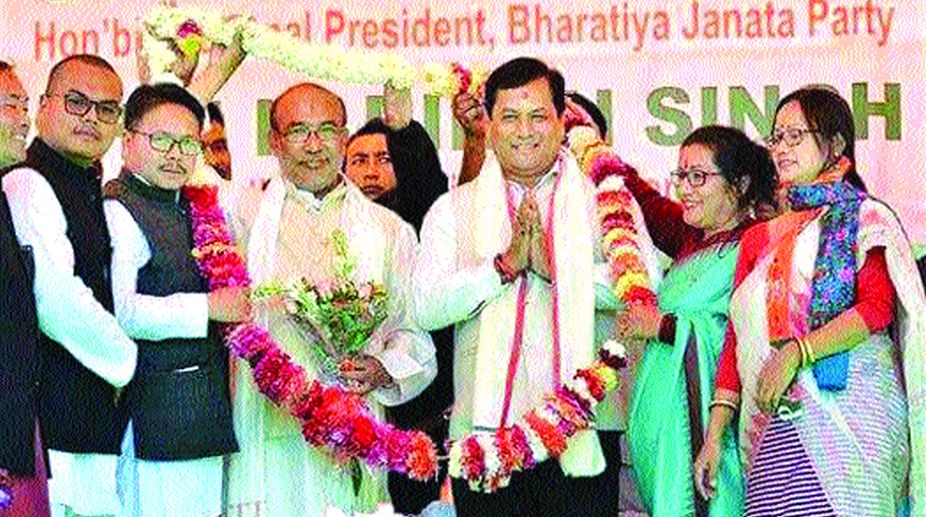
Former Border Security Force footballer and editor of a vernacular Naharol gi Thoudang and minister in Ibobi’s second tenure, Nongthonbam Biren was sworn in as the Chief Minister on 15 March.  Former director-general of police Yumnam Joykumar, who was denied a BJP ticket but was elected on an NPP ticket, was named the deputy chief minister. The only other BJP legislators to be   accommodated is Thongnam Bishwajit. All the four from the NPP got the ministerial posts, plus one from the LJP and one from the NPF. And the lone Congress MLA Th Shyamkumar, who joined the BJP, was rewarded with a ministerial post, bringing the tally to nine, including the chief minister, leaving only three more vacancies in the cabinet.
The run- up to the elections had been hectic with all the big guns of the saffron party lining up at Imphal.  It was headed by Prime Minister Narendra Modi with party president Amit Shah in tow and Prakash Javadekar, Union HRD minister, making Imphal his base camp with a host of other Central ministers who had been visiting Imphal over the last three months. They were later joined by Assam and Arunachal Pradesh chief ministers, Sarbanada Sonowal and Pema Khandu respectively.
Politicians make strange bedfellows and the BJP is no exception. For instance it was only in November 2016 that new chief minister Biren had announced that the BJP will have nothing to do with the NPF, a party which has, in its constitution, a clause that calls for the unification of all Naga-inhabited areas under one administrative unit, implying Greater Nagaland or a threat to Manipur’s territorial integrity.
But as soon as the NPF wrote to the governor extending support to a non –Congress government, the BJP seized the opportunity and even made an NPF legislator a cabinet minister.
The prime minister in his rhetoric best had told an election rally in Imphal that if a BJP government is elected in Manipur than the ongoing economic blockade the pro-NSCN (IM) Manipur-based United Naga Council had imposed since 1 November last year, will be liftedwithin 48 hours. And, with the NPF as a coalition partner, it was thought that the UNC will listen to the request of the new government, (the first cabinet meeting of the new government had a single agenda and that was to appeal to the UNC to lift the blockade).  But it appears to have fallen on deaf ears.
The UNC has now come out publicly stating that the blockade will continue till the new government invites them formally for talks. It seems that the Nagas want to have their pound of flesh and crucial to their demand is the rollback on the recent creation of the Kangpokpi District, carved out of Senapati and Jiribam districts bifurcated from Imphal East. And the NPF members are also going to be hell bent on the same.
And if just-sworn-in chief minister Biren does that, Kukis and Meiteis are certain to revolt. So, by all accounts, the honeymoon between the BJP and the NPF may not last long.
This election also saw some no-holds- bar advertisement war between the BJP and the Congress. The Election Commission of India is not happy over the BJP’s   desperate move in inserting an advertisement in the local newspapers with its doctored-certificates, putting in trouble the editors of the local papers that had carried the advertisements.
What is more, in its desperation to swell its rank, the BJP even tried to snatch the lone Independent MLA from Jiribam. A former Congress minister had gone to Jiribam to fetch him and was returning to Imphal from Guwahati by air. Apparently, acting on directives from the high command, the Central Industrial Security Force personnel, guarding the Imphal international airport, detained the duo till the Assam chief minister sent a special plane to Imphal and whisked the Independent MLA away to safer Guwahati, leaving the Congress dumfounded.
The other side show of the elections this time is the eclipsing of the “Iron Lady of Manipur” Irom Sharmila, who in August last year broke her 16-year-old fast demanding the repeal of the draconian Armed Forces (Special Powers) Act in force in Manipur since the end of 1979.  She, along with her Harvard-returned Erendro Leichombam had floated the People’s Resurgence and Justice Alliance and contested against outgoing chief minister Okram Ibobi Singh.
Around the same time her boyfriend/fiancé, an NRI of Goan origin by the name of Desmond Coutinho started abusing all her supporters and the general Manipuri people using filthy languages on social media. So much so that Sharmila was told in no uncertain terms that unless she apologised on behalf of Desmond, the people will announce that they have ceased to support her citing the reasons thereof. Sharmila seemed to have understood the predicament and issued a statement apologising on Desmond’s behalf and seeking forgiveness from the public on that account.
It was with great difficulty that her supporters could muster up 10 voters from Thoubal to vouch for her when she filed the nomination papers. And when the results finally came out she had polled just 90 votes compared to 16,000 plus for Ibobi.  
And the second shock she must have got was that initially she was planning to get married to the NRI after election, the results notwithstanding. But her lover boy again declared that he will marry her only after the Lok Sabha polls in 2019 where she is expected to bring about a sweeping change in Manipuri politics. Left with no choice a shattered Sharmila has left the state for a retreat centre somewhere in Kerala. She may soon become only a memory among the Manipuris.
But all said and done, the 19 sitting Congress members of the assembly, including four cabinet ministers, lost in the hustings thereby bringing in a semblance of change in the state and Ibobi’s  hope for a record fourth time got dashed although he managed to get his son and nephew elected.
The Congress MLA who switched over to the BJP has to elect himself in another six months. The BJP Government now only has three ministerial berths to offer to any new comers and the grapevine says that grumbling has already begun among the BJP legislators, so such so that Assam’s minister Himanta Biswa Sarma is said to be have taken four of them to Assam to assuage hurt feelings. And with the NPF demanding their pound of flesh and the UNC unrelenting in its stand, the NPF might be coerced into withdrawing support and therefore, the possibility of President’s Rule being imposed in the next six months cannot be ruled out.

(THE WRITER IS THE IMPHAL-BASED SPECIAL REPRESENTATIVE OF THE STATESMAN)

No solace in Manipur

Yambem Laba | New Delhi |

In the election to the 11th Manipur Assembly no party won the magic figure to form a government. But Governor Najma Heptullah acted as the perfect henchwoman of the saffron brigade and threw constitutional niceties to the wind by ignoring the claim of Congress leader Okram Ibobi Singh and his flock of 28 MLAs in the 60-member house being the single largest party and instead chose BJP, with 21 MLAs, to form a new government.
The BJP is being propped up by four MLAs belonging to the National People’s Party, four from the Naga People’s Front, one from the Lok Jana Sakhti Party, and one from the Congress. The BJP had also earlier inducted into its fold the lone Trinamool Congress MLA, taking its tally to 32 by virtue of which the governor was satisfied and opened the gates of the Raj Bhawan  for  them.
Former Border Security Force footballer and editor of a vernacular Naharol gi Thoudang and minister in Ibobi’s second tenure, Nongthonbam Biren was sworn in as the Chief Minister on 15 March.  Former director-general of police Yumnam Joykumar, who was denied a BJP ticket but was elected on an NPP ticket, was named the deputy chief minister. The only other BJP legislators to be   accommodated is Thongnam Bishwajit. All the four from the NPP got the ministerial posts, plus one from the LJP and one from the NPF. And the lone Congress MLA Th Shyamkumar, who joined the BJP, was rewarded with a ministerial post, bringing the tally to nine, including the chief minister, leaving only three more vacancies in the cabinet.
The run- up to the elections had been hectic with all the big guns of the saffron party lining up at Imphal.  It was headed by Prime Minister Narendra Modi with party president Amit Shah in tow and Prakash Javadekar, Union HRD minister, making Imphal his base camp with a host of other Central ministers who had been visiting Imphal over the last three months. They were later joined by Assam and Arunachal Pradesh chief ministers, Sarbanada Sonowal and Pema Khandu respectively.
Politicians make strange bedfellows and the BJP is no exception. For instance it was only in November 2016 that new chief minister Biren had announced that the BJP will have nothing to do with the NPF, a party which has, in its constitution, a clause that calls for the unification of all Naga-inhabited areas under one administrative unit, implying Greater Nagaland or a threat to Manipur’s territorial integrity.
But as soon as the NPF wrote to the governor extending support to a non –Congress government, the BJP seized the opportunity and even made an NPF legislator a cabinet minister.
The prime minister in his rhetoric best had told an election rally in Imphal that if a BJP government is elected in Manipur than the ongoing economic blockade the pro-NSCN (IM) Manipur-based United Naga Council had imposed since 1 November last year, will be liftedwithin 48 hours. And, with the NPF as a coalition partner, it was thought that the UNC will listen to the request of the new government, (the first cabinet meeting of the new government had a single agenda and that was to appeal to the UNC to lift the blockade).  But it appears to have fallen on deaf ears.
The UNC has now come out publicly stating that the blockade will continue till the new government invites them formally for talks. It seems that the Nagas want to have their pound of flesh and crucial to their demand is the rollback on the recent creation of the Kangpokpi District, carved out of Senapati and Jiribam districts bifurcated from Imphal East. And the NPF members are also going to be hell bent on the same.
And if just-sworn-in chief minister Biren does that, Kukis and Meiteis are certain to revolt. So, by all accounts, the honeymoon between the BJP and the NPF may not last long.
This election also saw some no-holds- bar advertisement war between the BJP and the Congress. The Election Commission of India is not happy over the BJP’s   desperate move in inserting an advertisement in the local newspapers with its doctored-certificates, putting in trouble the editors of the local papers that had carried the advertisements.
What is more, in its desperation to swell its rank, the BJP even tried to snatch the lone Independent MLA from Jiribam. A former Congress minister had gone to Jiribam to fetch him and was returning to Imphal from Guwahati by air. Apparently, acting on directives from the high command, the Central Industrial Security Force personnel, guarding the Imphal international airport, detained the duo till the Assam chief minister sent a special plane to Imphal and whisked the Independent MLA away to safer Guwahati, leaving the Congress dumfounded.
The other side show of the elections this time is the eclipsing of the “Iron Lady of Manipur” Irom Sharmila, who in August last year broke her 16-year-old fast demanding the repeal of the draconian Armed Forces (Special Powers) Act in force in Manipur since the end of 1979.  She, along with her Harvard-returned Erendro Leichombam had floated the People’s Resurgence and Justice Alliance and contested against outgoing chief minister Okram Ibobi Singh.
Around the same time her boyfriend/fiancé, an NRI of Goan origin by the name of Desmond Coutinho started abusing all her supporters and the general Manipuri people using filthy languages on social media. So much so that Sharmila was told in no uncertain terms that unless she apologised on behalf of Desmond, the people will announce that they have ceased to support her citing the reasons thereof. Sharmila seemed to have understood the predicament and issued a statement apologising on Desmond’s behalf and seeking forgiveness from the public on that account.
It was with great difficulty that her supporters could muster up 10 voters from Thoubal to vouch for her when she filed the nomination papers. And when the results finally came out she had polled just 90 votes compared to 16,000 plus for Ibobi.  
And the second shock she must have got was that initially she was planning to get married to the NRI after election, the results notwithstanding. But her lover boy again declared that he will marry her only after the Lok Sabha polls in 2019 where she is expected to bring about a sweeping change in Manipuri politics. Left with no choice a shattered Sharmila has left the state for a retreat centre somewhere in Kerala. She may soon become only a memory among the Manipuris.
But all said and done, the 19 sitting Congress members of the assembly, including four cabinet ministers, lost in the hustings thereby bringing in a semblance of change in the state and Ibobi’s  hope for a record fourth time got dashed although he managed to get his son and nephew elected.
The Congress MLA who switched over to the BJP has to elect himself in another six months. The BJP Government now only has three ministerial berths to offer to any new comers and the grapevine says that grumbling has already begun among the BJP legislators, so such so that Assam’s minister Himanta Biswa Sarma is said to be have taken four of them to Assam to assuage hurt feelings. And with the NPF demanding their pound of flesh and the UNC unrelenting in its stand, the NPF might be coerced into withdrawing support and therefore, the possibility of President’s Rule being imposed in the next six months cannot be ruled out.

(THE WRITER IS THE IMPHAL-BASED SPECIAL REPRESENTATIVE OF THE STATESMAN)

The Abbott and the Skeptic

Manish Nandy | New Delhi |

"A sucker is born every minute,” said Barnum, the 19th century showman. I saw enough of that when I lived in India and, on the recommendation of well-meaning friends, met revered gurus who quickly proved purveyors of snake oil. They would spout sacred verses in Sanskrit, which most Indians don’t know; but I had painstakingly learned the ancient language, in which most Hindu texts are written, and I frequently found these blatantly misquoted or misinterpreted.
When I came to the US, I found a parallel phenomenon with religious leaders. They would volubly cite Biblical verses, then interpret them to neatly fit their crass social or political views. A famous preacher in the south would massage them for a happy, upbeat creed, while a popular televangelist would use them for fiery anti-Arab diatribes. They cared little for the historical meaning of canonical texts.
So you will understand my hesitation when a friend in Kathmandu suggested that I join him and visit a reputed Buddhist lama. The latter, I was told in a hushed tone, was both a Rimpoche (the word means jewel), a scholarly abbot, and a Tulku, a child prodigy who is the custodian of a Tibetan Buddhist lineage.
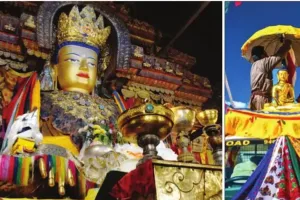
I had barely sipped my first cup of coffee that Saturday morning when my resolute friend came to collect me. Seto Gumpa, the white chapel, was a charming midtown monastery, neither small or cramped nor huge or overwhelming, and, with colorful little flags and bright curtains, almost unmonastic.
We sat cross-legged on the carpeted floor of a sun-drenched hall with sixty other visitors, and presently the Rimpoche arrived.
A middle aged man, with a young and sturdy look, he wore a loose brown-and-saffron garb and walked briskly across the hall to take his seat on a slightly elevated platform. The broad eyebrows and firm lips were a contrast to his sparkling eyes. When he spoke, his tone was of genial conversation, not weighty discourse. He gave pauses, seeming to invite questions, and when some came, he explained himself mildly, almost deferentially.
His was the shortest spiritual talk I have ever heard. When he stopped, some of the foreigners present asked him about Buddhist practices and he responded readily, sometimes drolly, to everyone.
Then suddenly the Rimpoche pointed at the last row, and I thought he wanted to talk to my friend. My friend whispered, “He wants to talk to you,” and quickly wrapped a silken scarf around my neck. I walked up to the Rimpoche, and following the Tibetan custom unwrapped the scarf, bowed and placed it around his neck. He acknowledged the gift with a bow and then placed his own scarf – gently but more deftly – round my neck.
As I sat awkwardly on the floor in front of him, he smiled and asked who I was. I gave the conventional reply that I was the American consul in Nepal. He said that I looked a little different from the other Americans in the room. I explained that I was born in India of Indian parents and had spent a large part of my life there.
Why did I then move to the US? I had met and loved somebody in India, who was an American. When she returned to her country, she wanted me to join her, and I did. He smiled broadly and said I was right to do so.
Then he asked me a question that stumped me. Was I happy? Did I like doing what I was doing in my life? I thought a little and said that there were parts of my work – parts where I felt I was helping other people – that I liked. There were also, I added, other parts that I did not like so much. In my private life too, I liked the affection of friends and family, but weren’t comfortable with some other elements.
I paused and then hesitantly said that I was often troubled by the feeling that my life was far too focused on small things and on myself; I would have preferred “a larger role for larger things.”
He looked at me for a long time in silence. His face was as placid as it was earlier, but now it had a tinge of concern and sadness.
He asked me to tell him my full name. When I did so, he repeated it and asked me to help him pronounce it properly. I said it twice more and he repeated it. When I nodded to approve, he asked me, so softly that I had to bend to hear him, to take care of myself. “Good care,” he emphasized.
He was again quiet for a while. Then he said: “Do the small things well. As well as you can. And wait for the larger things to appear.”
More than a decade has passed since that strange encounter. I cannot forget the astonishing tranquility the Rimpoche somehow conferred on me in those few minutes. Never have I talked with a total stranger and felt every syllable heard with supreme attention and, yes, acceptance.
I had heard a rumour that he was clairvoyant. He didn’t need to be, for he saw, I felt, right inside me. He didn’t just hear my words; he absorbed my thoughts, my feelings, all my fears, hopes and concerns. Ludicrous as it sounds, I said to my friend, I felt like a little boy sitting in front of my mother, loved, cared for, fully understood.
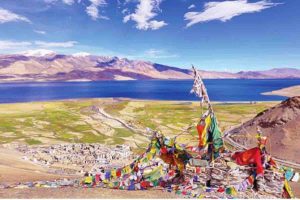
When I came out, the colourful little flags of Seto Gumpa, fluttering in the midday breeze, seemed to be singing a silent anthem.

(The writer is a Washington-based international development advisor and had worked with the World Bank. He can be reached at mnandy@gmail.com)

Why executioners are willing

Sobhya Agha | New Delhi |

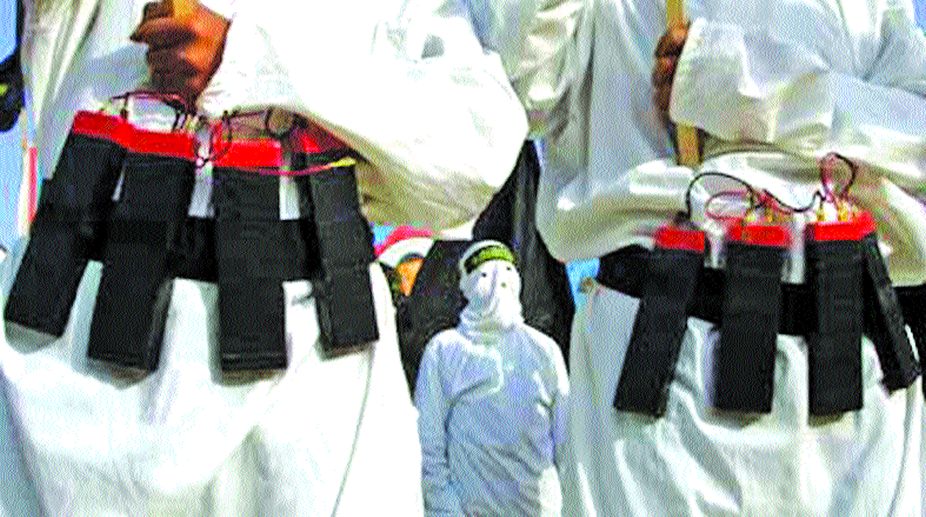
Terrorism, in one form or another, has existed for centuries. While its goals change according to the prevailing context, the basic technique ie using force to achieve political, social and religious ends has been the same throughout history, and has often included the use of suicide attackers.
Modern suicide terrorism began in the 1980s under conditions where the coercer was the weaker actor and the target the stronger. From Hezbollah, Hamas, the Tamil Tigers and Chechnyan rebel groups to Al Qaeda and the militant Islamic State group, the rhetoric of major suicide terrorist groups reflects the logic of coercive punishment. This technique’s purpose is to inflict punishment and provoke fear. Triggered in part by suicide attacks elsewhere, a trend of such attacks took off in Pakistan in 2004, with waves of increased frequency.
The protracted terrorism campaign in Pakistan seems to base itself on three levels of validation: strategic, social and individual — the strategy being to induce changes in the status quo through political coercion. If terrorist groups did not believe that suicide attacks would advance their political goals, they would not carry them out. The reason behind the uptick in such attacks is that its sponsors know that the strategy pays off and is effective in achieving some political and societal changes. People belonging to minority Islamic sects and minority religions, security forces, lawyers, etc are tactically selected to maximise the damage in terms of casualties and intimidation.
Social validation comes from terrorist groups’ ability to exist, nurture and thrive in society. Our government and society seem to tolerate their existence and recruitment efforts, and legitimise their proclamations of hate and religious 
purity.
The endless supply of individuals willing to give up their lives to attack innocent people provides the third validation. Religious indoctrination, weak states, hegemonic structures, inequality, poverty, and a lack of democracy and rule of law enable this supply of ‘willing executioners’.
Suicide attacks do not appear out of thin air, they require systematic efforts. Stopping this heinous act requires a multi-pronged strategy involving intelligence, security and operational measures, response and deterrence mechanisms, awareness campaigns and community involvement, and influencing the attitudes of such groups’ constituencies.
Intelligence is key, and both the federal and provincial law-enforcement agencies need to enhance their capabilities. Data collection and analysis, with support from modern technologies, is vital for eliminating terrorism’s infrastructure. Increased coordination among intelligence and law enforcement to collect, share and analyse data on terrorist threats is needed.
Even with such measures, attacks may occur, which is why the government must have effective response measures. Disaster preparedness plans and structures must be developed, and technical, mitigation and relief teams formed, to deal with rescue and evacuation. This would reduce public apprehension and panicked demands for extreme measures that may imperil democracy. Involving the community in emergency disaster preparedness would be of benefit.
Terrorism is a group endeavour and, thus, deterrence efforts should be mainly directed at groups rather than individuals. A credible threat of severe punishment that implies a group’s demise would presumably act as a deterrent, while addressing the grievances of larger population groups, to which the terrorists belong, may be effective in changing sympathies. A consistent, well-publicised de-radicalisation and rein­­tegration plan for deserters and sym­­pathisers would also be invaluable.
It is imperative to gain insights into the conditions and processes leading up to terrorist atrocities to identify possible interventions to prevent/ break the cycle of retaliation. Physical security measures may prevent attacks from occurring, but they do not eliminate the ideology or the enthusiasm for it.
When we tolerate religious parties and schools censuring religious minorities, women, and progressive sections of society, and subscribe to the absence of separation between religion and state, terrorism is inevitable. Collective efforts are needed at all levels of government and society to create an environment that discourages militancy and fanaticism.
An outright rejection of sectarian religious education, and advocating for policies and laws that create a more unprejudiced and equal society, can serve as an antidote to terrorism. The syllabi taught in madressahs must be regulated. Civil society, progressive writers, academics, activists, and print and electronic media must be given support and protection to counter prevailing narratives that inspire extremism through education and awareness campaigns that promote tolerance.

Dawn/ANN.

Why executioners are willing

Sobhya Agha | New Delhi |

Terrorism, in one form or another, has existed for centuries. While its goals change according to the prevailing context, the basic technique ie using force to achieve political, social and religious ends has been the same throughout history, and has often included the use of suicide attackers.
Modern suicide terrorism began in the 1980s under conditions where the coercer was the weaker actor and the target the stronger. From Hezbollah, Hamas, the Tamil Tigers and Chechnyan rebel groups to Al Qaeda and the militant Islamic State group, the rhetoric of major suicide terrorist groups reflects the logic of coercive punishment. This technique’s purpose is to inflict punishment and provoke fear. Triggered in part by suicide attacks elsewhere, a trend of such attacks took off in Pakistan in 2004, with waves of increased frequency.
The protracted terrorism campaign in Pakistan seems to base itself on three levels of validation: strategic, social and individual — the strategy being to induce changes in the status quo through political coercion. If terrorist groups did not believe that suicide attacks would advance their political goals, they would not carry them out. The reason behind the uptick in such attacks is that its sponsors know that the strategy pays off and is effective in achieving some political and societal changes. People belonging to minority Islamic sects and minority religions, security forces, lawyers, etc are tactically selected to maximise the damage in terms of casualties and intimidation.
Social validation comes from terrorist groups’ ability to exist, nurture and thrive in society. Our government and society seem to tolerate their existence and recruitment efforts, and legitimise their proclamations of hate and religious 
purity.
The endless supply of individuals willing to give up their lives to attack innocent people provides the third validation. Religious indoctrination, weak states, hegemonic structures, inequality, poverty, and a lack of democracy and rule of law enable this supply of ‘willing executioners’.
Suicide attacks do not appear out of thin air, they require systematic efforts. Stopping this heinous act requires a multi-pronged strategy involving intelligence, security and operational measures, response and deterrence mechanisms, awareness campaigns and community involvement, and influencing the attitudes of such groups’ constituencies.
Intelligence is key, and both the federal and provincial law-enforcement agencies need to enhance their capabilities. Data collection and analysis, with support from modern technologies, is vital for eliminating terrorism’s infrastructure. Increased coordination among intelligence and law enforcement to collect, share and analyse data on terrorist threats is needed.
Even with such measures, attacks may occur, which is why the government must have effective response measures. Disaster preparedness plans and structures must be developed, and technical, mitigation and relief teams formed, to deal with rescue and evacuation. This would reduce public apprehension and panicked demands for extreme measures that may imperil democracy. Involving the community in emergency disaster preparedness would be of benefit.
Terrorism is a group endeavour and, thus, deterrence efforts should be mainly directed at groups rather than individuals. A credible threat of severe punishment that implies a group’s demise would presumably act as a deterrent, while addressing the grievances of larger population groups, to which the terrorists belong, may be effective in changing sympathies. A consistent, well-publicised de-radicalisation and rein­­tegration plan for deserters and sym­­pathisers would also be invaluable.
It is imperative to gain insights into the conditions and processes leading up to terrorist atrocities to identify possible interventions to prevent/ break the cycle of retaliation. Physical security measures may prevent attacks from occurring, but they do not eliminate the ideology or the enthusiasm for it.
When we tolerate religious parties and schools censuring religious minorities, women, and progressive sections of society, and subscribe to the absence of separation between religion and state, terrorism is inevitable. Collective efforts are needed at all levels of government and society to create an environment that discourages militancy and fanaticism.
An outright rejection of sectarian religious education, and advocating for policies and laws that create a more unprejudiced and equal society, can serve as an antidote to terrorism. The syllabi taught in madressahs must be regulated. Civil society, progressive writers, academics, activists, and print and electronic media must be given support and protection to counter prevailing narratives that inspire extremism through education and awareness campaigns that promote tolerance.

Dawn/ANN.

A militant nationalist

Kabita Ray | New Delhi |

The revolutionary movement in India, the most fascinating chapter in the history of the struggle for freedom, had burst into a mighty tempest after the Partition of Bengal (1905). The origin of the movement, however, can be traced to an earlier period. Maharashtra may be regarded as the pioneer of the revolutionary struggle and the nerve-centre of sedition.
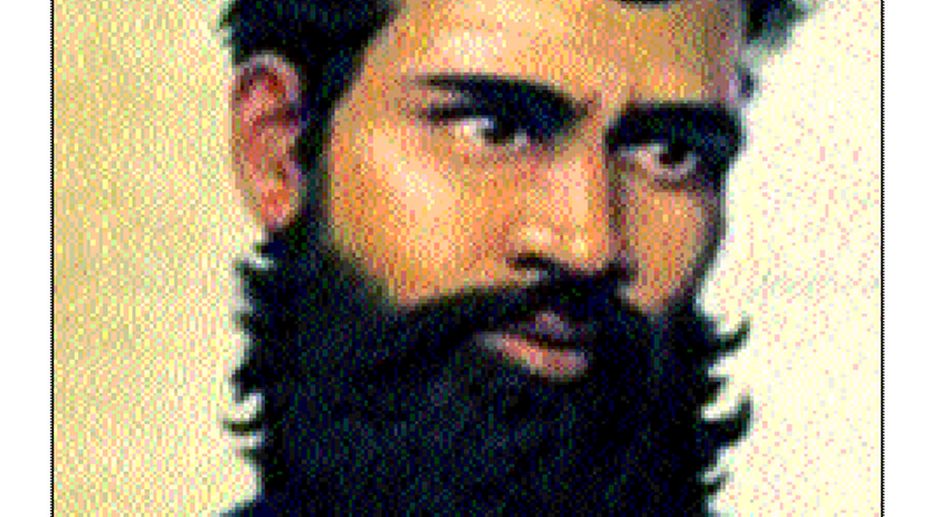
The credit for organising the first secret revolutionary society in Maharashtra in the post-Mutiny (1857) phase, with the objective of overthrowing British rule, belongs to Wasudeo Balwant Phadke (1845-83), a Chitpavan Brahmin of Kolaba district, Bombay.
Phadke was moved by the exploitation of Indians and had made a bold attempt to drive out the British by physical force.
Phadke’s hatred against the British Government was first roused by his failure to secure leave to visit his ailing mother. The devastating famine of 1876-77, which affected a large part of India, made him a determined enemy of the British. He was firmly convinced that the miseries were rooted in exploitation and the economic drain, also articulated by Dadabhai Naoroji.
After considerable reflection, he vowed to organise an armed rebellion against the British. He decided to give up his job in the Military Accounts department, the comforts of his family life, and devote his life to the task of liberating India. In his autobiography (1879), Phadke revealed the state of his mind in 1878 on the eve of his resignation from government service ~ “From morning to night, bathing, eating, sleeping, I was brooding over this and I could get no proper rest. At midnight, I used to get up and think how this ruin might be done until I was almost mad. I learnt to fire at targets, to ride, also sword and club exercise”.
Phadke travelled extensively in the guise of a sannyasi, with matted hair. His plan of action has been described in his autobiography thus: “Having obtained Rs 5000 from a sowkar, I proposed to send to all sides three or four men a month in advance so that small gangs might be raised by them from which great fear would come to the English. The mails would be stopped and the railway and telegraph interrupted, so that no information could go from one place to another. Then the jails would be opened and all the long-sentenced prisoners would join me because if the British Government remained they would not get off.”
Phadke realised that his objective could only be attained through a secret organisation, which he formed to preach the message of independence among school boys. There were also active members who were engaged in revolutionary activities. The members were bound by a secret pledge that they would sacrifice everything at the altar of their motherland. On the Vijayadashami day the most important ceremony was solemnised. Arms were collected secretly. The goddess of war was worshipped with prayers. The Revolt of 1857 was often the subject of post-prayer speeches.
The educated class, however, did not support Phadke’s ideas and he turned for support to the turbulent and backward people belonging to the Ramosis community. With their help, he planned to disarm the police guard of the Khed treasury and then loot the place. He then decided to attack the jails, release the prisoners (almost reminiscent of the siege of Bastille) and with them swell the number of his followers. With their help he decided to carry out his long-cherished desire to destroy British rule. His plan failed and he could neither secure the men nor the money.
The difficulty to obtain funds from the bhadralok has been described with pathos by Phadke ~ “In their hearts they wish the British to be driven out, but you must not ask money of them”. In sheer desperation, he thought of raising funds by committing dacoities. His attempt to collect money through dacoities with the help of the Ramosis failed as this group was never inspired by patriotic ideals. They quarrelled over the distribution of the looted money and deserted Phadke after receiving their share. His attempts to enlist the support pf other backward communities, such as Kolis and Dhangars, also failed.
However, Phadke gained the support of the countryside and he struck terror in the hearts of the British Government which announced a reward of Rs 4000 for his capture. Through a poster, he announced one and a half times the reward offered by the Government to any person who would bring to him the severed head of Sir Richard Temple, the Governor of Bombay Presidency, Panic gripped the administration.
Phadke turned to religion for solace and guidance. In April 1879 he left the few followers who were still with him. He went to Poona and spent a few weeks in “Shri Shaillya Malik Arjun”, a shrine in Karnal district in Madras. He then went to the Nizam’s territory where he masqueraded as a holy man from Benares. He was, however, arrested in Kaladagi district Kaladagi in Nizam’s state by Major Daniel and Abdul Haque, the Police Commissioner of Hyderabad, in July 1879. He was sentenced to transportation for life and imprisoned in Aden from where he fled in October 1880. He was however, rearrested within a few hours. He was fettered and soon developed phthisis, which turned out to be a terminal affliction. He died at a prison in Aden on 17 February 1883 after undergoing severe torture.
The single-handed fight of Phadke against the British Empire, wrote Dr R C Majumdar, was bound to end in complete failure. But it left its legacy and the seeds he sowed grew into a mighty banyan tree. His patriotism, his political activities, his secret organisation and his method of secretly collecting arms and money through political dacoities were taken up by the leaders of revolutionary movement in other parts of India. The spirit which he represented continued to live through the revolutionaries of a later period. His method acquired a strong philosophical foundation and a broader social basis. He may justly be called “the father of militant nationalism in India.”
Though forgotten by history and ignored by historians, Phadke must be given a place in the history of the revolutionary movement, an integral part of the Indian freedom struggle. It has rightly been pointed out that the credit for organising the first secret revolutionary society in the post-Mutiny period with the avowed objective of overthrowing British rule in India belongs to Wasudeo Balwant Phadke.

(The writer is a former Associate Professor, Department of History, Sivnath Sastri College, Kolkata)

A militant nationalist

Kabita Ray | New Delhi |

The revolutionary movement in India, the most fascinating chapter in the history of the struggle for freedom, had burst into a mighty tempest after the Partition of Bengal (1905). The origin of the movement, however, can be traced to an earlier period. Maharashtra may be regarded as the pioneer of the revolutionary struggle and the nerve-centre of sedition.
The credit for organising the first secret revolutionary society in Maharashtra in the post-Mutiny (1857) phase, with the objective of overthrowing British rule, belongs to Wasudeo Balwant Phadke (1845-83), a Chitpavan Brahmin of Kolaba district, Bombay.
Phadke was moved by the exploitation of Indians and had made a bold attempt to drive out the British by physical force.
Phadke’s hatred against the British Government was first roused by his failure to secure leave to visit his ailing mother. The devastating famine of 1876-77, which affected a large part of India, made him a determined enemy of the British. He was firmly convinced that the miseries were rooted in exploitation and the economic drain, also articulated by Dadabhai Naoroji.
After considerable reflection, he vowed to organise an armed rebellion against the British. He decided to give up his job in the Military Accounts department, the comforts of his family life, and devote his life to the task of liberating India. In his autobiography (1879), Phadke revealed the state of his mind in 1878 on the eve of his resignation from government service ~ “From morning to night, bathing, eating, sleeping, I was brooding over this and I could get no proper rest. At midnight, I used to get up and think how this ruin might be done until I was almost mad. I learnt to fire at targets, to ride, also sword and club exercise”.
Phadke travelled extensively in the guise of a sannyasi, with matted hair. His plan of action has been described in his autobiography thus: “Having obtained Rs 5000 from a sowkar, I proposed to send to all sides three or four men a month in advance so that small gangs might be raised by them from which great fear would come to the English. The mails would be stopped and the railway and telegraph interrupted, so that no information could go from one place to another. Then the jails would be opened and all the long-sentenced prisoners would join me because if the British Government remained they would not get off.”
Phadke realised that his objective could only be attained through a secret organisation, which he formed to preach the message of independence among school boys. There were also active members who were engaged in revolutionary activities. The members were bound by a secret pledge that they would sacrifice everything at the altar of their motherland. On the Vijayadashami day the most important ceremony was solemnised. Arms were collected secretly. The goddess of war was worshipped with prayers. The Revolt of 1857 was often the subject of post-prayer speeches.
The educated class, however, did not support Phadke’s ideas and he turned for support to the turbulent and backward people belonging to the Ramosis community. With their help, he planned to disarm the police guard of the Khed treasury and then loot the place. He then decided to attack the jails, release the prisoners (almost reminiscent of the siege of Bastille) and with them swell the number of his followers. With their help he decided to carry out his long-cherished desire to destroy British rule. His plan failed and he could neither secure the men nor the money.
The difficulty to obtain funds from the bhadralok has been described with pathos by Phadke ~ “In their hearts they wish the British to be driven out, but you must not ask money of them”. In sheer desperation, he thought of raising funds by committing dacoities. His attempt to collect money through dacoities with the help of the Ramosis failed as this group was never inspired by patriotic ideals. They quarrelled over the distribution of the looted money and deserted Phadke after receiving their share. His attempts to enlist the support pf other backward communities, such as Kolis and Dhangars, also failed.
However, Phadke gained the support of the countryside and he struck terror in the hearts of the British Government which announced a reward of Rs 4000 for his capture. Through a poster, he announced one and a half times the reward offered by the Government to any person who would bring to him the severed head of Sir Richard Temple, the Governor of Bombay Presidency, Panic gripped the administration.
Phadke turned to religion for solace and guidance. In April 1879 he left the few followers who were still with him. He went to Poona and spent a few weeks in “Shri Shaillya Malik Arjun”, a shrine in Karnal district in Madras. He then went to the Nizam’s territory where he masqueraded as a holy man from Benares. He was, however, arrested in Kaladagi district Kaladagi in Nizam’s state by Major Daniel and Abdul Haque, the Police Commissioner of Hyderabad, in July 1879. He was sentenced to transportation for life and imprisoned in Aden from where he fled in October 1880. He was however, rearrested within a few hours. He was fettered and soon developed phthisis, which turned out to be a terminal affliction. He died at a prison in Aden on 17 February 1883 after undergoing severe torture.
The single-handed fight of Phadke against the British Empire, wrote Dr R C Majumdar, was bound to end in complete failure. But it left its legacy and the seeds he sowed grew into a mighty banyan tree. His patriotism, his political activities, his secret organisation and his method of secretly collecting arms and money through political dacoities were taken up by the leaders of revolutionary movement in other parts of India. The spirit which he represented continued to live through the revolutionaries of a later period. His method acquired a strong philosophical foundation and a broader social basis. He may justly be called “the father of militant nationalism in India.”
Though forgotten by history and ignored by historians, Phadke must be given a place in the history of the revolutionary movement, an integral part of the Indian freedom struggle. It has rightly been pointed out that the credit for organising the first secret revolutionary society in the post-Mutiny period with the avowed objective of overthrowing British rule in India belongs to Wasudeo Balwant Phadke.

(The writer is a former Associate Professor, Department of History, Sivnath Sastri College, Kolkata)

Populism’s pitfall

Editorial | New Delhi |

To opt to “loosen” a plank of the platform from which a remarkably successful election campaign has just been mounted does call for distinct moral courage: particularly from the person who had been in the forefront of weathering the demonetisation storm. That only underscores the relevance of the caution on farm loan waivers sounded by the head of the State Bank of India. Though not a politician, Ms Arundhati Bhattacharya could not be unaware of the BJP having promised a farm loan wavier if the UP voters “returned” it to power in Lucknow, and she would also have been aware of the media being present at an event in Mumbai at which she contended that a waiver culture militated against credit discipline.

Whether other bankers will echo her sentiment is of limited consequence, she was targeting politicians who offer “sops” at somebody else’s expense. Adding weight to her words was the reality that the SBI had only the previous day announced a one-time settlement of assistance for farm equipment, tractor loans etc: so she was not insensitive to agrarian distress. “We feel that in case of a (farm) loan waiver, there is always a fall in credit discipline, because the people who get waivers have expectations of future waivers as well.

As such, future loans given often remain unpaid”. While she clarified that no formal proposal for waivers had been received, she pointed out that “Today the loans will come back as the government will pay for it, but when we disburse loans again the farmers will wait for the next election and another waiver”.

Ms Bhattacharya was actually endorsing the view of the former Governor of the Reserve Bank that “waiving off loan is an unhealthy activity, and every time a waiver is done it diverts access to credit and shrinks credit availability”.

The Indian Banks’ Association is said to be taking the issue up with the finance ministry too, “the magnitude of the problem, if the proposal (the poll promise) is implemented, can be seen from the fact that UP ranks third in India in terms of agricultural credit exposure” according to the IBA. And a CAG report a couple of years ago had determined that a number of beneficiaries were not eligible for the waivers.

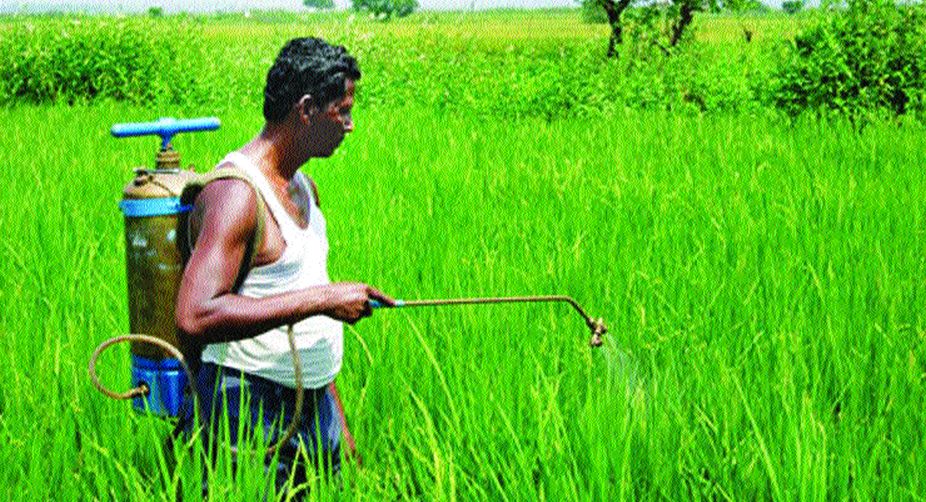
The basic issue is political rather than economic or financial. Successive governments have failed to tackle the core issues of the agricultural sector, and have taken the populist escape route of loan waivers.

Much noise is made about “non-performing assets” and the corporate sector is slammed as the culprit. The SBI chief has only injected a reality check into the equation: but will that suffice to disabuse the match-winning ploy that was Garibi Hatao?

MoD loses little

Editorial | National |

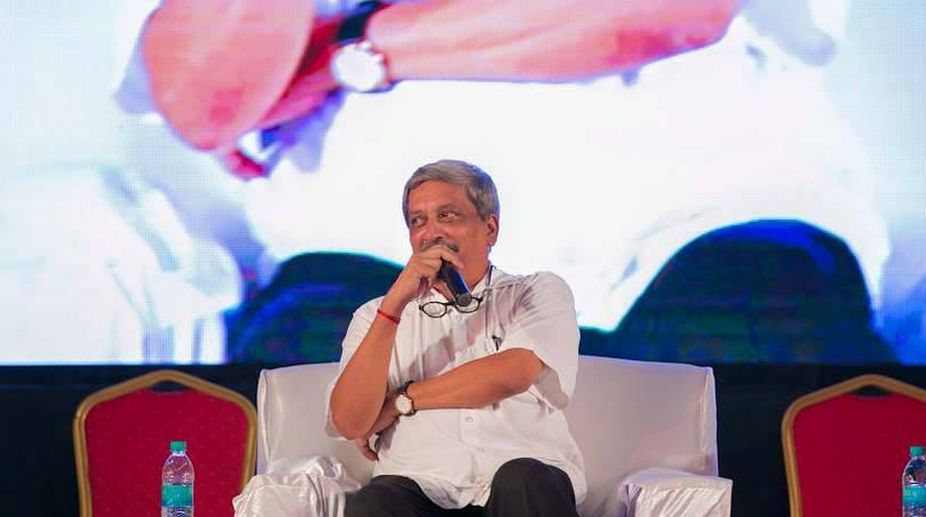
Having not only won the floor-test but simultaneously ridiculed the Congress’ contention that he would be chief minister for just 48 hours, it would be fair to assert that the BJP gained politically from Manohar Parrikar’s re-location from New Delhi to Panaji. It would also be fair and accurate to aver that the Ministry of Defence has lost little by that move. Although the Prime Minister had handpicked Parrikar for a place in the “big four”, the IIT-man has done little to leave a positive impression on South Block.

There would be many on Raisina Hill left wondering what made him so special that some of the smaller parties who imparted life-blood into the BJP’s power-game in Goa had made that conditional to Parrikar’s steering the showboat on the Mandovi.

True that no allegations of kickbacks were made when he presided over South Block: true also that few big ticket deals were forged during his tenure of some 26 months. The publicity-machine churns out reports of a series of acquisitions having borne fruit during that period ~ negotiations for all of them had begun before the NDA wrested power. To be fair, defence deals do take time to process, so it could be a couple of years before Parrikar’s moves take concrete shape: that is the nature of the job, there is no quick-fix to boosting the arsenal.

Other yardsticks, therefore, must be applied to measure the success of the former defence minister, and they do not prove flattering: certainly not as “vocal” as some of his belligerent statements, unless political angles are read into them. He never substantiated his charges about the vessel the Coast Guard set ablaze soon after he took over; his “personal” view on the no-first-use nuclear policy proved a national embarrassment, and he invited ridicule by imitating Gen. Patton’s line about heroes not dying for their country. Worse, he failed to prevent the BJP from dragging the Army into a political quagmire over the tactical strikes against terrorists’ launch-pads across the Line of Control. Though he did set up a series of committees on higher defence management, manpower utilisation, etc., no action followed.
Neither were the shortcomings in the Pay Commission award resolved, nor the grievances over the manner in which OROP was implemented. And the impact of the supersession in the appointment of the Chief of the Army Staff has yet to be fully felt. Parrikar might not have been the worst defence minister the nation has had to endure, his name would surely figure in a “negative” list. And that the Prime Minister has had to yet again revert to Arun Jaitley suggests that gung-ho bellicosity apart, the NDA’s “security assets” are thin.


Western UP finds place in Yogi Adityanath’s cabinet

Swati Sharma | Meerut |

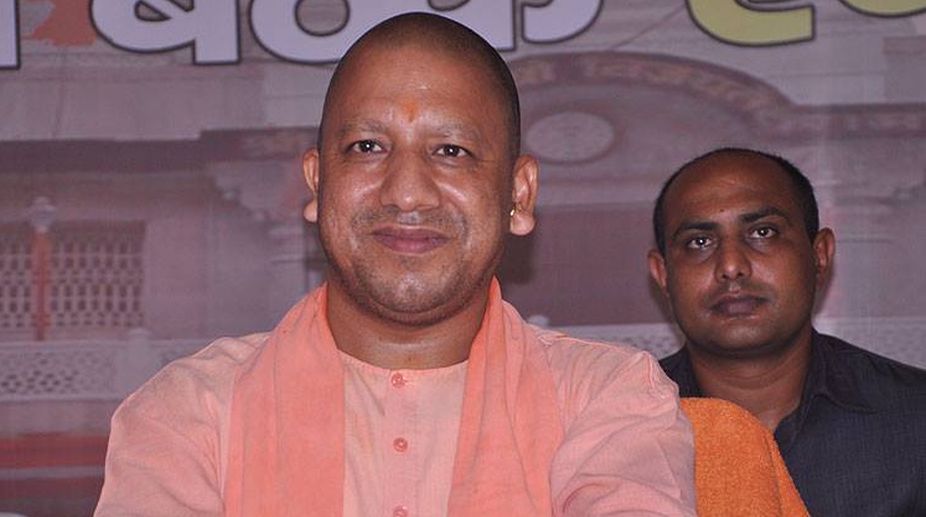
Western Uttar Pradesh gets it's due in the form of cabinet minister Chetan Chauhan and six ministers of state, including Muzzaffarnagar riot accused Suresh Rana, in the in the state. 

In the state cabinet which  took oath of office on Sunday with the Chief Minister Yogi Adityanath, seven MLAs have been included as minister and MoS. Senior BJP leader and former cricketer Chetan Chauhan is the only one included as a cabinet minister. Chauhan is MLS from Amroha. Yogi  Adityanath cabinet

Firebrand leader, who is also an accused in the Muzzaffarnagar riot case, Suresh Rana has been inducted as MoS with independent charge. Rana had won from the Thana bhawan seat of Shamli for the second time in a row after a lull of 55 years.

Sandeep Singh, grandson of former CM Kalyan Singh who made his political debut in this election from Aligarh has also been included in the state cabinet as MoS. Party's regional President Bhoopendra Singh Chaudhary and Ghaziabad MLA Atul Garg are also MoS in the cabinet. Chandausi MLA Gulabo Devi is the woman face from Western UP in the cabinet.Turncoat Dharam Singh Saini , a three time MLA from Nakur constituency of Saharanpur has also been made part of this cabinet. Saini was in the BSP and had deserted the party to join the BJP before the election.

Unfortunately, no one from Meerut from where the BJP had won six out of seven seats has been inducted in the cabinet. Fire brand party leader and Sardhana MLA Sangeeta Som, who was hopeful of his induction in the state cabinet, did not get a chance.

Like Meerut , districts of Muzzaffarnagar, Hapur, Bijnor and Noida also did not get any representation. From Noida Pankaj Singh , son of Union Home Minister Rajnath Singh was also a strong probable. Pankaj had won the Noida seat by a margin of over 40,000 votes but failed to get a cabinet berth.

 Shortly after taking the oath of office of MoS, Thana bhawan MLA Suresh Rana said that under the leadership of CM Adityanath and following the vision of PM Narendra Modi the state would be on the track of development. "Law and order situation will improve and people will now live in a fearless environment," Claimed Rana.

Party leadership had opted Rana over three other  Muzaffarnagar riot accused and MLAs Sangeet Som( Sardhana),Vikram Saini ( Khatauli) and Umesh Malik(Budhana).

Supporters of Sangeet Som and Suresh Rana were quite convinced that being Hindu faces of the party in the region both leaders would get their berth in the cabinet especially after elevation of a considerably hardliner Yogi as CM in the state. Party inducted Suresh but ignored claims of Sangeet which has disappointed Som`s supporters. 

Jagdish Singh, Pradhan of village Chabaria and Som supporter, says, "Growing popularity of Som deprived him from a berth in the cabinet because senior leaders don`t want him to be more stronger”. They did a step motherly treatment with Som, he added. Another supporter Dharmendra Singh of the same village says’ party has ignored entire western UP in the cabinet as none of the leaders from Meerut and many other districts were inducted in the cabinet’. 

Suresh Rana had came under fire during election campaign for his controversial statement and a case was lodged against him  for his alleged statement in which he said, "If I win this election, curfew will be imposed against those who don`t respect women and force people for exodus’.


Next green revolution may come from Northeast

IANS | Agartala |

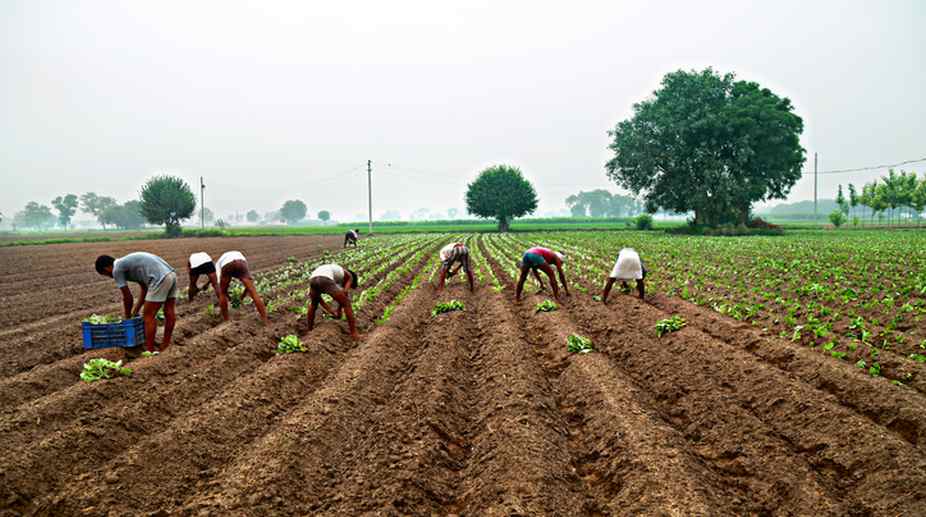
Union Agriculture Minister Radha Mohan Singh on Sunday said the second green revolution may come from eastern India and for this, the northeastern states will have to be brought into the mainstream for equitable agricultural development in the region.

The minister's remarks came while inaugurating the new Krishi Vigyan Kendra (KVK) in West Tripura. He said the government is committed to developing the agriculture sector in the region.

"The government has sanctioned seven KVKs for Tripura, of which five are already functional, and with the inauguration of this one, now six KVKs will become operational in the state," Singh said.

In addition, the site selection committee is also visiting the state for selection of site for the eighth KVK. With that, all districts in the state will have one KVK each.

The Union Minister said he is confident that the KVKs will equip the farmers of the state with the desired skills and build their capacities through on-farm testing and demonstration of the new technologies developed by agricultural scientists.

The total number of KVKs in the country has now gone up to 668, from 637 about three year ago. Of these, 78 KVKs are functional in the north-eastern states.

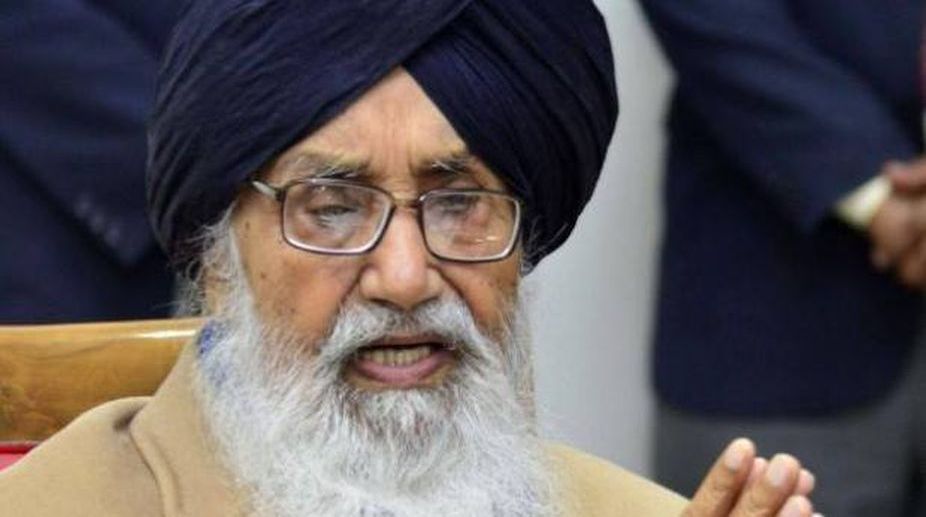
Badal ‘politely’ declines Amarinder govt’s free house offer

Ranjeet | Chandigarh |

Former Punjab chief minister (CM) Parkash Singh Badal  on Sunday declined the offer of a free government accommodation  made by the Captain Amarinder Singh-led Congress government as a goodwill gesture.

In a statement, the former CM said he was " thankful to CM Captain Amarinder Singh for his gracious gesture”. “It is very graceful of him to make this offer and  I thank him from the core of my heart for this. But I am making my own arrangements for stay. However, I value hissentiment highly and fully reciprocate it," Badal said.

The former CM also said  if the new  government  has the will to fulfill its promises, it can easily do so. “Their (Congress) manifesto was prepared and released by one of the finest economists in the world, Dr Manmohan Singh,(fomer Prime Minister) and he would not have made these promises if he thought that  Punjab government's treasury
was empty and lacks the funds to meet these expenses,” Badal said.

“ So I expect the new government to fulfill their  promises in he first months itself. I will personally congratulate them when they do so, " he added.

The former CM said he was surprised over the setting up of a committee by the new government  to study the farmer's debt. "All the details are available in government records and also in various studies conducted by farm economists and university experts. All it needs is for the new government to implement its promise."

Commenting on the first few decisions announced by the council of ministers, Badal said except a few cosmetic gestures like red beacons, almost 95 per cent of the announcements are either repeat of old policies or are mere empty rhetoric. For example, on the promise to ban sale of farmers land for loan defaults, Badal said that  the SAD-BJP government has already implemented that through the  Farmers Indebtedness Bill which prohibits sale of farmers land by banks or money lenders and banking institutions.

Similarly, there is already a provision for confiscation of properties of drug peddlers and many properties had already been confiscated by the SAD-BJP government.

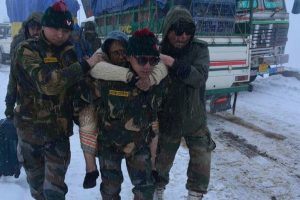
Army rescues 127 tourists stranded in Arunachal’s Sela Pass

IANS | New Delhi |

The Army has rescued 127 tourists stranded at the Sela Pass near Tawang in Arunachal Pradesh, official sources said on Sunday.

"Troops of Blazing Sword Division rescued 127 tourists from near Tawang, about 280 km from Tezpur," Defence Spokesperson (Kolkata) Wing Commander SS Birdi said.

The rescue operation started on Saturday night and continued till the early hours of Sunday. Those rescued included five foreign nationals from Japan, New Zealand and Bulgaria.

The tourists were trapped after a massive snow blizzard struck around 2.45 p.m. on Saturday between Ahirgarh, Sela and Nuranang on the Tezpur-Tawang road in West Kameng district of Arunachal Pradesh, Birdi said.

The body of a Bulgarian national, who fell into a gorge, was recovered around midnight. 

The rescued persons were accommodated at the Army transit camps and provided with medical assistance. 

The road, with about 2-3 feet of snow, was opened by the Border Roads Organisation for traffic on Sunday and all vehicles of the stranded tourists were recovered. 

Most of the rescued persons have since left for their respective destinations, Birdi added. 

Traffic restrictions on Delhi roads eased as Jats postpone stir

IANS | New Delhi |

The Delhi Police on Sunday said traffic restriction here have been scaled down after the Haryana Jat leaders decided to postpone their protest in the national capital but security arrangements will be kept in place to handle any untoward incident.

The police on Saturday said traffic on several Delhi roads will be closed on Monday, and asked the Metro to curtail its services to neighbouring Haryana and Uttar Pradesh in a bid to prevent the entry of protestors here.

"The traffic restrictions for March 20 have been scaled down. All roads will remain open to normal traffic. Commuters are, however, requested to avoid areas in New Delhi as certain security checks will still be in place," Joint Commissioner of Police (Traffic) Garima Bhatnagar said. 

The Jats are demanding reservation for the community in government jobs and educational institutions, among other things. 

They had threatened to lay siege to Parliament on Monday. 

Special Commissioner of Police (Operations) Dependra Pathak said three-tier security right from the city's borders to the New Delhi area will remain. It will help monitor the security situation. 

"As we know that the agitation has been called off, restrictions, particularly on the Metro, local trains, buses and other public transport, have been eased and these will ply normally. But security arrangements already made at border in central Delhi and New Delhi area will remain.

"Police presence will be ensured. We are continuously monitoring the situation," the officer added

Kingfisher rerun: Employee exodus from Air Costa

Statesman News Service | New Delhi |

Embattled Air Costa has seen an exodus of employees, including 40 pilots, in the last few weeks over non-payment of salaries. The airline, which has cancelled bookings till May, is scrambling for funds to restart its operations but is yet to make much headway in roping in investors.

Air Costa's 450-odd employees are literally at the crossroads amid worsening financial situation, and industry executives apprehend there could be a replay of erstwhile Kingfisher Airlines  whose shuttering in 2012 had rendered hundreds of people jobless.

Faced with cash crunch and financial issues with the aircraft lessors, Vijaywada-based Air Costa has not flown since February 28. A source said employees have not been paid salaries for the month of February while more than half of the staff have not received any payment since January.

Air Costa first suspended its operations in August 2016 after aircraft lessor GE Capital Aviation Services took back one of the three-leased Embraer planes as the airline failed to pay lease rentals. At that time, the regional carrier had over 600 employees on its roll. Since then, around 150 people, including the 14 commanders and 30-odd first officers have quit, the source said.

"These people have also not been paid along with the 450 existing staff. The way promoters have announced halting of operations till May seems this airline is also going the Kingfisher way," a senior Air Costa employee said on condition of anonymity.

According to the source cited earlier, Air Costa promoters had "promised" to pay the pending salaries for January and February by 15 March, but they "failed" to keep their word.The airline's monthly wage bill stands at around Rs 4 crore.The source said the airline requires around Rs 200 crore funds to take-off the ground once again.

"However, the investors with whom the airline is in talks to raise funds are not established players. This is also the reason why discussions with them are not making much headway," the source added.

When contacted, the airline's spokesperson Kavi Chaurasia said, "Air Costa is making all efforts to garner funds and resume operations at the earliest". Prior to suspending its flight services, Air Costa had been operating 16 flights per day to eight destinations. Currently, the airline has a fleet of two-leased Embraer E190 aircraft, which can carry over 100 passengers.

‘AAI must probe Kingfisher dues’

Abhijeet Anand | New Delhi |

The Airports Authority of India (AAI) should carry out a probe into how the defunct Kingfisher Airlines was allowed to accumulate dues worth nearly Rs.295 crore, a Parliamentary panel has said.

Making the recommendation, the panel said AAI allowed the accumulation of dues to such a high level in violation of all the existing rules and procedures in practice.

Bogged down by financial woes, Kingfisher Airlines was closed down in 2012. The carrier was promoted by businessman Vijay Mallya, who is wanted by Indian authorities in loan default and other cases.

At the end of December 2016, the airline owed dues worth Rs.294.69 crore to the AAI and the amount has been written off. The national airports operator has also filed a legal suit against the carrier to recover the dues.

The recommendation has been made by the Department-related Parliamentary Standing Committee on Transport, Tourism and Culture in its report tabled in Parliament on 17 March. The report is on the Demand for Grants (2017-18) of the Ministry of Civil Aviation.

The panel has recommended that AAI conduct an internal inquiry to "fix the responsibility of AAI officials for the accumulation of dues by Kingfisher Airlines".

Stressing that AAI should be cautious in future to ensure that "no individual stakeholder/airlines is accumulating such high levels of dues", the panel has called for strengthening of the system and procedures to prevent recurrence of such instances.The committee also said "it may be intimated about the outcome of the internal inquiry".