Logo

World’s oldest woman dies aged 117

IANS | Rome |

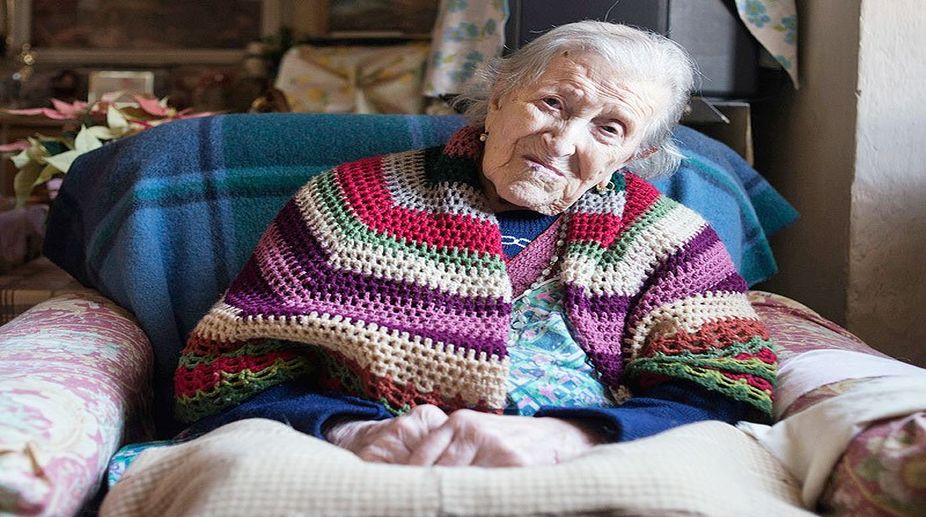
Emma Morano, the world's oldest woman and the last surviving person born in the 19th century, died at the age of 117 at her home in Italy's Verbania town on Saturday.

Emma Martina Luigia Morano, who lived 117 years and 137 days, was born on November 29, 1899, in the Italian town of Civiasco into a family of people who would prove to be very long-lived, with her mother and aunt living to past 90 and her sister Angela reaching 100, EFE news reported.

According to her grandchildren, Morano, who lived through two world wars, knew 11 popes and 12 Italian Presidents, died peacefully in her sleep.

"She had an extraordinary life. We will always remember the strength (she possessed) for moving forward, her combative attitude against adversity," said Verbania Mayor Silvia Marchionini.

Despite such surprising longevity, her life has not been easy at all. She outlived all of her family members, namely eight brothers and sisters. She lost a boyfriend in the First World War, and then married a quite abusive man, whom she did not love, Xinhua news agency cited local media.

Morano lost her only child, not long before leaving her brutal husband. Since then, she supported herself, lived alone, and worked in a jute factory until the age of 65.

However, the most surprising note in her life is perhaps her diet: three raw eggs a day up to some 10 years ago.

Always a biscuits-lover, she has been used to eating very little vegetables, according to her personal doctor.

In 2011, she was honoured with the Order of Merit award by the Italian state and on her latest birthday she received the congratulations of both the current head of state Sergio Mattarella and Pope Francis.

Revisiting the past

Shoma A Chatterji | New Delhi |

When I was around 10 years old, my mother took me to watch a film shooting at the RK Studio in Bombay. The spacious compound had a canteen that sold the tastiest mutton curry and roti for Rs 1.25 a plate. The interior was dark, filled with long rows of benches and desks like in small town schools but the service was superb. That was my first and last brush with a proper “canteen”. RK Studio is still there but I have no clue whether that canteen still exists.

Historically, a canteen referred to a place outside a military camp where refreshments and entertainment were provided to the members of the Armed Forces. Over time, factories, offices and workshops started calling their places of refreshment as canteens and the food there came to be especially tagged as “canteen food.”

Bombay Brasserie, the restaurant chain that has set its own exclusive standard of quality, taste and service has curated a special menu for older people to revisit the past and for youngsters to savour something they have never tasted before. It has branches in Bengaluru, Chennai and Kolkata and is scheduled to open similar restaurants in Mumbai and Pune.

Nostalgia comes in different shapes, sizes, colours, flavours and taste at the Bombay Brasserie. The restaurant has come up with the best from the menus of famous canteens at its Quest Mall outlet in Kolkata. Some of them are from cities other than Bombay but the irrepressible foodie knows them all —Film Studio Canteen of Bombay, Bombay City Canteen, Old Madras Street Canteen, Punjab University Canteen, Jimmy’s Canteen, Patil House Canteen, Purani Dill, Ali Tikkawala, and many more. According to those in the know, the idea is to bring the signature canteen dishes from across India to the gourmands of Kolkata without challenging the local food market —that is the reason why they did not choose to include any of the Kolkata canteen special dishes in this menu.

Among the famous dishes served on the menu are Chhole Double Roll, Paneer Pakoda with Imli Chutney and Sindhi Kheema Biryani from KC College Canteen; Roasted Chicken Wings, Uncle Special Vegetable Biryani from Uncle Pascal's Canteen; Achhari Roast Aloo, Tomato and Chicken Soup, Pav Vada, Bombay Mix Bhel, Tandoori Roti, Royal Mini Faluda, Choco Bar and many more from Rajasthan Academy. They also serve the famous “cutting” chai in small glasses.

One is free to chat, gossip, argue or quarrel over the tiniest of vada pavs or the mindblowing Sindhi Kheema Biryani or the Balbir Singh Special Chicken set in thick but subtly spiced gravy.

Among desserts, one must try the Chocolate Pudding served in a small glass. It tastes suspiciously like mud cake with melted chocolate sauce at the bottom. Some of the dishes however, are too small and big eaters might be confused with the size of single servings. One has a choice between vegetarian and non-vegetarian dishes alongside famous local staples and chaats.

The crockery and cutlery have been imaginatively and ingeniously designed in keeping with the canteen mood and temper. The age-old aluminum tiffin dabba the Mumbai dabbawalas are famous for, a saucepan, an aluminum frying pan with a broad rim and long handle complete with blue check dusters to protect the hands from the heat. Some of the dishes are served in tiny aluminum buckets to add to the nostalgia.

That said there is a fixed menu for the canteen special, at slightly high prices but no buffet. It’s always fine dining at the Bombay Brasserie!

EC must prove EVMs are fair

Kalyani Shankar | New Delhi |

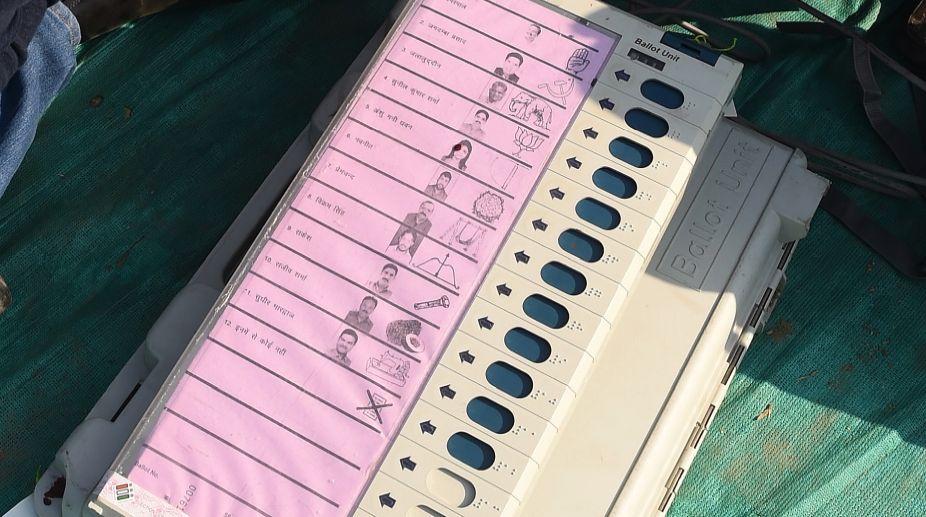
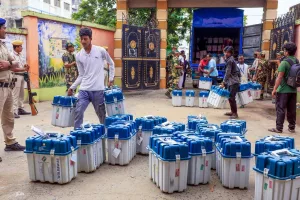
Do we need Electronic Voting Machines? Are they tamper- proof?  If we decide to abandon the EVMs what is the alternative? Go back to the old ballot paper system? The debate about efficacy of EVMs has surfaced once again after the recent five state Assembly polls. Political leaders who lost – BSP’s Mayawati, Uttarakhand’s Harish Rawat and Delhi’s Arvind Kejriwal among them – have alleged that the EVMs were tampered with. At least 16 Opposition parties have joined the chorus.

A delegation of 13 Opposition parties met President Pranab Mukherjee on Wednesday over the matter. “The recent cases of alleged tampering and malfunctioning of EVM machines, particularly in the recently concluded assembly elections, have raised bona fide concerns on the possibility of manipulating electoral outcomes,” they told Mukherjee in a memorandum. On Monday, they had approached the Commission, expressing their “complete loss of faith” in EVMs and demanded use of VVPAT (voter-verified paper audit trail) and paper ballots in upcoming polls.

After all these, the Supreme Court has come into the picture again by issuing a notice to the Centre and the Election Commission this week as to why paper trails should not be mandatory. The issue has been raised  earlier before various High Courts – Madras High Court (2002); Karnataka High Court (2001); Delhi High Court (2004) and Bombay High Court (Nagpur bench) in 2004 but all held that the EVMs are credible. Even the Apex court dismissed appeals against  High Court orders.

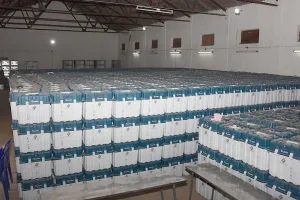
India has more than 800 million voters and about 1.2 million EVMs are used for the elections. The complaints were on two counts. First was that  technology could be tampered with. The second  was a legal challenge. In both cases, the final word has not come. Is there a possibility of rigging the polls in the next general elections? This question has arisen not only because of the unexpected number of seats won or lost by parties in the recent contest but also accentuated by the recent trend in the West doubting the integrity of EVMs and bringing back the ‘old-fashioned ballot system’.

The Election Commission claims that the programme or software  is burnt into a one time programmable or Masked chip so that it cannot be tampered with. Moreover, the machines are not networked either by wire or by wireless to any other machine and so there is no possibility of data corruption. Also the elaborate security arrangments would prevent any administrative or procedural manipulation according to the CEC.
The naysayers argue that when bank data could be hacked why not the EVMs? They point out how Western countries have gone against E-voting, especially in the US, Germany, Netherlands, France, Italy, England and Ireland to name a few. These countries have gone back to the ballots.

Why did India move towards the EVMs? It all began in 1977 when the Election Commission mooted the idea. The  arguments for moving to EVMs were because of some inherent  problems like printing, storage and  trasnportation of ballots besides the huge financial expenditure.

The counting also took a much longer time. Parliament amended the law in December 1988 and a new section 61A was inserted in the Representation of the People Act, 1951 empowering the Commission to use voting machines. It was implemented in March 1989. Since 2000, EVMs have been used in 107 polls including for the Lok Sabha and state assemblies.

The debate about EVMs is not new, as it has been going on since the time it was introduced in 1989. The Commission favoured EVMs because the method of casting your vote by the click of a button would have been tamper proof except that the doubting Thomases raise the question of their efficacy time and again.  As early as 2009, BJP’s veteran leader L K Advani had raised doubts about the security features of EVMs after the BJP lost the polls.

After hearing Dr Subramanian Swamy’s petition in October 2013, the Apex court ruled that the Commission would use voter verified paper audit trail (VVPATs) linked to EVMs by 2019. Under this system once the voter presses the button, the candidate’s name is printed on a slip of paper, shown to the voter and dropped in a box below.

It is a secondary step for the voter to double check that he has voted for the right candidate. This method was first used in the Nagaland elections in 2013. The Opposition  also slammed the Centre for failing to provide funds to the Commission to put in place sufficient number of VVPAT machines for the 2019 Lok Sabha polls. The Manmohan Singh government gave the first tranche of money for procuring 20 per cent of the machines. But the Narendra Modi  government has not released any money for the VVPATs so far.  ECI needs Rs. 3174 cr for these machines.

The Commission has challenged political parties or any one else to prove that the EVMs can be tampered with. But the political parties are not buying it. It is for the Election Commission to prove its case to the satisfaction of the political parties and the people, and remove the perception that machines can be tampered with. Until then the debate may go on.

The lives at stake if war breaks out

Graham Ong-Webb | New Delhi |

In the classic novel Heart Of Darkness by Joseph Conrad, the protagonist tells the tale of his steamboat voyage up the Congo River to a destination of unimaginable danger. Having to choose between unavoidable evils on his journey, he tries to pursue the lesser one, recognising that he has to be “loyal to the nightmare of (his) choice”.

The US Navy’s aircraft “supercarrier” – the USS Carl Vinson – and its accompanying fleet of warships that constitute Carrier Strike Group 1, currently steaming their way towards the Korean peninsula, is unnervingly resonant of that story. Having set sail from Singapore last Saturday, the American armada is sailing towards an abyss, steering the United States and North-east Asia towards a new brink that will trigger one of three possible scenarios by the end of next week.

The first scenario is the least garish and the most preferable. It sees political action leading to a halt in North Korea’s nuclear weapons-related activities. In this scenario, it is down to Chinese President Xi Jinping deciding to adopt a more coercive approach in dealing with North Korea’s supreme leader Kim Jong Un.
About 90 per cent of North Korea’s trade is with China, and Beijing has not lifted a finger in exacting sanctions that will hurt Pyongyang the most and shape its behaviour away from belligerence. For added effect, Beijing must recall its ambassador to North Korea who is resident there. It is not clear if the strongest sanctions will ultimately resolve medium-term challenges. For now, Mr Xi’s decision can buy everyone a little time until the United Nations Security Council convenes in a special meeting to discuss options on the North Korean issue, on April 28.

The second scenario – likely to be triggered if China fails to execute economic sanctions – sees Carrier Strike Group 1 launching a pre-emptive strike against North Korea’s nuclear-weapons facilities and sites in which intermediate- range ballistic missiles (IRBMs) are located. Washington’s intent would be to destroy as many (if not all) of North Korea’s warheads, the facilities that produce them, and also the missiles that are necessary to deliver these warheads to their intended targets.

Here lies the crux of the matter, currently glossed over in general coverage of the North Korean quagmire that tends to focus on the likelihood of missiles hitting America’s west coast. There are approximately 80,000 US military personnel and army, air force and naval assets sited at bases in Japan and South Korea. These help the Republic of Korea’s armed forces tip the scales against North Korea’s military. The clear and present danger posed by the North Korean nuclear threat is against these US assets, not against the US homeland.

In the light of its inferior military, Pyongyang’s intent would be to use the devastating power of its nuclear weapons as the only means to erase the overwhelming military firepower that the US can bring to bear against North Korea to defeat it.

There have been claims by numerous media that North Korea has not yet created nuclear warheads small enough to fit in a missile. But there have been other expert-based reports suggesting that North Korea already has miniaturised warheads, with some estimates capping this number at around 20. Then there is also the Rodong-1 IRBM, which has been successfully tested many times, and of which North Korea may have as many as 90, according to the latest estimate by the London-based International Institute of Strategic Studies.

The decision to divert Carrier Strike Group 1 from its original destination of Australia – from Singapore – to its new destination is no light matter. It is conceivable that the rerouting of Vinson may be driven by new intelligence on North Korea’s intermediate-range nuclear threat. In any case, to have the armada leave the Korean peninsula with no real strategic dividend will weaken US President Donald Trump’s credibility.
It is also conceivable that any new intelligence may have been received prior to the launch of 59 Tomahawk cruise missiles against the Syrian government for its chemical weapons attack on the country’s civilians. The missile strike carries the message that the United States will counter the threat (or the use) of weapons of mass destruction, especially those that threaten its national security, with overwhelming force.

The accompanying destruction of North Korea’s civilian infrastructure and a significant death toll of its citizens in this scenario would be unavoidable and dreadful. Yet, that would not be the nightmare. The bigger terror would be Pyongyang’s reprisal against Seoul – in the context of two countries still technically at war with each other – by unleashing a barrage of conventional artillery shells onto South Korea’s main capital of about 10 million people.

The North Korean regime has been aiming a sizeable number of its 21,000 artillery pieces at Seoul (and other parts of South Korea) for decades, like a coiled snake. It is impossible for the US and regional allies to neutralise this threat; not even the roughly 700 pieces that can only be expected to really be trained on Seoul – for tactical reasons – and which according to one estimate, would exact a death toll of about 64,000 South Koreans in one day. This being so, Pyongyang has established a deterrence mechanism that has kept the prospect of any significant military action against it in check. Using the estimated numbers for the purposes of scale, the question now is whether a unilateralist US President will go so far as to put the lives of 80,000 Americans ahead of 64,000 South Koreans.

Lastly, the third scenario would see North Korea doing the pre-emption, either as Vinson steams intolerably close to the Korean theatre of operations or while it is loitering around the peninsula at the Trump administration’s behest. Assuming that Mr Kim is convinced in his mind that Mr Trump is going to authorise a pre-emptive attack of his own, once again, this scenario must meet the condition of Pyongyang already having the requisite number of nuclear-tipped IRBMs.

We cannot exclude the possibility of a punitive nuclear response by Mr Trump, and it is reasonable to assume that Vinson is being accompanied by submarines that carry sea-launched nuclear-tipped intercontinental ballistic missiles capable of levelling Pyongyang itself. In this scenario, 144,000 Americans and South Koreans would have died and so would up to 2.5 million North Koreans.
This is the ugly business of nuclear war and why astute strategic thinkers and public intellectuals have long argued it should never be fought. It also explains why Mr Xi called his US counterpart on the telephone – both sides are clear that the humanitarian, environmental, economic and political fallout will set back the entire region.

The Trump administration has likely gamed that the Xi administration knows the implications and it is now up to Beijing to turn the available screws on Pyongyang in order to have Washington divert Vinson away.
The Trump administration has given Mr Xi and Mr Kim a clock to work with in this game of chicken. US Vice-President Mike Pence will be touring Seoul and Tokyo for five days from the moment he arrives this Easter Sunday – the same day Vinson is expected to also arrive – before he leaves for Jakarta.

A week for many to be kept up at night.

The Straits Times/ANN.

The Teesta Tap

Arindam Ghosh-Dastidar | New Delhi |

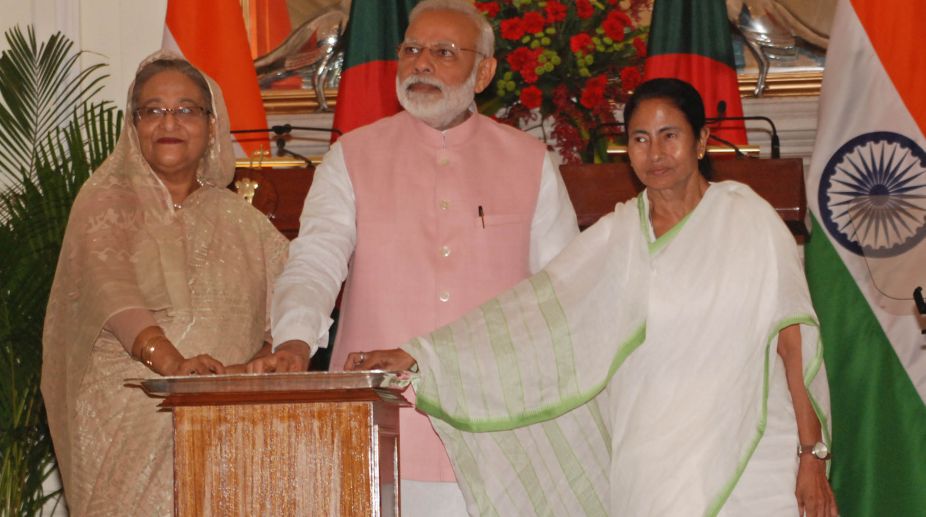
Begum Hasina’s mission to India has once again hit the reefs along the Teesta, to summon the language of the metaphor.  Neither India nor Bangladesh ~ nor for that matter Mamata Banerjee ~ can be particularly delighted with the upshot of her visit after seven years. Seemingly uniform is the degree of disappointment.  The thirty kg of   hilsa for President Pranab Mukherjee ~ almost a farewell gift, ~ the neighbouring PM's gesture of preparing the delectable  smoked variety at the Rashtrapati Bhavan kitchen, and the astonishing  linguistic switchover to  Hindi in a moment of candour may have lightened the undercurrent of despond  over life's essential. Unmistakable, however, is the decidedly jarring note to the grandstanding and the overblown prologue, that was built up both by the MEA ~ or more accurately the PMO ~ and the media.

Paani manga, bijli mila, was Hasina’s high-minded lament at a reception organised by the India Foundation. And then with tongue firmly in cheek: Lekin mujhe nahi pata didimoni kya karega. It was a stark message addressed as much to Narendra Modi as to a Chief Minister dogged in defending her state’s rights. Whether or not diplomatic dealings can come within the ambit of state administration need not detain us here. Suffice it to register that Teesta shall not flow into Bangladesh quite yet and West Bengal’s Chief Minister has had her way for the second time in six years… spanning the stewardship of two Prime Ministers. Though one must hasten to add that this time around, she was less vociferous in her opposition compared to September 2011 when she chose to be a no-show at the Kolkata-Dhaka check-in counter. The Chief Minister’s rigidity ~ then barely five months in office ~ had left Manmohan Singh and his delegation squirming in disbelief.

Aside from the benefits in terms of agriculture in a small and predominantly rural country, it is pretty obvious that both Modi and Hasina appear to be driven by a certain political underpinning. The Bangladesh PM, whose Awami League had won uncontested in 2013, will have to countenance the electoral stakes next year.

The nature of her election has rendered her authority somewhat brittle over the past four years. A breakthrough on Teesta will without question strengthen her defences against Begum Khaleda’s BNP ~ which had boycotted the 2013 parliamentary elections ~ and the potentially mortal Islamist forces. Mr Modi’s signal of intent that the Teesta treaty will be concluded during his tenure (till 2019) and that of Hasina (2018) sounds rather presumptuous. Indeed, it sounded almost as an expression of diplomatic courtesy, when there is nothing concrete to show, not to forget the agreements in the economic segment and connectivity. No wonder it has left the man on the street in Dhaka and elsewhere wondering whether the momentous agreement will be signed between now and next year. Is it possible that Mamata will change her mind ahead of the panchayat election in 2018 and the Lok Sabha election in 2019? Is it possible too that Mr Modi will accord short shrift to Miss Banerjee’s reservations and go ahead with the agreement… with scant regard to federal sensitivities? One must give it to the Prime Minister that ahead of the Hasina visit, he has stopped short of presenting Bengal’s head of government with a fait accompli, as did Manmohan Singh who had sent the Foreign Secretary, Shiv Shankar Menon, to Writers’ Buildings, there to inform the Chief Minister that Teesta was a done deal. Last weekend’s negotiations have thrown up more questions than they have addressed.

The uncertainty is much too overwhelming for bargaining at the high table, whether in Delhi or Dhaka. Neither Mr Modi nor his counterpart can be unaware of the low draught of the river. And Mamata has been cut to the quick with the Bangladesh delegation turning down her suggestion to share the water of other rivers, pre-eminently Torsa. She does have a point when she contends that any further reduction in the volume of the Teesta is bound to impede agricultural productivity in North Bengal, where Trinamul has supplanted the Congress.

It is the river that now dominates all and everything in the Delhi-Dhaka axis via Bengal. On the surface, the 35 agreements that were concluded between April 7 and 10 are primarily of peripheral import. This ought not to detract from the significance of what has been achieved, however. Chiefly, the defence framework agreement which envisages coordination between the forces of the two countries, notably through joint exercises and patrols, naval exercises. and as partners in training programmes. Deeply critical no less is the economic underpinning, pre-eminently the $ 5 billion line of credit that will take care of a welter of activity ~ primarily ports, roads, and IT. More buses, including one from Kolkata to Dhaka via Khulna, should provide an impetus to connectivity and at affordable rates for the hoi-polloi of the two countries. For all that, it is the journey on foot across a porous border that remains ever so intractable even after the quiet influx began in the late 1970s, in less than a decade after India played midwife in the birth of Bangladesh.

In the context of inter-personal relations, there appears to have been a certain mending of fences between Modi and Mamata (soured since the November 8 demonetisation) and between Hasina and Mamata (tense in the aftermath of the 2011 fiasco). It would be uncharitable to underline, in the manner of the chattering class, that the hilsa crate was a gift for President Pranab Mukherjee… and not Mamata Banerjee. In terms of geopolitics, there has been an upswing in India-Bangladesh relations, with the Awami League at the helm in Dhaka. And it is fervently to be hoped that the equation shall not flounder on the diplomatically choppy waters of the Teesta.

Having said that, the chief regret must be that India in 2017 lacks leaders of the calibre of Jyoti Basu and Atal Behari Vajpayee. Though radically different in their political persuasions, they had acted in concert to facilitate the agreement on Farakka in 1999 ~ in the high noon of the CPI-M in West Bengal and the Bharatiya Janata Party at the national level. To both does Bangladesh owe its share of the Farakkawater. But the Teesta tap remains ever so dry.

The writer is a Senior Editor, The Statesman.

Mother of all…

Editorial | New Delhi |

In the span of a week, the administration of Donald Trump has ratcheted up the pressure from Syria to Afghanistan, verily from one storm-centre to another. Indeed, the US offensive can be said to have escalated from a cruise missile attack to the dropping of the largest non-nuclear bomb ever used in combat. Never perhaps has the ISIS been so sharply targeted, and whether or not the Pentagon has reacted with greater indignation than warranted will be the topic of geostrategic discourse for some time yet.

Suffice it to register that the US has for the first time used what the military colloquially calls the “mother of all bombs” ~ the GBU-43/B. The death of 36 militants ~ the figure till Friday morning ~ is incidental or to summon a technical expression, “collateral damage”. Crucially, America has bombed what they call a “tunnel complex” that is used by the Afghan affiliate of the Caliphate. The first major strike on the Caliphate’s logistics anywhere in the world in the form of non-nuclear bombing has devastated the connectivity that is used by ISIS to spread its tentacles. And it has been devastated three years after US-led NATO forces pulled out of Afghanistan.

Of course, America has retained a relatively token presence in the country. Thursday’s blitzkrieg has shattered the fragile stability in a fractious land. The development ought not to be confused with America’s response to a “combat situation”. Was it really necessary to engage in what the Pentagon has described as the “first-ever combat use of the bomb?” The attack will almost certainly merit a prominent mention in military history. Yet it is open to question whether the “ISIS-Khorasan”, so-called, will be brought to its knees in a volatile swathe of Asia, indeed the Af-Pak region. Whether ISIS or Taliban, for every militant killed two are born.

It was by any reckoning a studiously calibrated strategy, one that the US has not had the nerve to try in any part of the Arab region, let alone the increasingly vulnerable West. If the media briefing by the White House Press Secretary is any indication, the security of US forces was the uppermost consideration ~ “We targeted a system of tunnels and caves that ISIS fighters used to move around freely, making it easier for them to target US military advisers.

In order to defeat the group, we must deny them operational space.” No bad thing from the strategic perspective, but it shall not be easy for the White House to justify the use of a “never-before” weapon from its arsenal. Mr Trump has come through as a war-mongering President. Though he has never been explicit
on Afghanistan, he had pledged to “bomb the shit” out of ISIS. As on a bevy of other issues, he
has begun to walk the talk, armed with the ‘right munition’.

Feasting on crumbs

Editorial | New Delhi |

The messages that politicians choose to discern from election results reduces to a joke the standard query about whether the glass is half-full or half-empty. Like all by-elections the ones just concluded to ten assembly seats across several states cannot be written off as inconsequential, yet they are far from a game-changer and the mixed bag of results would be very much on expected lines.

Yet the netas have been quick on the draw to project major gains and losses ~ even when having to settle for the second spot in races in which there are no “silver medals” to be won. While the BJP did win five of the ten contests, its ousting the Left Front from the number-two position in the Kanthi Dakshin constituency in West Bengal is being touted as a performance that could threaten Mamata Banerjee’s stranglehold of the state. But the prize for feasting on crumbs would go to the Congress, which sees its beating the Aam Aadmi Party down to the third place in Rajouri Gardens in West Delhi as a sign of “resurgence” ~ linking that  with Capt Amarinder Singh’s showing in the assembly polls in Punjab.

The Congress’ local show-boy, Ajay Maken, conveniently forgets that the BJP wrested that seat from the AAP, and that his outfit still remains ejected from the Old Secretariat ~ not that there is much  weight to the BJP contention that it is the “beginning of the end” for brash Kejriwal and Co. By most accounts the AAP surrendered the seat when it drafted its MLA to take on the Badals.

As far as the Capital is concerned a more authentic account of political popularity will be available after the 23 April polls to the three civic bodies ~ trifurcated as part of Sheila Dikshit’s effort to reduce BJP’s clout.
That move backfired, the BJP established control of the corporations. The AAP did project itself as ousting the BJP, even promised to abolish property tax, but it could find itself  deflated after its Rajouri Garden candidate was trounced into forfeiting his security deposit. As per present indications, the civic polls will be a BJP-AAP confrontation, but the Congress is hoping that the “resurgence” of which it entertains notions will not dissipate and confirm that it has lost relevance in local affairs.

As in most civic  polls, all parties have been plagued by complications over ticket distribution, defections and so on. In that sphere the BJP  being led by someone as “tough” as Amit Shah would have less about which to worry, and Kerjriwal does have some weight to throw about. The Congress’ “superstar”, Rahul Gandhi, has shown little interest in the upcoming affair ~ after all no ‘Yuvraj’ dirties his hands in municipal matters.

Innovative fabrics bark up Tokyo fashion tree

Statesman News Service | New Delhi |

Wood fashioned into lace and sculpted into evening dresses — the Hanae Mori Manuscrit label led the way this Tokyo Fashion Week in showing the world the original craftmanship that helps set Japan apart from the crowd. Dresses of persimmon wood lace paired with soft falling black fabric were the star of the show at designer Yu Amatsu’s autumn/winter 2017 collection for the brand that left fashionistas giddy with excitement.

Discs of chestnut and walnut were used on a dress of interlocking triangular panels, homage to Issey Miyake’s iconic Bao Bao bag, while wood was fashioned into sleeve ties and delicate butterfly hair pieces. Japan is famous for high-tech and specialty fabrics, which not only supply the likes of Chanel and other celebrated couture houses, but also provide constantly shifting inspiration for homegrown designers.

Misha Janette, a Tokyo-based stylist, creative director and blogger who has lived in Japan since 2004, said Japanese fashion was often less about entertainment and more thoughtful with “amazing” material. “They’re really, really keen on working with young designers to create new fabrics… that sets them apart,” she told AFP. Each little village has its own special kind of fabric. Amatsu said the theme of his collection was “combine”— combining fabrics to create something that was both different and more beautiful.

The persimmon was originally very hard. “Even the sewing machine needle couldn’t go through it. It’s quite heavy so when you move with the dress it makes a 3-D silhouette,” he explained. So he striped it down to 0.14 millimetres wide and bonded it with fabric to make it stronger. He then stitched it into a lace butterfly pattern.

Throughout he was careful to preserve the colour of the wood, making it look almost like pencil shavings or delicately processed tree bark, and there were belts and statement bags in the same material. Inspiration comes from the world at large. “I’m always looking around to find something interesting which can be key for new designs, like the movies, music, architecture and so on,” Amatsu. But wood was far from the only innovative fabric on the runway this Tokyo Fashion Week, which showcased the work of 52 designers.

Husband-and-wife label ROGGYKEI, known best for dressing US superstar Lady Gaga a handful of times, bases itself in Japan’s second city of Osaka to be close to specialist fabric factories. The pair have no plans to relocate, recognising their “made in Japan” heritage was a big boon when they exhibited in Paris in 2012. The fabric is 50 per cent polyester, 50 per cent wool, which designers Hitoshi and Keiko Korogi said makes it more supple. They also use some processed fabrics which they dye and wash. There was a stole made out of a special cashmere woven from Mongolian yarn in Japan’s Nara and coated to make it washable and yet prevent pilling. They presented tiedyed and indigo-dyed stoles too.

ROGGYKEI also used discarded pieces of cloth that would otherwise have been thrown out, and mixed natural materials and chemical fibre. But at least one Japanese designer with an emphasis on cutting edge fabrics admitted to shopping elsewhere. Takuya Morikawa offered a high-energy, Americana-inspired collection of silk dresses, fur and a maroon velvet jumpsuit for label TAAKK, which he set up in 2012 after working for Issey Miyake.

“All the fabrics are originals,” he told reporters. “The jacquards were made in Japan, but I had the embroidery made in China and India as it would have cost a lot to do in such good quality here. Of course Japan has good technique, but I am not too hung up on it. I’d rather use good things from everywhere in the world.”

The Straits Times/ANN

A sight for sore eyes

Debjeet Kundu | New Delhi |

This is an ccount of a seven-day trek to Goechala in West Sikkim to catch a glimpse of the wondrous Kanchenjunga.

29 March,Yuksom

Altitude: 1,780 metres (5,840 feet) It’s been a couple of hours since we have reached Yuksom from Gangtok after a six-hour drive.We have had our fill of the last ordered lunch that we’ll have access to over the next few days. We are to embark on the famed Goechala trek tomorrow morning.

30 March,Yuksom

Suncheman, the 21-year-old sherpa will guide us for the next seven days. And after a heavy breakfast we set out for the 16-kilometre trek to Tshoka through the gorgeous Kachenjunga National Park.

There are four bridges on this route and each is a resting point. These are also places for refilling one’s water botttle. Food is always limited — whatever is available is usually vegetarian and heavy on carbohydrates. Through mist and sweat, ready-to-bloom rhododendrons and rocky uphill paths, we reached Tshoka at 4:30 pm. Hungry, tired, drenched… we walked into the near-ghostly town. We climbed almost 1,500 metres (over 4,900 feet) today and deserved something hot.

We have already left electricity far behind. We made our last respective calls as we’ll leave the world of telecommunication too after this point.

31 March, Tshoka

Today we head for Dzongri, our next base at 4,050 metres (13,287 feet). And though it’s a nine km trek, the steep altitude gain will test us. But thankfully, we are to acclimatise in Dzongri for two nights and so the motivation is that a day’s rest awaits us if we could see through this climb of around 400 metres.

1 April, Dzongri

It was the first really cold night of the trek. The temperature was sub-zero, and we had to spend the whole of last evening in the kitchen — that’s where the only source of heat was.

Ankur, Richi and Rishi — the gang — are yet to wake up. I sneak out of the log hut to find a clear sky. The Dzongri Top or Dablhaghang is at 4,171 metres. I ran to the log hut to wake up others and bolted out with my camera for the 150 metres climb to the top.

By the time I reached Dablhaghang it was almost seven. The Golden Sunrise wasn’t there anymore, but what I got was no less. From the Kabur (or the Black Kabru) on the left to Mt Pandim on the right and Kanchenjunga peeping from behind all of that at a distance — it was a sight to behold.The sight was also a curtain raiser. If we made it to Goechala, the scale would be 10 times of what we saw!

2 April, Dzongri

Yesterday was spent lazing in the kitchen and eating dried beef with Sikkim Honeybee Brandy. Today we head for Thansingat around 3,800 metres, which means we have to descend from the height we have already gained.

This route will be covered in colours in another three to four weeks — with orchids and rhododendrons. The bloom is there only for a short period of time but those two to three weeks will transform these hills into paradise.

We reached Thansing at around 2 pm and were greeted with a hot lunch. But, a light one as dinner will be served at 5 pm and we are to sleep by 6 pm. Yes, 6 pm! That’s because our wake-up alarm will be at 1 am. Tomorrow is our Goechala climb and we start from Thansing at 2 in the morning!

3 April, Thansing

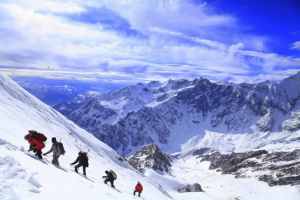
It was pitch dark outside. Nothing outside the purview of our torch’s light was visible as we walked close to each other over ice cold and semi-frozen streams and rocky trails. As the darkness gave way to the first hint of morning light, we reached Samiti Lake. It was 5.30 am. But the clouds showed no signs of giving way. We decided to sit near the still waters of Samiti for some time as Suncheman blew the conch shell, rang the bell and said his final prayers before the last climb. At 6 am, we got up and moved for the final push to the GP1 summit at 4,600 metres. The air had become considerably thin and every hurried move was telling me that. Just below the summit is a narrow passage of extremely loose rocks. On one side is a drop of around 400-500 metres while other is studded with huge boulders. I could see a frozen lake below and the cracks on its icy sheet made by falling rocks. One final push, and there I was at 4,600 metres. I had made it, finally!

Altitude: 4,604 metres (15,105 feet)

We were standing inside a blanket of clouds. We could hear the fearsome rumble of avalanches falling, but couldn’t see anything. We were ecstatic to have reached this far but one was apprehensive if it all would not be futile.

Suncheman, at around 8 am, hinted that sitting there would reap us nothing. But we still weren’t ready to accept that this would be the end of the story. At around 8.45 am, when Suncheman insisted that we should now turn back, Richi was struck by madness. We could see the base of Mt Pandim on our right, and the least he wanted was to make a dash and touch it, at least. He was desperate and just started for it. Suncheman, being the Sherpa, of course had to run behind him. The duo had barely crossed 300 metres, when suddenly the light brightened up from just behind Pandim. It was very difficult to look at the direction of the sun in the mountains but we could still figure out a rocky silhouette as we craned our necks to its last hilt. “Oh, my god! Do you see it?” I shouted. Ankur hadn’t fathomed until then that we were standing right under a 7,000 plus peak with its massive glacier face right above our heads! His mouth was agape. He saw it too! The next 10 minutes could be simply summed up as the greatest miracle of our lives. Words fail me.

The place seemed to have been waiting for some invisible nature’s clock up until then. And as soon as the stage bell was rung, the curtains started going up. First the massive Mt Pandim towered over us from the right. Almost simultaneously, the South Kabru and the Mt Kabru Dome made their appearances. The floodgates were opened for the winds to blow and it kept sweeping the clouds even as the North Kabru and Forked Peak was revealed.

And then, just as the King takes his seat after the other members of the durbar have lined up, the Kanchenjunga appeared. It was the greatest sight our eyes had ever witnessed.


Ornate & embellished

Chandan Sen | New Delhi |

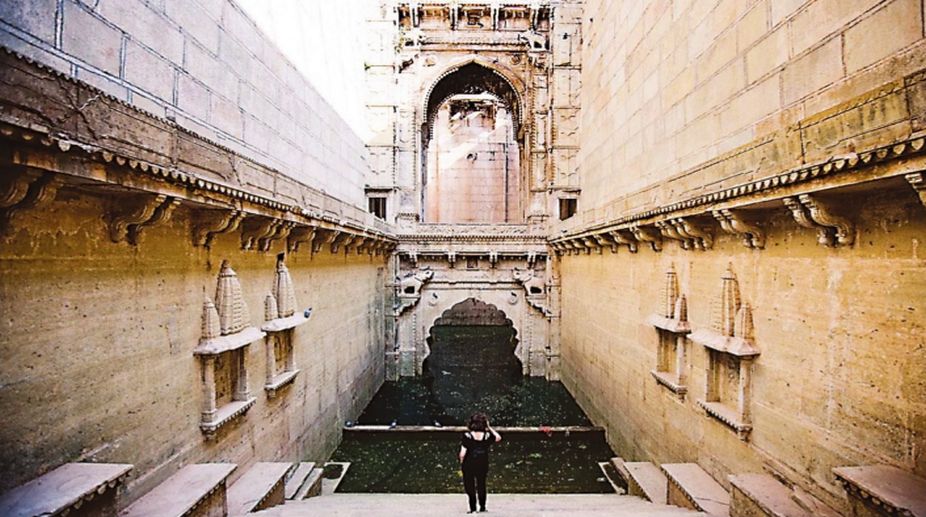
Water is the elixir around which our existence centers. Its dearth and storage has always exercised the ingenuity of people, rich and mass alike. The Baolis or stepwells, in their different forms, have occupied a pivotal role in all the major communities and also remained a part of their tradition especially in rural Rajasthan.

The kund, known to collect rainwater for drinking are structures open from all sides whereas the tankas are privately owned, assiduously guarded and the baories, open to the public. The aesthetic stepwells (Baolis), Kunds and Tankas have added to the heritage value of the city Bundi.

According to an official survey there are over 387 such Baolis all over the district with the city having 21 of them. Bundi (Talera) with 37, Hindoli with 132, Keshorai Patan 65, Indergarh-Lakheri (35) and Nainwa tehsils with 97 of them. Each has its own unique design, architectural excellence, interesting tales and names associated with it. Amongst the most impressive baolis (step wells) and kunds, many are present right in the heart of the city.

The Nagar Sagar Kund is a pair of matching stepwells just outside the Chowgaan Gate in the city.

The special reservoirs are spread all over having typical names owing to the place, background, history people and even caste. One stepwell on the outskirts of the city is named after a dancer while some have very special local names like, Bheru ji ki Baori, Phooti (broken) baori, Khaari Baori, Mahadeo Baori, Purushottan Baori, Nahar Doos ki Baori etc. A Bhoot Kund can also be seen made out of un-cemented stones. Tankas are also present inside the Taragarh (Star Fort) and the Meera Sahib ki Dargah in Bundi and other hill tops for storing water within, built using silt vales made out of stones. The Dabhai Kund or the Jail Kund is the largest of the kunds in Bundi. Though slightly overgrown, it has spectacular carvings on the numerous steps leading down to the water level.

The Raniji ki Baori though not as massive in its dimensions, is extremely ornate and embellished with a rich engraving of an elephant. The delicately chiselled arches on the columns add to the grace and grandeur of the total structure which is an example of baoli architecture. Rani Nathawati had commissioned many such baolis here. Rani ji ki Baori is presently under the care of the state archeology department. Heritage promoter A.H. Zaidi say, "the number of Baories, Kunds etc could be even more. Efforts are on to include the baolis /stepwells in the UNESCO World Heritage site list along with Abhaneri and Bandikui stepwells".

Stepwells have maintained the religious tradition of placing idols of gods and goddesses on either side. In the past, the only source of drinking water was the tanks, lakes and stepwells or wells.

Women carrying pots on their heads used to travel up to these wells in their colorful dresses, singing folk songs which brought these monuments to life. Providing water to the thirsty is considered a yeoman service and this has been depicted symbolically in the sculptures in the Raniji-ki-Baori, where a woman is shown pouring water from the pitcher.

Gulla-ki-baori or Gulabbaori at the Nahar ka Chohta area is also famous for its crystal clear water. Most of the baolis unfortunately need immediate attention and a few look as dry as Delhi around Gandhi Jayanti. Some of them have been ruthlessly and illegally trespassed and a few have fallen victim to the ravages of time .Some efforts are on to clean the existing kunds, baoris before the onset of the monsoons by the students , NGOs and their likes in the form of a ‘Shramdaan’. Some consciousness through works like ‘Amritam Jalam’ is proving useful in cleansing the monument. The revival, restoration and beautification of these pliant summer quenchers could surely make the little township much more than just a City of Stepwells.

In praise of old Mercs

Jeremy Chau | New Delhi |

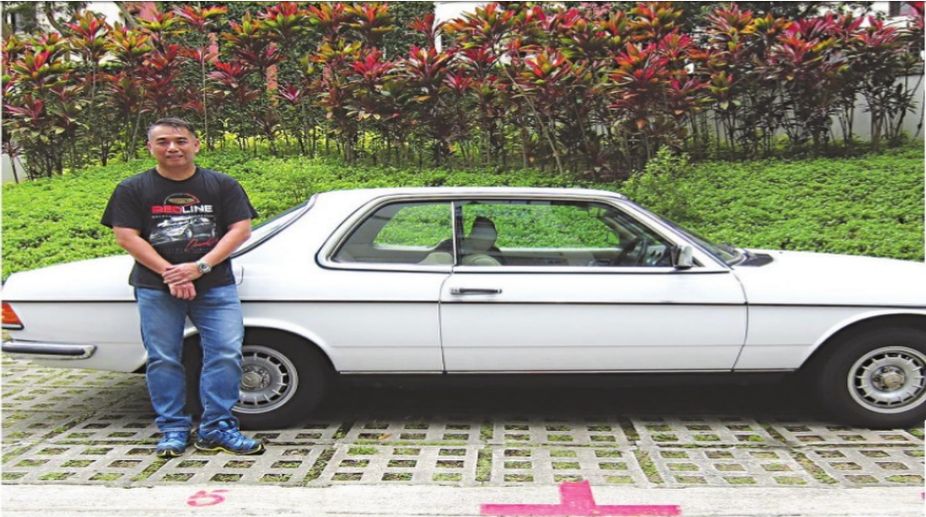
In the world of classic cars, a 1981 Mercedes-Benz 230CE is neither exotic nor particularly powerful. But for mechanical engineer Anthony Yu, the coupe is compelling because it tugs at his heartstrings.

The 47-year-old, who is married with a son and a daughter, has admired the model since he was a child. “When I was 10, one of my neighbours had a green W123,” he says, referring to the code name for the saloon variant of the car. “There’s something grand about Mercedes,” he adds. He picked the coupe version because he “wanted something rarer”. Yu’s first car, however, was no luxury coupe. It was a humble 1971 Mazda 1000 sedan, which he bought in 1990 for $3,600. “I found it funny that my first car was almost as old as I was then.”

As an engineer, he likes to tinker with his cars. But modern automobiles, with their vast electronic and computerised systems, simply do not allow for much tinkering. And that is another reason he is fond of his old-school Merc. “I can ‘do-it-youself’ if I need to,” he says with a chuckle.

The 230CE, however, was not the first Mercedes that Yu has owned. Over the years, he has had models such as the 190E and a W124 E200, which he converted into a “Masterpiece” variant by swopping the body panels and interior trims. The Masterpiece is a locally enhanced E-class variant that had elements such as wood trimmings inside the cabin, different body panels and alloy wheels.
When asked if the financial cost of his passion causes his wife to raise her eyebrows, Yu quickly points out that all the Mercedes cars he has owned are old ones. He paid $28,000 for the 230CE in 2002. He has renewed its certificate of entitlement once and plans to do so again when the current certificate expires in June 2023. “Besides, my wife knows that given my nature, I love tinkering with mechanical things,” he says, “If it’s not my car, then it’ll be my go-kart. If I have nothing to do, I will remove my Mercedes’ spark plugs and clean them.”

In 2008, Yu damaged the car’s fourspeed automatic gearbox when he took it to the Pasir Gudang race circuit in Johor Baru, Malaysia. The transmission had to be overhauled. He also overhauled the car’s 2.3- litre four-cylinder engine, which produced 134bhp, when it was new. Apart from these, his car has been problem-free.


Yu drives his car only on early Sunday mornings. “I’m afraid of my car being hit by a stupid driver. There are too many of them on our roads nowadays,” he says. Daily commutes are done in his other car, a five-year-old BMW 335i, which he describes as “a driver’s car”. “I love to drive,” he says.

The motoring enthusiast is looking out for another Merc — a W126 300SEL. “In old movies, it’s the car that mob bosses are usually chauffeured in,” he says, “But I’m wary of its road tax, which is very high.”

As for the 230CE, he intends to perhaps pass it to his son one day. “He loves it too,” he says.

The Straits Times/ANN

Cutting them to size

Julia Platt Leonard | New Delhi |

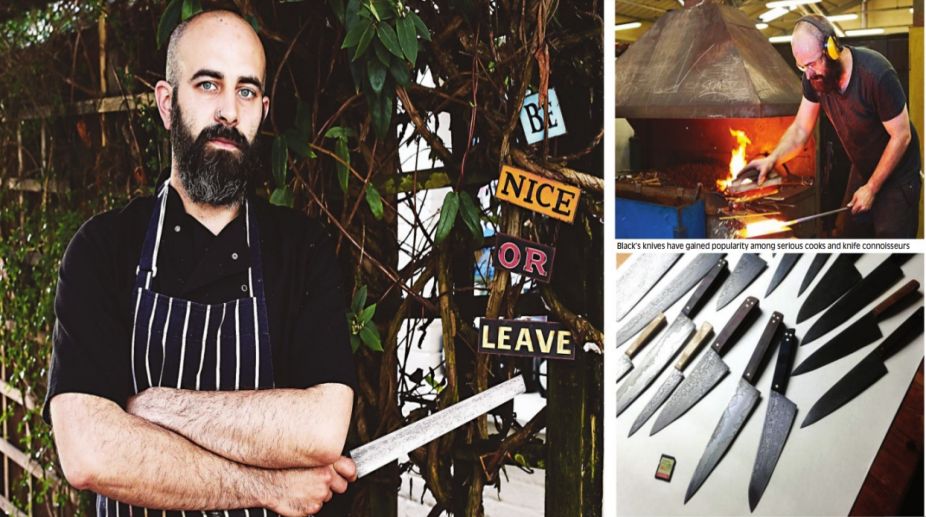
Making a knife is a lot like making puff pastry. If the connection between hard steel and flaky pastry seems tenuous it’s not, just ask Joel Black. Black is a knife maker who came to the profession after working as a chef for 17 years. For the last five, he’s been a blacksmith and his Damascus steel blades are coveted by both serious cooks and knife connoisseurs.

“The steel that I make, which are lots and lots of layers, is essentially puff pastry with steel. It’s tougher and hard but it’s made in almost exactly the same way,” he says. “You fold it over, you put layers and layers and layers through it and you end up with a lattice, which is the same as a mille-feuille or puff pastry.” Today, Black’s knives sell from around £75 for a small paring knife to £300 or more for a bespoke knife, with custom orders taking four to six weeks depending on demand. Eager would-be buyers track his website and snap up new knives almost as soon as they’re posted. Black creates only a few knives each week (his partner helps with the website and marketing), making every knife himself from hand-forged metal blade to handle. He also teaches want-to-be knife makers at a two-day course at his forge in Hereford.

The move from wielding knives in a professional kitchen to making them, came about after a trip to India. He’d worked in kitchens in the UK, Italy and France before deciding to chuck it in and travel. “When I got back, I decided I wasn’t very happy in the kitchen and thought I’d do something about it so I signed up for a blacksmithing course and that was that.”

That first course was an experience, “taster” day, mainly spent making a lot of nails. But it was enough to get him hooked. He went on to get a BA Honours Degree in Artist Blacksmithing at Hereford College of Arts. The goal? To learn how to forge the perfect chef’s knife. But what is a perfect knife? “It depends what the job’s for, what the knife is made for. If you’ve got a boning knife, you want it to be tougher. If you’ve got a fish filleting knife, you want it to be a bit flexible but very, very sharp.”

What he’s aiming for is very tied in with his experience as a chef. “I know what I like when it comes to a knife. It’s very different from somebody who’s come from engineering or a blacksmithing or a design background.” But knowing what he wants and translating that into a piece of razor sharp metal that can slice through food cleanly are two different things. “When I started doing blacksmithing I had no idea what steel could do, no idea how to work any of the machines, or how to forge properly.”

Black tells a story of mistakes early on like when he purchased a sheet of stainless steel only to find out it was the type used for making cheap cutlery and worktops — not the finest chef’s knives. He’s spent years getting the right steel. “You’ve got the perfect amount of carbon to make the steel very, very hard but not brittle.” Trial, error and lots of practice and now, Joel is making knives that are admired by knife pros like chef Henry Harris.

Harris learned about Black from Tim Hayward, author of Knife: the culture, craft and cult of the cook’s knife. A selfconfessed “obsessive hoarder”, Harris has kept every knife he has ever owned, including some of the original carbon steel knives he used when he went to Leith’s Cookery School. The joy of a well-forged knife is both an aesthetic experience as well as a practical one for Harris. “It’s less tiring because it requires less effort. You let the knife do the work and also it’s infinitely more pleasurable.”

Harris was tempted by a small paring knife Black posted for sale. “I thought, ‘I want to buy that.’ It looked the most perfect shape for me as a paring knife and it was a nice Damascus-patterned steel. And I thought, ‘No, I can’t just buy it, as nice as that would be.’” Instead he decided he wanted to meet Black. Even better, he learned that Black was launching knife-making classes at his forge. Harris joined another chef for a special mid-week session to try his hand at crafting his own knives.

Harris discovered that creating the paring knife of his dreams wasn’t going to be easy. “It’s surprisingly difficult when you’re forging something by hand, even if you’re using a pneumatic hammer, to keep it straight and it requires an understanding of where to tap the metal when it’s at that stage to bring balance to the blade.” By the end of the two-day course, Harris says he was exhausted — not only physically but also from absorbing so much new knowledge. “I was slightly humbled by it,” he admits. Harris’ idea for a paring knife turned into two knives, both with handles made from bog oak that has an intensely rich, deep and dark grain. It was a choice that seemed right. “The setting is so beautiful. The resonance of the hand forging, the natural reclaimed wood to make the handle with — it just came together.”

Would Harris recommend the course? “I think every cook should do it. It’s just very different and he’s (Black) driven by what he does. He does it because he loves the whole craft.” Harris’ knives are proudly displayed on Instagram and he’s toying with the idea of going back to make more. “It took over a week for my hands to lose their black, scaly, grubby, engrained dirt, which I carried with pride.”

The Independent

No govt data on drug abuse cases, finds panel

Statesman News Service | New Delhi |

Considering the co-relation between drug abuse and mental disorder, absence of any up-to-date statistics on the number of persons affected with the problem of drug addiction is seriously hampering the efforts to deal with the twin issues of drug abuse and mental illness in the country. 

The investigations by the parliamentary standing committee on social justice and empowerment have revealed that the Central government’s entire energy is currently focused on the problem of drug abuse obtaining in Punjab and Manipur.  There have been reports of increasing cases of drug abuse among women and juveniles, too, in the country. There is, however, no data available to launch a targeted campaign to deal with the problem. 

Moreover, the efforts at dealing with the drug menace in the country are limited to creating awareness ‘on the basis of a survey conducted by United Nations Office on Drugs and Crime (UNODC)’ over 13 years ago. 

“Taking cognizance of high rates of prevalence of addiction in other states with large population base such as Maharashtra, Uttar Pradesh, Andhra Pradesh, Odisha, etc., the committee exhorts the Ministry (of Social Justice and Empowerment) not to concentrate only on these two states but conduct awareness generation programme all over the country evenly, giving preference to all states having high rate of addiction covering rural and remote areas so as to also to target poor and illiterate people,” the committee in its fortieth report tabled in the Lok Sabha on 7 May stated.

All that work as suggested by the committee may remain unimplemented in the absence of any data on number of persons with drug addiction (alcoholism and substance abuse). 

After much dilly dallying the ministry has now decided to finalise an ‘agency’ for conducting a nationwide survey on drug addiction. The committee has expressed ‘surprise’ that the last national survey on drug abuse was conducted in 2000-2001. It has urged the department to put ‘extra efforts’ to complete the national survey ‘without further delay’.

The committee has called for ‘a focused strategy to conduct a nationwide survey every five years’ to facilitate appropriate planning and funding of strategies to tackle the menace of drug abuse in the country.

IPL 2017: Delhi Daredevils thrash Punjab by 51 runs to record their 2nd win

Zaheer Khan-led Delhi Daredevils registered their second straight win in the IPL at Feroz Shah Kotla.

Harpal Singh Bedi | New Delhi |

Englishman Sam Billings (60) led the assault and South African Chris Morris (3 for 23) plotted the collapse as Delhi Daredevils thrashed Kings XI Punjab by 51 runs to chalk out their second straight win in the IPL 2017 at Feroz Shah Kotla here on Saturday.

This was Punjab’s second successive defeat having earlier won two matches. Delhi have won two of their three matches having lost the opener to RCB.

Delhi skipper Zaheer Khan won the toss and opted to bat and his team mates justified his decision as they piled on massive 188 for 6. Punjab chasing 189 for a win could score only 137 for nine in their allotted 20 overs.

The visitors started their reply on a disastrous note as they lost opener Manan Vohra (3) in the second over. He was trapped leg before by leg-spinner Nadeem Shahbaz when the team’s score was five.

Ten balls and 16 runs later the visitors found themselves in trouble with Nadeem striking again to get rid off Wriddhiman Saha (7).

Much was expected from the opener and in-form Hashim Amla but he also flopped when the team needed him most.

The experienced batsman was consumed by Chris Morris who had him caught by Sam Billings. Amla’s 19 came off 12 balls which included four hits to the boundary.

Eoin Morgan and David Miller held on together for 4.5 overs in which they added 34 runs for the fourth wicket but then Australian pacer Pat Cummins broke the stand.

The England captain tried to break the shackle and went for a big shot only to be caught at backward point by Karun Nair. Morgan scored 22 off 20 balls with the help of three boundaries.

Three balls and a run later visitors were in ruins as leg-spinner Amit Mishra accounted for his bunny Glenn Maxwell whom he got caught by Billings. The batsman failed to open his account and the score at that stage was 65 for 5. Mishra claimed Maxwell for the fourth time in five innings.  Axar Patel and Morgan tried to hold on but the stand lasted for 23 runs as Anderson trapped Miller (24, 1×4, 28 balls) leg before, and after that, it was a mere formality.

Earlier Sam Billings dominated the Punjab bowling with swashbuckling 60 0ff 36 balls as Delhi Daredevils posted a daunting 188 for 6 in which 68 runs came in last five overs.

Sanju Samson and Billings gave the hosts a solid start putting up 53 runs for the opening wicket in 6.5 overs. Punjab bowlers especially pace duo of Sandeep and Mohit Sharma failed to make any impact on the openers who kept the scoreboard rotating at fairly fast pace. While Sanju was aggressive Billings was bit circumspect and only went after loose deliveries.

However, the Englishman soon opened up as he slammed three successive boundaries off Varon Aaron’s first over. Then Samson belted Mohit Sharma for a six over long on and the hosts were 49 in five overs.

Punjab skipper Glen Maxwell brought in spinner K Carrippa, who got into the playing eleven replacing pacer Ishant Sharma, into the attack in the sixth over and the move paid off as overeager Samson went for a big hit but fell short and was caught at long-off by Morgan. Samson scored 19 off 18 balls which included two boundaries and a six. The visitors then got another breakthrough in next over as Karun Nair edged Varon Arron to wicket keeper W Saha before opening his account and Delhi were 55 for 2.

 A 41-run third wicket partnership between Shreyas Iyer, who came to the side in place of Aditya Tare, stabilised the host’s innings before Mohit Sharma struck to get rid of Shreyas who went for a big drive only to be caught at mid-wicket by Morgan. The batsman chipped in with 19 runs off 17 balls hitting three boundaries. Then spinner Axar Patel dealt a big blow to Delhi as he got rampaging  Billings caught at long on by David Miller. The opener hit eight boundaries in his 60-run knock.

Young Rishab pant (16, 3×4 9 b) was also then caught by Morgan at mid-off to give Aaron his second wicket and Delhi were reduced to 120 for five in 15.1 overs and Punjab bowlers looked in control of the proceedings.

But at that crucial stage the visitors failed to tighten the grip and suddenly their bowling fell apart as Corey Anderson along with Chris Morris and Patrick Cummins launched a brutal counter assault.

The bowlers lost their focus, line, and length as Delhi batsmen plundered runs at will to add 68 runs in five overs. Anderson hit unbeaten 37 off 22 balls which included three sixes and an equal number of boundaries. He hit Mohit Sharma over long-on and then two successive sixes off Axar Patel over long leg and long on. Morris contributed 17 runs while Cummins hit unbeaten 8 off six balls.

Click here for more stories related to IPL 2017

Shah attacks opposition parties for questioning EVMs

IANS | Bhubaneswar |

Targeting the opposition for questioning electronic voting machines (EVMs), BJP President Amit Shah said on Saturday that instead of making excuses, these parties should have honestly introspected the reasons.

Speaking to the media, Shah dubbed this attitude of opposition parties as disrespect to the Election Commission (EC).

"After their defeat, these political parties should have honestly and gracefully accepted it, but they began making excuses. Among the excuses, EVMs are being discussed," Union Minister Ravi Shankar Prasad quoted Amit Shah as saying during his presidential speech.

According to Prasad, Shah said: "Such talks are like not accepting the defeat honestly and dishonouring the Election Commission."

In a sarcastic attack, Shah said that when United Progressive Alliance won two consecutive election in 2004 and 2009, "EVMs were all right".

"When Bahujan Samaj Party and Samajwadi Party won elections in 2007 and 2012, EVMs were all right. When BJP lost elections in Bihar and Delhi, it was OK, but now all of a sudden questions are being raised on EVMs," Shah said.

The BJP also challenged Delhi Chief Minister Arvind Kejriwal to accept the open challenege of Election Commission to hack EVMs.

"The EC has publicly asked to hack EVMs. Why doesn't he (Kejriwal) hack it. He is an IIT gradute," Prasad said.

President inaugurates Kempegowda festival

IANS | New Delhi |

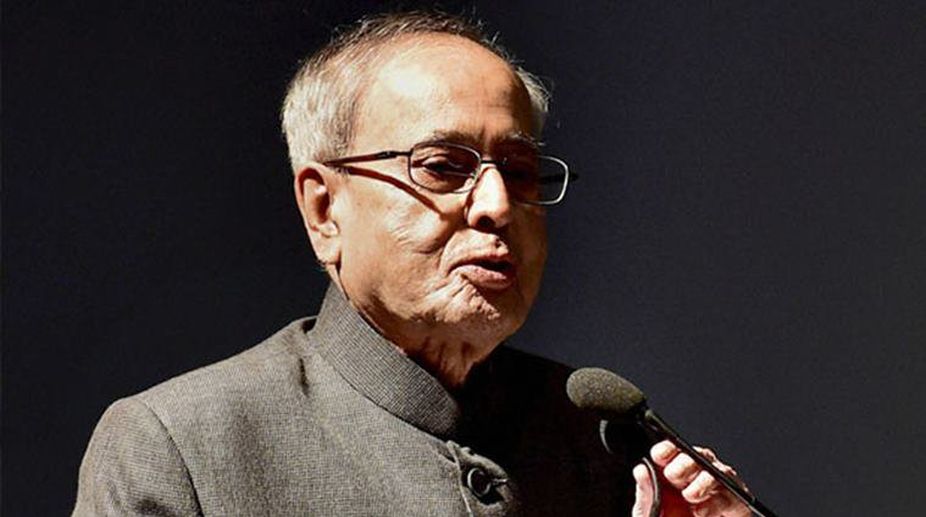
President Pranab Mukherjee on Saturday inaugurated the Kempegowda Festival, and said Kempe Gowda was a "just and humane" ruler of the Vijayanagara empire.

The festival is organised by the Nadaprabhu Kempegowda Foundation, an official release said.

"His genius lay in the fact that he could visualise and implement planned urban development that stands out, as early as in the 16th century A.D. It is a testimony to the genius of Kempe Gowda that Bangalore, despite unprecedented challenges of population, traffic and environmental pollution, remains the Garden City even today," the release quoted him as saying.

The President was glad to learn that the Nadaprabhu Kempegowda Foundation, founded on April 17 last year, is working towards popularising the legendary king and his works.

The President also extended his good wishes to the foundation and hoped that it would achieve its objectives, the release added.

BJP hopeful of winning Odisha in 2019

IANS | Bhubaneswar |

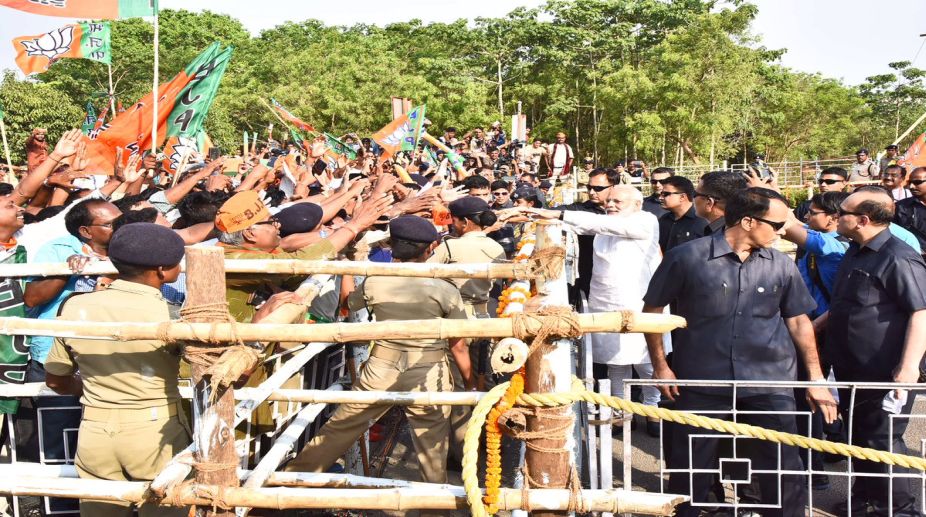
Enthused by its resounding victory in Uttar Pradesh, the Bharatiya Janata Party (BJP) is quite confident that it would come to power in Odisha, where it has never been in a commanding position despite being an ally of the ruling coalition for nine years.

The BJP, at its national executive meeting in Bhubaneswar, hoped that it would be able to build its prospects in the state in the wake of the anti-incumbency tide against the Biju Janata Dal government led by Chief Minister Naveen Patnaik, who has been in power since the last 17 years.

BJP president Amit Shah has given a clear signal in the executive meeting that the party would work relentlessly to grab the eastern state in the 2019 elections.

"The people in Odisha want change from the incumbent government, which is in power since 2000. The Naveen Patnaik government has failed to provide basic amenities to the people in the state," said senior BJP leader and Law Minister Ravishankar Prasad.

What boosted the party's prospects is the recently concluded panchayat polls, where the BJP emerged second, relegating the Congress party to third position.

"We were weak in Odisha. But, our workers fought relentlessly and we came to second position in the panchayat polls. Amit Shahji has asked the party workers to work harder and we will continue our work in the coming days as well," said Prasad.

The party's stunning victory in the Uttar Pradesh assembly elections has boosted the morale of the party – that it can defeat regional parties as well.

"Uttar Pradesh has proved political observers wrong. Political pundits used to say that BJP can overcome Congress, but it puts up a poor showing before regional parties. But the assembly election results have changed that perception," Prasad said.

When the BJP unfurled the saffron flag in many parts of the country in the 2014 Lok Sabha polls, Odisha was among the few states that remained untouched by the charisma of Prime Minister Narendra Modi.

The saffron party could only get one Lok Sabha seat out of 21 in Odisha while the ruling BJD grabbed 20 seats. It managed to get only 10 seats out of 147 in the state Assembly.

The BJP hopes that the situation has changed in the last three years and it can ride on the Narendra Modi wave to taste success in the 2019 polls.

"People in Odisha understand that there has been no development under the leadership of Naveen Patnaik. Amit Shah, during his address at the executive meeting, maintained that the Odisha government is yet to provide safe drinking water to 86 per cent people and electricity to 41 per cent," Sambit Patra, BJP national spokesperson, quoted Shah as saying.