Logo

High alert at Mumbai, Hyderabad, Chennai airports after hijack threat

PTI | New Delhi |

Security at three major international airports in Mumbai, Hyderabad and Chennai has been stepped up after agencies were informed about a possible hijack attempt of an aircraft from these facilities.

Officials said an high alert has been issued to the three facilities after Mumbai Police received an e-mail last night from a woman living there.

The e-mail mentions that the woman overheard six boys talking about a possible aircraft hijack attempt at these facilities, they said.

The Mumbai Police shared the e-mail with all security and intelligence agencies.

A meeting of all stakeholders at these airports was subsequently convened and the input was declared specific and actionable, they said.

CISF Director General O P Singh confirmed to PTI that the security apparatus at these airports has been put on “an enhanced alert and protocols have been stepped up”.

Special anti-sabotage sweeps are being undertaken at these airports since morning and security agencies, including the Central Industrial Security Force, have enhanced frisking of passengers, baggage scanning, pre-emabarkation checks and patrols in the vicinity of the airports, they said.

The CISF has called in its sniffer dog squads and quick reaction teams for undertaking sanitisation drills at the airports, they said, adding airlines have been asked to remain extra vigilant.

“However, there is no reason to panic and all the operations at these airports will be normal and without any hassle to passengers,” a senior officer who is part of airports security team said.

The police are probing the contents of the e-mail and trying to get in touch with the sender. 

IPL 2017: Kotla wicket was slow and we executed plans well, says Zaheer Khan

"We just did the basics right. Got a decent start. we did not lose wickets regularly," said Zaheer Khan.

PTI | New Delhi |

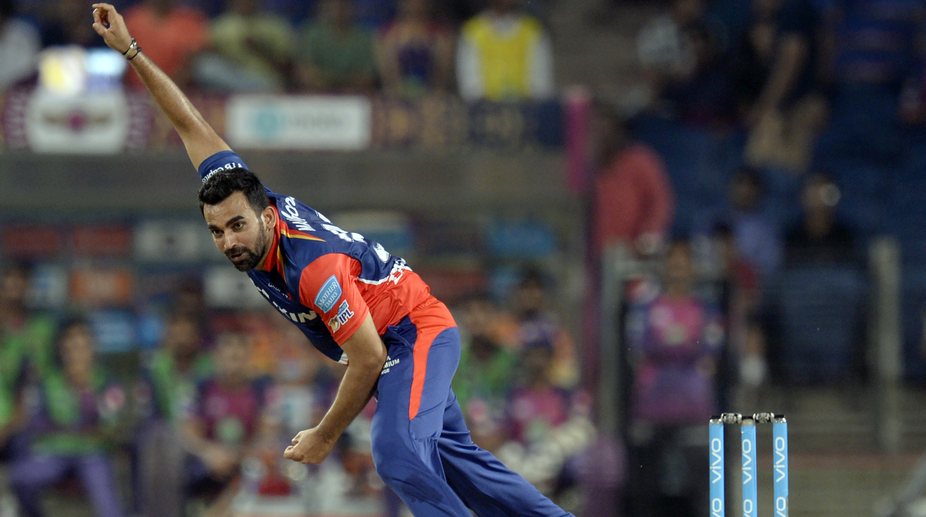
Delhi Daredevils captain Zaheer Khan on Sunday attributed his side's 51-run thrashing of Kings XI Punjab in an IPL match here to sticking to the basics.

He said his side executed the plans well on the field.

"We just did the basics right. Got a decent start. we did not lose wickets regularly. The pitch was slow and we executed the plans well," Zaheer said after the match.

"The pitch was slow and we executed the plans well. It was important that we accelerate at the right time and the start was good from Samson and Billings. We have good batsmen to hit in the end and the platform needs to be good, which it was today," said the former India strike bowler.

Electing to bat, Delhi scored 188 for 6 in their allotted 20 overs and then restricted Punjab to 137 for 9.

Talking about his bowlers' clinical show, Zaheer said, "The way Nadeem bowled was crucial. It was important not to give away runs. I bowled a lot of cutters too. Happy with the way things are going. So far so good."

A disappointed Punjab captain Glenn Maxwell said his side gave 30 runs too many to Delhi batsmen.

"We were a bit behind with the bat. We probably gave 30 too many in conceding 188. We let ourselves go and gave them too many boundary balls at the back end. We're not executing well enough with the ball," Maxwell said.

"We failed in all three facets of the game today. Axar continues to show he's a superstar and Cariappa did well too."

Man-of-the-match Corey Anderson of Delhi said, "It was the kind of wicket where it was tough to get going. Sanju and Sam (Billings) set a great platform. It was good to have that platform to go from.

"We thought 160 might have been a reasonable target during one of the time-outs and in the end it probably was," said Anderson who made 39 not out from 22 balls and took a wicket later.

"As a bowler, you have to read the game. Zaheer sets some interesting fields and he's a smart cricketer. It's a nice confidence to have. It was a clinical performance from the bowlers. It's valuable to be able to chop and change combinations. Finding the right people to do the job is key.

Here’s how heavy drinking causes accidents

IANS | New York |

People who are heavy drinkers-those that drink between 10 and 40 alcoholic drinks per week -may perceive that they can handle the alcohol, as it leads people to judge that they are not impaired.

The findings showed that tolerance to alcohol of men who take more than five drinks at one time and women taking more than four drinks, is not protective against accidents or injuries.

While heavy drinkers showed less impairment than light drinkers on a rote fine motor test over time, they did not perform better on a test involving more short-term memory, motor speed, and more complex cognitive processing.

Thus making decisions to attempt more difficult tasks when drunk may be highly risky, because it is based on faulty information, the researchers said.

"Overall, there is a common belief among heavy drinkers that they can 'handle their alcohol' and that many common daily tasks may not be affected by their alcohol use," said Ty Brumback researcher at the Veterans Affairs San Diego Healthcare System in California, US.

Some heavy drinkers' extensive experience with alcohol may cause increased speed of metabolism, and lower self-perceived impairment.

This behavioural tolerance in heavier drinkers may be a result of cellular adaptation within the brain, changing the sensitivity to alcohol.

Contextual factors also play a part, as when people learn a task while drunk, they adapt to performing that task while under the influence, the researchers said.

"The results have implications for our understanding of alcohol-induced impairments across neurobehavioural processes in heavy drinkers and their ongoing risks for alcohol-related consequences over time," Brumback added.

For the study, published in the journal Psychopharmacolog, 155 young adult volunteers were tested on two cognitive and motor coordination tests at the beginning of the study and again five years later.

Telangana assembly introduces bill to hike Muslim quota

IANS | Hyderabad |

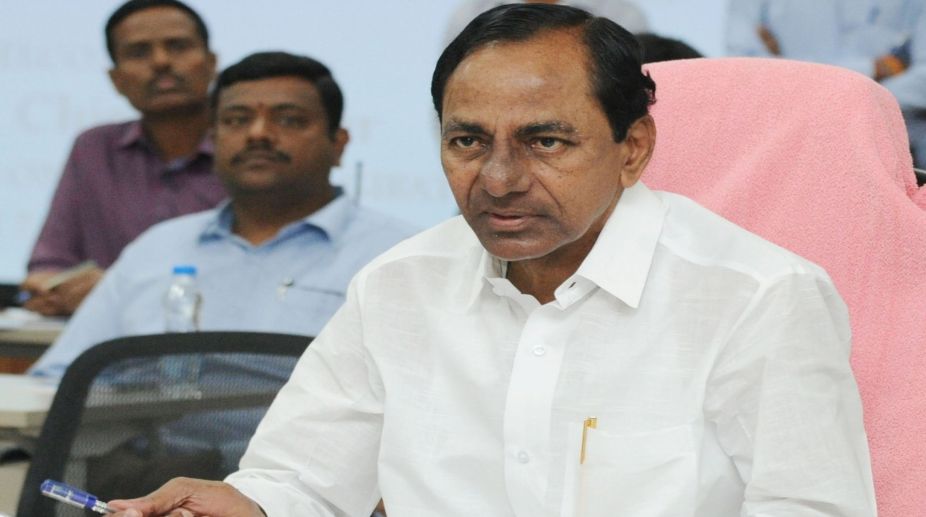
Telangana Chief Minister K Chandrasekhar Rao on Sunday moved a bill in the State legislative assembly to hike reservation quota for backward Muslims and the Scheduled Tribes (ST) to 12 and 10 per cent respectively.

As soon as the day-long special session began, the Chief Minister moved the Backward Class, Scheduled Castes and Scheduled Tribes Reservation Bill, 2017, to increase the quota for socially and economically backward among Muslims under the Backward Classes (E) category from the existing four per cent to 12 percent.

The reservations for STs in education and jobs has been increased from 6 per cent to 10 per cent.

The bill will be passed by both houses of the legislature after a debate and it will be sent to the Centre for President's assent and with a request to include it in the 9th Schedule of the Constitution as it was done in the case of Tamil Nadu.

The Chief Minister clarified that the reservations were being provided purely on the basis of socio-economic backwardness and not on the basis of religion or caste as some parties were trying to mislead people.

Terming it as a historic day, Rao said Telangana Rashtra Samithi (TRS) had during the elections promised that quota for the BC (E) and the STs will be increased in proportion to their population in the state.

He pointed out that STs are currently enjoying 6 percent quota though their population as per 2011 Census is 9.8 percent.

He assured Backward Classes that there will be no injustice to them because of increase in quota for the BC (E) and announced that the quota for the BCs will be increased. The state government has directed the BC Commission to submit a report within six months.

Rao also said that the reservation for the SCs, who constitute 16.3 per cent of the state's population, will be increased by one per cent. He said the government would soon constitute an SC Commission.

The SCs are currently enjoying 15 per cent reservations while the BCs have a total quota of 25 per cent.

The legislation will increase the total reservations in the state to 62 per cent. 

The Chief Minister argued that there is no constitutional bar on providing more than 50 per cent reservation. 

Rao said with 90 per cent of Telangana's population comprising the BCs, SCs, STs and minorities, the state definitely needed more than 50 per cent reservation, and pointed out that states like Tamil Nadu and Jharkhand were already providing more than 50 per cent quota.

Health authorities suspect mutation in swine flu virus

PTI | Hyderabad |

The health authorities in Telangana suspect that the H1N1 virus, that causes swine flu, may have mutated.

The state is witnessing swine flu cases even in the summer season though it is not unusual, an official said.

“Most probably yes, due to the high replication rate there could be an antigenic drift which could have milder mutations,” state-run Nizam's Institute of Medical Sciences (NIMS) Director K Manohar told PTI on April 15, when asked if they suspect that the virus has mutated.

The authorities are awaiting a confirmation on whether the virus has mutated.

“After confirmation of the probable mutation we have to study the disease profile and observe,” he said.

Manohar said, “It is not unusual to see swine flu cases in summer. There is a difference of occurrence in the northern hemisphere and in the southern hemisphere. But cases can occur in summer as well as in winter.”

He also said that it cannot be predicted if a virulent form of H1N1 would be seen when the high temperatures subside and the monsoon sets in.

According to a swine flu bulletin issued by Telangana government on April 12, as many as 9,382 samples were tested for swine flu from August 1, 2015 to April 11 this year in the state and out of them 1,343 were found to be positive.

There were 22 deaths because of swine flu and other complications during the period.

As per the figures, 11 of 77 samples tested on April 11 were found positive for the virus.

Sufficient stock of medicines and testing kits were available in the state at all levels, the bulletin said. 

NAAC suspends application process to undergo overhaul

PTI | New Delhi |

The National Assessment and Accreditation Council (NAAC), which accredits institutions of higher education in the country, has suspended the application process till the grading system undergoes an overhaul.

Following complaints of subjectivity in the accreditation process by the NAAC and corruption or misconduct by peer teams during their field visits, the HRD Ministry had directed the council to rework on the assessment framework to bring in transparency, objectivity and technology.

“HRD Minister Prakash Javadekar had directed that the grading system must be reworked and hence to bring a new system in place it was necessary to suspend the application process for some time.

“Therefore, the receipt of applications for the current assessment has been stopped from March 31 till further announcement,” a senior HRD Ministry official said.

Javadekar will also chair a national consultative meeting on revised accreditation framework on April 25 where over 200 educationists and experts are expected to meet in Delhi to discuss the proposed changes.

According to the new assessment, the institutions will not know in advance which team will visit them and the accommodation and travel plans of the peer team visit will be outsourced.

“The peer team's assessment of the institutions will be also be given just 20 per cent weightage instead of the 100 per cent at present in deciding the grade for an institution and 80 per cent of the weightage will be registered through the Information Communication and Technology (ICT),” the official added.

The application process is likely to resume in July with the launch of new accreditation framework.

100 more less cash townships in 3 months: GNFC

PTI | New Delhi |

Hundred more establishments of oil companies, security personnel, fertiliser companies and others are expected to become less cash townships in next three months, a top official of Gujarat Narmada Valley Fertilizers & Chemicals (GNFC) said.

A township of GNFC at Bharuch has been declared as India's first 100 per cent cashless town and the government has decided to replicate GNFC's model in other big townships to promote digital payments.
Now the company acts as an advisor to entities interested in setting up less cash ecosystem around their facilities.

A township is declared less cash once it starts conducting 80-100 per cent of transactions using digital means.

“There is potential of setting up of thousands of less cash townships in the country. We, as nodal agency of Niti Aayog, have received numerous interest for this. We expect there will be at least another 100 less cash townships in next 2-3 months,” GNFC Managing Director Rajiv Kumar Gupta told PTI.

He said that 81 less cash townships have been approved as on April 14 which will account for at least about Rs.9 crore digital transactions per year.

“Niti Aayog is working with the Human Resource Development Ministry to establish less-cash townships in collaboration with educational institutes. We are working on converting universities and their colonies into less-cash townships,” Gupta said.

“We earlier went around training and motivating people to use digital wallets. Now the Prime Minister has launched BHIM app linked Aadhar where only thumb impression is required and there are no transaction charges. We will now insist people to use this app,” Gupta said.

He said that GNFC is working with Niti Aayog to convert six townships of BSF and five of Central Reserve Police Force into less cash establishments.

“The new townships will include colonies and facilities of oil, steel and other fertiliser companies. This will be mainly driven by public sector units because we feel the ecosystem can be easily established in controlled environment,” Gupta said.

Niti Aayog is promoting less cash townships as part of its efforts to achieve the target of 2,500 crore digital transactions in the current financial year.

Prime Minister Narendra Modi on April 15 launched 75 cashless/less-cash townships, with an overwhelming 56 of them being in Gujarat.

These townships are likely to generate over 1.5 lakh digital transactions every day thereby leading to about 5.5 crore digital transactions in a year.

To qualify as a less-cash township, the establishment must have completed deployment of a payment acceptance infrastructure, and all the families residing there would have to be covered under training programmes.

Also, more than 80 per cent of the total number of transactions must have been done through digital modes of payments.

US confirms ‘failed’ North Korea missile test

PTI | Washington |

The US Defence Department has confirmed that North Korea carried out a missile test, and said the launch failed “almost immediately”.

“The missile blew up almost immediately. The type of missile is still being assessed,” the US Pacific Command said in a statement.

The US Pacific Command detected and tracked what it assessed was a North Korean missile launch at 2121 GMT on April 15, the statement said.

“The launch of the ballistic missile occurred near Sinpo,” US Pacific Command spokesman CDR Dave Benham said.
USPACOM is fully committed to working closely with its allies in the Republic of Korea and in Japan to maintain security, Benham said.

The failed launch came a day after North Korea showcased nearly 60 missiles at a giant military parade to mark the 105th birthday of its founder Kim Il-Sung.

15 arrested in protests demanding Trump’s tax returns

IANS | Washington |

At least 15 people were arrested after thousands of protesters took to the streets across the US to call on President Donald Trump to release his tax returns.

The arrests took place on April 15 in Berkeley, California, when fistfights broke out between supporters and opponents of the President, Efe news reported.

Two people were also injured in the fights.

Police fired tear gas to disperse the crowd and quell the fights, reporting that they had found some people in possession of prohibited items including a knife, helmets, clubs and a fake pistol.

Local authorities knew that there would be two demonstrations on April 15 both for and against Trump, while protests elsewhere in the country, however, were reported to be generally peaceful.

The "Tax March" movement had called for protests to begin at noon, coinciding with the day by which Americans traditionally must have filed their tax returns, though this year because April 15 fell on the weekend and Monday is a local holiday in Washington, taxpayers have until April 18, to file their returns.

The largest march took place in Washington, where protesters marched from the Capitol to the White House, but sizable anti-Trump demonstrations were also staged in Los Angeles, Chicago, Seattle and Austin, Texas.

In New York, hundreds of people carrying anti-Trump signs and effigies of the President gathered in downtown Bryant Park, from where they marched to Trump Tower.

Activists in Florida held dozens of marches around the state, in front of the condominiums at Trump Plaza in West Palm Beach and the entrance of his Mar-a-Lago mansion, where he is spending the weekend with his family.

The movement calls for "transparency" and complains in a statement on its Web site that "despite intense public pressure, President Trump has not yet done so (published his tax returns) – breaking with 40 years of precedent in the process."

The statement rejects the Trump government's excuse that "people don't care," and recalls an ABC/Washington Post survey that showed 74 per cent of Americans, including more than half of Republicans, want to know the president's tax history.

During Trump's presidential campaign, he kept postponing the release of his tax returns with the excuse that they were under audit.

Two days after he entered the White House, Presidential Adviser Kellyanne Conway said Trump was not going to disclose his tax situation because it became obvious during the campaign that US citizens really did not care about the matter.

Indian doctors suffer bias within UK medical system: Report

PTI | London |

Doctors trained in countries like India are suffering from an inherent bias within the UK medical system, a new report has indicated.

An analysis of the UK's General Medical Council (GMC) data between 1996 and 2013 revealed that Indian doctors were five times more likely to undergo "performance assessments within the state-funded National Health Service (NHS).

The research conducted by University College London (UCL) and published in 'BMC Medical Education' journal recently concluded that doctors trained outside the UK had significantly higher rates of GMC performance assessments than UK-trained doctors. 

"Bias within the system, particularly in terms of who is complained about, could be and probably is a factor. But I suspect it is not the only factor. We have raised these issues and we think more research is needed to tease apart different explanatory factors," said Dr Henry Potts, the lead author of the research.

The report recommends a more globalised testing arrangement that would help counter this imbalance. 

"There may be implications for transnational agreements on freedom of movement of healthcare professionals, and for what testing is required by national governments of individuals trained elsewhere," the report said.

Susan Goldsmith, Deputy Chief Executive of the General Medical Council, said: "We believe doctors and patients are best served by bringing in a single route to UK practice, replacing the multiple routes that exist now. 

"We are now consulting on a medical licensing assessment that would be taken by every doctor wishing to practise in the UK, regardless of where they qualified in the world." 

While Indian doctors were five times more likely to face investigations, Bangladeshi doctors fared the worst at 13 times. Doctors from Egypt and Nigeria were eight times more likely to be questioned, compared to seven times more likelihood for Iraqi doctors and six times for Germans.

Doctors from India make up a large chunk of the NHS workforce and the GMC currently has 25,281 Indian-trained doctors on its register.

The latest analysis supports the claims of the British Association of Physicians of Indian-origin (BAPIO), which had launched a high court battle in 2014 claiming the GMC failed too many doctors from overseas in GP tests.

"There is no doubt that there is an inherent problem within the system. BAPIO has always spoken up for fairness and equality. We are very proud of the services given by Indian doctors and while we do believe things are gradually improving, we are still concerned there continues to be differential treatment," said BAPIO president Dr Ramesh Mehta.

He welcomed any reform within the testing system as his group is in discussions with the Department of Health on a new international fellowship programme, which would see Indian medical graduates come to the UK for two to three years.

"In all our meetings with ministers, it is very clear that Indian doctors are considered the backbone of the NHS.

They have approached us to help recruit more Indian doctors and we are working on this fellowship programme which will see the NHS get doctors from India to fill shortages and Indian doctors get the excellent British training. We want to ensure it is not a brain drain from India but a win-win situation," Dr Mehta explained.

The UK had recently launched a new placement scheme to bring in doctors from India to plug shortages in NHS emergency departments. The first set of 20 Indian doctors start work in Manchester this year to help out in the region s eight Accident & Emergency (A&E) departments. Their placement is expected to run for up to three years, with the scheme also likely to be extended to other regions of the country. 

It is being operated by the Greater Manchester devolution team and Wrightington, Wigan and Leigh Foundation Trust and backed by the Health Education England (HEE), the Department of Health body in charge of education and training.

"Health Education England (HEE) through its Global Health Exchange is pleased to be helping to support the training and development of overseas doctors by placing them in clinical educational programmes in hospitals in the UK," said Ged Byrne, Director of Education and Quality, HEE – North West. 

"This work is helping to increase the number of doctors who are available to support acutely ill patients. The relationship benefits both the UK as it helps to fill an immediate need and the doctors themselves who gain access to high quality training and a unique skills set," he said.

The doctors who will have access to the scheme include those who have completed their basic training but are still learning specialist skills and have yet to qualify as a consultant. After a three-year period, they are expected to return to Indian hospitals.


Beyond Easter bunny, beautiful inspiring words

SNS | New Delhi |

Cute, furry Easter bunnies are out. Bright and beautifully painted Easter eggs are waiting for you on the table, and there are inspiring words for the soul – to quench the thirst and fill the hunger. There's rejoicing on the street and celebration in homes.

Easter celebration for some Christians are bigger than Christmas though both days are closely and symbolically linked. On Easter Sunday, millions across the world wake up in the wee hours of the morning and gather in a place to welcome and rejoice in the resurrection of Jesus Christ from death.
However, through history, the spiritual meaning of Jesus' life on earth, his crucifixion and victory over death has inspired not only the Christians, but also other people belonging to different faith. World leaders and well-known personalities, including Mahatma Gandhi, had commented on it. Here are some popular soul inspiring quotes on Easter by them.

This is what our own Father of the Nation, Mahatma Gandhi, wrote:

"A man who was completely innocent, offered himself as a sacrifice for the good of others, including his enemies, and became the ransom of the world. It was a perfect act."

Our spiritual guru Deepak Chopra too writes about Easter Sunday as a whole new way of thinking.

"The symbolic language of the crucifixion is the death of the old paradigm; resurrection is a leap into a whole new way of thinking."

According to Annie Besant: "Easter is a movable event, calculated by the relative positions of sun and moon, an impossible way of fixing year by year the anniversary of a historical event, but a very natural and indeed inevitable way of calculating a solar festival. These changing dates do not point to the history of a man, but to the hero of a solar myth."

Then, of course, Pope John Paul II, speaking on one of the Easter Sundays, said to all the people in the world:

"Do not abandon yourselves to despair. We are the Easter people and hallelujah is our song."

Dwight L Moody wrote: "We are told to let our light shine, and if it does, we won't need to tell anybody it does. Lighthouses don't fire cannons to call attention to their shining – they just shine."

World renowned evangelist Billy Graham too has a message for the world.

"God proved His love on the Cross. When Christ hung, and bled, and died, it was God saying to the world, ‘I love you.’"

"Dawn and resurrection are synonymous. The reappearance of the light is the same as the survival of the soul." ~ Victor Hugo

It's springtime, and the time is right for shedding of the old and embracing the new.

"Our Lord has written the promise of resurrection, not in books alone, but in every leaf in springtime," wrote Martin Luther.

Then Pope Francis prays for the world: "We ask the risen Jesus, who turns death into life, to change hatred into love, vengeance into forgiveness, war into peace."

And, as Pablo Naruda says, "You can cut all the flowers but you cannot keep spring from coming," let the inspiring quotes stir your soul and let the spring in you blossom. Celebrate new life, new beginning every day. And, let your soul shine.

Selena Gomez, The Weeknd look inseparable at Coachella

IANS | Los Angeles |

After The Weeknd made his romance with Selena Gomez Instagram official, the two love birds were spotted attending the 2017 Coachella together.

The couple was photographed making their way to Travis Scott's performance. Taking the lead, the "Starboy" hitmaker led the singer-actress by the hand to help make their way through the crowds, reported E! Online.

Gomez, 24, donned white t-shirt with jeans and shoes, while The Weeknd, 27, sported printed shirt, black pants and white sneakers.

The pair eventually settled in the VIP area of Travis' concert. Other attendees included Kendall and Kylie Jenner.

Turkey votes in landmark presidential referendum

IANS | Ankara  |

Voting began on Sunday in Turkey in a landmark referendum that will determine whether President Recep Tayyip Erdogan will be granted new powers, the media reported.

Erdogan is seeking to replace Turkey's parliamentary system with an executive presidency, the BBC reported.

A "yes" vote could see Erdogan remain in office until 2029 and would give him vastly enhanced powers to appoint cabinet ministers, issue decrees, choose senior judges and dissolve parliamen.

On April 15, Turkish politicians made their final appeals to voters preparing to cast their ballots on one of the most sweeping programmes of constitutional change since Turkey became a republic almost a century ago.

Some 55 million Turkish voters are eligible to cast their ballots, according to Hurriyet Daily News.

The referendum is expected to attract a high turnout, with 1.2 million young people eligible to vote for the first time.

The Supreme Board of Election has announced that 167,140 ballot boxes will be ready for voters; another 461 boxes have also been set up in prisons.

The election process for Turkish citizens living abroad ended on April 9. Over a million registered citizens voted at 120 foreign missions in 57 countries.

For those who have missed the two-week election period, 120 boxes at 31 customs gates will be open for Turkish citizens living abroad until 5 pm on Sunday.

The campaign for the referendum was launched last October.

I treat success, failure similarly: Sonakshi Sinha

IANS | New Delhi |

Success has ruined more people than failure, believes actress Sonakshi Sinha, who says she neither shouts from the rooftop when her films do well, nor does she sit in the dark and cry over her movie debacles.

"I have been brought up in a way that I treat success and failure in the same way," the actress told IANS while promoting her forthcoming film "Noor" here.

"Somebody once said, 'success has ruined more people than failure'. So it's very important to learn from mistakes and not dwell on them. When I had my huge successes, I never got on to a rooftop and shouted that my films are a hit; and in the case of failures, I don't sit in a corner and cry about them.

"You move on and do your next film," added Sonakshi.

The 29-year-old, who is the daughter of actor-turned-politician Shatrughan Sinha and Poonam Sinha, made her debut with "Dabangg", a film that starred Salman Khan.

Subsequently, she delivered hits like "Rowdy Rathore" and "Holiday: A Soldier Is Never Off Duty" and a female-driven film like "Akira". She also tried her hand at a different genre with "Lootera", which gave her a chance to show her range as an actor.

She will next be seen playing a journalist in "Noor", scheduled for a worldwide release on April 21.

Sonakshi credits her past work for helping her reach a point in Bollywood where she is getting to play title roles.

"I feel my journey in Bollywood has been great. Some of the initial roles I did have put me in a position today where I shoulder a film like 'Akira' by myself. I have played two title roles and it is really exciting to be able to do that.

"Honestly, the films that I have done in the past have put me in a position that I can do roles like 'Noor' today," she said.

She is also glad that the industry is changing in a way that's favourable for women.

"We are moving in a direction where films are being made with female protagonists, and it's really exciting because, finally, good and amazing roles are being written keeping women in mind. I am very happy to be part of this change and to be able to do those kind of roles," she added.

Directed by Sunhil Sippy, "Noor" is a crime thriller-comedy adapted from Pakistani novel "Karachi, You're Killing Me!".

The novel centres on a 20-year-old reporter, Ayesha Khan, living in Karachi, her misadventures and finding a nice lover. However, the film is set in Mumbai.

Asked about how this cross-cultural exchange between India and Pakistan can help, she said: "We are just here to entertain people and that's our purpose. It's an entertaining film taken from the book with the only purpose to entertain and nothing else."

The message she wants the audience to take is: "Your voices are important. Youth has the power to make a difference."

PM Modi greets people on the occasion of Easter

IANS | New Delhi |

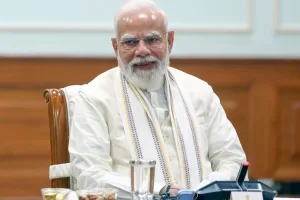
Prime Minister Narendra Modi on Sunday greeted the people on the occasion of Easter.

"Easter greetings to everyone. May the teachings of Jesus Christ further the spirit of harmony, compassion and togetherness in our society," he tweeted.

Easter celebrates the resurrection of Jesus Christ from the dead which occurred three days after his crucifixion.

25 ‘golden age’ to beat computers: Study

IANS | London |

Turning 25? This may be the best time of your life, as according to a study, 25 is the golden age when humans can outsmart computers.

The study showed that people's ability to make random choices or mimic a random process, such as coming up with hypothetical results for a series of coin flips, peaks around age 25.

At their peak, humans outcompete many computer algorithms in generating seemingly random patterns, an ability that arises from some of the most highly developed cognitive processes in humans and may be connected to abilities such as human creativity, the researchers said, in the paper published in the journal PLOS Computational Biology.

"This experiment is a kind of reverse Turing test for random behaviour, a test of strength between algorithms and humans," said Hector Zenil from the Algorithmic Nature Group in France.

"25 is, on average, the golden age when humans best outsmart computers," added Nicolas Gauvrit from the Algorithmic Nature Group.

Previous studies have shown that ageing diminishes a person's ability to behave randomly. However, it had been unclear how this ability evolves over a person's lifetime, nor had it been possible to assess the ways in which humans may behave randomly beyond simple statistical tests.

For the study, the team assessed more than 3,400 people aged four to 91 years old, who were asked to perform a series of online tasks that assessed their ability to behave randomly.

The scientists analysed the participants' choices according to their algorithmic randomness, which is based on the idea that patterns that are more random are harder to summarise mathematically.

After controlling for characteristics such as gender, language, and education, they found that age was the only factor that affected the ability to behave randomly. This ability peaked at age 25, on average, and declined from then on, the researchers noted.

Over 1 cr households in urban India without bathrooms: HUPA

IANS | New Delhi |

Over 1 crore households in urban areas of the country don't have bathrooms, according to data provided by the Ministry of Housing and Urban Poverty Alleviation (HUPA).

Under the Centre's flagship programme Swachch Bharat Mission, the government aims to make India open-defecation free (ODF) by 2019.

So far, 31.14 lakh individual toilets have been constructed under the programme, while 1.15 lakh community and public toilets have been constructed with the assistance of the government.

The total number of households in urban areas is about 7.8 crore.

"Nearly 1 crore or about 13 per cent of the total households in urban areas do not have latrine facility — neither access to public latrine nor do they have toilets within their premises," according to the data provided by the HUPA ministry in Parliament recently.

While 74.64 lakh houses use enclosures without roof, 18 per cent or about 1.42 crore households do not have separate kitchen in their houses.

It indicates that members of these households are exposed to pollution which may lead to severe health problems.

Under a component of Pradhan Mantri Awas Yojana (Urban), the households lacking in facilities like kitchen, toilet or bathroom may get central assistance of upto Rs 1.5 lakh for construction of these amenities.