Logo

Emma Stone, Jennifer Lawrence ‘saved’ Brie Larson’s life

IANS | Los Angeles |

Oscar-winning actress Brie Larson has revealed that her friends and actresses Emma Stone and Jennifer Lawrence saved her life and came to her rescue at a low point during the promotional whirlwind for her 2015 film "Room".

"I felt lonely and bad sometimes. I was embarrassed to keep talking about myself. Emma wrote this beautiful e-mail out of nowhere, and then one day Jen sent me a text message after she saw ‘Room', and we started talking," Larson told Vanity Fair magazine, reports dailymail.co.uk.

The text, Larson revealed, ended up being a group chat including actresses Lena Dunham and Amy Schumer.

"That saved my life," she said.

"I was able to talk with them about everything that was going on in my life, and it was with people who had been through it before and are also hilarious," she added.

India objects to Pakistan raising Kashmir issue at UN forum

PTI | United Nations |

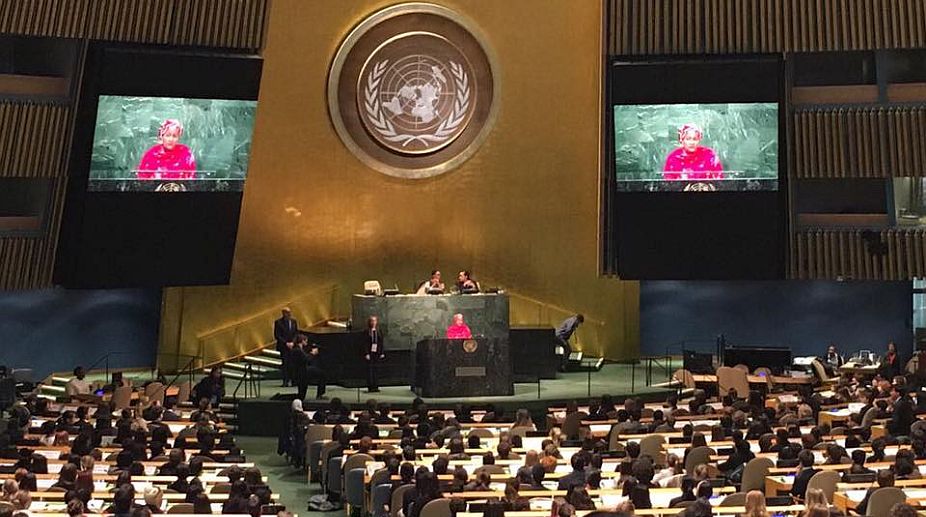
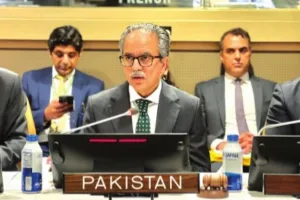
India has strongly objected to Pakistan raising the Kashmir issue at a UN General Assembly session here, asserting that it is a bilateral matter which should not be brought up in the UN forum.

Minister in Pakistan's Permanent Mission to the UN Masood Anwar raised the Kashmir issue in his statement to the UN General Assembly session of the Committee on Information on April 25.

He said Pakistan appreciates the efforts by the UNs Department of Public Information in arranging coverage of events related to the International Day of Solidarity with the Palestinian people.

“We would urge you to do the same for the people of Kashmir who continue to suffer under foreign occupation, Anwar said.

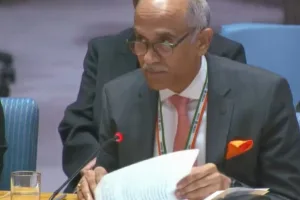
As soon as these remarks were made, Minister in Indias Permanent Mission to the UN S Srinivas Prasad interrupted Anwars speech and strongly raised objections to the mention of Kashmir by the Pakistani delegate.

“It is a bilateral issue which should not be brought here, Prasad told the Chair of the session.

Pakistans Ambassador to the UN Maleeha Lodhi, also present during the session, was heard prodding Anwar to “carry on” speaking even as Prasad raised his objections with the session's Chair.

Later, before delivering India's statement at the session, Prasad said the Kashmir issue was totally unrelated to the forum.

“Before I begin my statement, I would like to thank the Chair for its deft handling and not allowing the elaboration of a subject which is totally unrelated to this forum as was tried by a member state,” Prasad said.

The Committee on Information is a subsidiary body of the General Assembly established to deal with questions relating to public information. It is responsible for overseeing the work of the Department of Public Information and for providing it with guidance on policies, programmes and activities of the Department.


Donald Trump gives Pentagon more flexibility on Iraq, Syria troops

AP | Washington |

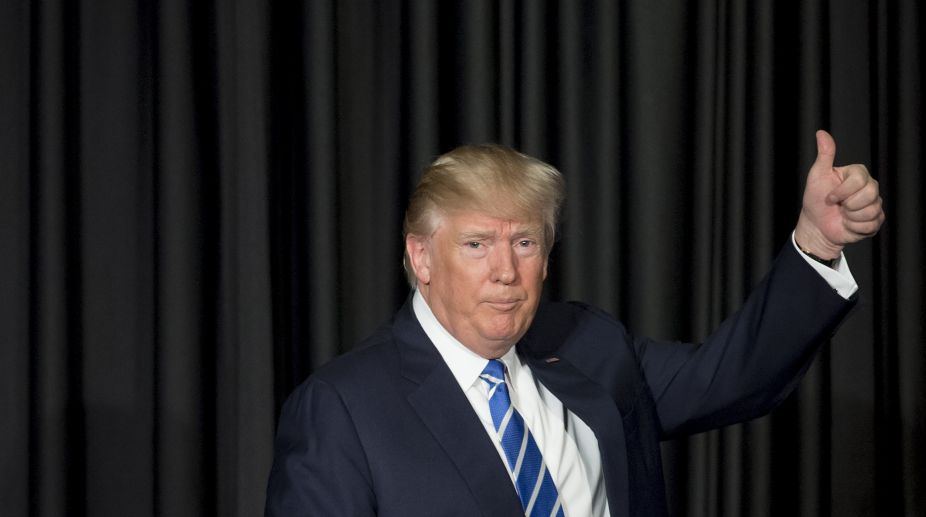
The White House is giving the Pentagon greater flexibility to determine the number of US troops in Iraq and Syria, in another move by President Donald Trump to shift greater power to his military leaders.

The decision will give Defense Secretary Jim Mattis the authority to send more forces into Syria, to assist US-backed local troops as they move to retake Raqqa from the Islamic State group, which has used the city as a de facto capital.

It will also let him adjust the force numbers in Iraq, in the ongoing fight to oust IS from Mosul and stabilize it as the rebuilding begins.

The Pentagon has already been making quiet, incremental additions to the troop levels in both countries in recent months, adding hundreds of Marines in Syria to provide artillery support, and sending more advisers into Iraq to work with units closer to the fight in Mosul.

Those moves were done with White House approval, but without any formal adjustment to the longstanding troop caps that had been set by the Obama administration.

Dana White, chief spokesperson for the Pentagon, said Wednesday that Mattis has not made any changes yet to the current authorised force levels.

Under the Obama White House, military leaders chafed about micromanagement that forced commanders to get approvals for routine tactical decisions and personnel moves, and provide justification for any troops sent into war zones.

Commanders have argued that they should be able to determine troop deployments based on the military capabilities they believe are needed at any given time.

The new authority will provide greater transparency about the actual number of US forces in Iraq and Syria after several years of public confusion about the accurate totals.

Under the Obama-mandated caps, the US was limited to 503 officially deployed troops in Syria, and 5,262 in Iraq. The Pentagon, however, has closer to 7,000 in Iraq, and hundreds more than the cap in Syria, but doesn't count them because they are on temporary duty or not counted under specific personnel rules.

The change, however, could trigger concerns particularly in Iraq, where there are political sensitivities about the footprint of American and coalition troops and fears about occupation forces.

Officials worry that if they publicly acknowledge there are thousands more troops there, it could fuel opposition and problems for the Iraqi government.

Trump's decision applies only to the two countries, and so far does not affect Afghanistan, although that change has also been discussed.
“This does not represent a change in our mission in Iraq and Syria to defeat ISIS,” said White, using another name for the Islamic State group.


India to help Sri Lanka build roads in Jaffna

IANS | New Delhi |

India has agreed to help develop the road infrastructure in Sri Lanka's Jaffna region, official sources said on Wednesday.

The issue came up for discussion when Road Transport and Highways Minister Nitin Gadkari called on visiting Sri Lanka Prime Minister Ranil Vickramasinghe.

"During the discussions, the Sri Lankan Prime Minister invited the Indian government to take up development of three major road stretches – Jaffna to Mannar, Mannar to Vavuniya and Dambulla to Tricomalee," a Ministry official said. 

Gadkari assured Vickramasinghe, who is on a five-day visit to India, full cooperation in "developing world-class infrastructure" in the region. 

He also suggested that taking up these stretches for development may only be possible with the active support of Sri Lankan agencies on land acquisition and local clearances. 

Gadkari reiterated Prime Minister Narendra Modi's commitment to India's active support in strengthening bilateral relations.

Suicide attack in Kashmir’s Kupwara kills 5

IANS | Srinagar |

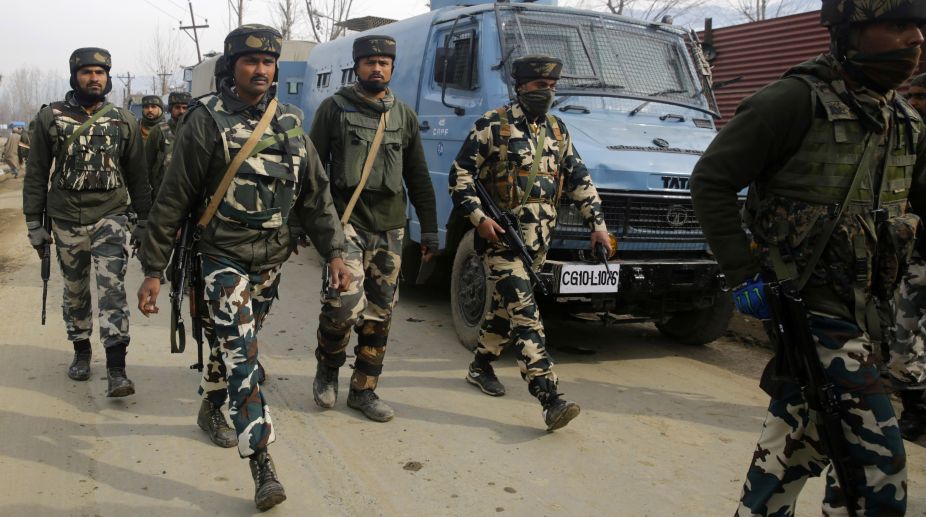
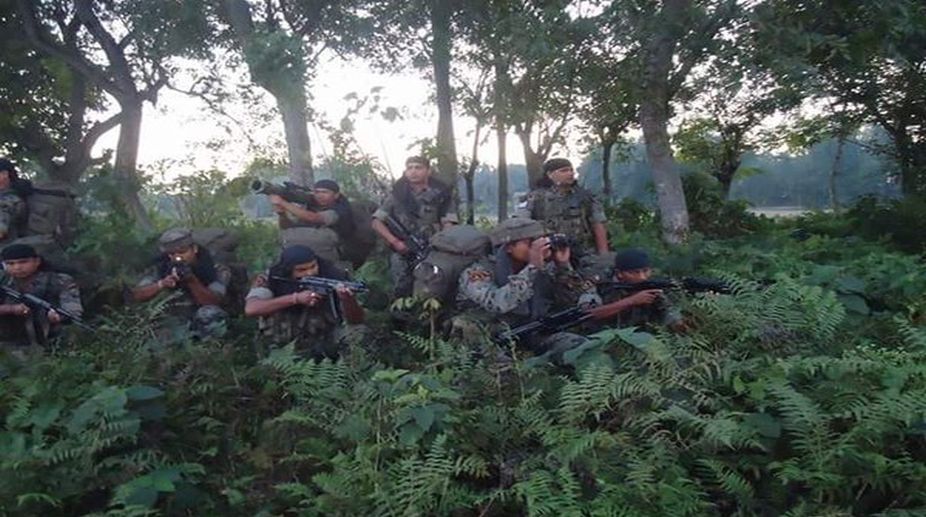
Five, including three soldiers and two militants, were killed in a 'fidayeen' (suicide) attack on an army camp on Thursday in north Kashmir's Kupwara district.

"Fidayeen terrorists attacked the Panzgam army camp close to the Line of Control (LoC) around 4.30 am" Defence Ministry Spokesman, Colonel Rajesh Kalia said. 

"The three soldiers killed, included a captain and a non-commissioned officer (NGO)," the spokesman added.

Searches were going on inside the camp to ascertain whether or not the militants managed to sneak into the camp.

EPL: Tottenham Hotspur edge Crystal Palace to keep title hopes alive

Christian Eriksen's late strike was worthy of winning any match!

SNS | New Delhi |

Tottenham Hotspur were made to work hard for a 1-0 win over Crystal Palace on Wednesday in their English Premier League fixture, with Christian Eriksen’s 78th minute strike ensuring the Lilywhites reduced Chelsea’s lead at the top of the table to four points in the process.

After the Blues had beaten Southampton 4-2 on Tuesday, Mauricio Pochettino’s men were under pressure to beat the in-form Eagles whose most recent scalps include heavyweights Chelsea and Liverpool.

Spurs were looking to get over their FA Cup exit at the hands of Chelsea over the weekend but despite having the likes of Kyle Walker and Ben Davies back in the starting XI, took time to get going.

The first-half saw plenty of end-to-end action, with Palace giving as good as they got, sitting deep and hitting the Lilywhites on the counter. While Spurs had plenty of the ball, as expected, they weren't able to really test Wayne Hennessey before the interval.

Pochettino made a double substitution at half-time, sensing that he needed to make a change to force the result, bringing on Son Heung-min for Mousa Dembele and Moussa Sissoko for Victor Wanyama.

Bolstered by the presence of fresh legs, Spurs started to dominate the home side but with Sam Allardyce tactics are almost always spot on and with six, even seven players inside the box at times, it looked like they would continue to stymie the Lilywhites for the whole game.

Harry Kane cut a frustrated figure at Selhurst Park, almost immediately closed down whenever he got the ball and even got a yellow card as tempers flared in the second half. 

The away side continued to press and were rewarded for their perseverance in 12 minutes from time when Eriksen let loose a sumptuous shot which beat Hennessey all ends up from outside the box. The Danish midfielder hasn't been scoring a lot this season, but sure picked the right time to find his scoring boots.  

While Spurs cooled down after the goal, not expending much energy as they knew the job was done and held on for the priceless three points. For Eagles fans, the loss was not the only bad news as defender Mamadou Sakho was stretchered off early on in the second half after suffering an awkward knee injury and they will hope it is nothing serious.

Spurs have a tougher fixture up next, as they entertain arch-rivals Arsenal in the North-London Derby on Sunday, but Chelsea face a daunting task when they travel to Everton earlier on the day, with the title race still very much alive. 

In the other matches on the night, Arsenal beat Leicester City 1-0 thanks to a Robert Huth goal while 19th-placed Middlesbrough beat bottom-ranked Sunderland 1-0 via Maarten de Roon strike.

DFB-Pokal: Borussia Dortmund stun Bayern Munich to reach final

A standout performance from the young Ousmane Dembele to spoil Bayern's double hopes!

Prithviraj Dev | New Delhi |

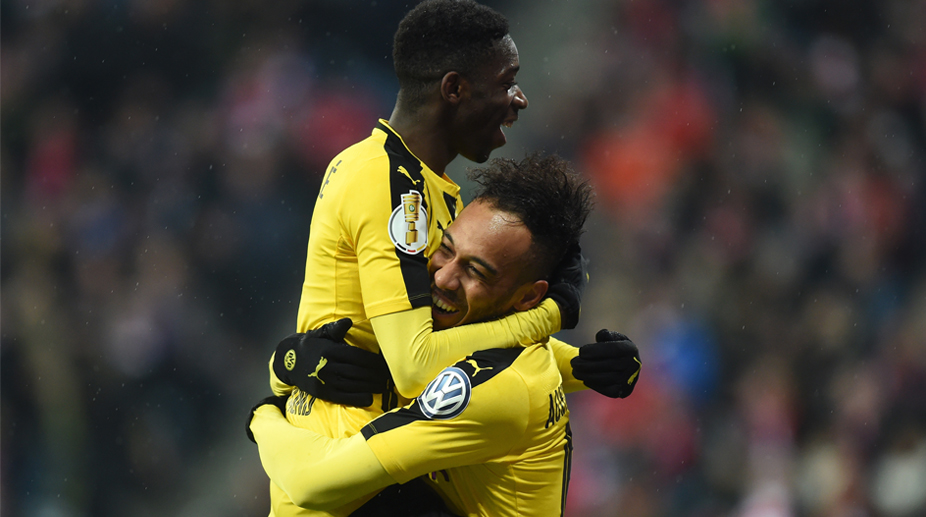
Borussia Dortmund made it a week to forget for Bayern Munich, scripting a 3-2 comeback win at the Allianz Arena to reach the DFB-Pokal final in a thrilling instalment of Der Klassiker on Wednesday night.

Reeling from their unfortunate exit from the UEFA Champions League at the hands of Real Madrid, Die Bayern were desperate to avoid a defeat in Der Klassiker and Carlo Ancelotti sent out his best-possible XI to force the result. 

With the notable exception of injured goalkeeper Manuel Neuer, the home side had their full complement of stars as they sought to keep hopes of a league and cup double intact.

It was Dortmund who drew first blood, however, Marco Reus tapping in an empty net in the 19th minute. Raphaël Guerreiro had snatched up Javi Martinez’s lose back-pass and shot past Sven Ulreich only for the ball to bobble off the post before Reus was on hand to finish from two yards out.

The away side should really have been two goals to the good already for Pierre Emerick Aubameyang had missed an absolute sitter in the early stages of the tie. The Gabonese striker just had to get a slight touch on Guerreiro’s cross, but somehow missed the target to give Bayern an initial reprieve.

Bayern were stung into action and responded with goals via their central defenders, Mats Hummels and Javi Martinez, in the first-half itself. Martinez, playing at centre-back after Jerome Boateng had been deemed fit for the bench, redeemed his earlier error when he equalised via a thundering header from Xabi Alonso’s corner in the 28th minute. And former Dortmund defender Hummels then applied a cool first-time finish to Franck Ribery’s low cross to give the host a vital lead going into the interval.

The second period began in the same vein as the first had ended, with Bayern utterly dominant and looking like they would rip apart Dortmund to shreds each time they attacked. However, due to several factors, not least including their profligacy and an inspired Roman Burkl in the Dortmund goal, were unable to find that third goal which would effectively kill the game.

And suddenly out of nowhere, Dortmund equalised via a lightning-quick counter. Ousmane Dembele sent in a cross at the far-post for Aubameyang and the striker didn't miss his target a second time to keep their chances of reaching a fourth consecutive German Cup final alive. 

Five minutes later, Die Borussen were ahead, as Dembele showed just what the fuss around him is all about with a brilliant counter-attacking goal. Initially the attack seemed to have fizzled out but as Marco Reus laid it out for him on the right, Dembele faked to shoot with his right and cut in to send in a thundering shot which cannoned off the post to cap a remarkable turnaround.

Bayern and Arjen Robben, were quite unlucky on the night, coming close to scoring on several occasions but could not find a way to force the issue into extra-time.

The entire Dortmund team wildly celebrated after the final whistle and with Eintracht Frankfurt awaiting them in the final, will aim to bring cheer after a difficult period which has seen them exit Europe at the hands of Monaco in a tie which was overshadowed by the attacks on their team bus.

For Bayern manager Carlo Ancelotti, however, the loss may well the death knell after a season which had started to promise so much will leave them with ‘only’ the Bundesliga title. Talk of him being replaced in the summer just won’t go away and while the Bavarians have cantered to the league title, failure in Europe is not looked kindly upon by the ever-demanding Bayern faithful.

I am the son of ‘discarded’ migrants, says Pope

IANS | Rome |

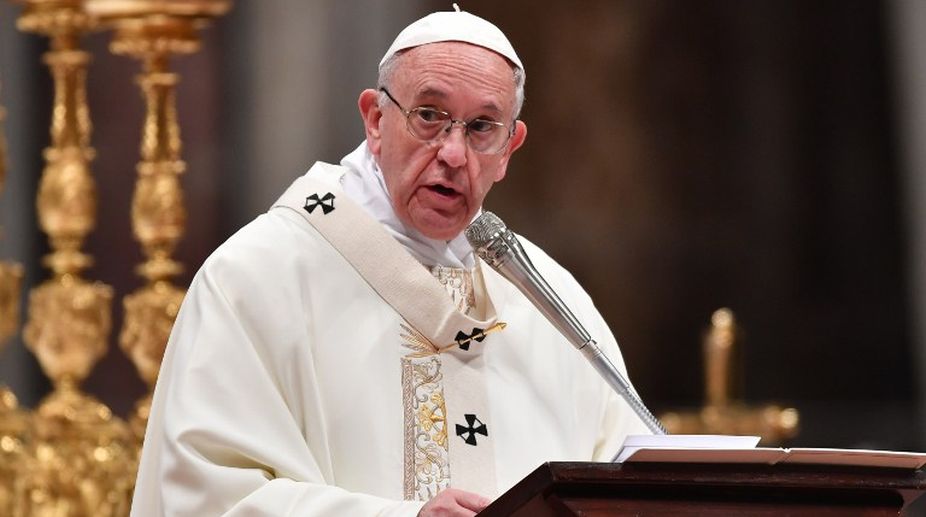
Pope Francis said on Wednesday he has always identified with migrants as he is the son and grandson of impoverished Italians who went to Argentina with nothing.

"I, myself, was born in a family of migrants," 80-year-old Francis said in a video address to the 'The Future You' conference taking place in Vancouver, Canada.

"My father, my grandparents, like many other Italians, left for Argentina and met the fate of those who are left with nothing. I could have very well ended up among today's 'discarded' people," Francis said.

"And that's why I always ask myself, deep in my heart: "Why them and not me?" said Francis, noting that he asks himself the same question when he meets the sick, prison inmates and the unemployed.

The address touched on the climate change, the migration crisis, despair about the future, and global inequality, urging greater social inclusion, humility by the world's powerful and solidarity to overcome what Francis called a 'culture of waste'.

"We can only build a future by standing together, including everyone," he said.

'The Future You' is the theme of this year's TED (Technology, Entertainment, Design) conference.

TED is a media organisation that posts talks from its annual conference online for free. Since 2006 the lectures have been viewed cumulatively more than 4.6 billion times.

Chocolate cake and intervention

Sanjay Pulipaka | New Delhi |

There has been a growing perception among most observers that the United States no longer has an appetite to indulge in conflict beyond its shores, especially when it comes to manpower. Contrary to this, the Trump administration has already used force, or its threat, on two occasions in less than a fortnight. On 6 April it launched 59 Cruise missile against an airfield in Syria, purportedly in response to Syria’s alleged use of chemical weapons. Subsequently, after a meeting between Russian President Putin and Secretary of State Tillerson, the latter noted that “there is a low level of trust between our countries … the world’s two foremost nuclear powers cannot have this kind of relationship.”

Given early speculation about Trump and Putin sharing a warm relationship, it is too early to see whether this attack will impact President Trump’s declared position of reaching out to Russia; possibly Trump’s team may be working on the premise that Syria will continue to be an area of divergence, while the US and Russia try to accommodate each other’s interests in other regions. Trump noted that he gave an order to launch the Cruise missiles on Syria while having a “beautiful piece of chocolate cake” with Chinese President Xi Jinping. This cultivated casualness could be designed to generate the view that US foreign policy is unpredictable, in order to deter both friends and foes from taking anti-US measures.

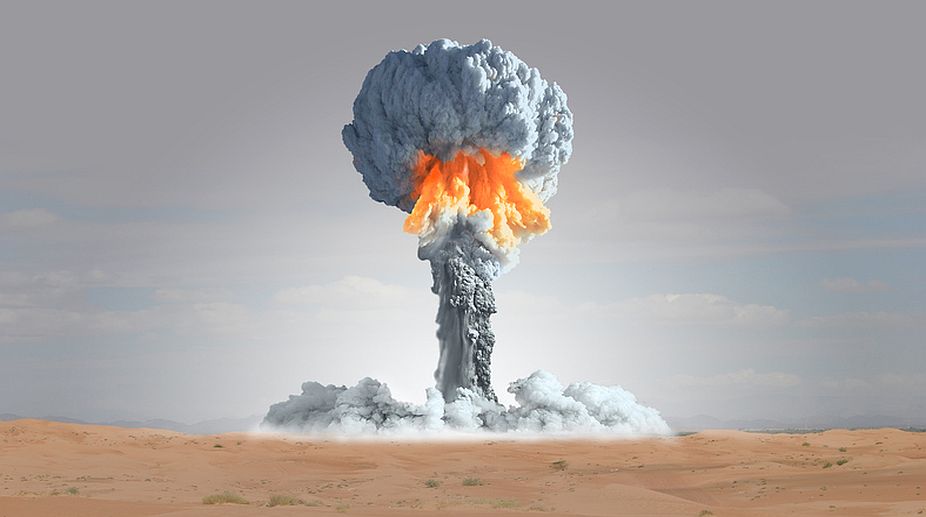
On 13 April the US used a Massive Ordnance Air Blast (MOAB) in Afghanistan, regarded as the largest nonnuclear bomb. This gave some credence to the view that there is a significant ISIS presence in Afghanistan that poses a threat. But MOAB was used without any signal that the US might be scaling-up its footprint in Afghanistan, and the efficacy of the bomb is itself in doubt. By using this weapon the US was demonstrating it has the technological edge and a leadership ready to use disproportionate force at short notice, and probably to intimidate North Korea on the latter’s nuclear and missile programme, particularly since the decision was taken during a dinner with Chinese President Xi Jinping, North Korea’s only ally.

The North Korean regime considers its survival dependent on possession of nuclear weapons, and will expend considerable resources to resist pressures to limit its weapons programme. For US allies Japan and South Korea, North Korea poses a real threat, joined by anxiety in the US that long-range North Korean missile capability will constitute a new and significant security challenge.

In response to this evolving scenario, Trump decided to upgrade the regular US-South Korean military exercises that take place in March-April each year. An aircraft carrier strike group is nearing the Korean peninsula after exercises with Japanese destroyers. A nuclear-powered submarine with Cruise missiles has berthed in South Korea. The US Senate was summoned by Trump for a briefing, and he called for UN Security Council sanctions on Pyongyang. While this suggests that Trump is threatening North Korea with armed intervention, he must certainly be aware of the enormous loss of devastation and human life that will be an inevitable consequence.

North Korea may not agree to cap its weapons programme despite the growing US presence and its new antimissile deployment in its neighbourhood. The current round of posturing could result in another round of a dialogue process involving regional powers led by China. An optimistic assessment may look misplaced at the moment, but the possibility of an American President visiting Myanmar was inconceivable a decade ago, and come May, the season for annual South Korea-US military exercises, to the accompaniment of excessive Pyongyang rhetoric, will come to an end.

These recent developments display the US ability to deploy force in distant parts of the world, and to operate simultaneously in different regions. More basically, Trump appears prone to use military strength in preference to diplomacy, despite past experience proving that use of force is no answer to the subtle challenges of international relations. Subtlety is clearly no part of Trump’s make-up, and significant funding cuts in the budget for the State Department reinforce this suspicion.

These shows of force do not suggest an isolationist approach, nor adherence to liberal strategies of restructuring societies and politics in other countries. It appears that the Trump administration is adopting an offshore posture of proactive and spasmodic interventions, which avoid the costs of long-term interventions and address the concern among allies of abandonment by Washington. Given the low cost associated with this approach, there may be a temptation to intervene frequently. Nevertheless, it may rightly be questioned whether brief intervention can remain so.

The writer is a Senior Consultant with ICRIER, New Delhi.

Understanding idiom of language politics

Kuldip Nayar | New Delhi |

It was then Home Minister Gulzarilal Nanda who brought the question of Hindi to the fore.This time, it is Union Minister of State for Home Affairs Kiren Rijiju who has done so. Many people in Tamil Nadu then immolated themselves alive to register their protest. Thank god it has not come to that stage yet. Nanda had advised Central government departments to write notes on the files in Hindi to express their opinion.

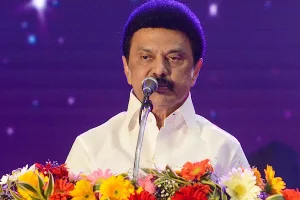
The latest is that DMK leader M.K. Stalin has accused the Centre of trying to relegate people who don’t speak Hindi to second-class citizens and of pushing the nation into becoming “Hindia”. The controversy had been generated after President Pranab Mukherjee accepted the recommendation of the Committee of Parliament on Official Language that all dignitaries, including the President and ministers, especially those who can read and speak Hindi, may be requested to give their speeches or statements in Hindi only.

The President has accepted several other recommendations, including making announcements on board aircraft in Hindi followed by English. However, Union Information and Broadcasting Minister M. Venkaiah Naidu has said the allegation that Hindi was being imposed is “completely false” and the government has “no intention” of imposing any language, particularly Hindi, on anyone.

The sharp reaction by leaders, particularly Stalin, indicates that at least Tamil Nadu is not yet ready to switch over. The issue is several decades old and yet it has not found any satisfactory solution. The nonHindi speaking states repeat Prime Minister Jawaharlal Nehru’s assurance that the switch over to Hindi from English will take place only when the non-Hindi speaking people say that they are ready for it. His categorical statement disappointed Hindi fanatics but the nation on the whole heaved a sigh of relief that India had retrieved itself from the brink.

The anti-Hindi movement gained momentum in the then Madras state where college students demonstrated against the switch over in 1965. Soon after, a full-scale riot broke out in Madurai sparking off a minor altercation between agitating students and Congress Party members. The riots spread all over the state and continued unabated for a couple of months.

They were marked by acts of violence, arson, looting, police firing and lathi charges. The then ruling Congress in the state had to call in paramilitary forces to quell the agitation. But their involvement resulted in deaths of 70-odd people including some policemen. To normalise the situation, Prime Minister Shastri reiterated Nehru’s assurance that English would continue to be used as the official language as long as the non-Hindi speaking states wanted. The riots subsided after Shastri’s promise, as did the student agitation.

But then the agitation had led to major political changes in the state. The DMK captured power in the 1967 assembly elections and thereafter the Congress never came to power in Tamil Nadu. The Official Languages Act was eventually amended in 1967 by the Congress headed by Prime Minister Indira Gandhi to guarantee the indefinite use of Hindi and English as official languages. This effectively ensured the current “virtual indefinite policy of bilingualism” of the Indian Republic. There were also two similar but smaller agitations in 1968 and 1986 which had varying degrees of success.

In fact, within the very first fortnight of Prime Minister Narendra Modi’s regime, Central government offices had received a circular that Hindi should be used on social media. This was an attempt to enter through the back door. The non-Hindi speaking states spotted the furtive move and protested against it. New Delhi readily withdrew its step and declared that the circular was meant only for the Hindi-speaking states.

The latest statement by Home Minister Rijiju has only rekindled the fears of non-Hindi speaking people. And they are afraid of what may happen tomorrow. I am convinced that Modi’s government is guided, if not goaded, by the Hindi chauvinists. The BJP has several liberal leaders who realise that the pace of switch over to Hindi would have to be slow, keeping in mind unity and diversity. Apparently, they do not have much say.

The India of today is very different from what it was 50 years ago, with each linguistic group asserting its identity. The turmoil during the States’ Reorganisation process should be a warning. The idea of India can be jeopardised. The entire fabric can get torn if the sensitivities of the people are not allayed. What is the hurry? A few more decades’ wait is a small price to pay for preserving the nation’s cohesion.

India has gone through large linguistic riots in the late 1950s and early 1960s following the Home Ministry instructions to different departments to make preparations for a switchover from English to Hindi as laid down in the Constitution. I wish this bilingualism should continue without anyone tinkering with it. But then Modi’s men seem to be hastening the process without considering the sentiments of non-Hindi speaking people. The government wants to restrict the use of English to certain fields.

Yet, they realise that their haste can tell upon the country’s unity. The non-Hindi speaking states, particularly Tamil Nadu, have accepted the Constitutional provision that Hindi is the Indian Union’s language. But they want time to learn it and come up to the standards of people living in the Hindi belt like Uttar Pradesh, Madhya Pradesh or Rajasthan.

No doubt, Modi feels at home with Hindi and his sweep in elections is primarily because of the campaign he led in Hindi, somewhat Sanskritised for northern Indians. But he should remember Nehru’s promise made in 1963 that both Hindi and English would continue to be the link languages for administration throughout the country. Nehru did not fix any deadline for the exclusive use of Hindi.

Heritage is linked with languages and therefore leaders all over the country will have to devise ways and means whereby regional languages get succour. Without a long-term plan to reinvigorate them, some regional languages would fall by the wayside as the days go by. How many regional languages will survive 50 years hence is anybody’s guess.

The writer is a noted journalist columnist and commentator.

Elections before ‘divorce’

Salman Haidar | New Delhi |

The post-Brexit scenario is now unfolding in the UK. After the drama and the shock of the vote to leave EU, the process of withdrawal is now beginning to take shape, and with the UK Parliament having agreed that the legislative procedures required for leaving the EU can commence, a stepby-step progress to a new destiny for the UK, and also for EU, is now under way. Experts envisage the need for more than a decade of painstaking dismantling of the political and economic structures that bind the UK to its erstwhile partners in EU. Creating these structures in the first instance was a most challenging task and European integration required the longdrawn-out labours of a highly skilled, multi-national army of officials comprising the formidable EU bureaucracy; undoing what they had worked so hard to put together may prove a no less onerous task.

To make matters more difficult, this is no 'velvet divorce' in the making; EU does not seem inclined to make it easy for the UK by permitting a simplified exit, and on the contrary it may well be that every clause of the existing documents will come under scrutiny as multiple voices are raised in deciding what, and how much, is entailed in the smallest rescinding of earlier commitments. While this process endures, the great energies of Europe, historic fount of some of the most momentous initiatives and ideas, are likely to be directed inwards, to the detriment of the European role in the wider world.

There could be further complications as EU deals with proposals to preserve some of its features, such as the search for a common foreign policy. This particular quest never achieved as much as some of its advocates demanded: the EU flies a common flag in places like New Delhi but major entities like the UK, while part of the structure of a common EU foreign policy have simultaneously retained their individual international identities and diplomatic traditions.

Thus while overall foreign policy goals may be shared by the EU as a whole, differences between members could reemerge and a major development like the departure of the UK could affect the cohesion of the group. One outcome could be that more room would be left for country initiatives, against the earlier trend of greater policy coordination within EU.

It is notable that as circumstances change and its relationship with EU has perforce to take a different shape, the UK has become active in searching for alternative partners outside Europe and EU.

It has made a special effort to reach out to India, aiming to revive old associations that were once an important part of India's engagements abroad when all roads led through London. Nowadays that sense of closeness has given way to more critical evaluation of their respective interests but even so India continues to find it relatively straightforward to deal with the UK and it is no great struggle for the two countries to develop mutual understanding and cooperation on a wide range of issues. Economic relations tend to top the agenda at high-level meetings among leaders, and there is a healthy process of exchange between them. Thus when UK PM Theresa May came to Delhi a few weeks ago she was able to look at a satisfactory economic relationship that was set to grow steadily in years ahead, with ambitious targets for the future. The bilateral economic tie has always been strong and is not likely to be affected adversely by Brexit. A particular area of interest is Indian investment in the British economy, a relatively recent phenomenon, and several high profile deals over the last few years have established India as one of the important investors in the UK market: currently it is the third largest and the UK is the largest investor in India from the G-20.

This is therefore a time in India-UK ties when relations are proceeding steadily across the board; politically there are few unsettling problems, and economic exchanges are doing well. The issues that have recently drawn attention and agitate the media derive largely from efforts to tidy up the bilateral legacy, matters like ownership of the Kohinoor and other historical issues, which are of absorbing interest but cannot be regarded as the pivot of the relationship. UK is making a considerable effort to revive the special character of its ties with India, and it is not insignificant that Mrs. Theresa May chose India for her first official visit as Prime Minister. A useful outcome of her journey was the impetus it gave to revival of the regular exchange of students that has recently been under strain owing to the loss of privileged entry from which Indian students once benefited, so they now often go elsewhere. Mrs. May's visit should bring a new spirit to relations and help revive the strategic and security dialogue that has been in the doldrums for some time.
As for the impending elections, initial indications are that Mrs May's Conservative party will be returned with a good majority. The decision to dissolve and call for a general election thus seems, at this juncture, to be a sound one so far as the ruling party is concerned. Many political commentators seem to be of the view that the Leader of the UK Opposition Mr. Corbyn has not established himself as a potential leader of his country and will be hard pressed to mount a challenge to the present leadership.

For India, both sides can provide very suitable partners: if the Conservatives tighten the rules on immigration to India's disadvantage, they are also more business-friendly, and both they and Labour are equally open and responsive to India. The problems to be anticipated as the UK heads for the polls are not in the bilateral sphere so much as in the impact of developments elsewhere, especially in Europe. Brexit has opened up adverse possibilities that can affect the stability and progress of the UK itself.

The greatest uncertainty is attached to the integrity of the UK and the continuance in one political frame of its sundry components. Scotland's restiveness is well documented, and though they will no doubt reflect carefully before taking any irrevocable step, the Scots have their own aspirations that could shake the structure of the UK.

All this points to a period of uncertainty in the affairs of our ancient associate. The links between the two countries are extensive and cannot be easily set aside, and they still have much to gain from each other. As friend and well-wisher, India would certainly like to see the UK emerge from its current uncertainties and once more play the part of a strong and influential factor on the world stage.

The writer is India’s former Foreign Secretary.

Muscle misfires

Editorial | New Delhi |

On the ground there would be few linkages between the raging insurgencies in the “Red Corridor” across central India and the unrest ~ some deem it an “uprising” ~ in the Kashmir Valley. The commonality lies in the approach of government to focus on the “military aspect” of counter-measures, rather than seek any resolution of core issues that have cemented public resentment of the state.

The present NDA government cannot explain away the deteriorating situations as “inherited problems”: it is about to celebrate its third year in office ~ time enough to have taken initiatives to reverse the ground-situation and restore the credibility of the administration. That kind of credibility will not be established by merely reinforcing the might of the state and “breaking the back” of the insurgencies: if there is a single lesson for Modi sarkar to learn from the last three years, it is that “muscle” will not suffice. It could actually misfire and prove counter-productive, highlighting the validity of the old saying “it is easier to wage war than fight for peace”.

There is a sickening familiarity to the ambush and killing of 25 men of the CRPF in Sukma. Having tracked the movement of the paramilitary squad on duty to facilitate the construction of a road through the Maoist heartland, over 300 insurgents “trapped” one section of jawans, fired at them from all directions, possibly having set up booby-traps in spots where the troopers might seek cover. The “reds” made off with the communications apparatus, so that when the other squad of troopers sought out their “mates” they walked into a firestorm.

There was little coordination with the local police, which is presumed to have intelligence on the terrain. All that the CRPF could say for itself was that it responded robustly, inflicting heavy casualties ~ small comfort that. The real tragedy is that from the Prime Minister downwards all talk centres around making the Maoists “pay”, but there are no signs of efforts at choking off their supply of weapons and munitions. And not even a stray thought on addressing the basic issue of alienation of tribal lands. The violence is cyclical: the troopers strive for area-domination, than an ambush like Sukma or Dantewada tilts the scales in the other direction.

It is not insignificant that in her latest interaction with Mr Narendra Modi, the chief minister of J&K called for a revival of the policy favoured by the other NDA Prime Minister, Atal Bihari Vajpayee: the present government regurgitates his words but is diffident about emulating his actions. The prevailing set-up condemns the pacifist approach, projects it as a sign of being “soft”. Yet whose government had the guts to defy international pressure and exercise the nuclear option?

Delhi demolishes

Editorial | New Delhi |

That the BJP continued with its electoral “roll” was a virtually foregone conclusion, the more significant point made by the voter in the polls to the three elected civic bodies in the Capital was the “royal” rout of the Congress party, and a firm pointer to Arvind Kejriwal’s Aam Aadmi Party being little more than a one-election wonder. The Delhi voter has done a powerful demolition job. Obviously the legion of trumpet-blowers in the Modi-Shah camp will be sounding many a fanfare: their claim to fame being the BJP securing a third consecutive term in the municipalities despite having performed miserably in the previous two. To conclude that an entirely fresh team will rejuvenate the party’s functioning would be more in the realm of hope than expectation, and since the “charisma” of Mr Narendra Modi is being hailed as the determining factor, the Dilliwallah would not be unjustified in demanding that the Prime Minister take it upon himself to clear the city of the filth that has accumulated over recent years. That demand would assume relevance in the context of the collapse of civic services being attributed to the stand-off between the AAP-run Delhi government and the three BJP municipalities.

The apprehensions of further conflict between Kejriwal and the municipal bodies on the one hand, and his continuing spat with the Centre/Lieutenant-Governor on the other are fuelled by a premeditated attack on EVMs: the predictable alibi for a miserable showing that has its roots in the chief minister’s ambitions and arrogance. He neglected basic duties in Delhi when indulging in flights of fancy in Punjab and Goa. The tirade against EVMs is wearing thin, no doubt the chief minister and his mates will find other reasons to cry “foul”. Looking within is not an AAP quality, blaming/accusing others is part of its confrontationist-negative DNA. Sure it took second place in its first civic election, but only after claiming that it deserved a clean sweep.

Blown away even before the season of duststorms has commenced has been the Congress, reduced to a miserable third place with only half the wards it had won five years back. Its apologists are seeking a fig-leaf of respectability by claiming an increased vote-share ~ selectively deciding which previous poll would serve as the basis of comparison. Having failed to win a single seat in the last elections to the Lok Sabha and the Delhi Assembly it is apparent that the party is on the verge of self-destruction. As is customary the “local” leader takes responsibility and offers to quit (Ajay Maken emulating Sanjay Nirupam in Mumbai), but essentially it does so to deflect the flak away from the “blunt” spearhead. Was Barkha Shukla Singh being prophetic when she contended that Rahul Gandhi was “mentally unfit” to lead the party?

For ’alternative care’’

Statesman News Service | New Delhi |

The United Nations Guidelines for the Alternative Care of Children course was recently launched that will be shared with learners around the world, including policy makers, practitioners and carers, in a free online course.

The course has been developed by academics and practitioners from Centre for Excellence for Looked After Children in Scotland (CELCIS) with the support of Education Enhancement at the University of Strathclyde.

Across the globe, for many different reasons, hundreds of thousands of children cannot live with their parents.

To address this, the United Nations General Assembly unanimously welcomed the Guidelines for the Alternative Care of Children driven by two fundamental principles – the ensuring of both the necessity and the suitability of alternative care.

‘Alternative care’ is the provision of a safe and caring setting for children to live whilst they are unable to stay with their families. Besides, an understanding of the implications of the UN Guidelines, at a theoretical and practical level, will be explored in the ‘Getting Care Right for All Children, a Massive Open Online Course (MOOC), offered in partnership with the social learning platform, FutureLearn. It will be available in English with some course materials (including text and videos) also accessible in Spanish and French, reflecting the truly global nature of this issue.

The initial concept for the course was proposed and sponsored by the Geneva Working Group on Children Without Parental Care, comprising of a number of major international child protection and child care organisations.

By the end of the course, participants will have a grasp of the key principals, pillars and implications of the UN Guidelines, taking in a view from across the world.

The ‘Getting Care Right for All Children’ MOOC follows the success of the University’s ‘Caring for Vulnerable Children’ MOOC, run in partnership between both the University of Strathclyde and CELCIS, which, in its sixth run, has had over 50,000 participants from more than 189 countries since it launched in 2015.

Appreciating life

Arundhati Rakshit | New Delhi |

Even when life has such extravagance and exuberance to offer, we lay submerged into the ocean of nothingness, desperately searching for truth, honesty and simplicity.

We must stop to ask ourselves the question-”Where are we heading to?” In the rush of our mundane lives, we are forgetting to appreciate our existence and our dreams. We have lost the poet inside us to listen to sounds of Nature. We are deceiving not only ourselves but the God in us by running before mirages while ignoring the beauty of creation which is the only eternal truth. We do not realise this until it is too late when our minds are completely gripped by fatigue and depression, rotting our conscience.

The pattering of rain, the tune of the sitar and the like are music for the soul but these are getting shattered leaving people bereft of acknowledging the little things in life and living every moment.

It seems ages since we last gazed at a full moon while returning home, ages since we last wrote a poem by the window. Yet these were the joys that offered us solace before we lost ourselves in the ocean of despair and deception.

Our society is taken over by acts of crime replacing those of sympathy, affection, fraternity and honesty. Trust has lost its reign. People have driven away from their roots ending up lonely in their cooped-up lives, almost forgetting the existence of the word ‘we’. It is the word ‘I’ that people are more concerned about. What has driven us into this “dreary desert, sand of dead habits?”

For this answer, we have to go back to those few lines of Tagore:

“Where tireless striving stretches its arms towards perfection,

Where the clear stream of reason has not lost its way in the dreary desert, sand of dead habits,

Where the mind is led by thee into overwhelming thought and action,

Into that heaven of freedom, my Father, let my country awake.”

Class XII, Coordinator, Gokhale Memorial Girls’ School

Honesty rules

Sutanu Bhattacharyya | New Delhi |

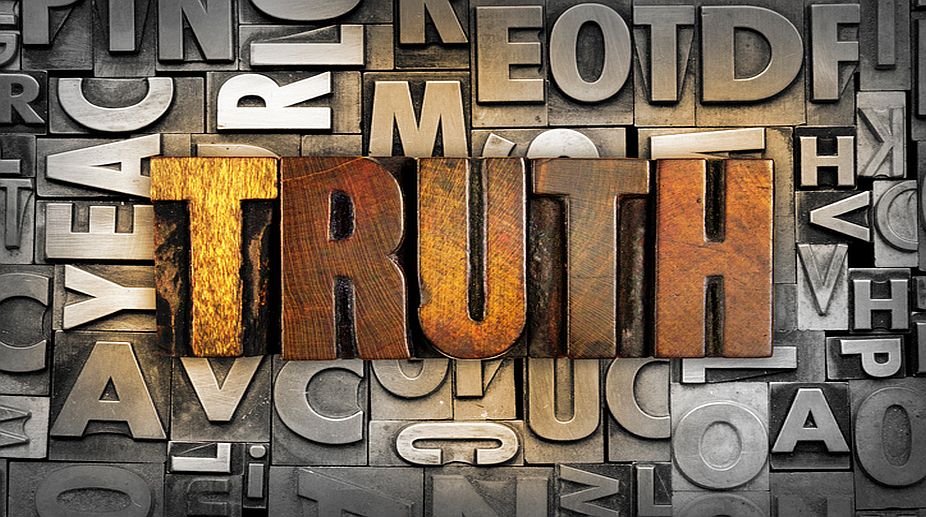
Every day we get to face a situation where we have to decide whether we should speak the truth or embrace a lie. We have to be wise in making that decision. If we lie then it will solve the problem of a few minutes and in turn it would arise as a problem that will poke us all along our life. But if we speak the truth, though it will make us go through tough situations but won’t appear as a lifelong stumbling block. So we should always speak the truth.

Speaking the truth is a cardinal tenet of all great religions and creeds. According to the fables illustrated in Holy and sacred books, liars are threatened with damnation and the tortures of Hell. Old Sanskrit scriptures command man to speak the truth but not bitter truth. Many are with the opinion that only saints can afford the pursuit of truth.

The ordinary man of the world cannot survive if he sticks to the truth in all circumstances. Contradictory views on whether one should speak the truth have always baffled the minds of the people throughout the world. The problem is compounded by the fact that telling a lie is not easier than speaking a truth. How many people can tell a lie without inculcating suspicion within the mind of the listener or can concoct a set of lies to prevent the exposure of a single lie?

Though lies often extricate us from difficult situations but they are bound to land us in hot soup sometime or the other. It is much easier to remain consistent when one is speaking the truth than when one is lying. It keeps our conscience clear and boosts our confidence.

But when we are telling a lie our conscience gets burdened and it is we who get deceived. The politicians always make tall claims and go about lying. The ruling party always exaggerate their accomplishments and spread canards about the party which is not in power. We, the common people are short in memory which results that we are taken in by the cunning rulers easily. However it does not take long for the people to get enlightened about the falseness of the claims and when their lies are exposed they get voted out at the subsequent elections.

One must never forget the story of a boy who used to cry ‘wolf’ to attract the villagers but in the process lost his credibility and eventually got himself into trouble when actually a wolf came and attacked him with not a single villager coming and helping him out. Being truthful helps us to move forward in life but dishonesty holds us back.

Now it is up to us whether we should speak the truth or tell a lie.

Coordinator, Class X, Patha Bhavan High School.

Rights of children

Ahana Chattopadhyay | New Delhi |

The first Labour Day was celebrated on the 5 September, 1882, in the New York City, USA. The Labour Movement in the United States encouraged labourers across the world to organise movements, to form pressure groups and labour unions. In the honour of the millions of labourers who toil hard round the clock, each day, to make life better for other citizens, India celebrates this cause on the 1May every year.

With this inspiring side of labour, however, comes also the gruesome reality of child labour. This practice of forcing children below 14 to engage themselves in income-generating activities, started back in the 17th century, and still remains a deadly part of what constitutes our ‘modern’ society. That they were not correctly educated, not conscious of their basic, human, lawful rights, were facts that made it easy for the inhuman manufacturers to exploit these little minds. But the injustice meted out to these children did not end there: the primary reason for their underage employment was their availability at cheap rates. This vile inequality on the children continued for several long decades until it came to be adjudged unacceptable both morally and legally. In 1924, the Geneva Declaration of the Right of Children Act came into existence, followed by the Universal Declaration of Human Rights in 1948. Today, India has the highest rates of child labour in the world, contributes to one-third of the labour requirements of Asia. This stands as the ground where the act of deadening innocent children is practised every day, increasingly, illegally, more than anywhere else on the globe. However, today fighting the wrongs of our country has become easier than ever before.

The declaration by the High Court of Punjab and Haryana in 2013, that a total ban should be levied on employment of children below the age of 14 – whether in hazardous or non-hazardous industries – was perhaps the most significant of all steps taken in this war against Child Labour. Until and unless the people themselves understand the pressing importance of this issue and the right of children, of everybody, to education and healthy growth conditions, Child Labour can never entirely be eradicated from our country.

Coordinator, Class XI, Gokhale Memorial Girls School.