Logo

Government hopeful of higher GVA in agriculture sector in 2017-18

IANS | New Delhi |

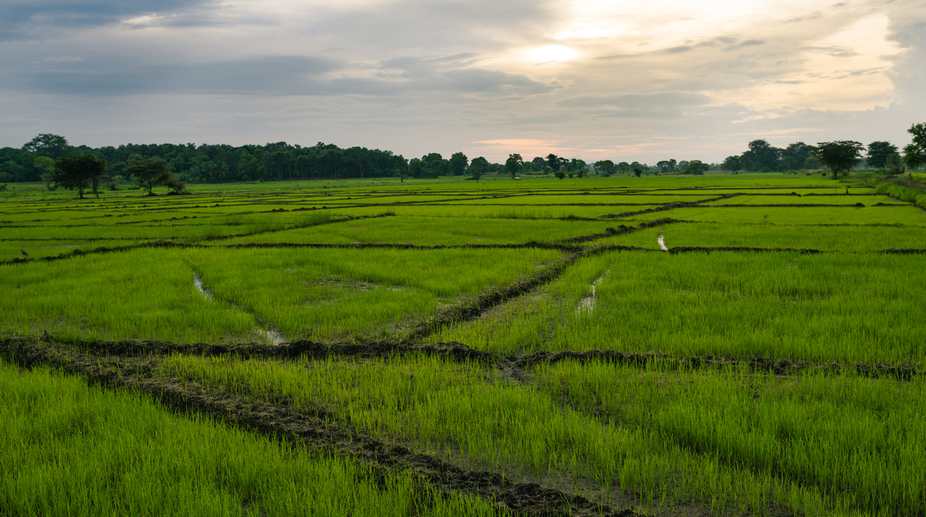
Following release of the Advance Estimate (AEs) of GDP and GVA for the economy for 2017-18, the Ministry of Agriculture and Farmers’ Welfare on Sunday said that the agriculture sector is estimated to register a higher GVA in the next financial year.

As per data released by the Central Statistics Office, the GVA of ‘Agriculture, Forestry and Fishing’ index for 2017-18 was estimated at 2.1 percent, compared to 4.9 percent in the preceding year.

The ministry has had a quick deliberation on the growth rate for the agriculture sector to strategize on ensuring that 2017-18 sees a much higher growth rate, said an official statement.

According to the statement, lower coverage of the area by August 2017 on account of the delayed onset of monsoons caused a poor reflection compared to the actual positive field situation by December, and despite a lower or negative share of crop sector in the GVA computation of Agriculture, based on August 2017 status, the growth rate still worked out to 2.1 per cent.

The ministry also said that it is also important to note that the Advance Estimate for the year 2017-18 comes on the back of a very robust GVA of 4.9 per cent in the previous year.

While coverage under different crops in Kharif as of August 2017 was below that of the previous year on account of delay in onset of monsoons in some parts of the country, good rainfall thereafter helped the ministry in increasing the area coverage in accordance with Kharif targets.

In terms of Rabi, the ministry said it was optimistic about achieving a high growth rate due to improvement in the performance.

“As on January 5, 2018, the area coverage under Rabi is 58.6 million hectares, which is very good progress. Considering that the Rabi sowing continues up to the first week of February, the total area under crops and resultant production will be very good,” it said.

Further, the ministry expects to consolidate the record production achieved during 2016-17, by focusing on higher productivity. The credit made available for the year 2017-18 is as high as Rs 10 lakh crore, compared to Rs 9 lakh crore in 2016-17.


Nagaland group demands President’s rule, postponement of assembly polls

IANS | Kohima |

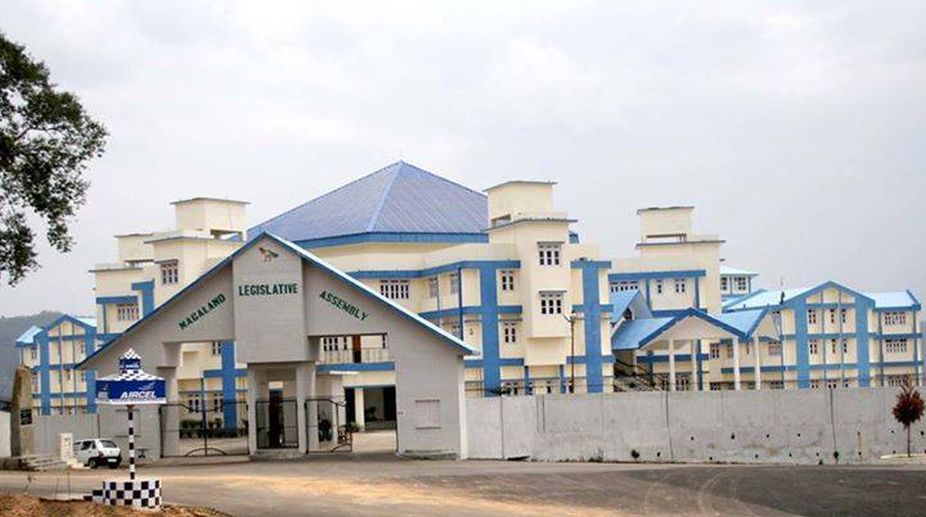
Nagaland-based group Against Corruption and Unabated Taxation (ACAUT) on Sunday urged Prime Minister Narendra Modi to defer the state’s assembly election and impose President’s Rule in order to facilitate solution to the vexed Naga insurgency.

In a letter to Modi, the ACAUT said: “If elections are held in Nagaland for the sake of constitutional process before the completion of the negotiation process with the six Naga National Political Groups (or rebel groups) and the NSCN-IM, then solution to Naga problems will remain a mirage.”

Expressing appreciation for Modi’s “sincere desire” to resolve the Naga political issue, it reminded Modi of his promise to resolve the issue within 18 months and his great personal initiative to invite the NNPGs for talks in 2017.

“Thus, while keeping the backdrop in mind, the ACAUT Nagaland, a people’s movement against corruption and illegal taxation, though appreciative, is however afraid that the much yearned Naga Solution will to continue to elude us if the 2018 State Assembly election is held as scheduled in the month of February/March,” the letter said.

“Election at this juncture with a duly elected government will consign the peace talks to the backburner for years to come.”

In fact, the Nagaland Assembly last year had adopted a resolution urging the central government to take emergent and extraordinary steps for an “honourable and acceptable solution” to the Naga political issues before the assembly election.

It had also urged the Election Commission not to announce the state election till this is done.

On August 3, 2015, the central government and the Nationalist Socialist Council of Nagaland-Iska-Muivah (NSCN-IM) signed the Framework Agreement. However, neither released its details.

CISF to take over security of Victoria Memorial from mid January

IANS | Kolkata |

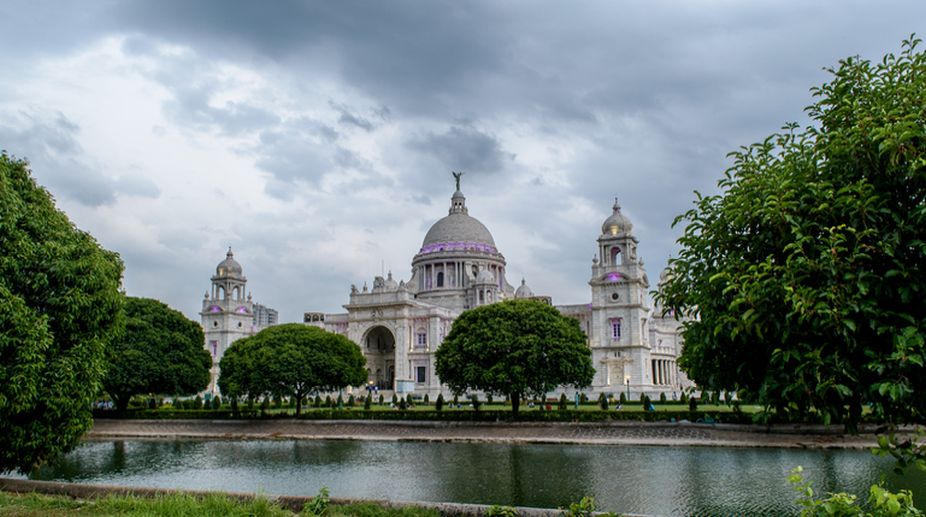
The Central Industrial Security Force (CISF) is likely to take over the security of Victoria Memorial from January 15 and deploy over a 100 personnel for its round the clock surveillance, an official said on Sunday.

“CISF will take charge of the security from January 15 and we are constructing a barrack for the CISF personnel inside the premises for their permanent accomodation. We have made temporary arrangements for their stay at Kolkata Port Trust barrack in Kidderpore area,” Victoria Memorial Curator Jayanta Sengupta said on the sidelines of the launch of e-ticketing system at the Memorial.

The central force would replace the existing three-tier security by the Kolkata Police, private agencies and the Memorial’s own security.

On Sunday, Union Culture Secretary Raghvendra Singh launched the e-ticketing system by purchasing the first ticket online. Two vending machines, one each at the North and South gate of the Memorial, were also installed, though which tickets can be bought by cash or card.

About the online ticketing system, Sengupta said that persons can purchase tickets six months in advance through a link in the website that has been linked with Book My Show portal which is a ticketing partner.

One can use debit and credit cards (Visa and Mastercard) as well as Netbanking to buy tickets. International users will need to have a PayPal account to buy tickets online.

Those who have smartphones will receive an email with a QR code which will just need to be scanned at the gates for a paperless validation. Those who don’t have smartphones will need a printout with the QR code.

According to estimates, around 35 lakh people including foreigners visit the the Memorial in a year. In the winter months, the footfall is around 35,000 per day and serpentine queue are a common sight.

“The online mode will help the visitors to save the time of waiting in the line for buying tickets,” Sengupta added.

Delhi locality holds hearing on liquor shops

IANS | New Delhi |

Around 150 people here in a Delhi locality cast their vote to decide whether a liquor shop in their locality should continue to function.

“The polling in Tilak Nagar (area of west Delhi) was organised by the Excise Department to deal with residents’ complaints about a liquor shop in the area,” AAP MLA from Tilak Nagar, Jarnail Singh told IANS.

He said the results of the polling will come out in a few days.

It was followed by a public hearing on the issue of “nuisance” created by the presence of the shop.

“The beneficiaries of a policy should be involved in its decision making. That’s direct democracy. This is why this polling has been organised,” said Chief Minister Arvind Kejriwal after listening to the opinions of the residents.

He said both the owners of the shop and the victims of the nuisance created by it were at the event so no biased decision is taken.

“We will go by what all of you decide for yourselves,” said Kejriwal, adding that complaints received from every locality on the issue will be considered and steps will be taken with the agreement of the residents.

Deputy Chief Minister Manish Sisodia questioned why should people take up a business if that bothers their own people. He also said that the hearing was important in context with women safety.

Two injured in Manipur grenade blast

IANS | Imphal |

Two persons were injured when a grenade was lobbed inside a grocery shop in Manipur’s Ukhrul district on Saturday night, police said on Sunday.

Police said that two unidentified persons came near Raj grocery and lobbed the grenade inside the shop despite the fact that there were some persons buying various items.

Anish and Bijoykumar were injured in the blast and taken to the local hospital, where they are said to be out of danger.

The attackers escaped before police could reach the spot.

So far no underground outfit has claimed responsibility for the attack and police suspect that it might have been an extortion threat to the owner of the shop who happens to be non-local.

Official sources said that due to shortage of police personnel and paramilitary personnel, the district administration could not launch massive operations immediately to nab the fleeing persons.

The Manipur government had deployed police commandos and other paramilitary forces in Ukhrul district, but withdrawn them after protests by people, who said that as “political talks” are being held, the tribal-dominated district is peaceful and there is no need for additional forces.

On Friday morning, a Chinese made hand grenade was found at the no man’s land near Moreh, the border town in Tengoupal district.

Remark against AKG triggers row

Statesman News Service | Thiruvananthapurm |

With Congress MLA V T Balram’s Facebook post on communist icon and leader of the Opposition in the first Lok Sabha AK Gopalan (AKG) triggering a controversy, the Congress came out in open, distancing itself from the young legislator’s comment.

Disowning V T Balram’s comment against communist stalwart, Opposition leader and senior Congress Ramesh Chennithala on Sunday said Congress will not accept picturing badly the first opposition leader of the Lok Sabha.

“One cannot agree with such statements. Congress will not accept picturing the communist icon AKG,who was the first Opposition leader of the LokSabha badly,” Ramesh wrote in a Facebook post. Distancing from Balram’s views, KPCC president MM Hassan said that the comment made by Balram was wrong and it is not the opinion of the party.

“AKG is a man who is respected by all. Making such a comment against AKG was not right. It is not the opinion of the Congress,” Hassan said Coming out against Balram’s statement, former chief minister Oommen Chandy said, “Balram’s statement has crossed limits. He shouldn’t have said that.” KPCC vice president VD Satheesan said that Congress does not share Balram’s comments.
Lashing out at Balram over his controversial comments on AK Gopalan, chief minister pinarayi Vijayan on Sunday said that the MLA’s comments are a lack of discernment and mark of stupidity.
“Making such a disparaging comments on AKG hurts the people of India, especially the farmers and labour communities. Even more pathetic is the condition of the party that has no one with conscience who can point it out to the unintelligent MLA,” Chief minister Vijayan wrote in a Facebook post.

In a Facebook post on Friday, Balram, a two-time MLA from Thrithala in Palakkad district, alleged that that AK Gopalan was a pedophile who married a 13-year-old girl.
Balram said AKG’s wife Susheela was only 22 at the time of the couple’s marriage. According to Balram, it is said the marriage was the culmination of a decade-long courtship. Then one can guess the age of Susheela Gopalan at the time, he said.

Congress is using Karnataka as its ATM: Yogi Adityanath

Statesman News Service | Bengaluru |

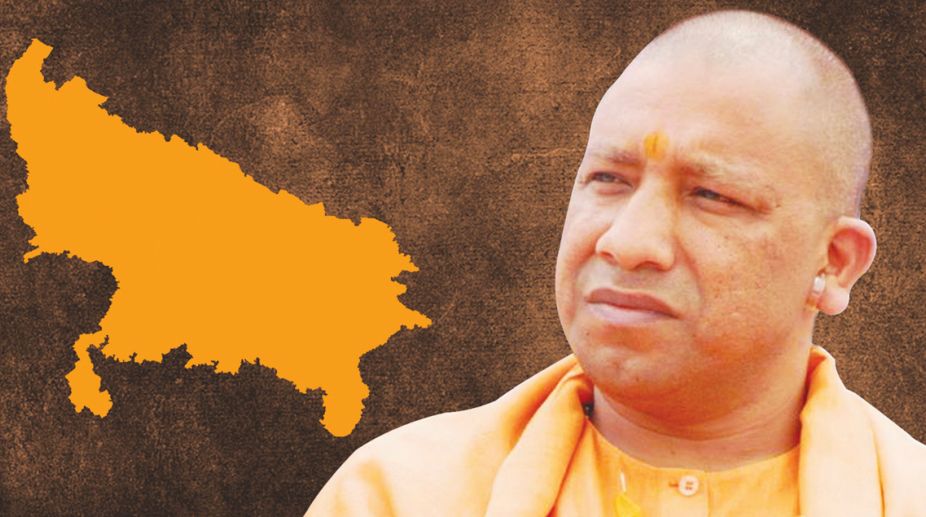
Uttar Pradesh chief minister Yogi Adityanath today slammed the Congress for playing the caste card at the expense of development even as he accused the party of using Karnataka as its ATM.

Addressing a public rally here , UP chief minister took a jibe at his Karnataka counterpart, Siddaramaiah, saying he was only now recalling his Hindu roots. However, calling himself a Hindu will not suffice till he continues to endorse eating beef, Adityanath claimed.Hinduism was a way of life and it did not allow eating of beef. “If you (Siddaramaiah) consider yourself a Hindu, then why do you promote beef eating? , the UP chief minister wanted to know.

His visit ,the second in a week to the IT capital, marks the launch of BJP’s poll campaign for the 224 seats in the State Assembly, elections to which are scheduled for May this year. His visit coincides with the parivartan yatra which BJP’s chief ministerial candidate and state unit president, B S Yeddyurappa, has been holding ,criss crossing the state to mobilise support for the party.Accordinto him, Karnataka is losing out on development as the Congress party is using the state as its ATM instead. Prime Minister Narendra Modi, he said ,was giving emphasis on development, and for the youths and farmers in the state to reap the benefits of such a model, it was imperative to bring the BJP to power in Karnataka.

“The party has become a burden…a problem for the nation,” Adityanath claimed.Exhorting the people to vote for the BJP, he said across the country, the Congress was being eased out of power ,evidenced by the recent results of assembly polls in Himachal Pradesh and Gujarat, to name but two states. That the party’s model of development had become a benchmark was clear from its ability to retain Gujarat for the sixth time, he asserted.Yogi Adityanath said if the ruling party at the centre and the state were to be the same, it would become much easier for the latter to get the benefit of the Union government’s schemes.

An obvious reference to the fact that invariably the states and the centre have been at loggerheads on allocation for various schemes if different parties are at the helm
Accordingly, he urged the people to ensure that like at the centre,in Karnataka too they plumbed for the BJP in the forthcoming Assembly elections.In this context, he slammed chief minister Siddaramiah for claiming recently that he was as much a Hindu as those in the BJP. He said this was similar to Rahul Gandhi’s sudden decision to visit temples in Gujarat during elections in that state.

Lashing out at the Congress for dividing people by playing the caste card, he said that as many as 22 Hindus had been killed during Congress rule in the state ,a clear evidence of the deteriorating law and order situation in Karnataka.

In sharp contrast, he said the situation had improved drastically ever since the BJP came to power in Uttar Pradesh,where law and order was a major issue earlier.
He blamed the Congress for disrupting Rajya Sabha over the Centre’s move to get a bill on triple talaq passed and alleged that the party was “anti-Muslim” and “anti-women”.

4 out of 10 trains delayed by maintenance work

Statesman News Service | New Delhi |

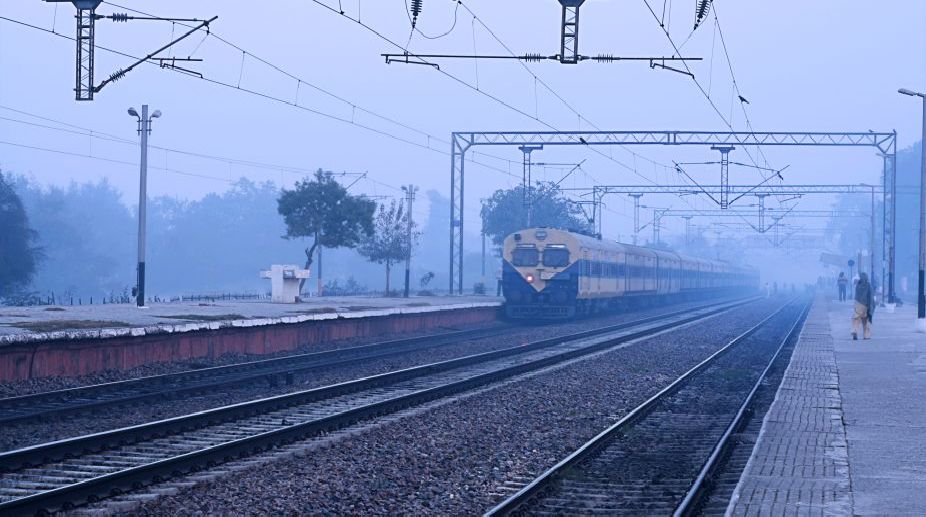
Four out of ten trains in the country are being delayed not because of fog, vagaries of nature or accidents, but because of repair work, according to official data.

Passengers, it seems, are paying the price of heavy track maintenance work which has seen a 43 per cent increase in the period between April and December, 2017 as compared to the same period in 2016. While during that period in 2017, 1,09,704 trains were delayed, in 2016, the number was less by 16,092 trains.

While 5 per cent of these trains were delayed due to accidents, including those in which cattle were run over, 20 per cent was due to asset failure and 40 per cent due to repair work. The rest has been attributed to inclement weather conditions.

Officials say that given that safety is the top priority for railways in the coming year, passengers have to bear the brunt on account of repair and maintenance work. A senior official said that on an average, between April-November 2017, railways have increased the block hours for maintenance by 18 per cent as compared to the previous year, resulting in delays across the network.

Indian Railways is slated to spend Rs 1,000 crore a month over six months starting October 2017 to replace old and out- of-date tracks with new ones. Rail minister Piyush Goyal has set a target of track renewal for the current fiscal at 3,600 km, an 80 per cent jump over the average 2,000 km of tracks renewed every fiscal.

Railways have completed a record 476-km track renewal in December and expects to touch 3,500-km of track renewal in 2017-18, officials said. “Safety is our top priority. Repair and maintenance work is the only way we can ensure that”, said a senior official.

Midnapore man held for harassing Sachin’s daughter

Statesman News Service | Midnapore |

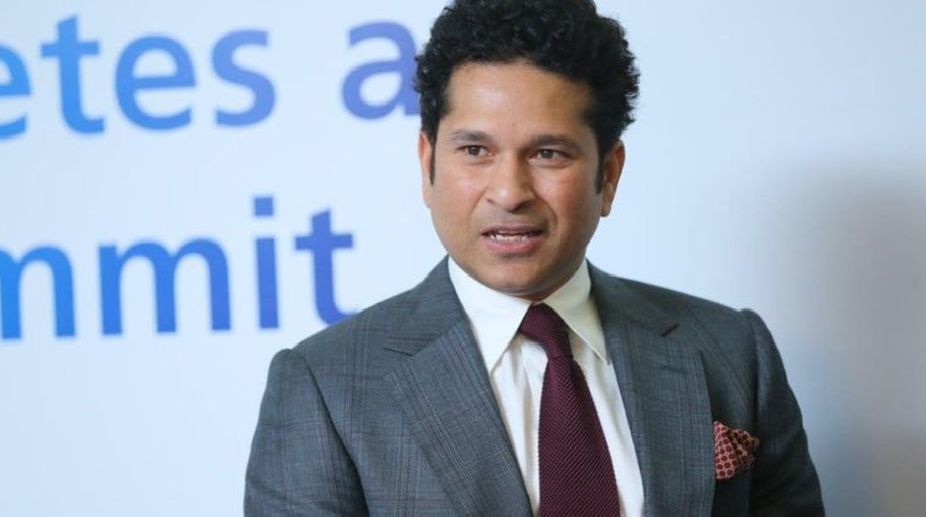
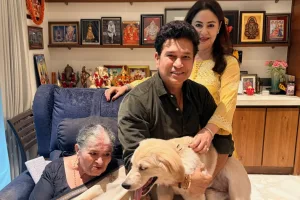
A team of Mumbai police arrested a youth on charges of stalking and harassing the daughter of former India cricket captain Sachin Tendulkar from his home in East Midnapore today.
The 32-year-old, identified as Debkumar Maity, a class XII dropout, is locally known to be an artist. He is said to have made at least 20 calls to Tendulkar’s residence and passed lewd comments about his daughter Sara and even threatened to kidnap her.

The Mumbai police team, which got a transit remand from a court at Haldia, is taking him to Mumbai for further questioning.

Bhimsen Gaikowar, a member of the team said that Maity had made several phone calls to Sara proposing marriage. “He also made several lewd comments during his phone calls and even went to the extent of threatening to kidnap her if she rejected his proposal,” Gaikowar said. The phone calls were made to the landline number at Tendulkar’s residence.

A complaint in this regard was filed at Bandra police station in Mumbai. “We tracked the number, contacted West Bengal police and finally arrested him on Sunday,” Gaikowar said.
Debkumar’s family members claimed that he was mentally ill for months and he often tormented his parents. “We had no idea how he was embroiled in this. Even at home he used to torment his parents. He lost his father recently. He has been undergoing medical treatment for his condition for the last eight years,” a relative said. A diary has also been found in Debkumar’s home in which he has scribbled Sara’s name.

Debkumar told police that he had seen Sara in the pavilion of a cricket stadium in Mumbai and collected the number through one of his relatives. Admitting that he had made several calls, Debkumar said that there was nothing wrong in his desire to marry Sara. Asked if he knew Sachin Tendulkar, he smiled and said, “He is my father-in-law.”

Police would investigate how he managed to get his hands on the numbers and a medical team will look into his mental condition.

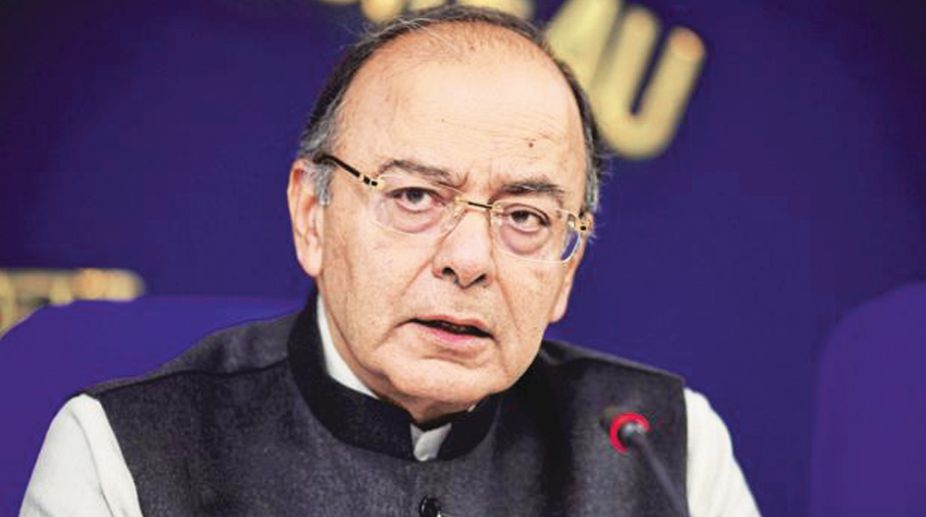
Govt open to proposals to cleanse pol funding: Jaitley

Statesman News Service | New Delhi |

Union finance minister Arun Jaitley on Sunday sought suggestions from political parties to further strengthen the cleansing of political funding.
The finance minister indicated thatthe government has no intention to take back its decision on electoral bonds taken last week to make political funding and hassle free. The bonds were being pitched as an alternative to cash donations made to political parties.
In a Facebook post, the Union finance minister said the electoral bonds mechanism is a substantial improvement in transparency over the conventional practice of funding. In the earlier system, poltical parties used to take donations as well as undertake expenditures in cash. The sources used to be anonymous or pseudonymous.

“It is a wholly non-transparent system. Most political groups seem fairly satisfied with the present arrangement and would not mind this status-quo to continue… The effort, therefore, is to run down any alternative system which is devised to cleanse up the political funding mechanism,” the finance minister said.

In the earlier system, the quantum of money was never disclosed and the system ensures unclean money coming from unidentifiable sources, the minister said.

The finance minister said the choice has now to be consciously made between the existing system of substantial cash donations involving unclean money and other transparent options like cheque, online transactions or electoral bonds.

“While all three methods involve clean money, the first two are totally transparent and the electoral bonds scheme is a substantial improvement in transparency over the present system of no-transparency,” he said.

“The government is willing to consider all suggestions to further strengthen the cleansing of political funding in India. It has to be borne in mind that impractical suggestions will not improve the cash denominated system. They would only consolidate it,” Jaitley wrote.

He said India, despite being the largest democracy in the world, has not been able to evolve a transparent political funding system in the last seven decades.

“The round the year functioning of the political parties involves a large expenditure… These expenditures run into hundreds of crores. Yet there has not been a transparent funding mechanism of the political system,” he said.

A heritage touch to tourism

Statesman News Service |

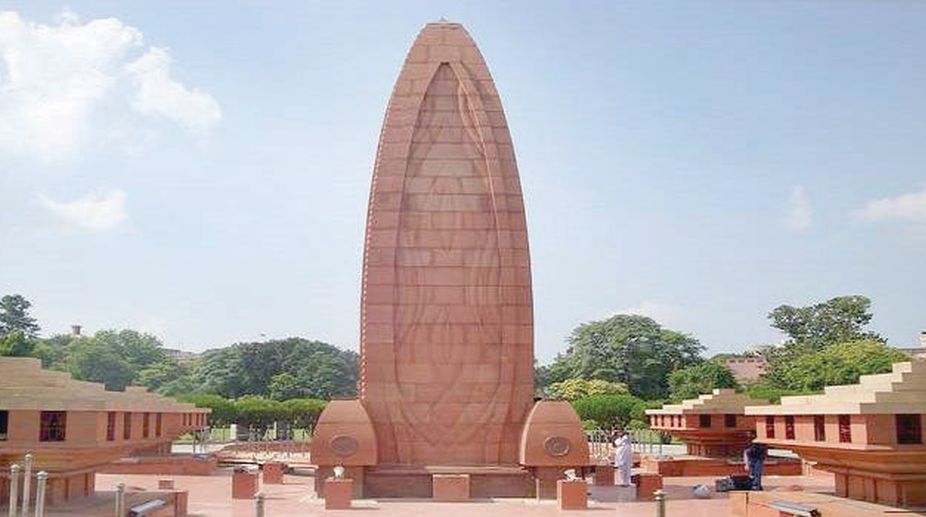
The Punjab government has plans to connect historically and culturally important spots, including places associated with the freedom struggle. State tourism and cultural affairs minister Navjot Singh Sidhu said the Union government has sanctioned Rs 100 crore for the religious circuit which comprises Sri Anandpur Sahib, Fatehgarh Sahib and Chamkaur Sahib. Jallianwala Bagh, Khatkar Kalan and Hussainiwala are also included in the circuit. An additional Rs 15 crore has been released for the Jang-e-Azadi memorial at Kartarpur. The Maharaja and Mughal circuits would also be given shape and proposals would be sent to the Union government for getting more funds, Sidhu said.

The Maharaja Circuit includes Patiala, Nabha, Kapurthala and Faridkot which would be developed. Mughal Circuit comprises serais in Punjab such as Shambhu, Doraha, Noormahal and Tarntaran which would be developed as wedding destinations, he said. The 550th Gurpurb of Sri Guru Nanak Devji in 2019 would be observed on a large scale and in the same year the centenary of the Jallianwala Bagh tragedy would be observed as per a specially chalked out programme, he added.

Apart from this, Sufi Mela, Heritage Melas at Patiala, Kapurthala, Amritsar and Bathinda and a Military Literature Festival would be held too. Traditional melas such as Harvallabh Sangeet Sammelan, Hola Mohalla, Qila Raipur, Baba Sheikh Farid Aagman Purb, Shiv Batalvi festival and Babe Da Viah purb would be held on a grand scale and given all assistance, Sidhu said.

Two countries, a sheltering tree and a tourist hotspot

S P Sharma |

The Peepul tree on the International Border (IB) at Suchetgarh in Jammu district is the most photographed landmark as this is the only tree on any border that serves as a pillar demarcating the boundaries of two countries.

The tree was not the dividing line a few years ago as a concrete pyramid shaped pillar number 918 stood there. However, the pillar vanished within the trunk of the tree that broadened with passage of time. The Indian Border Security Force and Pakistan Rangers guarding their respective borders did not cut the tree and finally painted it the number 918 on it. The next pillar 919 is made of concrete but the peepul tree has become an attraction for visitors who come from all parts of the country.

With its increasing circumference, half the Peepul tree is now within Indian territory and the other half in Pakistan. In the morning the tree provides shade to Pakistan and in the afternoon to India.

Both sides do not lay claim over the tree on whose front and back are identical concrete platforms of India and Pakistan. Flag-meetings between the BSF and Rangers are held here. The Pakistan Rangers sit on the Indian platform when the meeting is held on the Indian side and the BSF officers cross the border to sit on the platform on the other side of the tree if the meeting is organised by Pakistan.

This part of the IB does not host the colourful beating retreat of BSF and Rangers like in Wagha, Ferozepur or Fazilka in Punjab as it has remained a live border after the Partition of the country with many incidents of exchange of fire.

Prior to the Partition in 1947, Suchetgarh was an important railway station between Jammu and Sialkot (now in Pakistan). This was the last place in the territory of the then rulers of J&K and thereafter the Punjab area began with Sialkot as an important trade hub of that time.

Governor NN Vohra and Chief Minister Mehbooba Mufti visited the area recently and ordered the tourism department to promote it as a tourist destination. A cafeteria has been built but it is not being properly maintained.

The UN Observers cross over to either side of the border from this point and the erstwhile octroi post is being used by the BSF as its local office which also houses a museum of pictures.
Another attraction near the border is the Gharana wetland that is these days home to a large number of migratory birds.

About 6000 birds of different species can be seen in the wetland. Most of these birds are migratory and endangered covered under various schedules of the Wildlife Act.
The main attraction of Gharana is the Bar Headed goose which visits the area in large numbers during winter.

As many as 67 species of birds have been spotted in the area by the Wildlife Department. These include, Lesser Whistling Duck, Northern Shoveler, Egyptian Vulture, Long-tailed Shrike, Red-vented Bulbul and Indian Robin.

Return of the Gharials to Harike Wetland

Pankaj Dhiman |

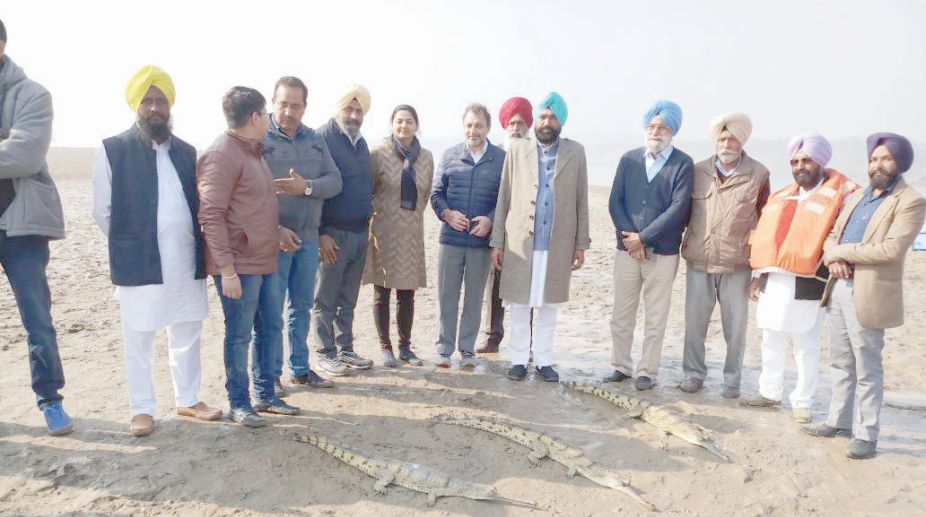
With the recent introduction of ten ‘Gharials’ (Gavialis Gengeticus), an Indian variety of crocodiles, at the Beas river near Gagrewal village, 30 km from Tarn Taran, Punjab’s decade-long wait has come to an end. The move is expected to boost eco-tourism alongside the Beas wetland area.

The step taken by the Punjab Forest and Wildlife Department has paved the way to bring more reptiles to the Harike wetland in coming days. The three-year-old, ten fish-eating reptiles were brought to the spot from Chhatbir Zoo in Mohali. However, farmers living adjoining the Harike wetland areaare apprehensive that the reptiles will prove dangerous for humans and damage crops. They did not allow the release of Gharials into the wetland.

The Harike site is the confluence of the Beas and Sutlej rivers. Residents of the area under the banner of Kisan Sangharsh Committee (KSC) have been opposing the move, terming it dangerous for people who frequently visit the area on boats to cultivate their land adjoining the wetland area. The forest officials are in the process of convincing the agitating farmers that Gharials are not dangerous and that the move will help clean the river water.

Farmers had recently sent a memorandum to Chief Minister Amarinder Singh on their opposition to the release of Gharials. “If the state government wants to release the reptiles in the wetland, it should purchase the farm land of the farmers falling near the river. We will not allow the government to release the animals in the river,” the memorandum had said.

Ferozepur range District Forest Officer (DFO) Charanjit Singh, told The Statesman that the reptiles were brought from Chhatbir Zoo to Gagrewal village. “They were released into the river as per the plan. The move is good to protect the ecology. We are likely to add a few more Gharials in coming days. Soon after resolving farmers’ concerns, we will release the Gharials in the Harike wetland as well,” he said.

Meanwhile, Assistant Professor at Department of Zoology and Environment Science at Punjabi University in Patiala, Dr Onkar Singh Brraich, said, “The move will not only conserve aquatic biodiversity of the Beas river, but the fishes so preserved will help in the survival of dolphins and Gharials. These endangered species are totally dependent on wild fishes. For the balance of ecology commercial fishing should be discouraged,” he said.

Brraich said there used to be a thick presence of dolphins and Gharials once upon a time in the Beas river. “The efforts to restore conservation are in the initial stage. It will need a lot of effort from the government to take control of the situation,” he said.

In July 2017, the CM with officials of the Wildlife Department gave in-principle approval to release Gharials into the Satluj and Beas rivers. Initially, 17 hatchlings of Gharials were planned to be released.

The proposal was initiated in 2005 for relocating around 100 Gharials in the wetlands. It took almost seven years to get the Central government’s nod. After this, the main hurdle was caused due to the people living near wetland areas who opposed the move. The breeding of Gharials had already started in the Chhatbir Zoo, and about 50 of them would be brought from Uttar Pradesh and Madhya Pradesh.

HARMLESS REPTILE
According to wildlife experts ‘Gharial’ is a harmless reptile as it does not attack humans or other mammals. The body structure of Gharial is designed to prey largely on fishes.

Gharials are physically different from ‘crocodiles’ as they have extremely long and thin jaws and they are predominantly fish eaters. On the other hand, crocodiles have broad snouts, enlarged scutes around the neck and they feed on fish, birds, reptiles and mammals. Of the total Gharial population of 5,000 in India, only 200 are at the breeding stage.

This freshwater reptile was once found in large numbers in the Indus river water system, but with the building of dams and barrages, it got confined to the wetlands. It vanished from Harike primarily due to unchecked hunting.

Heritage village losing shine

Kajal Parmar |

Aesthetically carved elegant havelis, Portuguese-styled mansions and old buildings with Italian finish scattered among graceful mud-plastered and slate roofed houses give a traditional ambience to the Pragpur village of Kangra valley in Himachal Pradesh.

In December 1997, this small village came into the limelight when the state government certified Pragpur as a heritage village, making it the country’s first such village. Pragpur was founded in the late 16th century to commemorate the wife of Rajpura’s prince, Princess ‘ Prag Dei ‘of the Jaswan royal family, who successfully and courageously resisted plunderers and pillagers.

The magnificent houses in the Pragpur village have a blend of varied architectural styles ~ Kangra, Rajput, British, Portuguese, and even Italian. The exquisite village has timeless shops, gravelled streets, antiquated water tanks along with many prehistoric structures. The svelte linear streets are lined with havelis, ornamental villas and temples on either side.

Receiving blessings from the three nearby shakti peeths, Chhinnamastika Dham also known as Chintpurni Mata temple, Jwalamukhi temple and Brajeswari temple, Pragpur is situated under the shadows of Dhauladhar mountains. The view of these majestic snow capped ranges from the village is breathtaking.

There are many classical places of interest in the village giving it a medieval aura.

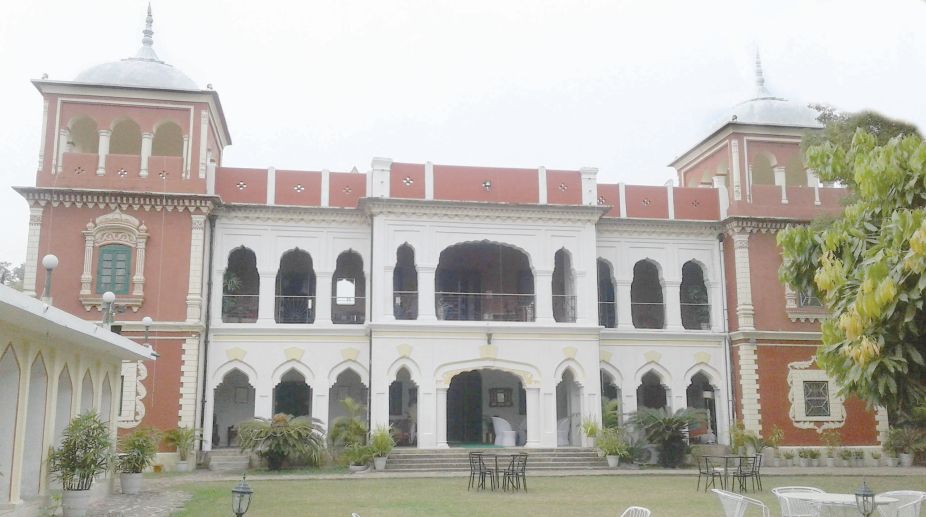
The Judge’s Court, which was completed in 1918, has now been converted into a resort. It was built in the typical Anglo-Indian style of architecture and is just walking distance from the village core. It is spread over 12 acres of land. The Judge’s Court is the pride of the Heritage Village. It is now run by the family which owns it as a heritage hotel.

Sunil, a 36-year-old manager at The Judge’s Court said, “This building is 110 years old. Everything including the stones laid, the furniture, the decorations, etc., are antique.”
The area has several stunn0ing ancient places. At the centre of Pragpur village is a pool or Taal (a water tank). It was constructed before 1868. The pond is surrounded by many heritage structures like Dhunichand Bhardial Serai, Nehar Bhawan and Radha Krishan Mandir.

The water tank was built with donations from local residents. A Nehar committee was formed for the care and maintenance of this water tank. “Water in the Taal comes from LagBaliana village, 4 km away from Pragpur. During the old days there were no iron pipes so people used bamboo pipes to transfer water from there. After the success of bamboo pipes the iron pipes were imported from London due to the unavailability of pipes in India,” said Brij Mohan Sood, the 77-year-old cashier of the Nehar committee.

“In that era there was no IPH department or PWD, it’s the local residents and the Sood community who took the initiative. So all the credit goes to them,” he added.
The remarkably designed pond with the structure of a lion on the edge is still intact. Made of lime and brick powder it gives a glimpse of what an ideal construction should be.
Along with these structures Butail Niwas, Butail Mandir, various havelis, temples and the Chateau Heritage Hotel in Pragpur-Garli have a unique and historic flavour.

The age-old shops in Pragpur-Garli area are popular for their traditional and good quality products. “One can buy any tool for any machinery here in these shops. These shops are very trusted,”said Sunita Devi of Haripur.

The heritage village reflects the essence of an earlier era. The mature buildings, fine work, remarkable architecture and old shops are the core of the heritage zone. But with time passing, some of these buildings are decaying. The historic buildings are crumbling because of neglect.

”Previously, it was a shooting spot for many Punjabi and Hindi movies. But today the roads are damaged and some of the prominent structures are fading and dying a slow death because of heedlessness”, he added further.

This heritage zone can give a boost to the rural tourism of Himachal Pradesh. India’s first heritage village, however, is crying for the attention both from the government as well as the local
residents.

A German Episode

Manish Nandy |

Right in the heart of Frankfurt am Main is the central cemetery, Hauptfriedhof. It is beautifully maintained and I found it interesting to saunter through its pathways and read the inscriptions on the gravestones. There is even an unexpected section devoted to deceased Jews.

If you get out of the cemetery and walk south along Eckenheimer Landstrasse, you will soon come across the nearest subway station. Now you turn left and walk only a few hundred yards, and you will be on Weberstrasse. It is one of many downtown streets and to most people nothing special. To me, however, it is very significant.

Near the corner of Weberstrasse and Schwarz burgstrasse there is a pintsize apartment building and an especially cozy apartment on the second floor. The apartment belonged to my friend, Adette Schneider. Her name was appropriate, for I am told in German the name connotes both grace and femininity. She came from an affluent family, but chose always to find her own way and follow her own counsel. Characteristically, she did it in a suave, considerate way that ruffled few feathers and, in fact, retained the affection of her friends and siblings.

She loved to visit exotic lands and took a job in the travel industry, planning and organizing packaged tours. That is how I met her in India, as she explored cities with tour potential for European travelers. I encountered her in Jaipur’s Amber Palace, as I was about to enter the gun section, and she said, “I don’t like weapons, but if you want to see the robe section I will join you.” I promptly changed my mind and opted for the royal turbans and gilded jodhpurs. The evening ended with a sumptuous Rajasthan dinner and a long chat over brandy.

Our paths crossed several times after that. We met in the US where I lived and in India which I visited periodically. We met most often in Germany, since the Frankfurt airport was the fulcrum of my innumerable trips across the Atlantic. If I had only a day or two, we would stroll through Städel Museum or go to see the international sculpture collection at the riverside villa Liebighaus, then veer to Romer Pils Brunnen and eat chicken schnitzel with copious Schofferhofer beer. On a weekend, we would spend the morning in the corner bakery, sitting on the tiny terrace when the weather was good, and drinking endless coffee inside with almond croissants when it wasn’t.

When we were lucky to have more time, we travelled, crisscrossing from Berlin to Munich and from Cologne to Dresden. My favorite place was the small, picturesque university town of Konstanz, which retained all its old buildings despite the ravages of war because it fooled the allied bombers into thinking that it was a part of adjacent Switzerland by the simple trick of keeping lights on at night. We stayed at the charming Steigenberger Hotel, made out of a Dominican monastery located on an island in Lake Constance, with a breathtaking view of the lake. You could walk to the opera, theatre or botanical garden. You could also, after a breakfast at the hotel, take a boat over to Switzerland for lunch, and then proceed to Austria for dinner. Best of all, you could stand at your hotel balcony, with a glass of sekt in your hand, and just watch the sun melt slowly, gloriously in the water.

The truth is, if you have a friend like Adette to accompany you, it does not matter where you are, in the middle of a desert or an unforgettably beautiful lake, for the world takes on a brighter hue, every footfall or rustle of a leaf could be the initiation of a Rachmaninov concerto, every conversation a plunge in ripples of imagination and understanding.
Even a cemetery could be your best compass. A plain street and simple apartment your guide to nirvana.

A scam or not a scam?

Pravesh Jain |

The 2G spectrum issue is back in national conversation. Almost everybody is talking about it. But no one is sure yet about what it really is. The recent judgment by the special CBI court has raised many specific questions. Is the 2G scam real or fake, true or a lie? Is it more about openness or secrecy; perception or reality? There are argument and counter arguments.

The divide is so clear that it has become an issue that puts lawyers against lawyers, court against court, political party against political party and one set of beliefs against another. Never has there been such a rarest of the rare case of corruption that might involve no corruption at all.

Just a few years ago, the nation was made to think of 2G as a historic corruption case with an astronomical figure of Rs 1.76 lakh crore involved. Today, the nation is made to believe that there was no corruption. The nation was shocked then and the nation is shocked now.

Why did the 2G story unfold like this? Who all were responsible for this? Why does the mystery deepen after years of digging? So many persons of position and credibility, the Comptroller and Auditor General, the Chief Vigilance Commissioner, the Central Bureau of Investigation and judges of the Supreme Court have looked at it. Some reputed business tycoons and industrial houses, some top bureaucrats, ministers and politicians and were spun into what at times looks like a craftily planned hoax of corrupt practices and unfair advantage?

The story unravelled when then CAG Vinod Rai, projecting the handling of spectrum distribution by the UPA government as huge irregularity, claimed that because of government action the national exchequer may have lost an astronomical Rs 1.76 lakh crore. But it was not clear if it was a case of direct loot by the corrupt or a matter of presumptive or imaginary loss because of some actions of the authorities.

Was it right on the part of the then CAG to calculate presumptive loss of such a high magnitude? Does it come in the domain of CAG to calculate presumptive loss? Is he not supposed to present only to Parliament about procedural lapses, systematic failures and irregularities, and on that basis, calculate real rather than the presumptive loss?

The media sensation at the time charged the atmosphere, and this was followed by protests organised by the opposition and social activists. Things happened in such quick succession that before anyone could sit and reflect, the nation found itself burning.

Had Dr. Manmohan Singh, the then PM, been an emphatic speaker, maybe things would have taken a different shape. But that was not to be, as even the ‘honest Singh’ was perceived to be dishonest being one with the corrupt and the dishonest. Why Dr. Singh could not be authoritative enough to neutralise questionable moves of some of his cabinet colleagues is not difficult to understand. After all the UPA regime was marked by the presence of two power centres, with Sonia Gandhi enjoying the allegiance of the party, the government and coalition partners.

To start with and looking at the gravity of the case, as perceived by all and sundry including CBI, many players including the minister, secretary, other officers, business tycoons and investors went behind bars while the case was being tried. It was as if a kind of “guilty until proven-innocent” consideration was working effectively.

Now after about seven years of trial involving 17 accused, 153 prosecution witnesses and 29 defence witnesses being examined by due process of law, the special court came out with yet another big shock – acquittal for all. After taking everything into consideration, the CBI special judge O P Saini produced a 1,553-page order stating he had not found a ‘’shred of evidence’’ to prosecute even a single person accused by the CBI.

The judge recorded with agony: “For the last about seven years, on all working days, summer vacation included, I religiously sat in the open court from 10 AM to 5 PM, waiting for someone with some legally admissible evidence in his possession but all in vain. Not a single soul turned up. This indicates that everybody was going by public perception created by rumour, gossip and speculation. However public perception has no place in judicial proceedings.’’

Can you feel the helplessness of a judge seemingly willing to find evidence to find and punish the guilty? The judge also said a very interesting thing: “In the beginning, the prosecution started with the case with great enthusiasm and ardour. However, as the case progressed, it became highly cautious and guarded in its attitude making it difficult to find out what the prosecution wanted to prove’’.
Can anyone say what the prosecution wanted to prove and why it became in the judge’s words “directionless’’? Did CBI lose the path or leave it? Did it find it difficult to walk on the path and thus change its way? Was the path so rough and rugged or filled with blockades that were unsurmountable? Did the agency known for its exemplary honesty and integrity lose its teeth?

Has the nation’s most elite and most credible investigating agency lost, not just its prominence but its very essence? The actions of the CBI were at times funny and at others motivated. In a land of extreme political interference where politicians are control freaks and the CBI is termed as a caged parrot, did it become imperative for the agency to lose interest for some specific reasons?

But one thing looks almost certain, that CBI suffered from its own leadership crisis. Great institutions are built and maintained by great individuals of character, strength and commitment. No one can ever deny that the CBI was not just our nation’s pride, but its world-class investigative calibre and functional superiority had won global recognition.

This was the result of its specially trained workforce, skilfully guided and carefully nurtured by uncompromising directors of vision and competence. Directors like John Lobo, Late M G Katre, PC Sharma and U S Misra, and a few others were the ones who would be watchdogs themselves at every stage of investigations.

But finally, what does the man who first created the perception of a scam have to say about it? Well after the judgment, as my knowledge goes, he is yet to open his mouth. But his perception changed all perceptions and created a whole new alternate reality. But just because the presumptions of the ex-CAG look questionable, does that mean all those now acquitted were honest? Looking at the history of Congress governments, one can fairly conclude that they were no holy cows.

Be that as it may, the fact is that today the 2G scam has become the cruellest chapter in Indian democracy that has questioned the credibility of many of our institutions. This scam that is not a scam has destroyed the reputations of individuals and institutions, sent many to jail, dragged many retired officers even in their 70s to court as witnesses and created fear in the minds of many who are still serving not to take independent decisions. Above all, it created panic among investors, caused a stock market crash, raised bank NPAs, almost destroyed the telecom sector and above all overthrew a government and helped bring the main opposition party to power.

No one knows whether the CBI will appeal in a higher court. Even if there is an appeal, no one knows if the story will look any different. No one knows how long the ghost of 2G will be allowed to haunt the nation. It may become another Bofors, where the ghost is resurrected from the grave from time to time. But one thing is certain, the scam that may not have been a scam will live long in our memory.


Campus apartheid

Tapas Kumar Chatterjee |

There are two broad areas of governance pertaining to higher education ~ interaction with the Government and its departments, regulatory bodies, funding agencies, accreditation agencies, foreign collaboration etc. The category of external governance includes policy concerning the national agenda through statutory bodies like the UGC and other entities governing the performance of higher education institutions in terms of course content and duration.

The other issue relates to internal governance, specifically administrative matters, student support systems, social outreach, and interaction with stakeholders. The internal systems have scope of autonomy through academic councils and the governing boards. The internal governance is by and large carried out by the governing structure of the institution which includes the apex authority of the university, notably the Board of Governors, the University Court, the Senate, Governing Council etc. These apex entities are supported by the Academic Council, Boards of Studies, Research Boards, Planning Boards, Admission Committees, Faculty Councils, Selection Committees, and several other committees. The financial management of the institutions is looked after by the Finance Committee. Private institutes/universities are normally headed by the Chairperson or President of the sponsoring Trust with a significant number of family members in the Governing Council.

The policy makers have consistently equated governance of higher educational institutions (HEIs) not in terms of the pre-requisites of legal instruments like Act/Statutes and the pool of human resources like teachers, officers and non-teaching staff, but in relation to the overall objectives of higher education. The national objectives such as empowering human resources with knowledge and skill-sets through concerted policy interventions in terms of access, equity and excellence have generally determined the contours of governance. The draft New Education Policy ( NEP, 2016 ) indicates the same approach. The NEP is somewhat like the UGC’s 12th Plan Vision Document, marked by considerable chest-thumping. It speaks of targets to meet the changing dynamics of quality education, innovation and research, to make India a knowledge superpower by equipping its students with the skills and knowledge. The other objective is to eliminate the shortage of manpower in science, technology, academics and industry.

The policy mentions the regulations of HEIs and imperatives of their amendments to make them more relevant to current and future needs of a globalised and competitive higher education system. It speaks of dedicated websites and transparency but the thrust appears to be only on the regulatory structures rather than its “soft core” or the involvement of all sections of teachers, officers and other staff empowered with the capacity to deliver in their respective domains.

The concept of governance in NEP and similar other policy formulations is superficial, narrow and myopic. The policy-makers emphasise the objectives, but ignore or overlook the ways and means to achieve these lofty targets. There is no reference to revamping the internal administration, rules and procedures for decision-making, domain knowledge and professional development of the administrative resources. Wherever there are references to the strategies of implementation, the policies invariably focus only on the faculty and development of research programmes. The university officers are ignored rather contemptuously.

This is a lopsided and narrow view of Governance. It is distressing that the draft NEP is aligned to the traditional path of ignoring the fact that strategies of governance must be in sync with the structures of governance and available physical and human resources. The development of capability in each of the three major sections is the pre-requisite to achieve the targets. The university management can play a crucial role in this respect and the success stories reflect that the best practices can be ensured by the involvement of all sections of the faculty, officers and other administrative staff with the highest level of professionalism , competence, skill-sets, commitment and dedication. Instead, the NEP , like the preceding policy documents, has stressed on the role of teachers only, going to the extent of proposing the Indian Education Service for faculty recruitment. There is a superficial reference to the concept of university management ~ “Efficient management of a university depends largely on the professional competence and managerial skills of the senior management personnel. The education sector needs professionals with qualities of leadership and credibility to tackle complex management issues.”

That is the be-all and end-all of this crucial category. There is no other reference to any scheme for professional development of university officers while there are many for the teachers. The policy completely overlooks the fact that recruitment qualifications of university officers are more or less similar to those of the teachers in respective categories under a three-tier pattern. The qualifications are based on the premise recommended by the Rastogi Committee ( 1996) that the universities will require a “movement” from teachers to officers and vice-versa. This is precisely why the administration is called academic-administration.
The quality deficiency and poor governance in higher education institutions stems from the callous policy of depending only on the teaching cadre and ignoring the managerial sector. Barring a few instances of quality governance like islands of excellence in an ocean of mediocrity, the traditional university administration is still being run with outdated, obsolete manners and tools and mindsets. There is no policy to launch initiatives to nurture and groom the personnel with modern 21st century tools of management, updated managerial culture, professionalism, soft skills and e-governance. A flexible pattern of organisational management which is responsive to changes in the era of collaborative education, globalisation and competition is imperative. This can only be built on the principles of professionalism, collective leadership, decentralisation and devolution of powers and functions, participation of officers in decision-making, parity with the Teachers in pay-scales and all service conditions.

The situation as it now prevails is no different from the principles of apartheid in higher educational institutions as far as treatment meted out to university officers is concerned. These officers are accountable on a 24×7 basis, their working hours are not fixed, and they are expected to discharge their work as fast as possible and with due transparency. And yet they are treated with indifference. They are often called upon to provide clarifications on important issues, but their opinions are generally disregarded. They are not allowed to pursue research programmes, attend seminars and conferences. There is hardly any scope for professional development through orientation and refresher courses.

The UGC Pay Review Committee has completely excluded this category. Another example of discrimination is the proposal to set up National and State Training Academies for an induction programme for only the “newly recruited faculty”. There is no reference to the officers although the imperatives are too obvious to all. Complete parity in service conditions is central to academic-administration. This ought to be the primary task for the nation that strives for excellence in higher education and research and a high employability-quotient. The discriminatory outlook must end and the policy of apartheid, woven around discrimination and deprivation to university officers, jettisoned. Let complete parity in pay-scales and service benefits between teachers and officers, who possess similar recruitment qualifications, be put in place as a matter of policy.

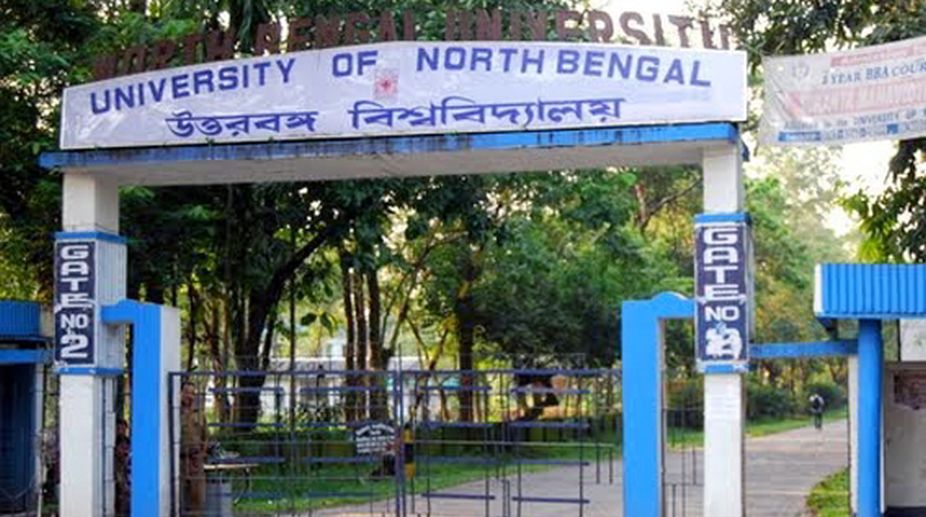
The writer is former Registrar, University of North Bengal, Siliguri.