Logo

PIOs conference will help open news vistas: Sushma Swaraj

IANS | New Delhi |

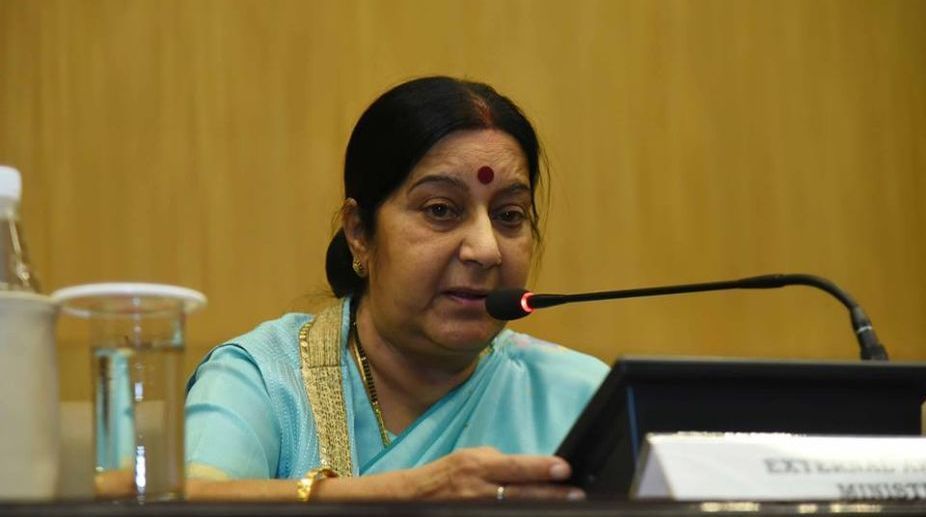
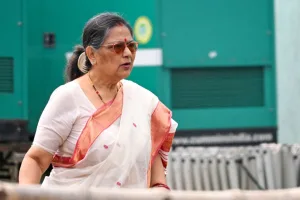
External Affairs Minister Sushma Swaraj on Tuesday said the conference of PIO Parliamentarians Conference will help in opening new vistas for regular dialogue and exchange of views.

She was speaking at the valedictory session of the first ever PIO Parliamentarians Conference here.

“I am confident that this historical conference will help open new vistas for regular dialogues and exchange of visits and views of PIO parliamentarians,” she said, adding global Indians had become India’s friends currently because of the several successful initiatives launched by the government to connect with Indian diaspora.

“In times of crisis in abroad, the Indian government has launched several rescue missions too.”

She said that the current government has one mission to remake India into a great nation and the “mission in which every Indian and equally every overseas Indian arrive at equal fate”.

“The government of India under the dynamic leadership of Prime Minister Narendra Modi has been specially proactive in making bonds with Indian dispora.”

A total of 143 PIO lawmakers from 24 countries attended in the first of its kind initiative taken by the government.

The PIO Parliamentarian forum was planned last year during a conversation with the Prime Minister to connect the lawmakers of Indian origin with their ancestral land, the Minister said.

Chinese troop’s presence continues near Doklam

IANS | New Delhi |

Despite extreme cold conditions, Chinese troops continue to be present close to the Doklam plateau, though the numbers have gone down over last couple of months, informed sources said on Tuesday.

According to government sources, around 800-900 Chinese People’s Liberation Army (PLA) troops are stationed in the Chinese territory close to the standoff area. The area had over 1300 soldiers positioned earlier.

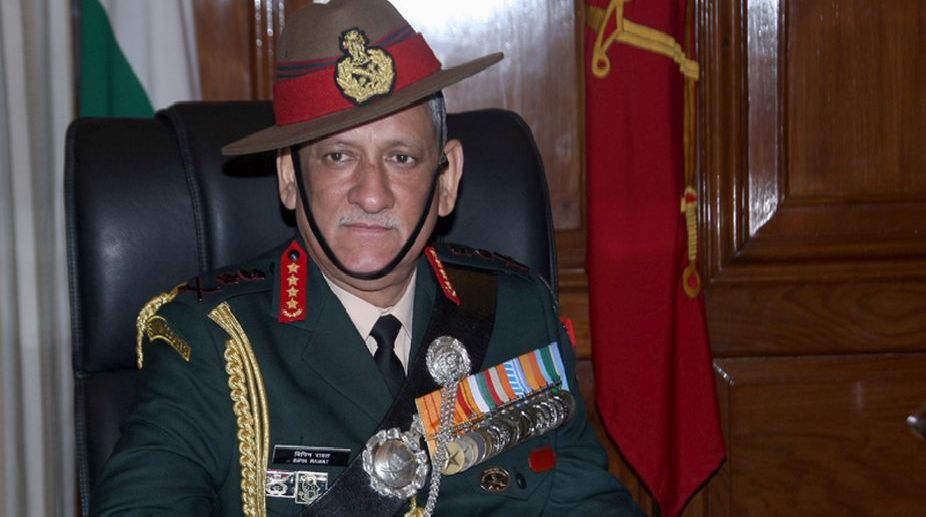
Army chief General Bipin Rawat had also said on Monday that the number of troops across the border near Doklam had gone down.

China attempted to build a road in territory claimed by Bhutan in June but was stopped by India, resulting in a 73-day stand-off in the Sikkim section of Sino-Indian border.

The stand-off started on June 16 and both sides announced disengagement on August 28.

The standoff had led to tension between the two nuclear-armed nations, and during a meeting between External Affairs Minister Sushma Swaraj and her Chinese counterpart Wang Yi in December, India had stressed on peace along the India-China border as a pre-requisite for strong bilateral relations.

Wang had also admitted that the standoff had put a “severe” strain on bilateral ties.

In December, India’s National Security Adviser Ajit Doval and Chinese State Councillor and Member of Central Committee of Politburo of the Communist Party of China Yang Jiechi held the 20th Meeting of Special Representatives of India and China on border issues.

The two sides later called the talks “positive and focused” and also agreed to seek “mutually acceptable resolutions of their differences with due respect for each other’s sensitivities, concerns and aspirations”.

Stock indices’ record-breaking run continues

Statesman News Service | Mumbai |

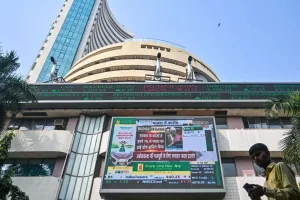
Equity benchmarks of Bombay Stock Exchange and National Stock Exchange extended their record-breaking run for the second session today as the 30-share Sensitive Index and the 50-stock Nifty kept climbing fresh peaks on robust buying support not only by domestic institutional investors but also by foreign portfolio investors.

FPIs have apparently stepped up investment which analysts attribute to rising expectation about much-awaited and needed growth in corporate earnings in October-December quarter of this financial year.

Commenting on the latest surge in main indices, Mr Laurence Balanco of CLSA, said: “It is a start of a re-rating for emerging markets and the positive trade is to move out of international assets into EM assets.” The Hong Kong-based agency has now upped Nifty target to 12,000 in the first half of 2018 and for the Bank Nifty to 31,000.

Several brokerages have been revising their targets upward for the Sensex and the Nifty as they see the liquidity-driven rally of 2017 is now receiving a push from improving fundamentals. According to them, the biggest positive in near term is likely to be revival of private capital expenditure after a gap of almost three years.

CLSA analyst, on the other hand, sees three to five per cent pullback ~ but not big correction ~ in the United States stock market where Dow Jones hit 25,000-mark for the first time last week. Any correction should be taken as buying opportunity.

Dalal Street analysts say the domestic benchmarks too declined several times in 2017, but also displayed remarkable resilience in sharp turnarounds on the back of buying on dips by domestic institutional investors and retail investors.

Yesterday, FPIs were net buyers in equities worth Rs 693 crore, much more than DII’s Rs 126 crore investment. In calendar year 2017, they collectively net invested $26 billion in shares, according to the Securities and Exchange Board of India and depository data.

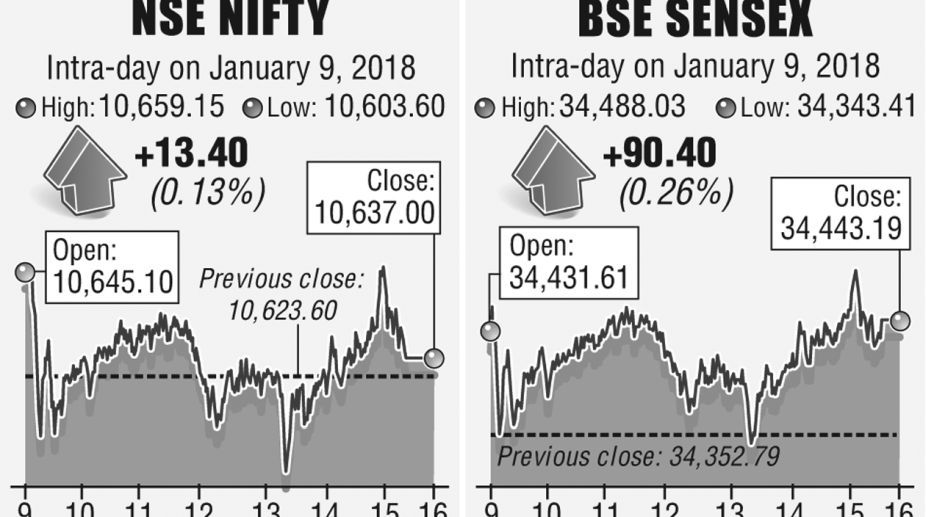
The Sensex today closed at 34,443.19 points, registering a gain of 90.40 points or 0.26 per cent. Broader market’s Nifty finished 0.13 per cent or 13.40 points up at 10,637 points. The Bank Nifty continued upside movement albeit slowly with an increase of 0.11 per cent or 27.70 points to end at 25,703.80 points. In the Sensex pack, 14 shares advanced and 17 declined. For the Nifty, the advance-decline ratio stood at 19 versus 31.

Aditya Birla Sun Life AMC’s Mr Mahesh Patil, who manages $6.3 billion assets, said: “Equity market has not done yet..it was a good 2017 in terms of returns but India has lagged global rivals on earnings and economic growth because of the impact of reforms. The pain of reforms is now behind us and slowly growth will start improving.”

He sees Nifty companies’ earnings to rise at an average of 19 per cent in the year starting 1 April 2018 as businesses have adjusted to the policy changes. Provisions for soured corporate loans at banks will reduce and earnings in telecom and drugmakers will drive indices’ profit growth. Foreign flows which were tepid in 2017 will turn favourable as economic growth returns and both these will continue to keep market buoyant and valuations high, says Mr Patil.

Today, top gainers in the BSE benchmark included Coal India at Rs 303.80, up 5.54 per cent; Yes Bank at Rs 341.10, up 2.31 per cent; Wipro at Rs 318, up 2.23 per cent and RIL at Rs 939, up 1.14 per cent. BSE’s market capital at close was Rs 1,54,86,079 crore.

Rahul’s Bahrain visit last resort of a failed leader, says BJP

Statesman News Service | New Delhi |

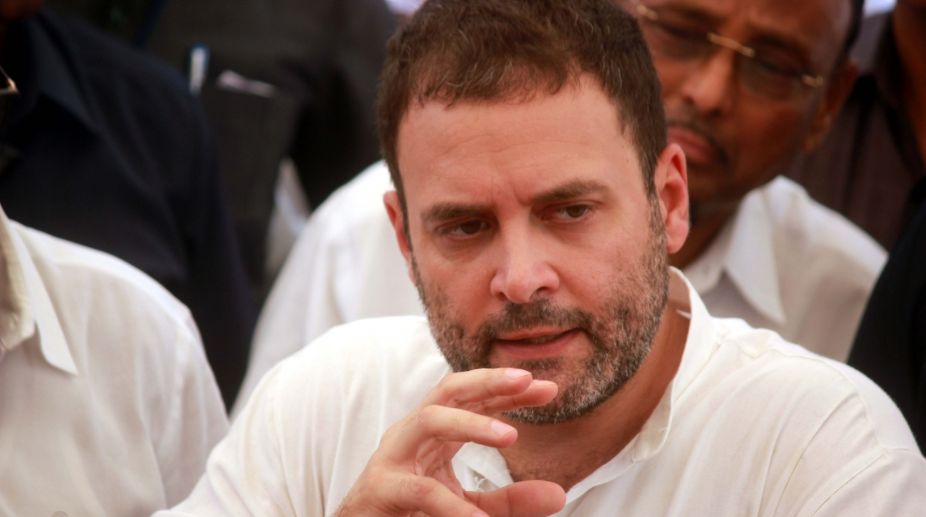
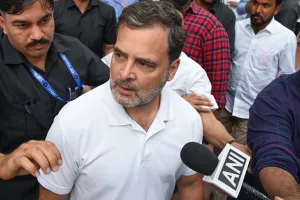
Barely a couple of weeks into its poll victories in Himachal Pradesh and Gujarat, the ruling BJP was back to targeting Congress president Rahul Gandhi over his ongoing visit to Bahrain.
The BJP, which loses no opportunity to mock at and criticise Gandhi, sought to highlight the Congress defeats in the two recent state elections, despite the Congress improving upon its past tally in Gujarat, under the leadership of the new party president.

Gandhi on Monday had called on Bahrain’s Crown Prince Sheikh Salman bin Hamad Al Khalifa. This was followed by his meeting with Prince Shaikh Khalid bin Hamad Al Khalifa at Al Wadi Palace. He gifted him books written by Jawaharlal Nehru while in prison, besides The Discovery of India. Gandhi later addressed a gathering of NRIs.

BJP leader and spokesman Sambit Patra, however, termed Gandhi’s visit to Bahrain as “the last resort of a failed leader”
“Rahul Gandhi’s political career in India has been jeopardised; he is going abroad and demeaning India. His conspiracies are out in the open, and the visit is the last resort of a failed leader,” Patra said.

He also sought to highlight that the main fight between the ruling BJP and Opposition Congress was over development and sectoral politics respectively. “While the BJP focuses on reforms, Rahul Gandhi believes in deforming politics. It is the politics of development versus the politics of division practiced by the Congress Party,” the BJP national spokesman said.

Joining Patra’s criticism of Rahul Gandhi’s Bahrain visit, senior BJP Rajya Sabha MP Subramanian Swamy alleged that it had been undertaken “possibly for money laundering.”

“These days a lot of leaders are going to Bahrain instead of Dubai, since the latter has stringent surveillance. If he (Rahul Gandhi) felt there was a serious problem in India, he should have stayed back to solve it, not gone to Bahrain,” Swamy said.

Electoral bonds regressive’

Statesman News Service | New Delhi |

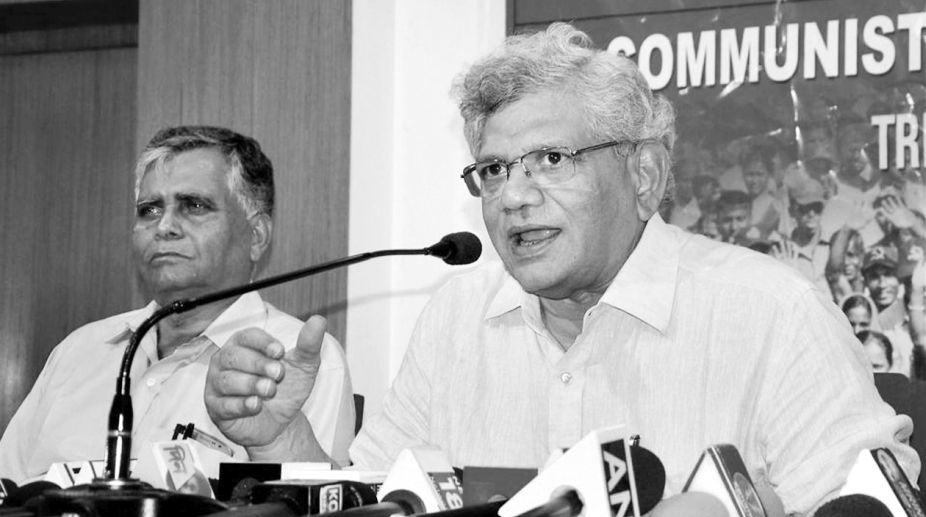
Hitting out at the BJP-led government for its “regressive policies”, CPI-M General Secretary Sitaram Yechury on Tuesday said what the country needed was policies and not leaders. He said alternative policies would be the basis of Opposition unity and hope for other secular parties.

Talking to the media at a “Meet the Press”under the aegis of Indian Women Press Corps (IWPC) here, Yechury termed the idea of electoral bonds “regressive” and made a strong pitch for state funding of political parties and a ban on flow of corporate funds directly.

He said the bonds “remove limits of corporate funding leading to establishment of shell companies. Nobody knows who redeems the bonds and it is very opaque and anti-democratic.”
“Contesting elections is now akin to a business enterprise, possible only for the wealthy.

“ This needs stringent reform. At the outset, a good move will be to ban availability of corporate funds to political parties,” he said.

He wanted to know why the reports of the two committees ~ Dinesh Goswami and Indrajit Gupta ~ which favoured state funding were not implemented. There is need for bringing a new legislation in regard to election funding, he said, adding that corporates should donate to the Election Commission.

Yechury described the prevailing situation in the country as a “critical time of our political history”. He said he unequivocally opposed any curbs of freedom of press and felt the present curbs are worse than during the time of Mrs Indira Gandhi. It was “an undeclared form of emergency”, he added.

Yechury spoke on various issues ranging from upcoming Assembly elections in Tripura to Opposition unity and foreign policy. He painted a gloomy picture of the government’s handling of various issues while being strongly critical of the “growing intolerance”. He slammed the government for not allowing Jignesh Mevani to hold a protest meet in the Capital.

The CPM leader said, “Gaurakshaks are going berserk all over the country. We demanded a ban on gaurakshaks and moral policing. Why are private armies of gaurakshaks being allowed and not one word of condemnation by the government. This is not acceptable.”

On the coming Assembly elections in Tripura, Yechury said, “Tripura would be BJP’s Waterloo. For electoral benefit BJP would let loose mayhem but we are prepared for it. The BJP’s fulcrum would be to unite all anti-left forces and a major battle is to be fought in Tripura and the outcome of the Assembly elections would have wider implications for the North East.”

On Aadhaar, he said “We have been opposing Aadhaar as it is violation of fundamental rights of the citizens under the Constitution.”

On foreign policy, Yechury said, “I am very worried as it has shifted in a big way. It was independent but has now shifted and become part of US global interest. The countries which we said were twin brothers like Nepal have now moved away. We cannot keep good relations with our neighbours. The Prime Minister visits Israel instead of Palestine and at the UN it votes with Palestine. It is much more than flip flop and it is a direct shift towards a pro-US foreign policy detrimental to India’s interests.”

On the generational change in politics, Yechury said, “There is a generational shift and demographically the younger leadership cannot be left out and this generational shift is positive. Such a shift also shows youth taking up issues very relevant today.”

Remembering the Count

S Ananthanarayanan |

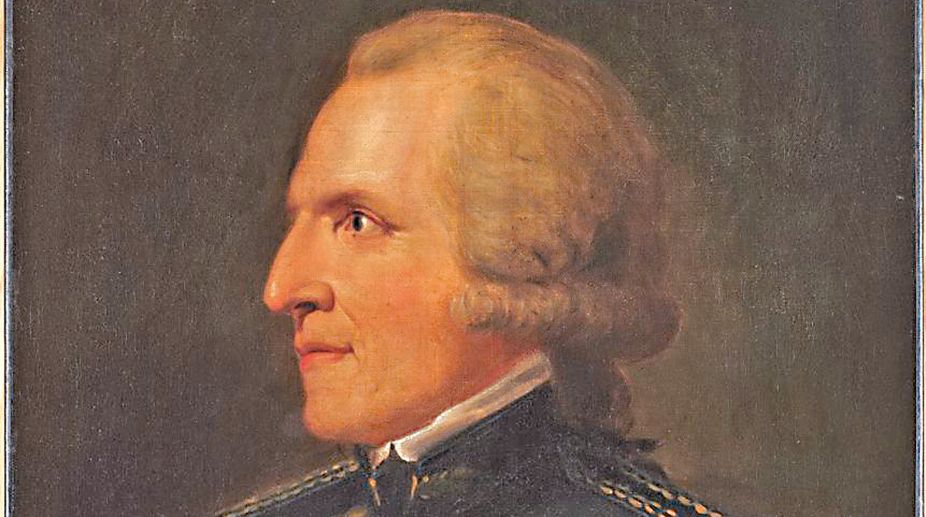
Benjamin Thompson, who fled the US and became a Bavarian Count, did important work on the mechanical equivalent of heat.

Thompson was born in 1773 in a small town in Massachusetts. He went to the village school but often visited the Harvard College in Cambridge, nearby, to attend lectures, was fascinated by perpetual motion machines and took interest in eclipses. At the age of 18 he became a schoolmaster in the town of Rumford in Massachusetts and married a wealthy widow many years his senior. With her help and influence, he got a position in the New Hampshire Militia. But during the American Civil War, his strong pro-British convictions went down poorly with the popular rebel party and Thompson abandoned his wife and crossed lines to the loyalist forces.

During the rest of the war, apart from passing military intelligence to the British, using devices like invisible ink, he carried out lunar observations and conducted experiments, which were later acclaimed, on the speed of projectiles fired by cannon and the properties of gunpowder.

When he did go over to England after the war, he already had a reputation as a scientist and he was soon elected a Fellow of the Royal Society.

During the next years in England, after what has been described as “unforgivable social climbing”, he migrated to Bavaria, where he rose to a high position in the court and the military. He spent 11 years in Bavaria, applying his talents in reorganising the army and the administration of the state. It was during this period — while working in the foundries that bored the barrels of the cannon — that he made observations, which ran counter to the current theory of heat.

Heat, at the time, was considered to be a kind of fluid, an aether called caloric, which flowed in and out of materials. Caloric was considered to be indestructible and incapable of being created, perhaps the last of the Aristotelian ideas of the four essences of matter — earth, air, water and fire. The word, caloric, for the essence of heat, in fact, had been coined by Lavoisier, the French chemist who had proved that mercury got heavier when it burned, not lighter!

Thompson was able to see that labour was expended in driving the bit that bored the barrels, which in turn grew so hot that they could keep the cooling water continuously boiling. The conclusion was not difficult to reach, that the heat came from mechanical work, not any currents of caloric! In 1798, Thompson published his work as An Experimental Enquiry Concerning the Source of the Heat which is Excited by Friction in the Philosophical Transactions of the Royal Society. That was the start of a scientific look at heat and work, which led to the laws of thermodynamics, the steam engine, petrol engine and all else!

Thompson made important contributions to the administration of the Bavarian state and brought the scientific method to dealing with civic problems. One area was of engaging the impoverished peasant population of the country in paid work in state workhouses — to make uniforms for the army, which was itself in low morale. He developed a specially formulated “soup” that was economical and nutritious and was served both in the army and in the workhouses. This may be considered one of the earliest scientific steps in the domain of dietetics. The Bavarian State recognised his services and he was made a count. As his title, he took the name of his hometown, as Count Rumford.

Count Rumford, went on to be celebrated for many inventions, including the double boiler, a kitchen range, the pressure cooker, the folding bed and he became well known for important improvements that he made in the design of fireplaces.

The Rumford fireplace was tall and shallow to reflect more heat, and had a streamlined chimney. The design of the chimney helped eliminate turbulence and allowed the smoke to rise as an even stream without mixing and carrying away the least warm air from the heated room. This improved comfort and saved fuel.

In 1796 and in 1798, he wrote two papers detailing the improved design of the fireplace, which were widely read and in the 1790s the “Rumford fireplace” became state-of-the-art worldwide.
In a few years, Count Rumford left Bavaria for England and France, and followed a life as successful, both in science and commerce and as colourful in the arts and in amorous escapades. In 1796, he gave $5,000 each to the Royal Society of Great Britain and to the American Academy of Arts and Sciences to award medals every two years for outstanding scientific research on heat or light. When he died most of his considerable fortune went to Harvard University.

But even if there were none of these contributions to science or notoriety, Count Rumford would still be immortal for his invention of the “drip-pot coffee percolator”. It is the simple arrangement of two containers, one above the other, with the base of the upper one pierced with little holes. Pure coffee powder is packed in the upper container and covered with boiling water. The water drips into the lower container, as the aromatic decoction. The device came to India with the British and was promptly adopted by South Indians – much to the joy of coffee drinkers.

Akhilesh makes up with his dad

Statesman News Service |

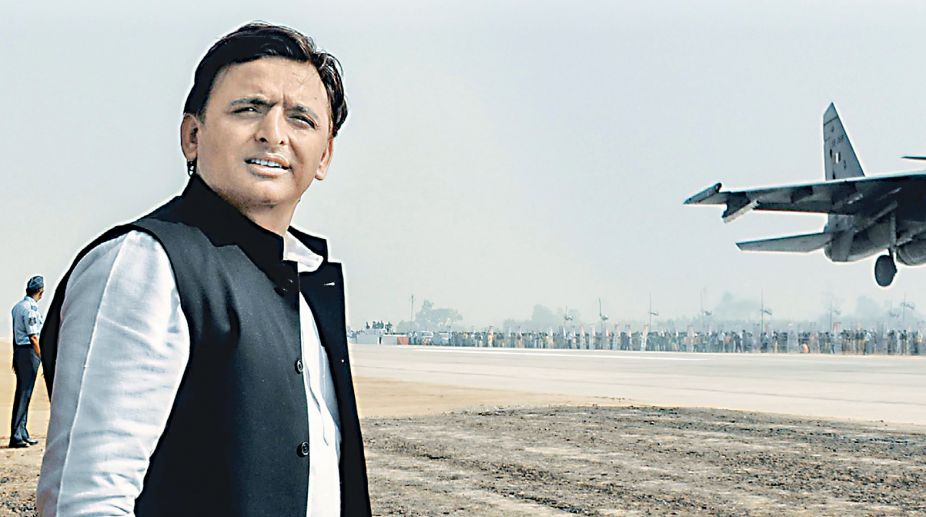
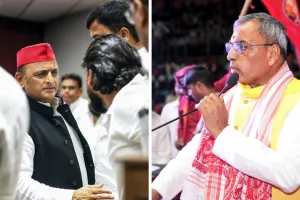
In a significant development for UP politics, SP patriarch Mulayam Singh Yadav has made up with his estranged son Akhilesh Yadav. The normalisation of their relationship after an ugly public spat prior to the UP assembly polls 2017 has been evident for some time now.

Mulayam turned up for Akhilesh’s birthday celebration at the SP headquarters in Lucknow last September. He stood next to Akhilesh as the former UP chief minister cut his birthday cake. Both fed each other cake.

Then, in November, a similar scene happened on Mulayam Singh’s birthday. Mulayam cut his cake and father and son fed each other a piece.

More recently, Akhilesh flew to Delhi specially to attend a dinner thrown by Ram Gopal Yadav for SP MPs shortly before the winter session of Parliament ended. It was like old times again, one of the invitees remarked. Father and son chatted comfortably with each other and when Mulayam left, Akhilesh went to the car to see him off.

SP members are relieved that the relationship between the two is back on an even keel. While Akhilesh is firmly in the saddle as SP chief, he needs his father by his side to shore him up.
His father’s support is particularly important because the relationship between his uncles Shivpal and Ram Gopal remains bitter and hostile. Shivpal did not show up for Ram Gopal’s dinner. His absence was felt by all present.

AAP surprises
Sushil and N D Gupta were not the only surprise Rajya Sabha nominees by Arvind Kejriwal’s AAP. Sanjay Singh is believed to have been a late addition to the list.

Although Sanjay Singh is an old and trusted Kejriwal man, his stint in Punjab as campaign in charge during the 2017 assembly elections made him very controversial. There were all sorts of charges against him and after AAP’s debacle, he was forced to lie low.

Actually, AAP sources say former journalist Ashutosh was a front runner for a RS nomination. He has been keeping AAP’s flag flying in print and on television and has been leading his party’s charge against Narendra Modi and the BJP.

His chances were scuttled because reports reached Kejriwal that Sanjay Singh had a secret meeting with rebel leader and another RS aspirant Kumar Vishwas at a house in Noida.
The reports rang alarm bells that the two could be plotting to drive a schism in AAP that could lead to a split on the eve of the RS elections. Sources say Sanjay Singh was called and offered a nomination to placate him.

The offer to the two Guptas was made several weeks ago. It was the third nomination that changed at the last moment, leaving Ashutosh out in the cold.
Interestingly, N D Gupta is well known to BJP leader Arun Jaitley while Sushil Gupta was in the Congress till a couple of months ago. The question being asked is this: has Kejriwal chosen wisely by picking people with links to the two national parties or has he made a strategic mistake?

Pilgrim’s progress
The railways ministry parliamentary standing committee headed by Trinamool Congress MP Sudip Bandhopadhyay has come out with a colourful report on tourism promotion and the pilgrimage circuit.

When the report was tabled in the Lok Sabha last week, BJP members were thrilled and heaped praise on it. Strangely, the words of praise were not for the chairman but for his boss, Mamata Banerjee. BJP MPs lauded her for the wonderful report.

Political circles were surprised by this sudden expression of affection for someone who has been fighting with the ruling party almost on a daily basis. Was it the subject of the report – pilgrimage circuit – that excited the BJP? Or was there a subtle message in the praise asking for Mamata’s help to get the triple talaq bill passed in the Rajya Sabha?

The ploy doesn’t seem to have worked because the Trinamool Congress remained at the forefront of the demand in the Rajya Sabha to send the bill to a select committee. In fact, it is the Trinamool’s consistent and aggressive approach that has forced the Congress to discard its wishy washy ways and finally take a stand.

Defiance of MPs
Despite the formidable presence of BJP president Amit Shah in Parliament and the scolding by Narendra Modi during the monsoon session, the BJP is having problems getting its MPs to Lok Sabha to pass the constitutional amendment bill granting constitutional status to the National Commission for Backward Classes.

On Wednesday, Lok Sabha Speakeer Sumitra Mahajan abruptly adjourned the house for the day after a lone BJP MP tried to disrupt proceedings. It seemed to be a planned move because the ruling party didn’t have the numbers to get the bill passed.

The next day, despite a three-line whip, it found a high rate of absenteeism in the House, which is why the government has now deferred the bill.

Ironically, this is the same bill which failed the quorum test in the monsoon session and provoked the PM to rap his MPs on the knuckles for being absent when the bill was to be passed.
Political circles are surprised by the defiance of BJP MPs. The persistent absenteeism suggests that many MPs are secretly unhappy with the bill and don’t want to see it become law. Wonder what the Modi-Shah duo have to say about this.

Transgenders need progressive laws

Sanjeeb Panigrahi |

Transgender-related issues have come to occupy centre stage and are acknowledged within our social and cultural framework, though social policies have failed to capture the specifics of their needs, experience and ground realities. Over the last decade, a divergent range of transgender identities have been articulated though transsexual narratives. The word ‘transgender’ is an umbrella term to denote persons whose gender identity is different from the sex assigned to them at birth. They are incredibly diverse and exist in every culture, religion, castes, creed etc as recorded in history. They often identify themselves as male, female, agender but their identity as transgender faces a unique set of challenges and social stigma. They continue to suffer a disproportionate level of negative attitude and severe forms of discrimination.

Sexual orientation has been an integral aspect of “private life” and it is essentially a private manifestation of the human personality which has been echoed in the privacy judgment of the apex court. Given rapid social changes occurring in different parts of the world, the evolving equality of standards and growing public acceptance of same sex marriage has been a watershed in the transgender persons’ battle for legal rights. There has been an increasing visibility of transgenders in every walk of life in India and they are numbered as 4.87 lakh (Census 2011) though the figure is disputed by NGOs and human right activists.

The legislative policies may appear to be neutral, but they are often rigid and impose strict gender requirements. Though the Government has been clamouring for equal opportunities for all communities, this community is still in the darker side of inclusive growth. In India, rights of the transgender have started moving from the margins of society to the mainstream political and legal discussions only after the Apex Court’s judgment in the NALSA case. A comprehensive non-discriminatory law for the transgender community is still elusive though there has been intense public discourse on the issue.

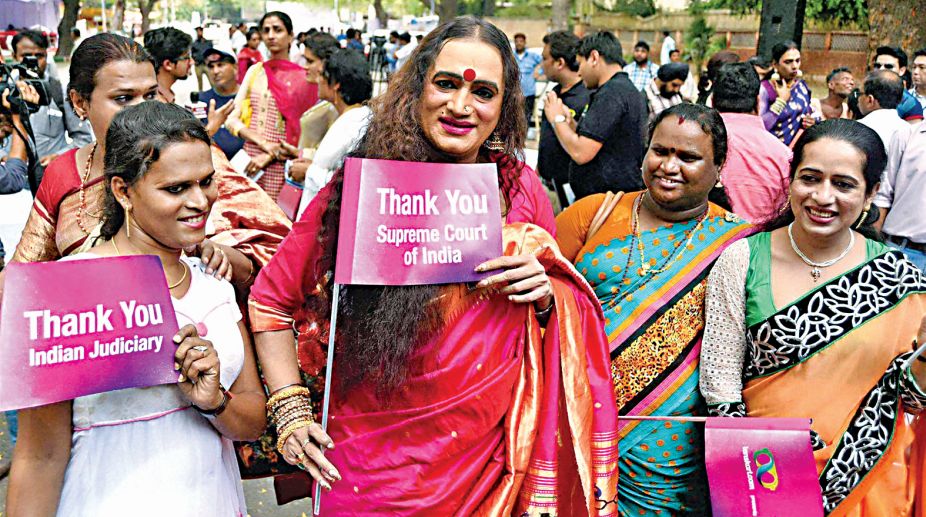
As many as 20 countries have made some tangible and concrete legislative efforts in some form or other in recognising their rights. The widespread lack of accurate identity in India deprives them from many public utility services including housing, transport facilities and medical facilities. The human right groups and transgender advocacy groups have been continuously working to remedy the disparities associated with them. The Supreme Court through NALSA judgment (2014) embarked on a journey by initiating legal recognition to transgender persons by creating a category called “third gender” seeking legitimacy through legislative efforts. In fact, it opened vista for a new discursive framework, there has been a paradigm shift in gender identities and the SC judgment is an identity innovator.

Besides, the negative right against discrimination, the apex court ruled that transgender persons are also entitled to some positive rights to make decisions about themselves, and are entitled to participate in community life. The apex Court also directed the government to accord “socially and educationally backward status to make them the beneficiary of the schemes and policies of affirmative action”. Consequently, the Union Government conceptualised a bill to reinforce the apex Court’s judgment and Parliament is in the process of making a law. However, this narrative collapses when the issues are considered more closely, as the Bill reflects a clear move to circumvent the spirit of the apex Court’s judgements on the subject.

The Bill was tabled in the Lower House and later referred to the Parliamentary Standing Committee on Social Justice and Empowerment for further deliberations on certain contentious issues. The standing committee in its report suggested certain amendments in the draft bill which included a definition of “transgender” that is not attuned with global norms. The proposed legislation is not sufficiently rooted in a rights-based approach. The Parliamentary Panel report echoes a progressive tone by addressing certain critical issues in the bill including the controversial Section 377 which criminalises homosexuality. Crucial issues like gay marriage, divorce, adoption etc. are not dealt with by the Bill.

The Union Government, however, ignoring the understanding of gender in proper perspective and without considering some illuminating suggestions of the Parliamentary Panel Report, appears determined to re-introduce the Transgender Persons (protection of rights) Bill with some inconsequential changes. The proposed legislation also seeks to reserve 2 per cent seats in educational institutions as well as in government jobs.

Besides, the formulation of national and state level commission for transgender people and formation of special transgender rights court, the Bill also takes care of the Rights of a transgender child for home and imposes condition for foster care and prescribes punishment for transgender-related hate crime; these indeed are some of the progressive clauses in the Bill.

Despite the Bill falling on stony ground and being beset with many deficiencies, it is a benevolent social legislation with a welfarist tone and approach. It is, therefore, incumbent upon the government to adopt an inclusive approach towards this neglected community and come up with the best law possible. The standing committee has gone much beyond rights and welfare of the transgender by making attempts to redefine many terms contained in the bill. The wrong assumption of biological determinism and the proposed national council for transgender person which is merely an advisory body sans any teeth in terms of enforcement power are some of the major flaws in the Bill.

There have been decent moves transcending rhetoric at the State level. Tamil Nadu, Karnataka and recently Odisha have rolled out the most progressive developmental policies for the Transgender community. Tamil Nadu has set a good precedent by appointing its first Transgender Police Officer, Prithika Yashini. In October 2014, the University Grants Commission (UGC) vide its circular mandated all Indian universities to include a column for Transgender Community in all application forms. The circular also included extension of affirmative action to Transgender students who would get acclimatised without facing humiliation, fear, stigma or shame including creation of Transgender friendly infrastructure and a sensitized atmosphere in the campuses.
Besides legislative efforts, there is a need to map work in order to formulate a robust policy with an inclusive approach. Any policy framework for the Transgender has to focus on issues like improving legal access and the law enforcement systems empowering and sensitising people on this issue, criminal and disciplinary action against perpetrators of violence against transgender persons, strict action against parents who neglect, abuse or leave their child because of their biological difference, provision of free legal aid for the Transgender community at ground level, supportive and encouraging role by educational institutions in providing education to transgenders ensuring smooth flow of the provisions of social entitlement and establishment of helpline for career planning and guidance. Liberal credit facilities and financial assistance need to be ensured for making them self-sufficient. In addition, separate policies targeting health care must be framed and communicated to all private and public hospitals or clinics, mass awareness programmes to reach the public and this community and a comprehensive sex-education programme need to be incorporated in school and college curricula for creating awareness.

It is heartening to note that during the last one decade, the views of people have widened dramatically crossing the traditional gender boundary. Taking a cue from the advanced countries of the world, India need to harmonise its domestic laws to reflect the progressive ideas on this subject. The cultural and religious norms must not impede a supportive and inclusive legislation considering the commands of social justice as enshrined in our Constitution. The NALSA judgment, Ram Singh judgment and the report of the “expert committee on transgender” must be the guiding force for the proposed legislation or any transgender-friendly social policy framework.

Anthropology at 100~I

Abhijit Guha |

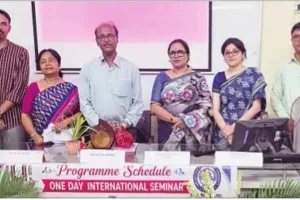
The teaching of Anthropology in universities as a holistic study of humankind began in Europe and America late in the nineteenth century. In India the first department of anthropology was established at the University of Calcutta in 1921. Anthropology was introduced in the university in 1918 as part of the curriculum of Ancient history and culture.

In 1920, it was given the status of an autonomous subject for study at the post-graduate level leading to M.A./M.Sc. degree. Thereafter, a separate department of Anthropology was established in 1921.

The teaching of Anthropology at Calcutta University completed hundred years with the start of 2018. What is most significant about the department is that despite its long association it lacks a documented book on its history. There is only a short paragraph of barely 250 words entitled ‘History of the Department’ in the official website of the Department on Anthropology at Calcutta University.

It is a matter of shame that a hundred-year-old academic department, which is devoted to the study of the biological and cultural evolution of human beings for millions of years, could not reconstruct its own history.

One may even wonder how this department will commemorate its hundred years of teaching without recollecting its own past. How will the present generation of students and teachers of this heritage department pay homage to the pioneers without a factual and interpretive evaluation of the contributions of the latter?

Not that the history of academic and research institutions of anthropology are absent in our country. One notable example is the history of the Anthropological Survey of India which is the largest governmental research organization of anthropologists in the world. It was established in 1945 with Dr BS Guha as its founder Director who taught briefly in the anthropology department of Calcutta University in the 1920s.

The legendary British civil servant cum anthropologist, Varrier Elwin who became a follower of Gandhi ,was the Deputy Director of the Anthropological Survey of India. There is a well documented book on the history of this institute entitled The History of the Anthropological Survey of India, edited by the then Director General Dr KS Singh and published in 1991.

The other problem is the dearth of important books by the notable pioneers of the department. I will just mention the names of two such books which have tremendous contemporary relevance and are neither available at the sales counter of Calcutta University nor are recommended for reading to the students in anthropology in their syllabi. The publication division of the University of Calcutta has not yet been able to reprint these memorable books.

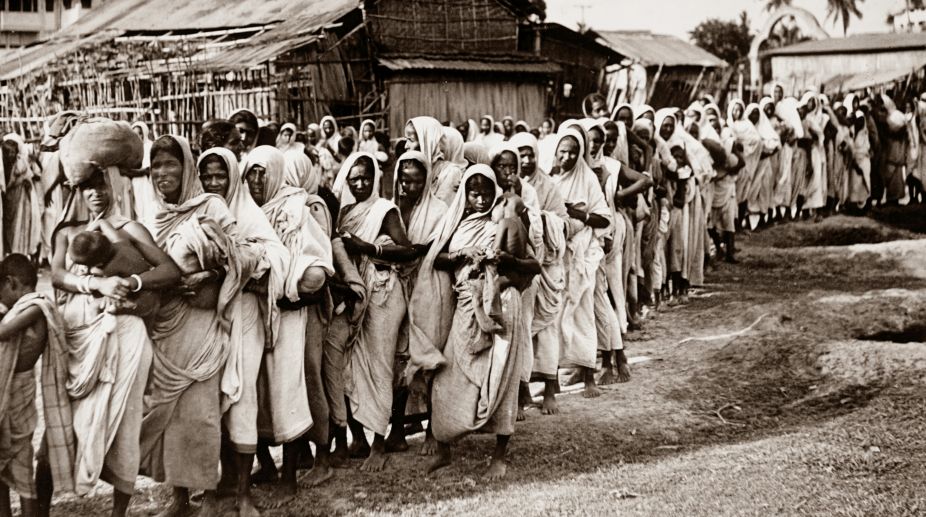
The first book was written by Tarak Chandra Das (1898-1964), a brilliant and dedicated teacher who joined the department at Calcutta University as a lecturer in 1923 and retired as Reader in 1963.The title of the book is Bengal Famine (1943) and carries a survey of the destitutes of Calcutta. The survey was undertaken by a team of anthropologists during 1943-44 in the city and the villages across ten districts of undivided Bengal.

The idea of conducting a survey with a team of trained anthropologists was first conceived by TC Das in July-August of 1943 when hundreds of hungry destitutes entered the city in search of food. Das proposed the survey to his colleagues and prepared a detailed questionnaire and a team was formed with eleven trained anthropologists including the teachers and research students of the Department of Anthropology of Calcutta University.

The data thus collected was analysed and a preliminary report was written. A major part of the report was submitted to the Famine Inquiry Commission (constituted by the then colonial government) in 1944 in the form of a memorandum which was placed in the British Parliament.

The report was later written in the form of a book by T.C.Das in July 1948 and was published in 1949 by Calcutta University. Bengal Famine, therefore, is a unique example of team-work under the leadership of TC Das by a dedicated group of university based anthropologists who were driven more by a kind of social and moral commitment than by pure academic quest.

This of course does not mean that the survey was conducted in a loose manner, that methodological rigors were sacrificed in order to conduct a rapid and quick appraisal of the situation. The team had no national or international funding agency behind them, let alone a political agenda. Calcutta University sanctioned Rs 500 only to extend the survey to the rural areas of the 10 districts of undivided Bengal.

In fact, the two chapters on methodology, which are the best portions of the book, reveal its strength. Chapter XI of the book entitled ‘Causes of the Famine of 1943’ is another treasure-house of the book which places Bengal Famine far above the category of a run-of-the-mill sample survey. Jawaharlal Nehru in his book, The Discovery of India (1946) referred to the survey before the publication.

He expressed confidence on the results of the survey in contrast to the one carried out by the government. In the words of Nehru: “The Department of Anthropology of Calcutta University carried out an extensive scientific survey of the sample groups in the famine areas. They arrived at the figure of about 3,400,000 total deaths by famine in Bengal… Official figures of the Bengal Government based largely on unreliable reports from village patwaris or headmen gave a much lower figure (pp. 495-496)”.

Amartya Sen in his famous book, Poverty and Famines: An essay on Entitlement and Deprivation (1999) cited TC Das’s book ten times, although Sen did not mention anything on Das’s explanation regarding the causes of the famine.

In chapter X of the book Das made an attempt to understand the various causes of the disaster and more importantly, came up with some concrete short and long-term remedial measures towards the prevention of famine or near-famine conditions in Bengal. Like Amartya Sen, Tarak Chandra Das did consider the question of the availability of rice, but in addition he also took into account consumption figures in Bengal and did not accept the thesis that the decline in the availability of food was a plausible cause of the famine.

With the help of massive quantitative data and based on his intimate field-based knowledge about the agriculture of Bengal, Das argued that the majority of Bengal’s population depended on the cultivation of small and scattered tracts of land which made the peasant families vulnerable to food crisis. In this connection, it would be worthwhile to quote from Das: “The only point we wish to emphasise is that a very large number of persons of Bengal depend on agriculture.

It is certain that each and every one of these families could not have a sufficiently extensive farm to meet all its demands and lay something for evil days. In fact they lived on the narrow margin which separates subsistence from starvation. Whenever there was even a slight disturbance of the balance either through natural or artificial causes a large number of them fell victims of starvation” (page 105).

The writer is former Professor, Dept of Anthropoliogy, Vidyasagar University, Midnapore in West Bengal.


Picnic at National

Editorial |

The National Library deserves to be left alone… in splendid isolation. A decade after a paramilitary rehearsal for the Republic Day parade ignited a controversy on the misuse of the sprawling complex, the wedding celebrations at the Central Services Officers’ Club were vehemently opposed by readers and borrowers of books.

The environmental pollution has now been exacerbated with an allegedly “unauthorised” employees’ union holding a picnic inside the complex on Saturday. Altogether, such events have made a travesty of what ought to be a serene atmosphere to facilitate learning and reference work for research. It reflects poorly on the authorities if all the unions of the library are “unauthorised and unregistered”. This is but one facet of the current controversy.

The other is that such “get-togethers” ~ to quote the National’s Director-General ~ are a regular feature at this time of year, when Kolkata is at its salubrious best. Mercifully, outsiders are yet to use the complex as a picnic spot ~ next door to the Agri-Horticultural Garden and across the road from Alipore Zoo. The singular casualty of this deliberate mess has been the National Library itself.

More accurately, the pride of India has been trivialised. The authorities would appear to be pretty helpless, even wimpish, despite the imprimatur of the Union Ministry of Culture that “picnics are not to be allowed inside the library complex” for such distracting sideshows and loud film music can only disturb the readers. Going by a report in this newspaper, the authorities have failed on two counts ~ to address the problem of “unauthorised” unions and the holding of picnics.

The second, verily an annual frivolity, has compounded the first. As the band plays on at wedding receptions and picnics, the utility of what academics refer to as “National” has been considerably denuded. It is rather distressing that the users are more concerned than the authorities over the misuse of the library.

Director-General Arun Chakraborty has made a strained distinction between a “picnic” and a “get-together” that can be no less distracting ~ “It’s a get-together and not a picnic. All unions organise such programmes every year. Some time ago one union had organised a similar programme where 500 people had participated. I have no idea whether the organiser has used the sound-box to blare the music on Saturday. All the unions inside the library complex are unauthorised and unregistered and this has been going on for years.”

The short point must be that such distractions lend no scope for semantic quibbling. The travesty of discipline calls for a stern crackdown… and not a defensive, even facile, response of the authorities. The sound-box was used by the employees in flagrant violation of the rules advanced by the Ministry of Culture. Quite plainly, the authorities of the institution at Belvedere must crack the whip.

Positive re-looks

Editorial |

A refreshing gust of liberal thinking appears to have swept across power centres in New Delhi. The apex court’s decision to re-visit its previous orders on criminalisation of homosexuality and, albeit with a welcome nudge from the Centre, to take another look at making it necessary for cinemagoers to stand when the National Anthem was mandated to be played before each show strikes a blow against authoritarian and regressive mindsets.

A pity that the “picture” is not complete ~ the government will soon be faced with tests on how to accord administrative sanctity and backing to the CBFC’s clearance of Padmavat. That a duly-elected chief minister should openly declare the rejection of a Centrally-appointed panel is a mini-crisis in terms of Constitutional propriety.

Can the NDA government afford, politically, to “sit this one out” ~ as it tends do when those on the fringes make a mockery of the rule of law? Since the judicial verdicts on the “cases” mentioned earlier are yet to be pronounced it would be premature to opine on the outcomes. Suffice it for the present to note with satisfaction and relief that their Lordships accept that they may have got it wrong in 2013 when the verdict of the Delhi High Court was overturned ~ to much public dismay it must be recalled.

When referring to a larger Bench the reconsideration of the validity of Section 377 of the IPC, a three-judge Bench headed by the Chief Justice struck a reassuring chord while observing that the sense of morality cannot be set in stone: adding that “the determination of the order of nature is not a common phenomenon. Individual autonomy, individual natural inclination cannot be atrophied unless the restrictions are determined as unreasonable”.

It said the law has to keep pace with time, and a section of people cannot live in fear of a law that criminalises their sexual orientation. The political reaction was generally favourable; the LGBT community would feel vindicated; and most others should appreciate the move since it could signal more “modern” times ahead.

Decidedly more “political” is the issue of the National Anthem. What few choose to note is that the objection to being made to stand had been raised in the specific context of cinema halls where people went for entertainment. It was no general objection, and many visitors to the first meetings in sessions of the Lok Sabha and Rajya Sabha wonder why they are told to remain seated when the anthem is played ~ the logic that visitors are not part of the House troubles them.

Hopefully this will be sorted out when the promised review of procedure is carried out. The bottom line is that patriotism cannot be enforced, and the self-styled nationalists need to be enlightened on that. And in any case, patriotism should be more than symbolic.

Transporter dies in Doon hospital, Cong terms it political murder

Statesman News Service | Dehradun |

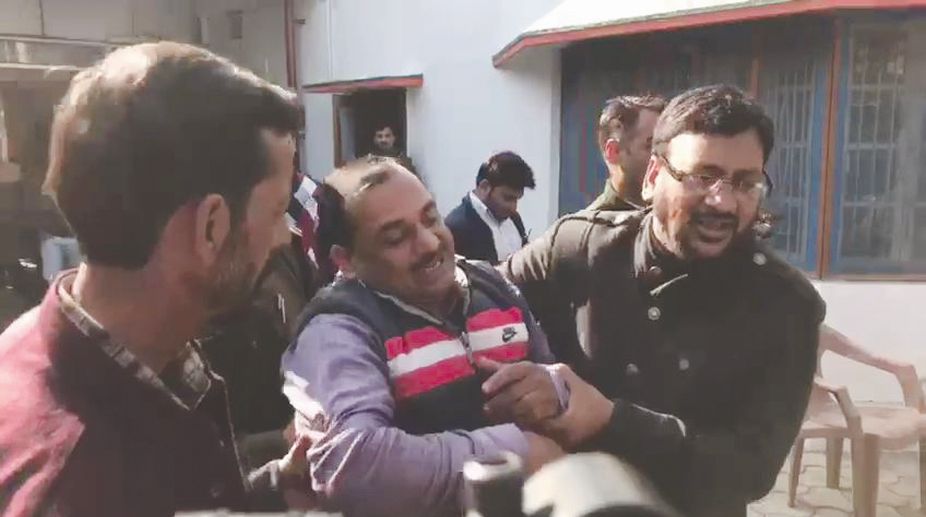
The debt ridden trader who had consumed poison before entering BJP office last week, died during treatment at a hospital in Dehradun on Tuesday. Transporter Prakash Pandey from Tanakpur, in district Haldwani, took the extreme effort after facing deep financial crises.

The trader was getting treatment at Max Hospital in Dehradun, where he breathed his last. Expressing pain over the death, Uttarakhand Chief Minister Trivendra Singh Rawat said, “The state government provided best medical treatment. Every possible effort was made to save his life.”

A new video of transporter Prakash Pandey has surfaced in the hill state. The video made minutes after consuming poison, the businessman claims he has consumed poison and there is no chance of his survival. He even says that BJP won because of Narendra Modi and the saffron party should not have come to power. Pandey praised Congress in last video sent to one of his friends.

Large number of Congress leaders gathered at the Max Hospital in Dehradun on Tuesday. Uttarakhand Congress president Pritam Singh said, “Prakash Pandey died because of GST and demonetization. It was a political murder. I demand the state government to provide compensation to the affected family.”

Prakash Pandey consumed before attending the ‘Janta Durbar’ of state agriculture minister Subodh Uniyal at the state BJP office here on 6 January. While interacting with the agriculture minister, the transporter accusing all the BJP leaders and claimed that he had come here by consuming poison. The minister was taken by surprise and asked police and other BJP members to take the person to hospital.

While police and other persons were taking the debt-ridden businessman to hospital he fainted inside the BJP office campus. Pandey was rushed to the state government run Doon Hospital, from where he was admitted to the Max hospital.
The death had its impact and Chief Minister Trivendra Rawat stayed away from many public function on Tuesday. Not many BJP leaders visited the Max Hospital. Heavy police force was deployed in the hospital. The postmortem of the trader was conducted at Max under the supervision of the Chief Medical Office by government doctors.
Close friends of Prakash Pandey claimed that the state government was not clearing Rs 50 lakh payment of the transporter. Which instigated the trader to end his life in a tragic way.

Bindal unanimous choice for Speaker in HP Assembly

Statesman News Service | Dharamshala |

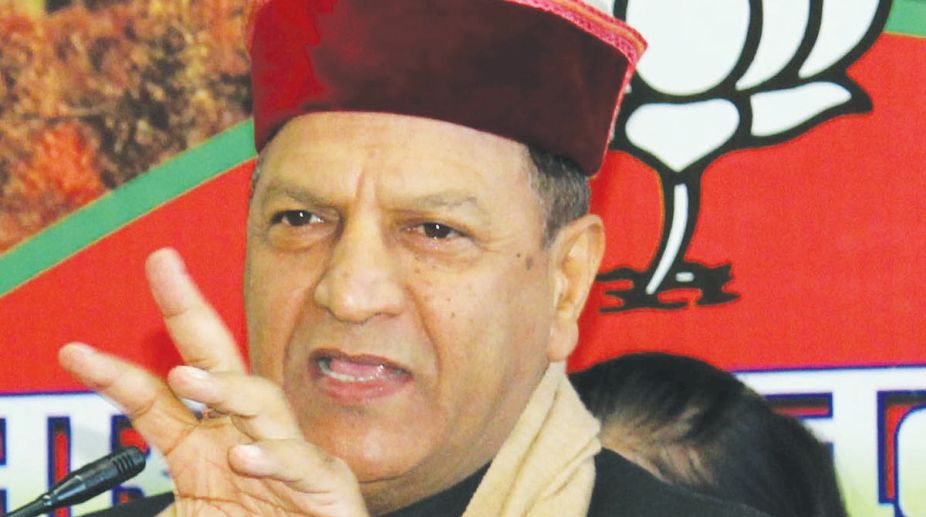
Stage is set for the unanimous election of five-time Bharatiya Janata Party (BJP) MLA in a row and former minister from Sirmaur, Rajeev Bindal, 62, as the Speaker of the 13th Himachal Pradesh Assembly on Wednesday.

The Opposition Congress, which has a strength of 21 MLAs, too, has extended support to Bindal.

Secretary Vidhan Sabha informed that four nomination papers in all have been filed for Speaker’s candidature, and all the four are for Rajeev Bindal.

He said the first nomination paper was filed by Chief Minister, Jai Ram Thakur, which was seconded by Education minister, Suresh Bhardwaj.

The second nomination paper was filed by the Congress Legislature Party leader, MukeshAgnihotri, which was seconded by former CM, Virbhadra Singh.
The other two nomination papers for Bindal’s candidature were filed by IPH minister, Mahender Singh Thakur and Health minister, VipinParmar.

The Speaker’s election is listed in the Assembly session on Wednesday.

Bindal, who will don the coveted Speaker’s chair, two days ahead of his birthday on 12 January, is known for his organising skills and administrative capacities. He was health and family welfare minister in the Dhumal government from 2007 to 2012 and is credited with major policy changes in the health sector for common people.Bindal has a strong RashtriyaSwayamsevakSangh (RSS) background.

He represented Solan Assembly seat thrice and had to shift to Nahan in Sirmaur district in 2012 when Solan was reserved.

He has registered two consecutive wins in Nahan in 2012 and 2017.

2 terrorists killed in encounter

Statesman News Service | Jammu |

Two terrorists were killed in an encounter with security forces on Tuesday in the Larnu forest area of Kokernag in South Kashmir’s Anantnag district.

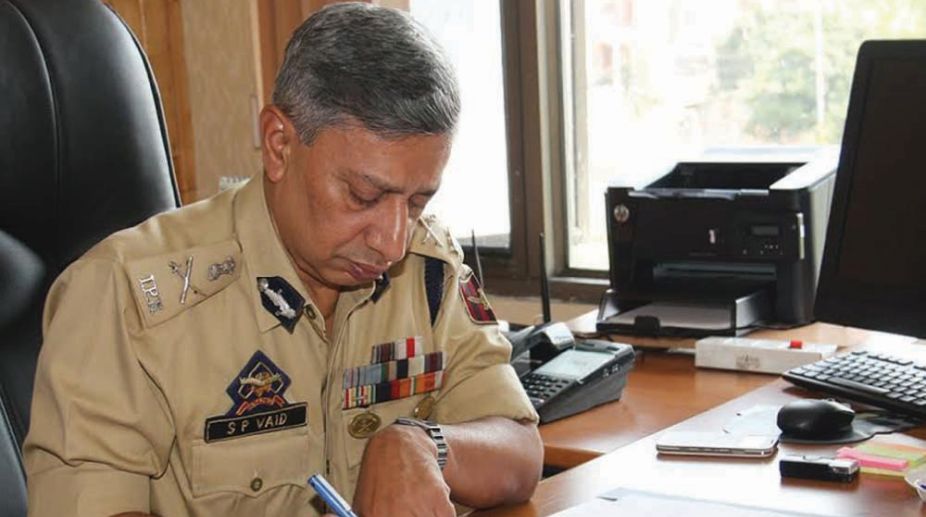
J&K DGP SP Vaid confirmed that two terrorists have been killed and the encounter was continuing.The security forces had on Monday killed a terrorist in the Chadoora area of Budgam district.
An Army spokesman said that the exchange of fire began this morning after a joint team of the Army, CRPF and police launched a cordon and search operation following intelligence inputs about presence of the militants at Larnu. The cordon and search turned into an encounter as the terrorists fired at the security forces.

Himachal to constitute committee on zero budget natural farming

Statesman News Service | Shimla |

Himachal Pradesh Governor Acharya Devvrat on Tuesday said a committee would be setup at the state level that will give its report after study on zero budget natural farming. After a meeting with senior scientists of Chaudhary Sarwan Kumar Agriculture University at Palampur in Kangra district, he said the recommendation of the committee will be followed so that HP becomes natural farming state in the country within next four years.

“Role of Agriculture University Palampur would be crucial in this field to carry forward the critical reform in agriculture sector,” he said.

He appreciated the efforts of scientists of Agriculture University Palampur in the field of natural farming and urged that they should take lead to make HP natural farming state after Sikkim. He asked them to extend missionary support to this project.

Acharya Devvrat said the past practice of chemical farming and organic farming was not fit in present context.”As far as chemical farming is concerned, the products so produced are harmful and poisonous and is also costly. Similarly, cost of production in organic farming is high and it absorbs more essential nutrients from soil,” he said, adding, therefore, zero budget natural farming is the best alternative for farming.

He said the side effects of chemical farming could be dealt with natural farming.

Mardi takes over as new Himachal DGP

Statesman News Service | Shimla |

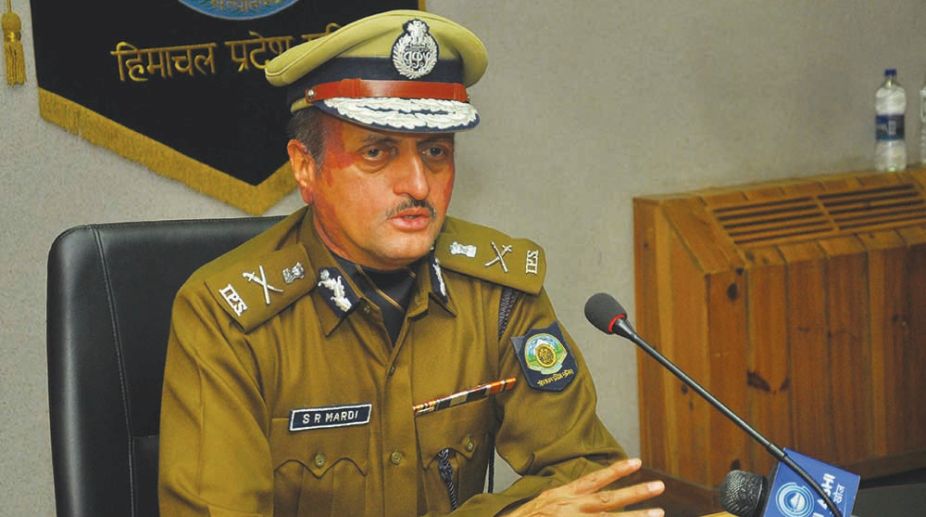
A 1986 batch Indian Police Service (IPS) officer, Sita Ram Mardi on Tuesday took over as the new Director General of Police (DGP) Himachal Pradesh.

While addressing media, Mardi said he would try to find out shortcomings in Police department and correct these during his tenure. “Police functioning would be made accessible to all and we will try to root out all evils from the state, including drug and mining mafia,” he said.

ardi was earlier holding the charge of DGP (Home Guard and Civil Defence) and he would SomeshGoyal, who would now hold the charge of DGP (Prisons and Correctional Services).In his 32-year career, Mardi has served in various positions, including as the Superintendent of Police, Shimla, Hamirpur and Kinnaur, Deputy Inspector General, Southern Range, DIG and IG, Vigilance, IG and additional DGP (Law and Order), ADGP (Law and order and CID) and DGP (Prisons).

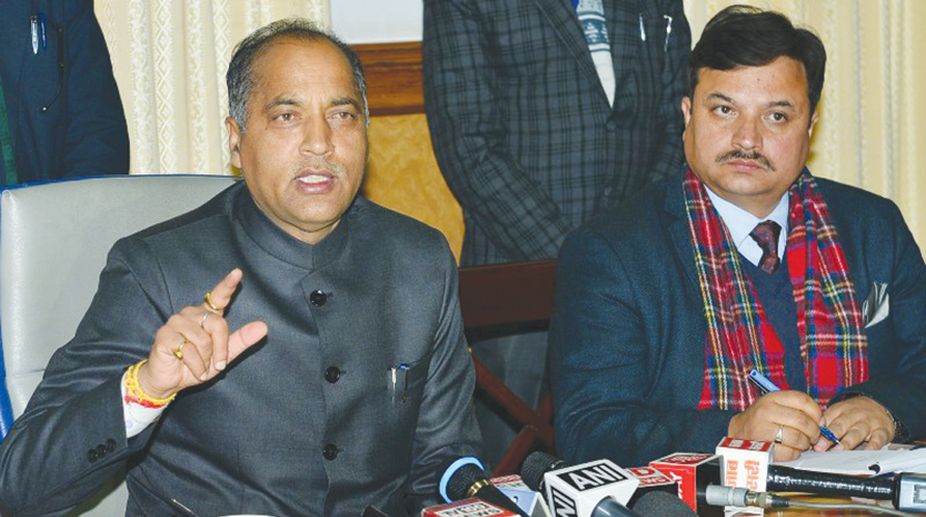
Generational change in HP politics is positive sign: CM

Statesman News Service | Dharamshala |

Himachal Pradesh Chief Minister, Jai Ram Thakur on Tuesday said there was a generational change in state politics this time.

“After the new BJP has taken over, even the Opposition party Congress has brought younger leadership to lead the Congress Legislature Party which is a good sign,” he said.

Talking to mediapersons briefly after the MLAs took oath in state Assembly here, Thakur patted his own back and appreciated the Central BJP leadership for formation of a balanced Council of ministers, with both experience and fresh faces in it.

“We will try to come up to the expectations of people. We will work with honesty. Our priority now is clean governance and zero tolerance to corruption,” he said.

Thakur, who has gone for major administrative reshuffle after he took oath, especially on the top positions of administrative and Police heads, did not link the reshuffle with any issues and said, “It is a natural process in the new government.”

He, however, categorically said the law and order situation was a matter of concern for the people of HP. “Somewhere there is a question mark on the functioning of the Police in HP. We will try and restore the faith of people on Police,” he said.

He said steps would be taken to curb crime against women and a special cell would be created to look into these cases in the three Ranges of Police, on priority.

He said the government will have 24X7 help lines in the name of Hoshiar Singh (who died under mysterious circumstances in Mandi district last year) and Guriya would be launched with strict monitoring on the action taken report by the Chief Minister’s Office.

Thakur strictly said the acchey dins are over for the mafias, whether drug or mining. “Himachal may be better compared with other states. But our younger generation is getting involved in drug abuse in different parts of the state and it is a matter of serious concern. We will work out a strategy to check this tendency,” he said.

Asked about whether he would continue with the tradition of winter stay in lower parts of the state, he said, “The Congress governments in the past have set up some traditions. Although I feel that it’s not about winters only, the CM should visit the entire state throughout the year. We will see. Sometimes, we have to keep with the sentiments of the people,” he said.

Thakur said the BJP government will look into the charge sheet submitted by the party previously, while in Opposition, against the then Congress government. “But let me make it clear that we will not work with vendetta or revengeful attitude,” he said.Thakur said the unemployment allowance was not the solution to unemployment problem in the state and the government would rather work out a policy for better employment opportunities for the youth.