Logo

Think Again

Statesman News Service |

There&’s little you can hide from them
IS a dog sensitive to your emotions? Or is it just a coincidence that he seeks you out when you are emotionally distressed? Plenty of pet owners are comforted by a pair of puppy-dog eyes or a lick of the tongue when their dog catches them crying. Now, research suggests that dogs really do respond uniquely to tears.
Dr  Deborah Custance and Jennifer Mayer of the Department of Psychology at the University of London Goldsmiths College, developed a procedure in 2012 to examine if domestic dogs could identify and respond to emotional states in humans. In their finding, published in the journal Animal Cognition, 18 pet dogs of different ages and breeds were exposed to four separate 20-second scenes in which either the dog&’s owner or an unfamiliar person pretended to cry, hummed in an odd manner, or carried out a casual conversation.
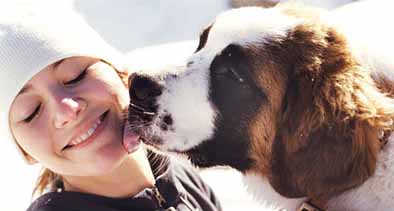
The dogs responded in a way that made it quite clear that they knew the difference and they knew which human was in trouble. Significantly, more dogs looked at, approached and touched the crying humans. They nuzzled and licked the person, the canine version of “there, there”. Some went to the odd-humming ones. No dogs responded to the talking ones. The dogs approached the crying person in a submissive manner consistent with empathic concern and comfort-offering.
The humming was added because it was new to the dogs and the researchers wanted to gauge whether the dogs were motivated by curiosity at the noise or whether they understood human distress. The experiments proved “the crying carried greater emotional meaning for the dogs and provoked a stronger overall response than either humming or talking”.
The study also found that the dogs responded to the person who was crying, regardless of whether it was their owner or a stranger: Initially, it was thought that dogs would respond only to their owners. According to the researchers, “No such preference was found. The dogs approached whoever was crying, regardless of their identity. Thus they were responding to the person&’s emotion, not their own needs, which is suggestive of comfort-offering behaviour without discriminating among familiar and unfamiliar people.”
In another study, researchers at the University of Otago, New Zealand, put 90 dogs through their paces — showing some recorded images of babies laughing, crying and babbling. Professor Ted Ruffman said the dogs’ responses indicated that they could understand, they could tell the difference between a happy and an angry person, and a laugh from a cry. He said dogs that saw the crying baby searched behind the television screen to “find” the baby, cocked their heads and expressed concern.
That dogs can understand us is something that every dog owner knows. They have been bred over centuries to be companions in every way to humans. Are they sensitive to our moods? Look at the phenomenon of yawning: if a human yawns, so does a dog.
Almost every dog owner has found out that when they are really sad, their dogs act differently toward them. A dog may approach its disturbed owner with a concerned look and, quite out of character, hunker down next to him/her as if to provide some emotional support. It is as if they are saying, “I know there&’s something wrong, I don’t know what it is but I’m here for you, anyway.”
Many dogs slink away and hide or sulk when their human “parents” argue. A major fight between adults really seems to take its toll on some dogs. It appears from the dog&’s behaviour that he understands discord and does not want to be around it. Of course, it can be argued that raised voices might drive the dog away, but there are dogs that fret even when their owners purposely keep their voices low. It&’s almost as if you can’t hide anything from a dog.
If an owner comes home and finds the home trashed by his/her dog, the guilty party will often be found hiding, perhaps with a hangdog look. Owners believe their dogs are feeling guilty about what they have done. If you accept the guilt explanation, you must also accept that the dog is able to understand your feelings of disappointment or anger.
In another study done on 84 dogs and published in Animal Cognition in February 2013, Dr Juliane Kaminski, of the University of Portsmouth&’s Department of Psychology, has shown that when a human forbids a dog from taking food, the dog is four times more likely to disobey in a dark room than a lit room, suggesting they take into account what the human can or cannot see. The study shows dogs understand that humans can’t see them, meaning they understand the human perspective and realise that it is safer to steal food in the dark.
Can dogs read emotion on human faces? When people look at a new face, their eyes tend to wander left, falling on the right hand side of the person&’s face first.
This “left gaze bias” only occurs when we encounter faces, and does not apply any other time, such as when inspecting animals or inanimate objects. A possible reason for the tendency is that the right side of the human face is better at expressing emotional states. Researchers at the University of Lincoln have now shown that pet dogs also exhibit “left gaze bias”, but only when looking at human faces.
The more tests that take place, the more we realise that dogs are like humans. It seems odd that so many people want to be mean to them.

To join the animal welfare movement contact gandhim@nic.in, www.peopleforanimalsindia.org
 

Country Notebook

Statesman News Service |

Serpentology
m krishnan

THERE are other breeds of venomous serpents besides the cobra, some with looks more arresting or venom more potent. The thick, squat-headed Russell&’s viper, blotched with heavy black rings, has always struck me as a more formidable-looking snake – one look at it and you know at once that it is virulent, just as you know by looking at them that some people are cantankerous — and though normally sluggish it can move like lightning when it wants to. The saw-scaled viper is smaller and less vivid, but not less venomous. And the modest, deadly Southern krait is more at home in human dwellings than the cobra and much more poisonous. But it is the cobra that has captured human imagination and compelled worship from time immemorial.

Motive of fear
Psychology, however Freudian, may not tell why this snake should have been preferred above all others for worship, but I think I can. Of course, the motive of fear is there, and the deeply dimly-felt urge to placate that which is feared, possibly there is psychological significance in snake-worship being connected with the concept of fertility. But all this does not explain the choice of the cobra. The belligerent territorial feelings of this snake, its intelligence and readiness to live at peace with humanity, are the bases, I think, of the real explanation.
Cobras get attached to their grounds and will challenge intruders — and their hissing, spread-hooded challenge can be impressive! When they have long had the run of a disused house, they will dispute the right of humans to occupy it again. I have been assured that if treated with firm kindness they will retreat to a far corner of the compound and give up their claim to the house — that the right thing to do, in the circumstances, is to offer them milk and burn camphor in their presence (burning camphor does seem to discourage them considerably) — but on the one occasion I had to reclaim a cobra-haunted house I slew my co-tenants, out of fear.

Temple guardian
In a celebrated temple at Kerala, where the worshippers enter barefooted (as in all temples) the ground literally crawls with cobras, but I believe no one has been bitten so far. I can attest, from personal knowledge, to a much less impressive instance of the willingness of these useful snakes to live and let live. For years I knew a Siva temple beside a main road, which had its resident cobra. I have sometimes seen the snake on the roadside, a few yards away, and have slowed my steps to admire its handsome repose; many others have seen and admired it likewise. One felt no tear at all then, in spite of its splendid proportions and proximity, it was only the temple cobra, it belonged there and had been there for years without doing anyone harm. I have entered the temple when its guardian lay close by the pathway. At times, it moved away and at times it was apathetic to the humans on the road. In September 1953, I revisited this temple and learned, to my sincere regret, that the snake was no longer to be seen, having been killed by some natural enemy, presumably.
In many parts of rural India where snakes are common, snake-worship is equally common and one can see many wayside shrines. These may be quite elementary, a slab of stone bearing the incised figure of a cobra stuck in the ground beneath a tree, or may be a stone palisade around a peepul featuring carved snakes. However, I have seen serpentine figures of considerable finish and beauty at such wayside shrines, intertwined snakes and many-headed cobras carved with much skill and sometimes, instead of cobras, superbly rhythmic figures of Nagas and Naginis — perhaps these belonged, originally, to temple ruins nearby famous for their classical richness.
It is amazing how quickly and unquestioningly these images are accepted in the countryside. Once I had a very fine Nagini removed from her obscure hiding place and publicly installed along with a few “snake stones” in the dreary compound of a courthouse, of which I was the presiding authority. I was surprised and delighted to find my court popular within the week, its compound meticulously maintained by all visitors, including the handful of litigants who had business with me, and my “honour” infinitely secondary in presiding authority.

Naga-folk
These fascinating snake-people, semi-human and subterranean inspir many folk legends, tales and mythological dramas in the South — I dare say, even in the North sometimes, in these stories, they are cobras which can assume human form at will and sometimes they are semi-serpentine Naga-folk. Often they are presented sympathetically, not at all as dreadful figures — in fact, I know authentic folktales where it is the wholly human characters that betray the trusting serpents. It is a feature of these legendary snake-people that the very mention of the word “Garuda” terrifies them. The “Garuda” is the “vahana” of Vishnu and a traditional killer of snakes; the name is specifically used in Tamil to denote the Brahminy Kite (which occasionally does kill small snakes, mainly water snakes) but no doubt it also connotes a number of powerful eagles and hawk-eagles which can and do kill large serpents.
As a tailpiece to this note I may mention a popular saying based on this traditional snake dread of the “Garuda” — my rendering is from a Sanskrit stanza, but the saying in a compressed, pithy form is common to many Indian tongues
Do not associate with the
lowly.
If you must, with the mighty
make friends
For the great cobra, having
God&’s protection,
Enquired fondly about the
Garuda&’s health.

This was first published on 8 August 1954  in The Sunday Statesman

Antony calls for closer Sino-India military ties

Editorial Team |

Press Trust of India
BEIJING, 6 JULY: Calling for closer military ties between India and China, Defence Minister A K Antony today said: “If the military leadership on both sides from the top to the ground formations can maintain both trust and mutual respect, and confidence, then it is easy to maintain peace and tranquility at the border areas.” As told to political commissar of National Defence University General Liu Yazhou.
Antony visited the academy of People’s Liberation Army here today on the second day of his official visit.
During the meeting, the defence minister and Mr Liu agreed to enhance military exchanges between the two countries.
Mr Antony yesterday held wide-ranging discussions with Chinese Premier Li Keqiang and Defence Minister General Cheng Wanquan on a host of issues including maintaining peace and tranquility at the borders.
In his interaction with Mr Liu, Mr Antony recalled his meeting with Premier Li and Gen. Cheng.
“India and China are close neighbours. Our relations are expanding in many areas,” he said, adding that he had a detailed discussions with the Chinese leadership on bilateral ties.
“Both sides are and have clear consensus that we must maintain peace tranquility and stability at our borders. In that endeavour military-to-military cooperation is an important aspect,” he said.
Accompanied by a high-powered delegation consisting of top officials from Indian Army, Navy and Air Force, Mr Antony went round the sprawling 15,000 square meters varsity campus evincing keen interest in China’s defence forces’ training programmes for the officers of all its three forces.
Officials said Mr Antony had expressed interest to visit the top military academy to study the Chinese pattern as India has recently launched its National Defence University in New Delhi which was expected to be ready in the next few years. Indian officials said that efforts are on currently to evolve combined training programmes for all the forces.

Celebrations as Dalai Lama turns 78

Statesman News Service |

Indo-Asian News Service
DHARAMSALA/BYLAKUPPE, 6 JULY: Thousands of Tibetan exiles assembled on today morning, in Dharamsala and Bylakuppe to celebrate the 78th birthday of their spiritual leader the Dalai Lama.
"Exiles, monks and well-wishers are joining the birthday celebrations. Prayers for the well-being and long life of our spiritual leader began," an official of the Dalai Lama’s office said in Dharamsala, the headquarters of the Tibetan government-in-exile.
He said the Dalai Lama would be participating in functions in Bylakuppe, one of the largest settlements of the exiles in India.
Special prayers began at the hilltop Tsuglagkhang temple close to the official palace of the Dalai Lama at McLeodganj near Dharamsala.
Born on 6 July, 1935 at Taktser hamlet in northeastern Tibet, the Dalai Lama was recognised at the age of two as the reincarnation of the 13th Dalai Lama Thubten Gyatso. He fled Tibet after a failed uprising against Chinese rule in 1959, basing his Tibetan government-in-exile here.
He was awarded the Nobel Peace prize in 1989 for his non-violent campaign for democracy and freedom in his homeland. Ever since he fled to India, he has spent his time in exile pushing for autonomy for Tibet.
The 14th Dalai Lama, Tenzin Gyatso, has been following a "middle-path" policy that seeks "greater autonomy" for Tibetans rather than complete independence.
The Dalai Lama has increasingly voiced his frustration with the ongoing self-immolations in Tibet and said, "these drastic actions are the symptom of a cause, which the Chinese authorities should investigate and take steps to resolve".

Two Koreas hold rare talks on joint zone

Statesman News Service |

Agence France-Presse
SEOUL, 6 JULY: North and South Korea held rare talks today on re-opening a joint industrial zone seen as the last remaining symbol of cross-border reconciliation.
The talks ~ delayed by nearly two hours ~ follow months of friction and threats of war by Pyongyang after its February nuclear test attracted tougher UN sanctions, further squeezing its struggling economy.
Kaesong was the most high-profile casualty of the elevated tensions on the Korean peninsula but neither side has declared the complex officially closed, instead referring to a temporary shutdown.
Both nations say they want to re-open the Seoul-funded industrial zone on the North Korean side of the border but blame each other for its suspension.
“There are a multitude of issues to discuss but the issue of preventing damage to facilities from monsoon rains should take precedence”, the North’s chief delegate Pak Chol-Su was quoted as saying at the start of the meeting by a press pool report.
His South Korean counterpart and senior Unification Ministry official, Suh Ho, said: “We’ve come here with a heavy heart as the Kaesong industrial zone has been shuttered down. I hope we settle the issue through mutual trust and cooperation.”
Pyongyang, citing military tensions and the South’s hostility toward the North, in April withdrew its 53,000 workers from the 123 Seoul-owned factories at the Kaesong park.
Until then the industrial park ~ a valuable source of hard currency for the impoverished North ~ had proved remarkably resilient to the regular upheavals in inter-Korean relations.
Technical problems delayed the start of the talks at the border truce village of Panmunjom today as telephone lines to the South needed repairs, the unification ministry in Seoul said.
Seoul is expected to call for a written guarantee aimed at preventing a recurrence of the unilateral shutdown, a demand which the North would find it hard to accept as it would amount to Pyongyang swallowing its pride and accepting full responsibility for the suspension.
On the agenda are issues of checking on mothballed factory facilities and equipment, moving finished products and raw materials held up at Kaesong to the South and the reopening of the zone.
At an access road to Panmunjom, Suh encountered a group of businessmen with plants in Kaesong. They carried banners expressing hope that the talks would be successful. One read: “We want to work again. Restart Kaesong.”

Food ordinance promulgated

Statesman News Service |

President gives assent to order, Opp criticises govt move
STATESMAN NEWS SERVICE
New Delhi, 5 July
Two days after the Union Cabinet cleared the National Food Security Ordinance, the President of India, Mr Pranab Mukherjee today gave his assent to it, even as the ruling Congress went all out to showcase this “historic” welfare measure as the “world’s biggest public food security law” that is set to become the party’s showpiece, “game-changer” issue in the coming general elections. 
Barely three weeks before the normal resumption of the monsoon session of Parliament, the Congress-led UPA government went ahead to take the ordinance route, in the teeth of fierce protests from the Opposition, to give effect to the legislation.  The legislation seeks to provide legal entitlement to 67 per cent of the country’s 1.2 billion population ~ 75 per cent in rural and 50 per cent in urban India ~ to get 5 kg of foodgrains, rice, wheat and coarse grains, per person every month at highly subsidised rates of Rs 3, 2, 1 respectively through ration shops. 
About 2.43 crore poorest of the poor families covered under the Antyodaya Anna Yojana scheme under the PDS would also get legal entitlement to 35 kg of foodgrains per family per month. 
The Opposition, including the BJP and the SP, have cried foul, questioning the government’s “tearing hurry” in adopting the ordinance route just ahead of a Parliament session, and describing it as a “political gimmick with a clear eye on the coming Lok Sabha elections”.  
Rejecting such allegations, the Congress general secretary Mr Ajay Maken, accompanied by the food minister Mr K V Thomas, told media persons at their party’s headquarters here that the Opposition’s “persistent disruption of Parliament” and its “stonewalling of the Food Security Bill in the last session” had left the government with “no option” but to press ahead with such a crucial social welfare intervention in “larger public interest”. 
Mr Maken dismissed the charge that the Congress was eyeing early Lok Sabha elections after clearing the “populist” food security legislation. He claimed it was not linked to elections, asserting that it was part of the Congress manifesto for the 2009 Lok Sabha elections and a “dream of the Congress president Mrs Sonia Gandhi, the vice-president Mr Rahul Gandhi and the Prime Minister Mr Manmohan Singh” which, he added, has “now come true”.   
Both Mr Maken and Mr Thomas gave a chronology of the food legislation’s progress through executive and legislative domains over the past four years, maintaining that the states, which are required to identify the beneficiaries and implement this law, had all along kept in the loop. A six-month period has been provided for implementation of the legislation in states. 
“This legislation is aimed at ensuring food security for 81 crore poor and aam aadmi (common person) across the country, it will help fight hunger and malnutrition, benefit women and children…With this we are fulfilling our key manifesto pledge, so obviously when we go to the people (in coming polls) they will be able to judge our credibility and performance,” said Mr Maken. The Congress tried to refute the Opposition’s charge that it had bypassed Parliament and had shown “contempt” to it. 
The ordinance will be placed before Parliament when it meets soon for its monsoon session, and will get replaced by a regular law. From the reassembly of Parliament, an ordinance ceases to operate at the “expiration of six weeks.’’

Sudipto, aide produced before Siliguri ACJM

Statesman News Service |

statesman news service
Siliguri, 5 July
The prime accused in Saradha Group default case, Mr Sudipto Sen and Ms Debjani Mukherjee were produced before the Siliguri additional chief judicial magistrate (ACJM) court today. The court remanded them in jail custody for 14 days.
Mr Sen and Ms Mukherjee were produced before the ACJM, Dr Madhumita Basu. A resident of Siliguri, Ms Uma Pal Majumdar, had lodged a complaint against the Saradha Group at Siliguri police station on 22 April, stating that she had deposited Rs 1 lakh in January with the group, expecting the assured sum of Rs 1.23 lakhs in six months.
“Both  were produced in the court in connection with a case lodged at Siliguri police station. The duo has been remanded in jail custody for 14 days. The court has also ordered that police can grill them in the Siliguri Special Correctional Home," said the assistant public prosecutor, Mr Sudip Roy Basunia.
Tension gripped the Siliguri court premises as over a hundred Saradha agents and depositors thronged the place. They demanded back their hard-earned money.
“They were using invectives and we apprehended that they would pounce upon the duo. We were alert and so nothing untoward happened,” said a police official. 
Ms Marzina Begam, an agent, said her life had been ruined. "There are around 40 people working under me. I had invested around Rs 10 lakh and altogether, I had raised around Rs 10 crore. I still receive threats from the investors. I am the lone earner of my family. I want our money to be returned or Sudipto Sen be hanged, “she said.
An investor, Mr Bikash Kumar Joardar, said he had invested around Rs 5 lakh. "I know I would not get back my money, but today I have come here to vent my anger,” he added.

TMC demands extra hour’s polling for Ramzan fasters

Statesman News Service |

statesman news service
Siliguri, 5 July
The Trinamul leadership in north Bengal approached its state leadership so that the state government&’s initiative for extra voting time, at least an hour at dawn, to facilitate minority people who will observe Ramzan fasting during rural polls in the fourth and fifth phase.
At a time when the state Left Front leadership has decided to appeal to the state and state election commission to start the time of voting from 7 a.m. to 6 a.m., keeping the total duration of voting time intact, the Trinamul Congress leadership here has demanded extra time. 
The present polling schedule is 7 a.m. to 5 p.m. The LF&’s proposal is 6 a.m. to 4 p.m.
But the Cooch Behar district Trinamul Congress president, Mr Rabindranath Ghosh, said: “We requested to our state leadership over phone today to demand an extra time for an hour at dawn for the people belonging to the minority community. We are demanding extra time for an hour for the people, who will observe fasting during holy Ramzan month, particularly in Murshidabad, Malda and adjoining districts, including some districts of north Bengal like Cooch Behar where more than 30 per cent people will observe fasting.”
According to the Trinamul leadership in Jalpaiguri, the state leadership has not yet conveyed instructions regarding the rural polls and on how to deal with the people, who will observe fasting, at the polling stations.
However, Mr Ghosh said: “We have already instructed all our party workers to request the elderly people, belonging to the minority community, to come to the polling stations early in the morning.”
“We have also asked party workers and supporters to line up at polling stations on time. Party workers and supporters will sacrifice their positions to accommodate voters, who will observe fasting,” he also said.
“We have also planned to arrange some foodstuff like puffed rice, chickpea, molasses, dates and water near the polling stations so that minority voters waiting for a long queue can break their fast,” said Mr Ghosh adding, “A section of people come to polling stations in the later half of the day.”
The political leaders belonging to other parties think that the state election commission should formulate specific guidelines regarding queue system in front of the polling stations.
Even the administrative officials suspect that the situation may turn chaotic if all political party activists try to facilitate those people competing with others.

GNLF threatens retaliation if GJMM ‘fascism’ continues

Statesman News Service |

statesman news service
Kurseong, 5 July
The GNLF leadership based in Kurseong threatened that they would pay the GJMM back in their own coin if the preponderant party of the Hills continues with their strategy of muscle-flexing vis-à-vis the Opposition.
Mocking at the GJMM&’s avowing by the canons of Gandhism, a senior leader of Subash Ghising&’s party said they would also practice the same variety of Gandhian non-violence the GJMM has been doing and would not hesitate to retaliate. “We know how to reciprocate attack with attack,” the GNLF leader said.
He further said that his party had never disturbed the GJMM rallies or meetings since the GJMM emerged in 2008. “We initially supported them as the goal of both the parties was the same ~ Gorkhaland. But later, when they betrayed the paramount aspiration of the people and accepted GTA which is unconstitutional, we have revived the demand for the 6th Schedule status for the Hills as this is the best option for the Hills presently,” he added.
The GNLF leader further said the GJMM activists have not just assaulted them but have ransacked and torched their residences at several places. “And they have been doing this in the name of the Gandhian postulates of non-violence. But ours is a party wedded to democracy. However, things are going beyond the threshold of tolerance,” he added.
The GNLF spokesperson, Mr Daya Dewan, said their party is not as powerful as it formerly used to be.
“However, things are looking up for us now, as the GJMM has let the people down,” he said.
“People disenchanted with the GJMM are swarming back to our party which they think as the only credible platform left in the Hills,” he added.

BUDGET exercise going for a toss

Statesman News Service |

soma mookherjee
soma@thestatesman.net

Kolkata, 5 July:
The state is going to be in the grip of financial uncertainty because of the panchayat poll schedule which has put the state’s Budgetary exercise virtually in the doldrums.
In April, the state finance minister Amit Mitra passed a vote-on-accounts for four months till June as the ruling party had no clue about when the panchayat poll would be held. But, now that the five-phase rural poll will continue from 11 July to 25 July, departmental Budgets can’t be passed in the House till the poll process is over, while different departments are to face financial constraints, state parliamentary affairs minister Partha Chatterjee said today.  The state government is really in a fix after the state election commission today "unilaterally" declared that counting of votes of the rural poll would take place on 29 July, Speaker of the state Assembly Biman Banerjee said.
He told The Statesman: “We thought the SEC would fix the date of counting on 27 or 28 July in which case I could convene the House on 29 July and pass some departmental Budgets from 29 to 31 July.”
“But as the SEC has fixed the day for counting on 29 July, it will be impossible for me to summon the House in the last two days of the month and pass the departmental Budgets,” the Speaker said.
The session can’t be convened before the commencement of the rural poll, Mr Banerjee said, since it would be a futile exercise with most of the MLAs except those from the city busy with campaign.
He also said the finance minister hadn’t informed him whether he would seek another vote-on-account for the next four months, so that the state government has adequate time to pass the departmental Budgets.

Apt of the times

Statesman News Service |

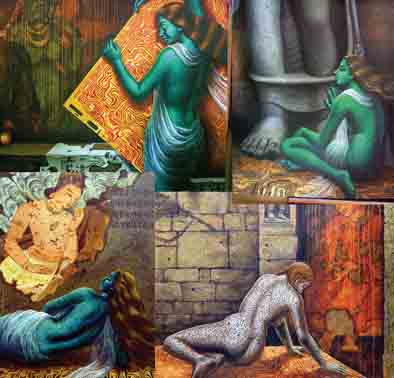
AARKRITI Art Gallery is currently holding an exhibition of Dipak Kundu&’s array of paintings on tales of love, life, divinity and death. A closer look would inform one of a borrowing from Eros and Thanatos, theorised by Sigmund Freud at the beginning of the 20th century who tried creating the same essence and whose work is surely intriguing – a face-to-face interaction with the human instinct of life, love and sexuality on one hand and death and aggression on the other.
The combination of the two as a reflection of each other makes Kundu&’s acrylic works “a breeding space of the human psyche exploring the dichotomy of male-female relationship in its different dimensions”. The figurative and semi-figurative elements form an imagery and are inter-related, one image standing “as the reflection of the other in a symbolic way”. The artist uses his skill, knowledge and wisdom to portray the social construct of the “Yin and Yang concept”, transcending the limitations bound by the societal code of conduct. He rather elevates the human erotic urge to the plane of “divine union”, where the broader message expressed is of the mystification of “true love” bound by no worldly or materialistic forms.
Tales from Indian mythology, epics and folklore acquire the basis of dealing with the narrative that eventually is built up in Kundu&’s tales. The indigenous aspect of his paintings, both in content and in treatment, make them more identical to the audience as well as more apt of their times.
Kundu is a professional painter who has postgraduated in fine arts from Rabindra Bharati University, Kolkata, and has showcased his works across India and abroad.
The exhibition is on till 27 July
db

‘I’m all for very different roles in every film’

Statesman News Service |

After Cannes, it&’s Toronto for Rituparna Sengupta. In conversation with shoma a chatterji, she gives her take on contemporary Bengal cinema
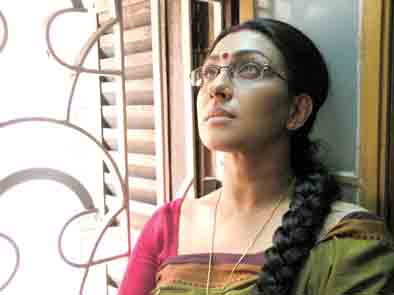
RITUPARNA Sengupta, the numero uno among actresses and stars in contemporary Bengali cinema, has pushed the envelope and walked the red carpet at Cannes earlier this year. As this goes into print, she will be in Toronto for the opening of her film, Mukti, directed by Reshmi Mitra and slated to release in India in August. Rituparna is currently doing mainstream films with out-of-the-box themes and storylines with veteran directors, contemporary directors and new directors. But let us hear this from the star herself. Excerpts:
– What was your first Cannes experience like?
Mind-blowing. One of my films I am looking forward to, Alikh Sukh, had a market screening in Riviera 1, a respectable venue inside the Palais de Festivals. Cannes is soaked in cinema, screens the most outstanding films in the world and is attended by some of the greatest international names gracing cinema today. Alongside Vidya Balan, the Indian member, the International Jury comprised names like Steven Spielberg, Ang Lee, Nicole Kidman and Christopher Waltz. The Bombay Talkies team invited me to their dinner party.
– Let us have a few details about Alik Sukh.
The screening drew a very positive response from the audience. Alikh Sukh is based on a Suchitra Bhattacharya novel and has been jointly directed by Shiboprosad Mukherjee and Nandita Roy. It is a socially and morally uplifting story that questions the ethics of a doctor who is torn between the responsibility of his profession on the one hand and the lure of money on the other. I play his wife, who is a strongly principled woman. Alikh Sukh is the first Bengali film in years to get a market screening.
– You are doing out-of-the-box roles in every film you appear in. Let us hear about some of them.
At this stage of my career, I do not wish to do run-of-the-mill films with boy-meets-girl storylines. So I am all for very different roles in every single film. Thankfully, my directors are giving me just what I want. In A Political Murder, directed by Agnidev Chatterjee, I play a college lecturer who suddenly finds herself trapped in a scam expose that becomes a life-threatening thing. In Raja Sen&’s Khacha, I portray a high-flying corporate woman who lives alone in a posh flat in Kolkata. The script is inspired by what is happening to women in our country. In Kaushik Ganguly&’s Apur Panchali, I play the saviour of a village girl who falls prey to trafficking. I have also done Sudeshna Roy and Abhijit Guha&’s BA Not Out that is a wonderful take on modern marriages. Ready for release is Gautam Sen&’s Jangal Mahal. Reshmi Mitra&’s Mukti will have been screened in Toronto by the time you read this.
– What is your take on contemporary Bengali cinema?
Things are brighter than they ever were for the past three decades, one can say. Bengali cinema is not exclusive to Bengali sentiments and culture but is getting international recognition despite being rooted in its Bengali identity. Bengali cinema today carries appeal also for those who are not Bengali. The market is widening and expanding and there is a rising demand from the international market for Bengali films. Satyajit Ray, Mrinal Sen and Ritwik Ghatak&’s films once brought honour to Cannes. Today, it can make a big breakthrough in the global market while also guaranteeing that the producers get their money back.
– Which actresses do you admire in Western cinema?
Who will I name first? There are so many that one tends to lose count. My choicest pick are names like Meryl Streep, Anne Bancroft, Susan Sarandon and Kate Winslet. But Indian cinema, especially regional cinema, does not provide the space and time to prepare for a single role because we are paid peanuts compared to what they get and cannot afford to take time off from current work just to prepare for a single role in one film. But I see to it that I do not work in more than three films at a time. It crowds my style.

Not with ‘senior’ heroes?

Statesman News Service |

Shraddha Kapoor apparently has courage of conviction, so she fearlessly says what she feels about pairing off with someone not of her age group. But most young actresses who have yet to rise to the top won’t benefit from that lead, writes ac tuli
IF your entry into the film industry as actor is comparatively of recent origin and you’re still to make your mark in order to enter the charmed circle of top stars, you’re of course always wary about what you say to the press lest you make a slip that could harm your career. But this is not what actress Shraddha Kapoor thinks. It appears the young woman has courage of conviction, so she fearlessly says what she feels. She recently signed for Mohit Suri&’s film, Villain, in which her co-star is Siddharth Malhotra. She is reported to have refused to be part of Umesh Shukla&’s next film, in which Abhishek Bachchan is the leading man. Kapoor says she is more interested in working with comparatively young heroes like Siddharth Malhotra, Varun Dhawan, Ayushmaan Khurraana and Ranbir Kapoor than with a “senior” actor like Abhishek Bachchan.
Curiously, if Kapoor thinks the 37-year-old Abhishek Bachchan is a “senior” actor, one wonders what adjective she would use for Bollywood&’s three most popular Khans. Would it be “veterans” or “venerable oldies”? Anyhow, it would be rather unfair to find fault with Kapoor for being so candid about the choice of actors she would like to be paired with in films.
She says she “doesn’t want to tread the same path as other actresses”. By “other actresses” she obviously means Sonakshi Sinha, Asin, Anushka Sharma, Kangana Ranaut and a few more. All of them have been paired with actors almost twice their age. But then one may ask: Is it not a calculated risk for an actress, who is still in the initial stage of her career, to decide to only do films with young but as yet not so well known actors? And especially when she knows that the star system, good or bad, is so firmly entrenched in our film industry that it would be naïve on the part of a new entrant to ignore its power and fascination. Doubtless, a budding starlet benefits if she gets the opportunity to work in a film with a big star and that film becomes a big box office hit.
For instance, Sonakshi Sinha began with Dabangg opposite Salman Khan, who is almost a quarter century older than her. In fact, she was just a one-year-old toddler when Salman Khan made his debut in films with Biwi Ho To Aisee (1988). But her pairing with Salman Khan in Dabangg proved very lucky for her because the film was a superhit of 2010 and Sonakshi achieved star status with her very first venture. Now imagine if she had refused to sign for Dabangg because Salman was a “senior” actor and she preferred to work with someone of her age group. Would she have reached where she is today?
Anushka Sharma&’s debut in Aditya Chopra&’s Rab Ne Bana Di Jodi (2008) opposite Shah Rukh Khan proved a landmark for her. Even though the film was not exactly a smashing box office hit, it gave a big fillip to her budding career as an actress. It was obviously because of Rab Ne Bana Di Jodi that she went on to work in films opposite other big stars of Bollywood. Aditya Chopra was so impressed with her performance that he once againcast her opposite Shah Rukh Khan in his film, Jab Tak Hai Jaan.
What proved a boon for Sonakshi Sinha and Anushka Sharma naturally stood Asin in good stead when she came to work in Hindi films. Her entry commenced with Aamir Khan&’s Ghajini, which was a box office superhit. It was obviously her pairing with Aamir Khan in this film that later paved the way for her pairing with Salman Khan in Ready, also a box office hit. Had she been finicky about the age of “senior” actors and made an off-the-cuff statement that she preferred working with heroes of her own age group, it is doubtful she would ever have emerged from the obscurity of anonymity to live forever in the sunshine of popularity.
Now, whatever we may say in praise of “senior” actors and their charisma, the truth is the truth and it is futile to deny it. It is, of course, natural for an actress of 20-something to feel far more comfortable working with an actor who is of her age group than with a “senior” who might have started acting in films before she was born. Here are a few instances to illustrate the point. Hema Malini was born in 1948 and made her debut with Raj Kapoor in Sapnon Ka Saudagar (1968). Raj Kapoor, born in 1924, made his debut as a hero in Kidar Sharma&’s Neel Kamal, which was released in 1947. Similarly, Kangana Ranaut, born in 1987, has now been paired with Sunny Deol in I Love New Year, which is to be released shortly. Sunny Deol, born in 1956, began his career in films with Betaab, which was released in 1982.
So this younger-heroine-much-older-hero phenomenon is not of recent origin. In fact, it has been the reality of Bollywood right from the inception of talkies in India. For instance, the three top heroes of the ’50s and ’60s — Dilip Kumar, Dev Anand and Raj Kapoor — were often cast opposite actresses much, much younger than they were. Similarly, in the late ’70s and ’80s, Sridevi was perhaps not very comfortable opposite actors like Amitabh Bachchan, Jeetendra, Rajesh Khanna and others who were two decades older than she was. But she was shrewd enough to understand that it was only when she was cast opposite such top actors that she could achieve stardom. And she did.
Similarly, Dharmendra also appeared opposite actresses like Mumtaz, Sharmila Tagore, Asha Parekh, Rekha, Sadhana and others, who were much younger than he was. But what was far more important than Dharmendra&’s age was the box office success of films in which he worked with these young heroines. Most of these films were box office hits that earned mega bucks for their makers.
So, taken all in all, this fuss about “senior” actors is not going to benefit young actresses who have yet to rise to the top. If working with young heroes of their age group appears to them a very comfortable idea, they have to be professional and hard-headed enough to willingly work with “seniors” too when the chance for doing so comes their way.
But when all has been said about stars and their undeniable box office pull, one must concede that Shraddha Kapoor does have a point when she says she is interested in working with young actors rather than with “seniors”. In fact, it is not unnatural for a 20-something actress if she, in her quiet and solitary moments, is slightly perturbed by a passing thought that the man who is romancing her in films could very well have been her father&’s classmate if both of them had lived in the same town and gone to the same school.
 

‘We had to be cautious

Statesman News Service |

suchayan mandal caught up with Shilpa Shukla before the ‘hot’ BA Pass hit theatres
‘A young college boy and a mysterious, married woman embark on an erotic journey that threatens to spiral out of control”: this defines Ajay Bahl&’s upcoming movie, BA Pass (set for a 12 July release). A small town youngster moves to Delhi to stay with his aunt and finish college. He is, soon enough, seduced by this mysterious, married woman who he knows as “Sarika Aunty”. Set amid the neon-lit bylanes of Delhi&’s Paharganj, an erotic human drama unfolds between the two.
As he gets more and more entrenched in his surroundings, he discovers a city that thrives on corrupting even the most naive and innocent. “Sarika Aunty” is played by Shilpa Shukla, dusky diva of B town, and she unwinds on how it all came about. Excerpts:
Your character in the movie…
It&’s basically the story of an unhappily married woman. Her husband has a government job and there is some pain she is hiding. So she seduces a young guy who comes to Delhi for studies. She doesn’t realise that she is doing something wrong because it&’s the circumstances that force her to do so. Her own loneliness is the reason for indulging in carnality. I understood there was scope for redemption in Sarika.
From a stubborn role in Chak de India to seductress in BA Pass…
It&’s a definitely a good transformation. From a realistic character to becoming someone who is conventionally beautiful. Otherwise, I have actually stepped out of my comfort zone. In that sense, even before Chak De I had never played hockey, but here I never thought of getting this opportunity ever. So the transformation was lovely. I never imagined I’d play this kind of role. For one year, Sarika was in me. But now once it&’s on posters and teasers. She is no more in me. I have loved everything about Sarika.
The difficulty level of playing this character…
This role was definitely my most challenging till date. In a sense, sometimes it was obviously easy because she is so luxuriant with her body, but again the dialogues were quite tough. It wasn’t the love-making scenes that bothered me, it was how she would speak, sit and walk that concerned me. But after the first day of shooting, once we were on the floor, it just flowed.
Remarkable event during shooting…
We were shooting and Ajay (Bahl) was directing. Every day something happened. The funniest moment was when we were having a briefing before going for a shot. I have a tendency to hold the script till the camera starts rolling. It&’s not that I’m mugging but just for the sake of confidence. At this, Ajay got pissed off and said, “I’ll screw the script.” This hurt me a lot and I just walked off the set. The director didn’t try to persuade me, rather he said he would do away with me. He was talking to everyone when the shooting stopped but not to me. Later we both calmed down and resolved our issues. I still laugh a lot remembering this.
Family issues in the bold scenes…
My husband Mohit is the associate director of this movie. But he and I are very good friends above all and he had no issues. I told my parents about the scenes. My mother liked it and watched the movie at Osean and she advised me not to be impulsive while talking to people on this issue. Unfortunately, I lost my dad before the film was completed so he couldn’t see it.
Preparing for the scenes…
We had a personalised workshop in the middle of Connaught Place, soaking in the summer sun. Ajay only gave one instruction: whether you’re shooting or off, a professional distance needs to be maintained. I agreed. We didn’t lunch together or have dinner together, we maintained the distance. Once we entered the character, love-making and seduction scenes were done with ease. It was such a great high. The second chunk of love-making was very aesthetic. In foreign films, you can have frontal nudity but at home we had to be cautious.
Your comeback after so long…
It was not planned. I was happy. BA Pass just happened to me. Before signing, I was asking myself if it was something I wanted to do. I took a break. I extended my other areas of work. I don’t understand why some actors choose the same lifestyle and thought process! I thought that if I could do this, I’d excel in it. I come from a theatre background so I analyse roles before going for it. Just looking at myself from that corner, I decided to do this.
Upcoming ventures…
Veena Bakshi&’s The Coffin Maker. Based in a small village in Goa, this is about Anton Gomes, who comes from a family of carpenters and takes to making coffins. He is disillusioned and is challenged by death. I play a Konkani drunkard here.
Dream…
I would like to work with Rajnikanth. If I have a dream, it&’s certainly to work with him.

Interpreting movements with clarity and new dimensions

Statesman News Service |

tapati chowdurie recently attended Odissi and Mayurbhanj Chhau workshops
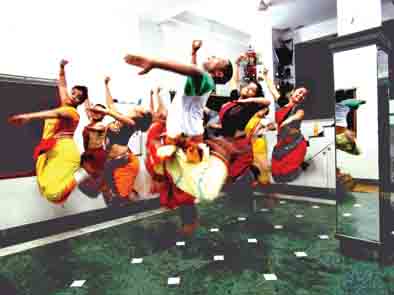
ODISSI exponent and Sangeet Natak awardee Sharmila Biswas is a dancer with a difference. She not only thinks and acts for the improvement of the dance form by working on its weak points, but also has a keen eye when it comes to training her students meticulously. With these aims in view, her Odishi Dance Vision and Movement institute conducted a workshop recently. The workshop was conducted by Lingaraj Swain, a student of Gangadhar Pradhan and Bichitrananda Swain. He is the senior guru of Konarak Natyamandam and repertory teacher at the Utkal Sangeet Mahavidyalaya. He has been associated with ODVM for the past 15 years.
Lingaraj Swain is a dedicated teacher, with a sharp eye for detail and what makes him very special is the rare ability to evolve and interpret movements with clarity and new dimensions.
Why I say Sharmila is a discerning guru is that she also held a Chhau workshop along side, because of her discovery that both Odishi and Mayurbhanj Chhau have been developing along parallel lines, which would give her students a chance to practice postures and stances of the form that would give support, strength and vigour to Odishi techniques and movements.
The Chhau workshop was conducted by Trilochan Mohanto from Baripada. The Centre&’s support of Mayurbhanj Chhau for the past 20 years has rejuvenated and helped the form evolve as one the finest performing art forms of India.
Shashwati Garai Ghosh, Priyanki Chatterjee, Jhinuk Nag, Neelay Sengupta, Krishnendu Roy and Sohini Majumdar helped Sharmila conduct the twin workshops. The other participants were the students of Shashwati, Krishnendu and ODVM students.
The Odishi workshop focused on bhramaris — circular movements. Almost 30 years back Guru Kelucharan Mohapatra had compiled all the possible bhramaris performed in Odishi and had categorised them into groups. Lingaraj Swain and Sharmila added a few more and taught the students.
At the end of the workshops, Sharmila presented a few pieces to a select group at Padatik Buildwel Theatre. The students did a Ganesh Vandana with simple and basic technique of Odishi. According to Sharmila, teaching expressional dance is difficult, mainly for two reasons: teachers lay stress on “angika abhinaya”, which makes students mere imitators at the expense of shutting out their minds and soul; and, added to this, the students take to heart whatever expression they have imbibed, which is difficult to erase.
Therefore in abhinaya it is important for the dancer to identify himself/herself with the main character one is depicting, as well as the characters that fleet in and out as the dancer becomes the storyteller, and maintain the stylisation required for Odishi dance, and, ultimately one has to be natural. Abhinaya entails a lot of work for both the dancers and the teacher.
At the Chhau workshop, Sharmila said that “when we include a traditional art form other than Odishi in the curriculum, besides familiarising dancers with their roots, it also makes them learn how that particular  form is adding to their Odishi experience”.
Odishi and Chhau being close cousins, they are both aware and independent of each other. Many of the movements are basically similar, but are executed with different techniques and expressions. Sharmila demonstrated how the technique of Chhau, like the shifting of weight, control of the pelvic region, flexibility of the joints, balance, upper torso movements, concentration, endurance, freedom and stamina could benefit Odishi dancers.
Padatik Dance Centre presented a collage on 30 June at Padatik Little Theatre II. Anuranam, which means vibration of sound, was its first presentation. Vibration of music leads the dancers to perform with joy and abandon. There was beauty of movement created by Souvik Chakraborty who choreographed it in Kathak style and the music was by Anushka Shankar. Black Coffee, choreographed by Susmita Chatterjee, explored the various features of Indian classical rhythms from the Kathak repertoire, using contemporary movements. The music was by Mayukh Bhowmick. Dancers Anirban Pramanik, Debjaya Sarkar, Srabanti Das, Sanchari Nandi and Proma Mukherjee were in excellent form and were a treat to watch.
Rabindranath Tagore&’s poignant tale, Kabuliwala, was presented beautifully.  The script and choreography was by Sushmita Chatterjee and was in the form of mono-acting, performed by the very talented Baidurja Chatterjee. Kunal Padhy lent his voice while the play was directed by anardan Ghosh. Little Baidurja had the versatility to sing, dance and act with ease, keeping the audience glued from start to finish.
Souvik Chakraborty&’s Krishnokoli was an interpretation of a selected portion of Tagore&’s Akash Prodeep. Souvik conceptualised it as the love story of a young village boy for Krishnokoli, whom he had seen on a cloudy day in the field. He fantasises, and romanticises his love for her in innumerable ways using the lyrics of Tagore mainly. A platonic, one-sided relationship develops in the boy, which is his wealth throughout his life. The music was by Agnibho Bandopadhyay while the recitation was by Sukumar Ghosh. The piece was aesthetically beautiful.
Some Dots, the last presentation, was choreographed by Anil Panchal of Delhi in Mayurbhanj Chhau and contemporary dance style and technique. The theme of the dance-theatre piece was the journey of human souls trying to discover themselves. It involved drama, music and various dance techniques for the portrayal of human emotions. Dancers Reshmi, Wanshu, Devika, Lazip, Prosenjit, Narottam, JD and actors Pratigya, Maruf and Sushil were highly disciplined. Light and sound by Pabitra Sarkar and Subho Das was helpful in bringing out the theme.
Anil Panchal, who is trained in Mayurbhanj Chhau from the Natya Ballet Centre, is famed for his improvisation in both traditional and contemporary dance technique. Over the years he has worked with several national and international choreographers and has also participated in various prestigious festivals and musicals both in India and abroad, some of which are: “Flavours of India”, in Australia; “India Summer Festival”, Switzerland; Sangeet Natak Academy Festival of choreographic work, Assam; Ibsen Festival, Norway; World Performing Arts Festival, Pakistan; Swan Lake in South Africa and Russia; Khajurao Festival of Dance; and Sadir Theatre Festival, Goa.
 

Mind-blowing talent hunt

Statesman News Service |

meena banerjee participated as a member of the jury
Voice of Kolkata
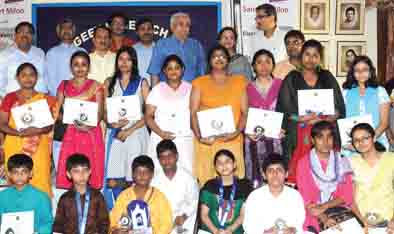
NINE-YEAR-OLD wonder boy Saagnik Sen lifted The State Bank Classical Voice of Kolkata trophy on 23 June at the ITC SRA auditorium. He gave a soul-stirring recital as a junior contestant – invited by Sangeet Milon, a Lucknow-based organisation, which was in Kolkata as it has launched an ambitious project to identify the “Classical Voice of India”, the finals of which will be organised in Lucknow after identifying talents from all over India.
The State Bank of India and ITC Sangeet Research Academy sponsored the Kolkata chapter of this classical music contest which was held on 22-23 June and assessed by judges like Sangeet Milon&’s beacon, Milon Debnath, Kolkata&’s renowned veteran musicians, Samar Saha (tabla) and Jyoti Goho (harmonium), ITC SRA&’s junior gurus and brilliant vocalists, Wasim Ahmed Khan and Omkar Dadarkar, and yours truly. After the contest, there was a prize distribution ceremony on the final day. The guests of honour were Ravi Mathur, executive director, ITC Sangeet Research Academy, and R Arumuga Pandi, general manager, State Bank of India. They gave away the trophies to the winners who once again presented their recitals for the audience.

Eye-opener
This was an eye-opener! People who lament that Indian classical music is a dwindling art should have been there to witness this Young Bengal with its genuine passion for this genre. While skeptics doubted there would be participation of a good standard, there were around 68 contestants in all, with 20 in the Junior group, 30 in the Middle group and 12 in the Senior group (khayal) and five participants in the Dhrupad category. It was a wonderfully successful programme with the entire environment reverberating with strains of popular ragas like Madhuwanti, Bhimpalasi, Miyan ki Todi and Yaman. Each contestant had to perform vilambit khayal and drut khayal, replete with vistar and tans, within 10 minutes. Most did this with superb dexterity. Contestants within the nine-23 age groups delighted the judges and organisers alike with their mellifluous melodies – most of which was innovative and improvised and not by rote only! This, according to me, was the most heartening aspect as there was a group of contestants that, apparently, was groomed together in one particular raga with the same compositions. Under the circumstances, mugged up performances would have been terribly tedious to assess.
Winners
Among the three categories, the Junior group was the most impressive, with amazing prodigious talents adorning the stage. It came as a wonderful surprise because this kind of matured participation was least expected from these children. Also, this was the only group that was totally dominated by young boys! It was a very difficult task to choose winners from such gifted children, but Saagnik Sen won the first prize and the Kolkata trophy hands down. He stood out for the unusually matured emotional contents in his delineation of raga Todi. He sang “Ab morey Ram” (slow ektal) and “Ab mori naiya paar” (fast teental) with peaceful vistar, neat sargams and thrilling taans interspersed with heart-rending pukars. One rarely finds such depth in such a small child.
On the other hand, Koulik Bhattacharya, another gifted child who also sang Todi, displayed stunning virtuosity as a “complete” performer with all the khayal elements at display. He stood third. The second position was a tie, shared by Ishan Ghosh and Arka Seal, while consolation prizes went to Tuhin Roy and Vedatrayi Bhattacharya.
Almost half the contestants flocked in the Middle group. The reason, probably, is less pressure from academics. Also, very few boys participated in this category as singing takes a back seat because most go through a change of voice in their early teens. So, this was captured by girls, entirely. Mayuri Saha stood first in this category with her brilliant recital in raga Madhuwanti (vilambit ektal, drut teental). Banhi Roy won the second position and third position was shared by Ankita Chowdhury and Shreya Mazumdar. Consolation prizes went to Rishita Saha and Sumedha Dey.
Among the Seniors, Iman Biswas gave a very convincing recital in raga Bhimpalasi and bagged the first prize. Tanula Chakraborty stood second and Sayan Sikdar third. But the latter appeared far too confident as a performer and commands attention. Reshmi Bhattacharya and Ankita Chakraborty won consolation prizes.
Dhrupad
In comparison, as is evident from the numbers, there were very few contestants in the Dhrupad category – and with good a reason. According to masters, the maximum age limit (23 years) is too challenging for a dhrupad singer and this should be relaxed to encourage more dhrupad students to come forward. But one was pleasantly surprised to find budding dhrupad singers like Sneha Chakraborty and Aparajita Bhattacharya. While Sneha enchanted all with her aesthetically pleasing recital and won the first prize, Aparajita got noticed for her forceful singing. She shared the consolation prize with Dipanita Sharma, who displayed talent but her high-pitched voice was very unlike dhrupad&’s.

Sangeet Milon
The judges, led by Milon Debnath, gave suggestions to the contestants on how they could improve their performances. In fact, Debnath&’s sole intent, behind this mega project, is to instill a serious sense of responsibility in young minds while handling a particular raga and its compositions. “The raga should be delineated according to the path shown in the bandish chosen for the day,” he stressed. “There are different compositions focusing on different angles of the raga. The same angle should get the top priority. Or else the raga will be confusing.”
Debnath, a disciple of Ustads Nyaz Ahmed and Fyaz Ahmed Khan, worked on this logic for years and, based on this, reorganised the “Kramik Pustak Malika” – compiled by Bhatkhandeji. After this monumental work, he penned “Sangeet Milon” in the same light. Arundhati Choudhuri, a dedicated disciple of this Lucknow-based guru took this logical way of looking at a raga rather seriously and went ahead to propagate this among the learners who are young, receptive and, fortunately, believe in logic. She also believes that it is every parent&’s duty to introduce their children to classical arts as these help them to give vent to pent-up feelings in a positive manner and make them complete human beings. According to her, it is better to mug up certain phrases of ragas than reproduce the cheap lyrics of film songs.
This belief was strong enough to inspire her small like-minded group, headed by her guru, to kindle an interest for classical music in young talents and started a classical vocal competition in the music-starved region of Uttar Pradesh in 2010. They, under the banner of “Sangeet Milon”, inspired children from 50 Lucknow schools to participate in “Classical Voice of Lucknow”.
The next year saw them holding competitions at different cities of Uttar Pradesh to identify the singing geniuses as the “Classical Voice of Uttar Pradesh”. The success inspired them to take the big leap and organise competitions all over India to identify the “Classical Voice of India”.  The inaugural session was held here in Kolkata. Come November, the finals will be held in Lucknow.

Coming up
12 July: Bharatiya Bhasha Parishad presents “RagaRasaSahitya”, an ongoing melodic literature-based series, featuring brilliant thumri and ghazal exponent Santa Kundu (disciple of Vidushi Purnima Chaudhuri and Ustad Sabir Khan) with Prashanta De Roy (tabla) and Sanatan Goswami (harmonium); Parishad Hall, 36 A, Shakespeare Sarani; 6.30-8 pm; all are welcome.
13 July: Sangeet Ashram presents vocal recital by Pandit Lachhman Dass Sandhu of Patiala gharana; Birla Sabhagar; 6.30 pm; for invitations contact: 22830210.
13 July: ITC Sangeet Research Academy presents kathak recital by Mitul Sengupta; choreography: Ronnie Shambik Ghosh; ITC SRA Hall; 1, NSC Bose Road; 6 pm; all are
welcome.
 

Andhra Assembly to take Telangana call

Statesman News Service |

Stanley Theodore
Hyderabad, 5 July
The Congress leadership has decided to leave the separate Telangana issue to the Andhra Pradesh Assembly after they take a decision in favour of separate statehood at their core committee meeting before this month-end. 
There is a likelihood of the Union Cabinet discussing the issue before sending it here. The leadership is not interested in bringing the issue before the Parliament, which has a final say regarding the creation or merger of new states. 
The procedure under Article 3 is that the law ministry will prepare a note and send it to the Union Cabinet, which in turn would route it to the Home Ministry. It will  then be sent to the President informing him that it contains the Centre&’s decision to carve out a new state. 
The President would send it to the AP Assembly “for its views” within 60-90 days. During this session the minutes would be noted. The decision of the Centre with the minutes would be sent back to the President and then the Home Ministry. It would be then sent to Parliament. 
The Congress leadership is caught in a sequence of dilemmas. On one hand, it is unable to decide conclusively regarding Telangana. Second, the pressures and arguments put forward before the separatist leaders and by the protagonists of a united Andhra confounding them. Third, it is unsure of whether a new state would be productive or counter productive in the 2014 elections. 
The compulsion before the Congress today is to literally take the Telangana issue off their heads. 
“The question of the issue following procedure and be tabled in Parliament is out of the question as the BJP would jump at the opportunity and support the Telangana bill. That kind of scenario does not exist now”, a top source informed The Statesman.
 Presently the leadership after their decision at the core committee would have the home ministry send its decision or a resolution to the AP Assembly.
 The House has 119 MLAs from Telangana and 175 MLAs from Coastal Andhra and Rayalaseema. MLAs from the latter two regions are against a new state and on various occasions have vowed to defeat any piece of paper that deals with the division of Andhra Pradesh.
The high command will use this development to reason that consensus on Telangana has not been reached among the stakeholders and would call for further consultations.  The point is a defeat of the Centre&’s decision, does not mean the abortion of Telangana state. The Constitution has it that irrespective of the outcome in the Assembly the Centre has the power to create a new state.  The Congress hopes to explain why it failed to utilise this power.