


agence france-presse
Colombo, 23 July
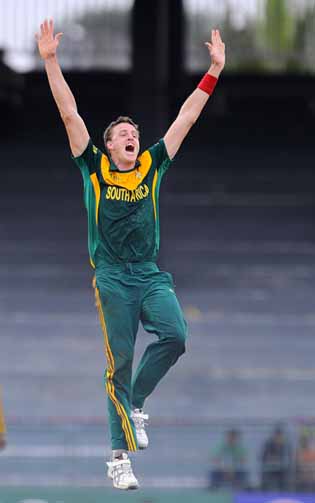
Rangana Herath took two crucial wickets as Sri Lanka defeated South Africa in the rain-affected one-dayer in Colombo today, taking a 2-0 lead in the five-match series. South Africa, set a revised target of 176 from 29 overs, were 104-5 in 21 overs when a heavy downpour at the Premadasa stadium forced the match to be called off. With 121-5 being the par score at that stage, the Proteas lost by 17 runs to suffer their second defeat in the series following the 180-run loss in the first match last Saturday.
Herath trapped opener Alviro Petersen leg-before for 24, and had Faf du Plessis caught behind to reduce the Proteas to 69-5 by the 14th over. David Miller (22 not out) and Ryan McLaren (14 not out) put on 35 runs for the unbroken sixth wicket before rain ruined their hopes of pulling off an upset. South Africa were dealt another blow as Hashim Amla injured his left knee while fielding and was rushed to hospital for precautionary scans.
Sri Lanka win



More like trial than triumph

Media&’s focus will quickly shift to football&’s Premier League
Angus Fraser
The joy of witnessing England take an almost impregnable 2-0 lead in this summer’s Ashes has not been lost on the British public. The chance to ridicule our oldest foes is not being wasted and the Australian supporters I watched and spoke to while Alastair Cook’s side thumped the Aussies at Lord’s had a forlorn and slightly embarrassed appearance. Many preferred to be drinking Pimm’s on the Coronation Garden at `The Home of Cricket’ to watching the cricket.
Despite the Ashes thrashings England suffered during my career England’s win in the 2nd Test did not provide me with a huge amount of satisfaction. It felt a little hollow. Yes, of course, it was great to see Cook and Co triumph but I left Lord’s relatively underwhelmed as I did not feel I had witnessed much of a contest. England were excellent and for that Andy Flower, Cook and the team should be congratulated but from the moment Australia lost nine first innings wickets for 62 runs on the second day the result and the cricket played had an inevitable feel to it.
Many England cricket fans will be relishing the fact their side have the chance of winning the Ashes in less than a fortnight, and that they then have an chance to inflict a 5-0 whitewash on Michael Clarke’s side. Yet it is questionable whether this is actually a good thing for English cricket.
Cricket is currently the first item on the sports section of television and radio news. It fills the back pages of newspapers too. All this is brilliant for the game. Victory at Old Trafford and the retention of the Ashes will continue this theme. But what then? After that the Ashes, as a newsworthy item, will become a non-event.
Before a ball is bowled in the fourth Test at Chester-le Street the focus of the media will have quickly moved away from the Ashes and Joe Root to football, the Premier League and the latest club Wayne Rooney has been linked with. Cricket lovers will have to wait for their game to feature on the news and search deep in to a newspaper to find reduced coverage. It sounds unpatriotic but the best thing that could have happened in this series was England losing the first Test in Nottingham. Then everybody would have been buzzing about Ashes cricket until the end of August.
I hope Australia put in a strong performance in Manchester because I want to see a contest similar to that in the first Test at Nottingham. Middlesex were preparing to play a t20 game at Richmond as Australia closed in on their target of 310. The state of the game at Trent Bridge had captured the attention of the Sunday crowd. Hundreds of people were packed in the bar at Richmond trying to get a glimpse of the action. Hundreds of others had earpieces in and were listening to the action on radio. It was a marvellous sight. When I left Lord’s on Saturday, with Australia seven wickets down and with more than 400 runs still needed, it was the Harris and Coronation Gardens that were packed. For them it was more fun chatting with friends than watching the cricket. Their apathy was understandable because the contest was over. And that is why I, with the exception of when Middlesex and Liverpool FC are playing, turn up to watch sporting events. I go to see a contest, to watch great sportsmen — whether they be English, Australian, West Indian or Indian — perform great deeds. For me the occasions when Brian Lara, Shane Warne, Muttiah Muralitharan and Sachin Tendulkar have starred is almost as good as when James Anderson, Graeme Swann, Kevin Pietersen and Cook have produced the goods. The Ashes of 2005 was a once in a lifetime series and we still talk about it fondly today. For all the immediate gloating Sunday’s win allowed England supporters need more Tests like Nottingham 2013 than Lord’s 2013 if we are to remember this series in five years time. THE INDEPENDEnt
SC dismisses plea for CBI probe
indo-asian news service
New Delhi, 23 July
The Supreme Court dismissed, as withdrawn, a PIL seeking CBI probe into the allegations of betting and spot fixing that rocked the sixth version of the Indian Premier League (IPL).
‘Go to the high court,’ said an apex court bench of Justice B.S.Chauhan and Justice S.A. Bobde as counsel for the petitioner pressed the prayer for the Central Bureau of Investigation (CBI) probe. Mumbai-based law lecturer Sharmila Ghuge in her PIL urged the court to direct the CBI to investigate the "allegations of spot fixing, match fixing, betting etc. pertaining to the cricket matches of IPL-6 or its earlier versions, unearth the huge racket committing such illegalities…"
Meet Aziz, the man who means business

animesh bhattacharyya
animesh@thestatesman.net
Kolkata, 23 July
One look at Moshood Bola Abdul Aziz, Mohammedan Sporting Club&’s new coach, and you realise that here is a man who means business. He talks business too, as he made it quite clear early on that he would be talking to the Press only after completing the training.
“As much as I would like to interact with the Press, I have to focus on the task at hand,” he said. The ‘task’, getting Mohammedan Sporting geared up for top-flight football after a four-year hiatus, he acknowledged is not an easy one. But going by the way he has taken the challenge by the scruff of its neck, one would not be too far off to expect great things from him.
Be it instructing the players or prepping the support staff or getting involved in the action, Aziz does not look like someone who has taken over the coaching mantle of Mohammedan Sporting only recently. It&’s not surprising given the fact he feels that the transition from a player to a coach is a ‘natural one’.
“You can only teach what you have learned. I have played football for a long time and whatever I have learned then, I will try to teach my boys now,” he added.
Having coached Atlantis FC, a Pro-Second Division club in Finland, where he was known for his tough training and strict discipline, Aziz would be looking to bring the same ethos to Mohammedan Sporting. “Discipline and training are two very important components in the making of a complete footballer. Discipline comes in handy both on the pitch and off it. As for training, light running, stretching are vital for warming up but the most important thing is what one does with the ball,” Aziz said.
He also believes that a coach cannot earn respect by only instructing players to do things.
“One has to do those things oneself. Only then can he set a benchmark, an example for his players to follow,” he said.
Aziz is also someone who does not mince words when it comes to tackling shambolic performances on the field.
At one point during the day&’s training, visibly unimpressed with the passing on display, he told his players in no uncertain terms to up the ante. “He is getting too agitated. I don’t know how the players will respond to it,” a bystander quipped but ‘agitated’ or not, Aziz knows the importance of keeping the players on their toes. “As a coach it&’s my duty to push them to their limits so that they give their best,” he said. However, for someone who prides himself for being a builder, he also realises the importance of giving time for a system to flourish. “One must always give time to a new setup to find its rhythm. Rush things too much and it may crumble but with time all the pieces will fit perfectly. It’s only pre-season and with not much football going on, it is very important for the players to get match ready and stay fit. Hopefully, in a few days time the boys will be back to their best,” he added.
And what do the players think of the new coach? “We like him and respect him. We have a good squad and with his backing we will be trying to give our best,” said Tolgey Ozbey, one of the black and white brigade&’s new recruits. With Joshimar, Luciano Sabrosa and Penn Orji in their ranks, Mohammedan Sporting certainly have the players to impress at the top level. As for actually doing it, one would have to wait and watch.
Bayern take on Barcelona
Catalans arrived in Munich for match without a chief coach
agence france-presse
Berlin, 23 July
Pep Guardiola’s former team meet his current employers in Wednesday’s friendly when European champions Bayern Munich host Spanish giants Barcelona.
Barcelona arrived in Munich without a head coach after Tito Vilanova resigned on Friday, as he battled against cancer.
Vilanova’s assistant Jordi Roura will be in charge at Munich’s Allianz Arena and the 45-year-old took charge of Barcelona from December to April when Vilanova was receiving treatment.
After Guardiola won 14 titles between 2008 and 2012 at Barcelona, the pre-season run out has added spice, especially given recent events which have strained relations between the two European powerhouses.
Guardiola took charge of Bayern last month, amid great fanfare, after the Bavarians lured the 42-year-old to Munich following his year’s sabbatical in New York.
Guardiola has already poached Spain Under-21 captain Thiago Alcantara from Barcelona to bolster his star-studded midfield which includes Holland’s Arjen Robben and France winger Franck Ribery.
But Guardiola stirred up bad blood with his former bosses earlier this month when he accused the Barcelona board of trying to "damage" him.
Guardiola lashed out in a press conference, making allegations against the board, which were later refuted, that he had snubbed Vilanova while he was being treated for cancer in New York.
"I will never forget that they used Tito’s illness to cause me damage, because it’s a lie that I never saw him in New York," he said.
With relations strained off the field, there is plenty of spice on it, although both teams are likely to name weakened teams.
Bayern’s Germany stars Bastian Schweinsteiger and Mario Goetze are both recovering from injuries, and the teams are not expected to have their Confederations Cup stars in action.
Both Barcelona’s new Brazil star Neymar and Spain’s Carles Puyol, who is working his way back to fitness after knee surgery in March, are expected to sit it out.
Senior stars Javier Mascherano, Adriano Correia, Alex Song and Alexis Sanchez are likely to feature among a host of reserves, while Argentinian superstar Lionel Messi is set to play some part.
Barcelona have something to prove against Bayern having been humbled 7-0 on aggregate in last season’s Champions League finals when the Germans backed up a 4-0 win in Munich with a 3-0 rout at the Camp Nou.
Having already chalked up wins over Bundesliga opposition Hamburg and Borussia Moenchengladbach in a pre-season tournament over the weekend, the Barcelona friendly is a big test for Guardiola’s new-look Bayern.
He has introduced a 4-1-4-1 system, from the 4-2-3-1 formation which won last season’s treble, and switched Germany captain Philipp Lahm from right-back into midfield with France winger Franck Ribery up front.
The game’s kick-off time has been brought forward to 1830 local time (1630 GMT) to allow home-team fans to watch Germany’s women in the semi-final of the 2013 European Championships.
In another development, Argentine coach Gerardo Martino has been named as Barcelona’s new boss on a two-year deal, the club confirmed on Tuesday.
"FC Barcelona have reached an agreement for the hiring of Gerardo Martino as the new coach of the first team for the next two seasons," said a statement on the club’s website.
"In the next few hours a programme will be confirmed for his arrival in Barcelona, the signing of his contract and his presentation."
The 50-year-old arrives after successful period in charge of Newell’s Old Boys in his homeland but has just over three weeks to get used to his new surroundings before the start of the Spanish league season on 17 August. Martino has no previous managerial experience in Europe, although he did enjoy a brief spell in Spain with Tenerife as a player in 1991.
Ponappa, Gutta miffed
New Delhi, 23 July: Doubles specialists Jwala Gutta and Ashwini Ponnappa were left disappointed with the Indian Badminton League’s decision to slash their base price at the last moment in the Player’s auction and termed it as “disrespectful” and “absurd”. Commonwealth Games women’s doubles champions Jwala and Ashwini were two of the six icon players, who went under the hammer yesterday but just hours ahead of the player’s auction, the IBL decided to reduce their base price from USD 50,000 (Rs 29,86,264) to USD 25,000 (14,93,125) after consultation with the six franchises. In the auction, Jwala went to Krrish Delhi Smashers at USD 31,000 (Rs 18,51,520), while Pune Pistons bagged Ashwini for the base price of USD 25,000. “I am very disappointed. Me and Ashwini signed the contract as icon players and we should have been given a better deal. We were not even informed about the reduction of base price. It is disrespectful and I am deeply hurt and upset by IBL,” Jwala told PTI.
Meanwhile, Denmark’s Mathias Boe today vowed to not visit India after appearing in Thomas Cup next year. Boe, who won the All England Super Series in 2011 with compatriot Carsten Mogensen, had a base price of USD 50,000 but the 33-year-old did not find any takers.
agencies
Ponappa, Gutta miffed
New Delhi, 23 July: Doubles specialists Jwala Gutta and Ashwini Ponnappa were left disappointed with the Indian Badminton League’s decision to slash their base price at the last moment in the Player’s auction and termed it as “disrespectful” and “absurd”. Commonwealth Games women’s doubles champions Jwala and Ashwini were two of the six icon players, who went under the hammer yesterday but just hours ahead of the player’s auction, the IBL decided to reduce their base price from USD 50,000 (Rs 29,86,264) to USD 25,000 (14,93,125) after consultation with the six franchises. In the auction, Jwala went to Krrish Delhi Smashers at USD 31,000 (Rs 18,51,520), while Pune Pistons bagged Ashwini for the base price of USD 25,000. “I am very disappointed. Me and Ashwini signed the contract as icon players and we should have been given a better deal. We were not even informed about the reduction of base price. It is disrespectful and I am deeply hurt and upset by IBL,” Jwala told PTI.
Meanwhile, Denmark’s Mathias Boe today vowed to not visit India after appearing in Thomas Cup next year. Boe, who won the All England Super Series in 2011 with compatriot Carsten Mogensen, had a base price of USD 50,000 but the 33-year-old did not find any takers.
agencies
Clubs to meet AIFF
Disagreement over IPL-style tournament
press trust of india
Mumbai, 23 July
Six representatives of the I-League Professional Football Clubs Association will meet officials of All India Football Federation soon over the contentious issue of the proposed IPL-style league, the club owners said today.
The I-League club owners, eleven of them in attendance and three others giving their consent to the decision taken, met here today and agreed to AIFF’s suggestion for an across the table meeting, it was announced today.
“A letter has come from Kushal Das (AIFF’s general secretary) asking for a joint meeting with IMG (AIFF’s marketing partners).
We today decided that six of our members would attend the meeting,” said I-League club Pune FC’s owner Nandan Piramal at a media conference.
“Raj Gomes (president of IPFCA), Chirag Tanna (its secretary), two of our vice presidents, Valanka Alemao (CEO of Churchill Brothers) and Mustafa Ghouse (from newly formed I-League club JSW) will attend the meeting on our behalf,” said Piramal.
Piramal said the meeting was basically to find out how the two-month long league proposed to be held early next year will benefit Indian football.
“We would like to know how such a league will benefit Indian football, I-League – which is the premier football tournament in the country – and the I-League clubs. We are going into this meeting with an open mind and without any preconceived notion,” Piramal said.
“We would like to know whether it is just about making money for someone or for improving Indian football,” he said. Valanka Alemao, daughter of Churchill Brothers’ owner, said that AIFF should not take the clubs for granted. “The message that is sent out today by us to the AIFF is not to take us for granted,” she said.
It was also revealed that none of the club owners have any idea about the contents of the 15-year agreement signed up by AIFF with IMG-R in 2010. “They say it has got a confidentiality clause,” she said. (More) Piramal and Valanka insisted that the I-League clubs have signed up all the players they need for the season ahead.
“I feel bad for the players who are sitting in the middle of this. We believe that what we are doing is for the good of Indian football and I-League is the bedrock of Indian football.”
Bangalore selections
Bangalore, 23 July: Following are Wednesday’s selections:
1.30 pm: Ice Kingdom 1, See You Later 2; 2 pm: Artesia 1, King Of The Court 2; 2.30 pm: Winning Story 1, Irish Song 2; 3 pm: Noble Reward 1, Bronzino 2; 3.30 pm: Trust Me Boy 1, Volans 2; 4 pm: An Acquired Taste 1, Tintinnabulation 2; 4.30 pm: Sprint Star 1, Esteban 2; 5 pm: Talita’s Girl 1, Blue Star 2; 5.30 pm: Icelander 1, Real Steal 2. Best bet: Sprint Star. sns
Kolkata races
Kolkata, 23 July: The Great Tribute Cup is the feature event in a card of six races framed for tomorrow here. Thanks to the cancellation of Bangalore races over the last weekend, Kolkata races will clash with Bangalore races tomorrow.
The feature event is a 1,100m sprint for horses in the highest Class.
Three runners attract attention in the pack of eight runners.
Among Aerator, Sreedhan and Rising Power, Sreedhan is fancied to score in a tight finish.
Mohammed Shabbani will ride the Shafiq Khan trained runner.
Selections:
2.45 p.m.: MOONLIT SKY 1, Haynestown 2, Avision 3.
3.15 p.m.: UNIQUENESS 1, Commelina 2, Carnival Point 3.
3.45 p.m.: ALCANDER 1, Conquest 1, Songstress 3.
4.15 p.m.: ADABELLA 1, Zoffany 2, Calypso Girl 3.
4.45 p.m.: SREEDHAN 1, Aerator 2, Rising Power 3.
5.15 p.m.: SNOW BALL 1, Amika 2, Beyond Stars 3. Day&’s best: Snow Ball. sns
Sports Briefs
Racquet decision: Roger Federer has said that he will spend this week at the Swiss Open testing his new larger racquet and make a decision later on whether to use it in the run-up to the US Open and beyond.
Diet book: Novak Djokovic attributes his recent success to a change of diet. Now he’ll be giving his nutrition tips in a book. Serve to Win reveals the diet that transformed his health and pushed him to the pinnacle.
Arsenal win: French striker Olivier Giroud plundered his sixth goal in three Asian tour games as Arsenal marked manager Arsene Wenger’s return to his former club Nagoya Grampus in Japan with a 3-1 win.
Uganda warned: Fifa has warned Uganda of a possible suspension if the government interferes with the running of the sport in the East African country. It was responding to a letter sent last week by Uganda.
Trezeguet moves: French football player David Trezeguet has joined Argentine club Newell’s Old Boys, where he will serve as a reinforcement. The forward will fill the vacancy left by Ignacio Scocco.
Baptista’s plan: Former Real Madrid and Brazil international forward Julio Baptista is negotiating a move to Brazilian football club Cruzeiro. The 31-year-old held talks with Cruzeiro director Alexandre Mattos.
Conte happy: Juventus coach Antonio Conte is satisfied with his side’s 10-day long pre-season preparations. "It has been an intense pre-season so far, but it has certainly been excellent," Conte said.
Zol shines: At Dambulla, skipper Vijay Zol’s unbeaten 129 helped India reach 333/2 against Sri Lanka at stumps on the opening day of the first U-19 Test on Tuesday. Sri Lanka’s decision to field backfired badly.
Shetty ineligible: The Mumbai Cricket Association has changed its electoral eligibility rules, barring the participation of cricket control board employees, so Ratnakar Shetty cannot stay on on its managing committee.
Austria F1: F1 racing is set for a return to Austria in 2014 after an 11-year break. The Austrian Grand Prix has been scheduled for 6 July in Spielberg after Red Bull team officials spoke with F1 boss Bernie Ecclestone.
O’Grady quits: Tour de France veteran Stuart O’Grady announced that he has ended his cycling career after taking part in his record 17th race around France. He pulled even with George Hincapie with his record 17th Tour.
Federation Cup: The Alchemist IHF Federation Cup hockey 2013 got underway on Tuesday at the Shivaji Stadium, New Delhi. In the first match of the day Tamilnadu overcame Mumbai with a 4-3 win.
Anderson optimistic: James Anderson said that the team was optimistic that Kevin Pietersen would be fit for next week’s Ashes Test at Old Trafford. He was off the field when the side completed a 347-run win on Sunday
Daruvala fourth: Force India Academy driver Jehan Daruvala finished fourth from 16th on the grid in the CIK European KF3 Championships in Ortona. Daruvala delivered an inspired performance in the final.
China and Ladakh
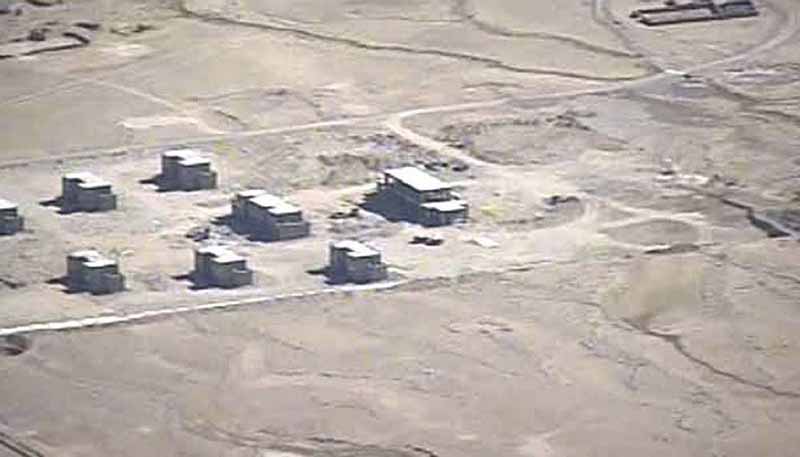
An Indo-Chinese settlement on Ladakh before Indo-Pakistan peace is achieved assumes special significance because of the leverage it would give to Beijing to mediate in the region. No settlement with Beijing is conceivable unless at least the minimal territory needed to connect Xingjian to Tibet is ceded by India to China ~ RAJINDER PURI
Once again on July 16 and 17, Chinese troops on horseback intruded into Ladakh. They retreated peacefully after laying claim to territory. Why is China repeatedly indulging in such brinkmanship? Various theories have been advanced. It is said the Chinese are worried about an Indian buildup that could monitor the infrastructural installations on their side of the border. It is more likely that China considers this the most suitable time to settle the border issue with India. These pinpricks are intended to prod a weak and ineffectual Indian government to capitulate and sign an agreement suiting Beijing. The present is particularly suiting China for a final settlement not only because the UPA government is on the ropes. There are three other constraints that impel Beijing&’s desire for quick settlement.
The first constraint relates of course to Beijing ‘s longstanding strategic imperative to connect Xingjian to Tibet which can be done only through Ladakh. In 1960, Zhou Enlai had offered trading Arunachal Pradesh, then NEFA, to India for Ladakh ceded to China. Had Nehru negotiated the offer by ceding only the strip joining Xingjian to Tibet, the 1962 conflict might have been avoided. His summary rejection of the offer led to hostilities. Beijing ‘s present need for the Xingjian-Tibet connection has become much more pressing because of unrest in both provinces.
The second constraint relates to growing rivalry between the US and China and Washington&’s entry into South-east Asia ‘s strategic zone. Beijing&’s worry is accentuated by prospects of closer Indo-US-Japan cooperation in the region. Therefore, Beijing would like to cement a relationship that puts India firmly in the Chinese camp which it believes might be achievable given New Delhi&’s weak and tottering government.
The third constraint is most crucial. With Pakistan ‘s election of Prime Minister Nawaz Sharif, the slight softening of attitude among a section of senior Pakistani Generals, and Pakistan&’s fatigue over the Kashmir dispute, the prospects of an Indo-Pakistan peace breakthrough appear faintly visible. The starting point for a peace formula was already laid down by former President, Musharraf&’s offer of soft borders and joint management of Kashmir. If negotiations based upon that formula as a starting point were to proceed and succeed, inevitably it could lead to the establishment of an Indo-Pakistan confederation culminating in the creation of a South Asian Union to cover the entire region.
That eventuality would be a nightmare for the hawks of the People&’s Liberation Army and Communist party hardliners. It would create a balance of power in Asia and dent their overweening ambitions for China on the global stage. Therefore, it would be top priority for Beijing to achieve an overall settlement with India, including agreement over the border before India and Pakistan settle differences. Indo-Pakistan peace would have to be achieved under the aegis of Big Brother China in order to satisfy Beijing&’s hegemonic designs. Beijing already has the ruling establishments of Islamabad and Rawalpindi in its pocket. It has already achieved its strategic goals in Pakistan by gaining access through Pakistan Occupied Kashmir (POK) to Iran. It has already gained access to the Indian Ocean through Gwadar port built by China with its control ceded by Pakistan to Beijing. What remains is to bring India within its fold.
An Indo-Chinese settlement on Ladakh before Indo-Pakistan peace is achieved assumes special significance because of the leverage it would give to Beijing to mediate in the region. No settlement with Beijing is conceivable unless at least the minimal territory needed to connect Xingjian to Tibet is ceded by India to China. If that were done, all three nations would have legitimate and recognized presence in Kashmir. Before that if Indo-Pakistan peace settlement has not been reached, Beijing would have a free hand to mediate between its two underling nations to hammer out an agreement. That is why it is imperative for New Delhi to reach a peace agreement with Islamabad before undertaking any serious negotiation with Beijing.
That is why New Delhi should continue maintaining its cool despite Chinese provocations in Ladakh and instead take the initiative to settle with Pakistan first. To be realistic, no settlement with Pakistan is likely unless the vexed dispute over Kashmir is resolved. It is here that the government and indeed all opposition parties need to reappraise the Kashmir dispute without bias or emotion. One need not recall the genesis of this dispute, the assurance given by Prime Minister Nehru when Kashmir first acceded to India, his initiative to seek UN intervention, the failure of successive Indian governments to accept the UN plebiscite on principle as long as all the preconditions listed for it to be held are met ~ this has long been iterated to indicate that India&’s claim to Kashmir is only marginally better than that of Pakistan. Past events dictate that the only honourable, democratic and credible solution rests with the people of Kashmir who should be given the right of self-determination.
Credible opinion polls by Chatham House think-tank in Britain carried across undivided Kashmir clearly suggest that the majority in Ladakh and Jammu are firmly with India, while the majority in POK is firmly with Pakistan. But both sides want soft borders and free movement of goods and people without visas across the border. The dispute really is over the Valley. In this region the overwhelming majority around 80 per cent want independence. Of the remainder in the Valley, more prefer India to Pakistan. Why then is India worried about granting self-determination to end this dispute once and for all? Clearly, self-determination, which might even favour India if sensible campaigning is conducted, can only be considered in the context of irrevocable commitment to participation in a South Asian Union having joint defence, common market and free movement without visas regardless of the future status of the Valley.
The possibility of an independent Valley as part of a South Asian Union would send shudders through the patriotic hawks across our political spectrum. They need to reflect. For over half a century the Indian people have co-existed with Article 370 in Kashmir . By this Article there has been discrimination between the citizens of Kashmir and those from the rest of India.
The rest are denied the right to acquire immovable property, to be recruited in a Government job, to vote in the Assembly and municipal or panchayat elections despite permanent residence in Kashmir , to obtain a bank loan, or even the access to higher education! Only since 1967 did they get the right to vote in parliamentary elections after the jurisdiction of the Election Commission of India was extended to Jammu & Kashmir.
Contrast this with all such rights that would be granted to all citizens of all member nations of the proposed South Asian Union. All these rights are granted to citizens of the different nation s of the European Union. The same would obtain in the proposed South Asian Union. Why then should Indian politicians be alarmed over self-determination to settle the Kashmir problem? The need to act is now because the situation is critical.
The writer is a veteran journalist and cartoonist. He blogs at www.rajinderpuri.wordpress.com
Edits
Multiple ‘strikes’
Audiences far beyond the defence community were sought to be addressed by last week&’s well-publicised announcement that the Cabinet Committee on Security had, eventually, approved plans to raise a China-oriented Mountain Strike Corps ~ the three other Strike Corps are Pakistan-specific. For a nation in which just about everything related to the military is deemed top secret, above the public domain, the details revealed were graphic: and that suggests a bigger game is underway. In an election year the UPA government is more than anxious to shed its image of being “soft” (the BJP makes much of that), an impression cemented by the non-response to the beheading of two soldiers on the Pakistan frontier, a series of incursions across the LAC by the Chinese and their protracted stay in the Depsang Valley, and of course the “welcome blast” from a key PLA strategist just ahead of AK Antony&’s Beijing visit. The UPA somewhat desperately needed to change that perception in the wake of dodgy defence deals, continuing bottlenecks in the acquisition process, and the confusion over indigenous production. The defence minister harks back to the “self-reliance” mantra but blocks an increase in the cap on FDI in the sector ~ without which many of his cabinet colleagues, and “industry” too, contend his mission is a non-starter. The bold Rs 62,000 crore announcement is palpably intended to regain some public confidence; perhaps convince military personnel too (increasingly are they opting to play the vote-game) that their interests are not being overlooked. Certainly, if all the proposals fall into place some of the military imbalance will be rectified, and the Army will have the potential to launch an offensive rather than merely stand its ground on the LAC. More than raising the number of boots on the ground, the new Corps will acquire specialised weapon systems, all-terrain vehicles etc, and with the Air Force working towards a capability to “swing” its assets from the western to the eastern theatres, a credible punch could be thrown. But will that have the desired impact ~ military and diplomatic ~ on Beijing? There has been no immediate reaction from China, it does not believe in knee-jerks. Yet it will not ignore the “development”, the overall advantage lies in its favour, will it allow India to develop adequate infrastructure in frontier areas since it has thwarted road-building in Ladakh? Will New Delhi have the wherewithal to stay the distance? Sloganeering may secure votes, much easier than acquiring the military muscle critical to keeping the nation secure.
The Tokyo story
Political stability will hopefully return to Japan with Sunday&’s decisive victory of Prime Minister Shinzo Abe in the election to the Upper House. Stability had eluded the country for the past seven years, indeed since Junichiro Koizumi left office in 2006. Mr Abe ought now to consolidate his authority with his Liberal Democratic Party (PDP) controlling both Houses; the legislative disconnect exists no more… as it does in America, on occasion impeding Barack Obama&’s agenda. The Japanese Prime Minister has been hobbled no less, most importantly in implementing what has come to be known as “Abenomics”. He now has a stronger mandate to warm up his recipe to revamp the economy, indeed introduce structural reforms that are pivotal to growth. It remains an open question though whether he will use his free hand to buttress his nationalist agenda. The victory, above all, will enable Mr Abe to shore up his standing after his LDP suffered a humiliating defeat in the election to the Upper House in 2007, during his first stint as Prime Minister. With a twisted Diet (parliament) for the past seven years, Japan has witnessed the uncertain, even destabilising, phenomenon of revolving-door heads of government. Indeed, the parliamentary deadlock has been the major impediment towards formulation of policy, with the Opposition blocking legislation as it often does in the USA. Sunday&’s result illustrates that the people have voted against recurrent legislative logjam. The people must benefit from “Abenomics” which, the LDP leadership claims in the aftermath of victory, is proceeding smoothly. It will be useful to enter a caveat here. The legislative victory is a political triumph for Mr Abe and the LDP; it ought not to be readily confused as an endorsement of “Abenomics”. That will depend hugely on the effectiveness of his new economic policy.
Congress hope in N-E
Union minister for Development of the North-East Region Pawan Singh Ghatowar does not think the BJP will pose any serious challenge to the Congress in the 2004 general elections and hopes the party will garner as many as 20 of the 25 seats in the region. Today, the Congress has seven MPs in Assam, two each in Manipur and Arunachal Pradesh and one each in Meghalaya and Mizoram. It has none from Nagaland, Sikkim and Tripura. Ghatowar might not end up having his bluff called because he feels Prime Minister Manmohan Singh&’s recent review of infrastructure projects in the region and the sanction of Rs 600 crore for the railway network will pay rich electoral dividends. He also claims that over the past nine years the region&’s GDP has shown a steady increase. Besides, the 12th Plan outlay has been fixed at Rs 360,000 crore, compared to Rs 184,000 crore in the 11th Plan. A laudable decision was to form an empowered group to ensure speedy upgradation of in-frastructure and completion of ongoing projects.
No excuses for Gandaman children deaths
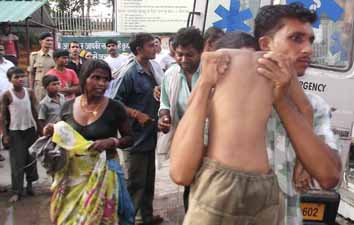
The Gandaman incident in Bihar should not become an excuse to call for the scrapping of the mid-day meal scheme. Instead, it should serve as a wake-up call for those in charge of implementing it. They must ensure there is regular monitoring, writes amit baruah
That children suffer from malnutrition and die in India is not a big-font story anymore. But when 23 children being fed in a government scheme die, it makes news.
And, when it made news, the Bihar state government, responsible for implementing the mid-day meal scheme for children in schools, came out with the theory that the food contained poison.
On Saturday night, a senior policeman in India quoted from a forensic report, that the meals served to the children contained a pesticide that was said to cause the deaths in Gandaman village in Bihar&’s Saran district.
As can be expected, parents in the area are afraid to send their children to school.
It&’s a natural reaction when the food served in the mid-day meal scheme, said to be the largest of its kind in the world, claims so many lives.
Also, on Saturday, came reports that 30 children in a primary school in Maugaon village in Chhatisgarh state had taken ill after eating their mid-day meal. All of them are now said to be out of danger.
There&’s little doubt that state governments that can’t get their act together in feeding clean and safe mid-day meal schools in a programme to feed as many as 120 million kids every day don’t need to remain in power.
A society must be judged by the way we treat our children. Those who are prepared to feed our children unsafe food should not be allowed anywhere near them.
We can’t bring the dead children back, but governments across India can certainly put in place robust monitoring systems to ensure that the Gandaman incident is not repeated.
In the wake of the tragedy, the Bihar government has announced its decision to close down all open air schools, where cooking was also done in the open.
As many as 220 schools across the state have reportedly been closed.
Whether these efforts are enough, one can’t really say. But the fact remains that anti-poor analysts in India believe that the mid-day meal scheme itself should be scrapped.
Such analysts, who believe that any measure for the poor should be scrapped in a country where nearly 270 million people remain below the poverty line, can be expected to harp on the health and safety implications of the scheme.
Their real target is the scheme, not ways and means of improving both quality and delivery.
There&’s little doubt that schemes like feeding kids in school and the rural employment guarantee programme have staved off many deaths on account of inadequate nutrition in India.
Reetika Khera, who has been writing on this issue, said on Sunday that the national scheme to feed children in school began in 1995 with dry rations, but cooked food had to be introduced following a Supreme Court order in November 2001.
According to her, 138 billion Indian rupees (US$2.3 billion) had been allocated in the 2013-14 budget for the mid-day meal scheme in 2013-14.
Khera also points out that in some states, dubious private parties had been contracted to supply food, but points to recent successes like Rajasthan in implementing the scheme.
What happened in Bihar was criminal. But it can’t be made an excuse to stop the mid-day meal scheme.
On the contrary, better quality of food grains and ingredients, along with hygienic cooking and regular monitoring is the only way to keep children healthy and safe in their schools.
There&’s no time to waste.
dawn/ann
Melting Pot
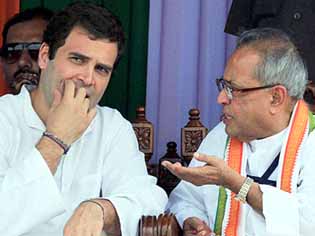
The story of Rahul Gandhi&’s experiments with truth ~ Arati R Jerath
Rahul Gandhi&’s “Gandhigiri” pep talk to party spokespersons seems to have been inspired by his recent private meeting with President Pranab Mukherjee. According to Congress sources, the young leader met the elder statesman over lunch last week. The luncheon lasted well over two hours as Rahul tapped a shrewd political mind that served as chief trouble-shooter for both the Congress and the Manmohan Singh government till a year ago. Rahul was to later reveal to close aides that he had gone to Rashtrapati Bhavan to seek political wisdom from Mukherjee.
Those privy to titbits of information about their lengthy, freewheeling chat say that during the course of conversation, Mukherjee deplored the level of current political discourse. It was his opinion that top leaders at least should not stoop to making personal attacks or using indecorous language. This was not the political culture that India&’s founding fathers had sought to establish.
It was interesting that in his address to Congress spokespersons some days later, Rahul referred to Mahatma Gandhi as he exhorted them to stay within the realm of decency and focus on positive politics. “We cannot do that (use abusive language). We are the party of Mahatma Gandhi,” he said. And when some queried how they should counter the false propaganda and wrong information spread by Narendra Modi, Rahul simply replied, “We have to seek the truth”. Thoughts inspired by the conversation with Mukherjee, clearly.
Nagpur line
Those wondering why the BJP has strayed away from development and gone back to Hindutva in recent speeches and remarks should join the dots to the flurry of activity at the RSS headquarters in Nagpur this month. Since the beginning of July, senior BJP leaders have been summoned to Nagpur one by one for a private audience with RSS chief Mohan Bhagwat. They all went: L K Advani, Murli Manohar Joshi, Rajnath Singh, Nitin Gadkari, Narendra Modi.
Since then, the language has changed. Suddenly, Modi is talking about “puppies” and “burqa of secularism” and boasting that he is proud to be a Hindu nationalist. Mumbai is plastered with hoardings of a messianic Modi proclaiming his Hindu nationalist identity.
While the campaign chief added a communal flavour to his speeches, BJP president Rajnath Singh turned the clock back to the Jan Sangh&’s favourite theme in the 50s and 60s, which was to rubbish English. Rajnath went to the ludicrous extent of lamenting the death of Sanskrit in the craze for Western culture. The very next day, RSS chief Mohan Bhagwat echoed Rajnath&’s comments.
As the RSS tightens the screws on the BJP, a new synergy between the mentor and its political arm seems to be unfolding, to put Hindutva back on the front burner and make it the saffron campaign theme for 2014. Forget development, economics, corruption and anti-Congressism. It&’s back to basics for the BJP and the line has come directly from Nagpur.
Betting on BJP
Expelled BSP MP Vijay Bahadur Singh had good reason for praising Narendra Modi&’s controversial “kutte ka bachcha” remark. It seems he is in talks with the BJP for a ticket to contest the 2014 polls. According to BJP sources, the party has more or less decided to nominate him for the Hamirpur seat, which he represents currently. Apparently, the BJP doesn’t have a strong enough candidate to field from this Thakur-dominated constituency. Vijay Bahadur Singh seems to be the best bet so far.
Singh&’s romance with the BJP began once he realised that Mayawati was unlikely to renominate him. Their relationship has been rocky ever since he started appearing suo moto on TV as a spokesperson for the party. No one does anything without permission from the boss in the BSP. Of course, elections are still ten months away and ticket distribution will begin only early next year. Now that he&’s burnt his boats with the BSP, Singh must be keeping his fingers tightly crossed that the deal with the BJP doesn’t fall through.
Passport travels
It must be a strenuous exercise to review the state of our passport offices. That&’s why the parliamentary standing committee of the external affairs ministry laid on a weeklong luxury tour for its members as they traversed through Chennai, Bhopal and Gurgaon, visiting regional passport offices to check out the reasons for unending public complaints of delays and harassment.
A stay at a five-star Leela Hotel, an evening Bollywood style entertainment programme at Gurgaon&’s Kindgom of Dreams and platefuls of kaju and chips were among the goodies on offer for the MPs. One of the more down-to-earth members wondered why the team needed a full week to get a grip on the problems at MEA&’s passports offices. It was more like a five-star holiday than work, the MP commented.
Plot targeting Sharif foiled
Press Trust of India
Lahore, 23 July
A terrorist plot to target Prime Minister Nawaz Sharif at his residence in Lahore was foiled by Pakistani security agencies with the arrest of eight persons, including four alleged suicide bombers.
The plot to attack Mr Sharif at his sprawling farmhouse at Raiwind on the outskirts of Lahore was uncovered by a joint investigation team of police and Intelligence officials which was probing the abduction of former premier Yousuf Raza Gilani’s son Ali Haider during the election campaign in May.
The team traced a North Waziristan-based militant group that was active in Lahore and plotting to target Mr Sharif with suicide bombers, according to an Intelligence report.
During a raid in Multan district, 400 km from Lahore, to trace Gilani’s son, security agencies arrested two suspects who belonged to Tehrik-e-Taliban Pakistan factions led by commanders Matiur Rehman and Muhammad Yasin.
These suspects divulged the plan to attempt a suicide attack on Mr Sharif at his Raiwind residence. The suspects also revealed the name of Fahim Meo, a resident of Raiwind who was described by officials as a “prime facilitator” of the planned attack.
A team of investigators stayed in Raiwind for a week and arrested Meo. Acting on information provided by him, investigators arrested another suspect identified as Usman alias Saifullah Mehmood Iqbal, also a resident of Raiwind.
Investigators said Usman owned land adjacent to Sharif’s palatial farmhouse and had direct links with Taliban militants based in Bannu and North Waziristan. The security agencies also arrested a group of four would-be suicide bombers from North Waziristan while they were travelling from Bannu to Lahore.
The threat to Sharif and his younger brother, Punjab Chief Minister Shahbaz Sharif, was so great that they stopped using the usual route leading to the Raiwind farmhouse on the advice of security agencies.
The two Taliban commanders linked to the plot ~ Matiur Rehman and Muhammad Yasin ~ were also involved in suicide attacks on former President Pervez Musharraf, former premier Shaukat Aziz, the Hamza Camp of the Inter-Services Intelligence and the army’s General Headquarters.
The Pakistan government has offered a bounty of Rs 3 million each for the two Taliban commanders.
Investigators also uncovered links between the Tableeghi Jamaat, a proselytising group, and the terrorists involved in the plot.
The terrorists were operating from within the headquarters of the Tableeghi Jamaat in Raiwind, which made it virtually impossible for investigators to track them. The four would-be suicide bombers were arrested by investigators while travelling in buses carrying Tableeghi Jamaat members, officials said.
Investigators are still looking for three more Lahore-based suspects and the arms cache that was to be used by the terrorists, officials said.
Meeting inconclusive about St. Margaret’s Home dispute
statesman news service
Kurseong, 16 July
The tripartite meeting called by the Kurseong SDO over St. Margaret&’s Home&’s issue concluded without any
decision.
The meeting was held at the Kurseong Sub-divisional office, in which the representatives of the Daughters of the Cross, Janmukti Secondary Teachers Organisation, including the representatives of the Vidhyarthi Morcha and the Kurseong SDO Mr RK Jha were present. All the representatives voiced their opinions and problems in the meeting, which lasted for two hours. The SDO, Mr RK Jha, said the follow up of the meeting will be
continued tomorrow.
St. Margaret&’s Home is a 114-year-old charity home in Kurseong, where many poor, helpless and orphan children get a home and education under the guidance of the Daughters of the Cross.
Recently, the home was closed by the concerned authorities and all the children were shifted to other homes. However, the authorities of the shelter claim that the home has been shutdown for construction
reasons.
Due to the shutdown of St Margaret&’s Home, several school students have been handed over transfer certificates in the middle of the year by the school authorities, run by the Daughters of the Cross, and reports say that they have been directed to study in other schools.
Protesting against this, the Janmukti Secondary Teachers Organisation in association with the Vidhyarthi Morcha filed a complaint with Kurseong police station and other concerned departments, saying the Right to Education Act 2010 was violated by the school authorities.
They demanded all the children should be taken back to the school.