Logo

Realising forest rights still a distant dream

Armin Rosencranz  and Zainab Lokhandwala | New Delhi |

Among many laws, policies and practices inherited from the British, exclusive state control over forests and its resources is one that has gained relevance today as never before. The British initiated this trend for economic and political reasons; however, successive Indian governments since 1947 have chosen to forge ahead in the same direction of command-and-control. India’s conservation strategies resonate the attitudes of the British, who laboured to survey India’s forests and to exploit them without any accountability or interference from forest communities.

Tribal and other forest dwelling communities in India are often defined by their relationship with natural resources like land, forests and water resources. This long association has resulted in a vast assemblage of traditional knowledge. Such knowledge contains insights, innovations and useful practices that relate to the sustainable management of natural resources and the development of the areas they 
inhabit.

Participatory conservation by local people is based not as much on the  logic of traditional knowledge and spiritual association, but more on the fact that areas with a major biodiversity concentration overlap with indigenous peoples’ inhabitation. According to the World Resources Institute, 80 per cent of the world’s biodiversity coincides with indigenous territories. Some of the largest tropical forests, boreal forests and mountainous biomes that continue to be the focus of conservation efforts, are occupied by  indigenous tribes and local populations. This harmonious confluence of forests and human habitation that goes back hundreds of thousands of years raises the question of whether traditional methods of conservation that include the demarcation of national parks and wildlife sanctuaries from their local populations are logical or even legitimate.

Yet, India’s experience with issues of forest conservation, forest rights and human rights of indigenous peoples can best be described as the continuation of the ‘British hangover’. This is because the laws, policies and schemes in India have largely been enacted in pursuance of the Indian Forest Act, 1927, which vested absolute control over forests in the hands of the colonialists.

This trend was slated to substantially change with the passing of the Scheduled Tribes and Other Traditional Forest Dwellers (Recognition of Forest Rights) Act, 2006 (FRA), which, for the first time, gave substantive forest rights to tribal and other forest dwelling communities. It endeavours to assuage the historical injustice meted out to scheduled tribes (STs) and other traditional forest dwellers (OTFDs) through their forcible eviction to meet the needs of industries and urban mainstream populations. The Act aims at securing traditional rights over forest land and community forest resources, and establishes democratic community-based forest governance.

In a nutshell, this Act recognizes the genuine legal right of any member of an ST/OTFD over forest land, and renders any eviction or removal therefrom illegal. A decade has now passed since the FRA came into being, yet its implementation has seen no real or concrete change in the scenario prevailing before its coming into force.
A 2016 Performance Report prepared as part of the Community Forest Rights-Learning and Advocacy Process, that involves grassroot organisations, people’s networks working with communities, and other support groups like legal advisors and individuals involved in research for forestry rights, shows that only a dismal 3 per cent of the FRA potential has been achieved. Forest lands that ought to have been included within the scope of the FRA remain inaccessible for local communities even after a legitimate right in their favour has been recognised.

The performance of FRA has been this poor due to deep structural and institutional issues. To begin with, the FRA is implemented not by the Ministry of Environment, Forests and Climate Change but the Ministry of Tribal Affairs, which is understaffed, and has access to a very low budgetary and resource allocation. State implementing agencies are in a greater state of debilitation owing to similar yet more aggravated institutional shortcomings.

Furthermore, merely passing an Act such as the FRA without truly defining the role of the forest bureaucracy that has been operating under other forest legislations and policies, has led to conflicts of interest within the government machinery itself. In cases where FRA nodal agencies want to equitably distribute land titles and access rights to local communities under the Act, they are met with resistance and even opposition by forest officials and rangers.

When a certain kind of forest bureaucracy has been operating even before independence, which has always viewed tribal populations and resident communities to be a threat to forests and their resources, it is difficult to change such attitudes overnight. While a lot of debate within the government and judiciary has managed to sway the tide in favour of the rights of such communities, ground level officers remain suspicious of their intentions and apathetic to their plight. This is procedural inertia at work: It can be observed in other sectors in India, where the law itself may be progressive, yet its realisation remains constricted in the hands of a gargantuan bureaucratic network of officers who have operated in a certain way and whose habits are near impossible to change. 

West Bengal is one of the low performing states in the country (high performing states include Kerala, Odisha, Gujarat and Maharashtra). Since the FRA’s operation, the state has managed to transfer only a small number of titles to adivasis who  have shown evidence of possessing a traditional right to forest land in some of the districts (20,405 acres recognized as individual forest rights and 58 acres as community forest rights vis-à-vis 14,64,127 acres of community or village forest land, i.e. less than 2 per cent implementation). In many instances, persons in whose name titles have been transferred are not even aware of their ownership rights. Transfers such as this may have been done to show something valuable on paper, yet in actuality, forest dwelling communities still face a great deal of marginalisation and discrimination when it comes to rights of access to forest produce.

West Bengal’s performance is even worse when other provisions of the FRA, other than mere land transfer, is taken into account. Community management, which is the true essence of the FRA itself, is completely non-existent, owing to the fact that the state government makes no distinction between jurisdictional capacities of panchayats and gram sabhas for the purpose of capacity building of community members under the FRA.

Gram sabhas are organised at the panchayat level, which dilutes the very purpose of the FRA and enables the state to continue managing forests. The tribal affairs department if the West Bengal government also made an open claim that only tribal communities were entitled to receive land titles under the Act, which excludes OTFDs.

A quintessential instance of bureaucratic apathy was seen in 2014, when the Range Forest Officer of the Moraghat Logging Range (under the authority of the West Bengal Forest Development Corporation), wrote a letter to the gram sabha of North Khairbari forest village in Alipurduar district of West Bengal, asking the sabha to grant permission to carry out Clear Coupe Felling in the same area claimed by the resident community as a Community Forest Resource under the FRA. This came after a long struggle of the forest villages in northern West Bengal protesting against coupe felling operations in the Dooar forests.

The position in Bengal seems even more stark when juxtaposed to that in the neighbouring state Odisha, wherein several gram sabhas (in a one-of-a-kind public referendum) rejected Vedanta’s plan to carry out bauxite mining in the Niyamgiri hills in the 2013-14, which the government and the courts of Odisha supported. This was done only after a lot of grass-root level public movements pressured the government and the courts to take their side, and after this story had already received a lot of media attention thereby making it that much harder to turn a deaf ear towards the plights of the communities involved.

The crux of these problems boil down to the lack of political and bureaucratic will to go ahead with the FRA’s core aims and objectives. The enactment of a legislation such as the FRA in 2006 stands out as a milestone in Indian political, legal and environmental history. It was an intervention by the government to correct injustice done to millions of forest dwelling communities. The full potential of FRA, however, can be achieved only by its implementation as if it were a mission, coupled with actual support, capacity-building measures and guidance to gram sabhas and implementing agencies at all levels; and holding such bodies accountable for implementation.

In West Bengal, a great deal of work is yet to be done. A huge number of individual and community claims are pending with the implementation authorities that require urgent attention. Furthermore attitudes among forest bureaucrats has to change so as to allow for better coordination between the forest and tribal affairs departments, and a clearer understanding of the FRA itself. The fundamental questions of who owns the forests, who has access to its resources and produce and who is best suited to manage and conserve them can no longer be ignored.

The authors are, respectively, professor of law at Jindal Global University, Sonipat and a recent LL.M graduate of National University of Juridical Sciences, Kolkata.

A matter of sovereignty

Salman Haidar | New Delhi |

The decision in Islamabad to alter the status of Gilgit-Baltistan in POK and describe it as a province rather than a region has not been well received in India. The Pakistani decision may be of little practical significance, for POK has never had any autonomy worth the name and the latest move is unlikely to make any real difference, but to come up with this changed nomenclature acts as a reminder of unresolved issues and of the illegal occupation of POK by Pakistan. Indo-Pak differences over J&K have been especially prominent lately on account of the newly developed CPEC (China Pakistan Economic Corridor) along an alignment that traverses a portion of POK, and has been denounced on that account by India as a further infringement of its sovereignty. Chinese complicity in Pakistan’s actions in POK is a long-standing Indian grievance and it has added a further dimension to the unresolved issues between them.


Much of what divides India and Pakistan in J&K goes back right to the beginning, when India and Pakistan emerged as independent nations. The complication of the Chinese connection was not part of the initial set of issues but it has progressively become more substantial as Sino-Pak activity in the mountains has taken on a more challenging aspect. As a means of thwarting India and pursuing its own territorial ambitions, Pakistan has actively tried to draw China into a role in Indo-Pak affairs in J&K, most notably by making extensive territorial concessions in the Shaksgam border region where a Sino-Pak border agreement in 1963 handed over large territories to China. The agreement has no validity so far as India is concerned, encroaching as it does on land that is rightly part of India, but since the agreement was concluded the collaboration between the two signatories has developed steadily. From early days China collaborated with Pakistan in developing road access from Xinjiang to POK in order to encourage trading activity between the two regions. This route came to be known as the Karakoram Highway (KKH) and it was largely made possible as a result of Chinese financial and technical assistance, with much of the required labour force being provided by that country.

Since then the pattern has been repeated and Chinese support has been provided for major infrastructure schemes in the mountain region. The KKH has become an active road link and permits a certain amount of trade though there are obvious limitations owing to the difficulties of the terrain. Even so, Pakistani traders make regular journeys along this route and fairly brisk commercial traffic has been established. Apparently some manufacturers of a particular sort of silk cloth in Shanghai that had been popular in South Asia more than a century ago have seen the opportunity and have revived a modest amount of manufacturing of this item specifically for the Pakistani market; they would no doubt look to the more appealing Indian market if the opportunity presented itself. At present, the KKH can be regarded as a small tributary of the Silk Road now being revived by China but if circumstances were to change it could amount to something more. It should also be seen as a precursor of the more ambitious CPEC which seems to follow much the same access route.

These activities in the surrounding area have required watchful response from India and alert awareness of the new developments. The paramount concern for India is to ensure that its sovereign rights are maintained at a time of change and of enlarged international activity all around, and at the same time to provide adequate developmental input for the benefit of the people of the region. The development issue requires a measure of cooperation between the sundered parts of J&K and is vulnerable to terrorist activity, but extensive negotiations have taken place in recent years to look for a modicum of cross-LOC exchanges to meet demands from the local population. As a result, some steps have been agreed that have done something to ease the situation for people around the LOC ~ among steps agreed between the sides, opening road links has been a big success, and though there have been frequent setbacks, the process continues, to the benefit of the locals.

As a result, there is considerable sentiment in J&K in favour of increasing the cross-LOC travel routes, facilitating people-to-people contact and expanding commercial exchanges. Revival of the old caravan routes based on Kargil where historic lines of commerce once met is a frequent demand;  this particular proposal has been held up owing to the unfavourable response of the Pak military authorities who would not wish to see easier access leading perhaps to the nearby KKH which, in the military mind, is a strategic lifeline between Pakistan and China. Such sentiments have held up the improvement in exchanges that was being attempted earlier, for even at times of greatest estrangement the effort to maintain a certain amount of cooperation has never been abandoned. Dr Manmohan Singh’s government was especially successful in conducting a back-channel dialogue that affirmed the essential legal and other principles of India’s policy while permitting a certain amount of interaction across the line. This diplomatic effort did not eventually lead to the results that at one time seemed attainable but it has left a body of useful ideas that could come into play when circumstances permit and dialogue can be resumed.

At present, relations are in a trough and the issue of state-backed terrorism has overshadowed all else. Mr Modi has made more than one striking gesture of outreach to demonstrate his willingness to ameliorate relations but each time his intentions have been thwarted by incidents that have made it impossible to proceed further. The CPEC has added a
further level of disagreement by bringing differences between India and China into consideration and thereby reducing further the chances of improvement in India-Pakistan ties. There can be little early expectation of change for the better.

In these circumstances, J&K’s Chief Minister Mahbooba Mufti has shown boldness in coming out with the 
suggestion that, far from opposing CPEC, India should consider joining it. Chinese spokespersons have on various occasions invited India to join but India has kept aloof, considering as it does that CPEC encroaches on its sovereignty. Ms Mufti’s views reflect the specific interests of her State which has much to gain from the opportunities that could flow from CPEC, including commercial and people-to-people contact, and revival of movement between Ladakh and Baltistan. What she says may not be immediately practicable but it merits serious consideration. India’s long-term interest is in improvement of ties with the neighbour and to find ways of transcending their differences and mutual hostility.

The writer is India’s former Foreign Secretary.

Accelerating Tejas

Editorial | New Delhi |

Since positive information on the progress of the indigenous Light Combat Aircraft ~  Tejas ~ is only occasionally circulated, there is reason for satisfaction that action has been initiated for doubling the capacity at Hindustan Aeronautics Ltd., Bangalore, to 16 jets a year. That would help make true the dream to produce enough aircraft in the next eight years to “retire” the 11 squadrons of MiG-21 and MiG-27 fighters that have been stretched well beyond their designed life-expectancy. The IAF is now operating with nine squadrons fewer than what is deemed necessary to tackle potential “situations” on the northern and western fronts, and with only 36 Rafales on the distant horizon the depletion of assets is becoming problematic. Doubling of the production of the Tejas could help fill a void: despite claims of other aircraft being evaluated, the prospects of them entering operational service in the near future are remote. The Tejas has had a chequered history, it will be another two years before the IAF can hope to receive the version it has configured as being close to what it requires. It does remain a moot point if a fighter conceived three decades back will “deliver”, given the improvements in missile technology, drones, etc., but our faujis have little option but to make do with whatever they get. Now that there is another change at the top in the defence ministry, whatever plans had been formulated could well be subjected to review by the next minister ~ for whom a “search” does not appear to have begun: Arun Jaitley can conduct little more than a “holding action”, as he had done in the opening months of the Modi government.

The plans to increase the capacity at HAL to 16 Tejas jets a year is more than a matter of numbers involving a second production line and modifying the facilities used for the Hawk trainer. In a mini-revolution, HAL will be outsourcing the production of the fuselage and wings of the Tejas to select private entities, and re-working itself into an “integrator”. Something long overdue, for the PSU giant has much too much on its hands to function efficiently, expeditiously and cost-effectively. The “blurring” of the public-private sector divide is welcome ~ except to those who retain obsolete ideological blinkers, and creating a stake for private ventures, and capital, in the defence production endeavour is critical to attaining the goal of self-reliance. Some leading private firms have made considerable commitments to defence production, and the key PSUs must now fully involve them in the production of hi-tech equipment. The commercial, competitive “edge” of private industry could shake some of the PSUs and Ordnance Factories out of their debilitating  sarkari lethargy.

Colour of Research

Editorial | New Delhi |

With its fortunes buttressed after the recent Assembly elections ~ only Punjab said, ‘No’ ~ the Bharatiya Janata Party has now embarked on an overdose of saffronisation, of a kind that goes beyond the detoxification of historical texts and faculty appointments. Through the regulatory authority called the University Grants Commission, the NDA government intends to stop funding research centres, pre-eminently in JNU, that specialise in conducting research on social discrimination ~ a malaise that has been pronounced in recent times. In the net, the Centre proposes to decide on what not to study. A more revolting intervention in matters academic would be hard to imagine. While facts ought ideally to be based on empirical evidence, interpretation of social history is a matter of subjective reflection. We do not know whether the government intends to protect the study of the “Brahminical social order”… to the exclusion of other class groups. Yet we do know that the BJP’s praxis of teaching and conducting research on social history ~ from ancient India to the contemporary ~ is perilously skewed and, as often as not to the point of persecution… when not suicides as in the Central University of Hyderabad and most recently at Jawaharlal Nehru University. The disconnect is stark. While the UGC has of late been funding courses on Vedic studies, it has simultaneously emitted a disconcerting signal to the universities, specifically that funds are set to be stopped for intensive studies on Dalits, social exclusion, and such inclusive policies as reservation. In a word, the proposal knocks the bottom out of the philosophy of Dr BR Ambedkar. The UGC will stop funding to these centres once the 12th Plan ends on 31 March, if its letter to the universities is any indication.

These research centres perform a dual function. While they provide an impetus to the advancement of learning, they do create a database on the marginalised groups… thus facilitating (at least theoretically) remedial action by governments both at the Centre and in  the states. It is more than obvious that the UGC has taken a bow in the direction of the BJP government’s gallery; the “joint initiative” flies in the face of academic certitudes. There is a distinct preference for the selective rather than a holistic study of history and sociology, indeed a certain selectivity that will be subject to saffronite lights. Midway through the research programmes, the centres have been left in the lurch for the “compelling” reason that they tend to question the hierarchical Brahminical social order. It is an ominous trend if the government pursues its political agenda through an academic entity called the University Grants Commission. Will caste determine the pursuit of academics? Pray why? This is India where Uttar Pradesh boasts a rabidly communalist Chief Minister.

Britain orders devices ban on flights from 6 Mideast nations

IANS | London |

Britain announced a ban on certain electronic devices being allowed in the cabin on Britain-bound flights from six Middle East countries.

The ban will apply to Britain-bound direct flights from Turkey, Lebanon, Egypt, Saudi Arabia, Jordan and Tunisia, a British government spokesperson saiwas quoted by Xinhua as saying.

Phones, laptops and tablets larger than 16.0cm x 9.3cm x 1.5cm are not allowed in the cabin on flights to Britain from the six countries. Most smartphones will continue to be allowed on board.

The British restrictions came after a similar US Department of Homeland Security ban.

The spokesperson added: "The additional security measures may cause some disruption for passengers and flights, and we understand the frustration that will cause, but our top priority will always be to maintain the safety of British nationals."

"Direct flights to the UK from these destinations can continue to operate to the UK subject to these new measures being in place."

"Travellers are advised to keep up-to-date with the latest FCO travel advice and to check online with their chosen airline for further information," spokesperson added.

BIMSTEC nations to enhance security cooperation to combat terror

Statesman News Service | New Delhi |

The National Security Chiefs of BIMSTEC countries, at their first meeting here today, identified terrorism as the single most significant threat to peace and stability in the region and decided to take concrete measures to enhance cooperation among their law enforcement, intelligence and security organisations to counter the spread of terrorism, violent extremism and radicalisation.

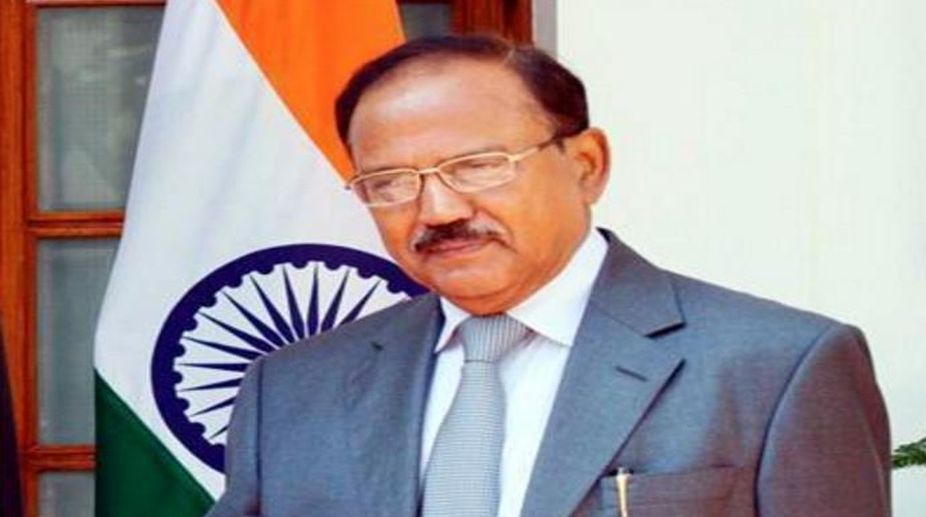
National Security Adviser Ajit Doval represented India at the meeting, which noted that BIMSTEC ((Bay of Bengal Initiative for Multi-Sectoral Technical and Economic Cooperation) member States face common security challenges and underlined the necessity of addressing traditional and non-traditional security challenges to harness economic prosperity and human security in the region.

The meeting underscored the importance of recognising the Bay of Bengal as common security space and agreed to work out collective strategies for common responses. BIMSTEC member States were also invited for a conference on counter radicalisation to be hosted by India.

Noting with concern the emerging trends in cyber space that have security implications, the meeting decided to deepen cooperation among the respective cyber institutions through a Joint Forum on cyber security, the MEA said.

It emphasised the importance of maritime security in view of the significance of the Bay of Bengal for the well-being, prosperity, security and socio-economic development in the BIMSTEC member States and decided to examine ways to further strengthen maritime security cooperation, including Humanitarian Assistance and Disaster Relief (HADR).

The meeting discussed ways and means of harnessing emerging space technologies for addressing security challenges. It decided to establish a Track 1.5 BIMSTEC Security Dialogue Forum to promote and encourage security dialogue among BIMSTEC strategic community.

India made an offer of 100 scholarships towards capacity building in security related sectors.

In view of the importance of security cooperation as a means to achieve the objectives of the BIMSTEC, it was decided to hold the meeting annually. The participants also called on Prime Minister Narendra Modi.

Ayodhya row: Parties welcome SC’s advice, Muslim bodies sceptical

Statesman News Service | New Delhi |

Political parties, including the ruling Bharatiya Janata Party (BJP) and the principal Opposition Congress, broadly welcomed the Supreme Court's suggestion on Tuesday for an amicable out-of-court settlement of the long-pending Ayodhya's Babri Masjid-Ram Janmabhoomi land dispute through talks.

The BJP-led central government also welcomed the apex court's suggestion for resolving the Ayodhya tangle–lingering for nearly three decade–through dialogue between the aggrieved parties.

Veteran BJP leader L K Advani, who was the face of his party's Ram Janmabhoomi campaign across the country in 1990s that catapulted it to power at the Centre, also welcomed the Supreme Court's suggestion, reportedly hoping that "in light of the apex court's advise, all concerned parties will reach consensus and will find a solution to resolve the Ram Temple issue".

A slew of other BJP ministers and leaders, including new Uttar Pradesh Chief Minister Yogi Adityanath, also reportedly welcomed the suggestion given by an apex court bench headed by the Chief Justice of India J S Khehar. Adityanath assured cooperation from his government in resolving the Ayodhya issue. 

"The Supreme Court has called for an out-of-court settlement between the aggrieved parties. The parties should resolve the issue amicably by talking to each other. We welcome this step and I believe they should have talks outside the court," the BJP spokesman Sambit Patra told reporters. He said the BJP will study in detail the apex court's observations, asserting that the issue is related to the faith and sentiments of millions of people.

Former Bajrang Dal leader and current BJP MP, Vinay Katiyar also welcomed the apex court's suggestion, even as another Ram Janmabhoomi campaign's leading figure, the Union minister Uma Bharti, demanded construction of Ram Temple at the disputed site at Ayodhya in Uttar Pradesh. 

Union Minister of State for Law and Justice P P Chaudhary said the government also favours talks to resolve the Ayodhya dispute, welcoming the Supreme Court's suggestion. 

"What mediation can do, cannot be done by judgement. Both the parties are happy in case of mediation but in case of judgement, one party is happy while the other is not," he said. "The matter is in the court. Nothing can be done until the Supreme Court gives the verdict. Now Supreme Court has said that solve it through negotiation. I feel that it would be solved through negotiation." 

The Congress also welcomed the apex court's suggestion, asserting that if both parties to this dispute could resolve the Ayodhya issue through negotiations and consensus, then it will be the "best way" to ensure peace  and social harmony in the country. 

"Otherwise, the court is competent to give its decision on the issue after hearing the pleas of both sides," the Congress's chief spokesman Randeep Surjewala said, adding that dialogue and goodwill have always been the cornerstone of India's pluralistic culture. 

Hitting out at the BJP without naming the party, Mr Surjewala also alleged that the ruling camp has been exploiting the Ayodhya issue for 25 years to create social strife in a bid to grab power. 

Various leading Muslim organisations appeared to be sceptical about the apex court's suggestion, highlighting that several such attempts made earlier by highest levels to resolve the Ayodhya dispute through talks had proved to be unsuccessful. Their position was, let the apex court decide the matter once and for all.   

Zafaryab Jilani of the Babri Masjid Action Committee said that going by the past experience the Ayodhya dispute could not be settled outside the court. He said, "We are ready with Chief Justice (of India) mediating… We trust him. We are also ready if he nominates a team…But out of court settlement is not possible." 

Govt admits to ‘little more’ custodial deaths in Maharashtra

Statesman News Service | New Delhi |

The government today admitted in the Lok Sabha that instances of custodial deaths in Maharashtra was a “little more” in comparison to other states.

Replying to queries on the issue during Question Hour, Minister of State for Home Kiren Rijju gave statistics of nationwide custodial deaths. He said the data revealed that there were 35 such deaths in Maharashtra in 2013, 21 in 2014 and 19 in 2015, which were highest among all states.

Rijiju said there were enough guidelines and directives issued by the National Human Rights Commission and the Supreme Court under which immediate action is taken against policemen responsible for custodial deaths.

Seeking to counter the minister, BJP member Satyapal Singh, a former Commissioner of Mumbai Police, said Maharashtra Police and Mumbai Police were the best police forces in the country evoking laughter among some members.

Speaker Sumitra Mahajan remarked, “We will have to find out your records”, leading to another bout of laughter by the MPs.

Singh said all custodial deaths cannot be described as deaths under police custody, as many of them are deaths under judicial custody, some could be natural deaths or some could be death due to illness.

However, former Union home secretary RK Singh and former Jharkhand director general police of VD Ram, both BJP MPs, seemed to disagree with Satyapal Singh and wanted to speak. But the Speaker disallowed them and moved to the next question.

RK Singh and Ram were seen gesturing towards Satyapal Singh suggesting that they would like to have a chat with him on the issue.

AIMMM ‘welcomes’ Yogi coronation, calls meet on 2019 polls

Statesman News Service | New Delhi |

The president of the All India Muslim Majlis-e-Mushawarat, an umbrella body of different Muslim organisations in the country, Navaid Hamid, has said he welcomes the coronation of Yogi Adityanath, the controversial Hindutva face, as the Chief Minister of Uttar Pradesh.

Justifying his statement, Hamid added, “I believe that there should not be any gray areas left by BJP. The BJP primarily has won these elections on the agenda of Hindutva and this appointment should be no surprise for anyone. I believe that such steps taken by BJP will develop political consciousness among Muslims and other marginalised communities.”

The Statesman got access to a letter drafted by the organisation which is to be sent to different Muslim Members of Parliament and intellectuals to attend a meet called by the Muslim body to ponder the future course of action on 29 March. 

The letter reads, “the General Elections of 2019 is round the corner. A new dawn is calling to all those who stand to protect the Constitution of India and its diverse culture. Who can deny the fact that the most critical and complex issues are concerned with Muslims and there are a lot of difficult challenges before them. Taking this into account, AIMMM is working sincerely on the above issue and it believes that it is high time; concerned Muslim leadership should understand their joint responsibility and collectively sit together, think together to formulate a strategy for 2019 elections so that modus operandi can be explored.”

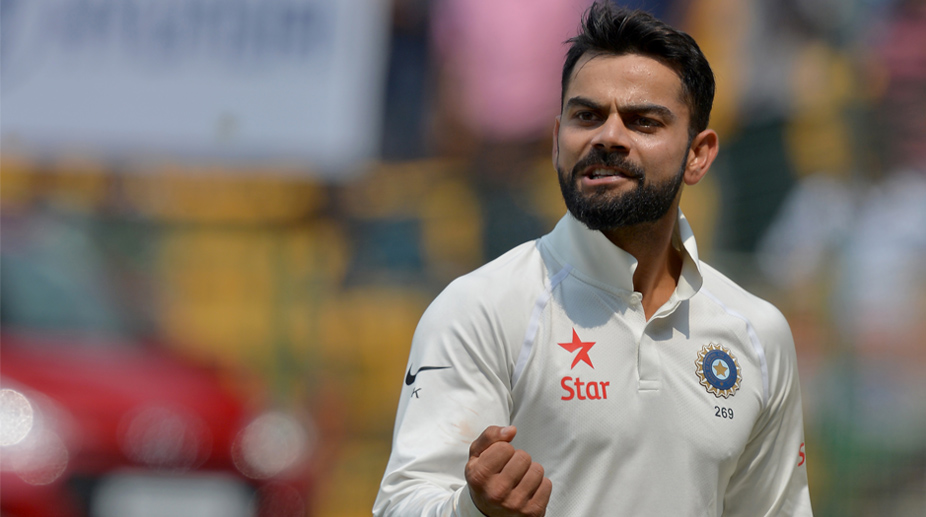
Kohli has become the Trump of world sport: Australian media

Kohli had on Monday accused the visitors of trying to disrespect the Indian team physio Patrick Farhart.

IANS | New Delhi |

The on-field antics from cricketers of either side in the ongoing India-Australia series are refusing to die down, with the Australian media on Tuesday comparing home skipper Virat Kohli to US President Donald Trump.

Kohli, who had earlier lashed out at the Australians before falling short of calling them 'cheats' after the second Test in Bengaluru, was held accountable for continual perpetuation of fake news by Australian newspaper 'The Daily Telegraph'.

The newspaper alleged that the 28-year-old Delhi batsman launched a scandalous attack on his opposite number Steve Smith and the Kangaroos where he accused of them being systematic cheats, but refused to apologise or provide any concrete evidence.

"Virat Kohli has become the Donald Trump of world sport. Just like President Trump, Kohli decided to blame the media as a means of trying to hide the egg smeared right across his face," the newspaper reported.

After completion of the third Test, which ended in a draw at Ranchi, Kohli had on Monday accused the visitors of trying to disrespect the Indian team physio Patrick Farhart.

"They (four-five of them) started taking Patrick's name. I don't know why. He's our physio. His job is to treat me. I don't find the reason behind it. I could not understand. You must ask why they have started taking his name," Kohli said at post match press conference.

Kohli, who hurt his shoulder while fielding on the opening day of the third Test, only came to bat on the third day after missing most of the action on the first two days. 

Later, it was Australian all-rounder Glenn Maxwell, who started mocking the India captain, when he dived to save a boundary. Kohli gave it back with similar gestures, when left-arm spinner Ravindra Jadeja went through opener David Warner's defence in the second innings.

Denying his counterpart's accusations, Smith said: "It was a bit disappointing. I didn't actually do anything. Virat was having a go at me saying I was disrespecting Patrick Farhart. I was probably the exact opposite."

"I think he (Patrick) probably did a pretty terrific job to be able to get Virat back on the field after that shoulder injury. He's a terrific physio and he obviously does a great job for them," the 27-year-old added.

Kohli has become the Trump of world sport: Australian media

Kohli had on Monday accused the visitors of trying to disrespect the Indian team physio Patrick Farhart.

IANS | New Delhi |

The on-field antics from cricketers of either side in the ongoing India-Australia series are refusing to die down, with the Australian media on Tuesday comparing home skipper Virat Kohli to US President Donald Trump.

Kohli, who had earlier lashed out at the Australians before falling short of calling them 'cheats' after the second Test in Bengaluru, was held accountable for continual perpetuation of fake news by Australian newspaper 'The Daily Telegraph'.

The newspaper alleged that the 28-year-old Delhi batsman launched a scandalous attack on his opposite number Steve Smith and the Kangaroos where he accused of them being systematic cheats, but refused to apologise or provide any concrete evidence.

"Virat Kohli has become the Donald Trump of world sport. Just like President Trump, Kohli decided to blame the media as a means of trying to hide the egg smeared right across his face," the newspaper reported.

After completion of the third Test, which ended in a draw at Ranchi, Kohli had on Monday accused the visitors of trying to disrespect the Indian team physio Patrick Farhart.

"They (four-five of them) started taking Patrick's name. I don't know why. He's our physio. His job is to treat me. I don't find the reason behind it. I could not understand. You must ask why they have started taking his name," Kohli said at post match press conference.

Kohli, who hurt his shoulder while fielding on the opening day of the third Test, only came to bat on the third day after missing most of the action on the first two days. 

Later, it was Australian all-rounder Glenn Maxwell, who started mocking the India captain, when he dived to save a boundary. Kohli gave it back with similar gestures, when left-arm spinner Ravindra Jadeja went through opener David Warner's defence in the second innings.

Denying his counterpart's accusations, Smith said: "It was a bit disappointing. I didn't actually do anything. Virat was having a go at me saying I was disrespecting Patrick Farhart. I was probably the exact opposite."

"I think he (Patrick) probably did a pretty terrific job to be able to get Virat back on the field after that shoulder injury. He's a terrific physio and he obviously does a great job for them," the 27-year-old added.

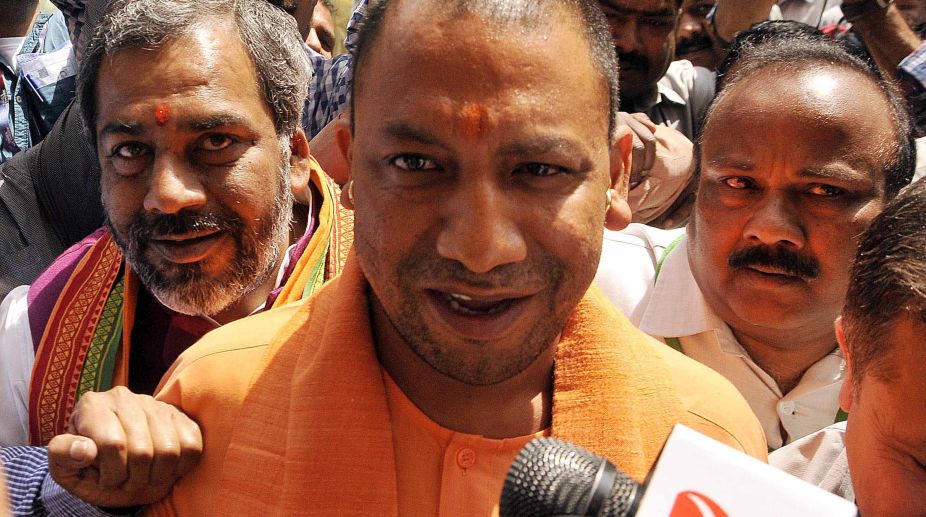
Yogi Adityanath vows to fulfil Modi’s UP dream

Statesman News Service | New Delhi |

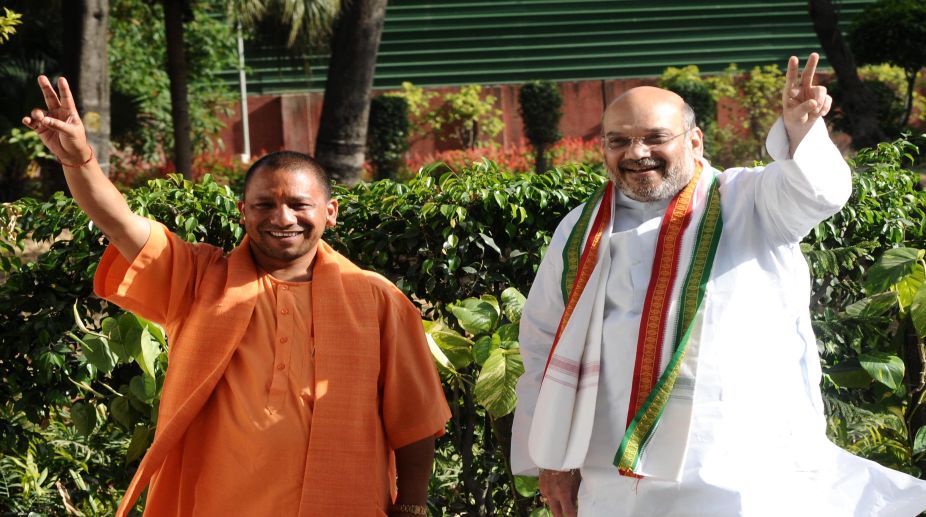
On a visit to the national capital, his first after being sworn in as Uttar Pradesh Chief Minister, Yogi Adityanath on Tuesday reiterated his commitment to work for the development of the state and live up to Prime Minister Narendra Modi’s dream of turning Uttar Pradesh into Uttam Pradesh ~ the best governed state of the country.

Adityanath's comments came after he made a sudden appearance in the Lok Sabha, donning his signature saffron robe around 4.30 pm when the members were discussing the Finance Bill. He spoke in the House being an MP from Gorakhpur.

As a special gesture, Adityanath’s name was included at the last minute as one of the participants in the discussion. As the chief minister entered the House amid chanting of ‘Jai Sri Ram’ and thumping of desks by members, Speaker Sumitra Mahajan welcomed him to speak by virtue of being a member of the House as well as the Chief Minister of Uttar Pradesh.

“You are welcome. You are the Chief Minister of UP and along with that you are a member of this House,” the Speaker said.

Adityanath, 44, waxed eloquent about Narendra Modi and his developmental initiatives. He said his government in Uttar Pradesh is committed to taking everybody along for the development of the state in accordance with PM’s ‘Sabka Saath, Sabka Vikas’ principle.

“In Uttar Pradesh, the new model of development will be based on 'Sabka Saath, Sabka Vikas…My government will be for everyone, not specifically for any caste or community… We will work for development of all sections and castes and create a new structure of progress,” the Chief Minister said.

Adityanath proposed creation of a ‘new model’ of development for UP. He said it would be implemented under the guidance of Prime Minister Narendra Modi.

“UP will be the state which our honourable Prime Minister has dreamt of, a corruption-free state, a state free of anarchy. It would be an incident free-state…Uttar Pradesh would work to make the dream of Prime Minister a reality,"  Adityanath said.

He also welcomed all the members of Lok Sabha to visit Uttar Pradesh and see the Prime Minister's dream of ‘sushasan’ unfolding before their eyes.

Congress party’s leader in Lok Sabha Mallikarjuna Khadge congratulated Adityanath and told him to lead the state of Uttar Pradesh with pride. He said in a lighter vein that members may expect many such ‘bandis’~ a pun on ‘note bandi’ ~ in the state in the days to come.

Earlier, in the day upon his arrival in the Capital the Uttar Pradesh chief minister met senior party leaders. He also met Home Minister Rajnath Singh among other leaders.

Yogi Adityanath vows to fulfil Modi’s UP dream

Statesman News Service | New Delhi |

On a visit to the national capital, his first after being sworn in as Uttar Pradesh Chief Minister, Yogi Adityanath on Tuesday reiterated his commitment to work for the development of the state and live up to Prime Minister Narendra Modi’s dream of turning Uttar Pradesh into Uttam Pradesh ~ the best governed state of the country.

Adityanath's comments came after he made a sudden appearance in the Lok Sabha, donning his signature saffron robe around 4.30 pm when the members were discussing the Finance Bill. He spoke in the House being an MP from Gorakhpur.

As a special gesture, Adityanath’s name was included at the last minute as one of the participants in the discussion. As the chief minister entered the House amid chanting of ‘Jai Sri Ram’ and thumping of desks by members, Speaker Sumitra Mahajan welcomed him to speak by virtue of being a member of the House as well as the Chief Minister of Uttar Pradesh.

“You are welcome. You are the Chief Minister of UP and along with that you are a member of this House,” the Speaker said.

Adityanath, 44, waxed eloquent about Narendra Modi and his developmental initiatives. He said his government in Uttar Pradesh is committed to taking everybody along for the development of the state in accordance with PM’s ‘Sabka Saath, Sabka Vikas’ principle.

“In Uttar Pradesh, the new model of development will be based on 'Sabka Saath, Sabka Vikas…My government will be for everyone, not specifically for any caste or community… We will work for development of all sections and castes and create a new structure of progress,” the Chief Minister said.

Adityanath proposed creation of a ‘new model’ of development for UP. He said it would be implemented under the guidance of Prime Minister Narendra Modi.

“UP will be the state which our honourable Prime Minister has dreamt of, a corruption-free state, a state free of anarchy. It would be an incident free-state…Uttar Pradesh would work to make the dream of Prime Minister a reality,"  Adityanath said.

He also welcomed all the members of Lok Sabha to visit Uttar Pradesh and see the Prime Minister's dream of ‘sushasan’ unfolding before their eyes.

Congress party’s leader in Lok Sabha Mallikarjuna Khadge congratulated Adityanath and told him to lead the state of Uttar Pradesh with pride. He said in a lighter vein that members may expect many such ‘bandis’~ a pun on ‘note bandi’ ~ in the state in the days to come.

Earlier, in the day upon his arrival in the Capital the Uttar Pradesh chief minister met senior party leaders. He also met Home Minister Rajnath Singh among other leaders.

iPhone 7 goes red to help fight AIDS

IANS | San Francisco |

Recognising more than 10 years of partnership with the Product (RED) charity that fights against HIV/AIDS, Apple on Tuesday announced iPhone 7 and iPhone 7 Plus in a vibrant red aluminium finish.

Apple is the world's largest corporate donor to the Global Fund to Fight AIDS, contributing more than $130 million as part of its partnership with (RED).

"Combining the global reach of the world's most loved smartphone with our efforts to provide access to life-saving ARV medication in sub-Saharan Africa, customers now have a remarkable opportunity to make a difference and contribute to the Global Fund through the purchase of this new beautiful (PRODUCT) RED iPhone," said Deborah Dugan, (RED)'s CEO, in a statement.

The special edition (PRODUCT) RED iPhone will be available to order online worldwide and in stores beginning Friday. iPhone 7 and iPhone 7 Plus (PRODUCT) RED Special Edition will be available in 128GB and 256GB models, starting at Rs 82,000, from Apple authorised resellers. 

"Since we began working with (RED) 10 years ago, our customers have made a significant impact in fighting the spread of AIDS through the purchase of our products," said Tim Cook, Apple CEO, in a statement. 

"The introduction of this special edition iPhone in a gorgeous red finish is our biggest (PRODUCT) RED offering to date in celebration of our partnership with (RED), and we can't wait to get it into customers' hands," Cook added.

Apple also updated its most popular-sized iPad, featuring a brighter 9.7-inch Retina display and best-in-class performance at an affordable price of Rs 28,900 (32GB with Wi-Fi). 

"iPad is the world's most popular tablet. Customers love the large, 9.7-inch display for everything from watching TV and movies, to surfing the web, making FaceTime calls, and enjoying photos, and now it is even more affordable," said Philip Schiller, Apple's senior vice president of Worldwide Marketing. 

iPad features a beautifully bright Retina display with over 3.1 million pixels for stunning pictures and videos. The Apple-designed A9 chip with 64-bit desktop-class architecture delivers fast processing and graphics performance for apps and games.

ipad, that comes with iOS 10, can also be purchased from Friday.

Apart from this, Apple also introduced Clips, a new app that makes it quick and fun for anyone to create expressive videos on iPhone and iPad. 

The app features a unique design for combining video clips, photos and music into great looking videos to share with friends through the Messages app, or on Instagram, Facebook and other popular social networks.

Clips also introduces "Live Titles", a feature that lets users create animated captions and titles using just their voice. 

"Clips gives iPhone and iPad users a new way to express themselves through video, and it's incredibly easy to use," said Susan Prescott, Apple's vice president of Apps Product Marketing. 

Clips will be available on the App Store for free beginning in April. It is compatible with iPhone 5s and later, the new 9.7-inch iPad, all iPad Air and iPad Pro models, iPad mini 2 and later, iPod touch 6th generation. Devices must be running iOS 10.3.

iPhone 7 goes red to help fight AIDS

IANS | San Francisco |

Recognising more than 10 years of partnership with the Product (RED) charity that fights against HIV/AIDS, Apple on Tuesday announced iPhone 7 and iPhone 7 Plus in a vibrant red aluminium finish.

Apple is the world's largest corporate donor to the Global Fund to Fight AIDS, contributing more than $130 million as part of its partnership with (RED).

"Combining the global reach of the world's most loved smartphone with our efforts to provide access to life-saving ARV medication in sub-Saharan Africa, customers now have a remarkable opportunity to make a difference and contribute to the Global Fund through the purchase of this new beautiful (PRODUCT) RED iPhone," said Deborah Dugan, (RED)'s CEO, in a statement.

The special edition (PRODUCT) RED iPhone will be available to order online worldwide and in stores beginning Friday. iPhone 7 and iPhone 7 Plus (PRODUCT) RED Special Edition will be available in 128GB and 256GB models, starting at Rs 82,000, from Apple authorised resellers. 

"Since we began working with (RED) 10 years ago, our customers have made a significant impact in fighting the spread of AIDS through the purchase of our products," said Tim Cook, Apple CEO, in a statement. 

"The introduction of this special edition iPhone in a gorgeous red finish is our biggest (PRODUCT) RED offering to date in celebration of our partnership with (RED), and we can't wait to get it into customers' hands," Cook added.

Apple also updated its most popular-sized iPad, featuring a brighter 9.7-inch Retina display and best-in-class performance at an affordable price of Rs 28,900 (32GB with Wi-Fi). 

"iPad is the world's most popular tablet. Customers love the large, 9.7-inch display for everything from watching TV and movies, to surfing the web, making FaceTime calls, and enjoying photos, and now it is even more affordable," said Philip Schiller, Apple's senior vice president of Worldwide Marketing. 

iPad features a beautifully bright Retina display with over 3.1 million pixels for stunning pictures and videos. The Apple-designed A9 chip with 64-bit desktop-class architecture delivers fast processing and graphics performance for apps and games.

ipad, that comes with iOS 10, can also be purchased from Friday.

Apart from this, Apple also introduced Clips, a new app that makes it quick and fun for anyone to create expressive videos on iPhone and iPad. 

The app features a unique design for combining video clips, photos and music into great looking videos to share with friends through the Messages app, or on Instagram, Facebook and other popular social networks.

Clips also introduces "Live Titles", a feature that lets users create animated captions and titles using just their voice. 

"Clips gives iPhone and iPad users a new way to express themselves through video, and it's incredibly easy to use," said Susan Prescott, Apple's vice president of Apps Product Marketing. 

Clips will be available on the App Store for free beginning in April. It is compatible with iPhone 5s and later, the new 9.7-inch iPad, all iPad Air and iPad Pro models, iPad mini 2 and later, iPod touch 6th generation. Devices must be running iOS 10.3.

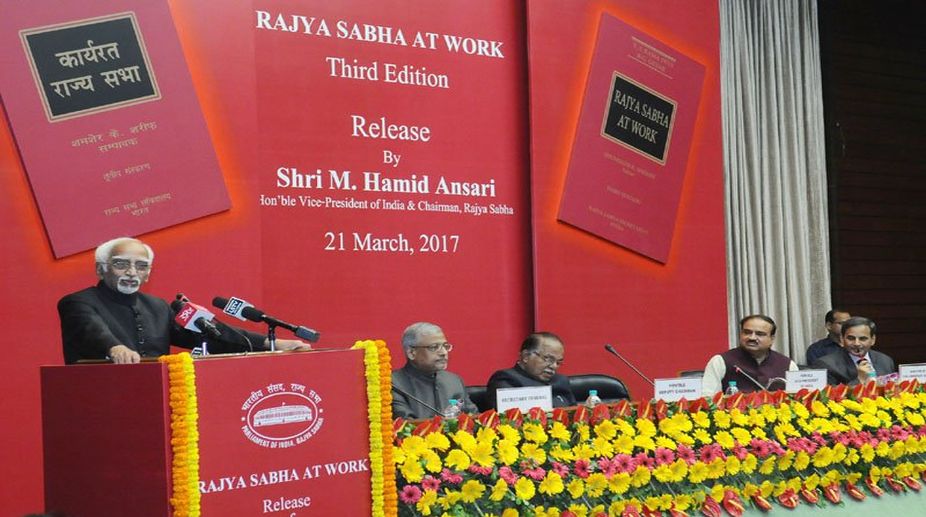
Third edition of Rajya Sabha at Work released

Statesman News Service | New Delhi |

Vice President Hamid Ansari on Tuesday released the third edition of “Rajya Sabha at Work” which compiles procedures, practices, conventions and rulings governing the functioning of the Upper House, having evolved over the years.

Speaking on the occasion, the Vice-President, who is also the Chairman of the Rajya Sabha, said the framers of the Constitution decided to create a Parliamentary structure, after a study of the best systems in the world, and provided for the Second Chamber.

The Second Chamber was certainly not meant to delay, nor to obstruct, but to give space to take a second look at legislation, Ansari said. A second look was always useful, and added to the quality of work, he said.

Select Committees of the House had through their detailed deliberations provided commendable inputs to their subjects.

Every piece of work done by these Committees added to the quality of legislation, he said.

Too many pieces of legislation these days, Ansari said, were landing in court. Perhaps sufficient attention was not paid to their drafting, he said.

The drafting was done by competent persons in different Ministries but the judges looked at the issues from different angles. Therein lay the significance of the second look at the issues, he said.

The Rajya Sabha had occasions when it displayed high quality of debate, like the one witnessed during the impeachment of a judge, he said.

The Rajya Sabha Deputy Chairman, P J Kurien, Minister of Parliamentary Affairs  Ananth Kumar, Members of Parliament,

and Secretary-General of Rajya Sabha Shumsher K Sheriff were among those present. Kurien said that “during the span of more than six decades of its functioning, the Rajya Sabha had stood the test of time and played a significant role as a legislative, deliberative and oversight body in our democratic polity.”

The Rajya Sabha Secretary proposed a vote of thanks to all those present including former Rajya Sabha Director B G Gujar, who had co-authored the first edition of the book with the late Rajya Sabha Secretary-General V S Rama Devi in 1996. The second edition came out in 2006 when Yogendra Narain was the Secretary-General.

Third edition of Rajya Sabha at Work released

Statesman News Service | New Delhi |

Vice President Hamid Ansari on Tuesday released the third edition of “Rajya Sabha at Work” which compiles procedures, practices, conventions and rulings governing the functioning of the Upper House, having evolved over the years.

Speaking on the occasion, the Vice-President, who is also the Chairman of the Rajya Sabha, said the framers of the Constitution decided to create a Parliamentary structure, after a study of the best systems in the world, and provided for the Second Chamber.

The Second Chamber was certainly not meant to delay, nor to obstruct, but to give space to take a second look at legislation, Ansari said. A second look was always useful, and added to the quality of work, he said.

Select Committees of the House had through their detailed deliberations provided commendable inputs to their subjects.

Every piece of work done by these Committees added to the quality of legislation, he said.

Too many pieces of legislation these days, Ansari said, were landing in court. Perhaps sufficient attention was not paid to their drafting, he said.

The drafting was done by competent persons in different Ministries but the judges looked at the issues from different angles. Therein lay the significance of the second look at the issues, he said.

The Rajya Sabha had occasions when it displayed high quality of debate, like the one witnessed during the impeachment of a judge, he said.

The Rajya Sabha Deputy Chairman, P J Kurien, Minister of Parliamentary Affairs  Ananth Kumar, Members of Parliament,

and Secretary-General of Rajya Sabha Shumsher K Sheriff were among those present. Kurien said that “during the span of more than six decades of its functioning, the Rajya Sabha had stood the test of time and played a significant role as a legislative, deliberative and oversight body in our democratic polity.”

The Rajya Sabha Secretary proposed a vote of thanks to all those present including former Rajya Sabha Director B G Gujar, who had co-authored the first edition of the book with the late Rajya Sabha Secretary-General V S Rama Devi in 1996. The second edition came out in 2006 when Yogendra Narain was the Secretary-General.