press trust of india
CHENNAI, 29 JUNE: Malaysian low-cost carrier AirAsia today said its Indian operations should begin later this year with three aircraft for the southern region and it would also look at setting up some ancillary businesses in the country.
“I have always said we will start in the fourth quarter. People said September, October whatever. I hope we start this year. It is not about when we start. It is about we start it right. I mean no rush,” AirAsia Group CEO Mr Tony Fernandes told reporters on his maiden visit to Chennai. AirAsia has formed a joint venture with Tata Sons and Arun Bhatia of Telestra Tradeplace with 49:30:21 holding to start its India operations.
“We haven’t got the approvals yet and I still believe we can start this year. May be September is a bit ambitious. I do not want to commit a date. Really, it is on the hands of the regulators to give us all the approvals. We are at the NOC stage. The key one is NOC. No, we have not received the NOC. It is with the Union home ministry.”
AirAsia is expected to bring in competitive pricing in the Indian aviation market with its “nano” airfares. To a particular query, Mr Fernandes said Air Asia India will be the “Chennai SuperKings of cost” in offering airline services.
“We will start with three planes. We rather not say it now (the destinations). A quick way of looking at is Tiruchirapalli. There was never a flight from Kuala Lumpur to Tiruchirapalli,” he said.
“Come next week, there will be three flights a day. We have benefited tremendous amount of people. So, we will apply tremendous amount of strategy to India and look at new destinations and markets that have been under-served.”
To a query on roping in former Tata Group Chairman Ratan Tata, Fernandes said: “He (Tata) is one of the most respected businessmen in the world, not just in India. He is humble, simple guy. He fits our culture very well.”
AirAsia to start India operations this year




HCIL to recall 42,672 Honda City cars
press trust of india
NEW DELHI, 29 JUNE: Honda Cars India Limited (HCIL) today said it will recall 42,672 units of second generation Honda City cars manufactured in 2007 and 2008 to replace their power window switch. “HCIL would carry out preventive part replacement of power window switch of 42,672 units of previous (2nd) generation Honda City, manufactured in the year 2007 and 2008,” the company said in a statement.
The company will proactively replace Power Window Switch, which may malfunction in case water or any other liquid enters the driver side window, it added.
HCIL is carrying out the part update as a preventive measure, although no such problem has been reported from any where in India. The replacement would be carried out free of cost at HCIL dealerships across India, and the owners will be contacted individually in a phased manner, the company said.
“Honda Cars India is carrying out the part replacement as part of a global exercise by Honda Motor Company to ensure stringent quality standards for its products,” it added.
The third generation Honda City cars currently sold in India, however, are not affected and does not require any part replacement. Also, global recall does not impact the Honda Jazz in India, it added.
Just living
aritra ghosh tries to unravel the many mysteries that surround our existence
Human life is a mingled thread of joy and sorrow. Every sorrow has a spark of joy underneath, every adversity gives way to an opportunity and every disappointment sharpens one’s resolve to conquer. Who could sum up this truth more succinctly than Shakespeare has done in the following lines? "Sweet are the uses of adversity
Which, like the toad, ugly and venomous Wears yet a precious jewel in his head." The banished duke in the Forest of Arden in As You Like It spoke these lines, while spending days of exile under the open sky. He, who once commanded pomp and power, was now a homeless fugitive, seeking shelter and solace in the lap of nature. This taste of adversity had its own advantage though. It made him a wiser being and opened new windows into his mind and heart and he could find-"Tongues in trees, books in the running brooks, Sermons in stones and good in everything.” Though the Duke’s utterance may sound idyllic, being cast as it is in a pastoral background, it embodies a world of truth. Misfortunes constitute the true test of one’s character.
The story of the Pandavas illustrate how they had to face misfortunes in their lives and how every difficulty equipped them with added courage to face greater challenges. The story of Harishchandra suggests how the fearless devotee of truth cheerfully faced sufferings for the sake of his ideals. If Rana Pratap was great at the battle of Haldighati in challenging the might of the likes of Akbar, he was a greater man during the hard life in the hills of Aravalli, with the Mughals always at his heels. To Shakespeare this life appears to be "such stuff as dreams are made of" while to Thomas Hardy "happiness is but an occasional episode in the general drama of pain". As the scripture says, human life is atonement for the original sin committed by Adam and Eve. We have to suffer it for as long as humankind exists.
Coordinator, Class XI, Salt Lake School
‘It takes a lifetime to even begin to understand the nuances’

Set to do a repeat performance in New York some time later today, Ayona Bhaduri tells aparajit chakraborty that the shift from Bharatnatyam to Odissi was a difficult one
HAVING put in one performance in New York, Ayona Bhaduri will do a repeat some time later today in the Big Apple to promote Odissi in a programme presented by the Trinayan Dance Theatre. She trained in Bharatnatyam for seven and half years and then withched to Odissi, of which form she is one of the finest young exponents. She was introduced to Bharatnatayam under guru Meena Mukherjee and then came under the tutelage of Bijayini Satpathy at Nrityagram in Bagalore.
Bhaduri was always keen on academics but her parents persuaded her to join Nrityagram and opt for dancing as a career. Now based in Kolkata, she worked with leading choreographer Sharmila Biswas as a senior repertory dancer and administrator at her institution, Odissi Vision & Movement Centre and is currently a soloist.
She has received repeated acclaim in major cities in India and abroad at dance festivals and some of her notable performances include the American Dance Festival, Jacob&’s Pillow Dance Festival, Spoleto USA Festival, Yerba Buena Center for the Arts, Central Park Summerstage, Skirball Cultural Center and Symphony Space, New York. She has performed at the Maximum India Festival hosted by the prestigious Kennedy Centre in Washington DC and has also travelled to Senegal, West Africa, Sri Lanka and South Korea to promote Odissi.
For her contribution to the art, Bhaduri has received a senior scholarship in Odissi from the Union ministry of culture, the Nalanda Nritya Nipuna Award 2010 and the Odissi Jyoti title in 2009. Excerpts from an interview:
– What led you to opt for dancing as a career?
An article on Protima Bedi in a Sunday magazine introduced me to Nrityagram as a dance village. It intrigued me so much that when Nrityagram advertised in Kolkata calling dancers to audition for a six-year residential course, I decided to find out about this too-good-to-be-true school. So I auditioned and was selected two days later. I was always more keen on academics, though, and when I had to choose between studying architecture and dance, I would have promptly chosen the former, had it not been for my parents who persuaded me to join Nrityagram. So, much against my will I started my life as a dancer in Nrityagram. It was only after a few months of living in such an artistic ambience, practicing dance for eight-10 hours everyday and watching Bijayini Satpathy and Surupa Sen practice, teach and perform that I felt inspired enough to take up dance as a full-time career.
– You trained in Bharatanatyam before taking up Odissi as a preferred medium. What influenced this decision?
The lyricism and softness of Odissi appealed to me instantly over the dynamism and vibrancy of Bharatnatyam, which I had been practicing for seven and half years when I first saw Odissi.
– Was Odissi a difficult dance form to learn?
Yes, the shift from Bharatnatyam to Odissi was a difficult one. More so, because Odissi is danced continuously in a position where the upper body, being soft and fluid, is pushed through extensive isolated torso movements while the lower half of the body is strong and very grounded. So these two different energies are constantly juxtaposed and the beauty of Odissi lies in finding the fine balance, both physically and emotionally, of the two.
– Who has been the driving force in achieving perfection?
At different stages of my career, I have had different people inspiring me. At the initial stage, it was Meena Mukherjee who introduced me to the world of dance through Bharatnatayam. Her cheerful nature and continuous encouragement made dancing fun for me. Then, at Nrityagram, I was motivated by the dedication and perfection of Bijayini Satpathy, who taught me with utmost care and instilled in me the discipline necessary to become a professional dancer. Later, Sharmila Biswas, who was extremely generous in supporting me while also giving me the freedom to grow as an individual artist. And finally, Madhavi Mudgal, one of the finest gurus I have had the opportunity to watch practice, perform, teach and choreograph, whose depth of knowledge ignites in one and all the desire to excel and achieve perfection.
-How important has the role of your guru been in your journey as a dancer?
I have been inspired by different gurus at various stages and the role of each one has been crucial and instrumental in making me what I am today. I feel fortunate to have met and interacted, even if briefly, with such eminent gurus like Madhavi Mudgal, Leela Samson, Sharmila Biswas. But I have been most influenced by Bijayini Satpathy and Surupa Sen and from having spent my formative years as a dancer under them in such a place as Nrityagram. My dance is very much a reflection of that.
– After how many years would you say you’ve managed to master the nuances of the dance form?
Indian classical dance is so vast in its depth and content that I feel it takes a lifetime to even begin to understand the nuances. Because the classical dances integrate history, literature, poetry, architecture, sculpture, science and so much more. And as one matures in the art form, with every step one uncovers a new layer that makes one feel that what one was practicing and perfecting till now was only a small drop in a vast ocean of content. So after 15 years of practicing and performing Odissi, I realise that I have only just begun to learn its subtle nuances.
– From your first performance till your next, how much have you matured as an artiste?
The life of an artist is one of constant learning and self-discovery. The journey from the first performance till the next has been one of continuous perseverance, hardship, of dark, empty moments, again ecstatic moments, of sacrifices and many mistakes and each experience — both in dance and life — has informed my dance, evolving and maturing my art all along. For me, dance is a reflection of life the way I have experienced it and with each passing day something in my dance changes, evolves, as I mature with the enriching experiences of everyday life.
– Did you have any particular plan after you completed your training in Nrityagram?
I grew up as a dancer in Nrityagram, having received one of the best trainings in Odissi, in my opinion. And that, till today, is the foundation of my dance upon which I continue to stand unfaltering and grow as an artist. Much as I believe in the rigours of Nrityagram&’s training, I also think it is equally important for a thinking dancer to move out of the protective shelter of her guru to perceive dance individually. I stepped out to find my own dance. I wanted to work with another choreographer in another set up to further hone my aesthetics and sensibilities before I started working on my own.
– Do you feel the investment in classical dance is not as rewarding as it should be?
A career in classical dance is a difficult one, especially when it is constantly being compared with other career choices such as engineering, medicine, banking and so on, where one benefits largely because it provides financial security/stability, more material gains, a more comfortable lifestyle — all of which dancing can never desirably fulfill.
But the joy, the sense of completeness that dancing brings can never be bartered for anything else, no matter how good that may be. I think Indian classical dance requires maximum intelligence for its training, presentation and propagation, more than studying any other discipline and today I don’t regret my decision to invest so much of myself in this art form at all. Because dance integrates all — the body, mind and soul. Dance has made me the person I am today, and the journey till now has been truly rewarding.
Dancing is and will remain my one and only choice as a full time career and the money that comes with it, for me, is enough to sustain my aspirations as an artiste. I think one has to choose between convenience and passion. I can only say that I am fortunate enough to choose my passion over anything else while many talented people are not, as circumstances often compel them to choose otherwise.
– Your challenges as a performer?
First and foremost is sustainability. A performer never has a fixed income, nor does she know when and how her next call for a performance will come and how much she will earn from it. And yet, she has to work very hard every day to keep fit, build stamina and rehearse for any possible upcoming show.
Next, generating funds for her creative work. Dancing is a lifetime investment where one has to repeatedly invest in costumes, jewellery, music — live or recorded — research work, publicity material (brochures, website, etc) and other paraphernalia that are indispensible to performing on stage.
Then there&’s the administrative aspect of dance which the performer has to singlehandedly take care of. This includes liaising with performance organisers and festival curators for promoting her work, doing publicity for her shows, managing accounts, travel plans, accommodation plans, relevant paperwork, etc, all of which lead to the success of the final performance.
There is also the need to have one&’s own creative space to rehearse in, to choreograph, to teach, to explore.
– Apart from Odissi, what are your other passions?
Indian classical music. I find music complete in itself and dance incomplete without it. Music, its lyrical and melodic aspect in particular, interests and motivates me largely.
– Do you find any interest among the new generation to learn Odissi?
Yes, there is a lot of interest among the new generation. Again, the interest needs to be cultivated and nurtured, which I believe is the role of the teacher. Dance is not only about the physical form, it must also intellectually stimulate the mind, which the new generation seeks. And the teacher should be able to do both. Unfortunately in Odissi, we have so many teachers who are unable to teach beyond just the physicality of dance, unable to provide food for thought to the student. And that&’s when the student loses interest and Odissi loses out on talented dancers.
Again, not everyone learns dance to become a professional. In this age of globalisation and the heavy influence of Western culture, I feel the practice of Odissi or any other classical dance form helps our young people to not only appreciate India&’s rich cultural heritage but also stay connected to their roots. And the new generation is interested in our culture. It is left to us, the performers and teachers of Odissi or another style, to inspire them and pique their interest enough to study the art form.
– What are the future prospects for a budding Odissi dancer?
One has to first decide what one wants to become — a performer (soloist or repertory artist), a choreographer, a teacher or an arts administrator. I feel dancing can lead to all of these. One has to start with performing, of course, but by the time one is 30 years old one is mature enough to realise which aspect of dance interests her the most. Once decided, the preparation then begins for the choice one makes. But overall it remains a very personal journey.
– What suggestions do you have to popularise Odissi?
I feel the first step should be to include Odissi as a compulsory component of our education system. This would help in not only creating Odissi dancers but also dance audiences who are well informed about the dance form.
Informative Exhibition
Vladimirovna Tereshkova (born 6 March 1937) is a retired Soviet cosmonaut and the first woman to have flown into space in Vostok 6 on 16 June 1963.
In order to be considered for the Cosmonaut Corps, Tereshkova was inducted into the Soviet Air Force and she also became the first civilian to fly in space.
Celebrating the golden jubilee of the first space flight by a woman cosmonaut, Russian Centre of Science and Culture in Kolkata and Birla Industrial & Technological Museum jointly organized an exhibition on Valentina Tereshkova which was inaugurated on 17 June at BITM by Ms Irina K Bashkirova, Consul General of the Russian Federation, Kolkata. Mr. Alexander Mazirka, Vice Consul and Director, Russian Centre of Science and Culture in Kolkata, Mr G S Rautela, Director General, National Council of Science Museums and Sk. E. Islam, Director, Birla Industrial & Technological Museum were also present in the inaugural programme.
A film Valentina Tereshkova was screened after the inaugural programme and will also be available for public viewing during the exhibition period.
The exhibition will continue till 28 June daily from 10 am to 5:30 pm.
Row, row, row your boat…
The 41st K C Mahindra All India Invitation Schools’ Regatta 2013, which is a week-long national rowing Championship reached its conclusion on 15 June. Introduced in 1973, the event has gained national recognition by the Rowing Federation of India and is one of the oldest and the largest rowing events in Asia, with the widest participant base of rowers. This championship, which was hosted by Lake Club, tested the sportsmanship and dexterity of 350 young rowers from 67 schools across India with entries from Tamil Nadu, Assam, Madhya Pradesh, Maharashtra and Andaman and Nicobar.The categories up for winning were Single Scull and Coxed Fours across both Junior and Senior Girls and Junior and Senior Boys. A total of 8 schools emerged victorious in these categories.
The chief guest, Mr MK Narayanan, Governor of West Bengal, facilitated the winners. The winner in the Junior Girls Single Scull is South Point High School and Junior Boys Single Scull is KV Assam. The winner of Senior Girls Single Scull is National High School for Girls and Senior Boys Single Scull is Govt. Boys School, Andaman. In the Coxed Fours category, the winner in junior girls group is GD Birla and junior boys group is La Martiniere ‘A’. In the Senior Girls group, the winner is Govt. Girls School Andaman, and in Senior Boys group the winner is KVN Naik College, Nashik. The last two categories up for grabs were the overall winner across both boys and girls. Govt. Boys School Andaman and Govt. Girls School Andaman were declared as the overall winners of the championship.
Additionally DPS Nazira, Assam and National High School won the two trophies for the best-disciplined school team, in both the Girls ‘and
rupak deb
Thrilling competitions
Satrangi, the inter-school singing competition for the M P Birla Trophy, hosted by South Point High School, was held on 14 June at GD Birla Sabhaghar. At the prelims held earlier, eight of the 15 participating schools were selected for the finals. These teams, each comprising three members, were Apeejay School, Ballygunge Siksha Sadan, Gokhale Memorial Girls’ School, Indus Valley World School, Laxhmipat Singhania Academy, National High School (Girls), Shri Shikshayatan School and the hosts, South Point High School. The moderator, Mir, regaled the audience with his repartees. Debojyoti Misra and Somlata Acharya Chowdhury judged the presentations. Each team had to sing three songs.
The first round was Tarang, a group presentation of any Bengali or Hindi songs. The second round, Tarannum, was dedicated to 100 years of the Indian cinema. It was a solo round. The third round, Tere Sur aur Mere Geet, was a judges’ choice round where any one member of the group (chosen by the judges) was asked to perform a song from a particular genre, chosen by the judges. The winning teams, South Point High School and Gokhale Memorial Girls’ School (joint-winners of the M P Birla Trophy), Shri Shikshayatan School (First runner-up) and Laxhmipat Singhania Academy (2nd runner-up), will receive cash prizes worth Rs.15,000, Rs.10,000 and Rs. 6,000 respectively on 4 July 2013, the birthday of M P Birla at a grand ceremony.
The evening ended on a cheerful note with Somlata Acharya Chowdhury joining in the chorus with the participants and singing her popular numbers.
As many as 18 schools of Kolkata, including Birla High School (Boys), Delhi Public School (Megacity & Ruby Park), La Martiniere for Girls, Modern High School for Girls, South City International School, St James School and St. Xaviers School, took part in the MP Birla Inter-School Quiz Competition, Q-Point, at GD Birla Sabhagar on 13 June 2013, under the aegis of the MP Birla Foundation. Charanpreet Singh was the quizmaster. The event included an audio round, a ‘Who-Am-I’ round, a visual round, a buzzer round, a connection round and two dry rounds. Among the 18 schools, eight qualified for the finals. While Birla High School bagged the M P Birla Trophy, Modern High School and Don Bosco School occupied the second and third positions. Cash prizes worth Rs.15,000, Rs.10,000 and Rs.6,000 will be handed over to the top three teams on 4 July 2013.
Aliens Sighted!
Even if extraterrestrials are visiting our Planet, they too must be sending their researchers to explore life forms just as we have sent Curiosity to Mars in quest of life. rounak bose takes a closer look at some of these ‘visits’
Anything is possible in this age of Photoshop and CGI, but before all that came some pretty crazy pictures. Whether we believe it or not, these possibly extraterrestrial newspaper sensations, seen by many and photographed by few, mark some of the world’s greatest mysteries.
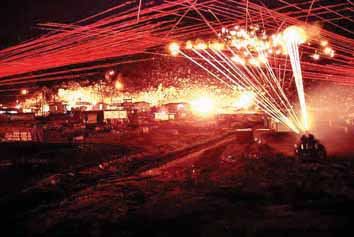
In Los Angeles, 1942, just three months after the Japanese attack on Pearl Harbour, between 24 and 25 February, an Unidentified Flying Object was spotted. Assumed to be another air strike from Japan, the UFO triggered a massive anti-aircraft military attack. The true identity of the object is still unknown. An unusual formation of lights flew over Lubbock, Texas, in 1951. Spotted by three professors from Texas Technical College and later photographed by a student, the UFO featured twenty to thirty lights that flew overhead in a "V" formation.
The sighting was so popular and highly publicised that the photos and the story appeared in the Life Magazine in 1952. First spotted on an air-traffic controller’s radar, seven objects moved in unusual flight patterns that witnesses called bright orange lights. The most publicised sightings occurred in consecutive weekends with the objects moving over the White House.
The incident was so publicised that it prompted then President Harry Truman to demand an explanation. These are instances of just UFOs being photographed.
The most substantial evidence was found in the case of what is also considered the most famous UFO related incident and suspected Government cover-up in 1947. Debris from an alien ship (or experimental high-altitude balloon as is claimed) was found in the desert of New Mexico, beginning one of the biggest controversies and mysteries in US history. "I saw UFOs on four different occasions as I grew up in West Texas. It was very exciting and each was an experience I will never forget," said a person who did not want to be named.
However, some people have said that the photos of the UFO sightings are fake. "All of these photos are fakes ~ Highway One’s a doll’s, Light beam one is a double exposure with the camera upside-down, Capitol one is dashboard lights reflected off rear windshield…" in response to some photos of alien sightings published in a magazine.
Charles Hickson, the chief claimant in the Pascagoula, Mississippi, UFO abduction case, died of a heart attack on 9 September 2011 at the age of 80. Until his death, he maintained the truth of his alien encounter- that has remained the second most famous UFO abduction case in history, according to UFO historian Jerome Clark. Hickson, then 42, was fishing from an old pier on the Pascagoula River with 19-year-old Calvin Parker Jr., on the night of 11 October 1973. Hickson claimed they heard a "zipping" sound and encountered a glowing object- an elongated UFO – hovering above the ground.
Three robot-like aliens exited from the craft: although they were gray humanoids just over five feet tall, they were otherwise of a type not reported before or since then. Each entity lacked a neck, exhibited only slits for eyes and mouth, had a nose, and ears that were sharp protrusions, and possessed clawed hands.
The legs were joined, pedestal-like, and the entity glided. The two men claimed they were taken aboard the spacecraft, where they were examined, after which they were returned to their fishing site. Unnerved, they sat in a car to regain their composure (with Hickson drinking alcohol) and then reported their experience to the Sheriff. Although the UFO reported by the men had not been seen by people on the heavily used highway nearby, there had been other UFO sightings in that area, including on the night in question.
The UFOs were variously described ~ some saw a helicopter-like object; one person reported a supposed experiment from an Air Force Base and so on. UFO believers J Allen Hynek of the Center for UFO Studies (CUFOS) and James Harder of the Aerial Phenomena Research Organisation (APRO) accepted the pair’s veracity, and both rushed to interview the "abducted."
Harder tried unsuccessfully to hypnotize the men but concluded that they had indeed experienced "an extraterrestrial phenomenon." Hynek believed the pair had had "a very real, frightening experience." The Sheriff’s department also felt the men were telling the truth, and Hickson requested and passed a lie-detector test arranged by the agent with whom the men had signed a contract to promote their story. Parker suffered a breakdown and was briefly hospitalized.
The men’s fantastic report drew much skepticism. Famed UFO skeptic Philip J Klass noted discrepancies in Hickson’s account (for instance, once referring to the creatures as having a "hole" for a mouth, but later calling it a "slit"). Klass also pointed out that an "inexperienced" polygraph operator conducted the lie-detector test and that Hickson refused to take another, administered by an expert police examiner. Based on other evidence- including the fact that Hickson had once been fired for improperly obtaining money from employees under his supervision ~ Klass concluded the case was a hoax.
So which was it: a genuine alien abduction, or a hoax? Or is that a false dichotomy? In reviewing the case, another possibility was found: the two men, who might have been drinking before the incident (as Hickson admitted he was after), might have dozed off. Hickson could then have entered a "hypnagogic" (waking dream) state, a trancelike condition between waking and sleeping in which some people experience hallucinations, often with bizarre imagery, including strange beings (like aliens, ghosts etc.). When all the facts are weighed, the preponderance of evidence appears not only to favour the hypothesis involving the hypnagogic state but also corroborate it. The realisation may not benefit the late Charles Hickson, but it could help others who hear of supposed alien abductions, to rest in peace.
As Clifton Fadiman had said, "Science fiction is a kind of archaeology of the future." So people like Hickson are none but highly successful science fiction story writers. Even if the extraterrestrials pay visits to Mother Earth, let them. In that case, they must be sending their researchers to explore life forms on the Blue Planet, just as we have sent Curiosity to Mars in quest of life, there.
St. Augustine’s Day School, Kolkata
Advertise
| |||||||||||||||||||||||||||