


suchayan mandal caught up with Shilpa Shukla before the ‘hot’ BA Pass hit theatres
‘A young college boy and a mysterious, married woman embark on an erotic journey that threatens to spiral out of control”: this defines Ajay Bahl&’s upcoming movie, BA Pass (set for a 12 July release). A small town youngster moves to Delhi to stay with his aunt and finish college. He is, soon enough, seduced by this mysterious, married woman who he knows as “Sarika Aunty”. Set amid the neon-lit bylanes of Delhi&’s Paharganj, an erotic human drama unfolds between the two.
As he gets more and more entrenched in his surroundings, he discovers a city that thrives on corrupting even the most naive and innocent. “Sarika Aunty” is played by Shilpa Shukla, dusky diva of B town, and she unwinds on how it all came about. Excerpts:
Your character in the movie…
It&’s basically the story of an unhappily married woman. Her husband has a government job and there is some pain she is hiding. So she seduces a young guy who comes to Delhi for studies. She doesn’t realise that she is doing something wrong because it&’s the circumstances that force her to do so. Her own loneliness is the reason for indulging in carnality. I understood there was scope for redemption in Sarika.
From a stubborn role in Chak de India to seductress in BA Pass…
It&’s a definitely a good transformation. From a realistic character to becoming someone who is conventionally beautiful. Otherwise, I have actually stepped out of my comfort zone. In that sense, even before Chak De I had never played hockey, but here I never thought of getting this opportunity ever. So the transformation was lovely. I never imagined I’d play this kind of role. For one year, Sarika was in me. But now once it&’s on posters and teasers. She is no more in me. I have loved everything about Sarika.
The difficulty level of playing this character…
This role was definitely my most challenging till date. In a sense, sometimes it was obviously easy because she is so luxuriant with her body, but again the dialogues were quite tough. It wasn’t the love-making scenes that bothered me, it was how she would speak, sit and walk that concerned me. But after the first day of shooting, once we were on the floor, it just flowed.
Remarkable event during shooting…
We were shooting and Ajay (Bahl) was directing. Every day something happened. The funniest moment was when we were having a briefing before going for a shot. I have a tendency to hold the script till the camera starts rolling. It&’s not that I’m mugging but just for the sake of confidence. At this, Ajay got pissed off and said, “I’ll screw the script.” This hurt me a lot and I just walked off the set. The director didn’t try to persuade me, rather he said he would do away with me. He was talking to everyone when the shooting stopped but not to me. Later we both calmed down and resolved our issues. I still laugh a lot remembering this.
Family issues in the bold scenes…
My husband Mohit is the associate director of this movie. But he and I are very good friends above all and he had no issues. I told my parents about the scenes. My mother liked it and watched the movie at Osean and she advised me not to be impulsive while talking to people on this issue. Unfortunately, I lost my dad before the film was completed so he couldn’t see it.
Preparing for the scenes…
We had a personalised workshop in the middle of Connaught Place, soaking in the summer sun. Ajay only gave one instruction: whether you’re shooting or off, a professional distance needs to be maintained. I agreed. We didn’t lunch together or have dinner together, we maintained the distance. Once we entered the character, love-making and seduction scenes were done with ease. It was such a great high. The second chunk of love-making was very aesthetic. In foreign films, you can have frontal nudity but at home we had to be cautious.
Your comeback after so long…
It was not planned. I was happy. BA Pass just happened to me. Before signing, I was asking myself if it was something I wanted to do. I took a break. I extended my other areas of work. I don’t understand why some actors choose the same lifestyle and thought process! I thought that if I could do this, I’d excel in it. I come from a theatre background so I analyse roles before going for it. Just looking at myself from that corner, I decided to do this.
Upcoming ventures…
Veena Bakshi&’s The Coffin Maker. Based in a small village in Goa, this is about Anton Gomes, who comes from a family of carpenters and takes to making coffins. He is disillusioned and is challenged by death. I play a Konkani drunkard here.
Dream…
I would like to work with Rajnikanth. If I have a dream, it&’s certainly to work with him.
‘We had to be cautious


Interpreting movements with clarity and new dimensions
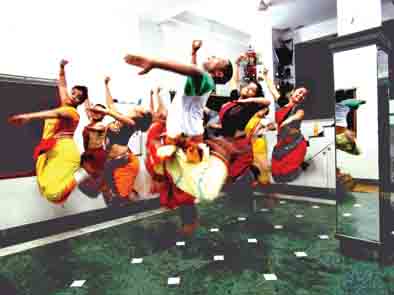
tapati chowdurie recently attended Odissi and Mayurbhanj Chhau workshops
ODISSI exponent and Sangeet Natak awardee Sharmila Biswas is a dancer with a difference. She not only thinks and acts for the improvement of the dance form by working on its weak points, but also has a keen eye when it comes to training her students meticulously. With these aims in view, her Odishi Dance Vision and Movement institute conducted a workshop recently. The workshop was conducted by Lingaraj Swain, a student of Gangadhar Pradhan and Bichitrananda Swain. He is the senior guru of Konarak Natyamandam and repertory teacher at the Utkal Sangeet Mahavidyalaya. He has been associated with ODVM for the past 15 years.
Lingaraj Swain is a dedicated teacher, with a sharp eye for detail and what makes him very special is the rare ability to evolve and interpret movements with clarity and new dimensions.
Why I say Sharmila is a discerning guru is that she also held a Chhau workshop along side, because of her discovery that both Odishi and Mayurbhanj Chhau have been developing along parallel lines, which would give her students a chance to practice postures and stances of the form that would give support, strength and vigour to Odishi techniques and movements.
The Chhau workshop was conducted by Trilochan Mohanto from Baripada. The Centre&’s support of Mayurbhanj Chhau for the past 20 years has rejuvenated and helped the form evolve as one the finest performing art forms of India.
Shashwati Garai Ghosh, Priyanki Chatterjee, Jhinuk Nag, Neelay Sengupta, Krishnendu Roy and Sohini Majumdar helped Sharmila conduct the twin workshops. The other participants were the students of Shashwati, Krishnendu and ODVM students.
The Odishi workshop focused on bhramaris — circular movements. Almost 30 years back Guru Kelucharan Mohapatra had compiled all the possible bhramaris performed in Odishi and had categorised them into groups. Lingaraj Swain and Sharmila added a few more and taught the students.
At the end of the workshops, Sharmila presented a few pieces to a select group at Padatik Buildwel Theatre. The students did a Ganesh Vandana with simple and basic technique of Odishi. According to Sharmila, teaching expressional dance is difficult, mainly for two reasons: teachers lay stress on “angika abhinaya”, which makes students mere imitators at the expense of shutting out their minds and soul; and, added to this, the students take to heart whatever expression they have imbibed, which is difficult to erase.
Therefore in abhinaya it is important for the dancer to identify himself/herself with the main character one is depicting, as well as the characters that fleet in and out as the dancer becomes the storyteller, and maintain the stylisation required for Odishi dance, and, ultimately one has to be natural. Abhinaya entails a lot of work for both the dancers and the teacher.
At the Chhau workshop, Sharmila said that “when we include a traditional art form other than Odishi in the curriculum, besides familiarising dancers with their roots, it also makes them learn how that particular form is adding to their Odishi experience”.
Odishi and Chhau being close cousins, they are both aware and independent of each other. Many of the movements are basically similar, but are executed with different techniques and expressions. Sharmila demonstrated how the technique of Chhau, like the shifting of weight, control of the pelvic region, flexibility of the joints, balance, upper torso movements, concentration, endurance, freedom and stamina could benefit Odishi dancers.
Padatik Dance Centre presented a collage on 30 June at Padatik Little Theatre II. Anuranam, which means vibration of sound, was its first presentation. Vibration of music leads the dancers to perform with joy and abandon. There was beauty of movement created by Souvik Chakraborty who choreographed it in Kathak style and the music was by Anushka Shankar. Black Coffee, choreographed by Susmita Chatterjee, explored the various features of Indian classical rhythms from the Kathak repertoire, using contemporary movements. The music was by Mayukh Bhowmick. Dancers Anirban Pramanik, Debjaya Sarkar, Srabanti Das, Sanchari Nandi and Proma Mukherjee were in excellent form and were a treat to watch.
Rabindranath Tagore&’s poignant tale, Kabuliwala, was presented beautifully. The script and choreography was by Sushmita Chatterjee and was in the form of mono-acting, performed by the very talented Baidurja Chatterjee. Kunal Padhy lent his voice while the play was directed by anardan Ghosh. Little Baidurja had the versatility to sing, dance and act with ease, keeping the audience glued from start to finish.
Souvik Chakraborty&’s Krishnokoli was an interpretation of a selected portion of Tagore&’s Akash Prodeep. Souvik conceptualised it as the love story of a young village boy for Krishnokoli, whom he had seen on a cloudy day in the field. He fantasises, and romanticises his love for her in innumerable ways using the lyrics of Tagore mainly. A platonic, one-sided relationship develops in the boy, which is his wealth throughout his life. The music was by Agnibho Bandopadhyay while the recitation was by Sukumar Ghosh. The piece was aesthetically beautiful.
Some Dots, the last presentation, was choreographed by Anil Panchal of Delhi in Mayurbhanj Chhau and contemporary dance style and technique. The theme of the dance-theatre piece was the journey of human souls trying to discover themselves. It involved drama, music and various dance techniques for the portrayal of human emotions. Dancers Reshmi, Wanshu, Devika, Lazip, Prosenjit, Narottam, JD and actors Pratigya, Maruf and Sushil were highly disciplined. Light and sound by Pabitra Sarkar and Subho Das was helpful in bringing out the theme.
Anil Panchal, who is trained in Mayurbhanj Chhau from the Natya Ballet Centre, is famed for his improvisation in both traditional and contemporary dance technique. Over the years he has worked with several national and international choreographers and has also participated in various prestigious festivals and musicals both in India and abroad, some of which are: “Flavours of India”, in Australia; “India Summer Festival”, Switzerland; Sangeet Natak Academy Festival of choreographic work, Assam; Ibsen Festival, Norway; World Performing Arts Festival, Pakistan; Swan Lake in South Africa and Russia; Khajurao Festival of Dance; and Sadir Theatre Festival, Goa.
Mind-blowing talent hunt
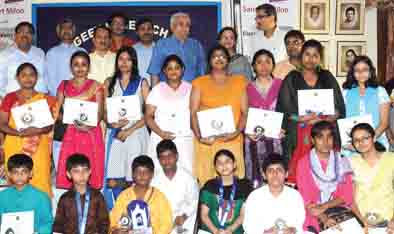
meena banerjee participated as a member of the jury
Voice of Kolkata
NINE-YEAR-OLD wonder boy Saagnik Sen lifted The State Bank Classical Voice of Kolkata trophy on 23 June at the ITC SRA auditorium. He gave a soul-stirring recital as a junior contestant – invited by Sangeet Milon, a Lucknow-based organisation, which was in Kolkata as it has launched an ambitious project to identify the “Classical Voice of India”, the finals of which will be organised in Lucknow after identifying talents from all over India.
The State Bank of India and ITC Sangeet Research Academy sponsored the Kolkata chapter of this classical music contest which was held on 22-23 June and assessed by judges like Sangeet Milon&’s beacon, Milon Debnath, Kolkata&’s renowned veteran musicians, Samar Saha (tabla) and Jyoti Goho (harmonium), ITC SRA&’s junior gurus and brilliant vocalists, Wasim Ahmed Khan and Omkar Dadarkar, and yours truly. After the contest, there was a prize distribution ceremony on the final day. The guests of honour were Ravi Mathur, executive director, ITC Sangeet Research Academy, and R Arumuga Pandi, general manager, State Bank of India. They gave away the trophies to the winners who once again presented their recitals for the audience.
Eye-opener
This was an eye-opener! People who lament that Indian classical music is a dwindling art should have been there to witness this Young Bengal with its genuine passion for this genre. While skeptics doubted there would be participation of a good standard, there were around 68 contestants in all, with 20 in the Junior group, 30 in the Middle group and 12 in the Senior group (khayal) and five participants in the Dhrupad category. It was a wonderfully successful programme with the entire environment reverberating with strains of popular ragas like Madhuwanti, Bhimpalasi, Miyan ki Todi and Yaman. Each contestant had to perform vilambit khayal and drut khayal, replete with vistar and tans, within 10 minutes. Most did this with superb dexterity. Contestants within the nine-23 age groups delighted the judges and organisers alike with their mellifluous melodies – most of which was innovative and improvised and not by rote only! This, according to me, was the most heartening aspect as there was a group of contestants that, apparently, was groomed together in one particular raga with the same compositions. Under the circumstances, mugged up performances would have been terribly tedious to assess.
Winners
Among the three categories, the Junior group was the most impressive, with amazing prodigious talents adorning the stage. It came as a wonderful surprise because this kind of matured participation was least expected from these children. Also, this was the only group that was totally dominated by young boys! It was a very difficult task to choose winners from such gifted children, but Saagnik Sen won the first prize and the Kolkata trophy hands down. He stood out for the unusually matured emotional contents in his delineation of raga Todi. He sang “Ab morey Ram” (slow ektal) and “Ab mori naiya paar” (fast teental) with peaceful vistar, neat sargams and thrilling taans interspersed with heart-rending pukars. One rarely finds such depth in such a small child.
On the other hand, Koulik Bhattacharya, another gifted child who also sang Todi, displayed stunning virtuosity as a “complete” performer with all the khayal elements at display. He stood third. The second position was a tie, shared by Ishan Ghosh and Arka Seal, while consolation prizes went to Tuhin Roy and Vedatrayi Bhattacharya.
Almost half the contestants flocked in the Middle group. The reason, probably, is less pressure from academics. Also, very few boys participated in this category as singing takes a back seat because most go through a change of voice in their early teens. So, this was captured by girls, entirely. Mayuri Saha stood first in this category with her brilliant recital in raga Madhuwanti (vilambit ektal, drut teental). Banhi Roy won the second position and third position was shared by Ankita Chowdhury and Shreya Mazumdar. Consolation prizes went to Rishita Saha and Sumedha Dey.
Among the Seniors, Iman Biswas gave a very convincing recital in raga Bhimpalasi and bagged the first prize. Tanula Chakraborty stood second and Sayan Sikdar third. But the latter appeared far too confident as a performer and commands attention. Reshmi Bhattacharya and Ankita Chakraborty won consolation prizes.
Dhrupad
In comparison, as is evident from the numbers, there were very few contestants in the Dhrupad category – and with good a reason. According to masters, the maximum age limit (23 years) is too challenging for a dhrupad singer and this should be relaxed to encourage more dhrupad students to come forward. But one was pleasantly surprised to find budding dhrupad singers like Sneha Chakraborty and Aparajita Bhattacharya. While Sneha enchanted all with her aesthetically pleasing recital and won the first prize, Aparajita got noticed for her forceful singing. She shared the consolation prize with Dipanita Sharma, who displayed talent but her high-pitched voice was very unlike dhrupad&’s.
Sangeet Milon
The judges, led by Milon Debnath, gave suggestions to the contestants on how they could improve their performances. In fact, Debnath&’s sole intent, behind this mega project, is to instill a serious sense of responsibility in young minds while handling a particular raga and its compositions. “The raga should be delineated according to the path shown in the bandish chosen for the day,” he stressed. “There are different compositions focusing on different angles of the raga. The same angle should get the top priority. Or else the raga will be confusing.”
Debnath, a disciple of Ustads Nyaz Ahmed and Fyaz Ahmed Khan, worked on this logic for years and, based on this, reorganised the “Kramik Pustak Malika” – compiled by Bhatkhandeji. After this monumental work, he penned “Sangeet Milon” in the same light. Arundhati Choudhuri, a dedicated disciple of this Lucknow-based guru took this logical way of looking at a raga rather seriously and went ahead to propagate this among the learners who are young, receptive and, fortunately, believe in logic. She also believes that it is every parent&’s duty to introduce their children to classical arts as these help them to give vent to pent-up feelings in a positive manner and make them complete human beings. According to her, it is better to mug up certain phrases of ragas than reproduce the cheap lyrics of film songs.
This belief was strong enough to inspire her small like-minded group, headed by her guru, to kindle an interest for classical music in young talents and started a classical vocal competition in the music-starved region of Uttar Pradesh in 2010. They, under the banner of “Sangeet Milon”, inspired children from 50 Lucknow schools to participate in “Classical Voice of Lucknow”.
The next year saw them holding competitions at different cities of Uttar Pradesh to identify the singing geniuses as the “Classical Voice of Uttar Pradesh”. The success inspired them to take the big leap and organise competitions all over India to identify the “Classical Voice of India”. The inaugural session was held here in Kolkata. Come November, the finals will be held in Lucknow.
Coming up
12 July: Bharatiya Bhasha Parishad presents “RagaRasaSahitya”, an ongoing melodic literature-based series, featuring brilliant thumri and ghazal exponent Santa Kundu (disciple of Vidushi Purnima Chaudhuri and Ustad Sabir Khan) with Prashanta De Roy (tabla) and Sanatan Goswami (harmonium); Parishad Hall, 36 A, Shakespeare Sarani; 6.30-8 pm; all are welcome.
13 July: Sangeet Ashram presents vocal recital by Pandit Lachhman Dass Sandhu of Patiala gharana; Birla Sabhagar; 6.30 pm; for invitations contact: 22830210.
13 July: ITC Sangeet Research Academy presents kathak recital by Mitul Sengupta; choreography: Ronnie Shambik Ghosh; ITC SRA Hall; 1, NSC Bose Road; 6 pm; all are
welcome.
Andhra Assembly to take Telangana call
Stanley Theodore
Hyderabad, 5 July
The Congress leadership has decided to leave the separate Telangana issue to the Andhra Pradesh Assembly after they take a decision in favour of separate statehood at their core committee meeting before this month-end.
There is a likelihood of the Union Cabinet discussing the issue before sending it here. The leadership is not interested in bringing the issue before the Parliament, which has a final say regarding the creation or merger of new states.
The procedure under Article 3 is that the law ministry will prepare a note and send it to the Union Cabinet, which in turn would route it to the Home Ministry. It will then be sent to the President informing him that it contains the Centre&’s decision to carve out a new state.
The President would send it to the AP Assembly “for its views” within 60-90 days. During this session the minutes would be noted. The decision of the Centre with the minutes would be sent back to the President and then the Home Ministry. It would be then sent to Parliament.
The Congress leadership is caught in a sequence of dilemmas. On one hand, it is unable to decide conclusively regarding Telangana. Second, the pressures and arguments put forward before the separatist leaders and by the protagonists of a united Andhra confounding them. Third, it is unsure of whether a new state would be productive or counter productive in the 2014 elections.
The compulsion before the Congress today is to literally take the Telangana issue off their heads.
“The question of the issue following procedure and be tabled in Parliament is out of the question as the BJP would jump at the opportunity and support the Telangana bill. That kind of scenario does not exist now”, a top source informed The Statesman.
Presently the leadership after their decision at the core committee would have the home ministry send its decision or a resolution to the AP Assembly.
The House has 119 MLAs from Telangana and 175 MLAs from Coastal Andhra and Rayalaseema. MLAs from the latter two regions are against a new state and on various occasions have vowed to defeat any piece of paper that deals with the division of Andhra Pradesh.
The high command will use this development to reason that consensus on Telangana has not been reached among the stakeholders and would call for further consultations. The point is a defeat of the Centre&’s decision, does not mean the abortion of Telangana state. The Constitution has it that irrespective of the outcome in the Assembly the Centre has the power to create a new state. The Congress hopes to explain why it failed to utilise this power.
Cong plans no-trust move against Chouhan
statesman news service
Bhopal, 5 July
Even as the Madhya Pradesh Congress has decided to move a no-confidence motion against the Bharatiya Janata Party (BJP) state government during the state assembly’s monsoon session beginning on 8 July, the focus of attack this time is most likely to be personal and direct on Chief Minister Shivraj Singh Chouhan.
The reason, feel political analysts, is that Mr Chouhan is the nucleus and the only mascot of the BJP in MP. Other than him, no cabinet minister or BJP leader attracts so much goodwill of the people of the state.
Even though on one hand people might have become fed up with the deteriorating law and order situation, rampant corruption and anti-incumbency might also play a role, yet on the other hand Mr Chouhan has succeeded in projecting himself as a pro-poor and people-friendly CM through his several personal initiatives, down-to-earth nature and simple image.
The state Congress seems to have finally understood this and, if recent events are any indication, the party’s top state leadership has begun launching direct attacks on the CM and his family.
The Leader of Opposition in the State Assembly Mr Ajay Singh met Assembly Secretary Mr Rajkumar Pandey on 3 July and submitted the notice to bring up the motion during the monsoon session.
"The Congress wants to bring the motion against Shivraj Singh Chouhan government over a range of issues like breakdown of law and order, corruption, failure of flagship Atal Jyoti Abhiyan, rising crimes against women etc," Mr Singh said.
Nonetheless, the outcome of the no-confidence motion is all but already written on the wall, as the Congress has merely 65 seats, against the BJP’s 151, in a house of 230.
The earlier no-confidence vote brought in the winter session of November 2011 had also been defeated comprehensively in the house due to lack of numbers behind the opposition Congress.
However, Congress sources say the motion aims at creating enough noise during the run-up to the November assembly elections by grilling Chief Minister Shivraj Singh Chouhan and his ministers over corruption and bungling in the implementation of most of the centrally-aided schemes meant to benefit the weaker sections.
The ten-day monsoon session, most probably the last one for this assembly, is all set to be a stormy one. It could witness a bitter war of words and unabashed allegations and counter-allegations right down to the personal level.
The ruling party is also aware that it won’t be a very pleasant last session. The state government’s spokesperson and state parliamentary affairs minister Mr Narottam Mishra has warned that the state BJP will give a befitting reply to every allegation made by the Congress. "We will not sit and swallow false propaganda made by the congress party," he said.
Madhya Pradesh is going to polls by year-end. In the 230 – member House, the BJP has 152 members, Congress 65 seats, Bahujan Samaj Party (BSP) 7 MLAs besides a lone Samajwadi Party (SP) legislator and three independents. Two seats are vacant.
CBI gives clean chit to Bansal in rail bribery scandal
Press Trust of India
New Delhi, 5 July
CBI does not have any tapped conversation which shows that former Railway Minister Pawan Kumar Bansal was involved in or had any knowledge of the Rs 10 crore cash-for-post bribery scandal, which prompted the agency not to make him an accused in the case, sources said today.
CBI sources said during investigations they could not find out any conversation between the minister’s nephew Vijay Singla and the minister which has any mention of suspended Railway Board member Mahesh Kumar’s posting.
Singla and Kumar are among the 10 accused in the scandal.
Sources said it has also come to light during the investigation that Bansal had no knowledge of the meetings between Singla and Kumar which took place at the official residence of the minister in his absence.
The sources also claimed the probe found that meetings which took place between Bansal and Kumar were all for official purposes and there was no instance of any irregular meeting taking place between the two.
CBI has included Bansal as one of its witnesses in the charge sheet filed in the railway bribery scandal, which had forced the minister to quit.
The probe agency has alleged that Singla had demanded Rs 10 crore from Kumar for his appointment to the post of Member (Electrical) and it was decided between the accused that Rs five crore will be paid before the appointment and the rest will be paid after the job was done.
The first tranche of Rs 89.68 lakh was given to Singla, who was apprehended while accepting the money, it said.
CBI had filed charge sheet on May 2 against 10 accused — Kumar, Singla, Managing Director of Bangalore-based G G Tronics India Pvt Limited Manjunath Narain Rao, middlemen Ajay Garg and Sandeep Goyal, Rahul Yadav, Samir Sandhir, Sushil Daga, C V Venugopal and M V Murali Krishan.
Barring Murali and Venugopal, CBI has arrested the eight accused named in its charge sheet.
CBI opposed bail plea to Ajay Garg
New Delhi, 5 July: CBI today opposed in a Delhi court the bail plea of an accused in the Rs 10 crore cash-for-post railway bribery case, saying that he may try to influence witnesses whose identities have become public with the filing of the charge sheet.
“We have filed the charge sheet in the case and names of the prosecution witnesses are mentioned in it. He (accused) knows their identities and can try to influence them after getting the relief,” the CBI told the court while opposing bail plea of Ajay Garg, suspected to be a middleman in the deal.
Senior public prosecutor Akshay Gautam told the court that Garg was one of the main conspirators and was involved in the fixing of the bribe amount to be paid to former Railway Minister Pawan Kumar Bansal’s nephew Vijay Singla, a key accused in the case.
Garg’s counsel, countered the CBI’s contentions saying the only evidence against his client is the intercepted telephonic conversations between the accused persons and thus there is no question of him influencing anyone in this regard. pti
Hidden links
‘Wildlife crimes are linked to terror ’
Press Trust of India
New Delhi, 5 July
Environment Minister Jayanthi Natarajan today said there is evidence that some wildlife crime syndicates are linked to terror groups, as she pushed for “swift and certain” retribution to curb illicit trade of Tiger and other endangered species.
“The existence of illegal wildlife trade undermines efforts made by a country to protect their natural resources,” she said. Speaking at the valedictory ceremony of the five-day programme on Asian Big Cat Related Crimes organised by Interpol and CBI, she said clear definition of culpability is required so that those indulging in destruction of environment and wildlife can be punished.
Swift and certain retribution and punishment for wildlife crimes is essential to effectively counter poaching and killing endangered species, she added.
The Minister said strict penalties coupled with strong and clear extradition agreements between countries are required to prevent illegal wildlife trade.
Corruption allows the criminal network to exploit wildlife as it is a low risk and high return business, she said, adding that international illegal wildlife trade is estimated to be about 10 billion US dollars annually.
“We must not forget that this is big business. Wildlife is trafficked much like illegal drugs and arms and therefore by very nature it is difficult to obtain correct figures of value of this trade. It runs into hundreds and millions of dollars,” she said.
Sebi cracks whip on Gillette India
Mumbai, 5 July: Taking action against the promoters of Gillette India for non-compliance with minimum public holding norms, Sebi today ordered freezing all corporate benefits arising out of their stake in the company.
Besides, Sebi also prohibited the promoters and directors of the company, which is part of global consumer goods giant P&G, from dealings in the shares of Gillette India, except for meeting the minimum 25 per cent public shareholding limit, till the time of their compliance to this requirement.
The corporate benefits which would be frozen include voting rights, issuance of bonus shares and dividend payments, Sebi said.
In addition to these interim orders, Sebi also warned the company, its promoters and directors of further penal actions including monetary penalties, prosecution proceedings and restriction in its trading, in the event of continued non-compliance. The company has been asked to present its case before Sebi within 21 days.
The market regulator&’s order follows the disposal of Gillette’s appeal by the Securities Appellate Tribunal (SAT) on 3 July against a previous decision by Sebi, wherein a proposed scheme of shareholding arrangement to meet the norms was rejected. PTI
Letters to the Editor
CBI not a police outfit in mufti
SIR, This is with reference to Ashok Kapur’s two-part article, “Tackling corruption”, published on June 28 and 29. With all respect, I beg to disagree with some of his observations, which are somewhat illogical and flawed.
First, it is not a fact that the CBI is a police organization in mufti. Though IPS officers hold the top positions in the organization, the majority of the investigating officers are directly recruited by the CBI and not enlisted under the Police Act. Field investigation of important cases is done by CBI officers.
Second, his comments on the Supreme Court&’s observations for liberating the CBI from political and executive interference betrays a mistaken understanding of the issue. It is a settled principle of law that there should be no interference in the investigation work of the police. This principle was laid down by the Privy Council and reiterated by Lord Denning in the well-known case of Rex vs. Metropolitan Police Commissioner. In a few cases, the Supreme Court has upheld this principle so that police investigation is not hobbled by baneful political interference.
However, the court scrutinizes evidence collected by the police and the manner of investigation during the trial, and in many cases it pulls up the investigating officers for shoddy investigation. But before the submission of the final form, there should not be any interference even by the court in police investigation.
Third, it is not correct to say that policemen are not involved in executive decision-making. A police officer in the field has to take prompt decisions in tense and difficult situations and does not enjoy the luxury of sitting over files for a long time without taking any decision.
The administration has become corrupt and effete because of the nexus between politicians and civil servants, which include senior IAS and IPS officers. The practice of offering coveted post-retirement jobs to officers particularly those who enjoy fixed tenures like the Director IB, Home Secretary, Director CBI etc is totally wrong and should be discontinued forthwith. The appointment of a CBI Director as the Governor of a state or the Defence Secretary as CAG is nothing but dangling carrots to make the officers beholden to the powers-that-be. The best way to revamp the CBI is to make the post of its Director a constitutional office like that of the Chief Election Commissioner or the CAG or put it under the oversight of a powerful parliamentary committee.
I agree with Mr Kapur that the judiciary is encroaching into the domain of the executive. This is an undesirable trend, but poor governance by the executive is paving the way for judicial interference.
Yours, etc., Sankar Sen,
New Delhi, 3 July
REDESIGNED WEBSITE
SIR, Hats off to The Statesman for the redesigned website. I was full of joy to discover the new website. After reading the paper for two hours this morning, I am sure it retains its core values of independence, authenticity, and credibility while adopting contemporary web design, tools and features. The new design offers a refreshing mix of easy-on-the-eye layout, rich visual content, and intuitive navigation and it has topic-based exploratory and research capability. A redesign should have happened earlier but I am sure avid readers of The Statesman will enjoy reading this great newspaper much more. I have been reading the paper for five years and I appreciate the top quality of this outstanding paper. There is no doubt I am in love with The Statesman and I will never stop reading this paper.
Yours etc. Kurt Waschnig,
Oldenburg (Germany), 3 July
Assad accuses West of sending terrorists to Syria
agence france-presse
Damascus, 4 July
Syria’s President Bashar al-Assad accused the West of sending “takfiri terrorist groups” to his country as a way to get rid of them, in an interview with a Syrian daily.
Western countries believe that “these takfiri (extremist) terrorist groups that have been a security concern for decades will come to Syria and be killed and that way they will get rid of them,” Mr Assad told the Al-Thawra daily today. Mr Assad added that the West hoped that by “supporting terrorism in Syria” it could weaken the country, which has been torn apart by a conflict that began with peaceful anti-government protests in March 2011. Syria’s government describes all those opposed to its regime as “terrorists,” and has pointed to the increasing entry of foreign fighters into the conflict as evidence that the uprising is a militant plot.
Mr Assad told the newspaper, a government daily, that even Western countries backing the uprising no longer referred to it as a “revolution”. “The word revolution is no longer mentioned, now what’s being talked about is terrorism,” Mr Assad told the daily. “They’ve moved to another phase. They distinguish between a good terrorist and a bad terrorist… but the word revolution is no longer mentioned,” he said. Much of the international community has thrown its support behind the uprising against Mr Assad.
USA warned over drone attacks
press trust of india
Islamabad, 4 July
A day after a US drone strike killed 18 suspected militants, Pakistan today warned America that continuation of the attacks by the CIA-operated spy planes in the country’s restive tribal areas could lead to a direct stand-off between the two nations.
Talking to reporters in Islamabad, Interior Minister Chaudhry Nisar Ali Khan said Pakistan has conveyed to the US that this stand-off could have serious implications on its forces’ withdrawal from Afghanistan and the post-withdrawal situation. “The US drone attacks are not only violation of Pakistan’s sovereignty but are resulting in collateral damage which are not acceptable at any cost,” Mr Khan said.
Yesterday’s attack in North Waziristan shows the US is in no mood to halt the strikes despite Pakistan’s public condemnation of the attacks. Talking about internal security, the interior minister said the government has decided to convene a meeting of leaders of major political parties possibly on 12 July to formulate a comprehensive National Security Policy to bring peace and overcome menace of terrorism. He said issue of possible dialogue with the Taliban will also be discussed in this meeting which will also be attended by the heads of civil and military security agencies as the government is “determined to bring peace at all cost with the support of all stakeholders”.
He said issue of detention camps and missing persons will also be addressed in the National Security Policy.
He said 3 task forces have been formed to look into the issues of national security missing persons and return of Pakistani woman Afia Siddiqi, who has been sentenced to over 80 years in jail by a New York court for firing at US soldiers while in custody in Afghanistan.
The interior minister said that it has been decided that none of the international agencies or foreigners could directly interact with Pakistani officials without proper permission from the concerned authorities.
IMF loan to boost growth
Pakistan today asked the International Monetary Fund for a $5.3 billion, three-year loan to boost growth in a bid to rebuild foreign exchange reserves and combat both an energy crisis and a sliding currency. The move, comes just weeks after the new government was sworn into office after May elections.
Sharif meets Xi, talks business
Dawn/ann
Beijing 4 July
Prime Minister Nawaz Sharif met Chinese President Xi Jinping today during his first foreign visit since his May election, looking to secure infrastructure projects to tackle a chronic energy crisis and economic malaise.
Since his victory at the polls, Mr Sharif has sought to strengthen economic ties with close ally Beijing as he tries to tackle weak growth, inflation and power cuts of up to 20 hours a day.
His first meetings in the Chinese capital included appointments with leaders from state-owned heavyweights the China Investment Corporation sovereign wealth fund, China Development Bank and China Power Investment Corporation.
Mr Sharif also met Mr Xi at Beijing’s Diaoyutai State Guesthouse, China Central Television reported on its main evening news broadcast.
Mr Xi, calling Mr Sharif an old friend of China as well as a good friend, good brother and good partner, said strengthening strategic cooperation with Islamabad was a priority for China’s diplomacy with countries on its periphery, it reported.
The prime minister, meanwhile, thanked Xi for China’s help and support, saying he chose the country as his first overseas destination to consolidate and further develop friendship between the countries.
He said his country welcomes Chinese investment and will work to create a friendly environment for it. Mr Sharif was due to hold talks with Premier Li Keqiang on Friday, according to a schedule provided by Pakistani officials.
Over the weekend he will attend a China-Pakistan Energy Forum in Shanghai and meet a power company in the southern city of Guangzhou, before flying home on Monday.
Pakistan, where Sharif won praise for high-impact infrastructure projects such as a motorway during his two previous tenures in office, has opened its arms to Chinese investment.
China is concerned that the separatist East Turkestan Islamic Movement ~ which seeks an independent homeland for Muslim Uighurs in China’s western Xinjiang region ~ is training “terrorists” in Pakistan.
Spaniard arrested with four kg of ketamine
statesman news service
New Delhi, 3 July
A 29 year-old Spanish national has been arrested with four kg of Ketamine in a drug trafficking case in the Capital.
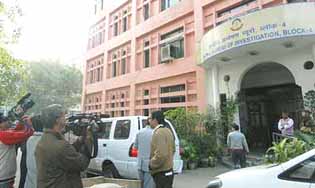
According to police, The accused Danis Jauregui Mendizabel has been arrested with 4 kg of fine quality Ketamine worth Rs 1.6 crore in the international market. Police was tipped-off that a man staying in a hotel in Paharganj area supplies Ketamine through courier to foreign countries. They were told that he would be coming to the Azad Market red light in front of the Gurdwara to courier a parcel containing Ketamine through a courier agent.
Police said a trap was laid and Mendizabel was apprehended. Ketamine kept in a corrugated box in a travelling bag was recovered.
Due to rising illicit use of Ketamine as a “party drug”, by a special government notification in 2011, Ketamine is covered under the Narcotic Drugs and Psychotropic Substances (NDPS) Act apart from the Drugs and Cosmetics Act.
Ketamine can be taken orally or by injecting or by sniffing. Sniffing gives more long-lasting effects. One is less likely to feel pain and one can in turn end up inflicting injury or harm on oneself. If Ketamine is repeatedly taken in large doses, it can induce unconsciousness and failure of the cardiovascular system, leading to death.
Police said during interrogation, Mendizabel revealed that he is in a live-in relationship with his girlfriend and has a baby. He has a younger sister. His parents are separated due to differences of opinion. He was running a wine shop in Spain but was incurring losses. He came in contact with drug abusers at his native place and soon he too started consuming Ketamine. The price of Ketamine in Spain is 10 times that of in India. Mendizabel smelled a fortune in this. Inspired by a friend who had brought ketamine from India and earned good money out of it, Mendizabel took the same route.
Ex-gratia payment:
Chief minister, Mrs Sheila Dikshit today announced Rs 5 lakh as ex-gratia payment to the parents of Flight Lieutenant, Tapan Kapoor, who recently lost his life in an IAF Helicopter, crashed during rescue and relief operation in Uttarakhand. sns
BJD hits back at Cong over rice issue
So it goes
The Congress has alleged that the state govt has given 10 kg less rice to BPL families.
It has launched a ‘FIR campaign’ and will get BPL families to file cases against chief minister and ministers
Statesman News Service
Bhubaneswar, 3 July
Sensing trouble, the ruling BJD launched a counterattack on the Congress campaign on BPL rice allocations, saying it was forced to reduce the entitlement from 35 kg to 25 kg per month per family in order to extend the coverage to more people.
The Centre had also reduced allocation of rice, alleged the ruling party.
The Central government allotment of subsidised rice is 35 kg per family per month for 22.35 lakh BPL families in Odisha and 5.41 lakh above poverty line families in KBK region (erstwhile undivided Koraput, Bolangir and Kalahandi districts) whereas the Odisha government is distributing BPL rice at 25 kg per family for 36.91 lakh BPL families and 5.41 lakh APL families in KBK region.
Evidently worried that the Congress campaign of lodging FIR&’s in every police station alleging that the state had denied 10 kg rice per month to the poor may catch the imagination of BPL families, the ruling BJD today fielded Finance Minister Prasanna Acharya, Food and Supplies Minister Pratap Deb and youth wing chief Mr Sanjay Das Burma to address the media and rubbish the Congress charges.
Talking to reporters, Mr Deb claimed in order to provide rice to all the BPL families and the APL families in KBK districts, the state government has had to incur an additional expenditure of Rs 189 crore per annum and buy 8890 MT rice very month. Since the allocation by the Central government is for only 27.76 lakh families and it falls short of our requirement for 42.3 2 lakh families, we have been buying rice to cater to the poor people, he said.
Explaining the position of the government, Mr Deb said in 1997-98 the BPL survey had been done and ration cards issued to 48.58 lakh families. But in 1999 the Centre, basing on the Lakedwala Committee report reduced the number of BPL families to 32.98 lakh families and stopped allocation of rice to the remaining 15.6 lakh families. The elimination of the ‘ineligible’ 15 lakh families having BPL ration cards at the field level was not possible as there was no guideline for this sort of a step, hence the Odisha government had to make necessary adjustment to continue providing subsidized rice to these families, he said.
BJD in a tight spot over manifesto promises
STATESMAN NEWS SERVICE
Bhubaneswar, 3 July
Ruling BJD leaders, particularly legislator and youth wing chief Mr Sanjay Das Burma, found themselves in a tight spot when their remark that the Congress party&’s failure to fulfil promises made in their 2009 election manifesto amounts to a case of cheating under Section 420 IPC.
In trying to counter the Congress ‘FIR campaign’ against the state government, the BJD leaders, at a Press conference here today remarked the Congress had declared in its manifesto that it will give rice at Rs 3 per kg and wheat at Rs 2 per kg to BPL families.
"The party has failed to fulfil this promise. Is it not a fit case for booking the OPCC chief and the AICC president in a case under Section 420 for cheating the public?" remarked Mr Das Burma. When asked if the BJD will register FIRs in this connection as is being done by the Congress on the subsidised rice issue, the BJD leader turned evasive.
The media asked Burma whether promises made in the manifesto of the BJD had been fulfilled and if not whether the BJD was also liable to face a charge of cheating.
Citing one such promise, the scribes said free electricity to farmers has not been given even after 14 years of BJD rule.
Mr Burma was left searching for an answer.
State Finance Minister Prasanna Acharya and Food and Supplies Minister Pratap Deb were present at the press conference .
It may be noted that the state Congress has decided to mobilise BPL families and lodge FIR&’s in police stations alleging that the government had ‘robbed’ the BPL families of 10 kg of rice per month.
The Centre is giving rice at 35 kg per month but the state is providing only 25 kg per family per month, charged the Congress. Besides lodging police complaints, the Congress has declared that it will collect signatures of BPL families and file a public interest petition in the High Court.
The BJD was reacting to the move today. Though its explanation relating to the reduction was effective, its counter charge of cheating against the Congress boomeranged.