Serpentology
m krishnan
THERE are other breeds of venomous serpents besides the cobra, some with looks more arresting or venom more potent. The thick, squat-headed Russell&’s viper, blotched with heavy black rings, has always struck me as a more formidable-looking snake – one look at it and you know at once that it is virulent, just as you know by looking at them that some people are cantankerous — and though normally sluggish it can move like lightning when it wants to. The saw-scaled viper is smaller and less vivid, but not less venomous. And the modest, deadly Southern krait is more at home in human dwellings than the cobra and much more poisonous. But it is the cobra that has captured human imagination and compelled worship from time immemorial.
Motive of fear
Psychology, however Freudian, may not tell why this snake should have been preferred above all others for worship, but I think I can. Of course, the motive of fear is there, and the deeply dimly-felt urge to placate that which is feared, possibly there is psychological significance in snake-worship being connected with the concept of fertility. But all this does not explain the choice of the cobra. The belligerent territorial feelings of this snake, its intelligence and readiness to live at peace with humanity, are the bases, I think, of the real explanation.
Cobras get attached to their grounds and will challenge intruders — and their hissing, spread-hooded challenge can be impressive! When they have long had the run of a disused house, they will dispute the right of humans to occupy it again. I have been assured that if treated with firm kindness they will retreat to a far corner of the compound and give up their claim to the house — that the right thing to do, in the circumstances, is to offer them milk and burn camphor in their presence (burning camphor does seem to discourage them considerably) — but on the one occasion I had to reclaim a cobra-haunted house I slew my co-tenants, out of fear.
Temple guardian
In a celebrated temple at Kerala, where the worshippers enter barefooted (as in all temples) the ground literally crawls with cobras, but I believe no one has been bitten so far. I can attest, from personal knowledge, to a much less impressive instance of the willingness of these useful snakes to live and let live. For years I knew a Siva temple beside a main road, which had its resident cobra. I have sometimes seen the snake on the roadside, a few yards away, and have slowed my steps to admire its handsome repose; many others have seen and admired it likewise. One felt no tear at all then, in spite of its splendid proportions and proximity, it was only the temple cobra, it belonged there and had been there for years without doing anyone harm. I have entered the temple when its guardian lay close by the pathway. At times, it moved away and at times it was apathetic to the humans on the road. In September 1953, I revisited this temple and learned, to my sincere regret, that the snake was no longer to be seen, having been killed by some natural enemy, presumably.
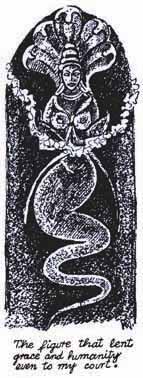
In many parts of rural India where snakes are common, snake-worship is equally common and one can see many wayside shrines. These may be quite elementary, a slab of stone bearing the incised figure of a cobra stuck in the ground beneath a tree, or may be a stone palisade around a peepul featuring carved snakes. However, I have seen serpentine figures of considerable finish and beauty at such wayside shrines, intertwined snakes and many-headed cobras carved with much skill and sometimes, instead of cobras, superbly rhythmic figures of Nagas and Naginis — perhaps these belonged, originally, to temple ruins nearby famous for their classical richness.
It is amazing how quickly and unquestioningly these images are accepted in the countryside. Once I had a very fine Nagini removed from her obscure hiding place and publicly installed along with a few “snake stones” in the dreary compound of a courthouse, of which I was the presiding authority. I was surprised and delighted to find my court popular within the week, its compound meticulously maintained by all visitors, including the handful of litigants who had business with me, and my “honour” infinitely secondary in presiding authority.
Naga-folk
These fascinating snake-people, semi-human and subterranean inspir many folk legends, tales and mythological dramas in the South — I dare say, even in the North sometimes, in these stories, they are cobras which can assume human form at will and sometimes they are semi-serpentine Naga-folk. Often they are presented sympathetically, not at all as dreadful figures — in fact, I know authentic folktales where it is the wholly human characters that betray the trusting serpents. It is a feature of these legendary snake-people that the very mention of the word “Garuda” terrifies them. The “Garuda” is the “vahana” of Vishnu and a traditional killer of snakes; the name is specifically used in Tamil to denote the Brahminy Kite (which occasionally does kill small snakes, mainly water snakes) but no doubt it also connotes a number of powerful eagles and hawk-eagles which can and do kill large serpents.
As a tailpiece to this note I may mention a popular saying based on this traditional snake dread of the “Garuda” — my rendering is from a Sanskrit stanza, but the saying in a compressed, pithy form is common to many Indian tongues
Do not associate with the
lowly.
If you must, with the mighty
make friends
For the great cobra, having
God&’s protection,
Enquired fondly about the
Garuda&’s health.
This was first published on 8 August 1954 in The Sunday Statesman