


press trust of india
NEW DELHI, 16 JUNE: Central government employees are in for a disappointment as the Centre is currently not considering any move to raise the retirement age to 62 years.
A senior official in the Ministry of Personnel, Public Grievances and Pensions, which acts as a nodal department for personnel matters, said there was no such proposal to increase the age for superannuation of government employees.
Recent media reports said the ministry has written to Prime Minister’s Office for raising the retirement age and sought the Union Cabinet’s nod for the purpose. There are about 50 lakh Central government employees working in various departments across the country.
Officials in the ministry said increasing retirement age requires a detailed consultation with all stakeholders and discussion with the Finance Ministry.
Without the finance ministry’s permission, the matter cannot not be processed, they said.
At a time when the government is working on austerity drive by cutting expenditure and putting in efforts to rein in current account deficit (CAD), the move to increase retirement age will also burden the exchequer’s kitty, they said.
The CAD, which is the difference between the inflow and outflow of foreign currency, had touched a record high of 6.7 per cent in the October-December quarter of 2012-13 on the back of rising oil and gold imports.
The retirement age for a majority of Central government employees is 60 years. However, the age for retirement in case of teachers and scientists is 62 years. The age of superannuation in states, like Madhya Pradesh, Chhattisgarh and Assam, is also 60 years.
In a related news, the government has decided to further increase the retirement age of specialists in scientific and medical fields (scientists) to 64 years. “A committee has been formed under the chairmanship of the Cabinet Secretary by Prime Minister Manmohan Singh for the purpose,” said another personnel ministry official.
‘No plan to increase retirement age for govt employees’


Sharma for FDI cap hike in telecom, defence
press trust of india
NEW DELHI, 16 JUNE: In a bid to spur investments, Commerce and Industry Minister Anand Sharma today “strongly favoured” raising the FDI cap in telecom, as well as defence sector, and said he will meet global investors to address their concerns, particularly in multi-brand retail.
Before leaving for a 10-day visit from tomorrow to Helsinki, St Petersburg, Belfast and London, Mr Sharma said he will address all the concerns of foreign retail sector investors and ensure all help in setting up stores.
Mr Sharma said his ministry would move the Cabinet for further liberalisation in other sectors, which hold potential for FDI inflows, as well.
“I am strongly in favour of raising the cap in telecom sector. I have discussed this with the Telecom and Finance ministers and once we have the proposal, we will move the Cabinet for raising the cap to 100 per cent, and also for FDI in defence because we want defence manufacturing to be here,” he said.
He said his ministry wants global majors in defence sector to partner both with the PSUs and the private sector to manufacture weapon systems in India.
“Defence technologies have multiple applications including industrial applications. We want the global majors to partner with the Indian entities… so that the big outgo of foreign exchange could also be brought down and domestic manufacturing improves and jobs are created,” he added.
On hiking FDI cap in defence sector, he said he has written to the Defence Minister and would meet him on the matter.
Mr Sharma said he will hold deliberations with Prime Minister Manmohan Singh on all these issues.
He said he will chair a Retail Round Table involving CEOs of Indian companies and foreign investors on 27 June to seek views on implementation issues and to address their concerns, if any.
Mr Sharma will also address global investors in different cities during his 10-day tour. He said after the consultations, the government may come up with clarifications and simplification of guidelines wherever required.
Mr Sharma said the moment the ministry receives any FDI proposal in the multi-brand retail sector, “it will be fast tracked and will do hand holding wherever required as we have done in the case of IKEA”.
The DIPP has already once released a clarification.
FDI of up to 26 per cent is permitted in the defence sector. The cap in telecom sector is currently fixed at 74 per cent.
India approaches tax havens on black money expose
press trust of india
NEW DELHI, 16 JUNE: India has approached over half a dozen foreign jurisdictions, including Singapore and some tax havens, for banking and other financial details of more than 500 individuals and entities that might have "secret offshore accounts" at those places.
The “names and listed addresses” of as many as 505 India-linked entities, including businessmen and companies from the country, have been made public after a global expose on secret offshore accounts by the US-based rights group, the International Consortium of Investigative Journalists (ICIJ).
The addresses of Indian entities and individuals, according to the ICIJ expose, have addresses of upmarket localities of account holders from Delhi, Mumbai, Bangalore, Kolkata, Chennai, Hyderabad, Pune, Ahmedabad, Baroda, Surat, Chandigarh and many other Indian cities and few other suburb locations.
According to sources, the Foreign Tax and Tax Research (FT&TR) division in the Finance Ministry has approached the British Virgin Islands, Cayman Islands and Singapore under the tax information exchange treaties with these jurisdiction for banking and other details of those named by ICIJ.
Besides, FT&TR has approached Cooks Islands and Samoa through other diplomatic channels, sources said, adding that a few other countries have also been approached for details of entities alleged to have secret accounts at those places.
“Preliminary inputs obtained in this regard do not present a clear picture and hence details have been sought through official protocol mechanisms and existing treaties,” a senior finance ministry official said. The ICIJ claims to have found over “one lakh secret companies, trusts and funds created in offshore locales” by entities from across the world in the past three decades.
While the broader details of this global expose were announced by ICIJ in April, the names and addresses of the individuals and entities were made public yesterday. The ICIJ has, however, put a disclaimer that there might be a legitimate use for offshore companies and trusts and being on the list does not necessarily mean that the said entities have broken any laws. Sources said the Indian authorities would also take a call on further action after they get necessary details from the concerned countries and find any wrongdoings on the part of the individuals and entities named by ICIJ.
“The information has been sought under the provisions of the Double Taxation Avoidance Agreement (DTAA) and Tax Information Exchange Agreement (TIEA) from the countries where we have such arrangements. Some other countries are being approached through the mutual tax assistance protocol of the OECD,” sources said.
The Organisation for Economic Cooperation and Development (OECD) is a Paris-based body spearheading combat against black money and tax crimes by partnering powerful economies and nations with low tax regimes, popularly called tax havens. “The effort is to see if these names are legitimate and if they are, it will be checked if that information is with the Income Tax department. Rest all other unreported entities in this list will be liable to action under Indian tax laws,” the sources said.
After ICIJ’s initial expose in April, Finance Minister P Chidambaram had said an inquiry has been initiated against the individuals who have been named in this global report for having stashed money in secret offshore accounts.
The expose claims to have unearthed details of 2.5 lakh individuals and entities from more than 170 countries, including India, that evaded taxes by setting up companies in tax havens. The body has, however, said the featuring of these names necessarily does not mean that the entities have committed tax crimes. “There are legitimate uses for offshore companies and trusts. We do not intend to suggest or imply that any persons, companies or other entities included in the ICIJ Offshore leaks database have broken the law or otherwise acted improperly,” the ICIJ said in its disclaimer posted on the portal.
Is the game changing in Mizoram?
prasenjit biswas
ON 23 May, the opposition Mizo National Front organised an anti-idolatry rally in Aizawl and there was a blast in the Assam Rifles’ temple complex that day. Following the signing of the June 1986 historic Mizo Accord, Mizoram has been a picture of peace, so the new development appears to indicate a subterranean discord that mixes politics, ethnic identity and religion. Little is known to the outside world of these subtle changes in the tune and nuances of politics in Mizoram, but internally it signals a social and cultural fragmentation.
On a recent visit to Aizwal, I heard of how its residents felt a sense of insecurity vis-a-vis the haphazard construction of residential buildings in a town that is prone to landslides and the government&’s apathy. Their frustration has found expression in action, like Mizo Young Association members taking it upon themselves to drive out Chin refugees from the Lengpui area to make the city crime-free. Anger and grief directed against the ruling party and blaming the growing rates of crime on Chin refugees go hand in hand with the larger picture of social, religious and ethnic fragmentation of Mizo society into many ideologies and groups. Raising the issue of idolatry practised by some Mizo leaders is also a psychological ploy to confuse social insecurity with the loss of faith that afflicts the community.
The rally was an expression of ideological differences not only between political parties but also between various social groups and identities. The blast, for which the MNF blamed the ruling Congress, indicates the extent of ideological manoeuvres. The state home minister described the rally as a kind of self-infliction. This is nothing but an ideological contestation of a complex mix of ethnicity, religion and politics that hurts Mizo society.
The rally&’s main objective was to expose how, during Durga Puja, Congress chief minister Lalthanhawla lit candles at a pandal. Opposition leader Zoramthanga argued that by doing so the chief minister had violated Christian ethics that prohibits the worshiping of idols. He also pointed out that the chief minister&’s wife, Lal Riliani, had even put colour on her forehead and broke coconuts. According to him, all this exposed how the Congress was pandering to what the Mizos considered an “evil” and, therefore, outside the Mizo way of life.
There&’s no gainsaying the fact that in a deeply Christian Mizo society, such public acts of display by the ruling party chief and his family members did not go down well with the masses as it contradicts their belief in Christ. The larger issue of secular practice by heads of a state as per the Constitution has not been broached by the MNF, but it simply hinted at the performance of a ritual that Christians are not supposed to indulge in.
This brings us to the issue of the Church&’s hold on and influence in the political outlook and choices of the Mizo people as such. A respected public figure cannot cross that Laxman Rekha drawn by his faith. Going against the deep-rooted faith and belief of the masses by a public leader in the Mizo context is still to be accepted as “normal”. The MNF protest rally simply voices the sentiments of commoners, who are taught not to practice any form of idolatry.
All this brings back the issue of the authenticity of being a Mizo, which lies in following God&’s commandments. Obviously, in a plural Indian society a narrow and mono-religious notion of God creates tension, both for those who believe and those who do not. Zoramthanga&’s reference to Exodus, Chapter 20 — which says “I am the Lord your God, who brought you out of Egypt, out of the land of slavery” — very successfully revived the memory of the abolition of the bawi (slave) system by Christian missionaries as well as invokes the Mizo belief that they are part of the 12 lost tribes that moved out of Egypt. The eschatology of the exodus out of Egypt and the contemporary revival of Bnei Menashe (children of Menasseh) who are lost in India&’s North-east and who now reconnect them with the resettled communities of Israel, are believed to be tribes of Manasseh. Such moves in imagination and faith constitute the contemporary sense of belonging to Mizo identity.
Having lost two elections consecutively, the MNF is trying to generate mass opinion against the Congress as a practitioner of “evil”. Such political rivalry, as always, centres round a search for roots and an assumption of the right identity-roles that would ultimately decide who wins the ideological battle.
In this battle, the idea of election in a Hebrew sense becomes an argument for revival. Election marks a reconnection with the tribes of Manasseh through a journey into Israel&’s territory. It also reinvokes the memory of the complex inter-clan relationship during and after the abolition of slavery. Clans such as the Raltes, Sailos, Hualngos, Lenchungs, Zadengs, Pacchaus, Chhakchhuaks, etc, and their complicated role during the anti-slavery movement, Mizo insurgency and their present social status determine the political influence of respective parties. The MNF&’s playing the identity card is effectively countered by the Congress&’s more prominent strategy of winning over people by its ideology of secularism. So, the whole picture seems to be emerging slowly into a game changing scenario through a carefully crafted ideological battle.
The writer ~ an associate professor, Department of Philosophy, North East Hill University, Shillong ~ co-edited Construction of Evil in India&’s Northeast, Sage Publications, New Delhi, 2012
Endangered Eden ~ jb lama
A dam personifying misery and some ‘other’ dietary delights
MORE than 7.8 million trees will have to be cut down, bamboo cultivation spread across 25,000 hectares will be lost for ever, some 40,000 people will be rendered homeless when 90 villages go under and, more importantly, several endangered species of flora and fauna will be gone for good. Would an environmental disaster of these proportions justify the construction of a 162.8-metre high mega-multipurpose dam at Tipaimukh in Manipur&’s Churachandpur district? The region is said to be highly seismic and is inhabited by several ethnic Naga communities. Though the project&’s installed capacity is said to be 1,500 MW, it will reportedly generate a mere 412 MW.
Prime Minister Manmohan Singh laid the foundation in December 2006 amid protests by locals and several organisations who claimed the project was cleared (in 2003) without any consideration of various aspects, both technical and economic. When the proposal was first mooted in 1995, then chief minister Rishang Keishing put his foot down. But the nod was given in 2001 when the state was under a short spell of President&’s Rule. (It is worth recall that when the Centre unilaterally extended the Nagaland ceasefire to Manipur in June 2001, the people of Imphal Valley took to the streets against it and in the police firing that followed 17 were killed. This also happened during President&’s Rule.)
Bangladeshis have also opposed the Tipaimukh project because they fear that during the monsoon, when the dam&’s spillway gates are opened to let out excess water, it will cause flash floods in their country. According to a report in these columns (13 July 2009), “the Bangladesh government had maintained the dam would have no ill-bearing on the country until the formation of the National Committee Against Tipaimukh”.
A recent report said the Tipaimukh project may not be feasible after all as it would cause massive destruction of the ecology downstream of the Barak river in Assam and the Tuivah river in Manipur. This seems to indicate that the authorities are having second thoughts about the project. The Union environment ministry is reportedly hesitant to clear the project as it feels “that no compensatory mechanism would help in mitigating the loss caused by erasing forests”. It is still not too late to take a fresh look because the actual construction work is yet to start.
Work on Manipur&’s Thoubal valley multipurpose project, conceptualised 30 years ago and now renamed Mapithel dam in Ukhrul district, is at a standstill following disputes over compensation for land losers. In 1980, the Planning Commission approved it at an estimated cost of Rs 47.2 crore. When it will be completed is anybody&’s guess. The Manipur government has come out with yet another dam project at Chakpikarong in Chandel district and this, too, has run into trouble. The locals have staged several demonstrations against it.
In Assam, the Krishak Mukti Sangram Samity, headed by Akhil Gogoi, has stopped work on the Lower Subansiri hydel project for about two years and has not allowed machinery and materials to reach the project site at Gerukamukh. It has refused to accept the Dam Design Review Panel report unless the demands of the downstream people are met. These include issues like landslides, downstream impact, flood control, ecological damage to aquatic wealth and earthquakes.
Since about 70 per cent of the construction work is said to be over, abandoning and dismantling structures that have already been built would be unthinkable. However, a way out must be found; after all, what the KMSS has asked for is that the project authorities ensure the safety of those living downstream as they fear their land will be washed away if, by chance, dams in Arunachal Pradesh get damaged.
***
RECENTLY, the Dimapur-based Morung Express published a photograph of street stall-holders in Dimapur selling different types of dried insects. Not that the vendors have taken a cue from a UN report that has urged the people to eat insects to fight world hunger. No eyebrows need be raised because the sale of such items in Nagaland is not an uncommon sight. Kohima has a “keeda” market (one can see it on YouTube) where the meat of different animals and dried snakes and insects are sold.
According to the UN report, two billion people the world over have already supplemented their diets with insects, noting at the same time that "consumer disgust" remains a barrier in many Western countries. We have seen photographs of people in South-east Asian countries selling live scorpions, considered a delicacy when deep-fried. Well, as the saying goes, the proof of the pudding is in the eating!
Attacks kill 32 across Iraq
BAGHDAD, 16 JUNE: A string of nearly a dozen apparently coordinated bombs and a shooting in cities across Iraq killed at least 32 and wounded dozens today, extending a wave of violence that is raising fears of a return to widespread killing a decade after the US-led invasion.
Violence has spiked sharply in Iraq in recent months, with the death toll rising to levels not seen since 2008. Nearly 2,000 have been killed since the start of April.
Most of the car bombs hit Shi’ite-majority areas and were the cause of most of the casualties, killing 26. The blasts hit half a dozen cities and towns in the south and centre of the country.
There was no claim of responsibility for any of the attacks, but they bore the hallmark of Al Qaida in Iraq, which uses car bombs, suicide bombers and coordinatd attacks to target security forces, members of Iraq’s Shi’ite majority, and others.
The blasts began when a parked car bomb went off early morning in the industrial area of the city of Kut, killing three people and wounding 14 others. ap
Perez formally indicted
ISLAMABAD, 16 JUNE: Former President Pervez Musharraf has been indicted by a Pakistani anti-terrorism court over the detention of dozens of judges during the emergency rule he imposed in 2007.
Musharraf, 69, was indicted during a hearing of the case held at his farmhouse in Chak Shahzad yesterday by anti-terrorism court Judge Kausar Abbas Zaidi. He was indicted under provision of the Anti-Terrorism Act and the Pakistan Panel Code. After the charges against him were read out, Musharraf refused to accept them and pleaded not guilty. He filed an application for his acquittal due to lack of evidence. pti
Woman bomber responsible for Quetta attack
dawn/ann
QUETTA, 16 JUNE: Intelligence officials revealed today that a woman suicide bomber carried out the first attack on a bus carrying students of Sardar Bahadur Khan Women&’s University earlier yesterday.
At least 25 people, including the deputy commissioner of Quetta, 14 students of a women&’s university and four nurses were killed yesterday when a bomb tore through a bus, followed by a suicide attack and a gunbattle in the Bolan Medical College hospital, where the injured students were taken for treatment.
Banned outfit Lashkar-i-Jhangvi claimed responsibility for the bomb blasts.
An Intelligence official, who requested not to be named, said that a woman suicide bomber managed to sneak into the university bus. "When all the students gathered inside the bus, she blew herself up", he said.
Officials said they had no information about the identity of the bomber. Moreover, Intelligence officials said after the woman bomber blew up herself in the bus, a second male bomber followed suit and struck inside the crowded Bolan Medical Complex Hospital to wreak maximum damage.
According to the Intelligence personnel, the male suicide bomber was waiting inside BMC Hospital ward for the arrival of high level officials, including the Chief Secretary, and blew up himself when they reached.
Quetta Police Chief Mir Zubair Mehmood also said that the Deputy Commissioner of Quetta Abdul Mansoor Kakar was killed as result of firing outside the hospital.
Militants kill 2 Pak polio vaccinators
ISLAMABAD, 16 JUNE: Suspected militants shot and killed two polio vaccinators at Swabi in north-west Pakistan today, the latest in a string of attacks targeting the government’s vaccination campaign.
The vaccinators were attacked while they administering polio drops to children in Swabi area of Khyber-Pakhtunkhwa province, officials said.
This was the second such attack in Swabi.
In January, six women and a man working for a NGO involved in the vaccination campaign were shot dead in the district. Last month, the killing of a woman polio vaccinator on the outskirts of Peshawar city had prompted the World Health Organisation to suspend its vaccination campaign. pti
Sensex ends in red for 2nd week
press trust of india
MUMBAI, 15 JUNE: In spite of last day recovery on hopes of rate cut from the Reserve Bank of India, both the key indices, S&P BSE benchmark S&P Sensex and Nifty ended in the red by over one per cent for the second consecutive week on persistent selling pressure following fall in the rupee value to an all-time low.
Fresh capital outflows also affected the market sentiment as foreign institutional investors (FIIs) sold shares worth Rs 2,515.68 crore during the week, including the provisional figure of 14 June. Shares of consumer durable, metal, realty, power and PSU sectors declined sharply on selling pressure from operators.
The benchmark S&P BSE Sensex resumed higher at 19,530.35 and moved up further to 19,585.75 on select buying mainly in IT sectors in view of depreciation of rupee value to lifetime low of 58.98 against the dollar.
However, it later turned negative and dropped to a low of 18,765.53 on profit-booking before recovering on the last day to end the week at 19,177.93, still showing a loss of 251.30 points or 1.29 per cent. It has lost 582.37 points or 2.95 per cent in the last two weeks.
The NSE 50-share Nifty also dropped by 72.60 points or 1.23 per cent to finish at 5,808.40.
Markets recovered at the end of the week due to fag-end buying on expectation of rate cut by the RBI in view of fall in inflation after WPI inflation fell to over three-and-half-year low to 4.7 per cent in May.
Finance minister Mr P Chidambaram’s comment that the government would announce steps soon to boost investment and growth also supported the market during the fag end of the week.
Lower inflation on account of declining prices of manufactured items and recent weak IIP data boosted hopes of monetary action by the RBI on 17 June traders said. The retail inflation (CPI) declined to 9.31 per cent in May from 9.39 per cent in April while industrial output growth (IIP) slowed down to two per cent in April this year from the revised 3.4 per cent in last month.
“Rupee’s sudden depreciation has led to some outflows and correction in the equity markets as well,” said Mr Lalit Thakkar, MD-Institution, Angel Broking.
Twenty shares out of the 30-share Sensex pack ended lower while 10 shares finished with gains.
Major losers from the Sensex pack were Jindal Steel (13.21 per cent), Tata Power (8.68 per cent), BHEL (7.06 per cent), Sterlite Ind (6.85 per cent), Tata Steel (6.11 per cent), Coal India (5.92 per cent), Sun Pharma (5.90 per cent), TCS (4.78 per cent), Hero Honda (2.66 per cent), ONGC (2.52 per cent) and M&M (2.03 per cent).
ALL EYES ON MONDAY’S RBI POLICY
– 10 June: The Sensex surrenders its gains to close just 12 points higher at 19,441.07, on profit-booking as the rupee at an all-time low was seen preventing the RBI from cutting interest rates on 17 June
– 11 June: The Sensex sinks by 298 points to close at nearly a two-month low level of 19,143 as a steep fall in rupee almost killed rate cut hopes
– 12 June: Slowdown in industrial production and higher-than-expected retail inflation pulls Sensex down by 102 points to end at 19,041.13, extending losses for the second day
– 13 June: A rout in world markets sends the Sensex 214 points down to end below the 19K-mark at 18,827.16, even as the finance minister Mr P Chidambaram says more reforms are on the anvil
– 14 June: Rebounding from two-month lows, the Sensex surges by 351 points to end at 19,177.93, as slowing inflation and strengthening rupee rekindled hopes of a rate cut by the RBI on Monday
M&M to buy 13.5% in Spain’s auto firm
indo-asian news service
MUMBAI, 15 JUNE: Mahindra and Mahindra Saturday said it will buy a 13.5 per cent stake in component manufacturer CIE Automotive for 96.24 million euros (Rs.738.45 crore).
"A committee of directors of the company on 15 June 2013 has approved entering into a share purchase agreement with Participaciones Internacionales Autometal, CIE Automotive and Autometal SA," the company said in a regulatory filling to the Bombay Stock Exchange (BSE).
"Investment of an amount of euro 96.24 million to be made by the company through its subsidiary(ies) for a stake of 13.5 per cent in CIE Automotive SA at a price of euro 6.00 per share."
The company which is headquartered in Bilbao, Spain, focuses on three strategic business areas of automotive components, biofuels and providing technological solutions and services. The company is listed on the Madrid and Bilbao stock exchanges and has presence in 15 countries.
The company had reported a slowdown in its turnover for the first quarter of 2013, the consolidated turnover stood at 418 million euros (down 2.6 per cent).
Net profit for the period under review reached 17 million euros, which was slightly lower than the like period of last year, which the company said was caused mainly due to fluctuations in exchange rates.
On the other hand Mahindra and Mahindra which is a part of $16 billion Mahindra Group is a large Indian conglomerate with interests in automobile, information technology, finance and a host of other industries.
Gold glitters on buying frenzy
press trust of india
MUMBAI, 15 JUNE: Gold jumped to a one-month high at the domestic bullion market today on a wave of buying spree from stockists and speculators amid buoyant overseas sentiment.
The industrial metal also rallied owing to renewed jewellery demand coupled with heavy industrial off-take.
Standard gold of 99.5 per cent purity spurted by Rs 235 to conclude at Rs 27,905 per 10 gm from Friday’s closing level of Rs 27,670.
Pure gold of 99.9 per cent purity surged by Rs 240 to end at Rs 28,050 per 10 gm from Rs 27,810.
Silver ready (.999 fineness) jumped by Rs 640 to finish at Rs 44,975 per kg compared to Rs 44,335 previously.
On the global front, the shiny metal recouped most of its lost ground driven by investment buying after larger-than-expected rise in wholesale prices for May, curbing speculation that the Federal Reserve might start winding down its huge bond purchase programme.
Gold for August delivery rose $9.80 to settle at $1,377.60 an ounce on the Comex division of the NYMEX late yesterday and July silver contract gained 32 cents to close at $21.95 an ounce.
Murthy seeks 3 yrs to rebuild Infosys
press trust of india
BANGALORE, 15 JUNE: Returning to ride out the bad times for Infosys, its chairman, Mr N R Narayana Murthy today said the task of rebuilding a “desirable” Infosys would take at least 36 months and there would be some tough decisions resulting in “pain.”
“The challenge is daunting and the task is tough,” said Mr Murthy in a candid address to shareholders at the 32nd Annual General Meeting here, two weeks after he was made Executive Chairman of Infosys which has reported poor earnings, disappointing investors.
He said: “The task of rebuilding a desirable Infosys will take at least 36 months, even with a high quality team and full dedication of every Infoscion. In the process, there will be some tough decisions resulting in pain as we move forward.” Mr Murthy sought the shareholders’ “understanding, support and encouragement in this exciting and rewarding journey of the next three years.”
Mr Murthy, who had shed executive role seven years ago and retired as the head of Infosys in August 2011, was made Executive Chairman on 1 June, replacing Mr K V Kamath during whose tenure the company shares slumped 15 per cent.
Mr Murthy, who surprised many by bringing his son Rohan Murthy as his executive assistant, said since the company’s focus on the third revenue stream was blurred in the last two years, it has to refocus on winning large revenue-yielding outsourcing projects in the short-term. The company should also ensure that it accelerates its progress in the first two streams in the medium to long term.
The first two revenue streams talks about focus on opportunities from consulting-led, end-to-end solutions leveraging technology for higher margins and developing intellectual property-based solutions to delink revenues from effort, he said.
“Such extra focus on commoditised businesses has the potential to accelerate our revenue growth while reducing our margins. I want you all to be aware of the downslide.”
He added that the current discussion on the new immigration bill in the US was both an opportunity for innovation and a challenge for growth and he would like every Infoscion to see this as an opportunity.
India Briefs
AFSPA revocation
Budgam (J-K), 15 June: The Jammu and Kashmir government’s demand for revocation of the controversial AFSPA is being discussed by Prime Minister Manmohan Singh and Chief Minister Omar Abdullah, Congress Vice-President Rahul Gandhi said today. Mr Abdullah has been pitching for revoking the controversial law from certain areas of the state where the Army does not operate. However, his efforts have so far met stiff resistance from the Army. pti
Telangana bandh
Hyderabad, 15 June: A day-long bandh began this morning in Telangana region of Andhra Pradesh in response to a call given by the TRS, which accused the state government of resorting to repressive measures to put down yesterday&’s statehood rally. pti
Irom Sharmila
IMPHAL, 15 JUNE: Irom Chanu Sharmila feels that the implementation of an Inner Line Permit System is a must in the state to safeguard the future of the indigenous people of Manipur. Speaking to the media yesterday, Sharmila, who has been on a years-long hunger strike demanding the revocation of the Armed Forces Special Powers Act, said unrestrained influx of non-locals is a major threat to the identity of indigenous Manipuris. sns
Drifting vessel
MUMBAI, 15 JUNE: The Directorate General of Shipping, today said Pratibha Tapi, one of the two vessels of the financially distressed Pratibha Shipping is drifting towards the coast and an emergency towing vessel has been requisitioned to take care of any situation. pti
Media credibility
LUCKNOW, 15 JUNE: Vice President M Hamid Ansari on Saturday expressed concern over certain media-related developments which were posing a threat to its objectivity and credibility. He said these developments related to cross-media ownership, the phenomenon of paid news, declining role of editors and their editorial freedom, media ethics and the lack of effective self regulatory mechanisms as also the need to bring an improvement in the working conditions of media personnel and their safety. He was speaking at the inaugural function of the biennial session of the National Union of Journalists at Hathras. sns
School destroyed
JAMUI, 15 JUNE: Maoists triggered a blast in a school building in Bihar’s Jamui district, damaging the structure. A group of Maoists stormed the government school last night and detonated explosives in the building damaging it totally, Superintendent of Police, Mr Deepak Barnwal said. They attacked the school building apparently in retaliation to intensified operations by the security forces against them, he said. A case has been registered in this connection and raids were being carried out to nab the ultras, Mr Barnwal said. pti
India crush Pakistan
press trust of india
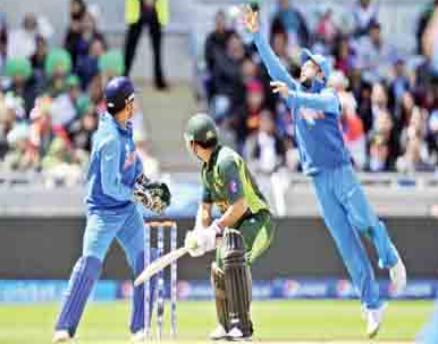
BIRMINGHAM, 15 JUNE: Title favourites India produced yet another clinical performance as they outplayed arch-rivals Pakistan by eight wickets in a high-voltage group league encounter of the ICC Champions Trophy here today.
In a match marred by numerous rain-interruptions, Pakistan were bundled out for 165 in 39.4 overs due to a disciplined effort by the Indian bowling unit led by Bhuvneshwar Kumar, who finished with figures of two for 19.
India’s final revised target courtesy D/L method was 102 in 22 overs which they achieved with 17 balls to spare as Shikhar Dhawan again blazed his way to a 41-ball-48.
India thus finished their group league engagements with an all-win record.
Winning the ‘prestige battle’ against Pakistan will certainly be a big morale-booster for Mahendra Singh Dhoni’s men as they await their semi-final opponents whom they will take on in the second semi-final in Cardiff on 20 June.
The win was also India’s first in the Champions Trophy against Pakistan, having lost against the same opponents in the 2004 and 2009 editions of the tournament.
With the game frequently delayed by intermittent rain, India never lost sight of the target as the openers Dhawan and Rohit Sharma (18) again gave a solid start adding 58 runs for the opening stand.
On an Edgbaston wicket where the Pakistan new ball bowlers, Junaid Khan and Mohammad Irfan, bent their back and extracted some pace and bounce, the batsmen looked quite at ease.
With rains looming on the horizon, the Indians were virtually racing along, scoring 45 in the mandatory powerplay of eight overs.
While Rohit was a bit subdued, Dhawan was in punishing mood, as he repeatedly peppered the off-side field. He twice slapped Junaid in the arc between point and extra-cover.
Dhawan hit five boundaries and just when a half-century was there for the taking, the Delhi lad slashed hard at one from Wahab Riaz to be caught at the deep third-man boundary.
However, Virat Kohli (22 no) and Dinesh Karthik (11 no) ensured that there were no hiccups in the chase. The rain probably spared Pakistan a bigger humiliation.
Earlier, India’s bowling quartet of Bhuvneshwar, Ravichandran Ashwin, Ravindra Jadeja and Ishant Sharma shared the bulk of the spoils as they never really let Pakistan batsmen off the hook.
Spin twins Ravindra Jadeja (2/30 in 8 overs)and Ravichandran Ashwin (2/35 in 8 overs) kept the Pakistan batsmen on a leash during the middle overs after a brilliant opening spell by Bhuvneshwar, who again produced the goods upfront.
While Asad Shafiq (41) was the top-scorer for Pakistan, a lot of their batsmen got starts but were unable to convert them into substancial scores due to some impressive bowling. The bowlers picked up wickets at regular intervals as Pakistan’s woeful show with the bat continued. The top-order again saw a familiar collapse.
Nasir Jamshed, who has scored all his three ODI centuries against India, failed to reproduce his magic this time.
The left-handed opener was circumspect and enjoyed a lifeline when on one. Ruled out leg before by umpire Richard Kettleborough, the batsman was saved by the DRS.
However, his innings was soon cut short by a beauty from Bhuvneshwar.
Bhuvneswar Kumar got the ball to swing both ways and found the edge of Jamshed’s tentative prod which saw Suresh Raina complete an easy catch at second slip. Jamshed scored just two runs off nine balls.
India captain Mehndra Singh Dhoni was all praise for young Bhuvneshwar Kumar whose brilliant spell of eight overs set the tone for India’s facile eight-wicket victory over arhc-rivals Pakistan in the ICC Champions Trophy here today.
“He (Bhuvneshwar) is not someone who is very quick but he bowls in very good areas. In these conditions, he used the new ball well as he can swing the ball both ways,” Dhoni said at the post-match presentation ceremony. India’s middle-order hasn’t been tested in the three matches so far but Dhoni said that it is not of great concern.
“We have a settled middle-order consisting of myself, Raina (Suresh) and Jadeja (Ravindra). We have played a lot of matches and only thing that we need is for Raina to get some more practice at the nets. Also the middle-order got a fair outing during the two warm-up games.”
Giles denies Willis’ ball-tampering claims
agence france-presse
CARDIFF, 15 JUNE: England limited overs coach Ashley Giles has denied his players tampered with the ball following controversial allegations by former captain Bob Willis.
Willis told Sky Sports on Friday that Pakistan umpire Aleem Dar and New Zealand&’s Billy Bowden had ordered the ball to be changed when Sri Lanka were batting during their seven-wicket Champions Trophy win over England at The Oval on Thursday because it had been tampered with.
"Let’s not beat about the bush ~ Aleem Dar is on England’s case. He knows that one individual is scratching the ball for England – who I am not going to name ~ and that’s why the ball was changed," Willis said.
But ex-England spinner Giles, speaking ahead of his side’s key Champions Trophy match against New Zealand in Cardiff on Sunday, said: “We don’t tamper with the ball.”
“With the situation the other day, the ball was changed because it had gone out of shape. We asked the question, the captain (Alastair Cook) asked that question to the umpires which he has a right to. The ball was changed, the rest is history.” Giles added: "The most important thing is winning cricket matches and not what Bob Willis says."
Reports in the British media have highlighted the role of Ravi Bopara in polishing the ball, a legitimate tactic, but Giles said the Essex all-rounder, who has starred with the bat in this tournament, had been selected for his cricket ability. "There’s even mention of one of our player’s (Bopara’s) specific role and that player is an extremely good cricketer. He has had an extremely good series so far and we’d like to let him concentrate on playing his cricket."
After England’s tournament-opening win over defending champions Australia at Edgbaston, Australia&’s stand-in captain George Bailey said he was "very surprised" by the speed with which Giles’s side got the ball to reverse.
However, Giles insisted on Saturday that an abrasive pitch at Edgbaston had played a key role in aiding England’s use of reverse-swing against Australia.
Prior to the Champions Trophy, New Zealand beat Giles’s men 2-1 in a one-day series in England. New Zealand coach Mike Hesson said on Saturday that he had seen nothing untoward during the recent home and away matches against England. "We played them in New Zealand and there were very abrasive surfaces. There was always going to be an element of reverse swing."
Asked if England achieved reverse swing by legitimate means, Hesson replied: "I’ve got no idea how they achieve reverse swing and that’s not my responsibility. The umpires are there to do a job and if they think something is done out of the ordinary then they will deal with it. From what I understand, they changed the ball the other day because it was out of shape."
On Thursday, Sri Lanka were 119 for two at the halfway stage of their reply to England’s seemingly imposing 293 for seven when the ball was changed.
The replacement ball moved little and Sri Lanka’s Kumar Sangakkara went on to complete a match-winning hundred.
Afterwards, Cook said: "The ball was changed because it was out of shape. The umpires make these decisions and you have to accept them. Sometimes you don’t think they are the right decisions."
Officials of the England-Sri Lanka match didn’t impose a penalty and the ICC explained, that as the umpires hadn’t reported anything and no team had complained, they were not planning to take any action.
Maternity homes need care
KOLKATA, 14 June: Nearly three years have passed since the Trinamul Congress board took control of the Kolkata Municipal Corporation (KMC), but nothing has been done as yet to improve the condition of the maternity homes.
After the new civic board came to power, the KMC authorities announced in June 2010 that every maternity home will have ambulance facility and the residential medical officers would be present at the hospitals. Also, steps would be taken to increase the number of beds and introduce caesarian operation facility.
After three years none of the promises has been kept. The ambulance facility has not been introduced as senior officials felt it was not needed to keep ambulances at the hospitals as almost every social welfare club has them these days and most of the ambulance services are open for 24 hours. No step has been taken to upgrade the maternity homes and increase the number of seats.
There are 100 seats in KMC’s four maternity homes. Kidderpore maternity home has 40 seats, which is highest among the maternity homes followed by north Kolkata, Champamoni and Garden Reach, each having 20 seats.
The Champamoni maternity home which stands on 20 cottahs of land was inaugurated by then then chief minister of West Bengal Dr BC Roy. The maternity home looks like a haunted house after dusk with no lights in most of the rooms. As there is no facility for caesarean operation, women prefer to go to state run hospitals. sns
Doctors achieve ‘miracle’ feat on woman
statesman news service
KOLKATA, 14 JUNE: Doctors at RG Kar Medical College and Hospital have virtually brought a pregnant woman out from the jaws of death who suffered two cardiac arrests within a gap of few seconds and was put on ventilator support, although the stillborn couldn’t be saved.
A resident of Basirhat, Mrs Pieu Chakraborty (25), in an advanced stage of pregnancy was admitted to the gynaecology ward of the hospital on 7 June after she complained of uneasiness.
She was brought to the hospital after local doctors failed to cure her. It was found after tests that she was suffering from Peripartum Cardiomyopathy (a rare disease in pregnancy causing deterioration in cardiac function) and pregnancy- induced hypertension, said doctors who treated her.
“The woman suffered the first cardiac arrest on the same day of admission and was immediately rushed to the Intensive Therapy Unit. But she suffered second cardiac attack on the way to the emergency ward,” said Dr Sugata Dasgupta, the critical care specialist at RG Kar.
“We found that the patient was affected with pneumonia, lung failure and drop in oxygen which resulted in cardiac arrests. It was difficult to treat her because supporting the diseased lungs, diseased heart and dysfunctional brain after two cardiac arrests is very difficult, especially where the woman is pregnant,” Dr Dasgupta said.
“The doctors and the staff did a remarkable job by pumping her heart while shifting her to the emergency building located at a distance from the ward where she was shifted. A delay of five minutes and any carelessness by the doctors attending her could have been risky,” he added.
Terming her survival as a miracle, the doctors admitted that such instances are rare in government hospitals due to lack of infrastructure.
We saved the mother but couldn’t save the premature child but she can become pregnant again and enjoy her motherhood.