Logo

100 years ago

Statesman News Service |

OCCASIONAL NOTE

The success achieved by Lord Kitchener in Egypt adds to his already great reputation for statesmanship and for the possession of keen insight into the needs and aspirations of the common people. It would have been fortunate for India if Lord Kitchener had returned to this country as Viceroy. We should certainly in that event have been spared the Delhi “boons”, and the ryot would have found a sympathetic friend and a practical benefactor. Lord Kitchener&’s report, like the annual account formerly given by Lord Cromer of his stewardship, is obviously of great interest, and there is justice in the gibe of the Times in comparing it with the “slovenly belated hack-work called the Moral and Material Progress Report which is annually flung by the India Office at an unheeding Parliament.” If the affairs of India were presented to the British public in the manner in which the affairs of Egypt have been presented to them for many years past, there would be far greater interest displayed in India at Home, and less difficulty would be experienced in raising loans in the London market for reproductive purposes in this country.

NEWS ITEMS

MR TAGORE’S RECEPTION IN LONDON
Growth Of The National Spirit
London, June 17
Mr. Tagore held a reception of Indian students in Britain at the Criterion, at which 300 persons were present. Mrs. Naidu, the poetess, garlanding Mr. Tagore as a declaration of the love borne him by his young countrymen, said that that would help to further the ideal of consecrating their lives to the service of the Great Mother, to whom they all cried bande mataram. The national spirit in India was overcoming all distinctions of caste and creed, for Mahomedans, Hindus and Parsis were together in that room to express a common admiration for the great Indian.

BALKAN LEADERSHIP
Crisis Suddenly Arises
Austria Angry With Russia
Sequel To The Tsar&’s Telegram
London, June 17
While the replies of King Ferdinand and King Peter may be construed as an intimation that they acquiesce in the Tsar&’s arbitration, the actual situation is still regarded with considerable apprehension. The overthrow of the Servian Cabinet implies disapproval of any yielding on the part of Servia. The newspapers in Servia and Greece continue to print violent attacks upon Bulgaria, the Press of which replies with equal acerbity.
Newspapers in Vienna are perturbed by the tone of the Tsar&’s telegram to the Balkan Sovereigns, and have opened a campaign against any assumption by Russia of the supreme leadership of the Balkan States.

18 June, 1913

Cops arrest robbers after highway chase

Statesman News Service |

statesman news service
KOLKATA, 17 JUNE: Police arrested armed robbers who were trying to make their getaway on a motorbike after snatching valuables and injuring two youths following a desperate highway chase at Pragati Maidan late last night.
  Police said that four armed robbers on a motorbike stopped two youths on their bicycles near Choubhaga on Basanti Highway.
The duo, Hari Shankar Shaw and Rahul Shaw, were heading toward their flats in Nonadanga. The accused, armed with a pistol and a dagger, threatened them and asked them to hand over their valuables at gunpoint.
They had handed over their mobile phones and Rs 800 in cash.
When the accused were about to make their getaway on the motorbike, Hari caught one of the criminals who was riding  pillion and had a pistol.
Both of them fell to the ground. In a bid to free their associate one of the accused stabbed Hari on his back and right leg when he was trying to salvage his valuables.
They beat up Rahul and fled towards Bantala on the motorbike.  Within a few seconds a patrol team, led by Mr Saroj Ghosh, officer-in-charge of Pragati Maidan police station, reached the spot.
Police took Rahul in their car and began a chase for the four youths who were trying to flee at a breakneck speed on the Basanti Highway.  Mr Ghosh tipped off another patrolling team who approached from the opposite direction and the accused’s motorbike collided head on with the police’s patrolling van. They fell from the bike and Md Aziz (19), one of the accused, tried to open fire at the policemen.He was caught immediately, said a senior police officer. Another accused, Md Zamir (18), was also arrested but two others managed to flee. Police seized the motorbike, the firearm and recovered Rs 800 in cash from them.
Police raided Tiljala areas at 3.30 a.m. today and arrested Amin Ali Gazi (19) and Abdul Sajjad (19). Police said that the area remains deserted after 9 p.m. and this the reason for frequent patrolling. The measure was taken to avoid any untoward incident on the stretch of the Highway  that comes under the jurisdiction of Kolkata Police.

Book rail tickets through mobiles

Statesman News Service |

statesman news service             
NEW DELHI, 17 JUNE: Moving forward from the passenger-friendly e-ticketing initiative, the Railways from next month, will be launching a pilot project of ticket booking through non-internet-based mobile phones.   
The Indian Railways Catering and Tourism Corporation (IRCTC), a public sector undertaking of the ministry of railways, will be launching the project.  
This will enable people using non-Internet-based mobile phones to easily access railway ticketing services through SMS/IVRS/USSD. The scheme is user-friendly, secure and eco-friendly, as no printout is required.  
The railway minister had made an announcement on the launch of ticketing through mobile phones in the Railway Budget this year.  
There will be a dedicated number on which text messages can be sent, which in turn would eliminate need of Internet at any stage ~ booking, payment, cancellation.
However, one will need to register the mobile number as well as one&’s bank account and one time password issued by it with the IRCTC for authorisation of payment.  The passenger has to type the train number, destination, journey date, class and passenger details like name, age and gender on the SMS box.  
The sender will receive transaction ID and then make payment through sending another SMS by typing PAY followed by the transaction ID, MMID as received from the bank and password.  
On successful booking of a ticket, a message will be sent to the user by IRCTC which will suffice as valid authority to travel along with a photo ID card in original.  
Cancellation of tickets can also be done through the cancellation option.  
The scheme is on a pilot basis and will not be available during the 8 a.m. to 12 p.m. for booking ARP/Tatkal/general tickets.

IRCTC&’s pilot project will enable people using non-Internet-based mobile phones to easily access railway ticketing services. The scheme is user-friendly, secure and eco-friendly, as no printout is required


13th Amendment: India to consider implications

Statesman News Service |

CHENNAI, 17 JUNE: Prime Minister Manmohan Singh today said India would convey its views on alleged attempts by political parties in Sri Lanka to repeal the 13th Amendment to its Constitution, after considering its implications. “While this is a matter on which a decision will be taken by various political parties within Sri Lanka, we will certainly consider its implications and make known to the Sri Lankan authorities our views in the matter,” the PM said in a letter to DMK chief M Karunanidhi. Mr Singh said the Centre had consistently worked for all communities in Sri Lanka to find their rightful place in the country. pti

22 MLAs suspended from AP Assembly

Statesman News Service |

press trust of india
HYDERABAD, 17 JUNE: Twenty-two legislators belonging to TRS and BJP, along with two Independent MLAs associated with them, were today suspended from the Andhra Pradesh Assembly for two days for constantly disrupting proceedings of the House on Telangana statehood issue.
Of the total suspended members, 17 belonged to Telangana Rashtra Samiti (TRS), three to BJP and an Independent each associated with these parties. These members stayed put in the Well of the House as soon as the proceedings began this morning and demanded the House adopt a resolution seeking statehood for Telangana region.
The House was adjourned within minutes as the din continued and Speaker Nadendla Manohar called a meeting of floor leaders to break the deadlock.
At the end of a three-hour meeting, the House resumed but the TRS and BJP members continued to disrupt the proceedings.
Finance minister Anam Ramanarayana Reddy appealed to the protesting members to let the House function as there was important business to be transacted in the next five days.
“There are 12 important Bills that have to be passed and we also need to discuss the reports submitted by the Departmentally-Related Standing Committees on the Budget proposals. At the end of it we have to pass the Appropriation Bill. Hence, I request the Opposition MLAs to let the House run smoothly,” the finance minister appealed. His appeal, however, fell on deaf ears as the TRS and the BJP MLAs raised slogans pressing for their demand.
The Speaker then asked the finance minister to move a motion for suspension of the agitating members.
The motion was carried through voice vote and the 22 MLAs were suspended from the House for two days.
Marshals were called in to bodily lift the suspended members from the House as they refused to move out.
The CPI MLAs staged a walkout protesting the police crackdown
on Telangana activists during the "Chalo Assembly" programme last Friday. The CPM, too, registered its protest on the issue.

RS poll: Jaya backs D Raja; DMDK enters fray

Statesman News Service |

CHENNAI, 17 JUNE: In a dramatic turn of events, Tamil Nadu’s ruling AIADMK today decided to withdraw its fifth candidate for Rajya Sabha elections in favour of CPI as DMK and DMDK entered the fray to fight for the sixth seat.
Lady luck virtually smiled on CPI candidate D Raja who succeeded in enlisting the support of ruling AIADMK as Jayalalithaa agreed to withdraw the candidature of K Thangamuthu who was nominated for the fifth seat.
The decision came following a request from CPI general secretary S Sudhakar Reddy, former general secretary A B Bardhan, and state secretary D Pandian, to support Mr Raja. Earlier, Miss Jayalalithaa had expressed her party’s inability to help the CPI and nominated five of her party candidates for the election. With these political developments, the ruling AIADMK could win four seats and the CPI could get the fifth. The fight is now between DMK’s sitting MP, Ms Kanimozhi, and DMDK’s Mr Elangovan, say observers.
Affirming AIADMK’s support, O Panneerselvam and Natham Viswanathan flanked Raja when he filed his nomination.
Meanwhile, Vijayakanth’s DMDK has also entered the fray as party treasurer Mr A R Elangovan filed his nomination for the 27 June biennial election to six Rajya Sabha seats in Tamil Nadu. sns

Creative crossroad

Statesman News Service |

moumita kundu reports on an art-oriented seminar at Burdwan University
VERY recently, Burdwan University&’s Department of English organised a seminar under the University Grants Commission&’s Departmental Research Support, which was coordinated by Professor Deb Narayan Bandhopadhyay and inaugurated by vice-chancellor Smritikumar Sarkar.
   Two renowned professors from the University of Louisville — Kiki Petrosino, Department of English —  and Phillip Miller, Hite Art Institute, attended the event, where the former spoke about her desire and literary life and offered a presentation, “Stride the Wreckage”. With many citations and quotations, she tried to put forward her theories on desire and constant striving towards its fulfillment.
   She said, “When you want impossible things, that is the beginning of desire,” and explained how this desire could be met through literary activity, for example poetry. She read some poems from her collection, Fort Red Border, and put it across that anxiety — which stemmed from the tension between desire and its fulfillment — could be alleviated by poetry. It is true that creative practice or literary engagements can shield us from spiritual disintegration that the present day lifestyle brings in its wake.
   Miller&’s presentation, “Necessary Action”, dealt with the innovative concept of making art an integral part of life and using it to re-energise one&’s faculties. Being well-versed with the Bhagawad Gita, he tried to link Western art with traditional Indian philosophies, citing the holy scriptures as and when required.
   The secret of form was formless  — a philosophy he demonstrated with the stupendously novel idea of a scroll which he painted, frame by frame, in terms of lunar cycle movements. According to him, this art form is replicatory of the fragmented nature of life itself. He echoed Heinrich Robert Zimmer&’s philosophy that art was not part of life but was life itself — something he not only professed but practised. This is also revealed in his sketchbook where he has worked with patterns of lines and made forms emanate from three-dimensional figures, linear outlines and geometric patterns. The intricacy of these sketches was extremely thought-provoking. Everyone at the seminar witnessed varying degrees of creativity — from poetry to painting.


Clinical Sri Lanka advance to semifinals

Statesman News Service |

press trust of india
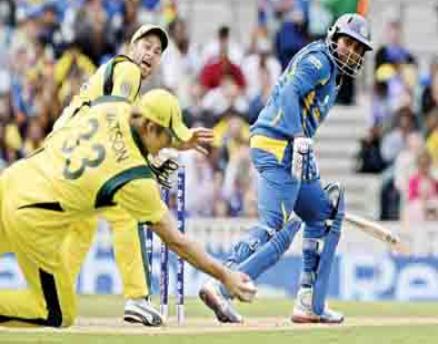
LONDON, 17 JUNE: A disciplined Sri Lanka set up a semi-final date with India in the ICC Champions Trophy as they knocked out holders Australia by posting a 20-run win, with veteran Mahela Jayawardene caressing his way to an unbeaten 84-run knock here today.
Jaywardene made his runs off 81 balls to propel Sri Lanka to 253 for eight in their 50 overs, leaving Australia with a near impossible task of chasing down the target in 29.1 overs to ensure a semi-final berth at the Kennington Oval.
Australia couldn’t achieve the target in the required overs and were eventually all out for 233 in 42.3 overs.
During the course of his innings, the elegant Jayawardene crossed 11,000 runs in this form of the game, the eighth cricketer to do so.
In Sri Lanka’s bowling department, Nuwan Kulasekara was the pick of the lot as he finished with impressive figures of three for 42 in his nine overs.
Going into the match, Sri Lanka’s recent success against Australia provided them the psychological edge.
In the last 10 ODIs played between the two sides, Sri Lanka have won six while they drew the ODI series 2-2 earlier this year in Australia.
A last-wicket stand of 41 runs between Clint McKay (30) and Xavier Doherty (15 not out) frustrated the Lankans before Tillakaratne Dilshan pulled off a brilliant catch off his own bowling to seal the issue in his side’s favour.
The move not to bring back strike bowler Lasith Malinga, with Australia on the verge of defeat, was surprising. But Dilshan’s blinder ensured it was Sri Lanka, and not New Zealand in the last-four stage.
Meanwhile, England will take on South Africa in the other semi-final at The Oval on 19 June.

Captain Clarke says it’s hard for Warner to retain Test spot

Statesman News Service |

agence france-presse
SYDNEY, 17 JUNE: Captain Michael Clarke says that it will be difficult for errant batsman David Warner (in photo) to hold his place in the Australian side for next month’s first Ashes Test after his bar room punch-up with England’s Joe Root.
Writing in Sydney’s Daily Telegraph today, he said that Warner’s actions were an unwelcome distraction at the beginning of a four-and-a-half month tour of England and he must work hard to win back the trust of his team-mates and Australian fans. The explosive opener was fined Aus$11,500 ($11,000) and suspended until the start of the Ashes series by Cricket Australia on Thursday for the incident during the ongoing Champions Trophy.
Warner will miss the rest of title-holders Australia’s involvement in the tournament and their two warm-up matches before he is again available for the first Test against England at Nottingham, which starts on 10 July.
But Clarke said that it would be difficult for opener Warner to keep his place, given what has happened.
“David has been punished and must now suffer the consequences,” he wrote in his newspaper column, adding: “He will miss most of the Champions Trophy and our two lead-up games before the first Test at Trent Bridge, making it difficult for him to retain his place in the Test side. David has accepted the punishment and knows he must work hard for the remainder of the tour to win back the trust of his team-mates and Australia’s cricket-loving public.”  Clarke, who has been away from Australia’s one-day team for treatment on a troublesome back, said that they could not afford a repeat of such incidents if they were to regain the Ashes.
“I have made it clear to David that his behaviour is not acceptable for an Australian cricketer,” he said.
“The other five guys who were out drinking with David also know they made a poor decision. If you haven’t got a reason to celebrate you shouldn’t be out at 2:30am and you shouldn’t be drinking with the opposition who have just beaten you,” he added.
Clarke said that sent out the wrong message, adding: “As proud Australians it should hurt when you lose.
There is an enormous difference between being on the winning side of an Ashes series and losing. I know which side of that ledger I want to be on come the end of August. He (Warner) has let the team down and all of those at home who love and support Australian cricket.”

‘No plan to increase retirement age for govt employees’

Statesman News Service |

press trust of india
NEW DELHI, 16 JUNE: Central government employees are in for a disappointment as the Centre is currently not considering any move to raise the retirement age to 62 years.
A senior official in the Ministry of Personnel, Public Grievances and Pensions, which acts as a nodal department for personnel matters, said there was no such proposal to increase the age for superannuation of government employees.
Recent media reports said the ministry has written to Prime Minister’s Office for raising the retirement age and sought the Union Cabinet’s nod for the purpose. There are about 50 lakh Central government employees working in various departments across the country.
Officials in the ministry said increasing retirement age requires a detailed consultation with all stakeholders and discussion with the Finance Ministry.
Without the finance ministry’s permission, the matter cannot not be processed, they said.
At a time when the government is working on austerity drive by cutting expenditure and putting in efforts to rein in current account deficit (CAD), the move to increase retirement age will also burden the exchequer’s kitty, they said.
The CAD, which is the difference between the inflow and outflow of foreign currency, had touched a record high of 6.7 per cent in the October-December quarter of 2012-13 on the back of rising oil and gold imports.
The retirement age for a majority of Central government employees is 60 years. However, the age for retirement in case of teachers and scientists is 62 years. The age of superannuation in states, like Madhya Pradesh, Chhattisgarh and Assam, is also 60 years.
In a related news, the government has decided to further increase the retirement age of specialists in scientific and medical fields (scientists) to 64 years. “A committee has been formed under the chairmanship of the Cabinet Secretary by Prime Minister Manmohan Singh for the purpose,” said another personnel ministry official.

Sharma for FDI cap hike in telecom, defence

Statesman News Service |

press trust of india
NEW DELHI, 16 JUNE: In a bid to spur investments, Commerce and Industry Minister Anand Sharma today “strongly favoured” raising the FDI cap in telecom, as well as defence sector, and said he will meet global investors to address their concerns, particularly in multi-brand retail.
Before leaving for a 10-day visit from tomorrow to Helsinki, St Petersburg, Belfast and London, Mr Sharma said he will address all the concerns of foreign retail sector investors and ensure all help in setting up stores.
Mr Sharma said his ministry would move the Cabinet for further liberalisation in other sectors, which hold potential for FDI inflows, as well.
“I am strongly in favour of raising the cap in telecom sector. I have discussed this with the Telecom and Finance ministers and once we have the proposal, we will move the Cabinet for raising the cap to 100 per cent, and also for FDI in defence because we want defence manufacturing to be here,” he said.
He said his ministry wants global majors in defence sector to partner both with the PSUs and the private sector to manufacture weapon systems in India.
“Defence technologies have multiple applications including industrial applications. We want the global majors to partner with the Indian entities… so that the big outgo of foreign exchange could also be brought down and domestic manufacturing improves and jobs are created,” he added.
On hiking FDI cap in defence sector, he said he has written to the Defence Minister and would meet him on the matter.
Mr Sharma said he will hold deliberations with Prime Minister Manmohan Singh on all these issues.
He said he will chair a Retail Round Table involving CEOs of Indian companies and foreign investors on 27 June to seek views on implementation issues and to address their concerns, if any.
Mr Sharma will also address global investors in different cities during his 10-day tour. He said after the consultations, the government may come up with clarifications and simplification of guidelines wherever required.
Mr Sharma said the moment the ministry receives any FDI proposal in the multi-brand retail sector, “it will be fast tracked and will do hand holding wherever required as we have done in the case of IKEA”.
The DIPP has already once released a clarification.
FDI of up to 26 per cent is permitted in the defence sector. The cap in telecom sector is currently fixed at 74 per cent.

India approaches tax havens on black money expose

Statesman News Service |

press trust of india
NEW DELHI, 16 JUNE: India has approached over half a dozen foreign jurisdictions, including Singapore and some tax havens, for banking and other financial details of more than 500 individuals and entities that might have "secret offshore accounts" at those places.
The “names and listed addresses” of as many as 505 India-linked entities, including businessmen and companies from the country, have been made public after a global expose on secret offshore accounts by the US-based rights group, the International Consortium of Investigative Journalists (ICIJ).
The addresses of Indian entities and individuals, according to the ICIJ expose, have addresses of upmarket localities of account holders from Delhi, Mumbai, Bangalore, Kolkata, Chennai, Hyderabad, Pune, Ahmedabad, Baroda, Surat, Chandigarh and many other Indian cities and few other suburb locations.
According to sources, the Foreign Tax and Tax Research (FT&TR) division in the Finance Ministry has approached the British Virgin Islands, Cayman Islands and Singapore under the tax information exchange treaties with these jurisdiction for banking and other details of those named by ICIJ.
Besides, FT&TR has approached Cooks Islands and Samoa through other diplomatic channels, sources said, adding that a few other countries have also been approached for details of entities alleged to have secret accounts at those places.
“Preliminary inputs obtained in this regard do not present a clear picture and hence details have been sought through official protocol mechanisms and existing treaties,” a senior finance ministry official said. The ICIJ claims to have found over “one lakh secret companies, trusts and funds created in offshore locales” by entities from across the world in the past three decades.
While the broader details of this global expose were announced by ICIJ in April, the names and addresses of the individuals and entities were made public yesterday. The ICIJ has, however, put a disclaimer that there might be a legitimate use for offshore companies and trusts and being on the list does not necessarily mean that the said entities have broken any laws. Sources said the Indian authorities would also take a call on further action after they get necessary details from the concerned countries and find any wrongdoings on the part of the individuals and entities named by ICIJ.
“The information has been sought under the provisions of the Double Taxation Avoidance Agreement (DTAA) and Tax Information Exchange Agreement (TIEA) from the countries where we have such arrangements. Some other countries are being approached through the mutual tax assistance protocol of the OECD,” sources said.
The Organisation for Economic Cooperation and Development (OECD) is a Paris-based body spearheading combat against black money and tax crimes by partnering powerful economies and nations with low tax regimes, popularly called tax havens. “The effort is to see if these names are legitimate and if they are, it will be checked if that information is with the Income Tax department. Rest all other unreported entities in this list will be liable to action under Indian tax laws,” the sources said.
After ICIJ’s initial expose in April, Finance Minister P Chidambaram had said an inquiry has been initiated against the individuals who have been named in this global report for having stashed money in secret offshore accounts.
The expose claims to have unearthed details of 2.5 lakh individuals and entities from more than 170 countries, including India, that evaded taxes by setting up companies in tax havens. The body has, however, said the featuring of these names necessarily does not mean that the entities have committed tax crimes. “There are legitimate uses for offshore companies and trusts. We do not intend to suggest or imply that any persons, companies or other entities included in the ICIJ Offshore leaks database have broken the law or otherwise acted improperly,” the ICIJ said in its disclaimer posted on the portal.

Is the game changing in Mizoram?

Statesman News Service |

prasenjit biswas
ON 23 May, the opposition Mizo National Front organised an anti-idolatry rally in Aizawl and there was a blast in the Assam Rifles’ temple complex that day. Following the signing of the  June 1986 historic Mizo Accord, Mizoram has been a picture of peace, so the new development appears to indicate a subterranean discord that mixes politics, ethnic identity and religion. Little is known to the outside world of these subtle changes in the tune and nuances of politics in Mizoram, but internally it signals a social and cultural fragmentation.
On a recent visit to Aizwal, I heard of how its residents felt a sense of insecurity vis-a-vis the haphazard construction of  residential buildings in a town that is prone to landslides and the government&’s apathy. Their frustration has found expression in action, like Mizo Young Association members taking it upon themselves to drive out Chin refugees from the Lengpui area to make the city crime-free. Anger and grief directed against the ruling party and blaming the growing rates of crime on Chin refugees go hand in hand with the larger picture of social, religious and ethnic fragmentation of Mizo society into many ideologies and groups. Raising the issue of idolatry practised by some Mizo leaders is also a psychological ploy to confuse social insecurity with the loss of faith that afflicts the community.
The rally was an expression of ideological differences not only between political parties but also between various social groups and identities. The blast, for which the MNF blamed the ruling Congress, indicates the extent of ideological manoeuvres. The state home minister described the rally as a kind of self-infliction. This is nothing but an ideological contestation of a complex mix of ethnicity, religion and politics that hurts Mizo society.
The rally&’s main objective was to expose how, during Durga  Puja, Congress  chief minister Lalthanhawla lit candles at a pandal. Opposition leader Zoramthanga argued that by doing so the chief minister had violated Christian ethics that prohibits the worshiping of idols. He also pointed out that the chief minister&’s  wife, Lal Riliani, had even put colour on her forehead and broke coconuts.  According to him, all this exposed how the Congress was pandering to what the Mizos considered an “evil” and, therefore, outside the Mizo way of life.
There&’s no gainsaying the fact that in a deeply Christian Mizo society, such public acts of display by the ruling party chief and his family members did not go down well with the masses as it contradicts their belief in Christ. The larger issue of secular practice by heads of a state as per the Constitution has not been broached by the MNF, but it simply hinted at the performance of a ritual that Christians are not supposed to indulge in.
This brings us to the issue of the Church&’s hold on and influence in the political outlook and choices of the Mizo people as such. A respected public figure cannot cross that Laxman Rekha drawn by his faith. Going against the deep-rooted faith and belief of the masses by a public leader in the Mizo context is still to be accepted as “normal”. The MNF protest rally simply voices the sentiments of commoners, who are taught not to practice any form of idolatry.
All this brings back the issue of the authenticity of being a Mizo, which lies in following  God&’s commandments. Obviously, in a plural Indian society a narrow and mono-religious notion of God creates tension, both for those who believe and those who do not. Zoramthanga&’s reference to Exodus, Chapter 20 — which says  “I am the Lord your God, who brought you out of Egypt, out of the land of slavery” — very successfully revived the memory of the abolition of the bawi (slave) system by Christian missionaries as well as invokes the Mizo belief that they are part of the 12 lost tribes that moved out of Egypt. The eschatology of the exodus out of Egypt and the contemporary revival of Bnei Menashe (children of Menasseh) who are lost in India&’s North-east and who now reconnect them with the resettled communities of Israel, are believed to be tribes of Manasseh. Such moves in imagination and faith constitute the contemporary sense of belonging to Mizo identity.
Having lost two elections consecutively, the MNF is trying to generate mass opinion against the Congress as a practitioner of “evil”. Such  political rivalry, as always, centres round a search for roots and an assumption of the right identity-roles that would ultimately decide who wins the ideological battle.
In this battle, the idea of election in a Hebrew sense becomes an argument for revival. Election marks a reconnection with the tribes of Manasseh through a journey into Israel&’s territory. It also reinvokes the memory of the complex inter-clan relationship during and after the abolition of slavery. Clans such as the Raltes, Sailos, Hualngos, Lenchungs, Zadengs, Pacchaus, Chhakchhuaks, etc, and their complicated role during the anti-slavery movement, Mizo insurgency and their present social status determine the political influence of respective parties. The MNF&’s playing the identity card is effectively countered by the Congress&’s more prominent strategy of winning over people by its ideology of secularism. So, the whole picture seems to be emerging slowly into a game changing scenario through a carefully crafted ideological battle.  

The writer ~ an associate professor, Department of Philosophy, North East Hill University, Shillong ~ co-edited Construction of Evil in India&’s Northeast, Sage Publications, New Delhi, 2012


Endangered Eden ~ jb lama

Statesman News Service |

A dam personifying misery and some ‘other’ dietary delights
MORE than 7.8 million trees will have to be cut down, bamboo cultivation spread across 25,000 hectares will be lost for ever, some 40,000 people will be rendered homeless when 90 villages go under and, more importantly, several endangered species of flora and fauna will be gone for good. Would an environmental disaster of these proportions justify the construction of a 162.8-metre high mega-multipurpose dam at Tipaimukh in Manipur&’s Churachandpur district? The region is said to be highly seismic and is inhabited by several ethnic Naga communities. Though the project&’s installed capacity is said to be 1,500 MW, it will reportedly generate a mere 412 MW.
Prime Minister Manmohan Singh laid the foundation in December 2006 amid protests by locals and several organisations who claimed the project was cleared (in 2003) without any consideration of various aspects, both technical and economic. When the proposal was first mooted in 1995, then chief minister Rishang Keishing put his foot down. But the nod was given in 2001 when the state was under a short spell of President&’s Rule. (It is worth recall that when the Centre unilaterally extended the Nagaland ceasefire to Manipur in June 2001, the people of Imphal Valley took to the streets against it and in the police firing that followed 17 were killed. This also happened during President&’s Rule.)
Bangladeshis have also opposed the Tipaimukh project because they fear that during the monsoon, when the dam&’s spillway gates are opened to let out excess water, it will cause flash floods in their country. According to a report in these columns (13 July 2009), “the Bangladesh government had maintained the dam would have no ill-bearing on the country until the formation of the National Committee Against Tipaimukh”.
A recent report said the Tipaimukh project may not be feasible after all as it would cause massive destruction of the ecology downstream of the Barak river in Assam and the Tuivah river in Manipur. This seems to indicate that the authorities are having second thoughts about the project. The Union environment ministry is reportedly hesitant to clear the project as it feels “that no compensatory mechanism would help in mitigating the loss caused by erasing forests”. It is still not too late to take a fresh look because the actual construction work is yet to start.
Work on Manipur&’s Thoubal valley multipurpose  project, conceptualised 30 years ago and now renamed Mapithel dam in Ukhrul district, is at a standstill following disputes over compensation for land losers. In 1980, the Planning Commission approved it at an estimated cost of Rs 47.2 crore. When it will be completed is anybody&’s guess. The Manipur government has come out with yet another dam project at Chakpikarong in Chandel district and this, too, has run into trouble. The locals have staged several demonstrations against it.
In Assam, the Krishak Mukti Sangram Samity, headed by Akhil Gogoi, has stopped work on the Lower Subansiri hydel project for about two years and has not allowed machinery and materials to reach the project site at Gerukamukh. It has refused to accept the Dam Design Review Panel report unless the demands of the downstream people are met. These include issues like landslides, downstream impact, flood control, ecological damage to aquatic wealth and earthquakes.
Since about 70 per cent of the construction work is said to be over, abandoning and dismantling structures that have already been built would be unthinkable. However, a way out must be found; after all, what the KMSS has asked for is that the project authorities ensure the safety of those living downstream as they fear their land will be washed away if, by chance, dams in Arunachal Pradesh get damaged.
***
RECENTLY, the Dimapur-based Morung Express published a photograph of street stall-holders in Dimapur selling different types of dried insects. Not that the vendors have taken a cue from a UN report that has urged the people to eat insects to  fight world hunger. No eyebrows need be raised because the sale of such items in Nagaland is not an uncommon sight. Kohima has a “keeda” market  (one can see it on YouTube) where the meat of different animals and dried snakes and insects are sold.
   According to the UN report, two billion people the world over have already supplemented their diets with insects, noting at the same time that "consumer disgust" remains a barrier in many Western countries. We have seen photographs of people in South-east Asian countries selling live scorpions, considered a delicacy when deep-fried. Well, as the saying goes, the proof of the pudding is in the eating!
 

Attacks kill 32 across Iraq

Statesman News Service |

BAGHDAD, 16 JUNE: A string of nearly a dozen apparently coordinated bombs and a shooting in cities across Iraq killed at least 32 and wounded dozens today, extending a wave of violence that is raising fears of a return to widespread killing a decade after the US-led invasion.
Violence has spiked sharply in Iraq in recent months, with the death toll rising to levels not seen since 2008. Nearly 2,000 have been killed since the start of April.
Most of the car bombs hit Shi’ite-majority areas and were the cause of most of the casualties, killing 26. The blasts hit half a dozen cities and towns in the south and centre of the country.
There was no claim of responsibility for any of the attacks, but they bore the hallmark of Al Qaida in Iraq, which uses car bombs, suicide bombers and coordinatd attacks to target security forces, members of Iraq’s Shi’ite majority, and others.
The blasts began when a parked car bomb went off early morning in the industrial area of the city of Kut, killing three people and wounding 14 others. ap

Perez formally indicted

Statesman News Service |

ISLAMABAD, 16 JUNE: Former President Pervez Musharraf has been indicted by a Pakistani anti-terrorism court over the detention of dozens of judges during the emergency rule he imposed in 2007.
Musharraf, 69, was indicted during a hearing of the case held at his farmhouse in Chak Shahzad yesterday by anti-terrorism court Judge Kausar Abbas Zaidi. He was indicted under provision of the Anti-Terrorism Act and the Pakistan Panel Code. After the charges against him were read out, Musharraf refused to accept them and pleaded not guilty. He filed an application for his acquittal due to lack of evidence. pti

Woman bomber responsible for Quetta attack

Statesman News Service |

dawn/ann
QUETTA, 16 JUNE: Intelligence officials revealed today that a woman suicide bomber carried out the first attack on a bus carrying students of Sardar Bahadur Khan Women&’s University earlier yesterday.
At least 25 people, including the deputy commissioner of Quetta, 14 students of a women&’s university and four nurses were killed yesterday when a bomb tore through a bus, followed by a suicide attack and a gunbattle in the Bolan Medical College hospital, where the injured students were taken for treatment.
Banned outfit Lashkar-i-Jhangvi claimed responsibility for the bomb blasts.
An Intelligence official, who requested not to be named, said that a woman suicide bomber managed to sneak into the university bus. "When all the students gathered inside the bus, she blew herself up", he said.
Officials said they had no information about the identity of the bomber. Moreover, Intelligence officials said after the woman bomber blew up herself in the bus, a second male bomber followed suit and struck inside the crowded Bolan Medical Complex Hospital to wreak maximum damage.
According to the Intelligence personnel, the male suicide bomber was waiting inside BMC Hospital ward for the arrival of high level officials, including the Chief Secretary, and blew up himself when they reached.
Quetta Police Chief Mir Zubair Mehmood also said that the Deputy Commissioner of Quetta Abdul Mansoor Kakar was killed as result of firing outside the hospital.

Militants kill 2 Pak polio vaccinators
ISLAMABAD, 16 JUNE: Suspected militants shot and killed two polio vaccinators at Swabi in north-west Pakistan today, the latest in a string of attacks targeting the government’s vaccination campaign.
The vaccinators were attacked while they administering polio drops to children in Swabi area of Khyber-Pakhtunkhwa province, officials said.
This was the second such attack in Swabi.
In January, six women and a man working for a NGO involved in the vaccination campaign were shot dead in the district. Last month, the killing of a woman polio vaccinator on the outskirts of Peshawar city had prompted the World Health Organisation to suspend its vaccination campaign. pti