


indo-asian news service
Belo Horizonte/Fortaleza, 27 June: Neymar has hit back at claims of Uruguay captain Diego Lugano that he is "talented at winning free-kicks".
Speaking after Brazil’s 2-1 victory over Uruguay in Wednesday’s Confederations Cup semi-final at the Mineirao Stadium, Neymar moved to avoid a verbal confrontation with the centre-back, reports Xinhua.
"He has the right to say what he wants, it won’t affect me. I don’t pay any attention to it. What is important is that I help my team to win," the 21-year-old Barcelona striker said.
After the match, Lugano stood by the accusations he made Tuesday. When asked about a statement from Brazil’s football confederation (CBF) condemning Lugano’s comments, the Paris Saint-Germain defender expressed bemusement.
"Do you think I care about what the CBF or the media say? It doesn’t interest me. I say what I think without worrying about the reaction of others."
Neymar failed to score for the first time in the tournament Wednesday but played a role in both of Brazil’s goals. Fred’s opener came after a Neymar shot was blocked by Uruguay goalkeeper Fernando Muslera while he provided the assist for Paulinho’s late winner with a precise corner-kick.
Neymar said Brazil’s squad would keep a keen eye Thursday’s other semi-final between Spain and Italy in Fortaleza. But he declined to nominate a preferred rival for Sunday’s final at the Maracana Stadium in Rio de Janeiro.
"You can’t choose who you play against. They are both difficult sides. We are going to be watching the match on a screen and try to be as prepared as possible," Neymar said.
Casillas speaks
Spain’s World Cup winning captain Iker Casillas has revealed he was brought to tears by the indifferent attitude of former Real Madrid coach Jose Mourinho.
The 32-year-old says he is a new man after making his first competitive appearance since January in Spain’s 2-1 defeat of Uruguay in the Confederations Cup last week, reports Xinhua. "I’ve cried," Casillas admitted in an interview with Fifa.com. "I’ve suffered, I’ve been unwell, I’ve had sleepless nights." Despite having recovered from a hand injury in March, Casillas was overlooked by Mourinho for the remainder of the season in favour of Diego Lopez. He admitted he would have considered leaving Real Madrid had Mourinho not left to Chelsea.
"I’m a Madridista right down to my soul and, above all else, what matters to me is the club," he said.
"I would love to retire at Real Madrid, but I will not create problems if a coach does not want me."
Spain coach Vicente del Bosque has rotated his goalkeepers during the Confederations Cup group phase, with Casillas, Victor Valdes and Pepe Reina all playing a game each.
But Casillas is expected to be chosen for Spain’s semi-final against Italy here Thursday. "I have regained my happiness," he said. "It was not easy but I’m another Iker Casillas now.
"After five months, it takes some time until everything comes back to you, but, luckily, I have had a great deal of help of my teammates and coach (Del Bosque) and that’s important when you have to start over again."
Neymar hits back at Lugano


India reach West Indies
KINGSTON (Jamaica), 27 JUNE: Fresh from their Champions Trophy triumph in England, an upbeat Indian cricket team landed here today to compete in a One-Day Internationals tri-series. “Jamaica welcomes us with bright sunshine and some lovely cricket fans, not to forget (billboards with pictures of) the great Usain Bolt,” tweeted off-spinner R Ashwin upon arrival here. The Indian team, carrying on from their unbeaten run in the Champions Trophy, will start their campaign on Sunday by taking on the hosts. pti
Caribbeans relish home advantage
agencies
KINGSTON (Jamaica), 27 JUNE: Eager to leave their Champions Trophy eliminations behind, hosts West Indies and Sri Lanka will square off here tomorrow in the opening match of a tri-nation one-day series which also features India.
The West Indies were eliminated in the group stage of the Champions trophy when they lost to South Africa via the Duckworth-Lewis method and the Sri Lankans were humbled in a semi-final by eventual champions India.
Sri Lanka beat Australia and finalists England en route to the knock-out stage while the Caribbeans were disfavoured by luck as the weather put paid to their hopes in a crucial match against the Proteas.
The teams have come into the tournament with almost the same set of players as did duty in England, except that the hosts have left out Ramnaresh Sarwan and Jason Holder. The Sri Lankans were forced to leave out injured opener Tillakaratne Dilshan.
Wicketkeeper Denesh Ramdin has re-joined the West Indian side after serving out his ban for wrongly claiming a catch against Pakistan in the Champions Trophy. The Sri Lankans have not played much in this part of the world. The last time they competed here was in the 2007 World Cup but the conditions might support their spin-oriented attack, which includes Ajantha Mendis, who has of late been labelled a Twenty20 specialist.
The weather is a matter of concern here too and if the rain gods allow a full game, it will be an interesting contest between the West Indies batting and Sri Lankan bowlers.
The spin trio of Ajantha Mendis, Sachithra Senanayake and Rangana Herath will pose a threat to the Caribbeans, who are expected to rely on good starts by the flamboyant Chris Gayle.
The Sri Lankan batting will once again revolve around the ever-reliable senior duo of Kumar Sangakkara and Mahela Jayawardene. The Caribbean line-up, led by Dwayne Bravo, is full of potent match-winning all-rounders and the home conditions would give them extra confidence and motivation to do well.
West Indies head coach Ottis Gibson said they had been “gutted” after what happened in England but reposed full faith in his players.
“It’s to put away those silly little mistakes that we made in England. We felt we had a good opportunity to win that tournament and we want to win this one and prove ourselves right,” he said ahead of the clash.
Gibson said his “players are taking more responsibility and are starting to believe a lot more” in their ability to do well as a team. Skipper Dwayne Bravo said his side had a good chance to win the tournament.
“It’s always good to play at home (and) we have a good record here. We want to start well, aim to get into the final, but it’s not going to be easy. We respect both teams and their positions, and it is for me as a captain to try and get the guys (playing) as consistently as possible and to get them to believe in themselves, believe in each other, so we can play some good cricket and entertain our fans,” Bravo said.
Biz briefs
Mercedes may hike price
HYDERABAD, 27 JUNE: Sliding rupee against world currencies may force luxury car maker Mercedes Benz to go for price hike in future, a top official of the German auto maker said today. Mr Eberhard H Kern, managing director and CEO, Mercedes Benz India, also said the company plans to invest Rs 250 crore to expand the existing manufacturing facility. The domestic currency has fallen by over 10 per cent in the last one month to trade at all-time low level of 60 against dollar. “We look at this development a bit worried. For the time being we are safe. We follow long-term hedging strategy. But if the rupee stays on this weak level, we have to look at our pricing,” Mr Kern told reporters on the sidelines of the launch of the new E-Class in Hyderabad. pti
Telecom licence
NEW DELHI, 27 JUNE: Norwegian firm Telenor and Qatar Telecommunications today won telecom licences in Myanmar, one of the last untapped mobile phone markets globally, pipping India’s Bharti Airtel and nine others. The government committee in charge of licence bids “is pleased to announce that Telenor Mobile Communications and Ooredoo (Qatar Telecom) have been selected as the two successful applicants”, a Myanmarese government statement said. pti
Honda launch
NEW DELHI, 27 JUNE: Honda Motorcycle & Scooter India today launched a new edition of its global sports performance bike CBR 250R priced between Rs 1.56 lakh and Rs 1.86 lakh (ex-showroom Delhi). The 2013 edition CBR 250R is available for sale across all Honda exclusive authorised dealerships starting this month end, HMSI said in a statement. pti
Tackling Corruption~I
Police As The Final Arbiter
THE recent observations of the Supreme Court in the controversy involving two Union Ministers need to be debated extensively before a final view can be taken. Otherwise, there is every possibility that the system may be damaged irretrievably. Once the Pandora&’s Box is opened, there is no way anyone will be able to shut it.
The Court has desired the Government to bring forward a Bill to grant full autonomy to the CBI to make it independent of government control. A deadline has also been indicated, according to media reports. The CBI has been described as a “caged parrot”. The implication is obvious. Somehow, the agency is being inhibited in discharging its role in a free and fair manner. Further, that there is political pressure on the CBI to tailor its reports to cater to the ruling political executive.
At the outset, it must be iterated that the apex court is a hallowed institution and its views deserve the highest respect. Having said that, it needs deep reflection on the issue of making a police agency independent of government control ~ it is fraught with grave risk. It will impact the functioning of the executive and hobble the decision-making process, if not paralyse it. In the ultimate analysis, all economic growth and development is a function of a decisive executive. “To be decisive is to provoke controversy,” as a former British Prime Minister put it.
To appreciate the issue in perspective, the role and responsibility of the various agencies involved in executive governance need to be analysed first. The CBI is a police agency in mufti, manned exclusively by policemen. A policeman throughout his official career is a privileged person. He is not involved in any executive decision-making. Indeed, he is not a part of the civilian executive. All through his career, his primary role is to investigate crime post facto. At the end of his innings, he can comfortably hang up his boots, sometimes fitted with iron spikes and justifiably look back at a controversy-free career.
On the other hand, the civil servants who constitute the permanent executive are not so privileged. From day one, the first official assignment of an executive officer is as a sub-divisional magistrate who is expected to implement around forty odd laws. He is the chief representative of the government in the outlying districts. He is thrown into the very vortex of the complex affairs of the modern welfare state, with all the attendant responsibility and day-to-day accountability. Generally an outsider, he is a solitary reaper. ‘God save him’ – a handy prayer – is his best armour.
The forty odd laws range from land laws, environment protection, regulation and control of essential commodities, economic legislation like procurement and distribution of food grains, municipal bye laws, conduct of periodic elections to the legislature and Parliament, tax and revenue laws, public health and organization of public festivals and fairs and so on. Besides, he is a designated executive magistrate under the Criminal Code of the country who has to hold inquiries and inquests, intervene in land disputes, exercise powers in cases of public nuisance and is ultimately responsible for law and order.
Arguably, nowhere in any established democracy the world over is so much responsibility thrust on such young and inexperienced shoulders. Besides, as the chief representative of the government in the field, he has a constant interface with the local political executive. Management experts the world over have come to acknowledge that political input is an important part of executive decision-making in a representative democracy.
In the states and at the Centre, the basic architecture of the government comprises specialized directorates which are supervised by ministries headed by elected ministers who are accountable to the Parliament. The CBI is just one such police directorate under the Union Home ministry which is supposed to be manned by civil servants ~ all trained and experienced magistrates. The civilians in the ministry ensure accountability of the directorates and assist the Home Minister in the discharge of his Parliamentary duties.
The bifurcation in a democratic government into departments and directorates ensures the in-built accountability of all executive authorities to Parliament, a first postulate of the ‘rule of law’. Authority without accountability would be the very negation of the rule of law. According to the Supreme Court itself, in the celebrated case of Keshavananda Bharati, ‘rule of law’ is a part of the ‘basic structure’ of the Constitution. Hence, it is immutable.
Theoretically, all executive decisions can be challenged and investigated by the CBI. In other words, a police officer who is not required to take any decision all his working life can question any executive decision. There is another factor, largely overlooked during the public discourse where the cry for blood is increasingly strident. The police always have the advantage of hindsight, against which no weapon of defence has ever been invented. A civilian decision-maker is thus always vulnerable. To make CBI even more powerful would be the sure harbinger of a police state.
Some CBI officers are forever moaning that they are being hindered in their duties by political pressure from the ruling politicians. Exceptions apart, nothing could be farther from truth. All investigation is conducted by the CBI under the Criminal Procedure Code, the oldest law on the statute book. Once an FIR is lodged, the investigating officer derives full authority from law and not from any executive superior. He already enjoys full autonomy.
Complete autonomy to the police during investigation had been granted by the Supreme Court itself in a landmark judgement more than half a century ago. Under the Criminal Code of the country, the respective High Courts have the inherent power to pass any order on the police “to secure the ends of justice”. But the Supreme Court categorically restrained the High Courts from intervening during the investigation of criminal offences. It is the long-settled law of the land.
Thus, in the spirit of the said judgement, the apex court refused to intervene during investigation even where the police had no territorial jurisdiction. When it was alleged that the police were conducting investigation in a mala fide manner, the apex court ruled that the High Court had no inherent jurisdiction in the case but Writ jurisdiction, i.e. only if any fundamental right of the accused were to be violated. “The functions of the judiciary and police are complementary, not overlapping”.
Assuming that an investigating officer was to be pressured to act other than in accordance with law, the Constitution fully protects him from any departmental or legal harassment in terms of Article 311. A police officer has nothing to fear unless, of course, he chooses to allow himself to be so manipulated, for rewards later. This appears to be the case more often than not, if recent developments are any indication. Two of the country&’s top investigators who had already retired, heads of NIA and CBI, have both been gifted recently with post-retirement plums. These have been gratefully accepted, thank you.
Evidently, in the bargain these top cops have set a very unedifying example before their juniors. The doublespeak is all too evident. Before the courts of law, some of these CBI officials plead helplessness. But when no one is watching, they quietly suck up to their political masters and willingly do their bidding. But when the balance sheet on corruption is drawn up, the executive, both political and permanent one is rendered a festival drum ~ beaten on either side by the judiciary and a sensation-mongering media.
(To be concluded)
The writer is a retired IAS officer
Edits
PM, SONIA, IN J&K
Good signals, follow-up vital
IT would be all too easy to write off as routine the first visit of the Prime Minister and the UPA chief to Jammu and Kashmir after the Afzal Guru execution. After all, it will be years before the full value of the railway ~ no mean achievement ~ and the power project Manmohan Singh and Sonia Gandhi launched trickle down to the common man. No dramatic promises were made either. Yet the very fact that they went ahead with their scheduled appointments despite militant forays clearly aimed at deterring them should serve to reassure a section of a long-harassed people. The agencies responsible for providing VIP security would surely have been apprehensive of their going ahead with plans after the attack on the security forces on Monday that took eight lives. The local police would have also had their concerns. While it might be an exaggeration to hail the trip as a “courageous display”, it would be unfair not to recognise that it was a politically sound move. Not only did it give a practical dimension to repeated claims that terrorism would not dictate the agenda, it would have convinced at least some people that New Delhi was prepared to share a little of their prolonged trauma. Never mind if a combination of a hartal-call by the separatists and strict “control” by the security forces kept the turn-out at the functions to moderate levels ~ there was no major attempt at disruptive action. That indeed does say something.
It is also worth noting that Omar Abdullah let his party men press the autonomy question, as he refrained from pushing his AFSPA-withdrawal campaign. Yet since it is important not to be seen as surrendering to “India” he flayed the BJP&’s consistent demand to abrogate Article 370 of the Constitution: a subtle way of confirming his Kashmiri credentials. Regretfully it cannot be truthfully said that the Banihal-Qazigund rail link offers a glimpse of “light at the end of the tunnel” in resolving larger issues. Nor will an emphasis on development, employment etc. douse the fires that still burn in Kashmiri hearts. Far too many promises stay unfulfilled, reports/recommendations of various committees remain ignored. Yet the generally favourable reaction to the visit suggests that another opportunity is presenting itself to “do business”. It must not be added to the tally of previous possibilities that were spurned because New Delhi “lives” only for the day.
‘SMILE’ THERAPY
More wind beneath IAF wings
“I WANT to see you smile”. Coming as it did in a scenario of difficulty, danger, and indeed some gloom, that directive from the Chief of the Air Staff might have appeared a trifle strange to those unfamiliar with the military ethos. Yet those six words might well go down in the history of the Indian Air Force as “Charlie Browne&’s” sweetest serenade: for they brought comfort to men who had just lost their mates flying the same missions as they would continue to undertake, inspired them to keep risking their lives to complete a humanitarian task that probably made more demands on their professionalism than their prime role in combat duties. The smile the Air Chief sought was an expression of satisfaction at having attained the highest levels of prowess in stretching the capability of man and machine to the maximum ~ to save the “least” of their countrymen. It may never be known just how many lives were lost in the Uttarakhand calamity, the Indian people should ever be grateful to their ‘faujis’ who preserved many more. And make no mistake about it, Air Chief Marshal NAK Browne was including his brothers-in-arms in olive green and khaki, when commending the ongoing rescue efforts ~ possibly the most ambitious (in terms of numbers, terrain and weather) helicopter-led operations of this nature anywhere. It is standard military practice to face difficulty head-on. Should a plane crash the commander of the base from where it had been launched almost always immediately orders another to take-off to prove a point: in sharp contrast to the “civil” practice of grounding all aircraft of the same type should a snag develop.
The “smile” the Chief wanted was just another manifestation of the spirit underlying the practice of getting another plane airborne at the earliest. The IAF would do well to commission the compilation of a detailed, humane and colourful account of Operation Rahat. Posterity could benefit from it. The defence ministry could also consider striking a special medal to be awarded to all military personnel who participated in the mission. And to digress a little, the faujis at Jolly Grant airport would have had cause for smiles of another kind at seeing rival politicians from Andhra getting into a punch-up trying to pinch some “glory” after the gallantry of the Army, Air Force and ITBP…
PROFLIGACY IN N-E
Rio and Sangma show it
MUKUL SANGMA’S Rs 10-crore office-cum-bungalow, now under renovation, will not be the costliest for any chief minister in the North-east. His Nagaland counterpart, Neiphiu Rio, operates from a palatial complex which reportedly cost the state exchequer a whopping Rs 31.65 crore. That no legislator raised an objection was understandable because every one of them has an eye on the chief minister&’s chair. Rio&’s residential complex is said to have state-of- the-art security arrangements and the ambience of a five-star hotel. According to reports, Sangma&’s new official residence is beautifully landscaped, has 30 rooms, barracks, tennis and badminton courts. Since the general administrative department has justified the expense, arguing that the chief minister needs “a befitting house” to stay in, no questions will be asked. In future there could be a helipad as well. If functioning from such swanky bungalows give Rio and Sangma added impetus for proficiency in governance, no one will grudge it.
While most other chief ministers have their official residences, Assam&’s Tarun Gogoi has been functioning from his modest government guest house in Khanapara ever since assuming office in 2001. North-east states are known for profligacy in the use of public funds. The message implied in the Shillong renovaton extravaganza and from Kohima is clear: what is being spent after all is the Centre&’s ~ and taxpayers’ ~ money and politicians should make hay while the sun shines. A few years ago a Meghalaya politician is said to have fixed expensive gadgets at his official quarters at public expense. After he vacated the house, the gadgets were missing.
Taliban will dictate terms in Afghanistan
The Americans have convinced the world about their ultra-strategic capabilities to the point that sovereign leaders accept Washington’s views as their own. The war on terror and the invasion of Afghanistan, and of course Iraq, was thus justified by a silent international community that allowed the US President of the time, George W Bush, to wreak havoc on unsuspecting peoples of a region far away from American shores. Thousands have been killed since, arrested, tortured and maimed as the US set into motion a war that based itself on intelligence information and shadowy conclusions.
The result was predictable. The Middle East is still paying the price for the ‘regime change’ policy that was camouflaged as a ‘war against terror’, where countries like Saudi Arabia ~ guilty of the worst kind of indoctrination ~ remained friends and allies, and secular nations like Iraq, Libya and Syria were and are being targeted for reasons that have little to do with terrorism and more to do with strategic control. But it is in Afghanistan, which has historically levelled all conquerors, where the US is eating crow. And is today talking to the very group that it sought to oust as “terrorists” when it entered the country so many long years ago. And what is more, the Taliban is talking from a position of strength as it has survived the onslaught unleashed not just by the most powerful country in the world, but by its militarily powerful allies as part of Nato.
The US decision to pull out troops in 2014 ~ President Barack Obama knows he cannot renege on this promise without severe domestic repercussions ~ has finally made it confront the reality that was known perhaps to every Afghan but not recognised by the US administration; that the American soldiers would not succeed in vanquishing the Pashtun, or for that matter the Afghan tribes. President Hamid Karzai brought in from the US to head the government in Afghanistan was not able to get the US writ to run outside Kabul, and has since remained where he was. The only difference is that he too is showing his teeth, and can no longer be taken for granted by the Americans as their “puppet”.
So Pakistan, which has taken a huge beating in the process as well, not just militarily with casualties, but also in terms of self-respect and reputation, is back in the picture negotiating talks between the US, and yes, the arch US foe, the mother of all terrorists (the al Qaeda being the father), the Taliban. After trying to bash all into submission, the US has opened talks with the Taliban and Pakistan is the broker. And as the world watched, again silently, the Taliban opened an office in Doha and their spokespersons, till recently hiding in the mountains, emerged to set out conditions for the dialogue. It is now known that the office would have opened a year earlier, except that the Taliban was upset with the US dragging its feet over the release of political prisoners. It is not clear whether this has been resolved as yet, but the talks as they continue will discuss this along with a sequential process to bring the Taliban back as a major political player, if not ruler, in Afghanistan politics. The rest, such as the Taliban must accept the Afghan constitution, is cosmetic with the ‘ayes’ not counting to much in the final analysis.
The US, bereft of a strategy after spending millions, killing countless people, and destroying nations, seems to have been cornered into placing all its Afghan eggs in the Pakistan-Taliban basket. US Secretary of State John Kerry appeared more than upset when he rushed around trying to ensure that the dialogue did not snap because of Karzai&’s angry outburst against the Taliban&’s decision to name the Doha office the Islamic Emirate of Afghanistan, and projecting it almost as a sovereign embassy rather than just a political office. Kerry is reported to have called Karzai thrice in 24 hours, as the Obama administration worked around the clock to retrieve the situation. It seems to have managed that, with talks back on the agenda, for the moment at least.
The Americans basically want to ensure that the pullout of troops is violence-free by getting the Taliban on board. And that a government that takes over, ensures the safety and security of the US troops stationed in the eleven bases across Afghanistan; and that the al Qaeda is not allowed to plan operations against the US and its citizens from Afghan havens. The Taliban has agreed not to allow such attacks from its ‘soil’, although it has still not come out with a blanket statement denouncing the al Qaeda as the Americans want it to.
The sailing is going to be rough, to put it mildly. The Taliban is continuing with the violence, a card it holds and will not let go until it is safely in power. Karzai is not going to be a walkover. India, Russia and Iran will be watching the developments closely and while New Delhi might be placated with a few lollipops, it is unlikely that Moscow and Tehran will allow a government in Kabul that threatens regional peace. Pakistan, a major player, is happy with the recent developments perhaps, but determined not to be edged out of the final picture. It is not playing the broker for free, and wants the US to ensconce it as a major ‘stakeholder’ in Afghanistan with partial control over the ‘assets’. Currently, Taliban leader Mullah Omar has a close relationship with Islamabad, but this may or may not last. Afghan provincial warlords can also be expected to become active as the talks begin, adding to the complexities of an uncertain dialogue.
The Afghan national security forces that are supposed to be taking over the security of the beleaguered country gradually are in no shape to tackle the immense security challenges. About 250 of its men are being killed on an average every month. The training is poor, the equipment mediocre, and the morale certainly not what is required to continue the fight without the aid of the Americans and their flying machines.
The writer is Consulting Editor,
The Statesman
Rousseau’s legacy has multiple hues
tarun kumar
Name dropping Rousseau, even around his 300th anniversary amongst liberal cognoscenti is bound to evoke a knee-jerk denigration. Questions will be asked: What is more perverse, his thought or his personal life? During the Cold War epoch, liberal intelligentsia consistently dubbed him as the intellectual forerunner of totalitarian projects. The crimes of the Left, from the Great Terror to Gulag, all seem to draw inspiration from Rousseau’s bizarre sense of collectivism. His rural sentimentalism was presented as an irrational hostility to science and progress.
On the other side of the spectrum, there are others who see him as a prophet with an insight into the false promise of modernity and nothing could be closer to truth than this as we face environmental degradation and economic dilapidation. He was indeed a philosopher who could smell foul in the future and provided a therapy for an ill that was yet to manifest itself fully. His thought is a primer on how to lead a healthy life in a world full of vanity, jealousy and competition.
Rousseau’s formulation of collective human action as the touchstone of social and political life at once made him the modern Prometheus, who stole the celestial fire from the Gods and thereby liberated mankind from the guilt of the biblical original sin. His rediscovery of nature and civic virtue of the ancients brings him in tandem not only with Socratic thinking, but also in tune with ancient Oriental philosophy of Taoism.
Born in an artisan family on 28 June 1712 in Geneva, a Calvinist Republican city state amidst Catholic Kingdoms, his personal life was trying and unconventional, interlaced as it was with a live-in relationship with his lady mentor and then wedlock with a long-time companion, producing many children all of whom were quietly dumped at orphanages. But he was bold enough to admit his ill doings in his work Confessions.
By 1749, Rousseau had interned as a domestic servant, a horologist, a tutor and even a musician; he was also a casual hanger on in the Enlightenment salons frequented by Denis Diderot and his group. Interestingly, it was on one of ‘solitary’ walks to visit an interred Diderot that he claimed to have been overwhelmed by a reverie that provided him with an insight into the Academy of Dijon literary question: Whether the arts and science have contributed to or undermined morals. Rousseau ingeniously crafted his central thesis that ran against the Enlightenment mainstream: Man is naturally good but has been corrupted by society.
Natural flow of humans, Rousseau was convinced, had been vitiated by the sediments of civilisation. These inchoate thoughts cobbled up with some Montesquieu inspired ideas went on to constitute his now famous, Discourse on the Science and the Arts.
His train of thought made him address the problem of instinctive human desire for freedom and recognition in an increasingly interdependent world. It inspired him to put forth a comprehensive critique of civilisation, in Discourse on the Origins of Inequality among Men. In this evolutionary essay, he intended to judge "the original constitution of human beings"; the preface opened with the Delphic precept, "Know thyself". "The trappings of civilisation had fooled everyone", he wrote, "all ran headlong to their chains…they had just enough wit to perceive the advantages of political institutions without experience enough to see the dangers."
No wonder then, "Man is born free and but is everywhere in chains." Society, with its inducements of rivalry and ambition, had trapped man into adopting a social self that stifled the authentic or natural self. Knowing oneself without the garbs of civilisation was the key to resumption of normal natural self that is endowed with the essential feeling of ‘pity’ and the ability to overcome habits through free will. To overcome the snares of civilization, one can strengthen one’s will by seeking classical virtue, an idea Rousseau took from the Greeks.
To build upon his sense of classical virtue and natural sentiments, Rousseau penned a romantic novel Julie or the New Heloise; the main characters were not sophisticates or even the French, but young people including rurals, foreigners, recluses who in their romantic imagination take the frenzy of their innocent minds to be philosophy. Set up as an epistolary Romance in the Alps, the novel was an unprecedented success as it got swiftly printed into English and German and sold multiple additions. It made Rousseau a cynosure of classical virtue and natural sentiments.
The stage was now set for his serious texts. Emile was an implicit critique that took education to be a form of fantasy, an account of a young man being raised in ideal circumstances by a solitary tutor ~ Rousseau imagined himself perhaps as tutor. The idea behind Emile was child-centred motivational education beyond mere rote learning. Emile also outlined Rousseau’s complex views on psychology and religious heterodoxy that got him into trouble and had him secretively taking refuge in Staffordshire in England with Hume’s help.
In his magnum opus, "The Social Contract", an attempt was made by Rousseau to politically reconcile Freedom and Interdependence. A properly cultivated free will was the route to deliverance as it endowed the individual with the ability to resist temptation and in its generic form, "General Will" was to be the basis of an ideal self-governing community. Unbridled exercise of Will of man is the bedrock of Governance and popular sovereignty. Rousseau had emerged from his texts as a paragon of civic republicanism that lay in a periodic assembly of citizens coming face to face to govern themselves.
His posthumous fame was indeed grotesque, perhaps as grotesque as his notion that citizens are constrained to obey the "general will" and "forced to be free" ~ a superficial linkage between Rousseau’s thinking and ecstatic Jacobin revolutionaries. A few years after his death, during the halcyon days of French Revolution, he was eulogised as a luminous star on the firmament of European history. In 1794, five years after the storming of Bastille, the state Prison, a symbol of ancien regime in France, his body was exhumed to be reburied with full state honours in a three-day celebration at the Pantheon, a church that was converted into a Mausoleum for the internment of this great French philosopher where he lays ironically with his arch rival Voltaire.
At the age of three hundred plus at least, there is more to Rousseau than just a wacky connection with the French Revolution, which in any case stood severed when revolutionary theorists like Abbe Seyes converted the Third Estate to represent the nation and later the Committee of Public Safety was considered as an expression of general will.
In terms of sheer political philosophy, Rousseau has proved to be somewhat distinct. He is at once the naturalist precursor to Immanuel Kant exploring the linkages between the moral and animal dimensions of humans. At another level, the totalitarian Rousseau, as liberals would want us to believe, coexists with a liberal Rousseau as an intellectual ancestor to John Rawls and his theory of Justice, a Rousseau whose citizens relate to each other in terms of shared political identity ~ an abstraction as in Rawls, apart from their real and unique identities.
There is obviously a Marxist Rousseau who comes home with a critique of exploitation, alienation and private property that dwarfs the citizen into a mere appropriator or an appendage. We also find a Habermasian Rousseau, who seeks the reinvigoration of public space and democratic spirit. Of late, there has been a resurgence of civic republicanism in the works of Quentin Skinner and Philip Pettit, which echo Rousseau’s assertion that any political system worth its salt must free fellow beings from the arbitrary wills of others.
With burgeoning civic assertion and a growing sense of citizenship in terms of new rights of information and service, it is time we acknowledge the philosophical fountainheads and their intellectual legacy. The days of passivity seem to be over and citizens are now keener than ever to have their voice heard, instantly, despite choosing representatives who claim to speak for them.
Governance, Representation and Legislation need a serious rehash. The variants of mass media and virtual public space resulting from cybernetics are producing a potent ingredient of directness in our Democracy. It is time we learn from the champion of civic participation, the nuances of an active citizenry in a polity that is mired in labyrinths of representation.
At least at the ideational level, there is perhaps no one better than Rousseau to be our friend, a philosopher and guide to iron out the current angularities of our public life. Rest assured, Rousseau, we have enough moral medicine in our scriptures to take care of your personal angularities and whims!
The writer is a bureaucrat
Stanza
The way a man weeps
(Manush Jebhabe Kande by Shakti Chattopadhyay, my translation)
The way a man weeps, do animals do too?
Alone I live, very very alone.
Deep within me alone.
In the middle of the forest alone.
Indoors or outdoors, day or night, happy or sad,
Alone, alone, alone.
No shadows, no illusions.
Flower-gardens, flowerless.
Starkly aslope like a waterfall,
Back gripped by dishevelled hair.
Clouds loom, but waterless, in a festival of the water-born,
Of waterless lotuses and lilies.
There is no paddy, no attraction, nothing to hold on to.
Just dried hay, utterly destroyed leaves,
disintegrating on paths below trees.
A country that teems with nothing but this vacuum.
Even then, man survives.
He survives because there is death.
But death is not life.
There is no continuity in it.
In a crowd, or alone, or in company, he survives.
Keeps alive.
He does, because he has to.
The way a man weeps do animals do too?
Capsule
(My second khayal)
Without my fever and my pains, am sick again.
Like I’ve been the decade before.
Poofed…
Hurled into space, with a body, fit like an astronaut&’s,
Inside a capsule in to which
Loneliness has drilled endless holes,
That suck feelings out.
Also life.
Desires.
Everything.
Like Shakti&’s tattered tent
Ribs endlessly seared.
Inside, no room to move.
Outside, space
With endless room
Soulless.
Brutally alone.
Alone. Alone. Alone.
But Memories yet?
Of your feel ’n touch?
Saplings trodden by Time,
Its clock that has its own plans.
Always had and will.
Its arms not shackle-able.
So now, nothing.
Its lesson of the now, unlearnt
Fertiliser-less, sand where no thoughts can seed.
Arid. Arid. Needless need.
Its embers, injurious to health, stubbed out,
Oxygen depleted by gasping lungs
Rushed to the ICU
To prevent from it
The bliss of the smokeless stub
Of a memory-less brain
Of Death
And Shakti screams, “But Death is not Life”
What is it then?
Where matter not the kith and the kin
Bhaj Govindam, Mudhamate.*
But not for me that BLISS
’Cause I do remember.
With a pince-nezzed brow
Wrinkled with Time&’s indelible pen
Tattooed.
And wish you were here to feel ’n touch,
My thoughts do not on death feed?
Trudging uphill to cook and eat.
Energy-less without, ever since.
Maybe the shower, Ganga&’s dip for the lifeless body?
Where water can replace space.
This drilled space. So thoughts can stay.
For an hour or two or ten.
Maybe. Maybe. Maybe.
But then?
Space. Space. Space.
Endless.
Infinite.
And this drilled capsule.
* From Bhajgovindam, one of Adishankara&’s loveliest of compositions that teach of the valuelessness of relationships.
~ basant rungta
For whom the bell tolls
A tribute to Rituparno Ghosh (1963-2013)
No man is an Iland, intire of it selfe; every man is a peece of the Continent, a part of the maine… any mans death diminishes me, because I am involved in Mankinde; And therefore never send to know for whom the bell tolls; It tolls for thee.
Devotions Upon Emergent Occasions; Meditation xvii (1624) John Donne
All the bells tolled that midnight
The spirit of the spirited one
Tiptoed to the undiscovered country
As those who loved him slept
He was not just anyone or any man
He was a person extraordinaire
A dreamer of unique dreams
A maker of unique moving pictures
It was a silent stealthy farewell
Sleep sweetened final departure
On that last lonely rainy midnight
Did his “heart burst smilingly”?
Such an untimely leave taking
Between countless brilliant takes
Between lights camera action
Resonance of non-violent shooting
No poet plaintively coaxed him
Not to depart gently into the good night
No one knows whether he had
Raged against the dying of the light
But he bravely opened the cruel closets
Making the invisible visible
The rainbow flag fluttered
It was a spectacular coming out
He tossed off the closet keys
Body-bridged the divide
He opened the last door too hastily
And stepped out into the bodiless unknown
Images and sounds on screen as never before
Creating history as he reconstructed stereotypes
Self-scripting the gypsy&’s graph, his focussed
Third eye emblazoned the screen with memories
Within himself he fused the world
Not binaries but the androgynous dream
He was gentle and tough at the same time
His inscribed body a rare meta-text
The eternal feminine, the assured feminist
The virile and the effeminate
Fused with felicity
As he stood tall, transgendered
It was a mistake, muttered the myopic
Oedipus complex internalised, invented others
What a lurid ludicrous tunnel vision —
Free from spin doctors he chuckled in relief
Everyone knew for whom the bell tolled
That cruel callous rainy night
For the bell did not toll for him alone
It tolled for the countless aficionados
Every song sung now
Will not be just in memoriam
Every song to be sung now
Will be the followers’ anthem
The closets will not close again
The sun will shine in every space
Sun rays will light up every dark alley
Subterranean streams will flow into the mainstream
~ sanjukta dasgupta
Think Again
The truth about technicalities
Why should we be so mean to those animals that help us in every way to survive? India will not be viable if we remove its cattle and yet how viciously we treat them, says maneka gandhi
TWO months ago I held a meeting with Union ministry of animal husbandry officials to ask them to change their policy on things that were killing India – the growing of emus and rabbits, a 100 per cent subsidy on slaughterhouses and bad slaughter practices. They heard me out in silence and the next day Sharad Pawar told me that none of these things would be changed because he was personally in favour of them.
One of the things I asked for was a policy decision on the terrible physical mutilations done to cattle, such as dehorning, castration and nose-roping. The commissioner for animal husbandry, a horrible, foolish man who epitomises the illiterate and pompous bureaucrat that has ruined India, felt he had to add to the discussion and so he butted in, “I am a vet and I believe that animals do not feel any pain while undergoing these ‘mutilations’ as they are not capable of feeling pain. So these procedures remain unchanged.”
On that I asked, “Do you think that a living being whose testicles are being crushed without anaesthesia does not feel pain?”
He answered, “Pain is relative, madam.”
Hearing this, I had this dire urge of inflicting the same on him. How unlucky animals are that these kind of people, who fail at 10th boards, take up veterinary science, pay their way into government jobs and are the ones put in charge of animals’ lives. No wonder there is so much cruelty!
This is the problem: under the Prevention of Cruelty to Animals Act, 1960, certain procedures that are commonly performed on cattle are exempt from being technically known as “cruel”, which include “dehorning and disbudding of cattle or castration or branding or nose-roping of any animal in the prescribed manner”. Anybody can try their hands on these poor beasts and yet not be considered cruel.
Dehorning is removal of a bovine&’s horns and disbudding refers to destroying horn-producing cells. These practices are performed not to make the animals comfortable but to render them defenceless while being mishandled, beaten, pushed into trucks for slaughter, etc. Also done as prevention from hurting one another for owners to earn more from sale while being squeezed into small spaces.
As a matter of fact, both dehorning and disbudding are extremely painful as disbudding methods include searing horn buds using hot irons, which is not only extremely painful but can also damage the underlying bone; applying or injecting caustic materials or using knives, shears or dehorning spoons to chop off buds. Surgically removing horns or physically cutting them off using wires, guillotine shears, dehorning knives, saws or spoons are some of the methods employed. Not that any anaesthesia is used, not even by a so-called vet. Compounders, village quacks and animal husbandry officials – it&’s a free call for all.
The cattle are in extreme pain during and after the procedure that causes tissue damage to the most sensitive part of the body – the head. Blood tests reflect pain indicators: increased plasma cortisol concentrations, increased adrenaline and no adrenaline concentrations. The poor, mute animal physically shows all the pain response that one can, such as tail-wagging, head movement, tripping and rearing during dehorning, head-rubbing, head-shaking, neck extension, ear-flicking, restlessness by lying and getting up frequently and appetite loss. Because of the inept methods, diseases such as tetanus, bovine cutaneous papillomas and bovine leukosis virus infection are common.
All we are asking for is that anaesthesia be given before the amputation and painkillers dispensed for relief and post-surgery care must be adopted without fail as this is a major operation. If your ears are cut off and then the nerves and bone seared with common iron to the side of your head, wouldn’t you go mad with pain? Then why should this be any less?
Castration is another common practice on male cattle done to prevent unwanted breeding and reduce aggressive behaviour for the animal to become docile even when he is overloaded, beaten, mishandled, starved and eventually crowded into a truck for slaughter. In India, the bail or castrated bull is the backbone of the agricultural economy and this is how they are ill-treated.
In most deep rural areas, one trusses the animal after forcing him on his side. Then his testicles are crushed, using a heavy stone. The following is the “approved” method, which is no better than the former. A rubber ring is attached to the neck of the scrotum (above the testicles) and a clamp (called a testicle crusher) is used to crush the animal&’s spermatic cord. The chemical method involves injecting toxic agents (eg, lactic acid) into the testicular parenchyma, and the hormonal method requires injecting immuno- contraceptives into the animal to induce antibody production against gonadotropin-releasing hormone, resulting in a drop in testosterone hormone production.
Like anticipated, all types of physical and chemical methods of castration cause animals to endure tremendous stress and pain as the testes and scrotum are heavily supplied with nerves, and any damage to them causes immediate and prolonged pain for weeks. After castration, the cattle&’s blood cortisol concentrations are found to have increased considerably and it takes a long time to return to normal.
The intense pain that animals experience during and after castration causes many cattle to exhibit acute responses, including struggling, kicking with the hind legs, tail-swishing, foot-stamping, head-turning, restlessness, a stilted gait, reduced activity, increased recumbency, abnormal standing posture, glazed expressions and reduced feed intake.
Analgesics, sedatives and anaesthetics can reduce or eliminate fear and pain during castration. Immuno-castration is a much better alternative: injections given every six months reduce a bullock&’s testosterone production and is a humane alternative to conventional castration.
Cattle in India are commonly subjected to painful hot-iron branding and freeze-branding to signify one&’s ownership. Both are extremely painful and loud moans and increased heart and respiratory rates are common symptoms, along with kicking, tail-flicking and trying to escape. This branding should be strictly banned unless accompanied by local anaesthesia, painkillers and done by an experienced vet. It would be much better to outlaw the process and replace it with ear-tattooing or micro-chipping.
Nose-roping involves piercing an animal&’s nasal septum in front of the cartilage using an iron rod, passing a rope through the hole and permanently fastening it behind the animal&’s head below the base of the horns. Pulling or twisting the rope exerts pressure on the extremely sensitive septum, causing the animal pain and making it easier for handlers to force him/her to manoeuvre.
In addition to the initial pain of piercing, nose ropes cause cattle chronic pain and injuries. Once in place, the nose ropes are pulled, yanked and jerked, causing immeasurable pain and suffering. According to a recent study, moderate to severe injuries in the nostrils were noted in 62 per cent of cattle, three per cent lesions bled continuously and 44 per cent had pus discharge.
A halter (called a morkee) is a simple, effective, inexpensive and humane alternative to nose ropes. This could be official policy and people can be taught how to use properly fitting gear and instructed to control bullocks through the use of positive training methods, including treats such as sweet grass, calmly talking to and gently stroking the animal.
Castrations must be performed by a registered veterinary practitioner. Anaesthesia should be mandatory for any invasive husbandry procedure in cattle. Why should we be so mean to those animals that help us in every way to survive? India will not be viable if we remove its cattle. But how viciously we treat them. Animal husbandry practices should be refined and state animal husbandry departments should define a standard operating procedure. Extremely strict action should be taken against those who violate these rules. Each rural hospital should have inventories of drugs, instruments and equipment for humane procedures. The Veterinary Council of India should issue directives to veterinary colleges and universities to amend their curricula to teach students to administer sedatives, analgesics and anaesthetics during field procedures. The old procedures must be banned under the Prevention of Cruelty to Animals Act, 1960.
To join the animal welfare movement contact gandhim@nic.in, www.peopleforanimalsindia.org
Country Notebook ~ m krishnan
Avian courts martial
THE “lynching” of one of their kind by Common Mynahs and Jungle Babblers, and the execution of a crow by crows, have been reported in the correspondence columns of The Statesman recently, and an explanation invited. The resigned passiveness of the victims has been remarked and a comparison to courts of justice suggested.
I have read similar reports of avian tribunals but shall not refer to them as the “court of justice” explanation is bad, both in fact and in law. I do not object to the comparison because there is no considered justice in these assaults by birds on one of their feather. No serious student of jurisprudence will pretend that rabid injustice has not been dispensed at human judicial tribunals. There have been many bloodthirsty courts in our history where the procedure was a farce and everyone knew the verdict before trial opened, but they were content to pronounce the sentence — its execution was left to others.
“I’ll be judge, I’ll be jury,”
said cunning old Fury:
“I’ll try the whole cause
and condemn you to death!”
Lewis Carroll tactfully refrains from adding what Fury did to that mouse. It is as one interested in law, not as a naturalist, that I object to the comparison!
An explanation goes
Having made this helpful contribution, I make another, as a naturalist this time. No explanation can cover all intraspecific attacks of individuals by groups, in gregarious birds. Such attacks are known among gregarious mammals also, but are most often noticed in birds. In the old days a moralistic explanation was sometimes advanced that it was the punishment of a culprit by plebiscite, intended to secure social welfare. We know now that birds are quite incapable of moralistic thought or self-conscious appreciation of communal good. That explanation must go.
My point is not that there can be no explanation; there can be many. But first we must consider what we know of avian social life, for in trying to explain these attacks we are trying to understand bird behaviour better than the birds themselves.
Clearly no question of sexual motive or extraspecific hostility is involved in these attacks. Crows and mynahs are intelligent as birds go, but we may safely rule out the motive of conscious punishment of a crime. Birds have no critical intelligence. In fact, their social life is totally independent of an intellectual comprehension of rights and duties. Is it because of their freedom from the imposition of the carping, petty, analytical intelligence that rules our lives so inexorably that we find birds fascinating?
Emotional language
In a bird clan social function and communications depend largely on patterned urges and responses, which may be visual, vocal, tactile or based on some other sense perception. But do not imagine for a moment that because communication is not based on intelligence but on instinctive and emotional gestures birds are automatons. On the contrary, so many circumstances condition this “emotional language” (as Dr N Tinbergen puts it), so personal and intimate can these expressions and reactions be that no scientific observer can deny the existence of a bird mind capable of much varied and sensitive apprehension. Thanks to the recent work of scientific naturalists, the idea that birds (and even lesser animals) are automatons whose lives are merely a chain of rigid, mechanical actions and reactions has been fully exploded.
Certain of these responses are released by specific “gestures” (I use the term loosely to indicate both visual and acoustic signals), called “releasers”. Releasers are of special value in the social behaviour of animals, particularly in their intraspecific fighting where they may serve to promote or inhibit hostile effort. In gregarious birds, these gestures often become highly personalised and are used only between birds knowing one another. Let me quote Tinbergen on this point: “Not all communication, however, is based on releasers; there are certain complications. As we have seen, many social animals respond to the species’ social releasers only when provided by certain individuals, which they know personally. In such cases, personal connections, established through learning processes, confine the reactor&’s responses to signals from one or a few individuals only; they still respond to the releasers of the species, but only after they have narrowed their attention to particular members of the species.”
That is the barest possible background against which we can try to understand these intraspecific attacks. In none of the instances reported by correspondents to The Statesman is there any detailed account of the circumstances anterior to the attack. We do not even know that the individual that was attacked by the group belonged to that group — though of the same feather, it might have belonged to another group. Among birds that go about habitually in company, such as the babblers (or mynahs during certain periods, while feeding), the company is strictly limited. No outsider is tolerated, usually. Here we may note that birds are well able to recognise members of their own party exceedingly well.
Clannish
Territorial feelings may also account for hostility towards intruders. In July 1951, I was staying at a forest bungalow and the gate of its compound seemed to limit one side of the domain of a party of Large Grey Babblers — another party of these highly clannish birds inhabited the scrub beyond the gate. One morning, a babbler from the scrub crossed over into the compound and was promptly mobbed by the bungalow party. The assault was technical; a voluble, excited attempt at encircling the gatecrasher, which retreated to the scrub in haste and was not pursued — there was sufficient threat in the attempt to constitute an assault in law. It could be that if that intruder had come far enough in, if it had not been so near the gate that escape was easy, there would have been more action.
Flight from what hurts or threatens is such a natural and widespread reaction among animals that the victim&’s lack of attempt at escape does seem surprising, at first sight. However, it could be that it does not respond to the threat gestures of its antagonists (this preliminary display by the attackers has probably been mistaken for deliberation before attack by the older naturalists) because those gestures have no compelling force or “meaning” to it, because they do not release either flight or appeasement responses in it. Of course, encirclement, confusion and bodily injuries caused by actual attack may all be reasons for the victim&’s apathy — illness or injury prior to the attack may also be causes. There is no intelligent appraisal of chances of escape or acceptance of the inevitable — if that bird were capable of intelligence, it could escape.
A safeguard
A group attack can, of course, be directed against a member of the group. There is usually some safeguard to prevent actual fighting in gregarious animals and threat gestures are often sufficient to assert rights. Fighting out of sexual rivalry or over rights of precedence is confined to the rivals and the rest of the clan takes no sides but where a basic “right” is violated the protesting bird summons clan aid and usually gets it. Lorenz describes the amusing behaviour of jackdaws when a stronger bird tries to usurp the nest hole of a weaker member of the colony. The aggressor assaults the rightful holder and appropriates the site by sheer force; the dispossessed bird indulges in a proprietorial “zicking” call which soon changes to an outraged “yipping”; this brings all the jackdaws within earshot to the nest, jostling one another and yipping furiously and this sudden babble usually breaks up the fight, “particularly since the original aggressor participates in the yipping!” Lorenz explains how this is not a cunning move by the miscreant to divert suspicion from itself by crying “stop thief” with the rest, but an uncontrollable reaction — he adds. “I have often seen cases, however, where the aggressor was very definitely recognised by the advancing members of the colony and was thoroughly thrashed if he persisted in the attack.”
Conceded ‘rights’
It is likely that some such communal disturbances, initiated by the outraged calls of a bird defending some usually conceded “right” against an aggressor brought about the “lynchings” reported. But the culprit need not have indulged in violent aggression — its culpability may be accidental or beyond its control.
That brings us to the crows. I have heard the theory that an injured or sick bird is some times executed by its clan and that this is a communal safeguard, for obviously an incapacitated bird must be a drag on the clan and cannot perform its duties by the next generation efficiently. There is, of course, no suggestion of conscious action in all this — the birds act instinctively in this manner. This is not a variation of the “court of justice” idea and is scientifically sound, but still it is a speculative theory.
I have seen crows pecking a crow to death — I am sure many others have also witnessed this happening. I cannot attempt any explanation of the murder because I did not observe the incidents that led up to it and had not studied those crows closely enough to know their identities or their relationship to the victim, ie, it is my ignorance of “the facts of the case” that obscures my understanding. However, I am happy to provide an example to the contrary from my own observation. I have seen a party of crows trying to rouse a member that had fallen to the earth with man-inflicted injuries. They flew low over it, repeatedly flying just over its prostrate, struggling body, evidently trying to induce it to follow them; later, they alighted and settled around it, cawing agitatedly; they approached close and then hopped away. That wounded crow took nearly 15 minutes to die and only when it was quite still did its companions fly away.
I trust I have at least explained why there cannot be any one explanation of intraspecific mobbing and how it is useless to theorise unless all the facts are known, especially those anterior to the attack. No little bird can tell us the truth about these things because, as pointed out already, we are attempting to understand motives far beyond avian understanding. However, our knowledge of bird behaviour is much sounder and more comprehensive than what it was, and an expert observer can often account for an avian mobbing — perhaps much more certainly than we can explain why human mobs sometimes react as people did during the recent Kumbha Mela.
This was first published on 11 July 1954 in The Sunday Statesman
KASHMIR GETS ON TO THE TRACK
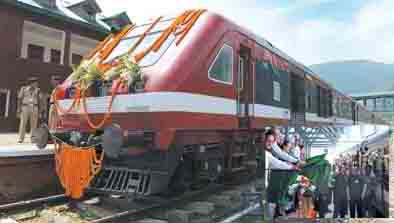
PM Manmohan Singh and UPA chairperson Sonia Gandhi on Wednesday flagged off (afp photo) a train at Banihal as they inaugurated the 11.2-km long Pir Panjal tunnel from Banihal to Qazigund in Jammu and Kashmir. People from Banihal can now reach Qazigund in just 12 minutes by train. At present, it takes about an hour and 15 minutes by road to commute between the two locations, that too if there are no traffic jams. The 17.7-km-long rail link is the country&’s longest transportation tunnel of an over 11.2 km tunnel through the Pir Panjal range. afp/sns
707 from MP still missing
statesman news service
BHOPAL, 26 JUNE: The Madhya Pradesh government informed the High Court in Jabalpur today that at least 707 persons who went on pilgrimage to Uttarakhand from the state are still untraceable.
The High Court has taken a suo motu action on reports published in newspapers, alleging inappropriate relief work was going on in the affected areas of the hill station.
According to sources, the state government also told the court that more information was being gathered regarding the pilgrims. The High Court was apprised that state religious endowment minister Laxmikant Sharma, along with IAS officer Sanjay Goyal and IPS officer R S Rathore, was monitoring the state’s rescue operations in the hill station.
A Division Bench comprising acting Chief Justice K K Lahoti and Justice S Kakade said the state is responsible for tracing pilgrims in the affected areas of Uttarakhand.
Around 2,836 persons had gone to Uttarakhand of which 1,193 have returned, MP advocate general R D Jain submitted before the High Court. Mr Jain said the state government has put up medical camps and treated 8,000 people in the hill state. Besides, three helicopters from the state have been pressed in to rescue operations being carried out by the Army in Uttarakhand, the HC was told.
Assistant solicitor general R S Siddiqui, appearing for the Union government, sought some more time to file reply on steps taken by the national-level disaster management committee to expedite rescue work in the affected areas of the hill state.
The court asked the state to furnish complete information in connection with the pilgrims on the next hearing, scheduled for 28 June.
Sen, Debjani produced before Balurghat CJM court
statesman news service
BALURGHAT, 26 JUNE: Mr Sudipto Sen and Ms Debjani Mukherjee, the prime accused in the Saradha default case, have turned up at Balurghat Chief Judicial Magistrate (CJM) Court today, as per the order issued by the Chief Judicial Magistrate, Ms Dipali Shribastave Sinha. The Chief Judicial Magistrate remanded both in 14 days’ police custody, said the state government pleader, Mr Debasish Mazumder. Earlier it had been decided that the duo would be presented at Balurghat CJM Court on 28 May, but it was delayed because of security reasons, Mr Mazumder said.
Several cases are reported to have been lodged against the four accused ~ Mr Arbind Singh Chauhan and Mr Manoj Nagel aside from the duo produced today ~ at Balurghat CJM Court by the agents and depositors of the Saradha Group of Companies, demanding money they have collected and invested in several money mobilising schemes to be paid back. Around 314 allegations are reported to have been filed by the agents and depositors at Balurghat police station.
Agents and depositors of the Saradha Group staged an agitation at Balurghat this afternoon. Sufficient police forces were deployed in areas adjoining Balurghat Court and the district administrative building to avoid any untoward incident.
Earlier, the deputy-magistrate of Balurghat, Mr Koushik Sinha reportedly sealed the Saradha office at Balurghat following a stir by the investors and the agents after the company had collapsed. Most of the agitators belonged to the lower and medium income groups of the district.
`100 cr Central grant for restoration of tourist facilities
statesman news service
NEW DELHI, 26 JUNE: The Union tourism minister, Mr K Chiranjeevi, today sanctioned a special financial package of Rs 100 crore for restoration and reconstruction of the affected government tourist facilities in Uttarakhand. This will be in addition to the Central assistance of about Rs 95 crore already sanctioned during the current financial year for developing tourism infrastructure in the state.
The state government has been advised by the tourism ministry to assess the destroyed and damaged tourist amenities and conveniences and get back with the requirement of funds for rebuilding the infrastructure.
The funds sanctioned in the relief package will be utilised for restoration and reconstruction of tourist infrastructure across the state with a special focus on tourist facilities along the yatra route which will be used for providing shelter to the disaster hit pilgrims and tourists.
Mr Chiranjeevi has been holding meetings with representatives of the hotel industry, tour operators, travel agents and other stakeholders in the travel and tourism trade since last week to coordinate the donations from the tourism industry to the Prime Minister&’s Relief Fund.
According to the PHD Chamber of Commerce and Industry, Uttarakhand has lost revenue earnings of about Rs 12,000 crore from its tourism sector alone in the current fiscal due to the rains that devastated the state.
Burdwan varsity not to register students if they don’t go online
statesman news service
KOLKATA, 26 JUNE: Burdwan University will not register any student for its Honours course this year if they do not avail the centralised online admission process initiated by the university from this year.
The university even extended the last date of applying online from 28 June to 1 July. “Many candidates might take admission to pass course, which is being conducted by individual colleges with a misconception that they might switch to Honours course later on. But no such thing will be allowed. We will not register any student under Honours course if they do not register online,” said Professor Smritikumar Sarkar, Vice-Chancellor of Burdwan University.
BU is the first among all state universities to switch to a centralised online admission system for its 40,000 Honours seats in 90 colleges affiliated to it. “The new system is to ensure absolute transparency in the admission process in the Honours seats. Hence, we will not allow any decentralised admission by the college in the Honours seats. If there is vacancy in Honours courses, we will admit those who have applied online,” said Prof Sarkar.
The first merit list will be out on 5 July in the university website (www.buruniv.ac.in).
‘V C Shukla’s name will figure in martyrs’ list’
press trust of india
NEW DELHI, 26 JUNE: The Congress today downplayed reports of veteran party leader Vidya Charan Shukla’s name missing from the martyrs’ list of those killed in the 25 May Maoist attack in Chhattisgarh.
“Shukla and one more Congress worker had succumbed to their injuries much later. This was the first list of 28 people, who were killed in the Maoist attack immediately. The two names will also be included as martyrs. It is not a question of any one leader. Everybody who died in the Maoist attack ~ be it a Congress worker or leader or a security personnel, all of them will be included in the martyrs’ list and will be given compensation,” party general secretary in-charge for Chhattisgarh B K Hariprasad said.
The Chhattisgarh government and Opposition Congress have declared to provide the status of “martyrs” to those killed in the attack. However, the name of Shukla was missing from the list. The former Union Minister had succumbed to his injuries on 11 June.
In a major attack on the Congress’ Parivartan Yatra in Bastar on 25 May, Maoists had killed 27 people, including PCC chief Nand Kumar Patel, his son Dinesh, party leader Mahendra Karma and ex-MLA Uday Mudaliyar and injured Shukla, who later succumbed to his injuries.
Hariprasad said it was the same list for providing compensation to the affected family members as well.
Union ministers Jairam Ramesh, V Narayanasamy Hariprasad and Acting president of the state Congress Charandas Mahant had yesterday visited Jagdalpur and distributed cheques to families of the 25 May attack victims. The party also distributed cheques to families of Maoist attack victims in Raipur, besides holding a condolence meeting.