Logo

Company Notices

Statesman News Service |

NOTICE FOR AGM
FY 2012-2013
WEST BENGAL FINANCIAL CORPORATION
12A, Netaji Subhas Road
3rd & 4th Floors
Kolkata-700001
It is hereby notified that the Fifty-ninth Annual General Meeting for FY 2012-2013 of the shareholders of West Bengal Financial Corporation [WBFC] will be held at the office of it in the third floor of 12A, Netaji Subhas Road, Kolkata-700001 on Tuesday, the 30 July, 2013 at 15-00 hours to transact the following business:
1. To consider and to adopt the balance sheet as on 31 March 2013 and the profit and loss account for the year ended 31 March, 2013, the report of the Board of Directors on the operations of the Corporation during FY 2012-13 and that of the auditors on the financial statements for FY 2012-13 under reference;
2. To appoint the statutory auditors of WBFC for FY 2013-14 from the panel of auditors approved by the Reserve Bank of India, on terms and remunerations as are fixed by RBI; and
3. To consider and to adopt the proposals for declaration of dividend and capitalisation of reserves.
By Order of the Board
Sd/-
Samarendra Nath Koley
Managing Director
Kolkata
28 June, 2013
Notes:
1. The share registrar of WBFC shall remain closed from 28 June, 2013 through 30 July, 2013, both days inclusive.
2. The list of shareholders of WBFC shall be available for purchase against one rupee from the HO of WBFC on and from 1 July, 2013 on all working days during the working hours.
3. Voting rights of the shareholders shall be determined in terms of the proviso under Section 4F of the SFCs Act, 1951.
4. The last date for submission of proxies shall be 29 July, 2013 up to 14-00 hours.
5. The last date for submission of certified copies of resolution(s) appointing duly authorized representatives
by the corporate entities, including the Cooperative Banks, shall be 29 July, 2013 up to 14-00 hours.
6. The last date for submission of orders from the Government of West Bengal authorizing any of its officials to represent the Government in the meeting shall be 30 July, 2013 up to 14-00 hours.
7. The meeting is being held, shall be conducted and the business in the meeting shall be transacted in terms of the provisos of the SFCs Act, 1951 read with West Bengal Financial Corporation General Regulations, 2013.                     (B0002)             C20014

KAZI NAZRUL UNIVERSITY
Asansol-4
0341-225 2024/0456
Admission form for MA Beng., Eng., Hist., M.Sc., Math available at IDBI Bank, Asansol Branch, Burnpur Rd. and in www.knuedu.in Last date of submission: 26-07-2013 at KNU Office.
Registrar                         C20006

Business & Professional

Statesman News Service |

WANTED old Coin, Watch, Ironsafe, Camera, Shawl & Carpet. Call: 9874486200.         (B0005)         C19990

KWIC Flat owners in a quandary

Editorial Team |

Owners write to President, PM demanding CBI Probe

Tarun Goswami
tarun@thestatesman.net
Kolkata, 1 July
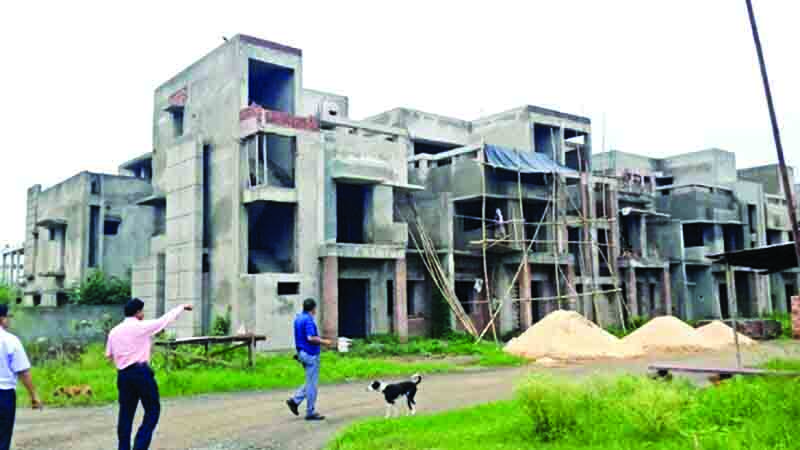
Flat owners at Kolkata West International City (KWIC) have approached the President and Prime Minister demanding a CBI inquiry into an alleged scam over the construction of flats and bungalows there.  
Erstwhile chief minister Buddhadeb Bhattacharjee ~ who had inaugurated it ~ had declared KWIC as his “ dream project”.
 But now, the owners of the row of houses in clusters C and D ~ which were supposed to have been handed over to them in November 2008 ~ are running from pillar to post for redress. 
Interestingly, the Trinamul Congress, which pledged to fight against corruption, is silent on the issue and two ministers, Mr Partha Chatterjee and Mr Firhad Hakim, refused to intervene due to the involvement of Mr Prasun Mukherjee, the state government’s blue-eyed businessman.
This is despite requests of help from the flat owners in writing.  
There are 399 row houses in clusters C and D. Professor Mritunjay Chakraborty (flat number D7/17) is paying Rs 25,000 as EMI.
“I have lost all hope and it has become nearly impossible to pay the EMI. Had this been a western country, the promoter would have been arrested for cheating,” he said.
Mr O P Bangar (C 0401) is even worse off.
The construction of his bungalow has just begun.
It’s priced at Rs 88.7 lakh, of which he has already paid Rs 70.96 lakh.
On top of that, his EMI is Rs 55,000. Mr Anurag Jain (C 503) has paid nearly 90 p.c. of the price of his flat.
He said  his family had been badly hit by  the delay. 
The Kolkata Metropolitan Development Authority (KMDA) cleared the master plan on 21 September, 2005. Construction began in 2006, but the pace is slow.
The KMDA also cleared the construction of six 14-storey residential buildings on 21 April, 2011.
The foundation of two towers has only just begun, but over 50 p.c. of the payment has already been taken from the flat owners. 
Asked when the houses would be handed over to the owners and when the construction of  all the towers would begin as The Statesman has received several complaints from the owners, Ms Pallavi Banerjee ~ on behalf of Mr Prasun Sengupta, director, KWIC Private Limited ~ said The Statesman would have to furnish the complaint letters to corroborate this claim as they keep updating the buyers.
But she was silent about when the houses would be handed over to the owners and the construction of the towers would begin. 

Most colleges lack accredition

Statesman News Service |

poulomi ghosh
poulomi@thestatesman.net
Kolkata, 1 July
 Only four out of 200-odd colleges affiliated to the West Bengal University of Technology (WBUT) are accredited by the National Board of Accreditation (NBA). Ahead of the admission season, considering this poor figure, the university has asked all its affiliated colleges and institutes to opt for this accreditation.
The university has found out that different programmes of 16 colleges affiliated to WBUT were accredited by NBA initially.
But for 12 colleges, the accreditation-term has already expired. At present only 10 programmes of four colleges now have the validity of NBA accreditation.
As there is the National Accreditation and Assessment Council (NAAC) to assess general degree colleges, NBA was entrusted with the task of assessing  technical colleges, including those that offer courses on engineering and technology, management, architecture, pharmacy and hospitality programmes.
“Statistics show the poor status of NBA accreditation of the colleges affiliated to us. Since this accreditation is believed to be a globally accepted benchmark, we have asked our colleges to opt for it because there is already so much concern regarding the quality of the technical and non-technical courses offered by these colleges,” said an official of the university.
After the West Bengal State Council of Higher Education was made the nodal centre of NBA, it has asked WBUT to look into the matter.

Trident lamps: CAG finds flaws in reply

Editorial Team |

Aparajit Chakraborty
aparajit@thestatesman.net
Kolkata, 1 July
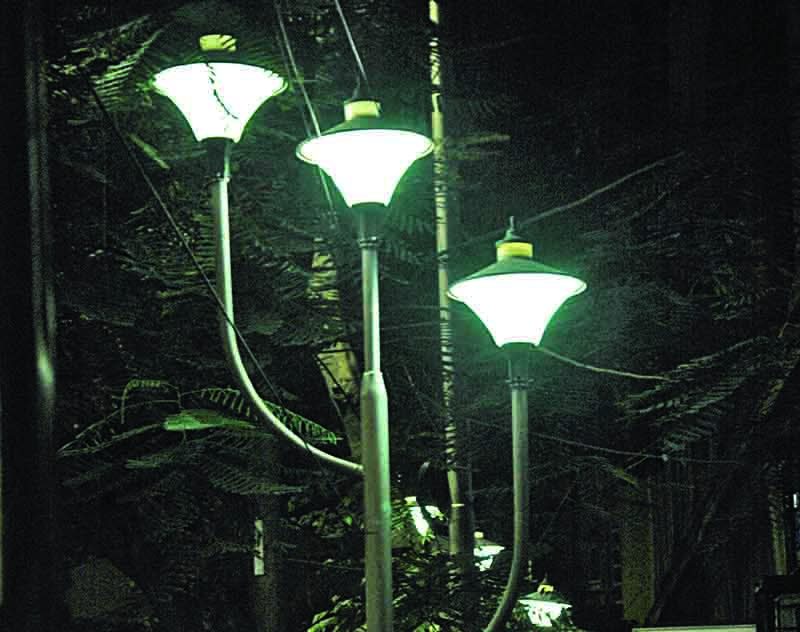
Kolkata Municipal Corporation’s  (KMC)  lighting and electricity department has replied to the Comptroller and Auditor General (CAG) that selection of price and components of  trident lamps was determined as directed by the  "higher authority". 
The CAG found irregularities in the installation of decorative trident light. The KMC’s lighting department failed to send a satisfactory answer to the CAG’s 12 queries regarding installation of the lamps. The basis of selection of sites and locations were considered as desired by the higher authority, the department stated in the letter. 
The department also mentioned that rates of various components of the electrical poles and sites for installation of the lights were finalised as per the direction of the higher authority.  It was asked to furnish the documents relating to planning and scheduling of installation of the decorative lights, tendering documents and the total amount paid till now in respect of electrical poles installed.
Everything is available with the KMC’s website, the department stated. The CAG’s representative, however, didn’t find any such documents on the website.
The department also could not produce any document revealing the future liability of the project and the source of money that will be used to pay electricity bills.
Senior officials of the Lighting, Electrical and Finance departments, as well as mayor Sovan Chatterjee and members, mayor-in-council are embarrassed about the CAG’s request for details regarding the installation of the lights. 
The department was asked to furnish papers to the CAG justifying the selection of components of electrical poles and basis of selecting locations.
As many as 200 firms were selected and to avoid tender orders, orders of a maximum value of up to Rs 5 lakh were placed.

Four more held for cheating bank

Statesman News Service |

Kolkata, 1 Juy: The Kolkata police has arrested four more persons on charges of cheating a nationalised bank to the tune of Rs 1.99 crore. 
Police investigating the case arrested Sukumar Subramaniam from Tamil Nadu a few days ago. After interrogating him, police arrested Raj Gafoor and Savrish Selvaraj from Coimbatore. They told police that they cheated the bank using a cheque, which was forged and appeared to be issued by the Surat-based Gujrat Narmada Valley Fertiliser Corporation limited  in the name of a fictitious company, Tirupati Traders.  The duo also told police that the forged cheque was prepared by Nirmal Sinha of Sodepur in North 24-Parganas. Police arrested him from his residence. On 11 December the bank lodged a complaint with the city police. Police had arrested Ashok Kumar Gupta and Naveen Rajgariah.  Police have seized the bank accounts which were used to transfer the money.                                   sns

Post review, HS results of 6K to change

Statesman News Service |

Kolkata, 1 July:Higher Secondary results of over 6000 candidates will be changed after the publication of the review and scrutiny results. The results, for those who applied online, were published last Saturday. Changed marksheets will be available from next week.
A total of 22,890 candidates applied for the re-evaluation. Among them, 6187 candidates have got changes in their marksheets while 16,087 candidates will have no change.The council received 40,589 scripts for scrutiny. Marks of 3225 scripts have increased. On the other hand, there were 9639 scripts for review among which marks have increased in 3039 papers and gone down in 638 papers. This was the first time that the provision to apply online for early scrutiny and review was introduced. This apart, candidates could also apply for review and scrutiny through their schools. That result will also get published shortly, said an official of the HS council.   sns

Youth fires at TMC leader, arrested

Statesman News Service |

statesman news service
Siliguri, 1 July
An anti-social fired at a Trinamul Congress leader Sanay Roy of Malan village in the Hemtabad police station area of North Dinajpur district this evening. The Trinamul leader escaped unhurt. Police later arrested the anti-social with firearms.
The arrested youth was identified as Tanay Aditya, a resident of Kanchanpally in Raiganj. Tension spread in the locality after the incident.
The Trinamul Congress leaders claimed the youth was under the shelter of the CPI-M.
The secretary of the state TMC committee, Mr Ashim Ghosh, said: "Our TMC leader of Malan village, Sanay Roy, was campaigning for the elections on behalf of our candidates of Malan region. During the campaign, the CPI-M-sheltered anti-social targeted him but was unsuccessful in his attempt.
“Locals chased him and finally caught him near Samaspur. After being informed, police arrived and arrested him.
“We had information that both the CPI-M and Congress leaders sent anti-socials with firearms in Hemtabad and Kaliaganj areas to attack TMC members before the panchayat elections.”
One of the members of North Dinajpur CPI-M committee, Mr Bharatendu Chaudhury, said: "The CPI-M members are not involved. We had information that it was a result of enmity between two groups of TMC activists."

Spectacles distributed

Statesman News Service |

Siliguri, 1 July: On the occasion of the birth anniversary of the former state Chief Minister Dr Bidhan Chandra Roy, the authorities of Raiganj municipality of North Dinajpur district distributed spectacles among the poor residents free of cost today.
On the occasion of  the birth anniversary of the great personality, the municipality authorities in the afternoon today held an eye checkup camp for the residents too. Four hundred poor residents living in the jurisdiction of Raiganj municipality were given spectacles.  The Chairman of  Raiganj municipality, Mr Mohit Sengupta, said: "We distributed a total of 400 spectacles among the people of a total of 25 wards who are poor.”                         sns

Cracks in Old Malda orchards

Statesman News Service |

Statesman News service
Malda, 1 July
Anxiety has gripped vast areas of Old Malda block as large cracks have been found in different areas. The cracks have generated fear among the inhabitants of Dumurtala, Singachari, Adampur and Nimuakamat villages in the Muchia gram panchayat of Malda police station area. Those cracks were mostly found in the mango orchards and agricultural land of those areas.
Locals said that they were under such a spell of fear that they were avoiding visits to those orchards or agricultural land. They also said the cracks have become visible after the incessant rain in the last two three days. People from the neighbouring areas also crowded those areas to see those ‘unusual cracks.’
The Panchayat pradhan of Muchia gram panchayat, Mr Uttam Chowdhury, said: "Following incessant rain for four days, places at Dumurtala, Singachari, Adampur and Nimuakamat villages have developed unprecedented cracks. The villagers are confused and worried over the sudden generation of such cracks. At some places the cracks are quite wide and at places there are narrow ones. At some places the cracks are so deep that even a full-length bamboo could be easily plunged into them.”
The District Magistrate, Mr Godala Kiran Kumar said, “We have received the information about the crack. There is nothing to be unnecessarily scared about. We have requested villagers not to panic. The Additional district magistrate NK Biswas is being sent there to submit a report.”

Cracks in Old Malda orchards

Statesman News Service |

Statesman News service
Malda, 1 July
Anxiety has gripped vast areas of Old Malda block as large cracks have been found in different areas. The cracks have generated fear among the inhabitants of Dumurtala, Singachari, Adampur and Nimuakamat villages in the Muchia gram panchayat of Malda police station area. Those cracks were mostly found in the mango orchards and agricultural land of those areas.
Locals said that they were under such a spell of fear that they were avoiding visits to those orchards or agricultural land. They also said the cracks have become visible after the incessant rain in the last two three days. People from the neighbouring areas also crowded those areas to see those ‘unusual cracks.’
The Panchayat pradhan of Muchia gram panchayat, Mr Uttam Chowdhury, said: "Following incessant rain for four days, places at Dumurtala, Singachari, Adampur and Nimuakamat villages have developed unprecedented cracks. The villagers are confused and worried over the sudden generation of such cracks. At some places the cracks are quite wide and at places there are narrow ones. At some places the cracks are so deep that even a full-length bamboo could be easily plunged into them.”
The District Magistrate, Mr Godala Kiran Kumar said, “We have received the information about the crack. There is nothing to be unnecessarily scared about. We have requested villagers not to panic. The Additional district magistrate NK Biswas is being sent there to submit a report.”

A talk with Mr Kerry

Editorial Team |

Mr Kerry came here as a relatively unknown quantity and while from his days as Senator he was familiar enough with the realities of South Asia, his stronger contact had been with Pakistan. So maybe New Delhi felt the need to assess him and try to develop a suitable
equation with him on this occasion

A visit by a US Secretary of State is a big event, and ordinarily it gets the full media treatment: meetings, talks,  statements, lectures, television appearances, are all avidly followed, reported, talked about, scrutinised, and assessed. By that measure, Mr Kerry&’s recent visit to India was without the customary high octane exposure. He went through all the motions, met all the high dignitaries he was expected to meet, held extensive discussions with his counterparts, made a few carefully arranged public appearances, stressed the importance he attached to his country&’s relationship with India, but yet the visit did not spark the public response that might have been expected.
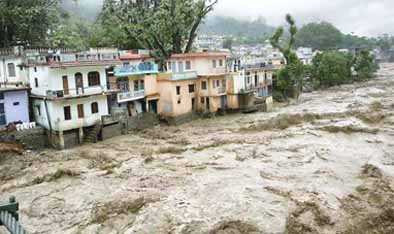
    Partly this was to do with the timing: Mr Kerry came to India when the country was daily learning more about the overwhelming scale of the disaster in Uttarakhand, so the channels and the papers scarcely had time for anything other than the grim events in the mountains. There were other reasons, too, for the relatively low key reception: Mr Kerry came here as a relatively unknown quantity and while from his days as Senator he was familiar enough with the realities of South Asia, his stronger contact had been with Pakistan. So maybe New Delhi felt the need to assess him and try to develop a suitable equation with him on this initial occasion. As it happens, there are no serious bilateral issues to be sorted out, no need for high level repair work, the relationship is in good shape and the challenge before Mr Kerry and his counterpart is to take it forward rather than to re-shape it, .
There are nevertheless some matters where differences have become prominent. For India, it is important that there should be no undue stringencies in the grant of visas to Indian professionals in the IT field. This is not a new issue but the current discussions in the USA suggest that there is a real risk of Indian software companies being placed at serious disadvantage as a result of the more severe visa rules that may be promulgated. The USA has its own issues with India, prominent among them being protection for US investments in India. US companies have been eyeing the nuclear power industry in India but feel that Indian rules for foreign investment in this sector are too demanding and tend to discourage potential investors. Building nuclear power plants is a very complex matter and it has been argued that the USA may not be the front runner if India were to soften its rules and look more actively for foreign investment. Yet it was the famous India-US nuclear deal that opened the doors to external investment and the USA has consistently pushed for conditions that would simplify the entry of US and other foreign technology and investment. No resolution of these differences was achieved during the visit, nor was it expected. But even though both sides have real interests to defend and promote and have not yet found a way forward, they do not appear disenchanted and will keep trying.
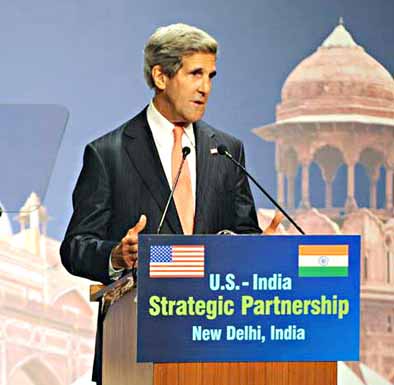
The formal setting for Mr Kerry&’s visit was the fourth round of the bilateral strategic dialogue. This is an ambitious, wide-ranging annual exercise that keeps leaders of the two countries in regular contact and seeks to establish common ground between them. ‘Strategic dialogues’ with partner countries have become somewhat commonplace and they seldom generate any extraordinary results, being in effect not much more than regular diplomatic consultations,  but the India-US exercise, for obvious reasons, is a rather different matter. The US presence and its strategic decisions can be central to the future shape of Asia, so dialogue can be properly substantive, as indeed it seems to have been on this occasion. Dialogue on strategic issues can also reveal real differences where the two sides have to struggle to come up with convergent views. The future dispensation for Afghanistan is one such issue, currently perhaps the most important one.
When Mr Kerry reached India,  the US-backed initiative to talk to the ‘good’ Taliban was still reverberating, and this is something India has never favoured. Indeed, the confusion and discord caused by the proposed meeting in Qatar may well have been seen with wry satisfaction in New Delhi. Though the Qatar initiative may not get very far, the problem of political dealings with the Taliban remains and India&’s concerns about the re-emergence of an extremist source in its close neighbourhood needs to be addressed.  The USA showed some sensitivity to India&’s concerns by sending its ‘AfPak’ envoy, Mr Dobbins, to brief governmental leaders in New Delhi.
 There is the linked question of Pakistan&’s part in this emerging process. This remains rather murky and it is sometimes feared that the military and other agencies may not have shed the ambitions nurtured in the heady days of the anti-Soviet campaign when Pakistan became the strategic pivot of the region. Mr Kerry spoke of positive expectations produced by the elections in Pakistan and expressed the hope that trade and investment between India and Pakistan would develop, which would in turn encourage others to follow suit. These are sentiments that India would support, and indeed India has long asked for the kind of pragmatic economic steps that Mr Kerry advocated. How to attain such a result is another matter and it is to be hoped that Mr Nawaz Sharif, who advocates better relations in economic matters, will be able to deal with the conservative no-changers in his army and security establishment.
Looking further afield from South Asia, both India and the USA have received high level visitors from the recently installed Chinese leadership. There is currently some expectation in New Delhi that important developments on the India-China border dispute may be in the making, if not on the alignment of the border itself then on rules for its better management.
At this time, too, the USA has embarked on a process of ‘re-balancing’ in Asia. What that entails has not been spelt out or discussed in any depth but whatever direction ‘re-balancing’ takes, its implications are bound to require scrutiny across the Asian continent. It can be inferred that something affecting the regional security architecture is being envisaged, which would be an appropriately challenging subject for the high-level strategic dialogue that has just taken place.
The India-US dialogue has become something of an industry, with numerous groups of officials meeting at regular intervals on all manner of subjects. This may become bewildering at times but it is a pleasant contrast to the situation of a couple of decades ago, when the parties were deliberately reticent in their dealings with each other. Mr Kerry&’s visit involved no drama and produced few headlines. But it took the maturing relationship a step further in the direction both parties desire.
THE WRITER IS INDIA’S FORMER FOREIGN SECRETARY
 

Edits

Statesman News Service |

Transparent ploy
Political desperation is evident from economic pointers. Repeated failures ~ the latest being the crippling impact of the rupee&’s collapse ~ are prompting the government to announce a slew of measures which it hopes might convince the common man (rather than the business community) that the situation is under control. With elections due a year from now economist-turned-politician Manmohan Singh is aware the voter will hold the UPA responsible for rising prices, and how all-round economic sluggishness will exacerbate the impression of policy-paralysis, misgovernance and rampant corruption. He is also aware that the sophistry and spin of his economic lieutenants has ceased to seduce even their acolytes in India Inc. And so we are now being treated to another round of “balloons”. The latest is setting of a target of Rs 1.15 lakh crore investment in infrastructure development in the private-public partnership mode. The most authentic reaction to the media splash the Prime Minister created for that was that same editions also reported that the private player had pulled out of the Delhi Metro&’s airport line. In short, it was wishful thinking to put much “reliance” on the private sector in the infrastructure sphere. And there is no need to look much beyond that line&’s western terminal for evidence of PPP moves turning bumpy. The private management of the Indira Gandhi International Airport has frequently been judicially rapped for flouting contractual obligations; just further afield there is trouble at the toll gates on NH-8. Economic experts question the Rs 1.15 lakh crore PPP serving as a wonder drug when presently similar projects worth several times that amount crore remain blocked in the bureaucratic pipeline. And the realistic in the Planning Commission indicate that only a small fraction of the game-changing 1.15 lakh crore will be expended between now and polls: in every sense of the term infrastructure development projects have a long gestation period. Similarly, what scope is there for developing another 51 airports ~ many in small towns ~ when the domestic aviation industry is struggling to remain airborne. Yes, there could be politically-loaded advantages. “Party funds” could well be boosted ahead of the electoral exercise by “donations” from those favoured in the allotment of projects. Experience also confirms that there are huge kickbacks in the process and everyone knows that the babus are not the only beneficiaries. Time was when a proposal from Mr Singh was taken in unquestionable good faith. But as the fairy tales say, that was “once upon a time…”
… And the rains came
Kolkata had a foretaste on Sunday of what to expect over the next three months when overnight rain ~ fairly normal at this time of year ~ flooded large parts of the city. And the taxpayer, his patience sorely tried over the collapse of civic amenities, expected better than the Mayor&’s utterly breathless response ~ “Nothing can be done to avoid waterlogging.” The only saving grace must be that the torrent was reduced to a drizzle on Sunday. Had the intensity of the previous night persisted, the city would have suffered another bout of urban flooding over the next few days. By throwing in the towel and before the monsoon is in full swing, Mr Sovon Chatterjee merely confirms that he is pretty much helpless, perhaps more so after his wings were clipped by the Chief Minister last year. He has confirmed once more ~ if confirmation were needed ~ that the urban renewal mission undertaken in the name of Jawaharlal Nehru has turned out to be a case-study in urban regression. The added area of Behala remains ever so vulnerable along with a vast swathe of north, south and central Kolkata. The extent of the waterlogging must make one wonder whether the nikashi project, so-called, has been executed with matching earnestness. Very probably, it hasn’t considering the unutilised allotment of funds that is returned to the Centre every year. In the event, the city makes do with sewer lines that were laid in British India! Cut to 2013, the sewer lines that converge at Palmer Bazar pumping station ~ technically referred to as “town outfall” ~ have not been cleaned and desilted for years on end. This was all too palpable on Sunday. Even contemporary totems of development have been far from effective.
Mockery of truce
There is a growing feeling that the NSCN(IM)&’s style of functioning has begun to hurt the Nagas. Last month, an organisation comprising various business, transport and medical associations observed a 12- hour bandh in the commercial town of Dimapur to highlight abnormal rise in prices of essential commodities following the imposition of “unabated” taxes by the NSCN(IM), prompting the Centre to write to the Nagaland government to take immediate action. Its letter said: “Having a ceasefire with the government of India is no excuse to go on the rampage and destroy public confidence.” The bandh assumed significance because it was for the first time that an organisation had dared challenge the NSCN(IM) which has been running a parallel government ever since the ceasefire came into force on 1 August 1997. On Monday, the powerful Kohima-based Naga Students’ Federation observed a 12- hour  bandh in the state to protest against an alleged attempt on the life of one of its functionaries by the NSCN(Khole-Kitovi) at Kohima on 25 June.

Strategies for Lok Sabha 2014

Editorial Team |

Modi&’s PR managers seek to marry his pro-economic development image with the BJP&’s commitment to Hindutva to create a groundswell that might help the party gain majority on its own steam in 2014, writes Rajinder puri

Analysts are scratching heads trying to decipher poll prospects for 2014. One issue of fierce debate is the impact Mr Narendra Modi will have on the results. To assess the rationale behind his projection, the poll strategy of the Rashtriya Swayamsewak Singh (RSS) – which is determinedly naming him as the BJP candidate for Prime Minister – needs to be understood. To decipher it and other related issues, there are two recent newspaper articles that are noteworthy.
First, there was the article by Mr Abheek Barman in The Times of India entitled “Modi&’s Himalayan Miracle”.
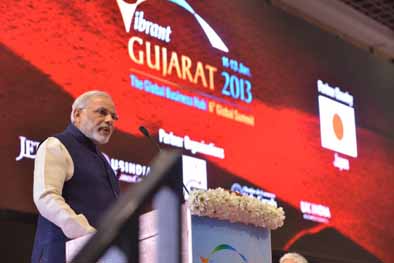
The author, quoting facts and figures, has effectively demolished many claims of the Gujarat chief minister. More tellingly, he has rubbished the claimed role of Mr Modi in rescuing 15,000 victims from the Uttarakhand deluge. But the most significant revelation of the article undoubtedly was about the deployment since 2007 of the powerful Israel-dominated public relations agency, Apco Worldwide, to promote the Vibrant Gujarat summits and Mr Modi&’s image. The other day, BJP President Rajnath Singh stated Mr Modi never claimed that he had rescued 15,000 pilgrims from Uttarakhand. Of course, Mr Modi never did that. That was what Apco was being paid $25,000 per month for doing. It would be reasonable to infer that many of Mr Modi&’s assertions and projections are inspired by inputs from Apco. For instance, his recent presentation of two video studies in the Planning Commission meeting may safely be attributed to this source. In that sense, much of the vigorous media and corporate support for Mr Modi may justifiably be credited to Apco.
There is nothing wrong or unique for aspiring political leaders to utilise the services of professional public relations outfits for electoral purpose. But a more significant aspect deserves attention – A highly professional and competent outfit like Apco would not ignore the background and persona of their client in formulating poll strategy. The relations of Mr Modi&’s party with its parent RSS must surely have been taken into account. Therefore would there not have been direct or indirect cooperation between RSS and Apco in forging the poll strategy? If so, to what end?
RSS and BJP leaders backing Mr Modi are openly stating that they aspire for single party majority in 2014 without the help of poll allies. On what premise would this daunting ambition be based? Till now, the BJP campaign is riding on two horses. It is targeting the Hindutva brigade, for which Mr Modi presents a most attractive face. Let it be noted that RSS Chief Mohan Bhagwat has repeatedly asserted the centrality of Hindutva for shaping India&’s future. Most recently, while extolling the legacy of Swami Vivekananda at a function on 19 June, he said, "We have changed leaders and agendas, nothing has worked. Politics is not the way to make India a superpower; it is only Hindutva that can do it." Given such commitment to Hindutva, how would Apco proceed with its campaign?
The answer seems to be simple. Mr Modi&’s claimed commitment to economic development appeals to the rising new generation of young Indians. The commitment to Hindutva appeals to the traditional pro-Hindu vote bank of the BJP. The strategy opted for Mr Modi seems to be to marry both commitments and create a groundswell that might give the BJP single-party majority, which would promise the stability that most Indians desperately yearn for. And how will that marriage be consummated? By convincing India that the Hindu rate of economic growth can be replaced by the new Hindutva rate of economic growth that could make India a superpower. And Mr Narendra Modi, with his background and record as Gujarat chief minister, is the man to accomplish it.
This is a credible strategy and should not be dismissed out of hand. However, there are serious pitfalls to overcome before it can succeed. That brings us to the second recent newspaper article referred to at the beginning of this essay.
In a perceptive analysis, “Doing the Modi Math”, Mr Ashutosh Varshney in The Indian Express has analysed reasons in the past for the accretion of the vote-share by the BJP in elections. Endorsing Mr LK Advani&’s reasoning, he has pointed out that the votes jumped mostly through poll adjustments with allies. However, there were two exceptions to this. Post Emergency in 1977, and post Mr Advani&’s Ayodhya Rath Yatra in 1991, the BJP significantly increased its tally. The Emergency, of course, was a rare issue and Indira Gandhi invited failure without help from opponents. The BJP, the Jan Sangh then, united with other opposition parties to exploit the wave.  It is with regard to the 1991 experience that I venture to add a caveat.
In 1991, BJP jumped to 120 seats from 88 during the Mandal agitation and immediately after the Ayodhya movement had consolidated its traditional vote bank. But let it be noted that in 1988, it had jumped from 2 to 88 seats because it had made poll alignment with VP Singh. In 1991, it could successfully bag 120 seats on the basis of its base achieved in 1988. Let it also be noted that it sank to 2 seats in 1984 because the RSS – due to a misplaced sense of patriotism – backed the Congress after the assassination of Indira Gandhi. As a member of the BJP then, I had warned Mr Atal Behari Vajpayee of this switch and predicted that he would lose to Madhav Rao Scindia in the election. This warning was given to him prior to my proposed resignation from primary membership of the party.

To be concluded…

The writer is a veteran journalist and cartoonist. He blogs at www.rajinderpuri.wordpress.com

A rubber stamp for biotech giants

Editorial Team |

Aritra Bhattacharya

Maharashtra&’s agriculture minister Mr Ramakrishna Vikhe-Patil was recently quoted by DNA as saying that introducing Bt cotton was a mistake. One look at the spate of farmer suicides in the Bt cotton belt of Vidarbha will make the reason for his statement apparent; following the introduction of Bt cotton in the state eight years ago, over 10,000 farmers have killed themselves ~ the number increasing substantially since the crop was introduced.
It is against this backdrop that one needs to examine the Biotechnology Regulatory Authority of India (BRAI) Bill 2013. The Bill seeks to facilitate a single-window clearance system for genetically-modified (GM) products of biotechnology giants like Monsanto and Syngenta. Bt cotton is the only GM crop that is commercially cultivated in India, and India&’s experience with the crop has been deeply devastating.

Tall claims
Although initial reports on Bt cotton cultivation pointed at bumper increase in yields, the journey has been downhill since. While Monsanto, the biotech giant which controls 93 per cent of the Bt cotton market in the country, has gone to town claiming increase in acreage under Bt cotton year-on-year, the yield from the same has fallen drastically, while input costs have increased exponentially.
The BRAI Bill, and the intended large-scale commercial cultivation of GM crops is part of the corporate-control-of-agriculture story. Although GM crops ride on the crest of the ‘promise of food security through higher production’, no studies show that increased yields sustain over time.

Lip service
The BRAI Bill was introduced in Lok Sabha in April 2013, and is right now before the Standing Committee on Science and Technology, Environment and Forests; the committee called for public comments on the Bill within a month from 11 June ~ departure from the norm, since a Bills are usually kept open for feedback for a period of 60 to 90 days. Although questions abound about the need for modern biotechnology in agriculture in the first place, the Bill does not say anything about exploring alternative routes to reach a desired target (say food security).
Instead, it indulges in lip service; it notes that India is a ‘party to the United Nations Convention on Biological Diversity…and Cartagena Protocol on Biosafety to the Convention’ which demand that the country take all measures to address biosafety. There is, however, nothing in the Bill that seeks to control or mitigate risks associated with biotechnology.
Part of the problem is with the source of the Bill: it has been floated by the Ministry of Science and Technology (S & T), which is tasked with promoting biotechnology. In the BRAI Bill, then, we have the promoter as the regulator! On the face of it, the Bill provides for a multitude of bodies functioning around the ambit of BRAI. Yet, a closer look at each of these reveals that power is highly narrowed and centralised in the Ministry of S & T.
Independent testing is another sore point. The Bill requires all companies desirous of conducting open-air trials of their products to submit data and documents on those products. In the event of data being supplied by biotech companies, there is every possibility that certain problematic aspects may be underreported.
This apart, the BRAI Bill violates the federal structure, in providing for an overriding Central authority, though agriculture is a state subject. It also seeks to bypass the Right to Information Act under the garb of ‘Confidential Commercial Information’.

Urgent measures
The back-story of the BRAI Bill lies in the National Biotechnology Regulatory Authority (NBRA) Bill, floated by the Ministry of S & T in 2008. The NBRA, which was mooted in the report of a task force constituted by the Ministry of Agriculture in 2003-04, woefully lacked in addressing bio-security. It came in for sharp criticism, only to be quietly buried.
The prospect of a biotech authority reared its head a year later, in 2009, in the form of the BRAI Bill 2009. This Bill, meant to be a ‘secret document’, sought to bulldoze those opposing the introduction of GM crops in the country by mooting their imprisonment, among other things.
The BRAI Bill 2013 is the latest avatar of an authority along the above lines, and the urgency in pushing through the legislation becomes apparent when one follows the twists in the tale. On 23 April 2013, 16 MPs wrote to the S & T Minister Mr Jaipal Reddy, asking him to ‘withdraw the Bill for thorough pre-pegislative concerns’.
Sources say the Minister in question, Mr Jaipal Reddy, was under great pressure to table it. On 7 May, he wrote to the Speaker of Rajya Sabha, mentioning that the Bill be referred to a Joint Committee of both Houses, and not to the Standing Committee on S & T. However, Rajya Sabha Speaker decided to refer the Bill to the latter.
In another curious twist, Ms Supriya Sule, daughter of agriculture Minister Mr Sharad Pawar — a known backer of biotechnology and corporate control over agriculture — made an entry into the Standing Committee on S&T in the first week of May, a few days before the Bill was referred to the committee.
As it stands now, a body like BRAI would be mere eyewash; it would provide an impression that the sector is being regulated, while in actual practice, the authority may function merely as a rubber stamp for large biotech giants.
The writer is a Phd candidate at the centre for studies in social sciences, calcutta. He can be contacted at aritra.bhattacharya@gmail.com


Asian Voices

Editorial Team |

Let&’s dare to dream ~ Nafis Zubair Khan

Bill Gates started Microsoft and Mark Zuckerberg registered the domain name for Facebook when they were 19. Is that only because they come from the land of opportunities? Then how come our neighbouring country has so many successful entrepreneurs? Truth is, we have a lot of successful young people.
Now, take a while to think about how we came to know the name of Zuckerberg. The Facebook homepage doesn’t show his name. Not many of us know the founder of  Bdjobs.com or Onnorokom Software Ltd. because they are not publicised. Our young generation knows every singer or TV actor. The successful entrepreneurs of our times should have been given this stardom. We tend to talk about politicians, musicians and players. It’s high time we talked about our entrepreneurs and followed them instead.
Another reason we are not being able to build great business ventures is the fear of social gossip. If a college student starts selling shoes in the streets of Dhaka, everyone will talk ill about him. But, if he grows up to start a shoe factory, everybody will praise him. People in our country start a business out of need, not to create or experiment. Need doesn’t motivate innovation.
The idea-sharing space is limited. Our young generation has great ideas which can be turned into successful businesses. But those ideas remain to themselves due to the limited space to express and work on it further. There are workshops and competitions being arranged nowadays to encourage young entrepreneurs and business leaders. But there should be a permanent platform. There is only one venture-capital firm in Bangladesh and no company to provide initial seed funding to start-ups. The large corporations don’t have an open policy towards people who want to share new ideas.
The Daily Star

Letters to the Editor

Editorial Team |

Lukewarm response to  catastrophe
SIR, The devastation in Uttarakhand has been massive both in terms of human life and property. Yet, the response of the authorities has been lukewarm. Regretfully, the nation as a whole doesn’t seem to be overly concerned. There was a time when social welfare organisations  would go from door to door to collect donations, clothes, utensils, medicines, and so on.  Attitudes appear to have changed over time. Not that people in general are insensitive,  but as yet there is no nationwide effort to organise relief. The National Disaster Management Agency has failed.
  It devolves on the Union environment ministry to coordinate relief and rehabilitation and also ensure that ecology is not disturbed.  The development of the state must be safer and sustainable. The enormity of the tragedy has deepened with reports of loot and molestation. Only the Army and the Air Force provide a ray of hope. The only bright side is the relief work done by the defence personnel who have evacuated hundreds of thousands of people.
Yours, etc., Achyut Mukherjee,
 Howrah, 29 June

‘Divine realm’ in ruins
SIR, ~  Nature has been cruel in a part of the country that believers would call the "divine realm". The villages of Uttarakhand are in ruins.
  The Union home minister,  Sushil Kumar Shinde, has called it a ‘national calamity’ and the Uttarakhand chief minister, Vijay Bahuguna, has described it  as ‘Himalayan tsunami’, a phenomenon that is no less devastating than the oceanic tsunami.
  It may be some time before the actual casualty toll is ascertained because people have been buried under buildings, roads, shrines, and dams.  Kedarnath and Rudraprayag are among the worst-affected areas. One prays for the safe return of those still stranded and missing.
  Hats off to the jawans who are conducting the rescue operations.
Yours, etc., Rabindranath Sarkar, Kolkata, 25 June.

Nature&’s revenge…
SIR, The media and the government are still not sure whether the calamity in Uttarakhand is rooted in ecological imbalance. The flash floods, cloudbursts, and landslides could well be Nature&’s revenge in this holy land, polluted by vehicles and the construction of hotels, lodges and cottages.
   There are six dams and four barrages in Uttarakhand,  which together run 11 hydro-electric power plants to generate about 2600 MW of electricity.
  The dams have damaged the Alakananda river and the tributaries of the Bhagirathi at Tehri, Ramganga, Dhauliganga, Koteswar and Ichari. There are barrages that span them at Bhimgora, Pashulok, Dakpathar and Asan. Loharinga Pala has the biggest hydel power project. Medha Patkar, Arundhati Roy and international ecologists have warned the government about the ecological damage that could be caused by these dams and barrages.
        Last year, Prime Minister Manmohan Singh chaired a meeting of the National Ganga River Pollution Control Board, following a fast by GD Agarwal, former Secretary of the Central Pollution Control Board, and an IIT Kanpur professor.
Both demanded a stop to the construction of more dams and barrages in order to save the bio-diversity of this splendid Himalayan plateau.
Yours, etc., Bibekananda Ray Kalyani, 24 June.
… and fury
SIR,  The unprecedented disaster symbolises a lethal cocktail of Nature’s fury and human greed. It is the latter that has destroyed the ecological balance. To an extent, therefore, the catastrophe is  man-made. Despite  periodic conferences, both the developed and developing nations are reluctant to halt the greenhouse gas emissions. Global warming has endangered the planet; the level of the sea has risen across the world. If Nature continues to be exploited in the name of development, it will strike back with greater ferocity. The world must protect Nature to protect itself.
Yours, etc., Aranya Sanyal, Siliguri, 27 June.