


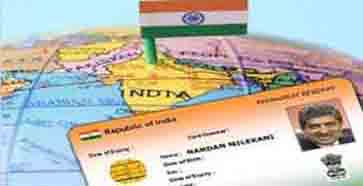
Who will have access to Aadhaar data? Which are the companies selected by Nandan Nilekani’s UIDAI project for this purpose? Can our government assure us that that these companies will keep data secure from foreign eyes? Has the government satisfied itself about the ownership of these companies? The evidence is available in the public domain but Indian authorities seem indifferent to what might well be a foreign invasion into our privacy. ~ Usha Ramanathan
In July 2010, UIDAI announced names of the companies that had been selected to implement the core biometric identification system. These companies would design, supply, install, commission, maintain and support the "multi-modal Automatic Biometric Identification System and multimodal Software Development Kit for client enrolment station, verification server, manual adjudication and monitoring function of the UID application". These would create the ability to de-duplicate on the basis of biometric information collected during enrolment.
The companies were: Mahindra Satyam (as it then was) partnering with Morpho, HP with L-1 Identity Solutions and a recently set up Indian company 4G Identity, and Accenture with MindTree and Daon. L-1 Identity Solutions was also present and participating in the PoC on enrolment.
These are companies with interesting profiles. A promotional document found on the web around the time that L-1 Identity Solutions was selected to partner with the UIDAI speaks of a close connection between the company and the security and intelligence establishment of the US government. "L-1 provides highly specialised government consulting services that address the most important challenges facing US defence and global security", it announces. "More than 1000 specialists, most holding top security clearances", it advertises, giving a more specific figure of "93 per cent holding high-level government security clearances".
In 2007, Tim Shorrock, an investigative journalist based in Washington, took a close look at the connection between L-1 and the CIA in an article he did on the former CIA chief, George Tenet, titled Cashing in on Iraq. Shorrock wrote: "Tenet sits on the board of L-1 Identity Solutions, a major supplier of biometric identification software used by the US to monitor terrorists and insurgents in Iraq and Afghanistan… The company with the closest ties with the CIA – and the biggest potential financial payoff for Tenet – is L-1 Identity Solutions, the nation’s biggest player in biometric identification. L-1’s software which can store millions of ID records based on fingerprints and eye and facial characteristics, helps the Pentagon and US intelligence in the fight against terrorism by providing technology for insurgent registration (and) combatant identification, the company says. L-1 technology is also employed by the State Department and the Department of Homeland Security…" When L-1 acquired Spec Tal, it got 300 employees with security clearances getting them several agencies with whom Spec Tal had contracts, "including the CIA, the NSA and the Defence Intelligence Agency." "We’re in the security business, right? So he’s a tremendous asset," Shorrock quotes an executive vice president of L-1 as saying about George Tenet.
Sagem Morpho which is among the participating companies is the Indian subsidiary of Morpho; which is part of the Safran group. Safran is a French defence company in which the French government holds 30.5 per cent shares.
In August 2011, Safran completed its acquisition of L-1 Identity Solutions. It was a $ 1 billion acquisition. With this, L-1 joins Safran’s security business which was until then operating as Morpho, and which together with L-1 was renamed Morpho Trust.
Morpho and L-1 have, with this acquisition, merged. So, when Mr. Nilakeni says that UIDAI has created a competitive environment, that is not quite accurate.
This deal was held back for about a year between September 2010 and August 2011 till the Committee on Foreign Investment in the US approved the acquisition. Since US contracts make up about 80 per cent of L-1’s business, and to protect US national interests, Safran was to establish "a three-person proxy board" to handle sensitive US contracts – a common feature when security companies are acquired by foreign companies. It was contemporaneously reported that the proxy board was expected to include Barbara McNamara, deputy director of the National Security Agency and William Schneider Jr. former Under Secretary of state under Ronald Reagan.
Accenture is known widely as a consultancy corporation. What is less known is its place in the world of surveillance technologies. Katherine Albrecht and Liz McIntyre, writing about Radio Frequency Identification (RFID) in their book, ‘Spychips: How major corporations and governments plan to track your every purchase and watch your every move’ (2006), introduced us to the patents and practices of Accenture in the RFID arena. It is interesting that Accenture describes itself as a "US based business…the global management consulting, technology services and outsourcing company"; no word on surveillance. Yet, in 2004, Accenture was selected by US Department of Homeland Security to design and implement the Smart Borders Project which would be deployed at the land, sea and air ports of entry. In November 2012, Accenture was awarded a bio-surveillance contract by the Department of Homeland Security.
This proximity and interdependence between foreign governments, including their intelligence agencies, and corporate ventures in surveillance technology is no secret. Yet, the UIDAI claims that it is unaware of the countries from where these companies originate.
A question that has been raised time and again in various fora relates to the security of the data. What effect does handing over data to companies that are close to foreign intelligence agencies, or allowing them to handle it, have on security of the person, and on national security? Laws such as the PATRIOT Act in the US, especially provisions such as section 215, bring all agencies in the country within the control of agencies such as the FBI and the Department of Homeland Security. As for Morpho and L-1, the French government is part-owner of these entities. Despite the concerns this should have raised in the UIDAI and within government, there has been a silence which provides no answers. The UIDAI’s response to an RTI query is more disturbing still.
In March 2011, Mr Veeresh Malik filed a request with the UIDAI for information, specifically asking for the "full name, address, websites of the foreign companies which are of US and non-US origin or control". In an appellate order of 21 July 2011, the Deputy Director at the UIDAI who is the Appellate Authority for purposes of the RTI, gave the names of three Biometric Service Providers to the UIDAI. These were, (i) Satyam Computer Services/ Sagem Morpho (ii) L-1 Identity Solutions (iii) Accenture Services. In a startling statement, the authority explained that "there are no means to verify whether the said companies/organisations are of US origin or not. As per our contractual terms and conditions, only the companies/organisations … who are registered in India can bid. Any further information in this regard can be obtained from the UIDAI public domain…" There is nothing more to be got from the UIDAI website.
Col. Mathew Thomas’ RTI query asking for copies of the contracts entered into with the companies was refused by the UIDAI citing section 8(1)(d) of the RTI Act 2005 which speaks of information including "commercial confidence, trade secrets or intellectual property" disclosing which would "harm the competitive position of a third party" to the request. The exception to this provision is if the "larger public interest warrants the disclosure of such information". At a hearing on 24 June 2013, the Central Information Commissioner has said she will hear and decide this matter. Snowden, and PRISM, have blown the lid, yet again, on surveillance by the USA.
Creating a database and handing the data over to companies, and with no discernible protection, should worry a government concerned about the safety of the people and national security, it would seem.
(The writer is an academic activist. She has researched the UID and its ramifications since 2009)
Aadhaar Unmasked ~ What we (don’t) know about the companies (12th July 2013)

Aadhaar Unmasked ~ But do the eyes really have it? (11th July 2013)
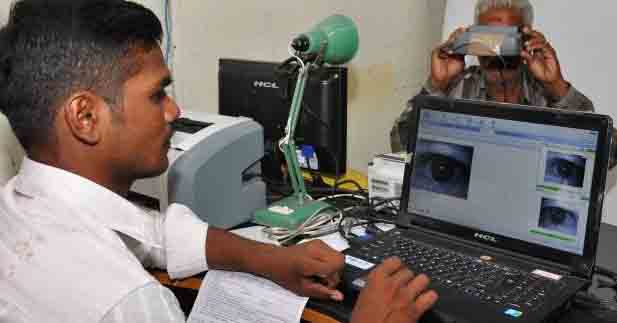
The UIDAI tasked with the Aadhaar project glossed over inconvenient facts to arrive at the fingerprint as an identification method. It then decided that iris capture was necessary as well to now cumulatively provide huge opportunities for those making fingerprint and iris scanners. We continue our series on the monstrously huge Aadhaar project. ~ Usha Ramanathan
In September 2012, two years after enrolment had begun, the UIDAI produced a report on iris authentication. As in the proof of concept (PoC) on fingerprint authentication, the iris report too was about field-testing the technology, and not a scientific study. This allowed for cleansing the data "of exceptions and anomalies", checking out vendors and their devices, encountering the people who came in their infinite variety – those with squints, those who had undergone eye surgery, those who had eye deformities and those without sight. The PoC was done in a semi-urban taluka in Mysore over a period of two months in 2012 with 5747 residents. As with the fingerprint report, here too the percentages that the UIDAI records are intended to reassure, but the devil is in the detail.
The older population, those who have undergone surgeries, those unable to open their eyes wide, those with eye deformities and, especially those who had undergone cataract surgery using older techniques were expected to have trouble authenticating. But, it was said, while iris authentication is significantly improved by using the dual eye camera, those with a squint would be better off with a single eye camera. What effect there would be on the error rate as the database grows larger and larger is not reckoned with.
Yet, these concerns lose their urgency when viewed against the first presumption on which the PoC is based. "The iris does not get worn out with age, or with use," it says. "In addition, iris authentication is not impacted by changes in the weather." This seems an improbable claim, for it is difficult to imagine a part of the human body which withers with neither age nor clime. Still, the improbable is not necessarily the impossible.
This, the report claims, is a presumption drawn from iris technology literature. But, in a paper presented at the IEEE Computer Society Biometrics workshop on 17 June 2012, two professors from the Department of Computer Science and Engineering at the University of Notre Dame found something quite different. Samuel E Fenker and Kevin W Bowyer did a study of iris images acquired between 2008 and 2011 using state-of-the-art technology, with 322 subjects ranging from 20 to 64 years, 177 male and 145 female, of different races. In introducing their study, they explained that the prevailing view that iris is "essentially immutable over a person’s life" had been repeated in several research papers, even though "we know that no studies with experimental results that support the conclusion that template ageing does not occur for iris biometrics" exist. This includes Daugman’s 1994 iris biometrics patent which asserted that "the iris of every human eye has a unique texture of high complexity, which proves to be essentially immutable over a person’s life." Fenker and Bowyer’s paper was "the most extensive experimental investigation to date on template ageing for iris biometrics."
In brief, their study found "clear and conclusive evidence that template ageing does occur in iris biometric matching. Specifically, the experimental evidence indicates that the false non-match rate increases with increasing time between acquisition of the enrolment image and the image to be recognised." That is, as time elapses, the image alters from how it was when it was enrolled. "In our results," they said, "the false non-match rate increases by greater than 50 per cent with two years of time lapse." The 50 per cent indicates the rejection rate when it was sought to be authenticated, and it is disturbingly large.
Fenker and Bowyer are not biometric skeptics, and they offer ways to proceed once it is acknowledged that template ageing does occur for iris biometrics. One possible route is "that the user may simply need to be re-enrolled in the system after some determined period of time." Given that the drop in confidence in the biometrics occurs within just two years, re-enrolment is not even an option amidst the Indian population. And, they suggest, "once the fact that template ageing for iris biometrics is acknowledged, research effort may be focused on reducing the magnitude of the effect."
This is the state of knowledge in biometrics.
The iris authentication report recognises this when it says: "Few global initiatives have empirically published results on iris based online authentication in a context similar to aadhaar." It is this use of untested technology that has had critics of the project say that it is an experiment where India is the laboratory, and Indian residents are mere specimens.
Spoofing and fraud
It is not only the experimental stage of the technology that raises questions. It is also questions of spoofing and fraud.
On 30 September 2011 a meeting was held at the Planning Commission to discuss the issue of privacy. The UID project, and the Human DNA Profiling Bill which has in circulation since 2007 and which resurfaced more recently, prompted the meeting. Representatives from the UIDAI, Natgrid, the Department of Personnel and Training were present among others that included professionals and activists. J T D’Souza, a biometrics expert who is in the trade, was present, and he demonstrated fingerprint authentication done with a faked fingerprint made out of Fevicol and wax. It was his wife’s fingerprint. It authenticated perfectly when he blew on the spoofed fingerprint to add moisture to its surface, so that the fingerprint reader could be made to believe that it was a live finger that was being applied to it. It is easy to spoof a fingerprint, he said. When it is cooperative, as it had been in his case where his wife gave her fingerprints willingly, he had used a plastic battery case into which he melted wax. When it had not quite set, the finger was pressed into the wax leaving an impression into which he poured Fevicol. When the Fevicol set, he had peeled it off and, hey presto, it was ready for use. When it is "non-cooperative", it may be an impression taken, say, from a glass or anything that is touched, the process would be a tad more tedious, involving using standard techniques from forensic sciences, making a positive, using a standard printed circuit board etching technique which is well known to any second-year electronic student or electronic hobbyist and use that as a template with Fevicol.
The danger is, too, that once the fingerprint has been compromised it cannot be changed, unlike a password or a pin number. In controlled spaces, biometrics may work because there are other controls along with the biometric. But a centralised database and long-distance authentication, D’Souza cautioned, is a prescription for fraud. D’Souza’s demonstration of the use of the spoofed fingerprint to the students of a Bombay college is on youtube; there has been no reaction to it so far. At the Planning Committee meeting, the representatives of the UIDAI said they would look into it. Six months later when the report was released, there was no mention of this issue.
The problem is not only that it is an experiment, and just may fail. It is that what is being attempted is what Mr Nilakeni calls "doing government process re-engineering" with this experimental technology as its foundation.
(The author is an academic activist. She has researched the UID and its ramifications since 2009)
Aadhaar Unmasked ~ Best finger first, but let’s now scan the eye (10th July 2013)
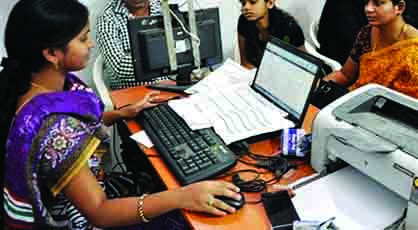
The UIDAI tasked with the Aadhaar project glossed over inconvenient facts to arrive at the fingerprint as an identification method. It then decided that iris capture was necessary as well to now cumulatively provide huge opportunities for those making fingerprint and iris scanners. We continue our series on the monstrously huge Aadhaar project. ~ Usha Ramanathan
In December 2011, when the Standing Committee on Finance (SCF) readied its report on the National Identification Authority of India Bill 2010 to be placed before Parliament, there were as yet no reports on authentication – viz., on how the biometrics collected during enrolment would be used in identifying a person.
Among a few pieces of the puzzle that was presented to the SCF was a statement from the Planning Commission, in which the UIDAI is located, that read: "It is well acknowledged that there will be failures in authentication for various reasons. After proof of concept studies (PoC) on authentication, appropriate policies and processes will be developed to take care of situations where failure occurs for various reasons .. The choice of using the authentication services is left to the third party service provider … Concerned agencies will have to develop policies and procedure to handle such exceptional situations .."
That is, there would be problems in authentication, no one could anticipate the extent of the problem because it was still untested, and responsibility would be diffused among service providers if authentication did not work.
This was a strange position to be adopted by an agency that had launched a nationwide project to biometrically de-duplicate and identify the entire population.
The Standing Committee had also seen an interview with the Mission Director and DG of the UIDAI, Mr R S Sharma, in Frontline in November 2011, where he had said: "Capturing fingerprints, especially of manual labourers, is a challenge. The quality of fingerprints is bad because of the rough exterior of fingers caused by hard work, and this poses a challenge for later authentication. … Issuing a unique identity will not be a major problem. But authentication will be, because fingerprint is the basic mode of authentication."
In January 2012, a document was put out by the UIDAI which was incensed by a statistic that the Standing Committee had referred to which estimated that the "failure to enrol" would be as high as 15 per cent.
The UIDAI tried explaining that these were "misconceptions", that they could "state with confidence" to the contrary, and that "it is now safe to conclude" that biometrics will work over the entire population.
Except – they were relying on their Proof of Concept on enrolment which, as their own report reveals, (see earlier report dated 6 July 2013) does not convince that the system can deal with the complexity of the population.
More damning still, Prof Ramakumar, the expert who had provided the statistic was drawing on an estimation made by a company, 4G Identity Solutions, which is partnering with the UIDAI! He quotes them as saying: "It is estimated that approximately five per cent of any population has unreadable fingerprints, either due to scars or aging or illegible prints. In the Indian environment, experience has shown that the failure to enrol is as high as 15 per cent due to the prevalence of a huge population dependent on manual labour." And, the DG and Mission Director’s interview stands unrebutted.
The first report on "authentication accuracy" was released in March 2012. This would indicate whether persons can be identified by their fingerprint. The PoC involved about 50,000 UID number holders.
It was carried out "in a controlled manner using different authentication devices.
The collected data was sent to the UIDAI Technology Centre. Further statistical analysis was performed at the Centre." This was a UIDAI exercise, and a statistic emerged from it: "accuracy of 96.5 per cent can be achieved using one best finger and 99.3 per cent can be achieved using two fingers" up to three attempts. "Accuracy," the report went on to say, "could be further improved by using the additional factors such as one-time-password (OTP), demographical data or second modality such as iris." A separate study was recommended to check that out.
What do these statistics mean? What is the `best finger’? What are two fingers in three attempts? What else does the report say? The "best finger" first.
Though all 10 digits are captured during enrolment, not all fingers work equally well when they have to be used to authenticate a person.
So, when enrolment is done, the report said, a person would have to go through a "best finger detection" (BFD) process, because: "The best finger to be used for authentication depends on the intrinsic qualities of the finger (ex. ridge formation, how worn out they are, cracked, etc.) as well as the quality of images captured during enrolment process and the authentication transaction."
Someone in the team that prepared the report clearly had a sense of humour: this description is accompanied by the sketch of a wrist and fingers, with the index finger pointing skywards with a bow tied to it as a sign of how special it is!
The fingerprints are sorted on the basis of "match scores" by comparing them with what has been enrolled and stored. This helps to rank the fingers: rank 1- best finger, rank 2- second best finger. "Further," the report reads, "the fingers are labelled Green, Yellow, or Red – depending on their suitability for single finger authentication." In addition, it continues, "some residents could be determined to be not suitable for reliable fingerprint authentication".
About the devices, there is the profound statement: "The best set of devices did much better than the good set of devices, which did much better than the rest of the devices." "In online authentication system, providing multiple attempts of the same finger was seen to improve resident’s chances of successful authentication." And the inference that was drawn was that "the resident learns to place fingers appropriately over multiple attempts". And, "residents in the 15-60 years group showed best authentication accuracy". The young and the old are somewhat troublesome. In sum, for those whose fingerprints work, if they have a best finger, or two yellow fingers, and more fingers are used, and if labelled matching works, and best devices are used, and when there are high quality fingerprint images, and immediate feedback, then …. fingerprint authentication may work 99.13 per cent of the time. That is the value of the statistic.
Then, multimodal authentication with both fingerprint and iris, OTP, buffered authentication, multiple attempts and with different fingers – these are recommended, "to not only improve accuracy but also to ensure inclusion."
The recommendations harbour the underlying unease about the capacity of fingerprints to identify the entire complex of people in this country.
That explains why, even as the report starts out, it says "although currently only fingerprint biometric is being offered … it is likely that in the near future iris biometric authentication will also be supported." And, in conclusion: "Low cost iris capture devices are becoming available in the market. A combination of fingerprint and iris is expected to improve accuracy by a factor of 10 to 100, while reducing failure to enrol (red fingers) rate by a factor of 10. A detailed study such as this should be done on iris authentication."
In the meantime, this report lends context to Mr Nilekani’s statement at the Centre for Global Development in Washington in April this year about having "created huge opportunity for fingerprint scanners, iris readers".
(The author is an academic activist. She has researched the UID and its ramifications since 2009)
SC: International pornographic websites should be blocked

It is difficult to block international pornographic websites in the country, as informed by the Centre. SC asks Centre to consult with various ministries and come out with a solution on the issue.
1984 anti-Sikh riots case: SC refuses to hear Tytler”s plea
Press Trust of India
NEW DELHI, 12 JULY: The Supreme Court today refused to entertain Congress leader Jagdish Tytler’s plea seeking a stay on an order of the trial court directing CBI to conduct further probe into his alleged role in a 1984 anti-Sikh riots case.
A Bench headed by Justice P Sathasivam said that the apex court should not interfere in the matter at this stage as the case is pending in the Delhi High Court which is scheduled to hear it on 18 September.
Sensing the mood of the Bench, senior advocate Mukul Rohatgi agreed to withdraw the petition which was allowed by the court.
Mr Tytler approached the apex court challenging the high court’s July 3 order refusing to grant interim stay on the trial court’s order.
The high court had refused to stay the probe saying, “Only investigation is ordered and this court will not stop the investigation.”
Mr Tytler had on 30 May moved the high court challenging the trial court order setting aside the CBI’s closure report giving him a clean chit in the 29-year-old case and directing the probe agency to examine eye-witnesses and people claiming to have information about the riots.
Mr Tytler, in his plea before the high court, had said that the trial court order is contrary to the scheme of code of CrPC. The method and mode of investigation by a probe agency is the absolute prerogative of the agency and it is not for the court to direct the agency that which witness should be examined by it, he had said.
The trial court’s order of further investigation had come on a plea by the riot victims against CBI giving a clean chit to Mr Tytler and filing the closure report.
CBI had sought dismissal of a plea filed by a victim before the trial court, saying the probe has made it clear that Tytler was not present on 1 November, 1984 at Gurudwara Pulbangash in north Delhi where three people were killed during the riots in the aftermath of assassination of the then Prime Minister Indira Gandhi.
Mr Tytler’s alleged role in the case relating to killing of the three persons Badal Singh, Thakur Singh and Gurcharan Singh, near Gurudwara Pulbangash was re-investigated by CBI after the magistrate court had in December 2007 refused to accept its closure report.
CBI had again given a clean chit to Mr Tytler on 2 April, 2009, claiming lack of evidence against him in the case.
On 27 April, 2010, the magistrate accepted CBI’s closure report in the case against Mr Tytler, saying there was no evidence to put him on trial.
CBI had claimed that at the time of the incident, Mr Tytler was at Teen Murti Bhawan where the body of Indira Gandhi was kept and that it had already re-investigated the case on the order of trial court but there was no sufficient evidence against the Congress leader.
The sessions court had set aside the CBI’s closure report giving clean chit to Tytler in the case, which has been challenged by him.
2G case: Court dismisses CBI”s plea to put Radia CD on record
Press Trust of India
NEW DELHI, 12 JULY: A Delhi Court today dismissed CBI’s plea seeking to place on record a CD of former corporate lobbyist Niira Radia’s taped conversations and the transcripts of her calls purportedly pertaining to radio waves allocation.
Special CBI Judge O P Saini dismissed the plea saying that it seems that the agency is not “much serious” about its petition as it has not provided certain documents to the accused.
“In view of the failure of the prosecution to supply annexure ‘A’ to the aforesaid letter to the accused, it has not pressed the application seriously.
“Since the application has been vehemently opposed by the defence as well as complete application has not been supplied to the defence and the prosecution itself does not appear much serious about the application, the same deserves to be dismissed and is accordingly dismissed,” the court said.
It said, “The (plea for) filing of the CD on record has been vehemently opposed by the defence on various grounds including that the same would prejudice the defence as the same is being attempted to be placed on record belatedly, when the accused have already disclosed their defence.
“It is further submitted that this CD cannot be taken on record through an incomplete application as annexure ‘A’ of the aforesaid letter has not been supplied to them,” the judge said.
The court noted that CBI had not supplied to the accused the annexure ‘A’ to the letter dated May 20, 2010 which was received by it from the Income Tax department having the details of intercepted calls stored in a USB hard disk.
During the brief arguments today, Special Public Prosecutor U U Lalit told the court that he is unable to supply the documents as it contains other details which are not relevant to this case and “cannot be disclosed in the interest of security of the state.”
The court dismissed the plea and asked the agency to proceed with the ongoing trial.
“The plea is dismissed,” the judge said, adding, “How many applications will you (CBI) move? Let the case proceed.”
Relations with India dominate Bhutan polls campaigning
Press Trust of India
THIMPU, 12 JULY: Bhutan’s relations with India and how to improve them have dominated the campaigning for the country’s second national elections with the two major political parties contesting the polls asserting unequivocally that bilateral ties cannot be impacted by minor hiccups.
During their four week-long campaigning, the Druk Phuensum Tshogpa (DPT), which ruled Bhutan for five years since the Himalayan nation turned into a democracy in 2008, and opposition People’s Democratic Party (PDP) have tried to impress upon people that concerns like India’s withdrawal of subsidy to kerosene and cooking gas would be resolved once they form the government.
However, both the parties admitted that it is a closely contested fight and who would form Bhutan’s second democratically elected government after tomorrow’s polling is anyone’s guess.
DPT strategist Rigden Tenzin said Indo-Bhutan relations are so strong that it can always withstand minor hiccups and bound to improve further because of historical, cultural, and economic reasons and no one should have any doubt in his or her mind about it.
“It is the opposition PDP which has confused the people by talking about the issue of subsidy to kerosene and cooking gas. If we form the government, the issue will be taken up with New Delhi and resolved amicably,” Mr Tenzin, a Delhi School of Economics alumni, told PTI.
He said India’s decision came when the interim government was in place and his party DPT cannot be blamed for it and the party was telling people this fact.
India has cut off the gas subsidy to Bhutan since a pact with the country had expired on 30 June.
India yesterday assured Bhutan that it will not make it “suffer” and will proceed on the issue of gas and kerosene subsidy in “full consultation” with the new government there.
However, New Delhi maintained that “careful accounting” was required to ensure proper usage of the subsidy.
Opposition PDP general secretary Sonam Jatsho expressed confidence that his party has a high chance of forming the next government in Thimphu as people showed their support to the party because of certain policies of outgoing Prime Minister and DPT leader Jigmi Y Thinley.
Mr Jatsho said, “Indo-Bhutan relations are so strong that you cannot imagine that it can be harmed due to some minor issues”.
“We are telling people that doubts about Indo-Bhutan relations getting strained are unfounded. The relations only go deeper and strong. But due to certain policies of the last government, people are a little bit shaky. If we form the government, we will resolve all issues,” he told PTI.
Mr Tenzin felt that the India’s decision to withdraw subsidy to kerosene and cooking gas being supplied to Bhutan has more to do with India’s own economy and abrupt hike ofinternational crude oil price rather than anything else.
“You have to see what difficulty Indian’s economy is facing and how the international crude price is going up,” he said.
Bhutanese people too feel that their country cannot afford to allow ties with New Delhi to be strained as it has to depend on “elder brother India” on everything.
“We get everything from India. Our essential commodities come from India, our children go to India for study, we go for our treatment, businessmen go for trade. So, how can we afford to allow our relations with our elder brother India to be strained,” said Yeshey Dorji, a college teacher.
Sherub Zangmo, a Thimphu resident, said people felt like the elections this time got “tenfold” dirtier than the first election in 2008.
“Party leaders were more focused on beating their opponent and did not hesitate to bring Indo-Bhutan relations in their speech,” he said.
Mr Zangmo said that while bringing in Indo-Bhutan relations, parties accused each other of straining the ties and highlighted the sudden removal of subsidies on kerosene and cooking gas.
This quickly took the campaign to a different level altogether, he said.
Telangana: AP CM Reddy meets Sonia
Press Trust of India
NEW DELHI, 12 JULY: Ahead of the crucial Congress meeting on Telangana, Andhra Pradesh chief minister Kirankumar Reddy today met Congress President Sonia Gandhi and briefed her about the political situation in the state.
The meeting came amid indications that Congress has decided to spell out a clear stand on the vexed issue of separate statehood soon.
Sources said that more than half a dozen Lok Sabha MPs from Telangana region today held a meeting at the residence of MP Ponnam Prabhakar. The meeting was also attended by ministers from Telangana region in the Reddy-led government in the state.
The MPs Prabhakar, Madhuyakshi Goud, Sukhender Reddy, S Rajaiah, Suresh Kumar Shetkar and others also held a meeting at the residence of AICC secretary and a senior leader from the region V Haumantha Rao.
The pro-Telangana leaders have plans to meet AICC general secretary in-charge for the state Digvijay Singh and Gandhi’s secretary Ahmed Patel before the Core Group meeting in which some finality on the issue is expected.
In the Core Group meeting, which will also be attended by Rahul Gandhi, the Andhra Pradesh Chief Minister, PCC Chief Botsa Satyanarayana and Deputy Chief Minister Damodar Rajanarasimha will give a presentation on the issue of Telangana.
Union Minister Ghulam Nabi Azad, who was the AICC in-charge of Andhra Pradesh before Digvijay is also expected to attend the Core Group meeting.
Maintaining that a decision cannot be postponed “anymore” Mr Singh had yesterday said that the Core Group meeting will discuss the Telangana issue with “both options open”–status quo or creation of a separate state.
“This has to be decided by Government of India in consultation with UPA partners. As this may also need amendment to the Constitution, we may have to take Opposition parties also on board,” Mr Singh had said.
Finance Minister P Chidambaram, who as Home Minister had on 9 December, 2009 announced the starting of the process of formation of the state, is abroad and hence will not be able to attend the meeting.
The meeting chaired by the Congress President with Prime Minister Manmohan Singh by her side will have the full attendance of Core Group members minus Mr Chidambaram.
They include home minister Sushilkumar Shinde, Defence Minister A K Antony and the Congress President’s political secretary Ahmed Patel. Mr Antony is also the head of the Congress sub committee on alliance.
A decision on Telangana is being taken amid a talk for an alliance with YSR Jaganmohan Reddy’s YSR Congress in the state.
Chief minister Reddy, PCC Chief Satyanarayana and Deputy Chief Minister Rajanarasimha are also likely to meet Digvijay Singh before the Core Group meeting.
Mr Singh had submitted a report on the Telangana issue to Mrs Gandhi last week.
To questions about the party’s commitment on the issue, Mr Singh had said yesterday, “If you see the manifesto, we had promised Second State Reorganization Commission.”
In the 2004 manifesto, the Congress did not promise anything specifically on Telangana.
But subsequently after the elections when it tied up with pro-Telangana TRS to form the government at the Centre, the Common Minimum Programme of the coalition said the UPA government will consider the demand for formation of a Telangana state at an appropriate time after due consultations and consensus.
The issue of separate statehood in the state has virtually bifurcated all parties in Andhra Pradesh on pro and anti Telangana lines.
In February 2010, the government appointed a five-member committee headed by Justice Sri Krishna to look into the issue, which came up with six solutions to the problem including keeping the state united.
Telangana: Cong may lose relevance
stanley theodore
stanley_theodore@yahoo.com
Hyderabad, 11 July
In the all consuming obsession to make Mr Rahul Gandhi the Prime Minister the Congress is playing a game where it is losing Andhra Pradesh in the hope that some numbers from here would come to his aid in Delhi.
The Congress’ premise is that if Telangana is granted the region and importantly a majority of the 17 seats would go in its favour. The Congress is already blamed for the delay in statehood for having made a forward looking statement on 9 December 2009 and backtracking two weeks later.
Ever since, it has been a case of lip sympathy, promises to resolve at the earliest or the “high command is seized of the matter”, which meant gibberish to the Telangana people.
In 2009 there is more on the voter&’s radar. Price rise is the single largest concern. For the two-term government anti-incumbency is intense. Also electricity is not just erratic but immensely expensive.
The BJP would want to climb the rungs rapidly to capture power. In chief minister N Kiran Kumar Reddy&’s survey his party would win 12 seats in Telangana, but the BJP is expected to win 15. The YSR Congress and the TDP would not win substantially. But the macro picture indicates the changing power equation in the region.
These apart the dangers of communal tension and the resurgence of Maoism have been referred to repeatedly and emphatically.
Coastal Andhra since 9 Dec 2009 night has been nurturing a feeling of being let down by the Congress. Even after it&’s made into a separate state, including a well meaning development package from the Centre, the emotional baggage that has been accumulating would be something else to reckon with. This region has long considered itself as the elder brother to both Rayalaseema and Telangana having contributed culturally, economically and politically. It has India&’s second largest coastline ~ 972 km. Visakhapatnam has the second largest port and Krishnapatnam is among the fastest growing ports in the world.
On paper this is enough for fissiparous tendencies to germinate and be akin to some of the home grown secessionist movements of Europe.
Jadeja jars sri lanka
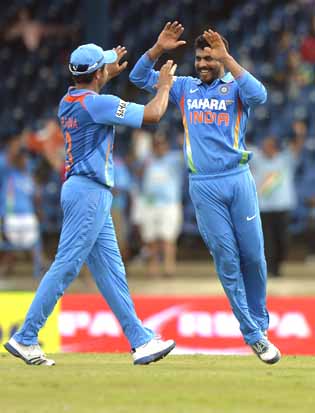
Islanders’ middle-order collapse meant they could only manage 201
press trust of india
Port of Spain, 11 July
India benefited immensely after Sri Lanka’s middle and lower-order batsmen committed hara-kiri, which saw the team lose eight wickets for just 30 runs before being bundled out for 201 in the final of the Tri-nation ODI series here today.
Sent into bat, Sri Lanka were sitting pretty at 171 for two in the 38th over, but lack of application on part of their batsmen saw them being packed off with seven balls left in their innings.
Ravindra Jadeja was the most successful Indian bowlers, returning figures of 4/23, while there were two wickets-a-piece for Bhuvneshwar Kumar, Ishant Sharma and Ravichandran Ashwin.
Earlier, in-from Bhuvneshwar made use of seaming conditions to send back Upul Tharanga and Mahela Jayawardene.
Incidentally, the duo had punished India with a double-century partnership in the match that Bhuvneshwar was dropped.
Sri Lanka then rode on Kumar Sangakkara (71) and Lahiru Thirimanne’s 122-run partnership for the third wicket to stage a fightback before their innings disintegrated largely due to some mindless batting.
Thirimanne scored 46 off 72 balls while Sangakkara got his runs in 100 deliveries.
From a comfortable position with about 12 overs to go, Sri Lanka were left licking their wounds at 193 for seven in the 46th over when skipper Angelo Mathews got out.
None of the last six batsmen could reach double figures.
Sri Lanka made a cautious start on a pitch that was not conducive for stroke-play.
But after reaching 27 in the seventh over, the islanders suffered their first blow when Bhuvneshwar changed his angle to induce an inside edge from Upul Tharanga. Dhoni did the rest behind the stumps.
The ever-consistent Bhuvneshwar was at it again, in the 14th over, as he removed Jayawardene with an innocuous delivery that moved a bit on landing at the Queen’s Park Oval.
Losing the experienced Jayawardene so early in the innings was a big blow for the Lankans and they desperately needed solidity at that point of time.
Sri Lanka found the answer to their worries in the form of another veteran, Sangakkara, who anchored the innings.
Sangakkara mixed caution with common sense as he realised early that playing expansive shots was not the way to go about the task on this wicket.
Playing equally responsibly at the other end was Thirimanne who complemented his senior partner to prop up Sr Lanka’s innings.
India were 146 for the loss of five wickets at the time of going to press. Ravindra Jadeja (1) and MS Dhoni (2) were at the crease.
Cavendish backed by Froome
agence france-presse
Mont-Saint-Michel, 11 July
Tour de France leader Chris Froome came to the defence of former team-mate Mark Cavendish on Wednesday and hit out at the spectator who threw urine at the British sprint star.
The incident happened during the 11th stage of the Tour de France, a 33-kilometre individual time-trial between Avranches and Mont-Saint-Michel in Normandy.
It came a day after he was blamed for a collision that sent Argos rider Tom Veelers crashing to the ground in Saint-Malo.
Cavendish did not talk to the media after the race, but Froome, speaking after holding on to the yellow jersey, said what happened “ruined” what has otherwise been a wonderful atmosphere throughout the 100th staging of the sport’s greatest race.
“It is disappointing to hear about one individual like that,” he said. “That’s one of the beauties of our sport. Anyone can come and watch at the side of the road and enjoy the excitement and really get close to the top riders in the world. Mark is one of the big characters in the sport, and some people love him, some people hate him.
“But to do something disrespectful like that, that’s really sad. It ruins the whole atmosphere.”
Earlier in the day, Omega Pharma team CEO Patrick Lefevere confirmed to AFP that Cavendish had been insulted by spectators and attacked by one individual on the race route.
“Probably some spectators were not very pleased with what happened yesterday and they yelled to him and then one other idiot threw urine at him,” said the Belgian.
“Mark is not upset, but he is really disappointed because he thinks he didn’t deserve this. The cycling public is known for being very fair, we have no hooligans, but there are thousands and thousands of people on the roads and not everybody is a gentleman,” the Belgian added.
Cavendish escaped without punishment following Tuesday’s clash with Veelers, which happened during a sprint for the line won by German rider Marcel Kittel.
Veelers pinned the blame on the British champion, and an anxious Cavendish became embroiled in a spat with one journalist after the finish to Tuesday’s stage, snatching away his dictaphone after being asked if he felt the crash was his fault.
However, Cavendish later called Veelers to apologise and Lefevere hopes that can be the end of the matter.
“He apologised already yesterday (Tuesday) on Twitter and on the phone,” he said. “If you don’t agree you don’t take the telephone, but he (Veelers) took the telephone.
“Today is a time-trial so you don’t have the time but maybe tomorrow (Thursday) he can have a little handshake with Tom Veelers if he agrees to do it and then this case has to be closed.”
Warne makes it to ICC Hall of Fame
He joins Brian Lara, Enid Bakewell and Glenn McGrath
press trust of india
Dubai, 11 July
Former Australia spinner Shane Warne will be inducted into the ICC Cricket Hall of Fame on 19 July during the tea interval of the second Ashes Test between England and Australia at Lords, ICC announced today.
Warne becomes the 69th male member of the Hall of Fame, and joins fellow 2012-13 inductees Brian Lara of the West Indies. England&’s Enid Bakewell and former Australia team-mate Glenn McGrath are also being recognised by the ICC and the living members of the Hall of Fame.
Lara and Bakewell were inducted last year at the ICC Awards in Colombo in September, and McGrath during the Sydney Test between Australia and Sri Lanka in January this year.
Warne represented Australia in 145 Tests between 1992 and 2007, claiming 708 Test wickets at an average of 25.41. Warne is credited with reviving interest in leg-spin outside Asia. He was the first cricketer to reach 700 Test scalps.
His tally of 3,154 Test runs is the most by any player without making a hundred.
He also played in 194 ODIs, claiming 293 wickets at an average of 25.73 and was part of the Australia side that won the World Cup in 1999 at Lords against Pakistan alongside fellow Hall of Famers Glenn McGrath and Steve Waugh.
His performance at the match saw him named Player of the Final after he concluded the game with match figures of 9-1-33-4. “I’m very honoured and proud to be announced as an inductee into the ICC Hall of Fame later this month and Id like to thank the voting academy very much for even considering me.
I’m looking forward to celebrating my induction with my friends and family in front of the crowd at Lords during the second Ashes Test,” Warne said.
Protest outside DJB office
STATESMAN NEWS SERVICE
New Delhi, 11 July
The residents of Kishangarh who have been forced to drink contaminated water for the past two months, lost their patience against the apathetic attitude of Delhi Jal Board (DJB) and staged a protest at the agency’s office in Vasant Kunj today.
They alleged that they had beenreceiving dirty water for the last two months despite several complaints made to the authorities.
Today, as the news broke out that a person died and several others had fallen ill in Rajokari village after consuming contaminated water, several people including women gathered at DJB office and started sloganeering against the staff.
"Yesterday, a person from Rajokari village died after drinking contaminated water. Two others had died in the NCERT Colony but still many colonies in south Delhi are receiving dirty water," said a resident.
Many blamed it on faulty pipelines. "Hard water is eating pipelines. Blocked pipes was a recurring problem in the area for the past two years, contamination was recent. Delhi is called Metro City and the national capital but people are not getting drinking water in many areas which is also leading to deaths and serious illness. Is the government waiting for similar cases like Rajokari and NCERT colonies to happen?" asked Narendra Khatri, Corporation Councilor.
However, DJB officials said that water being supplied by the board is potable and free of any contamination. "Since 17 million people are served through a large network of about 14,000 km long transmission and distribution pipelines, DJB’s Treatment and Quality Control (DTQC) wing immediately lifted water samples for testing from the area and the water was found to be potable and safe for human consumption," said a DJB official.
It has also pressed into service additional tankers in the areas. "Samples of water from the tube-wells tested on 11.07.2013 have shown that the water is of good quality. Also the residents have been advised to take water from DJB tankers," added the official. The unauthorized settlement of JJ Cluster, BSF camp located at Rajokari Pahari consists of about 500 JJ hutments. According to DJB, to meet the water needs of the residents, DJB has installed 4 tube-wells at nearby locations from where water is provided through public water hydrants.
The DJB clarifies that it lifts 9000-10,000 samples per month only from the distribution network and also declared that water is tested for physico-chemical and bacteriological parameters. "This figure does not include the samples tested for continuous surveillance at treatment plants. The number of samples tested from the distribution network is further raised to a minimum of 12,000 samples during the Monsoon season," added the official.
‘FIR campaign’ on rice issue launched
STATESMAN NEWS SERVICE
Bhubaneswar, 11 July
In its bid to sensitise people about the alleged irregularities committed by the state government by reducing 10 kg rice from the quota of BPL families, the Odisha Pradesh Congress Committee (OPCC) launched an ‘FIR campaign’ today.
Reports from across the state said that Congress workers took out rallies and reached their nearest police stations to hand over the FIRs. Chief Minister Naveen Patnaik and food supplies and consumer welfare minister Mr Pratap Keshari Deb were named as accused in the petitions.
The FIRs had several BPL family members as “complainants”.
The Congress claimed that the campaign will create awareness against the “anti-poor policies” of the state government.
The principal Opposition party alleged that though the Centre has been providing 35 kg of rice per month for the BPL families, the state government has been distributing only 25 kg to them.
The Congress observed that such reduction of rice quota is a clear-cut case of breach of Central guidelines.
The rice is provided to the BPL households under the public distribution system (PDS). The Congress alleged that the “misappropriation” has been going on for last eight-nine years.
“The FIR campaign was launched across the state today and our workers accompanied the BPL families who lodged FIRs against the CM and the departmental minister. People should know how the state government has duped and deprived them of their rice quota,” said a senior Congress leader who took part in the rally here in Bhubaneswar. He informed that the Congress will file a Public Interest Litigation (PIL) in the matter shortly.
Meanwhile, the BJD dismissed the charges and claimed that the government has not done no wrong by reducing the rice quota as the Centre has been providing less rice to cover all the BPL families of Odisha.
BJD workers to fast for special category status for Odisha
STATESMAN NEWS SERVICE
Bhubaneswar, 11 July
Evidently jolted by the Congress party&’s FIR campaign today, the ruling BJD announced that it will hold protest hunger strike across the state on 12, 15 and 16 July, (three dates given to all blocks to state the hunger strike on any one of the days as per their convenience), demanding special category status for Odisha.
The decision to launch a one-day token hunger strike across the state is a follow-up to the “Swabhiman Samavesh” held by the BJD at New Delhi last month, claimed BJD leaders while trying to dispel the notion that the FIR Campaign by the Congress had prompted it to resort to such tactic. We waited for a month since the Swabhiman Samavesh for the UPA government to respond. But the centre continues to ignore the genuine demand of the people of Odisha, so we have decided to organize a symbolic hunger strike, explained BJD leaders and Ministers Prasanna Acharya and Kalpataru Das.
Talking to reporters, they informed that the decision was taken after a meeting at CM Naveen Patnaik&’s residence today. Party workers at the block, municipality and notified area council level will sit on dharna and hunger strike from 10 am to 5 pm, they said.
The UPA government had said that a committee will be formed to examine and revise the guidelines for Special category status to states. The committee was to submit its report in two months time, but nothing has been done so far, alleged Mr Acharya.
The BJD had held a Swabhiman Samavesh at Delhi on 12 June , collected 1 crore signatures supporting the demand for special category status and submitted it to the President Mr Pranab Mukherjee.
That was the first phase of the agitation and now we are moving into the second phase, said Mr Das.
We must mine and burn coal so that India can develop: NTCP Chairman
STATESMAN NEWS SERVICE
Bhubaneswar, 11 July
Strongly pitching for stepping up coal mining in the country, NTPC chairman Dr Arup Roy Choudhury said it is imperative to increase coal production and use it for thermal power generation to further economic growth.
Citing China which is mining four times the coal that India does, Mr Roy Choudhury said Indian coal has high ash content and it cannot be exported, so it the huge reserves have to be tapped and used here.
We must mine and burn coal so that India can develop, he added.
The chairman of the global power major expressed confidence of achieving and even exceeding the targets as far as power generation during the 12th Plan period is concerned. NTPC has a coal block capacity of 100 million tonne, but by the time we produce that amount of coal our requirement will be around 240 million tonne, so Coal India Ltd has to support us, said Dr Choudhury who was here to witness the Puri Rath Yatra.
The target for the 12th Plan is 14000 MW and in the first year itself NTPC has done 4000 MW. We will exceed our target, he said.
NTPC had invested Rs 20,000 crore last year and will repeat it this year. For the entire 12th Plan period the goal is to invest Rs 1.50 lakh crore.
While planning such expansion, we tend to look at the fuel source and we have five coal blocks and are set to get another four which will take our coal capacity to 100 million tons, he informed.
Reaffirming his commitment to projects in Odisha, Dr Choudhury said he had assured Chief Minister Naveen Patnaik on this account yesterday.
We are running the oldest generating station at Talcher yet achieving a very high plant load capacity, he said while stating that Talcher STPS Kaniha has a capacity of 3000 MW and Talcher Thermal 460 MW. Besides, two new projects ~ Darlipali (2×800 MW) in Sundergarh district and Gajmara ( 2×800 MW) in Dhenkanal district are in progress. The NTPC has plans to expand existing capacity of TTPS ( 2x600MW). It has a 10MW solar power project and the Dulanga Coal mining project in the state, he said.
Once we get the required clearances for the two power projects, the investment proposals will be cleared which, then will include the medical college and the power engineering college, he said.
The Darlipali project has progressed in the sense that NTPC has got possession of 1200 acres of private land and alienation of 339 acre of government land and stage one forest clearance are in process, he said.
The Gajmara project is in the process of notification for land acquisition. Talking to reporters at Talcher, Dr Choudhury said while want of coal linkage come on the way of the expansion of NTPC-Kaniha and TTPS, land acquisition has been troublesome in the Gajamara power project. He dispelled speculation over shifting of the Gajmara project to another state.
Asked about the expansion of 3000 MW Kaniha plant of NTPC since a new coalmine Kaniha came up near it, he said “This coal is to run the power plant in current capacity ,for expansion fresh coal linkage is necessary. Due to want of coal linkage the proposed expansion of 460 MW Talcher Thermal Power station is also delayed” .