Logo

States as handmaidens of UIDAI

Statesman News Service |

Usha Ramanathan

Memoranda of Understanding, data sharing agreements and permanent enrolment centres tell a very different story from the images that the UIDAI has attempted to conjure up about the UID project. That it is cheap, at $2.50 per person, as Nandan Nilekani said in April in Washington. That the UIDAI only gives a yes or no answer, and does not share any information. That it is a finite exercise, with 600 million enrolled by 2014, and the rest in a phase that will follow. These are reassuring, perhaps, but they are not true.
On 23 November 2009, Mr Nilakeni told a gathering with a generous dash of lawyers to work on a law that would lay at rest questions that some in officialdom were asking, about passing on information on residents to the UIDAI. The law did not happen; but MoUs did. The MoUs not merely skirted the concerns raised; they reduced states to subservience, where they would act as instructed by the UIDAI, with little in the nature of reciprocal commitments. Why the states willingly fell in line is a mystery yet to be solved, especially since what the UIDAI was setting out to create was a centralized database of residents over which states would have no control.
The MoUs conform to a pattern. They refer to the relationship between states and the UIDAI as a "partnership". Government and other agencies are reduced to ‘Registrars’ for the UIDAI. The UIDAI would set the tasks, specify the software; and the Registrars would deploy the enrolling agencies "pre-qualified" by the UIDAI. The UIDAI would conduct "periodic audit of the enrolment process and to this end shall have the power to visit and inspect offices of the Registrars and enrolling agencies".
"Such audits," the Kerala MOU, as a case in point, reads, "are necessary to ensure the integrity of the enrolment process…." Inexplicably, the states asked for no reciprocal authority to inspect the UIDAI and audit its working. The UIDAI would "prescribe protocols for transmission of data," "to ensure the confidentiality, privacy and security of data," and "prescribe limits for fees that could be charged for issuing a UID number". The states demanded no role in any of this.
What the states had were responsibilities and obligations. The state ‘shall’ "cooperate and collaborate with the UIDAI in conducting proof of concept studies and pilots…," appoint the Registrars from among its departments as prescribed by the UIDAI and create mechanisms and provide "logistic and liaison support" to the UIDAI. The states are to "provide required financial and other resources to the Registrars to carry out the enrolment process…"; this, of course, figures nowhere in the computation of costs of the project.
 The UIDAI would issue instructions, and the state would follow them. If these were not followed, the UIDAI would make "reasonable attempts to discuss and attempt to resolve difficulties with the State Government….If the recommendations of the UIDAI are not implemented and matter settled to the satisfaction of both the parties, the UIDAI shall have the option to de-register the concerned Registrar and/or demand replacement of a concerned enrolment agency …" Unilateral, and no reciprocal obligation.
What was in it for the state governments? The MoUs said that during enrolment the Registrars may collect any additional information from residents, apart from that to be sent to the UIDAI for enrolment, and keep it with them. Even as the UIDAI assured residents that their UID number would be despatched only to them, the MoUs promise to send it to the Registrars simultaneously, which they can then append to the information already with them; and the process of convergence is set to begin.

ONCE IS NOT ENOUGH!

In the beginning, enrolment was projected as a one-time activity. By 2014, 600 million would be enrolled.
Then the rest. But, of course, it cannot be that simple. A ‘Policy on
Permanent Centre Model’ has hit the stands, in a manner of speaking. Now that enrolment has reached a point where the project may be
difficult to shelve, the un-discussed aspects are beginning to emerge. The plan is to set up permanent enrolment centres to
"facilitate ongoing enrolments and updates". Updates? Information about marriage, migration, mobile number, death or other personal changes would require demographic updates.
Newborns would need to be databased; children would have to have their biometrics taken when they stabilize which may be when they are around 15; badly captured
biometrics would need
re-enrolment. "Events like accidents and diseases" may lead to biometric authentication failures and may have to be
re-presented on the
database. And, capping all this: "Residents are
recommended to update their biometric data every ten years." This is the first admission of a
concern that those
questioning the wisdom of the project have been voicing from the
beginning: that biometrics change, age, vanish with age and circumstance.
Re-registering the population every ten years? Has this been thought through by someone in government? Where can we find what the thinking is?
The "suggested minimum station requirement" is pegged at 1854 in 585 districts to be set up by the `Registrars’. This is a grand vision of ubiquity, where police stations, post offices and, for the moment, PDS shops are joined by Permanent Centres.
Between ‘data sharing’, re-registration of biometrics every ten years, and ‘permanent centres’, this is a very different project from what it marketed itself as being when it began.
There has, so far, been no independent audit of cost, process or outcomes. May be now is the time.


Road projects under scanner

Statesman News Service |

Central team to review projects under PMGSY
STATESMAN NEWS SERVICE
Bhubaneswar, 7 August
Expressing concern over the implementation of Pradhan Mantri Gram Sadak Yojaya in Odisha, the Empowered Committee (EC) of the Rural Development Ministry has decided to depute a team to the state for a detailed review.
While approving proposals from Odisha, under Asian Development Bank (ADB) component of the PMGSY for 343 road works at a cost of approximately Rs 584 crore and 140 long span bridges at a cost of Rs 483 crore, the Empowered Committee has raised several critical issues relating to implementation of the road projects.
The state needs to enhance its capacity to deliver the desired quality of the roads. Odisha is yet to complete 2,048 road works out of the sanctions issued till March, 2011.
 In addition to State Quality Monitors (SQMs) engaged for second tier quality monitoring, the state should also institutionalise the quality monitoring in some selected districts, for which the plan of the state has been asked before August end, said Rural Development Minister Mr Jairam Ramesh in a letter to Chief Minister Naveen Patnaik today. The letter notes that Odisha is yet to financially close 1,100 works which is basically on account of pending final bill clearances. The state has been asked to financially close about 50 per cent completed works before August end and remaining by September, 2013.
Mr Ramesh requested the CM to direct the authorities concerned to look into the issues raised by the empowered committee at the earliest.

No light after much sound

Editorial Team |

State yet to implement light and sound project on Sepoy Mutiny
tarun goswami 
tarun@thestatesman.net 
Kolkata, 7 August
The Trinamul-led state government&’s tall claims of having done so much doesn’t hold true in Barrackpore. A light and sound project set up at an estimated cost of Rs 80 lakh is gathering dust due to the indifference of the minister and senior officials of the tourism department. 
After coming to power in 2011, chief minister Miss Mamata Banerjee had asked the tourism department to develop Barrackpore as a place of tourist attraction. Accordingly, the then minister in charge Rachpal Singh took up a light and sound project depicting the Sepoy Mutiny of 1857 at the Malancha tourist lodge premises. Barrackpore was the centre of  political activities when  Mangal Pandey, a sepoy, was hanged for raising the banner of revolt against the East India Company in 1857.  From here the mutiny spread to Jhansi, Nagpur and Lucknow. It may be noted that Karl Marx in an article published shortly after the mutiny had declared it as a national war of Independence.   The light and sound project was prepared by a private firm and it was decided that the show would begin after sundown and the entire path up to Malancha was illuminated for the purpose. The department will organise a conducted tour. Barrackpore is important to History students the world over. Every year many history students from universities like Oxford, Cambridge, Cornell and Heidelberg  visit the Flag Staff House where statues of George V, Lord Curzon, Lord Montague, Lord Woodburn are kept. These statues were removed from the Maidan area by the United Front government in the late 1960s. The project was supposed to have been inaugurated by the chief minister. But after Mr Singh was transferred to the planning and development department no initiative was taken any more. Mr Krishnendu Narayan Chowdhury who took over as the tourism minister expressed his ignorance of the project and said he would look into the matter.  It will be recalled that a team from the United Kingdom comprising History teachers and archaeologists had met the then chief minister Jyoti Basu in early 1990s and expressed his desire to repair the building where Robert Clive lived in Dum Dum. The government remained silent as it did not want to highlight the imperialist history. A portion of the building has collapsed and the remaining part may fall down any day.

Odisha briefs

Statesman News Service |

Posco notice: The Orissa High Court today issued notices to the Centre, state and Posco to file their counters within two weeks on a batch of PILs filed by the residents of Gobindpur village in Jagatsinghpur district.
Rail recruit: Mr Debaraj Panda, an officer of 1985 batch of the Indian Railway Traffic Service (IRTS), has assumed charges as the new divisional railway manager (DRM) in Sambalpur. Prior to this assignment, Mr Panda was serving as the chief freight transportation manager (CFTM) of East Coast Railway at Bhubaneswar.
Death trigger: Tension gripped Balasore town after a women died in a nursing home after undergoing laparoscopic operation on Wednesday. The deceased has been identified as 53 year old Subasini Das of Khantapara area. The relatives alleged that she succumbed barely five minutes after administration of the injection and held medical negligence responsible for her death.

SSKM gets a human milk bank

Statesman News Service |

Statesman news service 
Kolkata, 7 August
Chief Minister Mamata Banerjee today inaugurated a human milk bank at SSKM hospital to bring down the infant and neonatal mortality rate in the state. 
The human milk bank, which is the first of its kind in the state, has been inaugurated three years after it was first proposed. 
“The lactational failure of mothers results in newborns depending on other diets which is not the proper solution as there is no alternative to breast milk for children,” said Ms Banerjee, adding that more such milk banks would be set up in the medical colleges across the state. 
She also announced, that around Rs 3 crore would be donated from the MP LAD funds of Mr Subrat Bakshi for the development of the breast milk bank.  
Doctors at the newly-inaugurated Human milk bank said, nurses would counsel the women having enough milk left after feeding their child.  
“The blood of prospective donor will be examined to ensure that it is free from any infection and the donated milk would be pasteurised for four days before feeding it to the child,” said Dr Ranajit Mukherjee, associate professor, department of neonatology. 
The milk would only be provided to the newborns in the SSKM hospital whose mothers suffer from lactation failure or die post delivery. 
“We have imported a state-of-the art machine from UK to pasteurise the milk before feeding it to the newborn,”  added Dr Mukherjee. 
He attributed the delay in procurement of machines required in the milk bank. Later, Minister-in-charge of Health, Ms Chandrima Bhattacharya, along with Minister of sports and transport Madan Mitra and Urban development minister Mr Firhad Hakim and  senior health officials spoke about the importance of human  milk bank at a function organised in the hospital. 
Meanwhile, the newly-elected West Bengal Medical Council(WBMC) today warned the doctors against taking undue favours from pharmaceutical  companies to promote their brand of medicines, “We have also decided to initiate stern action against those who assault the doctors,” said Mr Nirmal Majhi, president of WBMC. 

Attemped rape or black magic ?

Statesman News Service |

STATESMAN NEWS SERVICE
Jagatsinghpur, 7 August
A married woman inflicted severe injuries on the genitals of a 17-year-old boy, Samyaranjan Jena, when he and one of his friends allegedly tried to rape her.
Jena’s father has also lodged a complaint alleging that the woman saying that  she was practicing witchcraft and had severed the genitals of his son as part of a ritual associated with black magic.
The incident occurred in Gopalpur village in the Tirtol police station limits.
The woman&’s husband works in Chennai, said Jena.
Two of his friends forcibly entered her house and tried to rape her.
Resisting the attempt the lady caught hold of a knife and inflicted injuries on the genitals of the boy.
She has lodged a police complaint.
The accused has been admitted to theJagatsinghpur district headquarter hospital.
Meanwhile, the father of the accused, Mr Rajkishore Jena lodged an FIR against the woman alleging that she had taken his son to a isolated place.
He further alleged that the woman stripped him and performed certain rituals before inflicting injuries on him as part of the ritual associated with witchcraft.
The inspector-in-charge of Tirtol police station, Mr Padarbinda Tripathy, said  investigation is at a primary stage.
He added that prima facie it appears to be a case of attempted gang-rape.
He said the identity of the ther two accused is known but they have absconded.
“We have registered two cases and are also looking into the alleged witchcraft charge leveled by the father of one of the accused,” he added.

Minister moved by newborn’s plight

Statesman News Service |

hospital authorities said dues have increased by Rs 34,000
Statesman News Service
Burdwan, 7 August
The minister for state for health today expressed displeasure on how a newborn was not discharged by a  private  hospital  for non clearance of  dues.
The Mission ~ a private operated super specialty hospital here was in the eye of a storm for not releasing a newborn girl child as her parents couldn’t clear her  treatment expenses. The hospital authorities today claimed that the dues further increased by R 34,000 today.
The newborn was referred to The Mission soon after delivery on 25
July following severe
asphyxia. Mr Partha Sarathi Dutta ~ father of the newborn alleged that on 1 August when the baby  was out of danger  he had  sought her release. At that time the dues stood at R 6,000. He said: “I had deposited R 15,000 in addition medi-claim coverage to the tune of R 52,000 also was exhausted. Since my child was much better I had asked for her release but they were reluctant. The dues began mounting and the hospital began applying pressure.”
Mr Dutta then lodged a complaint with the SDM, Durgapur, seeking her intervention. The Mission hospital authorities, meanwhile, claimed Mr Dutta was distorting facts. Dr Satyajit Bose, MD, The Mission, said today: “After  the child stabilised, we had repeatedly asked the parents to take the baby home as we could knew they wouldn’t be able to bear additional expenses. “It was the baby&’s father who was reluctant and insisted the baby stay on for a few more days at the hospital.” Mrs Chandrima Bhattacharya, minister of state for health told The Statesman today: “It is very unfortunate to hear of this newborn’s travails,” adding “It is a private run hospital and doesn’t come under the control and supervision of the state health administration.”

Mohanty selection cheers state fans

Statesman News Service |

OCA congratulates seamer
press trust of india
Cuttack, 7 August
Cricket lovers, enthusiasts and administrators in Odisha were elated when local seamer Basant Mohanty was picked in the India A team to play the upcoming one-day matches against the visiting New Zealand A team.
Mohanty was selected along with 13 other players in the team that would be led by Unmukt Chand. Born in November 1986 in Cuttack, the 26-year-old right-hand medium fast bowler till date has picked up 170 wickets in the 44 first-class matches he has played with an encouraging economy rate of 2.33. “My selection in the India A team would encourage me further and I would use this opportunity to stake my claim in the senior team,” Mohanty said after getting the news of his selection. Odisha Cricket Association (OCA) congratulated Mohanty on being selected in the India A team and hoped he would follow the footsteps of Debashis Mohanty, who made it into the senior India team in late 90’s. OCA secretary Asirbad Behera has congratulated Mohanty. “His selection is definitely an opportunity for other younger players to make an entry in the main India team,” he said.

jeers greet basudeb

Statesman News Service |

home secy was in darjeeling to assess law & order situation
STATESMAN NEWS SERVICE

Darjeeling, 7 August
The state home secretary, Mr Basudeb Banerjee, who had arrived in Darjeeling yesterday to assess the current situation in the Hills was jeered by the Gorkhaland supporters shouting slogans for statehood outside the premises of the office of the Darjeeling district magistrate today.
The home secretary left the convoy and walked all the way up to reach the DM office along with the outgoing DM Mr Saumitra Mohan and other senior administrative and police officials amidst tight
security.
After holding a conference at the GTA headquarters at Lalkothi, Mr Banerjee said; “I had visited Darjeeling earlier in June. It was peaceful then.”
After the change of guard in the state, the new government had begun implementing most of the development projects for the Hills in right earnest, he said. “Even a board was formed to expedite the transfer of the departments to the GTA as per the meeting held earlier with the GJMM leaders,” he added.
So far, the GTA has received Rs 64 crore as development assistance, said the official.
Regarding the salary of the government employees which has remained withheld for a month, Mr Banerjee said he would hold talks with the higher officials in Kolkata. Meanwhile, three GLP men, arrested for their alleged involvement in the incident of arson involving the Rimbick range office on 2 August, were produced at the Chief Judicial Magistrate (CJM) court today. “The court has rejected their bail plea. They have been booked under Section 436/437/120,” said the assistant public prosecutor, Mr Pankaj Prasad. “They have been remanded in judicial custody,” he added.
The court has further rejected the bail plea of 16 GJMM activists arrested earlier in connection with blocking the DSP van at Chowk bazaar and allegedly for setting a police van on fire at Singhamari.
According to the Darjeeling SP, Mr Kunal Agarwal, 146 GJMM activists have been arrested so far in relation with several cases of violence, arson and obstruction that happened after things flared up here in the aftermath of the ruling UPA having endorsed the creation of  the state of Telangana.  
Life in  Hills has remained paralysed as the indefinite bandh has entered its fifth day today. However, Darjeeling police arrested the vice president of the Gorkha Jan Mukti Morcha ( GJMM) vice president Amrit Yonzan. He is wanted in three cases.

‘Indefinite strike to continue as part of statehood demand’

Statesman News Service |

Statesman news service
Darjeeling, 7 August
Come Independence Day, the GJMM Chief Mr Bimal Gurung today said to waive the indefinite shutdown for a day. As per the declaration from the chief, “the indefinite strike will continue as part of the ongoing Gorkhaland agitation.”
In contrary, he added, “If people ask me to withdraw the shutdown, I will,” Mr Gurung said this while talking to reporters today at Lebong cart road near the party office at Singhamari, Darjeeling.
“The people of the Hills are supporting the Gorkhaland movement. Strikes, arrests is all part of the agitation. If they want me to withdraw the agitation, I am ready for the benefit of my people and if anybody is suffering for food he can come to me for ration.”
“Even the government employees have cooperated to the agitation. The state government has blocked their one month salary. They might not even receive their three-four months salary, they should face it” said Mr Gurung.
Today, in Darjeeling, many vehicles were seen plying with party flags comparatively compared to the past four days indefinite strike.
Most of the vehicles plied from the rural areas coming town to attend rallies.
It can be mentioned here that every year on Independence Day, the day is observed with all shops closed, off day in business and a grand celebration held at either St Joseph school ground or at Lebong public ground. 
When asked about the preparation for the day, the GTA executive member of the information and cultural affairs department, Mr Binay Tamang, said: “The GTA office is closed. No preparation is going on.”
On Independence day, people in thousands enjoyed every school of the Hills participating in the parade, a drill, sports competition and many more.
It seems that this time the people will have to go without it as everything is under lock down and no preparation is going on from their side too.
From the administrative side, a flag hoisting event will be conducted at the District Magistrate office on Independence day.

Home secretary denies facing resistance from GJMM supporters

Statesman News Service |

STATESMAN NEWS SERVICE
Siliguri, 7 August
The West Bengal home secretary, Mr Basudeb Banerjee, has denied having faced any resistance by the Gorkha Jan Mukti Morcha (GJMM) activists in Darjeeling today.
Mr Banerjee, who was in Darjeeling to take stock of the situation, reportedly had to walk from the office of the superintendent of police to the district magistrate office because the GJMM activists were squatting and shouting slogans.
“I have not faced any problem there. I held a meeting at Gorkhaland Territorial Administration( GTA) office and also had gone to the district magistrate’s office,” Mr Banerjee told reporters in Siliguri today.
He said the bandh was partial in the Hills.
A meeting was held involving the north Bengal development minister Mr Gautam Deb, the home secretary, the GTA principal secretary Mr R D Meena, the Darjeeling district magistrate Mr Saumitra Mohan, the Siliguri Metropolitan Police commissioner Mr K Jayaraman, the representatives of the tea industry, traders, and tour operators at Circuit House.
Mr Deb advised the GJMM leaders to read the people&’s mind. “People in the remote areas of the Hills have been badly hit with the shutdowns, time has come the GJMM leaders should read the writing on the wall," he said.
The minister said the government would not allow any divisive forces to demand separate states.
He also said an appeal had been made to the traders to thwart the bandh in
Siliguri. “We want normalcy to be restored in the Hills. The elected Gorkhaland Territorial Administration (GTA) representatives should work for the development,” Mr Deb said.

Nine injured in CPM-TMC clash

Statesman News Service |

Raiganj, 7 August: Nine persons were injured when the CPI-M and TMC activists armed with  weapons clashed at Baliapara village in Marnai gram panchayat in the Itahar police station area of North Dinajpur district this night.
The injured were immediately admitted to Itahar hospital.
Seven out of them who were seriously injured were sent to Raiganj district hospital.
Reportedly, chaos first started among the children. The guardians later involved themselves which took a political shape.
The Additional Superintendent of Police of North Dinajpur, Mr Devid Lepcha, said: "The situation is now under control. An investigation has started over the incident."     sns

‘Govt govt must act tactfully on statehood demands’

Statesman News Service |

MANAS R BANNERJEE
manas.bannerjee@gmail.com

Siliguri, 7 August
The senior leaders of the non-GJMM political parties operating in the Darjeeling Hills have opined that the state government must act with circumspection while dealing with the emotive statehood movement now going on in full steam.
The Communist Party of Revolutionary Marxists president, Mr R B Rai said the present situation in the Hills would further worsen if the state government, bolstered by today&’s Calcutta High Court directive, tries to run roughshod over the emotional susceptibilities of the Hill people by taking recourse to stern administrative measures. “This is not a problem to be dealt with on the plane of law and order. True, nearly 90 per cent of the Hill people are in trouble due to the indefinite shutdown. But it would be wrong to view things from the surface. It is a case of cauldron of long pent-up emotions having burst out. They are strongly inclined to undergo suffering taking this as penance for a better future. Yet, we wonder how long the people will put up with things with larders being exhausted. The plight of wage earners is the most pathetic. How they would sustain themselves is a question we all should ponder over,” he said.
Defending the democratic right to call strike as part of a peaceful movement, the CPRM leader said nothing should be done to gag the collective voice of the Hill people. “The chief minister should desist from ramming things down on our gullet. The stalemate can end if she tackles the tangle with love and understanding,” he added.
The All India Gorkha League vice president, Mr Laxman Pradhan echoed the view, saying it would backfire if the state government proceeds to choke the collective emotion of the people in the vain belief that it is a mere law and order problem.
“Application of excessive force to crush the spontaneous oomph sustaining the dragging movement would be counter-productive. It is true that the indefinite shutdown is landing the people, particularly the poor, in trouble. But it does not mean that they would welcome the state bullying them into submission,” he added.
The Hill-based CPI-M leader, Mr K B Watter, said the state&’s administrative machinery is deluding itself into believing that stern measures would crush the spirit out of the statehood movement.
“People even if they are not favourably inclined to the continuing bandh would put up with it as defying it would invite vendetta from those who are calling the shots,” he said.
“The Central forces might be deployed in front of the government offices, but it would be suicidal on the part of the state government to force the common people go against the momentum of the statehood movement,” he also said.
“This is despite the fact that over 80 per cent of the people here live from hand to mouth. They have been leaving the strike-stuck Hills for Nepal, Sikkim and in Siliguri to earn a living. Yet, this trend should not embolden the state government to go all out against the ongoing movement for statehood,” he opined.

Uncertainty over AIIMS-type hospital

Statesman News Service |

party to do everything to force ZP board to purchase land
STATESMAN NEWS SERVICE

Raiganj, 7 August
Uncertainty over the construction of AIIMS-styled health facility in Raiganj has deepened further after the Congress failed to secure adequate number of seats to form the North Dinajpur zilla parishad board.
The party had promised during the rural poll campaigning that the new zilla parishad board to be formed by them would acquire land to house the project the fate of which has kept hanging in the balance for years on the ticklish issue of land acquisition. 
Being substantially decimated, the Congress has decided to sit in the Opposition in ZP.
However, the party leaders assured that they would continue piling pressure for the purchase of land for the AIIMS-style hospital in Raiganj.
The outcome came as shock to the district Congress leadership as it trained its concentration in course of the campaigning on the emotive AIIMS issue, targeting the ruling party for deliberately stonewalling the project out of sectarian political interests.
The Union minister of state for urban development, Mrs Deepa Das Munshi, touted as the chief minister&’s bête noir, spearheaded the campaign, singling out the ruling party for the project remaining stuck in the land muddle.
 Mrs Das Munshi exuded confidence that the new zilla parishad board to be formed by her party would go for acquiring the land earmarked for the facility at Panishala in Raiganj at the earliest.
She also said that the Centre would fund the purchase of land for the long-delayed project.
But things proved otherwise as the Left Front won 13 ZP seats while the Congress won eight and Trinamul Congress five out of a total of 26 zilla parishad seats.
Admitting that the debacle would prove to be a setback for the movement for the AIIMS, the North Dinajpur district Congress committee secretary Mr Pabitra Chanda said they would not back out from it despite the rural poll debacle.
“Our movement will continue under the leadership of Mrs Das Munshi,” he said.
“We will do everything to force the new ZP board to purchase the land for AIIMS in Raiganj with the funds to be provided by the Centre,” he added.

Rupee continues to fall against dollar

Statesman News Service |

currency market stays volatile across Asian region
STATESMAN NEWS SERVICE

Mumbai, 7 August
The partially convertible rupee had its worst ever start at 61.26 against the United States dollar this morning mainly on account of persisting heavy demand for the American currency from importers. As the dollar demand kept piling pressure on the rupee it slumped more than 65 paise to 61.45/$.
The currency market stayed volatile not only in India but across the Asian region, dealers said. In the later part of the deals, particularly, after the Dalal Street closed for the day, the rupee again fell sharply from intra-day’s high of 60.81/ to close at 61.29/$ a decline of 52 paise or 0.86 per cent vis-a-vis Tuesday’s closing of 60.77/$.
The domestic unit improved in the early afternoon trade amid expectations that the Reserve Bank of India in consultation with the finance ministry officers would soon announce relaxation in the external borrowing or ECB norms to help debt-ridden domestic companies to raise dollars and also increase the flow of foreign investments that has reversed since May.
Continuing heavy demand for the American currency from exporters further eroded the rupee value which reflected in its weaker opening at 61.26/$ against Tuesday’s 60.77/$ closing. However, banks started easing dollar positions at the behest of the central bank which they were told was considering loosening of ECB norms for the corporate sector. Additional dollar liquidity helped the domestic currency to recoup losses.
Forex dealers say the weakness in dollar over the past two days has not helped Asian currencies because equities across the bourses in this region have been under sell-off stress. They point out simultaneous weakening of Thailand’s baht, the Philippines’ peso and Malaysia’s ringgit along with the rupee which, however, remained the worst performer.
Trading on the stock market today was lacklustre although the rupee in currency market was volatile falling and recovering alternately ahead of the scheduled meeting of a high level committee on ECB to revise the existing norms.
The members of the high level committee on ECB are secretary economic affairs, RBI Governor Mr D Subbarao and other departmental heads. The RBI Governor-designate Mr Raghuram Rajan has also been invited as he will be taking over in the first week of September.
The information available with dealers suggests the government and financial regulators have agreed to increase the external commercial borrowing limit for companies from $20 million to $300 million with a maturity period of less than three years.

Biz Briefs

Statesman News Service |

Airways: Seeking regulatory approval for its planned Rs 2,058 crore stake in Jet Airways, Etihad Airways said it is awaiting an approval from the Indian authorities for the deal which could enhance its global reach.     PTI
Assocham study: 5-star hotels and fine dining restaurants have registered a fall of 20 per cent in footfalls in the last 3 months as they have revised menu card rates in the backdrop of falling rupee.     PTI
BSNL profit: Telecom major BSNL needs to invest an estimated Rs 40,000 crore in             the next five years        to become profitable, chairman and managing director RK Upadhyay said here today.     PTI
Rights issue: Realty major Godrej Properties today said it will raise up to Rs 700 crore by issuing 2.15 crore shares to the existing shareholders through a rights issue priced at Rs 325 a share, a discount of about 30 per cent.     PTI
Horticulture export: Export of horticulture products from the country jumped to Rs 9,000 crore mark in the year 2011-12 from just Rs 150 crore in 1991-92, the Union agriculture minister Sharad Pawar said today.     PTI
Car markets: Korean auto major Hyundai is aiming to develop cars from the scratch in India, which is its second biggest global market after China, in its bid to strengthen           position in the country.     PTI
Raymond launch: Raymond today launched Bed & Bath Collection. This collection of bed sheets, pillow covers, comforters, blankets, bath robes and towels are available in a wide range of colours and designs.     sns
Sebi office: Capital market watchdog Sebi has begun its search for  office premises in Srinagar and Shimla as part of its plans to move closer to the investors and market operators from the two northern states. PTI

BJP: Dilli dur ast

Statesman News Service |

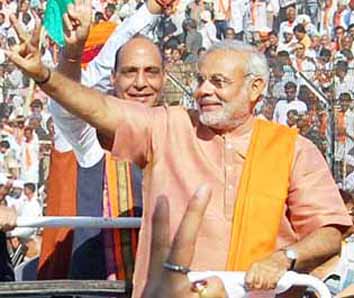
It  is  obvious  that  Modi  remains  an obstacle to the BJP&’s hope of making it to Delhi. The party&’s calculation is that if it can win close to 200 seats on its own, it will not have any difficulty in winning over allies. But, as the surveys show, it is falling well short. Evidently, the Modi magic is not working for it as effectively as it presumed ~ AMULYA GANGULI

While opinion polls about the forthcoming general election have confirmed the conventional wisdom that the Congress is faltering, the BJP&’s gains by default aren’t enough to enable it to enter the corridors of power in Delhi. According to one assessment, the Congress is likely to win 119 seats while another study puts the party&’s tally at 131/139. As for the BJP, it is expected to win 131 seats as per the first survey and 156/164 according to the second.
However, these tallies are not a guaranteed route to power since much will depend on how many allies the National Democratic Alliance (NDA) led by the BJP and the United Progressive Alliance (UPA) under the Congress are able to attract from among the regional parties in order to cross the half-way mark of 272 Lok Sabha seats out of a total of 543.
In this matter of winning friends and influencing people, the NDA may be at a disadvantage if Narendra Modi is at its helm because, except for a few like the AIADMK of Tamil Nadu, the Asom Gana Parishad of Assam and the Indian National Lok Dal of Haryana, most of the other regional parties will shy away lest any proximity to the NDA and, therefore, the BJP hurts their bases among the minorities.
Among those who are likely to stay away although they were the BJP&’s allies earlier are Trinamul Congress of West Bengal, Biju Janata Dal (BJD) of Odisha and Telugu Desam of Andhra Pradesh, not to mention Janata Dal (United) of Bihar.
The Congress will be slightly better placed since the parties which are likely to support it will include those who support it now, viz. the Samajwadi Party and the Bahujan Samaj Party (BSP).
In addition, the Janata Dal (United) may be on the Congress&’s side even if the latter maintains its present formal tie-up with the Rashtriya Janata Dal (RJD), which is the Janata Dal (United)&’s mortal enemy in Bihar. The reason is that having broken its ties with one national party, the BJP, the Janata Dal (United) will need to be friendly with another national party like the Congress since it may not find a place of honour among the other regional parties.
Why this may be so is because of the sharp differences between the regional parties. In fact, the mutual antipathy among some of them is so strong that these parties are likely to form two antagonistic blocs. Such an outcome is inevitable because the DMK will not be the member of any formation which includes its arch rival in Tamil Nadu, the AIADMK. Similarly, the Left will shun any alliance which includes Trinamul, its old adversary in West Bengal, and the Samajwadi Party cannot be expected to cohabit with the BSP.
The result of such divisions is that the so-called alternative to the Congress and the BJP will be weakened unlike, say, in 2008-09 when the Third Front conjured up by the CPI-M&’s Prakash Karat dreamed of coming to power with the BSP&’s Mayawati as the Prime Minister. The division among the regional parties cannot but compel most of them to gravitate towards the two national parties,  with the Congress proving to be the more suitable wooer because of its secular image.
It is obvious, therefore, that Modi remains an obstacle to  the  BJP&’s  hope  of  making  it  to  Delhi.  The  party&’s  calculation  is  that  if  it  can  win  close  to  200  seats  on  its own, it will not have any difficulty in winning over allies. But, as the surveys show, it is falling well short. Evidently, the Modi magic is not working for it as effectively as it presumed.
While the party is expected to do well in northern, central and western parts of the country, it is drawing a blank in the south. Interestingly, even Rahul Gandhi is more popular than Modi in the south. Clearly, the party&’s defeat in Karnataka following the scams which affected its government in the state has hit it badly in the region.
Since the BJP is also weak in the east, viz. West Bengal and Odisha while its position is uncertain in Bihar, the party will find it extremely difficult to get close to the coveted figure of 272. However, the party can draw some satisfaction from the forecast that it will emerge as the No. 1 outfit in UP, ahead of the Samajwadi Party and BSP with the Congress relegated to the fourth position.
But, if the Samajwadi Party and the Congress revive their earlier alliance in the state, the BJP will run into trouble. Considering how the Akhilesh Yadav government&’s image has been damaged by the controversy over the Durga Shakti Nagpal issue, the poor law and order situation and, above all, by the weakness of the chief minister vis-à-vis his father and uncles, the Samajwadi Party will probably have no option but look for a helping hand from the Congress lest it is overrun by a resurgent BSP.
The Congress, on its part, will hope for Modi frightening away the minorities in sufficient numbers to put Delhi out of the BJP&’s reach, and for the economy to show signs of life as the result of a fresh emphasis on reforms, exemplified by the relaxation of FDI norms, so that it can hang on to power, even if its finger nails.

The writer is a former Assistant Editor,  The Statesman