


Statesman news service
Darjeeling, 8 July
The prices of vegetables in Darjeeling increased by four times due to incessant rainfall that reportedly affected many vegetation plantations in the plains consequently leading to low productivity with suppliers stranded to fulfill the requirements.
For the past 10 days, not only the price of vegetables supplied from outside is on the rise but even the price of locally-produced vegetables has risen beyond the reach of locals and is expected to rise further, said a vendor of the vegetable market at Darjeeling Chowk Bazaar. “We don’t have much to benefit from it but the prices in itself is high at the regulatory market of Siliguri and Dhupguri ~ the two main suppliers of vegetables for Darjeeling ~ that is currently facing shortages.”
In Darjeeling, if the price of brinjal was 10 per kg, it is now being sold at 40. Tomato is being sold at 60 and beans for 120. Similarly, inflation has resulted in the hike in prices of all kinds of vegetables sold in the vegetable market, including fruits. On the other hand, the locally-supplied squash is being sold at 20 per kg. One of the locals said: “If the same continues we might have to purchase the vegetables not in kg’s but in value of per piece.”
Mr Tapan Das, secretary of Siliguri regulatory market association, said: “The continuous rain has damaged plantations in many areas of north Bengal. The regulatory market is currently facing shortages in vegetables. The farmers are in loss as a result of the damage done by the monsoon rain. In addition, prices have risen.”
One of the suppliers said: “If the requirement is of ten tons, we are able to supply only one. People will face a crisis till the government does not come up with solutions to help the farmers.”
It can be mentioned that the Gorkhaland Territorial Administration (GTA) organises agro-horti techno fair every year to boost the agricultural section of the Hills. However, the motive is barely in practice.
“Most of the vegetation grown in the Hills is based in rural areas. But their production is sufficient to feed their own areas and very scarcely the people of town areas gets to taste the vegetable grown in our own region,” said the local.
Prices of vegetables go through roof in Darjeeling Hills


SIBLAC condemns attack at Bodh Gaya
STATESMAN NEWS SERVICE
Gangtok, 8 July
The Sikkim Bhutia-Lepcha Apex Committee (SIBLAC) has condemned yesterday&’s terrorist attack on the Buddhist pilgrimage centre at “Dorjee-Dhen” at Bodh Gaya in Bihar and requested the Sikkim government to send officials to the place to assess the damage and cooperate with the government of Bihar in restoring the damaged parts of the shrine. Notably, the in-charge of the temples and its administration in the pilgrimage town is now under the care of the retired secretary of the Sikkim government, Mr Ninjey Dorjee, an IAS, belonging to Sikkim. “We request the concerned authorities of the Bihar government to provide security to Ninjey Dorjee who has been rendering a yeomen service since his retirement for the pilgrims visiting Bodh Gaya from across the world,” said a Press statement issued from SIBLAC.
The SIBLAC convenor, Mr Tseten Tashi Bhutia has pointed out that the attack on the holy Tashiding Bhum-Chu through the anti-Buddhist hydro project being commissioned over holy Rathong-Chu in West Sikkim and the attack on the historical sacred site of Kabi Lungtsok in North Sikkim are as outrageous and shocking as the recent attack on Bodh Gaya Temple or the attack by the Talibans on the Buddha Statue at Bamiyan in Afghanistan in 2002.
He said his organisation has also appealed to the international forums and organisations to come forward and take stances on matters related to the sites of faith for the Buddhists being defiled and destroyed.
1,000 left homeless
Statesman News Service
Raiganj, 8 July
More than 1,000 residents of different villages of Goalpokhar-I and Goalpokhar-II blocks of North Dinajpur district became homeless after a flood-like situation was created due to continuous rainfall for the past two days. The worst affected villages areas are Chakulia, Gandal and Belan villages in Goalpokhar-II blocks and Sahapur, Pachra and Panjipara in Goalpokkhar-I block. The Joint BDO of Goalpokhar-II block, Mr Purnendu Sanyal, said: "There was heavy rainfall in different phases since yesterday. As a result, the rivers like Sudani, Sherwani and Teesta cannel were submerged. Several 100 houses were affected. The homeless persons took shelter in Chakulia High school. Necessary relief will be distributed among them.
IMD warns Sikkim of heavy rains
STATESMAN NEWS SERVICE
Gangtok, 8 July
The Indian Meteorological Department has predicted heavy rainfalls at one or two places across the sub-Himalayan region of West Bengal and Sikkim.
It is learnt that the Meteorological Department of Sikkim has been warned by IMD about heavy to very heavy rainfalls measuring seven to 12 cm and 12 to 24 cm in the next 72 hours.
“The IMD has also warned of thunderstorms that are likely to lash sub-Himalayan West Bengal and Sikkim,” informed an official from Met based in Gangtok. All India Weather Forecasts have predicted heavy to very heavy rainfalls as the axis of monsoon trough (AMT) at the mean sea level passes through Ganganagar, Hissar, Patna, Purnia, Allahabad, Agra and then bends eastward to Assam that is lying close to the foothills of Himalayas,” added the Met official.
The rainfall so far recorded is stated to be normal in Sikkim. The state is yet to experience heavy rainfall so far this season. Flood is rare in the state, though landslides occur frequently disrupting traffic and normal life every year. During the monsoon it is not unnatural for the state to experience 40-70 mm rainfall in a day.
Sikkim gets around 230 cm rainfall in the monsoon and annually the figure reaches up to around 350 cm right from January till October. On 7 and 8 July, the department recorded 5 cm rainfall which is considered as heavy. Geyzing in West Sikkim has been receiving heavy rainfall since 6 July measuring around 9 cm.
JSW to expedite work on Bengal project
PRESS TRUST OF INDIA
New Delhi, 8 July
Reaffirming plans to go ahead with the Rs 35,000 crore West Bengal greenfield project, JSW Steel has said it hopes to speed up work on the plant after securing iron ore supply.
“Your company is committed to the 10 million tons per annum (mtpa) integrated steel project in West Bengal and have made significant progress in securing the requisite regulatory clearances during the year,” company chairman and managing director Mr Sajjan Jindal said in a letter to shareholders.
The company has already applied for a prospecting licence through West Bengal Mineral Development & Trading Corporation (WBMDTC) for an iron ore concession in Jharkhand.
“Simultaneously, we are also working towards securing long-term iron ore supply arrangement from third parties. Once iron ore sourcing is tied-up, project work will be further expedited,” he added.
The ministry of environment and forest (MoEF) has already granted the first stage forest clearance for iron and manganese ore mining project in Ankua and the Rohne coking coal block in Jharkhand.
About the West Bengal project, Mr Jindal had in April this year said: “Unless we have the visibility of iron ore… we cannot move ahead.”
However, in the latest annual report of the company, he has expressed satisfaction with the level of progress made towards setting up of the plant at Salboni in West Bengal’s West Midnapur district.
According to the original plan, JSW’s West Bengal project was envisaged to have a 10 million tons steel plant along with a 1,600 MW captive power plant at a total cost of Rs 35,000 crore that requires about 4,300 acres of land.
However, it has received approval from the ministry of environment and forest and Pollution Control Board for setting up a 3 mtpa steel plant and associated power plant.
The first phase also includes development of 2.4 mtpa in Kulti Sitarampur coal blocks and 2.6 MTPA Ichhapur coal block, through the company’s wholly owned subsidiaries. The first phase may require an investment of Rs 20,000 crore.
Maruti cuts diesel engine output
PRESS TRUST OF INDIA
New Delhi, 8 JuLY
The country’s largest carmaker Maruti Suzuki is understood to have asked 200 contract workers to go on indefinite leave following cut in diesel engine production at its Manesar plant due to low demand.
The company has shut the third shift at its diesel engine plant at Manesar, which has an annual capacity of 3,00,000 units, according to sources.
When contacted a company spokesperson said: “The diesel plant was operating at full capacity. With the continued slowdown in demand, some adjustments have been made at the diesel plant.”
With increase in prices of diesel, the demand for diesel cars has tapered off.
The prolonged slump in the automobile market has resulted in dip in sales. MSI had reported 12.6 per cent decline in total sales in June at 84,455 units. During the month, its domestic sales declined 7.8 per cent at 77,002 units.
MSI exports last month were down by 43 per cent to 7,453 units, from 13,066 units in the year-ago period.
MSI has been trying to bounce back after last year’s violence at the Manesar plant.
Prime Minister to meet captains of industry
statesman news service
New Delhi 8 July:
In view of the dipping rupee and industrial slowdown, the Prime Minister, Mr Manmohan Singh, has called leading industrialists to discuss proactive steps required to revive the economy from the prevailing severe slowdown.
The meeting, to be chaired by the Prime Minister, would take place on 29 July and discuss key issues such as correcting the current account deficit and measures to revive industrial growth.
“The Prime Minister will meet the captains of industry on 29 July 29 to review steps to revive the economy,” said a senior officer of the Prime Minister’s Office here today.
The Prime Minister would take up the depreciation of the rupee and its impact on trade and industry and skill development and ways of accelerating it.
Development of industrial corridors between Delhi and Mumbai, Chennai and Bangalore and Amritsar-Delhi-Kolkata would also be on the agenda.
The meeting takes place at a difficult time with growth slumping to five per cent, the lowest in a decade. Sluggish investments and industrial growth have been big drags on Asia’s third largest economy.
The manufacturing sector expanded by a meagre 2.6 per cent in the financial year 2012-13, according to the Central Statistical Office data.
The Indian rupee has weakened by almost 10 per cent this year and hit a record low of 61.21 against the dollar today.
The current account deficit has hit a record 4.8 per cent of gross domestic product in the fiscal year that ended 31 March.
Union Bank cuts base rate by 25 bps
STATESMAN NEWS SERVICE
Kolkata, 8 July
Public sector Union Bank of India today lowered its base interest rate or the minimum lending rate by 25 basis points in order to give a boost to the growth of credit in the country.
"Union Bank of India has reduced its base rate by 25 bps from 10.25 per cent to 10 per cent under all the slabs," the PSU bank said in a statement issued here today. The revised interest rates have become effective from today, according to the statement.
The bank is aiming to achieve substantial credit growth across all the sectors in the current financial year. The interest rate cut is aimed at boosting the credit growth, the statement said.
With the reduction in base rate the bank’s interest rates on home loan and car loan stand revised at 10 per cent and 10.45 per cent, respectively.
The Union finance minister Mr P Chidambaram, during a meeting with the chairmen of top banks last week, had advised the bankers to take a fresh look at their lending rates so that some benefits can be passed on to the common man.
Tata Motors focus on Indonesian market
JAKARTA POST/ANN
Mumbai, 8 July
Indian automotive giant Tata Motors is looking to start filling Indonesia&’s streets with its products later this year in an attempt to make Indonesia its biggest overseas market in the next four years. Tata Motors will start bringing in both its passenger and commercial vehicles in September, following the official launch of its brand in Indonesia last year.
The firm, which now has six dealers and around 30 to 40 workshops across Java and Bali, expects to have 10 dealers to help its operations by the end of this year and to have built 35 dealerships to cater to potential customers within five years.
Tata Motors managing director Mr Karl Slym declined to confirm its initial sales target or the number of cars and models to be introduced.
“We do have a very confident feeling because we have spent such a long time on our products, trusting the feedback of our brand and vehicles, otherwise I wouldn’t be suggesting that we can (make Indonesia) the largest market outside India in a very short period of time,” Mr Slym told reporters during a conference here last week.
Mr Slym said Tata Motors, which sold 3,50,000 vehicles outside India during the last financial year, was equipped with 50 years of experience in handling export markets in an attempt to grab a big slice of the Japanese auto-dominated market.
Tata Motors was established in 1945 and started its production in 1954, focusing mainly on commercial cars. It started exporting its products in 1961 and introduced its first passenger car, Indica, in 1998. With an annual income of $34.7 billion, the company is currently the fourth-largest commercial vehicle producer in the world and the biggest in India, controlling 65 per cent of the domestic market. It is also the third-biggest passenger car producer in India after Japan&’s Suzuki and South Korea&’s Hyundai, with a 12 per cent market share.
Tata Motors, which was listed on the New York Stock Exchange in 2004, acquired the likes of South Korean truck producer Daewoo in 2004 and British premium car maker Jaguar Land Rover in 2008.
With a sluggish car sales trend in India due to a global economic downturn, Tata Motors has attempted to expand its export market.
In line with its expansion plans, Tata considers Indonesia a potential pivot that could one day supply vehicles to the latter&’s neighbours.
Bengal Assembly observes Jyoti Basu birth centenary
Press Trust of India
KOLKATA, 8 JULY: The West Bengal Assembly today paid glowing tributes to Jyoti Basu, who was the longest-serving chief minister of the country, on the occasion of his birth centenary.
Paying his tribute, speaker of the Assembly Biman Bandopadhyay said that Mr Basu was a truly national leader with a great personality.
Mr Basu actually elevated the CPI(M) to the national level, for which he was asked to occupy the chair of Prime Minister in 1996, but he had refused for the sake of maintaining party discipline.
The former Lok Sabha speaker and a long-time colleague of Late Basu, Somnath Chatterjee, said that he used to speak in the language of the common people.
“Today his absence is felt very much. Mr Basu used to say that politics is the best method for serving people and our Assembly and Parliament are meant for the people. Let us take the pledge to serve people. Mr Basu always used to raise people’s problems in the House,” Mr Chatterjee said.
He also noted that Mr Basu could easily align himself with the masses and displayed an aura of great personality. He was not rigid and adapted himself to the changing times.
Among those who garlanded the portrait of Mr Basu were former West Bengal speaker Hasim Abdul Halim, Leader of the Opposition Surya Kant Mishra, Deputy Leader of the House Partha Chatterjee and members of the Assembly.
Srinagar-PoK bus service suspended due to rain
Press Trust of India
SRINAGAR, 8 JULY: The weekly bus service between Srinagar and Muzaffarabad, capital of Pakistan-occupied Kashmir (PoK), was today suspended after heavy rains swept away a portion of the highway in Uri sector of north Kashmir, as reported by official reports.
“The bus service, named as Karvan-e-Aman (peace carvan) was suspended after 100-feet portion of the highway near Gawalta was swept away by floods caused by heavy rains and cloudburst,” the officials said.
Heavy rains lashed wide parts of Kashmir Valley this morning but there was no other report of any damage or causality.
The cross-LoC bus service between Srinagar and Muzaffarabad was started in April 2005 to facilitate meeting of divided families.
The sources said senior civil officers have rushed to the scene to assess the damage caused to the highway due to cloudburst and heavy rains.
Repair work to restore the 170 km road between Srinagar and Muzaffarabad is expected to start within a day or two.
Five killed in car-truck collision
Press Trust of India
JAIPUR, 8 JULY: Five persons including a two-year-old child were killed today when their car collided with a truck in Churu district of Rajasthan.
"The incident occurred on the Ratangarh-Sardarshahar road in the district when the car coming from Ajmer collided head on with the truck,"police said, adding that another person was injured.
The victims, including a two year-old baby and a woman, were on their way to Srinagar after a visit to the Khwaja Moinuddin Chisti Dargah in Ajmer, SHO (Ratangarh) Amir Hassan said.
CBI files status report on coalgate probe before Supreme Court
CBI files status report on coalgate probe before Supreme Court in a sealed envelop. CBI pleads before SC to modify its order restricting it from sharing probe report with any government agency. CBI seeks modification of the apex court order directing the agency not to change the probe team without its approval in coalgate case.
What a way to police the region
THE RECENT POSTING OF GOVERNORS SHOWS THAT MORE POLICEMEN AND SPOOKS WILL BE OCCUPYING PALAtIAL RAJ BHAVANS ACROSS THE NORTH-EAST, SAYS PATRICIA MUKHIM
LOADS of platitudes are doled out along with grants to the chief ministers of the North-east when they go with their well-chalked-out plans to convince the Planning Commission members about their need for development funds. The Prime Minister, Union home minister and other big cheeses don’t miss an opportunity to patronise the politicians and bureaucrats of the North-east when they visit Delhi. The region is given different labels at different times. Sometimes it&’s called a region in turmoil, a conflict region, a region with great potential, a region with rainbow people( a la BG Verghese), a region populated by amiable people who have been misled to take up arms against a benevolent Centre.
We are advised to be less belligerent and more “nationalistic’”(what does that means anyway?) so that we can catch up with the pace of development elsewhere in the country. I wonder what that pace is, given the rupee&’s status today and which has sunk to such an abysmal low. So much of shallow rhetoric flowing out of the mouths of the learned sages and mandarins in North and South Blocks of Delhi have taught the people of this region to take the money and come back to do what they like. After all. Delhi hardly cares how the money is spent!
Perhaps because of our belligerence, the recent posting of governors shows that more policemen and spooks will be occupying our palatial Raj Bhavans across the region. While it can be stated that governors don’t really matter because their post is more ornamental than anything else, some governors have not endeared themselves because they have just been used as political instruments. The Congress has often used governors to impose President&’s Rule arbitrarily to jettison non-Congress-led governments and to facilitate Congress rule in different states. The Congress does not care about qualifications of governors. It places a premium on loyalists. Hence, the party uses former Intelligence officers, retired CBI directors, etc, to exert overt and covert control over Raj Bhavans.
This raises several unsavoury points about the police force, particularly its Intelligence and Investigation wings. Police officers on the verge of retirement ingratiate themselves with the powers that be in Delhi so that they have uninterrupted careers for themselves. Such a self-serving police force cannot be doing its job too well and this is evident in how the CBI is conducting itself — as an extension of the ruling party and as an advocate of its shenanigans.
The appointment of ex-CBI director Ashwani Kumar as governor of Nagaland had elicited some very scathing comments from the BJP and other non-Congress parties. BJP leader MM Joshi says the appointment of an ex-CBI director as governor suggests a quid pro quo, meaning that he had done the Congress&’s bidding during his tenure in the CBI. An editorial in a leading national newspaper some time ago alleged that intelligence, security and police officers were almost always close to the political party in power and therefore they made for even more loyal governors. By promising them governorships after retirement, the nexus became even stronger. The editorial went on to say that while all governments may have used gubernatorial appointments for political purposes, the Congress&’s use of former cops or spies as governors stood out for consistent misuse. It showed that the post was not at all supposed to be politically neutral.
This also implies that officers who do not toe the government line and are honest enough to tell the ruling mandarins the truth (that they often disdainfully choose to brush aside) will never be rewarded. So the message to the entire hierarchy of the police establishment — from security, law and order to intelligence and investigation wings — is clear: Do your duties at your own peril.
Why then are we surprised when the police consistently fail to deliver and when they flounder and fail? They are conditioned to steer away from professionalism. Those are the undertones that the government delivers to them at the personal level even as it waxes eloquent about police accountability and professionalism at memorial lectures that are organised at sundry forums in the national capital. For those who know how the system actually works, it is a frustrating journey of watching their hard work compromised by their seniors and juniors after them at the altar of expediency and politics.
But retired police officers and Army generals are not the only culprits who help extend the rule of the Congress to non-Congress-ruled states. Former Bihar governor Debenanda Konwar, now governor of Tripura, was known to have acted arbitrarily in appointing vice-chancellors in the universities of Bihar.
Normally, in private universities created by the states, governors hold the post of Visitor. While the appointment of a vice-hancellor of a private university is the brief of a search committee put together by the governing council of the university, once a vice-chancellor is appointed the university would seek the consent of the Visitor and also inform the state government. Konwar did nothing of the sort. He never once consulted the state government on this matter, which is what irked Bihar chief minister Nitish Kumar.
The Bihar assembly went to the extent of pushing through legislation to curtail the powers of the governor but Konwar sat on it. He also delayed the passage of the Bihar State University (Amendment) Bill, 2010, for curtailing the powers of the governor in the appointment of V-Cs — the Patna University (Amendment) Bill, 2010 — for giving the government a greater say in appointing V-Cs; the Bihar State University Service Commission Bill, 2011; and the Bihar University Tribunal Bill, 2011, which wants to set up a tribunal to reduce the number of university disputes that clog the courts.
In the case of Meghalaya, outgoing governor RS Mooshahary, a former top cop who commanded the National Security Guard during the Akshardham encounter, has played a key role in exposing the scams in a private university at the fagend of his governorship. The self-appointed chancellor of CMJ University, Chandra Mohan Jha, is still absconding even after several FIRs have been filed against him personally and against the university for turning it into a degree-awarding factory. CMJU had literally set up educational shops across the country asking people to register for their PhDs and promising to give that degree to them in three months. Thousands of scholars wanting to take a short-cut to acquiring a PhD have been duped by CMJU.
Mooshahary is remembered by the people of Meghalaya for the short stint of President&’s Rule he advocated after a political turmoil in Meghalaya between March- May 2009. During that time Mooshahary took over the administration and, true to form, made surprise visits to government hospitals, the Secretariat and other state-run institutions. At the Secretariat, he caught employees playing computer games and hauled them up. The streets at the time were free of traffic jams and things just moved like clockwork.
This made many people welcome President&’s Rule and even suggesting that it remain in force for a longer period since the delivery system had improved remarkably. Mooshahary, though a Bodo tribal, could recite lengthy shlokas better than most pundits.
He was also intellectually inclined and never read from a prepared text at any function. In fact, Mooshahary, who had studied in Shillong as a college student, very quickly endeared himself to the people. He had quickly shed the formality of his uniform. The people of Meghalaya wonder if their new governor, KK Paul, a much-decorated policeman, will be able to do that. They must wait and watch, I suppose!
The writer is editor, The Shillong Times, and can be reached at patricia17@rediffmail.com
Twelve killed in hotel building collapse in Secunderabad
Press Trust of India
HYDERABAD, 8 JULY: Atleast 12 persons were killed today and 18 others injured when a old building housing a Irani hotel, collapsed in Secunderabad here, as informed by the police.
The roof of the two-storeyed Hotel City Light and Bakery, located on RP road in Secunderabad, crashed at around 6 a.m. resulting in the building collapse leaving a dozen dead. Besides, some others are still feared trapped, Hyderabad police commissioner Anurag Sharma told reporters here.
The deceased include hotel staff and also customers who went to have tea and snacks in there.
The injured were rushed to Gandhi hospital.
Policemen, officials of Greater Hyderabad Municipal Corporation (GHMC), fire department and CISF personnel were involved in relief and rescue operations to clear the debris and pull out those trapped.
“The rescue operations are continuing. As a precautionary measure we are taking help of experts in removing those trapped under the debris,” Mr Sharma, who was monitoring the relief measures said.
On reports that placing of a furnace (bhatti for preparation of ‘Haleem’–a delicacy made during Ramzan season) on the building terrace may be one of the causes behind the incident, the Hyderabad police chief said investigation will reveal the exact reasons.
CISF is doing a commendable job in rescuing those trapped, he said.
The Mahankali police has booked a case of negligence against the hotel management.
Eye-witnesses say they saw the building come down suddenly with a loud sound coupled with cries of people.
GHMC commissioner M T Krishna Babu, who was also at the site of the accident, said there were several old buildings in the area and notices have been served in this regard to their owners. The collapsed building, however did not fall under that list, he said.
Earlier, Andhra Pradesh Chief Minister N Kiran Kumar Reddy, along with ministers Danam Nagender, Geeta Reddy and Mukesh Goud, visited the collapse site and also Gandhi Hospital where the injured were admitted.
2G: Karunanidhi”s wife moves SC for exemption from deposing
Press Trust of India
NEW DELHI, 8 JULY: Dayalu Ammal, wife of DMK chief M Karunanidhi and a key prosecution witness in the 2G case, today approached the Supreme Court, seeking its direction to exempt her from deposing before the Special CBI Court on medical grounds.
She filed her plea before the apex court challenging the trial court’s order refusing to exempt her from appearing as a witness in the case.
82-year-old Mrs Ammal had earlier approached the Delhi High Court but it had on 4 July asked her to move the apex court for relief.
The high court had also asked CBI to ensure that no coercive order is passed by the trial court till lunch time on Monday, 8 July, the day when Mrs Ammal has been summoned to appear before the trial court as a prosecution witness.
The high court had asked Ammal to move the apex court as the 2G case is being monitored by it.
Mrs Ammal, in her plea before the high court, had contended that she has been diagnosed with cognitive and behavioural abnormalities in June last year and that she is progressively and gradually losing recognition of even her near and dear ones.
It was also submitted that due to her physical and mental condition, Mrs Ammal is prone to “abrasive behaviour, clumsy habit with sudden hitting or punching people, inappropriate talk and action and inability to take care of day-to-day activities”.
The trial court had on 31 May dismissed Mrs Ammal’s exemption plea, saying she is an “important witness” as she was a director in Kalaignar TV Pvt Ltd in which an alleged bribe amount of Rs 200 crore was received.
Mrs Ammal had approached the trial court seeking exemption from personal appearance as a witness and to dispense with her presence in the case citing her ailments.
Murray conquers at last
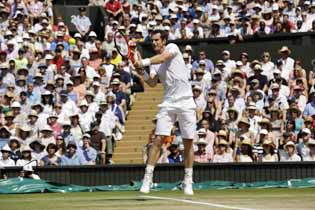
It is the scot&’s maiden wimbledon crown and his second grand slam title
AGENCE FRANCE-PRESSE
London, 7 July
Andy Murray ended Britain’s agonising 77-year wait for a Wimbledon men’s singles champion on Sunday when he destroyed world number one Novak Djokovic, 6-4, 7-5, 6-4 in the blistering heat of the All England Club. The 26-year-old became the country’s first male winner since Fred Perry in 1936, the year the Spanish Civil War started, Jesse Owens defied Hitler at the Berlin Olympics and Gone With The Wind was published.
It was Murray’s second Grand Slam title to follow his breakthrough triumph at the US Open in 2012 which followed his Olympic gold medal as well as a heartbreaking, tearful loss to Roger Federer in the Wimbledon final.
However, Sunday’s title showdown, between two men who have now contested three of the last four Grand Slam finals, rarely lived up to expectations.
Both struggled in the stifling 40-degree heat and the top-seeded Serb, who had beaten Murray in the Australian Open final in January, looked jaded after his record four hour 43-minute semi-final victory over Juan Martin del Potro.
And despite leads of 4-1 in the second set and 4-2 in the third, he was out-hit by Murray who finished with 36 winners to 31, with 21 unforced errors to the Serb’s 40 and having carved out 17 break points. Inside a baking Centre Court, and watched by Victoria Beckham, Wayne Rooney as well as Hollywood stars Gerard Butler and Bradley Cooper, the first point of the match was a punishing 20 strokes.
Murray, who has played in the final of his last four majors, had break points in the first and third games, with the Scot finally pouncing on his seventh for a 2-1 lead. Djokovic levelled at 2-2 but Murray was the more aggressive, positive man and broke to love for a 4-3 edge firing almost four times as many winners than the top-seeded Serb. Murray saved three break points for a 5-3 lead but Djokovic was furious that umpire Mohamed Lahyani had called a ball out at 30-40 while allowing play to continue with the Scot going to deuce. The British second seed took the opener 6-4 after 59 minutes with a love service game, having hit 17 winners to six and with only six unforced errors to the world number one’s
17. Murray wasn’t getting complacent — he had won the the first set of the pair’s last three meetings and still lost the match. Djokovic was obviously aware of the history, speeding into a 4-1 lead with two more marathon rallies of 30 and 32 shots. The British second seed took the opener 6-4 after 59 minutes with a love service game, having hit 17 winners to six and with only six unforced errors to the world number one’s 17. Murray wasn’t getting complacent — he had won the the first set of the pair’s last three meetings and still lost the match.
Djokovic was obviously aware of the history, speeding into a 4-1 lead with two more marathon rallies of 30 and 32 shots. But Murray roared back to 4-4 in a final which, despite its punishing hitting, still felt flat with both players too similar in style and then appearance when they both donned white caps to combat the sun’s glare.
Djokovic, however, was becoming increasingly frustrated with Lahyani, the court, on which he kept slipping, as well as his own poor judgement which left him without challenges as the set progressed.
In his fog of anxiety, Murray mugged him for a break to lead 6-5 and went two sets to the good at 7-5.
Murray had only lost once when two sets up and that was in the Wimbledon third round in 2005 against David Nalbandian, his debut year when he was a rookie 18-year-old. A break in the second game of the third set gave Murray a 2-0 lead before Djokovic, having discarded the hat, raced away with the next four games for a 4-2 lead.
But terrier Murray reclaimed the break in the seventh game.
In another development, Indian youngster Pinki Sonkar, beneficiary of a life-changing cleft lip surgery, flipped the coin at the final.