


statesman news service
New Delhi, 12 July
The Supreme Court today refused to entertain Congress leader Mr Jagdish Tytler’s plea seeking a stay on an order of the trial court, directing the CBI to conduct further probe into his alleged role in a 1984 anti-Sikh riots case.
A Bench headed by Mr Justice P Sathasivam said the apex court should not interfere in the matter at this stage as the case is pending in Delhi High Court which is scheduled to hear it on 18 September.
Sensing the mood of the Bench, senior advocate Mukul Rohatgi agreed to withdraw the petition which was allowed by the court.
The High Court had refused to stay the probe saying: “Only investigation is ordered and this court will not stop the investigation.”
Mr Tytler had, on 30 May, moved the High Court challenging the trial court order, setting aside the CBI’s closure report giving him a clean chit in the 29-year-old case and directing the probe agency to examine eye-witnesses and people claiming to have information about the riots.
According to PTI, Mr Tytler, in his plea before the High Court, had said the trial court order is contrary to the scheme of code of CrPC. The method and mode of investigation by a probe agency is the absolute prerogative of the agency and it is not for the court to direct the agency on which witness it should examine, he had said. The trial court’s order of further investigation had come on a plea by the riot victims against the CBI giving a clean chit to Mr Tytler and filing the closure report.
The CBI had sought dismissal of a plea filed by a victim before the trial court, saying the probe has made it clear that Mr Tytler was not present on 1 November, 1984 at Gurudwara Pulbangash in north Delhi where three people were killed during the riots in the aftermath of assassination of the then Prime Minister Indira Gandhi. Mr Tytler’s alleged role in the case was re-investigated by the CBI after the magistrate court had, in December 2007, refused to accept its closure report.
The CBI had again given a clean chit to Mr Tytler on 2 April, 2009, claiming lack of evidence against him in the case. On 27 April, 2010, the magistrate accepted CBI’s closure report in the case against Mr Tytler, saying there was no evidence to put him on trial.
SC refuses to hear Tytler’s plea


Court rejects CBI’s plea to put Radia CD on record
press trust of india
New Delhi, 12 July
A Delhi Court today dismissed the CBI’s plea seeking to place on record a CD of former corporate lobbyist Nira Radia’s taped conversations and the transcripts of her calls purportedly pertaining to radio waves allocation.
Special CBI Judge O P Saini dismissed the plea, saying that it seems that the agency is not “much serious” about its petition as it has not provided certain documents to the accused.
“In view of the failure of the prosecution to supply annexure ‘A’ to the aforesaid letter to the accused, it has not pressed the application seriously.
“Since the application has been vehemently opposed by the defence as well as complete application has not been supplied to the defence and the prosecution itself does not appear much serious about the application, the same deserves to be dismissed and is accordingly dismissed,” the court said.
It said: “The (plea for) filing of the CD on record has been vehemently opposed by the defence on various grounds including that the same would prejudice the defence as the same is being attempted to be placed on record belatedly, when the accused have already disclosed their defence.
“It is further submitted that this CD cannot be taken on record through an incomplete application as annexure ‘A’ of the aforesaid letter has not been supplied to them,” the judge said.
The court said the CBI had not supplied to the accused the annexure ‘A’ to the letter dated 20 May 2010, which was received by it from the Income Tax Department having the details of intercepted
calls stored in a USB hard disk.
During the brief arguments today, Special Public Prosecutor U U Lalit told the court that he is unable to supply the documents as it contains other details which are not relevant to this case and “cannot be disclosed in the interest of security of the state”.
The court dismissed the plea and asked the agency to proceed with the ongoing trial. “The plea is dismissed,” the judge said, adding, “How many applications will you (the CBI) move? Let the case proceed.”
The court, however, allowed CBI’s separate plea for recalling prosecution witness Mr Nitin Jain, whose statement has already been recorded.
The CBI had moved the plea to recall Jain on the ground that there “appears to be slight inconsistency” in his testimony regarding the cut-off date.
Asian Voices
More hours for spiritual growth ~ The Brunei Times
In Brunei, Ramadan is a period where time seems to slow down. Government offices and public services operate and ends earlier from 8 a.m. to 2 p.m. The private sector also makes its own adjustments to allow Muslim staff to go home earlier in order to prepare for the breaking of fast with their families.
What is the rationale of these reduced hours? We have to remember that there is no lunch break, and Muslims who fast take their first meal of the day very early before sunrise. Therefore, they are already up and about very early before performing their solat subuh or dawn prayer. In the early mornings, fasting Muslims are still energetic; so it makes sense to work as early as possible and through the lunch hour. There should not be a drop in productivity. In fact, Muslims should be even more focused as they do not have to think about what to eat at mid-day or for some, for mid-morning break.
Apart from experiencing how the poor feels not having enough to eat, fasting allows one to have better spiritual focus. Ramadan, is after all, a month where special prayers such as the tarawih, are performed, and many Muslims make extra effort to read the Quran, aiming to complete it before the first of Syawal.
’02 was ‘absolutely right’, says Modi
statesman news service
New Delhi, 12 July
Gujarat Chief Minister and the BJP’s national election campaign committee chief Narendra Modi today set off a political storm by saying, among other things, that he had done “absolutely the right thing” during the 2002 anti-Muslim Gujarat riots and that he is a “Hindu nationalist”.
Mr Modi drew fire from a slew of political parties, ranging from the Congress and the SP to the Left and the JD-U, who were especially incensed by his comment ~ when asked, during an interview with ***Reuters news agency, whether he regretted the 2002 riots ~ that even if a “puppy comes under the wheel of a car”, one feels pain. Attacking Mr Modi, some of these parties condemned him for using such an analogy, alleging that he was seeking to compare the Muslim community with dogs. They also questioned how Mr Modi could lead a secular country like India when he is defining himself in narrow, communal terms.
The BJP dismissed the allegations as unfounded and baseless, asserting that Mr Modi’s comments had been “distorted and misinterpreted” with an aim to “appease a particular community”. The Congress and the SP, however, insisted he should apologise.
Bail plea of Singla, six others rejected
UDAYAN KISHOR
udayankishor@thestatesman.net
New Delhi, 12 July
A city court today said the menace of corruption has affected the country for many years and the mindset of ‘right connections’ and ‘sifarish’ for getting one’s work done by jumping the queue or obtaining a contract or tender without deserving it by paying a bribe, needs to to be changed by sending a strong message to such elements of society.
Making these observations, the court dismissed the bail plea of former railway minister Pawan Kumar Bansal’s nephew Vijay Singla and six others in the Rs 10 crore cash-for-post railway bribery case, as they can tamper with the evidence or influence witnesses, if released on bail.
The court added that courts of law are neither caged nor parrots who will take any charge-sheet filed before them, while dismissing the contentions of the defence counsel that CBI has filed the charge-sheet under pressure and has let off the real culprits.
On the defence’s contention that the CBI has filed the charge-sheet in a hurry only to ensure that the accused do not get bail, the court pointed out, “The argument rather amuses me, as to whether they want to argue that the CBI should themselves have ensured grant of mandatory bail to the accused by not filing the charge-sheet?”
“It is strange that in this case when by their efforts they succeeded in filing the charge-sheet in time, they are being questioned.”
Besides Singla, special CBI judge Swarana Kanta Sharma also dismissed bail pleas of suspended Railway Board member Mahesh Kumar, MD of Bangalore-based G G Tronics India Pvt Ltd Narayan Rao Manjunath and alleged middleman Sandeep Goyal, saying they were the main players who hatched the
conspiracy.
“I have carefully gone through the intercepted conversations between Sandeep Goyal, Manjunath, Vijay Singla and Mahesh Kumar… After going through the same, I am of the opinion that a perusal of the conversation between the above mentioned accused and their conversation with other co-accused, clearly points out that they are the main players of hatching the conspiracy and ensuring that it is executed and taken to its logical end,” said the court.
Apart from the four accused, the court rejected bail pleas of Rahul Yadav, Samir Sandhir and Sushil Daga, who all were arrested in May.
While passing any order, the court said, it remains aware that if the high and mighty should not escape the law due to their position, there should not be instances when they should be targeted only because they hold a high position or are related to a person holding high position.
The court also said Mr Bansal, who has been made a witness in this particular case by the CBI, will be examined at the appropriate stage of trial.
Mursi supporters, rivals rally in Cairo

press trust of india
Cairo, 12 July
Supporters and opponents of ousted Egyptian President Mohamed Mursi launched rival protest rallies today, the first Friday of the holy month of Ramzan, as the deeply polarised Arab nation remains on edge after nearly 100 people were killed in violence earlier this week.
Mr Mursi’s supporters chanting anti-military slogans gathered in their thousands in eastern Cairo to call for his reinstatement.
After Friday prayers, Muslim Brotherhood supporters said they would head for the presidential palace and the Republican Guard headquarters, where they believe 61-year-old Mursi, the country’s first democratically president is being held.
Mr Mursi’s opponents whose mass protests led to his removal by the military last week, are expected to gather at the iconic Tahrir Square.
Reports yesterday also said prosecutors are planning to investigate allegations that Mr Mursi and other Muslim Brotherhood leaders escaped from jail in 2011 with the help of the Palestinian Islamist group Hamas.
Mr Mursi’s supporters have been staging mass protests throughout the week near the Presidential Guard barracks in eastern Cairo, where they believe he is being held.
The focal point of the protest is the Rabaa al-Adawiya Mosque, where they are camping out around the clock in their thousands, BBC reported.
The Brotherhood is not planning any marches but organisers hope a massive turnout will show support snowballing in their favour. Thousands came for midday prayers outside the mosque today despite the heat and lack of food and drink, in what is expected to be a full day of protests.
Snowden seeks asylum in Russia
agence france-presse
Moscow, 12 July
Fugitive US intelligence leaker Edward Snowden today told rights activists he would seek asylum in Russia, in his first encounter with the outside world since becoming marooned at a Moscow airport three weeks ago.
The meeting at Sheremetyevo airport with rights groups and lawyers appeared an attempt by Mr Snowden to find a way out of an increasingly difficult situation as he seeks to escape US espionage charges for leaking sensational details of widespread US surveillance activities.
Participants, including representatives of Human Rights Watch and Amnesty International, told reporters after the meeting that Mr Snowden told them he
wanted asylum in Russia since he could not fly out of the country without travel documents.
They also said that the 30-year-old had vowed not to harm the United States, apparently in response to a key Kremlin condition that he stop leaking damaging information about Washington’s spy programme.
Mr Snowden has been holed up at the airport’s transit zone since arriving on a flight from Hong Kong on 23 June before his US passport was revoked.
Human Rights Watch representative Tanya Lokshina told reporters agency Mr Snowden said “he wants to stay here”.
He has applied for asylum in 21 countries. Moscow said last week that Mr Snowden had withdrawn his application for asylum in Russia after learning it was conditional on not harming US interests.
Not afraid of terror threats, says Malala
press trust of india
UNHQ, 12 July
Pakistani teen activist Malala Yousafzai today told the UN that she would not be silenced by terrorist threats, as she gave her first public speech since being shot in the head by the Taliban.
“They thought that the bullet would silence us, but they failed,” Malala, who turned 16 today, said at the UN General Assembly as she appealed to the international community to put in greater efforts to get children into schools.
“Lets pick up our books and pens. They are our most powerful weapons. One child, one teacher, one book and one pen can change the world. Education is the only solution. The terrorists thought they would change my aims and stop my ambitions, but nothing changed in life, except this: weakness, fear and hopelessness died. Strength, courage and fervour was born,” she said in her speech that saw many standing ovations.
To mark her birthday, the UN has declared 12 July as ‘Malala Day’. At the heart of ‘Malala Day’ is a call to improve the lives of some 57 million unschooled children by improving education access by 2015.
Malala became a global icon for girls’ education after being brutally attacked by Taliban militants while on her way to school on 9 October, 2012. The Taliban said they shot her because they opposed her efforts to promote girls’ education.
They have made it clear she remains a potential target. She was flown to the UK for life-saving treatment and still lives there, but the attack has greatly boosted her campaign for greater educational opportunities for girls.
Paris accident
Paris, 12 July: France’s interior minister said at least 7 people are believed dead and several injured after a packed passenger train derailed outside Paris.
Interior Minister Manuel Valls told reporters that the casualty toll could rise. The train was carrying some 385 passengers when it derailed at 5:15 p.m. (1515 GMT) and crashed into the station at Bretigny-sur-Orge, south of Paris. AP
EDUCATIONAL
UNIVERSITY OF KALYANI
Faculty Councils for Post Graduate Studies Admission Notification
ADV. NO.: 12/13
Applications in prescribed forms are invited for admission into Master of Fine Arts in Painting for the Session 2013-14 (Total Seats = 12).
Eligibility: Candidates must have passed 4 years Bachelor of Fine Arts / Visual Arts (BFA / BVA) Degree Course with specialization in any discipline from any UGC recognized University. Employed candidates must apply through proper channel. Selection for admission will be on the basis of merit. Marks / Grade of the qualifying exam. including performance of the written and interview tests will be taken into account.
Application form along with Brochure & three parts fee payment Challan can be downloaded from the University website (www.klyuniv.ac.in) from 15th July, 2013. Application fee of Rs. 200 is to be deposited at any branch of State Bank of India using the three parts fee payment Challan. The downloaded filled-in application form along with University copy of fee paid Challan & self-attested testimonials should be submitted to the respective Department within 15th to 25th July, 2013 (except Saturday, Sunday & University holidays) between 11-00 a.m. to 3-00 p.m.
Reservation of seats as per State Government Rules.
Last date for receiving of application forms: July 25th, 2013.
Dr. Pinaki Chattopadhyay
Secretary
Faculty Councils (P.G.)
(B0001)
C20246
GUEST LECTURER
Applications are invited from the eligible candidates of Music for the post of Guest Lecturer within 24-07-2013. Eligibility as per UGC norms.
Teacher-in-Charge
Nahata JNMS Mahavidyalaya
P.O. Nahata, Dist.
North 24 Pgs., Pin-743290
Ph.: 03215-253267
C20259
UNIVERSITY OF CALCUTTA
A walk-in interview for selection of one Project Fellow in the research project entitled “Microbial remediation of chromium and development of enzyme sensor” funded by the University Grant Commission under the guidance of Prof. Priyabrata Sarkar, Dept. of Polymer Science & Technology, C.U. will be held on 18th July, 2013 at 12 noon.
For details visit website: www.caluniv.ac.in
Secretary UCSTA, C.U. (B0005), C20248
UNIVERSITY OF CALCUTTA
Department of Journalism and Mass Communication, Second Floor of Hardinge Building
87/1, College Street,Kolkata-700073
Post Graduate Diploma in Mass Communication ADMISSION NOTICE, Session 2013-2014
Applications are invited from Graduates (any stream, age limit 35 years) for admission to the one year PG Diploma Course in Mass Communication. There are 70 seats. The selection will be through admission test (objective type). The date of admission test is 11th August, 2013. The list of successful candidates will be published on 27th August, 2013. The admission will commence from 29th August, 2013. Classes will begin from 16th September, 2013. The course fee Rs. 12,000 (Rupees twelve thousand) only. The reservation of seats for SC / ST / PH categories will be as per Calcutta University rules.
Forms will be available from the Calcutta University Sales Counter on payment of Rs. 200 from 15th July to 7th August, 2013. The last date of submission of application form is 7th August, 2013. The Application Form and the other information can be downloaded from the official website of Calcutta University: www.caluniv.ac.in Downloaded application forms completed in all respects along with the proof of payment of Rs. 200 (Rupees two hundred) only by C.U. Challan will be received in the office of the concerned department. For further information call: 2219-4081. Prof. Dr. Tapati Basu, Coordinator
P.G. Diploma in Mass Communication,Department of Journalism and Mass Communication
University of Calcutta (B0003) C20253
UNIVERSITY OF CALCUTTA
Department of Journalism & Mass Communication,
Hardinge Building, Second Floor, 87/1, College Street, Kolkata-700073
NOTICE FOR ADMISSION TO M.A. COURSE IN JOURNALISM & MASS COMMUNICATION
(SESSION: 2013-14)
Applications are invited for admission to the abovementioned course.
No. of Seats: 85 (including all categories).
Direct Admission: A maximum of fifty-one (51) seats will be allotted for Direct Admission (i.e. exempted from Written Admission Test). Honours Graduates in Journalism & Mass Communication (in the system of 10+2+3) under Calcutta University are eligible to apply for Direct Admission. The merit list of the deserving candidates selected for Direct Admission be made on the basis of marks obtained in the Honours subject (Journalism & Mass Communication).
Admission through Written Admission Test: Thirty-four (34) seats (including a maximum of 05 seats reserve for Working Journalists) will be filled through a Written Admission Test. Honours Graduates (under 10+2+3 system) in any discipline/successful candidates in Communicative English (Major) from any recognized University (age within 30 years as on 01-06-2013) / Working Journalists (preferably Honours Graduates from any recognized University with 3 years experience in any media and within 35 years of age as on 01-06-2013) are eligible to apply for admission through Written Admission Test.
How to Apply: Prescribed Application Forms for all categories are available at the University Sales Counter, College Street Campus, Kolkata-73 from 15th July to 31st July, 2013 between 11 a.m. and 3 p.m.
Price of the Application Forms: (a) Eligible candidates may obtain the Application Forms for selection through the Written Admission Test on payment of Rs. 400 (Rupees four hundred only). (b) However, Honours Graduates in Journalism and Mass Communication who are eligible for Direct Admission, as stated above, may obtain prescribed Application Forms on payment of Rs. 50 (Rupees fifty only) on production of Honours Part-III Mark Sheet.
Last date for submission of duly filled-in Applications (for all categories): 31st July, 2013. The duly filled-in applications (for all categories) along with the requisite enclosures are to be submitted to the Office of the Department of Journalism and Mass Communication. Admit Cards for the Written Admission Test will be distributed from the Department of Journalism and Mass Communication.
Date of Written Admission Test: Sunday, 4th August, 2013 at 2 p.m. Venue: Asutosh Building, Calcutta University, College Street Campus. Pattern of Test: MCQ Test on OMR sheet with 150 questions each carrying 1 Mark. Marking will be made in black colour ball point dot pen. Award of Marks: For each correct answer 1 Mark, for wrong answer Minus 0.5 Marks and not attempted 0 (Zero) Marks will be awarded. If there is a Tie Marks obtained the Written Entrance Test amongst the candidates than the candidates with less negative marking will be placed in higher position in the merit list than the other candidate. Duration of Test: 90 (ninety) minutes. Syllabus of Admission Test: a) General knowledge (b) Current Affairs (c) Media Related Topics (d) Basic knowledge of Computer (e) Reasoning Test (f) Flair for English Language.
Publication of the List of Selected Candidates: (a) The Merit List of the deserving candidates selected for Direct Admission as stated above will be published on 2nd August, 2013. (b) The Merit List of the deserving candidates selected through Written Admission Test will be published on 21st August, 2013.
Admission for all categories will commence on 22nd August, 2013.
Classes to Commence: On 9th September, 2013.
N.B. Reservation for the SC/ST/Physically Handicapped candidates as per rules and University norms. The SC/ST candidates would write “SC/ST candidate” on the top of his/her Application Form and they must attach attested photocopy of SC/ST certificate from the office of the S.D.O.
Physically Handicapped candidates must mention the words “Physically Handicapped” on the top of his/her application form and must attach a certificate from the Competent Authority.
For further information you may contact the Department of Journalism and Mass Communication (Phone: 033-22194081). All concerned are also requested to visit the University website (www.caluniv.ac.in). All notices regarding selection (admission test/admission etc.) are put up on the Notice Board of the Department and the University is not under any obligation to send such information to any individual candidate.
Sd/-
Secretary, Faculty Council for PG Studies in Education, Journalism and Library Science
University of Calcutta (B0002) C20255
SITUATION VACANT
UNIVERSITY OF CALCUTTA
87/1, College Street
Kolkata-700073
NO. EST / 214 / 39A
Applications are invited from the interested candidates to fill the post of “(1) Deputy Inspector of Colleges, (2) University Engineer, (3) Sports Officer, (4) Assistant Registrar (Records & Statistics) and (5) Superintendent, Calcutta University Press. For details see the website at “www.caluniv.ac.in”.
(B0007)
Aadhaar Unmasked ~ What we (don’t) know about the companies (12th July 2013)
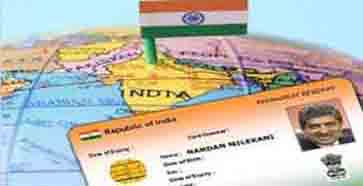
Who will have access to Aadhaar data? Which are the companies selected by Nandan Nilekani’s UIDAI project for this purpose? Can our government assure us that that these companies will keep data secure from foreign eyes? Has the government satisfied itself about the ownership of these companies? The evidence is available in the public domain but Indian authorities seem indifferent to what might well be a foreign invasion into our privacy. ~ Usha Ramanathan
In July 2010, UIDAI announced names of the companies that had been selected to implement the core biometric identification system. These companies would design, supply, install, commission, maintain and support the "multi-modal Automatic Biometric Identification System and multimodal Software Development Kit for client enrolment station, verification server, manual adjudication and monitoring function of the UID application". These would create the ability to de-duplicate on the basis of biometric information collected during enrolment.
The companies were: Mahindra Satyam (as it then was) partnering with Morpho, HP with L-1 Identity Solutions and a recently set up Indian company 4G Identity, and Accenture with MindTree and Daon. L-1 Identity Solutions was also present and participating in the PoC on enrolment.
These are companies with interesting profiles. A promotional document found on the web around the time that L-1 Identity Solutions was selected to partner with the UIDAI speaks of a close connection between the company and the security and intelligence establishment of the US government. "L-1 provides highly specialised government consulting services that address the most important challenges facing US defence and global security", it announces. "More than 1000 specialists, most holding top security clearances", it advertises, giving a more specific figure of "93 per cent holding high-level government security clearances".
In 2007, Tim Shorrock, an investigative journalist based in Washington, took a close look at the connection between L-1 and the CIA in an article he did on the former CIA chief, George Tenet, titled Cashing in on Iraq. Shorrock wrote: "Tenet sits on the board of L-1 Identity Solutions, a major supplier of biometric identification software used by the US to monitor terrorists and insurgents in Iraq and Afghanistan… The company with the closest ties with the CIA – and the biggest potential financial payoff for Tenet – is L-1 Identity Solutions, the nation’s biggest player in biometric identification. L-1’s software which can store millions of ID records based on fingerprints and eye and facial characteristics, helps the Pentagon and US intelligence in the fight against terrorism by providing technology for insurgent registration (and) combatant identification, the company says. L-1 technology is also employed by the State Department and the Department of Homeland Security…" When L-1 acquired Spec Tal, it got 300 employees with security clearances getting them several agencies with whom Spec Tal had contracts, "including the CIA, the NSA and the Defence Intelligence Agency." "We’re in the security business, right? So he’s a tremendous asset," Shorrock quotes an executive vice president of L-1 as saying about George Tenet.
Sagem Morpho which is among the participating companies is the Indian subsidiary of Morpho; which is part of the Safran group. Safran is a French defence company in which the French government holds 30.5 per cent shares.
In August 2011, Safran completed its acquisition of L-1 Identity Solutions. It was a $ 1 billion acquisition. With this, L-1 joins Safran’s security business which was until then operating as Morpho, and which together with L-1 was renamed Morpho Trust.
Morpho and L-1 have, with this acquisition, merged. So, when Mr. Nilakeni says that UIDAI has created a competitive environment, that is not quite accurate.
This deal was held back for about a year between September 2010 and August 2011 till the Committee on Foreign Investment in the US approved the acquisition. Since US contracts make up about 80 per cent of L-1’s business, and to protect US national interests, Safran was to establish "a three-person proxy board" to handle sensitive US contracts – a common feature when security companies are acquired by foreign companies. It was contemporaneously reported that the proxy board was expected to include Barbara McNamara, deputy director of the National Security Agency and William Schneider Jr. former Under Secretary of state under Ronald Reagan.
Accenture is known widely as a consultancy corporation. What is less known is its place in the world of surveillance technologies. Katherine Albrecht and Liz McIntyre, writing about Radio Frequency Identification (RFID) in their book, ‘Spychips: How major corporations and governments plan to track your every purchase and watch your every move’ (2006), introduced us to the patents and practices of Accenture in the RFID arena. It is interesting that Accenture describes itself as a "US based business…the global management consulting, technology services and outsourcing company"; no word on surveillance. Yet, in 2004, Accenture was selected by US Department of Homeland Security to design and implement the Smart Borders Project which would be deployed at the land, sea and air ports of entry. In November 2012, Accenture was awarded a bio-surveillance contract by the Department of Homeland Security.
This proximity and interdependence between foreign governments, including their intelligence agencies, and corporate ventures in surveillance technology is no secret. Yet, the UIDAI claims that it is unaware of the countries from where these companies originate.
A question that has been raised time and again in various fora relates to the security of the data. What effect does handing over data to companies that are close to foreign intelligence agencies, or allowing them to handle it, have on security of the person, and on national security? Laws such as the PATRIOT Act in the US, especially provisions such as section 215, bring all agencies in the country within the control of agencies such as the FBI and the Department of Homeland Security. As for Morpho and L-1, the French government is part-owner of these entities. Despite the concerns this should have raised in the UIDAI and within government, there has been a silence which provides no answers. The UIDAI’s response to an RTI query is more disturbing still.
In March 2011, Mr Veeresh Malik filed a request with the UIDAI for information, specifically asking for the "full name, address, websites of the foreign companies which are of US and non-US origin or control". In an appellate order of 21 July 2011, the Deputy Director at the UIDAI who is the Appellate Authority for purposes of the RTI, gave the names of three Biometric Service Providers to the UIDAI. These were, (i) Satyam Computer Services/ Sagem Morpho (ii) L-1 Identity Solutions (iii) Accenture Services. In a startling statement, the authority explained that "there are no means to verify whether the said companies/organisations are of US origin or not. As per our contractual terms and conditions, only the companies/organisations … who are registered in India can bid. Any further information in this regard can be obtained from the UIDAI public domain…" There is nothing more to be got from the UIDAI website.
Col. Mathew Thomas’ RTI query asking for copies of the contracts entered into with the companies was refused by the UIDAI citing section 8(1)(d) of the RTI Act 2005 which speaks of information including "commercial confidence, trade secrets or intellectual property" disclosing which would "harm the competitive position of a third party" to the request. The exception to this provision is if the "larger public interest warrants the disclosure of such information". At a hearing on 24 June 2013, the Central Information Commissioner has said she will hear and decide this matter. Snowden, and PRISM, have blown the lid, yet again, on surveillance by the USA.
Creating a database and handing the data over to companies, and with no discernible protection, should worry a government concerned about the safety of the people and national security, it would seem.
(The writer is an academic activist. She has researched the UID and its ramifications since 2009)
Aadhaar Unmasked ~ But do the eyes really have it? (11th July 2013)
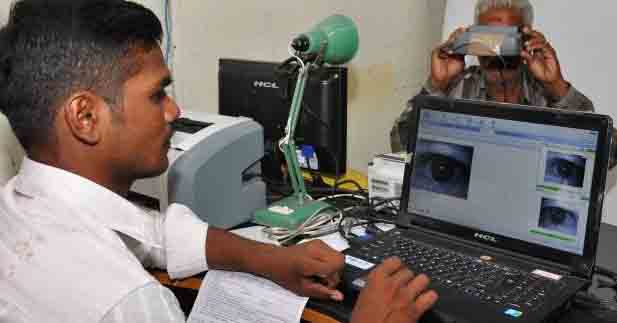
The UIDAI tasked with the Aadhaar project glossed over inconvenient facts to arrive at the fingerprint as an identification method. It then decided that iris capture was necessary as well to now cumulatively provide huge opportunities for those making fingerprint and iris scanners. We continue our series on the monstrously huge Aadhaar project. ~ Usha Ramanathan
In September 2012, two years after enrolment had begun, the UIDAI produced a report on iris authentication. As in the proof of concept (PoC) on fingerprint authentication, the iris report too was about field-testing the technology, and not a scientific study. This allowed for cleansing the data "of exceptions and anomalies", checking out vendors and their devices, encountering the people who came in their infinite variety – those with squints, those who had undergone eye surgery, those who had eye deformities and those without sight. The PoC was done in a semi-urban taluka in Mysore over a period of two months in 2012 with 5747 residents. As with the fingerprint report, here too the percentages that the UIDAI records are intended to reassure, but the devil is in the detail.
The older population, those who have undergone surgeries, those unable to open their eyes wide, those with eye deformities and, especially those who had undergone cataract surgery using older techniques were expected to have trouble authenticating. But, it was said, while iris authentication is significantly improved by using the dual eye camera, those with a squint would be better off with a single eye camera. What effect there would be on the error rate as the database grows larger and larger is not reckoned with.
Yet, these concerns lose their urgency when viewed against the first presumption on which the PoC is based. "The iris does not get worn out with age, or with use," it says. "In addition, iris authentication is not impacted by changes in the weather." This seems an improbable claim, for it is difficult to imagine a part of the human body which withers with neither age nor clime. Still, the improbable is not necessarily the impossible.
This, the report claims, is a presumption drawn from iris technology literature. But, in a paper presented at the IEEE Computer Society Biometrics workshop on 17 June 2012, two professors from the Department of Computer Science and Engineering at the University of Notre Dame found something quite different. Samuel E Fenker and Kevin W Bowyer did a study of iris images acquired between 2008 and 2011 using state-of-the-art technology, with 322 subjects ranging from 20 to 64 years, 177 male and 145 female, of different races. In introducing their study, they explained that the prevailing view that iris is "essentially immutable over a person’s life" had been repeated in several research papers, even though "we know that no studies with experimental results that support the conclusion that template ageing does not occur for iris biometrics" exist. This includes Daugman’s 1994 iris biometrics patent which asserted that "the iris of every human eye has a unique texture of high complexity, which proves to be essentially immutable over a person’s life." Fenker and Bowyer’s paper was "the most extensive experimental investigation to date on template ageing for iris biometrics."
In brief, their study found "clear and conclusive evidence that template ageing does occur in iris biometric matching. Specifically, the experimental evidence indicates that the false non-match rate increases with increasing time between acquisition of the enrolment image and the image to be recognised." That is, as time elapses, the image alters from how it was when it was enrolled. "In our results," they said, "the false non-match rate increases by greater than 50 per cent with two years of time lapse." The 50 per cent indicates the rejection rate when it was sought to be authenticated, and it is disturbingly large.
Fenker and Bowyer are not biometric skeptics, and they offer ways to proceed once it is acknowledged that template ageing does occur for iris biometrics. One possible route is "that the user may simply need to be re-enrolled in the system after some determined period of time." Given that the drop in confidence in the biometrics occurs within just two years, re-enrolment is not even an option amidst the Indian population. And, they suggest, "once the fact that template ageing for iris biometrics is acknowledged, research effort may be focused on reducing the magnitude of the effect."
This is the state of knowledge in biometrics.
The iris authentication report recognises this when it says: "Few global initiatives have empirically published results on iris based online authentication in a context similar to aadhaar." It is this use of untested technology that has had critics of the project say that it is an experiment where India is the laboratory, and Indian residents are mere specimens.
Spoofing and fraud
It is not only the experimental stage of the technology that raises questions. It is also questions of spoofing and fraud.
On 30 September 2011 a meeting was held at the Planning Commission to discuss the issue of privacy. The UID project, and the Human DNA Profiling Bill which has in circulation since 2007 and which resurfaced more recently, prompted the meeting. Representatives from the UIDAI, Natgrid, the Department of Personnel and Training were present among others that included professionals and activists. J T D’Souza, a biometrics expert who is in the trade, was present, and he demonstrated fingerprint authentication done with a faked fingerprint made out of Fevicol and wax. It was his wife’s fingerprint. It authenticated perfectly when he blew on the spoofed fingerprint to add moisture to its surface, so that the fingerprint reader could be made to believe that it was a live finger that was being applied to it. It is easy to spoof a fingerprint, he said. When it is cooperative, as it had been in his case where his wife gave her fingerprints willingly, he had used a plastic battery case into which he melted wax. When it had not quite set, the finger was pressed into the wax leaving an impression into which he poured Fevicol. When the Fevicol set, he had peeled it off and, hey presto, it was ready for use. When it is "non-cooperative", it may be an impression taken, say, from a glass or anything that is touched, the process would be a tad more tedious, involving using standard techniques from forensic sciences, making a positive, using a standard printed circuit board etching technique which is well known to any second-year electronic student or electronic hobbyist and use that as a template with Fevicol.
The danger is, too, that once the fingerprint has been compromised it cannot be changed, unlike a password or a pin number. In controlled spaces, biometrics may work because there are other controls along with the biometric. But a centralised database and long-distance authentication, D’Souza cautioned, is a prescription for fraud. D’Souza’s demonstration of the use of the spoofed fingerprint to the students of a Bombay college is on youtube; there has been no reaction to it so far. At the Planning Committee meeting, the representatives of the UIDAI said they would look into it. Six months later when the report was released, there was no mention of this issue.
The problem is not only that it is an experiment, and just may fail. It is that what is being attempted is what Mr Nilakeni calls "doing government process re-engineering" with this experimental technology as its foundation.
(The author is an academic activist. She has researched the UID and its ramifications since 2009)
Aadhaar Unmasked ~ Best finger first, but let’s now scan the eye (10th July 2013)
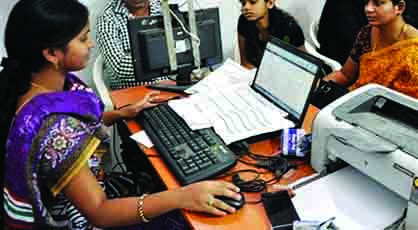
The UIDAI tasked with the Aadhaar project glossed over inconvenient facts to arrive at the fingerprint as an identification method. It then decided that iris capture was necessary as well to now cumulatively provide huge opportunities for those making fingerprint and iris scanners. We continue our series on the monstrously huge Aadhaar project. ~ Usha Ramanathan
In December 2011, when the Standing Committee on Finance (SCF) readied its report on the National Identification Authority of India Bill 2010 to be placed before Parliament, there were as yet no reports on authentication – viz., on how the biometrics collected during enrolment would be used in identifying a person.
Among a few pieces of the puzzle that was presented to the SCF was a statement from the Planning Commission, in which the UIDAI is located, that read: "It is well acknowledged that there will be failures in authentication for various reasons. After proof of concept studies (PoC) on authentication, appropriate policies and processes will be developed to take care of situations where failure occurs for various reasons .. The choice of using the authentication services is left to the third party service provider … Concerned agencies will have to develop policies and procedure to handle such exceptional situations .."
That is, there would be problems in authentication, no one could anticipate the extent of the problem because it was still untested, and responsibility would be diffused among service providers if authentication did not work.
This was a strange position to be adopted by an agency that had launched a nationwide project to biometrically de-duplicate and identify the entire population.
The Standing Committee had also seen an interview with the Mission Director and DG of the UIDAI, Mr R S Sharma, in Frontline in November 2011, where he had said: "Capturing fingerprints, especially of manual labourers, is a challenge. The quality of fingerprints is bad because of the rough exterior of fingers caused by hard work, and this poses a challenge for later authentication. … Issuing a unique identity will not be a major problem. But authentication will be, because fingerprint is the basic mode of authentication."
In January 2012, a document was put out by the UIDAI which was incensed by a statistic that the Standing Committee had referred to which estimated that the "failure to enrol" would be as high as 15 per cent.
The UIDAI tried explaining that these were "misconceptions", that they could "state with confidence" to the contrary, and that "it is now safe to conclude" that biometrics will work over the entire population.
Except – they were relying on their Proof of Concept on enrolment which, as their own report reveals, (see earlier report dated 6 July 2013) does not convince that the system can deal with the complexity of the population.
More damning still, Prof Ramakumar, the expert who had provided the statistic was drawing on an estimation made by a company, 4G Identity Solutions, which is partnering with the UIDAI! He quotes them as saying: "It is estimated that approximately five per cent of any population has unreadable fingerprints, either due to scars or aging or illegible prints. In the Indian environment, experience has shown that the failure to enrol is as high as 15 per cent due to the prevalence of a huge population dependent on manual labour." And, the DG and Mission Director’s interview stands unrebutted.
The first report on "authentication accuracy" was released in March 2012. This would indicate whether persons can be identified by their fingerprint. The PoC involved about 50,000 UID number holders.
It was carried out "in a controlled manner using different authentication devices.
The collected data was sent to the UIDAI Technology Centre. Further statistical analysis was performed at the Centre." This was a UIDAI exercise, and a statistic emerged from it: "accuracy of 96.5 per cent can be achieved using one best finger and 99.3 per cent can be achieved using two fingers" up to three attempts. "Accuracy," the report went on to say, "could be further improved by using the additional factors such as one-time-password (OTP), demographical data or second modality such as iris." A separate study was recommended to check that out.
What do these statistics mean? What is the `best finger’? What are two fingers in three attempts? What else does the report say? The "best finger" first.
Though all 10 digits are captured during enrolment, not all fingers work equally well when they have to be used to authenticate a person.
So, when enrolment is done, the report said, a person would have to go through a "best finger detection" (BFD) process, because: "The best finger to be used for authentication depends on the intrinsic qualities of the finger (ex. ridge formation, how worn out they are, cracked, etc.) as well as the quality of images captured during enrolment process and the authentication transaction."
Someone in the team that prepared the report clearly had a sense of humour: this description is accompanied by the sketch of a wrist and fingers, with the index finger pointing skywards with a bow tied to it as a sign of how special it is!
The fingerprints are sorted on the basis of "match scores" by comparing them with what has been enrolled and stored. This helps to rank the fingers: rank 1- best finger, rank 2- second best finger. "Further," the report reads, "the fingers are labelled Green, Yellow, or Red – depending on their suitability for single finger authentication." In addition, it continues, "some residents could be determined to be not suitable for reliable fingerprint authentication".
About the devices, there is the profound statement: "The best set of devices did much better than the good set of devices, which did much better than the rest of the devices." "In online authentication system, providing multiple attempts of the same finger was seen to improve resident’s chances of successful authentication." And the inference that was drawn was that "the resident learns to place fingers appropriately over multiple attempts". And, "residents in the 15-60 years group showed best authentication accuracy". The young and the old are somewhat troublesome. In sum, for those whose fingerprints work, if they have a best finger, or two yellow fingers, and more fingers are used, and if labelled matching works, and best devices are used, and when there are high quality fingerprint images, and immediate feedback, then …. fingerprint authentication may work 99.13 per cent of the time. That is the value of the statistic.
Then, multimodal authentication with both fingerprint and iris, OTP, buffered authentication, multiple attempts and with different fingers – these are recommended, "to not only improve accuracy but also to ensure inclusion."
The recommendations harbour the underlying unease about the capacity of fingerprints to identify the entire complex of people in this country.
That explains why, even as the report starts out, it says "although currently only fingerprint biometric is being offered … it is likely that in the near future iris biometric authentication will also be supported." And, in conclusion: "Low cost iris capture devices are becoming available in the market. A combination of fingerprint and iris is expected to improve accuracy by a factor of 10 to 100, while reducing failure to enrol (red fingers) rate by a factor of 10. A detailed study such as this should be done on iris authentication."
In the meantime, this report lends context to Mr Nilekani’s statement at the Centre for Global Development in Washington in April this year about having "created huge opportunity for fingerprint scanners, iris readers".
(The author is an academic activist. She has researched the UID and its ramifications since 2009)
SC: International pornographic websites should be blocked
It is difficult to block international pornographic websites in the country, as informed by the Centre. SC asks Centre to consult with various ministries and come out with a solution on the issue.
1984 anti-Sikh riots case: SC refuses to hear Tytler”s plea
Press Trust of India
NEW DELHI, 12 JULY: The Supreme Court today refused to entertain Congress leader Jagdish Tytler’s plea seeking a stay on an order of the trial court directing CBI to conduct further probe into his alleged role in a 1984 anti-Sikh riots case.
A Bench headed by Justice P Sathasivam said that the apex court should not interfere in the matter at this stage as the case is pending in the Delhi High Court which is scheduled to hear it on 18 September.
Sensing the mood of the Bench, senior advocate Mukul Rohatgi agreed to withdraw the petition which was allowed by the court.
Mr Tytler approached the apex court challenging the high court’s July 3 order refusing to grant interim stay on the trial court’s order.
The high court had refused to stay the probe saying, “Only investigation is ordered and this court will not stop the investigation.”
Mr Tytler had on 30 May moved the high court challenging the trial court order setting aside the CBI’s closure report giving him a clean chit in the 29-year-old case and directing the probe agency to examine eye-witnesses and people claiming to have information about the riots.
Mr Tytler, in his plea before the high court, had said that the trial court order is contrary to the scheme of code of CrPC. The method and mode of investigation by a probe agency is the absolute prerogative of the agency and it is not for the court to direct the agency that which witness should be examined by it, he had said.
The trial court’s order of further investigation had come on a plea by the riot victims against CBI giving a clean chit to Mr Tytler and filing the closure report.
CBI had sought dismissal of a plea filed by a victim before the trial court, saying the probe has made it clear that Tytler was not present on 1 November, 1984 at Gurudwara Pulbangash in north Delhi where three people were killed during the riots in the aftermath of assassination of the then Prime Minister Indira Gandhi.
Mr Tytler’s alleged role in the case relating to killing of the three persons Badal Singh, Thakur Singh and Gurcharan Singh, near Gurudwara Pulbangash was re-investigated by CBI after the magistrate court had in December 2007 refused to accept its closure report.
CBI had again given a clean chit to Mr Tytler on 2 April, 2009, claiming lack of evidence against him in the case.
On 27 April, 2010, the magistrate accepted CBI’s closure report in the case against Mr Tytler, saying there was no evidence to put him on trial.
CBI had claimed that at the time of the incident, Mr Tytler was at Teen Murti Bhawan where the body of Indira Gandhi was kept and that it had already re-investigated the case on the order of trial court but there was no sufficient evidence against the Congress leader.
The sessions court had set aside the CBI’s closure report giving clean chit to Tytler in the case, which has been challenged by him.
2G case: Court dismisses CBI”s plea to put Radia CD on record
Press Trust of India
NEW DELHI, 12 JULY: A Delhi Court today dismissed CBI’s plea seeking to place on record a CD of former corporate lobbyist Niira Radia’s taped conversations and the transcripts of her calls purportedly pertaining to radio waves allocation.
Special CBI Judge O P Saini dismissed the plea saying that it seems that the agency is not “much serious” about its petition as it has not provided certain documents to the accused.
“In view of the failure of the prosecution to supply annexure ‘A’ to the aforesaid letter to the accused, it has not pressed the application seriously.
“Since the application has been vehemently opposed by the defence as well as complete application has not been supplied to the defence and the prosecution itself does not appear much serious about the application, the same deserves to be dismissed and is accordingly dismissed,” the court said.
It said, “The (plea for) filing of the CD on record has been vehemently opposed by the defence on various grounds including that the same would prejudice the defence as the same is being attempted to be placed on record belatedly, when the accused have already disclosed their defence.
“It is further submitted that this CD cannot be taken on record through an incomplete application as annexure ‘A’ of the aforesaid letter has not been supplied to them,” the judge said.
The court noted that CBI had not supplied to the accused the annexure ‘A’ to the letter dated May 20, 2010 which was received by it from the Income Tax department having the details of intercepted calls stored in a USB hard disk.
During the brief arguments today, Special Public Prosecutor U U Lalit told the court that he is unable to supply the documents as it contains other details which are not relevant to this case and “cannot be disclosed in the interest of security of the state.”
The court dismissed the plea and asked the agency to proceed with the ongoing trial.
“The plea is dismissed,” the judge said, adding, “How many applications will you (CBI) move? Let the case proceed.”