Bengal’s chance to plant a new tree
In O. Henry’s The Last Leaf, ailing Johnsy clings to life because one painted leaf refuses to fall. Such is the power of optimism; it does not need to be certain to be effective.
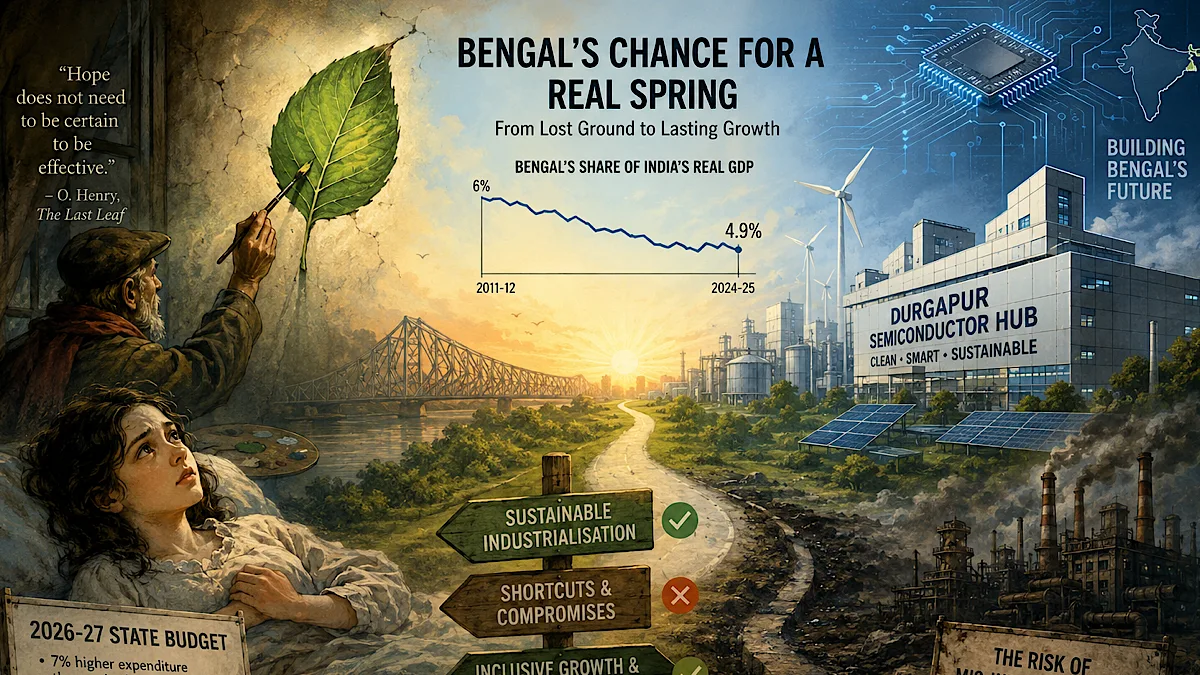
In O. Henry’s The Last Leaf, ailing Johnsy clings to life because one painted leaf refuses to fall. Such is the power of optimism; it does not need to be certain to be effective.

S&P Global Ratings cut India's GDP growth to 6.6 per cent in the current fiscal year, driven by energy stress, a sub-par monsoon and slowing global growth.
India's Gross Domestic Product (GDP) is set to grow at 6.6 per cent in the current fiscal as compared to 7.7 per cent in FY26, said BMI, a Fitch group company, citing weaker investments and consumption growth and trade shocks from the West Asia crisis.
India’s current account surplus moderated to $7.1 billion, or 0.7 per cent of GDP, in the fourth quarter (January-March) of financial year 2025-26, compared with $13.7 billion in the same period a year ago, according to the Reserve Bank of India’s latest Balance of Payments data.
Prime Minister Narendra Modi on Friday welcomed India’s latest GDP data, calling it proof of economic resilience, reform impact and the hard work of 140 crore Indians.

The IMF projection of India’s nominal GDP for 2025-26 of $4,187.017 billion, against Japan’s $4,186.431 billion, ($586 million or Rs.5,011 crore more), is going to make India the fourth largest economy in the world, pushing Japan to fifth position.

In the face of a turbulent global economic environment and persistent urban demand fragilities, India’s rural economy has quietly emerged as a resilient pillar of growth.

Fitch highlighted that the revised estimate for India shows a stronger contribution from labour inputs, mainly total employment, rather than labour productivity.

In 2025, the world finds itself suspended between progress and paradox. Across continents, women have stepped into roles once denied to them, leading nations, heading global corporations, and excelling in academia, science, and the arts.
India’s 7.4 per cent GDP growth in the final quarter of the 2024-25 fiscal year is more than just a statistical surprise ~ it is a testament to the economy’s underlying resilience at a time when global growth remains tentative and fragmented.