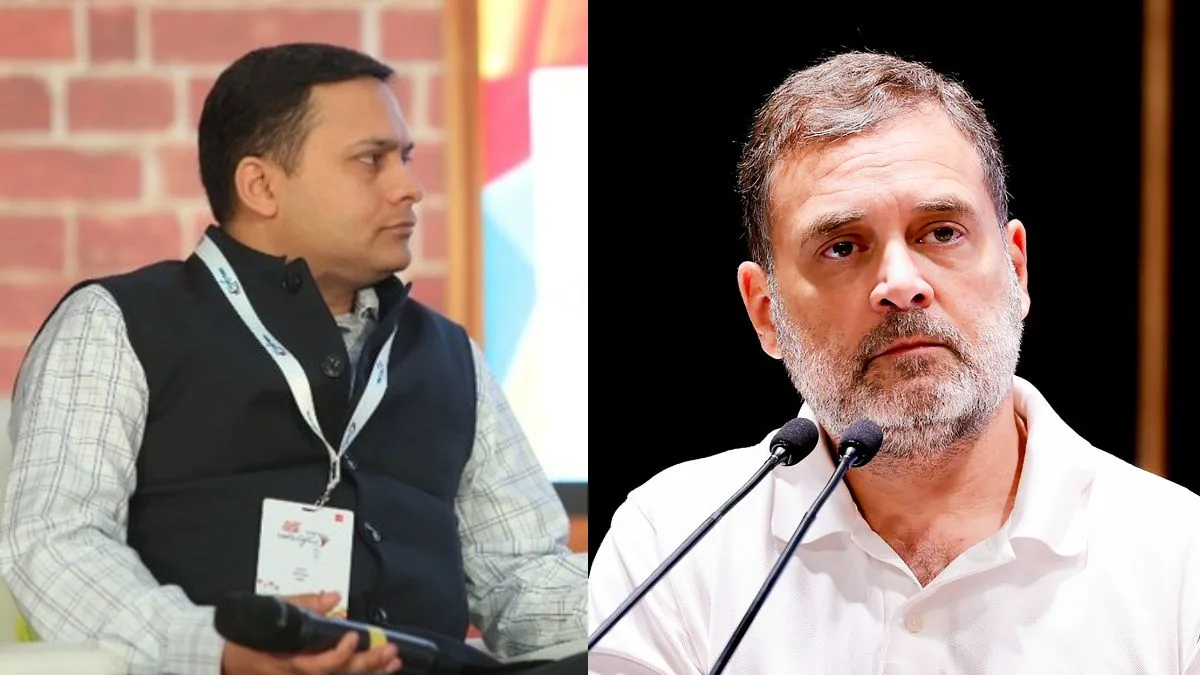
A day after Rahul Gandhi warned of an impending “economic tsunami,” the ruling Bharatiya Janata Party (BJP) on Thursday slammed the Leader of Opposition in Lok Sabha stating that his claim is “classic fear-mongering.”
In a lengthy post on X, Amit Malviya, head of the BJP’s national IT cell, provided key facts to highlight that India is “not defenceless,” despite facing an “external shock”.
Advertisement
“Rahul Gandhi’s claim that India is heading towards an ‘economic tsunami’ because the Government has removed all shock absorbers is not just wrong, it is classic fear-mongering. If India’s shock absorbers had truly been removed, why is the economy continuing to show resilience despite elevated crude prices, conflict in West Asia, supply-chain disruptions, global financial tightening and persistent geopolitical uncertainty? The reality is exactly the opposite. India is facing an external shock, but India is not defenceless. The shock absorbers have not been removed. They have been built over the last decade,” Malviya wrote.
To back his claim, the BJP leader mentioned how E-way bill generation increased 11.8 per cent in April 2026 and 12.9 per cent in May 2026, “reflecting strong economic activity.”
He noted that manufacturing PMI remained firmly in expansion territory at 54.7 in April and further improved to 56.6 in May, while Services PMI was even stronger at 58.8 in April and 58.9 in May.
“Electricity consumption grew 3.5 per cent in April and 5.9 per cent in May. Urban auto sales rose 11.8 per cent in April, while rural auto sales grew an even stronger 13.8 per cent. Retail inflation remained contained at 3.48 per cent in April—below the RBI’s 4 per cent target. Rice and wheat buffer stocks stood at 817.53 lakh tonnes at the end of April, providing a strong food security cushion. Gross FDI inflows touched a historic high of $94.5 billion in FY26. Forex reserves remain comfortable and provide insulation against global volatility. Strong services exports continue to support external stability and narrow the trade deficit,” he wrote.
‘Rahul Gandhi should stop selling panic’
Malviya went on to say that these were “not signs of an economy without shock absorbers” and rather “signs of resilience.”
“The Government has also taken direct measures to protect citizens, businesses and jobs…. Airlines facing fuel-price volatility can receive assistance of up to ₹1,500 crore per borrower. The objective is clear: protect jobs, sustain supply chains and ensure uninterrupted production,” he wrote.
He even highlighted that the Union Cabinet has approved ₹37,500 crore for surface coal and lignite gasification, targeting 75 million tonnes of gasification capacity and expected to mobilise investments worth ₹2.5–3 lakh crore.
“These are not the actions of a government dismantling shock absorbers. These are the actions of a government actively strengthening them. Now compare this with the Congress-led UPA period. Between 2011 and 2013, the rupee plunged by 36 per cent. Forex reserves declined from around $294 billion in July 2011 to approximately $256 billion in August 2013. Import cover fell to just over six months by September 2013, down sharply from 17 months in March 2004,” he noted.
He added, “Inflation averaged 8.2 per cent during FY04–FY14 and remained in double digits for much of FY10–FY14. Public sector bank stress, including restructured assets, climbed to 12.3 per cent by September 2013. The fiscal deficit remained at or above 4.5 per cent of GDP for six consecutive years from FY09 to FY14… That was the real removal of shock absorbers. Congress weakened India before the shock arrived.”
Malviya said that the Prime Minister Narendra Modi-led government at Centre has “strengthened India before, during and after repeated shocks, Covid, the Russia-Ukraine conflict, crude spikes, global rate hikes, supply-chain disruptions and now instability in West Asia.”
“Despite facing multiple black swan events, India has remained the world’s fastest-growing major economy, moved from the Fragile Five to the Top Five economies, maintained macroeconomic stability, expanded infrastructure at an unprecedented pace and strengthened domestic manufacturing. Rahul Gandhi should stop selling panic,” he wrote.
“India is facing global headwinds, but it is facing them with stronger reserves, lower inflation, better infrastructure spending, stronger domestic demand, record FDI inflows, substantial food buffers and targeted support for MSMEs and industry. The tsunami was 2013. The difference is simple: Congress created vulnerability. This Government created resilience,” he concluded.
‘Modi ji will not be PM in a year’
While addressing tribal leaders from across the country at an event organised by the Adivasi Congress at the Indira Bhawan in New Delhi on Wednesday, Rahul Gandhi claimed that Narendra Modi will not remain the Prime Minister in a year’s time as the “system that he once controlled is now shaken and collapsing internally,” PTI reported.
“In my assessment, Modi ji will not be the prime minister in a year’s time,” he said.
“From one side, a massive economic tsunami is coming, prices are rising and this is just the beginning. India will witness such an economic crisis that you have never ever witnessed in your lives. This is happening and no one can stop this. On the other hand, there is an institutional revolt happening within India’s system … the Election Commission (EC) is fully controlled,” he added.