AI’s Governance Sutras ~ I
On 5 November 2025, confronted with the most consequential regulatory question of the decade, the Government of India declined to pass a law.
The companies that built themselves on human power are now building themselves on intelligent machines. What that means for the workforce is profound.




File Photo
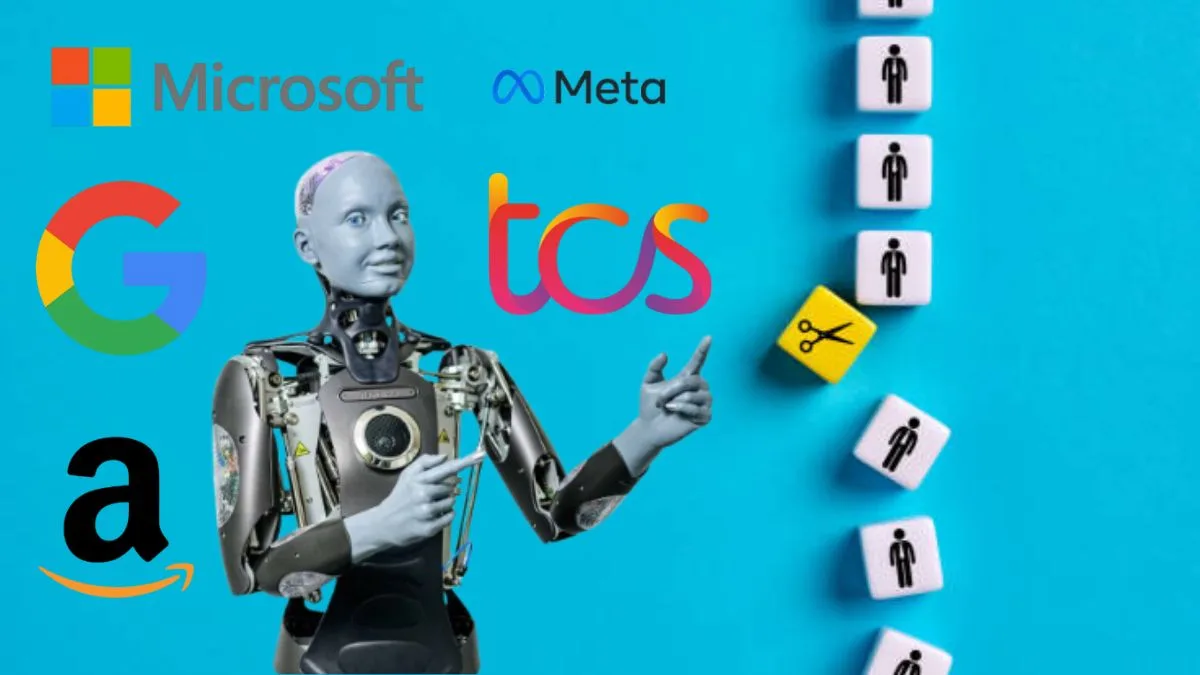
There’s a strange quiet in many high-tech offices this year, not the hum of chatter and keyboards, but the soft whirr of machines and automated dashboards. In 2025, the global tech industry is undergoing a dramatic transformation and it’s human workers who are feeling the tremors most intensely. Giants like Meta, Amazon, and Tata Consultancy Services (TCS) aren’t just revamping strategy. They’re redefining what “work” means.
For years, layoffs have been part of tech’s rhythm. But 2025 feels different. The industry is confronting not only an economic slowdown or post-pandemic readjustment but the arrival of something deeper: automation, powered by artificial intelligence (AI), is moving from the background into the main act.
Advertisement
According to Layoffs (dot) fyi and other trackers, more than 90,000 employees across 200+ tech companies are reported to have lost their jobs this year. One estimate puts the number at well over 161,000. As jobs vanish, the message is clear: the machines are coming. And they’re not just supporting workers. They’re, in fact, replacing them.
Advertisement
Imagine a warehouse floor once filled with people walking up and down aisles, picking items manually, packing, shipping. Now imagine fleets of robots humming around instead. That scenario is no longer futuristic; it’s the blueprint for Amazon’s next chapter.
Internal documents leaked this year show Amazon targeting up to 600,000 US jobs being replaced or avoided by 2027 through automation. The aim: 75% of its logistics operations run by robots. The cost savings? A whopping $12.6 billion in labour. Though Amazon denied concrete numbers of layoffs, it confirmed heavy investments in automation and robotics.
For warehouse workers, this shift isn’t subtle. Up to 160,000 jobs are likely to face an impact in just the next two years. That’s a seismic change in a company with over a million US employees.
What’s being automated? Robotic systems like ‘Proteus’ and ‘Sequoia’, machines that sort, lift, and move packages without human supervision. The plan doesn’t stop at warehouses. Amazon is also exploring driverless vehicles, drone delivery and AI-run logistics. The message is blunt that humans may still be in need, but fewer of them, and for far different tasks.
Over at Meta, it’s not dusty warehouses in the spotlight. It’s the corporate brain. Meta, the parent of Facebook and Instagram, announced the layoff of around 600 employees within its AI unit this year, citing the need for a leaner, faster structure.
In an internal memo, Meta’s chief AI officer, Alexandr Wang, wrote: “By reducing the size of our team, fewer conversations will be required to make a decision, and each person will be more load-bearing and have more scope and impact.”
The cuts hit the long-running AI research units called FAIR (Fundamental Artificial Intelligence Research), along with product-related AI roles. Meanwhile, the new elite TBD Labs housed in Meta’s shiny new AI division survived untouched. The optics are clear. Meta is doubling down on new talent and next-gen AI while legacy teams get squeezed.
Another memo revealed that Meta’s Risk org (bringing together product risk, shared services and global security & privacy tasks) is seeing roles eliminated because the company has moved from manual review processes into more automated ones.
So, not only is Meta investing in building AI, but it is also using AI (and automation) to reduce its own human headcount.
The ripple effects aren’t just in the US. On the other side of the world, India’s biggest IT firm, TCS, announced it would cut around 12,000 jobs, about 2% of its workforce in fiscal year 2025-26.
TCS says the layoff is a case of ‘skills mismatch’ and part of a broader restructuring. But analysts say it’s a canary in the coal mine for the outsourcing sector in India. The $283 billion industry which has long hired millions of software developers, testers and support staff is feeling the first strong gusts of the automation storm. Jobs once thought safe are now being rewritten.
It’s not only Meta, Amazon and TCS. Companies across the tech spectrum are making deep cuts. Microsoft is reported to shed around 7,000 jobs (about 3% of its global workforce) this year as it shifts resources toward AI.
A broad industry review shows a recurring pattern: automation, AI, and cost-saving are regularly given as reasons for job cuts. What’s new is the speed and scale. The wave of layoffs isn’t just a side effect of economic uncertainty anymore. It’s central to the strategy.
This means roles once considered stable (software engineers, back-office staff, testers, customer-service agents) are now at the mercy of algorithms and machines.
Think of it this way. Imagine walking into your office, and the company you’ve worked for is telling you that your job, or many jobs like yours, will now go to software, robots or algorithms. That’s exactly where many tech workers find themselves now.
In many cases, companies are telling employees they can apply for other internal roles. But the warning is loud: fewer roles overall, and the future ones demand different skills. The old script of “graduate, train, work ten years, move up” is slowly fading.
There are several forces converging:
Firstly, AI and automation capabilities have matured. What used to be futuristic handwriting recognition or simple bots are now advanced systems that can code, review, sort, lift, judge compliance, and even answer customer queries. The academic evidence backs this up — studies show AI is shifting work tasks and employment in occupations that rely heavily on routines.
Secondly, economic uncertainty is pressuring companies. Inflation, slowing demand, global supply-chain strain, and geopolitical uncertainty are forcing firms to do more with less. In this climate, automation offers a way to cut ongoing labour costs and increase efficiency.
Thirdly, the tech industry is in a fierce race. Companies are spending billions to stay ahead in AI, robotics, and next-gen platforms. That investment must be justified, and part of that justification is restructuring the workforce to fit the “new” model.
2025 will likely be the year tech’s promise collided with tech’s transformation. The companies that built themselves on human power are now building themselves on intelligent machines. What that means for the workforce is profound.
Advertisement