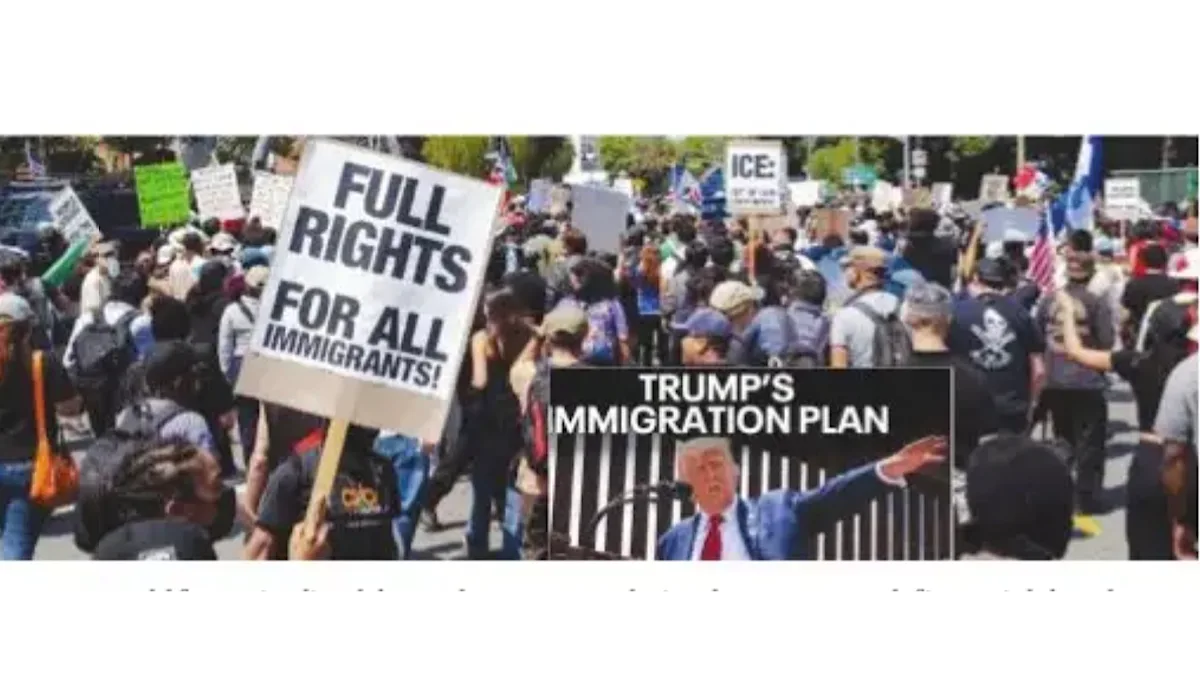
The United States has long been hailed as a land of opportunity ~ a paradise for those seeking prosperity. Migration has been a central force in shaping America’s identity, economy, and innovation enabling it to become a global power. This article explores the historical roots of migration, the comparative contributions of migrants and native-born citizens, the evolution of the immigration policy, and the broader implications of a migrant-free America. Migration to the U.S. started before its independence.
Settlers from Europe laid the foundation for colonial America. Africans forcibly brought as slaves built its economy. The 19th century saw waves of Irish, German, Italian, and Chinese immigrants, each group contributing to infrastructure, agriculture, and industry. They brought both cultural enrichment and political tension, but the cumulative effect has been a dynamic, resilient society. According to the Migration Policy Institute, 45.2 per cent of recent immigrants (post-2010) hold a bachelor’s degree or higher, compared to 38 per cent of U.S.-born citizens.
Advertisement
Immigrants from countries like India, China, South Korea, and Nigeria consistently outperform native-born Americans in educational attainment. Though the Latin American immigrants tend to have lower formal education, they contribute through skilled trades and entrepreneurship. This educational diversity in the U.S. workforce, fills both high-tech and essential service roles. Migrants have been instrumental in building America in all spheres. Immigrants added $2 trillion to GDP in 2016. They paid over $500 billion in taxes in 2021, including $76 billion from undocumented workers.
Twenty-two per cent of U.S. entrepreneurs are immigrants driving innovation and job creation. Over 45 per cent of Fortune 500 companies were founded by immigrants or their children. Immigrants account for 22.8 per cent of Science, Technology, Engineering, and Mathematics (STEM) workers, driving research and technological advancement. Migrants dominate sectors like agriculture, hospitality, elder care, and domestic services ~ cleaners and cooks. Without them, these sectors would face crippling labour shortages and economic stagnation. Migrants are no longer just labourers ~ they are leaders too. They have served in Congress, state legislatures, and as mayors.
Notable figures include Rep. Pramila Jayapal, India and Rep. Ilhan Omar, Somalia. Immigrant professors and researchers lead top universities and labs. CEOs of Google (Sundar Pichai), Microsoft (Satya Nadella), and Adobe (Shantanu Narayen) are all immigrants. They make up 15.2 per cent of nurses and 26.5 per cent of doctors. Their presence in leadership roles reflects excellence. Migrants are the invisible engine powering the U.S. logistics sector. Their presence is not just helpful ~ it is indispensable. Nearly 20 per cent of U.S. truck drivers are immigrants ~ up to 47 per cent in states like California and Texas.
They are largely employed in warehousing, loading docks, and freight handling and at ports. Restricting migrant entry has severe consequences. The U.S. already faces a shortfall of over 80,000 truck drivers. New immigration policies could displace 50,000 to 100,000 drivers. Fewer drivers result in slower freight movement, delays, and higher costs for consumers. Americans can be reluctant to take on these roles due to long hours, low pay, and harsh conditions. The first major federal restriction on immigration came through the Chinese Exclusion Act (1882).
The Immigration Act of 1924 imposed quotas favouring Northern Europeans. Later, quotas were abolished opening doors to Asia, Africa, and Latin America by enacting the Immigration and Nationality Act (1965). The Immigration Reform and Control Act (1986) legalized millions of undocumented immigrants. Recent reforms (2025) have introduced steep visa fees and narrowed pathways for migrants. U.S. immigration policy has oscillated between openness and restriction. Early policies favoured European migrants.
Post-1965 reforms diversified the migrant pool. The ‘Diversity Visa Lottery’ also known as the ‘DV Lottery’ or ‘Green Card Lottery’ has promoted immigration from countries with historically low rates of migration to the United States Recent reforms in 2025 include: Unimaginable hike of annual H-1B visa fee to $100,000; abolition of the Optional Practical Training (OPT) program for foreign graduates that allowed international students on F-1 visas to work temporarily in the United States after completing their studies, and wage-based visa selection, which will favour wealthier applicants.
These changes have made migration more expensive, exclusive, and uncertain ~ particularly for mid-level professionals and students. Many migrants rely on imports from their native countries ~ food, medicine, cultural goods, etc. Recent tariffs hike has led to their shortages and financial burden on migrants. An example is Indian textiles which face up to 50 per cent tariffs, hurting migrant-owned businesses. Kerala’s seafood and spice exports have drastically reduced due to U.S. penalties, affecting migrant workers and families. Tariffs on Chinese technology components have raised costs for immigrant-run start-ups.
Immigrant-owned businesses are a vital part of the U.S. economy ~ creating jobs, driving innovation, and contributing billions in revenue. This is another major contribution of immigrants to the American society. This can lead to reverse migration. Recent reforms have led to a projected decline in net immigration, with estimates suggesting the U.S. may experience negative net migration for the first time in decades (Brookings Institute).
Historically, countries like India, China, and Nigeria suffered from “brain drain” of highly educated professionals to the U.S. However, recent U.S. restrictions have reversed this trend. Skilled migrants are returning home, bringing back advanced education and training from U.S. institutions, entrepreneurial experience and global networks, as well as exposure to cutting-edge technologies and research. India’s technology hubs such as Bengaluru and Hyderabad, have seen a surge in start-ups founded by returnees, many of whom were previously employed in Silicon Valley (NASSCOM, 2024). Returnees are revitalising local industries by introducing best practices from U.S. companies and creating jobs through new ventures.
China’s semiconductor sector has benefited from engineers returning after facing visa hurdles in the U.S., accelerating domestic innovation, and reducing reliance on American firms, according to a report in the South China Morning Post. Ironically, while these policies aim to make America more self-reliant, they also encourage other countries to do the same. Reduction in immigration to the USA has led to a projected 0.8 per cent drop in GDP growth in 2025 compared to previous years (Congressional Budget Office, 2024). U.S. universities face funding gaps and reduced global competitiveness due to fewer international students and researchers.
STEM industries lose access to top talent – especially in artificial intelligence, biotech, and engineering. Patent filings and start-up formation rates are expected to decline. About 45 per cent of Fortune 500 companies were established by immigrants or their children, including Google, Tesla, and Intel (Partnership for a New American Economy, 2011). This will be curtailed by restricting migration. According to the American Health Care Association, a Florida facility reported $600,000 in annual losses after losing migrant staff.
While the U.S. tightens its borders, other countries are opening theirs. Canada, Australia, and Germany have launched aggressive campaigns to attract skilled migrants, offering fast-track visas, permanent residency options, and inclusive work environments. This global competition for talent means the U.S. risks losing its edge as the top destination for ambitious professionals. The shift is already visible in declining international student applications and reduced foreign investment in U.S. start-ups. These measures signal a shift from merit-based, skill-driven migration to wealth-based undermining the traditional U.S. model of attracting global talent.
Moody’s chief economist Mark Zandi warned that Trump’s tariffs and restrictive immigration policies are contributing to a looming recession, particularly in trade-exposed sectors like manufacturing and agriculture. Further, the US is losing market share to countries with more open immigration and trade policies. Migrants fill critical labour gaps in sectors that are physically demanding, low-paying, and often stigmatized – such as agriculture, elder care, hospitality, and domestic services.
These jobs are essential to the functioning of daily life and the economy, which are often shunned by native-born workers due to low wages, lack of prestige, and harsh conditions. According to economists cited by CNBC and IZA World of Labor, migrants tend to complement rather than replace native workers. They take jobs that Americans are unwilling to do. Americans prefer white-collar jobs, which creates a labour vacuum in “menial” jobs that migrants have been carrying out.
If migration policies continue to tighten, the U.S. could face labour shortages in essential sectors; rising costs for services like food, healthcare, and hospitality; reduced productivity and slower economic growth; and increased automation, which may not fully replace human labour. These immigration policies can boomerang unless American citizens are ready to take up the roles being played by the migrants. But it would require a massive cultural shift, economic restructuring, and revaluation of the labour spirit. Migrants are not just contributors ~ they are catalysts.
They bring skills, ambition, and diversity that fuel America’s innovation, economy, and culture. Restricting them would result in shrinking the labour force, lower GDP growth, and reduction in global competitiveness. In a world of interconnected economies and aging populations, migrants are not a burden, they are a lifeline. The latest U.S. migration policies may seem like a domestic issue, but their consequences are global. Native countries benefit from the return of skilled migrants, increased investment, and revitalized industries.
Meanwhile, the U.S. faces economic slowdown, innovation decline, and demographic challenges. In trying to protect its borders, America may be inadvertently exporting its future. Trump’s migration policy does not just reshape who gets to live and work in America ~ it reshapes how the world interacts with America. It promotes a fragmented global economy where countries turn inward, and the U.S. finds itself increasingly isolated in talent, trade, and influence. Hiking the H1-B Visa fee is like sawing off the branch you’re sitting on – short-sighted and self-defeating
(The writer is Scientist (retired), Council of Scientific & Industrial Research)