PM Modi Inaugurates NHPC’s 300 MW Karnisar Solar Power Plant in Rajasthan
Speaking on the occasion, the Prime Minister emphasized that renewable energy is the cornerstone of India's energy security and sustainable future.
With imports meeting nearly 85 per cent of India’s crude needs, OALP Round XI puts 80,228 sq km on offer in the government’s most ambitious domestic exploration push yet.




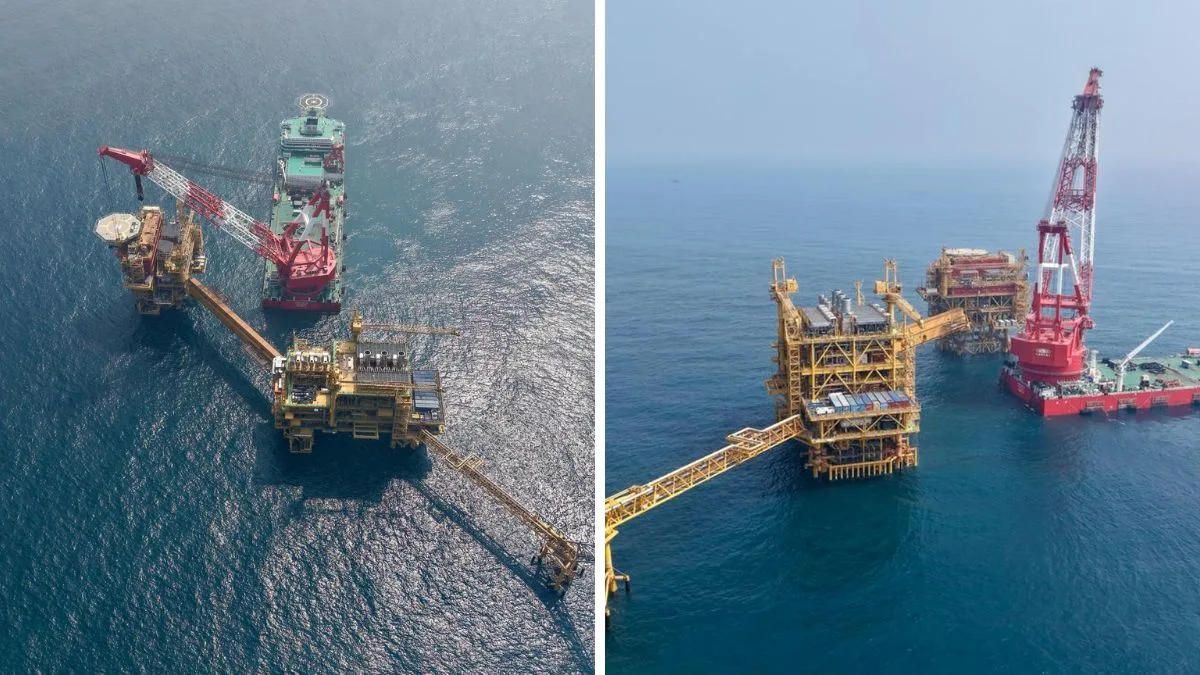
Offshore drilling platforms and support vessels at sea, reflecting India’s expanding focus on domestic oil and gas exploration under OALP rounds. | X/@HardeepSPuri
Union Petroleum Minister Hardeep Singh Puri on Monday announced the launch of OALP Round XI, putting over 80,000 sq km of fresh acreage on offer for oil and gas exploration. This is part of a wider government push to produce more energy at home and reduce dependence on imports, which currently account for roughly 85 per cent of India’s crude oil needs.
India imports nearly six out of every seven barrels of crude it consumes. The Open Acreage Licensing Policy, first introduced under the broader Hydrocarbon Exploration and Licensing Policy framework in 2016, was designed precisely to change that equation by making it easier, faster and more attractive for companies to go looking for oil and gas on Indian soil and in Indian waters. Round XI is the latest, and among the most ambitious, steps in that direction.
Advertisement
The new round offers around 80,228 sq km for exploration. It comes alongside Round X, which covers approximately 25 blocks spread over nearly 1.83 lakh sq km. Together, the two rounds put about 2,62,817 sq km on offer – one of the largest combined acreage offerings India has made in recent years.
Advertisement
Round X includes six onland blocks, six in shallow water, one deepwater zone and 12 ultra-deepwater areas. Companies bidding under the policy get incentives, including the right to retain exploration rights through the contract period, graded royalty reductions for offshore zones and flexibility in designing their own work programmes.
Since HELP was introduced a decade ago, 172 blocks covering 3,78,652 sq km have already been awarded across the first nine OALP rounds. The government has been steadily widening the exploration map, round by round, with the stated aim of building a stronger domestic hydrocarbon base.
In December, 50 new exploration and production blocks across oil, gas and coal-bed methane were also offered, which Puri called a “transformative milestone” aimed at drawing both domestic and global investors into the sector.
Announcing Round XI on X, Puri said the initiative aligns with Prime Minister Narendra Modi’s vision under the Samudra Manthan programme, which is a government framework focused on faster bidding cycles, wider acreage offerings and stronger energy security. “The quest to discover India’s hidden energy wealth continues,” Puri wrote.
A new chapter in India’s energy journey begins.
With OALP Round-XI now live, we unlock vast frontiers beneath our land and seas—powering growth, resilience, and self-reliance.
Round-X (~25 blocks; ~182,589 sq km) and Round-XI (~80,228 sq km) are now on offer – together… pic.twitter.com/sb2vslZY8k
— Hardeep Singh Puri (@HardeepSPuri) March 30, 2026
Samudra Manthan, named after the mythological churning of the ocean, is essentially the government’s overarching push to extract more value from India’s sedimentary basins (both onshore and offshore) by streamlining processes and expanding participation.
The exploration push sits within a wider effort to strengthen India’s entire energy ecosystem. As per official data shared in August 2025 (source: PIB), India has eight LNG terminals with a combined capacity of 52.7 million metric tonnes per annum. Gas pipelines have reached almost the entire mainland. Around 1.5 crore homes have piped gas connections, and over 8,000 CNG stations are operational across the country.
The Discovered Small Field Bid Round IV, which includes 55 discoveries across nine contract areas, is running alongside the exploration rounds, aimed at accelerating the transition from discovery to actual production.
Oil and gas are not the whole story. Even as it drills deeper for hydrocarbons, the government is quietly building a parallel track.
Green hydrogen is the big bet. Under the National Green Hydrogen Mission, India has set itself the target of producing 5 million metric tonnes a year by 2030.
Closer to the ground, the ethanol blending programme has been making steady, if unglamorous, progress. Blending in petrol has reached nearly 19 per cent in ESY 2025-26.
And then there is the SATAT scheme, which has been running since October 2018 with a deceptively simple idea: turn waste and biomass into compressed biogas, and put it to use as fuel.
Taken together, the message from the government is consistent: produce more energy at home, and gradually shift towards cleaner, more dependable sources.
Advertisement