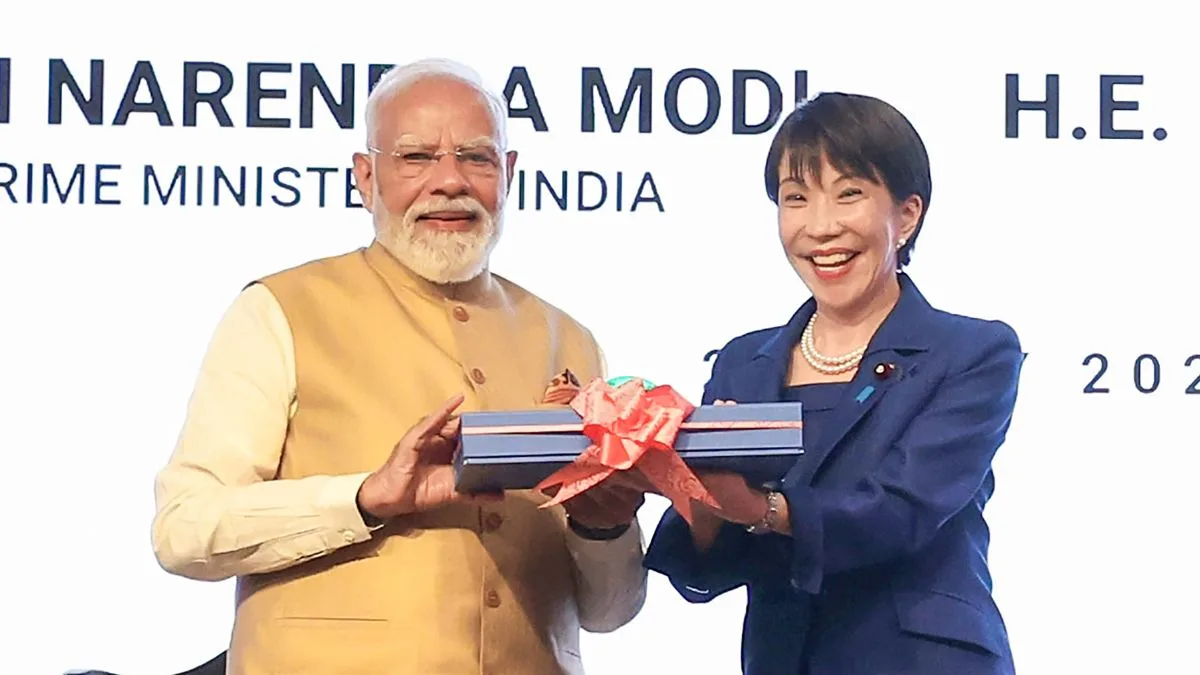
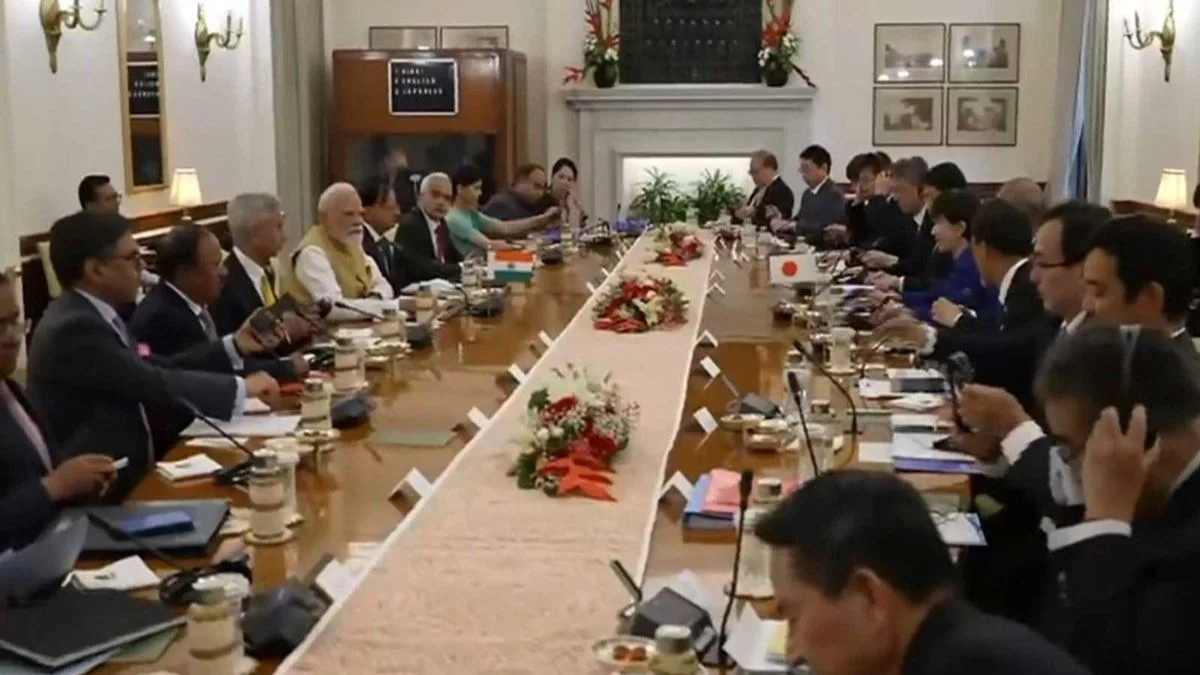
Prime Minister Narendra Modi and his Japanese counterpart Sanae Takaichi on Thursday jointly inaugurated Maruti Suzuki India’s Rs 35,000-crore automobile manufacturing facility at IMT Kharkhoda in Haryana. This action underscored the growing strategic and economic partnership between India and Japan while reinforcing New Delhi’s ambition to position the country as a global manufacturing hub under the “Make in India, Make for the World” initiative.
The facility was inaugurated virtually during the India-Japan Joint Economic Forum held alongside the 16th India-Japan Annual Summit in New Delhi, where the two leaders also unveiled an expansive roadmap to deepen bilateral cooperation in semiconductors, artificial intelligence, advanced manufacturing, clean energy and resilient supply chains.
Spread over 800 acres with an integrated supplier park, the Kharkhoda complex ranks among India’s largest greenfield automobile manufacturing investments. Developed with a planned investment of Rs 35,000 crore, the facility is designed to achieve an annual production capacity of 10 lakh vehicles at full scale, making it one of the world’s largest automobile manufacturing plants.
Advertisement
Commercial production has already begun from two operational units, each capable of producing 2.5 lakh vehicles annually, giving the facility an installed capacity of five lakh vehicles. The plant currently manufactures the Maruti Suzuki Brezza compact SUV and the Victoris mid-size SUV.
Besides significantly expanding Maruti Suzuki’s manufacturing footprint, the project is expected to create over 21,000 direct jobs while generating thousands of additional employment opportunities across the automotive supplier ecosystem, logistics, component manufacturing and allied industries. The expansion forms a key part of the company’s strategy to increase its annual production capacity in India to 40 lakh vehicles and strengthen exports under its global manufacturing programme.
Welcoming the inauguration, Toshihiro Suzuki, Representative Director and President of Suzuki Motor Corporation, described the Kharkhoda project as a landmark achievement in the long-standing partnership between India and Japan.
“It is a great honour for us, as you inaugurate our most advanced car manufacturing facility at Kharkhoda, Haryana. From the current capacity of half a million units, the plant will be further scaled to one million units, making it one of the largest car plants of the world,” Suzuki said.
Highlighting India’s favourable investment climate, he added, “It is a testament to the success of the India-Japan partnership and the Make-in-India initiative. With a favourable policy environment under Prime Minister Modi’s leadership, Suzuki is accelerating investments, employment, exports and technologies towards the Viksit Bharat journey.”
The Kharkhoda facility also showcases Suzuki’s latest manufacturing technologies and sustainability initiatives. Developed under the company’s “Suzuki Smart Factory” concept, it combines advanced digital production systems with environmentally responsible operations.
The plant incorporates Industry 5.0 technologies, including artificial intelligence-powered collaborative robots that work alongside human operators to improve safety, efficiency and manufacturing precision. It is powered entirely by renewable electricity and supported by an on-site solar power installation that will eventually expand to 70 MWp.
The facility also features zero liquid discharge technology to ensure complete recycling of industrial wastewater, while a dedicated in-plant railway siding has been built to facilitate greener transportation of finished vehicles. A biogas plant is scheduled to become operational during the 2026-27 financial year, further reducing the facility’s environmental footprint.
The inauguration marks another milestone in the more than four-decade industrial partnership between India and Japan, with Maruti Suzuki remaining one of the most successful symbols of bilateral economic cooperation. The Kharkhoda plant is the company’s newest manufacturing base after its facilities in Gurugram, Manesar and Gujarat.
Prime Minister Modi had laid the foundation stone for the project in August 2022. Its commissioning comes as India seeks to strengthen its position in global manufacturing amid the realignment of international supply chains and growing demand for diversified production bases.
The project also complements the broader outcomes of the India-Japan Annual Summit, during which the two Prime Ministers pledged to deepen cooperation across strategic sectors, including semiconductors, artificial intelligence, critical minerals, economic security and clean energy. Against this backdrop, the Kharkhoda manufacturing complex stands as both a significant industrial investment and a powerful symbol of the expanding India-Japan partnership, reflecting the two countries’ shared commitment to innovation, sustainable growth and globally competitive manufacturing.