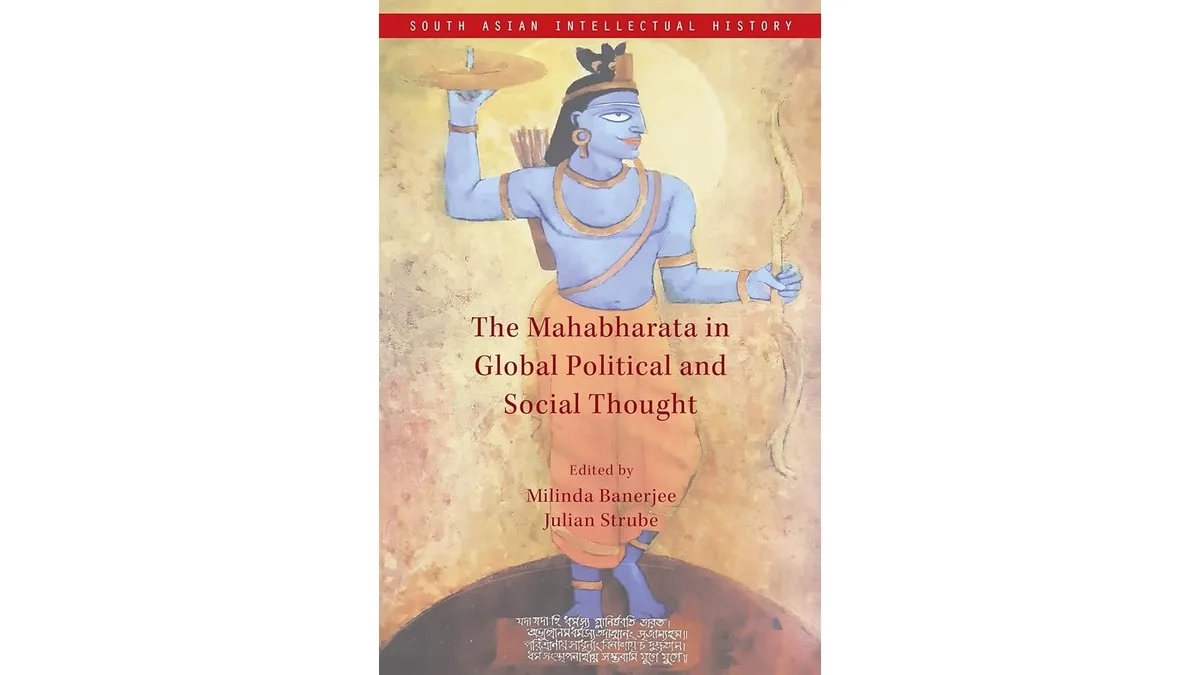
In the vast ocean of scholarly interpretations that exist as far as the Mahabharata is concerned, “The Mahabharata in Global Political and Social Thought” edited by Milinda Banerjee and Julian Strube has arrived like a tsunami of new ideas. The book tries to navigate the depths of the ancient epic using an original nautical chart as it were, where experts engage in discussions about another aspect of the Mahabharata: its role as a sort of lighthouse for nations and societies building social and political systems.
The gist of the collection comprising ten – riveting – essays is spelled out clearly. “(This book) positions the epic as an influential political text and explores its role in shaping the global history of ideas and modern social, political and religious thought across India, Europe, Japan, China, Thailand, Iran and the Arab world. Drawing on the methodologies of global intellectual and religious history, contributing authors to this volume study how kings and peasants, statesmen and revolutionaries, intellectuals and activists have invoked the epic to forge their political visions over the past centuries.” It is therefore essentially a look at how the Mahabharata was dipped into for ideas by both players and peripheral non-players globally – from those exercising power to those leading revolutions for the overthrowing of power to those watching and waiting in the peripheries for their turn at power. The Mahabharata is a veritable global guiding light.
Advertisement
In Milinda Banerjee’s own essay, “The Mahabharata and the Making of Modern India,” he suggests that the epic has “played a central role in the forging of concepts and practices of sovereignty in modern India.” Interestingly, earlier in the book, both a parallel and a distinction is drawn between the Indian Constitution, which primarily has a similar function – that of forging concepts and practices of sovereignty in modern India – and the Mahabharata. It is then argued quite compellingly, that unlike the latter the former has not permeated popular consciousness to that degree.
Banerjee begins by pointing to the sheer degree of interest that the Mughal rulers displayed in translating the epic to their languages and other languages of learning. He writes, “Mughal emperor Akbar (1542-1605) commissioned a Persian translation of the Mahabharata, called the Razmnamah (Book of War). There were earlier precedents of Indo-Muslim rulers and officials commissioning translations of the epic. The fifteenth-century ruler of Kashmir, Zayn al-Abidin, is said to have commissioned a translation in Persian though the text has not survived.” It is to be noted of course that the Mahabharata, originally passed down through oral tradition, was first composed in Sanskrit and then rendered into Indian vernaculars as well as other Asian and European languages.
The present collection however, does not, and this is one of its best facets, limit the discussion to how rajas of India or the rulers of the world looked to the Mahabharata for guidance in power politics. This aspect of the Mahabharata, arguably, has been dealt with exhaustively. This book brings to the table a set of entirely new premises, which, arguably again, has not been delved into previously. The peripheral people, the dalits, the marginalized, not to mention women….the Mahabharata has been both the inspiration for their struggles as well as a mirror of the images of what is ‘ideal’ and what is the anti-thesis. These ideas are intriguingly argued in the chapter “The Production and Deconstruction of the ‘Ideal Indian Woman’ on the Basis of the Mahabharata in the Twentieth and Twenty-First Centuries,” by Melanie J. Muller. Pointing to Draupadi and her various interpretations both as an “ideal” to emulate as well as an “idea” to reject, the writer delineates the Gandhian view. “Gandhi rejected violence as a political strategy for women, and even though Draupadi is one of the most important female characters in the Mahabharata, he only praised her faith but condemned her anger. He wanted to improve the female conditions in society but confined this freedom to the Sati-Savitri-like woman. The idea….that women’s position indicates a society’s advancement echoed with Indian nationalists, and one step on the way to independence was to redefine ‘femininity’ and by this, also Indian tradition. He thought that women and India in general, had abandoned the high qualities of chastity, self-control, sacrifice, and in order to be free and equal, they had to incorporate them again.” This chapter, it is noteworthy, is called, “Gandhi and the Production of the ‘Ideal Indian Woman’”. The author argues that India and India’s leaders and its people, after Independence, were directly looking to the Mahabharata for role models as it began it journey ahead.
A couple of examples from a sea of unique interpretations. Thematically, the essays in this collection reflect a shift away from the traditional global approach of interpreting intellectual ideas through western lenses and perspectives. This is the present anthology’s most unique characteristic.
Milinda Banerjee is a lecturer in the history of modern political thought and political theory at the University of St. Andrews, Scotland. Julian Strube is a professor of religious studies at the University of Gottingen. Edited by the experts in their fields and published by Cambridge University Press, this is one tome that should make it to any bucket list of “Things to read.” We carried it in The Statesman’s “Recommended Reading” column earlier.
The reviewer is Editor, Features